Department of Health and Human Services
Centers for Medicare & Medicaid Services
- 42 CFR Part 513
- [CMS-5545-F]
- RIN 0938-AV66
AGENCY:
Centers for Medicare & Medicaid Services (CMS), Department of Health and Human Services (HHS).
ACTION:
Final rule.
SUMMARY:
This final rule implements the Global Benchmark for Efficient Drug Pricing Model (GLOBE Model), a new mandatory Medicare payment model under section 1115A of the Social Security Act. The GLOBE Model will test whether a payment model that uses an alternative method for calculating Medicare Part B drug inflation rebate amounts for certain separately payable Medicare Part B drugs and biological products reduces costs for Original Medicare (OM) beneficiaries and the Medicare program while preserving quality of care. The term OM has the same meaning as Medicare fee-for-service and the traditional Medicare program.
DATES:
These regulations are effective on November 30, 2026.
FOR FURTHER INFORMATION CONTACT:
Nicholas Minter, (410) 786-8914 or GLOBEmodel@cms.hhs.gov.
SUPPLEMENTARY INFORMATION:
I. Executive Summary and Background
A. Background Overview
The high cost of healthcare continues to impact many Americans' lives. According to the West Health-Gallup Affordability Index, only 61 percent of adults over age 65 in the United States (U.S.) are considered “Cost Secure,” where a person has “access to quality, affordable care and ha[s] been able to pay for visits and prescriptions in recent months.” [1] Simultaneously, health insurance costs continue increasing. Challenges related to the affordability of prescription drugs adversely affect taxpayers by diverting funds that could be used to improve health.
Medicare Part B funding comes from two sources: beneficiary premiums and general Federal revenues. Total Medicare Part B beneficiary premium amounts increased by $39 billion, or 53 percent, from 2016 to 2021.[2] While this increase may be due to the total number of Medicare beneficiaries increasing from 52 million to 58 million in that period, the premium amount per enrollee also increased from $1,423 in 2016 to $1,942 in 2021.[3] Concurrently, the annual Federal revenue contribution has also increased from $235.6 billion in 2016 to $386.0 billion in 2024, illustrating increased burdens across all financing mechanisms in Medicare Part B.[4]
Increasingly high drug costs limit access to care and treatment which in turn results in complications that can lead to worse health outcomes and premature death. This results in increased medical spending to treat patients' conditions and potentially avoidable expenditures for all payers, including CMS.[5 6] Results from recent surveys revealed that many Americans, including Medicare beneficiaries, face significant financial burden of care that results in skipping or rationing medication due to cost.[7] A survey conducted in June 2025 showed that one quarter of adults reported not filling their prescription in 2024 because of cost; among those who had taken a prescription, one in three stated they did not fill at least one prescription because of the cost.[8] Financial toxicity, or the negative impact that the monetary burden of medical care can have on patients' well-being, fiscal security, and overall health,[9] can be most pronounced among the elderly population and among patients with low income and for whom the cost of treatment can be high. One in four adults taking prescriptions report difficulty affording their medication, including 40 percent of those with household income of less than $40,000 per year.[10] A separately conducted survey concluded that about 4 in 10 older adults with Medicare reported problems accessing healthcare because of its costs, and that 14 percent of Medicare beneficiaries stated they skipped taking or sometimes did not even fill their prescription because of the expense.11 12 Studies show that Medicare patients with cancer and certain chronic conditions are more likely to report cost-related medication non-adherence (that is, not taking medications as prescribed or indicated by a physician due to cost).13 14 15 One study has theorized Medicare beneficiaries without supplemental insurance are limited in accessing ( printed page 62937) immune checkpoint inhibitors (ICIs) due to the high cost of coinsurance.[16]
Studies have also shown that the impact on access to care due to costs can be significant. A literature review concluded that annual costs of medication non-adherence are up to $290 billion, finding that 10 percent of hospitalizations in adults are attributed to medication non-adherence, with the typical non-adherent patient requiring three extra visits per year leading to $2,000 in increased treatment costs per year.[17] This paper also found that cancer patients experience more than double the cost variation compared to other disease groups. Further, a 2020 report estimated that up to 112,000 seniors could die prematurely because drug prices are so high that they cannot afford their medication, and that Medicare could be spending $17.7 billion annually on avoidable medical spending because of complications associated with cost-related medication non-adherence.[18] Similarly, research has also found an increased risk of mortality among patients with certain types of cancer who filed for bankruptcy, compared with those who did not file.[19]
Research conducted by the Assistant Secretary for Planning and Evaluation (ASPE) and the RAND Corporation reveals a substantial and growing disparity between U.S. prescription drug prices and those of peer nations across the Organisation for Economic Co-operation and Development (OECD). An ASPE-funded study originally published in July 2022—using 2018 pricing data—found that U.S. drug prices with available pricing information exceeded the combined average of non-U.S. OECD countries by 256 percent.[20] A subsequent 2024 update incorporating 2022 pricing data demonstrated that this gap had widened further to 278 percent.[21] The disparity is most pronounced for originator (brand-name) drugs, where U.S. prices surpass the non-U.S. OECD average by 422 percent, with G7 country comparisons ranging from 324 percent above Canada to 464 percent above Japan.[22] A separate ASPE analysis focused on the top 50 Medicare Part B drugs—which collectively accounted for 80 percent of total 2018 Medicare Part B drug expenditures—found that U.S. prices were, on average, 211 percent higher than those in comparable OECD nations, with G7 country differentials ranging from 148 percent above Japan to 225 percent above France.[23]
B. Purpose
Prices for prescription drugs in the U.S.—including drugs covered under Medicare Part B—remain high, contributing to increased program expenditures. To address this challenge, this final rule implements a new mandatory payment model: the Global Benchmark for Efficient Drug Pricing (GLOBE) Model. The GLOBE Model is established under section 1115A of the Social Security Act (the Act), which authorizes CMS's Center for Medicare and Medicaid Innovation (hereinafter, “the CMS Innovation Center”) to test innovative payment and service delivery models to evaluate whether they reduce Medicare, Medicaid, and Children's Health Insurance Program (CHIP) expenditures while preserving or enhancing the quality of care for beneficiaries of such programs. The Inflation Reduction Act of 2022 (Pub. L. 117-169, enacted August 16, 2022) (IRA) established the Medicare Part B Drug Inflation Rebate Program, which requires drug manufacturers to pay a rebate when they raise prices for certain drugs faster than the rate of inflation. CMS calculates and invoices these rebates, which are deposited into the Medicare Prescription Drug Account within the Federal Supplementary Medical Insurance Trust Fund. Building on this framework, the CMS Innovation Center is finalizing the GLOBE Model to test an alternative approach to calculating Medicare Part B drug inflation rebates for certain Part B drugs and biological products. The model's purpose is to evaluate whether this alternative approach will reduce program expenditures while maintaining or enhancing quality of care for beneficiaries. The GLOBE Model will begin on January 1, 2027 with the collection of voluntary manufacturer-submitted international drug net pricing data, and will be tested over 5 performance years, running from April 1, 2027 through March 31, 2032. The associated payment period will run from April 1, 2027 through March 31, 2034.
 Pub. L. 117-169
C. Summary of Major Provisions
The GLOBE Model will test changes to the Medicare Part B Drug Inflation Rebate Program, specifically testing whether an alternative calculation for the Medicare Part B drug inflation rebate for certain drugs and biological products will reduce program spending for Medicare and taxpayers while preserving or enhancing the quality of care furnished to Medicare beneficiaries. We are finalizing the GLOBE Model to include the following major provisions.
1. Model Performance and Test Period
The GLOBE Model will begin on January 1, 2027, with the collection of voluntary manufacturer-submitted international drug net pricing data. The model will include 5 performance years, which will begin on April 1, 2027 and will end on March 31, 2032, during which the GLOBE Model beneficiary coinsurance and adjusted payments to providers and suppliers would apply and monitoring activities will occur. The model will also include a 7-year payment period, which will begin on April 1, 2027 and will end on March 31, 2034, during which CMS will calculate, invoice, collect, and reconcile the GLOBE Model rebates for a performance year. The model evaluation will reflect the entire GLOBE Model test period—which includes the voluntary manufacturer submission period and the 7-year payment period.
2. GLOBE Model Drugs
The GLOBE Model will focus on a set of Part B rebatable drugs that are single source drugs and sole source biological products and that are furnished to a cohort of beneficiaries in the OM program. The set of included drugs, as described in section II.B. of this final ( printed page 62938) rule, will include certain Part B rebatable drugs as identified in 42 Code of Federal Regulations (CFR) 427.101 for the purpose of the Medicare Part B Drug Inflation Rebate Program and that meet the definition of GLOBE Model drugs in § 513.130. Specifically, the GLOBE Model will include a subset of Part B rebatable drugs that have the following United States Pharmacopeia (USP) Drug Classification (DC) categories: Antigout Agents, Antineoplastics, Blood Products and Modifiers, Central Nervous System Agents, Immunological Agents, Metabolic Bone Disease Agents, and Ophthalmic Agents. These drugs must have a Healthcare Common Procedure Coding System (HCPCS) Level II code with OM Part B spending greater than $100 million over a 12-month period ending 6 months prior to the start of the applicable calendar quarter (as further specified in § 513.130(b)(3) and § 513.130(d)) and must not be excluded from the GLOBE Model as set forth in § 513.130(c).
The following drugs and biological products are excluded from the GLOBE Model as set forth in § 513.130(c): (1) a Part B rebatable drug for applicable calendar quarters prior to the first applicable calendar quarter for which CMS identifies a specified amount under 42 CFR 427.302(b); (2) a Part B rebatable drug for which a maximum fair price under the Medicare Drug Price Negotiation Program is in effect; (3) a drug or biological product which is no longer a Part B rebatable drug; (4) a Part B rebatable drug that is designated as a drug for one or more rare diseases or conditions under section 526 of the Federal Food, Drug, and Cosmetic Act (21 U.S.C. 360bb) and for which the only approved indication (or indications) is for one or more such rare disease or conditions; (5) a Part B rebatable drug that is a product listed on the FDA Approved Cellular and Gene Therapy Products website; and (6) a Part B rebatable drug that is a plasma-derived product as set forth in 42 CFR 427.400. Items (4), (5), and (6) were added to § 513.130(c) in response to public comments received during the comment period for the GLOBE Model proposed rule (90 FR 60244 through 60336). Drug selection (and removal, if applicable) for the model test will be determined by CMS based on the eligibility criteria and will not be subject to appeal, pursuant to section 1115A(d)(2) of the Act.
 42 CFR 427.302(b)
3. Defined Population and Intervention
The model cohort, as described in section II.C of this final rule, will be identified by CMS from approximately 25 percent of beneficiaries who are enrolled in OM Part B, have OM Part B as their primary payer (as defined by a beneficiary being enrolled in OM), and are not enrolled in a Medicare Advantage (MA) plan, section 1876 cost plan,[24] or section 1833 healthcare prepayment plan.[25] Beneficiaries must not have other group health coverage that is a primary payer (such as employer-sponsored health insurance). The GLOBE Model geographic areas will be determined through a random selection of ZIP Code Tabulation Areas (ZCTAs). Prior to the model performance period, and no more frequently than monthly thereafter, CMS will identify beneficiaries for inclusion in the model cohort by determining whether the beneficiary's address of record falls within the GLOBE Model geographic areas. To be eligible for inclusion in the model cohort, a beneficiary must not be identified by CMS for inclusion in the comparison group and must otherwise meet the eligibility criteria for inclusion. Medicare beneficiaries who are in the model cohort, or “GLOBE Model beneficiaries,” will not be model participants [26] but will benefit from reduced coinsurance, as applicable, when they receive a separately payable GLOBE Model drug as described in section II.G.7. of this final rule. When a GLOBE Model beneficiary receives a GLOBE Model drug on a date of service where they are identified as a GLOBE Model beneficiary, separately payable claim lines for that GLOBE Model drug will be eligible for GLOBE Model reduced coinsurance and included in the calculation of GLOBE Model billing units, as applicable, as described in section II.G.4. of this final rule. To identify the GLOBE Model beneficiary coinsurance amount for GLOBE Model drugs and ensure that beneficiary financial liability for coinsurance amounts for GLOBE Model drugs under the GLOBE Model would not be more than it would be absent the model test, CMS will compare the per unit GLOBE Model benchmark amount as set forth in § 513.400(c)(4) to the applicable inflation-adjusted payment amount as determined under 42 CFR 427.302(g) and the lesser of those amounts would be used in the computation of the GLOBE Model beneficiary coinsurance percentage. Beneficiary selection for the model cohort and comparison group (and removal, if applicable) will be solely determined by CMS and will not be subject to appeal pursuant to section 1115A(d)(2) of the Act. Providers and suppliers who furnish GLOBE Model drugs to GLOBE Model beneficiaries who are in the model cohort will not be model participants and will continue to buy and bill for GLOBE Model drugs as usual and receive separate payment under Medicare Part B (if applicable). These providers and suppliers include, but may not be limited to, hospital outpatient departments, physician practices, ambulatory surgical centers, pharmacies enrolled as durable medical equipment (DME) suppliers, and other pharmacies (in certain situations). When the reduced beneficiary coinsurance applies to units of GLOBE Model drugs furnished to a GLOBE Model beneficiary, the provider or supplier will reduce the amount of coinsurance charged to the beneficiary and the portion of the Medicare Part B allowed amount that will be payable by Medicare Part B will be adjusted upwards, as applicable. For example, if the Medicare Part B allowed amount for a GLOBE Model drug under the GLOBE Model is $100 and the GLOBE Model beneficiary coinsurance percentage is reduced to 10 percent (instead of the usual 20 percent), the Medicare Part B program payment to the provider or supplier will be adjusted upward and will be $90 (instead of the usual $80) and the beneficiary coinsurance financial responsibility will be $10 (instead of the usual $20).
4. Manufacturer Participation
The GLOBE Model will require mandatory participation for all manufacturers (as defined in 42 CFR 427.20) of Part B rebatable drugs that are GLOBE Model drugs. When Part B rebatable drugs subject to the GLOBE Model are furnished to OM beneficiaries who are in the model cohort, manufacturers that are GLOBE Model participants will pay GLOBE Model rebates to the Medicare Part B account in the Federal Supplementary Medical Insurance Trust Fund if the amount specified in section 1847A(i)(3)(A)(ii)(I) of the Act for the GLOBE Model drug exceeds a benchmark amount that will be based on available international drug pricing information (as described in section II.G. of this final rule). This amount will not be less than any rebates owed under the Medicare Part B Drug Inflation Rebate Program and will be invoiced using an incremental approach (as described in section II.G.8. of this final rule). The GLOBE Model rebate amount will only apply to certain units of the GLOBE Model drugs (as specified in § 513.520) and will be solely ( printed page 62939) determined by CMS and will not be subject to appeal, pursuant to section 1115A(d)(2) of the Act. Manufacturers may submit a Suggestion of Error (SOE) if they believe that a mathematical error exists and requires a correction.
5. Model Alternative Rebate Amount Calculation and Rebate Payment
As described in section II.G.2. of this final rule, the GLOBE Model will incorporate two approaches for establishing a benchmark amount for the alternative rebate amount calculation, each using differently sourced international drug pricing information and distinct calculation methodologies. The model evaluation will assess the impact of testing these two approaches. The first approach, Method I, as described in section II.G.2.a. of this final rule, will use existing, commercially available international drug pricing information to establish a benchmark based on an estimate of the lowest country-level price among the set of reference countries, as set forth in § 513.310, at a baseline. This pricing data may represent drug-specific sales data, list prices, ex-manufacturer prices, retail prices, other prices, or a combination of such pricing information, as available to CMS in commercially available data sources.
The second approach, Method II, as described in section II.G.2.b. of this final rule, will use voluntary manufacturer-submitted international drug net pricing data to establish a benchmark based on an average international price among the set of countries. This benchmark will reflect net prices realized by a manufacturer. Manufacturer submission of international drug net pricing data is discussed in section II.G.6. of this final rule.
CMS is finalizing that the set of reference countries for Method I and Method II benchmarks, as set forth in § 513.310(b), will include Australia, Austria, Belgium, Canada, Czech Republic, Denmark, France, Germany, Ireland, Israel, Italy, Japan, Netherlands, Norway, South Korea, Spain, Sweden, Switzerland, and the United Kingdom.
The GLOBE Model is designed to capture all applicable billing units for separately payable OM Part B claims for GLOBE Model drugs that are: (1) furnished to OM Part B beneficiaries in the model cohort on the date of service; (2) paid under the GLOBE Model for dates of service during a performance year; and (3) could be subject to the GLOBE Model beneficiary coinsurance and adjusted payments to providers and suppliers. For purposes of calculating the total and incremental GLOBE Model rebate amount for a GLOBE Model drug that a manufacturer would owe, CMS will identify applicable billing units several months after the end of a calendar quarter, as described in section II.G. of this final rule. Additional time is required for the calculation of these rebate amounts and the preparation of invoices. As a result, GLOBE Model operational processes—including claims processing, data collection, invoicing, payment of GLOBE Model rebates, and reconciliation—will occur concurrently with, and continue after the end of each performance year, including after the conclusion of the last performance year. In addition, CMS will use an incremental invoicing approach for these GLOBE Model operational processes which is described in section II.G.8. of this final rule.
6. Model Waivers
CMS has determined that it will be necessary to waive certain requirements of title XVIII of the Act and related program requirements codified in regulations, solely for purposes of carrying out the testing of the GLOBE Model, as described in 1115A(b) of the Act. Specifically, as further described in section II.O. of this final rule, pursuant to the CMS Innovation Center's waiver authority under section 1115A(d)(1) of the Act, CMS will waive provisions of sections 1847A(i), 1833(a), and 1833(t) of the Act, as well as associated regulatory provisions at 42 CFR 410.152(m), 419.41(e), 489.30(b)(1), and 489.30(b)(6), to the extent necessary to permit the testing of an alternative rebate amount calculation for certain units of GLOBE Model drugs, the collection of GLOBE Model rebate amounts, GLOBE Model reduced coinsurance, and adjusted Medicare payment.
In this final rule, CMS is codifying the requirements of the GLOBE Model at 42 CFR part 513. Section 513.1(d) provides that should any provision of part 513 be held invalid or unenforceable—whether by its terms, or as applied to any person or circumstance—such provision will be severable from the remainder of part 513, and the invalidity or unenforceability of that provision will not affect the remainder of the provisions of part 513.
7. Enforcement of Manufacturer Payment of Rebate
Consistent with the enforcement framework of the Medicare Part B Drug Inflation Rebate Program, manufacturers of a GLOBE Model drug that have failed to timely pay the incremental GLOBE Model rebate amount may be subject to a civil money penalty (CMP). Further details on the enforcement of manufacturer payment of rebates are provided in section II.H. of this final rule.
8. Quality and Monitoring Strategy
CMS has finalized a quality and monitoring strategy for the GLOBE Model. CMS will monitor and evaluate whether the alternative Medicare Part B drug inflation rebate calculation under the GLOBE Model reduces Medicare spending while preserving or enhancing the quality of care for beneficiaries. Consistent with section 1115A(b)(4) of the Act, CMS will conduct ongoing monitoring and evaluation activities throughout the model performance period to identify potential changes in beneficiary access to GLOBE Model drugs, utilization and prescribing patterns, beneficiary out-of-pocket costs, continuity and site of care, downstream healthcare utilization, drug availability and distribution patterns, and other unintended consequences. CMS will rely primarily on claims-based measures and existing data sources and may use targeted, voluntary surveys or other supplemental data collection, as appropriate, while seeking to minimize additional burden. Further details on the GLOBE Model quality, monitoring, and evaluation strategy are provided in sections II.J., II.L., and II.P. of this final rule.
9. Beneficiary Protections
CMS has finalized beneficiary protections activities for the GLOBE Model. CMS will not require direct beneficiary notification or establish a beneficiary opt-out because inclusion in the model does not require beneficiaries to enroll or take any action and does not change Medicare coverage or provider choice. CMS will coordinate, to the extent feasible, with 1-800-MEDICARE, the Medicare Ombudsman, and the CMS Office of Program Operations and Local Engagement (OPOLE) and will make a GLOBE Model helpdesk available so beneficiaries, providers, and other stakeholders can report model-related concerns. CMS will post accessible technical documentation, user-friendly fact sheets, FAQs, the GLOBE Model Drug HCPCS Level II Code List, and the model geographic areas on the GLOBE Model website to support beneficiary and provider awareness. Further details on beneficiary protections are provided in section II.K. of this final rule.
10. Interaction and Coordination With Other Models and Programs
CMS reviewed potential interactions between the GLOBE Model and other models and programs to ensure that the ( printed page 62940) evaluation of model impact is not compromised by issues of model overlap. The GLOBE Model has been designed to function alongside and in addition to the Medicare Part B Drug Inflation Rebate Program. Further details on CMS's approach to overlap of the GLOBE Model with other CMS Innovation Center Models and interaction with other Federal programs are provided in sections II.M. and II.N. of this final rule, respectively. Existing CMS Innovation Center Models may utilize waiver authority to waive the requirement of mandatory participation of manufacturers of GLOBE Model drugs is further discussed in section II.M. of this final rule.
11. Evaluation Methods
The GLOBE Model evaluation will employ a design to provide evidence that the proposed intervention would reduce Medicare expenditures and would preserve or enhance the quality of care for Medicare beneficiaries. The evaluation would include the collection of representative information from manufacturers of GLOBE Model drugs, drug purchasers, providers, and beneficiaries. The collection and analysis of these data would inform how the GLOBE Model might function if it were certified and expanded nationally. Consistent with the purpose of section 1115A of the Act, the collection and analysis of these data would also generate evidence on the effects of an international benchmark-based rebate methodology on Medicare expenditures, and quality of care that could inform future legislative action relating to such policies. Further details on the evaluation methodology, including data collection methods, key evaluation research questions, and the evaluation period and anticipated reports, are provided in section II.P. of this final rule.
D. Summary of Costs and Benefits
In section IV. of this final rule, we set forth a detailed analysis of the regulatory and Federalism impacts that the GLOBE Model may have on affected entities and beneficiaries. Tables 13, 14, and 15 in section IV.D. of this final rule display the estimated overall impact of the GLOBE Model on the Medicare and Medicaid programs.
We estimate that the GLOBE Model will result in overall savings of $440 million [27] in Medicare Part B net spending during the 7-year payment period, inclusive of $298 million in OM Part B benefit savings, $288 million in MA payment savings, and $147 million in premium offset impacts. In this estimate, we assume manufacturer behavioral changes and beneficiary utilization changes, as described in section IV. of this final rule. We estimate savings for the MA program of $288 million due to the way CMS calculates MA rates based on OM claims, which will include claims paid under the GLOBE Model beginning with rate setting for 2028. We also estimate savings for the Medicaid program of $39 million, of which roughly $17 million will be Federal premium savings, $6 million will be Federal cost sharing savings, $10 million will be state premium savings, and $5 million will be state cost sharing savings.[28] When annualized over the 7-year payment period, we estimate that the GLOBE Model will result in overall cost savings in Medicare Part B net spending of approximately $80 million at either the 3 percent or 7 percent rates of discount.
E. Background
The pace of growth in drug prices varies across disease categories. A report by the Healthcare Distribution Alliance (HDA) Research Foundation, showed that drugs classified in immunology, oncology, rheumatology, endocrinology and ophthalmology are among the top 20 therapeutic classes based on spending or prescriptions volume in the U.S. and that most of these categories have shown notable growth between 2023 and 2024.[29] This trend is also observed in Part B rebatable drugs, where these five therapeutic classes represent at least $42 billion (or 60 percent) in OM Part B drug allowed charges in 2024.[30 31]
To discourage drug manufacturers from increasing drug prices faster than the rate of inflation and to improve access to affordable treatments for Medicare beneficiaries, the IRA created the Medicare Part B Drug Inflation Rebate Program. If drug manufacturers raise prices for certain drugs faster than the rate of inflation for a calendar quarter beginning with the first quarter of 2023, manufacturers must pay a rebate to the Medicare Part B account in the Federal Supplementary Medical Insurance Trust Fund and Medicare lowers beneficiary coinsurance amounts for applicable drugs accordingly.
OM Part B drug spending [32] has also grown by 85.8 percent ($18.7 billion) [33] from 2014 to 2021 with the standard monthly Medicare Part B premium for beneficiaries increasing by 41.5 percent ($104.90 [34] to $148.50 [35] ). Based on the increasing OM Part B and beneficiary drug spending, we proposed, and are finalizing, to test a model to reduce OM Part B drug spending and beneficiary coinsurance amounts using international drug pricing information as a benchmark for an alternative Medicare Part B inflation rebate amount calculation for certain single source drugs and sole source biological products while preserving or enhancing quality of care.
1. Medicare Part B Drug Benefit
a. Medicare Payment for Separately Payable Under Medicare Part B Drugs
The majority of drugs covered under Medicare Part B generally fall into three categories: drugs furnished incident to physicians' service which are not usually self-administered by the patient (section 1861(s)(2)(A) and (B) of the Act); drugs administered via a covered item of DME (section 1861(s)(6) of the Act); and drugs specified by statute (for example, vaccines (section 1861(s)(10)(A) and (B) of the Act), oral cancer drugs (section 1861(s)(2)(Q) of the Act), oral antiemetics (section 1861(s)(2)(T) of the Act), and immunosuppressive therapy (section 1861(s)(2)(J) of the Act)).
Many drugs payable under Medicare Part B are administered via injection or infusion in a physician office, a hospital outpatient department, and certain other outpatient settings, such as ambulatory ( printed page 62941) surgery centers. When Medicare allows separate payment for these drugs, the payment limit is typically based on the methodology described in section 1847A of the Act, with certain exceptions, such as the methodology described in section 1833(t)(14)(A)(iii) of the Act. Payment for these drugs does not include payment for administration. Payment for drug administration services is made in accordance with the applicable payment policy for the setting in which the drug was furnished, such as the Physician Fee Schedule, the Hospital Outpatient Prospective Payment System, or the Ambulatory Surgical Center Payment System. Medicare Part B also allows separate payment for drugs in less common situations such as osteoporosis drugs furnished by a home health agency, and when a beneficiary does not have benefits available under the Medicare Part A program.
The payment methodology described in section 1847A of the Act is generally based on the volume-weighted average sales price (ASP) for all National Drug Codes (NDCs) that are assigned to a HCPCS Level II code for the drug plus an add-on percentage. For most HCPCS Level II codes, the add-on percentage is 6 percent except during the initial sales period when ASP is not yet available, for certain qualifying biosimilar biological products, and in certain circumstances specified within section 1847A(d)(3)(C) of the Act. When ASP is not yet available and the wholesale acquisition cost (WAC) is used, the add-on is 3 percent. Section 11403 of the IRA requires a temporary, 5-year increase for qualifying biosimilar biological products (as defined in section 1847A(b)(8)(B)(iii) of the Act) that have an ASP less than the ASP of the reference biological product. In these cases, the add-on is 8 percent of the reference biological product's ASP. Following the applicable five-year period (as described in section 1847A(b)(8)(B)(ii) of the Act) for these qualifying biosimilar biological products, the add-on percentage reverts back to 6 percent of the reference biological product's ASP.
The volume-weighted payment limit for a HCPCS Level II code is calculated quarterly by CMS using manufacturer-submitted ASP data on sales to all purchasers (with limited exceptions as articulated in section 1847A(c)(2) of the Act,[36] such as sales at nominal charge and sales exempt from Medicaid best price) [37] with manufacturer rebates, discounts, and price concessions included in the ASP calculation (that is, the sales price is net of these rebates, discounts, and price concessions). As a general matter, the ASP-based payment limit that Medicare pays for a separately payable OM Part B drug claim does not vary based on the exact price an individual provider or supplier pays to acquire the drug. This payment methodology may create an incentive for the use of more expensive drugs. Although the statute does not specifically state what the add-on represents, as noted in a MedPAC report,[38] it may be needed to account for handling and overhead costs and additional mark-up in U.S. distribution channels that are not captured in the manufacturer-reported ASP.
Currently, under Medicare Part B, beneficiary cost-sharing [39] is generally 20 percent of the Medicare-allowed amount. The term “Medicare-allowed amount” means the maximum amount that a provider or supplier will be paid for a covered health care service or drug. However, for items and services paid under the OPPS, beneficiaries are only financially responsible for a copayment amount up to the amount of the inpatient hospital deductible.[40] Medicare pays for the remaining portion of the Medicare allowed amount.[41]
b. Medicare Part B Drug Inflation Rebate Program
Section 11101 of the IRA established requirements under which drug manufacturers must pay Medicare Part B inflation rebate amounts if they raise their prices for certain drugs payable under Medicare Part B faster than the rate of inflation. Specifically, section 11101 of the IRA amended section 1847A of the Act by adding new subsection (i) which establishes a requirement for drug manufacturers to pay rebates into the Medicare Part B account in the Federal Supplementary Medical Insurance Trust Fund for Part B rebatable drugs for each calendar quarter beginning on or after January 1, 2023, if the amount specified, as determined under section 1847A(i)(3)(A)(ii) of the Act, exceeds the inflation-adjusted payment amount, which is calculated as set forth in section 1847A(i)(3)(C) of the Act. The IRA also provides for an adjustment to the beneficiary coinsurance amount in cases where the price of a Part B rebatable drug increases faster than the rate of inflation such that the beneficiary coinsurance is calculated based on the lower inflation-adjusted payment amount instead of the applicable payment amount, resulting in a coinsurance percentage that is equal to 20 percent of the inflation-adjusted payment amount as described in section 1847A(i)(3)(C) of the Act for a calendar quarter. Section 1847A(i)(2) of the Act defines a “Part B rebatable drug,” in part, as a single source drug or biological product (as defined in section 1847A(c)(6)(D) of the Act), including a biosimilar biological product (as defined in section 1847A(c)(6)(H) of the Act), for which payment is made under Medicare Part B. Certain product categories are excluded from the definition of a Part B rebatable drug pursuant to 42 CFR 427.101(b). Currently excluded product categories, which may change pursuant to changes in CFR 427.101,[42] include: (1) qualifying biosimilar biological products; [43] (2) products with historically excepted grouped billing and payment codes; (3) products billed under a “not otherwise classified” (NOC) code; (4) radiopharmaceutical drugs and biological products; (5) skin substitutes; (6) drugs with average total allowed charges per year per individual under the applicable threshold; (7) certain vaccines and other products; [44] and (8) generic drugs.[45] The applicable threshold specified in section 1847A(i)(2) of the Act was equal to $100 for applicable calendar quarters in 2023. Thereafter, CMS calculates the applicable threshold as equal to the ( printed page 62942) unrounded applicable threshold calculated for the prior calendar year increased by the percentage increase in the consumer price index for all urban customers (CPI-U) for the 12-month period ending with June of the previous year, rounded to the nearest multiple of $10.[46]
For each calendar quarter beginning on or after January 1, 2023, the manufacturer of a Part B rebatable drug is required, for such drug, not later than 30 days after date of receipt (as defined in 42 CFR 427.505) of the Rebate Report from CMS, to pay a rebate into the Medicare Part B account in the Federal Supplementary Medical Insurance Trust Fund if the amount specified in section 1847A(i)(3)(A)(ii) of the Act exceeds the inflation-adjusted payment amount (calculated as set forth in section 1847A(i)(3)(C) of the Act) for an applicable calendar quarter. With respect to invoicing manufacturers for the rebate amount owed, under section 1847A(i)(1) of the Act, CMS must report rebate amounts to each manufacturer of a Part B rebatable drug no later than 6 months after the end of each calendar quarter, except that for calendar quarters beginning in 2023 and 2024, CMS had until September 30, 2025, to invoice manufacturers for rebates. To implement section 11101 of the IRA, in the CY 2025 PFS final rule (89 FR 98228 through 98313) [47] CMS codified these requirements and established other policies at 42 CFR part 427. In the CY 2026 PFS final rule (90 FR 49733 through 49739),[48] CMS adopted certain limited modifications to the policies for the Medicare Part B Drug Inflation Rebate Program set forth in part 427 under title 42, chapter IV of the CFR for Part B. For example, 42 CFR 427.302(c)(5) described how CMS identifies the payment amount benchmark quarter in certain instances and the calculation for the Medicare Part B drug inflation rebate amount in such instances. In the CY 2027 PFS proposed rule (91 FR 43842 through 44557),[49] CMS proposed additional limited modifications to the policies for the Medicare Part B Drug Inflation Rebate Program, including the treatment of skin substitutes approved as a drug or biological product under section 351 of the PHS Act as rebatable products, and identification of the CPI-U in the event CPI-U data are unavailable.
c. Medicare Drug Price Negotiation Program
Sections 11001 and 11002 of IRA establish the Medicare Drug Price Negotiation Program (hereinafter the “Negotiation Program”) to negotiate maximum fair prices (MFPs) [50] for certain high expenditure, single source drugs and biological products. The requirements for this program are described in sections 1191 through 1198 of the Act, as added by sections 11001 and 11002 of the IRA. Additionally, on July 4, 2025, the Working Families Tax Cuts Act (Pub. L. 119-21) was signed into law. Section 71203 of the Working Families Tax Cuts Act expanded protections for certain orphan drugs in section 1192(e) of the Act. Drugs payable under Medicare Part B are eligible to be selected for negotiation or renegotiation beginning with initial price applicability year 2028.
2. Medicare and Beneficiary Spending
a. Historical Trending
An issue brief from ASPE evaluated Medicare Part B total spending and OM drug allowed charges from 2014 to 2021.[51] OM Part B drug allowed charges increased from $21.8 billion in 2014 to $40.5 billion in 2021, an increase of $18.7 billion. While total spending and drug allowed charges have both increased significantly, OM Part B drug allowed charges have seen higher spending growth. In 2014, OM Part B drug allowed charges represented about 12.1 percent of OM Part B spending but grew to 20 percent in 2021.[52]
The same report also found that between 2014 and 2021, OM Part B drug spending per enrollee grew on “average at 9.2 percent annually,” more than three times the rate of Medicare Part D (2.6 percent) and nearly four times as high as the rate of per capita annual prescription drug spending (2.4 percent). OM Part B drug spending was also concentrated among a few drugs where the top 20 drugs accounted for greater than 50 percent of drug spending in 2021 and the top 10 drugs accounted for 40 percent of drug spending in the same period. When comparing biological products to non-biological products, biological products accounted for 89 percent of the OM Part B drug spending growth between 2008 and 2021 and 79 percent of OM Part B drug spending in 2021. When reviewing OM Part B spending on multi-source drugs and biological products in 2021, generic drugs [53] accounted for only 2 percent of spending, and only 3 of the top 20 drugs by spend [54] (all biological products) were multi-source. Therefore, the majority of OM Part B drug expenditures in 2021 were attributable to single source drugs and sole source biological products.
An ASPE report evaluating OM Part B spending from 2018 to 2023 estimated biosimilar biological product competition (multi-source biological products) reduced spending by $12.9 billion, a 31 percent decrease compared to projected spending if only the reference biological product existed.[55] Savings after biosimilar biological product competition entered the market were driven by a mix of beneficiary switches to a lower-priced biosimilar biological product and price reductions in the reference biological products.
It is also important to note that the number of enrollees for OM Part B has decreased (8.8 percent) between 2016 to ( printed page 62943) 2021 (34 million to 31 million),[56] while OM Part B drug allowed charges has increased (47 percent) for the same time period.[57] Therefore, this increase in OM Part B spending for drugs during this period is likely explained more by increases in the prices of drugs, introduction of new drugs,[58] changes in utilization of drugs, and changes in the mix of drugs for those beneficiaries who received them more so than the changes in Medicare Part B enrollment.[59]
b. Impact on Premiums, Beneficiaries, and Taxpayers
Medicare Part B is funded by premiums paid by beneficiaries and general Federal revenues. Total Medicare Part B Premium amounts increased from $74 billion in 2016 to $113 billion in 2021, representing an increase of $39 billion.[60] While this increase in total Medicare Part B premiums is partially attributable to the increase in all Medicare beneficiaries from 52 million to 58 million,[61] there was also a rise in premium amount per enrollee from $1,423 in 2016 to $1,942 in 2021. A research study found the 2024 Medicare Part B premiums accounted for more than 10 percent of annual per capita income for 12 percent of Medicare Part B beneficiaries—approximately 7.4 million of the 61 million Medicare Part B beneficiaries in OM and MA.[62] The rise in premiums is partly due to projected costs for new drugs, price changes for health care services, new technologies, and assumed utilization increases.[63 64 65]
In addition to a monthly premium, OM Part B beneficiaries typically need to cover 20 percent of the cost of a Medicare Part B drug once their Medicare Part B deductible is met. OM Part B does not have an out-of-pocket maximum, whereas other forms of coverage such as MA plans and Medigap policies may have a maximum. While the IRA has reduced beneficiary coinsurance for certain Medicare Part B drugs whose prices have risen faster than inflation, beneficiaries may continue to experience significant cost sharing as overall OM Part B spending has increased. As previously discussed, this increase is likely driven by high overall prices and the introduction of new drugs.[66 67]
Further, as discussed earlier in section I.A., increasing high drug costs limit access to care and treatment which in turn results in complications that can lead to worse health outcomes and increased medical spending. For example, though not specific to Medicare Part B, the national healthcare expenditure (NHE) out-of-pocket (OOP) spending increased by 32.4 percent ($136.2 billion) between 2019 to 2024.[68] High OOP costs have been shown to reduce medication adherence. A study on specialty drugs found that 30 percent of new cancer drug prescriptions went unfilled among Medicare patients without low-income subsidies,[69] while another showed that 7 percent of adults 65 and older skipped or did not take their medications as prescribed because of cost.[70 71] Research has also found multiple indications of worse health status were associated with a higher likelihood of cost-related nonadherence to medications.[72]
The second source for Medicare Part B funding comes from general Federal revenues, which taxpayers primarily finance. General revenues fund approximately 75 percent of Medicare Part B expenditures, with beneficiary premiums accounting for the remaining 25 percent of projected expenditures.[73] Historical trend analysis on Medicare Part B spending has shown an increase in annual Federal revenue contribution from $235.6 billion in 2016 to $386.0 billion in 2024, illustrating the growth in general Federal revenues in Medicare Part B financing.[74]
c. Relative High Price of Medicare Part B Drugs
Research from ASPE and RAND provides comparative data on U.S. ( printed page 62944) prescription drug prices relative to 32 other OECD countries.[75] These studies examine pricing patterns of prescription drugs and present findings on how U.S. prescription drug costs compare to international benchmarks. OECD countries are generally developed, high-income nations, making them suitable comparators for evaluating drug prices.
ASPE funded research published in July 2022 indicated that U.S. prescription drug prices exceeded those of non-U.S. OECD countries combined by 256 percent [76] using 2018 data.[77] In 2024, the 2022 ASPE funded study was updated with pricing information from 2022 and showed an even larger gap of 278 percent compared to non-U.S. OECD countries combined.[78] When comparing the U.S. against individual G7 countries, the price differential ranged from 229 percent higher than Canada to 347 percent higher than Japan.
This analysis reveals even larger pricing differences when examining originator drugs separately. U.S. originator drug prices are 422 percent higher than non-U.S. OECD countries combined. Among individual G7 countries, the difference between U.S. and the international prices ranged from 324 percent higher than Canada to 464 percent higher than Japan. These data points indicate there are significant cost differences within the global pharmaceutical market for U.S. originator drugs and international originator drugs.[79]
In contrast, the unbranded generic drug market, not including biologics such as biosimilar biological products, shows different pricing dynamics. The same study showed U.S. unbranded generic pricing was 67 percent of the average price among non-U.S. OECD countries. The comparison of U.S. prices to individual G7 countries for unbranded generic drugs shows pricing that is 39 percent lower than Canada and 46 percent lower than Germany. This indicates that pricing patterns vary significantly between originator drugs and generic drugs in the U.S. market.
A separate ASPE analysis examined Medicare Part B drugs. The study evaluated drug prices for the top 50 Medicare Part B drugs against non-U.S. OECD countries using 2018 drug spending data.[80] Although this report included only 50 drugs, those drugs accounted for 80 percent of the total 2018 Medicare Part B drug spending. The analysis found that U.S. prices were 211 percent higher than other OECD countries on average.[81] In G7 country comparisons, the difference between the U.S. and individual countries for U.S. originators and international originators drugs ranged from 148 percent higher than Japan to 225 percent higher than France.[82]
The research findings indicate that U.S. prices used to calculate ASP rates for OM Part B payment limits are different from prices in international comparator countries. This price differential has led to recurring policy discussions about potential approaches for reducing Medicare Part B drug and biological product spending by reviewing international prices. Research from the Brookings Institute indicates that many non-U.S. OECD countries use international reference pricing as a benchmark when negotiating with prescription drug manufacturers, demonstrating that this practice is established among manufacturers.[83]
The data show that U.S. prescription drug prices, particularly for U.S. originator drugs,[84] exceed those found in other OECD countries. In addition, prior studies on generic drug pricing in the U.S. have shown that generic drug prices generally compare to or fall below international comparisons; suggesting that high overall drug costs are primarily driven by originator, single source drugs or sole source biological products. Based on the high spending by OM Part B and Medicare Part B beneficiaries on single source drugs and sole source biological products, in this final rule, we finalized the GLOBE Model to test the impact of using international drug pricing information as a benchmark for an alternative Medicare Part B inflation rebate amount calculation for a subset of Medicare Part B rebatable drugs (certain single source drugs and sole source biological products that meet the criteria defined in § 513.130) on Medicare program expenditures and quality of care.
F. Issuance of the Proposed Rule
On December 23, 2025, CMS published in the Federal Register (90 FR 60244) a proposed rule titled “Global Benchmark for Efficient Drug Pricing (GLOBE) Model” (hereinafter referred to as the “GLOBE Model proposed rule”). We solicited public comment on our proposals and on any alternatives considered (90 FR 60244). In response to the final rule, we received 20,168 pieces of correspondence, of which 157 were unique, timely correspondence from a variety of commenters, including, but not limited to, academia, consumer/patient advocacy organizations, consulting groups, ( printed page 62945) distributors, health plans, health care companies or providers, professional associations, pharmaceutical manufacturers, and individuals. The other 20,011 pieces of correspondence were duplicative correspondence submitted by the same entity.
In the sections of this final rule that follow, we present our proposals, summaries of the comments received, and responses to the comments within scope of the proposed rule. Some of the public comments received in response to the GLOBE Model proposed rule were outside of the scope of the proposed rule and are not addressed in this final rule.
II. Provisions of the Proposed Rule and Analysis of and Responses to Public Comments
In this final rule, we summarize our proposals and final policies for the GLOBE Model, including the general framework for implementing and evaluating the GLOBE Model, model-specific parameters, requirements, and definitions. We note that section 1115A(b) of the Act gives the Secretary discretion in the design of models. Through the GLOBE Model proposed rule (90 FR 60244 through 60336), published on December 23, 2025, CMS sought input from interested parties and welcomed comments on the proposed GLOBE Model. The proposed model-specific parameters, requirements, and definitions are described in sections of the GLOBE Model proposed rule and this final rule. We proposed to codify them at 42 CFR part 513.
For purposes of the GLOBE Model, we proposed that the following terms would have the same meaning as set forth for the Medicare Part B Drug Inflation Rebate Program in 42 CFR 427.20: allowed charges, applicable calendar quarter, average sales price (ASP), billing and payment code, billing unit, biosimilar biological product, final action claim, inflation-adjusted payment amount, manufacturer, National Drug Code (NDC), Not Otherwise Classified (NOC code), Part B rebatable drug, single source drug, specified amount, and unit (with respect to a Part B rebatable drug). We also proposed that the following terms would have the same meaning as set forth in 42 CFR 427.400: currently in shortage, drug shortage or shortage, natural disaster, other unique or unexpected event, plasma-derived product, and severe supply chain disruption.
We did not receive comments on these proposed definitions; therefore, CMS is finalizing these definitions as proposed with non-substantive technical corrections, except for severe supply chain disruption. To align with our proposed definitions, we have added the definitions for NDC and NOC Codes in § 513.20 which have the same meaning as set forth in 42 CFR 427.20. As discussed in section II.G.4.d. of this final rule, CMS is not finalizing our proposal at § 513.500(e), to reduce the incremental GLOBE Model rebate amount for a GLOBE Model drug that is a biosimilar biological product when there is a severe supply chain disruption due to the finalization of the provision excluding Part B rebatable drugs that are biosimilar biological products from the GLOBE Model. Therefore, we are removing and not finalizing a definition for “severe supply chain disruption” at § 513.20. Additionally, as the term, Original Medicare or OM, has the same meaning as Medicare fee-for-service and the traditional Medicare program, we have made minor terminology updates to reflect this in 42 CFR part 513.
We received many comments that discuss the overall model, the CMS Innovation Center's authority to carry out the model, and broad legal concerns. Below are summaries of these comments and our responses:
Comment: Multiple commenters believed that the GLOBE Model exceeds the statutory authority granted to the CMS Innovation Center under section 1115A of the Act. Commenters stated that: (1) section 1115A of the Act requires that models be expected to preserve or enhance quality of care as a threshold condition—not merely reduce expenditures; (2) the statute does not authorize “savings-first” experimentation that may compromise patient outcomes; and (3) CMS should not use demonstration authority to achieve outcomes, such as de facto price controls or restructuring of Medicare Part B, that Congress has not explicitly authorized. Other commenters further remarked that CMS has not demonstrated how the GLOBE Model would benefit patients. Accordingly, commenters recommended the GLOBE Model be withdrawn.
Response: We agree with commenters that section 1115A of the Act directs CMS to test innovative payment and care delivery models that preserve or enhance quality of care. Under section 1115A of the Act, Congress has granted CMS broad authority to test payment and service delivery models that aim to reduce program expenditures while preserving or enhancing quality of care furnished to beneficiaries. We believe the GLOBE Model is consistent with the statutory language, as it tests whether changes to payment incentives and reduced beneficiary coinsurance for certain Part B drugs can maintain or improve quality of care outcomes, for example, by alleviating affordability-related barriers to care and support continued access to needed treatment, while reducing program expenditures.
Previous studies—mentioned in the background section of the GLOBE Model proposed rule (90 FR 60247)—have shown that high drug costs can create barriers to care by limiting access to treatment, leading to poorer health outcomes and deficits of care. Consistent with these findings, financial distress has been identified as a risk factor for mortality following cancer diagnosis, and high coinsurance amounts may limit the utilization of certain cancer treatments.[85 86] For beneficiaries who rely on high-cost Part B drugs, financial barriers and disruptions in access may adversely affect treatment continuity and, in turn, health outcomes. To address cost-related barriers to care, GLOBE Model beneficiaries are expected to receive a coinsurance reduction. As discussed in section II.G.7. of this final rule, using illustrative 2024 data for drugs identified in Table 4, 94 percent of illustrative GLOBE Model drugs would have a beneficiary coinsurance percentage between 2 and 12 percent—well below the standard 20 percent coinsurance. While beneficiaries with supplemental insurance may not directly benefit from the coinsurance reduction, this reduction has the potential to meaningfully increase access for OM Part B beneficiaries who bear the full cost of the coinsurance directly. Additionally, all OM Part B beneficiaries may see reduced Part B premiums regardless of supplemental coverage. As discussed in section IV.D. of this final rule, the GLOBE Model is expected to generate $177 million in total out-of-pocket savings, benefiting a substantial number of OM Part B beneficiaries. As such, we disagree with the assertion that CMS has not stated how the GLOBE Model would benefit patients.
As discussed in section II.J. of this final rule, CMS will assess the model's effects on quality through a comprehensive monitoring and evaluation framework that includes measurable, patient-level indicators such as: beneficiary financial liability; ( printed page 62946) utilization and prescribing patterns; access to Part B drugs; continuity of care; site of care; and downstream health care utilization. This framework will enable CMS to evaluate whether the model preserves or enhances quality of care and to identify and address any unintended consequences. Further, quality preservation or improvement is a co-equal, not secondary, objective of the GLOBE Model, and the monitoring framework is designed to ensure this standard is met throughout the GLOBE Model performance period.
Further, the GLOBE Model does not mandate or restrict how manufacturers respond to the model. Manufacturers retain full discretion in how they choose to respond to the model. CMS notes that manufacturers retain the operational flexibility to set pricing and to implement targeted pricing or contracting.
For these reasons, CMS disagrees that the GLOBE Model exceeds the statutory authority granted to the CMS Innovation Center under section 1115A of the Act and declines to withdraw the model on this basis.
Comment: Many commenters stated the GLOBE Model is not a payment and service delivery model under section 1115A of the Act because it changes manufacturer-to-government rebate obligations rather than Medicare payments or care delivery. Commenters stated that the GLOBE Model rebate payments are not considered a “payment” under section 1115A of the Act because the payment methodology does not alter Medicare payments to plans and providers, and the rebate obligation arises later than the underlying drug payment.
Commenters further stated the GLOBE Model seeks to impose a “fine or sanction (via) rebate when manufacturers' domestic prices exceed foreign reference prices” or that the mandatory rebates are “taxes levied on manufacturers.” Commenters stated that “service delivery” implies a change in how care or payment is conveyed and structured, not merely the payment amount, and that the GLOBE Model satisfies neither prong. Commenters further stated that the GLOBE Model does not change how care or drugs are furnished, coordinated, prescribed, dispensed, or managed, so it fails the “payment and service delivery” requirement under section 1115A of the Act. Commenters believed that the enumerated examples under section 1115A of the Act include both “payment and service delivery” elements and therefore, reflect Congress's intent that models include both components. For these reasons, commenters recommend the GLOBE Model be withdrawn.
Response: CMS disagrees with commenters that the GLOBE Model is not an appropriate model for testing under section 1115A of the Act. In section 1115A of the Act, “payment and service delivery” is a categorical descriptor for the types of models CMS may test; it is not a requirement mandating that every model include both payment and service delivery components simultaneously. We further disagree with the characterization that CMS's model selection authority must be understood only considering the expressly enumerated model types. While section 1115A of the Act enumerates 27 model types for testing, the statute, by its own terms, does not limit CMS's authority to those listed types. Examples of CMS Innovation Center models that did not include both payment and service delivery elements include models such as the Bundled Payments for Care Improvement (BPCI) Model [87] and the Part D Senior Savings Model.[88]
CMS acknowledges that the GLOBE Model represents a novel application of CMS Innovation Center authority under section 1115A of the Act. However, we disagree that the GLOBE Model rebates are not a “payment” under section 1115A of the Act. The GLOBE Model is not the only model in which manufacturers' obligations include rebates using authority under section 1115A of the Act. In the CGT Access Model, manufacturers that participate are required to provide states that participate in the model with supplemental rebates that reflect model-negotiated terms.[89 90] Under the CGT Access Model, if a Medicaid beneficiary who receives a covered therapy does not benefit from it, the state Medicaid program will be entitled to a rebate from the manufacturer equal to a portion of the therapy's cost. Congress enacted section 1115A of the Act to encourage the CMS Innovation Center to test approaches that have not yet been tried, not to replicate existing programs and approaches.
CMS also disagrees with the commenters' suggestion that the GLOBE Model is not a payment model or that it imposes a sanction or tax on manufacturers because it changes manufacturer rebate obligations, which commenters do not view as payments. Section 1115A of the Act directs the CMS Innovation Center to test payment and service delivery models for the purpose of reducing program expenditures and improving quality. CMS notes that the Medicare Part B Drug Inflation Rebate Program reduces the net cost of payable drugs for Medicare, and the GLOBE Model tests a change to the rebate amount calculation. The GLOBE Model rebate is tied directly to a pricing benchmark and functions as an adjustment to a mandatory monetary obligation. The fact that the rebate is invoiced and paid subsequent to the underlying drug transaction does not diminish its character as a “payment” under Medicare. Moreover, we note that Congress has treated rebates as a payment-related topic. For example, in enacting statutory language requiring Part B rebates, Congress chose to house its language in section 1847A of the Act, entitled “Use of average sales price payment methodology.” The same is true of the Medicaid drug rebate program created by section 1927 of the Act, entitled “Payment for covered outpatient drugs.” In addition, CMS notes that numerous Medicare payment mechanisms, including retrospective reconciliation payments, shared savings distributions, and quality-based adjustments, are similarly calculated and remitted after the point of care. For example, Accountable Care Organizations (ACOs) in ACO REACH and the Medicare Shared Savings Program may owe payment to CMS if their spending exceeds the benchmark. These examples show payment systems that involve downside risk inherently involve a repayment or reconciliation made back to the government rather than affirmative payments to participants from CMS.
Furthermore, section 1115A of the Act does not restrict “payment” to transactions involving healthcare providers or plans. To the contrary, the statute's broad reference to “program expenditures” and “program costs” supports an interpretation that encompasses any mandatory monetary obligation that affects what Medicare ultimately pays for covered items and ( printed page 62947) services—including manufacturer rebates.
For these reasons, CMS concludes that the GLOBE Model constitutes a payment model within the meaning of section 1115A of the Act, and that manufacturer rebate obligations under the model represent “payments” that directly affect Medicare's net expenditures for covered drugs. As such, CMS declines to withdraw the model.
Comment: A commenter stated that the GLOBE Model rule ignored the spirit of the Regulatory Bill of Rights, referring to a set of principles set forth in section 6 of Executive Order 13924.[91]
Response: CMS acknowledges the commenter's reference to the Regulatory Bill of Rights.
CMS notes that the principles reflected in the Regulatory Bill of Rights—including transparency, regulatory clarity, and meaningful opportunity for public participation—are consistent with the administrative process CMS followed in developing the GLOBE Model. At all points in the process, CMS has complied with the requirements of the Administrative Procedure Act and section 1871 of the Act: CMS published a proposed rule (90 FR 60244), accepted public comments over a 60-day comment period, and considered and responded to those comments in this final rule. As described herein, we have made modifications to certain proposals in this final rule based on our consideration of public comments including, for example, the addition in the final GLOBE Model regulations of exclusions for orphan-only drugs,[92] plasma-derived products as set forth in 42 CFR 427.400, and drugs listed by FDA as Approved Cellular and Gene Therapy products. The GLOBE Model's terms, drug selection criteria, rebate calculation methodology, and applicable exclusions are set forth in detail in this final rule, providing manufacturers and other stakeholders with clear notice of their obligations.
For these reasons, CMS disagrees that the GLOBE Model ignored the spirit of the principles the commenter identifies and CMS declines to withdraw the model on this basis.
Comment: A few commenters stated that the GLOBE Model raises separation of powers and nondelegation doctrine concerns under the premise that the model effectively amends or supplants congressionally enacted drug-pricing frameworks. The commenters specifically cited FCC v. Consumers' Research, 606 U.S. 656 (2025), in which the court stated that Congress is required to “set out an intelligible principle to guide what it has given the agency to do.” These commenters specifically stated that section 1115A of the Act does not permit CMS to implement sweeping Most Favored Nation (MFN)-style rebates through a CMS Innovation Center model test.
Response: We disagree with these comments. The GLOBE Model does not violate the separation of powers or the nondelegation doctrine of the Constitution, and it does not amend or supplant any congressionally enacted drug pricing framework. The CMS Innovation Center was established by section 1115A of the Act for the purpose of testing “innovative payment and service delivery models to reduce program expenditures while preserving or enhancing the quality of care” provided to individuals who receive benefits from Medicare, Medicaid, or CHIP. This authority does not violate separation of powers or the nondelegation doctrine because Congress provided a statutory framework that both authorizes and constrains CMS's development and testing of models. Under the nondelegation doctrine, a delegation of authority to an executive agency is permissible where Congress has provided an “intelligible principle” to guide the agency's exercise of that authority. See Whitman v. Am. Trucking Ass'ns, 531 U.S. 457 (2001). Section 1115A of the Act satisfies this standard because, as discussed herein, section 1115A of the Act contains intelligible limiting principles.
Commenters cited FCC v. Consumers' Research, which reaffirmed the longstanding intelligible principle standard for evaluating delegations of legislative authority to executive agencies—the same standard articulated in Whitman v. American Trucking Ass'ns, and its predecessors. As discussed previously, section 1115A of the Act readily satisfies this standard. Congress did not delegate open ended or standardless authority to CMS; rather, it enacted a detailed, purpose-specific statutory framework that identifies the goals of model testing (reducing program expenditures while preserving or enhancing quality of care), authorizes specific waivers of certain Medicare and Medicaid requirements only as necessary to carry out model tests, and establishes binding criteria governing when a model may be expanded. These provisions collectively constitute a robust intelligible principle that meaningfully guides and constrains CMS's exercise of authority under section 1115A of the Act. The GLOBE Model has been designed in accordance with the limitations of section 1115A of the Act to generate evidence about the effects on Medicare expenditures and beneficiaries' quality of care of considering international drug pricing information in alternative payment methodologies for drugs payable under Medicare Part B. This evidence can inform future policy decisions by Congress, as envisioned by section 1115A(g) of the Act which states that reports to Congress on activities under section 1115A of the Act “shall provide such recommendations as the Secretary determines are appropriate for legislative action to facilitate the development and expansion of successful payment models.” Thus, testing the GLOBE Model is precisely the kind of evidence-generating function that section 1115A of the Act was designed to support.
The intelligible principle supplied by Congress is not merely present in the abstract; it is directly operative in shaping the design and boundaries of the GLOBE Model itself. Accordingly, FCC v. Consumers' Research does not provide a basis for concluding that section 1115A's delegation of authority is constitutionally inappropriate as applied to the GLOBE Model. Section 1115A of the Act establishes the scope of permissible models, the parameters for defining populations for testing, the authority to waive Medicare and Medicaid requirements as deemed necessary to test a model, and the criteria for expansion. These statutory conditions and goals meaningfully direct CMS's development and testing of models. Congress constrained CMS's authority to test time-limited models by requiring that models be tested for the specific purpose of reducing program expenditures while preserving or enhancing quality of care, evaluated against statutory criteria, and expanded in duration and scope if such expansion meets the requirements set forth in section 1115A(c) of the Act. For these reasons, Congress granted CMS broad, yet constrained, authority under section 1115A of the Act, rather than delegating its legislative powers to the executive branch. This structure satisfies the constitutional requirements of separation-of-powers concerns and does ( printed page 62948) not implicate the nondelegation doctrine. With respect to the GLOBE Model specifically, CMS is not amending statutory drug pricing frameworks. Instead, as discussed in the GLOBE Model proposed rule (90 FR 60338) and in this final rule, the GLOBE Model is limited to testing an alternative approach to the calculation of rebates for certain Part B rebatable drugs and biological products under the Medicare Part B Drug Inflation Rebate Program established under the IRA for the purpose of evaluating whether this approach would reduce program expenditures while maintaining or enhancing quality of care for Medicare beneficiaries. The GLOBE Model would not implement sweeping MFN-style pricing; it would test a targeted alternative approach to an existing rebate calculation methodology within the bounds of the authority under section 1115A of the Act.
Comment: A commenter stated that the GLOBE Model effectively amends the IRA's rebate scheme without going through the constitutionally mandated bicameralism and presentment requirements.
Response: We disagree that the GLOBE Model raises bicameralism and presentment concerns. The bicameralism and presentment requirements of Article I, Section 7 of the Constitution apply to the enactment of legislation by Congress and does not constrain an executive agency's exercise of authority that Congress has delegated by statute to such agency. Agency rulemaking and program implementation are executive, not legislative, functions, and are therefore distinct from the lawmaking process that bicameralism and presentment are designed to govern.
The GLOBE Model would be implemented pursuant to section 1115A of the Act, a duly enacted statute that passed both chambers of Congress and was signed into law. Section 1115A of the Act grants the Secretary broad authority to test innovative payment and service delivery models to reduce program expenditures while preserving or enhancing the quality of care. Congress deliberately crafted this delegation with wide latitude, anticipating that CMS would exercise significant discretion in model design. The GLOBE Model falls squarely within this grant of authority, and its implementation is a lawful exercise of delegated power, not an end-run around the legislative process.
CMS's exercise of authority under section 1115A of the Act does not implicate the bicameralism or presentment requirements, as CMS is not enacting new legislation; rather, it is acting within the bounds of authority Congress has already granted. The commenter has not identified any authority suggesting that model design decisions, including those that interact with other statutory provisions, must independently satisfy bicameralism and presentment requirements.
Comment: A commenter stated strong support for the inclusion of severability language in the GLOBE Model, stating that such language would ensure that existing statutory provisions remain unaffected should any provision included in the GLOBE Model proposed rule be deemed invalid or unenforceable by a court. The commenter indicated that severability protections are an important safeguard for the integrity of the broader rule and the statutory framework within which the GLOBE Model operates.
Response: CMS agrees that severability language is an important structural safeguard for the integrity of the rule and the statutory framework within which the GLOBE Model operates.
As finalized in this rule, the severability provision is designed to ensure that, should any individual provision of the GLOBE Model be found invalid or unenforceable by a court of competent jurisdiction, the remaining provisions of the rule would continue in full force and effect to the maximum extent permitted by law. This approach reflects CMS's intent that each provision of the GLOBE Model be capable of operating independently, and that the invalidation of any single provision not be construed to affect the validity or enforceability of the rule as a whole or of the underlying statutory authority granted to the CMS Innovation Center under section 1115A of the Act.
CMS believes that the inclusion of severability language is consistent with sound regulatory drafting practice and supports the long-term operational stability of the GLOBE Model. Accordingly, CMS is finalizing the severability provision at § 513.1(d) as proposed.
Comment: Multiple commenters state that the GLOBE Model exceeds CMS's statutory authority under section 1115A of the Act. Commenters believed that the GLOBE Model exceeds the permissible boundaries of a CMS Innovation Center model by attempting to regulate pricing relationships between the U.S. and other countries. Specifically, commenters contended that: the use of international reference pricing (foreign benchmark prices) as the basis for manufacturer rebates effectively imports foreign price controls into the U.S. Medicare system; the CMS Innovation Center's statutory authority is limited to testing payment and service delivery models within the Medicare and Medicaid programs and does not extend to regulating international pharmaceutical pricing or trade; and this approach raises significant concerns regarding the rule of law, separation of powers, and the appropriate scope of executive agency authority. Commenters believed this aspect of the model independently renders it unlawful and outside the scope of the CMS Innovation Center's mandate.
Additionally, a few commenters stated that the model does not take a phased approach as directed by statute, whereby Phase I is meaningfully constrained before any broader expansion via rulemaking. Commenters went on to note that the biotech and pharmaceutical market is nationwide because manufacturers cannot isolate their global research, development, and pricing activities to specific geography or sector; therefore, commenters stated the model would operate as a functionally mandatory, nationwide program, which goes beyond the CMS Innovation Center's intended demonstration authority. For these reasons, commenters recommend the GLOBE Model be withdrawn.
Response: CMS disagrees with these comments. The CMS Innovation Center was established by section 1115A of the Act for the purpose of testing “innovative payment and service delivery models to reduce program expenditures . . . while preserving or enhancing the quality of care furnished to individuals” who receive benefits from Medicare, Medicaid, or CHIP. CMS's reliance on this authority for the GLOBE Model does not violate the rule of law, separation of powers, or the non-delegation doctrine because Congress provided an adequate statutory framework that both authorizes and constrains CMS's development and testing of models. Specifically, section 1115A of the Act defines the scope of permissible models, grants the authority to waive certain Medicare and Medicaid requirements as necessary to test a model, and sets criteria for evaluation and expansion of models, among other provisions. These statutory conditions and goals meaningfully direct CMS's development and testing of models. Furthermore, as discussed previously, section 1115A of the Act readily satisfies the “intelligible principle” standard. Congress did not delegate open-ended or standardless authority to CMS; rather, it enacted a detailed, purpose-specific statutory framework ( printed page 62949) that identifies the goals of model testing (reducing program expenditures while preserving or enhancing quality of care), defines the permissible scope of models and the populations that may be tested, authorizes specific waivers of certain Medicare and Medicaid requirements only as necessary to carry out model tests, and establishes binding criteria governing when a model may be expanded. These provisions collectively constitute a robust intelligible principle that meaningfully guides and constrains CMS's exercise of authority under section 1115A of the Act.
Congress further constrained CMS's authority by requiring that models be evaluated against statutory criteria, and expanded only if the model meets the statutory requirements for expansion under section 1115A(c) of the Act. For these reasons, Congress granted the CMS Innovation Center broad, yet constrained authority under section 1115A of the Act, rather than delegating its legislative powers to the executive branch.
With respect to the GLOBE Model specifically, CMS is not amending statutory drug pricing frameworks. CMS disagrees with commenters that the GLOBE Model is functionally a mandatory, nation-wide program that exceeds the agency's statutory authority. Rather, the GLOBE Model is limited to testing an innovative payment methodology for the Medicare Part B drug inflation rebate amount calculation for GLOBE Model drugs. As discussed in section II.G.1.e. of this final rule, this methodology uses international drug pricing information to establish a benchmark reflecting prices paid in a set of economically comparable countries.
Section 1115A(a)(5) of the Act expressly authorizes the Secretary to “limit testing of a model to certain geographic areas.” Consistent with this authority, the GLOBE Model is limited to a random selection of ZCTAs representing approximately 25 percent of OM Part B enrollees, as outlined in section II.F. of this final rule. Other mandatory CMS Innovation Center models have similarly employed randomization: the Ambulatory Specialty Model (ASM) and the Transforming Episode Accountability Model (TEAM) each randomly selected eligible Core Based Statistical Areas (CBSAs) into their respective intervention groups—approximately 40 percent for ASM and 25 percent for TEAM.
The GLOBE Model is a time limited test, focused on specific geographic areas, and applies only to a defined subset of high-expenditure, Part B rebatable drugs. These design features are consistent with the “testing” framework contemplated by section 1115A of the Act and distinguish the GLOBE Model from a broad restructuring of drug pricing policy.
With respect to the model's randomization ratio, as described in II.D. of the GLOBE Model proposed rule and this final rule, CMS considered establishing a 1:1 intervention-to-comparison ratio. However, CMS determined that the randomized design eliminates concerns about selection bias and the need for post-hoc matching of comparison group beneficiaries. Accordingly, CMS adopted a 1:3 intervention-to-comparison ratio, which enables a sufficiently large selection of beneficiaries into the GLOBE Model while maintaining analytical rigor. CMS expects this approach will reduce program expenditures for OM Part B while preserving or enhancing the quality of care furnished to beneficiaries.
CMS also disagrees that the GLOBE Model imports foreign price-setting systems, foreign price controls, or a Most Favored Nation-style approach into the Medicare Part B program. As explained in sections II.A. and II.B. of this final rule, the GLOBE Model is a time-limited test focused on a subset of Part B rebatable drugs to evaluate whether an alternative rebate amount calculation reduces Medicare spending while preserving or enhancing the quality of care for Medicare beneficiaries. The GLOBE Model tests an alternative approach to the Medicare Part B drug inflation rebate amount calculation, as described in section II.G.3. of this final rule. The existing Medicare Part B program structure remains in place, and all applicable Medicare Part B program rules continue to apply under the GLOBE Model.
Further, the GLOBE Model does not mandate or restrict how manufacturers respond to the model. Manufacturers retain full discretion in how they choose to respond to the model. CMS notes that manufacturers may tailor their response to the areas selected for the GLOBE Model, if they choose to do so. While CMS acknowledges that some manufacturer responses may have national implications, manufacturers retain the operational flexibility to implement targeted pricing or contracting strategies in selected geographies, and the model does not compel a nationwide response.
Importantly, the GLOBE Model does not incorporate or rely upon any foreign country's legal policies, formulary rules, coverage rules, or health technology assessment (HTA) processes in its alternative rebate amount calculation. Nor does the GLOBE Model require that populations in foreign countries have the same clinical or disease profiles as the Medicare population in the U.S. CMS has selected a set of economically comparable reference countries to derive the international benchmark for a GLOBE Model drug because CMS believes significant disparities between U.S. drug prices and prices in economically comparable countries are contributing to potentially excessive expenditures for drugs payable by Medicare Part B and harms to beneficiaries' quality of care. Therefore, testing an alternative approach to the rebate amount calculation in the Medicare Part B Drug Inflation Rebate Program that relies on an international benchmarks for certain Part B rebatable drugs to reduce program expenditures while preserving or enhancing quality of care is consistent with the CMS Innovation Center's authority under section 1115A of the Act and does not reflect an impermissible importation of foreign price controls. Further, the use of foreign prices in the international benchmark serve as a proxy for the payment levels drug manufacturers are willing to accept for their products, from drug manufacturers' perspectives-despite what foreign payors are willing to spend or how lower foreign prices are developed. Given that the international benchmarks are illustrative of payment levels that drug manufacturers may accept for these products, we believe testing a targeted alternative to the rebate amount calculation under the Medicare Part B Drug Inflation Rebate Program using these international benchmarks to reduce program expenditures while preserving or enhancing quality of care represents a reasoned and valid innovative payment model duly authorized by section 1115A of the Act. The evidence generated by this model can inform future policy decisions by Congress, as envisioned by section 1115A(g) of the Act which states that reports to Congress on activities under section 1115A of the Act “shall provide such recommendations as the Secretary determines are appropriate for legislative action to facilitate the development and expansion of successful payment models.”
Additionally, CMS notes that there is no language in section 1115A of the Act that limits model tests to only those models that have completely contained direct effects. CMS has previously tested models that have, in practice, had some spillover effects and downstream effects, including spillover effects on patients, providers, payers, and health ( printed page 62950) systems that were not the primary target of the model's payment incentives. We present a non-exhaustive list of examples next.
- The Oncology Care Model (OCM) saw spillover impacts as participating practices implemented standardized workflows, 24/7 nursing lines, patient navigation, and expanded screening for all cancer patients regardless of payer.[93] These benefits extended well beyond OCM-aligned Medicare beneficiaries and reflected practice choices to adopt OCM-driven improvements system-wide.
- The Pioneer Accountable Care Organization (ACO) Model documented that approximately 45 percent of physicians reported that the model “influenced how I care for ALL my patients, even those not aligned with the ACO,” and 28 percent of ACO physicians reported being more likely to deliver higher quality care for non-ACO patients.[94]
- The Next Generation ACO (NGACO) Model documented that the proportion of visits that the comparison group obtained from Medicare ACO-affiliated providers increased significantly, ranging from 14 to 18 percent during the baseline and first performance year.[95]
- The Comprehensive ESRD Care (CEC) Model produced anecdotal evidence from qualitative data collection that care process changes occurred for patients not aligned to the model as well as those within it.[96]
- The Global and Professional Direct Contracting Model, later modified and renamed by CMS as the ACO REACH Model, generated evidence from annual ACO surveys showing that approximately half of ACOs were implementing model strategies in MA populations, approximately one third were applying strategies to original Medicare populations not aligned to the model, and some were extending strategies to commercial and Medicaid beneficiaries as well.[97]
Some CMS Innovation Center models also produced infrastructure and tool adoption spillovers, where model developed innovations were adopted broadly beyond the model's direct participants. For example:
- The Accountable Health Communities (AHC) Model generated spillovers through the broad adoption of its health-related social needs screening tool. Beneficiaries assigned to the control group received community referral summaries, and the community advisory boards likely had broad impacts beyond those who were screened and received navigation services, with those impacts likely persisting after the model ended.[98]
- The Kidney Care Choices (KCC) Model and the ESRD Treatment Choices (ETC) Model produced spillovers as participants made electronic health record modifications and added care coordinators, patient education programs, and new roles to support home dialysis and transplantation—infrastructure changes that were likely available to all providers and patients within an organization or health system, not just those aligned to the model.[99 100]
- The BPCI Advanced model generated anecdotal evidence from interviews and site visits that care redesign best practices—including enhanced preoperative optimization, changes to interdisciplinary rounding, establishment of new care protocols, employment of care navigators, and formation of preferred post-acute care networks—spread to other hospitals within the same health system that were not participating in the model.[101]
- The Strong Start for Mothers and Newborns initiative generated community and referral network spillovers. The main spillover effect was the adoption of universal screening tools and related care improvements, along with strengthened community partnerships, referral networks, care coordination, and expanded access to services like group prenatal care beyond the original target population.[102]
- The State Innovation Models (SIM) Initiative generated State level, multipayer infrastructure spillovers that were sustained by design. Analyses found that the Arkansas Medicaid Patient Centered Medical Home Program, using funding from the SIM Initiative, had spillover effects on commercial populations for early adopting practices, increasing access to outpatient care.[103]
Evidence from across the CMS Innovation Center portfolio suggests that model participants may voluntarily apply care delivery changes, infrastructure investments, and practice transformation efforts learned through model participation beyond the model's targeted populations. The GLOBE Model is designed as a geographically targeted intervention, and any broader health system impact would reflect participants' independent adoption of model informed practices rather than the scope or intent of the model's design.
CMS also notes that section 1115A(c) of the Act separately provides for later expansion of the duration and the scope of a tested model, if statutory criteria are met, which could include testing the GLOBE Model on a nationwide basis. Contrary to commenters' allegations, the current design of the GLOBE Model is consistent with a Phase I test, and the CMS Innovation Center will determine at a later time whether to expand the GLOBE Model, as authorized under section 1115A(c) of the Act. CMS does not believe that the GLOBE Model as ( printed page 62951) proposed will qualify or function as a Phase II expanded model. For these reasons, CMS declines to withdraw the GLOBE Model.
Comment: A few commenters stated that the GLOBE Model implicates the major questions doctrine, which requires Congress to “speak clearly” before an agency may make decisions of “vast economic and political significance.” Util. Air Regul. Grp. v. EPA, 573 U.S. 302, 324 (2014) (internal quotation marks omitted). Commenters stated that the proposed GLOBE Model would impose approximately $11.9 billion in new rebates—totaling tens of billions of dollars in new manufacturer obligations; fundamentally alter net drug payments under OM Part B by tying rebates to foreign reference prices rather than domestic inflation benchmarks; and address a question—international reference pricing—that Congress has actively debated and deliberately declined to enact when it passed the IRA. Commenters believed that Congress specifically evaluated and removed international pricing provisions prior to passing the IRA, opting instead for domestic benchmarks. Given this context, commenters stated that CMS cannot rely on the CMS Innovation Center's general “test” and “waiver” authority to unilaterally implement a sweeping international reference pricing regime. Commenters believed that the Supreme Court's decisions in West Virginia v. EPA, 597 U.S. 697 (2022), and Biden v. Nebraska, 600 U.S. 477 (2023), confirm that such broad agency action requires clear congressional authorization, which commenters state is absent here. Commenters also cited Loper Bright Enterprises v. Raimondo, 603 U.S. 369 (2024), and stated that courts must give statutory text its ordinary meaning in context. Commenters further cited Learning Resources, Inc. v. Trump, 607 U.S. 229 (2026), and noted that the Supreme Court has stated that “both separation of powers principles and a practical understanding of legislative intent” suggest that Congress does not delegate “highly consequential power” through ambiguous language.
Response: CMS disagrees with commenters that the GLOBE Model raises concerns under the major questions doctrine. Congress created the CMS Innovation Center for the specific purpose of testing “innovative payment and service delivery models,” expressly authorized the Secretary to waive under section 1115A(d)(1) of the Act any Medicare requirements “as may be necessary solely for the purpose of carrying out this section,” and expressly bounded the authority with limiting conditions. CMS is not invoking broad, general statutory language to claim transformative power; rather, CMS is acting within a detailed, purpose-specific statutory framework that Congress designed precisely for this type of model test in the context of a voluntary Spending Clause program (Medicare). Notably, section 1115A of the Act does not merely confer a general or open-ended mandate; it establishes a structured testing framework and includes an illustrative list of model types that Congress itself identified as falling within the scope of the authority. The GLOBE Model fits squarely within that framework, further confirming that CMS is not claiming power from vague or ancillary text but is instead acting within the specific contours of the authority Congress deliberately designed.
The major questions doctrine is directed at agencies that claim extraordinary power from vague or ancillary statutory text over issues of vast economic and political significance—the framing the Supreme Court applied in West Virginia v. EPA. The GLOBE Model, by contrast, derives its authority from section 1115A of the Act, which provides a clear and express statutory basis for the model's design and scope. The GLOBE Model is a time-limited and narrowly scoped test designed to understand whether changing the Medicare Part B drug inflation rebate amount calculation will reduce Medicare spending while preserving or enhancing quality of care furnished to beneficiaries. This structural limitation is itself significant for purposes of the major questions doctrine. The doctrine is animated by concern about agencies making lasting, transformative policy changes without clear congressional authorization. Because the GLOBE Model operates within this inherently provisional framework, it cannot produce the kind of sweeping, enduring transformation that triggers concerns under the major question doctrine. Congress built this limitation directly into the statute, demonstrating that it deliberately constrained the scope of the authority it was delegating.
CMS's approach in designing the GLOBE Model is consistent with the manner in which the CMS Innovation Center has exercised its section 1115A authority across a wide range of models throughout its history. Since its establishment, the CMS Innovation Center has routinely tested alternative payment methodologies that test an alternative approach to how Medicare pays for items and services, including alternative approaches for existing statutory payment formulas. For example, OCM tested, and the Enhancing Oncology Model (EOM) is testing, episode-based payment approaches that alter standard Medicare fee-for-service reimbursement for cancer care. The BPCI and BPCI Advanced models restructured Medicare payment for episodes of care across a broad range of clinical conditions. The CJR Model—which, like the GLOBE Model, was implemented on a mandatory basis—altered Medicare payment for lower extremity joint replacement procedures across geographically selected markets. The MA Value-Based Insurance Design Model tested modifications to cost-sharing structures for MA enrollees. In each of these models, the CMS Innovation Center exercised its section 1115A authority to waive existing Medicare payment requirements and substitute alternative payment approaches. Moreover, the very purpose of section 1115A of the Act is to test innovative policies that would reduce program expenditures while preserving or enhancing quality of care that Congress has not yet enacted; requiring prior congressional endorsement and/or the prior existence of the elements of each innovative payment and service delivery model proposed by CMS would render the innovative model-testing authority of section 1115A of the Act superfluous. In sum, in order to test innovative payment or service delivery models in accordance with the statutory objectives of section 1115A of the Act, the CMS Innovation Center must design innovative elements of the model test and, where applicable, waive statutory and regulatory provisions that would conflict with the testing of those innovative elements; that authority is squarely what CMS is exercising here. The GLOBE Model's alternative approach to the Medicare Part B drug inflation rebate amount calculation using international drug pricing information represents the same category of payment model innovation that the CMS Innovation Center was designed and authorized to test. The major questions doctrine does not require that every exercise of CMS Innovation Center authority be tied to a specific precedent; it requires only that the authority be grounded in clear statutory text, and, as discussed previously, section 1115A of the Act provides exactly that.
CMS also does not believe the GLOBE Model implicates the concerns raised in Biden v. Nebraska. In that case, the Supreme Court held that, under the HEROES Act, the Secretary of Education could not rely on authority to waive or ( printed page 62952) modify statutory or regulatory provisions applicable to student financial assistance programs as deemed necessary in connection with a war or other military operation or national emergency, to implement a broad student loan forgiveness program, as the latter was statutory provisions that had vast economic and political significance without clear congressional authorization. The GLOBE Model is distinguishable on the basis that the model falls squarely within the purpose-specific statutory framework of section 1115A of the Act that expressly authorizes the CMS Innovation Center to test time-limited innovative payment models, waive any Medicare requirement “as may be necessary solely for the purpose of carrying out this section with respect to testing models,” and evaluate the results against defined statutory criteria. Unlike the action at issue in Biden v. Nebraska, which canceled approximately $430 billion in Federal student loans and completely erased the debts of 20 million borrowers pursuant to the claimed authority under the HEROES Act, the GLOBE Model (1) tests a targeted alternative rebate amount calculation under the Medicare Part B Drug Inflation Rebate Program in accordance with section 1115A of the Act's statutory objectives of reducing program expenditures while preserving or enhancing quality of care, (2) is limited to a random selection of ZCTAs representing approximately 25 percent of OM Part B enrollees, (3) focuses on a subset of Part B rebatable drugs, (4) operates only for a limited test period from January 1, 2027 to March 31, 2034 (further discussed in section II.A. of this final rule), (5) is estimated to produce overall savings of $440 million [104] in Medicare Part B net spending (where overall total OM Part B drug spending was $81.90 billion according to 2025 claims data), (6) is evaluated for impacts to program expenditures and quality of care in accordance with section 1115A(b)(4) of the Act, (7) is subject to specific statutory requirements for expansion should the CMS Innovation Center seek to expand the duration and the scope of the model test pursuant to section 1115A(c) of the Act, and (8) is subject to regular reporting to Congress under section 1115A(g) of the Act. Thus, the GLOBE Model does not represent the type of action at issue in Biden v. Nebraska. Accordingly, CMS does not believe the GLOBE Model presents the type of sweeping, transformative agency action that the major questions doctrine is intended to constrain.
Commenters also cited Loper Bright for the proposition that courts must give statutory text its ordinary meaning in context, and they suggested that this principle undermines CMS's reliance on section 1115A authority for the GLOBE Model. CMS disagrees. Loper Bright held that courts must independently interpret statutory text and are not required to defer to an agency's reading of an ambiguous statute. However, Loper Bright does not alter the outcome here because CMS's authority to implement the GLOBE Model does not rest on a strained or ambiguous reading of section 1115A of the Act—it rests on the plain text of the statute itself. Read according to its ordinary meaning, section 1115A of the Act expressly authorizes the Secretary to test “innovative payment and service delivery models” and to waive any Medicare requirements “as may be necessary solely for the purpose of carrying out this section with respect to testing models.” The ordinary meaning of this language provides CMS with the authority to test an innovative payment model to reduce program expenditures while preserving or enhancing quality of care that is time-limited and geographically scoped where CMS waives section 1847A(i)(3) of the Act as related to calculation of rebate amounts as necessary so that the rebate amount calculation can incorporate certain international drug pricing information. See Loper Bright, 603 U.S. at 395 (“When the best reading of a statute is that it delegates discretionary authority to an agency, the role of the reviewing court under the APA is, as always, to independently interpret the statute and effectuate the will of Congress subject to constitutional limits. The court fulfills that role by recognizing constitutional delegations, fixing the boundaries of the delegated authority, and ensuring the agency has engaged in reasoned decision making within those boundaries”) (cleaned up).
Far from requiring deference to a contested agency interpretation, the plain text of section 1115A of the Act, read in its full statutory context, affirmatively supports CMS's authority here. Loper Bright instructs courts to apply the best reading of the Act's statutory provision, consistent with its text, structure, and purpose. Here, CMS believes the best reading of section 1115A of the Act is that it authorizes the GLOBE Model. The statute was enacted by Congress with the deliberate purpose of enabling the CMS Innovation Center to test innovative Medicare payment models, and the GLOBE Model falls squarely within that purpose. Accordingly, Loper Bright does not provide a basis for concluding that the GLOBE Model exceeds CMS's statutory authority.
Commenters finally cited Learning Resources, Inc. v. Trump and noted that the Supreme Court has stated that “both separation of powers principles and a practical understanding of legislative intent” suggest that Congress does not delegate “highly consequential power” through ambiguous language. CMS disagrees that this principle undermines its authority here. As an initial matter, the GLOBE Model does not rest on ambiguous statutory language. Section 1115A's text is clear and expansive: it expressly grants the Secretary broad authority to test innovative payment and service delivery models and to waive any Medicare requirements as necessary to carry out such testing. The GLOBE Model represents a time-limited, geographically scoped model designed to test the effect of incorporating international drug pricing information into rebate amount calculations, which falls squarely within the core of the Secretary's expressly delegated testing authority under section 1115A of the Act. This is not an instance of CMS claiming sweeping or transformative regulatory power through a strained reading of ambiguous text; it is a straightforward exercise of authority that Congress plainly conferred. Accordingly, Learning Resources does not alter CMS's conclusion that section 1115A of the Act provides sufficient statutory authority for the GLOBE Model.
CMS also respectfully disagrees with the characterization that Congress “actively debated and deliberately declined to enact” international reference pricing when passing the IRA, and that this legislative history forecloses the GLOBE Model. The fact that a Congress subsequent to the one that enacted section 1115A of the Act considered and did not adopt a particular policy approach in the specific context of the Negotiation Program does not foreclose the CMS Innovation Center from testing an approach that uses certain international drug pricing information within the limited bounds of its statutory authority under section 1115A of the Act. Section 1115A of the Act, which predates the IRA and was enacted as part of the Patient Protection and Affordable Care Act (Pub. L. 111-148), provides the CMS Innovation Center with express, independent authority to test innovative payment and service delivery models, including models that explore alternative rebate and pricing ( printed page 62953) methodologies. The GLOBE Model does not purport to implement the international reference pricing provisions that Congress considered and did not adopt in the context of the Negotiation Program; rather, it is a time-limited, narrowly scoped model test conducted pursuant to the CMS Innovation Center's distinct statutory mandate.
Commenters' position that the CMS Innovation Center cannot test the GLOBE Model due to the major questions doctrine and the rejection of using foreign reference prices specifically in the context of the Medicare Drug Price Negotiation during the passage of the IRA constrains Congress in a manner that has heretofore never been recognized by law. Rather than allowing the CMS Innovation Center to test this model pursuant to its statutory authority under section 1115A of the Act—a model that has undergone notice and comment rulemaking and is limited in geographic scope, limited in the drugs subject to the Model, and limited in duration—in order to understand whether this alternative payment methodology that incorporates certain international drug pricing information preserves or enhances beneficiaries' quality of care while reducing program expenditures, commenters' position asserts that Congress is prevented from relying on this duly authorized, limited kind of testing in the first place to understand the consequences of particular policy approaches on beneficiaries' quality of care and Federal spending before enacting legislation with significant, nationwide ramifications. That is not an outcome required by current law.
As discussed elsewhere in this section of this final rule, CMS does not believe that the presence of spillover effects means that the GLOBE Model would constitute a nationwide model, that it would bring about sweeping changes to the Medicare program, or that it would transform the negotiation framework that Congress established. CMS disagrees that the GLOBE Model constitutes a nationwide drug pricing change. As discussed in the GLOBE Model proposed rule (90 FR 60338) and this final rule, the model would apply to a randomly selected subset of geographic areas representing 25 percent of OM beneficiaries, a limited subset of Part B rebatable drugs, and a defined test period. These limitations are inconsistent with the characterization of the model as a nationwide restructuring of drug pricing. The limited footprint of the GLOBE Model stands in stark contrast to the types of agency actions that courts have found to constitute claims of “highly consequential” or transformative power, such as nationwide vaccine mandates, sweeping emissions regulations affecting entire industries, or broad student loan cancellation programs with economy-wide consequences. The GLOBE Model does not eliminate or wholesale replace the existing rebate framework, does not apply universally across the Medicare program, and does not impose new obligations across the broader healthcare system. Where the real-world impact of an agency action is this circumscribed and targeted, the major questions doctrine provides no basis for invalidation.
Finally, CMS notes that Congress' silence on international reference pricing in the IRA or other legislation does not prohibit the CMS Innovation Center from testing models under section 1115A of the Act. While section 1115A of the Act enumerates twenty-seven model types for testing that do not include drug pricing tests, the statute, by its own terms, does not limit CMS's authority to those listed types. Section 1115A(b)(2)(A) of the Act provides that the models selected for testing “may include, but are not limited to, the models described in subparagraph (B).” (Emphasis added.) The Supreme Court has held that “the expansive phrasing of `may include' points directly away from the sort of exclusive specification” that commenters' argument requires. See Chevron U.S.A. v. Echazabal, 536 U.S. 73, 80 (2002) (quoting 42 U.S.C. 12113(b)); see also NationsBank of N.C., N.A., v. Echazabal, 536 U.S. 73, 80 (2002) (quoting 42 U.S.C. 12113(b)); NationsBank of N.C., N.A., v. Variable Annuity Life Ins. Co., 513 U.S. 251, 258 n.2 (1995) (upholding Comptroller of the Currency's “discretion to authorize activities beyond those specifically enumerated” in statute). Here, section 1115A of the Act provides abundant “contrary indications” that Congress intended broad model-testing authority: the statute's stated purpose is to “test innovative payment and service delivery models to reduce program expenditures”; the illustrative models encompass approaches as varied as promoting payment and practice reform in primary care, utilizing medication therapy management services, and familiarizing individuals with coverage availability for qualified psychologist services (sections 1115A(b)(2)(B)(i), (vii), and (xxvi) of the Act). This breadth of categories demonstrates that Congress did not intend the list to cabin CMS's authority within narrow topical boundaries.
The absence of an express statutory provision permitting international reference pricing does not establish a prohibition; had Congress intended to foreclose this type of model testing, it could have done so expressly. Thus, the CMS Innovation Center is duly authorized to test the GLOBE Model under section 1115A of the Act.
Comment: A couple of commenters stated a distinct appropriations law concern under the anti-augmentation principle, codified in the Miscellaneous Receipts Act, 31 U.S.C. 3302(b). Commenters stated that this principle requires that any money received by the Federal government to be deposited into the Treasury's general fund, not into a specific trust fund, unless Congress has explicitly authorized otherwise. Commenters believed that, because the GLOBE Model would direct manufacturer rebate payments into the Federal Supplementary Medical Insurance Trust Fund, not the general Treasury, and because CMS lacks express congressional authorization to deposit those funds into the Federal Supplementary Medical Insurance Trust Fund, the model violates this long-standing principle of appropriations law.
Response: CMS disagrees with the commenters' argument that the GLOBE Model violates the anti-augmentation principle. CMS also disagrees with the commenters' contention that the GLOBE Model impermissibly augments congressional appropriation by directing new manufacturer payments into the Federal Supplementary Medical Insurance Trust Fund without express authorization.
The Medicare Part B Drug Inflation Rebate Program's statutory framework confirms that manufacturer rebate payments are properly credited to the Federal Supplementary Medical Insurance Trust Fund, as mandated by section 1847A(i)(6) of the Act. Further, Congress established the CMS Innovation Center under section 1115A of the Act to test innovative payment and service delivery models to reduce program expenditures while preserving or enhancing quality of care. The GLOBE Model does not augment agency appropriations through unauthorized means; rather, it operates pursuant to the CMS Innovation Center's explicit Congressional authorization to test an innovative payment model, where the CMS Innovation Center tests a targeted alternative approach to the rebate amount calculation under the Medicare Part B Drug Inflation Rebate Program and the rebates are deposited consistent with the requirements of the Medicare Part B Drug Inflation Rebate Program ( printed page 62954) into the Federal Supplementary Medical Insurance Trust Fund as required by Congress under section 1847A(i)(6) of the Act.
Comment: A few commenters stated that the GLOBE Model violates the Anti-Deficiency Act, codified at 31 U.S.C. 1341-1342 and 1511-1519, which bars employees of the Federal government from obligating funds in advance of or in excess of appropriations. Specifically, the commenters stated GLOBE impermissibly directs new incremental rebate payments into the Federal Supplementary Medical Insurance Trust Fund rather than the Treasury's general fund, effectively boosting the Federal Supplementary Medical Insurance Trust Fund's available resources without congressional authorization. The commenters believed this is an end-run around Congress's power of the purse.
Response: CMS disagrees that the GLOBE Model violates the Anti-Deficiency Act. The Anti-Deficiency Act prohibits Federal employees from obligating or expending funds in advance of or in excess of available appropriations. The GLOBE Model operates within the existing statutory framework, wherein Congress authorized rebate payments under the Medicare Part B Drug Inflation Rebate Program, section 1847A(i) of the Act. Under that framework, rebate payments from manufacturers are already directed to the Federal Supplementary Medical Insurance Trust Fund by statute. The GLOBE Model does not create a new or independent funding stream; rather, it creates an alternative methodologyby which the rebate amount is calculated for certain drugs tested under the model, consistent with the CMS Innovation Center's authority under section 1115A of the Act. Because the GLOBE Model substitutes an alternative rebate amount calculation for the otherwise applicable statutory rebate amount, rather than establishing a wholly new category of payment obligation, the destination of those funds remains consistent with the existing statutory framework. No new appropriation is required, and no funds are obligated in advance of or in excess of available appropriations. Congress itself established both the Federal Supplementary Medical Insurance Trust Fund as the repository for Medicare Part B drug inflation rebates and the CMS Innovation Center's broad authority to test alternative payment models. The GLOBE Model operates squarely within both of those congressional mandates.
Furthermore, the Anti-Deficiency Act's prohibition on obligating funds in excess of appropriations is not implicated here because the GLOBE Model does not direct CMS to spend funds beyond what has been appropriated. On the contrary, the model is designed toreduceMedicare expenditures by testing whether an alternative payment methodology produces lower net drug costs for the Medicare program while preserving or enhancing quality of care. Any rebate payments collected under the model flow through the same statutory channels already established by Congress for the Medicare Part B Drug Inflation Rebate Program. For these reasons, CMS does not believe the GLOBE Model violates the Anti-Deficiency Act, and the related concerns articulated by commenters are not present here.
Comment: Many commenters raised broader policy concerns about the GLOBE Model's potential impact on biomedical innovation and patient access. Commenters stated that tying U.S. drug reimbursement to foreign prices, which are often set by foreign governments through price controls, would introduce uncertainty into Medicare Part B reimbursement. Commenters also stated the GLOBE Model would import process controls that undervalue biomedical innovation and reduce incentives for research and development (R&D), particularly for treatments for rare diseases. A commenter stated that Part B spending is concentrated in biological products and that use of price controls “disproportionately affects products with no therapeutic substitutes and limited pricing flexibility,” which would affect investment in these areas. Commenters also stated that reduced R&D investment would ultimately limit the development of new therapies, harm patient access to innovative treatments, shorten lifespan, diminish health outcomes, and that the IRA already includes carefully calibrated exceptions (for example, the orphan drug exclusion) to protect innovation incentives, while the GLOBE Model contains no such safeguards. A commenter believed that implementing foreign price controls would “circumvent the generic and biosimilar pathway” in the U.S. that delivers “affordability through market entry and competition.” Another commenter cited studies and stated that drug prices in the U.S. are not exorbitant and price controls harm innovation. Commenters further expressed concerns about threats to intellectual property, job losses, market distortions, economic harm, and loss of U.S. global leadership in biopharmaceutical innovation (potentially shifting to countries like China and other foreign competitors). A commenter further believed that the GLOBE Model will result in a net negative for state and Federal government savings and that states such as California, New York, and Texas will “suffer the most” with respect to potential job losses and economic harm (for example, tax revenue, earnings). Commenters further stated that these policy tradeoffs related to innovation are precisely the type of major decisions that courts presume Congress intends to make itself, rather than delegate to agencies through ambiguous statutory language such as section 1115A of the Act. For these reasons, commenters recommended the GLOBE Model be withdrawn.
Response: CMS appreciates the thoughtful comments submitted regarding the potential impact of the GLOBE Model on biopharmaceutical innovation incentives. CMS takes seriously the concern that Federal drug pricing policies, individually and in combination, could affect manufacturer investment decisions in therapeutic areas of critical importance to Medicare beneficiaries, including rare diseases. However, CMS disagrees that the GLOBE Model will materially reduce biopharmaceutical R&D spending or innovation, shorten lifespan, or diminish health outcomes or patient access to treatments in the manner or to the extent suggested by commenters.
The model's rebate obligation, as a starting point, reaches only drugs exceeding $100 million in OM Part B allowed charges over a 12-month period—a threshold reflecting substantial market penetration—and affects only the OM Part B market, leaving commercial, MA, and ex-U.S. revenues unaffected. CMS also notes that commenters' analyses of potential model impacts on innovation and the U.S. pharmaceutical industry may not fully account for the range of ways in which manufacturers may adapt to changing market conditions—conditions that exist regardless of the GLOBE Model—through partnerships, portfolio management, operational efficiencies, and other strategies to sustain R&D activities and remain competitive in the U.S. market. Pharmaceutical manufacturers make R&D decisions in response to the broader domestic and global environment affecting expected returns, rather than based on any single payment model or drug-pricing initiative in one subset of the market. Pharmaceutical R&D investment is also influenced by development and other input costs, anticipated lifetime global revenues, and policies affecting the supply of and demand for drugs within ( printed page 62955) a given market, with expected revenues reflecting anticipated prices and sales across markets worldwide.[105] This broader environment includes numerous domestic and international drug-pricing and reimbursement policies, public and private payer arrangements, and market-specific conditions. Accordingly, any decision by a manufacturer to reduce, increase, or redirect investment—and any resulting impact on future innovation—would reflect the combined effect of these factors, rather than the singular effect of the GLOBE Model. There are numerous initiatives that are beyond the scope of this final rule that will influence R&D spending and innovation for new drugs. We direct the reader to the 2026 Council of Economic Advisors Report for a discussion of U.S. based drug pricing policy initiatives.[106 107]
Furthermore, projections of reduced innovation are highly dependent on a series of assumptions regarding manufacturer, investor, and market responses; assumptions for which the magnitude and direction are inherently uncertain. Economic research on the relationship between drug pricing and innovation incentives is highly contested, and no established economic analysis posits a simple linear relationship between drug prices and innovation outcomes.[108 109] Assuming such a simplified linear relationship could be established, if taken to its logical conclusion, this would justify any level of drug spending regardless of its proportionality or value to the Medicare program.
Researchers additionally have found no association between drug prices and amount of R&D investments; in other words, high drug prices are not necessarily due to high R&D costs but rather what the market is willing to pay.[110 111] A substantial body of research suggests that pharmaceutical R&D incentives are strongly shaped by expected commercial returns, patent and exclusivity rules, and risk-adjusted profitability, which can steer investment toward known, high-revenue therapeutic areas, follow-on products, line extensions, and other incremental innovation rather than exclusively toward products with the greatest clinical value.[112 113 114] We note that the GLOBE Model does not alter any of these existing incentives. However, even if lower expected revenues led to fewer future approvals, it does not necessarily mean that patients would lose access to a proportional number of high value therapies; some foregone products would have offered limited incremental benefit.
CMS also disagrees that the GLOBE Model imports foreign price-setting systems or foreign price controls into the Medicare program or that the GLOBE Model would lead to significant uncertainty in Medicare Part B reimbursement. The GLOBE Model tests an alternative approach to the Medicare Part B drug inflation rebate amount calculation such that the GLOBE Model rebate for a GLOBE Model drug reflects the difference between a benchmark price, which is informed by international drug pricing information, and the specified amount, as described in section II.G.4. of this final rule. The existing OM Part B program structure remains in place, and all applicable OM Part B program rules continue to apply under the GLOBE Model. Importantly, the GLOBE Model does not incorporate or rely upon any foreign country's legal policies, formulary rules, coverage rules, or health technology assessment processes in its alternative rebate amount calculation or into the Medicare program. Therefore, we disagree that the use of foreign prices as a benchmark in the GLOBE Model would lead to limits in patient access, reduce lifespan, or diminish health outcomes as the model does not incorporate foreign price-setting systems or foreign price controls.
As stated previously, the use of foreign prices in the international benchmark serve as a proxy for the payment levels drug manufacturers are willing to accept for their products, from drug manufacturers' perspectives—despite what foreign payors are willing to spend or how lower foreign prices are developed. Given that the international benchmarks are illustrative of payment levels that drug manufacturers may accept for these products, we believe testing a targeted alternative to the rebate amount calculation under the Medicare Part B Drug Inflation Rebate Program using these international benchmarks to reduce program expenditures while preserving or enhancing quality of care represents a reasoned and valid innovative payment model duly authorized by section 1115A of the Act.
CMS also disagrees with the commenter's general statement that drug prices in the U.S. are not high compared to other countries. The data shows that U.S. prescription drug prices, particularly for U.S. originator drugs, exceed those found in other OECD countries, with 23.1 percent of U.S. patients skipping prescribed medicines because of costs.[115] In addition, prior studies on generic drug pricing in the U.S. have shown that generic drug prices in the U.S. generally compare to or fall below international comparisons, which suggests that high overall drug costs in the U.S. are primarily driven by originator, single source drugs or sole source biological products. Based on the high spending by OM Part B and Medicare Part B beneficiaries on single source drugs and sole source biological products, in this final rule, we finalized the GLOBE Model to test the impact of using international drug pricing information as a benchmark for an alternative Medicare Part B drug inflation rebate amount calculation for a subset of Part B rebatable drugs (certain single source drugs and sole source biological products that meet the criteria defined in § 513.130) to reduce ( printed page 62956) Medicare program expenditures while preserving or enhancing quality of care.
CMS notes that the scope of the model is limited to approximately 25 percent of OM Part B beneficiaries and a subset of Part B rebatable drugs that meet certain criteria, as described in section II.B. of this final rule, and that, as noted previously, the model operates for the purpose of evaluating whether an alternative rebate amount calculation reduces Medicare spending while preserving or enhancing quality of care for Medicare beneficiaries. As such, we disagree with the assertion that the GLOBE Model contains no safeguards for biomedical innovation and patient access. Because the GLOBE Model is applicable to only 25 percent of the OM Part B beneficiaries, leaving commercial, MA, and ex-U.S. revenues unaffected, we believe the model's design itself provides a meaningful safeguard for innovation. In addition, in response to these and other comments expressing concerns about reduced incentives for R&D, particularly for treatments for rare diseases, CMS is adopting additional drug exclusions in the finalized GLOBE Model design, as discussed in section II.B. of this final rule, such that Part B rebatable drugs designated as a drug for one or more rare diseases or conditions under section 526 of the Federal FD&C Act (21 U.S.C. 360bb) and for which the only approved indication (or indications) is for one or more such rare diseases or conditions are excluded from the GLOBE Model (hereinafter the “orphan-only drugs”).
CMS notes that biopharmaceutical research and investment decisions are influenced by a wide range of factors—including scientific feasibility, market size, competitive dynamics, regulatory pathways, and the broader policy environment—that are difficult to disentangle from the potential effects of a model test within the Medicare program. As part of the GLOBE model test, CMS will work with its evaluation contractor, as described in section II.P. of this final rule, and will address confounding factors and develop rigorous analytic approaches for assessing the GLOBE Model's contribution to any observed changes in innovation activity and will be transparent about the limitations of these analyses in its public evaluation reports, given the complexity of such analyses. Leveraging the randomized design of the GLOBE Model and CMS's extensive experience with evaluating models in complex, policy environments, the GLOBE Model evaluation, as described in section II.P. of the final rule, will be designed to isolate the model's effects on program expenditures and quality of care, including through the use of appropriate comparison groups and statistical methods.
Also, CMS disagrees with the comment that the GLOBE Model circumvents the generic and biosimilar pathway in the U.S. We assume the comment refers to the drug approval pathway and incentives to develop generics and biosimilars in the U.S. As stated in the GLOBE Model proposed rule (90 FR 60255 through 60256), only single source drugs and sole source biological products that are Part B rebatable drugs would be GLOBE Model drugs. As such, the GLOBE Model intentionally does not include multi-source drugs or biological products to prevent disruption to the generic and biosimilar approval pathways and their related incentives to develop such products in the U.S.
We acknowledge that the GLOBE Model focuses on high-spend Part B rebatable drugs that are single source drugs or sole source biological products. This focus is intentional, as the model is designed to test an alternative Medicare Part B drug inflation rebate calculation on high spend Part B rebatable drugs where access barriers—such as high costs—are likely to contribute to deficits in care. Further, the generic and biosimilar pathways commenters have referenced do not address the high prices of these high spend Part B rebatable drugs prior to generic or biosimilar entry in the U.S. and as such cannot address related deficits in care prior to such generic or biosimilar market entry in the U.S. In contrast, the GLOBE Model seeks to address Medicare's significant expenditure on these drugs and related access barriers or deficits in care prior to generic or biosimilar market entry in the U.S.
Additionally, we strongly disagree that the GLOBE Model will undermine U.S. biopharmaceutical leadership, domestic manufacturing (that is, job losses), market stability, or create a net negative in savings for state and Federal governments as suggested by the commenters. The GLOBE Model is a limited test of an alternative Medicare Part B drug inflation rebate amount calculation for a defined subset of drugs and beneficiaries, and commenters' predictions related to loss of capital, market stability, supply-chain relocations, or geopolitical effects depend on a series of uncertain assumptions about how manufacturers, investors, and foreign markets will respond. CMS has not identified record evidence sufficient to quantify those economy-wide effects with reasonable certainty for this time-limited model. CMS has nevertheless considered those risks in model design by limiting the model's scope, excluding orphan-only drugs, plasma-derived products, certain approved cellular and gene therapy products, and low-spend drugs, and monitoring access and utilization outcomes.
With respect to the commenters' statement that the policy tradeoffs such as those related to innovation presented by the GLOBE Model are of the type that courts presume Congress intends to resolve itself, rather than delegate to agencies, CMS disagrees that the major questions doctrine precludes the GLOBE Model as discussed more thoroughly previously. Section 1115A of the Act was enacted by Congress specifically to authorize the CMS Innovation Center to test innovative payment and service delivery models, including models that involve alternatives to existing payment and rebate structures, to reduce program expenditures while preserving or enhancing quality of care. The GLOBE Model is a targeted, time-limited test directly tied to the CMS Innovation Center's express statutory mandate. CMS does not rely on ambiguous or incidental statutory language to justify the GLOBE Model; rather, the model is a direct exercise of the authority Congress conferred in section 1115A of the Act.
For these reasons, CMS does not believe that the GLOBE Model must be withdrawn. Finally, CMS has responded to comments about intellectual property and patents in another comment summary and refer readers to our response related to the Patent Clause of the U.S. Constitution in this next comment.
Comment: Commenters stated that by imposing below-market, administratively determined benchmark prices on patented drug products prior to patent expiration or the end of FDA-granted exclusivities, the GLOBE Model conflicts with the Patent Clause of the U.S. Constitution and the Federal intellectual property framework established by Congress—both of which are designed to protect manufacturers' time-limited right to earn market-rate returns on their patented innovations.
Response: CMS disagrees that the GLOBE Model violates the Patent Clause or conflicts with the Federal intellectual property framework established by Congress. The Patent Clause of the U.S. Constitution provides Congress the power to “promote the Progress of Science and useful Arts, by securing for limited Times to Authors and Inventors the exclusive Right to their respective ( printed page 62957) Writings and Discoveries.” U.S. Const. art. I, § 8, cl. 8. Critically, this is an affirmative grant of power to Congress, not a grant of rights to patent holders. It empowers Congress to create a patent system; it does not itself confer substantive rights on inventors or manufacturers, nor does it guarantee any particular economic outcome. Because the Patent Clause is an affirmative grant of power to Congress rather than a grant of rights to private parties, commenters have not identified a constitutional defect in the GLOBE Model under the Patent Clause. A constitutional challenge under the Patent Clause would require demonstrating that Congress exceeded or acted contrary to this grant of power, not merely that a Federal program affects the economic value of a patent. Commenters have not made that argument here. We also disagree that the GLOBE Model conflicts with the Federal intellectual property framework. The GLOBE Model is intended to reduce expenditures for certain high spend Part B rebatable drugs while preserving or enhancing the quality of care. The Federal intellectual property framework does not entitle drug manufacturers to particular payment levels or prices for their patented drugs or biological products. As such the GLOBE Model does not conflict with the Federal intellectual property framework as asserted by commenters. Further, Federal agencies routinely procure patented inventions, and Federal intellectual property frameworks do not require Federal agencies to bear whatever prices suppliers command. In sum, the GLOBE Model does not conflict with the Federal intellectual property framework.
We have addressed related concerns regarding economic impact and constitutional property protections in our responses to comments on Due Process and the Takings Clause, and would refer readers to those responses in other parts of this section of this final rule.
For these reasons, CMS disagrees with commenters that the GLOBE Model exceeds the CMS Innovation Center's statutory authority under section 1115A of the Act based on Patent Clause concerns. The GLOBE Model does not violate the Patent Clause, alter patent or exclusivity rights, or guarantee any price or revenue outcome—nor is CMS required to do so under the Patent Clause or any provisions of law.
Comment: A commenter stated that the use of an international reference price benchmark that is unilaterally established by CMS—without notice or an opportunity for review—combined with a mandatory rebate system lacking meaningful procedural protections constitutes a deprivation of manufacturer property rights without due process of law in violation of the Fifth Amendment. The commenter also stated that CMS has departed from the more robust procedural protections ordinarily afforded to CMS Innovation Center model participants in favor of procedures that parallel the Medicare Part B Drug Inflation Rebate Program, which the commenter characterizes as insufficiently protective. Several commenters also state that the GLOBE Model violates the Fifth Amendment Due Process Clause on the basis that CMS would deprive manufacturers of protected property interests without adequate procedural protections or that the international reference price benchmark would impose arbitrary or confiscatory prices without ensuring a reasonable return.
Response: CMS respectfully disagrees that the GLOBE Model would deprive manufacturers of property rights without due process of law, impose rebate obligations so excessive as to be confiscatory, or otherwise violate the Fifth Amendment's Due Process Clause.
Since the enactment of the Medicare and Medicaid programs in 1965, multiple courts have consistently rejected this precise argument. See, for example, Garelick v. Sullivan, 987 F.2d 913 (2d Cir. 1993), see also Bristol Myers Squibb Co. v. Sec'y U.S. Dep't of Health & Hum. Servs., 155 F.4th 245, 256 n.10 (3d Cir. 2025), cert. denied sub nom. Bristol Myers Squibb Co. v. Kennedy, No. 25-751, 2026 WL 1377095 (U.S. May 18, 2026), and cert. denied sub nom. Janssen Pharms., Inc. v. Kennedy, No. 25-749, 2026 WL 1377134 (U.S. May 18, 2026). The Due Process Clause of the Fifth Amendment provides that no person shall be deprived of life, liberty, or property without due process of law. First, commenters' arguments do not identify a deprivation of a constitutionally protected property interest. When drug manufacturers voluntarily sell their goods to Medicare, there is no constitutionally protected interest in selling goods, patented or otherwise, to Medicare at a certain price level to which due process protections would apply. No court has recognized a constitutionally protected property interest in such circumstances. See Nat'l Infusion Ctr. Ass'n v. Kennedy, __F.4th __, 2026 WL 2517285, at *12 (5th Cir. Aug. 26, 2026); Boehringer Ingelheim Pharms., Inc. v. HHS, 150 F.4th 76, 94 (2d Cir. 2025), cert. denied, No. 25-799, 2026 WL 1377142 (May 18, 2026).
CMS notes that the procedural framework for the Medicare Part B Drug Inflation Rebate Program was established by Congress. The use of a similar procedural framework for the GLOBE Model reflects CMS's considered judgment that the framework in section 1847A(i) of the Act provides an appropriate reference and balance of procedural protection and administrative efficiency for a mandatory model test of an alternative rebate amount calculation. CMS disagrees that the GLOBE Model's procedures are constitutionally deficient as they are modeled on an existing congressionally established program.
Further, the GLOBE Model does not eliminate, abridge, curtail, or otherwise interfere with manufacturers' patent rights. Because the GLOBE Model does not deprive manufacturers of a protected property interest, the procedural protections required by Mathews v. Eldridge, 424 U.S. 319 (1976), are not triggered. The Mathews v. Eldridge balancing framework applies where the government seeks to deprive an individual or entity of an existing protected interest. Here, no such deprivation occurs: manufacturers continue to hold and exercise their patent rights in full.
We further note that manufacturers are not without due process under the GLOBE Model. The model's terms, drug selection criteria, rebate calculation methodology, and applicable exclusions are set forth in this final rule, providing manufacturers with advance notice of their obligations. Manufacturers receive preliminary rebate reports and preliminary reconciliation reports that are subject to a suggestion of error process under the model and can appeal civil monetary penalties imposed for failure to pay rebate obligations under the model, similar to the Medicare Part B Drug Inflation Rebate Program. These procedural protections are consistent with the requirements of the Due Process Clause.
We also disagree that the GLOBE Model imposes rebate obligations so excessive as to be “confiscatory” within the meaning of Duquesne Light Co. v. Barasch, 488 U.S. 299 (1989). That case was about utility rate regulation, where a government-imposed rate structure could, in theory, prevent a regulated utility from earning any return on its investment—effectively confiscating the utility's property. The commenter's extension of this notion to pharmaceutical manufacturer rebate obligations under a Medicare payment model is novel and unsupported.
We acknowledge that manufacturers may disagree with the GLOBE Model's rebate methodology and may believe that the rebate obligations are excessive. ( printed page 62958) However, disagreement with payment policy does not establish a constitutional violation. CMS further notes that the GLOBE Model is a time-limited model test under section 1115A of the Act, not a permanent statutory program. The procedural framework for the GLOBE Model is designed to be consistent with the model's objectives and operational requirements, and CMS retains the flexibility to adjust the framework as CMS gains experience with its implementation. For these reasons, we conclude that the GLOBE Model does not violate the Fifth Amendment's Due Process Clause and does not impose confiscatory rebate obligations.
We also disagree that we did not provide notice or opportunity for review of the international reference price benchmark rebate calculation methodologies in the GLOBE Model or that such methodologies are unilaterally established by CMS. In section II.G.1. of the GLOBE Model proposed rule (90 FR 60265 through 60273), we discussed the proposed international drug pricing information data sources, the requirements for existing data sources, and the hierarchy for using such existing data sources. The comments we received addressing very methodological questions for this section is evidence that CMS provided sufficient notice and opportunity for review. We refer readers to section II.G.1. of this final rule for our response to public comments related to existing data sources. As proposed and finalized in sections II.G.1.d. and II.G.6. of this final rule, manufacturers may also choose to voluntarily submit international drug net pricing data.
Comment: A commenter stated that by mandating manufacturer participation in the GLOBE Model, imposing below-market prices through a rebate scheme, and compelling the supply of patented drugs on nonconsensual terms, including at launch, CMS effectuates a forced transfer of constitutionally protected property interests for public benefit without just compensation, in violation of the Takings Clause of the Fifth Amendment.
Commenters stated that the GLOBE Model violates the Takings Clause of the Fifth Amendment, which prohibits the government from taking “private property . . . for public use, without just compensation.” Specifically, commenters contended that CMS's use of its CMS Innovation Center authority under section 1115A of the Act to establish new rebate requirements based on prices calculated from international reference pricing data would constitute an unconstitutional taking. Commenters note that both the Due Process Clause and the Takings Clause require the government to allow for a just or reasonable return on investment and prohibit the imposition of arbitrary or confiscatory prices. Commenters noted that the GLOBE Model imports reference prices from countries whose legal frameworks do not include equivalent constitutional protections, therefore the resulting “calculated” prices cannot satisfy these constitutional requirements. Commenters stated that forcing manufacturers to bear these financial burdens violates the constitutional principle that public burdens should be borne by the public, not imposed on private entities. For these reasons, commenters recommended the GLOBE Model be withdrawn.
Response: CMS disagrees that the GLOBE Model effects an unconstitutional taking of manufacturer property under the Constitution's Fifth Amendment. The Takings Clause of the Fifth Amendment provides that private property shall not “be taken for public use, without just compensation.” U.S. Const. amend. V. The commenter contends that the GLOBE Model's mandatory rebate structure effectuates a forced transfer of constitutionally protected property interests, including patent rights, for public benefit without just compensation and characterizes the GLOBE Model as compelling manufacturers to supply patented drugs on “nonconsensual terms.”
As an initial matter, commenters have identified no deprivation of a constitutionally protected property interest under the Due Process or Takings Clauses. When drug manufacturers voluntarily participate in Medicare, there is no constitutionally protected property interest in selling goods to Medicare beneficiaries, patented or otherwise, at prices preferred by drug manufacturers. Thus, there can be no Takings Clause or Due Process Clause claim. Commenters' position stating that the GLOBE Model is an unconstitutional taking, by extension, would establish that sellers have a constitutionally protected property interest to command whatever price they desire from the Federal government, regardless of what the Federal government is willing or able to pay. That principle has never before been recognized by any court. Further, participation in the Medicare program, while practically significant for manufacturers of drugs covered by Medicare, is not legally compelled. Manufacturers retain the ability to withdraw their products from the Medicare market. See Bristol Myers Squibb Co. v. Sec'y U.S. Dep't of Health & Hum. Servs., 155 F.4th 245, 260-61 (3d Cir. 2025). The practical significance of Medicare as a voluntary market does not transform a manufacturer's business decision to participate in that market into legally compelled conduct for purposes of the Takings Clause. In any case, the payment methodology under the GLOBE Model provides just compensation to drug manufacturers, as the use of foreign prices in the international benchmark serve as a proxy for the payment levels drug manufacturers are willing to accept for their products, from drug manufacturers' perspectives. This also belies any claim under the Takings Clause.
As discussed in this section of this final rule in response to other comments, CMS believes the model's rebate methodology is a permissible exercise of the CMS Innovation Center's broad model-testing authority and would not violate the constitutional limitations commenters have identified. For these reasons, we do not believe the GLOBE Model would violate the Takings Clause of the Fifth Amendment.
Comment: A few commenters stated that by setting Medicare payment levels based on foreign government prices and structuring incentives that directly influence manufacturer global pricing strategies and foreign market participation decisions, the GLOBE Model operates as an instrument of foreign economic regulation—a power vested exclusively in Congress and not delegated to CMS through section 1115A of the Act or any other authority. Specifically, a commenter stated that the GLOBE Model would “operate as an instrument of foreign economic regulation in violation of the foreign commerce clause” because it could influence manufacturer negotiations with foreign nations and impact manufacturer decisions about whether to enter or remain in foreign markets. They noted that the GLOBE Model would “represent an agency instrument of foreign economic regulation that is not authorized by Congress and is beyond the scope of CMS authority.”
Response: CMS respectfully disagrees that the GLOBE Model operates as an instrument of foreign economic regulation in violation of the Foreign Commerce Clause, or that it exceeds the authority granted to the CMS Innovation Center under section 1115A of the Act. At the outset, the GLOBE Model would operate exclusively within the U.S. applying to approximately 25 percent of OM beneficiaries.
Using pricing data from reference countries to inform the GLOBE Model ( printed page 62959) rebate payment calculation does not constitute regulating foreign commerce. The use of pricing data from reference countries is an element of the domestic payment model authorized to be tested under section 1115A of the Act; the regulation of foreign commerce would require CMS to impose obligations on foreign markets or foreign commercial actors—which the GLOBE Model does not do. The commenter characterizes the GLOBE Model as an instrument of foreign economic regulation because it uses international reference prices as benchmarks for Medicare payment and because its incentive structure may influence manufacturer pricing decisions in foreign markets. CMS respectfully disagrees with this characterization. The GLOBE Model is, at its core, a domestic Medicare payment model. Its purpose is to test whether aligning Medicare drug payment with prices paid in comparable international markets can reduce Medicare program expenditures while preserving beneficiary access to innovative therapies. The model operates entirely within the domestic Medicare program: it applies to Medicare-covered drugs, imposes obligations on manufacturers of drugs payable under Medicare Part B, and directs any rebates collected to the Federal Supplementary Medical Insurance Trust Fund. The GLOBE Model does not adopt, replicate, or incorporate any foreign regulatory, coverage, or pricing framework.
The GLOBE Model does not purport to, or otherwise contain any provision that would, regulate the prices that manufacturers charge in foreign markets, does not impose obligations on foreign governments, and does not direct manufacturers to take any particular action in foreign markets.
The fact that the GLOBE Model uses international reference prices as an input into a domestic payment calculation does not transform it into an exercise of foreign commerce regulation. Federal agencies routinely reference foreign data, standards, and practices in designing domestic regulatory programs without thereby regulating foreign commerce. For example, the FDA routinely accepts foreign clinical trial data in support of domestic drug approval decisions; and the Occupational Safety Health Administration has incorporated the United Nations' Globally Harmonized System of Classification and Labelling of Chemicals into its Hazard Communication Standard. In each of these cases, the use of internationally developed data, standards, or frameworks as an input into a domestic regulatory determination has not been understood to constitute an exercise of foreign commerce regulation. The GLOBE Model's use of international drug-pricing benchmarks as an input into a domestic Medicare payment calculation is consistent with this well-established regulatory practice and does not constitute the regulation of foreign commerce.
The relevant question is whether the GLOBE Model regulates foreign commerce, that is, whether it imposes legal obligations on foreign commercial transactions; the clear answer is that the GLOBE Model does not regulate foreign commerce since it is a domestic payment model authorized by Congress under section 1115A of the Act.
Comment: Several commenters believed that the GLOBE Model proposed rule did not provide the public adequate opportunity for notice-and-comment under the APA. Commenters claimed that the GLOBE Model proposed rule lacks key methodological and implementation information, such as the definition of “international analog drugs,” a data hierarchy, a process for validation, an audit and dispute framework, and a list of exempted drugs. Some of these commenters requested that CMS extend or reopen the comment period while others recommended the GLOBE Model be withdrawn.
Response: CMS disagrees with these comments. CMS provided the public with sufficient detail and a meaningful opportunity to comment on the GLOBE Model through the proposed rule, consistent with the requirements of the APA and section 1871 of the Act. Specifically, the proposed rule discussed the core structure of the model, the key requirements of the model test, the objectives and goals of the model, and CMS' statutory basis for testing the model. Additional details and clarifications on specific topics are provided in the relevant sections of the proposed rule and in response to comments throughout this final rule. CMS notes that some degree of uncertainty is inherent in every CMS Innovation Center model, because these models are designed to test whether a proposed approach achieves its intended objectives in practice. The inherent uncertainty associated with model testing does not establish that the public lacked adequate notice of the proposed policies, nor does it impose on CMS an obligation to resolve every implementation detail before publishing a proposed rule. The proposed rule described the core features of the GLOBE Model and provided sufficient information for the public to meaningfully comment on the model's scope, methodology, and implementation framework. Under the APA, an agency satisfies notice requirements if the proposed rule fairly apprises interested parties of the subjects and issues involved, even if every operational detail is not specified in advance, provided that the final rule is a logical outgrowth of the proposed rule. See Long Island Care at Home, Ltd. v. Coke, 551 U.S. 158, 174 (2007). To the extent commenters sought additional operational details—such as a precise definition of `international net price,' a data hierarchy, a validation process, an audit and dispute framework, or a complete list of exempted drugs—CMS notes that the APA does not require every implementation detail to be included in the proposed rule, provided the public has been given a fair opportunity to comment on the meaningful substance of the proposed policies. CMS further notes that many of the specific items identified by commenters, including the definition of `international net price,' the data hierarchy, the validation process, the audit and dispute framework, and the list of exempted drugs, are addressed in detail in the relevant sections of this final rule. Indeed, the volume and specificity of the comments received on these issues, including the detailed comments addressing very methodological questions, further demonstrate that the public had a meaningful opportunity to understand and comment on the proposed model. Therefore, CMS disagrees that it is necessary to extend or reopen the comment period and declines to withdraw the model.
Comment: Many commenters suggested alternatives to the GLOBE Model including, but not limited to: (1) prioritizing prevention, earlier intervention, and better management of chronic disease, (2) reforming pharmacy benefit manager (PBM) rebates and fees, (3) focusing on access barriers such as formulary restrictions that prevent patients from using guideline-directed therapy, (4) providing most favored nation pricing to all health plans (including commercial plans), (5) working on trade policies (for example, market access in foreign markets), (6) pursuing intellectual property rights, (7) strengthening oversight of Part B formulary and utilization managements, (8) directing rebates and savings to patients instead of intermediaries, (9) addressing foreign freeloading, (10) pursuing drug valuation and pricing system (for example, determine fair price, conduct independent pricing ( printed page 62960) assessment), (11) delaying when international reference pricing would apply to drugs and biological products, (12) coordinating complex care for cancer patients, and (13) pursuing outcomes-based agreements. With respect to item (11), a commenter stated that Medicare drug price negotiations are delayed for 7 years after FDA approval for small-molecule and 11 years for biological products and suggested that a similar delay be applied to international reference pricing under the GLOBE Model. Another commenter suggested the GLOBE Model should be delayed until the PBM reforms in the Consolidated Appropriations Act, 2005, Public Law 108-447, 118 Stat. 2809 (2004), have been enacted.
Response: CMS thanks the commenters for sharing their suggestions on alternatives to the GLOBE Model.
Section 1115A of the Act authorizes the CMS Innovation Center to test innovative payment and service delivery models expected to reduce Medicare, Medicaid, and CHIP expenditures while preserving or enhancing the quality of care furnished to the beneficiaries of such programs. The GLOBE Model is focused on a defined set of Part B rebatable drugs that are single source drugs and sole source biological products that are furnished to a cohort of beneficiaries in the OM program. Accordingly, commenters' suggestions related to PBMs, formularies, commercial plans, trade policies, foreign freeloading, and intellectual property rights fall outside the scope of this final rule or are not directly part of the payment methodology for Medicare Part B drugs (for example, PBMs are not part of ASP + 6 percent payment methodology).
While we acknowledge commenters' suggested alternatives regarding intellectual property rights, trade policy, and addressing foreign freeloading, we believe these alternatives and GLOBE's time-limited model test serve different purposes. The GLOBE Model tests an innovative payment methodology that tests an alternative to the Medicare Part B drug inflation rebate amount calculation for GLOBE Model drugs using a benchmark relying upon international drug pricing information in a set of economically comparable countries. The model does not attempt to resolve broader intellectual property or trade-related policies.
We agree with commenters' suggestions to direct rebates and savings to patients. As reflected in section IV.D. of this final rule, we expect the GLOBE Model to result in reduced coinsurance for some beneficiaries and a potential reduction in Medicare Part B premiums for all beneficiaries.
At this time, we decline to include a drug valuation, pricing system mechanism, outcomes-based agreements, or coordination of complex care for cancer patients into the alternative approach to the Medicare Part B drug inflation rebate amount or to delay when the GLOBE Model would apply to Part B rebatable drugs. We also decline to modify the GLOBE Model to include coordination of complex care for cancer patients as this type of care is out-of-scope for testing an alternative Medicare Part B drug inflation rebate amount calculation methodology for certain Part B rebatable drugs. We also note that the CMS Innovation Center has an active model test, EOM, that incentivizes oncology practices to deliver coordinated, high-quality, patient-centered care for Medicare beneficiaries receiving certain cancer therapies, including chemotherapy.[116]
We may consider modifications to the GLOBE Model in future rulemaking based on factors such as changes in Medicare Part B drug spending patterns, the emergence of new therapeutic areas with significant financial burden, and the results of ongoing model evaluation.
Final Decision: CMS is finalizing the GLOBE Model regulation at 42 CFR part 513 with modifications as discussed in this final rule.
A. Model Test Period
In proposed § 513.1(c), we proposed that the GLOBE Model would have a 7-year test period consisting of 5 performance years, beginning October 1, 2026 and ending September 30, 2031,[117] during which the GLOBE Model beneficiary coinsurance and adjusted payments to providers and suppliers would apply (as applicable) and monitoring activities would occur, and 7 payment years during which CMS would calculate, invoice, collect, and reconcile the GLOBE Model rebates for a performance year, unless sooner terminated in accordance with proposed § 513.100(d).[118] We noted that it is necessary to include 2 payment years after the end of the final performance year to allow for rebate invoicing and reconciliation activities, as CMS delivers the information defined in section 1847A(i)(1) of the Act no later than 6 months after the close of the calendar quarter, and, as codified in 42 CFR 427.501(d), CMS would perform reconciliation of the rebate amount in specified scenarios, including one regular reconciliation of the rebate amount within 12 months of the date of the receipt of the rebate report for each applicable calendar quarter. As such, CMS proposed a 7-year test period to include 7 payment years in order for rebate invoicing and reconciliation processes to take place for all of the applicable calendar quarters in the model performance period. The proposed model test period was illustrated in Figure 1 in the GLOBE Model proposed rule (90 FR 60252). As discussed in section II.G.4. of this final rule, we proposed to test the GLOBE Model to capture all applicable billing units for all OM Part B claims for GLOBE Model drugs that are furnished to Medicare beneficiaries who are in the model cohort on the date of service during the model performance period and that are paid under the GLOBE Model. Accordingly, we proposed that, given the length of time during and after the end of an applicable calendar quarter that is necessary to conduct the GLOBE Model processes for claims processing, data collection, rebate invoicing, manufacturer payment of GLOBE Model rebates, reconciliation, and model evaluation, model-related activities would continue into calendar year 2033, through September 30, 2033, as applicable, as set forth in proposed § 513.1(c). In Table 1 of the GLOBE Model proposed rule (90 FR 60253), we illustrated, at a high-level, the proposed key information for the first four reporting windows for voluntary manufacturer-provided data. We proposed that a reporting window is the period of time that a manufacturer would have to submit voluntary manufacturer-provided international drug net pricing data ahead of the deadline for that quarter. These time periods were further detailed within subsections of section II.G.6. of the GLOBE Model proposed rule.
The following is a summary of the comments received and our responses.
Comment: A few commenters expressed concern that the proposed model start date of October 1, 2026 may not provide sufficient time for implementation, given the scope and complexity of the model. Commenters also stated the proposed model start date would leave CMS with a very limited window to issue a final rule, conduct stakeholder engagement, establish monitoring safeguards, and ( printed page 62961) develop a beneficiary educational campaign. Commenters further stated that the compressed implementation timeline could create operational strain and administrative burden for stakeholders, particularly if systems, beneficiary communications, and monitoring safeguards are not fully developed prior to the start of the model performance period, potentially leading to disruptions in care delivery and patient access.
Response: We appreciate commenters expressing concern over the short period of time before the start of the model. We recognize commenters' concerns regarding potential operational complexity of the model, including the need for sufficient time for CMS to finalize notice and comment rulemaking, conduct stakeholder engagement, and establish appropriate monitoring and beneficiary communication processes. In response to these comments, we are revising the model start date to January 1, 2027, to provide additional time for implementation and stakeholder readiness. As a result of this shift, we have determined that it is necessary to also shift by 2 calendar quarters (relative to what we proposed) the beginning of the first performance year such that GLOBE Model rebates and beneficiary coinsurance and adjusted payments to providers and suppliers, as applicable, would begin on April 1, 2027.
Under this revised timeline, the GLOBE Model test period will begin on January 1, 2027, allowing for an initial reporting period during Q1 2027, followed by the start of the first performance year and payment year on April 1, 2027. As further discussed in section II.A. of this final rule, the initial reporting period allows time during which manufacturers may submit international drug pricing data for the applicable ASP calendar quarter ending December 31, 2026, to CMS following model start and prior to the first applicable calendar quarter of performance year 1. We have reviewed and confirmed the viability of the GLOBE Model data management, systems, and operational requirements for implementation, monitoring, and evaluation under the revised timeline. In doing so, CMS considered the extent to which GLOBE Model operations would build on existing CMS systems, processes and infrastructure, as applicable. The revised timeline is reflected in Figure 1 and Table 1 of this final rule.
Comment: A few commenters expressed concern that the proposed 5 performance years, within a 7-year test period, may be too lengthy for a model and suggested that CMS consider shortening the GLOBE Model test period.
Response: We thank commenters for their feedback. We disagree that the GLOBE Model test period is too lengthy for a model. The duration of the GLOBE Model is consistent with the length of many models tested by the CMS Innovation Center, which commonly span multiple years to allow for robust evaluation of impacts on cost and quality. For example, CMS Innovation Center models frequently include test and evaluation periods spanning approximately 5 to 10 years, with several models—including the Maryland Total Cost of Care Model, the Financial Alignment Initiative, and the Next Generation ACO (NGACO) Model—having test periods of similar or greater duration as measured from initial implementation through final evaluation reporting.
A 7-year GLOBE Model test period, including 5 performance years, provides CMS with sufficient time to complete payment and rebate operations, consistent with our authority under section 1115A of the Act. The duration of the test period is driven primarily by the operational time needed to complete these activities. The 7-year GLOBE Model test period is necessary to complete rebate invoicing and reconciliation processes for all five performance years. We note that many CMS Innovation Center models such as the EOM and OCM also include reconciliation processes in their model timeline, as is necessary and appropriate for models including performance-based recoupments.
Evaluation of the model will occur on a separate timeline. As described in sections II.L. and II.P., we will conduct ongoing monitoring throughout the model test period and will release early evaluation findings as they become available. These activities will inform the CMS Innovation Center regarding the model's initial impacts and may inform potential modifications, as appropriate. We will also coordinate closely with the independent evaluation team to ensure that interim findings are assessed in a timely manner and, where appropriate, inform model refinements consistent with section 1115A of the Act.
Final Decision: After consideration of the public comments, including requests for additional time to support stakeholder engagement, operational readiness, monitoring infrastructure, and implementation of data reporting processes, and further considerations of the time necessary to implement operational and systems changes, including modifications to the Medicare claims processing systems, CMS has decided to delay the start of the GLOBE Model to January 1, 2027. Therefore, CMS is finalizing as set forth in § 513.1(c) that the GLOBE Model test period begins on January 1, 2027 and ends on March 31, 2034 and the GLOBE Model test period consists of a 1 quarter voluntary manufacturer submission period (initial reporting period) beginning on January 1, 2027, a 5-year performance period beginning April 1, 2027 and ending March 31, 2032 (unless sooner terminated in accordance with § 513.100(d)(4)) and a 7-year payment period beginning April 1, 2027, and ending March 31, 2034, or upon the completion of all model payment activities, whichever is later (unless sooner terminated in accordance with § 513.100(d)(4)).
Accordingly, CMS is finalizing with modifications related definitions in § 513.20, such that the definition of “performance year” (PY) means a 12-month period beginning on April 1 and ending on March 31 during the first 5 years of the GLOBE Model test period, “GLOBE Model performance period” means the 5 year period beginning April 1, 2027, and ending on March 31, 2032, “payment year” means a 12-month period beginning on April 1 and ending on March 31 during the GLOBE Model test period, and “GLOBE Model payment period” means the 7-year period beginning April 1, 2027, through March 31, 2034, or upon the completion of all model payment activities, whichever is later, as specified in § 513.1(c). CMS is adding a definition to § 513.20 providing that the “GLOBE Model test period” means the period beginning on January 1, 2027 (the model start date) and ending on March 31, 2034, or upon the completion of all model payment activities, whichever is later, unless sooner terminated in accordance with § 513.100(d)(4). In conjunction with this addition, CMS has revised the title and body of § 513.100(b) to incorporate a reference to the newly defined GLOBE Model test period.
CMS has also made technical corrections to the regulatory text at § 513.1(c), § 513.1(c)(1), and § 513.1(c)(2) to address a drafting error involving incorrect citation. As corrected, both § 513.1(c)(1) and § 513.1(c)(2) reference § 513.100(d)(4), and § 513.1(c) references paragraphs (c)(1), (c)(2), and (c)(3) of that section.
The finalized GLOBE Model test period is illustrated in Figure 1 and Table 1 provides a summary of the key data timelines, including the first four reporting windows for voluntary ( printed page 62962) manufacturer-submitted international drug net pricing data.
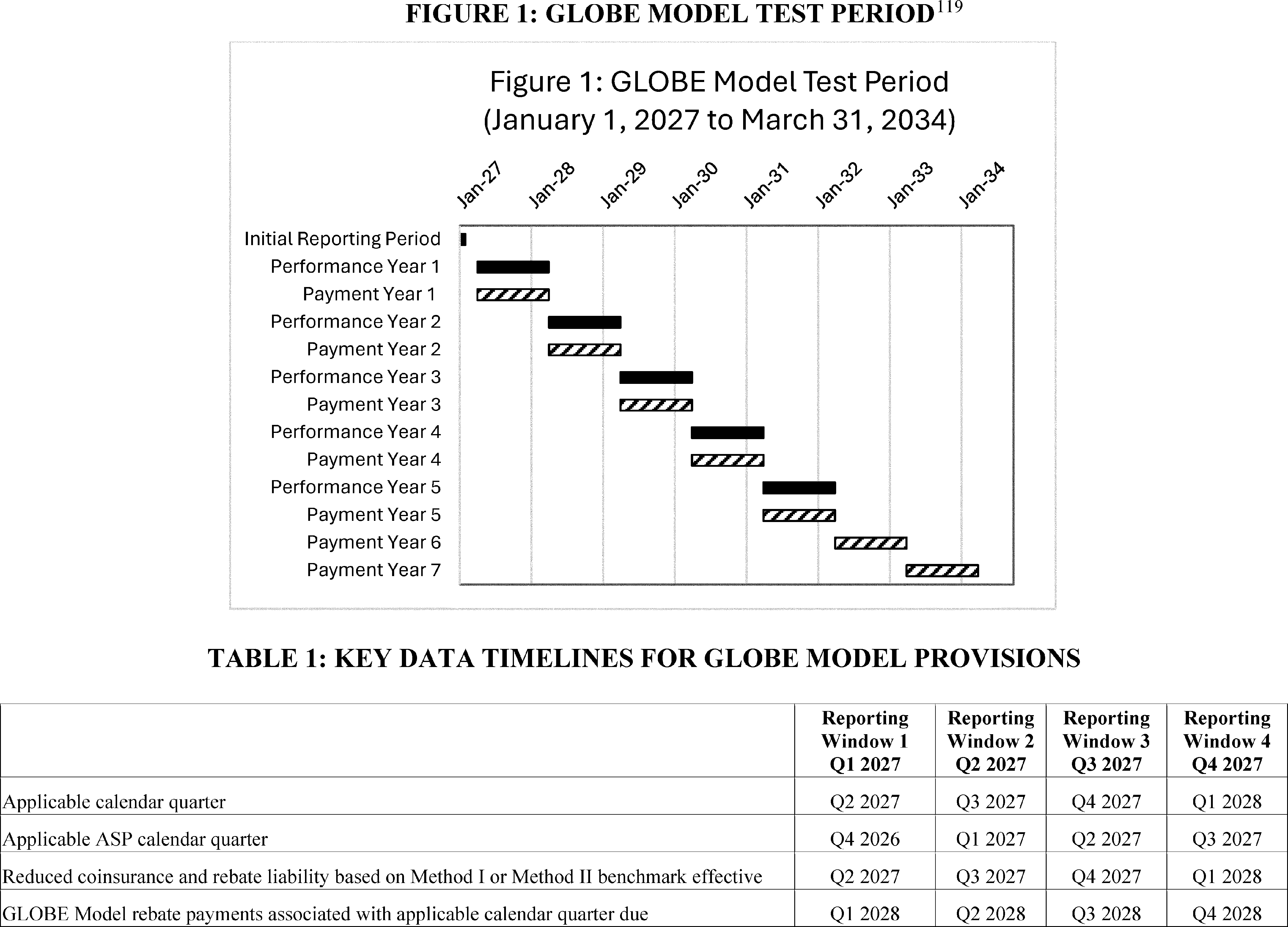
B. GLOBE Model Drugs
CMS proposed the GLOBE Model would include, as GLOBE Model drugs, a set of Part B rebatable drugs (single source drugs and sole source biological products) that are used to treat beneficiaries with conditions where there are potentially avoidable high program expenditures and access barriers due to high costs which likely contribute to deficits in care. Analysis of historical OM Part B drug spending and non-U.S. OECD spending for similar drugs and biological products has highlighted U.S. originator drugs without generic [120] or biosimilar biological product [121] competition in the U.S. (called “single source drug” and “sole source biological product” for purposes of the GLOBE Model proposed rule and this final rule) as the main contributor to high drug spending within OM Part B and globally.
The majority of OM Part B drug spending is also concentrated in a select number of drugs and biological products. For example, as illustrated in Table 2 of the GLOBE Model proposed rule (and repeated as Table 2 in this final rule), spending for the top 50 OM Part B drugs and biological products in 2024 was concentrated in the therapeutic areas of oncology (39 percent), immunology (19 percent), skin substitutes (13 percent), ophthalmology (12 percent), endocrinology (9 percent), and rheumatology (5 percent). Per 42 CFR 427.101(b), skin substitutes are an excluded product category for Part B rebatable drugs.
( printed page 62963)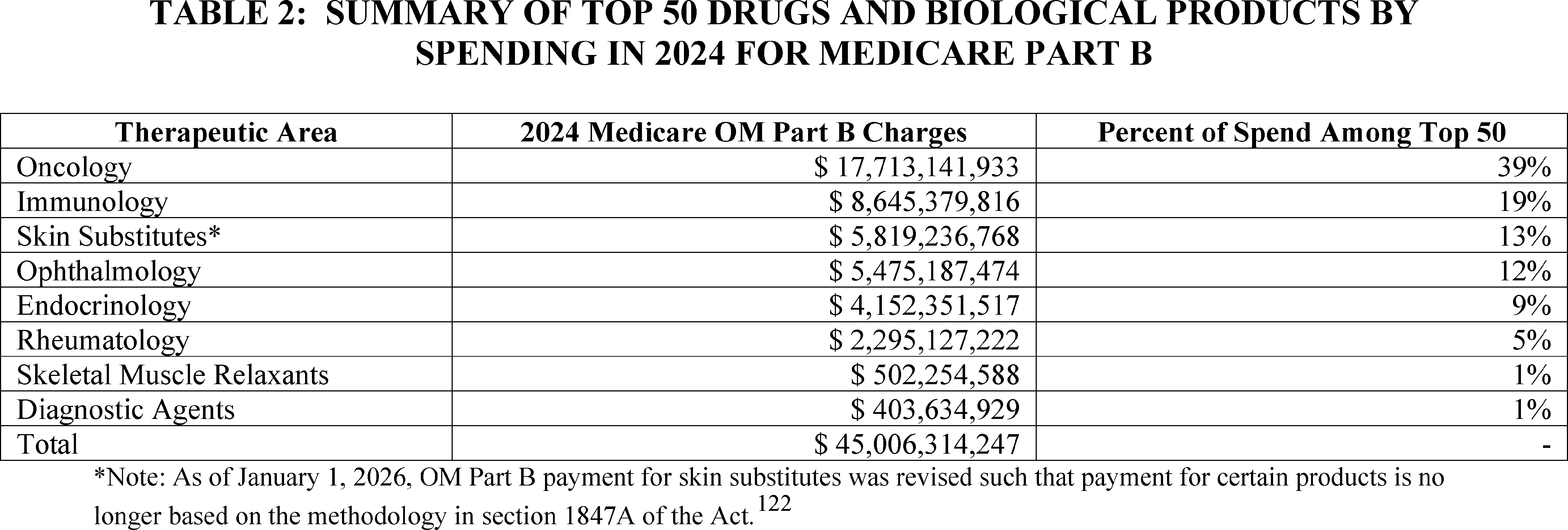
Increased drug costs limit access to care and treatment for beneficiaries with conditions in these categories, increasing their risk for deficits of care and worse health outcomes. According to a report by ASPE, between 2008 and 2021, the average annual payment for OM Part B drugs grew by 8.8 percent.[123] In contrast, OM Part B program payments for separately payable Medicare Part B drugs in the therapeutic areas of oncology, immunology, endocrinology, and rheumatology grew by an average of 10.8 percent annually,[124] suggesting that these therapeutic areas experienced faster spending growth. The same ASPE report also found that ophthalmologists [125] had the highest average annual growth rate of OM Part B drug spending at 15 percent, 1.7 times higher than the overall average annual payment growth for all OM Part B drugs. These therapeutic types and physician specialties use drugs and biological products to treat conditions related to cancer, endocrinology, immunology, rheumatology, and ophthalmology. CMS identified the categories for the top 50 OM Part B drugs using the standardized USP DC criteria and a Food and Drug Administration (FDA) label review. These therapeutic areas are associated with the following USP DC categories listed in Table 3 of the GLOBE Model proposed rule (90 FR 60254) (and repeated as Table 3 in this final rule).
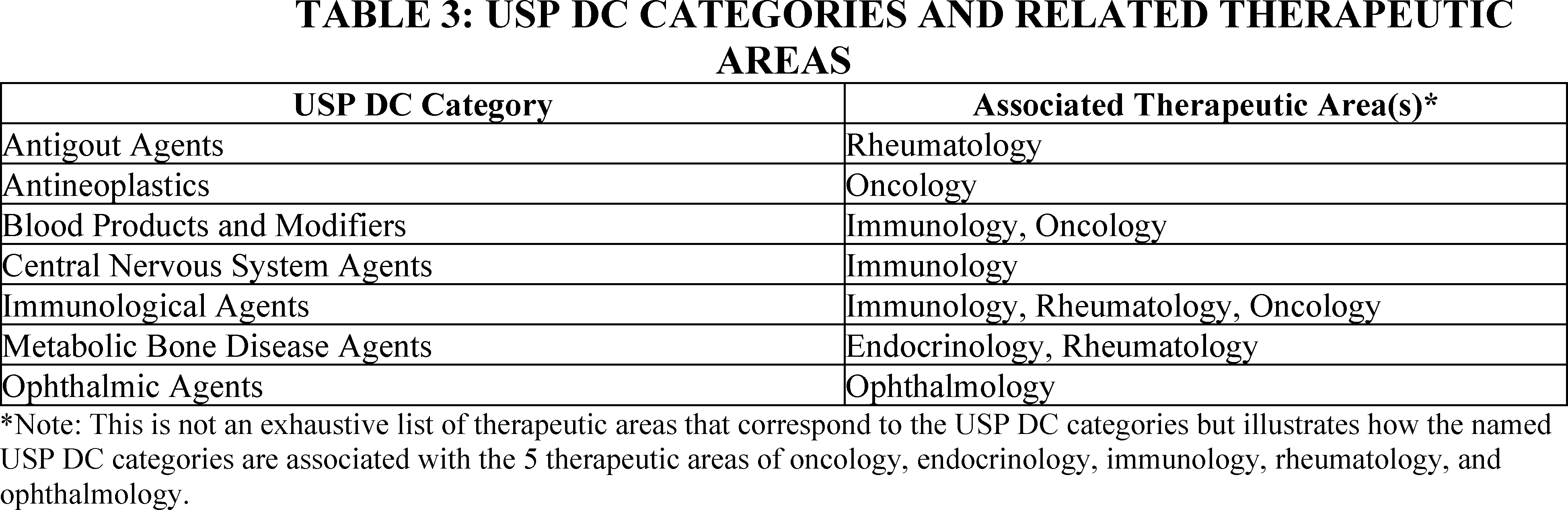
While higher drug costs are not the only contributor to Medicare Part B spending growth, it may lead to increased financial burden for some beneficiaries. Previous studies have found that high costs can increase the likelihood of nonadherence to medications leading to potentially worse health status.[126 127 128] Thus, CMS proposed to scope the GLOBE Model to target potential deficits of care in specific USP DC categories as shown in ( printed page 62964) Table 3 and defined in proposed § 513.130.
Previous analyses have also shown that U.S. originator drugs are, on average, about 422 percent more expensive in the U.S. than in non-U.S. OECD countries. Other studies indicate that growth in Medicare Part B drug spending has largely been driven by single source drugs and sole source biological products. As such, we proposed to scope this model to focus on testing drugs and biological products where high program expenditures are most likely to arise and are potentially avoidable.
To achieve this objective, we also proposed to identify, in advance of each applicable calendar quarter and using information available to CMS, the single source drugs and sole source biological products within the drug categories identified in Table 3 that would qualify as GLOBE Model drugs for that quarter, by applying the criteria described in section II.B.1. of this final rule. By applying such criteria to identify GLOBE Model drugs for an applicable calendar quarter, CMS would use a consistent methodology to identify a set of Part B rebatable drugs that are used to treat beneficiaries with conditions where deficits in care and high program expenditures are potentially avoidable and a representative subset of Part B rebatable drugs that account for a substantial portion of annual OM Part B spending for Part B rebatable drugs. By excluding Part B rebatable drugs that are not sole source biological products, the GLOBE Model would also avoid including drugs with biosimilar biological product approvals in the U.S. which may be subject to unique market dynamics that would confound the model test. We note the definition of Part B rebatable drugs includes single source drugs and have chosen to re-iterate the term “single source drugs” for clarity and completeness.
Using Part B rebatable drugs as the basis for identifying GLOBE Model drugs that are single source drugs and sole source biological products and meet the USP DC categories in Table 3 is necessary to allow CMS to test an alternative Medicare Part B drug inflation rebate amount calculation. Limiting inclusion in the model test to a set of Part B rebatable drugs that meet the proposed inclusion criteria is necessary to focus the model test where model impacts related to expected high program expenditures may be observed within the study population over the course of the model evaluation (as described in section II.F. of this final rule). As further described in section II.B.1. of this final rule, CMS would identify GLOBE Model drugs and add them to the GLOBE Model Drug HCPCS Codes List that would be made available on the GLOBE Model web page at www.cms.gov/priorities/innovation/innovation-models/globe. The GLOBE Model Drug HCPCS Codes List would be maintained quarterly to add and remove drugs as appropriate in accordance with the inclusion criteria. We proposed to identify a GLOBE Model drug using the same applicable billing and payment code (that is, HCPCS code) that is identified for the Part B rebatable drug pursuant to 42 CFR 427.101(a)(1)(ii) for the Medicare Part B Drug Inflation Rebate Program.
 www.cms.gov/priorities/innovation/innovation-models/globe
Further, for the purposes of the GLOBE Model, we proposed to treat FDA-approved biosimilar biological products and their reference biological products as “multi-source” products instead of sole source biological products when certain conditions are met due to the unique market dynamics of these products within the U.S and because qualifying biosimilar biological products (as defined under section 1847A(b)(8)(B)(iii) of the Act) are not Part B rebatable drugs.
We note that qualifying biosimilar biological products (as defined under section 1847A(b)(8)(B)(iii) of the Act) are not included in the Part B rebatable drug definition at 42 CFR 427.20 and therefore, would not be a GLOBE Model drug regardless of whether the criteria for exclusion in proposed § 513.130(c) were met. We also note that the Medicare Part B Drug Inflation Rebate Program includes non-qualifying biosimilar biological products and their reference biological products as applicable.
We believe there are observable differences in pricing dynamics of sole source and multi-source biological products that lead to unique market dynamics in the U.S. For example, when there is no competing biological product licensed under section 351(k) of the Public Health Service (PHS) Act to a U.S. originator drug, manufacturers are less likely to provide price concessions and rebates. Compared with sole source biological products (as defined at § 513.20), when reference biological products and their biosimilar biological products that are licensed under section 351(k) of the PHS Act are sold, manufacturers of multi-source biological products may provide higher price concessions and discounts to be competitive. These market differences result in varying manufacturer-to-provider incentives in the U.S. When competing biosimilar biological products are available in the U.S., manufacturers may provide discounts to providers through price concessions and rebates that impact Medicare spending. In response to the GLOBE Model, manufacturers may change these discount strategies depending on how many patients are within a GLOBE Model geographic area. As such, manufacturers may provide lower discounts to clinics with more GLOBE Model eligible beneficiaries in GLOBE Model geographic areas than to clinics with fewer GLOBE Model eligible beneficiaries because of the rebates the manufacturer would be required to pay under the GLOBE Model. This difference in incentives may lead to providers switching utilization between FDA-approved products (biosimilar biological products to their reference biological products, reference biological products to their biosimilar biological products, or from one biosimilar biological product to another). We recognize that if the reference biological product for a biosimilar biological product that is licensed under 351(k) of the PHS Act were included in the GLOBE Model and the biosimilar biological product was not included, beneficiaries could face higher cost sharing amounts for such biosimilar biological products than their reference biological products. The discussion in section II.B.1. of this final rule further describes our proposed approach to exclude Part B rebatable drugs that are biosimilar biological products and their reference biological products.
1. GLOBE Model Drug Inclusion Criteria
We proposed to apply the following criteria to identify GLOBE Model drugs for an applicable calendar quarter during the GLOBE Model performance period. In advance of each applicable calendar quarter, CMS proposed in § 513.130 to identify the GLOBE Model drugs for that applicable calendar quarter by applying these criteria to Part B rebatable drugs, as identified by CMS in accordance with 42 CFR 427.101: (1) are listed as antigout agents, antineoplastics, blood products and modifiers, central nervous system agents, immunological agents, metabolic bone disease agents, or ophthalmic agents as specified in the USP DC; (2) are single source drugs or sole source biological products as set forth in proposed § 513.20; (3) have OM Part B spending greater than $100 million over a 12-month period (as further specified in proposed § 513.130(d)); and (4) are drug or biological products that are not excluded from the GLOBE Model under proposed § 513.130(c). We proposed that a Part B rebatable drug would have to meet all four criteria to be included as a GLOBE Model drug. ( printed page 62965)
To identify GLOBE Model drugs for the first criterion for the first applicable calendar quarter of the GLOBE Model performance period, we proposed to use the USP DC 2025 [129] to identify all Part B rebatable drugs that meet the categories listed in Table 3 using their scientific or nonproprietary name(s), brand name, and/or NDC. The publicly available USP DC system has four tiers, of which we proposed to use the highest-level tier, USP DC category. CMS believes the drug category level is sufficient to identify therapeutic areas that may have deficits of care, while allowing for differences in mechanism of action and biological or molecular targets for products that treat the same therapeutic area. We recognize that a drug or biological product may be listed in more than one USP DC category. As such, as long as one of the categories listed in Table 3 applies to the drug or biological product, it would be considered to have met this criterion. We also recognize that drug and biological products may be identified as a Part B rebatable drug after the GLOBE Model's start and may not appear in USP DC 2025. As such, we proposed that for Part B rebatable drugs that were not previously assigned a USP DC category, CMS would use the most recently published USP DC to identify the category for such Part B rebatable drug to determine whether it meets the first criterion. We also proposed that once CMS has identified the USP DC category or categories as falling within the GLOBE Model's list of included categories, the drug would remain in the GLOBE Model's drug category or categories for the entire model duration. We also proposed that, when posted on the GLOBE Model website, the GLOBE Model Drug HCPCS Codes List would include the USP DC category for each GLOBE Model drug HCPCS code. Table 4 in the GLOBE Model proposed rule shows the associated USP DC category for an illustrative list of HCPCS codes (90 FR 60260). The USP DC 2025 has 50 categories of which Part B rebatable drugs during 2024 are listed in at least 34 of them.
Our proposal to include 7 categories represents 21 percent of the 34 possible Part B rebatable drug categories. Analysis of 2024 OM Part B rebatable drug spending data indicates that these 7 USP DC categories were responsible for most OM Part B rebatable drug spending (91 percent), with antineoplastics having the highest proportion of any single category at approximately 47 percent. Given the high disparity in prices for originator drugs in the U.S. as compared to other OECD member countries,[130 131 132] we believe this data further substantiates that there are potentially avoidable expenditures among Medicare beneficiaries who rely upon these high spend Part B rebatable drugs.
We also proposed that if USP creates a new drug category that stems from the drug categories set forth in § 513.130(b)(1), then such newly created drug categories would be incorporated into the GLOBE Model drug inclusion criteria. We proposed that CMS may make this determination based on a review of USP revision bulletins, revision histories, and corresponding change log information published by USP.
For the second criterion, CMS would focus the GLOBE Model test on a subset of Part B rebatable drugs that are single source drugs or sole source biological products. We recognized by definition, only single source drugs are Part B rebatable drugs and proposed to use the same definition of single source drug as defined in section 1847A(c)(6)(D) of the Act, which is not a multiple source drug and which is produced or distributed under a new drug application (NDA) approved by the FDA, including a drug product marketed by any cross-licensed producers or distributors operating under the NDA. A “multiple source drug,” as defined in section 1847A(c)(6)(C) of the Act, means, for a calendar quarter, a drug for which there are 2 or more drug products which: (1) are rated as therapeutically equivalent (under the FDA's most recent publication of “Approved Drug Products with Therapeutic Equivalence Evaluations”); (2) except as provided in section 1847(A)(6)(E) of the Act, are pharmaceutically equivalent and bioequivalent, as determined under section 1847(A)(6)(F) of the Act and as determined by the FDA, and (3) are sold or marketed in the United States during the quarter.
We also proposed to define “sole source biological product” in § 513.20 for the purposes of the GLOBE Model as a biological product licensed by the FDA under a biologics license application (BLA) under section 351(a) of the PHS Act and that, at time of evaluating for inclusion into the GLOBE Model for each applicable ASP calendar quarter, is not the reference biological product, as defined in section 1847A(c)(6)(I) of the Act, for a biosimilar biological product licensed by the FDA in a BLA under section 351(k) of the PHS Act. The biosimilar biological product must be recognized in the FDA's most recent publication of “Lists of Licensed Biological Products with Reference Product Exclusivity and Biosimilarity or Interchangeability Evaluations” (the “Purple Book”) and be identified as sold or marketed as set forth in 42 CFR 427.20. We note that the proposed definition for sole source biological product is different than the definition for single source biological, as defined in section 1847A(c)(6)(D) of the Act. As the proposed definition of a sole source biological product is based on a 351(a) licensure and not being the reference biological product for a biosimilar biological product sold or marketed, any biological product that meets this definition—even if marketed by any cross-licensed producers or distributors operating under the BLA—qualifies as such sole source biological product. The counterpart to a sole source biological product is a multi-source biological product, and the difference is that they have a reference biological product and a biosimilar biological product that is recognized in the FDA's Purple Book and identified as sold or marketed.
We also proposed to use the definition for “sold or marketed” established in 42 CFR 427.20, which means CMS would use marketing data as listed in either the ASP data reported to CMS by a manufacturer or the NDC directory to identify a start marketing date for the biosimilar biological product in the U.S. prior to the applicable calendar quarter when the product meets one of the following criteria: (1) the NDC has units reported for the rebate quarter; (2) the end marketing date is during the rebate quarter; (3) the end marketing date is after the rebate quarter; or (4) the end marketing date is missing.
To apply this criterion, we proposed, at the time of evaluating inclusion in the GLOBE Model for each applicable ASP calendar quarter, CMS would use the FDA's NDC Directory, including ( printed page 62966) historical information from NDC Directory files such as discontinued, delisted, and expired listings, provided by the FDA or published on the FDA website to determine the marketing status of a biosimilar biological product in the U.S. We proposed that, if a biosimilar biological product is marketed in the U.S., as determined by CMS for purposes of the GLOBE Model as of the beginning of an applicable calendar quarter, the biosimilar biological product, and reference biological product [133] for such biosimilar biological product would not be included as a GLOBE Model drug for the applicable calendar quarter. We proposed that for an applicable calendar quarter CMS would conduct this analysis prior to the applicable calendar quarter to update the GLOBE Model Drug HCPCS Codes List.
We recognized for the GLOBE Model that authorized generics and unbranded biological products in the U.S. share the same NDA approved by the FDA or 351(a) licensure as the original drug and biological product and therefore meet the proposed definitions of single source drug and sole source biological. As such, authorized generics and unbranded biological products that are Part B rebatable drugs could potentially be GLOBE Model drugs. In the U.S., authorized generics are drugs sold, licensed, or marketed under a NDA approved by the FDA under section 505(c) of the FD&C Act that is marketed, sold or distributed under a different labeler code, product code, trade name, trademark, or packaging (other than repackaging the listed drug for use in institutions) than the brand drug. In the U.S., unbranded biological products are biological products sold without their brand name by the original manufacturer or a third party under the BLA of the original biological product. Since, in the U.S., both authorized generics and unbranded biological products, are directly or indirectly, sponsored by the original pharmaceutical drug manufacturer, we believe that if an authorized generic or unbranded biological product is included in the Medicare Part B Drug Inflation Rebate Program, then, subject to the exclusions described in § 513.130(c), it could be included in the GLOBE Model. In other words, an authorized generic or unbranded biological product could meet the definition of a single source drug or sole source biological product in § 513.20 if such product was approved under section 505(c) of the FD&C Act or licensed under section 351(a) of the PHS Act.
For the third criterion, we proposed to identify the Part B rebatable drugs with total OM Part B allowed charges greater than $100 million over a 12-month period using separately payable final action claims (spend threshold). As specified in § 513.130(d) in the GLOBE Model proposed rule, we proposed that CMS would identify OM Part B final action claims with dates of service within the consecutive 12-month period ending 6 months prior to the start of the applicable calendar quarter that have separately payable allowed charges greater than $0 for any billing and payment code used to describe the GLOBE Model drug, and sum the allowed charges. We stated that, for example, if the applicable calendar quarter is Q1 2027, all separately payable final action claims with OM Part B allowed charges greater than $0 for any billing and payment code used to describe the Part B rebatable drug with a date of service from July 1, 2025 to June 30, 2026 would be summed together to determine if the spend threshold is met. By applying a minimum total annual OM Part B spend as an inclusion criteria, CMS intends that the GLOBE Model would be focused on Part B rebatable drugs that account for a significant portion of annual OM Part B drug spending and on drugs that would be expected to account for approximately a minimum of $8 million in allowed charges per month under the model. We also proposed that Part B rebatable drugs would need to meet the spend threshold at least one time during the duration of the GLOBE Model to meet this criterion for the applicable calendar quarter and subsequent applicable calendar quarters. To illustrate this proposal in the GLOBE Model proposed rule, we provided the following example (90 FR 60256). If Drug I meets the $100 million threshold for performance year 1 over a 12-month period for Q3 2026 but not for Q4 2026, Drug I is still considered to have met this criterion for Q4 2026 and the subsequent GLOBE Model applicable calendar quarters and would retain inclusion in the GLOBE Model.
Historical analysis of OM Part B drug spending has shown that the majority of spending is focused on a select number of drugs. A threshold of $100 million in total annual OM Part B spending applied to Part B rebatable drugs for the consecutive 12-month period ending on December 31, 2024, would encompass 90 percent of the total 2024 OM Part B spending on Part B rebatable drugs and account for 21 percent of Part B rebatable drugs (by HCPCS Level II code). This analysis highlights that a small number of Part B rebatable drugs represent the majority of OM Part B drug spending. A threshold of $100 million would therefore focus the GLOBE Model on a majority of OM Part B drug spending to enable detection of expected savings for the GLOBE Model test while reducing the burden of studying the impacts of the GLOBE Model on all Part B rebatable drugs.
The following is a summary of the comments received and our responses.
Comment: A commenter stated support for CMS's efforts and recommended the inclusion of immunosuppressive therapies such as belatacept and similar medications and stated that expanding affordability and access to these medications will significantly improve graft survival and provide an option for patients unable to continue other immunosuppressive regimens.
Response: We thank the commenter for sharing their support of the GLOBE Model. We agree that access to immunosuppressive agents such as belatacept is important for graft survival and for patients who may not be able to tolerate alternative immunosuppressive regimens. One of the GLOBE Model's inclusion criteria is the USP DC category of immunological agents, which includes belatacept and other immunosuppressive agents. We note that GLOBE Model drugs will be identified through the GLOBE Model Drug HCPCS Level II Codes List as set forth in § 513.130(e).
Comment: A couple of commenters stated their support for the proposed drug inclusion and exclusion criteria, including Part B rebatable drugs experiencing significant spending growth, such as those used in ophthalmology, rheumatology, and oncology.
Response: We thank the commenters for sharing their support of the GLOBE Model drug inclusion and exclusion criteria. We agree that including Part B rebatable drugs experiencing significant spending growth—such as those used in ophthalmology, rheumatology, and oncology—is consistent with the GLOBE Model's objectives of reducing program expenditures while preserving or enhancing beneficiaries' quality of care.
Comment: A couple of commenters supported CMS's use of the USP DC in the GLOBE Model. A commenter stated that using the most recent version of the USP DC for drug categories will promote clarity, reduce administrative burden, and help mitigate unintended ( printed page 62967) consequences such as formulary gaps or disruptions in patient access.
Response: We thank the commenters for sharing their support for use of the USP DC system. As proposed in the GLOBE Model proposed rule (90 FR 60255), we will use the USP DC 2025 to identify all Part B rebatable drugs that meet the USP DC categories in Table 3 at model start for the first applicable calendar quarter of the GLOBE Model performance period. We proposed to use the USP DC 2025 for identification of the USP DC categories at model start as the categories listed in Table 3 were identified using the USP DC 2025. We also proposed to use the most recently published version of the USP DC to identify drug categories for Part B rebatable drugs not previously assigned a USP DC category. We agree that using the most recently published version of the USP DC for Part B rebatable drugs not previously assigned a category promotes clarity and helps reduce administrative burden.
Comment: A commenter recommended that CMS explain in the final rule why the 7 USP DC categories were selected over others and what criteria would govern any future expansion.
Response: We thank the commenter for sharing their feedback. As shown in Tables 2 and 3 of the GLOBE Model proposed rule (90 FR 60244 through 60254) and this final rule, the 7 USP DC categories are associated with the therapeutic areas representing the highest percentage of total OM Part B drug spending among the top 50 separately payable Medicare Part B drugs by expenditure in 2024. CMS also considered other USP DC categories, including: antimyasthenic agents, cardiovascular agents, dermatological agents; genetic, enzyme, or protein disorder: replacement, modifiers, treatment; and respiratory tract/pulmonary agents. However, CMS believes that initially focusing the model test on these 7 high expenditure USP DC categories will target beneficiaries receiving treatment in these therapeutic areas with potentially avoidable expenditures and beneficiaries who are most likely to experience significant financial burden and greater deficits of care due to high drug costs, consistent with the GLOBE Model's objectives of reducing program expenditures while preserving or enhancing quality of care.
Regarding future expansion of included therapeutic areas, CMS may consider adding USP DC categories in future rulemaking based on factors such as changes in Part B rebatable drug spending patterns, the emergence of new therapeutic areas with significant beneficiary financial burden, and the results of ongoing model evaluation. Any updates to the GLOBE Model drug categories set forth in § 513.130(b)(1) would be subject to notice-and-comment rulemaking, as appropriate.
Comment: A commenter suggested that CMS monitor USP DC categories that represent areas of active research and development for potential impacts on innovation. The commenter also suggested a prioritization method that identifies drugs with the highest likelihood of being priced above their true patient-centered value and drugs in therapeutic areas with substantial ongoing research and development activity. The commenter further suggested the use of the Generalized Risk Adjusted Cost-Effectiveness framework to evaluate drugs that exceed their value. The commenter also stated that price controls targeting therapeutic areas with little ongoing research activity would have less impact on innovation. Another commenter suggested that CMS only include drugs assessed as providing low or no added therapeutic benefit, regardless of USP DC category, to preserve stronger price signals for high-value innovation.
Response: We thank the commenters for sharing their feedback. As stated in the GLOBE Model proposed rule (90 FR 60244 through 60254), the purpose of the GLOBE Model is to test whether an alternative approach for calculating the Medicare Part B drug inflation rebate amount for GLOBE Model drugs—using international drug pricing information to establish a benchmark reflecting prices paid in economically comparable countries—would reduce Medicare Part B program expenditures while preserving or enhancing beneficiaries' quality of care. As such, we disagree that the model needs a separate prioritization method or framework to determine if a drug exceeds its value. We proposed that GLOBE Model drugs would be a subset of Part B rebatable drugs that: (1) are designated as one of the seven listed USP DC categories set forth in § 513.130(b)(1); (2) are single source drugs or sole source biological products; (3) have total OM Part B allowed charges greater than $100 million over a 12-month period ending 6 months prior to the start of the applicable calendar quarter (as further specified in §§ 513.130(b)(3) and 513.130(d)); and (4) are not excluded from the GLOBE Model as proposed in § 513.130(c). CMS continues to believe it is essential to focus the model test where model impacts on program expenditures are most likely to be observed during the evaluation period. We believe the finalized criteria for identifying GLOBE Model drugs set forth in § 513.130 would best achieve this goal.
Regarding the commenter's suggestion to monitor USP DC categories for potential impacts on innovation, CMS will conduct ongoing monitoring and evaluation throughout the GLOBE Model payment period, which will include assessment of model impacts on drug availability, program spending, and access to GLOBE Model drugs. With respect to cost-effectiveness and therapeutic benefit frameworks, while we appreciate the commenters' suggestions, we do not believe a separate cost-effectiveness framework is necessary to achieve the model's objectives. Furthermore, the GLOBE Model is not designed to evaluate drugs based on cost-effectiveness, patient-centered value assessments, or therapeutic benefit.
Comment: A commenter stated that the proposed drug inclusion criteria related to spending—using HCPCS Level II codes for the $100 million in total OM Part B allowed charges during a 12-month period—means that different strengths and dosage forms of the same active moiety or active ingredient from the same holder of a NDA will not be aggregated. The commenter suggested using inclusion criteria that align with the Negotiation Program to avoid manufacturer gaming.
Response: We thank the commenter for sharing their feedback regarding the use of HCPCS Level II codes for the drug inclusion criteria related to spending. We also acknowledge the commenter's concern regarding the potential for manufacturer gaming. As proposed in § 513.130(d)(1), the criteria are not based on active moiety or active ingredient level but rather based on how OM Part B identifies drugs and biologicals. This approach allows CMS to assess the spend threshold during the applicable 12-month period for any billing and payment code that includes the drug or biological. Our proposed approach aligns with the methodology for identifying Part B rebatable drugs under section 1847A of the Act for the Medicare Part B Drug Inflation Rebate Program as set forth in 42 CFR 427.101. We believe this approach provides a consistent and administrable framework that limits the potential for manufacturer gaming. Further, as the GLOBE Model will test an alternative rebate amount calculation and adjusted coinsurance for certain Part B rebatable drugs, we believe it is essential that our approach be consistent with the methodology CMS uses to identify Part B rebatable drugs. ( printed page 62968)
Comment: A commenter stated that CMS should maintain drugs in the GLOBE Model if their U.S. price exceeds the applicable international reference price, rather than updating the list quarterly to add and remove drugs in accordance with the inclusion and exclusion criteria.
Response: We thank the commenter for their feedback regarding the GLOBE Model drug inclusion and exclusion criteria. As proposed in § 513.130, once CMS identifies a Part B rebatable drug as a GLOBE Model drug and adds it to the GLOBE Model Drug HCPCS Level II Codes List, the drug will remain in the GLOBE Model unless it is no longer a single source drug or sole source biological or meets one of the exclusion criteria such as having a MFP under the Negotiation Program in effect or no longer being a Part B rebatable drug. We note that inclusion and exclusion would be based on the criteria set forth in § 513.130, not on a drug's U.S. price relative to an international reference price. We believe this approach will maintain model integrity and allow CMS to test an alternative Medicare Part B drug inflation rebate amount calculation for certain single source drugs and sole source biological products—with the goal of reducing Medicare program expenditures while preserving or enhancing quality of care.
Comment: A commenter stated that the GLOBE Model applies the minimum spend threshold as an inclusion criterion, whereas the GUARD Model applies it as an exclusion criterion, and stated that standardizing the approaches to the spend threshold across the two models could lead to operational efficiencies for manufacturers.
Response: We thank the commenter for their feedback regarding the GLOBE Model's drug inclusion criteria. The proposed GLOBE Model and proposed GUARD Model are two separate proposed CMS Innovation Center model tests, each designed to evaluate distinct policy interventions. As such, the proposed drug inclusion and exclusion criteria for each model are tailored to the specific objectives of that test, and standardization across models is not required. We are not persuaded that a difference in how a spend threshold would be applied across the two proposed models would create a meaningful operational burden for manufacturers, as both approaches require CMS to identify applicable drug spending data, calculate a sum, and compare the result to the applicable threshold.
Comment: A commenter requested clarification on how newly approved drugs billed under a NOC HCPCS code would be treated under the GLOBE Model. The commenter recommended that CMS explicitly exclude the 6-month drug launch period—during which a newly approved drug is billed under an unspecified or NOC HCPCS code before a permanent product-specific HCPCS Level II code is assigned—from all GLOBE Model spending threshold calculations, drug selection criteria, and rebate calculations.
Response: Under 42 CFR 427.101(b), certain product categories are excluded from the definition of a Part B rebatable drug, including products billed under a NOC code. In addition, to calculate the OM Part B allowed charges, as set forth in § 513.130(d), CMS would use any OM Part B final action claims that are used to describe a GLOBE Model drug. Because a claim billed under a NOC HCPCS code does not contain sufficient information for CMS to associate such claims with a specific drug or biological, such claims would not be included in spending threshold calculations for purposes of the GLOBE Model. Accordingly, we do not agree that a specific exclusion of the 6-month drug launch period is necessary.
Comment: A commenter recommended CMS provide clearer rules for how drugs transition between sole source and multi-source status as biosimilars enter the U.S. market, including time of exclusion and benchmark recalculations.
Response: We thank the commenter for sharing their feedback. In § 513.20, for purposes of the GLOBE Model, CMS proposed definitions for single source drug and sole source biological products. Further, as discussed in the GLOBE Model proposed rule (90 FR 60244 through 60254), CMS proposed to use the definition of sold or marketed as set forth in 42 CFR 427.20 to identify a sole source biological product. As such, CMS would use marketing data, as listed in either the ASP data reported to CMS by a manufacturer or the NDC directory, as available, to identify a start marketing date(s) and end marketing date(s), as applicable, for a biosimilar biological product(s) and its reference biological product. If a biosimilar biological product and reference biological product for such biosimilar biological product are marketed, as determined by CMS, as of the beginning of an applicable calendar quarter, CMS would identify that the biosimilar biological product(s) and reference biological product for such biosimilar biological product(s) would not be sole source biological products and would not be included as a GLOBE Model drug for the applicable calendar quarter. If CMS determines that a GLOBE Model drug is multi-source rather than a single source drug or sole source biological product, CMS would not identify benchmarks nor calculate a total GLOBE Model rebate amount or incremental GLOBE Model rebate amount for subsequent applicable calendar quarters during the GLOBE Model performance period for which a Part B drug is multi-source as it would not meet the inclusion criteria to be a GLOBE Model drug for such applicable calendar quarter(s). CMS proposed to identify GLOBE Model drugs for an applicable calendar quarter during the GLOBE Model performance period in advance of such applicable calendar quarter using information available to CMS, and CMS would add identified GLOBE Model drugs to the GLOBE Model Drug HCPCS Codes List for such applicable calendar quarter. We believe this approach provides clear rules that CMS would apply when a biological product in the U.S. would transition between sole source and multi-source for purposes of the GLOBE Model.
Final Decision: After consideration of the public comments received, CMS is finalizing the drug inclusion criteria at § 513.130(b) and § 513.130(b)(1) as proposed with minor terminology updates. CMS is finalizing § 513.130(b)(2) and § 513.130(b)(4) as proposed without modification. CMS is finalizing § 513.130(d) with modification to insert a table showing the consecutive 12-month period ending 6 months prior to the start of each applicable calendar quarter, a non-substantive technical correction to change “GLOBE Model drug” to “Part B rebatable drug,” and a change from “billing and payment” to “HCPCS” for clarification.
CMS has also made technical corrections to the regulation text at § 513.20 to address a drafting error related to the definitions of single source drug and sole source biological product. In the definition of single source drug, we removed the term “biological product.” In the definition of sole source biological product, CMS added the word “product”, corrected “PHSA” to “PHS”, corrected “applicable ASP calendar quarter” to “applicable calendar quarter during the GLOBE Model performance period”, corrected “in a BLA” to “under a BLA”, listed the full name of Purple Book, clarified “sold or marketed” to be as set forth in 42 CFR 427.20. CMS is also finalizing § 513.130(e) with technical correction change from “paragraph (d)(2)” to “paragraph (e)(2)” and with other minor terminology updates. ( printed page 62969)
CMS also revised § 513.130(a) for clarity and to align with the preamble. Paragraph § 513.130(a) is changed from “reserved” to stating that, subject to § 513.130(b), for each applicable calendar quarter during the model performance period, CMS identifies the Part B rebatable drugs that are included in the GLOBE Model for purposes of (1) application of the coinsurance adjustment and adjusted Medicare payment as set forth in 42 CFR part 513 subpart C, and (2) for determining the total GLOBE Model rebate amounts as set forth in 42 CFR part 513 subpart F.
We refer readers to section II.B.4. of this final rule for discussion of additional modifications to the inclusion criteria.
2. Exclusion of Certain Part B Rebatable Drugs
To avoid interactions with other initiatives and programs that focus on manufacturers of drugs payable under Medicare Part B, in § 513.130(c)(1)(ii), we proposed to exclude from the GLOBE Model a Part B rebatable drug for which a MFP, as defined in section 1191(c)(3) of the Act, under the Negotiation Program is in effect. This proposal would mean that drugs that have been selected for Medicare Drug Price Negotiation (under section 1192 of the Act), for which a MFP has been agreed upon, and for which the manufacturer of such drug is required to provide access to the MFP, would be excluded from the GLOBE Model for appliable calendar quarters in which the MFP is in effect.[134 135] For example, if a GLOBE Model drug is selected for negotiation in 2027 for initial price applicability year 2029, the manufacturer and CMS agree upon a MFP for the drug during 2027, and the MFP goes into effect on January 1, 2029, the GLOBE Model drug would exit the GLOBE Model after December 31, 2028. We note that the earliest date for which an MFP would apply for a drug payable under Medicare Part B is January 1, 2028, per section 1192(a)(3) of the Act. Because we proposed to begin the GLOBE Model on October 1, 2026, we noted in the GLOBE Model proposed rule that there would be no Part B rebatable drugs that could be a GLOBE Model drug for which the manufacturer is required to provide access to the MFP at model start (90 FR 60257). We proposed that this exclusion from the GLOBE Model would end when the Medicare Part B payment limit for a Part B rebatable drug that would otherwise be eligible to be a GLOBE Model drug is no longer based on the MFP. As stated in the GLOBE Model proposed rule (90 FR 60257), we believe that excluding drugs when the Medicare Part B payment limit is based on an MFP is appropriate because these drugs are subject to different market dynamics within the U.S., and we believe that including them could confound the model test and impact our ability to evaluate the impacts of the model.
In addition, we proposed, in § 513.130(c)(1)(i), that a Part B rebatable drug would not be a GLOBE Model drug for applicable calendar quarters prior to the first applicable calendar quarter for which CMS identifies a specified amount pursuant to 42 CFR 427.302(b) for such drug. This proposal would ensure that the GLOBE Model and the Medicare Part B Drug Inflation Rebate Program would treat a subsequently approved drug (that is, a drug first approved or licensed by the FDA after December 1, 2020) in a similar manner. In other words, until a specified amount is established by CMS for a subsequently approved Part B rebatable drug, that drug would not be considered for the GLOBE Model. We noted that, given the proposed GLOBE Model drug inclusion criteria in § 513.130(b), this exclusion would only be applied to drugs that meet all the proposed inclusion criteria.
We also noted that during the duration of the GLOBE Model, certain drugs or biological products may no longer be Part B rebatable drugs. As such, in § 513.130(c)(1)(iii) we proposed that if a GLOBE Model drug is no longer a Part B rebatable drug for an applicable calendar quarter, it would be excluded from the GLOBE Model for that applicable calendar quarter and any other subsequent quarters in which it is no longer rebatable.
The following is a summary of the comments received and our responses.
Comment: A commenter asked CMS to publish a methodology outlining which drugs will be included and excluded in the GLOBE Model. For those excluded drugs, the commenter requested CMS outline the rationale for the exclusion.
Response: We thank the commenter for the feedback. We believe that the methodology described in this section of this final rule and in § 513.130 clearly outlines the information and process CMS would use to apply the spending threshold, USP DC categories, Part B rebatable drugs, and other criteria for identifying GLOBE Model drugs, including the specific inclusion and exclusion criteria. We refer the commenter to sections II.B.2. and II.B.5. of this final rule for additional information related to how CMS would identify included and excluded drugs. CMS will publish the GLOBE Model Drug HCPCS Level II Codes List for an applicable calendar quarter on the GLOBE Model website.
Comment: Many commenters requested that the GLOBE Model include explicit language excluding drugs and biologics approved exclusively for one or more rare diseases or conditions. Many commenters also stated that the GLOBE Model would understate the value of orphan drugs and disincentivize R&D in this area and emphasized existing legislation such as the Orphan Drug Act recognizing the special circumstances of orphan drugs. Commenters further stated that orphan drugs serve unique patient populations, do not exhibit traditional market dynamics through the global nature of their supply chain, require a complex and diverse array of technologies for manufacturing, are less likely to receive reimbursement recommendations in, or to launch in, other countries, are likely to be subject to outcomes-based arrangements (OBAs) for payment in reference countries where they are sold, and may be more likely to experience shortages. Several commenters stated that the Negotiation Program, the Working Families Tax Cuts Act (Pub. L. 119-21), and the 340B Drug Pricing Program (section 340B of the Public Health Services Act) include provisions for orphan drug exclusions and that the 2020 Most Favored Nation (MFN) Model Interim Final Rule included an orphan drug exemption.
A couple of commenters recommended that CMS adopt the following exclusion: “A drug or biological product that is designated as a drug for one or more rare diseases or conditions under section 526 of the Federal FD&C Act and for which the only approved indication or indications are for one or more such rare diseases ( printed page 62970) or conditions (as defined in section 526(a)(2) of the Federal FD&C Act).”
A couple of commenters requested exclusion of genetically targeted therapies (GTTs), CAR-Ts, and personalized medicine treatments, stating these products were discovered and first commercialized in the U.S. and that these products treat underlying genetic cause of disease for some of the most serious and intractable disease with higher per-patient contact and public health burden. Commenters believe exclusion of these products from the GLOBE Model would ensure incentives for development of innovative medicines remain. A commenter suggested using exclusion language that leverages statutory definitions including 21 U.S.C. 360ff-1 (Targeted drugs for rare diseases). Specifically, the commenter requested CMS exclude “drugs that incorporate or use a mechanism designed to modulate the function of a specific gene or its associated gene product through sequence-directed interaction with DNA or RNA (including antisense oligonucleotides [ASOs] and small interfering RNA [siRNA]).”
Response: We thank the commenters for sharing their feedback. We believe the proposed inclusion criteria of including drug or biological products with total OM Part B allowed charges greater than $100 million over a 12-month period focus the model test on drugs and biological products with high program expenditures and targets potentially avoidable expenditures and potential deficits of care while protecting personalized medicine incentives. For instance, our analysis of 2024 OM Part B allowed charges determined that, of the products listed on the FDA's Approved Cellular and Gene Therapy Products web page, only 2 (4 percent) products met or exceeded the OM Part B $100 million spending threshold. While we believe the proposed criteria are sufficient to focus the GLOBE Model on drugs with high program expenditures while protecting personalized medicine incentives, we also carefully considered the full range of public comments received, including detailed analyses provided by several commenters regarding the unique market dynamics of orphan drugs and the potential impact of the model on innovation in rare disease research and development.
We acknowledge commenters' concerns that orphan drugs may not exhibit traditional market dynamics, may be less likely to receive reimbursement recommendations in, or launch in, other countries, and they may be more likely to be subject to OBAs for payment. While we do acknowledge these concerns, our analysis of international drug pricing information showed that CMS would likely be able to calculate a GLOBE Model benchmark for these drugs. Although we disagree with commenters' concerns, we have decided to add exclusions for orphan-only drugs to avoid the possibility of commenters' concerns manifesting for these therapies. Our decision is out of an abundance of caution specifically for Medicare beneficiaries with rare diseases who may rely upon these drugs.
We also acknowledge commenters' suggestion to exclude GTTs to maintain incentive in development of innovative medicines which may be personalized such as being manufactured using a patient's cells. CMS declines to use the commenter's exclusion language for GTTs as 21 U.S.C. 360ff-1 includes a definition for genetically targeted drug and genetically targeted technology. The purpose of 21 U.S.C. 360ff-1 is targeted drugs for rare diseases. As such, this supports our decision to further refine the GLOBE Model drug eligibility criteria by adding an exclusion for orphan drugs. We note that we are adding an exclusion for products listed on the FDA's Approved Cellular and Gene Therapy Products web page (CGTs (for example, CAR-Ts)), which include a subset of GTTs; further discussion on this decision can be found in section II.B.5. of this final rule.
Accordingly, we will exclude a Part B rebatable drug that is designated as a drug for one or more rare diseases or conditions under section 526 of the Federal FD&C Act (21 U.S.C. 360bb) and for which the only approved indication (or indications) is for one or more such rare diseases or conditions.
Comment: A commenter stated that radiopharmaceutical drugs and biological products should be excluded from the GLOBE Model due to their unique characteristics, including their radioactive nature and short half-lives, that make them unsuitable for inclusion in the GLOBE Model, and further stated that, by definition, they are not Part B rebatable drugs.
Response: We note the commenter's observation regarding the unique characteristics of radiopharmaceuticals, including their radioactive nature and short half-lives. As a threshold matter, we confirm that separately payable radiopharmaceutical drugs and biological products that are not paid under section 1847A of the Act fall within an excluded product category for purposes of the Part B rebatable drug definition at 42 CFR 427.101(b)(4). As such, radiopharmaceutical drugs and biological products that are in this excluded product category would not satisfy the GLOBE Model inclusion criteria and therefore, would not be in the GLOBE Model.
Comment: A couple of commenters recommended excluding breakthrough therapy-designated drugs, stating that they are often transformative therapies and that their inclusion in the GLOBE Model could negatively affect future innovation. A commenter further stated that breakthrough therapy-designated drugs are often developed by small and mid-sized U.S. companies and that inclusion of these drugs would disproportionately harm small and mid-sized U.S. manufacturers. Another commenter stated the GLOBE Model harms innovation by including products that have FDA Breakthrough Therapy, Fast Track, or Priority Review designation(s) and that these programs were created to identify products that make a significant contribution to care.
Response: We thank the commenters for sharing their feedback. CMS recognizes that drugs receiving FDA Breakthrough Therapy, Fast Track, or Priority Review designations may offer important advances in care and has considered commenters' concerns that including such drugs in the GLOBE Model could affect future innovation. We disagree, however, that an exclusion criterion for breakthrough therapy-designated drugs or other drugs designated by FDA for expedited review, such as Fast Track or Priority Review, is warranted for the GLOBE Model. We do not believe that the GLOBE Model would deter investment in Breakthrough Therapy, Fast Track, or Priority Review designated drugs, nor do we believe the GLOBE Model would disproportionately impact small and mid-sized U.S. manufacturers.
The GLOBE Model does not change any policies related to Breakthrough Therapies, Fast Track, and Priority Review programs at the FDA so CMS does not expect the impacts of these programs to change due to the GLOBE Model. For example, drugs with breakthrough therapy designation have a lower late-stage clinical development time and higher immediate share price boosts, compared to drugs without breakthrough therapy designation,[136] and we expect that to continue. The model's rebate obligation reaches only drugs exceeding $100 million in OM Part B allowed charges over a 12-month ( printed page 62971) period—a threshold reflecting substantial market penetration—and affects only the OM Part B market, leaving commercial, MA, and ex-U.S. revenues unaffected. Using illustrative 2024 data, CMS estimates these criteria would result in a single small-manufacturer participant. A categorical exclusion is therefore not necessary to address the commenters' concern about disproportionate effects on smaller or emerging firms.
CMS acknowledges commenters' concerns that including drugs with FDA Breakthrough Therapy, Fast Track, or Priority Review designations in the GLOBE Model could negatively affect future innovation, including the development of breakthrough or transformational therapies. In considering these concerns, CMS refers commenters to the Congressional Budget Office's (CBO) evaluation of Title I of H.R. 3 (2019).[137] Although this legislative proposal was broader than the GLOBE Model and differed from the GLOBE Model in many material respects, one of the mechanisms included was the use of international reference pricing to negotiate the prices of certain drugs. For this reason, we believe it illustrates the potential effects of international reference pricing on innovation. In this analysis, CBO projected that between eight to fifteen fewer new drugs could be approved and introduced in the U.S. market over a decade as a result of the drug pricing legislative proposal. This reduction was measured against a baseline of approximately 300 expected new drug approvals over a 10-year period, which means that CBO estimated a relatively small percentage decline in future approvals of new drugs. The estimate did not identify which drugs would not be developed; whether they would have been breakthrough therapies or modest incremental products; or whether patients would experience reduced access or downstream harms.
CBO's estimate projected a relatively small reduction in future drug approvals, and even this estimate does not by itself establish that Medicare beneficiaries would lose access to breakthrough or transformational drug therapies.
Additionally, the relationship between expected returns in a single U.S. payer market and innovation outcomes is contested in the economic literature and is not well described by a simple linear relationship. R&D investment reflects expected global lifetime revenues, development costs, and a range of domestic and international policies, including not only reimbursement but also policies related to patent length, market exclusivity, and regulatory approval. Any change in a manufacturer's investment would reflect the combined effect of these factors rather than the GLOBE Model in isolation.
Finally, we note that pharmaceutical manufacturers make research and development decisions in response to the broader domestic and global environment affecting expected returns, rather than based on any single payment model or drug-pricing initiative. Pharmaceutical research and development investment is influenced by expected lifetime global revenues, development costs, and policies affecting the supply of and demand for drugs, with expected revenues reflecting anticipated prices and sales across markets worldwide.[138] This broader environment includes numerous domestic and international drug-pricing and reimbursement policies, public and private payer arrangements, and market-specific conditions. Accordingly, any decision by a manufacturer to reduce, increase, or redirect investment—and any resulting impact on future innovation—would reflect the combined effect of these factors, rather than an effect of the GLOBE Model. There are numerous initiatives that are beyond the scope of this final rule that will influence research and development spending and innovation for new drugs. We direct readers to the 2026 Council of Economic Advisors Report for a discussion of U.S.-based drug pricing policy initiatives.[139 140]
A Breakthrough Therapy, Fast Track, or Priority Review designated drug would only be included in the GLOBE Model if it meets the GLOBE Model inclusion criteria, including the spending threshold which ensures that the model is focused on drugs with the greatest potential impact on program costs. We note that evidence shows a majority of drugs or biological products that use FDA programs for expedited availability are orphan drugs.[141] Thus, we believe the GLOBE Model's exclusion of a Part B rebatable drug that is designated as a drug for one or more rare diseases or conditions under section 526 of the Federal FD&C Act (21 U.S.C. 360bb) and for which the only approved indication (or indications) is for one or more such rare diseases or conditions addresses commenters' concerns.
Comment: A few commenters stated that oncology drugs should be excluded from the GLOBE Model, as their inclusion could result in manufacturers limiting production or withdrawing products from the market to avoid rebate obligations or price reductions, thereby increasing the risk of drug shortages. The commenters further stated that such exclusion is necessary to preserve patient access and preserve financial incentives for the research and development of innovative cancer treatments.
Response: We thank the commenters for sharing their feedback. We disagree that an exclusion criterion for oncology drugs is warranted for purposes of the GLOBE Model. We believe the proposed inclusion criteria—requiring total OM Part B allowed charges greater than $100 million over a 12-month period (as further specified in § 513.130(b)(3) and § 513.130(d))—focus the model test on drugs and biological products with high program expenditures, where we can evaluate whether the proposed intervention would reduce program expenditures while maintaining or enhancing the quality of care for Medicare beneficiaries, and where the model's impact on affordability and access is most likely to be observed.
Regarding the commenter's concern about drug shortages, we note that the GLOBE Model's rebate mechanism does not impose price controls or production mandates on manufacturers. Manufacturers retain the ability to set prices and production levels, and the model's rebate obligation applies only to drugs that already have high Medicare Part B expenditures and only to the extent that such drug would be furnished to a GLOBE Model eligible beneficiary and such units of such drug would be included in the GLOBE Model rebate amount calculation. We do not believe the model's structure creates incentives for manufacturers to limit production of oncology drugs. Inclusion ( printed page 62972) in the GLOBE Model does not impact a manufacturer's revenue in other markets, such as the commercial market or MA; the GLOBE Model only impacts the OM Part B market. We also note that an oncology drug would only be included in the model if it meets the GLOBE Model drug inclusion criteria, including exceeding the $100 million spending threshold (as further specified in § 513.130(b)(3) and § 513.130(d)), which is a high bar that reflects significant market penetration and commercial success. This ensures that the model is focused on drugs with the greatest potential impact on Medicare program costs.
Regarding the potential impacts of the GLOBE Model on innovation, there are many factors that contribute to decisions by manufacturers to invest in research and development for specific types of drugs, as discussed in a previous response, including but not limited to expected development costs, expected return on investments, domestic and foreign policies, and other factors. A complete discussion of the various drug pricing policy initiatives that may contribute to stakeholders' decisions to increase, reduce, or redirect pharmaceutical investment is beyond the scope of this final rule. However, we direct readers to the 2026 Council of Economic Advisors Report that discusses various drug pricing policy initiatives for more information.[142]
Finally, regarding the concern around patient access, we note that the GLOBE Model will test whether the intervention would reduce program expenditures while maintaining or enhancing the quality of care for Medicare beneficiaries. Given documented research around financial toxicity, we theorize that reducing the program expenditures, including oncology drugs, will reduce the financial toxicity levels faced by OM beneficiaries, thereby improving patient access. As discussed in section II.K. of this final rule, we believe the GLOBE Model reporting and monitoring plan, along with model education activities, will offer sufficient safeguards to protect beneficiaries' access to necessary drugs while also monitoring for any access disruptions that may arise.
Comment: A commenter stated their belief that the exclusion of biosimilars and their reference products has the effect of disproportionately harming non-biosimilars and non-reference products that compete in the same therapeutic space. As such, commenter suggested that CMS should also exclude Medicare Part B drugs and biological products that share the same or overlapping FDA-approved indications with an FDA-approved biosimilar or generic product that would be excluded.
Response: We thank the commenter for sharing their concern that an exclusion of biosimilar biological products and their reference products disproportionately harms non-biosimilar biological products and non-reference products that compete in the same therapeutic space. Our proposed exclusion policy is not based on indication but whether the drug or biological product is sole-source or multi-source. CMS's exclusion of biosimilar biological products and their reference products reflect the observable differences in pricing dynamics of sole source and multi-source biological products that lead to unique market dynamics in the U.S. We disagree that an exclusion of non-biosimilar biological products and non-reference products that share the same or overlapping FDA-approved indication as excluded biosimilar biological products and their reference products is necessary for purposes of the GLOBE Model because these products are not multi-source and thus, not subject to the same observable differences in pricing dynamics.
Further, the purpose of the GLOBE Model test is to reduce program expenditures while preserving or enhancing quality of care, and the CMS Innovation Center is testing, for certain single source drugs and sole source biological products, an alternative approach to the rebate amount calculation under the Medicare Part B Drug Inflation Rebate Program that incorporates international drug pricing information precisely because the extremely high price of these drugs in the U.S. compared to comparable economic countries suggests there are potentially avoidable expenditures that could be addressed while preserving or enhancing beneficiaries' quality of care.[143] Thus, including an exclusion for non-biosimilar biological products and non-reference products that compete in the same therapeutic space as biosimilar biological products and their reference products, which would carve out single source drugs and sole source biological products in these therapeutic areas, would disrupt the very purpose of this model test.
Comment: A commenter expressed concern that the GLOBE Model would negatively affect innovation and planned research and development for long-acting pre-exposure prophylaxis (PrEP) formulations designed to improve medication adherence.
Response: We thank the commenter for sharing their concerns on the GLOBE Model drug inclusion and exclusion criteria. We appreciate the commenter's concern regarding the potential impact of the GLOBE Model on innovation in long-acting PrEP formulations. HIV medications such as PrEP are identified as Antivirals in the 2025 USP DC classification system. Antivirals are not among the seven USP DC categories that CMS proposed to include in the GLOBE Model and, therefore, HIV medications like PrEP would not be in the proposed selection criteria for the GLOBE Model and would not be included as GLOBE Model drugs. Accordingly, we do not believe the GLOBE Model would negatively affect innovation or research and development in this therapeutic area.
Final Decision: After consideration of the public comments received, CMS is finalizing an additional drug exclusion criterion at new § 513.130(c)(1)(iv) to exclude from the GLOBE Model, a Part B rebatable drug that is designated as a drug for one or more rare diseases or conditions under section 526 of the Federal FD&C Act (21 U.S.C. 360bb) and for which the only approved indication (or indications) is for one or more such rare diseases or conditions. As further discussed in section II.B.5. of this final rule, CMS is also finalizing the exclusion of products listed on the FDA's Approved Cellular and Gene Therapy products website and plasma-derived products as set forth in 42 CFR 427.400.
Additionally, CMS has made a technical correction to the regulation text to remove the definition of maximum fair price from § 513.20 to remove redundancy. The exclusion for a Part B rebatable drug for which a maximum fair price under the Negotiation Program is in effect resides in § 513.130(c)(1)(ii) and for clarity, CMS is finalizing the regulatory text at § 513.130(c)(1)(ii) with a modification to add “(as defined in section 1191(c)(3) of the Act)” after the words maximum fair price. CMS is also finalizing the regulatory text at § 513.130(c)(1)(iii) without modification. ( printed page 62973)
3. Summary of GLOBE Model Drug Inclusion and Exclusion
To summarize, CMS proposed that GLOBE Model drugs as set forth in § 513.130 in the GLOBE Model proposed rule would be a subset of Part B rebatable drugs that: (1) have the listed USP DC categories in Table 3; (2) are single source drugs or sole source biological products; (3) have a HCPCS Level II code with OM Part B spending greater than $100 million over a 12-month period (as determined by CMS under § 513.130(d)) ending 6 months prior to the start of the applicable calendar quarter; and (4) are not excluded from the GLOBE Model as proposed in § 513.130(c).
In addition, CMS proposed that once a Part B rebatable drug has been identified as meeting the criteria for inclusion in the GLOBE Model, it would remain in the GLOBE Model unless the drug or biological product becomes multi-source (no longer a single source drug or sole source biological product) or meets the exclusions proposed in § 513.130(c).
The drugs or biological products that meet the proposed definition of a GLOBE Model drug in § 513.20 are frequently prescribed and administered by various providers in settings such as a physician's office or hospital outpatient department to Medicare beneficiaries with various medical conditions and would have had a minimum of $100 million in OM Part B allowed charges over a 12-month period. Examples include drugs used to treat cancer and related conditions, rheumatoid arthritis and other immune mediated conditions, and macular degeneration and other serious eye conditions. OM Part B beneficiaries who receive such drugs, often on a recurring basis, face substantial cost-sharing liability directly related to each drug administration in the form of monthly Medicare Part B premiums, the Medicare Part B annual deductible and coinsurance, and premiums and coinsurance through their supplemental insurance. The proposed approach for identifying GLOBE Model drugs could encompass approximately 55 percent [144] of annual OM Part B drug spending for separately payable Medicare Part B drugs based on an analysis of all 2024 OM Part B claims. This proposed approach also focuses the model test on single source drugs and sole source biological products with high Medicare Part B program expenditures, and thus the beneficiaries who rely upon these drugs represent a population for which there are potentially avoidable expenditures and likely deficits of care due to high costs.
Table 4, Illustrative GLOBE Model Drug HCPCS Level II Codes List, provided in section II.B.6. of the GLOBE Model proposed rule (90 FR 60260), showed an illustrative list of how the GLOBE Model could apply to Part B drugs by HCPCS code using available claims information from calendar year (CY) 2024 after applying the proposed drug inclusion and exclusion criteria. As stated in the GLOBE Model proposed rule, this illustrative list may not fully capture all relevant HCPCS codes for potential GLOBE Model drugs and may include HCPCS codes for drugs that may not meet the inclusion criteria and exclusion criteria that would be specified in a final rule establishing the GLOBE Model.
4. Alternatives Considered
As stated in the GLOBE Model proposed rule (90 FR 60257), we considered including all Part B rebatable drugs in the GLOBE Model. However, OM Part B drug spending is concentrated among high expenditure drugs, with 50 drugs (by HCPCS code) accounting for 64 percent of 2024 OM Part B drug spending. We also noted that many Medicare Part B rebatable drugs have annual total OM Part B allowed charges of less than $100 million. For example, using separately payable claims, 302 Medicare Part B rebatable drugs had less than $100 million in total 2024 OM Part B drug spending each, representing 7 percent of total 2024 OM Part B drug spending. Similarly, 266 Medicare Part B rebatable drugs had less than $50 million in total 2024 OM Part B drug spending each, accounting for 3 percent of total 2024 OM Part B drug spending. These lower spend drugs could have approximately $8 million or less in allowed charges per month paid under the GLOBE Model, based on our proposed model design described in section II.B. of the GLOBE Model proposed rule. However, the approximately 80 Part B rebatable drugs with greater than $100 million in 2024 OM Part B allowed charges accounted for 61 percent of 2024 OM Part B drug spending. As such, we considered that it may be too burdensome for the operational and administrative efforts to include Part B rebatable drugs with less than $100 million in total OM Part B allowed charges during a consecutive 12-month period in the model test at this time in order to detect potential changes in Medicare spending or beneficiaries' quality of care. We believe that the model test and evaluation could be efficiently focused on Medicare Part B rebatable drugs with over $100 million in total annual OM Part B spending without sacrificing the potential for meaningful model findings and learning. Therefore, we opted to not propose including all Part B rebatable drugs in the GLOBE Model and instead proposed to focus the model on a subset of drugs that would be anticipated to have a meaningful amount of Medicare spending under the model test and address deficits of care for beneficiaries.
In addition, we considered the alternative of including all Part B rebatable drugs in the GLOBE Model, which would introduce multi-source biological products (biosimilar biological products and their reference biological products) into the model. Most of the biosimilar biological products that are available now and are separately payable under Medicare Part B are qualifying biosimilar biological products, which are excluded from the definition of Part B rebatable drugs, and as such could be excluded from being a Part B rebatable drug for some portion of the model performance period. We recognize the list of qualifying biosimilar biological products may also change quarterly when the ASP of the biosimilar biological product exceeds the ASP of the reference biological product or when the applicable 5-year period for a temporary payment add-on has elapsed. Therefore, we noted that, if biosimilar biological products that are not qualifying biosimilar biological products for an applicable calendar quarter were included as GLOBE Model drugs, there could be operational challenges related to monitoring, potential for beneficiary and healthcare provider confusion related to beneficiary coinsurance changes during the GLOBE Model performance years, and increased complexity and potential challenges in operating the model evaluation. As such and to meet our model intent, we proposed to exclude biosimilar biological products licensed under 351(k) of the PHS Act and their reference biological products.
We considered an alternate exclusion process for reference biological products by requiring the manufacturers of the reference biological product to submit an attestation of when a competing biosimilar biological product would be sold in the U.S. We noted that there would be insufficient time for CMS to review requests by a manufacturer of a reference biological product for GLOBE Model exclusion before the manufacturer submits ASP information ( printed page 62974) for the applicable calendar quarter and prior to determination of the GLOBE Model beneficiary coinsurance for included drugs. Further, manufacturers of reference biological products may not have an accurate estimation of when sales of a biosimilar biological product would be first sold in the U.S. Therefore, we believe our proposed approach would likely be a faster and more efficient way than verifying reference biological product manufacturer attestations to identify when a biosimilar biological product and its reference biological product would be excluded from the GLOBE Model Drug HCPCS Level II Codes List for an applicable calendar quarter to support our goal of focusing the model test on single source drugs and sole source biological products.
We also considered including additional USP DC categories such as antimyasthenic agents, cardiovascular agents, dermatological agents; genetic, enzyme, or protein disorder: replacement, modifiers, treatment; and respiratory tract/pulmonary agents, which are also categories represented in Part B rebatable drugs with OM Part B spending over $100 million in 2024. However, we believe starting the model with the high expenditure therapeutic areas and their USP DC categories shown in Table 3 would help focus the model test on beneficiaries with related conditions that are likely exposed to higher financial burden and greater deficits of care. We stated that CMS may explore a future expansion to other high spend USP DC categories outside of the therapeutic areas listed in Table 3 after we have made operational and administrative progress with respect to the model, but that any such expansion would be subject to notice and comment rulemaking. We also considered reviewing the latest published USP DC at the beginning of each applicable calendar quarter to determine if a drug or biological product has changed categories. However, we believe using the 2025 USP DC for the GLOBE Model Drug HCPCS Level II Codes List, except in the case of drugs and biological products added after model start, would maintain data standardization. Similarly, we also believe keeping the same category for each drug and biological product once identified also maintains data standardization and allows CMS to test and evaluate an alternative Medicare Part B drug inflation rebate amount calculation. In addition, we considered categorizing the drugs or biological products by therapeutic areas such as endocrinology, immunology, rheumatology, oncology, or ophthalmology or for CMS to develop a classification method. However, we believe using a publicly available drug classification list such as the USP DC provides for a more transparent and straightforward method for identifying GLOBE Model drugs.
We considered other alternatives to the proposed subset of Part B rebatable drugs included as GLOBE Model Drugs such as including only a certain number of Part B rebatable drugs; only including drugs with high utilization among the Medicare population, for example, drugs furnished to more than 20,000 OM Part B beneficiaries during a specified period; [145] and including drugs based on high annual per beneficiary coinsurance liability, for example, drugs with an average per beneficiary coinsurance amount greater than $200 during a consecutive 12-month period (assuming a coinsurance percentage of 20 percent, this alternative would focus on drugs with approximately $1,000 or more in average per beneficiary Medicare Part B allowed charges during a consecutive 12-month period). We also considered phasing in the inclusion of Part B rebatable drugs in the GLOBE Model over time, for example, starting the model with 50 drugs and adding drugs at the beginning of each performance year until all Part B rebatable drugs that would not be specifically excluded would be included in the model. We also considered if the spend threshold (total OM Part B allowed charges greater than $100 million over a 12-month period) would be adjusted for each subsequent performance year by the percentage increase or decrease in the CPI-U for the previous performance year. This would mean that for each subsequent performance year, the GLOBE Model spend threshold would adjust to account for inflation. We welcomed comments on whether CMS should update the spend threshold based on inflation.
We considered these alternative approaches and believe that focusing the model on higher spend drugs that impact beneficiaries thereby demonstrating these beneficiaries are a population for which there are potentially avoidable expenditures, and who likely have a deficit of care allows for a transparent, consistent, and clear approach that would provide sufficient opportunity to observe the impacts of the model test on a sufficient number of OM beneficiaries who may receive a Part B rebatable drug. Our proposed approach would minimize complexity within the model implementation and evaluation and improve CMS's ability to understand the findings from model monitoring and evaluation activities by focusing on a subset of beneficiaries. We believe the benefits of including the higher spend drugs for specific USP DC categories of Part B rebatable drugs in the GLOBE Model with limited exclusions as discussed in section II.B. of the GLOBE Model proposed rule (90 FR 60252) and in this section of this final rule enable the model to encompass a large number of Part B rebatable drugs without increasing complexity and burden that may occur with a larger set of Part B rebatable drugs. We welcomed comments on our process for identifying the USP DC categories, our proposed method for identifying and excluding certain drugs, and the alternatives we considered. We also welcomed comments on CMS's proposed process for when a reference biological product would be excluded from the list of GLOBE Model drugs for an applicable calendar quarter. Specifically, we sought feedback on ways CMS could structure the exclusion process to minimize the potential for excluding a reference biological product for a biosimilar biological product that is marketed under a license under section 351(k) of the PHS Act but not sold during an applicable calendar quarter.
The following is a summary of the comments received and our responses.
Comment: A commenter stated their support for adjusting the $100 million sales threshold by CPI-U, stating that without the inflation index, lower-cost drugs that may not pose affordability concerns could be captured by the GLOBE Model's inclusion criteria.
Response: We thank the commenter for sharing their concern that without adjustment of the threshold to account for inflation, drugs that may not have affordability issues could be included in the GLOBE Model. We note that the commenter characterized this threshold as a $100 million sales threshold; we clarify that CMS proposed a spend threshold based on total OM Part B drug allowed charges, not a sales threshold. We also note that the GLOBE Model focuses on a subset of Part B rebatable drugs that meet certain inclusion criteria and there may be drugs outside the GLOBE Model that pose affordability concerns regardless of whether the spend threshold would be adjusted for inflation, such as adjusting ( printed page 62975) the spend threshold by the change in CPI-U.
After reviewing the public comments and the detailed analyses provided by several commenters, we have determined that updating the minimum spend threshold for each subsequent applicable calendar quarter by the percentage increase in the CPI-U for the consecutive 12-month period ending 6 months prior to the start of such applicable calendar quarter would be a reasonable approach for the GLOBE Model to maintain the model's focus on drugs that meet a meaningful minimum spend threshold over time, while maintaining predictability for manufacturers regarding the likelihood that a Part B rebatable drug would meet this inclusion criterion. We note that in rare circumstances, the CPI-U for the consecutive 12-month period ending 6 months prior to the start of an applicable calendar quarter may not be available from the Bureau of Labor Statistics, as determined by CMS. In such cases, CMS would use the percentage increase in the CPI-U for the most recent consecutive 12-month period prior to the specified 12-month period for which data is available, as determined by CMS. We note that should the change in CPI-U for a specified 12-month period be negative, the percentage increase for such period would be zero.
Accordingly, we are modifying § 513.130(b)(3) to specify how a GLOBE Model minimum spend threshold would be calculated for each applicable calendar quarter. Within these modifications, we are retaining our proposal that this inclusion criterion would be met if the Part B rebatable drug meets the spend threshold for at least one applicable calendar quarter during the GLOBE Model performance period. If the Part B rebatable drug meets this criterion for an applicable calendar quarter, it would continue to meet this criterion for subsequent applicable calendar quarters, even if the total OM Part B allowed charges falls below the GLOBE Model minimum spend threshold for any subsequent applicable calendar quarters. Part B rebatable drugs not previously included in the GLOBE Model would be evaluated each calendar quarter to determine if they meet the minimum spend threshold.
Final Decision: After consideration of the public comments received, CMS is finalizing § 513.130(b)(3) with modifications to specify that the minimum spend threshold for each subsequent applicable calendar quarter would be increased by the percentage increase in the CPI-U for the consecutive 12-month period ending 6 months prior to the start of such applicable calendar quarter, rounded to the nearest multiple of $10, and how CMS would determine the CPI-U in instances when the percentage increase in the CPI-U for a specified 12-month period is not available, as determined by CMS. CMS is also finalizing § 513.130(b)(3) to state if the Part B rebatable drug meets this criterion for an applicable calendar quarter, it continues to meet this criterion for all applicable calendar quarters thereafter during the model performance period, even if the OM Part B allowed charges falls below the applicable minimum spend threshold for any applicable calendar quarters thereafter during the model performance period. CMS is also modifying § 513.20 by adding a definition for “CPI-U ” and specifying that CPI-U has the same meaning as set forth 42 CFR 427.20.
5. Considerations Related to Cell and Gene Therapies and Plasma-Derived Products
We also considered excluding cell and gene therapies (CGTs) from the GLOBE Model. CGTs include cellular immunotherapies, cancer vaccines and other products aimed to treat or prevent certain diseases including cancer, genetic diseases, and infectious diseases. We sought comments on the merits of excluding CGTs based on supply chain criteria, or if there are other factors that warrant their inclusion or exclusion. We similarly welcomed comments on whether the GLOBE Model should exclude plasma-derived products, particularly because these products may be more likely to experience shortages and the rebate amount for these products may be reduced as discussed in section II.G.4.d. of the GLOBE Model proposed rule (90 FR 60286).
The following is a summary of the comments received and our responses.
Comment: Many commenters stated that CGTs, including CAR-Ts, should be excluded from the GLOBE Model. Commenters cited several reasons, including: the lack of international pricing benchmarks for CGTs; the prevalence of outcome-based agreements internationally that make direct price comparisons difficult; and the existence of a separate CMS Innovation Center CGT Access Model. Commenters further believed that CGTs represent a unique class of medical products with complex storage and handling requirements, clinical development requirements, and no biologically similar comparators. Commenters stated that CGT manufacturing frequently occurs on a just-in-time basis, may require “individualized production using each patient's own cells”, and that the complexity of the manufacturing process makes access challenging even in the U.S. Commenters expressed concern that the model's benchmarking approach does not account for these complexities or benefits, which may result in reimbursement rates that fail to cover actual development, delivery, and treatment costs. Commenters also stated that CGTs may involve a single administration that provides potentially curative treatment, distinguishing them from other pharmaceutical products.
In contrast, a commenter recommended that CGTs should be included in the GLOBE Model given their high costs. The commenter asserted that Medicare and its beneficiaries should benefit from any lower prices that other countries may be achieving for these treatments.
Response: We thank the commenters for their feedback, including support for and concerns regarding the exclusion of CGTs. We note that, per the FDA, cellular therapy products include cellular immunotherapies, cancer vaccines, and other types of autologous and allogenic cells for certain therapeutic indications, while gene therapy products modify or manipulate the expression of a gene or alter the biological properties of living cells for therapeutic use.[146] Collectively, we refer to these products as CGTs and use FDA's list of Approved Cellular and Gene Therapy Products for identification purposes.
The proposed inclusion criteria—specifically the requirement in § 513.130(b)(3) for including Part B rebatable drugs with total OM Part B allowed charges greater than $100 million over a 12-month period—are designed to focus the model test on drugs and biological products with high program expenditures to target Medicare beneficiaries for whom there are potentially avoidable expenditures and potential deficits of care. CMS believes the criterion meets the model's core intent.
We acknowledge commenters' concerns that CGTs represent a unique class of medical products with complex process, storage and handling requirements, and clinical development requirements. We further acknowledge concerns that these products may have unique international pricing ( printed page 62976) characteristics due to the prevalence of outcome-based agreements and other pricing strategies for CGTs in other countries. While we acknowledge these concerns, our analysis of existing data sources for international drug pricing information showed that CMS would be able to identify a per unit GLOBE Model benchmark for these drugs. We also recognize that CGTs may involve a single administration with potentially curative outcomes, distinguishing them from other pharmaceutical products.
After careful consideration of the full range of comments received, and although we disagree with commenters' assertions that the benchmarking process does not account for the unique attributes of CGTs, out of an abundance of caution due to the complex manufacturing process required to develop CGTs (for example just in time basis, use of a patient's own cells), we have determined that it is reasonable to exclude products listed on FDA's Approved Cellular and Gene Therapy Products website from the GLOBE Model at this time.[147] Accordingly, we are modifying the GLOBE Model's drug inclusion and exclusion criteria to exclude CGTs, including CAR-Ts, from the model. We note that this decision is done out of an abundance of caution for the Medicare beneficiaries receiving CGT treatment to prevent the possibility of commenters' concerns manifesting for these products, and we may reconsider this topic in the future through notice and comment rulemaking.
Comment: A commenter suggested an alternative payment methodology for CGTs under the GLOBE Model that would test a three-party warranty contract structure involving the health plan, the manufacturer, and the Federal government.
Response: We thank the commenter for this feedback. While we appreciate the commenter's suggestion that CMS test a three-party warranty contract structure involving the health plan, manufacturer, and Federal government for CGTs, the GLOBE Model is designed to test an alternative rebate amount calculation to reduce Medicare Part B drug expenditures while preserving or enhancing quality of care. We believe it would be administratively complex to accommodate alternative payment contract structures of this nature within the model's framework and doing so could confound the model evaluation. Therefore, we decline to adopt the commenter's suggestion within the GLOBE Model test. We note that the CMS Innovation Center is currently testing the CGT Access Model which supports outcomes-based agreements between the Federal government, states and manufacturers within a framework that is designed to improve access to CGTs, lower prices for states, and ties payment to outcomes. We refer the commenter to the CMS Innovation Center's CGT Access Model website for additional information.
Comment: Many commenters stated that plasma-derived products should be excluded from the GLOBE Model to protect patient access. Commenters also stated that these products rely on a complex, donor-dependent supply chain that is uniquely vulnerable to disruptions, and that treating a single patient may require numerous plasma donations, making these therapies both resource-intensive and life-saving. Commenters wrote that plasma-derived products are excluded from the Negotiation Program and were exempted from the 2020 MFN Model Interim Final Rule, citing these precedents as support for exclusion from the GLOBE Model as well. In addition, commenters highlighted that plasma-derived products operate within different manufacturing ecosystems and reimbursement structures in foreign markets compared to the U.S. and expressed concern that applying international reference pricing to these products could lead to supply shortages and delays in patient access. A commenter requested CMS exclude Immunoglobulin G (IgG) products if plasma-derived products are included in the model.
Response: We thank the commenters for their feedback, including support for and concerns regarding the exclusion of plasma-derived products, including IgG products. The proposed inclusion criteria—covering drug or biological products with total OM Part B allowed charges greater than $100 million over a 12-month period—are designed to focus the model test on high-expenditure drugs and biological products to target Medicare beneficiaries for whom there are potentially avoidable expenditures and potential deficits of care. CMS believes this criterion meets model's core intent.
We acknowledge commenters' concerns that plasma-derived products rely on a complex, donor-dependent supply chain that is uniquely vulnerable to disruptions and that these therapies are life-saving for many patients who may require treatment derived from numerous plasma donations. We further acknowledge that plasma-derived products are excluded from the Negotiation Program and were exempted from the 2020 MFN Model Interim Final Rule, and we recognize these existing policy precedents as relevant considerations. We disagree that the GLOBE Model would likely create access implications for plasma-derived products as suggested by commenters, given the limited nature of the model in terms of its scope as discussed previously. Out of an abundance of caution for the Medicare beneficiaries that rely upon these products, however, we are refining the GLOBE Model's drug inclusion and exclusion criteria by excluding plasma-derived products to prevent the possibility of commenters' concerns manifesting for these products.
For purposes of identifying these products for exclusion, CMS would apply the definition at 42 CFR 427.400 for plasma-derived products. As set forth in 42 CFR 427.400, “plasma-derived product” means a licensed biological product that is derived from human whole blood or plasma, as indicated on the approved product labeling. Accordingly, in § 513.20, we are finalizing the proposed definition of plasma-derived product.
Final Decision: After consideration of the public comments received, CMS is finalizing § 513.130(c) with modifications. Specifically, CMS is adding a new exclusion criterion at § 513.130(c)(1)(v) to exclude a product that is listed on the FDA's Approved Cellular and Gene Therapy products website.[148] CMS is also adding a new exclusion criterion at § 513.130(c)(1)(vi) to exclude a Part B rebatable drug that is a plasma-derived product as set forth in 42 CFR 427.400. CMS is also finalizing the definition of plasma-derived product in § 513.20 as proposed.
The GLOBE Model proposed rule included a definition of “GLOBE Model drug” in the regulatory text. Although the preamble did not separately propose the definition, the inclusion in the proposed regulatory text provided notice and an opportunity for public comment, and CMS is therefore finalizing the definition of “GLOBE Model drug” at § 513.20 with minor technical modifications.
6. Illustrative List of Proposed Performance Year 1 GLOBE Model Drugs
To create an illustrative GLOBE Model Drug HCPCS Level II Codes List ( printed page 62977) for the GLOBE Model proposed rule, we identified the 2024 Part B rebatable drugs by HCPCS Level II code, applied the proposed GLOBE Model drug inclusion criteria and exclusions as discussed in sections II.B.1. and II.B.2. of the GLOBE Model proposed rule. Using this approach, an illustrative GLOBE Model Drug HCPCS Level II Codes List was shown in Table 4 of the GLOBE Model proposed rule (90 FR 60260) and includes drugs and biological products that met the proposed criteria for at least one applicable calendar quarter in 2024. As stated in the GLOBE Model proposed rule, Table 4 (90 FR 60260) was an illustrative list of how the GLOBE Model might apply to Part B rebatable drugs and is not intended as a list of GLOBE Model drugs or Part B rebatable drugs that would be applicable for a quarter in a performance year. Further, we stated that this illustrative list is based on CMS's initial analyses and proposals discussed in the GLOBE Model proposed rule and was provided for informational purposes only.
In response to public comments, and to illustrate the changes to the GLOBE Model's drug inclusion and exclusion criteria finalized in this rule, we direct readers to Table 4, Illustrative GLOBE Model Drug HCPCS Level II Codes List, in this final rule. This table reflects the additional exclusions for a Part B rebatable drug finalized under § 513.130(c). Specifically, a Part B rebatable drug is excluded from the GLOBE Model if it is (1) designated as a drug for one or more rare diseases or conditions under section 526 of the Federal FD&C Act (21 U.S.C. 360bb) and for which the only approved indication (or indications) is for one or more such rare diseases or conditions; (2) listed on the FDA Approved Cellular and Gene Therapy Product website; or (3) a plasma-derived product as set forth in 42 CFR 427.400. Readers should note that this is an illustrative list only, based on 2024 Part B rebatable drugs identified by CMS, and does not indicate that these drugs or biological products would be a GLOBE Model drug, that the manufacturer of such products would owe a GLOBE Model rebate, or that absence of a drug or biological product in this illustrative list means it would not be a GLOBE Model drug at model start.
( printed page 62978)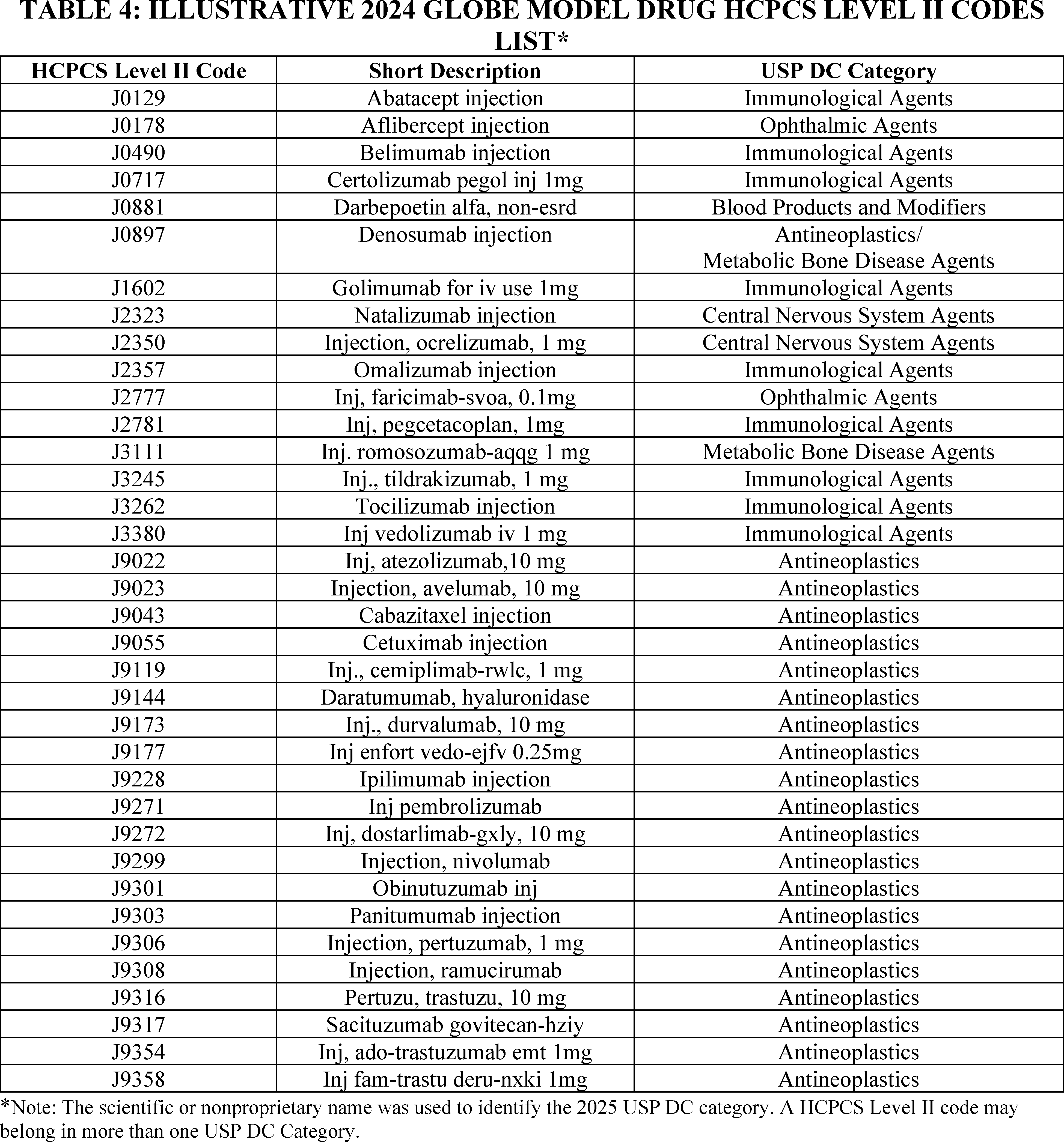
C. Defined Population
As stated in section II.C. of the GLOBE Model proposed rule (90 FR 60261), for the GLOBE Model design, we considered ways to identify the Medicare beneficiaries who would be eligible for inclusion in either the intervention or comparison groups. After considering a number of factors, we proposed to use a geographically randomized design such that the defined population for the GLOBE Model would be a set of CMS-selected OM Part B beneficiaries who are identified as eligible for inclusion in the model cohort as set forth in § 513.120 and receive a GLOBE Model drug (as set forth in § 513.130) during the model performance period for which separate Medicare Part B payment is made under the GLOBE Model. The OM Part B beneficiaries who are identified as eligible for inclusion in the model cohort would be included in the model cohort as a GLOBE Model beneficiary as of the date they are furnished a GLOBE Model drug for which separate Medicare Part B payment is made during the model performance period. GLOBE Model beneficiaries would be eligible for the GLOBE Model adjusted beneficiary coinsurance for GLOBE Model drugs, if applicable, and would remain in the model cohort unless they no longer meet the criteria for inclusion.
A GLOBE Model beneficiary may receive one or more GLOBE Model drugs. Specifically, we proposed that, prior to the model start, CMS would randomly identify the model geographic areas (based on ZIP Code Tabulation Areas as discussed in section II.F.2. of this final rule). We also proposed that, prior to model start and periodically thereafter, but no more frequently than weekly, CMS would identify eligible ( printed page 62979) OM beneficiaries (as set forth in § 513.120) and update the GLOBE Model eligible beneficiary list, which would be effective when the Medicare claims processing system are updated with the GLOBE Model eligible beneficiary list information. We proposed that the identification of eligible beneficiaries and the timing of such identification and updating of the GLOBE Model eligible beneficiary list and the Medicare claims processing systems, as well as the identification of OM beneficiaries who are eligible for inclusion in the comparison group, would be performed by CMS and would not be subject to review.
In § 513.120, we also proposed how CMS would identify the Medicare beneficiaries who would be eligible for inclusion in the model cohort and comparison group. In § 513.20, we proposed to define the term “GLOBE Model eligible beneficiary.” A GLOBE Model eligible beneficiary is a Medicare beneficiary who has been identified by CMS for potential inclusion in the model and added to the GLOBE Model eligible beneficiary list for some or a portion of the GLOBE Model performance period as set forth in § 513.120. Specifically, in § 513.120(b), we proposed that, approximately 30 days prior to model start using available Medicare program administrative information as determined by CMS, CMS would identify Medicare beneficiaries who are enrolled in Medicare Part B, have Original Medicare Part B as their primary payer, and have an address of record within the GLOBE Model geographic areas selected for inclusion in the model at model start (as identified by CMS under § 513.110(c)), as determined by CMS. These beneficiaries would encompass the beneficiaries who would be eligible for inclusion in the GLOBE Model at model start. CMS would add such beneficiaries to the GLOBE Model eligible beneficiary list and update the Medicare claims processing systems with such list for the first applicable calendar quarter of performance year one.
Similarly, in § 513.120(b)(2), we proposed that, approximately 30 days prior to model start using available Medicare program administrative information as determined by CMS, we would identify Medicare beneficiaries who are enrolled in Medicare Part B, have OM Part B as their primary payer, and do not have an address of record within the GLOBE Model geographic areas selected for inclusion in the model at model start (as identified by CMS under § 513.110(c)), as determined by CMS. These beneficiaries would be assigned as being eligible for inclusion in the comparison group as described in the evaluation section II.P. of this final rule.
To maintain a clear record of which beneficiaries are eligible for inclusion in the model cohort, in § 513.120(c), we proposed that, CMS would update the GLOBE Model eligible beneficiary list periodically, but not more frequently than weekly, using available Medicare program administrative information as determined by CMS, to: (1) identify the Medicare beneficiaries who are enrolled in Medicare Part B, have OM Part B as their primary payer, and have an address of record within the GLOBE Model geographic areas selected for inclusion (as identified by CMS under § 513.110(c)), are not yet included on the GLOBE Model eligible beneficiary list, are not assigned as eligible for the comparison group, and adds such beneficiaries to the GLOBE Model eligible beneficiary list at the next update; and (2) identify beneficiaries on the GLOBE Model eligible beneficiary list that no longer meet the criteria for a GLOBE Model eligible beneficiary and removes such beneficiaries from the GLOBE Model eligible beneficiary list at the next update. CMS would not routinely reevaluate the eligibility of beneficiaries who were identified as eligible for the comparison group. That is, beneficiaries who are identified as eligible for inclusion in the comparison group prior to model start would remain eligible for inclusion in the comparison group and model monitoring and analyses as determined by CMS. In § 513.120(d), we proposed beneficiary exclusions for clarity regarding the beneficiaries who would not be eligible for assignment to the GLOBE Model eligible beneficiary list or comparison group, as applicable: beneficiaries who do not have OM Part B as their primary payer, and beneficiaries who are enrolled in a MA plan, section 1876 of the Act cost plan, section 1833 of the Act healthcare prepayment plans, or who have other group health coverage that is a primary payer (such as employer-sponsored health insurance). In addition, § 513.120(d)(3) clarifies that beneficiaries who are identified by CMS as eligible for inclusion in the comparison group prior to model start remain eligible for the comparison group as determined by CMS.
We proposed that, for purposes of identifying a beneficiary's address and determining if the beneficiary's address is within the GLOBE Model geographic areas, we would use the beneficiary's address as recorded in CMS's Medicare Beneficiary Database (MBD), System No. 09-70-0536, at the time CMS identifies beneficiaries for inclusion in the model. We also proposed to define in § 513.20 the term “GLOBE Model geographic areas” as the set of ZIP Codes identified as set forth in § 513.110 (as discussed in section II.F. of this final rule). Under our proposed approach for identifying the defined population, beneficiaries who are identified by CMS as a GLOBE Model eligible beneficiary, at the start of the model or subsequently, would be added to the GLOBE Model eligible beneficiary list and remain on the list until the model ends or the beneficiary is no longer enrolled in OM or is otherwise ineligible for inclusion. For example, if a beneficiary is identified for inclusion on the GLOBE Model eligible beneficiary list based on the beneficiary's address as recorded in CMS's MBD being within the selected model geographic areas and then subsequently the beneficiary's address recorded in CMS's MBD changes such that the beneficiary no longer has an address within the GLOBE model geographic areas, the beneficiary would continue to be assigned as a GLOBE Model eligible beneficiary unless the beneficiary is no longer enrolled in OM or is otherwise ineligible for inclusion. Beneficiaries who become newly enrolled in OM due to becoming newly eligible for OM after the model begins and are identified by CMS as a GLOBE Model eligible beneficiary (because all criteria are met) would be added to the GLOBE Model eligible beneficiary list from the time CMS next updates the list and remain on the list unless the beneficiary is no longer enrolled in OM or is ineligible for inclusion. Beneficiaries for whom OM Part B switches from being a secondary payer to being the primary payer and who are identified by CMS as a GLOBE Model eligible beneficiary (because all criteria are met) would be added to the GLOBE Model eligible beneficiary list when CMS next updates the list and remain on the list unless the beneficiary is no longer enrolled in OM or is ineligible for inclusion. No other beneficiaries would be added to the GLOBE Model eligible beneficiary list. For example, the following changes would not enable beneficiary inclusion on the GLOBE Model eligible beneficiary list after the model starts: (1) beneficiaries who were enrolled in Medicare Part B at the time CMS creates the initial GLOBE Model eligible beneficiary list prior to the start of the model and had an address within CMS's MBD that was not selected as a GLOBE Model geographic area and then had an address change to a GLOBE Model geographic area; and (2) newly enrolled OM Part B beneficiaries with an address with a new ZIP Code that did ( printed page 62980) not exist at the time that the GLOBE Model geographic areas were identified. In addition, beneficiaries who were identified by CMS as being eligible for the comparison group would not be eligible for the model cohort. Testing the GLOBE Model in this population would allow the GLOBE Model alternative rebate amount calculation test to apply to a broad set of conditions, clinical settings, localities, and manufacturers rather than having the model test focus on a limited set of conditions, drugs (for example, only including drugs approved under section 505 of the FD&C Act) or a single type of clinical setting (for example, only including GLOBE Model drugs that are furnished in a physician's office). Defining the population broadly and in a manner that fosters a stable and consistent model cohort and comparison group would allow CMS to observe the implications of an alternative approach to determining the net Medicare payment for GLOBE Model drugs across a broad set of providers and suppliers and beneficiaries, as well as a large set of manufacturers.
The following is a summary of the comments received and our responses.
Comment: Many commenters stated that CMS does not reasonably identify a “defined population” with a demonstrated “deficit of care” as required under section 1115A(b)(2)(A) of the Act. Specifically, commenters stated that beneficiaries who receive a GLOBE Model drug within the randomly selected GLOBE geographic area do not constitute a stable or clinically coherent defined population. Commenters also stated that high Federal drug spending does not equate to a shortcoming in care leading to poor clinical outcomes or potentially avoidable expenditures, and that CMS provided no reasoned basis for distinguishing selected therapeutic categories from excluded ones. A commenter stated that by enacting the model through randomization, CMS is not identifying areas or populations with observed deficits of care through a baseline analysis. Additionally, commenters suggested that even if high spending were considered a valid deficit of care, CMS's proposal would not sufficiently rectify this deficit, because most beneficiaries have supplemental insurance that alleviates the coinsurance burden associated with Part B drugs. Further, a commenter stated that the model does not address access barriers that prevent patients from initiating or staying on guideline-directed therapy.
Response: We thank commenters for their feedback. While we acknowledge the concerns raised, CMS disagrees that the model does not have a defined population or a demonstrated deficit of care. Section 1115A(b)(2)(A) of the Act authorizes the Secretary to select models for testing where “there is evidence that the model addresses a defined population for which there are deficits in care leading to poor clinical outcomes or potentially avoidable expenditures.” The GLOBE Model addresses a defined population for which there are potentially avoidable expenditures and likely deficits of care due to high costs. As stated in section II.B., CMS proposed the GLOBE Model would include, as GLOBE Model drugs, a set of Part B rebatable drugs (single source drugs and sole source biological products) that are used to treat beneficiaries with conditions where there are potentially avoidable high program expenditures and access barriers due to high costs which likely contribute to deficits in care. Given the high disparity in prices for originator drugs in the U.S. as compared to other OECD member countries (single source drugs and sole source biological products),[149 150 151] we believe this data substantiates that there are potentially avoidable expenditures among Medicare beneficiaries who rely upon these high spend Part B rebatable drugs.
As stated in the GLOBE Model proposed rule, the GLOBE Model's defined population consists of Medicare beneficiaries residing in selected ZCTAs who receive a qualifying GLOBE Model drug. This population is defined in a non-arbitrary manner grounded in both geographic residence and drug utilization, providing a stable and identifiable basis for model participation. Further, randomizing ZCTAs enables a robust evaluation that identifies the effect of the Model on beneficiaries and produces generalizable results that can inform what would happen if the model were scaled nationally. Selecting geographic areas with the populations most affected by affordability challenges or access barriers would limit the generalizability of results.
We also note that other CMS Innovation Center models—including EOM, BPCI-Advanced Model, and the Comprehensive Care for Joint Replacement (CJR) Model—similarly define their populations based on an initiating therapy or an admission for an inpatient stay or specific procedure, rather than on clinical diagnosis alone. Other examples include the family of ACO models such as the ACO REACH Model which define their beneficiary population based on an Evaluation and Management visit with a participating provider. The selection of ZCTAs to represent 25 percent of Medicare beneficiaries strengthens the evaluation and testability of the GLOBE Model by enabling the formation of a treatment group that directly benefits from the model's intervention and a comparison group that does not, supporting a rigorous assessment of the model's impact.
Additionally, high drug costs lead to potentially avoidable expenditures and can limit access to care and treatment, which can result in poor clinical outcomes. For example, financial distress has been attributed as a risk factor for mortality after cancer diagnosis, and high coinsurance amounts likely limit the use of certain cancer treatments.[152 153] Previous analyses have shown that U.S. originator drugs are, on average, about 422 percent more expensive in the U.S. than in non-U.S. OECD countries. Other studies indicate that growth in Medicare Part B drug spending has largely been driven by single source drugs and sole source biological products.
Further, CMS has initially focused the model test on seven USP DC categories that will target patients in therapeutic areas most likely to experience significant financial burden due to high drug costs. As shown in Tables 2 and 3 of the GLOBE Model proposed rule (90 FR 60244 through 60254), the seven USP DC categories are associated with the therapeutic areas representing the highest percentage of total OM Part B drug spending among the top 50 ( printed page 62981) Medicare Part B drugs by expenditure. Specifically, analysis of 2024 OM Part B rebatable drug spending data indicates that these 7 USP DC categories were responsible for 91 percent of OM Part B rebatable drug spending. Consistent with section 1115A of the Act, we believe the GLOBE model will reduce program expenditures and would not only preserve quality of care, but enhance it by addressing access barriers that may prevent beneficiaries from initiating or staying on guideline-directed therapy by improving affordability and access.
CMS believes that the GLOBE Model will result in meaningful cost savings, including through a reduction in total out-of-pocket expenditures for Medicare beneficiaries, as indicated in Table 14 in section IV.D. of this final rule.
Comment: Commenters raised concerns about potential detrimental effects on health equity and different population subgroups. Commenters expressed concern that excluding MA beneficiaries from the GLOBE Model would leave out a large share of underserved populations, such as Latino seniors, and would exacerbate inequities between OM and MA beneficiaries.
Response: CMS thanks the commenters for their feedback. CMS believes that the GLOBE Model has the potential to benefit beneficiaries residing in GLOBE Model-selected geographies by reducing their coinsurance when they receive a GLOBE Model drug and their Medicare Part B premiums as further discussed in section IV.D. CMS will monitor the impact of the GLOBE Model on beneficiary access to monitor and address potential access challenges that may arise under the model.
With respect to commenters' concerns about the exclusion of MA beneficiaries, CMS acknowledges that MA enrollment is disproportionately higher among certain underserved populations, including Latino seniors, and that excluding MA beneficiaries from the GLOBE Model may limit the reach of the model's potential benefits to those populations. However, CMS declines to include MA beneficiaries in the defined population at this time. This decision is consistent with the structure of the Medicare Part B Drug Inflation Rebate Program which, at this time, does not include MA units in Medicare Part B drug inflation rebate amount calculations due to operational considerations. Therefore, we are not including MA beneficiaries within the GLOBE Model. Beneficiaries who are eligible for the GLOBE Model defined population but subsequently enroll in a MA plan will no longer be GLOBE Model eligible beneficiaries. However, if such a beneficiary returns to OM during the GLOBE Model performance period, they would once again become a GLOBE Model eligible beneficiary. We will revisit this topic for future consideration should the Medicare Part B Drug Inflation Rebate Program include MA units in Medicare Part B drug inflation rebate amount calculations.
Comment: A commenter raised concerns about how they, as a health care provider, would meet compliance requirements such as monitoring drug inclusion lists and potential updates to billing systems. The commenter cited their own resource constraints, including direct financial risk exposure, acquisition cost-to-reimbursement instability, additional operation burdens, and long-term duration of the model test, as grounds for requesting an exemption from the model.
Response: CMS thanks the commenter for its concern. CMS believes that the GLOBE Model will not impose additional compliance requirements on providers, including on the specific commenter. Further, the allowable payment limits for separately payable GLOBE Model drugs will continue to be based on the applicable non-model methodology, generally ASP+6 percent, which is intended to provide a stable reimbursement baseline. As with the Medicare Part B Drug Inflation Rebate Program, when the GLOBE Model beneficiary coinsurance adjustment for GLOBE Model Drugs applies, CMS would adjust the Medicare payment to the provider or supplier for a separately payable GLOBE Model drug claim in the same manner as under the Medicare Part B Drug Inflation Rebate Program as set forth in 42 CFR 410.152(m) and, for hospital outpatient department services, 42 CFR 419.41(e). That is, the Medicare payment amount is correspondingly adjusted and would be equal to the allowed amount for the GLOBE Model drug minus the product of the GLOBE Model beneficiary coinsurance percentage and the allowed amount, assuming no other claim adjustment applies. As the GLOBE Model uses existing methods for provider reimbursement, providers do not need additional resource(s) because of the GLOBE Model. CMS has considered these concerns in the design of the GLOBE Model and declines to provide blanket exemptions at this time.
Comment: Several commenters raised concerns about equity arising from the reduced coinsurance benefit being limited to beneficiaries in GLOBE Model-selected regions, as well as concerns about the use of randomization at the ZCTA level. A commenter stated that geographic randomization may deepen existing racial and regional inequalities, noting that residential segregation and concentrated poverty often follow ZIP Code patterns. Another commenter raised concern that, given the rarity of orphan diseases, geographic randomization could disproportionately select beneficiaries with orphan diseases into the GLOBE Model. A commenter recommended that beneficiaries within a ZCTA be individually randomized into comparison or model intervention group, citing concerns about social determinants of health.
Response: We thank commenters for their thoughtful comments and sharing areas of concern. CMS believes that it is important to retain the geographic selection approach, under which a portion of Medicare beneficiaries are enrolled into the GLOBE Model, so that we can compare the outcomes of beneficiaries in GLOBE Model-selected areas to those in non-selected areas. Positive impacts observed among GLOBE Model beneficiaries could inform potential expansion of the model to all beneficiaries consistent with section 1115A(c) of the Act.
With respect to the use of ZCTAs as the unit of randomization, CMS believes that ZCTA-level selection is sufficiently granular to achieve a balanced representation of beneficiaries across important socioeconomic and clinical characteristics. Regarding concerns about patterns associated with ZIP Codes, CMS notes how ZCTAs differ from ZIP Codes. ZIP Codes are not geographic areas and are based on mail delivery routes. As a result, ZIP Codes create unequal sizes which, when randomized, can inadvertently over- or under-represent certain communities. ZCTAs are designed to enable better statistical analysis and can more uniformly represent communities compared to analyses based on ZIP Codes. CMS does not anticipate that the model will result in harm to beneficiaries, as the model reduces coinsurance for GLOBE Model beneficiaries and does not restrict access to covered drugs.
Further, in response to commenters' concerns about the potential disproportionate inclusion of beneficiaries who use orphan drugs, CMS has decided to exclude Part B rebatable drugs that are designated as a drug for one or more rare diseases or conditions under section 526 of the Federal FD&C Act (21 U.S.C. 360bb) and for which the only approved indication (or indications) is for one or more such rare diseases or conditions from the ( printed page 62982) GLOBE Model. This exclusion should address concerns about the potential disproportionate selection of beneficiaries using orphan-only drugs. Refer to section II.B.2. and § 513.130(c) for details on how we identify orphan drugs for exclusion.
Comment: A commenter stated that beneficiaries will not see the cost savings at the point of sale.
Response: CMS disagrees. As stated in § 513.210, beneficiaries in the GLOBE Model would benefit from reduced coinsurance as applicable when they receive a qualifying GLOBE Model drug, particularly beneficiaries who do not have supplemental insurance that covers the costs of coinsurance. In addition, CMS expects that Medicare beneficiaries will experience a reduction in Medicare Part B premiums as a result of the GLOBE Model.
Final Decision: After consideration of the public comments received, CMS is finalizing the provisions at § 513.120 with two technical modifications. Due to changes in the dates establishing the start of the model and the model performance period, CMS is revising § 513.120(b). CMS will establish the initial assignment of beneficiaries as eligible for the model cohort or comparison group approximately 30 days prior to the first model performance period which begins April 1, 2027, instead of the model start date. Due to operational constraints in the CMS claims processing systems, in § 513.120(c), CMS is finalizing that the GLOBE Model Eligible Beneficiary List updates will occur no more frequently than monthly. CMS has also made minor terminology updates to § 513.120(c)(2) for clarity. As discussed in the preceding comment-and-response section, these provisions establish model-specific requirements necessary to support the administration and evaluation of the GLOBE Model.
CMS has also made technical corrections to the regulatory text at § 513.20 to address a drafting error which inadvertently omitted a phrase from the definition of “GLOBE Model geographic areas.” As corrected, “GLOBE Model geographic areas” means the set of ZIP Codes in the U.S., excluding U.S. territories, identified in accordance with § 513.110. Finally, CMS has clarified the regulatory text at § 513.20 to address a drafting error which inadvertently omitted a phrase from the definition of “GLOBE Model beneficiary.” As corrected, “GLOBE Model beneficiary” means a Medicare beneficiary who has been identified by CMS as set forth in § 513.120 for inclusion in the model, added to the model cohort for all or a portion of the GLOBE Model performance period and is furnished a GLOBE Model drug for which OM Part B makes separate payment under the model as determined by CMS. We have also deleted § 513.120(e) as this definition is redundant with the definition of “GLOBE Model beneficiary” in § 513.20.
D. Scale for Inclusion of GLOBE Model Beneficiaries
Section 1115A(b) of the Act gives the Secretary discretion in the design of models, including the geographic reach of models. Section 1115A(a)(5) of the Act states that the Secretary may elect to limit testing of a model to certain geographic areas. Testing a model in randomly selected geographic areas facilitates identification of the intervention and comparison groups for model implementation. In developing our proposal, we considered the variation in cost and use in the Medicare population of proposed GLOBE Model drugs along with other aspects of the proposed model design and determined that a sufficient allocation between intervention and comparison groups for achieving precise estimates in tests is approximately 25 percent of OM beneficiaries. To determine the geographic areas that CMS would use to identify approximately 25 percent of OM beneficiaries as GLOBE Model eligible beneficiaries, we proposed that CMS would select geographic regions to represent 25 percent of OM beneficiaries (as described in section II.F.2. of this final rule).
The following is a summary of the comments received and our responses.
Comment: A commenter expressed concern that only 25 percent of OM beneficiaries will benefit from reduced coinsurance under the GLOBE Model. The commenter asked whether the remaining 75 percent of beneficiaries would benefit from reduced cost sharing, and how CMS would ensure rebate dollars collected under the model are returned to beneficiaries.
Response: We thank the commenter for their feedback. Under the GLOBE Model, only eligible beneficiaries residing in a GLOBE Model-selected region—representing approximately 25 percent of OM beneficiaries and spending—as identified by CMS would benefit from reduced coinsurance when they receive a GLOBE Model drug. Limiting the coinsurance reduction to beneficiaries in selected regions is a deliberate design choice that allows CMS to evaluate the model's impact by comparing the experiences of beneficiaries in selected regions to those in non-selected regions.
Regarding the disposition of rebate dollars, GLOBE Model rebates collected by CMS would be deposited into the Federal Supplementary Medical Insurance Trust Fund. While rebates are not returned directly to individual beneficiaries, their deposit into the Federal Supplementary Medical Insurance Trust Fund would enable reductions in the Medicare Part B premium and help sustain the financial integrity of the Medicare Part B program, which benefits Medicare beneficiaries and American taxpayers broadly.
Comment: Commenters believed that only 0.3 percent of OM Part B beneficiaries would be exposed to changes in their cost-sharing under the proposed coinsurance methodology. The commenter posited that because the model reaches only a small fraction of the beneficiary population, CMS would be unable to generate reliable data sufficient to meaningfully “test” the model's effectiveness.
Response: We disagree with the commenters' assertion that CMS will lack sufficient data to test the effectiveness of the GLOBE Model.
While commenters cited a figure of 0.3 percent of OM Part B beneficiaries being exposed to cost-sharing changes, CMS notes that the relevant consideration for model testability is not solely the percentage of the total beneficiary population affected, but rather the absolute number of eligible beneficiaries in the defined population and the breadth and rigor of the evaluation design. The GLOBE Model is designed to select beneficiaries residing in ZCTAs representing approximately 25 percent of OM beneficiaries and OM spending, providing a substantial population from which to draw meaningful comparisons.
The model reduces the coinsurance liability for beneficiaries who use a GLOBE Model drug, thereby reducing direct out-of-pocket costs. Notably, even among beneficiaries with supplemental insurance coverage, the potential change in out-of-pocket spending yields a meaningful effect and sample size to test the model's effects on patient experience. CMS believes that the model's evaluation framework is designed to generate reliable and actionable data to assess the GLOBE Model's effectiveness.
Comment: Several commenters cited potential concerns about operational complexity stemming from the GLOBE Model's geographic design. Commenters stated that practices treating patients from both included and excluded geographic areas would effectively need to maintain parallel systems, potentially ( printed page 62983) resulting in two different reimbursement rates for the same drug and creating additional administrative and billing burdens. Additional specificity was requested regarding the mechanics of beneficiary cost-sharing adjustments, with a specific request for additional operational guidance and information to support providers in verifying reimbursement accuracy.
Response: CMS thanks commenters for their feedback and clarifying questions. For GLOBE Model drugs, provider payment continues to be based on the Medicare Part B allowed amount (in general ASP+6 percent, as applicable) regardless of whether a beneficiary participates in the GLOBE Model, ensuring that providers are not negatively impacted. CMS does not require that providers create or maintain systems separate from and parallel to existing claims reimbursement systems to account for different reimbursement and we do not believe that it would be necessary for providers to do so. CMS acknowledges that beneficiaries who are selected in the model may have a coinsurance reduction that does not apply to beneficiaries who are not selected in the model. Patient liability differences (deductibles, coinsurance, and copay) across patients is a common occurrence for a provider that serves a population with different types of health insurance coverage. While this business situation can be challenging and a potential source of abrasion for providers if all of what a patient owes is not collected by the provider, we note that when the GLOBE Model beneficiary coinsurance reduction would apply, the Medicare program would pay the provider an amount that is greater than the typical 80 percent of the Medicare Part B allowed amount, reducing provider exposure to uncollected amounts and expenses related to collection.
To assist providers to anticipate when the GLOBE Model beneficiary coinsurance adjustment may apply, CMS will publish the ZIP Codes that constitute the GLOBE Model geographic regions, which would enable providers to identify if their OM patients may have been selected into the model and therefore may qualify for reduced coinsurance. CMS will also publish quarterly the GLOBE Model Drug HCPCS Level II Codes List with the applicable GLOBE Model beneficiary coinsurance percentage. Providers will continue to be informed of the coinsurance amounts owed by their beneficiaries as part of usual Medicare claims processing. CMS does not anticipate that providers will require additional support beyond these resources and the usual existing claims process to ensure accurate collection of coinsurance from their beneficiaries. Further, because Medicare Part B payment limits for separately payable drugs are updated quarterly, we believe that providers have established expertise in adjusting their estimates of the coinsurance amounts that beneficiaries would owe and that any additional effort related to the GLOBE Model would be minimal, particularly because providers commonly identify beneficiary coinsurance after all applicable payers have adjudicated a claim.
In addition, to enhance awareness of the GLOBE Model including coinsurance adjustment, CMS will publish technical documents—including Frequently Asked Questions (FAQs) and factsheets—on the GLOBE Model website that will be publicly accessible to beneficiaries, providers, and other interested parties.
Comment: A commenter supports the approach whereby providers would not be required to calculate the adjusted beneficiary coinsurance or adjusted Medicare Part B rebatable drug payments.
Response: CMS acknowledges the commenter's support for our approach. We note that providers would not be required to calculate the GLOBE Model beneficiary coinsurance amount for a GLOBE Model drug because the usual Medicare Part B claims process will inform the provider of the beneficiary liability based on the GLOBE Model beneficiary coinsurance percentage and the adjusted Medicare payment when applicable.
Comment: A commenter requested clarification on how CMS would address circumstances in which a beneficiary relocates or seeks care outside their GLOBE Model selected geographic area, and how CMS will handle mid-year address changes or retroactive corrections with respect to their effect on beneficiary eligibility and cost-sharing under the model.
Response: We thank the commenter for this question. As described in section II.D. of the GLOBE Model proposed rule (90 FR 60244 through 60254) and codified at § 513.120, a beneficiary's eligibility in the GLOBE Model is determined solely by CMS in part by their address of record at certain points in time. Once eligibility is established by CMS, a beneficiary's subsequent change in address during the GLOBE Model performance period would not alter their eligibility status. Similarly, the location where a beneficiary seeks care, including care received inside or outside the GLOBE Model selected geographic area, would not affect their eligibility or their entitlement to the GLOBE Model reduced coinsurance applicable to GLOBE Model beneficiaries. If a need to correct a beneficiary's selection into the model is identified by CMS, CMS would make the appropriate corrections to the GLOBE Model Eligible Beneficiary List as determined by CMS as set forth in § 513.120.
Comment: A commenter stated that the GLOBE Model creates manufacturer administrative complexity by imposing different rebate methodologies depending on geographic area in which their Part B drugs are administered. The commenter further stated that this complexity is compounded because the same drug may be administered across multiple provider settings, which bill Medicare separately and may be located in different ZCTAs.
Response: We thank the commenter for raising this concern. CMS agrees that under OM, the provider setting plays a role in determining how a drug is covered, billed, and paid. That is, OM has separate payment systems for covered drugs delivered in inpatient, outpatient, and other healthcare settings. CMS also recognizes that the model's rebate methodology is restricted to GLOBE Model geographic areas. This restricted geographic approach enables testing and evaluation of the model's effects on reducing program costs while preserving or enhancing quality. CMS also does not expect a significant increase in administrative complexity for manufacturers under the model since there are no enrollment procedures and CMS handles rebate invoicing for the rebate methodologies employed under both the GLOBE and non-GLOBE regions. CMS estimates the paperwork burden on manufacturers who voluntarily submit international drug net pricing data will be marginal and that manufacturers should be able to absorb these reporting costs. We refer readers to section IV.D.3. of this final rule for additional discussion on paperwork burden. With respect to manufacturer obligations related to GLOBE Model rebates reports, invoicing, and reconciliation, we refer readers to section II.G.8. of this final rule for additional comment and responses.
Comment: A commenter recommended applying the GLOBE Model to 100 percent of Medicare beneficiaries, suggesting that the proposed 25 percent coverage would not constitute a large enough lever for influencing international pricing behavior or for assessing whether foreign markets would respond to the ( printed page 62984) model by adjusting their prices. An additional commenter asked CMS to elaborate on why it did not adopt a nationwide policy, beyond what is described in the GLOBE Model proposed rule regarding how the current geographic selection facilitates a representative comparison group.
Response: CMS thanks the commenters for their feedback. With respect to the suggestion to apply the GLOBE Model to 100 percent of Medicare beneficiaries, CMS believes that a national scope is not necessary to test the concept of the model. As provided in section 1115A(a)(5) of the Act, the Secretary may elect to limit testing of a model to certain geographic areas: the statute expressly contemplates limited geographic testing. The selection of geographic areas representing 25 percent of OM beneficiaries is consistent with this statutory authority and is designed to enable a rigorous evaluation of the model's effects.
A critical element of the GLOBE Model's evaluation design is the creation of a comparison group—beneficiaries who are not selected into the model—against which the outcomes of GLOBE Model beneficiaries can be assessed. If the model were implemented across 100 percent of OM beneficiaries, there would be no sufficiently sized comparison group of beneficiaries not selected into the model test, which would make it harder for CMS to reliably attribute observed changes in spending or quality to the model's intervention. Consistent with section 1115A of the Act, one goal of this model is to test if Medicare spending can be reduced while preserving or enhancing beneficiary quality of care. Influencing international pricing behavior and foreign markets is not the objective of the GLOBE Model and will not be assessed as part of the model.
Final Decision: After consideration of the public comments received and are discussed here and in section II.F. of this final rule regarding operational complexity, CMS is finalizing the provisions at § 513.110 with slight modifications. In § 513.110(a), CMS proposed to randomly select GLOBE Model geographic areas no later than 60 calendar days prior to the start of the model performance period. In response to comments, CMS is finalizing that CMS will randomly select GLOBE Model geographic areas no later than 90 calendar days prior to the start of the model performance period, April 1, 2027. In § 513.110(c), CMS proposed that no later than 30 calendar days in advance of the model start, CMS would provide a table on the GLOBE Model website that lists the GLOBE Model geographic areas by ZIP Code. In response to comments, CMS is finalizing that CMS will provide a table on the GLOBE Model website that lists the GLOBE Model geographic areas no later than 75 calendar days prior to the start of the model performance period, April 1, 2027.
E. Model Participants
1. Mandatory Participation of Manufacturers of GLOBE Model Drugs
In section II.E.1. of the GLOBE Model proposed rule (90 FR 60262), we proposed that model participation would be mandatory for all manufacturers of GLOBE Model drugs (as described in section II.B. of this final rule) that are furnished to a GLOBE Model beneficiary during the GLOBE Model performance period. We proposed that, for purposes of the GLOBE Model, “manufacturer” would have the same meaning as that term is defined and used in section 1847A(c)(6)(A) of the Act and 42 CFR 427.20. We note that this is consistent with how CMS defines “manufacturer” for purposes of the Medicare Part B Drug Inflation Rebate Program. We also note that the proposed GLOBE Model drugs, as single source drugs and sole source biological products, usually have one manufacturer. However, there could be GLOBE Model drugs for which multiple manufacturers report ASP data to CMS, for example, when there is a repackager or relabeler or when more than one manufacturer markets a single source drug or sole source biological product within the U.S. In such cases, we proposed that all manufacturers of a GLOBE Model drug would be required to participate in the GLOBE Model.
We proposed to define “GLOBE Model participant” as a manufacturer of a GLOBE Model drug that is required to participate in the GLOBE Model in accordance with proposed § 513.100. We proposed that there would be no specific enrollment activities for GLOBE Model participants; rather, their participation would be effectuated by the requirements under the Medicare Part B Drug Inflation Rebate Program, and where applicable, the application of the proposed GLOBE Model calculation for the GLOBE Model rebate amount. Mandatory participation can enhance the generalizability of model results, as mandatory model participants may be more broadly representative of all entity types that could be affected by a model. Requiring manufacturer participation in the GLOBE Model would allow us to observe the experiences of manufacturers of drugs with diverse characteristics. Further, we believe mandatory participation in the GLOBE Model would be essential to the model test because we believe that, despite the potential for the GLOBE Model to lower beneficiaries' financial liability for a manufacturer's Part B rebatable drug and reduce financial barriers to access such drugs which could increase utilization of such drugs, manufacturers of proposed GLOBE Model drugs would likely not volunteer to participate in this model.
In the proposed § 513.100(a), we proposed to codify that model participation would be mandatory for all manufacturers of GLOBE Model drugs.
We considered excluding manufacturers where the U.S. manufacturer may not be the same entity that is responsible for sales in other countries. Another option we considered was to exempt manufacturers that had existing sales or licensing agreements with other entities outside of the U.S. to sell GLOBE Model drugs prior to the publication of the GLOBE Model proposed rule. However, we were concerned about the possibility of manufacturers transferring responsibilities to other entities to avoid model participation. We also considered an application process through which a manufacturer could qualify for a model exemption given their lack of responsibility for sales of drugs outside of the U.S. However, given the complex nature of manufacturer relationships outside of the U.S., such an exclusion might potentially be too broad, diluting CMS's ability to rigorously evaluate the model's impact on costs and quality. Having considered these alternatives, CMS did not propose such exclusions. We also sought comment on other factors, for example, manufacturer size, that CMS could consider exempting certain manufacturers while maintaining sufficient model participation and a robust model test.
We sought comments on our proposal for mandatory participation in the GLOBE Model by all manufacturers that may be subject to the model (that is, manufacturers of Part B rebatable drugs that could be designated as GLOBE Model drugs pursuant to the criteria in proposed § 513.130). We also sought feedback on whether manufacturers of proposed GLOBE Model drugs would voluntarily participate in the proposed GLOBE Model absent a mandatory participation requirement and feedback on evidence that could support a voluntary participation approach which would ensure sufficient model participation for a robust model test and ( printed page 62985) evaluation during performance year 1 and thereafter.
The following is a summary of the comments received and our responses. Comments received regarding manufacturers with existing sales or licensing agreements with other entities outside of the U.S are addressed in section II.G. of this final rule.
Comment: Several commenters recommended that CMS make the GLOBE Model voluntary rather than mandatory. These commenters stated that mandatory participation may create operational strain, undermine evaluation integrity, and introduce unintended market disruptions, particularly for providers and supply chain stakeholders.
Response: We disagree with the commenters. We believe mandatory participation is necessary to ensure sufficient sample sizes and reduce known areas of bias to increase the rigor and strength of the evaluation of the GLOBE Model's effects on program expenditures, access, and quality of care.
First, we believe that despite the potential for the GLOBE Model to lower beneficiaries' financial liability and reduce financial barriers to access, which could increase utilization of GLOBE Model drugs, manufacturers would likely not volunteer to participate, given that the model's rebate mechanism reduces their effective reimbursement. As such, we believe the GLOBE Model would have few voluntary participants. Mandatory participation also allows for a broader set of manufacturers with varying characteristics to be included in the model and limits selection bias inherent to any model in which participants elect whether they will participate. A voluntary model would therefore risk selection bias, may lead to no model participants, and therefore, undermine the integrity of the evaluation, limiting CMS's ability to draw meaningful conclusions about the model's impact on program expenditures and beneficiary quality of care.
Second, mandatory participation enhances the generalizability of model results, as participants are more broadly representative of all entity types that could be affected by the model, allowing CMS to observe the experiences of a diverse range of manufacturers of drugs with diverse characteristic types.
Third, CMS disagrees with commenters that mandatory participation would undermine evaluation integrity. Mandatory participation supports a more rigorous evaluation design by reducing self-selection and enabling more reliable comparisons across model and non-model populations. As described in section II.P., CMS has designed the model to support causal inference through geographic randomization and the use of comparison groups, which further strengthens evaluation integrity.
With respect to commenters' concerns regarding operational strain and market disruptions, CMS plans to monitor utilization, access, and quality of care throughout the model test period for unintended impacts on providers, supply chain stakeholders, and beneficiaries, as described in sections II.J., II.L., and II.P.
Comment: A couple of commenters supported CMS's proposal of mandatory manufacturer participation, stating that a mandatory approach is necessary to ensure consistent application of the model and enable meaningful evaluation.
Response: We thank the commenters for their support. We agree that a mandatory approach is necessary to ensure consistent application of the model and to support a robust and unbiased evaluation of its effects on expenditures, access, and quality of care, consistent with CMS's authority under section 1115A of the Act.
Comment: Many commenters expressed concern that mandatory participation would disproportionately affect small and mid-size biotechnology companies with limited product portfolios. Commenters stated that these companies may face financial constraints that limit their ability to absorb pricing changes and that such pricing changes could reduce investment in research and development. Several commenters also recommended that CMS consider exemptions or alternative thresholds for smaller manufacturers, including adjustments based on company size, revenue exposure, or stage of development.
Commenters recommended several potential exemptions, including exempting from the model drug manufactured by companies with fewer than 500 employees and no prior commercialized products from the $100 million Medicare Part B threshold; considering the length of time elapsed since a manufacturer's first FDA product approval as a criterion for defining a small manufacturer; excluding manufacturers whose Medicare Part B prescription drug spending constitutes less than 1.0 percent of total Medicare Part B prescription drug spending; and raising the $100 million Medicare Part B allowed charges threshold for drugs as an alternative means of limiting the model's applicability to small manufacturers.
Response: CMS recognizes commenters' concerns that mandatory participation could disproportionately affect small and mid-size biotechnology companies, including potential impacts on financial capacity and research and development investments. The GLOBE Model drug inclusion and exclusion criteria finalized in this final rule and codified at § 513.130, focus the model test on drugs and biological products with high program expenditures and target areas with the greatest opportunity to reduce Medicare spending, while excluding categories of products for which participation could confound the model test. Additionally, the GLOBE Model contains exclusions for orphan-only drugs,[154] plasma-derived products as set forth in 42 CFR 427.400, and drugs listed by FDA as Approved Cellular and Gene Therapy products out of an abundance of caution to prevent commenters' concerns on orphan-only drugs, CGTs, and plasma-derived products from manifesting for Medicare beneficiaries who may rely upon such drugs. These criteria are intended to appropriately scope the model and limit participation to drugs that meaningfully contribute to Medicare Part B spending, rather than targeting manufacturers based on company size, revenue exposure, or stage of development.
However, CMS considered the commenters' concerns in developing the final design of the model and in the regulatory impact analysis (RIA) included in this final rule. As discussed in section IV. of the final rule, CMS assessed the potential impact of the GLOBE Model on small entities and determined that the final rule will not have a significant economic impact on a substantial number of small entities by the GLOBE Model largely due to the final drug exclusions identified in § 513.130(c). Additionally, we note that the $100 million spending threshold is a high bar that is unlikely to be met by drugs from small or mid-sized manufacturers unless those drugs have achieved significant market penetration. As previously mentioned, an internal analysis found that a lower spending threshold of $50 million would increase the number of small manufacturer participants to 9. We refer the ( printed page 62986) commenters to the introduction of section II. and section II.B. of this final rule for our additional responses related to investments in research and development where we discuss in detail the reasons we do not believe the model will directly and materially affect investments and innovation.
CMS also considered, but declines to adopt, the alternative approaches suggested by commenters to exempt or tailor participation for small or mid-size manufacturers, including thresholds based on number of employees, time since first FDA approval, share of Medicare Part B spending, increased spending thresholds for included drugs, the number of approved products in a manufacturer's portfolio, or portfolio concentration. We note that we are excluding orphan-only drug drugs which is a drug-specific exclusion, not manufacturer-specific. Given that this model is not expected to have a significant impact on a substantial number of small entities, CMS does not believe additional exemptions are necessary or appropriate. Specifically, our RIA shows that this final rule will impact one small firm, with that impact estimated to represent 2.3 percent or less of that firm's annual U.S. revenue. CMS believes that applying the model's criteria uniformly is necessary to support a comprehensive evaluation of its effects on expenditures, access, and quality of care; adjusting participation for small or mid-sized manufacturers would limit CMS's ability to evaluate the effects of an alternative rebate amount calculation across a diverse and generalizable set of manufacturers.
Final Decision: After consideration of the public comments received, CMS is finalizing the provisions at § 513.100(a) with minor technical modification for clarity, which establishes the requirement for participation by all manufacturers of GLOBE Model drugs (as described in section II.B. of this final rule) that are furnished to a GLOBE Model beneficiary during the GLOBE Model performance period.
2. Model Participation Requirements
As discussed in section II.E.2. of the GLOBE Model proposed rule (90 FR 60263), in § 513.100, we proposed to codify GLOBE Model participant requirements during the GLOBE Model test period. During the GLOBE Model test period described in proposed § 513.100(b), we proposed that GLOBE Model participants must—
- Adhere to the proposed GLOBE Model rebate payment instructions as proposed in § 513.740 and established by CMS and its contractors responsible for providing rebate reports containing GLOBE Model rebate amounts and processing payments, including without limitation those described in proposed § 513.500, to ensure appropriate and accurate GLOBE Model rebate payments; and
- Participate in GLOBE Model monitoring and evaluation activities in accordance with42 CFR 403.1110(b), including collecting and reporting of information as the Secretary determines is necessary to monitor and evaluate the GLOBE Model.
- If electing to submit international drug net pricing data, adhere to the requirements set forth in proposed § 513.610 and the GLOBE Model data agreement.
In addition, for GLOBE Model participants that elect to submit international drug net pricing data, for the applicable ASP calendar quarter beginning April 1, 2025 (which as shown in Table 1 in the GLOBE Model proposed rule (90 FR 60253) would align with the applicable calendar quarter for the proposed model start (fourth quarter of 2026)), we proposed that such GLOBE Model participants would be required to adhere to the requirements set forth in proposed § 513.620 and the GLOBE Model data agreement prior to the start of performance year 1.
Based on comments received and discussed in section II.A. of this final rule, CMS is modifying the model start date to be January 1, 2027 as specified in § 513.1(c). The initial reporting quarter for voluntary manufacturer-submitted international drug net pricing data begins on January 1, 2027, for the applicable ASP calendar quarter beginning October 1, 2026, which aligns with the first quarter of performance year 1 that begins on April 1, 2027.
We sought comments on our proposal for model participation requirements from potential GLOBE Model participants.
We refer readers to section II.G.6. of this final rule for a discussion of the option for eligible manufacturers of separately payable Part B single source drugs and sole source biological products determined to be GLOBE Model drugs to voluntarily submit manufacturer international net drug pricing information to CMS for purposes of identifying a per unit Method II GLOBE Model benchmark which could potentially lower the total GLOBE Model rebate amount that a GLOBE Model participant would be responsible for. If electing to submit international drug net pricing data, we proposed that the manufacturer must adhere to the requirements set forth in proposed § 513.610 and in the proposed GLOBE Model data agreement as described in proposed § 513.620.
We did not receive any comments on the proposed model participation requirements and are therefore finalizing § 513.100(b) and (c) with conforming modifications to align with the finalized model test period as set forth in § 513.1(c).
3. Standard Provisions
In section II.E.3. of the GLOBE Model proposed rule (90 FR 60263), we proposed that the Standard Provisions for CMS Innovation Center Models, originally established in 42 CFR part 512, subpart A and applicable to certain CMS Innovation Center models, would not apply to the GLOBE Model. Given the unique characteristics and operational framework of the GLOBE Model, we believe it differs substantially from most mandatory CMS Innovation Center models. Therefore, rather than applying the Standard Provisions, we proposed implementing GLOBE-specific requirements that would provide the necessary regulatory specificity and flexibility to effectively test and evaluate the GLOBE Model's innovative approach.
We proposed specific audit, record access, and retention requirements for manufacturers participating in the GLOBE Model. These provisions are essential to ensure program integrity, enable proper oversight of the model's implementation, and protect the interests of Medicare beneficiaries and the Federal government. Given the unique structure and operational characteristics of the GLOBE Model, we believe it is necessary to establish clear audit rights, record access requirements, and retention standards that are specifically tailored to this model's framework.
We proposed at § 513.100(d)(1) to establish explicit Federal audit rights to ensure that CMS, HHS, the Comptroller General, and their designees maintain comprehensive oversight authority over GLOBE Model implementation. This provision is necessary to verify compliance with model requirements, assess program effectiveness, and identify potential areas for improvement or corrective action.
We proposed at § 513.100(d)(2) record access requirements to ensure that manufacturers maintain and give access to all documentation necessary for effective oversight. This includes, but is not limited to, records supporting the accuracy of voluntarily-submitted data and documentation related to CMS identified program integrity issues. Such access is critical for validating manufacturer-reported information and ( printed page 62987) ensuring the model operates as intended.
We proposed at § 513.100(d)(3) a 6-year retention period for GLOBE Model-related records, with extensions under specific circumstances. This timeframe aligns with standard Federal audit and investigation cycles while providing flexibility for situations involving disputes, fraud allegations, or special retention needs identified by CMS. The proposed retention requirements balance the need for thorough oversight with reasonable administrative burden on participating manufacturers.
We proposed at § 513.100(d)(4) that in the event we terminate the GLOBE Model, we would provide written notice to GLOBE Model participants specifying the grounds for termination and the effective date of such termination. As provided by section 1115A(d)(2) of the Act, termination of the model under section 1115A(b)(3)(B) of the Act would not be subject to administrative or judicial review.
We sought comment on our proposed requirements for audit, record access, and record retention, and model termination parameters for GLOBE Model manufacturers.
The following is a summary of the comments received and our responses.
Comment: A commenter stated that the GLOBE Model-specific requirements are vague and appear duplicative of standard CMS Innovation Center provisions and requested clarification on why GLOBE-specific requirements are needed to test and evaluate the model. Specifically, the commenter requested clarification on how the proposal at § 513.100(d)(1) in the GLOBE Model proposed rule (90 FR 60244 through 60336) differs from the general CMS Innovation Center model requirements at 42 CFR part 512(a). Additionally, the commenter requested clarification on § 513.100(d)(3) in the GLOBE Model proposed rule, stating that it is unclear which date CMS intends to use as the date of the “last GLOBE model rebate payment” that would substitute for the “last payment determination” under the model—for example, whether CMS intends to use the date of the Preliminary Rebate Report or Reconciliation Rebate Report.
Response: While the commenter referenced 42 CFR part 512(a), we interpret the comment to refer to 42 CFR 512 subpart A. With respect to the commenter's question about why GLOBE Model specific requirements are needed, while the general CMS Innovation Center model provisions at 42 CFR part 512 establish baseline requirements applicable to all mandatory CMS Innovation Center models, the GLOBE Model's unique design features—including its international reference pricing mechanism, manufacturer rebate structure, and geographic selection methodology—require model-specific administrative and operational provisions that are not addressed by the general framework at 42 CFR part 512. The provisions at § 513.100(d) are not intended to duplicate the general CMS Innovation Center requirements; rather, they establish the GLOBE Model-specific requirements necessary to support the administration and evaluation of the model.
With respect to § 513.100(d)(3), CMS intends to use the last issued Reconciliation Rebate Report as the reference point for the last GLOBE model rebate payment. The Reconciliation Rebate Report represents the final, settled rebate obligation after all adjustments have been made, and therefore provides the most definitive and administratively appropriate reference date for this purpose.
Final Decision: After consideration of the public comments received, CMS is finalizing the provisions at § 513.100(d) with minor technical modifications. In § 513.100(d)(2), CMS is also changing “manufacturer” to “Model participant” to align terminology. CMS also clarifies that, for purposes of § 513.100(d)(3), CMS will use the last issued Reconciliation Rebate Report for the last applicable calendar quarter of the performance period as the reference point for the last GLOBE model rebate payment.
F. GLOBE Model Test Design and Geographic Areas
In section II.F. of the GLOBE Model proposed rule (90 FR 60244 through 60336), we proposed the model test design, unit of analysis, and method for identification of GLOBE Model geographic areas.
1. Model Test Design
In § 513.110, for the model test design, we proposed a randomized design in which the GLOBE Model geographic reach would be determined by selection of geographic areas where approximately 25 percent of OM Part B beneficiaries have an address of record within CMS's MBD (as determined by CMS as set forth in § 513.120) and CMS would identify the selected geographic areas for the model start. Model test geographic areas would be randomly selected to balance the Medicare beneficiary population and Medicare expenditures nationwide. We also proposed that after CMS finalizes a rule establishing the GLOBE Model, no later than 30 calendar days in advance of model start, CMS would provide a table on the GLOBE Model website that lists the GLOBE Model geographic areas by ZIP Code. CMS may include other information such as total Medicare beneficiary statistics and total Medicare Part A and OM Part B expenditures. This table would identify the GLOBE Model geographic areas for model start. CMS would not change the list of GLOBE Model geographic areas by ZIP Code after the initial random selection of the model geographic areas. For example, during the model performance period, if a ZIP Code that is within the GLOBE Model geographic areas is split or redesignated, that ZIP Code would not get reassigned to a GLOBE Model geographic area.
The following is a summary of the comments received and our responses.
Comment: A commenter expressed support for the GLOBE Model's methodology to test a new payment system for brand-name pharmaceutical products furnished to randomly selected 25 percent of Medicare beneficiaries with Medicare Part B coverage. Commenters raised concerns that the operational complexity of the GLOBE Model's geographic selection approach would result in an administrative burden of parallel billing systems for beneficiaries inside and outside the model, provider unfamiliarity with cost-sharing differences, and the need for manufacturers and patient groups to project revenue impacts. Commenters also said that the timeline for disclosing the selected model regions was too short. We received additional comments on the proposed model test design and have responded to them in section II.D. of this final rule.
Response: We thank the commenter for their support of GLOBE Model's methodology. Responses to comments on the proposed model test design can be found in section II.D. of the final rule. In response to those comments, CMS agrees to modify the policy to publicly release the selected beneficiary geographic areas no later than 75 calendar days prior to the start of the model performance period.
Final Decision: After consideration of the public comments received here and in section II.D. of this final rule regarding operational complexity, CMS is finalizing § 513.110 with slight modification to align with the finalized model start on January 1, 2027 and model performance period start on April 1, 2027. In § 513.110(a), CMS proposed to randomly select GLOBE Model geographic areas no later than 60 calendar days prior to the start of the model performance period. In response ( printed page 62988) to comments, CMS will randomly select GLOBE Model geographic areas no later than 90 calendar days prior to the start of the model performance period, April 1, 2027. In § 513.110(c), CMS proposed that no later than 30 calendar days in advance of the model start, CMS provides a table on the GLOBE Model website that lists the GLOBE Model geographic areas by ZIP code. In response to comments, CMS will provide a table on the GLOBE Model website that lists the GLOBE Model geographic areas no later than 75 calendar days prior to the start of the model performance period, April 1, 2027. CMS is finalizing § 513.110(b) as proposed, without modification.
2. Unit of Analysis
In developing the proposed GLOBE Model, CMS determined that conducting the proposed GLOBE Model test in the population of OM beneficiaries who may receive Part B rebatable drugs that are included in the model (as discussed in sections II.B. and II.C. of this final rule) would provide the best means for testing an innovative payment model using the alternative rebate amount calculation. Defining the population in this manner would allow CMS to assess if the GLOBE Model payment test reduced Medicare costs while preserving or enhancing quality of care, in line with section 1115A of the Act across a broad set of providers and suppliers and beneficiaries, as well as a broad set of manufacturers. Learnings from the GLOBE Model would inform CMS and other interested parties about the effect of applying the proposed innovative rebate approach to a broad set of drugs on a diverse set of beneficiaries and to the Medicare program.
We received comments on the proposed model test design including the unit of analysis and the defined population, that is, Medicare beneficiaries who receive a Part B rebatable drug, and have responded to them in section II.C. of the final rule.
Final Decision: After consideration of the public comments received, CMS is finalizing § 513.110 with modifications, as described in section II.C. of the final rule.
3. Method for Identification of GLOBE Model Geographic Areas
a. Geographic Unit of Randomization
As discussed in the GLOBE Model proposed rule (90 FR 60264), we considered establishing the unit of geography CMS would use for randomization and for evaluation of model impacts based on existing well-defined geographic units that were sufficiently numerous to support statistical analysis. Based on CMS's review of existing defined geographic units that are suitable for statistical purposes, CMS, after consideration of alternatives, identified that ZCTAs would be an appropriate geographic unit for a limited scope model and for the proposed GLOBE Model specifically. ZCTAs are approximate area representations of U.S. Postal Service five-digit ZIP Code service routes that the Census Bureau creates using whole blocks to present statistical data from censuses and surveys. A change in site of service due to a difference in incentives between the intervention and comparison group could bias statistical analyses. Given that beneficiary address would be the basis for their geographic assignment as eligible for the model test or comparison group, the site of service for the administration of a GLOBE Model drug would not bias statistical analyses. As a result, the smallest practical geographic area is preferred to allow for a simpler randomized design, that would involve fewer strata or weights. A simple random selection of small geographic units would achieve the desired balance for both observable and unobservable characteristics between the model test and comparison groups. In particular, it would allow us to achieve our intended geographic scope in terms of approximate share of beneficiaries and Medicare spending.
Therefore, we proposed to identify the GLOBE Model geographic areas through a simple random selection of 25 percent of all ZCTAs in the U.S., excluding the U.S. territories. Specifically, in § 513.110(a), we proposed that the GLOBE Model geographic areas would be identified by ZIP Codes that are aligned with ZCTAs that are randomly selected by CMS no later than 60 calendar days prior to the start of the model performance period. During the model performance period, if a ZIP Code that is within the GLOBE Model geographic areas is split or redesignated, we proposed that such new ZIP Code would not be reassigned to a GLOBE Model geographic area.
The following is a summary of the comments received and our responses.
Comment: A commenter stated their belief that CMS should not randomize beneficiaries into the GLOBE Model unless CMS can definitively assert that there will be no change in access or outcomes, or unless a beneficiary knowingly and voluntarily consents to their assignment. The commenter also stated that it is unclear if beneficiaries will be notified of their assignment and provided with a clear explanation of the model.
Response: We thank the commenter for their feedback. CMS does not anticipate any harm to beneficiaries as a result of their participation in the GLOBE Model. On the contrary, CMS expects that beneficiaries will benefit directly from participation through reduced coinsurance obligations. Additionally, CMS has established monitoring mechanisms to identify and address any access constraints that may arise in connection with the model. As described in section II.L. of this final rule, CMS will conduct ongoing monitoring throughout the GLOBE Model test period and will take appropriate action if monitoring identifies any adverse impacts on beneficiary access or quality of care.
To promote transparency and beneficiary awareness, CMS will publish technical documents—including Frequently Asked Questions (FAQs) and factsheets—on the GLOBE Model website that will be publicly accessible to beneficiaries, providers, and other interested parties. These materials will describe how beneficiaries may potentially benefit from reduced coinsurance if they reside in a selected GLOBE Model geographic area and utilize a GLOBE Model drug.
Comment: A few commenters raised concerns regarding the operational complexity associated with the GLOBE Model's approach to geographic selection. Commenters stated that CMS's proposed timeline for disclosing the selected beneficiary ZIP Codes is too short. Commenters raised practical concerns about beneficiaries who receive care with providers who are unfamiliar with the cost-sharing differences for beneficiaries inside and outside of the model. Specifically, a commenter was concerned about potential confusion and administrative burden, citing the example of providers potentially having to reconcile or refund beneficiaries for the difference between the Medicare-allowed amount and the cost-sharing provided by the GLOBE Model.
Commenters proposed that releasing the ZIP Codes earlier would provide manufacturers, providers and patient groups sufficient time to establish systems and better prepare for the model. In particular, commenters stated that earlier disclosure would allow providers to address the administrative burden of having parallel billing and reimbursement systems for beneficiaries selected into the model and those who are not. A commenter believed that earlier disclosure would allow companies additional time to project the ( printed page 62989) impact on their revenues and educate patient groups. Additionally, commenters stated that CMS should collaborate with plans, PBMs, and plan sponsors to ensure a predictable implementation. A commenter also asked whether the ZCTA files will be version-controlled and machine-readable.
Response: We thank the commenters for their feedback regarding requests for earlier disclosure of beneficiary ZIP codes that would be in the GLOBE Model. As described in section II.D. and section II.F of the final rule, CMS agrees to modify the policy to publicly release the selected beneficiary ZIP Codes earlier than originally proposed. CMS will publicly release the ZCTA files on the CMS website in a machine-readable format. Revised data, if any, will be distributed via incremental version updates. Regarding the request for coordination with plans, PBMs, and plan sponsors, CMS does not believe such coordination is necessary, as the GLOBE Model pertains exclusively to Part B drugs and does not impose requirements on plans or PBMs.
Final Decision: After consideration of the public comments received and as noted in section II.D. and section II.F. of the final rule, CMS is finalizing the proposed GLOBE Model Test Design and Geographic Areas at § 513.110 with slight modification. That is CMS is modifying § 513.110(a) to require that CMS randomly select the ZCTAs no later than 90 calendar days prior to the start of the model performance period, April 1, 2027, and CMS will provide a table on the GLOBE Model website that lists the GLOBE Model geographic areas no later than 75 calendar days prior to the start of the model performance period. CMS is finalizing § 513.110(b) as proposed, without modification.
b. Alternatives Considered
In the GLOBE Model proposed rule (90 FR 60264), we stated that we also considered the suitability of the following as the geographic unit from which the GLOBE Model geographic areas would be identified: (1) ZIP Codes; (2) counties; (3) states; (4) Census-defined Core Based Statistical Areas (CBSAs) or Combined Statistical Areas (CSAs); and (5) Medicare Administrative Contractor (MAC) regions. ZIP Codes were considered because they are part of the beneficiary data that is maintained in Medicare beneficiary records and are the proposed basis for identifying GLOBE Model beneficiaries. However, ZIP Codes, unlike ZCTAs are not technically geographic areas, but represent U.S. postal delivery routes. ZIP Codes are useful identifiers to link a beneficiary record to a specific geographic area but are not geographic areas. Counties, states and CBSAs were determined to be too heterogeneous in their size and population to achieve balance between selected and not selected regions for measured and unmeasured factors that may be linked to the outcomes for the proposed model design. The MAC regions were considered to reduce operational complexity but also were determined to be too large and heterogeneous.[155]
We also considered selecting the entire country as the model geographic area. However, we concluded that limiting geographies would facilitate the identification of a representative comparison group, which would improve CMS's ability to identify a suitable counterfactual for evaluating the impact of the GLOBE Model test.
We also considered starting the model with a greater number of geographic areas to include up to approximately 50 percent of OM Part B beneficiaries in the model eligible beneficiary cohort instead of our proposal to test the model in geographic areas with approximately 25 percent of OM Part B beneficiaries. We also considered an approach of initially testing the model in geographic areas with approximately 25 percent of OM Part B beneficiaries and then, after initial monitoring observations were assessed, increasing the model beneficiary cohort to include up to approximately 50 percent of OM Part B beneficiaries by including additional geographic areas. Under an approach where the number of included geographic areas would increase during the model performance period, we considered that CMS could update the table provided on the GLOBE Model website to include the complete list of GLOBE Model geographic areas by ZIP Code over time. We noted that these alternatives would likely necessitate selection of the initial and potentially additional geographic areas at the same point, prior to model start and processes for including additional geographic areas. These approaches would have the benefit of enhancing the model evaluation as a random selection of approximately 50 percent of the OM population would enable a 1:1 allocation of the treatment to comparison group.
We considered including the ZCTAs of U.S. territories among the geographic regions from which the randomly selected model geographic area would be selected.
We welcomed comment on our proposal to use ZCTAs as the basis for the model geographic areas, exclude U.S. territories, and select the geographic area. We welcomed comment on our proposal to test the model with geographic areas that would include approximately 25 percent of OM Part B beneficiaries in the model beneficiary cohort and on whether CMS should test the model with an alternative approach that would include additional geographic areas and beneficiaries in the model as well as the processes that CMS should consider for such an approach.
The following is a summary of the comments received and our responses.
Comment: A commenter stated that the model's geographic assignment does not align with how drugs are distributed, inventoried, or financially reconciled. The commenter requested clarification for how the GLOBE Model accounts for the fact that drug acquisition and distribution costs do not vary based on beneficiary residence.
Response: We thank the commenter for their feedback. CMS recognizes that distribution costs affect pharmacies, hospitals, and other dispensing entities whose patient population may span multiple ZCTAs. CMS maintains that the selection of geographies based on beneficiary residence will be sufficient to generate generalizable information and capture a representative variation in distribution costs faced by various dispensing entities. While CMS acknowledges that drug acquisition and distribution costs are largely determined at the dispensing entity level and are not directly tied to beneficiary residence, the geographic assignment is intended to support the evaluation and randomization design of the model test rather than to reflect or adjust for individual dispensing entity cost structures. Dispensing entities will not be required to alter their existing drug acquisition or distribution practices as a result of geographic assignment under the GLOBE Model.
We received no comments on the exclusion of U.S. territories. We received a few comments on the scale of inclusion of OM beneficiaries, addressed in section II.D. of the final rule.
Final Decision: After consideration of the public comments received for alternative considerations, CMS is finalizing § 513.110(a) as proposed with modifications as discussed in section II.F.3.a. of this final rule. ( printed page 62990)
G. Model Payment Test for GLOBE Model Drugs
In accordance with section 1847A(i) of the Act as codified in 42 CFR part 427, CMS determines the rebate amount that manufacturers of Part B rebatable drugs owe to the Federal Supplementary Medical Insurance Trust Fund and computes adjusted beneficiary coinsurance and adjusted Medicare payment for Part B rebatable drugs as applicable. Under the GLOBE Model, we proposed to test an alternative rebate amount calculation and an alternative calculation to adjust the beneficiary coinsurance and Medicare Part B payment for GLOBE Model drugs that are furnished to GLOBE Model beneficiaries. The alternative calculation would expand upon the current methodology by incorporating additional drug pricing information while ensuring that beneficiary coinsurance and net Medicare payment for a service would not exceed what they would be absent the model test.
We proposed to base the alternative calculation on a per unit GLOBE Model benchmark that is described in section II.G.2. of this final rule. To test two methods for establishing a per unit GLOBE Model benchmark using different data sources, CMS proposed that the per unit GLOBE Model benchmark for a GLOBE Model drug would be determined—subject to available information as determined by CMS, as described in section II.G.1. of this final rule—based on the greater of: (1) a per unit Method I GLOBE Model benchmark that reflects the lowest country-level price among a set of reference countries,[156] after applying an economic adjustment, as discussed in section II.G.2.a. of this final rule; or (2) a per unit Method II GLOBE Model benchmark that reflects the volume-weighted average of the manufacturer's net pricing for sales within a set of reference countries, based on data voluntarily reported by the manufacturer, after applying an economic adjustment, as discussed in section II.G.2.b. of this final rule.[157] As discussed in section II.G.1.e. of the GLOBE Model proposed rule (90 FR 60270 through 60273), we proposed the criteria that would be applied to identify the set of reference countries for purposes of identifying the information that would be used, as available, by CMS to determine the per unit Method I GLOBE Model benchmark and the per unit Method II GLOBE Model benchmark. To the benchmark that is greater, as discussed in section II.G.3.a. and II.G.3.b. of the GLOBE Model proposed rule (90 FR 60280 through 60282), we proposed to apply an applicable threshold percentage and an add-on percentage amount, that would, in general, equal any add-on percentage included in the Medicare Part B payment limit under section 1847A(b) of the Act (which would, in general, be the same as the “specified amount” (as determined under 42 CFR 427.302(b))) to calculate a per unit GLOBE Model benchmark amount and then determine if a GLOBE Model rebate amount would apply. The alternative calculation would be structured such that the GLOBE Model rebate amount would not be less than the rebate amount (if any) determined under the Medicare Part B Drug Inflation Rebate Program as codified in 42 CFR part 427.
As discussed in section II.G.4.a. of the GLOBE Model proposed rule (90 FR 60282 through 60283), we proposed that the per unit GLOBE Model rebate amount for an applicable calendar quarter would reflect the result of the alternative rebate amount calculation. That is, for a GLOBE Model drug, for an applicable calendar quarter during the model performance period, we proposed that the per unit GLOBE model rebate amount would be the greater of: (1) the difference between the specified amount, as determined under 42 CFR 427.302(b), and the per unit GLOBE Model benchmark amount, as determined under § 513.400(c); or (2) the difference between the specified amount determined under 42 CFR 427.302(b), and the inflation-adjusted payment amount determined under 42 CFR 427.302(g). As discussed in section II.G.4.b. of the GLOBE Model proposed rule (90 FR 60283), we proposed a methodology for identifying the included billing units of a GLOBE Model drug in the total GLOBE Model rebate amount calculation. As discussed in section II.G.4.c. of the GLOBE Model proposed rule (90 FR 60283 through 60284), we proposed that the total GLOBE Model rebate amount for a GLOBE Model drug during an applicable calendar quarter would be the product of the per unit GLOBE Model rebate amount of such drug, as determined under § 513.510(a), and the total number of GLOBE Model billing units, as identified by CMS as set forth in § 513.520. To facilitate the model test, we proposed that the incremental GLOBE Model rebate amount for a GLOBE Model drug for an applicable calendar quarter would be the product of the incremental per unit GLOBE Model rebate amount of such drug, as determined under § 513.510(b), and the total number of GLOBE Model billing units, as identified by CMS as set forth in § 513.520. The incremental per unit GLOBE Model rebate amount would be the amount in excess of the per unit rebate amount calculated as set forth in 42 CFR 427.302. That is, as determined in § 513.510(b) and discussed in section II.G.4.c. of the GLOBE Model proposed rule, the incremental per unit GLOBE Model rebate amount would be an `incremental amount' that taken together with the per unit rebate amount calculated as set forth in 42 CFR 427.302 would represent the per unit GLOBE Model rebate amount. To determine GLOBE Model billing units, in § 513.520, CMS proposed to identify the number of billing units in accordance with 42 CFR 427.303(b) where, on the date of service, the beneficiary was identified by CMS as a GLOBE Model eligible beneficiary and for which OM Part B made separate payment. We also proposed, as discussed in section II.G.4.d. of the GLOBE Model proposed rule (90 FR 60286), that the incremental GLOBE Model rebate amount may be reduced or adjusted in the same manner as described in 42 CFR 427 subparts E and F, if applicable, when a drug is currently in shortage or when there is a severe supply chain disruption, and/or through the reconciliation or suggestion of error process.
In section II.G.8. of the GLOBE Model proposed rule (90 FR 60299), we presented two alternative proposals, a combined approach and an incremental approach, for how CMS would provide rebate reports and reconciliation rebate reports to GLOBE Model participants, and a process for suggestion of error when GLOBE Model rebates are owed. Under the combined approach, we proposed that CMS would delay Medicare Part B Drug Inflation Rebate Program invoicing for all manufacturers by up to 2 months and would provide a combined report (invoice) to all manufacturers of Part B rebatable drugs for both the Medicare Part B Drug Inflation Rebate Program and the GLOBE Model. Under the incremental approach, we proposed that CMS would use a separate invoicing process that would run approximately a month after the Medicare Part B Drug Inflation ( printed page 62991) Rebate Program reports and would invoice manufacturers of GLOBE Model drugs for the total GLOBE Model rebate amount using the incremental GLOBE Model rebate amount and reconciling the portion of the total GLOBE Model rebate amount invoiced through the Medicare Part B Drug Inflation Rebate Program processes. We sought comment on these alternative approaches for reporting, invoicing, and reconciliation and stated our intent to adopt only one approach for the model. We also stated CMS's intent to establish an efficient approach that closely aligns with processes currently used by the Medicare Part B Drug Inflation Rebate Program and would be familiar to manufacturers of Part B rebatable drugs. Under these alternative approaches, we proposed that GLOBE Model participants would have access to reports, submit a Suggestion of Error to CMS, and pay GLOBE Model rebate amounts based on the GLOBE Model's alternative calculation in the same manner, or substantially similar manner, as set forth in 42 CFR 427.504 with respect to the Medicare Part B Drug Inflation Rebate Program. In addition, in § 513.740, we proposed that the provisions for the deadline and process for payment of the rebate amount in 42 CFR 427.505 would apply to GLOBE Model rebate amounts in the same manner as they do to Part B drug rebate amounts that are calculated under 42 CFR 427.301. However, to align GLOBE Model rebate processes closely with the Medicare Part B Drug Inflation Rebate Program, we identified the need to adjust the timing for providing reports and proposed using the CMS Innovation Center's waiver authority to do so as discussed in section II.G.8. of the GLOBE Model proposed rule and this final rule.
We also proposed that, in addition to other applicable authorities, the provisions for enforcement of manufacturer payment of rebate amounts of the Medicare Part B Drug Inflation Rebate Program and the implementing regulations at 42 CFR 427.600, regarding civil money penalties would apply to manufacturers of GLOBE Model drugs with respect to GLOBE Model rebate amounts.
We also proposed that the GLOBE Model would test alternative calculations to adjust the beneficiary coinsurance and Medicare Part B payment for separately payable units of GLOBE Model drugs that are furnished to GLOBE Model beneficiaries (that is, beneficiaries who are on the GLOBE Model eligible beneficiary list as discussed in section II.C. of this final rule). As discussed in section II.G.7. of the GLOBE Model proposed rule (90 FR 60298 through 60299), we proposed to use the alternative calculation for identifying the per unit GLOBE Model benchmark amount to identify the GLOBE Model beneficiary coinsurance that would be applied as a percent to the payment amount for a GLOBE Model drug for an applicable calendar quarter. To ensure that beneficiary financial liability for coinsurance amounts for GLOBE Model drugs under the GLOBE Model would not be more than it would be absent the model test, for an applicable calendar quarter, we proposed that CMS would compare a per unit GLOBE Model benchmark amount (that would be calculated in advance of the calendar quarter, with limited exceptions in cases of error, as determined by CMS) to the applicable inflation-adjusted payment amount as determined under 42 CFR 427.302(g) and the lesser of those amounts would be used in the computation of the GLOBE Model beneficiary coinsurance percentage and the GLOBE Model OM Part B payment amount for separately payable units of the GLOBE Model drug furnished to GLOBE Model beneficiaries during the applicable calendar quarter. The GLOBE Model beneficiary coinsurance would only be applicable to separately payable units of GLOBE Model drugs that are furnished to the OM Part B beneficiaries who are, for the date of service, on the GLOBE Model eligible beneficiary list in use by the Medicare claims processing systems on the date a claim was processed, as determined by CMS. When the GLOBE Model reduced beneficiary coinsurance applies to units of GLOBE Model drugs furnished to OM Part B beneficiaries who are included in the GLOBE Model beneficiary cohort, the provider or supplier would reduce the amount of coinsurance charged to the beneficiary and the portion of the Medicare Part B allowed amount that would be payable by Medicare Part B would be adjusted upwards.
For a discussion on the GLOBE Model monitoring and evaluation, we refer readers to sections II.L. and II.P. of this final rule, respectively.
1. International Drug Pricing Information Data Sources
In section II.G.1. of the GLOBE Model proposed rule (90 FR 60266), we discuss the proposed international drug pricing information data sources and the international drug pricing information that CMS proposed to use, if available, to identify the per unit Method I GLOBE Model benchmark, based on available data from existing data sources (as described in section II.G.2.a. of this final rule). We also discussed the proposed data and information that eligible manufacturers would have the option to voluntarily submit to CMS, which would, if submitted and determined to meet acceptance criteria, be used by CMS to identify the per unit Method II GLOBE Model benchmark (as described in section II.G.2.b. of this final rule). We proposed that the availability of data and information, its completeness, and use for purposes of the GLOBE Model would be determined solely by CMS.
In section II.G.1.e. of this final rule, we discuss the finalized set of reference countries for the GLOBE Model (at § 513.310(b)) for purposes of identifying international drug pricing information available in existing data sources and calculating the per unit Method I GLOBE Model benchmark (as described in section II.G.2.a. of this final rule) and the per unit Method II GLOBE Model benchmark (as described in section II.G.2.b. of this final rule).
a. Existing Data Sources for International Drug Pricing Information
In section II.G.1.a. of the GLOBE Model proposed rule (90 FR 60267), we proposed to identify the per unit Method I GLOBE Model benchmark for a GLOBE Model drug using one or more existing data sources available to CMS (at least 60 business days prior to the start of the first applicable calendar quarter for which the drug is a GLOBE Model drug) that contain international drug pricing information, including pricing information, sales, and/or volume data (for example, package size, and number of items or packages sold), as available, in order to optimize operational efficiency and inform the identification of the per unit GLOBE Model benchmark amount including in the absence of voluntarily submitted manufacturer net pricing data and information (which we proposed to use to inform the identification of the per unit Method II GLOBE Model benchmark as described in section II.G.2.b. of this final rule). Within available data sources, pricing information (such as sales and list prices) may represent actual or calculated prices paid to the manufacturer by wholesalers and other distributors, retail prices, prices for other distribution channels, or a combination thereof. Data sources have proprietary collection, and projection methodologies to harmonize data across countries. For example, data sources may use proprietary adjustment factors to facilitate comparison of different pricing level information or apply proprietary projection methodology to estimate data available for a sample of ( printed page 62992) distribution channels to obtain a projected value for the entire country. Confidential manufacturer rebates would not likely be accounted for within these available data sources; therefore, existing sources for international drug pricing information may overstate actual prices realized by manufacturers. On balance, we believe existing data sources are adequate for purposes of identifying country-level prices and a per unit Method I GLOBE Model benchmark (as described in section II.G.2.a. of this final rule), particularly because we proposed that eligible manufacturers would have the option to voluntarily submit international drug net pricing data to CMS that could potentially be used instead to identify the per unit GLOBE Model benchmark.
As stated in the GLOBE Model proposed rule (90 FR 60267), we assessed several existing data sources to determine the availability and sufficiency of international drug pricing information. These data sources include those made available by private companies, which may include data reported by manufacturers or data obtained through a review of publicly filed material by manufacturers in other countries or in the U.S. Specifically, we reviewed proprietary global pharmaceutical pricing data sources that include drug pricing information for a large diverse set of pharmaceutical products (that are the types of pharmaceutical products that could be covered under Medicare Part B) for more than 30 countries. These data sources vary with respect to the scope (such as products, manufacturer level, market level data, countries), and periodicity of updates (such as daily, monthly, quarterly). For example, IQVIA MIDAS® [158] is an IQVIA proprietary information service which integrates IQVIA's national audits into a globally consistent view of the pharmaceutical market, and provides estimated product volumes of registered medicines, trends and market share through retail and non-retail channels. IQVIA MIDAS [159] includes detailed drug product information, such as drug name, molecule, strength, dosage form, pack size, manufacturer, generic product classification (such as non-generic or generic), biologic classification (such as biosimilar or reference biological products), market information (such as country, distribution channel, the Anatomical Therapeutic Chemical (ATC) classification,[160] sales data, standard units, extended units, number of packs), pricing information (such as price per pack, price per unit, derived average list price), temporal information (such as month, quarter, year of sale), and other information.[161] IQVIA MIDAS is updated monthly and retains extensive historical data for 33 countries.
Another potential data source we assessed is GlobalData Pharmaceutical Prices (POLI) [162] which includes three price levels (ex-manufacturer, wholesalers, and retail) for at least 80 countries at the pack level (pharmaceutical name, generic name, dosage form, strength and number of units). POLI includes drug product information (such as drug descriptor, molecule type, dosage form, strength, classification as brand or generic), and market information (such as ATC classification, therapy area, and geography). POLI is updated monthly and provides historic data since 2016. Eversana NAVLIN's Price & Access database,[163] includes pricing data for more than 100 countries, as well as tools to compare international drug pricing information (specifically, pricing across countries), and is another potential data source.
These data sources, if available, would likely provide adequate information to inform CMS's identification of a Method I GLOBE Model benchmark for the vast majority of GLOBE Model drugs (as discussed in section II.G.2.a. of this final rule).
Another data source option we considered would be for CMS to construct price comparisons from public sources of each country. However, we believe this would be cumbersome and pose difficulties for CMS to routinely identify a Method I GLOBE Model benchmark for a broad set of proposed GLOBE Model drugs.
In § 513.310(c)(1), we proposed that CMS would use one or more existing data sources for international drug pricing information available to CMS to identify the per unit Method I GLOBE Model benchmark for a GLOBE Model drug. Specifically, we proposed to use one or more data sources available to CMS at least 60 business days prior to the start of the first applicable calendar quarter for which the drug is a GLOBE Model drug to identify if the per unit Method I GLOBE Model benchmark is available. In § 513.310(c)(1)(ii), we proposed that such data sources would utilize a standardized method for identifying drugs across countries within the data source, such as using an internationally recognized method for identifying scientific and nonproprietary names and a standard method for identifying dosage form and route of administration such as using an internationally recognized nomenclature for pharmaceutical forms like the New Form Code classification (that, at a minimum, distinguishes among injectable, oral, and other forms of a drug), and strength. For example, the data source might use the International Nonproprietary Names (INN), as applicable.[164] We also proposed that the data source must use a standardized method for identifying drug names, dosage forms, and route of administration because the process that CMS proposed to use to identify the country-level prices to identify the per unit Method I GLOBE Model benchmark requires mapping between the data source's method for identifying drug names, dosage forms and route of administration to the HCPCS codes that are associated with GLOBE Model drugs. We also proposed that the data source must use a standardized method for identifying strength or concentration ( printed page 62993) and that they are expressed in internationally recognized measures such as milligrams or milliliters because this could be used to identify the quantity of drug and the billing units. Further, we proposed that the one or more data sources that CMS would use would contain international drug pricing information with corresponding volume data (for example, number of items, packages, or units sold) or data sources with only pricing information, where applicable. We proposed that the pricing information in the data sources would include sales data or pricing data (which may be based on ex-manufacturer prices, sometimes referred to as ex-factory prices) that represent actual or calculated prices paid to the manufacturer by wholesalers and other distributors, or retail prices that represent actual or calculated sales for retail purchasers, or prices paid by other purchasers in the distribution channels (such pricing information must be expressed in U.S. currency). We also proposed that the data source would use a standard method based on regulatory approval pathways to identify U.S. originator drugs and international originator drugs (such as brand name products, reference listed drugs, or reference products), and U.S. non-originator drugs and international non-originator drugs [165] (such as generics, biosimilars, biocomparable products, reference product equivalents, or off-patent products) and, at a minimum, distinguishes international generics and international biosimilar biological products. In addition, we proposed that the one or more data sources CMS would use must have mechanisms in place to maintain, update, validate, and correct, if necessary, the international drug pricing information in a data source on at least a quarterly basis. Further, we proposed that the data sources CMS would use must be maintained by organizations that seek to limit the lag inherent in data to no more than 90 days from the end of the calendar quarter for which drug pricing information is compiled to the time that the organization makes such updates available to users of the data source. We stated that, based on CMS assessment of the available data sources, the current lag may be up to 90 days and our belief that a limit of no more than 90 days provides sufficient time for organizations to collect data, perform data checks, and update their data sources, and for CMS to obtain and use the most current, timely available data for the purposes of the GLOBE Model.
As discussed in section II.G.1.b. of this final rule, we also proposed that CMS would use a hierarchy to select the data source as set forth in § 513.310(c)(2) and (3). Whenever possible, to identify the per unit Method I GLOBE Model benchmark for a GLOBE Model drug, we proposed that CMS would use international drug pricing information from two calendar quarters prior to the first applicable calendar quarter for which the drug is a GLOBE Model drug and the GLOBE Model rebate amount would apply since the ASP payment limits that apply to that calendar quarter (and are generally the basis for the specified amount set forth in 42 CFR 427.302(b)) are based on manufacturers' U.S. sales from two calendar quarters prior (as further discussed in section II.G.2.a. of this final rule). In the GLOBE Model proposed rule (90 FR 60268), we noted that, as an example, for GLOBE Model drugs to be included on the GLOBE Model Drug HCPCS Codes List for the first calendar quarter of performance year 1 (that is, the calendar quarter beginning October 1, 2026, as proposed in § 513.130), CMS would use international drug pricing information from the second calendar quarter of 2026 (that is, the ASP calendar quarter beginning on April 1, 2026). In addition, except for extracted data used by CMS to identify the most recent per unit Method I GLOBE Model benchmark from January 1, 2024 to December 31, 2024, we proposed that CMS would use international drug pricing information from no earlier than the second calendar quarter of 2025 (that is, the ASP calendar quarter beginning on April 1, 2025) to minimize the possibility of having no international drug pricing information to calculate the per unit Method I GLOBE Model benchmark while limiting the possibility that historical data would not reasonably approximate international drug pricing information for the applicable ASP calendar quarter and mitigating the potential effect of manufacturers' limiting the availability of international drug pricing information during the GLOBE Model performance period. If international drug pricing information from two calendar quarters prior to the first applicable calendar quarter for which the drug is a GLOBE Model drug and the GLOBE Model rebate amount would apply are not used, we proposed that CMS would use international drug pricing information from the most recent ASP calendar quarter for which data are available.
The following is a summary of the comments received and our responses.
Comment: Many commenters expressed concerns about CMS's use of international drug pricing information from existing data sources to identify the per unit Method I GLOBE Model benchmark. Commenters stated that such information may not be representative of actual net prices in reference countries, and this approach may create opportunities for manufacturers to manipulate data, resulting in unreliable international drug pricing information and diminished confidence in potential model impacts.
Response: We thank the commenters for sharing their concerns about the use of existing data sources and potential for strategic behavior by manufacturers that could result in unreliable international drug pricing information. These are issues that CMS carefully considered and sought to address in the design of the GLOBE Model.
In proposing to test the use of existing data sources for international drug pricing information to establish a per unit Method I benchmark (90 FR 60267 through 60268), CMS acknowledged that, within available data sources, pricing information may represent actual or calculated prices paid to the manufacturer by wholesalers and other distributors, such as retail prices, prices for other distribution channels, ex-manufacturer prices, list prices, or a combination thereof, which may be available as sales data, and may include corresponding volume data (that is, for example, the number of units, items, or packages sold). We noted that an existing data source may not incorporate or reflect all discounts, rebates, and other price concessions into its drug pricing information. CMS further noted that existing data sources may use proprietary data collection, harmonization, and projection methodologies. Accordingly, CMS acknowledged that country-level prices and a per unit Method I GLOBE Model benchmark may not represent actual net prices realized by manufacturers, and that confidential manufacturer rebates would not likely be reflected in available data resources—meaning that existing sources for international drug pricing information may overstate actual prices realized by manufacturers.
As set forth in § 513.310(c)(1), CMS would use existing data sources that meet specified requirements for content, standardization, and maintenance. CMS believes these requirements establish a ( printed page 62994) sufficient nexus between the pricing information in existing data sources and actual prices within a country for purposes of identifying an estimate of drug pricing. CMS further believes that applying additional adjustments to such country-level pricing data to inform the identification of a per unit Method I GLOBE Model benchmark is sufficient for purposes of the GLOBE Model, as the aim is to identify a reasonable estimate of international drug pricing to test use of existing data sources as the input for an alternative rebate amount calculation—particularly when voluntary manufacturer-submitted international drug net pricing data is not available.
CMS considered possible avenues for manipulation of pricing information and proposed the following model design elements to address the risk that a Method I benchmark could be based on unreliable international drug pricing information. The Method I benchmark would be based on international drug pricing information from existing data sources available to CMS at least 60 business days prior to the first applicable calendar quarter for which the drug is a GLOBE Model drug, when such information is available to CMS. CMS would apply a hierarchy as specified in § 513.310(c)(2) and (3) to identify the applicable data source and pricing information, including the possibility of using historical data when current international drug pricing information for the applicable ASP calendar quarter is not available. The data source would have mechanisms in place to maintain, update, validate, and correct, if necessary, the information on international drug pricing in the data source on at least a quarterly basis. In addition, the data source would be maintained by an organization that seeks to limit the data lag to no more than 90 days from the end of the calendar quarter for which drug pricing information is compiled to the time that updates are made available to users.
Further, in response to comments received, CMS is finalizing in this final rule that, for a GLOBE Model drug, for applicable calendar quarters when CMS has not yet identified a per unit Method I GLOBE Model benchmark, CMS would reassess quarterly the availability of international drug pricing information from existing data sources, as available.
CMS believes that these design elements mitigate the potential for manufacturers to limit the availability of international drug pricing information in existing data sources during the GLOBE Model performance period and minimize the possibility of CMS having no international drug pricing information to calculate the per unit Method I GLOBE Model benchmark. However, during the GLOBE Model performance period, CMS will monitor available international drug pricing information to assess whether additional safeguards may be appropriate and would address any such needs through model oversight activities.
To clarify the types of international drug pricing information that would be used by CMS from available existing data sources, we are making non-substantive modifications to § 513.310(c) to clarify and streamline the description of the international drug pricing information data source requirements. In § 513.310(c)(1)(i), we added the words “and the U.S.” to clarify the data source that CMS would use to calculate average U.S. price as set forth in § 513.410(d). In § 513.310(c)(1)(ii), we are clarifying that the data source must use a standardized method across countries within that data source for identifying the requirements listed in subparagraphs § 513.310(c)(1)(ii)(A) through (D), as determined by CMS, and to remove repetitious wording within each subparagraph. In § 513.310(c)(1)(ii)(D), we simplified the wording to clarify that the data source must use a standardized method for identifying the applicable regulatory approval pathway that at a minimum distinguishes international originator drugs, international generic drugs, international biosimilar biological products, and U.S. originator drugs. With respect to the international drug pricing information that the data source must contain, in § 513.310(c)(1)(iii), we are aligning this provision with the finalized data sources hierarchy in § 513.310(c)(2). In addition, in § 513.310(c)(1), we removed the words “HCPCS Level II” and inserted “billing and payment” for consistency.
Comment: A few commenters stated that it would be costly and burdensome for manufacturers to obtain and use existing data sources, and that doing so would be necessary to judge how CMS determined the Method I benchmark.
Response: The existing data sources we discussed in section II.G.1.a. of the GLOBE Model proposed rule (90 FR 60267) are widely used by interested parties within the biopharmaceutical industry, domestic and foreign governments and commercial organizations, as well as the health technology assessment and drug pricing research communities. As such, it may be likely that manufacturers of GLOBE Model drugs have access to and familiarity with these existing data sources, and that any financial burden associated with access to such data source related to participation in the GLOBE Model would be minimal.
Comment: A couple of commenters stated that CMS should not use international drug pricing information for international analogs that are international originator drugs for a reference country where international non-originator drugs are also sold because the pricing for such international originator drugs would reflect generic or biosimilar biological product competition within such reference country and the U.S. manufacturer should not be held responsible for rebates because the market in such reference country does not drive the U.S. manufacturer's price, which is separate from the international prices set for such a drug. Commenters expressed concerns about how such situation would be inconsistent with the exclusion of U.S. originator drugs and biological products that have generic or biosimilar biological product competition in the U.S. and would impact the GLOBE Model evaluation.
Response: We appreciate the concerns raised by these commenters. We disagree that such situation would raise concerns for GLOBE Model implementation or evaluation. In section II.G.2.a. of the GLOBE Model proposed rule (90 FR 60276 through 60277), CMS describes the process to identify the per unit country-level price if there is an international drug pricing information data source for an applicable international analog. In § 513.600 of the GLOBE Model proposed rule, CMS proposed to define an applicable international analog to mean, “a non-US analog whose scientific or nonproprietary name, dosage form, and route of administration (if applicable) align with a GLOBE Model drug and that are sold in one or more reference countries during the applicable ASP calendar quarter, excluding those identified in their respective country as a generic or biosimilar biological product according to the country's own regulations.” This means that in identifying an international analog only international drug pricing information from originator products would be included. In considering this design element, CMS considered that individual countries differ in the regulatory processes and standards governing approval of drugs and biological products including the timing for when non-originator products may be approved. Hence, CMS proposed to apply data checks and exclude certain records that could inappropriately contribute to the calculation of country- ( printed page 62995) level prices that reflect pricing for originator products. We believe that using international drug pricing information based on originator products in combination with the data checks and exclusions that CMS proposed are an appropriate methodology to identify an estimate of the lowest international price among the set of economically comparable countries for purposes of the GLOBE Model, including cases where drug pricing information for a reference country may reflect market factors such as the availability of non-originator products, therapeutic alternatives, and parallel importation.
Further, we do not believe that our proposed approach is inconsistent with the exclusion of U.S. originator drugs and biological products that have generic or biosimilar biological product competition in the U.S. because focusing the model test on U.S. originator products is an entirely separate, independent component of the model design from the benchmark methodology for testing an alternative rebate amount calculation. Data shows that, among the proposed reference countries listed in Table 5 in the GLOBE Model proposed rule (90 FR 60272), U.S. originator prices are between 339 and 703 percent higher than international originator drugs prices or, on average, 422 percent higher in the U.S.[166] Prices diverge sharply abroad for a variety of reasons, including generic or biosimilar biological product competition with branded originator drugs in such countries. The benchmarking methodology in this model is agnostic about the reasons why the prices in reference countries are different. For this model, the use of foreign prices in the international benchmark serve as a proxy for the payment levels drug manufacturers are willing to accept for their products, from drug manufacturers' perspectives-despite what foreign payors are willing to spend or how lower foreign prices are developed. Thus, the use of an international benchmark, regardless of whether the reference countries have international generic or biosimilar biological product competition, in an alternative rebate amount calculation under the Medicare Part B Drug Inflation Rebate Program for GLOBE Model Drugs is intended to reduce program expenditures while preserving or enhancing quality of care for Medicare beneficiaries and is thus a valid exercise of the CMS Innovation Center's statutory authority.
Moreover, this is not inconsistent with the exclusion of U.S. originator drugs and biological products that have generic or biosimilar biological product competition in the U.S from GLOBE Model drugs because (1) the inclusion of these products among GLOBE Model drugs could raise difficulties in attributing program spending reductions or quality of care impacts to the model intervention's alternative rebate amount calculation as opposed to the impacts of generic or biosimilar biological product competition in the U.S. more generally and (2), as discussed in the background section of this final rule, single source drugs and sole source drugs are the significant drivers of spending in the Medicare Part B spending which is why the model has been scoped to certain single source drugs and sole source biological products. The use of the international benchmark in the alternative rebate amount calculation, regardless of whether there is international generic or biosimilar biological product competition in such reference countries, does not raise the data evaluation issues discussed in the prior sentence, nor is it relevant to the scoping of this model to address the significant drivers of spending in the Medicare Part B program.
Additionally, we disagree that manufacturers of international originator drugs do not have control of prices of their international originator drugs for a country where international non-originator drugs are also sold as such manufacturers adopt a variety of strategies to maintain revenue streams from their products in those countries.
Comment: Several commenters questioned the use of international drug pricing information from existing data sources when the U.S. manufacturer does not sell international analogs of its GLOBE Model drug outside of the U.S. Many commenters stated that out-licensing non-U.S. sales is a common business strategy for small and medium-sized manufacturers that is critical to financing commercialization of drugs that treat rare diseases, including orphan drugs, within the U.S.
Response: As finalized in this final rule, CMS is modifying the criteria for GLOBE Model drugs such that Part B rebatable drugs designated as a drug for one or more rare diseases or conditions under section 526 of the Federal Food, Drug, and Cosmetic Act (21 U.S.C. 360bb) and for which the only approved indication (or indications) is for one or more such rare disease or conditions (orphan-only drugs) would be excluded from the model. We believe that the exclusion of orphan-only drugs would significantly reduce the number of GLOBE Model drugs where the U.S. manufacturer or its affiliate does not sell international analogs to the GLOBE Model drug in the set of reference countries set forth in § 513.310(b). Based on our analysis of potential GLOBE Model drugs for performance year 1, we observed the U.S. manufacturer and manufacturer in a reference country are most often the same entity or affiliated entities. We recognize that there could be cases where the U.S. manufacturer of a GLOBE Model drug is not affiliated with the entity (or entities) that sell international analogs to a GLOBE Model drug in reference countries. CMS also recognizes that out-licensing is an important business practice, not just for small, mid-size, innovation intensive, rare disease, and pre-revenue manufacturers, but for any drug manufacturer.
Our analysis suggests manufacturers, including manufacturers that out-license or co-license in certain reference countries, are likely to be able to voluntarily report some pricing information and would likely do so to avoid model rebates based on a Method I benchmark that would be identified by CMS using available international drug pricing information from existing data sources. As discussed in section II.G.1.d. of this final rule, we are finalizing in this final rule that manufacturers would have an option as part of the voluntary manufacturer submission framework that would allow manufacturers to pursue the voluntary submission of international drug net pricing data even when they are unable to obtain all required data elements for every international analog. Specifically, for any data elements of an international product that they are unable to obtain due to out-licensing or co-licensing, manufacturers would submit an explanation as part of the reasonable assumptions, which would be subject to CMS review. We believe this option would mitigate commenters' concerns about the use of international drug pricing information when the U.S. manufacturer does not sell international analogs to its GLOBE Model drug in the set of reference countries set forth in § 513.310(b) because we believe that manufacturers would pursue the option that best favors their situation.
Comment: A few commenters expressed concern that CMS would have significant discretion in identifying Method I benchmarks and needs to clarify the meaning of “available information” and the standards CMS would use to identify ( printed page 62996) international analogs. Commenters suggested that available information should be limited to only include international drug pricing information when certain similarities exist between the GLOBE Model drug and international analogs, such as an international analog has the same strength and approved indications as the GLOBE Model drug, was approved under a system with regulatory standards comparable to the FDA, is used in the same population, or the U.S. and foreign manufacturer are the same.
Response: We thank the commenter for sharing their perspective regarding how international analogs could be identified and the need to clarify the meaning of “available information” to ensure the integrity of the GLOBE Model test. In terms of the “available information” used to determine the per unit GLOBE Model benchmark as set forth in § 513.400(b), CMS clarifies that, for the Method I benchmark, “available information” would be the international drug pricing information contained in the selected data source for a GLOBE Model drug that is extracted by CMS as set forth in § 513.410(a)(1). For the Method II benchmark, “available information” would be the manufacturer-submitted international drug net pricing data for a GLOBE Model drug contained in an applicable submission as set forth in § 513.610(a). We note that the proposed regulatory text at § 513.410(a)(3)(ii)(A) contains the words “the available information (such as package labeling)” which CMS intends to mean information associated with the selected data source as well as publicly available information such as package labeling or other documentation related to product licensing within a country as stated in the GLOBE Model proposed rule (90 FR 60275). As such, CMS declines to further define “available information” in the GLOBE Model regulations and will use our best practices in determining available information for purposes of the GLOBE Model.
We do not believe that it would be appropriate or necessary to add limitations to the international drug analogs that would be included as suggested by these commenters because the GLOBE Model would be focused on single source drug and sole source biological products, would only include products that align with the scientific or nonproprietary naming included in the GLOBE Model drug's HCPCS code long descriptor, and would exclude data for international data analogs that are not identified as originator products.
We note that we proposed that CMS would consider strength data to identify the presentation level data that would be used and to identify cases where it would be appropriate to accept and convert data. As set forth in § 513.410(a)(2)(i), we proposed to apply data checks to extracted data and discard international drug pricing information for an international analog when the product information (for example, product strength or package size) is inconsistent with the GLOBE Model drug's HCPCS Level II code long descriptor or not verifiable (using available product information such as product labeling or product approval information for that product). We believe that these steps would be sufficient to avoid identifying international analogs that have a strength that would not be comparable to the GLOBE Model drug. Therefore, we decline to add additional criteria regarding strength to how CMS would identify international analogs using existing data sources.
We also considered whether additional criteria would be necessary to limit international analogs to those with the same approved indications or use in the same populations within the U.S. and a reference country. We believe that originator products would be subject to sufficient regulatory standards within the proposed reference countries, regardless of the approved indications and population. In addition, because Medicare Part B drug coverage for indications that are not included on the FDA-approved labeling is allowable in appropriate cases and to maintain incentives for manufacturers to sell innovative products in the U.S. (including those for different populations), we do not believe it would be prudent to add additional criteria regarding approved indications or specific populations to how CMS would identify international analogs using existing data sources.
We also do not believe it would be appropriate or necessary to restrict international analogs based on attributes of the manufacturer because, as many commenters stated, various marketing strategies may be employed which could create gaming opportunities to avoid the impact of the GLOBE Model and compromise the integrity of the model test. We recognize that there may be cases where the U.S. manufacturer of a GLOBE Model drug is not affiliated with the entity (or entities) that sell international analogs to a GLOBE Model drug in reference countries and existing data sources would contain pricing information for such products. Based on our analysis of the illustrative GLOBE Model drugs shown in Table 4 in this final rule, we observed the U.S. manufacturer and manufacturer in a reference country are most often the same entity or affiliated entities. We also considered that existing data sources may contain available information for international analogs to a GLOBE Model drug that are sold by parallel importers, where the approval status of such products is unknown. Based on our review of available international drug pricing information from existing data sources for the illustrative GLOBE Model drugs shown in Table 4 in this final rule, we observed that pricing information associated with potential parallel importers tends to account for no more than a minimal amount of sales within a reference country or would not tend to meaningfully change a country-level price, because such pricing information is approximately the same as pricing information for other sources such as manufacturers and other distributors.
Therefore, to avoid creating an incentive for manufacturers to increase the instances where the U.S. manufacturer and manufacturer in a reference country would not be the same entity or affiliated entities to manipulate international analogs that would be identified by CMS using existing data sources, for purposes of identifying a per unit Method I GLOBE Model benchmark, we decline to add additional criteria to only identify international analogs when the U.S. and reference country manufacturers are the same. Further, to ensure that CMS does not exclude data that would encourage parallel importing behavior that could distort the available international drug pricing information from reference countries, CMS declines to adopt the commenter's suggestion to add criteria for how CMS would identify international analogs for purposes of identifying a per unit Method I GLOBE Model benchmark.
Comment: A few commenters asked CMS to clarify how an analog for a drug that is only sold in the U.S. or that does not have international comparators would be identified.
Response: For purposes of identifying the per unit Method I GLOBE Model benchmark, using the available existing data source, CMS would identify available international drug pricing information by aligning the GLOBE Model drug's HCPCS Level II code long description (including scientific or nonproprietary name, dosage form, route of administration and other details within the billing and payment code long description, as applicable) with the data sources' standardized method for identifying scientific names or nonproprietary names, dosage form, and ( printed page 62997) route of administration, as applicable. CMS would extract pricing data for the set of reference countries specified in § 513.310(b)(6) that have strength data and represent an international originator drug. After applying the data checks specified in § 513.410(a)(2), using the remaining data, CMS would identify the data source at the highest level of the hierarchy specified in § 513.310(c)(2) and the remaining international drug pricing information extracted from the selected data source for the GLOBE Model drug would represent the international analogs to the GLOBE Model drug. If a drug is only sold in the U.S. or does not have any international comparators, CMS would not expect that existing data sources for international drug pricing information would contain information that aligns with the GLOBE Model drug's HCPCS Level II code long description. In such cases, CMS would expect to find no available pricing information and would determine that a Method I benchmark was not available at that time.
We note that, for purposes of identifying the per unit Method II GLOBE Model benchmark, the term “applicable international analog” means a non-U.S. analog whose scientific or nonproprietary name, dosage form, and route of administration (if applicable) align with a GLOBE Model drug and that are sold in one or more reference countries during the applicable ASP calendar quarter, excluding those identified in their respective country as a generic or biosimilar biological product according to the country's own regulations. If a drug is only sold in the U.S., CMS would expect that a U.S. manufacturer would not identify any applicable international analog and would not submit international drug net pricing data to CMS for such GLOBE Model drug. In such cases, CMS would expect to determine that a Method II benchmark was not available at that time.
Comment: A commenter recommended that CMS publish detailed operational guidance specifying how ASP quarterly updates will be synchronized with international pricing data for each applicable calendar quarter. The commenter also stated the proposed existing data source lag of no more than 90 days may not align with the ASP quarter.
Response: We appreciate the commenter's view about the need to synchronize GLOBE Model implementation with the ongoing non-model ASP quarterly updates. In § 513.310(c)(1), CMS proposed that available international drug pricing information data sources that CMS would use to identify the per unit Method I GLOBE Model benchmark for a GLOBE Model drug must be maintained by an organization that seeks to limit the lag inherent in data to no more than 90 days from the end of the calendar quarter for which drug pricing information is compiled to the time that the organization makes such updates available to users of the data source. As we stated in II.G.1.a of the GLOBE Model proposed rule (90 FR 60268), based on our assessment of available data sources, CMS determined that the current lag may be up to 90 days. However, based on our experience with existing data sources for international drug pricing information, the lag may be only up to 60 days which we believe is sufficient for purposes of the GLOBE Model.
To align with the ASP processes, CMS proposed to prioritize use of international drug pricing data from the applicable ASP calendar quarter for the first applicable calendar quarter for which the drug is a GLOBE Model drug. When necessary, with certain limitations, the data sources hierarchy specified at § 513.310(c)(2) would allow for use of international drug pricing information for a period prior to the applicable ASP calendar quarter for the first applicable calendar quarter for which the drug is a GLOBE Model drug. We expect that CMS will be able to apply the proposed approach for using existing data sources in a timely manner and that quarterly Medicare Part B drug pricing files, including GLOBE Model coinsurance percentages, would be available prior to the start of an applicable calendar quarter in manner that aligns with CMS's existing processes and timing for quarterly Medicare Part B drug pricing files. However, after consideration of the comments received, as further discussed in section II.G.2.a. of this final rule, we are adding new § 513.410(c)(5) to address situations where the organization that maintains the data source that was selected in accordance with § 513.310(c)(2) makes updates to the international drug pricing information for international analogs for a GLOBE Model drug available to users within 90 days from the end of the calendar quarter for which drug pricing information is compiled. In such cases, as determined by CMS, CMS would use the updated international drug pricing information as available to identify the per unit Method I GLOBE Model benchmark amount for purposes of determining the per unit GLOBE Model rebate amount for such GLOBE Model drug, and for purposes of calculating the GLOBE Model beneficiary coinsurance adjustment as set forth in § 513.210(b).
Through GLOBE Model monitoring activities, CMS will assess the availability of international drug pricing information that is available through existing data sources and would take steps to address issues related to availability of data as necessary to support consistent and accurate testing of the Method I benchmark approach.
Final Decision: CMS is finalizing § 513.310(c)(1) with the following non-substantive technical modifications:
- To correct a numbering error appearing in the proposed regulatory text, subparagraphs (iv) through (vi) are renumbered as (iii) through (v);
- Within renumbered § 513.310(c)(1)(ii) and (iii), the redundant phrase “across countries with the data source” is removed from each subparagraph;
- In § 513.310(c)(1), the phrase “for a reference country” is removed for clarity; Typographical errors in § 513.310(c)(1)(ii)(D) and renumbered § 513.310(c)(1)(iv) are corrected;
- In § 513.310(c)(1)(i), the words “and the U.S.” are inserted to clarify the data source that CMS would use, if available, to calculate average U.S. price as set forth in § 513.410(d);
- In § 513.310(c)(1)(ii), “sources” is revised to read as “source”, the phrase “as determined by CMS” is relocated to the end of this provision, and the words “across countries within that data source” are inserted in conjunction with removing such wording from subparagraphs § 513.310(c)(1)(ii)(A) through (D);
- In § 513.310(c)(1)(ii)(D), the wording is reorganized and revised to align with terms defined at § 513.20 and read as “Regulatory approval pathway that at a minimum distinguishes international originator drugs, international generic drugs, international biosimilar biological products, and U.S. originator drugs”;
- In § 513.310(c)(1), we removed the words “HCPCS Level II” and inserted “billing and payment” for consistency;
- In § 513.310(c)(1)(iv), the wording is reorganized to read “The data source must have mechanisms in place to maintain, update, validate, and correct, if necessary, the international drug pricing information in the data source on at least a quarterly basis;”
- In § 513.310(c)(1)(v) the words “The data source must be” is added for clarity on what must be maintained; and
- In § 513.310(c)(1)(ii)(A), the word “product” was removed to align § 513.310(c)(1)(ii)(A) with terminology in § 513.610(b)(1)(ii)(B)(1) for nonproprietary name. ( printed page 62998)
After considering the comments received, CMS is also finalizing § 513.310(c)(1) with modifications to align the data source requirements in renumbered § 513.310(c)(1)(iii) with the data sources hierarchy in § 513.310(c)(2). Specifically, § 513.310(c)(1)(iii) is modified as follows:
- Paragraph § 513.310(c)(1)(iii) is updated to read as “The data source must contain one of the following categories of international drug pricing information;”
- Paragraphs § 513.310(c)(1)(iii)(A), (C), (E) and (F) are consolidated into new paragraphs § 513.310(c)(1)(iii)(B) and (C);
- Paragraph § 513.310(c)(1)(iii)(B) is renumbered as § 513.310(c)(1)(iii)(A) and revised to read as: “Drug-specific sales data that represent actual or calculated prices paid to the manufacturer by wholesalers, distributors, and other purchasers (expressed in U.S. currency) and corresponding volume data, meaning quantity of units (for example, number of items or packages) sold;”
- New paragraph § 513.310(c)(1)(iii)(B) reads as “Drug-specific pricing data that represent actual or calculated list prices, ex-manufacturer prices, retail prices or other prices paid to the manufacturer by wholesalers, distributors, and other purchasers (expressed in U.S. currency) and corresponding volume data, meaning quantity of units (for example, number of items or packages) sold;” and
- New paragraph § 513.310(c)(1)(iii)(C) reads as “Drug-specific pricing data that represent actual or calculated list prices, ex-manufacturer prices, retail prices or other prices paid to the manufacturer by wholesalers, distributors, and other purchasers (expressed in U.S. currency).”
CMS has removed the extraneous words “developed and” from the definition of “U.S. originator drug”, changed “reference listed drug” to “reference listed drugs”, and changed “Public Health Services” to “PHS” in § 513.20. CMS has changed “Public Health Services” to “PHS” in the definition of “reference product” in § 513.20. CMS has also corrected a drafting error in the definition of “international originator drug” and updated “351(k)” to “section 351(a).”
b. Hierarchy for Using Existing Data Sources
To identify available data sources for purposes of identifying the per unit Method I GLOBE Model benchmark for each GLOBE Model drug, in the GLOBE Model proposed rule (90 FR 60268 through 60269), we proposed that CMS would use the following hierarchy that we proposed to codify in § 513.310(c)(2):
- A data source with drug specific sales and volume data for the applicable ASP calendar quarter from at least one country that is included in the set of reference countries identified by CMS in accordance with § 513.310(b);
- Except for extracted data used by CMS to identify the most recent per unit Method I GLOBE Model benchmark from January 1, 2024 to December 31, 2024, a data source with drug specific sales and volume data for any prior ASP calendar quarter beginning on or after April 1, 2025 from at least one country that is included in the set of reference countries identified by CMS in accordance with § 513.310(b) when drug specific sales and volume data are not available for the applicable ASP calendar quarter from at least one country that is included in the set of reference countries identified by CMS in accordance with § 513.310(b);
- The extracted data used by CMS to identify the most recent per unit Method I GLOBE Model benchmark available in a document posted on the GLOBE Model website. We noted that this could include a data source with drug specific sales and volume data from January 1, 2024, to December 31, 2024, from at least one country that is included in the set of reference countries identified by CMS in accordance with § 513.310(b) (90 FR 60269);
- A data source with drug specific ex-manufacturer price (sometimes referred to as ex-factory price) data for the applicable ASP calendar quarter from at least one country that is included in the set of reference countries identified by CMS in accordance with § 513.310(b); and
- A data source with drug specific list price data (for example, the price made available to wholesalers) for the applicable ASP calendar quarter from at least one country that is included in the set of reference countries identified by CMS in accordance with § 513.310(b).
In cases when there is more than one data source meeting the requirements in § 513.310(c)(2) for a GLOBE Model drug, we proposed to use the data source at the highest level of the hierarchy that contains information from the highest number of countries, and, if available, incorporates discounts, rebates, or other price concessions into its drug pricing information. Our proposed approach for using existing data sources would allow CMS to use different data sources for different GLOBE Model drugs over different quarters. We proposed that CMS would select a data source and extract the data as available from that data source, and we would not make adjustments to account for differences between the data source selected and other available data sources. For example, for GLOBE Model drug X, suppose we identify Data Source 1 that meets the requirements of § 513.310(c)(2) where Data Source 1 contains sales and volume data for GLOBE Model drug X for the applicable ASP calendar quarter from 7 out of a total of 19 reference countries, Data Source 2 contains sales and volume data for GLOBE Model drug X for the applicable ASP calendar quarter from 8 reference countries, Data Source 3 contains sales and volume data from one quarter prior to the applicable ASP calendar quarter for GLOBE Model drug X from 9 reference countries, and Data Source 4 contains list price information for the applicable ASP calendar quarter from all included countries. In this scenario, in accordance with our proposed approach, we would use information solely from Data Source 2, and we would not use Data Sources 1, 3, or 4.
We noted that in that scenario, if CMS were unable to identify a data source for international drug pricing information for GLOBE Model drug X for a reference country, the lowest per unit country-level price would be identified using the information available (90 FR 60269). That is, a country-level price for each of the reference countries would not be required and we proposed that CMS would solely use the available information for as many reference countries as possible. Further, we proposed that CMS would not combine data from different data sources to identify international drug pricing information for GLOBE Model drug X across countries.
The following is a summary of the comments received and our responses.
Comment: A few commenters questioned the use of international drug pricing information from existing data sources for periods of time prior to CMS's announcement of the GLOBE Model and prior to finalization of the GLOBE Model in a final rule. In contrast, a commenter supported the use of international drug pricing data prior to the announcement of the GLOBE Model as a strategy to minimize manufacturer influence on available data and CMS's ability to identify a Method I benchmark.
Response: We thank the commenters for their feedback on the use of international drug pricing information for periods prior to the start of the ( printed page 62999) GLOBE Model to identify the per unit Method I GLOBE Model benchmark. At § 513.310(c)(2), CMS proposed how CMS would select an existing data source for international drug pricing information for purposes of identifying a per unit Method I GLOBE Model benchmark for a GLOBE Model drug. As discussed in the GLOBE Model proposed rule (90 FR 60269), we proposed to use a hierarchy to prioritize the use of the international drug pricing information from a data source that includes drug-specific sales and volume data that incorporates discounts, rebates, or other price concessions (if available) from the highest number of reference countries for the applicable ASP calendar quarter and, only when such information was not available, CMS would use available international drug pricing information associated with calendar quarters prior to the applicable ASP calendar quarter, with limitations.
Specifically, in § 513.310(c)(2)(ii), we proposed to use international drug pricing information that contains drug specific sales and volume data from no earlier than the most recent ASP calendar quarter beginning on or after April 1, 2025 (that is, the ASP calendar quarter that would align with the first applicable calendar quarter of the model performance period based on the proposed October 1, 2026 model start), and, in § 513.310(c)(2)(iii), we proposed as necessary CMS would use the extracted data used by CMS to identify the most recent per unit Method I GLOBE Model benchmark available in a document posted on the GLOBE Model website, including extracted data with drug-specific sales and volume data from January 1, 2024 to December 31, 2024.
This aspect of our proposal was included as an essential component of the model to address the need to mitigate the potential effect of manufacturers' limiting the availability of international drug pricing information in existing data sources during the GLOBE Model performance period and minimize the possibility of CMS having no international drug pricing information to calculate the per unit Method I GLOBE Model benchmark while limiting the possibility that historical data would not reasonably approximate international drug pricing information for the applicable ASP calendar quarter (90 FR 60268).
CMS does not interpret the use of historical data as reflecting current global market dynamics, nor does CMS believe that international drug pricing information available in existing data sources must do so for purposes of the model test, provided that the data is within a reasonable timeframe for establishing the per unit Method I GLOBE Model benchmark, which would be the time a Part B rebatable drug becomes a GLOBE Model drug, subject to the availability of data. CMS believes that the data specified in the proposed hierarchy would be sufficiently recent for purposes of the GLOBE Model test and would not be outdated even if data from any prior ASP calendar quarter beginning on or after April 1, 2025 would be used because we believe that such information would retain their utility as a reasonable estimate of international drug pricing information.
As we considered commenters' feedback on this topic, we identified that the provisions at § 513.310(c)(2)(iii) and discussed in section II.G.1.b. of the GLOBE Model proposed rule (90 FR 60269) were inadvertently included in the GLOBE Model proposed rule. Shortly before publication of the GLOBE Model proposed rule, CMS determined that it was not feasible to identify per unit Method I GLOBE Model benchmarks based on such extracted data from January 1, 2024 to December 31, 2024, in a document posted on the GLOBE Model website. As such, we are removing this level of hierarchy from the GLOBE Model regulation finalized in this final rule.
With respect to our proposal in § 513.310(c)(2)(ii), we believe it is necessary for the model test to retain the potential use of international drug pricing information that contains drug specific sales and volume data from the most recent ASP calendar quarter beginning on or after April 1, 2025. This approach means that CMS would use international drug pricing data for a calendar quarter prior to the publication of the GLOBE Model proposed and final rules as necessary to minimize manufacturer influence on available data. As previously stated, we believe data beginning on April 1, 2025 or after is sufficiently recent to provide a reasonable estimate of international drug pricing in the event that drug specific sales and volume data for the applicable ASP calendar quarter from at least one country that is included in the set of reference countries identified by CMS in accordance with § 513.310(b) is not available.
With these clarifications and modifications, we believe we are addressing the commenters' concerns about the potential use of international drug pricing information from prior periods to the extent feasible while maintaining a reasonable safeguard against the potential effect of manufacturers limiting the availability of international drug pricing information in existing data sources.
Comment: A commenter requested clarification about how CMS will select among multiple data sources when more than one meets the criteria and how data would be combined across data sources.
Response: We appreciate the commenter's request for clarification. In section II.G.1.b. of the GLOBE Model proposed rule (90 FR 60268), CMS proposed a process for selecting an existing data source for purposes of identifying the per unit Method I GLOBE Model benchmark for a GLOBE Model drug. That is, for each GLOBE Model drug, only one data source would be used and CMS would not combine data across data sources or make adjustments to account for differences between the data source selected and other available data sources. To identify the data source that CMS would select and use, we proposed using a hierarchy approach that would identify one data source at the highest level of the hierarchy for each GLOBE Model drug as set forth in § 513.310(c)(2). Further, in cases where there is more than one data source meeting the requirements in § 513.310(c)(2) for a GLOBE Model drug, CMS proposed to use the data source at the highest level of the hierarchy that contains information from the highest number of countries, and if available, incorporates, discounts, rebates or other price concessions.
We also provided a detailed example of how CMS would apply the proposed hierarchy to identify the sole data source that CMS would use for a GLOBE Model drug in the GLOBE Model proposed rule (90 FR 60269). We did not propose to combine multiple sources of international drug pricing information to develop a single Method I benchmark; however, we did discuss such an approach as a potential alternative (90 FR 60269).
During our consideration of comments we received on this topic, we identified a typographical error in section II.G.1.b. of the GLOBE Model proposed rule within the first sentence of the paragraph in the first column that begins with “In cases when” (90 FR 60269). The words “for a reference country” incorrectly appear. The intended sentence is as follows: In cases where there is more than one data source meeting the requirements in § 513.310(c)(2) for a GLOBE Model drug, we propose to use the data source at the highest level of the hierarchy that contains information from the highest number of countries, and if available, incorporates discounts, rebates or other price concessions into its drug pricing ( printed page 63000) information. Because there is ample discussion of our proposal within the GLOBE Model proposed rule preamble, and the proposed regulatory text reflects our proposal accurately, we believe that the public has had adequate notice and opportunity to comment on our proposal. We received few comments seeking clarification of our approach, demonstrating that the error in the GLOBE Model proposed rule was not substantive. To clarify this policy, we are finalizing § 513.310(c)(1) with a modification to remove the words “for a reference country” as discussed in section II.G.1.a. of this final rule.
Final Decision: After considering the comments received, CMS is finalizing § 513.310(c)(2) with modifications. Specifically, CMS is making the following modifications to § 513.310(c)(2):
- The phrase “for each GLOBE Model drug for an applicable calendar quarter” is removed;
- In § 513.310(c)(2)(ii), for clarification, with respect to prior ASP calendar quarter and most recent ASP calendar quarter, “ASP calendar quarter” is replaced with “calendar quarter”;
- The proposed regulatory text (90 FR 60327) at § 513.310(c)(2)(iii) is removed, along with the reference to that provision in § 513.310(c)(2)(ii);
- To align with new §§ 513.310(c)(1)(iii)(B) and 513.310(c)(1)(iii)(C) described in section II.G.1.a. of this final rule, the proposed regulatory text (90 FR 60327) at § 513.310(c)(2)(iv) is removed and new paragraphs § 513.310(c)(2)(iii) and (iv) are added;
- New paragraph § 513.310(c)(2)(iii) reads as “The data source contains drug-specific pricing data and corresponding volume data for the applicable ASP calendar quarter from at least one country described in paragraph (b) of this section;”
- New paragraph § 513.310(c)(2)(iv) reads as “The data source does not contain drug-specific pricing data and corresponding volume data for the applicable ASP calendar quarter but contains drug-specific pricing data and corresponding volume data for any prior calendar quarter beginning on or after April 1, 2025 from at least one country described in paragraph (b) of this section. If pricing data and corresponding volume data from a prior calendar quarter are used, CMS uses pricing data and corresponding volume data from the most recent calendar quarter for which both sales data and corresponding volume data are available;” and
- Paragraph § 513.310(c)(2)(v) is revised to read as “The data source contains drug-specific pricing data for the applicable ASP calendar quarter from at least one country described in paragraph (b) of this section.”
CMS has also made non-substantive corrections of typographical errors appearing in the regulatory text:
- In § 513.310(c)(2), the reference to § 513.400(b) is corrected to read as § 513.410;
- In paragraphs § 513.310(c)(2)(i) through (v), “drug specific” is corrected to read as “drug-specific;”
- In paragraphs § 513.310(c)(2)(i) and (ii), “sales and volume data” is corrected to read as “sales data and corresponding volume data;” and
- In § 513.310(c)(3), the words “its drug” is corrected to read as “the drug-specific”.
c. Alternatives Considered for Using Existing Data Sources
In section II.G.1.c. of the GLOBE Model proposed rule (90 FR 60269), we stated that in cases when there is more than one data source meeting the requirements in proposed § 513.310(c)(3) for a GLOBE Model drug, or in cases when there is more than one data source meeting the requirements in proposed § 513.310(c)(3) for a GLOBE Model drug and for the same number of countries, we considered two alternatives. Under one alternative, we would first identify the data source at the highest level of the data source hierarchy that has the most pricing information available and use the lowest value of the pricing information available within that data source even if international drug pricing information is available from other reference countries within another data source. We also considered using all the available data sources for a drug and calculating the average of the pricing information available across all the data sources. Because these alternative approaches could result in cases where available international drug pricing information for a drug from a reference country would not be used or cases where different types of pricing information for a drug from a reference country would be combined, we did not propose them and stated that we may reconsider the potential value of these approaches based on feedback from interested parties and further information gathering. We sought comments on these alternatives and how CMS could use the most comprehensive international pricing information available.
In the GLOBE Model proposed rule (90 FR 60269), we also stated that we were interested in better understanding the existing data sources for international drug pricing information that may be available to CMS and steps we could follow to best use such data sources for the GLOBE Model payment test. We welcomed comments on the methods or processes CMS could consider when more than one existing data source is available at the highest level of the hierarchy to determine which data source is more comprehensive, as well as on how CMS might refine the hierarchy for potential use of more than one data source for a GLOBE Model drug or to incorporate new data sources that may become available during the GLOBE Model performance period.
The following is a summary of the comments received and our responses.
Comment: A commenter proposed the use of multiple sources of data to develop a singular benchmark as a strategy to minimize manufacturer influence on data.
Response: We thank the commenter for suggesting that we consider combining existing data sources. The commenter did not provide specific steps or methods that CMS could follow to best combine such data sources and use such results for the GLOBE Model or how CMS would refine the proposed hierarchy for potential use of more than one data source. Therefore, we decline to adopt this suggestion.
We note that, in section II.G.1.c. of the GLOBE Model proposed rule (90 FR 60269), CMS discussed two alternatives that we considered in cases when there is more than one data source meeting the requirements in proposed § 513.310(c)(3) for a GLOBE Model drug or in cases when there is more than one data source meeting the requirements and for the same number of countries. Because these alternative approaches could result in cases where available international drug pricing information for a drug from a reference country would not be used or cases where different types of pricing information for a drug from a reference country would be combined, we continue to decline to adopt them at this time and may reconsider the potential value of these approaches in the future.
d. Voluntary Submission of International Drug Net Pricing Data
As discussed in the GLOBE Model proposed rule (90 FR 60269), under the GLOBE Model, if a manufacturer elects to submit international drug net pricing data for a GLOBE Model drug, to be considered by CMS for identifying the per unit Method II GLOBE benchmark, we proposed that the manufacturer ( printed page 63001) would be required to execute a data agreement that must be effective prior to the manufacturer's first submission of voluntary international drug net pricing data. The data agreement would establish terms, conditions, and requirements, including data completeness and validity requirements, and compliance responsibilities. In § 513.620(b), we proposed that, once the data agreement is effective, it would remain applicable for the duration of the GLOBE Model unless either the manufacturer or CMS terminates the agreement. We considered having data agreements that were effective for a shorter duration such as one performance year or for one quarter of a performance year. However, we were concerned that allowing manufacturers to opt in and out of reporting for each quarter would potentially result in manufacturers choosing to report only if the Method II benchmark would be higher than the Method I benchmark. Additionally, given the operational complexity associated with conducting reporting on a quarterly basis, CMS believes it would be less burdensome for CMS and manufacturers to enter one data agreement for the duration of the GLOBE Model. Under the data agreement, manufacturers may make submissions for one or more GLOBE Model drugs for any applicable ASP calendar quarter that corresponds with an applicable calendar quarter during the model performance period.
For each submission, we proposed that the manufacturer must include “applicable international analog” defined in § 513.600 as a non-U.S. analog whose scientific or nonproprietary name, dosage form, and route of administration (if applicable) align with a GLOBE Model drug and that are sold in one or more reference countries identified in § 513.310(b) during the applicable ASP calendar quarter, excluding those identified in their respective country as a generic or biosimilar biological product according to the country's own regulations.[167] We also proposed that manufacturers would use data that (1) represent the price of international originator drugs; (2) have complete package size information; (3) have strength data; and (4) represent a dosage form that could be described by the GLOBE Model drug's HCPCS Level II code long descriptor, including route of administration (if applicable). For example, if the HCPCS Level II code long descriptor includes the word injection, manufacturers would provide applicable international analog net pricing data for products that are administered by injection (for example, data for liquid and dry powder for injection products would be submitted whereas data for tablets that are administered orally would not be submitted). Further information on the manufacturer voluntary submission is described in section II.G.6. of this final rule.
We also proposed that manufacturers who elect the option to submit international drug net pricing data for an applicable calendar quarter during the GLOBE Model performance period would submit data that corresponds to the applicable ASP calendar quarter for that applicable calendar quarter. The applicable ASP calendar quarter is the calendar quarter two quarters prior to the applicable calendar quarter. We noted, as an example, for the proposed first applicable calendar quarter of model performance year 1 that would begin on October 1, 2026, the applicable ASP calendar quarter would be April 1, 2026 to June 30, 2026 (90 FR 60270). We also proposed that submission of data must occur no later than 30 days after the end of the applicable ASP calendar quarter. We also noted, for example, for the proposed first applicable calendar quarter of performance year 1, manufacturers would have to submit data to CMS no later than July 30, 2026 (in advance of the proposed model performance period), for it to be considered submitted timely and, if determined to be acceptable by CMS, be considered by CMS for purposes of identifying the per unit Method II GLOBE Model benchmark (90 FR 60270). In this example, we noted that the manufacturer submitted data would include data for the entire applicable ASP calendar quarter (April 1, 2026 to June 30, 2026). We further noted that our proposal would mean manufacturers would have to establish an effective data agreement no later than July 30, 2026 (based on the proposed model start).
Further, we proposed that CMS would conduct a verification review for validity to determine whether the manufacturer's submission meets the submission requirements proposed in § 513.610, which, as we also proposed, would be necessary for CMS to determine whether the submission represents an “applicable submission” to identify a per unit Method II GLOBE Model benchmark. To conduct the verification review, we proposed that CMS would: (1) review the data for completeness to ensure all required data elements are present; (2) verify the validity of the data, including verifying that the submitted sales and volume data and calculated international drug net pricing values are greater than zero and adhere to data format requirements (for example, values are numeric and are rounded at the third decimal place); and (3) as part of verifying the validity of the data, CMS would assess the extent to which the submission reflects international drug net pricing in the reference countries using all available data sources and information, including data sources used to identify the per unit Method I GLOBE Model benchmark and previous submissions by the manufacturer for the same GLOBE Model drug (as determined by CMS). For example, existing data shows U.S. ex-manufacturer prices are, on average, 278 percent higher than prices in other OECD countries, with U.S. originator drugs exhibiting—an even greater difference of 422 percent. Therefore, we expect that reported international drug net prices for applicable international analogs would be, on average, less than the average sales price that is reported to CMS and below or similar to prices contained within existing international drug pricing information data sources. We also expect that manufacturer submitted international drug net pricing data for the applicable ASP calendar quarter would be within a reasonable margin of previous submissions by the manufacturer for the same set of applicable international analogs (if data exists). We welcomed comments on other methods CMS could consider for verification.
The proposed process for how manufacturers would submit international drug net pricing data to CMS is discussed in section II.G.6. of this final rule.
The following is a summary of the comments received and our responses.
Comment: Many commenters expressed concerns about the reliability and transparency of the manufacturer-submitted international net pricing data that CMS would use to calculate the Method II benchmark. Several commenters stated that there are structural limitations associated with manufacturers' ability to submit accurate voluntary international drug net pricing data due to competition laws, confidential reimbursement agreements, out-licensing agreements, government clawback agreements, and managed entry agreements. As an example, a commenter stated that countries in the European Union (EU) and the United Kingdom (UK) limit or ( printed page 63002) prohibit the exchange of competitive pricing information between independent companies or disclosure of confidential information related to net prices, rebates and payer-specific discounts even where the originating manufacturer retains an economic interest through royalties. The commenter also stated that foreign prices are often determined through confidential reimbursement arrangements with national health authorities or payers which commonly impose non-disclosure obligations that bind the licensee and preclude sharing of net price information, including with the original manufacturer. Commenters stated that these and other limitations may preclude manufacturers from submitting data for the Method II benchmark and, as a result, make certain manufacturers of GLOBE Model drugs solely subject to the Method I benchmark which would be more punitive.
Response: We thank the commenters for sharing their concerns regarding potential obstacles manufacturers may face regarding voluntary submission of international drug net pricing data and the potential impact on the GLOBE Model test if manufacturers would be precluded from submitting net pricing data for a GLOBE Model drug. We appreciate that a manufacturer of a GLOBE Model drug may be subject to legal obligations that may constrain their ability to obtain or disclose certain drug pricing information. CMS disagrees that legal constraints, methodological limitations, and commercial risks identified by commenters render the voluntary submission of international drug net pricing data legally impermissible, methodologically unreliable, or commercially untenable. For the GLOBE Model, manufacturer submission of international drug net pricing data is voluntary. Manufacturers are not required to submit this data; the submission option exists to give manufacturers the opportunity to provide international drug net pricing data that is an essential component of testing the Method II benchmark approach and may result in a more favorable benchmark calculation. In the GLOBE Model proposed rule, CMS expressly proposed confidentiality protections for submitted data and a verification process using public and external sources. In regards to transparency, we note that CMS proposed to provide each model participant (that is, a manufacturer of the GLOBE Model drug) with a preliminary rebate report and an opportunity to identify potential mathematical errors using the Suggestion of Error process before CMS would provide a rebate report that would serve as the invoice.
CMS recognizes that countries have different health care systems, market structures, contracting frameworks, and other characteristics, which may lead to some differences in how net prices would be calculated by manufacturers and reported to CMS. CMS does not agree, however, that these differences would make international drug net pricing data unusable for purposes of the GLOBE Model. CMS does not agree that foreign confidentiality restrictions, foreign legal constraints, or commercially sensitive arrangements would mean that the model cannot reasonably rely on manufacturer-reported international drug net pricing data or that it would make the use of such data methodologically risky. These comments identify possible limitations on the availability and completeness of data, but they do not suggest or provide evidence that manufacturers would be completely unable to access relevant information; that such information would be erroneous; or that such information cannot be submitted to CMS, given appropriate reasonable assumptions and confidentiality protections. CMS acknowledges that there may be certain exceptional circumstances where a manufacturer would be unable to submit complete international drug net pricing data. However, we do not believe that such factors would prevent manufacturers from submitting international drug net pricing data in accordance with our proposed requirements at 42 CFR part 513 subpart G, primarily because manufacturers of GLOBE Model drugs could apply reasonable assumptions to the extent necessary to gather information and submit the required data.
To address commenters' concern that a manufacturer in some exceptional circumstances could not satisfy the proposed requirements at 42 CFR part 513 subpart G for submitting international drug net pricing data, we are modifying § 513.610(a)(3)(i)(E) to further clarify that a manufacturer's submission must include supporting documentation that explains how each of the basic data elements (as described in § 513.610(b)) and net pricing data elements (as described in § 513.610(c)) contained within the submission were compiled or calculated and any reasonable assumptions that were applied. We are also modifying §§ 513.610(b)(1) and 513.610(c)(2) and adding new §§ 513.610(b)(3) and 513.610(c)(3) to clarify that, if a manufacturer is unable to include certain basic data elements or net pricing data elements as applicable in its submission, the manufacturer must submit supporting documentation, including any reasonable assumptions that were applied, to fully explain why such data element is not included in its submission. For example, to the extent that a manufacturer may not be able to submit sales data for a drug involved in out-licensing agreements, the manufacturer may describe this as a limitation or assumption in the reasonable assumptions submitted by the manufacturer.
In addition, while we are retaining the completeness and validity requirements in § 513.610(a)(3), in § 513.610(a)(4), we are finalizing a modification to our proposal to clarify that CMS would determine that a submission is an applicable submission if the submission is complete (as described in § 513.610(a)(3)(i)), includes the basic data elements as specified in § 513.610(b), includes the net pricing data elements for one of the two options specified in § 513.610(c), and is valid as determined by CMS as set forth in § 513.610(a)(3)(ii). We are also clarifying in §§ 513.420(a) and 513.420(c) that when CMS is unable to identify an available across country volume-weighted average GDP (PPP) adjusted net price per HCPCS billing unit within available manufacturer-submitted international drug net pricing data for the applicable calendar quarter for a GLOBE Model drug as set forth in § 513.130(d)(2)(ii), CMS identifies that the per unit Method II GLOBE Model benchmark is unavailable for such GLOBE Model drug for such applicable calendar quarter.
We believe that, taken together, these modifications clarify how manufacturers may address external limitations that restrict their access to certain information that they would otherwise include in their identification and submission of international drug net pricing data for purposes of the GLOBE Model as set forth in 42 CFR part 513 subpart G, and how CMS would consider applicable submissions.
In deciding to finalize these modifications, we considered the potential impact on per unit Method II GLOBE Model benchmarks and the model test. Without these clarifications, as stated by the commenters, certain manufacturers may view the option to voluntarily submit international drug net pricing data for a GLOBE Model drug to be impractical. To the extent that the modifications we are finalizing in 42 CFR 513 subpart G and § 513.420 would encourage a manufacturer to ( printed page 63003) submit international drug net pricing data, we believe that these modifications are essential for testing the Method II benchmark within the GLOBE Model test, particularly in cases where there are more than one manufacturer of a GLOBE Model drug because such cases may involve business arrangements that could limit a manufacturer's ability to include certain data within its voluntary submission of international drug net pricing information. We believe that these modifications help clarify how a manufacturer of a GLOBE Model drug may submit international drug pricing data in a manner consistent with the requirements finalized in 42 CFR 513 subpart G even in cases where a manufacturer does not have access to certain net pricing information, for example, a U.S. manufacturer that is a repackager or relabeler that is not involved with sales of the GLOBE Model drug for any reference country.
Comment: A commenter recommended that CMS adopt additional verification mechanisms to assess the reasonableness of manufacturers' voluntarily submitted international drug net pricing data that would be used as a data source for the Method II benchmark. The commenter stated that CMS should independently estimate volume-weighted benchmarks using external data sources and compare those estimates against manufacturer-submitted international drug net pricing data. The commenter further suggested that CMS use financial reporting data to approximate net-to-gross ratios and apply such adjustments to ex-manufacturer pricing information from available existing data sources to develop a metric for assessing the accuracy of the manufacturer submitted data before accepting and using such data for the Method II benchmark test.
Response: We thank the commenter for their suggestions for how CMS might enhance the verification review for validity of voluntary manufacturer-submitted international drug net pricing data. As described in section II.G.1.d. of the GLOBE Model proposed rule (90 FR 60269), CMS would conduct a review of the data for completeness and validity to determine whether the voluntarily submitted international drug net pricing data is acceptable for use to identify a per unit Method II GLOBE Model benchmark. We stated that, as part of verifying the validity of the data, CMS would assess the extent to which the submission reflects international drug net pricing in the reference countries using all available data sources and information, including data sources used to identify the per unit Method I GLOBE Model benchmark and previous submissions by the manufacturer for the same GLOBE Model drug (as determined by CMS). We appreciate the commenter's suggestion that in using available data sources to assess the validity of manufacturer submitted international drug pricing data CMS should calculate a volume-weighted average. We agree and intend to do so as one approach for assessing the validity of a submission pursuant to § 513.610(a)(3)(ii)(B). We believe that the proposed regulatory text is sufficient for this purpose and decline to make modifications to add specificity.
After additional review, we believe that, at this time, CMS does not have access to sufficient data at the GLOBE Model drug level that would be necessary to adopt the commenter's suggestion to use financial reporting data to approximate net-to-gross ratios for all potential GLOBE Model drugs and use such ratio in the verification process. Therefore, we are finalizing our proposed approach without modification. However, CMS may use publicly available manufacturers' financial reporting data as necessary, when available to CMS, to assess the extent to which a manufacturer's submission reflects international drug net pricing in the reference countries as set forth in § 513.610(a)(3)(ii)(B).
Comment: A commenter expressed concern that CMS would use significant discretion in determining whether a manufacturer's voluntary submission of international drug net pricing data meets CMS's proposed submission requirements and would qualify to be a data source for a Method II benchmark. The commenter stated that the complexity of establishing international analogs and determining an accurate international benchmark for GLOBE Model drug necessitates a transparent and collaborative approach between CMS and manufacturers.
Response: We disagree that significant discretion would have to be used by CMS to determine whether a manufacturer's voluntary submission of international drug net pricing data meets completeness and validity requirements set forth in § 513.610(a)(3) and would be available for purposes of identifying a per unit Method II GLOBE Model benchmark because CMS proposed and is finalizing in this final rule with clarification that manufacturers would submit supporting documentation that explains how each of the data elements was compiled or calculated and any reasonable assumptions that were applied. In addition, we are clarifying when CMS identifies that the per unit Method II GLOBE Model benchmark is unavailable for an applicable calendar quarter in § 513.420(c). While we acknowledge that CMS may use its discretion in performing its review of a submission, we do not believe that substantial discretion would be necessary to determine if a submission is an applicable submission when a manufacturer adheres to the submission requirements. Further, we do not believe that substantial discretion would be necessary to determine the availability of manufacturer-submitted international drug net pricing data for purposes of identifying the per unit Method II GLOBE Model benchmark because CMS would use the applicable submission as set forth in § 513.610(a)(4) submitted by each manufacturer of a GLOBE Model drug as set forth in § 513.310(d)(2) for this determination.
With respect to identifying international analogs, we note that, in § 513.600, CMS proposed that applicable international analog means a non-U.S. analog whose scientific or nonproprietary name, dosage form, and route of administration (if applicable) align with a GLOBE Model drug and that are sold in one or more reference countries during the applicable ASP calendar quarter, excluding those identified in their respective country as a generic or biosimilar biological product according to the country's own regulations. Because manufacturers of Part B rebatable drugs operate in highly competitive markets where competitive intelligence is essential for commercial success, we believe that manufacturers of GLOBE Model drugs would have existing lines of sight on applicable international analogs and would apply such expertise in compiling their submissions. In addition, manufacturers would discuss how international analogs were included or not included in their submissions in the supporting documentation that CMS would review.
As part of model implementation, CMS's Innovation Center typically offers technical support for model participants regarding various aspects of model implementation, such as data reporting. For the GLOBE Model, CMS will offer drug manufacturers technical support through a number of mechanisms, such as education and outreach on topics related to model activities and operations, data submission, access to reports, payment of rebates, and inquiries. Through these supports, manufacturers will have the opportunity to communicate with CMS about their identification of applicable international analogs. We believe these supports will address the commenter's concerns about ( printed page 63004) the need for a transparent and collaborative approach between CMS and manufacturers with respect to the identification of international analogs for purposes of the Method II benchmark.
Comment: A commenter suggested a series of steps that CMS could use for assessing the validity and completeness of the manufacturer submitted international drug net pricing data, and to identify inconsistencies with market dynamics. The suggested steps include assessing exchange rate conversion trends and anomalies, validating GDP and PPP adjustments, comparing prices across multiple data sources where available, identifying outliers, identifying sharp price decreases that revert within short time windows, and detecting abrupt changes in price trends. Another commenter recommended that CMS develop methodologies and enforcement mechanisms to counterbalance or even prevent the manufacturers' manipulation of pricing information and help ensure manufacturers provide their international drug net pricing data in an accurate and timely manner.
Response: We thank the commenter for their input on the verification review for validity to determine whether a manufacturer's submission meets the requirements for an applicable submission. As we stated in the GLOBE Model proposed rule (90 FR 60288), as part of verifying the validity of the data, CMS would assess the extent to which a timely and appropriately submitted submission reflects international drug net pricing for the applicable international analogs that were sold in the reference countries during the applicable ASP calendar quarter using all available data sources and information, including data sources used to identify the per unit Method I GLOBE Model benchmark and previous submissions by the manufacturer for the same GLOBE Model drug (as determined by CMS). CMS also provided examples of the validation processes (90 FR 60270), such as those described by the commenter, including, assessing whether (1) the reported international net prices for applicable international analogs would be, in general, on average, less than the average sales price that is reported to CMS and below or similar to prices contained within existing international drug pricing information data sources, and (2) manufacturer submitted international drug net pricing data for the applicable ASP calendar quarter would be within a reasonable margin of previous submissions by the manufacturer for the same set of applicable international analogs (if data exists), meaning CMS does not expect manufacturer submitted international drug net pricing data to increase beyond pricing in existing international drug pricing information data sources. Additionally, as discussed in section II.G.1.f. of this final rule, CMS would publish the GDP (PPP) adjuster for manufactures to use, and therefore, would not need to validate the GDP and PPP adjustments as these would be provided to manufacturers, other than to assess that the applicable GDP (PPP) adjuster was applied.
We believe these steps are sufficient to encourage timely and accurate submissions and for CMS to assess the validity and completeness of the manufacturer submitted data, and to identify inconsistencies with market dynamics and are sufficient for purposes of the GLOBE Model. Therefore, we decline to make modifications to add more specificity to the verification process and decline to adopt as codified requirements at this time the commenters suggestion of assessing exchange rate conversion trends and anomalies, identifying outliers, identifying sharp price decreases that revert within short time windows, and detecting abrupt changes in price trends. We intend to apply these types of analyses as CMS determines to be appropriate and, after we gather information through model monitoring activities, may reconsider the potential value of codifying these approaches as requirements in the future.
Comment: Commenters raised concerns that manufacturers attempting to comply with the GLOBE Model's Method II data submission requirements could face conflicts with foreign antitrust and competition laws. Commenters noted that EU competition law and the competition laws of individual member states generally prohibit the exchange of competitively sensitive information—including pricing information—between independent companies. Commenters further stated that many foreign countries maintain legal regimes that protect the confidentiality of negotiated net prices as conditions of reimbursement, and that the exchange of such information between licensors and licensees across jurisdictions could constitute a violation of resale price maintenance prohibitions or horizontal information-exchange restrictions under foreign law.
Response: CMS acknowledges the commenter's concern regarding potential conflicts between foreign competition law requirements and the voluntary manufacturer submission of international drug net pricing data. CMS provides the following response.
As an initial matter, CMS reiterates that manufacturer submission of international drug net pricing data is entirely voluntary. Manufacturers are not required to submit international drug net pricing data; the submission option exists to provide manufacturers with the opportunity to supply data that may result in an alternative Method II benchmark calculation relative to the Method I benchmark. A manufacturer that determines it cannot lawfully obtain or disclose the required pricing information under applicable foreign law may elect not to submit international drug net pricing data for Method II.
CMS does not have the authority to exempt manufacturers from compliance with foreign competition law, nor does the GLOBE Model require manufacturers to engage in conduct that would violate such laws. CMS expects that manufacturers will exercise independent legal judgment regarding their ability to submit data consistent with applicable legal obligations in all relevant jurisdictions. CMS notes that manufacturers regularly engage in internal reporting, financial disclosure, and regulatory compliance activities that require aggregation of international pricing data—for example, in connection with transfer pricing determinations, financial reporting, and existing government pricing obligations—and CMS expects that similar legal analysis would apply to Method II data submissions.
In light of the barriers to submission of complete data for all reference countries for Method II as asserted by manufacturers, and as discussed in this section II.G.1.d. of this final rule, we are finalizing in this final rule that manufacturers would have an option as part of the voluntary manufacturer submission framework that would allow manufacturers to pursue the voluntary submission of international drug net pricing data even when they are unable able to obtain all required data elements for every international analog. For example, for any data elements of an international product that they are unable to obtain due to out-licensing or co-licensing, manufacturers would submit an explanation as part of the reasonable assumptions, which would be subject to CMS review. We believe this option would mitigate commenters' concerns about foreign antitrust or competition law concerns. CMS also notes that the data agreement at § 513.620 establishes confidentiality obligations that may mitigate some of ( printed page 63005) the competition law concerns raised by commenters, and as stated in § 513.610(e), the submitted data would not be disclosed in a form which discloses the identity of a specific manufacturer and their international drug net pricing and sales data except as CMS determines to be necessary to carry out §§ 513.210 and 513.500 (Computation of GLOBE Model beneficiary coinsurance percentage, adjusted Medicare payment for GLOBE, and GLOBE Model rebate).
For these reasons, CMS believes the voluntary structure of Method II, combined with the confidentiality protections at § 513.610(e), adequately addresses the competition law concerns raised by commenters without requiring modifications to the model's regulatory text.
Comment: Several commenters expressed concerns about the feasibility of testing a benchmark methodology that would be based on voluntary manufacturer-submitted international drug net pricing data. A few commenters stated that CMS should expect that manufacturers will report international drug net prices in ways that are advantageous to their financial circumstances.
Response: We thank the commenters for sharing their concerns regarding potential strategic behavior from manufacturers and the feasibility of testing a benchmark based on voluntary manufacturer-submitted international drug net pricing data that could impact the integrity and timeliness of the data and identification of a per unit Method II GLOBE Model benchmark. Prior to identifying the availability of manufacturer-submitted international drug net pricing data that would be used to identify the per unit Method II GLOBE Model benchmark for a GLOBE Model drug for an applicable calendar quarter as set forth in § 513.310(d), CMS would conduct a verification review for validity to determine whether a manufacturer's submission meets certain requirements for voluntary manufacturer-submitted international drug net pricing data as set forth in § 513.610(a)(3) to counterbalance potential manufacturer manipulation of international pricing information and ensure data integrity, completeness and accuracy. As we previously stated in this section of this final rule, we believe our proposal for how CMS would assess the validity and completeness of the manufacturer submitted data is sufficient for purposes of the GLOBE Model. Therefore, we decline to make modifications to add more specificity to the verification process at this time. We also believe our update to §§ 513.610(b) and 513.610(c) to allow manufacturers the option to submit supporting documentation, including any reasonable assumptions that were applied, when manufacturers are unable to include certain basic data elements and net pricing data elements provides an opportunity for manufacturers to submit voluntary manufacturer-submitted international drug pricing when they may otherwise may not, and therefore, increases feasibility of testing a per unit Method II GLOBE Model benchmark. For this reason, we do not believe that further modifications to the proposed provisions are warranted at this time to increase feasibility and integrity of testing a per unit Method II GLOBE Model benchmark.
Comment: A few commenters suggested that CMS pursue an alternative method for obtaining data for the Method II benchmark. Commenters recommended that CMS should require that manufacturers report international drug net pricing data instead of allowing manufacturers to voluntarily submit data to ensure that there would be a data source for the Method II benchmark so that this approach could be tested consistently.
Response: We thank the commenter for this suggestion. We do not believe that it is necessary to mandate manufacturer reporting of international drug net pricing data as such data is not essential for testing an alternative rebate amount calculation for purposes of the GLOBE Model because the model is also testing the Method I benchmark approach using existing data sources for international drug pricing information, as available. Furthermore, mandating manufacturer reporting of international drug net pricing data would not allow CMS's Innovation Center to learn from testing a voluntary approach. Therefore, at this time, for the GLOBE Model, CMS declines to mandate that manufacturers of GLOBE Model drugs submit international drug net pricing data.
Comment: A few commenters expressed concern that, because manufacturers would have limited visibility into the underlying existing data sources and extracted data that CMS would use to identify the per unit Method I GLOBE Model benchmark and because there could be flaws in the how the Method I benchmark is identified, manufacturers would face pressure to submit international drug net pricing data for the Method II benchmark, making this option mandatory rather than voluntary.
Response: We disagree that submitting international drug pricing information for purposes of the GLOBE Model would be mandatory for any manufacturer of a GLOBE Model drug; as proposed and as finalized in this final rule, manufacturer submission of international drug net pricing data would be voluntary. CMS proposed mechanisms within the GLOBE Model design to incentivize manufacturers to voluntarily submit international drug pricing information, such as identifying the greater of the per unit Method I GLOBE Model benchmark (if available) and the per unit Method II GLOBE Model benchmark (if available) as the per unit GLOBE Model benchmark for a GLOBE Model drug for an applicable calendar quarter and applying a higher applicable threshold percentage when the per unit Method II GLOBE Model benchmark is greater. Further, to reduce manufacturers' potential concerns with the reasonableness of the per unit Method I GLOBE Model benchmark and to avoid the potential that such international drug pricing information may not represent actual prices, at § 513.410(a)(4)(i)(A), we proposed (and are finalizing in this final rule) to remove pricing information at the dosage form and strength level for a country that falls below 5 percent of the average price in the U.S. These incentives do not change the fact that manufacturer submission of international drug net pricing data would be voluntary.
We also disagree that manufacturers would have limited visibility into existing data sources that CMS could use to determine the per unit Method I GLOBE Model benchmark. As discussed in section II.G.1.a. of the GLOBE Model proposed rule (90 FR 60267) and this final rule, the existing data sources that CMS proposed to potentially use include those made available by private companies, which may include data reported by manufacturers or data obtained through a review of publicly filed material by manufacturers in other countries or in the U.S. Based on our assessment of such companies' websites, we believe these data sources are routinely accessed by many manufacturers of Part B rebatable drugs, researchers, and others for market assessment and analysis and other purposes. Further, based on a review of the comments we received and the level of detail contained within some of them, we believe that commenters, including potential model participants, in general, already have access to these data sources and would not have limited visibility into the underlying data that CMS may extract and use to calculate a per unit Method I GLOBE Model benchmark.
Final Decision: After consideration of the public comments received, CMS is ( printed page 63006) finalizing § 513.310(d) with non-substantive technical corrections for typographical errors that appeared in the proposed regulatory text and to align wording with §§ 513.420 and 513.610. CMS made modifications so that the term “international drug net pricing data” is consistently used and corrected the cross-reference in § 513.310(d)(3) to read “for purposes of § 513.420.”
In § 513.310(d)(1), “accepted in accordance with 42 CFR 513.610” is replaced with “determined by CMS to be an applicable submission as set forth in § 513.610(a)(4)”. In § 513.310(d)(2)(i), the word “accepted” is removed. In § 513.310(d)(2)(ii), “accepted international drug net pricing information” is replaced with “an applicable submission”, the extraneous phrase “using the accepted international net pricing information identified in paragraph (d)(2)(ii)(A) of this section,” is removed, and “presentation level information” is replaced with “international drug net pricing data”.
In § 513.310(d)(2)(ii)(B), “international net pricing and sales data” is replaced with “net pricing data elements” and “with across country volume-weighted average GDP (PPP) adjusted net price per HCPCS billing unit and sales volume in HCPCS billing units greater than zero” is added. CMS deleted § 513.310(d)(2)(iii) to remove a step that would be completed under § 513.610.
In § 513.310(d)(3), CMS replaced “the presentation level information” with “such manufacturer-submitted international drug net pricing data.”
In addition, CMS removed the term for “eligible manufacturer” from § 513.310(d) and its associated definition in § 513.20 because it was determined that this term is not necessary for the finalized regulation at § 513.310(d).
In new § 513.610(c)(3), CMS added the following: “If a manufacturer is unable to include certain net pricing data elements in its submission, the manufacturer must submit supporting documentation, including any reasonable assumptions that were applied, to fully explain why such data element is not included.”
e. Criteria and Process for Identifying the Set of Reference Countries
In section II.G.1.e. of the GLOBE Model proposed rule (90 FR 60270), we proposed the criteria and process CMS would use to identify the non-U.S. countries that would be included in the set of reference countries for the GLOBE Model for purposes of identifying international drug pricing information available in existing data sources and calculating the per unit Method I GLOBE Model benchmark as described in section II.G.2.a. of this final rule and the per unit Method II GLOBE Model benchmark as described in section II.G.2.b. of this final rule.
We stated that our proposed approach aims to select a large set of reference countries that are economically similar to the U.S., and have reasonably comparable purchasing power to the U.S. Specifically, we proposed that CMS would identify a set of reference countries that are non-U.S. Organisation for Economic Co-operation and Development members (that is, non-U.S. OECD-member countries) [168] as of October 1, 2025 with: (1) a real GDP per capita that is at least 60 percent of the U.S. real GDP per capita, as estimated and available in the Central Intelligence Agency (CIA) World Factbook; [169] and (2) an annual real GDP that is at least $400 billion (as measured in U.S. dollars) as estimated and available in the CIA World Factbook,[170] as determined by CMS. We proposed to use the real GDP per capita and the annual real GDP based on purchasing power parity (PPP), as estimated and available in the CIA World Factbook for the year 2024 and available as of October 1, 2025. Further, we noted that, at the time the GLOBE Model proposed rule was published, while the CIA online World Factbook was updated daily, the underlying data such as GDP and PPP were reported no more frequently than annually, based on a July 1 mid-point. Therefore, we noted that our proposal to identify the set of reference countries using data available as of October 1, 2025, in the CIA World Factbook would mean that the set of reference countries would be identified using real GDP information from 2024. We also noted that there are other existing sources for GDP per capita data besides the CIA World Factbook, including the World Bank,[171] and the International Monetary Fund.[172] Upon examining these sources, we noted that the GDP data across these sources are highly associated with one another. We proposed using the CIA World Factbook as our source for real GDP per capita and real GDP data as it was issued by a U.S. government agency and includes data for countries that are economically comparable to the U.S.
In the GLOBE Model proposed rule (90 FR 60271), we proposed that, given that the identified set of countries would be economically comparable to the U.S. based on real GDP per capita in 2024 and aggregate real GDP in 2024, the identified set of reference countries would remain the same throughout the 5-year GLOBE Model performance period, even if the CIA World Factbook shows that, based on more recent information, a country would no longer meet the criteria for the set of reference countries during any performance year of the model.
We proposed to codify the criteria that CMS would use once to identify the set of reference countries for purposes of the GLOBE Model in § 513.310(b). We sought comments on our proposal to use the CIA World Factbook as the data source for real GDP per capita and real GDP data as well as the other data sources we considered.
Following publication of the GLOBE Model proposed rule, on February 4, 2026, the CIA announced that the CIA World Factbook is no longer being published.
To illustrate the potential set of reference countries that would result if the proposed criteria for identifying the set of reference countries were adopted in a final rule establishing the GLOBE Model, we applied the proposed criteria (as set forth in § 513.310(b)) using CIA World Factbook data that were available on October 1, 2025 and identified the following potential set of reference countries: Australia, Austria, Belgium, Canada, Czech Republic, Denmark, France, Germany, Ireland, Israel, Italy, Japan, Netherlands, Norway, South Korea, Spain, Sweden, Switzerland, and the United Kingdom (see Table 5 in the GLOBE Model proposed rule (90 FR 60272)). We noted that all 19 countries are economically comparable to the U.S., with real GDP per capita in 2024 (the most recent data available) falling between 63 and 170 percent of U.S. real GDP per capita in 2024 and aggregate real GDP in 2024 exceeding $400 billion, and are non-U.S. OECD member countries. ( printed page 63007)
In the GLOBE Model proposed rule (90 FR 60272), we stated our belief that applying a minimum of 60 percent of the U.S. real GDP per capita and $400 billion aggregate real GDP strikes a balance between having too low a real GDP per capita threshold and including data from countries with economies that are substantially different from the U.S. while also not having such a high real GDP per capita threshold that the set of reference countries would be very small. For example, a real GDP per capita threshold of 80 percent of the U.S. real GDP per capita could result in the set of reference countries only including 9 countries (Austria, Belgium, Denmark, Germany, Ireland, Netherlands, Norway, Sweden, and Switzerland). By contrast, a real GDP per capita threshold of 40 percent of the U.S. real GDP per capita could result in a set of 23 reference countries including the 19 countries noted previously as well as Chile, Poland, Portugal, and Turkey. We also stated our belief that the proposed approach would result in a set of reference countries that are economically similar, have reasonably comparable purchasing power to the U.S., and generally have existing international drug pricing information that is available.
We also discussed that we considered different criteria to identify economy size, including aggregate nominal and real GDP below $400 billion, between $400 billion and $1 trillion, between $1 and $2 trillion, and greater than $2 trillion. We noted that lower aggregate real GDP thresholds would include more countries, while a threshold above real GDP $2 trillion would result in a small number of countries. For example, using the CIA World Factbook data for 2024 that were available on October 1, 2025, only eight non-U.S. OECD member countries—Canada, France, Germany, Italy, Japan, Spain, South Korea, and the United Kingdom—have economies larger than $2 trillion in real terms. We also considered criteria based on intergovernmental political and economic forums like the G7 countries that include Canada, France, Germany, Italy, Japan, and the United Kingdom, or the G20 countries.[173]
We also considered alternative approaches to our proposed criteria for identifying the set of reference countries. Specifically, we considered including all non-U.S. OECD member countries or including countries based on factors such as the World Health Organization (WHO) recognition as a Stringent Regulatory Authority (to be replaced by the WHO-listed authority or WLA) and intellectual property protections.[174 175] We also considered including only countries that may represent large markets for drug manufacturers such as all countries in the European Union, Canada, Japan, and United Kingdom. However, we stated our belief that these approaches would not be as objective and predictable for purposes of identifying the GLOBE Model benchmark amount.
We also considered alternatives that would phase-in countries or would adjust the set of reference countries over time based on a defined set of characteristics, such as real GDP per capita or average drug prices. We stated our belief that phasing in countries over time or adjusting the set of reference countries periodically would create instability within the model test and could cause potential negative impacts on GLOBE Model participants (for example, creating confusion regarding voluntary data submission), GLOBE Model beneficiaries (for example, greater variation in coinsurance from calendar quarter to calendar quarter) and the Medicare Part B program (for example, additional administrative costs that would reduce potential model saving).
Despite our concerns at the time we developed the GLOBE Model proposed rule about potential negative impacts that could occur if the set of reference countries was not held constant during the 5-year GLOBE Model performance period, we welcomed comment on the potential benefits and drawbacks of establishing a threshold for removing a country from the set of reference countries (that CMS would identify using CIA World Factbook data available as of October 1, 2025 for the year 2024) at certain points during the model performance period. Specifically, we sought comment on the proposed criteria to select the list of reference countries and whether to revise the list of reference countries. We also welcomed comments on the processes and timing that would be necessary to operationalize a change to the set of reference countries that would minimize impacts on the model test.
The following is a summary of the comments received and our responses.
Comment: Many commenters provided feedback on the criteria for identifying the set of reference countries. Many commenters suggested that countries that explicitly or implicitly use Quality Adjusted Life Years (QALY) or other standards of comparative- and cost-effectiveness analysis should be excluded for various reasons, including assertions that such methods could effectively import valuation frameworks that assign a lower value to the lives of people with disabilities, chronic illness, rare diseases, cancer, or old age and because CMS is prohibited from using health outcome measures that assign lower value to extending the lives of ill patients compared with healthy individuals. Commenters stated that our proposal is inconsistent with the Affordable Care Act, section 504 of the Rehabilitation Act, Title II of the Americans with Disabilities Act, and Federal nondiscrimination policies, and may cause delays in access to care and innovation. A commenter also stated that populations in the proposed reference countries that use QALYs are different from the U.S. Medicare population.
Response: We thank the commenters for their input on the proposed criteria and process for identifying the set of reference countries for the GLOBE Model. Section 1182(e) of the Act states, “The Patient-Centered Outcomes Research Institute established under section 1181(b)(1) shall not develop or employ a dollars-per-quality adjusted life year (or similar measure that discounts the value of a life because of an individual's disability) as a threshold to establish what type of health care is cost effective or recommended. The Secretary shall not utilize such an adjusted life year (or such a similar measure) as a threshold to determine coverage, reimbursement, or incentive programs under title XVIII.”
The GLOBE Model would not adopt the use of QALYs or a similar health outcome measure “as a threshold” to determine coverage or reimbursement of GLOBE Model drugs per the plain text of the statute. The GLOBE Model design does not include coverage determinations and does not establish a QALY based reimbursement formula. The use of observed drug pricing data from a set of reference countries would not run afoul of the statute's prohibition. Rather, for purposes of the GLOBE Model, as an input into an alternative rebate amount calculation, foreign prices serve as a proxy for the payment levels at which drug manufacturers are willing to sell their ( printed page 63008) products, from drug manufacturers' perspectives.
We do not believe it is necessary to exclude countries based on their health valuation methodologies nor do we believe that additional guardrails are necessary to ensure compliance with civil rights protections, given that existing protections, described in more detail below, already are being complied with in full and would continue to be complied with under the GLOBE Model. We also believe that, while a reference country's population may be different than the U.S. Medicare population, using drug pricing data for such country is appropriate as a proxy for the payment levels at which drug manufacturers are willing to sell their products, from drug manufacturers' perspectives, as discussed previously. The GLOBE Model would not incorporate the reference country's legal practices, ethical principles, reimbursement systems, formulary structures, HTA process, or other policies related to health care valuation or access. We do not believe that using international pricing data as one input into the alternative rebate amount calculation is equivalent to adopting the full foreign decision-making framework that may have contributed to that pricing. We also do not believe that using international drug pricing data as an input means that the Medicare program would adopt the broader coverage, reimbursement, or health system features of any reference country—including any differences in investment in innovation or other access-related features that commenters associate with the systems within the proposed set of reference countries. We note that any access-related issues within the proposed set of reference countries reflect a combination of country-specific coverage rules, reimbursement systems, budget constraints, and health system design features within such countries—none of which would be aspects of the GLOBE Model.
CMS notes that existing Federal civil rights protections would continue to apply under the GLOBE Model. Those protections include, among others, section 504 of the Rehabilitation Act of 1973, section 1557 of the Affordable Care Act, and other applicable Federal nondiscrimination requirements. No provision of the GLOBE Model alters, limits, or displaces these protections.
Comment: A couple of commenters recommended using a narrower set of reference countries that would have more similar economic and pharmaceutical market sizes to the U.S. These commenters supported using the G7 countries other than the U.S. (Canada, France, Germany, Italy, Japan, and UK) or the countries selected for the GENErating cost Reductions for U.S. (GENEROUS) Model that CMS announced on November 6, 2025, which include the G7 countries other than the U.S. plus Denmark and Switzerland. Commenters also suggested alternative inclusion criteria for identifying the set of reference countries including using one single country and then expanding to other countries, with limitations to exclude countries that use specific reimbursement frameworks. The commenter stated that applying most favored nation pricing based on a single reference country—for example, France—would more faithfully replicate the incentive structure of a most favored nation policy. The commenter believed that while this alternative may not be a perfect proxy, it could help inform policymakers' decisions to expand to other countries. A commenter suggested using an alternative approach such as adding a third criterion for identifying the set of reference countries that would be based on a minimum pharmaceutical market size but stated that this approach may be more administratively burdensome to assess than simply using the G7 country grouping.
Response: We thank the commenters for their input on the proposed criteria and process for identifying the set of reference countries for the GLOBE Model. As discussed in the GLOBE Model proposed rule (90 FR 60270 through 60272), we considered several alternatives to identify the set of reference countries, including alternatives that would have a smaller set of reference countries such as those that have more similar economic and pharmaceutical market size to the U.S. We stated our goal to select a large set of reference countries that are economically similar to the U.S. and have reasonably comparable purchasing power to the U.S. (90 FR 60270). We acknowledged that our proposed approach to include countries with a minimum of 60 percent of the U.S. real GDP per capita and $400 billion aggregate real GDP would strike a balance between having too low a real GDP per capita threshold and including data from countries with economies that are substantially different from the U.S. while also not having such a high real GDP per capita threshold that the set of reference countries would be very small (90 FR 60272). We noted that a higher real GDP per capita threshold could result in a very small set of reference countries and that a lower real GDP per capita threshold could result in a larger set of reference countries which may include countries that would be less similar to the U.S. We believe that these commenters' suggestions would result precisely in the situation that we sought to avoid.
Specifically, we believe that adopting the commenters' suggestions—whether to limit reference countries to G7 nations (excluding the U.S.) plus Denmark and Switzerland, or to begin the model with only a single country—would directly undermine the very outcome the GLOBE Model was designed to prevent: reliance on an insufficiently small set of reference countries that would not support testing and alternative rebate amount calculation using both Method I and Method II benchmark approaches. The proposed alternative rebate amount calculations were explicitly developed to leverage a robust, internationally diverse dataset. For example, a smaller set of reference countries could reduce the appropriateness of removal of pricing information at the dosage form and strength level for a country that falls below 5 percent of the average U.S. price in the Method I benchmark calculation, (2) the application of the GDP (PPP) adjuster to per unit country-level prices in both benchmark calculations, and (3) application of the proposed threshold percentage in the calculation to identify the per unit GLOBE Model benchmark amount. For example, in consideration of the comments received, we estimated that for an illustrative GLOBE Model drug, in general, using a smaller set of reference countries would likely result in a different, higher per unit Method I GLOBE Model benchmark and per unit Method II GLOBE Model benchmark, which would result in a higher per unit GLOBE Model benchmark amount and lower GLOBE Model rebate amount, lowering the amount of GLOBE Model rebates that manufacturers would pay and estimated beneficiary and model savings. Additionally, if the model test was limited to a single reference country, this would increase the probability of a GLOBE Model drug not having a benchmark that CMS could calculate. For these reasons CMS declines to incorporate the commenter's suggestion to use a smaller set of reference countries for the model test.
Comment: A commenter suggested that CMS consider including a periodic review mechanism such as every three years to ensure the set of reference countries remains economically comparable.
Response: We thank the commenter for their suggestion to consider periodic review in the process to identify the ( printed page 63009) non-U.S. countries that would be included in the set of reference countries for the GLOBE Model. As discussed in section II.G.1.e. of the GLOBE Model proposed rule (90 FR 60270), we proposed that the identified set of reference countries would remain the same throughout the 5-year GLOBE Model performance period, even if recent information showed that a country would no longer meet the criteria for the set of reference countries during any performance year of the model. CMS also considered alternatives such as adjusting the set of reference countries periodically. CMS is not adopting this approach because we believe it would create instability within the model test and could cause potential negative impacts on GLOBE Model participants (for example, creating confusion regarding voluntary data submission), GLOBE Model beneficiaries (for example, greater variation in coinsurance from calendar quarter to calendar quarter) and the Medicare Program (for example, additional administrative costs that would reduce potential savings).
Comment: A commenter opposed the proposed process to select a large set of reference countries based on “economically comparable” criteria, stating that many of the included countries rely on external reference pricing based on countries that do not meet the proposed GDP-based inclusion criteria.
Response: We thank the commenters for their input on the proposed criteria and process for identifying the set of reference countries for the GLOBE Model.
We acknowledge that the proposed criteria for the set of reference countries would include countries that use various methods for drug pricing. For the proposed reference countries that do use external reference pricing, this is not the only element contributing to how pricing is set. Therefore, CMS does not agree that use of external reference pricing should prohibit inclusion of such country. The proposed criteria for inclusion are based on measures of general economic comparability to the U.S. and are not intended to differentiate based on or incorporate a reference country's internal drug pricing system. CMS explicitly addressed the potential for differences between reference countries' drug pricing approaches by including several aspects within the benchmark approaches to accommodate such potential variations in the development of an estimate of pricing realized by the manufacturer. Further, CMS understands the complexity of a country's health care system. Inclusion as a reference country for purposes of the GLOBE Model is not intended to and does not imply perfect similarity with the U.S.
After reviewing the comments we received on this topic, we are not convinced that excluding countries that use external reference pricing would result in a more appropriate set of reference countries than our proposal. For some of these countries, their use of external reference pricing, in part, may contribute to the fact that single source prescription drugs analogous to those sold within the U.S. are three to four times less expensive in these countries.[176] This contributes to potentially avoidable expenditures under the Medicare program, and CMS is authorized under section 1115A of the Act to test an alternative rebate methodology that incorporates the international drug pricing information, regardless of their use of external reference pricing, to reduce program expenditures while preserving or enhancing beneficiary quality of care. As such, we decline to adopt the commenters' suggestions.
Comment: A commenter expressed concern that while GDP-based thresholds provide a reasonable starting point for defining economic comparability, it alone is insufficient to account for structural differences in how each reference country manages pharmacy benefits, negotiated drug prices, and delivery of specialty drugs to patients. The commenter recommended that CMS publish a detailed analysis of each reference country's pharmaceutical benefit structure, pricing mechanisms for sole source drugs, the role of intermediaries in price-setting, regulatory approval timelines, patient access restrictions, and distribution cost structures.
Response: We thank the commenter for their input. We do not believe that alignment across drug pricing systems among the reference countries is necessary to test an alternative rebate amount calculation. CMS notes that the purpose of the set of reference countries for the GLOBE Model is not to identify perfectly comparable reference countries; rather, the purpose of the set of reference countries for the GLOBE Model is to identify boundaries for the available data that CMS would consider to identify a benchmark to include in an alternative rebate amount calculation tested under the GLOBE Model. Specifically, as explained in section II.G.1.e. of the GLOBE Model proposed rule (90 FR 60270 through 60273), the purpose of identifying the set of reference countries is to identify the scope of international drug pricing information for international analogs to a GLOBE Model drug that would be, if available in existing data sources available to CMS, used to calculate the per unit Method I GLOBE Model benchmark and, if submitted by manufacturers and accepted by CMS, used to calculate the per unit Method II GLOBE Model benchmark.
CMS understands the complexity of a country's health care system. Inclusion as a reference country for purposes of the GLOBE Model is not intended to and does not imply perfect similarity with the U.S. We recognize that GDP-based measures are standard economic practice for cross-country comparisons and, as such, are used to assess economic comparability. Although the commenter identified additional factors that may affect drug pricing within a country, those observations do not show that the approach proposed (or finalized in this final rule) by CMS would be unreasonable for the limited purpose of identifying the set of reference countries for the GLOBE Model. The existence of other variables does not, by itself, mean that CMS has failed to consider an important aspect of the problem. Despite the structural differences commenters note, this does not alter the fact that single source prescription drugs analogous to those sold within the U.S. are three to four times less expensive in economically comparable countries.[177] This contributes to potentially avoidable expenditures under the Medicare program, and CMS is authorized under section 1115A of the Act to test an alternative rebate methodology that incorporates international drug pricing information to reduce program expenditures while preserving or enhancing beneficiary quality of care. After consideration of the commenter's arguments, we disagree that GDP-based criteria alone would be insufficient to determine a set of economically comparable countries for purposes of the GLOBE Model. As such, we decline to adopt the commenter's suggestion.
Final Decision: After consideration of the public comments received, CMS is finalizing § 513.310(b) as proposed with minor technical modifications and finalizing § 513.300 with modification to clarify that the definitions of real GDP ( printed page 63010) per capita and annual real GDP are for purposes of § 513.310(b). In addition, we are also finalizing non-substantive restorative changes throughout the regulatory text to restore the word “reference” where it was inadvertently omitted, thereby ensuring that the defined term “reference country” is used consistently throughout.
f. Data and Methodology for Identifying the GDP (PPP) Adjuster
In section II.G.1.f. of the GLOBE Model proposed rule (90 FR 60273), we proposed the data sources and calculation CMS would use to identify the GDP (PPP) adjuster, which CMS proposed to codify at § 513.430. Sections II.G.2. and II.G.6. of this final rule discuss the application of the GDP (PPP) adjuster in calculating the per unit GLOBE Model benchmark.
We proposed that, for each country in the set of reference countries, CMS would use the most recent data on real GDP per capita based on purchasing power parity for a country available in the CIA World Factbook at the start of the applicable ASP calendar quarter (as defined in § 513.20) as determined by CMS. Specifically, at § 513.430(a), we proposed to use the following calculation to determine the GDP (PPP) adjuster: divide the U.S. real GDP per capita by the country's real GDP per capita and round the result to the third decimal place. In calculating the GDP (PPP) adjuster, in § 513.430(c) and (d), we proposed to apply the following limitations: (1) the country's real GDP (PPP) per capita and U.S. real GDP (PPP) per capita data must be from the same year; and (2) the real GDP (PPP) per capita used must be for the same year as the data used to calculate the per unit country-level price (as set forth in § 513.410(a)(4)), or the most recent earlier year available; and (3) in cases where the resulting ratio is less than 1.000, the GDP (PPP) adjuster would be set to 1.000.
In Table 5 of the GLOBE Model proposed rule (90 FR 60272), we presented an illustrative GDP (PPP) adjuster using 2024 data from the CIA World Factbook.
We also proposed that, at the beginning of each applicable calendar quarter, CMS would publish a supplemental document on the GLOBE Model website with details on which GDP (PPP) adjuster would be used for each applicable ASP calendar quarter. To establish the GDP (PPP) adjuster for each ASP calendar quarter, as the data source used, in § 513.430(b), we proposed that CMS would use the most recently available information from the CIA World Factbook for each reference country.
On February 4, 2026, the CIA announced that the CIA World Factbook is no longer being published.
The following is a summary of the comments received and our responses.
Comment: A couple of commenters stated that the CIA announced that the CIA World Factbook has ended and recommend that CMS identify an alternative data source for GDP information. A commenter recommended that CMS use GDP information published by the World Bank.
Response: We thank the commenters for their input. CMS is aware that on February 4, 2026, the CIA announced the sunset of the CIA World Factbook. As noted in the GLOBE Model proposed rule (90 FR 60271), besides the CIA World Factbook, CMS also considered using GDP information from the World Bank or the International Monetary Fund (IMF). Based on our assessment of these two data sources, both data sources provide authoritative, standardized and timely GDP information. In addition, both sources use the International Comparison Program (ICP) data, a global statistical initiative to produce Purchasing Power Parity (PPP) metrics. The World Bank has led the global program coordination of the ICP since 2009.
We compared illustrative per unit Method I GLOBE Model benchmarks using these three potential data sources for the GDP (PPP) adjuster. Our analysis showed there is minimal change on the illustrative per unit Method I GLOBE Model benchmark. Specifically, we estimated that the illustrative per unit Method I GLOBE Model benchmark using the World Bank data for the GDP (PPP) adjuster was, on average, 2.5 percent lower than the corresponding benchmark using the CIA World Factbook. Similarly, using the IMF data for the GDP (PPP) adjuster, the illustrative per unit Method I GLOBE Model benchmark was, on average, 1.8 percent lower compared to the corresponding benchmark using the CIA World Factbook. The estimated percentage difference was 0.7 percent between the illustrative per unit Method I GLOBE Model benchmark using the IMF and the World Bank data. We found qualitatively similar results when comparing our proxy illustrative per unit Method II GLOBE Model benchmark.
To ensure consistency of data sources, given its established history and expertise with the underlying ICP data, and in response to public comment supporting the use of the World Bank data, we believe the World Bank would be the most suitable source for GDP and PPP information for purposes of applying a GDP (PPP) adjuster in the identification GLOBE Model benchmarks. However, to minimize the risk of not having a specified data source for GDP and PPP information, we believe that it is prudent to establish a secondary data source.
Therefore, we are opting to modify the regulatory text to finalize that CMS would use GDP and PPP information from the World Bank as the primary source of GDP and PPP data and the International Monetary Fund as an alternative source if World Bank data are not available. Specifically, CMS would use the World Bank's World Development Indicators (WB WDI) [178] GDP per capita PPP (current international $)(NY.GDP.PCAP.PP.CD) series for the real GPD per capita.[179] If World Bank Development Indicators GDP per capita PPP is not available for a reference country, CMS would use the International Monetary Fund GDP per capita, current prices, purchasing power parity series.[180] We note that the GDP (PPP) adjuster would be used to calculate the per unit country-level price only; as finalized in this final rule, the GDP (PPP) adjuster would not be used to identify the set of reference countries. In Table 5 of this final rule, we present an illustrative GDP (PPP) adjuster using the World Bank data for the set of reference countries set forth in § 513.310(b).
( printed page 63011)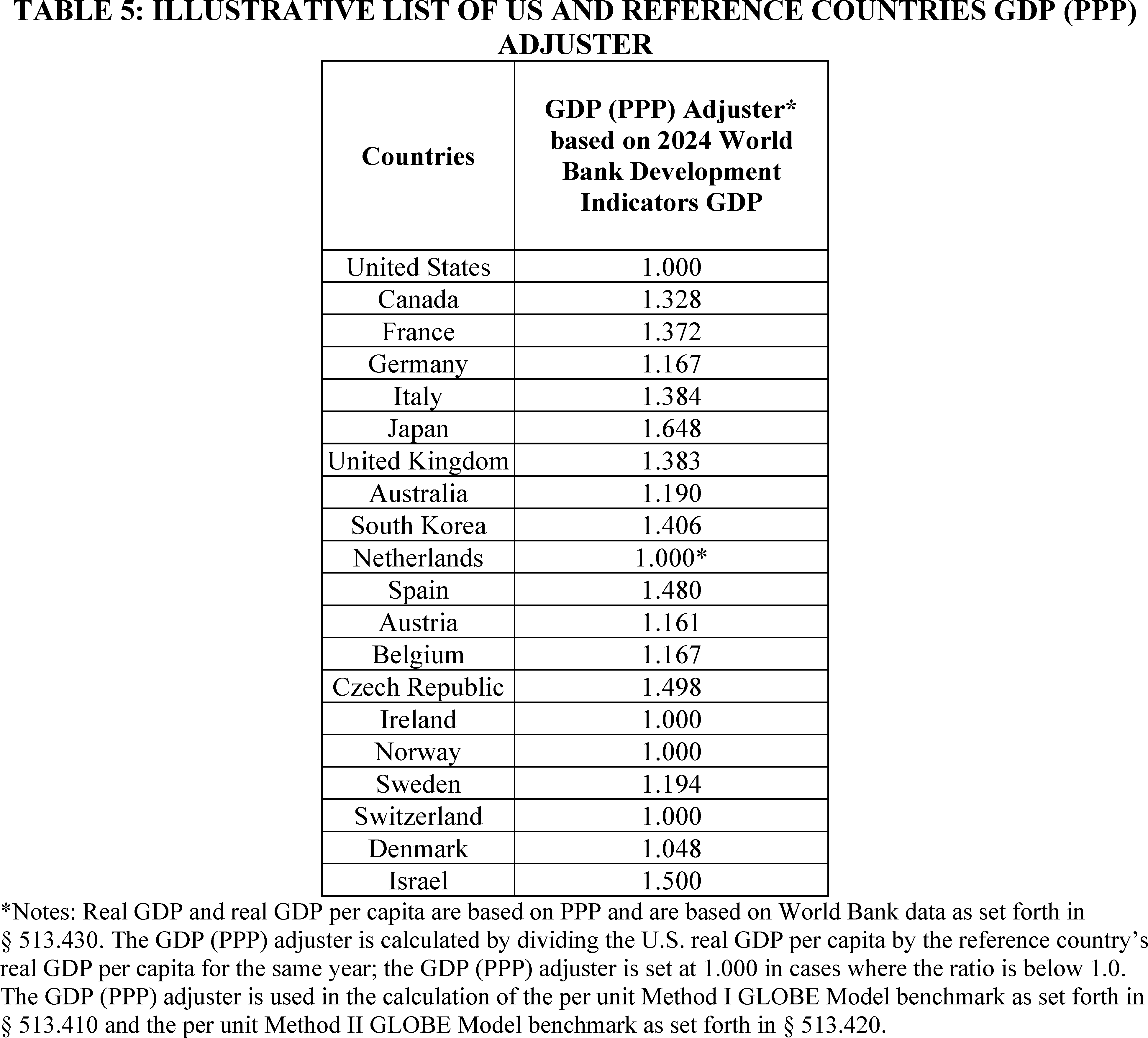
Comment: A few commenters believed GDP-based thresholds are inadequate or not enough to account for differences in income levels and health care systems between the U.S. and the proposed reference countries.
Response: We thank the commenters for their input on the inclusion of a GDP (PPP) adjuster. We disagree that, for purposes of the GLOBE Model, the GDP-based thresholds are inadequate or not enough to account for differences in income levels and healthcare systems between the U.S. and a reference country or that CMS must address these differences among reference countries. CMS considered not applying a GDP (PPP) adjustment within the calculations for the Method I and Method II benchmarks, which would result in lower benchmarks and greater anticipated model savings and beneficiary coinsurance reductions for GLOBE Model beneficiaries. In the GLOBE Model proposed rule (90 FR 60277 and 60279), CMS stated that we would expect that adjusting for country wealth differences based on PPP adjusted GDP would more likely result in appropriate international pricing information that align with other country-specific dynamics.
CMS understands the complexity of a country's healthcare system and selection as a reference country does not imply perfect similarity with the U.S. GDP-based measures are standard economic practice for cross-country comparisons and as such, are used to compare the economic size, growth, and living standards of countries, often using purchasing power parity to adjust for cost of living differences. Although commenters identify additional factors that may affect prescription drug prices, those observations do not show that the approach taken by CMS is unreasonable for the purpose of accounting for economic differences across countries. The existence of other variables does not, by itself, mean that CMS has failed to consider an important aspect of the problem.
Further, we note that, as discussed in section II.G.3.a. of the GLOBE Model proposed rule (90 FR 60281) and this final rule, CMS proposed to increase the per unit GLOBE Model benchmark by a minimal threshold adjustment.
Final Decision: After consideration of the public comments received, CMS is finalizing § 513.430 with modifications as described later in the rule.
- In § 513.430(a), the following is added: For a country, subject to paragraph (b) of this section, CMS calculates the real GDP per capita by dividing the total gross domestic product based on purchasing power parity (PPP) by the total population;
- § 513.430(b) is revised to read as follows: Subject to the limitations ( printed page 63012) specified in paragraphs (c) and (d) of this section, the GDP (PPP) per capita for a country is the most recent estimate of real GDP per capita at the start of the applicable ASP calendar quarter, as determined by CMS, using the total gross domestic product based on purchasing power parity (PPP) and the total population for the same year as estimated and available in the World Bank World Development Indicators GDP per capita PPP (current international) (NY.GDP.PCAP.PP.CD), if available, otherwise as available in the International Monetary Fund GDP per capita, current prices, purchasing power parity series;
- In § 513.430(c), the word “real” is added before GDP (PPP) per capita for clarification;
- In § 513.430(c)(2), the word “unadjusted” is struck and the phrase “set forth in § 513.410(a)(4)” is inserted after “country-level price,” in order to align with the finalized regulatory text in § 513.410(a); and
- In § 513.430(d), CMS is making a non-substantive technical modification to rename the paragraph from “Maximum ratio” to “Minimum ratio,” which more accurately describes the cases where the resulting GDP (PPP) adjuster ratio less than 1.000 is set to 1.000.
2. Methodology To Identify the Per Unit GLOBE Model Benchmark
In the GLOBE Model proposed rule (90 FR 60273), we stated that the proposed GLOBE Model would test alternative calculations to those used by CMS to determine the Medicare Part B drug inflation rebate amount that manufacturers of Part B rebatable drugs owe to the Federal Supplementary Medical Insurance Trust Fund, adjusted beneficiary coinsurance, and the adjusted Medicare payment for Part B rebatable drugs, as applicable, pursuant to section 1847A(i) of the Act as codified in 42 CFR part 427. Under the GLOBE Model, these alternative calculations would expand upon the current methodology by incorporating additional drug pricing information (as described in section II.G.1. of this final rule) while ensuring that beneficiary coinsurance and net Medicare Part B payment would not exceed what they would be absent the model test. In section II.G.2 of the GLOBE Model proposed rule (90 FR 60273 through 60280), we proposed to test two alternative calculation approaches using different data sources for international drug pricing information and methods to identify the per unit GLOBE Model benchmark. Specifically, we proposed that, subject to available information as determined by CMS, the per unit GLOBE Model benchmark for a GLOBE Model drug for an applicable quarter during the model performance period would be based on the greater of—(1) a “per unit Method I GLOBE Model benchmark” that would reflect the GDP (PPP) adjusted [181] lowest country-level price among a set of reference countries at a baseline using existing data sources for international drug pricing information for the applicable ASP calendar quarter as available to and calculated by CMS (this benchmark would be identified by CMS for the first applicable calendar quarter for which data is available according to the hierarchy set forth in § 513.310(c)(2) for the GLOBE Model drug and remains in place for each applicable calendar quarter thereafter until the end of the model performance period, as discussed in section II.G.2.a. of this final rule); or (2) a “per unit Method II GLOBE Model benchmark” that would reflect the volume-weighted average of the GDP (PPP) adjusted net price per HCPCS billing unit among a set of reference countries for the applicable ASP calendar quarter based on data calculated and voluntarily reported by manufacturers to CMS on a quarterly basis (this benchmark would only be available and identified by CMS if CMS determines that manufacturer-submitted international drug net pricing data is complete and valid as set forth in § 513.610).
As further described in section II.G.2.a. of this final rule, to identify the per unit Method I GLOBE Model benchmark and determine if such benchmark is available for purposes of identifying the per unit GLOBE Model benchmark for a GLOBE Model drug, we proposed that, in general, CMS would follow these steps (subject to data availability): identify available international drug pricing information for the set of reference countries for the applicable ASP calendar quarter (or prior calendar quarter, if necessary) that aligns with the first applicable calendar quarter for which the drug is a GLOBE Model drug; apply data checks; convert the available international drug pricing information to align with the HCPCS Level II code long descriptor associated with the GLOBE Model drug; identify per unit GDP (PPP) adjusted country-level prices using the applicable methodology for the available international drug pricing information for a country (for example, calculating a volume-weighted average per unit price when sales data or pricing data and corresponding volume data are available or calculating an average per unit price when pricing data are available but volume data are not available in the selected data source); and identify the lowest per unit GDP (PPP) adjusted country-level price as the per unit Method I GLOBE Model benchmark. We proposed that the results of the interim calculation steps would be rounded to the fifth decimal place and the last step would be rounded to the third decimal place.
As further described in section II.G.2.b. of this final rule, to identify the per unit Method II GLOBE Model benchmark and determine if such benchmark is available for purposes of identifying the per unit GLOBE Model benchmark, we proposed that, in general, CMS would follow these steps for a GLOBE Model drug for each applicable calendar quarter (subject to data availability): identify voluntary manufacturer-submitted international drug net pricing data that was timely submitted and meets requirements for completeness and validity (as set forth in § 513.610 and described in section II.G.6. of this final rule) and identify the volume-weighted average per unit price as the per unit Method II GLOBE Model benchmark. As set forth in § 513.420, we proposed that the manufacturer across country volume-weighted average GDP (PPP) adjusted net price per HCPCS billing unit data element (further discussed in section II.G.6. of this final rule) would be calculated by the manufacturer and would be rounded to the third decimal place prior to being submitted to CMS.[182] As discussed in section II.G.6. of this final rule, we proposed that manufacturers would have two data submission options—streamlined and limited—for the international drug net pricing data that would be voluntarily submitted. We refer readers to section II.G.6. of this final rule for additional details on the two manufacturer data submission options.
In § 513.410, we proposed that, prior to model start, CMS would identify the per unit Method I GLOBE Model benchmark for each GLOBE Model drug for the first applicable calendar quarter of performance year 1, if available. These benchmarks would remain in place for applicable calendar quarters that the drug is a GLOBE Model drug ( printed page 63013) until the end of the model performance period. Similarly, subsequently, for each Part B rebatable drug that becomes a GLOBE Model drug during the performance period, we proposed that CMS would identify the per unit Method I GLOBE Model benchmark for the first applicable calendar quarter for which the drug is a GLOBE Model drug and that benchmark would remain in place for the remaining applicable calendar quarters that the drug is a GLOBE Model drug until the end of the model. Thus, quarterly for each GLOBE Model drug, after CMS identifies the per unit Method I GLOBE Model benchmark (as previously calculated at baseline, if available) and the per unit Method II GLOBE Model benchmark (as most recently calculated, if available), we proposed that CMS would compare the per unit Method I GLOBE Model benchmark and the per unit Method II GLOBE Model benchmark to identify which is greater; the greater of the two would be identified as the per unit GLOBE Model benchmark for the GLOBE Model drug for the applicable calendar quarter. If only the per unit Method I GLOBE Model benchmark is available for the GLOBE Model drug (for example, the manufacturer has not submitted international drug net pricing data), then the per unit Method I GLOBE Model benchmark becomes the per unit GLOBE Model benchmark for the GLOBE Model drug for the applicable calendar quarter.
As discussed in section II.G.3. of the GLOBE Model proposed rule (90 FR 60280), we proposed how CMS would use the identified per unit GLOBE Model benchmark to calculate the per unit GLOBE Model benchmark amount for the GLOBE Model drug for that applicable calendar quarter which would be used to calculate the alternative rebate amounts, coinsurance adjustments, and adjusted Medicare payments to providers.
We believe that our proposed approach to identify the per unit Method I GLOBE Model benchmark for a GLOBE Model drug, based on available international drug pricing information, is necessary to protect the integrity of the model test and minimize corresponding impacts if the international drug pricing information in available data sources become artificially inflated by shifts in manufacturers' pricing and rebate practices, such as a shift to higher prices along with greater rebates that do not change the net pricing realized by manufacturers. Given the potential ease with which available international drug pricing information could be potentially manipulated by manufacturers by changing their pricing and rebate strategies and/or by taking actions that would restrict data sources' ability to source or update international drug pricing information in a manner that represents actual prices and given that such behavioral change would impede CMS's ability to test the model, we believe that it is essential to establish the per unit Method I GLOBE Model benchmark once at a baseline (at the time the drug enters the model) and use that benchmark for the duration of the GLOBE Model.
a. Methodology To Identify the Per Unit Method I GLOBE Model Benchmark Using Existing Data Sources
In section II.G.2.a. of the GLOBE Model proposed rule (90 FR 60274) and in § 513.410, we proposed a methodology that CMS would use to identify the per unit Method I GLOBE Model benchmark for a GLOBE Model drug for the first applicable calendar quarter that the Part B rebatable drug is a GLOBE Model drug using existing data sources that are described in section II.G.1. of this final rule. As discussed in section II.G.1.b. of this final rule, CMS would use available international drug pricing information data sources in accordance with the proposed hierarchy (as set forth in § 513.310(c)) to select the data source used to identify a per unit country-level price for each country that is included in the set of reference countries (as specified in § 513.310(b)).
Specifically, we proposed that CMS would first identify available data sources, available to CMS at least 60 business days prior to the start of the applicable calendar quarter, meeting the requirements in proposed § 513.310(c), that have international drug pricing information for the scientific or nonproprietary name for the GLOBE Model drug for the applicable ASP calendar quarter for the first applicable calendar quarter that the drug is a GLOBE Model drug (or earlier quarter if applicable) for any country that is included in the set of reference countries identified in proposed § 513.310(b). Then, CMS would select a data source at the highest level of the hierarchy as available, extract international drug pricing information for the scientific or nonproprietary name for the GLOBE Model drug, and using available data identify a per unit country-level price or determine that a per unit country-level price is unavailable for a reference country using the selected data source.
To select a data source at the highest level of the hierarchy as available and identify available international drug pricing information for the GLOBE Model drug, we proposed that CMS would align the GLOBE Model drug's HCPCS Level II code long description (including dosage form and, if applicable, route of administration) with the data sources' standardized method for identifying scientific names or nonproprietary names and dosage forms, as applicable. CMS would then extract available drug pricing information for that country from the selected international drug pricing information data source. We proposed that CMS would extract and use data that, as determined by CMS, (1) represent the price of a U.S. originator drug (as defined in § 513.20) or international originator drug (as applicable for data for a country); (2) have complete package size information; (3) represent scientific or nonproprietary name and dosage form that could be described by the GLOBE Model drug's HCPCS Level II code long descriptor, including route of administration (if applicable); and (4) have strength data.[183] In § 513.20, we proposed to define U.S. originator drug to mean “the original biologic and drug developed and licensed or approved via section 351(a) of the Public Health Services Act or submitted under section 505(b) and approved under section 505(c) of the FD&C Act. U.S. originator drugs are also sometimes called brand name drugs, reference listed drug, or reference products.”
We proposed to only extract and use data for a dosage form that could be described by the GLOBE Model drug's HCPCS Level II code long descriptor (as determined by CMS) because a HCPCS Level II code may only describe drug products that are a certain type of formulation, such as short-acting intravenously administered drug products, and a data source's standardized method for drug names could apply more broadly such that a different formulation, such as a long-acting suspension for intramuscular injection, might be extracted if our proposed limitation was not adopted. For example, CMS would examine the data source's methods for describing dosage form and only extract data where the description is complete and clear, as determined by CMS. We proposed that CMS would also examine the data source's methods for describing drug products in terms of being sold as a U.S. ( printed page 63014) originator drug, international originator drug, or other indicator that would allow CMS to not extract and use international drug pricing information for drug products that are identified as international generic or biosimilar biological products, or U.S. generic or biosimilar biological products (that is, products that are not a single source drug or sole source biological product).
To avoid unintentionally using extracted international drug pricing information for drug products that do not align with the GLOBE Model drug's HCPCS Level II code long descriptor, we proposed that CMS would apply data checks to ensure that the extracted data aligns with the HCPCS Level II code long descriptor for the GLOBE Model drug and information about formulations and package sizes sold. Based on our experience using existing international drug pricing information data sources, we proposed that CMS would perform additional data checks to identify and discard extracted data when the sales, pricing, or volume data are not greater than zero or the drug product information (for example, product strength or package size) is inconsistent or not verifiable with available product labeling or product approval information. We proposed the exclusion of these records because these records could inappropriately contribute to the calculation of per unit country-level prices.
In addition, we proposed to make adjustments to align volume data with the HCPCS Level II code dosage descriptor, when necessary, as determined by CMS. For example, if we find that a data source from which we obtain international drug pricing information makes adjustments for overfill, we would make adjustments to the data that we extract from such source so that the extracted data would be used in a manner that is comparable to how CMS uses ASP data to calculate payment limits. In these cases, we proposed to identify the quantity of drug without counting overfill based on the package labeling or other documentation related to product licensing within a country. We noted that there could be other cases where we may find it necessary to make adjustments to align the extracted data with a HCPCS Level II code long descriptor for a GLOBE Model drug. For example, there may be cases where a selected data source shows package size information that is standardized (for example, “per each” which may not clearly distinguish the quantity of drug) or inconsistent with a manufacturer's publicly available information that describes their drug product or the amount of active drug in a presentation level (as defined in § 513.20). We proposed that, in such cases where we confirm a difference and an appropriate conversion method, CMS would make adjustments in how the pricing, sales and volume data are associated with the HCPCS Level II code long descriptor, as necessary, before calculating the per unit country-level price, such as limiting the number of HCPCS billing units assigned. In § 513.20, we proposed that “HCPCS billing units” are the standardized measurement quantities (such as milligrams, milliliters, or individual items) used to determine how medical services, procedures, supplies, and drugs are quantified and billed for reimbursement under the Healthcare Common Procedure Coding System, where the billing quantity is calculated by dividing the total amount administered or provided by the unit of measurement defined for that specific HCPCS Level II code. For the purposes of the GLOBE Model, this can be determined by dividing the quantity of drug in the package by the HCPCS dosage (quantity of drug represented in one HCPCS billing unit, which is the identifiable quantity of a drug or biological product associated with a billing and payment code (for example, a HCPCS Level II code), as established by CMS). Based on our experience, we believe that cases where CMS would make an adjustment would be uncommon, and, in most cases, the appropriate conversion would be straightforward. We noted that there could be additional cases when adjustments would be necessary if international drug pricing information data sources that are available show prices, sales or volume data that are inconsistent with other reliable data sources (for example, product information available on manufacturers' websites), include multiple ingredients for a single drug product and the data source presents information in a different manner from the HCPCS Level II code long descriptor, or are in error (for example, the package size represents the maximum volume of a vial instead of the volume or quantity of drug in a package as indicated in product labeling).
In addition, to carefully align extracted data with the HCPCS Level II code for a GLOBE Model drug, we proposed that CMS would assess whether there are differences in the international drug pricing information attributed to data source coding or country-specific considerations to determine whether the available international drug pricing information consistently and accurately aligns with the HCPCS Level II code long descriptor. An example of a data coding difference that CMS would consider equivalent is if some available international drug pricing information records describe the packaging as a disposable vial in some countries but in others, the packaging is described as a single-dose vial in other records. Because disposable vials are single-dose vials, in this case, CMS would determine that disposable vials and single-dose vials are equivalent packaging and would not consider such variations to be inconsistent with product information. An example of country-specific considerations that CMS would consider is differences in drug naming standards across countries. For example, although not a GLOBE Model drug, in the U.S. and Japan, acetaminophen is the scientific or nonproprietary name while in most other countries, instead of being called acetaminophen, it is referred to as paracetamol. In this type of case, CMS would consider acetaminophen and paracetamol equivalent drugs when a data source's standardized method for identifying scientific names or nonproprietary names treats them as equivalent or alternative names.
To further avoid the potential that some international drug pricing information available in existing data sources may not represent actual prices and, if included in the calculation of per unit country-level prices, could result in a per unit country-level price that would not be a reasonable benchmark, at § 513.410(a)(4)(i)(A), we proposed to remove pricing information at the dosage form and strength level for a country that falls below 5 percent of the average U.S. price. Specifically, prior to calculating the per unit country-level price, we proposed that CMS would calculate an average price for a reference country only using pricing information for the same scientific or nonproprietary name, dosage form, and strength using extracted international drug pricing information (that was not discarded due to data checks). If the resulting average price for a country for a dosage form and strength falls below 5 percent of the average U.S. price for the GLOBE Model drug (across all dosage forms and strength), CMS would remove the pricing information for that dosage form and strength and would not use such data to calculate the per unit country-level price.
For purposes of this step, which would compare and then remove certain pricing information from the calculation of per unit country-level prices for the Method I alternative calculation ( printed page 63015) approach, we proposed to identify an “average U.S. price” using pricing information from the selected data source used for the reference country for the applicable ASP calendar quarter, if available, otherwise CMS would use the most recently published Medicare Part B payment limit (minus the add-on amount, that is, in general 100 percent ASP) for the HCPCS Level II code for the GLOBE Model drug for the calendar quarter before the applicable ASP calendar quarter as such term is defined in 513.20. Because existing data sources for international drug pricing information have a unique approach for presenting drug pricing information and for making data within the data source useful for cross-country comparison, we believe that, if available, using drug pricing information for the applicable ASP calendar quarter that would be extracted from the same data source for the GLOBE Model drug for both the reference country and the U.S. would be a more consistent and appropriate approach for this proposed purpose than using available ASP-based Medicare payment limit information, which, given time limitations, would be for a prior calendar quarter. Nevertheless, if the selected data source for the reference country did not contain available U.S. pricing information for the applicable ASP calendar quarter, we believe that using available ASP data from the calendar quarter before the applicable ASP calendar quarter, would be a reasonable alternative and would be suitable for purposes of removing international drug pricing information that is low and may not reflect actual prices for a dosage form and strength.
We considered several alternatives, including not proposing to remove potentially inappropriately low pricing information, only using U.S. pricing information from external data sources, and applying a higher threshold (for example, removing pricing information that would fall below 10 percent of the average U.S. price). Using available international drug pricing information, we estimated that a 5 percent threshold, on average, could raise the benchmark about 1 percent overall. For a few potential GLOBE Model drugs, the impact would raise the benchmark to a more reasonable level and would still likely result in a per unit country-level price for a reference country being available. At a 10 percent threshold level, we observed that removing reference country pricing information had several effects: it removed pricing information for a given dosage form and strength that appears consistent with U.S. pricing information, it removed pricing information with significant corresponding sales volume for that dosage form and strength, and in some cases, it removed all pricing data for a dosage form and strength. This resulted in higher country-level prices that approached U.S. pricing in the data source, providing evidence that this approach would not likely produce a reasonable estimate of the pricing realized by manufacturers for the reference countries identified in proposed § 513.310(b). This analysis suggests that a lower threshold would be more appropriate. We also considered whether to compare reference country pricing information at the country level across all products regardless of dosage forms and strengths. We noted that this approach was more likely to result in a country-level price being unavailable, due to data for one dosage form and strength impacting the overall average price for all dosage forms and strengths when the data were combined.
For a GLOBE Model drug where CMS has selected a data source and extracted available international drug pricing information for a GLOBE Model drug for a country that is included in the set of reference countries, we proposed that CMS would use the following steps to identify a per unit country-level price by country, apply the GDP (PPP) adjuster (as determined pursuant to § 513.430) and identify the lowest per unit GDP (PPP) adjusted country-level price as the per unit Method I GLOBE Model benchmark:
Step 1: Apply data checks (as described previously and in proposed § 513.410(a)(2)) and discard or adjust data as applicable as determined by CMS.
Step 2: Convert the volume data to the unit of measurement delineated in the HCPCS Level II code long descriptor (for example, mg, ml, mcg, etc.), as applicable, using volume and strength information as proposed in § 513.410(a)(3). Note that volume data referred to in these steps includes information about the quantity of drug in the product packaging and, when available, the corresponding volume data, as applicable.
Step 3: Adjust the volume data (as proposed in § 513.410(a)(3)(i)), as applicable, before converting the volume data to the unit of measurement delineated in the GLOBE Model drug's HCPCS Level II code long descriptor when the data source shows the package size for a presentation level that is inconsistent with the manufacturer's information about that product, as determined by CMS.
Step 4: Limit the number of HCPCS billing units (as proposed in § 513.410(a)((3)(ii)) when—
- The available information (such as package labeling) indicates a limited quantity of drug to be used from the presentation level; and
- Depending on the HCPCS Level II code description, the HCPCS dosage is per therapeutic dose, per dose, or per treatment.
Step 5: By country, identify the per unit country-level price using the calculation that is applicable.
a. If an international drug pricing information data source with sales data and corresponding volume data is used, the applicable calculation is as follows (as proposed in § 513.410(a)(4)(i)):
(1) CMS removes pricing information at the dosage form and strength level for a country that falls below 5 percent of the average U.S. price as set forth in § 513.410(d).
(2) Using remaining data, CMS sums the adjusted volume data for the presentation levels for the applicable international analog (as defined in § 513.600).
(3) Using remaining data, CMS sums the total sales for all the presentation levels for the applicable international analog (as defined in § 513.600).
(4) CMS divides the sum determined in Step 5a(3) by the sum determined in Step 5a(2), resulting in an average country-level price per unit, where the unit is the same unit delineated in the HCPCS Level II code long descriptor.
b. If an international drug pricing information data source with pricing data (such as ex-manufacturer or list prices) is used (that is, the data source does not contain available corresponding volume data and the pricing data is a positive value (note that data that have missing, negative, or zero values would be discarded by data checks)), the applicable calculation is as follows (as proposed in § 513.410(a)(4)(ii)):
(1) For each extracted price, CMS calculates the number of HCPCS billing units in the presentation level by dividing the quantity of drug in the presentation level by the quantity of drug represented in the HCPCS dosage from the HCPCS Level II code long descriptor.
(2) CMS divides the price by the number of HCPCS billing units in the presentation level, resulting in a price per unit where the unit is the same unit delineated in the HCPCS Level II code long descriptor.
(3) CMS removes pricing information at the dosage form and strength level for a country that falls below 5 percent of ( printed page 63016) the average price in the U.S. as set forth in § 513.410(d).
(4) Using remaining data, CMS calculates the sum of the price per unit calculated in Step 5b(2) for each price that was identified as available and not removed in step 5b(3).
(5) CMS divides the sum calculated in Step 5b(4) by the number of prices that were summed in Step 5b(4), resulting in an average country-level price per unit where the unit is the same unit delineated in the HCPCS Level II code long descriptor.
Step 6: Calculate the per unit GDP (PPP) adjusted country-level price by multiplying the per unit country-level price calculated in Step 5 by the applicable GDP (PPP) adjuster for such country as set forth in § 513.430 (and illustrated in Table 5 in this final rule) and round the result at the fifth decimal place.
Step 7: After identifying the available per unit GDP (PPP) adjusted country-level price by country, we proposed that CMS would identify the lowest per unit GDP (PPP) adjusted country-level price, round that amount at the third decimal place, and identify the result as the per unit Method I GLOBE Model benchmark. For a discussion on use of a data source with pricing data and corresponding volume data, we refer readers to the final decision in this section of this final rule.
In developing our proposal to base the per unit Method I GLOBE Model benchmark on the identified lowest per unit GDP (PPP) adjusted country-level price we considered that a 2024 analysis comparing drug prices in the U.S. and other countries concluded that U.S. prices for brand drugs are, on average, about 422 percent more expensive in the U.S. than in non-U.S. OECD countries.[184] This study did not account for economic differences across markets. We believe that selecting the lowest per unit GDP (PPP)-adjusted country-level price as the per unit Method I GLOBE Model benchmark is an acceptable alternative approach to the rebate amount calculation under the Medicare Part B Drug Inflation Rebate Program. This approach incorporates international drug pricing information for certain single-source drugs and sole-source biological products, and is justified by the fact that the extremely high U.S. prices for these drugs—compared to economically comparable countries—suggest there are potentially avoidable expenditures that could be addressed while preserving or enhancing beneficiaries' quality of care. As such, we believe that the proposed GLOBE Model fits within the statutory authority under section 1115A of the Act which authorized the Secretary to test models to reduce program expenditures while preserving or enhancing the quality of care furnished to Medicare beneficiaries.
CMS also believes that using the lowest GDP (PPP) adjusted country-level price when available existing international drug pricing information data sources are used is the most appropriate approach for the GLOBE Model because these data sources may not include pricing information that reflects all price concessions. Calculating an across country average using existing international drug pricing information data sources that contain sales data or pricing data that do not represent actual net prices paid for a GLOBE Model drug in the reference countries (because confidential manufacturer rebates would not likely be accounted for within available existing data sources) or using the n lowest country-level price or the average of the n lowest GDP (PPP) adjusted country-level prices would be even less likely to estimate the payment levels drug manufacturers are willing to accept for their products, from drug manufacturers' perspectives.
CMS also considered an alternative approach to identify the per unit Method I GLOBE Model benchmark that would involve applying a gross to net sales estimate in aggregate to available international drug pricing information. However, gross to net sales data is generally not publicly available at the drug level making this approach impractical for CMS to test and would not yield a transparent benchmark metric.
In our proposed methodology to determine the per unit Method I GLOBE Model benchmark amount, we opted to adjust the country-level prices to account for economic differences among countries, such as GDP per capita, prior to the comparison of the available country-level prices to identify the lowest country-level price for a GLOBE Model drug. Further, we stated our belief that adjusting a single country-level price using a GDP (PPP) adjuster is reasonable (90 FR 60277). Specifically, given that the proposed reference countries are economically comparable to the U.S. and our proposal to identify the lowest country-level price, we would expect that adjusting for country wealth differences based on GDP (PPP) adjustment would more likely result in an appropriate estimate of international drug pricing information that align with other country-specific dynamics and the payment levels drug manufacturers are willing to accept for their products, from drug manufacturers' perspectives.
We sought comment on our proposed approach and steps to identify the per unit Method I GLOBE Model benchmark once in advance of the first applicable calendar quarter for the GLOBE Model drug and potential alternative approaches, including available data sources, methods for identifying an international pricing benchmark using existing international drug pricing information, and ways to use such information to closely represent actual prices of a drug in reference countries. We also sought comment on whether we should consider data sources that report only in local currency, which could require CMS to perform a currency conversion in addition to a GDP (PPP) adjustment. We also sought comment on our proposal to apply a GDP (PPP) adjustment, including the extent to which it may be appropriate to make any adjustments based on other factors not considered in this final rule.
The following is a summary of the comments received and our responses.
Comment: A few commenters stated that, for new drugs, pricing information for international analogs for the applicable ASP calendar quarter for the first applicable calendar quarter the Part B rebatable drug is a GLOBE Model drug might not be available in existing data sources available to CMS and there would be no Method I benchmark for such GLOBE Model drugs for the remainder of the model test. A commenter suggested that CMS should reassess the availability of international drug pricing information periodically to address the risk of the Method I benchmark being not available.
Response: We thank the commenters for sharing their view that there should be a mechanism to ensure that a lack of available international drug pricing information for the applicable ASP calendar quarter for the first applicable calendar quarter the drug is a GLOBE Model drug does not preclude CMS's ability to test a Method I benchmark for such drug. We agree and believe that the commenters' suggestion that in such cases CMS should reassess the availability of international drug pricing information for such drug in existing data sources is reasonable and would enhance the integrity of the model test. Therefore, we are finalizing our proposed process for identification of ( printed page 63017) the per unit Method I GLOBE Model benchmark in § 513.410 with modifications to establish that CMS would apply the process for identification of the per unit Method I GLOBE Model benchmark for subsequent applicable calendar quarters during the model performance period until a per unit Method I GLOBE Model benchmark is identified. We are retaining that, once identified, the Method I benchmark would remain in place for each applicable calendar quarter thereafter until the end of the model performance period.
Specifically, we are modifying §§ 513.410(a)(1) and 513.410(c) to specify that the identification of available international drug pricing data is subject to the timing specifications in revised § 513.410(c). In § 513.410(c)(2), we are modifying our proposal to specify that, for each Part B rebatable drug that becomes a GLOBE Model drug during the model performance period, CMS would identify the per unit Method I GLOBE Model benchmark for earlier of: (1) the first applicable calendar quarter for which the drug is a GLOBE Model drug; or (2) the first applicable calendar quarter during the model performance period for which CMS identifies a per unit Method I GLOBE Model benchmark for the GLOBE Model drug. In revised § 513.410(c)(3), we are specifying that, subject to new §§ 513.410(c)(4) and 513.410(c)(5), the per unit Method I GLOBE Model benchmark would remain in place for each applicable calendar quarter thereafter until the end of the model performance period. In new § 513.410(c)(4), we are adding that, when the per unit Method I GLOBE Model benchmark for a GLOBE Model drug is identified for an applicable calendar quarter that is not the first applicable calendar quarter for which the drug is a GLOBE Model drug (that is, CMS has identified a per unit Method I GLOBE Model benchmark pursuant to new § 513.410(c)(2)(ii)), for each subsequent calendar quarter, CMS would determine if a per unit Method I GLOBE Model benchmark for that GLOBE Model drug for an earlier applicable calendar quarter is available and, if available, would apply such benchmark for the remaining applicable calendar quarters thereafter until the end of the model performance period. We intend that these modifications will allow CMS to identify a per unit Method I GLOBE Model benchmark for each GLOBE Model drug using international drug pricing information for the earliest applicable calendar quarter, as available, and strengthen the integrity of the model test.
In addition, we are adding new § 513.410(c)(5) to address situations where the organization that maintains the data source that was selected in accordance with § 513.310(c)(2) makes updates to the international drug pricing information for international analogs for a GLOBE Model drug available to users within 90 days from the end of the calendar quarter for which drug pricing information is compiled. In such cases, as determined by CMS, CMS would use the updated international drug pricing information as available to identify the per unit Method I GLOBE Model benchmark amount for purposes of determining the per unit GLOBE Model rebate amount for such GLOBE Model drug, and for purposes of calculating the GLOBE Model beneficiary coinsurance adjustment as set forth in § 513.210(b).
Comment: A commenter stated that there is no benefit for Medicare and beneficiaries from Method II submissions, as manufacturers would only submit data if the calculated benchmark is favorable to them and therefore recommended that CMS rely on Method I and implement strategies to prevent gaming. Another commenter supported using only Method I given the limited benefits of encouraging manufacturer voluntary submission of net pricing data.
Response: We appreciate the commenters' support to use the per unit Method I GLOBE Model benchmark as a primary benchmark. As we stated in the GLOBE Model proposed rule (90 FR 60245), for the Method I benchmark, CMS would use existing international drug pricing information to identify a benchmark based on an estimation of the lowest international price among the set of economically comparable countries. CMS appreciates the concern raised by the commenter regarding the potential for manufacturer strategic behavior designed to circumvent the GLOBE Model's rebate obligations. CMS takes these concerns seriously and agrees that the integrity of the international benchmark—and the model's ability to achieve meaningful savings for Medicare beneficiaries—depends on robust safeguards against gaming and evasion.
We note that several features of the GLOBE Model's design provide structural protections against the manipulation scenarios described by commenters. The international benchmark would be derived from publicly available and administratively reported pricing data across multiple comparator countries, reducing the ability of any single manufacturer to materially distort the benchmark through pricing actions in a single foreign market. Nonetheless, CMS acknowledges that no model design is fully immune to strategic behavior, and that the concerns raised by commenters reflect real-world risks that warrant active monitoring and enforcement attention. As such, CMS will monitor for changes in available international drug price information throughout the duration of the GLOBE Model payment period.
Comment: A few commenters stated the lowest country-level price may not be representative of pricing across the set of reference countries. Commenters suggested that to ensure robustness and representativeness of the benchmark the per unit Method I GLOBE Model benchmark should be identified using pricing information for more than one country and that there should be a requirement for a minimum number of countries used to identify the benchmark. A commenter suggested that more than one data source could be used to increase the number of country prices that would be used. A commenter cited a study related to drug launches and stated that the study's findings suggest that, based on past patterns, the Method I benchmark for a GLOBE Model drug could be based on pricing information from a very limited number of reference countries and, in some cases, potentially a single reference country. A few commenters suggested that CMS should use an alternative, such as the second lowest, median, or average country-level price or an across country volume-weighted average price (similar to the Method II approach), to identify the Method I benchmark.
Response: We thank the commenters for noting that there could be potential alternatives to our proposal to identify the lowest country-level price as the per unit Method I GLOBE Model benchmark.
In response to the suggestion to use pricing information for more than one country, we note that, as proposed in § 513.310(c)(3), if there is more than one data source for a GLOBE Model drug, CMS would select the data source at the highest level of the hierarchy that contains information from the highest number of reference countries. We believe that the $100 million OM Part B spend threshold in the GLOBE Model drug inclusion criteria and the drug exclusions that we are finalizing in this final rule, including the exclusion of orphan-only drugs, reduce the likelihood that newly launched drugs would enter the GLOBE Model without being launched within the finalized set ( printed page 63018) of reference countries.[185] However, because there could be cases where international drug pricing information would only be available for one reference country, we decline to add a requirement for international drug pricing information for a minimum number of reference countries to be available in order for CMS to identify a Method I benchmark to avoid cases where a per unit GLOBE Model drug benchmark amount would not be identified and CMS would not be able to apply the model test for such applicable calendar quarters which may distort the model evaluation.
In response to the suggestion to use the second lowest, median, or average country-level price or an across country volume-weighted average price instead of the lowest country-level price, we note that these potential alternatives would likely result in a higher Method I benchmark than our proposed approach, which may create greater uncertainty for manufacturers with respect to their decision-making related to voluntarily reporting international drug net pricing data and CMS's ability to test the use of a Method II benchmark. Further, because international drug pricing information available to CMS through existing data sources may overstate actual prices realized (because confidential manufacturer rebates would not likely be accounted for within these available data sources), we do not believe that these alternative approaches for identifying a Method I benchmark would be prudent or essential for the GLOBE Model test.
In response to the suggestion to use international drug pricing information for more than one data source, as discussed in the GLOBE Model proposed rule (90 FR 60269), we note that CMS did not propose to combine data from different data sources to identify international drug pricing information for a GLOBE Model drug across countries because there could be cases where different types of pricing information for a drug from a reference country would be combined. We also stated that CMS may reconsider the potential value of such an approach based on feedback from interested parties and further information gathering. We appreciate the commenters' feedback; however, we remain concerned that combining pricing information across existing data sources could result in unrepresentative benchmarks. Therefore, we continue to believe that our proposed approach is a reasonable balance between concerns about using available international drug pricing information in a manner that would result in a Method I benchmark that is representative of prices for the set of reference countries to the extent feasible and the potential difficulties inherent in combining information extracted from multiple data sources.
After considering the commenters' feedback, based on our analyses and aims of the model test, on balance, we continue to believe that identifying the lowest country-level price as the Method I benchmark is the most appropriate approach for the GLOBE Model test of an alternative Medicare Part B drug inflation rebate amount calculation that would reduce program expenditures while preserving or enhancing quality of care. We further believe that retaining our proposed approach for identifying the per unit Method I GLOBE Model benchmark would not discourage manufacturers from reporting international drug net pricing data (for a Method II benchmark).
Comment: Commenters shared mixed views on CMS's proposal to identify the per unit Method I GLOBE Model benchmark once for the first applicable calendar quarter the Part B rebatable drug is a GLOBE Model drug. A few commenters supported CMS's proposal noting the potential for manufacturer behavioral responses that could increase international list prices while not increasing net prices. For example, raising international list prices over time while also increasing international rebates. In contrast, a few commenters stated that, to avoid GLOBE Model rebates, manufacturers may launch international analogs only in reference countries with higher prices, delaying market entry or supply in reference countries with lower prices until after CMS identifies the per unit Method I GLOBE Model benchmark. A few commenters expressed concern that a per unit Method I GLOBE Model benchmark for the first applicable calendar quarter the drug is a GLOBE Model drug may not represent actual prices for the set of reference countries over time, during the remainder of the model performance period. Commenters suggested that the Method I benchmark could be updated to include pricing information that reflects pricing changes, such as higher or lower prices that reflect a more informed perspective on the value of the drug and market changes.
Response: As we stated in the GLOBE Model proposed rule (90 FR 60245), for the Method I benchmark, CMS would use existing international drug pricing information to identify a benchmark based on an estimation of the lowest international price among the set of economically comparable countries. In response to the suggestion that the Method I benchmark could be updated during the 5-year performance period to reflect higher prices, we note that this was an alternative we discussed in the GLOBE Model proposed rule and rejected (90 FR 60274). As evidenced by commenters' feedback, the potential ease with which available international drug pricing information could be potentially manipulated by manufacturers, such as by changing their pricing and rebate strategies and/or by taking actions that would restrict data sources' ability to source or update international drug pricing information in a manner that represents actual prices (regardless of whether actual pricing reflects a more informed perspective on the value of the drug and market changes), and given that such behavioral change would impede CMS's ability to test the model, we continue to believe it is essential to establish the per unit Method I GLOBE Model benchmark once at a baseline (at the time the drug enters the model, when feasible) and use that benchmark for the duration of the GLOBE Model.
In response to the suggestion that the Method I benchmark could be updated during the 5-year performance period to reflect lower prices based on a more informed perspective on the value of the drug and market changes, we decline to adopt this modification at this time to avoid increasing the complexity of the Method I benchmark approach which may confound the monitoring and evaluation of this aspect of the model, except, in cases when the per unit Method I GLOBE Model benchmark for a GLOBE Model drug is identified for an applicable calendar quarter that is not the first applicable calendar quarter for which the drug is a GLOBE Model drug as set forth in new § 513.410(c)(4) as discussed in this section of this final rule. CMS will monitor international drug pricing changes during the model performance period and would, if necessary for the integrity of the model test, consider this alternative in future notice and comment rulemaking.
Additionally, we acknowledge commenter's concerns that to avoid GLOBE Model rebates, manufacturers may launch in only reference countries with higher prices or delay market entry ( printed page 63019) in reference countries with lower prices until after CMS identifies the per unit Method I GLOBE Model benchmark. While these are potential manufacturer responses, our analysis of the illustrative 2024 GLOBE Model Drug HCPCS Level II Codes List (as shown in Table 4 in this final rule) showed that this risk is low as the average time on market since FDA approval for these drugs is 13.5 years, and therefore, if manufacturers were to launch these drugs and biological products in reference countries, they likely would have already done so.
Comment: A few commenters stated that transparency is necessary for stakeholders to understand how CMS identified the model benchmarks. Some commenters specifically believed that, because CMS proposes using third-party proprietary existing data sources to identify the per unit Method I GLOBE Model benchmark, CMS should provide full transparency so stakeholders, including manufacturers, would have insight into the data, assumptions, and validation. A few commenters expressed concern that a process without transparency may have errors and would not likely be suitable for future program design. A commenter stated that CMS must develop at least an outline of the procedures CMS will follow to calculate the relevant comparable prices from the comparator nations and allow for public comment on the lowest-cost product or the weighted average prices.
Response: We thank these commenters for their feedback. CMS supports transparency to promote fair drug prices. CMS disagrees that it must develop at least an outline of the procedures CMS will follow to calculate the per unit GLOBE Model Method I benchmark. CMS provided the public with sufficient detail and a meaningful opportunity to comment on the process through the GLOBE Model proposed rule (90 FR 60244). In the GLOBE Model proposed rule, we proposed criteria that CMS would use to select an existing data source (90 FR 60266 through 60269 and § 513.310(c)) and a multiple step process that CMS would use to extract and use international drug pricing information from the selected existing data source (90 FR 60274 through 60278 and § 513.410) to identify the per unit Method I GLOBE Model benchmark for a GLOBE Model drug and ensure data quality and transparency. These requirements allow CMS the ability to assess not only the data elements, but also the data collection and processing practices for the data sources and ensure they are appropriate to identify the per unit Method I GLOBE Model benchmark for a GLOBE Model drug. As we do for all CMS Innovation Center models, CMS would create and maintain necessary documentation to support the GLOBE Model test, which may include confidential proprietary information and would not be releasable, and CMS would share nonsensitive model information with stakeholders through the GLOBE Model website, while ensuring the confidentiality of data as appropriate.
We understand that using third-party or proprietary data to inform the GLOBE Model benchmarks would mean that certain data may not be releasable in granular form, although certain data at a higher level, such as monitoring and evaluation findings, would be releasable. We believe that stakeholders would have different interests and information needs regarding specific per unit Method I GLOBE Model benchmarks. For example, Medicare beneficiaries, healthcare providers, researchers and entities interested in impacts of the GLOBE Model on Medicare Part B drug spending may find it sufficient to have access to the GLOBE Model beneficiary coinsurance percentages (which would be based on either a Method I or Method II benchmark) that will be posted quarterly on the GLOBE Model website. We note that, in § 513.710(b)(1)(iv)-(v), CMS proposed to provide GLOBE Model participants (that is, manufacturers of GLOBE Model drugs), among other information, the per unit Method I GLOBE Model benchmark and the per unit Method II GLOBE Model benchmark as part of the GLOBE Model Preliminary Rebate Report for each GLOBE Model drug.
Comment: A commenter expressed concerns that data extracted from existing international pricing data do not reflect real-world pricing conditions that could result in over- or under-estimated rebates and payment adjustments. The commenter recommended incorporating validation or sensitivity-testing mechanism and providing greater transparency around data sources and assumptions to improve the reliability of the benchmarks.
Response: We thank the commenter for sharing their concern regarding the proposed international drug pricing information that CMS proposed to use to identify the per unit Method I GLOBE Model benchmark. In section II.G.1.a. of the GLOBE Model proposed rule (90 FR 60267), CMS discussed that international drug pricing information in available data sources may be based on prices that represent actual or calculated prices paid to the manufacturer by wholesalers and other distributors, retail prices, prices for other distribution channels, or a combination thereof and that confidential manufacturer rebates would not likely be accounted for within these available data sources. As such, existing sources for international drug pricing information may overstate actual prices realized by manufacturers. In § 513.310(c)(1), we proposed and are finalizing in this final rule criteria for the existing data sources that CMS would use, including that such data sources would have mechanisms in place to maintain, update, validate, and correct, if necessary, the information on international drug pricing in the data source on at least a quarterly basis. As such, we disagree that additional transparency is needed around data sources and data source assumptions.
Additionally, CMS would likely be unable to publicly release certain underlying data elements, as they would include proprietary or confidential commercial information. Even so, CMS believes manufacturers would be able to estimate the per unit GLOBE Model benchmark, as: (1) manufacturers have access to their own international drug pricing information; (2) they likely have access to the data sources described in the GLOBE Model proposed rule (90 FR 60267); (3) detailed steps for how CMS would use available international drug pricing information are outlined in sections II.G.1 through II.G.7 of the GLOBE Model proposed rule (90 FR 60265 through 60299) and this final rule; and (4) GLOBE Model adjusted coinsurance percentages would be published on the GLOBE Model website quarterly, providing insight into the difference between the per unit GLOBE Model benchmark amount and the Medicare payment limit. Also, the per unit Method I GLOBE Model benchmark as identified under § 513.410 and the per unit Method II GLOBE Model benchmark, if available, as identified under § 513.420 will be shared with GLOBE Model participants as part of the GLOBE Model Preliminary Rebate Report for each GLOBE Model drug.
Further in section II.G.2.a of the GLOBE Model proposed rule (90 FR 60274), CMS stated that to avoid the potential that some international drug pricing information available in existing data sources may not represent actual prices and, if included in the calculation of country-level prices, could result in a per unit country-level price that would not be a reasonable benchmark, CMS proposed to remove pricing information at the dosage form and strength level for a country that falls below 5 percent of the average U.S. ( printed page 63020) price and considered alternative approaches as discussed in this section of this final rule. As such, we do not believe that additional sensitivity-testing mechanisms or validation of existing data sources would be necessary.
To protect the integrity of the model test and minimize corresponding impacts if the international drug pricing information in available data sources become artificially inflated by shifts in manufacturers' pricing and rebate practices, CMS proposed to establish the per unit Method I GLOBE Model benchmark once at a baseline and use that benchmark for the duration of the GLOBE Model. In this final rule, we are slightly modifying our proposed approach to protect model integrity and address situations when CMS does not identify a per unit Method I GLOBE Model benchmark for the first applicable calendar quarter for which the Part B rebatable drug is a GLOBE Model drug and in cases where the existing data source used makes updates to the international drug pricing information for international analogs for a GLOBE Model drug available to users within 90 days from the end of the calendar quarter for which drug pricing information is compiled. On balance, we continue to believe that data extracted from existing data sources available to CMS would be adequate for purposes of identifying country-level prices and a per unit Method I GLOBE Model benchmark for purposes of the GLOBE Model.
Final Decision: After consideration of the public comments received, CMS is finalizing the methodology for identifying the per unit Method I GLOBE Model Benchmark using existing data sources at § 513.410, with modifications to: (1) address situations when CMS does not identify a per unit Method I GLOBE Model benchmark for the first applicable calendar quarter for which the Part B rebatable drug is a GLOBE Model drug; (2) clarify the benchmark calculation steps when pricing data and corresponding volume data are available; and (3) clarify how the average U.S. price is calculated by CMS. These modifications include:
- Revising §§ 513.410(a)(1) and 513.410(c) to specify that the identification of available international drug pricing information is subject to the timing specifications in revised § 513.410(c) and remove extraneous language from § 513.410(a)(1);
- Revising §§ 513.410(a)(2)(i)(A) and 513.410(a)(4)(i) to include “drug-specific”, “sales data”, pricing data” and “corresponding volume data” to align with the updates in § 513.310(c);
- Revising § 513.410(a)(4)(i)(B) to update “paragraph (3) of this section” to “paragraph (a)(3) of this section” for clarity;
- Revising § 513.410(a)(4)(i)(C) to clarify how the average country-level price per unit is calculated when sales data and corresponding volume data are available;
- Revising § 513.410(a)(4)(i)(D) to clarify how the average country-level price per unit is calculated when pricing data and corresponding volume data are available;
- Adding new § 513.410(a)(4)(i)(D)(1) to specify that, for each extracted price for a presentation level of the applicable international analogs (as defined in § 513.600), CMS divides the price by the number of HCPCS billing units for the presentation level of the applicable international analogs (as defined in § 513.600) by dividing the quantity of drug in the presentation level by the quantity of drug represented in the HCPCS dosage from the HCPCS Level II code long descriptor. CMS limits the number of HCPCS billing units as described in paragraph (a)(3)(ii) of this section as applicable;
- Adding new § 513.410(a)(4)(i)(D)(2) to specify that CMS calculates the sum the products of the price per unit (as calculated in § 513.410(a)(4)(i)(D) (1)) and the corresponding converted volume amount (as set forth in § 513.410(a)(3)), and divides that total by the sum determined in § 513.410(a)(4)(i)(B), resulting in an average country-level price per unit, where the unit is the same unit delineated in the HCPCS Level II code long descriptor;
- Revising § 513.410(a)(4)(ii) to update “ex-manufacturer or list price” to “drug-specific pricing data” and insert “and the data source does not contain available volume data” to align with the updates in § 513.310(c);
- Revising § 513.410(a)(4)(ii)(A), to remove “ex-manufacturer or list”, revise “in the presentation level by dividing the quantity of drug in the presentation level” to read “for the presentation levels of the applicable international analogs (as defined in § 513.600) by dividing the quantity of drug in a presentation level”, and adding the sentence “CMS limits the number of HCPCS billing units as described in paragraph (a)(3)(ii) of this section as applicable;”
- Revising § 513.410(a)(4)(ii)(B) to update “ex-manufacturer or list price, as applicable” to “price” to align with the updates in § 513.310(c);
- Revising § 513.410(a)(4)(ii)(D) to update “ex-manufacturer or list price, as applicable” to “price” to align with the updates in § 513.310(c);
- Revising § 513.410(a)(4)(ii)(E) to update “ex-manufacturer or list prices that were identified” to “prices identified” to align with the updates in § 513.310(c);
- Revising § 513.410(c)(2) to specify that, for each Part B rebatable drug that becomes a GLOBE Model drug during the model performance period, CMS identifies the per unit Method I GLOBE Model benchmark for earlier of: (1) the first applicable calendar quarter for which the Part B rebatable drug is a GLOBE Model drug; or (2) the first applicable calendar quarter during the model performance period for which CMS identifies a per unit Method I GLOBE Model benchmark for the GLOBE Model drug;
- Adding new § 513.410(c)(3) to specify that, subject to new §§ 513.410(c)(4) and 513.410(c)(5), as applicable, the per unit Method I GLOBE Model benchmark for the GLOBE Model drug remains in place for each applicable calendar quarter thereafter until the end of the model performance period;
- Adding new § 513.410(c)(4) to specify that, when the per unit Method I GLOBE Model benchmark for a GLOBE Model drug is identified pursuant to § 513.410(c)(2)(ii), for each subsequent applicable calendar quarter, CMS will determine a per unit Method I GLOBE Model benchmark for that GLOBE Model drug for the first applicable calendar quarter during the model performance period for which such benchmark is available, and will apply such benchmark for that subsequent applicable calendar quarter and the remaining applicable calendar quarters until the end of the model performance period;
- Adding new § 513.410(c)(5) to specify that, when the data source selected in accordance with § 513.310(c)(2) makes updates to the international drug pricing information for international analogs for a GLOBE Model drug available to users within 90 days from the end of the calendar quarter for which drug pricing information is compiled, CMS uses the updated international drug pricing information as available to identify the per unit Method I GLOBE Model benchmark amount for purposes of determining the per unit GLOBE Model rebate amount for such GLOBE Model drug, and for purposes of calculating the GLOBE Model beneficiary coinsurance adjustment as set forth in § 513.210(b); and
- Revising § 513.410(d)(1) to clarify how CMS calculates the average U.S. ( printed page 63021) price for a GLOBE Model drug and adding specifications for the calculation at new §§ 513.410(d)(1)(i) and 513.410(d)(1)(ii). Specifically, revised § 513.410(d)(1) clarifies that CMS uses U.S. drug pricing information from the selected data source when available to calculate the volume-weighted average U.S. price per unit. New §§ 513.410(d)(1)(i) and 513.410(d)(1)(ii) clarify the calculation that is used when drug-specific sales data or pricing data and corresponding volume data are available or pricing data are available and the data source does not contain available volume data.
CMS is also finalizing non-substantive modifications to § 513.410 to correct typographical errors in the regulatory text:
- In § 513.410(a)(1), the words “international” and “and the U.S.” are inserted and “pricing data” is replaced with “pricing information;”
- The provisions within § 513.410(a)(2)(i) are renumbered and in renumbered § 513.410(a)(2)(i)(B), the words “the GLOBE Model drug's HCPCS Level II code descriptor” is replaced with “that product;”
- In § 513.410(a)(2)(i), “data” is replaced with “information;”
- In § 513.410(a)(3), “HCPCS Code Level II” is corrected to read as “HCPCS Level II Code;”
- In § 513.410(a)(3)(i), the extraneous phrase “for the GLOBE Model drug's HCPCS Level II code descriptor” is removed;
- In § 513.410(a)(3)(ii)(B), the words “per therapeutic dose” and “per treatment” are added to reflect the preamble;
- In § 513.410(a)(4), the phrase “extracted and adjusted in accordance with paragraphs (3)(i) and (3)(ii)” is revised to read “extracted, adjusted, and converted in accordance with paragraphs (a)(1) through (3) of this section” and the extraneous phrase “for the international drug by country for each country specified in § 513.310(b) for which international drug pricing information is available” is removed;
- In § 513.410(a)(4)(i)(A) and § 513.410(a)(4)(ii)(C), the phrase “average price in the U.S.” is revised to read as “average U.S. price;”
- In § 513.410(a)(4)(i)(B), the word “adjusted” is revised to read “converted”, the word “analog” is revised to read “analogs”, the word “specified” is revised to read “defined”, and “paragraph (3)” is revised to read “paragraph (a)(3);”
- In § 513.410(a)(4)(i)(D), the phrase “average price” is revised to read “average country-level price;”
- In § 513.410(a)(4)(i)(D)(2), “CMS” is removed;
- In § 513.410(a)(4)(ii)(C), the phrase “average price in the U.S.” is revised to read “U.S. price;”
- In § 513.410(a)(4)(ii)(D), the phrase “using remaining data” and the word “unit” are added;
- In § 513.410(d)(1), the words “of this section” are added;
- In § 513.410(d)(2), the extraneous phrase “for the reference country” is removed and the word “percentage” is added following the word “add-on” for clarification; and
- Throughout § 513.410 and in the definition of country-level price in § 513.20, “code descriptor” is revised to read “code long descriptor”.
Finally, CMS is finalizing non-substantive modifications to § 513.20 to correct typographical errors in the regulatory text. Specifically, the defined term, “GLOBE Model adjusted beneficiary coinsurance percentage” is revised to “GLOBE Model beneficiary coinsurance percentage.” CMS has also added the words “per unit GDP (PPP) adjusted” and “reference” to the definition of “Method I GLOBE Model Benchmark” in § 513.20 for clarity and in alignment with the preamble.
b. Methodology for Identifying the Per Unit Method II GLOBE Model Benchmark Using Manufacturer Submitted Data
In section II.G.2.b. of the GLOBE Model proposed rule (90 FR 60278) and § 513.420, we proposed a methodology that CMS would use to identify the per unit Method II GLOBE Model benchmark for a GLOBE Model drug for an applicable calendar quarter using voluntarily manufacturer-submitted international drug net pricing data (as described in section II.G.1.d. of this final rule) when such data is available and meets acceptance criteria (as described in section II.G.6. of this final rule), as determined by CMS.
To identify available manufacturer-submitted international drug net pricing data for a GLOBE Model drug, we proposed that CMS would use accepted manufacturer-submitted international drug net pricing data (that is, an “applicable submission” for a GLOBE Model drug as set forth in § 513.610) for an applicable ASP calendar quarter that aligns with the applicable calendar quarter and the GLOBE Model drug's HCPCS Level II code long description (including scientific or nonproprietary name, dosage form, and route of administration (if applicable)).
We proposed to only use data for dosage forms that can be described by the GLOBE Model drug's HCPCS Level II code long descriptor (as determined by CMS) because a HCPCS Level II code may only describe drug products that are a certain type of formulation, such as short-acting intravenously administered drug products, and manufacturer-submitted international drug net pricing data for an international drug could apply more broadly such that information for a different formulation, such as a long-acting suspension for intramuscular injection, might be available and used if our proposed limitation was not adopted. To avoid unintentionally using data for formulations that do not align with the GLOBE Model drug's HCPCS Level II code long descriptor, we would apply data checks to ensure that the accepted manufacturer-submitted international drug net pricing data aligns with the HCPCS Level II code long descriptor for the GLOBE Model drug.
Because manufacturers would submit net pricing data at the HCPCS Level II code billing unit level and would not include overfill in the net pricing data and because applicable submissions would meet a completeness and validity check, we stated that we do not foresee the need to make adjustments to the manufacturer-submitted international drug net pricing data for a GLOBE Model drug.
Because we proposed that manufacturers have the option to submit international drug net pricing data for a GLOBE Model drug and we anticipated the potential situation where CMS would not identify available data, in such cases, we proposed that, in the absence of available manufacturer-submitted net pricing information for a GLOBE Model drug for an applicable ASP calendar quarter, CMS would identify that the per unit Method II GLOBE Model benchmark was unavailable for an applicable calendar quarter. Therefore, subject to § 513.420(c), when there is one manufacturer submission of international drug net pricing data for a GLOBE Model drug for an applicable calendar quarter, we proposed that the across country volume-weighted average GDP (PPP) adjusted net price per HCPCS billing unit data element (as defined in § 513.20 and further discussed in section II.G.6. of this final rule), submitted by the manufacturer, determined to be an applicable submission by CMS as set forth in § 513.610(a)(4), and identified as available manufacturer-submitted international drug net pricing data as set forth in in § 513.310(d), would be identified as the per unit Method II GLOBE Model benchmark. Further, we ( printed page 63022) proposed that, subject to § 513.420(b), when there is more than one manufacturer submission of international drug net pricing data within available manufacturer-submitted international drug net pricing data for a GLOBE Model drug for an applicable calendar quarter, CMS would calculate a volume-weighted average using data across all of the applicable submissions. For example, when a manufacturer and a repackager submit international drug net pricing data and CMS accepts both manufacturer submissions, CMS would calculate a volume-weighted average using the available across country volume-weighted average GDP (PPP) adjusted net price per HCPCS billing unit data elements and the volume data elements (in HCPCS billing units).
Specifically, we proposed that CMS would apply the following steps:
Step 1: Separately, for each applicable submission, CMS multiplies the across country volume-weighted average GDP (PPP) adjusted net price per HCPCS billing unit by the sum of the volume in HCPCS billing units in the applicable submission. The sum of the volume of HCPCS billing units is calculated by summing the volume in HCPCS billing units in the applicable submission.
Step 2: CMS sums the amounts calculated in Step 1.
Step 3: CMS calculates the total volume by summing the volume in HCPCS billing units across all applicable submissions.
Step 4: CMS divides the sum calculated in Step 2 by the total volume calculated in Step 3. The resulting volume-weighted average would be rounded at the third decimal place and would be identified as the per unit Method II GLOBE Model benchmark.
However, in § 513.420(c), we also proposed that when a manufacturer submission for an applicable ASP calendar quarter is either not accepted by CMS as set forth in § 513.610 or was not submitted by all manufacturers of the GLOBE Model drug, CMS would identify that the per unit Method II GLOBE Model benchmark is unavailable for such applicable calendar quarter. That is, when there is more than one manufacturer of a GLOBE Model drug, all manufacturers of such GLOBE Model drug would have to voluntarily submit net pricing data for the applicable ASP calendar quarter and each of such data submissions would have to be accepted in accordance with § 513.610 in order for CMS to identify a per unit Method II GLOBE Model benchmark.
In cases where CMS does not identify a per unit Method II GLOBE Model benchmark, the per unit GLOBE Model benchmark would only be available if a per unit Method I GLOBE Model benchmark was available.
In our proposed methodology to determine the per unit Method II GLOBE Model benchmark, we opted to allow manufacturer-submitted international drug net pricing data to be adjusted using a GDP (PPP) adjuster, as specified by CMS. We believe, based on our proposed criteria for the set of reference countries, that all of the countries included in the set of reference countries would be economically comparable with the U.S. and each other reference country (that is, each reference country's GDP per capita would be no less than 60 percent of U.S. GDP per capita) and would have a comparable economy size (real GDP greater than $400 billion). Previous research comparing international prices of U.S. originator drugs and international originator drugs show that prices can vary widely across countries. For example, among the proposed reference countries listed in Table 5 in the GLOBE Model proposed rule (90 FR 60272), the U.S. originator prices are between 339 and 703 percent higher than international originator drugs.[186] We expect that the per unit Method II GLOBE Model benchmark would tend to be higher than the lowest per unit country-level price identified under our proposed methodology for the per unit Method I GLOBE Model benchmark—before CMS would apply the proposed GDP (PPP) adjuster—because it reflects the price variations in reference countries and accounts for them through a volume-weighted price. As such, we believe this approach would be a strong incentive for manufacturers to conduct data gathering, analyses, and reporting activities related to voluntary manufacturer submission of international drug net pricing data as discussed in section II.G.6. of this final rule. Our goal is to encourage manufacturers to report international drug net pricing data (that is reflective of the actual transaction prices internationally) for applicable international analogs that align with a GLOBE Model drug to CMS for purposes of the GLOBE Model to enhance the model test and inform CMS's model monitoring and evaluation activities. We welcomed comments or data on the extent to which the per unit Method II GLOBE Model benchmark would tend to be higher than the per unit Method I GLOBE Model benchmark, as well as comments on situations when the per unit Method II GLOBE Model benchmark may be lower than the per unit Method I GLOBE Model benchmark.
We also welcomed comment on our proposed methodology to identify the per unit Method II GLOBE Model benchmark for a GLOBE Model drug for an applicable calendar quarter.
The following is a summary of the comments received and our responses.
Comment: A commenter recommends that Method II be simplified to allow for a one-time annual submission without losing the fixed stability of the benchmark, which would reduce administrative burden.
Response: We thank the commenter for their feedback. Given the GLOBE Model's limited duration and the voluntary nature for manufacturer-submitted international net drug pricing data, we do not believe the administrative effort would be significant. Further, as other commenters have expressed in other comments, it is important for CMS to monitor and assess the impacts of the model, including potential strategic behavior from manufacturers. Providing one-time annual submission would limit CMS's ability to clearly understand the impacts of the model. We believe the GLOBE Model currently balances the goals of the test with the limited administrative burden for manufacturers, and for this reason we decline to allow for a one-time annual update of the per unit Method II GLOBE Model benchmark.
Comment: A commenter encouraged CMS to reconsider the Method II requirement that all manufacturers of a GLOBE Model drug must submit voluntary manufacturer-reported international drug net pricing data for an applicable calendar quarter and such information must be accepted by CMS. The commenter questioned whether this approach would constrain the model evaluation by limiting the use of the Method II benchmark methodology and CMS's ability to meaningfully compare outcomes under both benchmark methodologies.
Response: We thank the commenter for their feedback. Because all manufacturers of a GLOBE Model drug would be responsible for model rebates, if any, we believe it is important to have all manufacturers of a GLOBE Model drug submit voluntary manufacturer-reported international drug net pricing data as a condition for identifying a per unit Method II benchmark for an applicable calendar quarter. We note that, in contrast to this commenter's ( printed page 63023) suggestion, as previously discussed in this final rule, other commenters suggested that CMS require manufacturer-reporting of international drug net pricing data to address potential gaming. As we gain experience under the model, we may revisit this topic for future consideration.
We note that, as discussed in section II.G.6. of this final rule, CMS is finalizing the provisions related to voluntary manufacturer submission of basic data elements and net pricing data elements with modifications to allow manufacturers to submit as part of reasonable assumptions an explanation for why a manufacturer is not able to include certain data elements when calculating the across country volume-weighted average GDP (PPP) adjusted net price per HCPCS billing unit. To the extent that these modification may result in cases where CMS would be unable to identify an available across country volume-weighted average GDP (PPP) adjusted net price per HCPCS billing unit within an applicable submission, we are updating § 513.420(c) to address such cases.
Final Decision: After considering the comments received, CMS is finalizing § 513.420 with the following non-substantive modifications:
- In the introductory text of § 513.420, the reference is corrected to cite § 513.310(d) and the reference to § 513.610(a) is corrected to cite § 513.610(a)(4);
- In § 513.420(a), for clarity, the words “within each applicable submission” are replaced with “using available manufacturer-submitted international drug net pricing data for the applicable ASP calendar quarter (as identified by CMS in accordance with § 513.310(d));”
- In § 513.420(b)(2)(i), for the clarity, the following sentence is added: “The sum of the volume of HCPCS billing units is calculated by summing the volume in HCPCS billing units in the applicable submission;”
- In § 513.420(b)(2)(i), for clarity, the word “HCPCS” is added so that the phrase reads “volume in HCPCS billing units;”
- In § 513.420(b)(2)(iii), for clarity, the words “volume in HCPCS” are added so that the phrase reads “volume in HCPCS billing units;” and
- Paragraph § 513.420(c) is revised to read as “When CMS determines that manufacturer-submitted international drug net pricing data for an applicable calendar quarter (as set forth in § 513.20) is not available for purposes of § 513.420 as set forth in § 513.310(d)(3) or CMS is unable to identify an available across country volume-weighted average GDP (PPP) adjusted net price per HCPCS billing unit as set forth in paragraph (a) of this section, CMS identifies that the per unit Method II GLOBE Model benchmark is unavailable for such applicable calendar quarter.”
c. Alternatives Considered
Instead of proposing that, for a GLOBE Model drug, CMS would identify the per unit Method I GLOBE Model benchmark once for the first applicable calendar quarter for such GLOBE Model drug and CMS would not reassess that benchmark, we considered an alternative that would allow CMS to revise the benchmark prospectively, no more frequently than quarterly, only if such benchmark would be lower than the currently applicable per unit Method I GLOBE Model benchmark. For example, prior to model start in accordance with proposed § 513.410, CMS would identify the per unit Method I GLOBE Model benchmark for each GLOBE Model drug for the first applicable calendar quarter of performance year 1. These benchmarks would remain in place for the duration of the model performance period unless CMS identifies a lower per unit GDP (PPP) adjusted country-level price for the GLOBE Model drug using available data sources that meet the requirements in proposed § 513.310. Similarly, for drugs that become GLOBE Model drugs during the performance period, CMS would identify the per unit Method I GLOBE Model benchmark for the first applicable calendar quarter for which the drug is a GLOBE Model drug and that benchmark would remain in place for the remaining applicable calendar quarters until the end of the model performance period unless CMS identifies a lower per unit GDP (PPP) adjusted country-level price for the GLOBE Model drug. Under this alternative, if a per unit Method I GLOBE Model benchmark was prospectively revised, the revised benchmark would remain in place for the remaining applicable calendar quarters until the end of the model performance period unless CMS identifies a lower per unit GDP (PPP) country-level price for the GLOBE Model drug that would be used beginning with the next applicable calendar quarter. We note this approach would allow CMS to consider international drug pricing information that becomes available over time, for example, after a per unit Method I GLOBE Model benchmark is identified by CMS for a GLOBE Model drug, a new data source may become available, a data source may add data for additional countries to its offering, data for sales for certain countries in the set of reference countries might become available within an existing data source, or international sales pricing and volume data may reflect lower prices related to market changes in reference countries. A lower benchmark could result in a lower per unit GLOBE Model benchmark amount and greater total GLOBE Model rebate amount as well as lower GLOBE Model beneficiary coinsurance. Allowing for a potential lower per unit GDP (PPP) country-level price could potentially positively impact model beneficiaries' access to GLOBE Model drugs and lower beneficiary financial liability. However, doing so would increase operational complexity for the model.
Similarly, we considered identifying the lowest country-level GDP (PPP) adjusted net price per HCPCS billing unit reported by a manufacturer as the Method II benchmark. This also could result in a lower benchmark, lower per unit GLOBE Model benchmark amount, and likely greater total GLOBE Model rebate amount as well as lower GLOBE Model beneficiary coinsurance. However, CMS is concerned this could also impact manufacturers' decision to voluntarily submit international drug net pricing data, which could prevent CMS from being able to test the alternative rebate amount calculation using Method II.
We considered not adjusting the country-level prices for differences in economy size and purchasing power. That is, we considered not applying a GDP (PPP) adjustment within the calculations for the Method I and Method II benchmarks, which would result in lower benchmarks, and applying a GDP (PPP) adjustment to the Method II benchmark only, because there is some uncertainty in our belief that existing international drug pricing information closely reflects actual prices paid as those data may not include lagged price concessions and therefore may not closely represent actual prices. Using available 2024 international drug pricing information, we estimated that not applying a GDP (PPP) adjustment would result in lower benchmarks and greater anticipated model savings and beneficiary coinsurance reductions for GLOBE Model beneficiaries. Relatedly, manufacturers would also be more likely to owe total GLOBE Model rebates. Our analysis showed that including the GDP (PPP) adjustment, using illustrative 2024 data, could result in up to 28 percent less potential model performance year 1 savings, given that the reference countries are economically comparable to the U.S., we would ( printed page 63024) expect that adjusting for country wealth differences based on GDP (PPP) adjustment would more likely result in appropriate international pricing information that align with other country-specific dynamics. We also considered that there are a range of alternative rebate amount calculations that could be appropriate for testing under the GLOBE Model and that it may be feasible to test other alternative approaches (or calculation steps) than the two methods we proposed to test. For example, a benchmark could be identified by using a formula that calculates an average “lowest” country-level price by calculating an average country-level price across the countries with the two lowest country-level prices. To test a limited model design, we opted to propose a test for two alternative rebate amount calculations that each use unique calculations and different international drug pricing information data sources. Although there could be other appropriate alternative calculations for a model test, we opted to test alternatives that would have distinct features related to data sources and benchmark calculations to enhance the potential to understand the impact of each alternative and the overall model test.
In addition, we considered testing an alternative rebate amount calculation using the proposed Method I and Method II approaches in different subsets of the GLOBE Model beneficiary cohort, such as creating two separate model beneficiary groups using different model geographic areas (that is, after selecting the model geographic areas, about half would be aligned with testing each benchmark approach). We opted not to pursue this alternative because the proposed model test calculations are specific to a GLOBE Model drug and manufacturer submission of international net pricing information would be voluntary making separate test areas not necessary and potentially insufficient. For example, a separate population subset for testing each benchmark methodology could result in weaker incentives for manufacturers to voluntarily submit data necessary for CMS to test identifying a benchmark based on the proposed Method II approach. Further, we believe that, if the GLOBE Model were to test our proposed Method II approach, or any alternative rebate amount calculation, using a benchmark based on voluntary manufacturer reporting of international net pricing information in a distinct model beneficiary cohort, a default benchmark would still be necessary in cases when manufacturer net pricing information would not be available. As such, we believe our proposed approach of testing a Method I benchmark alongside a test of a Method II benchmark is essential for a feasible model design that would test an alternative rebate amount calculation that is based on manufacturer submitted net pricing information. Therefore, we opted to pursue the approach of a single model beneficiary cohort for testing both alternative rebate amount calculations. We welcomed comments on the alternatives we considered and our proposed approach for identifying a per unit GLOBE Model benchmark using two alternative calculations.
The following is a summary of the comments received and our responses.
Comment: A commenter suggested that CMS take a more directive approach, such as directly engaging with reference country health authorities to obtain verified transaction prices.
Response: We thank the commenter for this suggestion. As we stated in the GLOBE Model proposed rule (90 FR 60279), we recognize that there could be alternative ways to identify a benchmark. At this time, we believe that this suggested alternative would be administratively complex and would require substantial start up efforts that make this alternative not feasible for a limited model design beginning on January 1, 2027. We may consider this suggestion in the future for the GLOBE Model if warranted and for other CMS Innovation Center model design alternatives.
Comment: A commenter suggested that CMS should not test Method II and rely instead on Method I benchmarks due to the potential strategic behavior from manufacturers.
Response: We thank the commenter for this suggestion. As we stated in the GLOBE Model proposed rule (90 FR 60245), the intent of the GLOBE Model is to test an innovative, alternative benchmark for Medicare Part B drug inflation rebate amount for GLOBE Model drugs using international drug pricing information to identify a benchmark that reflects prices paid in a set of economically comparable countries. CMS proposed to include two approaches for identifying a benchmark amount for the alternative rebate amount calculation—using differently sourced international drug pricing information and different calculations—and the model evaluation would assess the impacts of testing these different approaches for identifying a benchmark amount for the alternative rebate amount calculation. We recognize that there could be alternative ways to identify a benchmark. We proposed that one approach (Method I) would use existing data sources for international drug pricing information to identify a benchmark based on an estimation of the lowest international price among the set of economically comparable countries, which may be tied to pricing data that represent list, invoice, ex-manufacturer sales, other prices, or a combination of such prices as available in commercially-available data sources. The other approach (Method II) would use voluntary manufacturer-submitted international drug net pricing data to estimate a benchmark based on an average international price among the set of economically comparable countries, which would reflect net prices realized by a manufacturer. At this time, we continue to believe that testing both of these approaches in combination would best inform our understanding of innovative alternative benchmarks for Medicare Part B drug inflation rebate amounts for GLOBE Model drugs using international drug pricing information that reflects prices paid in a set of economically comparable countries.
As applicable, we have addressed other comments related to the alternatives we considered for identifying the per unit Method I GLOBE Model benchmark and per unit Method II GLOBE Model benchmark for a GLOBE Model drug in sections II.G.1., II.G.2.a., and II.G.2.b. of this final rule.
3. Methodology for Identifying the per Unit GLOBE Model Benchmark Amount for an Applicable Calendar Quarter
In section II.G.3. of the GLOBE Model proposed rule (90 FR 60280), we proposed the methodology CMS would use to determine the per unit GLOBE Model benchmark amount for a GLOBE Model drug for an applicable calendar quarter.
In § 513.400, we proposed that, quarterly for each GLOBE Model drug, after CMS identifies the “per unit Method I GLOBE Model benchmark” as set forth in § 513.410, as available, and the “per unit Method II GLOBE Model benchmark” as set forth in § 513.420, as available, CMS would compare the identified per unit Method I GLOBE Model benchmark (if available) and the identified per unit Method II GLOBE Model benchmark (if available) to identify which benchmark is greater and would be identified as the per unit GLOBE Model benchmark for the GLOBE Model drug for the applicable calendar quarter. In § 513.400(b)(3), we proposed that if CMS determines that neither of these benchmarks is available, CMS would determine that the per unit ( printed page 63025) GLOBE Model benchmark for the GLOBE Model drug for the applicable calendar quarter is “not available.”
In addition, we proposed that CMS would apply an adjustment to the identified per unit GLOBE Model benchmark to calculate the per unit GLOBE Model benchmark amount, which would include: (1) a modest increase to account for potential differences between the U.S. market and markets in the reference countries that may remain after allowing for economic and purchasing power differences (called the “applicable threshold percentage” as set forth in § 513.400(d) and discussed in section II.G.3.a. of this final rule); and (2) an amount that would equal the dollar value of the add-on percentage included in the Medicare Part B drug payment limit for the GLOBE Model drug as specified under section 1847A(b) of the Act for the applicable calendar quarter (as discussed in section II.G.3.b. of this final rule) which would be called the add-on percentage amount. The add-on percentage would be the percentage above 100 percent that is specified under section 1847A(b)(1)(B) of the Act. In § 513.20, we proposed that “add-on percentage amount” means the amount of payment for a drug or biological product determined in accordance with section 1847A(b)(1)(B) of the Act above the drug or biological product's average sales price. In general, the Medicare Part B payment limit would be equal to the “specified amount” (as defined at 42 CFR 427.302(b)). As noted in section I.B.1.a. of this final rule, for most HCPCS Level II codes, the add-on percentage is 6 percent, but it may be 3 percent or 8 percent (when ASP is not yet available during the initial sales period, for certain qualifying biosimilar biological products (as defined under section 1847A(b)(8)(B)(iii) of the Act), and in certain circumstances specified within section 1847A(d)(3)(C) of the Act).
The per unit GLOBE Model benchmark amount would be used in the calculation of the per unit GLOBE Model rebate amount for a GLOBE Model drug for an applicable calendar quarter as discussed in section II.G.4.a. of this final rule.
As discussed in section II.G.2. of this final rule, for a GLOBE Model drug for an applicable period, if neither a per unit Method I GLOBE Model benchmark nor a per unit Method II GLOBE Model benchmark is available, CMS would identify that the per unit GLOBE Model benchmark for such GLOBE Model drug for such applicable calendar quarter as “not available.” In such cases, we proposed that CMS would determine that the per unit GLOBE Model benchmark amount was not available for purposes of calculating the per unit GLOBE Model rebate amount in proposed § 513.510, as discussed in section II.G.4. of this final rule. We note that this scenario would be possible in cases where a GLOBE Model drug is sold in the U.S. and international drug pricing information for an applicable international analog for that GLOBE Model drug is not available through at least one international drug pricing information data source, including voluntary manufacturer submission of international drug net pricing data, and in cases where such GLOBE Model drug is sold in the U.S. but is not sold in any of the reference countries. We also note that in such cases, the per unit GLOBE Model rebate amount, as proposed in § 513.510, would be based on the difference between the specified amount (as determined under 42 CFR 427.302(b)) and the inflation-adjusted payment amount (as determined under 42 CFR 427.302(g)). This means that, in cases where CMS has not identified a per unit GLOBE Model benchmark amount, the per unit GLOBE Model rebate amount would equal the per unit rebate amount that CMS determines in accordance with the Medicare Part B Drug Inflation Rebate Program under 42 CFR 427.302, as applicable.
We addressed comments we received on the applicable threshold percentage and add-on percentage amount in the sections that follow. We received no comments on the remainder of our proposal for identifying the per unit GLOBE Model benchmark amount for an applicable calendar quarter.
Final Decision: After consideration of the public comments received, CMS is finalizing § 513.400(a) as proposed and §§ 513.400(b) and 513.400(c) with non-substantive modifications to correct typographical errors in the proposed regulatory text. Specifically, in §§ 513.400(b) and 513.400(c), the phrase “of this section” is added for clarification.
In addition, CMS is finalizing the definition of “add-on percentage amount” in § 513.20 with a modification to remove the extraneous phrase “the drug or biological product's average sales price, expressed as a percentage of the average sales price or wholesale acquisition cost” and replaced with “the amount determined in accordance with section 1847A(b)(4) of the Act” for clarity. CMS is also finalizing a non-substantive, technical modification to the regulatory text by relocating the definition for “per unit GLOBE Model benchmark amount” from § 513.200 to § 513.20 and have updated the definition to mean the amount calculated in accordance with § 513.400.
a. Applicable Threshold Percentage
In § 513.400(c)(1), we proposed to increase the per unit GLOBE Model benchmark by an applicable threshold percentage which would allow for a modest increase over the international benchmark to account for potential differences between the U.S. market and markets in the set of reference countries for which international drug pricing information was available for identifying the benchmark. Although the proposed calculation for the per unit GLOBE Model benchmark includes adjustments for economic and purchasing power parity differences, we proposed that further adjustment for some potential remaining differences by applying a minimal threshold adjustment could be warranted.
Because the reference countries for which international drug pricing information would be available for identifying either the Method I or Method II benchmark (as described in sections II.G.2.a. and II.G.2.b. of this final rule, respectively) could vary by GLOBE Model drug, by applicable calendar quarter, and by the alternative calculation approach used (that is, Method I or Method II), we considered whether a consistent or variable approach for selecting the applicable threshold percentage would be appropriate for the model test. We considered that there could be many factors that could be included in the development of a threshold that would suit our aim of allowing for a modest margin over the identified per unit GLOBE Model benchmark that would be connected meaningfully to the different methods and data sources for an alternative rebate amount calculation that would be tested and would not be overly complex such that the calculation would be as transparent and easily implemented as practical. We also stated our belief that applying a consistent threshold to the benchmarks that were identified using the same method and data sources would be appropriate for the model test. That is, we believe that the threshold, if adopted for the model test, should be determined consistently for both methods, but that the magnitude of the threshold could be different for Method I and Method II to account for potential remaining differences for each method between the U.S. market and markets in the reference countries. We believe that this straightforward approach would avoid unnecessary variation in the model test and would increase the learning potential for the model. ( printed page 63026)
Under our proposed approach for identifying the per unit Method I GLOBE Model benchmark, the benchmark would be based on available existing international drug pricing information data sources that contain prices that could represent list prices, ex-manufacturer prices (sometimes called ex-factory prices) that represent actual or calculated prices paid to the manufacturer by wholesalers and other distributors, retail prices that represent actual or calculated sales for retail purchasers, and/or prices paid by other purchasers in the distribution (as discussed in section II.G.1. of this final rule). Such pricing information may not include all applicable discounts such that net pricing would be lower than the identified benchmark particularly after the proposed GDP (PPP) adjustment, even though we proposed to base the benchmark on the lowest country-level price. Further, existing data sources capture drug pricing information that is made available from various sources and, by its nature, does not likely reflect the full range of confidential discounts and net pricing. In addition, because drug pricing information that is made available to existing data sources becomes accessible to drug purchasers, the variation among such prices for a given drug would be expected to lessen over time. Thus, we believe a reasonable margin necessary for purposes of the model test above a benchmark that would be based on international drug pricing information from existing data sources would be minimal, such as a de minimis amount of up to 2 percent, based on our review of variation among international drug pricing information for a given drug over time and to account for potential differences between the U.S. market and markets in the reference countries that would not be addressed by other proposed aspects of the alternative calculation that is based on the lowest-country-level price.
Under the proposed approach for identifying the per unit Method II GLOBE Model benchmark, the benchmark would be based on voluntary manufacturer-submitted international drug net pricing information which is intended to reflect the full range of discounts and net pricing. CMS also proposed mechanisms within the GLOBE Model design to incentivize manufacturers to voluntarily submit international drug net pricing data, such as applying a higher applicable threshold percentage when the per unit GLOBE Model benchmark is based on a per unit Method II GLOBE Model benchmark. In § 513.400(d), we proposed that, when the per unit GLOBE Model benchmark is based on the per unit Method I GLOBE Model benchmark, the applicable threshold percentage would be 102 percent. When the per unit GLOBE Model benchmark is based on the per unit Method II GLOBE Model benchmark, the applicable threshold percentage would be 105 percent.
In developing our proposal, we considered two options for structuring the threshold: (1) apply a fixed adjustment (such as a percentage amount) for all GLOBE Model drugs regardless of the benchmark method; or (2) apply a variable adjustment that reflects one or more characteristics of the GLOBE Model drug, the alternative rebate amount calculations, or reference countries. We also considered that no adjustment would be necessary. As noted previously, we opted to prioritize a straightforward approach that would be connected to the alternative benchmark calculation methodologies.
In developing this proposal, we also considered that, although our proposal for how CMS would identify the per unit GLOBE Model benchmark amount would allow a modest threshold above the per unit GLOBE Model benchmark to account for potential remaining differences between the U.S. market and markets in the reference countries, the difference between the proposed adjustment, which is 102 percent of the per unit Method I GLOBE Model benchmark (that is, the lowest per unit GDP (PPP) adjusted country-level price) and the 105 percent of the per unit Method II GLOBE Model benchmark (the per unit volume weighted GDP (PPP) adjusted manufacturer reported net price), might not provide sufficient incentive for manufacturers to voluntarily submit international drug pricing information for testing the Method II alternative rebate amount calculation. Without sufficient incentive, the model test of the Method II benchmark could be limited or unsuccessfully implemented.
We welcomed comments on our proposal for the applicable threshold percentage and alternatives that may help advance the aims of the model test.
The following is a summary of the comments received and our responses.
Comment: A commenter stated that the proposed applicable threshold percentage, 102 percent for Method I and 105 percent for Method II, are not sufficient to account for differences between average sales price (ASP) and foreign prices, and suggested that CMS increase these amounts to account for Federally mandated discounts that are not included in manufacturers' ASP data. Another commenter stated that CMS's proposal to further adjust benchmarks after adjusting for relative gross domestic product acknowledges that rebates could be based on international prices that are not appropriate comparators.
Response: We thank the commenters for their input on the proposed applicable threshold percentage. CMS proposed to increase the per unit GLOBE Model benchmark that is based on a per unit Method I GLOBE Model benchmark by an applicable threshold percentage to allow for a modest de minimis increase over the international benchmark (2 percent) and a slightly higher applicable threshold percentage (5 percent) when the per unit GLOBE Model benchmark is based on a per unit Method II GLOBE Model benchmark as an incentive for manufacturer voluntary submission of international drug net pricing data. We disagree with the interpretation that allowing for a modest increase over the Method I or Method II benchmark means that such benchmarks are not appropriate comparators for purposes of the GLOBE Model test.
With respect to the observation that the proposed applicable threshold percentage would not be sufficient to account for differences between a GLOBE Model drug's ASP and foreign prices, we note addressing such difference is not the intent of CMS's proposal to include the applicable threshold percentage within the calculation to identify the per unit GLOBE Model benchmark amount. We also note that if such interpretation were to be the intent of CMS's proposal the impact would be to obscure the results of the alternative rebate amount calculation and would likely result in marginal, if any, model rebates.
Final Decision: After considering the comments received, CMS is finalizing the applicable threshold percentage as proposed in § 513.400(d).
b. Add-On Percentage Amount
In § 513.400(c)(2), we proposed to increase the per unit GLOBE Model benchmark by the add-on percentage amount (that is, the dollar value of the add-on percentage) that is included in the specified amount (as determined under 42 CFR 427.302(b)) when calculating the per unit GLOBE Model benchmark amount. Specifically, CMS would identify the dollar amount of the statutory add-on amount, typically 6 percent of the Medicare Part B payment amount as calculated under section 1847A(b) of the Act (which is typically based on the volume-weighted average sales price). For example, if the per unit volume-weighted average sales price for a drug for an appliable calendar quarter ( printed page 63027) is $100 and the 6 percent add-on applies, the statutory add-on amount per unit would be $6 and CMS would add $6 in the calculation of the per unit GLOBE Model benchmark amount. This proposed approach is intended to avoid including an amount equal to the add-on within the GLOBE Model rebate amounts that manufacturers would owe. We note that under the Medicare Part B Drug Inflation Rebate Program, when the specified amount (as determined under 42 CFR 427.302(b)) and the inflation-adjusted payment amount (as determined under 42 CFR 427.302(g)) are compared, each of these amounts could include an amount related to an add-on percentage. Our proposed approach would be consistent with the treatment of add-on amounts under the Medicare Part B Drug Inflation Rebate Program.
We considered an alternative of not increasing the per unit GLOBE Model benchmark to account for an add-on that would be included in the specified amount (as determined under 42 CFR 427.302(b)) but we decided to propose this increase because we believe that not increasing the per unit GLOBE Model benchmark by the dollar value of the add-on included in the Medicare Part B payment limit for the HCPCS Level II code for the GLOBE Model drug as specified under section 1847A(b) of the Act for the applicable calendar quarter (which, in general, is equal to the specified amount as determined under 42 CFR 427.302(b)) would likely increase the rebate amounts manufacturers could owe simply due to one part of the alternative rebate amount calculation including an add-on amount while the other part in the comparison would not.
We sought comments on our proposed methodology for identifying the per unit GLOBE Model benchmark amount and our rationale for this approach. We also sought comment on potential alternative approaches that would closely align the per unit GLOBE Model benchmark amount with the net pricing in various international markets. For the per unit Method I GLOBE Model benchmark, we also considered the possibility of adjusting annually for inflation. However, it is not clear how best to do that given differences across reference countries that exist and because each drug may have a different reference country that is used to identify the per unit Method I GLOBE Model benchmark. Therefore, we sought comments on this potential policy to inflation adjust the default international benchmark and the best ways to implement this while maintaining the goals of the model test.
The following is a summary of the comment received and our response.
Comment: A commenter expressed concern that including the add-on amount would continue the incentive for providers to choose the highest cost drug to administer to their patient. The commenter suggested an alternative where the GLOBE Model benchmark calculation would not include the add-on amount, which the commenter stated could increase savings.
Response: As discussed in section II.G.3.b. of the GLOBE Model proposed rule (90 FR 60281), we proposed to add the add-on percentage amount when calculating the per unit GLOBE Model benchmark amount to avoid overstating the GLOBE Model rebate amount that manufacturers would owe and unintentionally distorting the model test. We believe that consistent treatment of the add-on amount is essential to maintain the focus of the model test on an alternative rebate amount calculation. If an add-on percentage amount were not included, the model test would be confounded by a reduction of the GLOBE Model benchmark amount in a manner that would not likely reflect international drug net pricing in the reference countries.
Final Decision: After consideration of the public comments received, CMS is finalizing the proposal to include an add-on percentage amount in the calculation of the per unit GLOBE Model benchmark amount, as set forth in § 513.400(c)(2), with non-substantive modifications to correct typographical errors that appeared in the proposed regulatory text. Specifically, in § 513.400(c)(2), the phrase “add-on percentage” is revised to read as “the add-on percentage” and the citation “section 1847A(b)” is revised to read as “section 1847A(b)(1)(B).”
4. Methodology for Calculating the GLOBE Model Rebate Amount
In section II.G.4. of the GLOBE Model proposed rule (90 FR 60283), we proposed how CMS would calculate the per unit GLOBE Model rebate amount and the incremental per unit GLOBE Model rebate amount due. We also proposed a methodology to identify the total number of GLOBE Model billing units in order to calculate the total GLOBE Model rebate amount and the incremental GLOBE Model rebate amount due, and a methodology to reduce the incremental GLOBE Model rebate amount for GLOBE Model drugs in shortage and when there is a severe supply chain disruption as defined in § 513.20.
a. Methodology for Calculation of the Per Unit GLOBE Model Rebate Amount and the Incremental Per Unit GLOBE Model Rebate Amount
In section II.G.4.a. of the GLOBE Model proposed rule (90 FR 60283), we proposed how CMS would identify the per unit GLOBE Model rebate amount and the incremental per unit GLOBE Model rebate amount for a GLOBE Model drug for an applicable calendar quarter. The per unit GLOBE Model rebate amount would reflect the result of the alternative rebate amount calculation and the incremental per unit GLOBE Model rebate amount would be the amount in excess of the rebate amount calculated as set forth in 42 CFR 427.301. Thus, the incremental per unit GLOBE Model rebate amount would be an “incremental amount” in addition to the Medicare Part B drug inflation rebate amount to avoid complex operational overlap with the Medicare Part B Drug Inflation Rebate Program activities and potential confusion for GLOBE Model participants.
To test the program impact of the alternative rebate amount calculation, for a GLOBE Model drug for an applicable calendar quarter, we proposed that the per unit GLOBE Model rebate amount would be the greater of: (1) the difference between the specified amount (as determined under 42 CFR 427.302(b)) and the per unit GLOBE Model benchmark amount (as described in section II.G.3. of this final rule), if available; or (2) the difference between the specified amount (as determined under 42 CFR 427.302(b)) and the inflation-adjusted payment amount (as determined under 42 CFR 427.302(g)). If the result is an amount less than $0, we proposed that the per unit GLOBE Model rebate amount would be set at $0.
We stated our intent to design the GLOBE Model in a manner that ensures OM beneficiaries who are GLOBE Model eligible beneficiaries would not face greater financial liability when they receive a GLOBE Model drug for which Medicare Part B allows separate payment and the Medicare program would not also pay more in such cases. Therefore, we proposed that the per unit GLOBE Model rebate amount would not be lower than the difference between the specified amount (as determined under 42 CFR 427.302(b)) and the inflation-adjusted payment amount (as determined under 42 CFR 427.302(g)). That is, our proposed approach would ensure that the per unit GLOBE Model rebate amount would not be less than the Medicare Part B drug inflation ( printed page 63028) rebate amount, if any, for the applicable calendar quarter.
We also proposed to calculate an incremental per unit GLOBE Model rebate amount for a GLOBE Model drug for an applicable calendar quarter which would represent the amount in excess of the per unit Part B rebate amount calculated as set forth in 42 CFR 427.302. We believe that calculating the incremental per unit GLOBE Model rebate amount for a GLOBE Model drug for an applicable calendar quarter is necessary for purposes of the GLOBE Model test to provide transparency to manufacturers with respect to how GLOBE Model rebate amounts would be invoiced, due, and paid—that is, the follow-on model operational activities that are inherent components of the model test but that, given the proposed limited geographic scope of the model, must coincide with Medicare Part B Drug Inflation Rebate Program operational activities for a Part B rebatable drug. We believe that calculating incremental distinct amounts for purposes of GLOBE Model follow-on activities would provide clarity, reduce potential confusion, and facilitate accurate invoices and rebate payment for both the GLOBE Model and the Medicare Part B Drug Inflation Rebate Program as further discussed in section II.G.8. of this final rule.
We proposed to codify these calculations in § 513.510, including that the results would be rounded to the second decimal place.
We note that in cases where CMS determines that the per unit GLOBE Model benchmark amount is not available, our proposal means that the per unit GLOBE Model rebate amount for an applicable calendar quarter would be the difference between the specified amount (as determined under 42 CFR 427.302(b)) and the inflation-adjusted payment amount (as determined under 42 CFR 427.302(g)). We also note that, in these cases, the incremental per unit GLOBE Model rebate amount would be zero because there would be no amount in excess of the per unit Medicare Part B drug inflation rebate amount calculated as set forth in 42 CFR 427.302.
We welcomed comments on our proposed methodology for determining the per unit GLOBE Model rebate amount and calculating the incremental per unit GLOBE Model rebate amount for a GLOBE Model drug for an applicable calendar quarter.
The following is a summary of the comments received and our responses.
Comment: A few commenters supported CMS's proposal to use an incremental rebate approach noting that this approach would be clear and support severability. A commenter stated that the incremental rebate approach would protect the model against anomalously low rebates but is contingent on accurate international drug pricing data.
Response: We appreciate the commenters' support for the incremental rebate proposal. We acknowledge this approach would serve as a safeguard for beneficiaries and the Medicare program and that access to international drug pricing data that accurately estimates drug pricing is a key component of the model.
Comment: A commenter recommended that CMS publish detailed operational guidance specifying: (1) how the frozen Method I benchmark would be reconciled against dynamic quarterly ASP updates over the five-year performance period; and (2) the process for handling ASP restatements and corrections in GLOBE Model rebate amount calculations and reconciliation.
Response: The purpose of the GLOBE Model is to test an alternative payment methodology to the Medicare Part B Drug Inflation Rebate Program's rebate amount calculation that is based on the greater of a per unit Method I GLOBE Model benchmark or a per unit Method II GLOBE Model benchmark. Method I is not intended to reflect global market dynamics and therefore, we disagree that we need to reconcile the Method I benchmark against a dynamic quarterly ASP update. We note, however, that for certain calculations the Medicare Part B Drug Inflation Rebate Program uses the specified amount which may reflect ASP updates. The GLOBE Model is designed to also use the specified amount in certain calculations and would align with ASP updates, such as in situations where there are ASP restatements and corrections. Therefore, with respect to handling ASP reinstatements and corrections in the GLOBE Model rebate amount calculations and reconciliation, CMS would use the most recent data, as applicable, for the calendar quarter, for purposes of determining the specified amount at the time the per unit GLOBE Model rebate amount is calculated by CMS.
As discussed in II.G.1.d. and II.G.6. of the GLOBE Model proposed rule (90 FR 60269; 90 FR 60287) and this final rule, manufacturers have an option as discussed in II.G.1.d. and II.G.6., of the GLOBE Model proposed rule (90 FR 60269; 90 FR 60287) and this final rule to voluntarily submit international net pricing data for an applicable ASP calendar quarter, which could encompass global market dynamics. CMS would then use the greater of the per unit Method I GLOBE Model benchmark or the per unit Method II GLOBE Model benchmark to identify the per unit GLOBE Model benchmark amount for an applicable calendar quarter, using available information as determined by CMS as set forth in § 513.400(b), which may include corrections and restatements of manufacturer-submitted international drug net pricing information as set forth in § 513.610(d)(1), as well as updated international drug pricing information made available by the selected data source within 90 days from the end of the calendar quarter for which drug pricing information is compiled as set forth in § 513.410(c)(5).
Final Decision: After consideration of the public comments received, CMS is finalizing § 513.510 as proposed.
b. Identification of the Total Number of GLOBE Model Billing Units
In section II.G.4.b. of the GLOBE Model proposed rule (90 FR 60283), we discussed how the total number of GLOBE Model billing units for a GLOBE Model drug for an applicable calendar quarter would be identified for the purpose of thereafter being used to calculate the total GLOBE Model rebate amount and the incremental GLOBE Model rebate amount.
For purposes of the Medicare Part B Drug Inflation Rebate Program, CMS identifies the total number of billing units as set forth in 42 CFR 427.303. We proposed, in § 513.520, that, to identify the total number of GLOBE Model billing units, CMS would identify the total number of billing units from the total number of billing units that CMS identified in accordance with 42 CFR 427.303(b) where, on the date of service, the Medicare beneficiary was identified by CMS as a GLOBE Model eligible beneficiary and for which OM Part B made separate payment. We proposed that the resulting sum of the identified billing units would be identified as the total number of GLOBE Model billing units that CMS would use to calculate the total GLOBE Model rebate amount and the incremental GLOBE Model rebate amount for a GLOBE Model drug for an applicable calendar quarter. This approach would ensure that units that are not included in the total number of billing units determined under 42 CFR 427.303, such as 340B units and units of discarded drugs, would also not be included in the total number of GLOBE Model billing units.
We note that, because the total number of GLOBE Model billing units would be determined from the total ( printed page 63029) number of billing units that CMS identified in accordance with 42 CFR 427.303(b), the total number of GLOBE Model billing units would always be equal to or less than the total number of billing units identified for the Medicare Part B Drug Inflation Rebate Program and most likely substantially less given our proposal to limit the model scope to approximately 25 percent of OM Part B beneficiaries. We also note that this method of identification of the total number of GLOBE Model billing units prevents any potential discrepancies related to the number of billing units used to calculate GLOBE Model rebate amounts because the total number of billing units as determined under 42 CFR 427.303 would be the starting point and the GLOBE Model Eligible Beneficiary List and Medicare claims would clearly facilitate CMS's identification of the subset of those billing units where, on the date of service, the Medicare beneficiary was identified by CMS as a GLOBE Model eligible beneficiary and for which OM Part B made separate payment.
The following is a summary of the comments received and our responses.
Comment: A commenter stated that additional work is needed to ensure 340B units are identified and excluded accurately and consistently across all GLOBE Model drugs. Specifically, the commenter stated that CMS should require providers to use a claims modifier to identify both 340B and non-340B units to increase transparency in the exclusion process.
Response: We thank the commenter for their input on the process for identifying 340B units for purposes of the GLOBE Model. To identify the total number of GLOBE Model billing units, CMS proposed to start with the total number of billing units that are identified in accordance with 42 CFR 427.303(b). This starting point ensures that the GLOBE Model and Medicare Part B Drug Inflation Rebate Program will identify 340B units in the same manner and through a single process. Under the CY 2024 OPPS/ASC Final Rule (CMS-1786-FC, 88 FR 81791 through 81792), beginning on January 1, 2025, CMS required all 340B covered entities that submit claims for separately payable Part B drugs and biologicals to report the 340B modifier “TB” on claims for drugs acquired through the 340B Program so that CMS can exclude 340B units from the Medicare Part B Drug Inflation Rebate Program. This approach ensures that CMS and manufacturers can address any issues related to 340B units and the Medicare Part B Drug Inflation Rebate Program independent of the GLOBE Model. To the extent that through the Medicare Part B Drug Inflation Rebate Program, the total number of billing units that are identified in accordance with 42 CFR 427.303(b) are revised for an applicable calendar quarter, the GLOBE Model would incorporate such revision through reconciliation activities set forth in § 513.710(d).
Comment: A commenter stated that the GLOBE Model rebate should only apply to sales exceeding the $100 million threshold to ensure that small drug markets are protected.
Response: We thank the commenter for their input and interpret the comment to be a suggestion that CMS calculate the GLOBE Model rebate after excluding $100 million in OM spending. We appreciate that such an approach may substantially reduce the total GLOBE Model rebate for a manufacturer. However, this suggested approach would substantially limit the scope of the model test and CMS's ability to evaluate the potential impact of the model.
Final Decision: After consideration of the public comments we received, we are finalizing § 513.520 with non-substantive modifications to correct typographical errors that appeared in the proposed regulatory text. In § 513.520(b), the phase “made separate payment” is updated to “made separate payment under the model.” In § 513.520(c), “equal” is revised to read as “equals” and “rebate” is revised to read as “applicable calendar,” and the cross-reference is corrected to read “paragraph (b) of this section.”
c. Calculation of the Total GLOBE Model Rebate Amount and Incremental GLOBE Model Rebate Amount Due for a GLOBE Model Drug for an Applicable Calendar Quarter
In section II.G.4.c. of the GLOBE Model proposed rule (90 FR 60283) and in § 513.500, we proposed how CMS would calculate the total GLOBE Model rebate amount and the incremental GLOBE Model rebate amount for a GLOBE Model drug for an applicable calendar quarter. To clearly identify the alternative rebate amount calculation under the GLOBE Model test, CMS would calculate the total GLOBE Model rebate amount that manufacturers would be accountable for. To avoid potential duplication across activities under the Medicare Part B Drug Inflation Rebate Program, an incremental per unit amount would be used to identify the incremental GLOBE Model rebate amount which manufacturers would owe to CMS in addition to any amount invoiced under the Medicare Part B Drug Inflation Rebate Program. Both of these amounts would be used for follow-on steps for GLOBE Model reporting, invoicing, and rebate payment as discussed in section II.G.8. of this final rule. The incremental GLOBE Model rebate amount would be adjusted prior to these follow-on steps, when applicable, for GLOBE Model drugs in shortage and when there is a severe supply chain disruption as discussed in section II.G.4.d. of this final rule.
We proposed that the total GLOBE Model rebate amount for a GLOBE Model drug for an applicable calendar quarter owed by a manufacturer of the GLOBE Model drug to the Federal Supplementary Medical Insurance Trust Fund would be the product of the per unit GLOBE Model rebate amount as calculated pursuant to § 513.510(a) and the total number of GLOBE Model billing units (as identified as set forth in § 513.520(c)). We note that when the per unit GLOBE Model rebate amount is zero, the total GLOBE Model rebate amount would also be zero. To simplify operations while clearly invoicing manufacturers for this amount, we proposed to also calculate an incremental GLOBE Model rebate amount that would represent the amount of the total GLOBE Model rebate amount that is in excess of the rebate amount for the Medicare Part B Drug Inflation Rebate Program that applies to the total number of GLOBE Model billing units.
In § 513.500(b), we proposed that the “incremental GLOBE Model rebate amount” would be the amount calculated as the product of the “incremental per unit GLOBE Model rebate amount” as set forth in § 513.510(b) and the “total number of GLOBE Model billing units” (as identified as set forth in § 513.520).
Final Decision: We received no comments on this proposal and therefore are finalizing §§ 513.500(a), 513.500(b), and 513.500(c) with non-substantive modifications for editorial accuracy.
We also refer readers to Table 6 in this final rule where we present illustrative incremental per unit GLOBE Model rebate amounts for an illustrative Part B rebatable drug that could potentially be a GLOBE Model drug for an illustrative calendar quarter based on average estimates of a per unit Method I and Method II GLOBE Model benchmarks 187 ( printed page 63030) using international drug pricing information that was available to CMS for purposes of the GLOBE Model proposed rule. The illustration incorporates the GLOBE Model drug inclusion and exclusion criteria set forth in § 513.130 and other provisions finalized in this final rule. The illustrative per unit specified amount, illustrative per unit add-on percentage amount, estimated per unit inflation-adjusted payment amount, and estimated per unit Medicare Part B drug inflation rebate amount are based on CMS claims data for 2024 and represent averages for an illustrative GLOBE Model drug. The illustrative per unit GLOBE Model benchmarks for Method I and Method II are based on international pricing information that was available to CMS following the process described in sections II.G.1. to II.G.3. of this final rule. The illustrative per unit Method I GLOBE Model benchmark represents the lowest per unit GDP (PPP) adjusted country-level price. To provide an illustrative per unit Method II GLOBE Model benchmark, CMS used international pricing data available as a proxy for an across country volume-weighted average GDP (PPP) adjusted net price. For example, for Method I, the illustrative per unit GLOBE Model benchmark amount ($12.237) is calculated by taking the sum of the product of the illustrative per unit Method I benchmark and a threshold percentage of 102 percent and the dollar value of the illustrative per unit add-on percentage of the Medicare Part B payment limit ($8.830*(1.02) + $3.230). The illustrative per unit GLOBE Model rebate amount for Method I is the greater of $44.905 or $0.000, where $44.905 is the difference between the illustrative per unit specified amount and the illustrative per unit GLOBE Model benchmark amount ($57.146−$12.24) and $0.000 is the difference between the illustrative per unit specified amount and the estimated per unit Inflation-Adjusted rebate amount ($57.146−$57.146). The illustrative incremental per unit GLOBE Model rebate amount is then calculated as the difference between the illustrative per unit GLOBE Model rebate amount and the estimated per unit Part B rebate amount ($44.905−$0.000). We follow a similar process to calculate the illustrative Method II per unit GLOBE Model rebate amount using 105 percent as the threshold percentage.
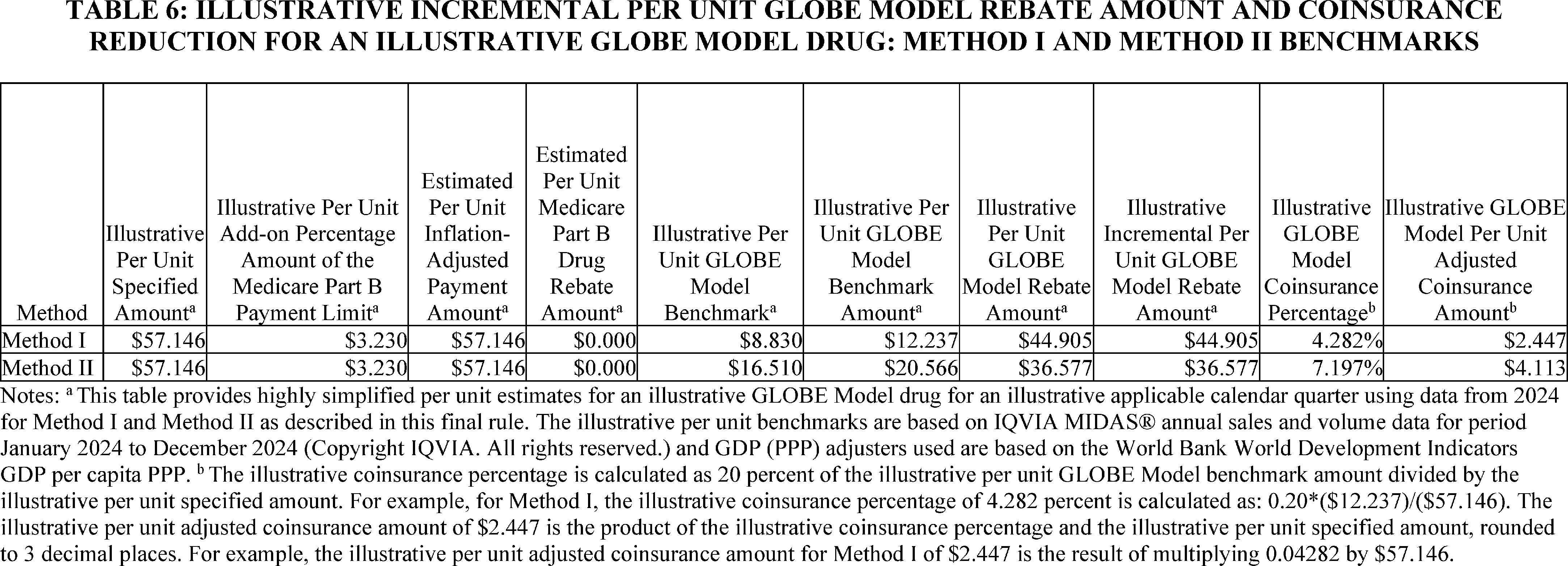
d. Reducing the Incremental GLOBE Model Rebate Amount for GLOBE Model Drugs in Shortage and When There Is a Severe Supply Chain Disruption
(1) Reducing the Incremental GLOBE Model Rebate Amount for GLOBE Model Drugs in Shortage
In accordance with section 1847A(i)(3)(G)(i) of the Act as codified in 42 CFR 427.401, CMS reduces the total rebate amount determined under 42 CFR 427.301(a), if any is owed, for a Part B rebatable drug that is currently in shortage, as set forth in 42 CFR 427.400. For purposes of the Medicare Part B Drug Inflation Program, to calculate the reduction in the total rebate amount for a Part B rebatable drug that is currently in shortage, CMS calculates the number of days such drug is described as “currently in shortage” on an FDA shortage list maintained under section 506E of the FD&C Act in a calendar quarter, divides by the number of days in the calendar quarter, and then multiplies that amount by the applicable percentage as specified in 42 CFR 427.401(b)(2).
For purposes of the GLOBE Model, we proposed, in § 513.500(d), to reduce the incremental GLOBE Model rebate amount, if any, for such GLOBE Model drug for such applicable calendar quarter using the methodology specified in proposed § 513.500(d). Specifically, to closely align with the Medicare Part B Drug Inflation Rebate Program, for any GLOBE Model drug currently in shortage during an applicable calendar quarter during the model performance period, we proposed to use the applicable percent reduction and percentage of time the drug was currently in shortage during the applicable quarter as set forth in 42 CFR 427.401(b). The “applicable percent reduction” in the proposed formula would be determined as set forth in 42 CFR 427.401(b)(2) as applicable, including to account for whether the GLOBE Model drug is a plasma-derived product and the number of consecutive applicable calendar quarters such drug is currently in shortage. We noted that this approach would maintain the ( printed page 63031) meaning and use of the terms “applicable percent reduction” and “time drug was currently in shortage” as those terms are used in 42 CFR 427.401(b). Specifically, we proposed that the equation would be:
Reduced incremental GLOBE Model rebate amount = the incremental GLOBE Model rebate amount multiplied by (1 minus “applicable percent reduction” determined under 42 CFR 427.401(b)(2)) multiplied by (“percentage of time drug was currently in shortage during the applicable calendar quarter” as determined in accordance with 42 CFR 427.401(b)(3)) added to the incremental GLOBE Model rebate amount multiplied by (1 minu s “percentage of time drug was currently in shortage during the applicable calendar quarter” as determined in accordance with 42 CFR 427.401(b)(3)).
Further, we proposed to apply a reduction of the incremental GLOBE Model rebate amount as determined under § 513.500(d)(2) to all the NDCs under the relevant billing and payment code as specified in 42 CFR 427.401(c). As discussed in section II.G.8. of this final rule, any applied reductions would be identified in the GLOBE Model Rebate Report.
As an alternative to our proposed approach, we considered whether, for purposes of the GLOBE Model, the applicable percent reduction should be greater than or less than the applicable percentage reduction specified in 42 CFR 427.401(b)(2). To maintain consistency with the Medicare Part B Drug Inflation Rebate Program and avoid creating different manufacturer incentives for addressing shortages and supply chain disruptions, we proposed to apply, for purposes of the GLOBE Model, the same applicable percentage reduction as used under the Medicare Part B Drug Inflation Rebate Program.
The following is a summary of the comments received and our responses.
Comment: A couple of commenters expressed support for reducing GLOBE Model rebate amounts when there is a shortage but also expressed concern that a reduction would not mitigate the underlying risk for shortages. A couple of commenters stated that CMS's proposal to reduce GLOBE Model rebates for plasma-derived products in the event of a shortage is insufficient and does not address concerns that the GLOBE Model could lead to supply chain disruptions.
Response: We thank the commenters for their feedback on the proposed reduction in the incremental GLOBE Model rebate amount for a GLOBE Model drug that is currently in shortage. We acknowledge the commenters' concern that a reduction would not mitigate the underlying risk for shortage. Based on the comments we received, we are not persuaded that an alternative approach for reducing the incremental GLOBE Model rebate amount would be more appropriate or warranted for the GLOBE Model test and any such approach would not be within the scope of the GLOBE Model test. Therefore, we are not modifying our proposal. We note that, as discussed in section II.B.5. of this final rule, we are finalizing at § 513.130(c)(1)(vi) that plasma-derived products are excluded from the GLOBE Model.
Comment: A commenter stated the FDA's drug shortage list does not reflect the full scope of shortages that health care providers face at any given time, due to how the FDA collects information and the lag in its reporting. The commenter suggested that CMS work with the FDA to update its processes to ensure that any drug facing a shortage is appropriately and timely included in FDA's drug shortage list.
Response: We thank the commenter for sharing feedback on our proposal. FDA maintains public, up-to-date lists of finished drugs and biological products that FDA has determined to be in shortage in the United States.[188] For purposes of the GLOBE Model, to maintain consistency with the Medicare Part B Drug Inflation Rebate Program, we believe that using a shortage list maintained by the FDA under section 506E of the FD&C Act would be adequate to identify GLOBE Model drugs in shortage. The FDA has a robust and established process to identify drug shortages. Since the enactment of the Food and Drug Administration Safety and Innovation Act in 2012, manufacturers have been required to notify FDA of certain discontinuances and interruptions in manufacturing, and FDA works closely with manufacturers to obtain drug supply information. As we proposed, CMS will collaborate with the FDA to review FDA's shortage lists and determine whether the number of drugs or length of time on a shortage list changes over time. To the extent that CMS identifies an issue through regular monitoring that would require a change to the GLOBE Model, CMS could take necessary action to make such a change. In addition, to the extent that health care providers may experience local changes in availability of GLOBE Model drugs, such health care providers would be able to inform CMS through the GLOBE Model helpdesk.
Final Decision: After consideration of the public comments received, CMS is finalizing § 513.500(d) as proposed. CMS is revising the description of this provision in the preamble for technical accuracy. CMS has also corrected a non-substantive typographical error in § 513.500(d)(1): the reference for equation 1 has been corrected to state “paragraph (d)(1)” instead of “paragraph (c)(1).”
(2) Reducing the Incremental GLOBE Model Rebate Amount for a GLOBE Model Drug When There Is a Severe Supply Chain Disruption
Under section 1847A(i)(3)(G)(ii) of the Act as codified in 42 CFR 427.402, CMS reduces the total rebate amount determined under 42 CFR 427.301(a), if any is owed, for a Part B rebatable biosimilar biological product when CMS determines there is a severe supply chain disruption during the applicable calendar quarter such as that caused by a natural disaster or other unique or unexpected event. Additional instructions for submitting rebate reduction requests are provided in the collection of information that was approved on July 22, 2024, under OMB control number 0938-1474 and can be found on reginfo.gov. As discussed in section II.B.1. of this final rule, we proposed to exclude Part B rebatable biosimilar biological products from the definition of GLOBE Model drugs. We proposed that, if after notice and comment that proposal is not finalized, for any GLOBE Model drug that is a biosimilar biological product as set forth in section 1847A(c)(6)(H) of the Act, CMS would reduce the incremental GLOBE Model rebate amount, if any, when there is a severe supply chain disruption during the applicable calendar quarter in the same manner as specified in 42 CFR 427.402, including the limitation on rebate reductions in 42 CFR 427.402(b)(4).
Specifically, we proposed that to the extent that CMS finalizes a definition of GLOBE Model drugs that were to include Part B rebatable biosimilar biological products, when CMS reduces the total rebate amount determined under 42 CFR 427.301(a), if any is owed, for a Part B rebatable biosimilar biological product that is a GLOBE Model drug for an applicable quarter, CMS would likewise reduce the incremental GLOBE Model rebate amount determined pursuant to § 513.500(b), if any is owed, using the specifications for calculation of the reduced rebate amount set forth in 42 CFR 427.402(b), substituting “the ( printed page 63032) incremental GLOBE Model rebate amount” for “the total rebate amount”, subject to the eligibility requirements set forth in 42 CFR 427.402(c), and to apply that rebate reduction only if the eligibility criteria in 42 CFR 427.402(c) are met.
In the GLOBE Model proposed rule (90 FR 60286), we noted that, if our proposal to exclude biosimilar biological products from the definition of GLOBE Model drugs is finalized in a final rule establishing the GLOBE Model, our proposal for reduction of the incremental GLOBE Model rebate amount for GLOBE Model drugs that are biosimilar biologicals when there is a severe supply chain disruption would not be necessary and we would not include such provision in such final rule.
The following is a summary of the comments received and our responses.
Comment: A couple of commenters expressed support for reducing GLOBE Model rebate amounts when there is a severe supply chain disruption for GLOBE Model drugs that are biosimilar biological products but also expressed support for excluding Part B rebatable biosimilar biological products from the GLOBE Model which would make this provision unnecessary.
Response: We thank the commenter for sharing their support for the proposed reduction of the incremental GLOBE Model rebate amount for GLOBE Model drugs that are biosimilar biological products when there is a supply chain disruption. In section II.G.4.d.(2) of the GLOBE Model proposed rule (90 FR 60286), CMS noted that if our proposal to exclude Part B rebatable biosimilar biological products from the GLOBE Model is finalized, our proposal for reduction of the incremental GLOBE Model rebate amount for GLOBE Model drugs that are biosimilar biological products when there is a supply chain disruption would not be necessary and we would not include such provision in such final rule. Because CMS is finalizing the inclusion of sole source biological products and therefore Part B rebatable biosimilar biological products are not included in the GLOBE Model as discussed in section II.B. of this final rule, our proposal is not necessary. Therefore, we are modifying § 513.500(e) to remove the proposed regulatory text at § 513.500(e) and instead read as “Reserved” and modifying § 513.500(f) to read in part as “paragraphs (a) through (d)” to remove reference to paragraph (e).
Final Decision: After consideration of the public comments received, CMS is finalizing § 513.500 with modifications to remove the proposed regulatory text at § 513.500(e) and insert “Reserved.” CMS is also modifying § 513.500(f) to read in part as “paragraphs (a) through (d)” to remove reference to § 513.500(e) and removing the definition of severe supply chain disruption from § 513.20.
5. Payment Responsibilities
As discussed in section II.E. of the GLOBE Model proposed rule (90 FR 60287), we proposed that model participants would be manufacturers of GLOBE Model drugs. Consistent with the Medicare Part B Drug Inflation Rebate Program, under the GLOBE Model, we proposed that a “manufacturer” would be identified using the same approach used for reporting ASP and the Medicaid Drug Rebate Program data. The manufacturer of a GLOBE Model drug would be responsible for all GLOBE Model rebate payments for each applicable GLOBE Model drug. We proposed that manufacturers of GLOBE Model drugs with a total GLOBE Model rebate amount due of $0 or greater would be provided a rebate report which would serve as an invoice for the total GLOBE Model rebate amount due, using an incremental GLOBE Model rebate amount, as described in section II.G.4.c. of this final rule. As discussed in section II.G.8. of this final rule, we proposed to include the total GLOBE Model rebate amount and incremental GLOBE Model rebate amount in either the Preliminary Rebate Report and Rebate Report provided to the manufacturer pursuant to 42 CFR 513 subpart H (which would be the same rebate reports used for the Medicare Part B Drug Inflation Rebate Program) or in separate Preliminary GLOBE Model Rebate Report and GLOBE Model Rebate Report that CMS would provide to the manufacturer.
When multiple manufacturers are linked to a single HCPCS Level II code that represents a GLOBE Model drug (for example, GLOBE Model drugs that have NDCs involving multiple labeler codes), we proposed to apportion the incremental GLOBE Model rebate amount as set forth in paragraph (b) or (c) of 42 CFR 427.301 as applicable. That is, a manufacturer's liability for the incremental GLOBE Model rebate amount would be calculated by CMS and would be proportionate to the manufacturer's total billing units sold during the applicable calendar quarter. This approach adopts CMS's current operational approach for the Medicare Part B Drug Inflation Rebate Program and is necessary for testing the model in an efficient and consistent manner.
We sought comment on this proposed approach for calculating the manufacturer payment responsibility for total GLOBE Model rebate amounts due, if any, for a GLOBE Model drug for an applicable calendar quarter.
The following is a summary of the comments received and our responses.
Comment: A commenter urged CMS not to impose additional administrative burdens on pharmacies, pharmacists, or pharmacy personnel related to payment, reconciliation, reimbursement, reporting, or distribution.
Response: As discussed in section II.G.8. of this final rule, CMS is finalizing an incremental invoicing approach for GLOBE Model rebate reports, invoicing, payment, Suggestion of Error, and reconciliation processes, which will involve only manufacturers of GLOBE Model drugs (and their designees, if applicable) and CMS (and its contractors, as applicable). Pharmacies and other health care providers and suppliers will not be involved in these processes. For additional information regarding our responses to administrative burdens, we refer readers to section II.G.8. of this final rule.
Final Decision: After consideration of the public comments received, CMS is finalizing § 513.530 as proposed, without modification.
6. Reporting Requirements and Process for Voluntary Manufacturer-Provided Data
As discussed in section II.G.2.b. of this final rule, in order for CMS to identify a per unit Method II benchmark in the alternative inflation rebate amount calculation for a given GLOBE Model drug, a manufacturer must voluntarily report international pricing data. A manufacturer must submit this data in accordance with reporting requirements and process set forth for voluntary manufacturer-provided data. For CMS to determine that the submission is an “applicable submission” we proposed in § 513.610(a)(3)(i) that the data must include all the basic data elements (as set forth in § 513.610(b) and described in section II.G.6. of this final rule) required for each “applicable international analog” as defined in § 513.600 that corresponds to a GLOBE Model drug. As discussed in section II.G.1.d., we proposed that an applicable international analog means a non-US analog whose scientific or nonproprietary name, dosage form, and route of administration (if applicable) aligns with a GLOBE Model drug and that is sold in one or more reference countries during the applicable ASP ( printed page 63033) calendar quarter, excluding those identified in their respective country as a generic or biosimilar biological product according to the country's own regulations.
In addition, the submission must contain all the net pricing data elements (as set forth § 513.610(c)) required under one of the two options manufacturers can select to submit net pricing data (as described in section II.G.6.b. of this final rule). We further proposed in § 513.610 that the submission must be complete, meaning the submission: (1) has a proper and full execution of the manufacturer data agreement; (2) has a proper and full attestation by the manufacturer's authorized representative; (3) was submitted using the proper portal and all security requirements within; (4) was executed in the manner and form required by CMS; and (5) includes supporting documentation that explains how each of the elements of the submission were compiled or calculated and any reasonable assumptions that were applied. Incomplete submissions, as determined by CMS, would not be considered an applicable submission and would not be used by CMS for purposes of identifying a per unit Method II GLOBE Model benchmark.
In addition, we proposed that complete data submissions would be assessed by CMS for validity. To do so, CMS would utilize all available existing data sources and information to assess the extent to which the submission reflects international drug net pricing for the applicable international analogs that were sold in the reference countries during the applicable ASP calendar quarter. To inform the review, as determined by CMS, CMS may use available data sources. We proposed that CMS may choose to request additional supporting information and/or data from the manufacturer who submitted the data to inform CMS's assessment of the validity of the submission. Because the amount of time that CMS would have to complete the review would be minimal (for example, approximately 2 weeks), CMS would limit the amount of time that a manufacturer would have for submission of additional supporting information to no more than 5 business days from the agency's request for additional supporting information or data or both.
Final Decision: CMS is finalizing non-substantive technical modifications to § 513.610(a)(3)(ii)(C)( 1) and new § 513.610(a)(3)(ii)(C)( 2) for clarity and alignment with the preamble in the GLOBE Model proposed rule (90 FR 60287 through 60288). Specifically, § 513.610(a)(3)(ii)(C)( 1) is updated to clarify manufacturer submission of additional supporting information or data or both must be submitted to CMS within 5 business days after the date of CMS's request for additional supporting information or data or both. Section 513.610(a)(3)(ii)(C)( 2) is added to state failure to respond within 5 business days will result in CMS being unable to confirm the validity of the submission.
a. Basic Data Requirements
Under an effectuated GLOBE Model data agreement, manufacturers may make submissions for one or more GLOBE Model drugs for any applicable ASP calendar quarter that corresponds with an applicable calendar quarter during the model performance period. If a manufacturer chooses to make a submission for a GLOBE Model drug to enable identification of a per unit Method II GLOBE Model Benchmark, we proposed that the manufacturer would include all applicable international analogs as defined in § 513.600. We also proposed that the basic data element requirements would consist of data elements, including but not limited to presentation level information, that manufacturers must submit in order for CMS to corroborate that an applicable international analog (as defined in § 513.600) which is included in the manufacturer submitted data corresponds to a GLOBE Model drug and to verify the results of the manufacturer's conversion to HCPCS billing units. To verify a manufacturer's conversion to HCPCS billing units, we proposed to calculate the number of “HCPCS billing units” (as defined in § 513.20) in the applicable international analog, by dividing the quantity of drug in the package by the “HCPCS dosage” (which means, as defined in § 513.20, the quantity of drug represented in one HCPCS billing unit).
In § 513.610(b), we proposed that the required basic data elements that would be used by CMS to identify the international net pricing data that corresponds to a GLOBE Model drug, would include the GLOBE Model drug brand name, scientific or nonproprietary name, and HCPCS Level II code. We also proposed that the basic data elements provided by the manufacturer would contain a list of every applicable international analog (as defined in § 513.600) that was sold in one or more reference countries during the applicable ASP calendar quarter. The following list is the required basic data elements that also include presentation level information. We proposed that a complete submission must include all of the following data elements for all of the applicable international analogs (as defined in § 513.600) by reference country:
- Scientific or nonproprietary name.
- Brand name (all variations in international drug names).
- Names of manufacturers, marketers, or licensees.
- Non-U.S. country regulatory approval status [189] (international originator drug or international non- originator drug).
- Dosage form and route of administration (if applicable).
- Strength or concentration.
- Volume per item (for example, 10 ml in one vial).
- Package type (for example, syringe, vial, ampule, etc.).
- Number of items per package (for example, 10 vials in a package).
- HCPCS dosage (CMS published data which are the quantity of drug represented in one HCPCS billing unit).
- Number of HCPCS billing units.
We proposed that these data elements would be required to be submitted for all applicable international analogs sold in the reference country during the applicable ASP calendar quarter that correspond to a GLOBE Model drug. We proposed that, if there are missing data elements, the submission would be considered incomplete until the manufacturer provides all the necessary data elements to CMS no later than 30 calendar days after the end of the applicable ASP calendar quarter. This means that if, for a GLOBE Model drug, there are six applicable international analogs in a reference country, the manufacturer submitted data must include the basic data elements for every applicable international analog in that reference country. If an applicable international analog was sold in multiple reference countries, then the manufacturer submitted data must also include the basic data elements for all applicable international analogs in each of the reference countries. That is, the basic data element requirements necessitate submitting the data elements separately for each applicable ( printed page 63034) international analog for each reference country. This information would be necessary to allow CMS to identify each applicable international analog within each reference country where the drug is sold.
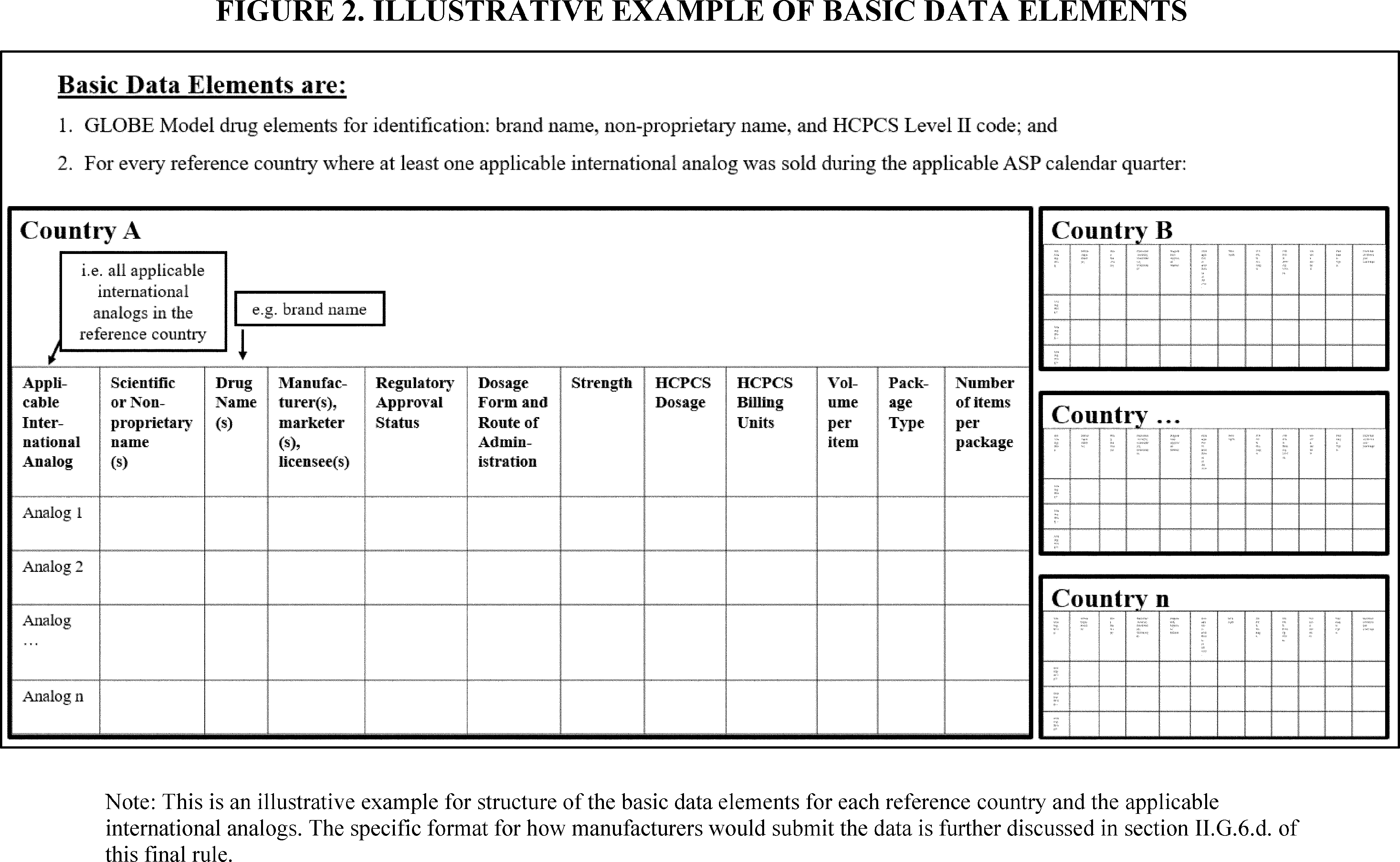
In addition, we proposed that if, for any of the basic data elements, third-party individuals and organizations were used to gather, analyze, or submit the data, the manufacturer must specify their use of third party data with respect to each of the type of activity (gather, analyze, or submit the data) engaged in by the third party, and the identity of the third-party individual or organization.
We recognize the complexities inherent in international pharmaceutical markets, including variations in strengths, formulations, and routes of administration; packaging differences; and diverse relationships between U.S. and international entities responsible for product marketing and distribution. We sought comments on whether the proposed voluntary framework, which includes basic required data elements to ensure applicable international analogs correspond with GLOBE Model drugs, adequately addresses these market complexities. We also sought comments on whether additional basic data elements should be required or if any of the proposed data elements presents significant data collection, analysis, or submission challenges.
Final Decision: Although we did not receive comments on the basic data elements identified in § 513.610, CMS is modifying § 513.610 to address comments discussed in subsequent sections of this final rule. For details on those modifications, see section II.G.6.f. of this final rule. CMS has also made the following non-substantive technical corrections to the regulatory text to correct typographical drafting errors:
- Section 513.610 is renamed as “Submission and verification of international drug net pricing data;”
- In § 513.610(a)(2), the phrase “identified in § 513.310” is replaced with “specified in § 513.310(b)” for clarification;
- In § 513.610(a)(3), “acceptability” is replaced with “completeness and validity;”
- In § 513.610(a)(3)(i)(B), the citation “(d)(2)” is inserted for clarification;
- In § 513.610(b)(1)(i), “scientific or” is added for clarification;
- In § 513.610(b)(1)(ii)(B)(6), “or concentration” was added to align with terminology in § 513.310(c);
- In § 513.610(b)(1)(ii)(B)(11)( i), “the number of” is added for clarification; and
- In § 513.600, CMS corrected a typographical error in the definition of non-U.S. country regulatory approval status by replacing “drug's” with “analog's.”
b. Options for Submission of Net Pricing Data Elements
As discussed in section II.G.6.b. of the GLOBE Model proposed rule (90 FR 60289), when manufacturers choose to submit voluntary international drug net pricing, we proposed that a two-step process would be used: (1) submission of basic data elements as previously described; and (2) submission of international drug net pricing data from one of the two options proposed in § 513.610(c). For submission of international drug net pricing data, we proposed that manufacturers can choose between these 2 options to submit: streamlined or limited. In both options, we proposed that manufacturers would provide the required volume-weighted average GDP (PPP) adjusted net pricing per HCPCS billing unit for the applicable international analogs for all ( printed page 63035) reference countries the applicable international analogs were sold in for the applicable ASP calendar quarter (that is, the across country volume-weighted average GDP (PPP) adjusted net price per HCPCS billing unit). The difference between the two options is the level of aggregation allowed for the submission of gross sales, net sales, and sales volume that was used by the manufacturer to calculate the across country volume-weighted average GDP (PPP) adjusted net price per HCPCS billing unit. In the streamlined option, we proposed that manufacturers would report net pricing data for each applicable international analog in each reference country by net price level. In the limited option, we proposed that manufacturers would report net prices aggregated at the reference country level.
We also proposed, in § 513.610(a)(3)(i), that manufacturers who elect to submit international drug net pricing data must submit all of the net pricing data elements required for one of the two options described later in section, in addition to the basic data elements set forth in § 513.610(b). We proposed the required net pricing data elements in § 513.610(c)(2)(i) for the streamlined option and § 513.610(c)(2)(ii) for the limited option, and discussed our proposal in the GLOBE Model proposed rule (90 FR 60289 through 60295). We proposed that manufacturers would select which option to follow but must select one option. We also proposed that, for each GLOBE Model drug, manufacturers must report net pricing data elements for all the applicable international analogs that are sold in the set of reference countries, using one of the two available options. Additionally, we proposed that the manufacturer would continue to use the same submission option for net pricing data elements (either streamlined or limited) to submit all their international net pricing data for that GLOBE Model drug for subsequent applicable ASP calendar quarters.
The following is a summary of the comments received and our response.
Comment: Commenters recommended that CMS ensure that the assumptions used by manufacturers when reporting international net sales and pricing data are consistent, transparent, and verifiable to support reliable benchmark calculations.
Response: We thank the commenters for their feedback. CMS agrees that consistency, transparency, and verifiability of reported data are important to support reliable benchmark calculations. We also interpret assumptions to mean reasonable assumptions manufacturers would use when reporting international drug net pricing data.
As proposed in the GLOBE Model proposed rule (90 FR 60331 through 60333), the voluntary manufacturer data submissions would include supporting documentation explaining how each element of the submission was compiled and calculated, along with any reasonable assumptions underlying the submission. In addition, to the extent that a manufacturer would use third party individuals and organizations to gather, analyze, or submit the data, the manufacturer would specify their use of third party data with respect to each of the type of activity (gather, analyze, or submit the data) engaged in by the third party and the identity of the third-party individual or organization. As an example of a reasonable assumption that may be appropriate, CMS noted in the GLOBE Model proposed rule that expected clawbacks and other types of price concessions subject to delayed reporting may be estimated based on historical data, as this information may not be available to manufacturers in time to be included in a submission due no later than 30 days after the end of the applicable ASP calendar quarter.
CMS sought comment on the reasonable assumptions manufacturers may make when reporting average gross-to-net ratio and net sales data. However, we did not receive any specific comments on this topic. Accordingly, CMS continues to believe that the use of historical data for expected clawbacks and other price concessions with delayed reporting could represent a reasonable assumption that supports consistent and transparent reporting of international drug net pricing data.
In addition, as proposed in § 513.610, CMS would verify the voluntary manufacturer-provided data submission for completeness, including confirming the net pricing data elements and supporting documentation—including documentation of reasonable assumptions—are present. CMS proposed to utilize all available data sources and information to assess the extent to which the submission reflects international drug net pricing in the reference countries, and to request additional supporting materials from manufacturers, as needed, prior to completing its validation assessment. We believe these verification and validation mechanisms are well-suited to ensuring that reasonable assumptions used by manufacturers are appropriate and that benchmark calculations are reliable.
Final Decision: While the comments received on topics discussed in this section did not require substantive modifications to § 513.610, CMS is modifying § 513.610 to address comments discussed in other subsections of section II.G.6. of this final rule. Additionally, while CMS proposed that a manufacturer must select the streamlined or limited net pricing data option for the duration of the model performance period, this language was inadvertently left out of the regulation text. CMS did not receive comments on this proposal and, as such, CMS is finalizing the following additions to § 513.610(c)(2) to reference new § 513.610(c)(3) (as discussed in section II.G.1.d. of this final rule): “Subject to paragraph (c)(3) of this section” and “A manufacturer must select one of the net pricing data submission options for the duration of the model performance period.”
(1) Streamlined Option
Under the streamlined option, we proposed that manufacturers would be required to report a set of net pricing data elements for the applicable international analogs that correspond to the GLOBE Model drug. For the purposes of the streamlined option, we proposed to define in § 513.600 that “gross sales amount” means for each sale the manufacturer made in that reference country to a purchaser, the amount of money owed to a manufacturer by the purchasers, before subtracting any discounts, rebates, or price concessions. We proposed to define “purchaser” in § 513.600 as the entities or organizations acquiring the drug product for subsequent sale within the pharmaceutical supply chain or for administration or dispensing to a human. It may include, among others, wholesalers, distributors, hospitals, pharmacies, and other healthcare providers and practitioners. For “price concession,” we proposed the following definition in § 513.600—the sum of the value of the following types of transactions and items whether at the time of sale or afterwards:
- Volume discounts: “Volume discounts” are also known as quantity discounts or bulk discounts where the price per unit is reduced when purchased in larger quantities.
- Prompt pay discounts: The term “prompt pay discounts”, also known as early payment discounts, means any reduction in the total value of units purchased routinely offered to a purchaser when a payment is made within a specified timeframe and consistent with customary business practices for payment. ( printed page 63036)
- Cash discounts: The term “cash discounts” refers to reductions on the price per unit when payment is made in cash. This may be facilitated through discount cards, coupons, or other agreements.
- Free goods include samples or other benefits provided to purchasers or patients that are contingent on any purchase requirement.
- Chargebacks: This term refers to retrospective payments made from manufacturers to purchasers.
- Rebates: This term refers to reimbursements made by a manufacturer to a wholesaler or other purchaser, for the difference between the price the wholesaler or other purchaser initially paid for the product and the lower price at which the wholesaler or other purchaser sold the product.
- Other price concessions that lower the amount realized by the manufacturer.
We also proposed to define in § 513.600 that “net sales amount” means for each sale the manufacturer made in that reference country to a purchaser, the amount of money owed by the purchaser exclusive of any price concessions. Each net sales amount would have a corresponding sales volume, expressed in HCPCS billing units. The net sales amount is not a list price (for example, the equivalent of WAC in the United States); rather, it is based on the net price of the applicable international analog sold in each reference country. We proposed that “net price level” as defined at § 513.600 would, with respect to sales of applicable international analogs, mean all sales of the applicable international analogs in a reference country at the same price net of price concessions during the applicable ASP calendar quarter. We also proposed the submission would include the net sales amount in the reference country currency, what the local currency is (for example, euro, yen, etc.), and its equivalent U.S. dollar amount, at the net price level. This means the data submitted would report each sales transaction's net sales amount, at an aggregated net price level, along with the corresponding volume sold expressed in HCPCS billing units. In addition, we proposed the gross sales amount and net sales amount to be rounded to 5 decimal places.
We recognize that manufacturers may not have access to every sale in a reference country if they are not the ones who are making the sale. We proposed that we would expect the manufacturer to obtain data for every transaction that is made directly to healthcare entities, distributors, wholesalers, or other international purchasers and aggregate those that share a price and concession amount resulting in sales by the net price level.
In Table 7 in the GLOBE Model proposed rule (90 FR 60291) that is also repeated here in the final rule, we provided an illustrative example of a voluntary submission of net pricing data by the manufacturer of a fictitious GLOBE Model drug. This fictitious GLOBE Model drug I has more than one applicable international analog in 3 reference countries, A, B and C. In reference country A it has 2 applicable international analogs, in reference country B it has 4, and in reference country C it has 3. For reference country A, the applicable international analog 1 has 5 net price levels, thus an applicable submission would include gross and net sales amounts and volume sold expressed in HCPCS billing units for each of the 5 levels. In the same reference country A, applicable international analog 2 has 3 net price levels, thus an applicable submission would include 3 gross and net sales amounts with the corresponding volumes. This logic is repeated for the other reference countries with applicable international analogs to GLOBE Model drug I. In the accompanying narrative (90 FR 60290), we explained that because a net price level represents all sales transactions that occurred at the same net price during the applicable ASP calendar quarter, there may be multiple individual sales of each applicable international analog. However, all such sales would be aggregated into a single net price level when they share the same net price after applying any applicable price concessions.
( printed page 63037)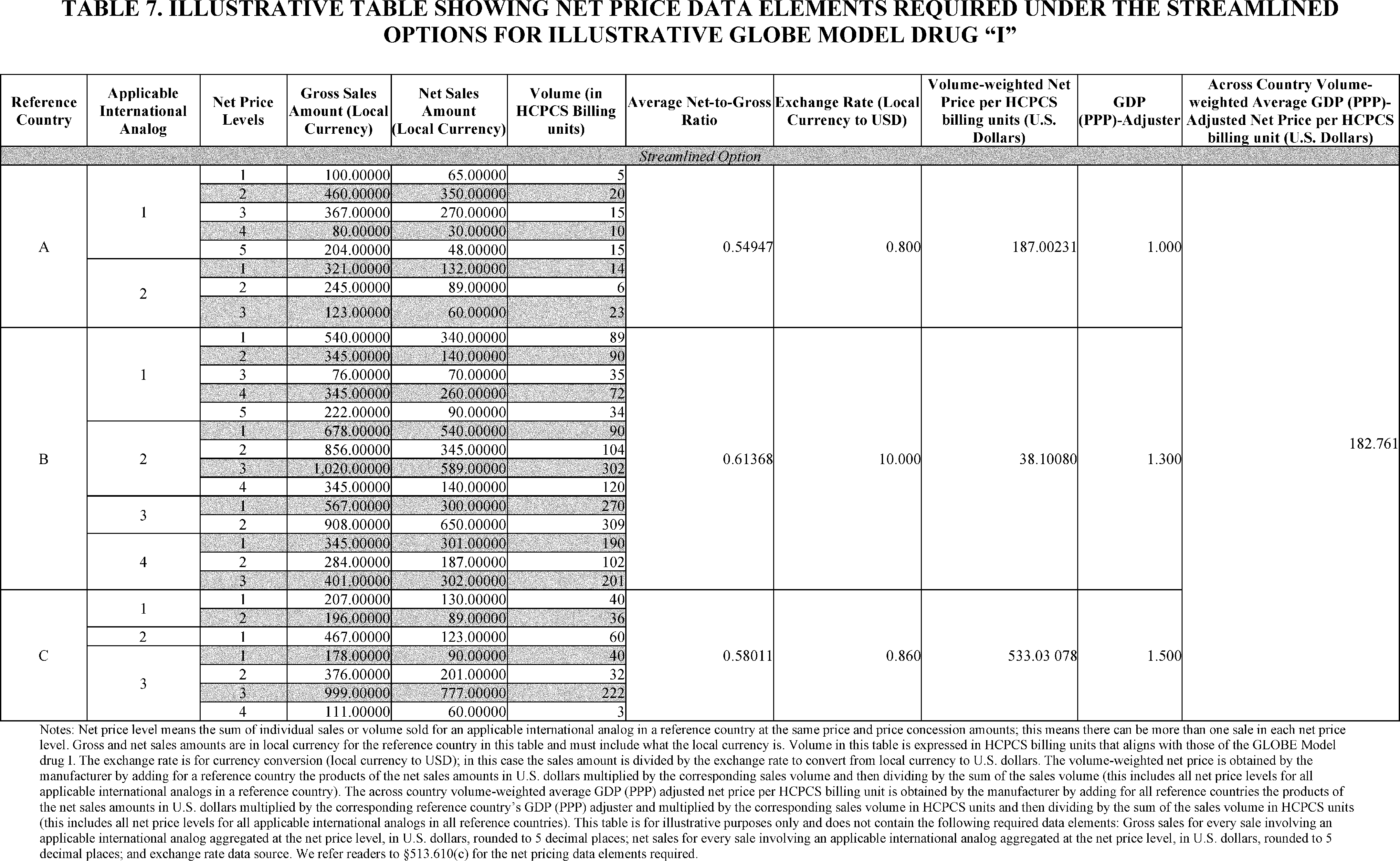
In addition, under the streamlined option, we proposed that manufacturers would provide one average net-to-gross ratio for each GLOBE Model drug per reference country. For the purposes of the streamlined option, we proposed to define the “average net-to-gross ratio” to mean, for a reference country, the total net sales of the set of applicable international analogs in the reference country divided by the total gross sales of the same set of applicable international analogs in the same reference country. We also proposed that the average net-to-gross ratio would be rounded to 5 decimal places. An example of how the average net-to-gross ratio would be reported is shown in Table 7 in the GLOBE Model proposed rule (90 FR 60291) and this final rule. In that example, in Reference Country A, the sum of all net sales amounts for all applicable international analogs is 1044.00000 and the sum of all gross sale amounts for the same set of applicable international analogs is 1900.00000. Thus, the average net-to-gross ratio would be the sum of all net sales amount divided by the sum of all gross sales amounts resulting in 0.54947. A more detailed calculation is shown later in this section.
In addition, we proposed that manufacturers would be required to report for each country, the volume-weighted net price across all applicable international analogs, in U.S. dollars. We also proposed to define in § 513.600 that “volume-weighted net price” to mean, exclusive of any price concessions, the volume-weighted reference country average net price in U.S. dollars where the weights are sales volumes in HCPCS billing units. In addition, we proposed that the volume of the applicable international analog in HCPCS billing units must be expressed using the same number of decimals places as the submitted GLOBE Model drug's HCPCS billing units. The volume-weighted net price for a reference country must also be rounded to 5 decimal places.
As illustrated in the GLOBE Model proposed rule (90 FR 60291), using the example of reference country A shown in Table 7, each of the net price sales amounts for both applicable international analogs contribute to the volume-weighted net price according to how much volume was sold. The net sales amounts are converted from local currency to U.S. dollars using an exchange rate that is described by 3 decimal places and expressed as number of local currency units to U.S. dollars. In other words, net sales amounts are converted to U.S. dollars by dividing the net sales by the exchange rate. Our proposal for exchange rate considerations is discussed in section II.G.6.c. of this final rule. For this example, each net sale is divided by 0.800. This results in an average price for one HCPCS billing unit of GLOBE Model Drug I in reference country A being $187.00231. A more detailed calculation is shown later in this section.
We also proposed that manufacturers would be required to submit, across all the reference countries, the across country volume-weighted average GDP (PPP) adjusted net price per HCPCS billing unit, which would be the volume-weighted average GDP (PPP) adjusted net price of all the applicable international analogs corresponding to a GLOBE Model drug in U.S. dollars, along with the GDP (PPP) adjuster that was used for the adjustment. We proposed to define, at § 513.20, the “across country volume-weighted average GDP (PPP) adjusted net price per HCPCS billing unit” to mean the volume-weighted average for all reference countries of GDP (PPP) adjusted net prices, where the weights are the sales volume in HCPCS billing units for each reference country in U.S dollars from international drug net pricing data from an applicable ( printed page 63038) submission. In addition, we proposed that the across volume-weighted average GDP (PPP) adjusted net price per HCPCS billing unit would be reported and rounded to 3 decimal places.
We proposed that the GDP-adjustment would be based on purchasing power parity (PPP) and that manufacturers must use the GDP (PPP) adjuster from CMS that aligns with the applicable ASP calendar quarter. We proposed that CMS would publish a supplemental document on the GLOBE Model website with details on which GDP (PPP) adjuster would be used for each applicable ASP calendar quarter. To establish the GDP (PPP) adjuster for each ASP calendar quarter, in § 513.430, we proposed to use the most recent estimate of GDP per capita based on purchasing power parity for a country (GDP (PPP)) available in the CIA World Factbook at the start of the applicable ASP calendar quarter (as defined in § 513.20) as determined by CMS. We note that, as discussed in section II.G.1.f. of this final rule, in response to comments related to the discontinuation of the CIA World Factbook, CMS would use the World Bank WDI GDP (PPP) if available, otherwise the IMF GDP (PPP) to calculate the GDP (PPP) adjuster for each country for each calendar quarter as finalized at § 513.430.
An example of the across country volume-weighted average GDP (PPP) adjusted net price per HCPCS billing unit for all reference countries can also be observed in Table 7. In this example for GLOBE Model Drug I, there is only one across country volume-weighted average GDP (PPP) adjusted net price per HCPCS billing unit for all three reference countries. Each net sales amount for all applicable international analogs in the three reference countries contribute to this average according to the volume sold. Each of the 29 net sales amounts are converted to U.S. dollars using the appropriate exchange rate (0.800 for the 8 net sales amounts for reference country A, 10.000 for the 14 net sales amounts for reference country B, and 0.860 for the 7 net sales amounts for reference country C) and adjusted by the reference country's GDP (PPP) adjuster (1.000 for reference country A, 1.300 for reference country B, and 1.500 for reference country C). In this illustrative example for GLOBE Model drug I, the across country volume-weighted average GDP (PPP) adjusted net price per HCPCS billing unit in all reference countries where it is sold is $182.761, having accounted for how much quantity is sold, the country's currency, and its GDP (PPP) adjuster. As a summary, after manufacturers have identified applicable international analogs as defined in § 513.600, for a GLOBE Model drug for an applicable ASP calendar quarter, manufacturers would use the following steps to identify the average net-to-gross ratio, volume-weighted net price per reference country, and across country volume-weighted average net GDP (PPP) adjusted net price per HCPCS billing unit for all reference countries for each GLOBE Model drug:
Step 1: By reference country, apply the following data checks. Identify and discard data as follows:
a. Exclude sales for international biosimilar biological products and international generic products. In other words, sales data must be based on international originator drugs.
b. Exclude international drug net pricing data without both sales and volume data that are greater than zero.
Step 2: By reference country, convert the volume data to the unit of measurement delineated in the GLOBE Model drug's HCPCS Level II code long descriptor (for example, mg, ml, mcg, etc.), as applicable, for each applicable international analog and net price level. Volume must be expressed using the same rounding convention as the corresponding GLOBE Model drug. We proposed that manufacturers would calculate the number of HCPCS billing units in the applicable international analog as defined in § 513.600 by dividing the quantity of drug in the package by the HCPCS dosage (quantity of drug represented in one HCPCS billing unit, which is the identifiable quantity of a drug or biological product associated with a billing and payment code (for example, a HCPCS Level II code), as established by CMS).
Step 3: By reference country, aggregate gross sales amount, in local currency, for each applicable international analog that has the same net price level for each reference country. Gross sales amount must be rounded to 5 decimal places. Report what the local currency is.
Step 4: By reference country, aggregate net sales amount, in local currency, for each applicable international analog for the corresponding GLOBE Model drug that have the same net price level for each reference country. Net sales amount must be rounded to 5 decimal places. Report what the local currency is.
Step 5: By reference country, calculate the average net-to-gross ratio, in local currency, for each reference country.
a. Sum the gross sales amount for all net price levels of all applicable international analogs.
b. Sum the net sales amount for all net price levels for all applicable international analogs.
c. Divide the sum determined in Step 5b. by the sum determined in Step 5a., resulting in the average net-to-gross-ratio per reference country. The average net-to-gross-ratio must be rounded to 5 decimal places.
Step 6: By reference country, convert the net sales amount, in local currency, to U.S. dollars. Divide the net sales, in local currency, by, the exchange rate to convert to U.S. dollars and round to 5 decimal places. The manufacturer applies the same exchange rate identified as set forth in § 513.610(c)(2)(i)(A)( 3) to all net pricing data in a reference country for the applicable ASP calendar quarter.
Step 7: By reference country, calculate the volume-weighted net price as follows:
a. Multiply the net sales, in U.S. dollars, by the sales volume in HCPCS billing unit for each applicable international analog and net price level.
b. Sum together the products determined in Step 7a.
c. Sum together the volume sold in HCPCS billing units for all applicable international analogs and all net price levels.
d. Divide the sum determined in Step 7b by the sum determined in Step 7c, resulting in the volume-weighted net price per HCPCS billing unit per reference country. Round the volume-weighted net price per reference country to 5 decimal places.
Step 8: Calculate the across country volume-weighted average GDP (PPP) adjusted net price per HCPCS billing unit for all applicable international analogs to a GLOBE Model drug for all reference countries.
a. Per reference country, multiply the volume-weighted net price calculated in Step 7d by the applicable GDP (PPP) adjuster per applicable ASP calendar quarter (to be published by CMS in a supplemental document).
b. Per reference country, multiply the amounts calculated in Step 8a by the sum calculated in Step 7c. (total volume sold in HCPCS billing unit for all applicable international analogs and all net price levels).
c. Sum together the amounts calculated in Step 8b and divide by the sums in Step 7c. (the total volume sold in HCPCS billing units for all applicable international analogs in all reference countries), resulting in the across country volume-weighted average GDP (PPP) adjusted net price per HCPCS billing unit for all applicable international analogs to a GLOBE Model drug across all reference countries. ( printed page 63039) Round the across country volume-weighted average GDP (PPP) adjusted net price per HCPCS billing unit to 3 decimal places.
We proposed that manufacturers would submit information on how each of the elements of the submission were compiled and computed and consistent with ASP reporting, any reasonable assumptions that were made during this process. We also proposed that manufacturers would provide any other pertinent information that CMS should consider in its verification process for the data. Examples of information to submit include if a third party was used to gather, analyze, or submit the net pricing data elements and the identity of the third party, or if the manufacturer made any reasonable assumptions to determine the average net-to-gross ratio (for example, expected clawbacks and other price concessions based on past historical data that may have delayed reporting to the manufacturer and would not otherwise be available to the manufacturer in time to be included in the manufacturer's data submission to CMS no later than 30 days after the end of the applicable ASP calendar quarter). We sought comments on reasonable assumptions manufacturers may make during their reporting of average net-to-gross ratio and net pricing data elements such as how they account for clawbacks and other price concessions that may have delayed reporting to the manufacturer.
We also recognized that manufacturers may need to allocate gross and net sales amounts to the applicable international analogs in order to provide the data elements required. We proposed in § 513.610(a)(2) that any allocation and calculations be done in a manner consistent with the GAAP, IFRS, or other internationally recognized accounting approaches.[190] We sought feedback on whether there are other accounting approaches that CMS should consider. The following is a summary of the comments received and our responses.
Comment: A few commenters raised concerns that, because manufacturers are not required to disclose net prices and may choose whether to voluntarily disclose such prices, CMS should consider establishing minimum data requirements to ensure that reference prices reflect actual net transaction prices rather than list prices. A commenter suggested CMS provide guidance on acceptable methodologies for calculating net-to-gross ratios and for handling delayed price concessions. Commenters also expressed concern that voluntary reporting could lead to incomplete or inconsistent data and may create incentives for strategic reporting behavior—whereby manufacturers report in ways that are advantageous to their financial circumstances—thereby reducing the reliability of Method II benchmarks.
Response: CMS thanks the commenters for their feedback. CMS believes that the combination of basic data elements, net price data elements, and a review of supporting documentation, including reasonable assumptions—as set forth in § 513.610—provides a set of minimum data requirements that would be sufficient for CMS to assess reported net prices.
Additionally, CMS has defined in § 513.600 the net sales amount and volume-weighted net price as the amount of money owed by the purchaser exclusive of price concessions. As proposed in § 513.600, price concessions would include volume discounts, prompt pay discounts, cash discounts, free goods, chargebacks, rebates, and other price concessions that lower that amount realized by the manufacturer. Accordingly, CMS expects that reported net prices will reflect actual net transaction prices rather than list prices.
As part of the validation framework proposed in § 513.610(a)(3)(ii), CMS will utilize all available data sources and information to assess the extent to which a submission reflects international drug net pricing in the reference countries and may request additional supporting information or data or both before completing its validation assessment. Under § 513.610(d)(2), manufacturers are also required to attest to and certify the completeness and accuracy of their submissions. CMS believes these requirements, taken together, establish the minimum standards necessary to ensure that submitted information reflects actual net prices rather than list prices.
Regarding guidance on methodologies for calculating net-to-gross ratios, CMS believes it has provided sufficient guidance in the GLOBE Model proposed rule. In section II.G.6. of the GLOBE Model proposed rule, CMS provided illustrative examples for both the limited option (Table 7) and the streamlined option (Table 8), along with step-by-step instructions for calculating each of the net pricing data elements. In addition, § 513.610(a)(2) requires that manufacturers ensure all allocations and calculations are performed in a manner consistent with the generally accepted accounting principles (GAAP), international financial reporting standards (IFRS), or other internationally recognized accounting approaches. As manufacturers regularly prepare financial reports and estimations, CMS believes these accounting principles, standards, and approaches are familiar to manufacturers and provide a well-established foundation for consistent reporting. However, in considering the comments received, CMS identified that the proposed definition of average net-to-gross ratio could be updated to clarify the calculation by a manufacturer and more closely reflect the illustrative examples and details provided in the GLOBE Model proposed rule and has updated this definition in § 513.600 in this final rule.
CMS also recognizes that certain price concessions may be subject to delayed reporting. As discussed in section II.G.6. of the GLOBE Model proposed rule (90 FR 60293), manufacturers may, as part of their reasonable assumptions, use historical data to account for expected clawbacks and other price concessions that may have delayed reporting to the manufacturer and would not be available in time to be included in a data submission due no later than 30 days after the end of the applicable ASP calendar quarter.
Finally, CMS relies on manufacturers providing an accurate and complete submission when submitting their own data. However, if a submission is found to not meet the applicable submission requirements in § 513.610(a)(4), CMS will not use the submission for purposes of identifying available information for purposes of identifying a per unit Method II GLOBE Model benchmark as set forth in § 513.310(d)(3). CMS believes that the established minimum data requirements and applicable submission standards reduce the potential for incomplete or inconsistent data, mitigate incentives for strategic reporting behavior, and support the reliability of Method II benchmarks.
Final Decision: While responding to the comments received did not require edits to the regulatory text in § 513.610(c)(2)(i), CMS is finalizing § 513.610(c)(2)(i) as proposed, with a technical modification in the regulatory text for clarity. Specifically, in § 513.610(c)(2)(i)(A)( 5), CMS has corrected a drafting error by replacing “GDP (PPP) adjustment” with “GDP (PPP) adjuster.” CMS did receive comments related to manufacturer's overall ability to submit international drug net pricing data and has addressed ( printed page 63040) these comments in section II.G.6.f. of this final rule.
In § 513.600, to clarify, CMS is updating the definition of average net-to-gross ratio to read as: “ Average net-to-gross ratio means, for a reference country, the sum of net sales for the set of applicable international analogs in the reference country divided by the sum of gross sales for the same set of applicable international analogs in the same reference country.” CMS is also updating the definition of volume-weighted net price to read as: “ Volume-weighted net price means, exclusive of any price concessions, the volume-weighted average net price in U.S. dollars for a reference country where the weights are sales volume in HCPCS billing units. The volume-weighted net price for a reference country is obtained by the manufacturer by adding the products of the net sales amounts in U.S. dollars multiplied by the corresponding sales volume in HCPCS billing units for the set of applicable international analogs in the reference country and then dividing by the sum of the sales volume in HCPCS billing units for the same set of applicable international analogs in the same reference country.” For clarification, CMS also added the phrase “of an applicable international analog” to the definitions of gross sales amount and net sales amount.
In § 513.20, CMS is updating the definition for across country volume-weighted average GDP (PPP) adjusted net price per HCPCS billing unit for clarity and to align with the preamble and remove the phrase “from international drug net pricing data from an applicable submission.” The updated definition reads as: “ Across country volume-weighted average GDP (PPP) adjusted net price per HCPCS billing unit means the volume-weighted average GDP (PPP) adjusted net prices in U.S dollars for all reference countries, where the weights are the sales volume in HCPCS billing units for each reference country. The across country volume-weighted average GDP (PPP) adjusted net price per HCPCS billing unit is obtained by the manufacturer by adding for all applicable international analogs in all reference countries the products of the net sales amounts in U.S. dollars multiplied by the corresponding reference country's GDP (PPP) adjuster and multiplied by the corresponding sales volume in HCPCS billing units and then dividing by the sum of the sales volume in HCPCS billing units for all applicable international analogs in all reference countries.”
(2) Limited Option
Under the limited option, we proposed that manufacturers would be required to submit a set of data elements that are aggregated at higher levels than CMS proposed under the streamlined option. For all the applicable international analogs to a corresponding GLOBE Model drug, as defined in § 513.600, and for each reference country, we proposed that manufacturers would submit the total gross sales amount in local currency and its equivalent U.S. dollar amount, which would be computed as the sum of all gross sales amounts for the applicable international analogs in the reference country's currency, the total net sales amount in local currency and its equivalent U.S. dollar amount, which would be computed as the sum of all net sales amounts for the applicable international analogs in the reference country's currency, and the corresponding total sales volume in HCPCS billing units. In other words, the total gross sales, total net sales, and total sales volume by reference country that are an aggregate of all the applicable international analogs and net price levels. For the purposes of the limited option, we proposed to use the same definition as for the streamlined option for “gross sales amount” and “net sales amount” as defined in § 513.600. Manufacturers must also report what the local currency is (for example, euro, yen, etc.). We also proposed the total gross sales and total net sales would be rounded to 5 decimal places and that the total sales volume must be expressed using the same number of decimals places as the corresponding GLOBE Model Drug's HCPCS billing units.
In the GLOBE Model proposed rule (90 FR 60293), we stated that we recognize that manufacturers may not have access to every sale in a reference country if they are not the ones who are making the sale. Under our proposal, we would expect the manufacturer to obtain every transaction that is made directly to healthcare entities, distributors, wholesalers, or other international purchasers. In addition, we proposed that manufacturers would be required to submit the average net-to-gross ratio for each of the reference countries where the applicable international analogs were sold for a GLOBE Model drug. We proposed to define the “average net-to-gross ratio” for the limited option to be the same as for the streamlined option which is the total net sales of the applicable international analogs in the reference country divided by the total gross sales of the applicable international analogs in the reference country. We proposed that manufacturers would round the average net-to-gross ratio to 5 decimal places.
We also proposed that manufacturers would report, for each country, the volume-weighted net price across all applicable international analogs corresponding to a GLOBE Model drug, as defined in § 513.600, in U.S. dollars. To convert from local currency to U.S. dollars, the net sales amount, in local currency, is divided by an exchange rate with 3 decimal places expressed as number of local currency units to U.S. dollars. Our proposal for exchange rate considerations is discussed in section II.G.6.c. of this final rule. For the limited option, we also proposed to define the “volume-weighted net price” the same as for the streamlined option, which is the volume-weighted reference country average net price in U.S. dollars where the weights are volume in HCPCS billing units exclusive of any price concessions as defined in § 513.600. The volume-weighted net price per reference country must be rounded to 5 decimal places.
In addition, we proposed that manufacturers would be required to submit, across all the reference countries, the across country volume-weighted average GDP (PPP) adjusted net price per HCPCS billing unit of all the applicable international analogs to a corresponding GLOBE Model drug, as defined in § 513.600, in U.S. dollars along with the GDP (PPP) adjuster that was used for the adjustment. The limited option would use the same definition as the streamlined option for the across country volume-weighted average GDP (PPP) adjusted net price per HCPCS billing unit as defined in § 513.20. This across country volume-weighted average GDP (PPP) adjusted net price per HCPCS billing unit for all reference countries must be rounded to 3 decimal places.
We proposed that the GDP adjustment would be based on purchasing power parity (PPP) and that manufacturers must use the GDP (PPP) adjuster from CMS that aligns with the applicable ASP calendar quarter. We proposed that CMS would publish a supplemental document on the GLOBE Model website with details on which GDP (PPP) adjuster to use for each applicable ASP calendar quarter. To establish the GDP (PPP) adjuster for each ASP calendar quarter, in § 513.430, we proposed to use the most recent estimate of GDP per capita based on purchasing power parity for a country (GDP (PPP)) available in the CIA World Factbook at the start of the applicable ASP calendar quarter (as ( printed page 63041) defined in § 513.20) as determined by CMS. We would publish this GDP (PPP) adjuster at the beginning of each applicable calendar quarter. We note that, as discussed in section II.G.1.f. of this final rule, in response to comments related to the discontinuation of the CIA World Factbook, CMS would use the World Bank WDI GDP (PPP) if available, otherwise the IMF GDP (PPP) to calculate the GDP (PPP) adjuster for each country for each calendar quarter as finalized at § 513.430. The across country volume-weighted average GDP (PPP) adjusted net price per HCPCS billing unit would represent the volume-weighted average net price per HCPCS billing unit of the applicable international analogs corresponding to a GLOBE Model drug across all reference countries where the applicable international analogs are sold and would include an adjustment using GDP (PPP).
Table 8 in the GLOBE Model proposed rule (90 FR 60294) and this final rule illustrate the net pricing data elements that would be required for GLOBE Model Drug I for the limited option. In this illustration, while there may be multiple applicable international analogs to GLOBE Model Drug I and multiple net pricing levels, only total gross sales, total net sales, total sales volume, average net-to-gross-ratio, volume-weighted net price in U.S. dollars per reference country, and across country volume-weighted average GDP (PPP) adjusted net price per HCPCS billing unit are shown.
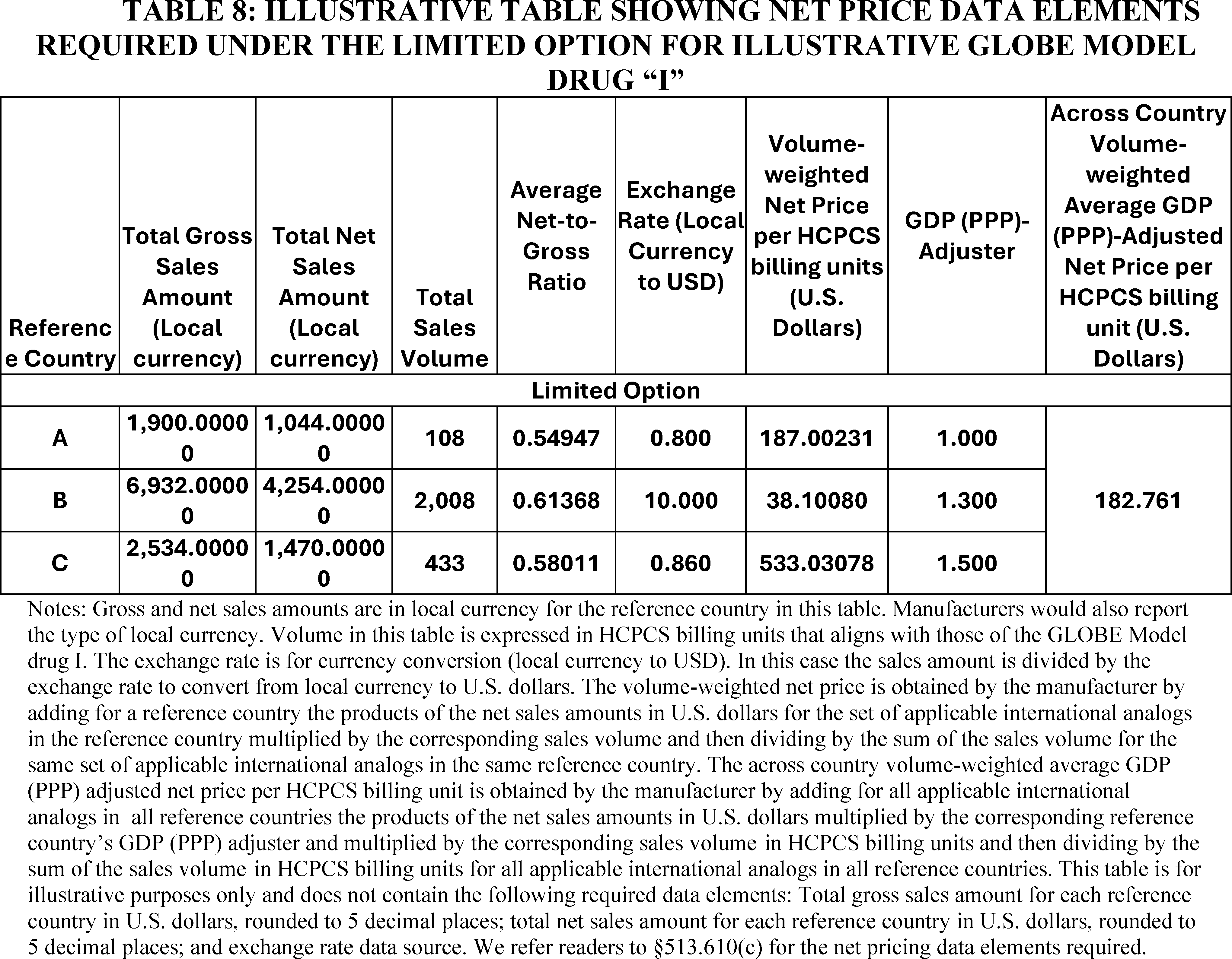
In the GLOBE Model proposed rule (90 FR 60294), we provided a summary of our proposal as follows. After manufacturers have identified applicable international analogs sold that correspond to a GLOBE Model drug for an applicable ASP calendar quarter, we proposed that manufacturers use the following steps to identify average net-to-gross ratio, volume-weighted net price per reference country, and across country volume-weighted average GDP (PPP) adjusted net price per HCPCS billing unit for all reference countries for each GLOBE Model drug:
Step 1: By reference country, apply the following data checks. Identify and discard data as follows:
a. Exclude sales for international biosimilar biological products and international generic products. In other words, sales data must be based on international originator drugs.
b. Exclude international drug pricing data without both sales and volume data that are greater than zero.
Step 2: By reference country, convert the total volume data to the unit of measurement delineated in the GLOBE Model drug's HCPCS Level II code long descriptor, as applicable, for all applicable international analogs. Total volume must be expressed using the same rounding convention as the corresponding GLOBE Model Drug. We ( printed page 63042) proposed that manufacturers would calculate the number of HCPCS billing units in the applicable international analog as defined in § 513.600 by dividing the quantity of drug in the package by the HCPCS dosage (quantity of drug represented in one HCPCS billing unit, which is the identifiable quantity of a drug or biological product associated with a billing and payment code (for example, a HCPCS Level II code), as established by CMS).
Step 3: By reference country, aggregate gross sales amount, in local currency, for all applicable international analogs. The total gross sales amount must be rounded to 5 decimal places. Report what the local currency is.
Step 4: By reference country, aggregate net sales amount, in local currency, for all applicable international analogs. The total net sales amount must be rounded to 5 decimal places. Report what the local currency is.
Step 5: By reference country, calculate the average net-to-gross ratio, for each reference country:
a. Sum the gross sales amount for all net price levels of all applicable international analogs.
b. Sum the net sales amount for all net price levels for all applicable international analogs.
c. Divide the sum determined in Step 5b by the sum determined in Step 5a, resulting in the average net-to-gross-ratio per reference country. Round the average net-to-gross-ratio to 5 decimal places.
Step 6: By reference country, convert the net sales amount, in local currency, to U.S. dollars. Divide the net sales, in local currency, by, the exchange rate to convert to U.S. dollars and round to 5 decimal places. The manufacturer applies the same exchange rate identified as set forth in § 513.610(c)(2)(ii)(A)(4) to all net pricing data in a reference country for the applicable ASP calendar quarter.
Step 7: By reference country, calculate the volume-weighted net price.
a. Multiply the net sales, in U.S. dollars, by the sales volume in HCPCS billing unit for each applicable international analog.
b. Sum together the products determined in Step 7a.
c. Sum together the sales volume in HCPCS billing units for all applicable international analogs in the reference country.
a. Divide the sum determined in Step 7b by the sum determined in Step 7c, resulting in the volume-weighted average net price per HCPCS billing unit for the reference country and round to 5 decimal places.
Step 8: Calculate the across country volume-weighted average GDP (PPP) adjusted net price per HCPCS billing unit for all applicable international analogs to a GLOBE Model drug across all reference countries.
a. Per reference country, multiply the volume-weighted net price calculated in Step 7d by the applicable GDP (PPP) adjuster for the applicable ASP calendar quarter (to be published by CMS in a supplemental document).
b. Per reference country, multiply the amounts calculated in Step 8a by the sum calculated in Step 7c (total sales volume in HCPCS billing unit for all applicable international analogs for the reference country).
c. Sum together the amounts in Step 8b and divide by the sum of the sums from Step 7c (total sales volume in HCPCS billing units for all applicable international analogs in all reference countries), resulting in the across country average volume-weighted GDP (PPP) adjusted net price per HCPCS billing unit for all applicable international analogs to a GLOBE Model drug across all reference countries. Round the across country average volume-weighted GDP (PPP) adjusted net price per HCPCS billing unit for all reference countries to 3 decimal places. We note that the results of the simplified calculations shown in Step 8 are equivalent to adding for all applicable international analogs in all reference countries the products of the net sales amounts in U.S. dollars multiplied by the corresponding reference country's GDP (PPP) adjuster and multiplied by the corresponding sales volume in HCPCS billing units and then dividing by the sum of the sales volume in HCPCS billing units for all applicable international analogs in all reference countries as stated in the definition of across country volume-weighted average GDP (PPP) adjusted net price per HCPCS billing unit in § 513.20.
The following is a summary of the comments received and our responses.
Comment: A commenter suggested that the methodology for calculating method II benchmarks should incorporate standardized net price reporting across dosage forms and strength.
Response: We thank the commenter for this suggestion. In § 513.20, we proposed and are finalizing that “HCPCS billing units” are the standardized measurement quantities used to determine how medical services, procedures, supplies, and drugs are quantified and billed for reimbursement under the Healthcare Common Procedure Coding System, where the billing quantity is calculated by dividing the total amount administered or provided by the unit of measurement defined for that specific HCPCS Level II code. CMS believes that this is the most robust and appropriate method for converting information about international drug products to a level that permits comparison with OM Part B data for a GLOBE Model Drug, aligns with the way Part B rebatable drugs are identified as set forth in 42 CFR 427.101(a)(1), is consistent with Method I benchmark calculations, and provides a consistent and necessary methodology for using international drug pricing information for purposes of the GLOBE Model.
Final Decision: CMS did not receive any comments specific to the limited option and is therefore finalizing § 513.610(c)(2)(ii) as proposed, with two technical modifications to the regulatory text. First, in § 513.610(c)(2)(ii)(A), CMS added the words “and for every sale involving an applicable international analog aggregated at the reference country level.” Second, in § 513.610(c)(2)(ii)(A)( 3), CMS added the words “rounded to 5 decimal places for each reference country.” These additions correct drafting errors in the GLOBE Model proposed rule; the omitted language appears in both the preamble and the corresponding regulatory text for the limited option in this final rule. In § 513.610(c)(2)(ii)(A)( 7), CMS has corrected a drafting error by replacing “GDP (PPP) adjustment” with “GDP (PPP) adjuster.” CMS did receive comments related to manufacturers' overall ability to submit net pricing data and has addressed these comments in section II.G.6.f. of this final rule.
c. Exchange Rate Considerations
In section II.G.8.c. of the GLOBE Model proposed rule (90 FR 60295), for both options for submitting net pricing data elements, we proposed that certain data elements would be submitted in U.S. dollars and the manufacturer would report the exchange rate for the currency conversion rounded to 3 decimal places, which we proposed would mean the conversion rate used by the manufacturer to convert from the currency of each reference country to U.S. dollars for data included in the submission. We proposed that manufacturers would use either the World Bank Atlas (for a conversion method in lieu of a straight exchange ( printed page 63043) rate),[191] IMF exchange rates data,[192] the Federal Reserve Bank foreign exchange rates,[193] or exchange rates from country-specific sources to identify the average exchange rate. We proposed that, if the data source chosen uses an exchange rate frequency that is less than annual (for example, daily, weekly, monthly, quarterly), manufacturer will calculate an exchange rate for the currency conversion which corresponds to an average exchange rate of the chosen frequency for the applicable ASP calendar quarter during which international sales occurred. We also proposed that manufacturers would use the same exchange rate for currency conversion for all applicable international analogs, as defined in § 513.600, in a reference country. In other words, all net pricing data in a reference country for an applicable ASP calendar quarter would be calculated by the manufacturer using the same exchange rate. We also proposed that, once an exchange rate data source is identified, the manufacturer would continue to use the same data source for all subsequent data submissions, unless the data source is no longer available, and that the exchange rate data source would be reported with each voluntary submission. We stated that this approach is necessary so that a manufacturer's submitted international net pricing data for a GLOBE Model drug would be in a consistent format and CMS would be able to combine the data appropriately for purposes of testing an alternative rebate amount calculation methodology. We sought feedback on other data sources manufacturers would consider for currency conversion; the methods that would be used; the challenges that might arise; and any other pertinent information related to this topic.
Final Decision: CMS did not receive any comments relating to the exchange rate considerations and is therefore finalizing § 513.610(c)(2)(i)(A)( 3)( i) and § 513.610(c)(2)(ii)(A)( 4)( i) with non-substantial modification to align the language in these sections such that they read as: “The exchange rate comes from one of these exchange rate data sources and is rounded to 3 decimal places: World Bank Atlas, IMF exchange rates data, Federal Reserve Bank foreign exchange rates, or exchange rates from country-specific sources.” CMS is also revising § 513.610(c)(2)(i)(A)( 3)( iv) and § 513.610(c)(2)(ii)(A)( 4)( iv) to state “The manufacturer reports which exchange rate data source was used and continues to use this exchange rate data source for subsequent submissions” for clarity and alignment with the preamble.
CMS also received a comment regarding the validity and completeness of manufacturer-submitted international drug net pricing data, including concerns about market dynamic inconsistencies, exchange rate conversions, and anomalies. CMS has addressed this comment in section II.G.1.d. of this final rule.
d. Attestation and Submission
As we stated in the GLOBE Model proposed rule (90 FR 60295), while manufacturer reporting would be voluntary, submitted data must meet completeness, and validity standards in proposed § 513.610 and must be determined by CMS to be an applicable submission in order to be used by CMS to identify the per unit Method II GLOBE Model benchmark for a GLOBE Model drug for an applicable calendar quarter, as discussed in section II.G.2.b. of this final rule. In § 513.610(a)(1), we proposed that if the manufacturer is electing to submit international drug net pricing data, the data must be received by CMS within 30 calendar days after the end of the applicable ASP calendar quarter for which the manufacturer is making the submission and the data that is contained within the submission must correspond to the applicable ASP calendar quarter. In addition, we proposed that an authorized representative, on behalf of the manufacturer, must provide an attestation that each submission is accurate and complete to the best of the manufacturer's knowledge, is prepared in full compliance with the requirements specified under § 513.610 (including, but not limited to the requirements for basic data elements and net pricing data elements, either the streamlined or limited option), and that the authorized representative has the authority to make such attestation on behalf of the manufacturer. We also proposed that the authorized representatives for the manufacturer must provide contact information and attest as such. We proposed, in § 513.600, that “authorized representative” would mean an individual, designated by a manufacturer, as responsible for submitting international drug net pricing data, and who is also responsible for managing all communications related to such submission on behalf of the manufacturer. The authorized representative must also be legally authorized to bind the manufacturer to the terms and conditions contained within the data agreement. We proposed that an authorized representative must specify if they are a third-party organization that is submitting data on behalf of the manufacturer.
We proposed that a data submission would not be considered complete if it does not include all attestation requirements in § 513.610(d)(2), such as contact information of the authorized representative, whether a third-party organization is submitting on behalf of the manufacturer, and the attestation itself. We also stated that the submission would also be considered incomplete if the required basic data elements defined in § 513.610(b) and the required net pricing data elements in the selected streamlined or limited option, as defined in § 513.610(c) as applicable, are missing, or if the basic data elements and net pricing data elements do not correspond to the applicable ASP calendar quarter that is submitted.
In § 513.610(f), we also proposed that the attestation and data submission process would occur through a CMS designated system. We proposed that authorized representatives would access the CMS Health Plan and Management System (HPMS), which is currently used for Manufacturer Discount Program reporting, reporting for the Negotiation Program, and for the Medicare Part B Drug Inflation Rebate Program. We stated that leveraging existing technology and systems would facilitate executing the GLOBE Model data agreements and attestations, submitting data templates for the various data submission pathways, and provide a method for protecting submitted information. We stated that, while we intend to designate HPMS, we may designate a different CMS system for submission, if necessary.
In § 513.610(e), we proposed that CMS would maintain the confidentiality of information submitted to the extent permitted by law and in accordance with applicable privacy and security requirements. We also proposed that, pursuant to an effectuated GLOBE Model data agreement, CMS would not disclose manufacturer-submitted international drug net pricing information in a form which discloses the identity of a specific manufacturer ( printed page 63044) and their international drug net pricing and sales data except as CMS determines to be necessary to carry out §§ 513.210 and 513.500 regarding the determination and implementation of the GLOBE Model rebate amount, the GLOBE Model beneficiary coinsurance, and adjusted Medicare payment amount.
We also proposed that a manufacturer selects one submission option for net pricing data elements, either limited or streamlined, for all applicable international analogs to a GLOBE Model drug. That is, for all applicable international analogs to a GLOBE Model drug for an applicable ASP calendar quarter, the manufacturer could not use one submission option for net pricing data elements for some of the reference countries and a different submission option for net pricing data elements for other reference countries for which international net pricing and sales data is submitted. We further proposed that once the manufacturer chooses to voluntarily submit international drug net pricing data, the manufacturer must continue to do so for the duration of the GLOBE Model so long as sales of applicable international analogs have occurred in the reference countries specified in § 513.310(b) for the applicable ASP calendar quarter. We stated that this approach is necessary so that a manufacturer's submitted international drug net pricing data per GLOBE Model drug would be in a consistent format and that CMS would be able to combine the data appropriately for purposes of testing an alternative rebate amount calculation methodology. We also proposed in § 513.620(a)(3)(iii) that if a manufacturer chooses to no longer submit voluntary international drug net pricing data after the data agreement is effective and CMS has determined sales of the applicable international analogs have occurred in the reference countries specified in § 513.310(b) for the applicable ASP calendar quarter, CMS may terminate the data agreement. The manufacturer may also elect to terminate the data agreement.
If the data agreement has been terminated, as discussed in section II.G.4. of this final rule, the per unit Method I GLOBE Model benchmark would be used for the GLOBE Model drug for the remainder of the model duration.
The following is a summary of the comments received and our responses.
Comment: A few commenters expressed concern about how CMS will maintain the confidentiality of net pricing data submitted under Method II. Commenters stated that release of such information could cause significant harm to protected privacy and business interests. Some commenters also raised concerns that CMS has not provided assurances regarding whether submitted data could be used for other governmental purposes or disclosed beyond the model, including to other agencies or through public processes. A commenter further stated that if net prices were to become visible to foreign countries, it could lead to downward price spirals and exacerbate the practice of foreign “free riding.”
Response: We thank commenters for raising these concerns. In § 513.610(e), CMS proposed to maintain the confidentiality of information submitted under this section to the extent permitted by law and in accordance with applicable privacy and security requirements. Under an effectuated GLOBE Model data agreement, CMS would not disclose manufacturer-submitted international net pricing information in a form which discloses the identity of a specific manufacturer and their international net pricing and sales data, except as CMS determines to be necessary to carry out §§ 513.210 and 513.500, governing the computation of GLOBE Model beneficiary coinsurance percentage, the adjusted Medicare payment for the GLOBE Model, and GLOBE Model rebate. As such, these net prices would not be disclosed to foreign countries. CMS believes these protections are sufficient to support the submission and use of Method II data for purposes of the model.
Comment: Several commenters stated that CMS has not articulated adequate data-use limitations or non-disclosure commitments for manufacturer-submitted international drug net pricing data under Method II. Commenters stated that the existing confidentiality provision at § 513.610(e) provides only that CMS will maintain confidentiality “to the extent permitted by law,” which commenters characterized as insufficient given the sensitivity of the data. Commenters raised specific concerns about: (1) whether submitted data could be shared with other HHS components, other Federal agencies, or Congress; (2) whether the data would be protected from disclosure under the Freedom of Information Act (FOIA); (3) whether net pricing data could be disclosed to foreign governments, potentially triggering downward price spirals in reference countries; and (4) whether the data could be used by CMS for purposes beyond the GLOBE Model, including other CMS Innovation Center models, the Negotiation Program, or enforcement proceedings.
Response: CMS acknowledges the heightened sensitivity of international drug net pricing data and the importance of providing manufacturers with clear, specific assurances regarding data protection. CMS provides the following clarifications.
First, manufacturer-submitted international drug net pricing data under § 513.610 are not releasable to the public unless authorized by law. CMS will review records responsive to any FOIA request on a case-by-case basis in accordance with FOIA, including 5 U.S.C. 552(a)(8), and other applicable law.
Second, under the GLOBE Model data agreement at § 513.620, CMS will not disclose manufacturer-submitted international drug net pricing data in a form that identifies a specific manufacturer or its drug-specific international net pricing and sales data, except as CMS determines necessary to carry out §§ 513.210 and 513.500 (governing the GLOBE Model rebate amount calculation, beneficiary coinsurance, and adjusted Medicare payment). This protection applies to all downstream uses within CMS.
Third, CMS will not share manufacturer-specific international drug net pricing data with foreign governments, international organizations, or any non-U.S. entity.
Fourth, with respect to inter-agency sharing, CMS will not disclose manufacturer-submitted international drug net pricing data to other Federal agencies—including the Department of Justice, the Federal Trade Commission, or the Office of the U.S. Trade Representative—for purposes other than carrying out the GLOBE Model, unless requested in the course of a law enforcement action or investigation or as necessary for HHS program integrity functions.
Fifth, manufacturer-submitted international drug net pricing data will be used for purposes of the GLOBE Model—specifically, for the identification of per unit Method II benchmarks, rebate calculations, verification and compliance reviews, and model evaluation.
CMS believes these commitments, together with the data agreement requirements at § 513.620 and the confidentiality provision at § 513.610(e), provide manufacturers with adequate assurance regarding data protection under the GLOBE Model.
Final Decision: CMS made a non-substantive modification to correct a typographical error in the numbering of the attestation requirements under § 513.610(d) from § 513.610(d)(1) to § 513.610(d)(2). Additionally, after ( printed page 63045) consideration of the public comments received, CMS is finalizing the attestation requirements at § 513.610(d)(2) and the submission platform and security requirements at § 513.610(f) as proposed, with minor technical modifications.
CMS is also finalizing the confidentiality and data protection requirements at § 513.610(e) with non-substantive terminology modifications. Specifically, CMS added the word “drug” to the phrases “manufacturer-submitted international net pricing information” and “international net pricing and sales data” to align § 513.610(e) with the terminology used throughout this final rule.
CMS is also finalizing § 513.620 with the following minor technical modifications for clarity:
- In § 513.620(a)(1), revising “of paragraphs (b) in” to read as ” in paragraph (b) of”;
- Renumbering § 513.620(a)(3)(iii) to § 513.620(a)(3)(ii);
- Adding the phrase “and as specified in the applicable executed data agreement” to § 513.620(a)(2);
- Splitting § 513.620(a)(3)(i) into § 513.620(a)(3)(i)(A) and § 513.620(a)(3)(i)(B);
- Updating § 513.620(a)(3)(i) to read “If a manufacturer elects to voluntarily submit manufacturer's international drug net pricing data, the manufacturer;”
- Renumbering proposed regulatory text § 513.620(a)(3)(ii) to § 513.620(a)(3)(i)(B);
- Adding the words “any of” to § 513.620(a)(3)(i)(B);
- Updating § 513.620(a)(2) to read as “CMS uses applicable submissions, determined in accordance with paragraph (b) of this section, § 513.610(b) and § 513.610(c), and as specified in the applicable executed data agreement, to identify the per unit Method II GLOBE Model benchmark, subject to § 513.310(d) and § 513.420 for the applicable ASP calendar quarter corresponding to the submission.”; and
- Updating the first sentence in § 513.620(a)(3)(ii) to read as “After the data agreement specified in paragraph (b) of this section is effective, if a manufacturer chooses to no longer submit voluntary international drug net pricing data for GLOBE Model drug(s) for which the manufacturer has submitted voluntary international drug net pricing data and CMS has determined sales of applicable international analogs to such GLOBE Model drug(s) have occurred in the reference countries specified in § 513.310(b) for the applicable ASP calendar quarter, CMS may terminate the data agreement for all GLOBE Model drugs of the manufacturer.”
e. Corrections and Resubmissions
In the GLOBE Model proposed rule (90 FR 60296), we stated that we recognize errors may occur during a manufacturer's submission of international drug net pricing data. We proposed, in § 513.610(d)(1), to allow corrections of an applicable submission within 30 calendar days of the submission deadline. For example, if a manufacturer submits international drug net pricing data for the applicable ASP calendar quarter ending December 31, 2026, to CMS no later than January 30, 2027, in accordance with the requirements for submission of such data, the manufacturer would be allowed to correct the submitted data by submitting a full replacement data submission and attestation for that applicable ASP calendar quarter to CMS (in accordance with the requirements for submitting corrected data) no later than March 1, 2027. We proposed to limit the timeframe for submission of corrected international drug net pricing data to CMS for an applicable ASP calendar quarter to 30 calendar days after the deadline for the initial submission to potentially allow CMS to revise the GLOBE Model beneficiary coinsurance percentage for applicable GLOBE Model drugs prior to the start of the applicable quarter in which the GLOBE Model beneficiary coinsurance adjustment would apply. We stated that CMS must complete the calculation of the GLOBE Model beneficiary coinsurance percentage approximately 30 days prior to the start of an applicable quarter. Therefore, allowing 30 calendar days for manufacturers to submit corrected international net pricing data to CMS would provide CMS a small window of time to recalculate the GLOBE Model beneficiary coinsurance percentage and make the results available within the Medicare Part B claims processing systems timely, while avoiding the operational complexity of continuously revising Method II benchmarks from different quarters, which may change quarterly based on manufacturer submissions. We note that our calculation of the Method II benchmark is more operationally complex compared to the Method I benchmark, which in most circumstances is calculated once for the duration of the model.
We also proposed that if CMS chooses to request additional supporting information and/or data from the manufacturer who submitted the data to inform CMS's assessment of the validity of the submission, the manufacturer would have to respond by submitting such information and/or data within 5 business days of such request.
The following is a summary of the comments received and our responses.
Comment: A commenter suggested CMS develop a manufacturer submission portal with validation to provide real-time validation of submissions, reduce errors, and enable faster corrections within the 30 calendar days window for manufactures to submit corrected international net pricing data.
Response: We thank the commenter for their suggestion to have a manufacturer submission portal with validation to reduce errors and allow faster corrections. As the voluntary submission of international drug net pricing data is based on manufacturer's gross and net sales information, CMS relies on manufacturers providing an accurate and complete submission when submitting their own data. As such, we would be unable to determine a complete and valid submission without having reviewed all submitted data and therefore, we do not intend to include a comprehensive real time validation process within the manufacturer submission portal. As proposed in § 513.610(f), CMS intends to use the HPMS for manufacturer submission of voluntary international drug net pricing data. This system is currently used for Manufacturer Discount Program reporting, reporting for the Negotiation Program, and for the Medicare Part B Drug Inflation Rebate Program. Therefore, we expect that most manufacturers of Part B rebatable drugs would have familiarity with HPMS, which would reduce submissions errors. CMS intends to allow submission of all the required data elements set forth in § 513.610(b) and § 513.610(c), as deemed feasible, in the HPMS system to also reduce submission errors related to missing data elements. To the extent feasible, CMS intends that HPMS would facilitate some automated data validation checks, such as missing required data elements and incorrect data formats, that would enable manufacturer corrections during the submission process. As we further develop the submission portal, we will provide manufacturers with technical instructions for data submission. We may revisit this topic for future consideration as we explore use of HPMS and should we designate a different manufacturer submission portal.
Final Decision: After consideration of the public comments received, CMS is ( printed page 63046) finalizing § 513.610(d)(1) as proposed, without modification.
f. Alternatives Considered
As discussed in section II.G.8.f. of the GLOBE Model proposed rule (90 FR 60296), we considered offering a more comprehensive option for manufacturers to report net pricing data elements. Under this potential option that we considered, in addition to the data elements noted in the streamlined and limited options, manufacturers would be required to submit more granular information and a greater number of data elements. Specifically, in addition to submitting net sales amount at the net price level, we considered that manufacturers would be required to submit the corresponding amount of any discounts, rebates, or other price concessions for each net sales amount at the net price level. As part of such submission, manufacturers would also submit an across country volume-weighted average GDP (PPP) adjusted net price per HCPCS billing unit across all the applicable international analogs corresponding to the GLOBE Model drug and across all the reference countries where the applicable international analogs are sold. However, we stated that we decided not to offer this option due to concerns of manufacturer and CMS reporting burden.
We stated that we also considered offering an option that would allow manufacturers to submit for the entire set of applicable international analogs that correspond to a GLOBE Model drug, the total gross revenue, total net revenue, and total volume for each reference country. Under this potential option, manufacturers would combine the gross revenue, net revenue, and volume across all the applicable international analogs and report this to CMS along with other necessary data elements (volume-weighted average net price by reference country and across country volume-weighted average GDP (PPP) adjusted net price). However, we stated that we decided against including this option because our ability to verify this information would be limited. In addition, we stated that we also considered whether manufacturers would be required to calculate the volume-weighted average net price for each reference country and the across country volume-weighted GDP (PPP) adjusted net price per HCPCS billing unit or whether CMS would calculate these values. We stated that we decided against the policy of CMS calculating values because we believe that the manufacturer burden related to doing the calculations given the other data elements that are required is minimal. In addition, we considered whether to require the manufacturer to also identify the lowest net price among the set of reference countries for the set of applicable international analogs that correspond to a GLOBE Model drug. However, as this information is already part of the submission, we stated that we did not believe it was necessary. We sought feedback on these policies.
In addition, we stated that we considered providing manufacturers the set of applicable international analogs for which they must submit the international net pricing data. However, we stated our belief that manufacturers have this information, and it would not be burdensome to them to identify the set of applicable international analogs that are sold in the reference countries. We also considered the possibility of accepting a submission without the full set of applicable international analogs included in the submission and using the data that is submitted along with existing information to calculate a Method II GLOBE Model benchmark. However, we stated that we decided against this approach because of concerns about combining different data sources and whether it would be logical to do so. We also considered allowing manufacturers to submit an explanation for why they cannot provide pricing information for the full set of applicable international analogs for all reference countries where they are sold and for CMS to review the explanation to determine if this meets the requirement of an applicable submission. However, we stated our belief that manufacturers have access to pricing information for where their drugs or biological products are sold and can make a reasonable assumption of their net to gross ratio. We sought feedback on our proposed policy as well as the alternatives presented, including whether CMS should provide the set of applicable international analogs for which data would be submitted for each corresponding GLOBE Model drug.
In addition, we stated that we recognize the complexities inherent in international pharmaceutical markets, including variations in strengths, forms, and routes of administration; packaging differences; and diverse relationships between U.S. and international entities responsible for product marketing and distribution. For these reasons, we stated that we also considered only requesting this data for the set of applicable international analogs that correspond to a GLOBE Model drug that are sold directly by the manufacturer and not by any other subsidiary or company in the reference countries. We stated that we also considered an option where manufacturers would only submit the data for the set of applicable international analogs that they directly sell in the reference countries. However, we stated our belief that manufacturers have relationships with subsidiaries, wholesalers, and other businesses involved in selling the set of applicable international analogs in the reference countries and can obtain the requested data under our proposed approach. We stated that we were also concerned that allowing manufacturers to only submit for applicable international analogs sold directly by the manufacturer would potentially result in manufacturers choosing which applicable international analogs to sell directly and which ones to be sold by other entities to reduce the manufacturer's GLOBE Model rebate liability. We stated that we balanced multiple policy priorities, including administrative burden for manufacturers and CMS; the need for complete and verifiable data submissions; and potential concerns that may arise from disclosing detailed international drug pricing information, in formulating our proposed approach and assessing the alternatives described previously. We sought feedback on our proposed policy, the alternatives presented, and situations in which manufacturers may find it challenging to report the proposed net pricing information to CMS.
We stated that we also considered two alternatives for exchange rate for currency conversion. In the first option considered, CMS would not specify which exchange rate data source to use, allowing manufacturers maximum flexibility. In the second option, we considered publishing the exchange rate for currency conversion on the GLOBE Model website that would align to the applicable ASP calendar quarter, which would provide the most data standardization. After considering these alternatives, we stated our belief that allowing maximum flexibility would lead to significant data standardization issues that may pose a challenge in testing an alternative rebate amount calculation methodology. We also believed that while the second option would provide for maximum data standardization it would limit manufacturer's ability to determine the most appropriate exchange rate and data source for when the sale of the applicable international analog occurred. As such, we stated our belief that our proposed approach of allowing manufacturers to choose within a set of exchange rate data sources but requiring manufacturers to use the same data ( printed page 63047) source within a reference country and for subsequent submissions, balances the need for flexibility and data standardization.
In addition, we stated that we also considered alternatives such as a longer timeline, 90 days after the end of the applicable ASP calendar quarter, for initial submission of international drug net pricing data as manufacturers may need additional time for reconciliation of pricing data after the end of the applicable ASP calendar quarter. We stated that we understand that manufacturers' processes and timelines for data gathering, calculations and reporting may vary widely by manufacturer, applicable international analog, reference country, and distribution arrangements. We stated that we balanced the timing needed to calculate the GLOBE Model beneficiary coinsurance percentage and manufacturers' process and timelines for data gathering and believe that manufacturers would be able to make reasonable assumptions of nets sales based on historical data. Therefore, we stated our belief that requiring initial data submission to occur within 30 calendar days after the end of the applicable ASP calendar quarter provides sufficient time for manufacturers to assess any reasonable assumptions needed for net sales reporting.
Further, we stated that we also considered allowing manufacturers up to 1 year after initial data submission to correct data and account for any delayed price concessions such as clawbacks. For this alternative, CMS would invoice manufacturers for any additional rebates identified after this corrected data submission, but would be unable to update the GLOBE Model beneficiary coinsurance percentage without reprocessing paid claims to apply retrospective changes to the coinsurance percentage which would be administratively burdensome for GLOBE Model beneficiaries, healthcare providers that submitted claims for GLOBE Model drugs that were furnished to GLOBE Model beneficiaries, CMS, and supplemental insurers, as well as confusing for impacted beneficiaries which could increase beneficiary requests for assistance through 1-800-Medicare and from their healthcare providers. We considered this alternative and decided that, although manufacturers are only required to report multiple net pricing data elements, including those that reflect the effects of price concessions, manufacturers are also required to report an average net-to-gross ratio, and because most manufacturers likely have an estimate of expected clawbacks and other price concessions with data lag from historical data, manufacturers could make a reasonable assumption in developing these reported values. We sought comments on whether the proposed timeline provides sufficient timing for manufacturers to submit pricing data (for example, clawbacks or other types of price concessions), whether manufacturers have sufficient information to make a reasonable assumption on their average net-to-gross ratio within the reporting timelines proposed for attestation, and if there are other types of reasonable assumptions manufacturers may make to meet the proposed submission requirements.
The following is a summary of the comments received and our responses.
Comment: Many commenters stated that manufacturers may be held financially responsible under the model's international benchmarking approach for prices they do not set or influence. Commenters stated this may particularly harm U.S.-only licensees and small biotechnology firms that do not commercialize products in reference countries or that have out-licensed foreign rights to unaffiliated third parties. Commenters also stated that manufacturers that have out-licensed or co-licensed their products may be disadvantaged, as they are legally restricted from gathering information about the international analog, resulting in their products' benchmarks defaulting to Method I.
Commenters explained that foreign licensees independently establish pricing, discounts, and rebates and may not share transaction-level net pricing data due to confidentiality agreements or the absence of contractual audit rights. A commenter further stated that Federal antitrust laws prohibit industry participants from sharing confidential pricing information. Commenters argued that applying Method II reporting requirements to manufacturers without global pricing control could impose financial liability without corresponding authority over foreign pricing decisions and urged CMS to establish exemptions, safe harbors, or alternative reporting pathways for affected manufacturers to not sell, distribute, or market products outside the U.S.
Response: We emphasize that the submission of international net pricing information is voluntary without any punitive element. If the manufacturer chooses to submit voluntarily, in § 513.610(a)(3)(i) and in the preamble of the GLOBE Model proposed rule, we proposed that, in part, a complete manufacturer's voluntary submission of international drug net pricing data would include supporting documentation that explains how each of the elements of the submission were compiled or calculated and any reasonable assumptions that were applied. In the preamble of the GLOBE Model proposed rule (90 FR 60293), examples of information to submit for reasonable assumptions include how the manufacturer determined the average net-to-gross ratio.
One of the alternatives we considered for Method II and outlined in the GLOBE Model proposed rule was to allow manufacturers to submit an explanation for why they cannot provide pricing information for the full set of applicable international analogs for all reference countries where they are sold and for CMS to review the explanation to determine if this meets the requirement of an applicable submission. We also recognize the complexities inherent in international pharmaceutical markets including diverse relationships between U.S. and international entities responsible for product marketing and distribution and acknowledge commenters recommendations to establish, exemptions, safe harbors, or alternative reporting pathways for manufacturers that are unable to share transaction-level pricing data for applicable international analogs in certain reference countries due to contractual arrangements. CMS appreciates commenters' recommendations for exemptions or alternative treatment where a manufacturer does not control or influence pricing in certain reference countries due to bona fide out-licensing or similar arrangements. Rather than establishing a categorical exemption, CMS is finalizing an approach that permits manufacturers to document such circumstances as part of their reasonable assumptions when submitting Method II data.
As such, we are updating the basic data elements and net pricing data elements requirements to allow manufacturers to submit as part of reasonable assumptions an explanation for why a manufacturer is not able to include certain data elements when calculating the across country volume-weighted average GDP (PPP) adjusted net price per HCPCS billing unit. An example of a reasonable assumption is if the manufacturer has an out-licensing or co-licensing agreement in which they do not control pricing in certain reference countries. CMS will verify a manufacturer's submission for completeness as proposed in § 513.610(a)(3), which includes reviewing the submission for supporting ( printed page 63048) documentation for reasonable assumptions that were applied. As such, we believe this updated approach does not cause harm to small biotechnology firms that do not commercialize products in certain reference countries.
We disagree that this model conflicts with Federal antitrust laws and note that commenters have not identified a legally cognizable harm within the U.S. that would give rise to antitrust liability domestically. However, we acknowledge commenters' concerns and believe that this updated approach to submitting Method II data alleviates those concerns.
Additionally, we also believe this updated approach does not cause manufacturers that out-license or co-license in certain reference countries to default to Method I, as our analysis after implementing the finalized GLOBE Model drug inclusion and exclusion criteria in § 513.130 suggests manufacturers are likely able to voluntarily report some pricing information such as the across country volume-weighted average GDP (PPP) adjusted net price per HCPCS billing unit that would be sufficient for CMS to assess the validity and completeness. We also believe that such information, if deemed applicable by CMS, is also sufficient for CMS to use to identify a per unit Method II GLOBE Model benchmark. Therefore, we believe manufacturers can report under Method II, if desired. Finally, we note that the alternative calculation for the rebate amount under the Medicare Part B Drug Inflation Rebate Program does not hinge on whether manufacturers of GLOBE Model drugs control foreign prices. As stated in section II.G.1.a. of this final rule, the prices that are used in the benchmark are a proxy for the payment levels drug manufacturers accept in economically comparable countries for similar drugs and demonstrate potentially avoidable expenditures for Medicare beneficiaries that use GLOBE Model drugs because the GLOBE Model drugs are priced significantly higher in the U.S.
Comment: A commenter recommended that CMS develop guidance on acceptable methodologies for manufacturers' calculation of net-to-gross ratios and delayed price concessions to encourage manufacturers to submit international drug net pricing data for the Method II benchmark.
Response: We thank the commenter for their suggestion. Beyond what we have already discussed in this section of this final rule, we decline to develop further guidance for how manufacturers must compile and calculate international drug net pricing data at this time. As we gain experience with manufacturer-submitted international drug net pricing data, we may reconsider this topic.
Final Decision: After consideration of the public comments received, CMS is finalizing the provisions at § 513.610(a), § 513.610(b), and § 513.610(c) with modifications to update the requirements related to: scope of submission; verification of manufacturer submission; applicable submission; basic data requirements; and net pricing data elements requirements. These modifications are intended to allow manufacturers to submit an explanation for why certain basic data elements or net pricing data elements are not included as part of reasonable assumptions in the submission. CMS is also finalizing the definitions in § 513.600 not previously mentioned as finalized in section II.6.a through II.6.e of this final rule, such as, authorized representative, applicable international analog, net price level, price concession, and purchaser as proposed with a minor non-substantive modifications to the definition of applicable international analog and price concession for clarity. For applicable international analog, the phrase “specified in § 513.310(b)” is added after reference countries and grammatical corrections are applied to reflect a singular subject. For price concession, the definition for free goods was reformatted to reflect formatting of the other price concessions listed within the definition of price concession.
7. GLOBE Model Beneficiary Coinsurance Adjustment and Adjusted Medicare Payment for GLOBE Model Drugs
As part of the GLOBE Model design, in § 513.210, we proposed to test an alternative calculation for beneficiary coinsurance for GLOBE Model eligible beneficiaries who receive a GLOBE Model drug for which separate Medicare Part B payment is allowed. In general, for a separately payable Part B drug, the basic allowable charges that a participating provider or supplier may charge the beneficiary are the Part B annual deductible and 20 percent of the Medicare allowed amount in excess of that deductible, subject to the limitation described in 42 CFR 419.41(c)(4)(1) when applicable (that is, in certain circumstances, such as under the OPPS, beneficiary coinsurance does not exceed the inpatient deductible amount). In the case of a Part B rebatable drug, the basic allowable charges that a participating provider or supplier may charge the beneficiary are the Part B annual deductible and 20 percent of the inflation-adjusted payment amount for the rebatable drug in excess of that deductible, which is applied as a percent to the payment amount for such calendar quarter, as set forth in 42 CFR 489.30(b)(6).
For the GLOBE Model, we proposed to calculate the GLOBE Model beneficiary coinsurance adjustment for GLOBE Model drugs with respect to an applicable calendar quarter using a methodology that is similar to the coinsurance adjustment under the Medicare Part B Drug Inflation Rebate Program as set forth in 42 CFR 427.201. We proposed that, for a GLOBE Model drug for an applicable calendar quarter, to determine if the GLOBE Model beneficiary coinsurance adjustment applies, CMS would compare the payment amount, as set forth in 42 CFR 427.201(b)(3) (that is, CMS would use the published payment amount in quarterly pricing files published by CMS as the payment amount in this determination), to the per unit GLOBE Model benchmark amount as set forth in proposed § 513.400(c)(4) as determined by CMS. If the payment amount exceeds the per unit GLOBE Model benchmark amount, the GLOBE Model beneficiary coinsurance adjustment would apply and the GLOBE Model beneficiary coinsurance would be calculated by multiplying the per unit GLOBE Model benchmark amount by 0.20. To apply this amount as a percent to the payment amount for an applicable calendar quarter, we proposed that CMS would then calculate the GLOBE Model beneficiary coinsurance percentage by dividing the result by the payment amount and rounding the result to the third decimal place.
We also proposed that, if the payment amount does not exceed the per unit GLOBE Model benchmark amount, the GLOBE Model beneficiary coinsurance adjustment would not apply. In such cases, the GLOBE Model beneficiary coinsurance would be calculated using the non-model coinsurance to ensure that beneficiary liability for a GLOBE Model beneficiary is not greater than it would be absent the model.
To ensure that beneficiary financial liability for coinsurance amounts for GLOBE Model drugs under the GLOBE Model would not be more than it would be absent the model test, for an applicable calendar quarter, we proposed that CMS would compare a per unit GLOBE Model benchmark amount (that would be calculated in advance of the calendar quarter, with limited exceptions in cases of error, as determined by CMS) to the applicable inflation-adjusted payment amount as determined under 42 CFR 427.302(g) and the lesser of those amounts would ( printed page 63049) be used in the computation of the GLOBE Model beneficiary coinsurance percentage and the GLOBE Model OM Part B payment amount for separately payable units of the GLOBE Model drug furnished to GLOBE Model beneficiaries during the applicable calendar quarter. (90 FR 60266)
We proposed that CMS would determine and apply the GLOBE Model beneficiary coinsurance percentage to the payment amount when processing a claim for a separately payable GLOBE Model drug that was furnished to a GLOBE Model eligible beneficiary on a date of service within the applicable calendar quarter. We also proposed that CMS's calculation and application of the GLOBE Model beneficiary coinsurance percentage would not be subject to appeal.
Using the illustrative data for Method I presented in Table 6 of this final rule, the illustrative payment amount of $57.146 exceeds the illustrative per unit GLOBE Model benchmark amount of $12.237. In this case, the illustrative GLOBE Model beneficiary coinsurance is $2.447, calculated by multiplying the per unit GLOBE Model benchmark amount by 0.20. The illustrative GLOBE Model beneficiary coinsurance percentage is 4.282 percent, which is the result of dividing $2.447 by the illustrative payment amount of $57.146. Based on the finalized GLOBE Model drug inclusion and exclusion criteria in § 513.130 and using illustrative 2024 data for drugs identified in Table 4, calculations for the Method I benchmark estimated that, for 94 percent of the illustrative GLOBE Model drugs, the beneficiaries who would be eligible for the model would see an illustrative GLOBE Model coinsurance percentage between 2 and 12 percent.
In conjunction with testing an alternative calculation for beneficiary coinsurance, we proposed that CMS would adjust the Medicare payment to the provider or supplier for a separately payable GLOBE Model drug claim in the same manner as under the Medicare Part B Drug Inflation Rebate Program as set forth in 42 CFR 410.152(m) and, for hospital outpatient department services under 42 CFR 419.41(e). That is, when the GLOBE Model beneficiary coinsurance adjustment applies, we proposed that the Medicare payment amount (the adjusted Medicare payment amount) would be equal to the allowed amount for the GLOBE Model drug minus the product of the GLOBE Model beneficiary coinsurance percentage and the allowed amount, assuming no other claim adjustment applies. For example, if the Medicare Part B allowed amount under the GLOBE Model is $100 and the GLOBE Model beneficiary coinsurance percentage is 10 percent (instead of the usual 20 percent), the Medicare Part B program payment to the provider or supplier would be adjusted and would be $90 (instead of the usual $80) and the beneficiary financial responsibility would be $10. The formula in this example is $100—(0.100 × $100) = $90.
We note that claims for any Part B rebatable drug that is excluded from the GLOBE Model for an applicable calendar quarter, is not separately payable, or is not eligible for the inflation-adjusted beneficiary coinsurance as defined at 42 CFR 427.200 would not be subject to the GLOBE Model beneficiary coinsurance percentage and payment adjustment.
We sought comments on our proposed approach for testing an alternative calculation for beneficiary coinsurance and the Medicare Part B payment for GLOBE Model drugs that are furnished to GLOBE Model eligible beneficiaries during an applicable calendar quarter during the GLOBE Model performance period.
The following is a summary of the comments received and our responses.
Comment: A commenter supports the proposed reduction in beneficiary coinsurance paired with corresponding adjustments to physician reimbursement to maintain the full Medicare Part B allowable payment.
Response: We thank the commenter for their support for the proposed approach for GLOBE Model beneficiary coinsurance adjustment and adjusted payment for GLOBE Model.
Comment: A commenter expressed concern that the GLOBE Model will not significantly reduce Medicare beneficiary out-of-pocket costs because patient cost-sharing is tied to list prices instead of net prices.
Response: We thank the commenter for sharing their concern that the out-of-pocket costs may not be reduced significantly under the proposed GLOBE Model beneficiary coinsurance adjustment for GLOBE Model drugs. We disagree that Medicare beneficiary out-of-pocket costs will not be significantly reduced. In section IV.D.1. of this final rule, specifically in Table 14, CMS presents the estimated out-of-pocket savings to Medicare beneficiaries based on reduced premiums and coinsurance rates from the GLOBE Model totaling $177 million.
To maintain alignment with how beneficiary coinsurance is adjusted in accordance with section 1847A(i) of the Act and 42 CFR part 427 subpart C while testing an alternative rebate amount calculation, we believe that the GLOBE Model beneficiary coinsurance adjustment and adjusted Medicare payment for GLOBE Model drugs are essential components of the GLOBE Model and are finalizing their inclusion in the GLOBE Model. In § 513.210(b), we are clarifying that GLOBE Model beneficiary coinsurance would only apply to claims when 42 CFR 410.152(m), 42 CFR 419.41(e), and 42 CFR 489.30(b)(6) as applicable would apply.
Comment: A few commenters sought clarification regarding the process that providers will use for calculating and collecting beneficiary coinsurance amounts when the beneficiary has supplemental coverage. Commenters also expressed concern about collecting incorrect beneficiary coinsurance amounts and how the model will ensure GLOBE Model rebate dollars are returned to patients. Commenters also sought clarification on how they or CMS would identify GLOBE Model eligible beneficiaries and GLOBE Model drugs. A commenter urged CMS to ensure that the GLOBE Model Eligible Beneficiary List is made available to all hospitals that bill for Medicare Part B drugs, as there is no other mechanism outlined by CMS for hospitals to identify which of their OM patients are included in the GLOBE Model, and which are not. The commenter stated that, absent access to this list or any other way to identify GLOBE Model beneficiaries, hospitals could be at risk of collecting the incorrect beneficiary coinsurance amounts.
Response: We thank the commenters for their feedback on the proposed GLOBE Model beneficiary coinsurance adjustment and adjusted Medicare payment for GLOBE Model drugs. We believe that healthcare providers serve patients who have a variety of health insurance coverage with varying cost-sharing requirements for different services, including those with supplemental coverage and those who are furnished drugs that could be GLOBE Model drugs. Due to these variations, healthcare providers routinely adopt processes for collecting amounts associated with patient financial responsibility either upfront or after claims are processed. Upfront collection is more likely to result in situations where a refund is necessary as compared to collecting cost-sharing after the insurer has processed the claim and notified the healthcare provider of the patient's financial responsibility.
Beneficiary coinsurance reduction under the Medicare Part B Drug Inflation Rebate Program began on April 1, 2023. Since that time, health care providers have been responsible for collecting applicable coinsurance which ( printed page 63050) may be less than the typical 20 percent for Part B rebatable drugs and have existing methods and processes to comply with applicable Medicare participation requirements related to accurate collection of amounts from beneficiaries. We believe that these existing methods and processes will be sufficient for healthcare providers who furnish a GLOBE Model drug to a GLOBE Model eligible beneficiary to accurately determine the amount of coinsurance to collect from a beneficiary. For example, Medicare participating providers may routinely wait for the Medicare Explanation of Benefits, and a response from any supplemental insurer, before determining the amount that a beneficiary owes the provider.
In section II.C. of the GLOBE Model proposed rule, CMS proposed that, prior to the model start and periodically thereafter, but no more frequently than weekly, CMS would identify eligible OM beneficiaries and update the GLOBE Model Eligible Beneficiary List, which would be effective when the Medicare claims processing system are updated with the GLOBE Model Eligible Beneficiary List information. In section II.F. of the GLOBE Model proposed rule, CMS proposed that after CMS finalizes a rule establishing the GLOBE Model, no later than 30 days in advance of model start, CMS would provide a table on the GLOBE Model website that lists the GLOBE Model geographic areas by ZIP Code. Further, as discussed in section II.B. of this final rule, CMS will make available the GLOBE Model Drug List along with the applicable GLOBE Model coinsurance percentage on the GLOBE Model website quarterly, in advance of the calendar quarter. CMS believes that this information is adequate for providers to identify potential GLOBE Model beneficiaries. In addition, CMS intends to provide technical documents such as FAQs and factsheets that providers may share with their beneficiaries, for example, including, but not limited to an overview of the GLOBE Model and what the cost-sharing reductions mean for beneficiaries.
We appreciate the commenters' concern about collecting incorrect beneficiary coinsurance amounts. After reviewing the comments received, to mitigate this potential risk and to minimize potential administrative burden on providers and suppliers, we are modifying § 513.210 by adding new paragraph (b)(4) to clarify that the applicable GLOBE Model beneficiary coinsurance adjustment is determined solely by CMS and administrative and judicial review is precluded consistent with sections 1847A(i)(8)(D) and (E) of the Act and section 1115A(d)(2) of the Act. CMS will update its claims processing systems such that the applicability of the GLOBE Model beneficiary coinsurance adjustment will be determined as part of claims processing on the date a claim is processed.
Comment: A commenter stated that the mark-ups that 340B hospitals charge on Part B medications exceed the total price of those drugs in wealthy European countries and that these markups inflate insurance premiums and increase patients' coinsurance spending. The commenter suggests reforms are needed to ensure transparency and eliminate abuse of the 340B Program in order to improve affordability and access.
Response: We thank the commenter for sharing their concerns regarding the 340B Program. We refer the commenter to section II.N.2. of the GLOBE Model proposed rule for a discussion of the potential interactions of the GLOBE Model with the 340B Program; proposed reforms to the 340B Program are outside the scope of this final rule.
Final Decision: After consideration of the public comments received, CMS is finalizing § 513.210 with modifications to clarify that GLOBE Model beneficiary coinsurance would only apply to claims when 42 CFR 410.152(m), 42 CFR 419.41(e), and 42 CFR 489.30(b)(6) as applicable would apply. CMS is also adding new paragraph § 513.210(b)(4) to clarify that the applicable GLOBE Model beneficiary coinsurance adjustment is determined solely by CMS and administrative and judicial review is precluded consistent with sections 1847A(i)(8) of the Act and section 1115A(d)(2) of the Act. Sections 1847A(i)(8)(D) and (E) of the Act preclude administrative or judicial review of the computation of coinsurance and amounts paid related to the Medicare Part B Drug Inflation Rebate Program, respectively. Absence of such language elsewhere does not mean other parts of the GLOBE Model are not precluded from administrative and judicial review consistent with section 1847A(i)(8) of the Act and section 1115A(d)(2) of the Act.
CMS is finalizing paragraphs (a), (c), and (d) in § 513.210 as proposed, without modification. CMS is also finalizing the definitions in § 513.200 with a technical modification to remove the definition of “per unit GLOBE Model benchmark amount.” In its place, CMS is finalizing § 513.210(b) with a modification to clarify that the per unit GLOBE Model benchmark amount is set forth in § 513.400(c)(4) and to include regulatory text for ensuring that beneficiary financial liability for coinsurance amounts for GLOBE Model drugs under the GLOBE Model would not be more than it would be absent the model test as proposed at 90 FR 60266 but omitted from the proposed regulatory text.
Specifically, CMS made the following changes:
- In paragraph § 513.210(b), “GLOBE Model drugs” is revised to read as “a GLOBE Model drug” and the matter after “CMS” is replaced with “uses the following steps:”;
- Paragraphs § 513.210(b)(1) and (2) are renumbered as paragraphs § 513.210(b)(2) and (3) respectively.
- New paragraph § 513.210(b)(1) is added and reads as “CMS identifies the lesser of the per unit GLOBE Model benchmark amount as set forth in § 513.400(c)(4) and the inflation-adjusted payment amount for the applicable calendar quarter determined under42 CFR 427.302(g) as determined by CMS.”;
- The first sentence of renumbered § 513.210(b)(2) is updated to read as “If the payment amount as set forth in42 CFR 427.201(b)(3) exceeds the amount identified in paragraph (b)(1) of this section, the GLOBE Model beneficiary coinsurance adjustment applies and the GLOBE Model beneficiary coinsurance is calculated by multiplying the amount identified in paragraph (b)(1) of this section by 0.20.”; and
- Renumbered § 513.210(b)(3) is updated to read as “If the payment amount as set forth in42 CFR 427.201(b)(3) does not exceed the amount identified in paragraph (b)(1) of this section, the adjustment to the beneficiary coinsurance set forth in paragraph (b)(2) of this section is not applied. In such case, the GLOBE Model beneficiary coinsurance is the coinsurance amount computed as set forth in 42 CFR 419.41(e) or 42 CFR 489.30(b)(1) as applicable.”8. GLOBE Model Rebates Reports, Invoicing, and Reconciliation
In section II.G.8. of the GLOBE Model proposed rule (90 FR 60299) and in proposed 42 CFR 513 subpart H, we presented two alternative approaches for how CMS would invoice manufacturers for GLOBE Model rebates. We stated that, after considering future comments on the GLOBE Model proposed rule, CMS intends to adopt one of these approaches, or a similar approach that emerges from CMS's consideration of comments and further analysis of the alternatives and establish corresponding regulatory text. Hence, although the GLOBE Model proposed rule included two options for invoicing ( printed page 63051) processes in subpart H, CMS only described one option within the regulatory text (90 FR 60333). We stated that CMS only intends to include one option in a final rule that would establish the GLOBE Model.
As discussed in the GLOBE Model proposed rule, one option we considered is called the “combined” approach. Under a combined approach, we proposed that, using the waiver authority under section 1115A of the Act, CMS would delay Medicare Part B Drug Inflation Rebate Program Preliminary Rebate Reports for all manufacturers by up to 2 months and would provide a combined report to all manufacturers of Part B rebatable drugs for both the Medicare Part B Drug Inflation Rebate Program and the GLOBE Model. The combined report would show, in one report, the information included in a Medicare Part B Drug Inflation Rebate Program Rebate Report as specified in 42 CFR 427.501 and further discussed in section II.G.8.a. of this final rule. Because there would be a single combined report and rebate amount due, we proposed that the Suggestion of Error process specified in 42 CFR 427.503 would be used such that manufacturers would use one submission if the manufacturer believes that there is a mathematical error or errors to be corrected before the Rebate Report or a subsequent reconciliation of the rebate amount due for both the Medicare Part B Drug Inflation Rebate Program and the GLOBE Model (if any), is finalized. We note that, as discussed in section II.G.4. of this final rule, the total GLOBE Model rebate amount invoiced would be an incremental amount (the incremental GLOBE Model rebate amount), which represents the amount of the GLOBE Model rebate that is in excess of the rebate amount for the Medicare Part B Drug Inflation Rebate Program that applies to the total number of GLOBE Model billing units.
We stated that the combined approach would present information in a single report which may enhance transparency for manufacturers of GLOBE Model drugs. In a single report, GLOBE Model Rebate Report information would not appear in Rebate Reports for Part B rebatable drugs that are not GLOBE Model drugs. We also stated that, for CMS, the increased operational complexity of combining data from the Medicare Part B Drug Inflation Rebate Program and the GLOBE Model into a single report would lengthen the time necessary for creating Preliminary Rebate Reports for all manufacturers of Part B rebatable drugs, which, correspondingly, would extend the time following the end of an applicable calendar quarter for manufacturers to pay rebates.
Also as discussed in the GLOBE Model proposed rule, another option we considered is called the “incremental” approach. Under the incremental approach, we proposed that GLOBE Model reports and invoicing would not disrupt the Medicare Part B Drug Inflation Rebate Program reports and invoicing timelines. This approach would use a separate report and invoicing process that would run approximately two months after the Medicare Part B Drug Inflation Rebate Program reports and would invoice manufacturers of GLOBE Model drugs for the incremental GLOBE Model rebate amount due as set forth in § 513.500(b). Under this two-stage process, we proposed that the Medicare Part B Drug Inflation Rebate Program reports would show information specified for that program and the GLOBE Model reports would show information specific to the model as proposed in § 513.710 and further discussed in section II.G.8.b. of this final rule. In § 513.710(b), we proposed that a GLOBE Model Preliminary Rebate Report would be provided to each manufacturer of a GLOBE Model drug at least 1 month prior to the issuance of the GLOBE Model Rebate Report which would be provided no later than 8 months after the end of each applicable calendar quarter as set forth in § 513.710(c).
Consistent with our proposed timing of invoicing activities, the GLOBE Model Preliminary Rebate Report would reflect any revisions identified through the Suggestion of Error (SOE) process specified in 42 CFR 427.503 related to the Medicare Part B Drug Inflation Rebate Program Rebate Report, and the GLOBE Model Rebate Report (or subsequent GLOBE Model report) would reflect such revisions as applicable. In addition, because there would be separate reports, in § 513.720, we proposed a separate SOE process such that a manufacturer would submit its SOE within 10 calendar days from the date of receipt of a GLOBE Model Preliminary Rebate Report (or a report detailing the preliminary reconciliation of a GLOBE Model rebate amount) for the applicable calendar quarter, using a method and process that would be established by CMS, if the manufacturer believes that there is a mathematical error or errors to be corrected before the GLOBE Model Rebate Report or a subsequent reconciliation of the GLOBE Model rebate amount, as applicable, is finalized. We stated that the incremental approach, using a two-step reporting and invoicing process and separate SOE process, could facilitate administrative efficiencies for CMS and manufacturers of GLOBE Model drugs compared to the combined approach. Separate reports could avoid potential confusion for manufacturers of Part B rebatable drugs that are not GLOBE Model drugs. We stated that, under each approach, CMS would need to calculate the incremental per unit GLOBE Model rebate amount for an applicable calendar quarter after the Part B rebate amount has been calculated as set forth in 42 CFR 427.301, and CMS would need additional time following the end of an applicable calendar quarter for providing incremental GLOBE Model Rebate Reports to manufacturers of GLOBE Model drugs and, similarly, for manufacturers to pay rebates. We estimated that the extended time would be about the same under either the combined or incremental approach, and the amount of additional time that would be necessary would be about 2 months.
At § 513.20, we proposed, that “date of receipt” would have the same meaning as set forth in 42 CFR 427.500. We proposed that this term would be applicable to both options.
We sought comment on these proposed approaches for reports and reconciliation and potential refinements to them as well as potential alternative approaches that would support efficient testing and evaluation of the GLOBE Model and transparency for manufacturers while minimizing adverse impacts on manufacturers of Part B rebatable drugs and CMS's systems, operations, and financial resources.
The following is a summary of the comments received and our responses.
Comment: A commenter stated that current billing payment statements under the Medicare Part B Drug Inflation Rebate Program are inadequate for the level of detail required for the GLOBE Model, noting that they contain little more than an NDC code, number of units dispensed, and an amount owed. The commenter recommended that CMS work with affected manufacturers to develop a billing statement that would provide sufficient information to ensure that claims and rebate data are accurate (including the identification of 340B claims) and that any data derived from the GLOBE Model to support future claims of efficacy can be validated.
Response: We thank the commenter for their input. We believe that the data proposed to be provided in the Preliminary GLOBE Model Rebate Reports are sufficient for manufacturers to review the Preliminary GLOBE Model ( printed page 63052) Rebate Report for a Suggestion of Error. Thus, we interpret the commenter's feedback as seeking clarification on the level of information that will be made available for GLOBE Model Rebate Reports, including how rebatable units for purposes of the GLOBE Model will be identified.
As discussed in section II.G.8.b. of this final rule, CMS is finalizing an incremental invoicing approach. We are finalizing under § 513.710(b)(1), the GLOBE Model Preliminary Rebate Report for an applicable calendar quarter, under an incremental invoicing approach, would include the following information:
- The NDC(s) billing and payment codes identified for the GLOBE Model drug as determined by CMS;
- The total number of GLOBE Model billing units as set forth under § 513.520;
- The total number of billing units as determined under42 CFR 427.303;
- The per unit Method I GLOBE Model benchmark as identified under § 513.410;
- The per unit Method II GLOBE Model benchmark, if available, as identified under § 513.420;
- The per unit GLOBE Model benchmark amount as set forth in § 513.400;
- The per unit GLOBE Model rebate amount as set forth in § 513.510(a) ;
- The incremental per unit GLOBE Model rebate amount as set forth in § 513.510(b) ;
- The applicable calendar quarter specified amount as determined under42 CFR 427.302(b) ;
- The amount, if any, by which the specified amount as determined under42 CFR 427.302(b) exceeds the inflation-adjusted payment amount under 42 CFR 427.302(g) for the Part B rebatable drug for the applicable calendar quarter, as set forth in 42 CFR 427.302;
- The amount, if any, by which the specified amount as determined under42 CFR 427.302(b) exceeds the per unit GLOBE Model rebate amount under § 513.510(a) for the GLOBE Model drug for the applicable calendar quarter, as set forth in § 513.510(a)(1)(i);
- The total GLOBE Model rebate amount as set forth in § 513.500(a);
- The incremental GLOBE Model rebate amount as determined in § 513.500(b);
- Any applied reductions as determined under42 CFR 513 subpart F;
- The proportion of manufacturer-reported ASP units, if applicable;
- The reduced incremental GLOBE Model rebate amount, if applicable;
- The incremental GLOBE Model rebate amount or reduced incremental GLOBE Model rebate amount due, if any; and
- Other data elements as determined by CMS.
The subsequent GLOBE Model Rebate Report, as set forth in § 513.710(c), would also include the information listed above, as well as any revisions resulting from CMS's review of a Suggestion of Error as set forth under § 513.720, if applicable, and any CMS-determined recalculations pursuant to § 513.720(d)(2). We note that the above-mentioned information includes two provisions that were not shown in the proposed regulatory text but were discussed conceptually in the GLOBE Model proposed rule preamble (90 FR 60301). These provisions are (1) the amount, if any, by which the specified amount exceeds the per unit GLOBE Model rebate amount and (2) the incremental GLOBE Model rebate amount or reduced incremental GLOBE Model rebate amount due, if any (incremental GLOBE Model rebate owed). The inclusion of these provisions are technical modifications to the regulatory text to align with the preamble of the GLOBE Model proposed rule and also to provide clarification that the rebate report will include the incremental amount owed by the manufacturer. We are also including an additional provision at § 513.710(b)(1)(xviii) to allow CMS to add other data elements to the GLOBE Model rebate reports, as determined by CMS, as necessary to support model operations. We believe that this level of detail will be sufficient for manufacturers to identify any potential mathematical errors.
Accurate identification of rebatable billing units is a priority for CMS. Under the Medicare Part B Drug Inflation Rebate Program, CMS provides guidance on how CMS identifies the number of billing units sold during the rebate quarter and to assist manufacturers' understanding of how billing units are identified.
For the GLOBE Model, the CMS Innovation Center will work closely with the Medicare Part B Drug Inflation Rebate Program and will use the total number of billing units as determined in accordance with 42 CFR 427.303(b) as the starting point for identifying the total number of GLOBE Model billing units as set forth under § 513.520. The total number of billing units determined under 42 CFR 427.303(b) excludes the following: (1) billing units acquired under the 340B Program, as identified under 42 CFR 427.303(b)(1); (2) billing units with a rebate under section 1927 of the Act, as identified under 42 CFR 427.303(b)(2); (3) billing units that are packaged into the payment amount for an item or service and are not separately payable, as identified under 42 CFR 427.303(b)(3); (4) billing units when a drug is no longer a Part B rebatable drug, as identified under 42 CFR 427.303(b)(4); and (5) billing units subject to discarded drug refunds, as identified under 42 CFR 427.303(b)(5). Any future changes to the determination of total number of billing units under 42 CFR 427.303 would carry over to the GLOBE Model.
From the total number of billing units determined under 42 CFR 427.303(b), CMS will identify the billing units for which, on the date of service: (1) the beneficiary was identified by CMS as a GLOBE Model eligible beneficiary, and (2) OM Part B made separate payment under the model.
To implement the GLOBE Model, CMS is modifying the OM Part B claims processing systems. These modifications will enable real-time identification of claims for GLOBE Model drugs furnished to GLOBE Model eligible beneficiaries that were processed using the GLOBE Model claims processing instructions. These instructions will be issued prior to the start of the model and will implement the GLOBE Model beneficiary coinsurance percentage and adjusted Medicare payment amount. Information for interested parties, including beneficiaries and healthcare providers, will be made available on the GLOBE Model website.
By capturing GLOBE Model claims in real time, CMS believes it will accurately calculate the total GLOBE Model billing units, the total GLOBE Model rebate amount, the incremental GLOBE Model rebate amount due, and other applicable calculations. Throughout the GLOBE Model payment period, the CMS Innovation Center will maintain a help desk which manufactures can email to request assistance with their inquiries.
Comment: Two commenters raised concerns regarding pharmacy involvement in the GLOBE Model rebate process. A commenter requested clarification on whether pharmacies would have any role in the rebate invoicing, payment, or reconciliation process under the GLOBE Model, or whether that process would be exclusively between manufacturers and CMS. A second commenter urged CMS not to impose additional administrative burdens or unfunded mandates on pharmacies, pharmacists, or pharmacy personnel related to payment, reconciliation, reimbursement, reporting, or distribution.
Response: The GLOBE Model Rebate Reports, invoicing, payment, Suggestion ( printed page 63053) of Error, and reconciliation processes, as set forth in 42 CFR 513 subpart H, will involve only manufacturers of GLOBE Model drugs (and their designees, if applicable) and CMS (and its contractors, as applicable). Pharmacies and other healthcare providers and suppliers will not be involved in these processes.
As discussed in section II.B. of this final rule, Medicare Part B providers and suppliers who furnish GLOBE Model drugs to OM beneficiaries in the model cohort will not be GLOBE Model participants. These providers and suppliers will continue to buy and bill for GLOBE Model drugs as usual and receive separate payment under Medicare Part B, as applicable. Additionally, as with the Medicare Part B Drug Inflation Rebate Program, when the GLOBE Model beneficiary coinsurance adjustment for GLOBE Model Drugs applies, CMS would adjust the Medicare payment to the provider or supplier for a separately payable GLOBE Model drug claim in the same manner as under the Medicare Part B Drug Inflation Rebate Program as set forth in 42 CFR 410.152(m) and, for hospital outpatient department services, 42 CFR 419.41(e). That is, the Medicare payment amount is correspondingly adjusted and would be equal to the allowed amount for the GLOBE Model drug minus the product of the GLOBE Model beneficiary coinsurance percentage and the allowed amount, assuming no other claim adjustment applies. Accordingly, the GLOBE Model will not impact OM Part B providers' or suppliers” payment levels.
To assist providers and suppliers to anticipate when the GLOBE Model beneficiary coinsurance adjustment may apply, CMS will publish the ZIP Codes that constitute the GLOBE Model geographic regions, which would enable providers and suppliers to identify if their OM beneficiaries may have been selected into the model and therefore may qualify for reduced coinsurance. CMS will also publish quarterly the GLOBE Model Drug List with the applicable GLOBE Model beneficiary coinsurance percentage. Providers and suppliers will continue to be informed of the coinsurance amounts owed by their beneficiaries as part of usual Medicare claims processing. CMS does not anticipate that providers and suppliers will require additional support beyond these resources and the usual existing claims process to ensure accurate collection of coinsurance from their beneficiaries. Further, because Medicare Part B payment limits for separately payable drugs are updated quarterly, we believe that providers have established expertise in adjusting their estimates of the coinsurance amounts that beneficiaries would owe and that any additional effort related to the GLOBE Model would be minimal, particularly because providers commonly identify beneficiary coinsurance after all applicable payers have adjudicated a claim. As such, no unfunded mandates will be imposed on pharmacies, pharmacists, or pharmacy personnel as a result of the GLOBE Model rebate process.
For additional information regarding our responses to administrative burdens and unfunded mandates more broadly, we refer readers to section IV. (Final Regulatory Impact Analysis) of this final rule.
Comment: A couple of commenters strongly supported the use of the proposed incremental approach (rather than the combined approach) for GLOBE Model rebate amounts reports, invoicing, and reconciliation processes. Key reasons include: the incremental approach preserves the integrity and timeline of the existing Medicare Part B Drug Inflation Rebate Program under the IRA, avoiding unnecessary delays to existing Rebate Reports; the combined approach would delay Preliminary Rebate Reports for all manufacturers by up to 2 months, creating administrative disruption even for manufacturers not subject to GLOBE Model obligations; the incremental approach reinforces the proposed severability policies, ensuring that GLOBE Model operations do not interfere with the IRA's inflation rebate program if the model is challenged or invalidated; and separate reporting timelines reduce the risk of errors and allow for cleaner reconciliation processes. The commenters also expressed their belief that the incremental approach would be operationally more favorable than the combined approach and would provide administrative efficiencies for CMS and manufacturers.
Response: We thank the commenters for sharing their support for the incremental approach. After careful consideration of the comments received, CMS agrees with commenters that the incremental approach is the appropriate framework for reporting, reconciling, and invoicing GLOBE Model rebate amounts. We are finalizing the incremental approach in this final rule.
As discussed in section II.G.8. of the GLOBE Model proposed rule (90 FR 60299 through 60302), CMS sought to establish an efficient approach that closely aligns with processes currently used under the Medicare Part B Drug Inflation Rebate Program and would be familiar to manufacturers of Part B rebatable drugs. We agree with commenters that maintaining the established timelines and operational integrity of the Medicare Part B Drug Inflation Rebate Program under the IRA is a paramount concern. The IRA's inflation rebate program represents a significant statutory obligation with established reporting cadences and manufacturer expectations. CMS does not intend for the GLOBE Model to disrupt or supersede the IRA's existing rebate infrastructure. The incremental approach allows GLOBE Model-specific rebate amount calculations and reporting to proceed while preserving the Medicare Part B Drug Inflation Rebate Program's timelines and minimizing operational disruption to the broader manufacturer community.
CMS is persuaded by commenters' concerns that the combined approach would impose administrative burdens on manufacturers that have no GLOBE Model obligations. Delaying Preliminary Rebate Reports by up to 2 months for all manufacturers—including those not participating in or subject to the GLOBE Model—could lead to disproportionate operational consequence. The incremental approach appropriately limits the administrative impact of the GLOBE Model to those manufacturers with actual GLOBE Model rebate obligations, consistent with CMS's general commitment to minimizing unnecessary regulatory burden.
CMS also agrees with commenters that separate reporting timelines reduce the risk of errors and facilitate cleaner reconciliation processes. Combining GLOBE Model and IRA inflation rebate reporting into a single, integrated process introduces complexity that could increase the likelihood of calculation errors, data discrepancies, and reconciliation disputes. The incremental approach allows each rebate amount calculation to be independently verified and reconciled, improving accuracy and reducing administrative burden for both manufacturers and CMS.
Based on the comments received, CMS is finalizing the incremental invoicing approach at § 513.710. CMS believes that this approach supports the efficient testing and evaluation of the GLOBE Model, provides adequate transparency for manufacturers and minimizes adverse impacts on manufacturers and on CMS's systems, operations, and financial resources.
Additionally, CMS is modifying the definition for “date of receipt” in § 513.20 to align with the required definition for the incremental approach. For the incremental approach, the date of receipt means the calendar day ( printed page 63054) following the day on which a report of a GLOBE Model rebate amount (as set forth in § 513.500(a) through (f)) is made available to the manufacturer of a GLOBE Model drug by CMS.
Final Decision: After consideration of the comments received, CMS has determined that the incremental invoicing approach will provide sufficient information to ensure the accuracy of claims and rebate data under the GLOBE Model. CMS is finalizing § 513.710 with modification to add the following provisions in § 513.710(b)(1) and adjust the paragraph numbering accordingly:
- The amount, if any, by which the specified amount as determined under42 CFR 427.302(b) exceeds the per unit GLOBE Model rebate amount as determined under § 513.510(a) for the GLOBE Model drug for the applicable calendar quarter as set forth in § 513.510(a)(1)(i);
- The incremental or reduced incremental GLOBE Model rebate amount due, if any; and
- Other data elements as determined by CMS.
CMS is also finalizing the definition of “ date of receipt” in § 513.20 with modification to align with the incremental approach. As finalized, “ date of receipt” means the calendar day following the day on which a report of a GLOBE Model rebate amount (as set forth in § 513.500(a) through (f)) is made available to the manufacturer of a GLOBE Model drug by CMS.
CMS has also made non-substantive modifications to correct typographical errors that appear in the proposed regulatory text for § 513.710(b) and made comporting changes within § 513.710(b). Specifically, CMS has corrected (1) citation in § 513.710(b)(vii) from “§ 513.520” to “§ 513.510(a);” (2) citation in § 513.710(b)(viii) from “§ 513.520” to “§ 513.510(b);” (3) citation in § 513.710(b)(xii) from “§ 513.500” to “§ 513.500(a);” and (4) removed “as determined” from § 513.710(b)(x) and § 513.710(b)(xi).
CMS has also made comporting changes to § 513.710(d)(1)(i) to address the additional information finalized in § 513.710(b) and to fix drafting errors. Specifically, in § 513.710(d)(1)(i), “paragraph (b)(1)(i) through (xiii)” is updated to “paragraph (b)(1)(i) through (xviii)” and “paragraphs (d)(1)(i)(A) through (K)” is updated to “paragraphs (d)(1)(i)(A) through (J).”
CMS has also made technical corrections to § 513.710(c) to address the following drafting errors: (1) an incorrect CFR citation for the SOE; (2) clarification that the GLOBE Model Rebate Report serves as the invoice of a manufacturer's incremental GLOBE Model amount or reduced incremental GLOBE Model rebate amount due; (3) changed “from paragraph d(2) of this section” to “pursuant to paragraph d(2) of this section;” and (4) a clarification that the manufacturer's incremental GLOBE Model amount or reduced incremental GLOBE Model rebate amount due—not the total rebate amount—is reported as a dollar amount rounded to the nearest cent.
We note that CMS will also provide additional operational guidance, including specific reporting timelines and submission requirements, through sub-regulatory guidance issued in advance of the model's implementation to inform model participants of the manner and process for obtaining reports and submission of a SOE.
a. Changes to the Rebate Report and Reconciliation Under the Combined Approach
Under a combined approach for rebate invoicing, to operate the GLOBE Model in a streamlined efficient manner, we proposed that the total GLOBE Model rebate amount due would be invoiced to the manufacturer using the Medicare Part B Drug Inflation Rebate Program rebate report processes with some minor changes to convey GLOBE Model information within one Preliminary Rebate Report (and subsequent reports) for an applicable calendar quarter and allow CMS more time to make reports available to manufacturers.
Specifically, we proposed to waive 42 CFR 427.501(c) to the extent necessary such that CMS would provide each manufacturer of a Part B rebatable drug a Rebate Report that is the invoice for the total rebate amount due under both the Medicare Part B Drug Inflation Rebate Program and the GLOBE Model (if applicable), if any, no later than 8 months after the end of each applicable calendar quarter instead of 6 months after the end of each applicable calendar quarter. The extended timeline would apply to all Part B rebatable drugs and manufacturers not just those that are GLOBE Model drugs and GLOBE Model participants. We stated our belief that it would not be feasible to extend the timeframe solely for GLOBE Model drugs and GLOBE Model participants because CMS confirms the identification of GLOBE Model drugs and the manufacturer(s) of such drugs as CMS completes the steps to compile all Rebate Reports and the additional GLOBE Model considerations would increase the level of effort and time necessary for CMS to complete all rebate calculations and report generation steps.
In addition, we proposed to waive 42 CFR 427.501 to the extent necessary to include GLOBE Model rebate information within the Rebate Report (and subsequent reports). We proposed that, for a calendar quarter, a Preliminary Rebate Report (and subsequent related Rebate Reports) would include the information set forth in 42 CFR 427.501(b)(1) as well as GLOBE Model information specified in new 42 CFR 427.520(b)(2), which we proposed would include but not be limited to the following: the NDC(s) billing and payment codes identified for the GLOBE Model drug as determined by CMS; the total number of GLOBE Model billing units as set forth in § 513.520; the total number of billing units as determined under 42 CFR 427.303; the per unit Method I GLOBE Model benchmark (as described in section II.G.2.a. of this final rule and identified under § 513.410); the per unit Method II GLOBE Model benchmark, if available (as described in section II.G.2.b. of this final rule and identified under § 513.420); the per unit GLOBE Model benchmark amount as set forth in § 513.400; the per unit GLOBE Model rebate amount as set forth in § 513.510(a); the incremental per unit GLOBE Model rebate amount as set forth in § 513.510(b); the applicable calendar quarter specified amount as determined under 42 CFR 427.302(b); the amount, if any, by which the specified amount as determined under 42 CFR 427.302(b) exceeds the inflation-adjusted payment amount as determined under 42 CFR 427.302(g) for the Part B rebatable drug for the applicable calendar quarter as set forth in 42 CFR 427.302; the total GLOBE Model rebate amount as set forth in § 513.500(a); the incremental GLOBE Model rebate amount as set forth in § 513.500(b); any applied reductions as determined under 42 CFR 513 subpart F; the proportion of manufacturer-reported ASP units, if applicable; and the reduced incremental GLOBE Model rebate amount, if any. The total rebate amount due would be the combined rebate amount due under both the GLOBE Model and the Medicare Part B Drug Inflation Rebate Program. The GLOBE Model information specified at proposed § 513.710(b)(1) would only be populated in Preliminary Rebate Reports (and subsequent related Rebate Reports) for manufacturers of GLOBE Model drugs. For a Rebate Report for a manufacturer of a Part B rebatable drug that is not GLOBE Model drug for an applicable calendar quarter, the total rebate amount due would equal the amount specified in 42 CFR ( printed page 63055) 427.501(b)(1)(ix) which is the rebate amount due as determined under the Medicare Part B Drug Inflation Rebate Program at 42 CFR 427.301(a). We noted that, while we proposed to issue the Preliminary Rebate Reports 2 months later, under the combined invoicing approach, the cadence for Rebate Reports and reconciliation under 42 CFR 427.501(b) and (d) would be unchanged. For example, Preliminary Rebate Reports would be issued 1 month before Rebate Reports. Similarly, payment of rebate amounts owed would be due no later than 11:59 p.m. Pacific Time (PT) on the 30th calendar day after the date of receipt of information regarding the total rebate amount. To specify how this cadence would apply to Rebate Reports, invoicing, and reconciliation, we proposed several amendments to 42 CFR 427.501(b)(2), (c) and (d). Specifically, we proposed that 42 CFR 427.501(c) would be waived to the extent necessary that CMS would provide each manufacturer of a Part B rebatable drug no later than 8 months after the end of each applicable calendar quarter a Rebate Report with the total GLOBE Model rebate amount due for a GLOBE Model drug for that applicable calendar quarter. We proposed that 42 CFR 427.501(d)(1) would be applied such that CMS would perform one regular reconciliation of the rebate amount within 12 months of the date of receipt of the Rebate Report for each applicable calendar quarter. As discussed in section II.O. of the GLOBE Model proposed rule (90 FR 60308), under the combined approach, we proposed to use the waiver authority under section 1115A of the Act, to the extent necessary to delay Medicare Part B Drug Inflation Rebate Program invoicing for manufacturers of all Part B rebatable drugs by up to 2 months. We proposed the GLOBE Model information would be added to the Preliminary Rebate Reports, Rebate Reports, and Reconciliation Rebate Reports for an applicable calendar quarter under 42 CFR 427 subpart F. Because the Suggestion of Error process specified in 42 CFR 427.503 would apply to the GLOBE Model rebate information included in the Preliminary Rebate Report or Preliminary Reconciliation Rebate Report, manufacturers would use one submission if the manufacturer believes that there is a mathematical error or errors to be corrected before the Rebate Report or a subsequent Reconciliation Rebate Report, as applicable, is finalized. As such, we did not propose a separate SOE process for GLOBE Model information under the combined approach. We proposed that, if the combined approach is adopted for the GLOBE Model, CMS would inform manufacturers of the revised Rebate Report format by posting information on the CMS website and issuing a memorandum to all manufacturers of Part B rebatable drugs.
Final Decision: CMS did not receive comments in support of the combined approach. Having received comments in favor of the incremental approach, CMS is finalizing the incremental approach for rebate reporting and reconciliation, as discussed in sections II.G.8.a. and II.G.8.b. of this final rule.
b. Changes to the Rebate Report and Reconciliation Under the Incremental Approach
Under the incremental approach, the GLOBE Model rebate amount would be invoiced to the manufacturer using a process that would be separate from, but harmonized with, the Medicare Part B Drug Inflation Rebate Program rebate invoicing process. As such, in § 513.710 and § 513.720, we proposed regulatory text for GLOBE Model Rebate Reports and reconciliation, including a SOE process, that aligns as applicable with the Medicare Part B Drug Inflation Rebate Program as set forth at 42 CFR 427 subpart F. The Medicare Part B Drug Inflation Rebate Program reporting and reconciliation would continue as specified under 42 CFR 427 subpart F.
In § 513.710(c), for the GLOBE Model rebate reporting activities, we proposed that CMS would provide each manufacturer of a GLOBE Model drug a GLOBE Model Rebate Report no later than 8 months after the end of each applicable calendar quarter. For a calendar quarter, the GLOBE Model Preliminary Rebate Report would include the information set forth in § 513.710(b)(1), including the following: the NDC(s) billing and payment codes identified for the GLOBE Model drug as determined by CMS; the total number of GLOBE Model billing units as set forth in § 513.520; the total number of billing units as determined under 42 CFR 427.303; the per unit Method I GLOBE Model benchmark as identified under § 513.410; the per unit Method II GLOBE Model benchmark as identified under § 513.420; the per unit GLOBE Model benchmark amount as set forth in § 513.400; the per unit GLOBE Model rebate amount as set forth in § 513.510(a); the incremental per unit GLOBE Model rebate amount as set forth in § 513.510(b); the applicable calendar quarter specified amount as determined under 42 CFR 427.302(b), the amount, if any, by which the specified amount as determined under 42 CFR 427.302(b) exceeds the inflation-adjusted payment amount as determined under 42 CFR 427.302(g) for the Part B rebatable drug for the applicable calendar quarter as set forth in 42 CFR 427.302; the amount, if any, by which the specified amount as determined under 42 CFR 427.302(b) exceeds the per unit GLOBE Model rebate amount as determined under § 513.510(a) for the GLOBE Model drug for the applicable calendar quarter as set forth in § 513.510(a)(1)(i); the total GLOBE Model rebate amount as set forth in § 513.500(a); the incremental GLOBE Model rebate amount as determined in § 513.500(b); the proportion of manufacturer-reported ASP units, if applicable; any applied reductions as determined under 42 CFR 513 subpart F; and the reduced incremental GLOBE model rebate amount, if applicable.
In § 513.710, we proposed that the incremental GLOBE Model rebate amount would be invoiced to the manufacturer using a process that would be harmonized with, but separate from, the Medicare Part B Drug Inflation Rebate Program rebate invoicing process. First, in accordance with 42 CFR 427.501(c), CMS would provide each manufacturer of a Part B rebatable drug a Rebate Report that is the invoice for the rebate amount due for a Part B rebatable drug under the Medicare Part B Drug Inflation Rebate Program (if any) no later than 6 months after the end of each applicable calendar quarter. For an applicable calendar quarter, the Rebate Report would continue to include the information set forth in 42 CFR 427.501(b)(1), including the total number of billing units as determined under 42 CFR 427.303 and the rebate amount due as determined under 42 CFR 427.301(a), if any. Second, via an invoice that is specific to the GLOBE Model for an applicable calendar quarter, we proposed that CMS would provide each manufacturer of a GLOBE Model drug a GLOBE Model Rebate Report that would be the invoice for the incremental GLOBE Model rebate amount (if any) which, when considered with the rebate amount already invoiced under the Rebate Report for the Medicare Part B Drug Inflation Rebate Program, reconciles the rebate amount due under the GLOBE Model to the total GLOBE Model rebate amount. The incremental rebate amount due (and invoiced on the GLOBE Model Rebate Report) would be calculated by multiplying the incremental per unit GLOBE Model rebate amount by the total number of GLOBE Model billing units as proposed under § 513.520 and then applying applicable reductions as ( printed page 63056) determined under 42 CFR 513 subpart F. The amount that would be reflected in the second GLOBE Model-specific incremental invoice for a GLOBE Model drug for a manufacturer would be the additional amount owed within 30 days of receipt of the GLOBE Model rebate report. We proposed that the GLOBE Model would adopt the reconciliation approach under the Medicare Part B Drug Inflation Rebate Program specified at 42 CFR 427.501(d). That is, we proposed that, within 12 months of the issuance of the GLOBE Model Rebate Report, a report of the reconciled incremental GLOBE Model rebate amount would be provided to each manufacturer of a GLOBE Model drug to account for certain updates (for example, updates to the GLOBE Model billing units or restatement of inputs to the specified amount under 42 CFR 427.302(b)) that may affect the GLOBE Model rebate amount calculation. One month prior to the issuance of this report with the reconciled incremental GLOBE Model rebate amount, CMS would conduct a preliminary reconciliation of the incremental GLOBE Model rebate amount as set forth in § 513.710(d). We also proposed that CMS would provide the GLOBE Model report to manufacturers of GLOBE Model drugs 2 months after the Medicare Part B Drug Inflation Rebate Program provides a report for the applicable calendar quarter. Under the Medicare Part B Drug Inflation Rebate Program, for an applicable calendar quarter, there are four reports. Table 9 in the GLOBE Model proposed rule (90 FR 60302) and repeated in the final rule (Table 9A), showed the four reports for an applicable calendar quarter, the timing for each report, and an example of how the timing for these reports would occur for the first applicable calendar quarter during performance year 1 of the GLOBE Model assuming the proposed model start on October 1, 2026.
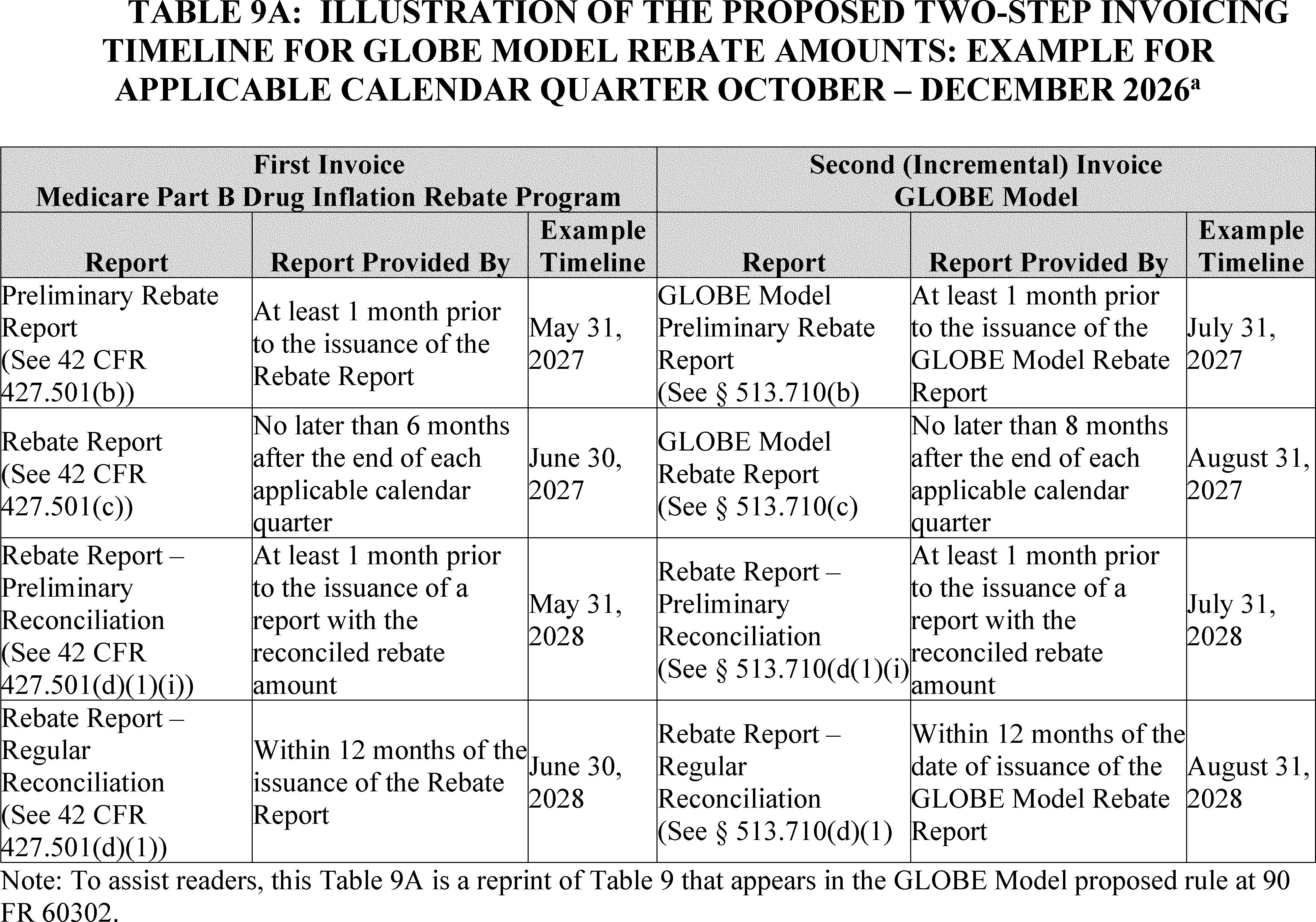
We proposed that GLOBE Model rebate invoicing would occur after invoicing under the Medicare Part B Drug Inflation Rebate Program to create a unified framework for testing the GLOBE Model while maintaining harmonization between the model and non-model activities. We stated our belief that up to 2 months would be a reasonable timeframe during which CMS would gather the necessary information to calculate the incremental GLOBE Model rebate amount and incremental rebate due and perform data quality checks prior to providing each manufacturer of a GLOBE Model drug a GLOBE Model Rebate Report that would be the invoice for the incremental GLOBE Model rebate amount due (if any). We proposed to harmonize the model and non-model activities, including the proposed incremental GLOBE Model invoicing approach, to maintain consistency and transparency for manufacturers with respect to the Medicare Part B Drug Inflation Rebate Program while minimizing administrative impacts on manufacturers and complexity for CMS operations of the Medicare Part B Drug Inflation Rebate Program during the GLOBE Model test.
In § 513.500, we proposed to, when applicable, reduce the incremental GLOBE Model rebate amount for drugs in shortage and/or when there is a severe supply chain disruption or likely shortage, if applicable. Under the incremental approach, CMS would apply any reductions as determined under sections 42 CFR 427.401 and 42 CFR 427.402 to the incremental GLOBE Model rebate amount such that the ( printed page 63057) rebate amount due would reflect such reductions (if applicable). In addition, we proposed that CMS would provide a GLOBE Model Rebate Report for each GLOBE Model drug for each applicable calendar quarter even in cases when the incremental per unit GLOBE Model rebate amount equals zero.
We proposed that, if the incremental approach is adopted for the GLOBE Model, CMS would establish a GLOBE Model Rebate Report format that would be similar to the current Rebate Report format and would inform manufacturers of the GLOBE Model Rebate Report format by posting information on the CMS website and issuing a memorandum to all manufacturers of Part B rebatable drugs.
We received comments in favor of the incremental approach and are finalizing the incremental approach for rebate report and reconciliation. We refer readers to section II.G.8. for comments related to the incremental approach and our responses.
As discussed in section II.A. of this final rule, we are revising the model start date to January 1, 2027, with the first performance year starting April 1, 2027, to provide additional time for implementation and stakeholder readiness. As such, we have updated the information that appeared in Table 9 in the GLOBE Model proposed rule (90 FR 60302) to reflect the model start date and beginning of model performance period as finalized at § 513.1(c).
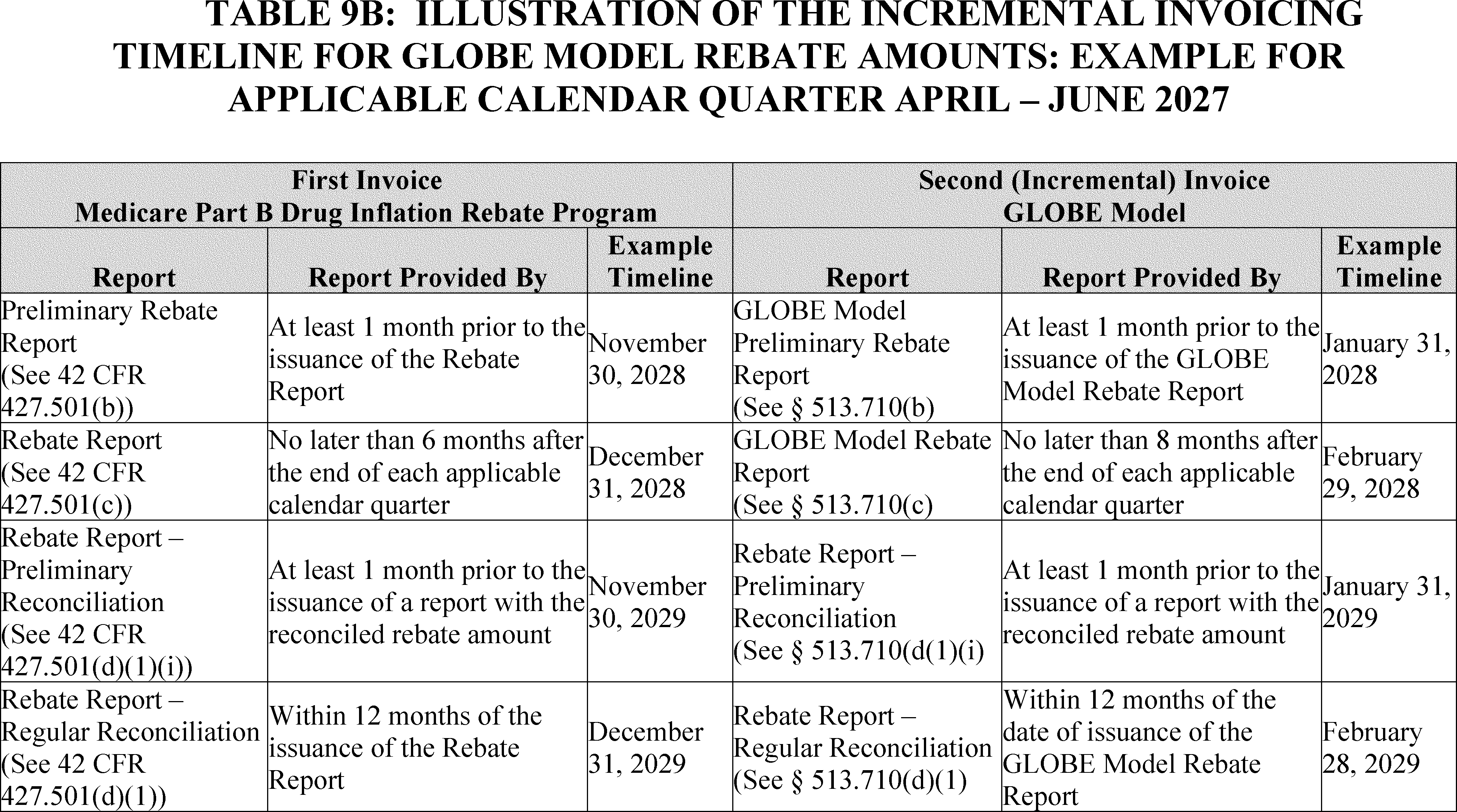
c. Suggestion of Error (SOE) Process Under the Incremental Approach
In § 513.720, we proposed a SOE process for the GLOBE Model such that a manufacturer would submit its SOE to CMS, for CMS's discretionary consideration, for the applicable calendar quarter within 10 calendar days from the date of receipt of a GLOBE Model Preliminary Rebate Report or a GLOBE Model Preliminary Reconciliation Rebate Report using a method and process established by CMS if the manufacturer believes that there is a mathematical error or errors to be corrected before the GLOBE Model Rebate Report or a subsequent GLOBE Model Reconciliation Rebate Report, as applicable, is finalized. We proposed that CMS would make available a method for a manufacturer to submit a SOE for GLOBE Model reports that would be substantially similar to the method used for the Medicare Part B Drug Inflation Rebate Program. Further, we proposed that CMS would include any revisions to the calculation of the incremental GLOBE Model rebate amount, if determined necessary by CMS based on the manufacturer's SOE, prior to providing the GLOBE Model Rebate Report or any GLOBE Model Reconciliation Rebate Report, if applicable. CMS would notify the manufacturer whether CMS revised its calculation of the rebate amount based on the SOE. We noted that the scope of the SOE process set forth in § 513.720 would be limited to GLOBE Model information and any corrections would not impact the information in the Reconciliation Rebate Report as set forth in 42 CFR 427.501(d)(ii).
We sought comment on our proposal for a separate SOE process that would be included for the incremental approach if such approach is adopted for the model.
The following is a summary of the comments received and our responses.
Comment: Several commenters expressed concern that CMS did not propose any review, reconsideration, or appeal process for manufacturers. Commenters stated that it is important for CMS to provide a process through which manufacturers can seek review of the agency's calculations and rectify errors in identification of GLOBE Model beneficiaries, coinsurance, reimbursement, and rebate calculations.
Response: We respectfully disagree with the assertion that CMS did not propose any review, reconsideration, or appeal process for manufacturers. As discussed in section II.G.8. of the GLOBE Model proposed rule (90 FR 60244 through 60254), CMS discussed that the SOE process would be available to GLOBE Model participants who believe there is a mathematical error or errors to be corrected prior to the issuance of the Rebate Report or a subsequent reconciliation of the rebate amount due. ( printed page 63058)
CMS does not believe a more complex review process is necessary, as the GLOBE Model SOE process will mirror the already-established Suggestion of Error process in the Medicare Part B Drug Inflation Rebate Program—a framework that is familiar to manufacturers of Part B rebatable drugs.
In addition, CMS plans to make the following information publicly available on the CMS website for review by providers, beneficiaries, and other interested parties: GLOBE Model geographical ZIP Code areas; the GLOBE Model Drug List; and cost-sharing reduction information. Based on the comments received, CMS also intends to publish technical documents—such as a user-friendly fact sheet or similar resource—that providers can use or share with their beneficiaries regarding, for example, the overview and goals of the GLOBE Model. Furthermore, CMS intends to leverage existing infrastructure, including a model help desk, where providers and manufacturers may submit inquiries.
Comment: A commenter opposed the proposed SOE process, noting that a courtesy process is insufficient for a mandatory, high-dollar model. The commenter urged CMS to clarify the methodology—including data used and underlying assumptions—to improve transparency, and to incorporate reconciliation and resolution of errors so that GLOBE Model determinations are contestable, attributable, and correctable, with binding timelines and escalation procedures.
Response: We thank the commenter for sharing their concern regarding the proposed SOE process.
As discussed in section II.G.8. of the GLOBE Model proposed rule (90 FR 60244 through 60254), CMS presented its proposed process—including timelines—for manufacturers to submit a SOE when they believe there is a mathematical error or errors to be corrected prior to the finalization of the Rebate Report or a subsequent reconciliation of the rebate amount due. Our timelines for the SOE process mirror the binding timelines in the Medicare Part B Drug Inflation Rebate Program, 42 CFR 427.503(c), which states the manufacturer must submit its Suggestion of Error for the applicable calendar quarter within 10 calendar days from the date of receipt of a Preliminary Rebate Report or a preliminary reconciliation of a rebate amount using the method and process established by CMS.
As stated in section II.G.8. of this final rule, CMS is adopting the incremental invoicing approach. CMS believes this approach supports the efficient testing and evaluation of the GLOBE Model and provides adequate transparency for manufacturers to identify mathematical errors and for CMS to make revisions, if deemed necessary, prior to the issuance of the GLOBE Model Rebate Report—while minimizing adverse impacts on manufacturers and the CMS's systems, operations, and financial resources.
The GLOBE Model's SOE process, as previously stated, mirrors the existing Medicare Part B Drug Inflation Rebate Program's Suggestion of Error process. As such, the GLOBE Model will utilize the established methodology of that program, which is already familiar to manufacturers of Part B rebatable drugs. CMS believes that leveraging this existing framework—rather than developing a more complex separate process—is appropriate given the model's structure and the nature of the calculations involved.
With respect to an escalation procedure, we believe the SOE process is sufficient for manufacturers to escalate to CMS if they believe there is a mathematical error or errors to be corrected. Additionally, we note that administrative and judicial review is precluded consistent with sections 1847A(i)(8) and 1115A(d)(2) of the Act.
Final Decision: After careful consideration of the comments received, CMS is finalizing § 513.720 as proposed, without modification, except to correct two drafting errors: (1) an incorrect CFR citation; (2) to change “total” to “incremental” in paragraph (c); and (3) the removal of the word “total” from § 513.720(d). As corrected, § 513.720(d) should reference § 513.710(b) and § 513.710(c)(1), respectively.
H. Program Compliance Requirements and Enforcement
1. Enforcement Action
a. Enforcement of GLOBE Model Rebate Amount Payments by Manufacturers
In § 513.740, we proposed that the manufacturer of a GLOBE Model drug would be required to pay the incremental GLOBE Model rebate amount by 11:59 p.m. PT on the 30th calendar day after receipt of the GLOBE Model Rebate Report.
We stated in the GLOBE Model proposed rule (90 FR 60302) that manufacturer payment of GLOBE Model rebate amounts is critical to model test integrity and is necessary to make the OM program whole. Without these payments, there would be limited ability to test potential savings to program expenditures or impacts to quality of care. In circumstances when CMS reduces the coinsurance for GLOBE Model eligible beneficiaries who have received a GLOBE Model drug (that is, when the published payment amount, as set forth in 42 CFR 427.201(b)(3), exceeds the per unit GLOBE Model benchmark amount), we stated that CMS must collect GLOBE Model rebate amounts in order to recoup what it has spent on GLOBE model drugs where it paid more than 80 percent of the allowed amount. Given the importance of these rebates, we proposed that CMS may utilize available civil money penalty (CMP) authority at section 1847A(i)(7) of the Act or section 1128A of the Act to ensure timely compliance with payment of GLOBE Model rebate amounts due to effectuate this model test.
Consistent with the Medicare Part B Drug Inflation Rebate Program and the regulations at 42 CFR 427.600, in § 513.800, we proposed that manufacturers of a GLOBE Model drug that have failed to timely pay the incremental GLOBE Model rebate amount, including any reconciled rebate amount, would be subject to a CMP in an amount equal to 125 percent of the incremental GLOBE Model rebate amount for such GLOBE Model drug and applicable calendar quarter which would be in addition to any unpaid incremental GLOBE Model rebate amount due. However, this GLOBE Model CMP would be separate from and in addition to any CMP assessed under 42 CFR 427.600.
We further proposed to rely on the general CMP authority in section 1128A of the Act as codified in 42 CFR part 423, subpart T. For instance, section 1128A(a)(8) of the Act allows a CMP to be imposed against anyone who “knowingly makes, uses, or causes to be made or used, a false record or statement material to a false or fraudulent claim for payment for items or services furnished under a Federal health care program.” We stated our belief that any manufacturer that knowingly fails to comply with GLOBE Model requirements as set forth in a regulation that establishes the GLOBE Model, including provisions in the GLOBE Model data agreement, could be subject to a CMP in addition to any incremental GLOBE Model rebate amount due.
In addition, we proposed that, if CMS assesses a CMP for a manufacturer, the manufacturer would be held responsible for paying the incremental GLOBE Model rebate amount, and any related CMP amount imposed on the incremental GLOBE Model rebate. We proposed the CMP payment would be due within 60 days after the date of notice of imposition of the CMP according to section 1128A of the Act. ( printed page 63059)
In the event of non-payment of the incremental GLOBE Model rebate amount, we considered other potential enforcement approaches. For example, CMS could refer manufacturers to the Department of Justice (DOJ) for breach of contract or false certification, Department of the Treasury for their use of the Debt Management or Recovery Offset Programs, or HHS' Office of Inspector General (OIG) for use of their CMP authority and for further review and investigation. However, given the importance of recovering GLOBE Model rebate amounts due from manufacturers, CMS believes it would be appropriate for CMS to pursue CMPs in order to ensure compliance with payments of the incremental GLOBE Model rebate amount, and to effectuate this model test.
In the event that a manufacturer declares bankruptcy, as described in Title 11 of the United States Code, and as a result of the bankruptcy, fails to pay either the full GLOBE Model rebate amount owed or the total sum of CMP imposed, or both, the government intends to reserve the right to file a proof of claim with the bankruptcy court to recover the unpaid amount of the GLOBE Model rebate amount and/or CMP owed by the manufacturer as set forth in § 513.800(b).
We also proposed appeals procedures for GLOBE Model rebate amounts at § 513.800, including a manufacturer's right to a hearing following a decision by CMS to impose a CMP. We proposed to codify CMP and appeals procedures for GLOBE Model rebate amounts at 42 CFR 513, subpart I.
The following is a summary of the comments received and our responses.
Comment: Many commenters objected to the use of CMPs to enforce GLOBE Model rebate amount payments. Commenters maintained that CMS lacks statutory authority to impose CMPs without Congressional authorization and that CMPs are beyond an agency's administrative powers. A commenter further contended that the CMP structure is disproportionate and lacks procedural protections for manufacturers. Another commenter stated that the CMP structure introduces coercion.
Response: We thank commenters for expressing their concerns regarding the use of CMPs to enforce GLOBE Model rebate obligations.
We note section 1115A(b) of the Act grants CMS the authority to test payment and service delivery models, and manufacturer payment of GLOBE Model rebate amounts is critical to the integrity of the model test.
Furthermore, section 1128A of the Act provides CMS with broad authority to impose CMPs in a variety of contexts where program integrity and compliance are at issue. CMS has long relied on CMPs as a standard and legally recognized tool to enforce compliance with Medicare and Medicaid program requirements. The use of CMPs in the GLOBE Model is consistent with this established legal framework and is necessary to ensure that manufacturers fulfill their rebate obligations and that the OM program is made whole, thereby supporting the model's cost-reduction objectives. We note that Congressional authorization for CMPs need not be model-specific; rather, the existing statutory framework under sections 1115A and 1128A of the Act provides a sufficient legal basis for the enforcement mechanisms established in this final rule.
We respectfully disagree with the characterization that CMPs are beyond CMS's administrative powers in this context or introduce coercion. Federal agencies routinely exercise enforcement authority through CMPs when such authority is grounded in statute, and courts have consistently upheld the use of CMPs as a legitimate exercise of administrative power where the statutory basis is clear. As noted previously, the statutory authority under sections 1115A and 1128A of the Act provides the requisite legal foundation for the GLOBE Model's enforcement mechanisms. The CMP structure established in this final rule represents a reasonable and proportionate exercise of that authority, designed to deter non-compliance and protect the integrity of the Medicare program and Federal expenditures by ensuring that manufacturers fulfill their rebate obligations and that the OM program is made whole.
We also believe our proposed CMP structure is proportionate, as it aligns with the CMP structure established under the Medicare Part B Drug Inflation Rebate Program. Accordingly, where the CMS Innovation Center tests a model under section 1115A of the Act that tests an alternative change to the calculation of the rebate amount within that existing statutory framework, CMS believes the existing congressional penalty authority remains applicable to the rebate obligation as tested under the model. Because the GLOBE Model tests an alternative rebate methodology for the otherwise applicable statutory rebate amount for certain drugs tested under the model, use of the existing enforcement mechanism is necessary to effectuate the alternative payment in the same manner that the Medicare Part B Drug Inflation Rebate Program operates. Additionally, we note that a manufacturer retains the right to a hearing following any CMS decision to impose a CMP, and those hearing and appeal rights are set forth in statute under section 1128A of the Act. We believe those standard and established appeal and hearing rights are an adequate procedural protection for manufacturers.
Final Decision: After careful consideration of the public comments received, CMS is finalizing § 513.800 with modifications to clarify the CMP structure aligns with the CMP structure established under the Medicare Part B Drug Inflation Rebate Program, by adding the following: “The provisions of 42 CFR 427.600 regarding the imposition of civil money penalties and their respective appeals also apply with respect to this subchapter to the same extent as they are applicable with respect to part 427, except that, in applying such provisions with respect to this subpart, any reference to 42 CFR 427.301(a) shall be considered a reference to the incremental GLOBE Model rebate amount calculated pursuant to § 513.500.” As this revised language adequately covers CMP determination, notice, collection, and appeal, CMS has removed the provisions related to determination of the CMP amount, notice of imposition of CMPs, collection of CMPs, and appeal procedures for CMPs in paragraphs § 513.800(b) through (e) and renumbered paragraph § 513.800(f) as paragraph § 513.800(b).
b. Other Enforcement Actions
We proposed that CMS could impose one or more enforcement actions such as CMPs or terminating the data agreement if CMS determines that the following has occurred, which is not an exhaustive list:
- The GLOBE participant has submitted false data or made false representations, warranties, or certifications in connection with any aspect of the GLOBE Model.
- The GLOBE participant is subject to investigation or action by HHS (including the HHS-OIG, CMS, or FDA) or the DOJ due to an allegation of fraud or significant misconduct, including being subject to the filing of a complaint or filing of a criminal charge, being subject to an indictment, being named as a defendant in a False Claims Act qui tam matter in which the Federal Government has intervened, or similar action.
We proposed that CMS may take one or more of the following enforcement actions if CMS determines that one or ( printed page 63060) more of the grounds for enforcement action described in section H.1. of this final rule had taken place:
- Suspending or terminating the data agreement with the manufacturer.
- Requiring the manufacturer to provide additional requested information to CMS or its designees through an audit.
- Subjecting the manufacturer to additional monitoring, auditing, or both.
As part of the CMS Innovation Center's monitoring and assessment of the impact of models tested under the authority of section 1115A of the Act, CMS has a special interest in ensuring that these model tests do not interfere with program integrity interests of the Medicare program. For this reason, CMS will monitor actions of GLOBE Model participants for compliance with model terms, as well as other Medicare program rules. When CMS becomes aware of noncompliance with these requirements, it is necessary for CMS to have the ability to impose certain administrative enforcement actions on a noncompliant model participant. We sought comment on these proposed provisions regarding the proposed grounds for enforcement actions, enforcement actions generally, and whether additional types of enforcement action would be appropriate.
We received no comments on this proposal.
Final Decision: All manufacturers must abide by all existing Federal rules and regulations. Therefore, this language is not subject to finalization of such requirements in regulatory text since the government retains the authority to audit, monitor, request additional information, and terminate a participant in other existing Federal rules and regulations.
I. Collection of GLOBE Model Rebate Amounts
1. Systems To Collect GLOBE Model Rebate Amounts
In § 513.740, CMS proposed the deadline and process for payment of incremental GLOBE Model rebate amounts, including the amounts owed by a manufacturer, the consequences of failure to pay an incremental GLOBE Model rebate amount due, and potential refunds to a manufacturer (as articulated similarly in 42 CFR 427.505), applicable to GLOBE Model rebate amounts calculated under the GLOBE Model. In § 513.730, we proposed the process by which manufacturers would access Rebate Reports (which is substantially similar to the process codified in 42 CFR 427.504). We stated that this process would apply to Rebate Reports including GLOBE Model rebate amounts (that is, combined rebate amounts, under the proposed combined invoicing approach described in section II.G.8.a. of the GLOBE Model proposed rule and incremental GLOBE model rebate amounts under the incremental invoicing approach described in section II.G.8.b. of the GLOBE Model proposed rule, as applicable) calculated under the GLOBE Model, including any report of reconciled rebate amounts. In addition, we proposed that the “date of receipt” would have the same meaning as set forth in 42 CFR 427.500, that is the date of receipt would be the calendar day following the day on which a report of a GLOBE Model rebate amount (as set forth in § 513.500) is made available to the manufacturer of a GLOBE Model drug by CMS.
We also proposed, in § 513.740(a), that payment of an incremental GLOBE Model rebate amount owed by a manufacturer would be due no later than 11:59 p.m. PT on the 30th calendar day after the date of receipt of information regarding the rebate amount on a GLOBE Model Rebate Report (as set forth in § 513.710) or a report of a reconciled incremental GLOBE Model rebate amount (as set forth in § 513.710(d)). In addition, in § 513.740(c), we proposed that if a reconciled incremental GLOBE Model rebate amount for an applicable calendar quarter as set forth in § 513.710(d) is less than what the manufacturer paid for that applicable calendar quarter, CMS would initiate the process to provide a refund equal to the excess amount paid within 60 days of the date of receipt of the report with such reconciled incremental GLOBE Model rebate amount. As further discussed in section II.H. of this final rule, we proposed at § 513.740(b), that failure to pay an incremental GLOBE Model rebate amount due timely and in full may result in an enforcement action as described in 42 CFR 513 subpart I.
As discussed in section II.G.8. of this final rule, CMS is finalizing the incremental invoicing approach in this final rule.
The following is a summary of the comment received on this topic and our response.
Comment: A commenter stated that the process of invoicing Preliminary Rebate Reports, Rebate Reports, and reconciliation would create administrative complexity and burden for participants.
Response: We thank the commenter for this feedback. We are finalizing a process to access Rebate Reports and pay invoices that is substantially similar to the process codified in 42 CFR 427.504. By leveraging existing reporting and reconciliation infrastructure and processes, we believe this approach will minimize administrative burden on model participants associated with payment of the incremental GLOBE Model rebate amount. Further, we note that the Preliminary Rebate Report process facilitates the SOE process which we believe is an important protection for manufacturers who are model participants and should be retained as part of the GLOBE Model invoicing process.
Final Decision: CMS is finalizing § 513.730 as proposed without modification and § 513.740 as proposed, with a technical modification to insert the words “an incremental GLOBE Model” in the section heading and correcting typographical errors. Specifically, (1) in § 513.740(a) the phrase “either of the following” is added; (2) in § 513.740(b) “subpart I of this part” is changed to “42 CFR part 513 subpart I;” and in § 513.740(c) “will initiate” is changed to “initiates”. CMS also refers readers to section II.G.8.b. of this final rule for the final decision on finalizing the incremental invoicing approach and the corresponding update to the date of receipt definition at § 513.20.
J. Quality Measures
1. General
Consistent with the evaluation provisions of section 1115A(b)(4) of the Act, we proposed utilizing quality measures to monitor and evaluate whether quality of care, including as measured through patient-level outcomes, remains consistent or changes as a result of the alternative Medicare Part B drug inflation rebate amount calculation for GLOBE Model drugs (90 FR 60304). We proposed that payments to manufacturers or providers would not be adjusted based on quality of care. We stated that CMS would consider multiple domains of monitoring as outlined elsewhere in the rule, including but not limited to, out-of-pocket costs, utilization of care, and access to GLOBE Model drugs.
2. Collection of Quality Measures
In § 513.900, we proposed utilizing claims-based measures or existing national surveys, such as the Medicare Current Beneficiary Survey, when possible, to monitor the quality of care in a way that directly reflects patient-level factors as a means to monitor the GLOBE Model's use of an alternative approach to the calculation of the Medicare Part B drug inflation rebate ( printed page 63061) amount under the Medicare Part B Drug Inflation Rebate Program. As such, the quality measures in this final rule are not to assess individual provider performance but to assess model performance. As stated in section II.J.1. of this final rule, we proposed that payments to providers would not be adjusted based on quality of care. In the GLOBE Model proposed rule (90 FR 60304), we stated that the GLOBE Model may include, but would not be limited to, measures to monitor—
- Part B drug utilization and prescribing patterns—such as changes in medication treatment, or cessation of treatment earlier than expected given disease course;
- Out-of-pocket costs for Part B drugs that were administered—comparing costs for beneficiaries with and without supplemental prescription drug coverage based on available data;
- Frequency and regularity of administration of Part B drugs, such as inappropriate gaps between administration of infusions or injections;
- Changes in site of service for a beneficiary receiving administration of Part B drugs;
- Changes in site of service for outpatient clinic appointments;
- Changes in prescriber of the Part B drug; and
- Downstream healthcare utilization, such as hospitalizations or emergency room visits.
CMS would monitor these measures for all separately payable Part B drugs as well as for the subset of GLOBE Model drugs. This would enable CMS to examine changes among drugs that are specifically targeted by the model as well as broader effects on Medicare Part B and downstream outcomes.
We also stated that CMS may find it necessary to supplement claims-based measures with voluntary surveys of providers who administer Part B drugs to assess variables including but not limited to changes in: (1) perceived prescribing practices as a result of this alternative payment approach; (2) site of service for administration of clinician-administered drugs; and (3) interactions between patient and provider.
When developing our proposed quality strategy, we considered a range of quality measures, including high-value prescribing of efficacious Part B drugs, medication management, barriers to access, medication adherence, patient experience of care measures, and drug-related adverse events.
We stated that we do not anticipate the GLOBE Model test of a new payment approach would impact high value prescribing as the payment incentive directly to the prescribers (that is, the Medicare allowed amount and payment to the provider or supplier) would be equivalent between the intervention and control group (generally ASP+6 percent).
We noted that accurate measurement of medication management and medication adherence for Medicare Part B clinician-administered drugs is challenging because dosing schedules are variable, clinical assessment is required, and insurance claims lack sufficient clinical context.[194] To limit additional burden upon beneficiaries, we proposed using existing national surveys wherever possible. If necessary to assess how the GLOBE Model has affected patient quality of care, we proposed that CMS may consider implementing a beneficiary survey. Information obtained through existing national surveys and any beneficiary surveys conducted for purposes of the GLOBE Model may be used to inform CMS' monitoring and evaluation activities and to identify potential unintended consequences, changes in access to care, or other quality concerns associated with the model. CMS may use information from these activities, together with claims data and other available information, to determine whether modifications to model operations, monitoring activities, or other actions are warranted.
We also stated that the proposed GLOBE Model does not test the efficacy of prescription drugs, but rather, it tests the impact of an alternative payment approach. Thus, we did not propose new monitoring of changes to drug-related adverse events. We proposed that CMS would monitor changes in downstream health care utilization, such as changes in rates of emergency room visits, hospitalizations, or use of other clinical services. We stated that any additional measures, including potential beneficiary surveys, utilized by CMS would not add significant burden to GLOBE Model participants or beneficiaries.
CMS sought comments on the proposed quality measures that CMS would use to monitor potential changes in the quality of care that may result from the alternative approach to the calculation of the rebate amount under the Medicare Part B Drug Inflation Rebate Program.
The following is a summary of the comments received and our responses.
Comment: Many commenters emphasized that CMS should ensure its quality monitoring framework captures changes in patient access, treatment continuity, and clinical outcomes—particularly for patients with serious conditions such as cancer, rare diseases, and chronic illnesses. Commenters highlighted specific risks including treatment delays, therapy switching, and disease progression, and urged CMS to employ clinically meaningful measures capable of detecting these potential unintended consequences.
Response: We thank commenters for their feedback on the quality monitoring framework. CMS agrees that it is important to assess potential unintended consequences of the GLOBE Model, particularly for patients with serious conditions. The quality monitoring framework includes measures related to patient access, costs, and quality of care—with a specific focus on drug utilization, out-of-pocket costs for Part B drugs, changes in site of care or prescriber, prescribing patterns, continuity of care, and downstream healthcare utilization. These measures are identified to provide CMS with timely insight into whether the model is producing unintended effects on patient care.
In alignment with our quality monitoring strategy, the model's evaluation will assess the GLOBE Model's impact on quality through clinically meaningful measures, including treatment patterns and care delivery (as discussed in section II.P. of this final rule). CMS is committed to using this monitoring and evaluation framework to identify and respond to any adverse impacts on patient access or clinical outcomes throughout the GLOBE Model test period.
Comment: Several commenters expressed concern that the proposed quality measurement framework may not fully capture real-world impacts on care delivery and patient experience. Commenters recommended that CMS consider whether additional measures or data sources are needed to assess medication management, patient out-of-pocket costs, total cost of care, changes in site of care, and downstream healthcare utilization. Commenters also raised concerns regarding the model's reliance on claims-based measures and existing survey data, noting that such data sources may lack sufficient clinical context to accurately assess medication adherence, treatment appropriateness, and quality of care. Commenters recommended greater transparency around data sources and suggested that CMS consider whether additional data collection approaches may be needed.
Response: We thank commenters for their feedback on the proposed quality ( printed page 63062) measurement framework. We recognize the importance of measuring a broad range of factors that may affect beneficiaries under the GLOBE Model, including patient out-of-pocket costs, total cost of care, site of care, and downstream utilization. As part of the model's monitoring and evaluation activities, we plan to assess these considerations on an ongoing basis to the extent feasible, while primarily using claims-based measures and existing national surveys in order to minimize additional administrative burden. Claims-based data are available for both the comparison and intervention groups and support evaluation of changes in utilization, site of care, and other observable indicators of quality.
Specifically, as discussed in sections II.J. and II.P. of the GLOBE Model proposed rule, we will assess beneficiary out-of-pocket spending, including variation by supplemental coverage status, and evaluate whether the model influences drug access, site of care, including potential shifts across outpatient hospital, physician office, and other care settings, and changes in prescribing. We will also examine patterns of medication utilization using available data sources to better understand how the model may impact prescribing patterns and continuity of care.
As stated in the GLOBE Model proposed rule (90 FR 60304), CMS recognizes that claims-based data sources have inherent limitations with respect to assessing certain aspects of care, including medication adherence and treatment appropriateness for Part B clinician-administered drugs, due to variable dosing, the need for clinical context, and limitations in available data. The GLOBE Model quality measures, monitoring activities, and evaluation framework have been designed with these limitations in mind. To the extent feasible, we may assess these domains using claims-based indicators such as treatment continuity, timing and regularity of drug administration, and patterns of treatment initiation, switching, or discontinuation, consistent with these limitations.
To supplement claims-based measures where appropriate, we may also use targeted, voluntary surveys of providers who administer Part B drugs to assess aspects of care not captured in claims data, such as changes in perceived prescribing practices, site of service, and interactions between patient and provider. With respect to patient experience, we will assess whether the GLOBE Model produces any notable changes using existing survey instruments, such as the Consumer Assessment of Healthcare Providers and Systems (CAHPS) surveys. If monitoring and evaluation activities indicate that existing data sources are insufficient, CMS may consider deploying targeted survey instruments.
Finally, we are committed to transparency in our monitoring and evaluation approach and will maintain clear documentation of data sources and methodologies. We will continue to assess whether supplemental data sources are needed to support a comprehensive and clinically meaningful evaluation of the GLOBE Model and will consider additional data collection approaches if existing sources prove insufficient.
Comment: A few commenters expressed concern that additional quality monitoring activities beyond existing claims sources, including provider surveys or other supplemental data collection, could increase the reporting and administrative burden on providers, health systems and model participants. These commenters recommended that CMS minimize additional data collection requirements and rely on existing data sources where possible.
Response: We thank commenters for sharing their concerns regarding the potential administrative burden associated with quality monitoring activities under the GLOBE Model. We are committed to minimizing additional reporting and administrative burden by relying primarily on existing claims-based data sources and limiting the need for new reporting requirements. The GLOBE Model quality, monitoring, and evaluation frameworks have been designed with this principle in mind, leveraging data that is already routinely collected and available for both the comparison and intervention groups through evaluation activities.
Where supplemental data collection is determined to be necessary to support a comprehensive evaluation of the model, we will consider approaches that reduce burden on providers and health systems to the extent feasible, including the use of targeted, voluntary data collection instruments rather than mandatory reporting requirements. CMS will continue to assess whether the existing data infrastructure is sufficient to meet the model's quality, monitoring and evaluation needs and will seek to avoid imposing requirements that go beyond what is necessary to evaluate the GLOBE Model's impact.
Comment: Several commenters recommended that CMS adopt safeguards and closely monitor access and quality issues as they emerge during model implementation. These commenters emphasized the importance of identifying negative impacts on care delivery and ensuring that CMS has the capacity to respond promptly if the model notices related access or treatment disruptions over the course of the GLOBE Model test period. Some commenters also requested clarification on how CMS will take action if monitoring identifies adverse effects on patient access or outcomes.
Response: We thank commenters for their feedback on access and quality monitoring under the GLOBE Model. We agree that ongoing monitoring of patient access and quality of care throughout the GLOBE Model test period is essential, including the timely identification of potential adverse impacts. The GLOBE Model will include robust ongoing monitoring and evaluation processes, and CMS will use data gathered through these activities to assess whether modifications to model operations, monitoring approaches, or other safeguards may be appropriate, including actions to mitigate identified access or quality concerns during the model performance period.
With respect to commenters' requests for clarification on how CMS will respond to adverse findings, we retain the authority and commitment to act through available mechanisms to address any meaningful negative impacts on beneficiary access or quality in a timely manner. This includes the authority to recommend to the Secretary that CMS initiate proposed rulemaking to modify or terminate the GLOBE Model, as needed.
CMS declines to specify in this final rule the precise model adjustments that would be made in response to any particular monitoring and evaluation findings. The nature and scope of any responsive action will depend on the specific circumstances identified, and we believe that retaining flexibility to tailor our response is essential to effective model oversight. We are committed to transparency in our quality and monitoring activities and will communicate with model participants and other stakeholders, as appropriate, if significant access or quality concerns are identified.
Final Decision: After careful consideration of the public comments received, CMS is finalizing the proposed approach to quality measurement and providing clarification regarding the scope of monitoring and evaluation activities, as described in this section of this final rule. ( printed page 63063)
CMS will maintain a quality, monitoring, and evaluation framework for the GLOBE Model that primarily relies on claims-based measures and existing data sources, consistent with the proposed approach. As such, CMS is finalizing § 513.900 with modification to § 513.900(b)(1) to include the words “including claims-based measures”.
CMS is also clarifying that monitoring will encompass a broad set of domains to assess model performance and identify potential unintended consequences. These domains include, but are not limited to: utilization and prescribing patterns; access to Part B drugs; continuity of care; site of care; and downstream healthcare utilization.
During model implementation, CMS will assess whether supplemental data collection, including targeted and voluntary surveys, may be necessary to capture aspects of care not reflected in existing claims and survey data, while seeking to minimize additional reporting and administrative burden on providers and beneficiaries.
Finally, CMS will conduct ongoing quality and monitoring activities throughout the model performance period. Data gathered through these activities may be used to inform potential modifications to model operations, monitoring approaches, or other safeguards, as appropriate, to address any identified concerns related to patient access, quality of care, or unintended consequences.
K. Beneficiary Protections
1. General
In the GLOBE Model proposed rule (90 FR 60304), we stated that CMS recognizes stakeholders may have concerns over potential disruptions to beneficiary access to Medicare Part B drugs, including those that are GLOBE Model drugs, as a result of the GLOBE Model changing financial incentives for manufacturers. To alleviate these concerns, CMS considered various options to protect beneficiary access to Medicare Part B drugs during the GLOBE Model test period. One potential option CMS considered was creating a reporting system where stakeholders, such as providers or beneficiaries, could notify CMS that a particular drug has become harder to source or obtain after the implementation of the GLOBE Model. A reporting system such as this could allow CMS to gather information to inform potential follow-up investigations to determine if any drug access issues are occurring. As such, in § 513.910, we proposed setting up a process for collecting complaints from providers and beneficiaries to notify CMS that a particular drug has become harder to source or obtain. We also proposed to conduct investigations, as appropriate, based on information reported to the system, including but not limited to requesting additional information from the submitter and conducting additional analyses to determine whether the report requires further action from CMS or other governmental entities. We noted that a GLOBE Model reporting system could include existing CMS reporting systems such as 1-800-Medicare for beneficiaries. Additionally, we stated that CMS could develop an email inbox for the GLOBE Model to receive reports from providers and beneficiaries. We also stated that CMS may develop multiple ways to receive reports. Instructions for how to report, using one or more methods, would be posted on the CMS website for awareness. In addition, we noted that CMS could consider making beneficiaries aware of the available reporting methods such as sending letters to eligible GLOBE Model beneficiaries with reporting instructions. We sought comment on a potential plan to build a GLOBE Model reporting and monitoring system for stakeholders and any other methods to protect beneficiaries.
The following is a summary of the comments received and our responses.
Comment: A few commenters supported CMS's proposal to offer a reporting system for providers and beneficiaries to notify CMS of drug access issues related to the GLOBE Model. A commenter also encouraged CMS to leverage the Medicare Ombudsman and the Office of Program Operations and Local Engagement (OPOLE), 1-800-MEDICARE, and the State Health Insurance Programs (SHIPs) as part of the reporting system for the GLOBE Model.
Response: We thank the commenters for their support of our proposal to establish a reporting system for providers and beneficiaries to notify CMS of drug access issues under the GLOBE Model.
We agree with the commenter's suggestion to incorporate existing, well-established Medicare resources into the GLOBE Model reporting framework. Accordingly, CMS will coordinate, to the extent feasible, with the Medicare Ombudsman, OPOLE, and 1-800-MEDICARE as part of monitoring efforts for the GLOBE Model. These resources provide accessible and widely recognized channels through which beneficiaries and providers can raise concerns about drug access issues, and their inclusion will help ensure that CMS receives timely and comprehensive information to monitor and address any access challenges that may arise under the model. The Medicare Ombudsman and OPOLE serve as important resources for beneficiaries experiencing difficulties with their Medicare coverage, including issues related to accessing prescription drugs. By coordinating with the Medicare Ombudsman and OPOLE, CMS will be positioned to identify and respond to systemic drug access concerns in a timely manner. Similarly, 1-800-MEDICARE is a widely recognized and accessible helpline that beneficiaries and providers (on behalf of beneficiaries) already use to report Medicare-related issues, making it natural to incorporate as one facet of the GLOBE Model reporting system.
For beneficiaries, 1-800-MEDICARE will remain the primary point of contact for questions and assistance related to beneficiary inquiries, including inquiries about the GLOBE Model.
With respect to the commenter's recommendation to also include the SHIPs, CMS appreciates this suggestion and notes that SHIPs can report issues and send inquiries directly to OPOLE through existing coordination processes. CMS also notes that SHIPs primarily serve an educational and counseling function by helping beneficiaries understand Medicare coverage options, rather than serving as a formal reporting mechanism for model-related access concerns. CMS will continue to assess the potential role that SHIPs and other stakeholder resources may play in supporting the GLOBE Model's reporting infrastructure and may consider additional reporting channels in future rulemaking or model guidance as the model is implemented and evaluated. CMS believes that coordination with the Medicare Ombudsman, OPOLE, and 1-800-MEDICARE programs provides sufficient existing reporting channels for purposes of the model, and at this time, we do not believe it is necessary to expand the existing reporting infrastructure further. CMS also notes that there are existing reporting vehicles outside of the GLOBE Model for reporting drug supply and procurement issues. For example, the FDA maintains a drug shortage reporting mechanism that is available to healthcare providers and other stakeholders.[195] CMS encourages providers to make use of these existing channels, as appropriate, ( printed page 63064) in addition to the GLOBE Model helpdesk.
Comment: A few commenters requested CMS conduct outreach to beneficiaries, including providing beneficiary notices of participation and opportunities for beneficiary engagement. A commenter specifically requested that CMS provide beneficiary notices in the beneficiary's language of choice. Another commenter urged CMS to develop beneficiary education tools that outline how the model operates and what beneficiary protections are available. A commenter also recommended engaging affected communities in developing patient-centered alternatives.
Response: We thank the commenters for their feedback regarding beneficiary outreach and education under the GLOBE Model. We appreciate the commenters' interest in ensuring that beneficiaries are informed about the model and have access to resources that explain how it operates and what protections are available to them.
After careful consideration, CMS declines to adopt direct beneficiary notices of inclusion in the model cohort under the GLOBE Model. While CMS can identify beneficiaries who meet the criteria for inclusion in the model cohort, CMS cannot reliably determine prospectively which of those beneficiaries will receive a separately payable GLOBE Model drug during the model performance period. A notice sent to all beneficiaries in the model cohort would therefore reach many beneficiaries who may never receive a GLOBE Model drug or experience a model-related coinsurance effect, while a notice targeted to beneficiaries who have received a GLOBE Model drug would generally rely on claims information available after the relevant service. In addition, beneficiaries are not model participants and are not required to enroll, opt in, consent, take any action, change providers or suppliers, or make an opt-out decision as a result of their inclusion in the model cohort. For these reasons, CMS does not believe that individual beneficiary notices of cohort inclusion are necessary. Beneficiaries retain all existing Medicare rights and protections under the GLOBE Model, and the model does not alter Medicare coverage rules or beneficiaries' ability to choose among Medicare providers and suppliers.
Nevertheless, CMS recognizes the importance of ensuring that beneficiaries and providers have access to clear, accessible information about the model. To support transparency and beneficiary awareness, we will make technical documentation and user-friendly fact sheets available on the GLOBE Model website. These resources will explain how the model operates and may impact beneficiaries, including the circumstances in which beneficiaries may receive reduced coinsurance for GLOBE Model drugs, the beneficiary protections that remain in place, and the CMS resources available for questions or concerns.
To further support beneficiary awareness, CMS will publish on the model website the selected geographic areas with the relevant ZIP Codes associated with the GLOBE Model. CMS will also post the GLOBE Model Drug List and other model information so that beneficiaries and other interested parties can learn about the model and its potential applicability. Beneficiaries may use existing CMS assistance resources, including 1-800-MEDICARE, the Medicare Ombudsman, and OPOLE, or the GLOBE Model helpdesk to obtain information or report concerns.
With respect to the commenter's request that beneficiary notices be provided in the beneficiary's language of choice, CMS appreciates this recommendation and is committed to accessible communication. CMS will develop user-friendly fact sheets and other educational and technical materials for the GLOBE Model website consistent with CMS's existing language access obligations and commitments.
Regarding the request to develop beneficiary education tools that outline how the model operates and what beneficiary protections are available, as noted previously, CMS will develop and post a user-friendly fact sheet and technical documentation on the GLOBE Model website to serve this purpose. These materials will be designed to be clear and accessible to beneficiaries and will outline the model's structure, the potential cost-sharing benefits available, and the protections that remain in place for all Medicare beneficiaries under the model.
Regarding the recommendation to engage affected communities to develop patient-centered alternatives, CMS does not believe that an alternative model design is necessary. The GLOBE Model is designed to directly examine impacts to selected beneficiary populations who use a GLOBE Model drug through reduced coinsurance, which itself represents a meaningful, patient-centered benefit. CMS will continue to monitor the model's impact on beneficiary access and outcomes throughout the model performance period and will consider stakeholder input as part of its ongoing evaluation activities.
Comment: A commenter requested adding a reporting mechanism specifically for physicians.
Response: We thank the commenter for their feedback regarding the establishment of a physician-specific reporting mechanism under the GLOBE Model. We appreciate the commenter's interest in ensuring that providers have clear and accessible channels through which to raise concerns about drug access (including procurement issues) that may be related to the model.
CMS acknowledges the importance of ensuring that physicians and other providers impacted by the GLOBE Model have meaningful opportunities to report drug access issues as they arise. In response to this comment and as we discussed in the GLOBE Model proposed rule (90 FR 60304), CMS will post on the GLOBE Model website instructions for how to contact the model helpdesk email inbox through which stakeholders, such as providers or beneficiaries, may reach out directly to CMS to report concerns related to drug access issues experienced under the GLOBE Model. CMS encourages providers to utilize this resource as a primary point of contact for questions and concerns, including, but not limited to model-related drug access concerns.
CMS also notes that there are existing reporting vehicles outside of the GLOBE Model through which providers may report drug supply and procurement issues. For example, the FDA maintains a drug shortage reporting mechanism that is available to healthcare providers and other stakeholders on its Drug Shortages website.[196] CMS encourages providers to make use of these existing channels, as appropriate, in addition to the GLOBE Model helpdesk.
To further support providers impacted by the GLOBE Model, CMS plans to post the GLOBE Model Drug List and model geographic areas on the GLOBE Model website. These resources will allow providers to readily identify the drugs included under the model and to monitor any updates to the drug list over time. In addition, CMS will develop and post a FAQ document on the GLOBE Model website. This FAQ will address common questions related to the model. In addition to other drug shortage reporting, providers who encounter procurement issues are encouraged to notify CMS through the model's helpdesk so that CMS can monitor and respond to any access challenges that may arise under the model. ( printed page 63065)
CMS believes that these resources—the helpdesk, the GLOBE Model Drug List, a list of model geographic areas, and the FAQs—will collectively provide providers and other stakeholders with the information and reporting channels necessary to support successful model implementation and to ensure that any drug access concerns are identified and addressed in a timely manner.
Comment: A couple of commenters opposed CMS's proposal to primarily rely on a reporting system to identify access issues. These commenters specifically request that CMS expand beneficiary protections under the model to include activities before access issues arise. The commenters suggest that CMS specifically include safeguards against access disruptions, increased transparency for patients, and protections for beneficiaries without supplemental coverage. Further, these commenters stated that limiting a reporting system to drug access issues would not capture additional beneficiary complaints relating to the model. Finally, these commenters are concerned that CMS will depend on beneficiary complaints alone to determine whether there are access issues caused by the implementation of the model and encouraged CMS to develop beneficiary educational tools that explain the model and how beneficiaries are protected under it.
Response: We thank the commenters for their feedback. Beneficiary protection is of paramount importance to CMS, which is why we proposed to implement a plan for reporting and monitoring that will allow stakeholders to identify potential disruptions to drug access that may result from the GLOBE Model. We solicited feedback on the details surrounding this reporting and monitoring system to ensure we sufficiently learn about and can investigate any potential beneficiary access issues. CMS acknowledges commenters' views that affordability challenges may vary across beneficiary populations and that many beneficiaries have supplemental coverage that may reduce their out-of-pocket liability. However, CMS continues to believe that reducing coinsurance for GLOBE Model drugs may provide meaningful financial benefits for affected beneficiaries and that monitoring beneficiary access remains an important component of the model. We agree that stakeholder responses to the GLOBE Model, including distribution decisions, could in some circumstances affect how certain clinician-administered drugs are sourced or furnished, even though the model does not require alternative distribution arrangements. Accordingly, CMS does not intend to rely solely on beneficiary complaints to identify access issues. In addition to the reporting pathways finalized in this section, CMS will use available model oversight and claims-based monitoring, as feasible and consistent with applicable privacy protections, to assess potential signals of access disruption, including patterns that may be consistent with increased use of alternative distribution arrangements such as white-bagging or brown-bagging. CMS recognizes concerns raised by commenters that increased reliance on such arrangements could create operational challenges for providers and could contribute to delays or disruptions in beneficiary access to clinician-administered therapies, including concerns related to care coordination and patient safety. While CMS is not finalizing specific restrictions on alternative distribution arrangements as part of the GLOBE Model, we will use the reporting and monitoring processes finalized in this section of this final rule to identify potential access disruptions associated with such arrangements. Such monitoring may include review of available Medicare Part B and Part D claims and other operational data for changes in utilization, billing, and site-of-care patterns that may suggest delayed, interrupted, or displaced access to clinician-administered therapies, including access in the office setting. We believe the reporting and monitoring plan, along with the model education activities, will offer sufficient safeguards to protect beneficiaries' access to necessary drugs while also monitoring for any access disruptions that may arise.
We appreciate the recommendation that CMS directly notify beneficiaries of their inclusion in the GLOBE Model. CMS is not finalizing individual beneficiary notices of model-cohort inclusion because, although CMS can identify beneficiaries who meet the cohort eligibility criteria, CMS cannot reliably determine prospectively which beneficiaries will receive a separately payable GLOBE Model drug. A notice to all beneficiaries in the model cohort would be overinclusive, while a notice targeted based on receipt of a GLOBE Model drug would rely on claims information available after the relevant service. In addition, the model does not require beneficiaries to take any action and does not change beneficiary eligibility for Medicare benefits, Medicare coverage rules, or provider choice. CMS will support beneficiary awareness through publicly available educational materials, website information, and existing beneficiary assistance resources. Further, we believe that the regular mechanisms available to beneficiaries to report complaints and get help with Medicare issues—including but not limited to 1-800-MEDICARE and Medicare Beneficiary Ombudsman—can be utilized by beneficiaries to report any other issues that may be related to the GLOBE Model, allowing the model-specific reporting and monitoring system to be primarily focused on access-related issues.
Final Decision: After consideration of the public comments received, CMS will enhance model implementation activities. CMS will coordinate with 1-800-MEDICARE, the Medicare Ombudsman, and OPOLE resources for beneficiaries (and providers on behalf of beneficiaries) to report issues potentially related to the GLOBE Model; stakeholders can also utilize the GLOBE Model helpdesk to report issues potentially related to the GLOBE Model. CMS will also supplement these reporting channels with claims-based monitoring to identify potential access disruptions, including those associated with alternative distribution arrangements or shifts in site of care for clinician-administered therapy access. While CMS will not provide individual notices of model-cohort inclusion to beneficiaries, CMS will make accessible technical and educational materials and model information available through CMS channels to support beneficiary and stakeholder awareness. CMS will not impose a beneficiary-notification or outreach requirement or expectation on providers or suppliers. CMS is finalizing § 513.910 as proposed with non-substantive modification to change “In a form and manner specified by CMS, CMS will establish” to “CMS establishes” for clarity.
2. Alternatives Considered
CMS Innovation Center models frequently include various policies to protect beneficiaries from any negative intended or unintended consequences of models. One of the most common forms of beneficiary protections CMS Innovation Center models include are policies that allow beneficiaries to choose to be excluded from a model. These usually take the form of a letter sent to beneficiaries who would be included in the CMS Innovation Center model outlining what the model is and how it might impact beneficiaries. These letters then usually include a section allowing the beneficiary to opt-out of the model by changing to a ( printed page 63066) provider not included in the model, or some other general opt-out mechanism.
In the GLOBE Model proposed rule (90 FR 60304), we stated that CMS considered including a beneficiary opt-out within the GLOBE Model as an additional protection for beneficiaries but has chosen to not move forward with a beneficiary opt-out at this time. We stated that, while CMS acknowledges the GLOBE Model may affect drug access, we believe that the likelihood of reduced access is relatively low. GLOBE Model beneficiaries are expected to benefit from the program through lower coinsurance costs for GLOBE Model drugs, removing the potential for downside risk for beneficiaries. We stated that not including a beneficiary opt-out would enhance the model test integrity and improve the generalizability of results, as there would not be a selection bias among beneficiaries who choose to remain in the model if an opt-out were offered. We stated our belief that beneficiaries would benefit by being categorized as a GLOBE Model eligible beneficiary due to the potentially reduced coinsurance percentage that would apply for eligible GLOBE Model drugs for GLOBE Model eligible beneficiaries.
We sought comment on the decision not to include a beneficiary opt-out and whether variations of a beneficiary opt-out could be considered.
The following is a summary of the comments received and our responses.
Comment: Several commenters expressed concern over beneficiaries' inability to opt out from the model, commenting on a lack of beneficiary choice in model inclusion. Commenters stated that beneficiaries could be exposed to potential adverse effects and experience unintended consequences without having any opportunity to leave the demonstration. A few commenters specifically highlighted the importance of uninterrupted access to appropriate oncology care and noted the potential for included beneficiaries to face reduced access to appropriate therapies if the model impacts how drugs are distributed. A commenter requested CMS establish a consent protocol for beneficiaries. A commenter, however, stated that CMS should not allow beneficiary opt-out to preserve the integrity of the evaluation.
Response: We thank commenters for this feedback. Because beneficiaries in selected geographic areas will automatically be assigned to the model cohort as part of the model test, individual beneficiaries will not be able to opt out of the GLOBE Model. However, the model does not limit a beneficiary's ability to choose among Medicare providers and suppliers or the range of services that are available to them. Further, CMS does not believe that beneficiaries will be harmed by their inclusion in the model cohort and, therefore, an opt-out mechanism is not warranted.
Final Decision: After consideration of the public comments received, CMS is finalizing our proposal to not include a beneficiary opt-out provision in the GLOBE Model.
L. Monitoring and Compliance Actions
1. General Provisions: Monitoring and Compliance
The CMS Innovation Center has described general provisions for monitoring and compliance for CMS Innovation Center models at 42 CFR 512.150. However, we note that many of these provisions would not apply to the GLOBE Model, and the GLOBE Model is substantially different from other mandatory CMS Innovation Center models.
Instead, we stated in the GLOBE Model proposed rule (90 FR 60305) that CMS intends to monitor for specific potential issues that could arise as part of the GLOBE Model. Specifically, we stated that CMS intends to monitor for major changes in beneficiary access, as viewed through changes in site of care, provider, and other measures (as described in section II.J. of this final rule). We also stated that CMS may also monitor changing pharmaceutical list prices in the U.S. to determine whether any changes to model policies or duration could be necessary in future performance periods. In addition, we stated that CMS may also consider monitoring impacts on drug innovation, R&D, and timing of drugs coming to market in the U.S. We also proposed to collaborate with the FDA to review shortage lists and determine whether the number of drugs or length of time on a shortage list changes over time. We stated that, to the extent that CMS identifies an issue through regular monitoring that would require a change to model policies or duration under section 1115A(b)(3)(B) of the Act, CMS would take necessary action to change a model policy or model duration based on its finding. If CMS determines through regular monitoring that an issue warrants consideration of a change to a model policy or the model duration, CMS will initiate review of potential responsive action within 30 calendar days of that determination. Any resulting modification or termination would occur in accordance with section 1115A(b)(3)(B) of the Act, 42 CFR part 513, and, as necessary, notice-and-comment rulemaking.
The following is a summary of the comments received and our responses.
Comment: Many commenters broadly urged CMS to establish robust, proactive monitoring mechanisms to detect and respond to any adverse impacts on patient access to drugs—particularly for oncology, rare disease, and complex therapies. Specific concerns included: manufacturers potentially narrowing drug distribution or reducing supply to the U.S. to avoid GLOBE Model rebates; drugs being withdrawn from the market or becoming unavailable in GLOBE Model-designated ZCTAs; and shifts in utilization from Medicare Part B to Medicare Part D that could increase patient cost-sharing burdens. Commenters recommended that CMS establish clear access monitoring triggers and corrective action protocols, including the ability to remove drugs from the model if access is compromised.
Response: CMS appreciates the thoughtful comments submitted by a broad range of stakeholders regarding the importance of protecting patient access to drugs under the GLOBE Model. CMS shares commenters' commitment to ensuring that Medicare beneficiaries continue to receive timely access to clinically necessary therapies throughout the model's operation.
CMS agrees that a robust, proactive monitoring framework is essential to the implementation of the GLOBE Model. CMS recognizes commenters' concerns that access disruptions may contribute to treatment delays, disruptions in care coordination, or other patient safety concerns, particularly for beneficiaries receiving complex clinician-administered therapies. As described in section II.J. of this final rule, CMS intends to conduct continuous monitoring of model performance with a focus on assessing beneficiary access measures.
CMS appreciates commenters' recommendations regarding the monitoring of model effects across beneficiary sub-populations. As described in section II.J. of this final rule, CMS intends to conduct ongoing monitoring of model performance with a focus on beneficiary access measures and other indicators relevant to assessing potential effects on beneficiaries. To the extent feasible and consistent with applicable law and available data sources, CMS may consider whether model effects differ across beneficiary sub-populations that may be differentially affected by the model as part of its broader monitoring and assessment activities. CMS also ( printed page 63067) recognizes commenters' concerns regarding the potential downstream effects that changes in beneficiary access may have on health outcomes. As described in sections II.J. and II.P. of this final rule, CMS will assess such effects, as appropriate, through the model's broader quality and evaluation framework.
CMS acknowledges commenters' recommendation that the model include clear corrective action protocols, including the authority to remove drugs from the model if access is compromised. For example, as part of monitoring for impacts on access, CMS will monitor for potential drug availability issues that may impact beneficiary access to GLOBE Model drugs by reviewing available information, such as manufacturer sales data, Medicare Part B claims data, and other data sources as identified by CMS, for GLOBE Model drugs and other separately-payable Part B drugs, on a monthly basis beginning the first month of the first performance year (that is, April 2027). Such monitoring may include assessing whether changes in manufacturer production, distribution, or market participation for GLOBE Model drugs are associated with reductions in drug availability or beneficiary access. CMS will also monitor, using available claims and operational data as feasible, for changes in drug distribution patterns that may be associated with increased use of alternative distribution arrangements, such as white-bagging or brown-bagging, and assess whether such arrangements are associated with treatment delays, interruptions in therapy, changes in beneficiary cost-sharing or out-of-pocket costs, or other access-related concerns. CMS appreciates commenters' recommendations regarding enhanced monitoring of alternative distribution arrangements involving clinician-administered therapies. While CMS is not finalizing additional reporting requirements as part of the GLOBE Model, CMS may use, to the extent feasible, available claims data, operational data, and other information sources, as appropriate, to monitor for potential changes in drug distribution patterns and assess whether such changes may be associated with disruptions in beneficiary access to clinician-administered therapies. If CMS identifies evidence of potential drug availability issues for a GLOBE Model drug, CMS will review available data to determine whether issues also exist in non-Medicare markets in the U.S., such as commercially available markets or appear to exist solely in the Medicare market. If drug availability issues persist, CMS retains the authority and commitment to act through available mechanisms to address any issues related to beneficiary access or quality in a timely manner.
Comment: A few commenters raised concerns that the GLOBE Model's benchmark design could be susceptible to manipulation by manufacturers, including: increasing list prices for non-model drugs or in overseas markets to artificially inflate or deflate the international benchmark; exploiting gaps in the model's geographic scope to avoid model rebates; and engaging in distribution restrictions or supply chain changes to circumvent GLOBE obligations. Commenters recommended that CMS develop specific monitoring protocols to detect and deter these behaviors, including surveillance of international pricing trends, list price changes, and distribution patterns, with clear enforcement mechanisms and penalties for non-compliance.
Response: CMS appreciates the detailed concerns raised by commenters regarding the potential for manufacturer pricing manipulation and strategic behavior designed to circumvent the GLOBE Model's rebate obligations. CMS takes these concerns seriously and agrees that the integrity of the international benchmark—and the model's ability to achieve meaningful savings for Medicare beneficiaries—depends on robust safeguards against gaming and evasion. CMS notes that several features of the GLOBE Model's design provide structural protections against the manipulation scenarios described by commenters. For example, the Method I international benchmark is derived from publicly available and administratively reported pricing data across multiple comparator countries and CMS is maintaining the Method I benchmark throughout the performance period after initial identification, reducing the ability to distort the benchmark through pricing actions in a foreign market.
Nonetheless, CMS acknowledges that no model design is fully immune to strategic behavior, and that the concerns raised by commenters reflect real-world risks that warrant active monitoring and enforcement attention. To help safeguard against the risk that manufacturers may take steps to limit international drug pricing information that would be contained within existing data sources that are available to CMS, CMS is finalizing that if the Method I benchmark is identified at the time a Part B rebatable drug becomes a GLOBE Model drug (except in cases where data is unavailable), the Method I benchmark would remain in place for each applicable calendar quarter thereafter until the end of the model performance period. CMS will also monitor for changes in available international drug pricing information throughout the GLOBE Model payment period.
CMS is committed to ensuring that the GLOBE Model achieves its intended goal of reducing Medicare drug expenditures by holding manufacturers accountable for the prices they set in the U.S. We will continue to refine the monitoring and enforcement framework in response to stakeholder input and emerging evidence of manufacturer behavior, and we welcome ongoing engagement from stakeholders on these critical issues.
CMS recognizes that manufacturers may respond to the GLOBE Model in ways that could result in changes in pricing to drugs that have not been selected as part of the GLOBE Model. As part of the model test, CMS seeks to carry out a comprehensive evaluation of the impacts of the GLOBE Model, including evaluating any spillover effects as described in section II.P. of this final rule.
Comment: A few commenters highlighted that the proposed GLOBE Model would not exist in a policy vacuum and urged CMS to monitor how the model interacts with the Negotiation Program for Medicare Part B drugs. Key concerns include: beginning in 2028, for selected Medicare Part B drugs that have a negotiated MFP, Medicare payment will shift from being based on ASP+6 percent to MFP+6 percent, potentially causing significant financial losses for community oncology practices (estimated by commenters at $12-$25 billion); the GLOBE Model's rebate mechanism could serve as a model for preserving provider stability under the IRA, but only if the two frameworks are carefully coordinated; and overlapping or conflicting policies could create compounding financial pressures on providers. Commenters recommend that CMS establish cross-program monitoring to assess the cumulative impact of the GLOBE Model and IRA policies on provider viability, drug access, and patient care. A commenter suggested CMS delay the GLOBE Model until after the first negotiation cycle for Medicare Part B drugs and assess before additional Medicare Part B drug pricing changes are tested.
Response: CMS appreciates the thoughtful comments submitted regarding the interaction between the GLOBE Model and the Negotiation Program's framework. We acknowledge that the GLOBE Model is being tested within a broader and rapidly evolving ( printed page 63068) Federal drug pricing policy landscape, and that the cumulative effects of multiple concurrent changes on providers, beneficiaries, and the biopharmaceutical market warrant careful attention. To avoid direct interaction between the Negotiation Program's MFP framework and the GLOBE Model's alternative inflation rebate test, CMS proposed and is finalizing in this final rule that the model test would not apply during applicable calendar quarters while an MFP is in effect to avoid altering the market dynamics of these drugs.
Comment: A few commenters expressed concern that the GLOBE Model, in combination with other Federal drug pricing policies, could dampen incentives for biopharmaceutical innovation with long development cycles and high fixed costs. Commenters made the following monitoring recommendations: tracking manufacturer investment decisions and pipeline activity in therapeutic areas affected by GLOBE Model; assessing whether the GLOBE Model implementation correlates with reduced clinical trial activity or drug development in targeted disease areas; and monitoring for disproportionate impacts on small and mid-size biopharmaceutical companies. Commenters urged CMS to closely monitor how the GLOBE Model interfaces with manufacturer investment strategies and to report findings publicly as part of the annual evaluation process.
Response: CMS acknowledges and responds to the commenters' concerns related to potential impact of the GLOBE Model on the biopharmaceutical innovation ecosystem in the introduction of section II. We also refer to our plan in section II.P. of this final rule to develop rigorous analytic approaches for assessing the GLOBE Model's contribution to any observed changes in innovation activity and CMS's commitment to being transparent about the limitations of these analyses in its public evaluation reports.
Comment: A commenter asked for clarification on how findings from continuous monitoring will be used to guide mid-course changes to the model.
Response: CMS declines to specify at this time what specific model adjustments would be made in response to monitoring and evaluation findings as it would be difficult to project in advance what the evaluation or monitoring would reveal. CMS retains the authority and commitment to act through available mechanisms to address any meaningful negative impacts on beneficiary access or quality in a timely manner.
Comment: A commenter urges CMS to incorporate safeguards that account for the financial realities of office-based buy-and-bill practices.
Response: Medicare Part B providers and suppliers who furnish GLOBE Model drugs to OM beneficiaries in the model cohort will not be GLOBE Model participants. These providers and suppliers will continue to buy and bill for GLOBE Model drugs as usual and receive separate payment under Medicare Part B, as applicable. The GLOBE Model does not change the Medicare Part B payment limit or add-on payment (generally, ASP+6 percent). When the GLOBE Model beneficiary coinsurance adjustment applies, CMS will correspondingly adjust the Medicare payment so that the sum of the Medicare payment and the beneficiary's financial responsibility equals the Medicare Part B allowed amount, assuming no other claim adjustment applies. Accordingly, the GLOBE Model beneficiary coinsurance adjustment will not reduce the payment received by Medicare Part B providers or suppliers for furnishing a GLOBE Model drug. After consideration of the comments received, CMS intends to provide technical and educational materials such as user-friendly fact sheets or FAQs to better understand the goals of the GLOBE Model, including information for ways to report questions or concerns pertaining to the GLOBE Model.
2. Appeals Process
We proposed that the appeals processes established in 42 CFR 427.600 would apply. Additionally, we proposed that the enforcement provisions of section 1847A(i)(8) of the Act and the judicial review section 1847A(j) of the Act would apply.
We sought comment on our proposal and did not receive any comments.
Final Decision: CMS proposed that the appeals processes established in 42 CFR 427.600, as well as the enforcement provisions of section 1847A(i)(8) and the judicial review provisions of section 1847A(j) of the Act, would apply to the GLOBE Model. As discussed in section II.H. of this final rule, CMS is finalizing § 513.800 with modifications to clarify that the CMP and appeals provisions align with the corresponding provisions of the Medicare Part B Drug Inflation Rebate Program. CMS refers readers to section II.H. for additional discussion.
M. Interaction With Other Models and Programs
1. Approach for Overlap With Other Models
In designing each CMS Innovation Center model, CMS considers potential overlap between a new model and other ongoing and potential models and programs. Based on the type of overlap, such as participating entity, healthcare provider, or beneficiary, operating rules may be established for whether entities, healthcare providers, and beneficiaries can be part of both models as well as how to handle overlap when it occurs. These policies help to ensure that the evaluation of model impact is not compromised by issues of model overlap and that double counting of entities, healthcare providers, beneficiaries, and dollars across different models does not occur.
As discussed in section II.F. of this final rule, we proposed to test the GLOBE Model in selected geographic areas because we believe that this approach would best allow the model evaluation to observe the impacts of the model. We stated in the GLOBE Model proposed rule (90 FR 60305) that we considered whether additional design modifications, such as testing models in different geographic areas, or operational adjustments would be necessary for a robust test of the GLOBE Model in situations where ongoing and potential models and programs would also apply. We concluded that no modifications for the GLOBE Model were warranted at this time. We intend for the GLOBE Model monitoring activities and evaluation to observe for potential behavioral changes (such as in prescribing or patterns of care) and other potential impacts on non-model aspects of the Medicare program and other models and programs. For example, as discussed in section II.J. of this final rule, we proposed to monitor for shifts in prescribing and potential impacts on beneficiaries' access to care. We also stated that if, during implementation of the proposed GLOBE Model, CMS were to observe unintended impacts on beneficiaries or model operations (for example, in GLOBE Model geographic areas if CMS were to observe an increase in Part D utilization of clinician-administered drugs), we intend to propose appropriate operational adjustments to the GLOBE Model through notice and comment rulemaking.
We also stated that, in developing the proposed GLOBE Model, CMS conducted an internal review of which models and programs could have potential overlap with the GLOBE ( printed page 63069) Model. As a result of our review, we stated that we expect there may be situations where a GLOBE Model eligible beneficiary who receives a GLOBE Model drug would also be assigned, aligned, or attributed to another CMS Innovation Center model or CMS program or initiative. We noted that overlap could also occur among healthcare providers and suppliers, health plans, prescription drug plans, and other entities that participate in such models, programs, or initiatives. We stated our belief that healthcare provider or beneficiary overlap between the GLOBE Model and other models, programs, and initiatives would not impact our ability to conduct the GLOBE Model evaluation or interpret findings. Therefore, we did not propose adjustments to the GLOBE Model when there is overlap of healthcare providers that prescribe, pharmacies and other entities that furnish or dispense, or beneficiaries who receive GLOBE Model drugs. Instead, we proposed that other CMS Innovation Center models and CMS programs and initiatives, as determined by CMS, would make adjustments as necessary to accommodate the GLOBE Model test and maintain the integrity of such models, programs, and initiatives. For example, EOM [197] uses standardized payment amounts [198] and, as applicable, other adjustments to ensure that expenditures included in EOM calculations (such as benchmarks and performance year expenditures) reflect amounts that would have been paid by Medicare in the absence of other CMS initiatives, and that payments or recoupments are not double counted. Specifically, EOM uses standardized allowed amounts in calculations that include Medicare Part B drug claims. The Medicare Part B allowed amount represents the Medicare payment limit before beneficiary cost sharing liability is applied. We noted that, therefore, the proposed GLOBE Model beneficiary coinsurance percentage adjustment when applicable would not be expected to impact EOM calculations. We noted that other CMS Innovation Center models and CMS programs also use standard payment amounts in calculations (for example, to calculate benchmarks, target expenditures, total cost of care, and shared savings) and would also not be expected to be impacted by claims that would be paid under the proposed GLOBE Model and would have the proposed reduced beneficiary coinsurance applied. We also noted that some existing models and programs would not have overlap at the healthcare practitioner or participant level and do not impact manufacturers due to the way in which the model or program operates and makes payments.
We stated that, in response to the proposed GLOBE Model beneficiary coinsurance adjustment policy (as discussed in section II.G.7. of this final rule), healthcare providers and beneficiaries may increase use of GLOBE Model drugs that qualify for lower coinsurance and/or manufacturers may adjust the sales price of GLOBE Model drugs. To the extent that changes in drug prices and/or beneficiary coinsurance amounts would result in more appropriate provision of care, we noted that other CMS Innovation Center models and CMS programs and initiatives that reward efficient use of Medicare and Medicaid services could experience additional impacts from the design of such models, programs, and initiatives because of overlap with the proposed GLOBE Model.
As discussed in the GLOBE Model proposed rule (90 FR 60306), we anticipated model overlap may occur between the proposed GLOBE Model and future CMS models or programs not yet implemented. We stated that, if the GLOBE Model is finalized, CMS would take the GLOBE Model into consideration in the development of future model designs to address potential impacts of overlap with the GLOBE Model.
In summary, at the time we developed the GLOBE Model proposed rule, we did not propose to modify or adjust the GLOBE Model based on any CMS Innovation Center model or CMS program or initiative where overlap with the GLOBE Model would occur. We stated that, if, in the future, CMS determines a modification or adjustment to the GLOBE Model or other CMS Innovation Center model or CMS program or initiative is necessary for purposes of testing the GLOBE Model or other CMS Innovation Center model or to operate a CMS program or initiative, CMS would pursue such modification or adjustment at such time through the appropriate mechanisms. For example, modifications or adjustments to ensure the feasibility of the GLOBE Model test and evaluation would be pursued through notice and comment rulemaking, whereas it might be appropriate for modifications or adjustments needed to ensure the feasibility of other Innovation Center model tests and their associated evaluations to be pursued through updates to model policies and data agreements, or program participation criteria or requirements.
We sought comment on our proposed approach to address overlap between the GLOBE Model and other ongoing or future CMS Innovation Center models and CMS programs. We also sought comment on the potential need for any specific modifications or adjustments to the proposed GLOBE Model that would be necessary to support a robust model test of the proposed GLOBE Model or other CMS Innovation Center model. We also sought comment on the potential ways the proposed GLOBE Model may impact CMS programs and initiatives and the potential need for modifications or adjustments to the proposed GLOBE Model that may be necessary to minimize overlap impacts.
The following is a summary of the comments received and our responses.
Comment: Commenters expressed a variety of views related to model overlap. A few commenters stated that it is not possible to comment on model overlaps because CMS has not provided a specific overlaps policy to which the public could react. Several commenters stated that the GLOBE Model proposed rule omitted specifics about how overlaps between the GLOBE Model and other Trump Administration initiatives would be addressed. In addition, several commenters stated that the GLOBE Model would interact with the voluntary GENEROUS Model making it impossible to measure the impact of the GLOBE Model, such as price changes. These commenters stated that manufacturer participation in both the GLOBE Model and the GENEROUS Model would confound and distort the GLOBE Model evaluation. Some commenters claimed that CMS would not be able to identify and measure manufacturers' response to the GLOBE Model due to manufacturers' participation in the GENEROUS Model and voluntary MFN commitments. Similarly, several commenters stated that manufacturers who have made voluntary commitments to the U.S. Government to reduce U.S. drug prices, pursue “MFN-based” pricing initiatives, make discount prices available directly to consumers, and repatriate foreign revenue realized due to successful U.S. trade policies should be exempt from the GLOBE Model. These commenters stated that CMS should codify that manufacturers who participate in the GENEROUS Model or have made MFN ( printed page 63070) commitments would be exempted from participation in the GLOBE Model otherwise there would be uncertainty and unpredictability about the future applicability of the GLOBE Model. A few commenters stated that CMS should clarify which manufacturers would be excluded from the GLOBE Model by participating in other Federal initiatives or CMS Innovation Center models and allow further opportunity for public comment on the GLOBE Model. Some commenters stated the GLOBE Model should be withdrawn to prevent adverse impacts on the GENEROUS Model.
In addition, several commenters claimed that the methodology differences between the GLOBE Model and GENEROUS Model benchmark approaches would add burden to CMS and manufacturers and create risks for measuring and attributing impacts of manufacturer responses to these models. Commenters stated that CMS has previously exempted participants from certain models to prevent distortive effects. In contrast, some commenters expressed concern that the GLOBE Model's potential to achieve savings would be lower if the number of GLOBE Model drugs is constricted through manufacturer exclusions. A few commenters stated that allowing larger manufacturers that participate in the GENEROUS Model to be excluded from the GLOBE Model would disadvantage smaller manufacturers that would be required to participate in the GLOBE Model. Commenters stated that manufacturer exemptions would cause the requirements of the GLOBE Model to apply to smaller and mid-sized companies differently than to larger companies. Several commenters suggested that, in general, small manufacturers should be excluded from the GLOBE Model because these companies may not qualify for the GENEROUS Model, are less able to pay model rebates, are more likely to invest in treatments for rare diseases, and are more likely to not be financially responsible for sales in the proposed reference countries.
Response: We disagree that CMS has not provided a specific overlaps policy to which the public could react. In section II.M.1. in the GLOBE Model proposed rule (90 FR 60305), we discussed our proposal to allow overlap between the GLOBE Model and other CMS Innovation Center models. We stated that CMS conducted an internal review of which models and programs could have potential overlap with the GLOBE Model and our belief that healthcare provider or beneficiary overlap between the GLOBE Model and other models, programs, and initiatives would not impact our ability to conduct the GLOBE Model evaluation or interpret findings. We proposed that other CMS Innovation Center models and CMS programs and initiatives, as determined by CMS, would make adjustments as necessary to maintain the integrity of such models, programs, and initiatives. We also stated that we anticipate that model overlap may occur between the GLOBE Model and future CMS models or programs not yet implemented. We further stated that, if the proposed GLOBE Model were finalized, CMS would take the GLOBE Model into consideration in the development of future model designs to address potential impacts of overlap with the GLOBE Model. In addition, we also stated that if certain manufacturers were excluded due to interactions with other CMS Innovation Center models or for any other reason, the impacts from the GLOBE Model could be significantly less than described in our analysis presented in the GLOBE Model proposed rule (90 FR 60312).
With respect to potential interaction with participation in the GENEROUS Model, we note that the GENEROUS Model Request for Applications (RFA) states, “To ensure that data from the GENEROUS Model can be accurately evaluated and are not affected by potential distortions or confounding variables from overlapping participation in other models, CMS may, at its discretion, waive or modify the applicability of other CMMI Models or Model requirements. Any such waivers shall be provided for in GENEROUS Model PAs [participation agreements].” [199] The GENEROUS Model PAs were not available at the time CMS developed the GLOBE Model proposed rule. In the interest of clarity and transparency, however, we note that in the process of implementing the GENEROUS Model, CMS has determined that a manufacturer's participation in the GLOBE Model could impact CMS's ability to isolate the effects of the GENEROUS Model. To safeguard the CMS Innovation Center's ability to attribute changes in Medicaid spending and quality of care for Medicaid beneficiaries under the GENEROUS Model, we note that CMS intends to use its authority under section 1115A(d)(1) of the Act to waive the requirements for mandatory participation of manufacturers of GLOBE Model drugs under § 513.100 as applicable for a calendar quarter within the GLOBE Model performance period where such manufacturer participates in the GENEROUS Model during such calendar quarter, as necessary for purposes of the GENEROUS Model test. This use of waiver authority will address the evaluation challenges related to overlapping participation in other models that would arise from a manufacturer's simultaneous participation in both models, consistent with CMS's stated intent as described in the GENEROUS Model RFA. We emphasize that the waiver of the requirements for mandatory participation of manufacturers of GLOBE Model drugs under § 513.100 as applicable would be effectuated under the CMS Innovation Center's authority to test the GENEROUS Model, a voluntary model that is not subject to notice and comment rulemaking.
We believe that the authority in section 1115A of the Act is broad and grants us significant flexibility in the design and implementation of models. As with all CMS Innovation Center models, CMS monitors for potential issues that could arise, including potential issues related to model overlaps, and has the authority to modify model design as determined by CMS. As we stated in the GLOBE Model proposed rule (90 FR 60305), if, during implementation of the GLOBE Model, we were to observe unintended impacts on beneficiaries or model operations, we intend to propose appropriate operational adjustments to the GLOBE Model through future notice and comment rulemaking. For all these reasons, we do not believe that the GLOBE Model should be withdrawn and decline to codify manufacturer exemptions from the GLOBE Model. In response to comments and for transparency, in section IV. of this final rule, the estimates in the final regulatory impact analysis assume that manufacturers that have signed GENEROUS Model participation agreements as of August 17, 2026 will have a waiver that waives the requirements of mandatory participation of manufacturers of GLOBE Model drugs and will therefore not participate in the GLOBE Model. We refer readers to sections II.E. and IV.E. in this final rule for comment summary and our responses related to potential GLOBE Model impacts on small manufacturers.
Comment: A commenter stated that the GLOBE Model does not have a mechanism to prevent overlap with the GUARD Model. Another commenter ( printed page 63071) stated that the USP DC categories included in the GLOBE Model should also be included in the GUARD Model to avoid shifts to more costly sites of care and maintain home infusion therapy services under Medicare Part B.
Response: As discussed in section II.B. of this final rule, the GLOBE Model will focus on drugs that are identified with certain USP DC categories. The proposed GUARD Model (90 FR 60338) would also focus on drugs that are identified with certain USP Medicare Model Guidelines categories, including some categories selected for the GLOBE Model. In designing the GLOBE Model, we have chosen to allow potential overlap with other CMS Innovation Center models and CMS programs and initiatives, including the GUARD Model to the extent that it would occur, because it would not result in operational duplication, as utilization of a specific dose of a drug for a beneficiary could not occur under both Medicare Part B and Part D. We note that allowing model overlap and inclusion of the same USP DC categories in both models would not likely serve as a mechanism to avoid potential shifts between Part B and Part D. As we stated in section IV.D.1 of this final rule, while likely minimal (we found that anticipated GLOBE model drugs did not have significant utilization in Medicare Part D), we anticipate that there could be behavioral changes from manufacturers and providers to incentivize the increased use of white-bagging, where drugs would be reimbursed for under the Medicare Part D benefit while still being administered in an office/facility setting, allowing the manufacturer to avoid owing a GLOBE Model rebate amount for those units. To assess impacts of potential utilization shifts between Medicare Part B and Part D, CMS would use monitoring activities for both models. As discussed in section II.L. of this final rule, CMS will monitor for potential impacts that could arise during GLOBE Model implementation, including potential changes in site of care, and would address issues as warranted.
Comment: A commenter stated that overlap between the GLOBE Model and EOM may create significant complexity and should be further addressed.
Response: We appreciate the commenter's suggestion to further address potential overlap between the GLOBE Model and EOM. Under the voluntary EOM, participating oncology providers are incentivized to take on accountability for the total cost of care and the quality of care for Medicare beneficiaries receiving certain cancer therapies, including chemotherapy. EOM participants offer EOM beneficiaries services such as care planning and patient navigation, which can lead to more timely and tailored coordinated care. The EOM total cost of care benchmark is based on Medicare allowed amounts, which are not changed by the GLOBE Model.
As discussed in section II.L. of this final rule, CMS will monitor for potential impacts that could arise during GLOBE Model implementation, including potential interactions with other CMS Innovation Center models. Through these ongoing monitoring mechanisms, we anticipate that we would be able to identify any overlap concerns with EOM and develop strategies to address issues as warranted. In addition, the CMS Innovation Center frequently communicates with EOM participants and other model participants through our learning and diffusion activities. We anticipate that these existing communication channels will provide participants in other CMS Innovation Center models with efficient ways to share feedback on potential issues that may be related to model overlaps, including overlap with the GLOBE Model, and other CMS initiatives and programs.
Comment: A commenter stated that if the GLOBE Model includes cell and gene therapies then overlap with the CGT Access Model should be avoided.
Response: As discussed in section II.B.5. of this final rule, the GLOBE Model will exclude certain cell and gene therapies. This exclusion is specified in § 513.130(c)(1)(v).
Comment: A commenter stated that CMS does not address how the GLOBE Model would interact with the Better Approaches to Lifestyle and Nutrition for Comprehensive health (BALANCE) Model.
Response: We thank the commenter for sharing their concern about model overlap. Under the BALANCE Model, CMS will negotiate drug pricing and coverage terms with manufacturers of GLP-1 medications on behalf of state Medicaid agencies.[200] On April 21, 2026, CMS announced a delayed implementation of the Medicare Part D portion of the BALANCE Model, pending further evaluation and data collection.[201] As announced on July 1, 2026, eligible Medicare Part D beneficiaries may get certain GLP-1 medication through a separate short-term demonstration, the Medicare GLP-1 Bridge, through December 31, 2027.[202] At this time, GLP-1 medications, as categorized in the USP DC, are not listed within the USP DC categories that would be included in the GLOBE Model as specified in § 513.130. As such, there would not be overlap between the GLOBE Model and either the BALANCE Model or the Medicare GLP-1 Bridge demonstration related to drug inclusion criteria.
Comment: A commenter stated that hospitals might experience indirect negative impacts under the Hospital Value-Based Purchasing Program which is tied to outcomes for inpatients.
Response: We thank the commenter for mentioning potential indirect impacts on inpatient hospitals and Medicare beneficiaries that may have a connection with the GLOBE Model. During the GLOBE Model test period, CMS will monitor for changes in utilization, including trends in hospital readmissions that would be observable through monitoring claims data.
Comment: Several commenters stated that CMS should not test the GLOBE Model at this time because there are several concurrent changes occurring in Medicare, such as the Negotiation Program, the Medicare Part B and Part D Drug Inflation Rebate Programs, the Part D redesign, and outside the Medicare program, such as new direct to consumer sales and PBM reforms, that are reshaping market entry and competitiveness, research and development investments, and pricing strategies. A commenter stated that these changes are occurring alongside substantial operational disruptions as manufacturers respond to concurrent changes and the GLOBE Model's rebate approach risks diverting more resources from patient access and post-approval development.
Response: We understand that manufacturers can face multiple, simultaneous changes within and across markets. In designing the GLOBE Model, we considered ways to minimize overlap with other CMS Innovation Center models and CMS programs and initiatives.
As with all CMS Innovation Center models, CMS monitors for potential issues that could arise, including potential issues related to model overlap with other initiatives as well as changes ( printed page 63072) in the healthcare delivery ecosystem. As we stated in the GLOBE Model proposed rule (90 FR 60305), if, during implementation of the GLOBE Model, we were to observe unintended impacts on beneficiaries or model operations, we intend to propose appropriate operational adjustments to the GLOBE Model through future notice and comment rulemaking.
Comment: A commenter suggested that CMS should conduct and publish a comprehensive analysis of cumulative pricing obligations facing manufacturers subject to multiple simultaneous Federal pricing programs, including CMS Innovation Center models, the Negotiation Program, and the Medicaid Drug Rebate Program, to assess whether the cumulative effect of simultaneous obligations could generate unintended incentive effects on product development and market entry decisions, particularly for smaller manufacturers with concentrated portfolios. This commenter stated that layering of interconnected pricing obligations creates a complex regulatory environment in which a pricing decision affecting one program may trigger downstream consequences across others and may create pressure for manufacturers with multiple high-spending drugs in specialty categories, where revenues from existing products help finance research and development pipelines. This commenter also stated that features of the GLOBE Model are meaningful and distinguish it from broader external reference pricing frameworks that have historically raised more substantial innovation concerns, specifically the GLOBE Model focus on established products with demonstrated high utilization and no generic or biosimilar competition in the U.S.
Response: We appreciate the commenter's suggestion that CMS consider potential cumulative effects on manufacturers. We understand that manufacturers can face multiple, simultaneous pricing obligations within and across markets. In designing the proposed GLOBE Model, we conducted a robust analysis of potential layering of pricing obligations related to the Medicare and Medicaid programs and published our conclusions in the preamble of the GLOBE Model proposed rule (90 FR 60244 through 60321). Based on our analyses, we proposed that the GLOBE Model would not include Medicare Part B drugs for which an MFP is in effect under the Negotiation Program. In alignment with the Medicare Part B Drug Inflation Rebate Program, we also proposed that GLOBE Model rebate amounts would not apply to units of drug furnished to Medicare beneficiaries who have Medicaid coverage that may provide cost-sharing assistance, which means these units would not be subject to both the Medicaid Drug Rebate Program and GLOBE Model rebates. We further proposed that other CMS Innovation Center models, CMS programs and initiatives, as determined by CMS, would make adjustments as necessary to accommodate the GLOBE Model test and maintain the integrity of such models, programs and initiatives. We intend for those adjustments to consider cumulative impacts on manufacturers as appropriate.
We believe it would be impractical to conduct and publish a more comprehensive analysis of cumulative pricing obligations facing manufacturers before testing the GLOBE Model because any such analysis could only reflect a point in time retrospective view and would not be predictive of conditions during a future time or reliably inform GLOBE Model design. Instead, we have incorporated robust monitoring and evaluation activities into the final model design as discussed in section II.L. and section II.P. of this final rule.
Final Decision: After consideration of the public comments received, CMS is finalizing our proposed approach for overlap between the GLOBE Model and other CMS Innovation Center models and CMS programs and initiatives as discussed in the GLOBE Model proposed rule (90 FR 60305 through 60306). In response to comments and for transparency, in section IV. of this final rule, the estimates in the final regulatory impact analysis assume that manufacturers that have signed GENEROUS Model participation agreements as of August 17, 2026 will have a waiver that waives the requirements of mandatory participation of manufacturers of GLOBE Model drugs and will therefore not participate in the GLOBE Model.
2. Quality Payment Program
As we stated in the GLOBE Model proposed rule (90 FR 60306), the GLOBE Model would not qualify as an Alternative Payment Model (APM) under the Quality Payment Program (QPP) or as a Merit-based Incentive Payment System (MIPS) Alternative Payment Model (MIPS APM).[203] Specifically, GLOBE Model participants would be manufacturers of GLOBE Model drugs, and those entities are not healthcare providers and do not qualify to participate in the QPP or MIPS APM. We noted that Medicare allowed amounts for claims for GLOBE Model drugs submitted by healthcare providers that are eligible for participation in the QPP would not be changed under the GLOBE Model. Therefore, the cost element of the QPP would not be impacted by the GLOBE Model.
We received no comments on this topic. We are finalizing CMS's determination that the GLOBE Model does not qualify as an APM under the QPP.
N. Interaction With Other Federal Programs
As discussed in the GLOBE Model proposed rule (90 FR 60306), the GLOBE Model may have impacts on other Federal programs, such as Medicaid, the 340B Program, the Veterans Health Administration, the Department of Defense, the Public Health Service, the Coast Guard, and Medicare.
1. Impact on Medicaid
a. Impact on Medicaid “Best Price”
With respect to single source or innovator multiple source drugs (which Medicaid recognizes to include biological products), the term “Medicaid Best Price” is the lowest price available from the manufacturer during the rebate period to any wholesaler, retailer, provider, health maintenance organization, non-profit entity or governmental entity within the U.S. with certain exclusions. That is, a manufacturer's best price determination represents the lowest price available from the manufacturer during a rebate period (a quarter) to best price eligible entities or purchasers in the U.S. only. In accordance with section 1927(c)(1)(C)(ii)(I) of the Act, a manufacturer's best price determination is inclusive of cash discounts, free goods that are contingent on any purchase requirement, volume discounts, and rebates other than rebates under section 1927 of the Act, section 1847A(i) of the Act, or section 1860D-14B of the Act. As we stated in the GLOBE Model proposed rule (90 FR 60306), because GLOBE Model rebates would be paid by manufacturers pursuant to section 1847A(i) of the Act, the GLOBE Model rebates themselves would not be included in the manufacturer's best price determination.
We also stated that, although not required as part of manufacturer participation in the GLOBE Model, we expect that the GLOBE Model would lead manufacturers to seek to adjust prices in order to lower the amount of GLOBE Model rebates they would owe. However, we do not expect such ( printed page 63073) potential manufacturer behavioral response would result in a material impact on a manufacturer's Medicaid Best Price. Therefore, our estimates of potential model impacts (as presented in section IV. of this final rule) only reflect Medicaid savings related to the GLOBE Model via the reduced cost sharing and premiums that Medicaid pays on behalf of dual eligible beneficiaries in the model geographic areas. Dual eligible beneficiaries are people who are enrolled in both Medicare (Part A, Part B, or both) and Medicaid.
In addition, we noted that awareness of the GLOBE Model would likely drive an increase in purchasers' interest in obtaining lower drug prices from manufacturers. We also noted that the model may indirectly impact a manufacturer's best price to the extent that a manufacturer's U.S. best price would be lower than what it would be otherwise. In other words, if during the course of the GLOBE Model, market forces result in manufacturers reducing prices available to purchasers and such prices are included in a manufacturer's determination of best price, a manufacturer's best price could potentially be lower and possibly increase Medicaid rebates. We noted that these behavioral responses may be possible because the GLOBE Model rebates would be based in part on pricing outside of the U.S., which are typically lower than prices in the U.S., and may impact the prices made available by the manufacturer in the U.S. The resulting effect on the Medicaid drug rebate would depend upon the relationship of any best price change and any average manufacturer price (AMP) change.
The following is a summary of the comments received and our responses.
Comment: A commenter agreed that GLOBE Model rebates should be treated as rebates under section 1847A(i) of the Act and excluded from a manufacturer's determination of Medicaid Best Price.
Response: We thank the commenter for sharing their view that GLOBE Model rebates should be treated as rebates under section 1847A(i) of the Act and excluded from manufacturers' determination of Medicaid Best Price. As stated in the GLOBE Model proposed rule (90 FR 60306), CMS believes that because GLOBE Model rebates would be paid by manufacturers pursuant to section 1847A(i) of the Act, the GLOBE Model rebates themselves would not be included in the manufacturer's Medicaid Best Price determination.
b. Impact on Average Manufacturer Price (AMP)
AMP is defined at section 1927(k)(1) of the Act. Generally, AMP is determined based on the average price paid to the manufacturer for a covered outpatient drug in the U.S. by wholesalers for drugs distributed to retail community pharmacies and retail community pharmacies that purchase drugs directly from the manufacturer with certain exclusions. As we stated in the GLOBE Model proposed rule (90 FR 60307), the GLOBE Model would focus on certain Part B rebatable drugs. Because Part B rebatable drugs are typically furnished in the outpatient setting and are most commonly injected or infused, the AMP for GLOBE Model drugs that are identified as 5i drugs [204] may be impacted by the model. Specifically, the AMP computation for 5i drugs that are not generally dispensed through retail community pharmacies encompasses sales and other financial transactions beyond those involving retail community pharmacies—such as sales to physicians, PBMs, and hospitals--as provided under section 1927(k)(1)(B)(i)(IV) of the Act and 42 CFR 447.504(d).
We also stated that, because proposed GLOBE Model rebates would be paid by manufacturers pursuant to section 1847A(i) of the Act, the GLOBE Model rebates themselves would not be included in a manufacturer's AMP for a GLOBE Model drug in accordance with section 1927(k)(1)(B)(i)(VII) of the Act. We noted that, if a manufacturer lowers its prices for a GLOBE Model drug in the U.S., the manufacturer's AMP for a GLOBE Model drug may be lower. If a drug's AMP decreases, it may result in potentially lowering the applicable Medicaid drug rebate paid (the rebate, in part, is based on a percentage of AMP or the difference between AMP and the best price of the drug). However, as discussed in section II.N.1.a. of this final rule, the GLOBE Model may also have indirect impacts that could lower a manufacturer's best price for a GLOBE Model drug. The resulting effect on the Medicaid drug rebate would depend upon the relationship of any AMP change and any best price change.
We also noted in the GLOBE Model proposed rule (90 FR 60307) that, if the AMP for a GLOBE Model drug is lowered, it may be more likely that, in accordance with section 1847A(d) of the Act, the Inspector General may find that the ASP for a GLOBE Model drug exceeds the AMP for such drug, and that, in accordance with section 1847A(d)(3)(C)(ii) of the Act, the circumstances in which 103 percent of AMP is substituted for the ASP-based price in CMS's determination of the payment allowance for such drug would occur.
We did not receive comments specific to this topic.
2. Interaction With the 340B Program
The Health Resources and Services Administration (HRSA) administers the 340B Drug Pricing Program that allows certain hospitals and other healthcare providers (“covered entities”) to obtain discounted prices on “covered outpatient drugs” (as defined at 1927(k)(2) of the Act) from drug manufacturers. HRSA calculates a 340B ceiling price for each covered outpatient drug, which represents the maximum price a manufacturer can charge a covered entity for the drug that is provided to an eligible patient. Several types of hospitals as well as clinics that receive certain Federal grants from HHS may enroll in the 340B Program as covered entities. In the GLOBE Model proposed rule (90 FR 60307), we stated that billing units associated with claims for GLOBE Model drugs that are submitted with a 340B modifier and paid for under Part B would be excluded from the total number of GLOBE Model billing units and total GLOBE Model rebate amount as discussed in section II.G.4. of this final rule.
Covered entities that enroll in the 340B Program can purchase covered outpatient drugs at no more than a “ceiling price,” which is calculated as AMP minus Medicaid unit rebate amount.[205] We note that some 340B hospitals can obtain covered outpatient drugs at less than the ceiling price. Since the Medicaid unit rebate amount is based partly on AMP minus best price, to the extent the proposed GLOBE Model may indirectly affect a drug's AMP and best price, the 340B prices would be affected.
The following is a summary of the comments received and our responses.
Comment: A few commenters sought clarification on how the GLOBE Model would impact the 340B Program and whether CMS would monitor for changes in 340B prices and pharmacy drug acquisition costs. A commenter asked CMS to explore ways to insulate 340B price calculations from being affected by the GLOBE Model, if CMS determines the model could negatively impact 340B hospitals. ( printed page 63074)
Response: As we noted in the GLOBE Model proposed rule (90 FR 60307), the GLOBE Model may indirectly affect 340B ceiling prices. To the extent that manufacturers adjust their drug prices in response to the GLOBE Model, there may be an effect on a drug's AMP and best price such that there could be a resulting impact on 340B ceiling price and drug acquisition costs for covered entities that enroll in the 340B Program.
Because 340B ceiling prices are confidential, CMS will monitor for potential impacts on the 340B Program through the GLOBE Model monitoring and evaluation activities described in section II.L. and section II.P. of this final rule. We note that the 340B Program, including its price calculation, is out of scope of the GLOBE Model.
Comment: A commenter stated that the mark-ups that 340B hospitals charge on Part B medications exceed the total price of those drugs in wealthy European countries and that these markups inflate insurance premiums and increase patients' coinsurance spending. The commenter suggests reforms are needed to ensure transparency and eliminate abuse of the 340B Program in order to improve affordability and access.
Response: We thank the commenter for sharing their concerns regarding the 340B Program. Reforms to the 340B Program are outside the scope of the GLOBE Model.
3. Interaction With Medicare
a. Original Medicare Part B
As discussed in section IV.D. of this final rule, we believe the GLOBE Model would result in lower net OM Part B spending for GLOBE Model drugs, including lower beneficiary cost-sharing, and in overall reduced Federal Supplementary Medical Insurance Trust Fund expenditures, which in turn could lower OM expenditures and beneficiaries' Medicare Part B premiums. In the GLOBE Model proposed rule (90 FR 60313), we estimated that total OM Part B savings would amount to $8.4 billion over the GLOBE Model payment period before accounting for changes in the Medicare Part B premium, and that there would be additional beneficiary premium savings of $1.4 billion over the GLOBE Model test period. We refer readers to section IV. of this final rule for the corresponding estimates that are presented in this final rule, which are $298 million in OM Part B benefit savings and $111 million in cost sharing and premium savings for OM Part B beneficiaries, respectively, based on the provisions finalized in this final rule.
As discussed in section IV.D. of the GLOBE Model proposed rule (90 FR 60312), we note that manufacturers' ASPs for GLOBE Model drugs may be higher or lower than they otherwise would be absent the GLOBE Model. In turn, OM Part B payments (before sequestration) to providers and suppliers for GLOBE Model drugs could be higher or lower than what the payments would have been absent the model. We also note that, consistent with section 1927(c)(1)(C)(ii)(I) of the Act and section 1847A(c)(3) of the Act, because the GLOBE Model rebate amounts are rebates under section 1847A(i) of the Act, manufacturers would not include GLOBE Model rebates in the calculation of Medicaid Best Price and the manufacturer's average sales price. Further, we note that if the AMP for a GLOBE Model Part B drug is lowered it may be more likely that, in accordance with section 1847A of the Act, the Inspector General may find that the ASP for a GLOBE Model drug exceeds the AMP for such drug, and that the circumstances in which 103 percent of AMP is substituted for ASP in CMS's determination of the payment allowance for such drug would occur.
The following is a summary of the comments received and our responses.
Comment: A few commenters sought clarification on how the GLOBE Model would impact the calculation of ASP, OM Part B payment limits for Medicare Part B drugs, and providers' acquisition costs. These commenters stated that reduced payment and compression of providers' drug revenue should be avoided and that constraining reimbursement for Medicare Part B drugs will limit treatment options for patients.
Response: The GLOBE Model will not directly impact manufacturers' ASPs, quarterly Medicare Part B payment limits for separately payable Part B drugs, or providers' acquisition costs. Manufacturers will remain responsible for their drug prices. To the extent that manufacturers adjust their drug prices in response to the GLOBE Model, manufacturers' ASPs for GLOBE Model drugs (and perhaps other drugs) may be higher or lower than they otherwise would be absent the GLOBE Model. Providers' acquisition costs may be higher or lower due to manufacturers' pricing decisions. Manufacturers will continue to report their ASPs to CMS quarterly. Because the GLOBE Model rebate amounts are rebates under section 1847A(i) of the Act, consistent with section 1927(c)(1)(C)(ii)(I) of the Act and section 1847A(c)(3) of the Act, manufacturers would not include GLOBE Model rebates in the calculation of the manufacturer's average sales price. As we stated in the GLOBE Model proposed rule (90 FR 60307), the OM Part B payments (before sequestration) to providers and suppliers for GLOBE Model drugs could be higher or lower than what the payments would have been absent the model. We also noted that if the AMP for a GLOBE Model Part B drug is lowered it may be more likely that, in accordance with section 1847A of the Act, the Inspector General may find that the ASP for a GLOBE Model drug exceeds the AMP for such drug, and that the circumstances in which 103 percent of AMP is substituted for ASP in CMS's determination of the payment allowance for such drug would occur. As discussed in section II.L. and section II.P. of this final rule, during the GLOBE Model test period, CMS will implement robust monitoring and evaluation activities. As we stated in the GLOBE Model proposed rule (90 FR 60305), if, during implementation of the GLOBE Model, CMS were to observe unintended impacts on beneficiaries or model operations, CMS intends to propose appropriate operational adjustments to the GLOBE Model through future notice and comment rulemaking.
b. Medicare Advantage
In the GLOBE Model proposed rule (90 FR 60307), we stated that MA plans and beneficiaries enrolled in MA plans would not be included in the GLOBE Model. We noted that when MA plans pay non-contracted, out of network providers who have administered a GLOBE Model drug to an enrollee, the amount paid would continue to be based on the OM payment amount (that is, the amount that MA plans would pay to these providers would reflect the non-model payment amount) and the beneficiary coinsurance must not exceed 50 percent of the plan's total financial liability or the non-model OM allowed amount per 42 CFR 422.100(f)(6)(i). We noted that, when MA plans pay contracted, in-network providers who have administered a GLOBE Model drug to an enrollee, beneficiary coinsurance must not exceed the coinsurance percentage listed in the applicable non-model quarterly ASP file consistent with the requirements of 42 CFR 422.100(j)(1).
As discussed in section IV.D. of the GLOBE Model proposed rule, we expect the GLOBE Model would lower overall net OM expenditures; that is, Medicare Part B net payment amounts for GLOBE Model drugs would be lower than such payment would be absent the model, and the model would result in an overall reduction in Medicare ( printed page 63075) expenditures. We stated that the overall decrease in OM expenditures would be considered in determining the rates for plan service areas. We noted that payments to MA organizations may be lower than they would be absent the model, resulting from lower MA benchmarks and bids. At a high level, the OM component of the non-ESRD MA rates is based on the product of the projected national per-capita spending and a county-level relative cost index. Thus, we noted that, if the GLOBE Model is finalized, the MA rate book calculations would reflect changes in OM expenditures due to the impact of the GLOBE Model. We also noted that this approach is consistent with treatment of payments made under other CMS Innovation Center models and the Medicare Shared Savings Program.
As discussed in section IV.D. of the GLOBE Model proposed rule (90 FR 60313), we estimate that MA benchmarks and bids may be lower, resulting in $7.5 billion in savings over the model period before accounting for changes in the Medicare Part B premium. In turn, we noted that MA plans may reduce supplemental benefits and increase MA beneficiary out-of-pocket costs. We also noted that there is much uncertainty around the assumptions for this estimate.
We note that, in section IV. of this final rule, the final regulatory impact analysis aligns with the final policies set forth in this final rule and estimates that MA benchmarks and bids may be lower, resulting in $288 million in savings over the model period before accounting for changes in the Medicare Part B premium.
The following is a summary of the comments received and our responses.
Comment: Several commenters stated that the GLOBE Model could have a negative impact on care for beneficiaries who are enrolled in MA plans if such plans reduce their bids and supplemental benefits in response to lower MA benchmarks that are based on lower OM spending due to the model. A few commenters stated that reduced supplemental benefits can have negative consequences for Medicare beneficiaries with low incomes, those with health disparities, and those enrolled in Special Needs MA plans that offer critical supplemental benefits to support access to key needs like food, transportation, and other vital services not covered under OM. Commenters stated that CMS should not proceed with the GLOBE Model without protecting MA beneficiaries from unintended consequences. In addition, a commenter claimed that GLOBE Model impacts on MA plans would complicate CMS's evaluation of the model. Another commenter requested that CMS issue rate-setting guidance to MA plans to prevent unintended benchmark volatility.
Response: As stated in the GLOBE Model proposed rule (90 FR 60308), our proposed approach is consistent with treatment of payments made under other CMS Innovation Center models and the Medicare Shared Savings Program. We also note that MA rate book calculations would reflect changes in OM spending due to the impact of the GLOBE Model, and that there is much uncertainty around the assumptions for our estimate of potential impacts on MA benchmarks and bids, and MA plans. As discussed in section IV. of this final rule, based on the final policies set forth in this final rule, we present our estimate of potential impacts on the MA program. As shown in Table 13 and Table 14, respectively, our updated analysis estimates $288 million in total MA payment savings and $90 million in total premium savings for MA beneficiaries over the model period. This estimate includes the finalized drug inclusion and exclusion criteria in § 513.130 and other assumption impacts as further described in section IV. of this final rule. Based on this updated analysis, we believe that the GLOBE Model as finalized in this final rule may mitigate the concerns raised by commenters. At this time, we decline to commit to issuing rate-setting guidance to address potential GLOBE Model impacts, due to the uncertainty around the assumptions for our estimate of potential model impacts on MA plans and beneficiaries.
Comment: A few commenters stated that MA plans would not benefit from lower costs of GLOBE Model drugs and that MA beneficiaries should not be disadvantaged as OM Part B spending and MA benchmarks decrease because of the GLOBE Model. A commenter suggested including beneficiaries who are in MA plans and receive GLOBE Model drugs from out-of-network providers in the model because these beneficiaries can face coinsurance up to 50 percent. Another commenter stated that CMS should reconsider excluding MA units from the Medicare Part B Drug Inflation Rebate Program.
Response: We thank the commenters for these suggestions to potentially include MA beneficiaries within the model test. At this time, the Medicare Part B Drug Inflation Rebate Program does not include MA units in Medicare Part B drug inflation rebate amount calculations due to operational considerations. Therefore, we are not including MA beneficiaries within the GLOBE Model. We will revisit this topic for future consideration should the Medicare Part B Drug Inflation Rebate Program include MA units in Medicare Part B drug inflation rebate amount calculations.
Final Decision: After considering the public comments received and the existing statutory and regulatory requirements applicable to the Medicare program generally and to MA rate setting in particular, CMS is finalizing our proposed approach for how the GLOBE Model may interact with the MA program. We refer readers to the final regulatory impact analysis in section IV. of this final rule for additional discussion on expected changes in MA benchmarks and the corresponding change in MA payments and potential impacts on MA beneficiaries.
O. Medicare Program Waivers
1. Overview
In the GLOBE Model proposed rule (90 FR 60308 through 60309), we stated our belief that it may be necessary to waive certain requirements of title XVIII of the Act for the testing of the GLOBE Model. We proposed to use our waiver authority under section 1115A(d)(1) of the Act to waive several Medicare program requirements, as further discussed in this section of this final rule. Section 1115A(d)(1) of the Act provides authority for the Secretary to waive such requirements of title XVIII of the Act as may be necessary solely for the purposes of carrying out section 1115A of the Act with respect to testing models described in sections 1115A(b) of the Act. This provision affords broad authority for the Secretary to waive Medicare program requirements as necessary to carry out the provisions of section 1115A of the Act with respect to testing models.
We sought comments on other possible waivers under section 1115A of the Act of certain Medicare program rules beyond those specifically discussed in this final rule that might be necessary to test this model. We stated that we would consider the comments received during the public comment period and may make future proposals regarding program rule waivers during the course of the model test.
The following is a summary of the comments received and our responses.
Comment: Commenters stated the repurposing of an entire statutory program in this manner is not a permissible waiver and represents an ultra vires assertion of authority beyond what is granted in section 1115A of the ( printed page 63076) Act. They state the Supreme Court has rejected the notion that agency waiver authority is limitless, denouncing the use of waiver authority to “create a novel and fundamentally different” program from the underlying statute. The commenters contend that the agency's action is particularly troubling here given that the international reference pricing metric CMS now proposes to “test” is one that was specifically considered and soundly rejected by Congress just over 3 years ago.
Response: CMS respectfully disagrees with the commenter's characterization of GLOBE as an ultra vires exercise of authority and maintains that the GLOBE Model falls squarely within the broad authority granted to the CMS Innovation Center under section 1115A of the Act.
Section 1115A of the Act authorizes the CMS Innovation Center to test innovative payment and service delivery models that have the potential to reduce program expenditures under Medicare, Medicaid, or CHIP while preserving or enhancing the quality of care furnished to beneficiaries. Congress deliberately crafted this authority broadly, granting the CMS Innovation Center significant discretion to design and test models that address the drivers of program costs—including drug pricing—without requiring separate legislative authorization for each model tested. Critically, in section 1115A(d)(1) of the Act, Congress expressly authorized the Secretary to waive any Medicare requirements “as may be necessary solely for the purpose of carrying out this section,” and expressly bounded that authority with limiting conditions. CMS is not invoking broad, general statutory language to claim transformative power; rather, CMS is acting within a detailed, purpose-specific statutory framework that Congress designed precisely for this type of model test.
The GLOBE Model is designed to test whether aligning Medicare drug payments more closely with prices paid in comparable international markets can reduce program expenditures while maintaining beneficiary quality of care. This objective is directly consistent with the cost-reduction and quality-preservation purposes of section 1115A of the Act. Moreover, CMS's approach in designing the GLOBE Model is consistent with the manner in which the CMS Innovation Center has exercised its authority under section 1115A of the Act across a wide range of models throughout its history. Since its establishment, the CMS Innovation Center has routinely tested alternative payment methodologies that alter how Medicare pays for items and services, including alternatives to existing statutory payment formulas. For example, OCM tested, and EOM is testing, episode-based payment approaches that alter standard OM Part B reimbursement for cancer care; the BPCI and BPCI Advanced models restructured Medicare payment for episodes of care across a broad range of clinical conditions; and the CJR Model, which, like the GLOBE Model, was implemented on a mandatory basis, altered Medicare payment for lower extremity joint replacement procedures across geographically selected markets. The GLOBE Model's alternate approach to the Medicare Part B drug inflation rebate amount calculation using international drug pricing benchmarks represents the same category of payment model innovation that the CMS Innovation Center was designed and authorized to test.
The commenter invokes the Supreme Court's admonition against using waiver authority to create programs that are “novel and fundamentally different” from the underlying statute. See Biden v. Nebraska, 600 U.S. 477 (2023). In that case, the Supreme Court held that, under the HEROES Act, the Secretary of Education could not rely on authority to waive or modify statutory or regulatory provisions applicable to student financial assistance programs as deemed necessary in connection with a war or other military operation or national emergency, to implement a broad student loan forgiveness program, as the latter was statutory provisions that had vast economic and political significance without clear congressional authorization. The GLOBE Model is distinguishable on the basis that the model falls squarely within the purpose-specific statutory framework of section 1115A of the Act that expressly authorizes the CMS Innovation Center to test time-limited innovative payment models, waive any Medicare requirement “as may be necessary solely for the purpose of carrying out this section with respect to testing models,” and evaluate the results against defined statutory criteria. Unlike the action at issue in Biden v. Nebraska, which canceled approximately $430 billion in Federal student loans and completely erased the debts of 20 million borrowers pursuant to the claimed authority under the HEROES Act, the GLOBE Model (1) tests a targeted alternative rebate amount calculation under the Medicare Part B Drug Inflation Rebate Program in accordance with section 1115A of the Act's statutory objectives of reducing program expenditures while preserving or enhancing quality of care, (2) is limited to a random selection of ZCTAs representing approximately 25 percent of OM Part B enrollees, (3) focuses on a subset of Part B rebatable drugs, (4) operates only for a limited test period from January 1, 2027 to March 31, 2034 (further discussed in section II.A. of this final rule), (5) is estimated to produce overall savings of $440 million [206] in OM Part B net spending (where overall total OM Part B drug spending was $81.90 billion according to 2025 claims data), (6) is evaluated for impacts to program expenditures and quality of care in accordance with section 1115A(b)(4) of the Act, (7) is subject to specific statutory requirements for expansion should the CMS Innovation Center seek to expand the duration and the scope of the model test pursuant to section 1115A(c) of the Act, and (8) is subject to regular reporting to Congress under section 1115A(g) of the Act. Thus, the GLOBE Model does not represent the type of action at issue in Biden v. Nebraska. Accordingly, CMS does not believe the GLOBE Model presents the type of sweeping, transformative agency action that the major questions doctrine is intended to constrain.
CMS also respectfully disagrees with commenters' argument that, because Congress considered and rejected international reference pricing in prior legislation, CMS may not test such an approach under section 1115A of the Act, for several reasons.
The GLOBE Model remains a Medicare payment model—it operates within the Medicare program, applies to Medicare-covered drugs, and is designed to test whether a specific payment methodology can achieve the statutory goals of section 1115A of the Act. CMS therefore does not agree that the GLOBE Model crosses the line from permissible model innovation into impermissible program transformation.
The commenter argues that because Congress considered and rejected international reference pricing in prior legislation, CMS may not test such an approach under section 1115A of the Act. CMS respectfully disagrees with this reasoning for several reasons.
First, the scope and structure of the GLOBE Model differ materially from the legislative proposals previously considered by Congress in establishing the Negotiation Program, where Congress considered and did not adopt a cap for negotiated prices that was based on foreign reference prices. ( printed page 63077) Determining applicable benchmarks for ceilings negotiated in good faith is a very different context from the GLOBE Model, which is a time-limited model test that is scoped to a particular set of GLOBE Model Drugs when administered to a model cohort that represents 25 percent of OM Part B beneficiaries, and is not a permanent statutory program. Thus, the fact that the Congress that enacted the IRA did not adopt the reference pricing provision in this very different context is not indicative of the kind of testing the Congress that enacted the Affordable Care Act would have condoned under section 1115A of the Act. To the contrary, the GLOBE Model has been designed in accordance with the limitations of section 1115A of the Act to generate evidence about the effects on Medicare expenditures and beneficiaries' quality of care of considering international pricing data in alternative payment methodologies for drugs payable under OM Part B. This evidence can inform future policy decisions by Congress, as envisioned by section 1115A(g) of the Act which states that reports to Congress on activities under section 1115A of the Act “shall provide such recommendations as the Secretary determines are appropriate for legislative action to facilitate the development and expansion of successful payment models.” Thus, testing the GLOBE Model is precisely the kind of evidence-generating function that section 1115A of the Act was designed to support.
Further, the legislative history of the IRA cannot override the clear language of section 1115A of the Act in providing the CMS Innovation Center the authority to test this model. The rejected provision of a subsequent Congress cannot constrain the ambit of the plain text under section 1115A of the Act, nor agency action under a different Administration that complies with the plain terms of the statute. As the Supreme Court held in Loper Bright Enterprises v. Raimondo, courts must give statutory text its ordinary meaning in context. Read according to its ordinary meaning, section 1115A of the Act expressly authorizes the Secretary to test “innovative payment and service delivery models” and to waive Medicare payment requirements “as may be necessary solely for the purpose of carrying out this section with respect to testing models.” The ordinary meaning of this language encompasses a time-limited, geographically scoped test regarding an innovative approach to the payment of certain drugs under Medicare Part B—precisely what the GLOBE Model proposes. The plain text of section 1115A of the Act, read in its full statutory context, affirmatively supports CMS's authority here.
Comment: Many commenters argued that the GLOBE Model misuses CMS's waiver authority. The CMS Innovation Center statute authorizes waivers of certain Social Security Act provisions only “as may be necessary” to carry out a Phase I test. Commenters noted that CMS is not actually proposing to waive any statutory provision; rather, it is seeking to impose new obligations on manufacturers that go beyond existing law; to “waive” means to voluntarily relinquish a legal right or refrain from enforcing a claim, not to create new mandates or rewrite statutory frameworks. Commenters stated that the GLOBE Model, while styled as a “model,” effectively seeks to implement broad, far-reaching authority that Congress has not authorized, analogous to the student loan debt cancellation case in which the U.S. Supreme Court rejected an agency's attempt to use a limited waiver provision to rewrite large sections of law. Commenters cited Biden v. Nebraska, 600 U.S. 477 (2023) and related Supreme Court precedent to argue that Congress must speak clearly before an agency can unilaterally alter large sections of the American economy, which GLOBE attempts to do. Commenters requested that CMS withdraw the model or, at minimum, significantly narrow its scope to align with permissible waiver authority.
Response: CMS disagrees with commenters' suggestion that the GLOBE Model misuses the waiver authority in section 1115A(d)(1) of the Act, as the waivers proposed in the GLOBE Model proposed rule (90 FR 60308 through 60309) are necessary to test the GLOBE Model. CMS believes that the proposed waivers align with how CMS has applied the necessity standard across dozens of prior CMS Innovation Center models.
For the GLOBE Model, waivers of standard Medicare payment rules are functionally necessary because without waiving the standard payment methodology, CMS cannot test an alternative payment approach—the model's core purpose would be legally impossible to implement. This is exactly the scenario section 1115A(d)(1) of the Act was designed to address. Furthermore, CMS has precedent for issuing this type of waiver in other CMS Innovation Center models like the OCM, Primary Care First Model, and End-Stage Renal Disease Treatment Choices Model. In all those CMS Innovation Center models, CMS used section 1115A(d)(1) of the Act to waive the specific statutory payment rules that would otherwise prevent the alternative payment model from operating. The GLOBE Model follows this well-established pattern.
We believe this is a permissible use of our statutory waiver authority, and not an impermissible rewrite of the statute. The proposed waivers only apply to GLOBE Model beneficiaries (not all Medicare beneficiaries). The waivers themselves are time-limited to the GLOBE Model performance period. The waivers and the GLOBE Model itself are subject to the model's statutorily mandated evaluation and both the waivers and the GLOBE Model itself can be terminated if the model fails to meet statutory requirements regarding quality of care and savings. Finally, the waivers are instrumentally tied to the model's testing purpose. All of these reasons demonstrate the intent of CMS to create a permissible waiver.
Finally, CMS disagrees with commenters that the GLOBE Model raises major questions doctrine concerns. Congress created the CMS Innovation Center for the specific purpose of testing “innovative payment and service delivery models;” expressly authorized the Secretary to waive Medicare payment requirements under section 1115A(d)(1) of the Act “as may be necessary solely for the purpose of carrying out this section;” and expressly bounded the authority with limiting conditions. CMS is not using broad, general statutory language to claim transformative power. CMS is acting in a detailed, purpose-specific statutory framework that Congress designed precisely for this type of model test. For a more robust response to the major questions doctrine comment, we refer readers to the introduction of section II. of this final rule.
Comment: Many commenters believed that CMS's authority under section 1115A(d)(1) of the Act to “waive” statutory provisions does not authorize the agency to create entirely new rebate obligations. Commenters contended that the plain meaning of “waive”—to abandon, refrain from enforcing, or surrender a requirement—permits CMS only to forbear enforcement of existing statutory requirements, not to substitute or supplement them with novel obligations. Commenters stated that under the GLOBE Model, the existing Medicare Part B and Part D inflation rebates authorized by Congress under the IRA would continue to apply in full, meaning CMS is not actually waiving anything. Instead, CMS would be layering on an additional, foreign-reference-pricing-based rebate obligation unrelated to inflation. ( printed page 63078) Commenters argued this is the opposite of a waiver—it increases regulatory burdens rather than relaxing them. Commenters further cited Biden v. Nebraska, in which the Supreme Court held that authority to “waive or modify” statutory provisions does not grant an agency unlimited power to rewrite statutes. The Court found that drafting “radically new text” by “waiving provisions root and branch” constitutes an impermissible “exhaustive rewriting of the statute” that exceeds the bounds of statutory authority. Commenters argued the GLOBE Model suffers from the same defect, as it would effectively create a new section of the Act imposing a novel foreign-pricing-based rebate scheme rather than easing existing requirements.
Response: We thank the commenters for their detailed legal analysis regarding the scope of CMS's waiver authority under section 1115A(d)(1) of the Act. We respectfully disagree with the commenters' characterization of the GLOBE Model's legal basis and the scope of the CMS Innovation Center's statutory authority.
Section 1115A(d)(1) of the Act grants the CMS Innovation Center authority to waive such requirements of titles XVIII and XIX of the Act as the Secretary determines necessary solely for purposes of carrying out section 1115A of the Act with respect to testing models. As described in this section of this final rule, CMS is exercising that waiver authority by waiving specific statutory provisions, including sections 1847A(i), 1833(a), and 1833(t) of the Act, as well as associated regulatory provisions at 42 CFR 410.152(m), 419.41(e), 489.30(b)(1), and 489.30(b)(6), to the extent necessary to permit the testing of the GLOBE Model's alternative payment methodology. These are targeted, model-specific waivers directly tied to the testing objectives authorized under section 1115A of the Act.
We disagree with the commenters' assertion that CMS is not “actually waiving anything” under the GLOBE Model. Pursuant to its statutory authority under section 1115A of the Act, CMS is testing an innovative payment model that relies on an alternative rebate methodology for calculating Medicare Part B drug inflation rebate amounts using international drug pricing benchmarks in order to reduce program expenditures while preserving or enhancing beneficiary quality of care. In order to test this innovative payment model in accordance with section 1115A of the Act, we need to utilize our waiver authority under section 1115A(d)(1) of the Act to waive the existing requirements regarding the Medicare Part B drug inflation rebate amount calculation and the invoicing timelines that conflict with novel elements of this innovative payment model. Without this waiver of the existing, conflicting requirements under the Medicare Part B Drug Inflation Rebate Program, we would be unable to test whether a payment model that uses an alternative method for calculating Medicare Part B drug inflation rebate amounts for certain separately payable Part B drugs and biological products reduces costs for OM beneficiaries and the Medicare program while preserving quality of care. That is, under our statutory authority under section 1115A(b)(1) of the Act, we are testing this payment model relying upon a novel rebate methodology for a subset of drugs and biological products payable under Part B to observe effects on Medicare expenditures and beneficiaries' quality of care. Waiving the existing, conflicting requirements of the Medicare Part B Drug Inflation Rebate Program is necessary to test the alternative rebate calculation for the treatment group, which constitutes the 25% of Medicare beneficiaries that reside in the selected ZCTAs for the subset of Part B rebatable drugs that would be GLOBE Model drugs. However, for the control group, the existing requirements of the Medicare Part B Drug Inflation Rebate Program remain in place to serve as a comparison group for the treatment group in this model test. To operationalize the waiver of the existing, conflicting requirements of the Medicare Part B Drug Inflation Rebate Program in the treatment group without disrupting the existing Medicare Part B drug inflation rebate amount calculation, reports, and other operational functions in the control group, we have chosen to invoice the total GLOBE Model rebate amount via the incremental approach as discussed in section II.G.8. of this final rule. Commenters' concerns and arguments that CMS is not waiving anything do not account for how we must test the alternative payment methodology in the treatment group against the existing requirements in a comparison group as part of this innovative payment model test.
With respect to the commenters' argument that the GLOBE Model's rebate obligation is a novel addition rather than a relaxation of existing requirements, we note that section 1115A(d)(1) of the Act authorizes the waiver of statutory requirements “to the extent necessary” to carry out the model test. The waiver of specific payment and cost-sharing provisions in sections 1847A(i), 1833(a), and 1833(t) of the Act ensures the conflicting existing requirements do not prevent the CMS Innovation Center from testing the GLOBE Model's alternative rebate amount calculation and payment structure. To emphasize, without these waivers, the existing statutory payment framework would preclude the model test from functioning as designed. The GLOBE Model rebate obligation is the direct consequence of the exercise of that waiver authority.
Our waiver authority under section 1115A(d)(1) of the Act enables the implementation of our statutory authority under section 1115A(b)(1) of the Act to test payment and service delivery models—indeed, these two authorities work in concert. To interpret section 1115A of the Act's grant of statutory authority as limited only to the waiver authority under section 1115A(d)(1) of the Act not only ignores the rest of the statutory text including section 1115A(b)(1) of the Act, but also suggests a tortured reading of the statute where CMS could test payment and service delivery models only to the extent they could be sculpted in the negative from existing payment and service delivery frameworks—a reading incompatible with both the surrounding text and the explicit purpose and mission to innovate.
CMS acknowledges commenters' reliance on Biden v. Nebraska for the proposition that “waiver” authority does not permit an agency to draft “radically new text” in place of existing statutory provisions. However, CMS believes the GLOBE Model is distinguishable from the circumstances addressed in that case. CMS also does not believe the GLOBE Model implicates the concerns raised in Biden v. Nebraska. In that case, the Supreme Court held that the HEROES Act did not clearly authorize the Secretary of Education to implement a broad student loan forgiveness program, emphasizing that agencies may not rely on general statutory authority to take actions of vast economic and political significance without clear congressional authorization. The GLOBE Model is distinguishable because section 1115A of the Act is not a general or ancillary grant of authority, but rather a detailed, purpose-specific statutory framework that expressly authorizes the CMS Innovation Center to test alternative payment models, waive applicable Medicare requirements, and evaluate the results against defined statutory criteria. The GLOBE Model operates squarely within these express statutory ( printed page 63079) parameters and does not represent the type of action at issue in Biden v. Nebraska. Accordingly, CMS does not believe the GLOBE Model presents the type of sweeping, transformative agency action that the major questions doctrine is intended to constrain.
The GLOBE Model does not eliminate or nullify the existing IRA inflation rebate framework. Rather, CMS is exercising its waiver authority to test an alternative payment methodology—specifically using international drug pricing information to identify a benchmark that reflects prices paid in a set of economically comparable countries—as part of a defined, time-limited model test expressly authorized by Congress under section 1115A of the Act. The existing Medicare Part B Drug Inflation Rebate Program remains operative, and the GLOBE Model's operational approach for invoicing incremental rebate obligations is designed to facilitate testing whether an alternative pricing approach can reduce Medicare expenditures while preserving quality of care, consistent with the statutory purposes of section 1115A of the Act.
CMS further notes that section 1115A of the Act was enacted by Congress with the express purpose of testing innovative payment and service delivery models, and that the statute's waiver authority was designed to provide the CMS Innovation Center with the flexibility necessary to conduct such tests. CMS believes that the best reading of the statute supports the agency's ability to test alternative rebate structures as part of a mandatory model, provided such testing is consistent with the statutory criteria set forth in section 1115A of the Act.
We acknowledge that the GLOBE Model's rebate structure represents a novel approach to drug pricing within the Medicare program. However, novelty alone does not render a model test or its associated waivers impermissible under section 1115A of the Act. The CMS Innovation Center's mandate is precisely to test new and innovative approaches to payment and service delivery that have the potential to reduce program expenditures while preserving or enhancing quality of care. CMS believes that the waivers finalized in this rule fall squarely within the scope of the waiver authority conferred by section 1115A(d)(1) of the Act and are necessary to carry out the GLOBE Model test as designed.
Comment: A commenter acknowledged CMS's authority under section 1115A of the Act to waive statutory provisions, including sections 1833 and 1847A of the Act, to test alternative approaches to drug pricing and beneficiary coinsurance. However, the commenter argued that the GLOBE Model proposed rule does not establish a corresponding obligation or mechanism to ensure that adjustments made pursuant to waiver authority result in net affordability improvements for beneficiaries. The commenter stated that CMS's own impact analysis acknowledges the potential for reductions in supplemental benefits and other downstream cost effects that may offset any coinsurance changes.
Response: CMS acknowledges the commenter's observation that the GLOBE Model proposed rule does not establish an explicit mechanism to guarantee that coinsurance adjustments will result in net affordability improvements for all beneficiaries. CMS takes seriously its obligation to ensure that model tests do not adversely affect beneficiary access to care or financial well-being.
CMS notes that the GLOBE Model is designed to test whether an alternative rebate amount calculation reduces Medicare spending while preserving or enhancing the quality of care for Medicare beneficiaries. The model evaluation will assess if the model can generate meaningful savings at the program level, with the expectation that such savings will, over time, contribute to reduced cost-sharing burdens for Medicare beneficiaries. CMS's use of waiver authority under section 1115A(d)(1) of the Act to waive the conflicting requirements under sections 1833 and 1847A of the Act is intended to enable the testing of alternative coinsurance calculation methodologies that may more directly reflect the lower net payments for GLOBE Model drugs achieved under the model.
CMS recognizes, however, that program-level savings as described in section IV. of this final rule, do not automatically translate into patient-level affordability improvements, and that downstream effects, including potential reductions in supplemental benefits, may offset some of the anticipated coinsurance reductions for certain beneficiaries.
Final Decision: After considering the public comments received, CMS is proceeding with its decision to include statutory waivers in the GLOBE Model. The following sections describe in detail the specific waivers being finalized in this final rule.
2. Waiver of the Calculation of the Rebate Amount
In section II.O.2. of the GLOBE Model proposed rule, (90 FR 60308), we proposed to waive program requirements that are necessary solely for the purposes of testing the GLOBE Model. Specifically, in § 513.1000(a), we proposed to waive the Medicare Part B drug inflation rebate amount calculation provisions, as described in section 1847A(i)(3) of the Act and 42 CFR 427.302 and 42 CFR 427.301, which describe the calculation of the rebate amount. We stated that we believe this is necessary in order to implement the alternative calculation for the GLOBE Model rebate amount as described in section II.G. of this final rule. We also stated our belief that section 1115A of the Act is broad and grants us significant flexibility in the design and implementation of new models. Further, section 1115A(b)(2)(A) of the Act provides the Secretary with broad authority to test alternative payment models where “there is evidence that the model addresses a defined population for which there are deficits in care leading to poor clinical outcomes or potentially avoidable expenditures.” We stated our belief that this supports our implementation of the GLOBE Model test and innovative payment models. We also stated that the GLOBE Model would test an alternative approach to the Medicare Part B drug inflation rebate amount calculation for GLOBE Model drugs using international drug pricing information to identify a benchmark that reflects prices paid in a set of economically comparable countries, and that we expect that this alternative approach would reduce program expenditures for Medicare Part B while preserving or enhancing beneficiaries' quality of care. Further, the Secretary has the authority under section 1115A(d)(1) of the Act to waive certain Medicare and Medicaid statutory requirements “as may be as may be necessary solely for purposes of carrying out this section with respect to testing models.”
As such, we stated our belief that the proposed waiver of the Medicare Part B drug inflation rebate amount calculation provisions section 1847A(i)(3) of the Act is necessary in order to implement the proposed alternative calculation for the rebate amount (as described in section II.G. of this final rule).
We sought comment on our proposed waiver of the Medicare Part B drug inflation rebate amount calculation provisions as described in section 1847A(i)(3) of the Act.
Final Decision: CMS received no comments on this proposed provision. Accordingly, CMS is finalizing this provision as proposed, without modification. CMS has made a non-substantive technical correction to correct a drafting error in § 513.1000(a) ( printed page 63080) so that “rebate calculation” is replaced with “rebate amount calculation” and also corrected a typographical error with the removal of the phrase “of this chapter”. For consistency, CMS uses “alternative rebate amount calculation” throughout this final rule as applicable.
3. Waiver of Timing Requirements
In § 513.1000(b), we proposed to waive program requirements that are necessary solely for the purposes of testing the GLOBE Model. As described in section II.G.8. of the GLOBE Model proposed rule (90 FR 60299), we considered two proposals for invoicing GLOBE Model rebate amounts. Under both approaches, we proposed to waive section 1847A(i)(1) of the Act and instead we proposed the following deadlines, effective dates, and time period requirements for the GLOBE Model under either option.
For the combined invoicing approach, we noted that the increased operational complexity would lengthen the time necessary for creating Rebate Reports, which would extend the time following the end of an applicable calendar quarter for manufacturers to pay rebates. We proposed that no later than 8 months after the end of each calendar quarter beginning October 1, 2026, CMS would, for all Part B rebatable drugs and for each GLOBE Model Drug, report to the manufacturer the information described in section II.G.8.a. of the GLOBE Model proposed rule and the information in 42 CFR 427.501. We also proposed, for each calendar quarter beginning on or after October 1, 2026, the manufacturer of a GLOBE Model Drug shall, for such drug, no later than 30 days after the date of receipt of the information for such calendar quarter, provide to CMS the total GLOBE Model rebate amount as set forth in § 513.500(a) for such drug for such calendar quarter.
For the incremental invoicing approach, we noted that the Preliminary Rebate Reports and Rebate Reports issued as part of the Medicare Part B Drug Inflation Rebate Program must necessarily be delivered before the GLOBE Model Preliminary Rebate Report and GLOBE Model Rebate Report could be issued. As such, we similarly proposed that, for each calendar quarter, no later than 8 months after the end of each calendar quarter beginning October 1, 2026, CMS would, for each GLOBE Model drug, report to the manufacturer of a GLOBE Model drug the information described in section II.G.8.b. of the GLOBE Model proposed rule. We also proposed, for each calendar quarter beginning on or after October 1, 2026 (which was based on the proposed model start), the GLOBE manufacturer of a GLOBE Model drug must, for such drug, not later than 30 days after the date of receipt of the information for such calendar quarter, provide to CMS the incremental GLOBE Model rebate amount due as set forth in § 513.520 for such drug for such calendar quarter.
We stated our belief that these waivers are necessary to implement the GLOBE Model on the proposed timeline given various operational considerations necessary to calculate GLOBE Model rebate amounts. We stated our belief that, by issuing Rebate Reports 2 months later than specified in section 1847A(i)(a)(1) of the Act, under the combined invoicing approach, CMS would be able to both calculate the necessary information for a comprehensive Rebate Report as well as align with the need to provide information about Medicare Part B drug inflation rebate amounts and GLOBE Model rebate amounts to manufacturers of GLOBE Model drugs timely. As such, under the combined invoicing approach, we proposed waiving section 1847A(i)(1) of the Act to the extent necessary to allow CMS to issue Rebate Reports no later than 8 months after the end of a calendar quarter during the GLOBE Model performance period. We stated our belief that, under the incremental invoicing approach, by delivering the incremental GLOBE Model Rebate Report 2 months later than specified in section 1847A(i)(a)(1) of the Act, CMS would be able to conduct the necessary calculations to provide the information needed for the incremental GLOBE Model Rebate Report. As such, under the incremental invoicing approach, we proposed waiving section 1847A(i)(1) of the Act to the extent necessary to allow CMS to provide the incremental GLOBE Model rebate information to manufacturers of GLOBE Model drugs.
We sought comments on our proposed waiver of section 1847A(i)(1) of the Act. We received comments related to the combined and incremental invoicing approach and refer readers to section II.G.8. of this final rule for our response and final decision related to those comments. We note that CMS is finalizing the incremental invoicing approach in this final rule.
Final Decision: After considering the public comments received regarding invoicing, CMS is finalizing the inclusion of a waiver of section 1847A(i)(1) of the Act to the extent necessary to allow CMS to test an alternative invoicing procedure for GLOBE Model rebate amounts, including providing the incremental GLOBE Model rebate information to manufacturers of GLOBE Model drugs, without modification. Accordingly, CMS is finalizing § 513.1000(b) without modification.
4. Waivers of Section 1833 of the Act (Payment of Benefits)
In section II.G.7. of the GLOBE Model proposed rule (90 FR 60309), we stated that we intend to implement an alternative calculation for beneficiary coinsurance and, in conjunction with this calculation, adjust the Medicare payment for the GLOBE Model drug claims. Accordingly, we stated our belief that it would be necessary to waive sections 1833(a)(1), 1833(a)(1)(S), 1833(a)(1)(EE), and 1833(t) of the Act in order to implement these changes as they relate to payment to providers and beneficiary coinsurance. In addition, we stated our belief that it would be necessary to waive provisions in 42 CFR 410.152(m), 419.41(e), 489.30(b)(1), and 489.30(b)(6). Without these waivers, we stated our belief that CMS would not be able to carry out the model test of implementing an alternative calculation for beneficiary coinsurance and correspondingly adjust the Medicare payment for the GLOBE Model drug claim in the same manner as under the Medicare Part B Drug Inflation Rebate Program.
Final Decision: CMS received no comments on this proposed provision. Accordingly, CMS is finalizing § 513.1000(c) as proposed with one typographical correction to remove the phrase “of this chapter.”
P. Evaluation
As stated in section II.P. of the GLOBE Model proposed rule (90 FR 60309), CMS would conduct an evaluation of the proposed GLOBE Model, as required under section 1115A(b)(4) of the Act. The evaluation would analyze the quality of care furnished under the model and the changes in spending under Medicare by reason of the model. The evaluation would include the collection of representative information from manufacturers of GLOBE Model drugs, drug purchasers, providers, and beneficiaries. The collection and analysis of these data would inform how the GLOBE Model might function if it were certified and expanded nationally.
All CMS Innovation Center models, which would include the GLOBE Model, are rigorously evaluated on their ability to improve quality without increasing costs or to reduce costs while preserving or enhancing quality. In addition, we routinely evaluate monitoring data from CMS Innovation Center models for potential unintended consequences that run counter to the ( printed page 63081) stated objective of lowering costs without adversely affecting quality of care. The design and evaluation methods, the data collection methods, key evaluation research questions, the evaluation period and anticipated reports for the GLOBE Model are outlined as follows.
1. Evaluation Methods
The proposed evaluation methodology accounts for the GLOBE Model's innovative alternative benchmark for the Medicare Part B drug inflation rebate amount calculation for certain Part B rebatable drugs that are single source drugs and sole source biological products to account for prices paid in economically comparable countries. As we stated in the GLOBE Model proposed rule (90 FR 60309), CMS expects the model would reduce program expenditures for Medicare Part B while preserving or enhancing beneficiaries' quality of care. We noted the evaluation would employ a design to provide evidence that the proposed intervention would reduce program expenditures and would maintain or enhance the quality of care for Medicare beneficiaries. The first objective would be to estimate the change in the net savings to Medicare due to the model intervention. The second objective would be to examine any changes to the quality of care, including out-of-pocket costs of GLOBE Model drugs for the cohort of beneficiaries subject to the model intervention compared to a comparison cohort of eligible beneficiaries not randomized to the model intervention.
The impact of the model would be measured by comparing the change in key outcomes in GLOBE Model regions to non-selected regions. We are considering several populations of interest for the GLOBE Model evaluation, such as Medicare beneficiaries who are likely to receive one of the GLOBE Model drugs based on recent diagnoses and/or prior treatment and populations defined by recent diagnoses (for example, those diagnosed with cancer, rheumatoid arthritis, ophthalmologic conditions) and/or prior treatment to capture the model's impact on beneficiaries directly affected by the changes due to the model.
Medicare spending would be examined in terms of total Part B drug spending for GLOBE Model drugs, total Part B drug spending for any Part B drugs, total Parts A and B spending, and potentially other spending measures for specific types of healthcare services (for example, inpatient hospital spending). The evaluation of the model's impact on quality of care would examine beneficiary out of pocket spending and drug access, measured by utilization (for example, rates of any use and duration of use) of both Part B drugs (including Part B rebatable drugs, GLOBE Model drugs, and other Part B drugs) and Part D drugs (particularly, for Part D drugs that can substitute for GLOBE Model drugs). We would also examine non-drug healthcare utilization that may change because of the GLOBE Model to estimate any impacts on access to care. Examples of other non-drug healthcare utilization include hospitalizations, emergency department visits, and condition specific utilization related to a given sub-group of beneficiaries. The impact estimates would reflect the collective effect of the GLOBE Model's changes to Medicare payments and quality of care.
The following is a summary of the comments received and our responses.
Comment: Commenters stated a perceived lack of testing rationale and experimental design and stated CMS did not articulate a credible testing hypothesis, because any reduction in program expenditures is preordained, or did not establish the criteria to assess the “results” of the test or an experimental design. A few commenters raised concerns about the validity of the GLOBE Model's comparison group since manufacturers set list prices nationally. Commenters stated that if manufacturers raise list prices nationally, it could invalidate the comparison group. Another commenter stated CMS has “not provided affirmative evidence that international prices for Part B drugs are lower” than U.S. ASP-based methodology and as such, is a “flawed premise” for launching this model.
Response: CMS thanks commenters for raising these concerns. CMS disagrees with commenters' characterizations of the GLOBE Model as lacking a credible testing hypothesis, adequate evaluation framework, or meaningful control group. The GLOBE Model satisfies the statutory requirements of section 1115A of the Act and is designed to generate reliable evidence to assess the GLOBE Model's effects.
CMS disagrees that no meaningful control group exists against which to measure the model's effects. The model's geographic scope—covering approximately 25 percent of OM Part B beneficiaries and spending—is a deliberate design feature that enables a randomized control trial which compares the cost and quality outcomes associated with those beneficiaries in the control regions to those outside of it.
CMS recognizes that the GLOBE Model may have spillover effects that result in manufacturers choosing to raise list prices nationally. A main research question would assess how manufacturers respond to the model. If CMS determines that manufacturers modify list prices for GLOBE Model drugs among the randomized comparison group, CMS would consider deploying alternative evaluation strategies to assess the model's impact on list prices. For example, CMS could construct an alternative comparison group comprised of drugs that are not eligible for the GLOBE Model based on drug classification or spending threshold. Alternative comparison groups would enable CMS to create a credible comparison group in the face of potential spillover effects. CMS has experience accounting for potential spillover effects of a model by using multiple comparison groups. For example, in the Comprehensive Primary Care Plus (CPC+) Model, non-model practices in the same markets with substantial CPC+ practices were likely exposed to similar regional care transformation pressures, payer initiatives and learning collaboratives. To address this, the CPC+ Model evaluation used a within-market comparison group of non-CPC+ practices in the same regions, since these practices shared similar regional characteristics. Another comparison group of non-CPC+ practices outside of CPC+ regions was used in sensitivity analyses to test whether within-market spillover was attenuating estimated market effects.
CMS disagrees that the model lacks a credible testing hypothesis or is based on a flawed premise. The model tests a specific, meaningful hypothesis that calculating Medicare Part B drug inflation rebates using benchmarks that are informed by international drug prices will reduce Medicare program spending while preserving or enhancing the quality of care. As stated in the background section of the GLOBE Model proposed rule (90 FR 60250 through 60251) and this final rule, we believe prices for Part B rebatable drugs in reference countries are, on average, generally lower than what Medicare pays. The purpose of the GLOBE Model is to test if this hypothesis will reduce Medicare program spending while preserving or enhancing the quality of care. The model does not mandate how participants respond to the model in ways that ensure net Medicare savings are predetermined.
As proposed (90 FR 60310), the model evaluation will study key evaluation questions such as how manufacturers respond to the model and how those responses affect Medicare expenditures ( printed page 63082) and beneficiary quality of care—precisely the kind of behavioral uncertainty that characterizes a genuine test. This approach is consistent with prior CMS Innovation Center models, such as the CJR Model, which established mandatory savings targets but predicated the test on observing and learning from how participants responded to those targets.
Further, the magnitude of any expenditure reduction, the distribution of savings across drug categories, the behavioral responses of manufacturers and providers, and the effects on beneficiary access and health outcomes all remain uncertain. These uncertainties constitute substantive research questions that the GLOBE Model evaluation is specifically designed to address.
Comment: Several commenters raised concerns about the confounding effects of the GENEROUS Model, voluntary MFN commitments with manufacturers, the Negotiation Program, the Medicare Part B Drug Inflation Rebate Program, and broader Administration initiatives. Commenters were concerned that multiple co-occurring initiatives make it difficult to isolate and causally attribute any observed changes in Medicare program expenditures or beneficiary quality of care to the GLOBE Model.
Response: CMS thanks the commenters for their concerns regarding the potential confounding effects of multiple co-occurring initiatives. CMS acknowledges that the GLOBE Model will be implemented concurrently with other programs and within a changing environment. CMS also recognizes it is important for the evaluation to isolate the effects of the GLOBE Model to assess its impact on Medicare spending and quality of care, within the context of co-occurring initiatives. To enable the isolation of GLOBE Model's effects on the model's primary outcomes related to costs and quality, CMS will use randomized geographic regions to compare the outcomes in the intervention group to those of the comparison group. Many co-occurring initiatives described by commenters would affect both the GLOBE Model intervention and comparison groups such that CMS's evaluation would be able to remove the effect of those initiatives. In the event that there is concern about serious confounding associated with interactions between multiple CMS Innovation Center models, CMS will develop an overlap policy designed to mitigate risks and preserve the test and evaluation for each model. CMS will address the specifics of the GLOBE Model evaluation in the model evaluation documentation.
The CMS Innovation Center implements models in a changing environment, and model evaluations deploy robust techniques to control the effects of overlaps with co-occurring initiatives and spillovers between the model and the environment within the model is tested. The CMS Innovation Center has extensive experience evaluating models in the presence of confounding factors. For example, evaluations of CMS Innovation Center models such as Pioneer ACO Model, Comprehensive Primary Care Model, CPC+ Model, BPCI Model, BPCI Advanced Model, and OCM have provided examples of how to account for overlapping participation with other center models or the Shared Savings Program to isolate the causal effects of their respective model. We note that CMS has addressed these challenges in the evaluation of state-level models, such as the Maryland Total Costs of Care Model which faces the methodological challenge of isolating the model-specific effects in a state whose outcomes were shaped by the predecessor All-Payer Model. CMS's portfolio of evaluations of CMS Innovation Center models—including models implemented during periods of significant concurrent policy changes—demonstrate the agency's capacity to apply rigorous methodological controls to address potential confounding factors arising from co-occurring initiatives. CMS will apply the same level of methodological rigor to the evaluation of the GLOBE Model, including through the use of appropriate comparison groups, statistical controls, and sensitivity analyses designed to isolate the model's effects from those of concurrent changes. This evaluation approach is consistent with CMS's statutory obligation under section 1115A(b)(4) of the Act to evaluate each tested model's effects on program expenditures and quality of care, and to use that evidence to inform decisions regarding the model's continuation, expansion, or termination.
Comment: Several commenters asserted that CMS has failed to articulate a testable hypothesis regarding the GLOBE Model's impact on quality of care. Commenters stated that the proposal for the GLOBE Model evaluation does not satisfy the statutory requirements that CMS Innovation Center models must evaluate quality of care, including patient-level outcomes, patient satisfaction, and other patient-centeredness criteria.
Specifically, commenters stated that while CMS proposes to monitor domains such as out-of-pocket costs, utilization, and access to GLOBE Model drugs, CMS did not specify what hypothesis these quality measures are designed to test, and that, without a clear hypothesis—including whether the model's impact on quality would be neutral, positive, or negative, CMS cannot credibly claim it is “testing” a model under the belief it will preserve or enhance quality of care, as required by statute. Some of the commenters stated that the absence of a quality hypothesis is not merely a procedural deficiency; it is a fundamental flaw that undermines the legal basis for the model under section 1115A of the Act. Commenters urge CMS to either articulate a clear, testable quality hypothesis or withdraw the model.
Response: CMS thanks commenters for their thoughtful feedback. CMS disagrees with commenters that it has failed to articulate a testable hypothesis for the GLOBE Model. CMS recognizes the importance of a testable hypothesis for CMS Innovation Center models and affirms that both cost and quality are co-equal objectives under section 1115A of the Act. In section II.P. of the GLOBE Model proposed rule (90 FR 60309 through 60310), CMS described the GLOBE Model evaluation design, evaluation methods, data collection methods, key evaluation research questions, evaluation period, and anticipated reports. CMS stated that the evaluation would employ a design to provide evidence that “the proposed intervention would reduce the cost of these [GLOBE Model] drugs and would maintain or enhance the quality of care for Medicare beneficiaries.” CMS considers this statement a clear and explicit articulation of the model's testable hypothesis.
Further, as described in section II.J. of this final rule, CMS will assess measurable patient-level impacts on quality, including, but not limited to, access to Part B drugs, treatment continuity, utilization patterns, and downstream healthcare utilization, using claims-based measures and other data sources. These quality measures directly correspond to the quality domains identified in the GLOBE Model evaluation hypothesis.
The evaluation will be designed to enable CMS to identify the causal effects of the GLOBE Model on quality by comparing outcomes for eligible beneficiaries randomly selected into model—as discussed in section II.D. of this final rule—to those of beneficiaries not selected as part of the model test. This randomized design strengthens the evidentiary value of the evaluation and supports CMS's ability to draw credible conclusions about the model's impact on quality of care. ( printed page 63083)
For these reasons, CMS disagrees that the GLOBE Model lacks a testable quality hypothesis or that the evaluation framework fails to satisfy the statutory requirements of section 1115A of the Act, and declines to withdraw the model on this basis.
Comment: We received many comments that provided suggestions for the model evaluation, including aspects to address in the GLOBE Model's evaluation framework. Commenters emphasized the need for clearly defined access and quality objectives with aligned evaluation metrics. Commenters suggested that included measures pertain to quality, costs, innovation, access, market impacts, and effects of the model. Commenters recommended quality measures that focus on patient access, drug utilization, care delivery patterns, site-of-care shifts, provider participation, prescriber changes, frequency of drug administration, care continuity, downstream medical costs, utilization patterns, and patient experience. Commenters also highlighted the importance of evaluating effects on patients and the cost savings they might achieve, suggesting that CMS include patient-reported outcome measures and implement a beneficiary survey to better understand how the model affects patient access to care and overall quality of care. A commenter emphasized that patient-centered affordability should be evaluated using a total cost of care framework that considers medical and drug spending together, alongside patient access and outcomes.
A few commenters recommended that the evaluation assess impacts on specific sub-groups, including oncology patients, rare disease patients, dual eligible beneficiaries, and Medicaid beneficiaries. Commenters also recommended that CMS establish a comprehensive evaluation framework that would track effects on innovation, research and development activity and market access outcomes. Several commenters recommended that the evaluation explicitly assess spillover effects beyond the model's direct scope, including impacts on MA (premiums, benefit design, coverage flexibility), Medicaid, and the broader innovation ecosystem. A few commenters recommended that the evaluation framework incorporate monitoring of market and behavioral responses—including manufacturer contracting and rebate strategy adjustments—and assess how those responses affect care delivery, provider participation, and therapy availability. A commenter also recommended examining how participant responses may have subsequent market impacts in countries that use reference pricing.
A commenter recommended an evaluation of the role of pharmacists, proposing specific quality measures in the GLOBE Model that recognized pharmacists as key stakeholders in drug access and administration. A commenter recommended evaluating pharmacy reimbursement for Part B drugs. A commenter stated that CMS should allow stakeholders an opportunity to weigh in on the specific evaluation outcome measures that will be included in the evaluation.
Response: CMS thanks commenters for these suggestions. In accordance with section 1115A(b)(4)(A)(i) of the Act, the GLOBE Model “evaluation shall include an analysis of the quality of care furnished under the model, including the measurement of patient-level outcomes and patient-centeredness criteria determined appropriate by the Secretary.” As described in section II.J. of this final rule, CMS plans to monitor quality measures related to: drug utilization; out-of-pocket costs; frequency and regularity of administration of Part B drugs; changes in site of service; changes in prescriber of the Part B drugs; and downstream healthcare utilization. These measures will also guide the evaluation of the model's impact on quality of care.
CMS believes that the main research questions are broad enough to address the evaluation of the suggested outcomes and sub-group analyses. CMS will evaluate the model's impact on: cost, including the total cost of care; market impact; quality, including claims-based quality measures; patient experience; and unintended consequences. The evaluation of unintended consequences will include an assessment of spillover effects on non-targeted populations in the U.S., such as the MA population. CMS will also examine model's effects on key sub-groups—including beneficiaries with cancer—and will consider evaluating other meaningful sub-groups, such as dual eligible beneficiaries or patient groups with rare diseases.
As stated in section II.J. of this final rule, CMS will consider the use of surveys to assess patient experience. The evaluation will also examine, through primary data collection activities, how participants respond to the model, including if they change their pricing strategy, their approach to research and development, and availability of drugs in reference priced countries.
CMS declines to commit to measuring patient-reported outcomes as part of the GLOBE Model evaluation. Patient-reported outcomes provide an important measure of patient's response to clinical treatments. However, the data is not widely available for both comparison and intervention populations to be usable by CMS's evaluation of the GLOBE Model. Instead, CMS intends to evaluate patient experience, by relying on existing patient experience survey information that would be available for both comparison and intervention beneficiaries.
CMS notes that some of the topics raised by commenters fall outside the scope of the GLOBE Model. For example, CMS does not intend to assess the role of pharmacists in the model as a primary outcome of the model, nor does it intend to evaluate the model's impacts on pharmacy reimbursement or on markets in other countries.
CMS declines to post a complete list of evaluation measures for stakeholder input beyond what has been described in sections II.J. and II.P. of the GLOBE Model proposed rule and this final rule. CMS will, however, take the commenters' suggestions into consideration as it develops and implements the evaluation framework.
Comment: A commenter requested that CMS clarify how findings from the continuous monitoring and evaluation, including the evaluation report, would be used to inform the model adjustments, particularly if the evaluation finds meaningfully negative impacts on access, treatment availability, or quality of care.
Response: CMS intends to use the findings from our monitoring data as well as those from our annual public evaluation reports to make recommendations to the Secretary regarding any adjustments over the course of the model's implementation. For example, based on monitoring and evaluation findings, CMS may recommend to the Secretary that CMS seek to modify the GLOBE Model through notice and comment rulemaking, as needed.
CMS declines to specify in this final rule what specific model adjustments would be made in response to monitoring and evaluation findings. CMS retains the authority and commitment to act through available mechanisms to address any meaningful negative impacts on beneficiary access or quality in a timely manner.
Final Decision: CMS has carefully considered all public comments received regarding the GLOBE Model evaluation framework. Because the evaluation approach is not established through regulatory text, it is not subject to finalization in this final rule. CMS appreciates the thoughtful input ( printed page 63084) provided by commenters and will take those recommendations into consideration as it develops and refines the evaluation framework. The evaluation methodology will be communicated through sub-regulatory guidance and model documentation, as appropriate.
2. Data Collection Methods
As we stated in the GLOBE Model proposed rule (90 FR 60309), we are considering multiple sources of data to evaluate the effects of the GLOBE Model. We expect to base much of our analysis on secondary data sources such as Medicare enrollment and claims data. Beneficiary level claims data would be analyzed to estimate expenditures in total and by type of drug and service. We would examine other sources of data that may include rebate or provider discount information, and international pricing data.
For Medicare Part B drugs, we would analyze data on drug utilization patterns, pricing, and expenditures in OM. We would give strong preference to existing surveys and available data collected for other purposes and would consider CMS evaluation contractor administered site visits, interviews or surveys with selected manufacturers, physicians/practitioners, wholesale drug purchasers, and beneficiaries necessary to measure quality of care. These qualitative sources would provide information that would help us understand better the dynamics and interactions occurring among the stakeholders in the GLOBE Model that cannot be estimated using the proposed secondary data sources.
Because the evaluation approach is not established through regulatory text, it is therefore not subject to finalization in this final rule. Comments received on the proposed data collection method are summarized under II.P.1. of the final rule.
3. Key Evaluation Research Questions
As stated in the GLOBE Model proposed rule (90 FR 60310), our evaluation research questions are structured to assess the impact of the GLOBE Model on reducing Medicare expenditures and preserving or enhancing quality of care. To the extent possible, we would explore how net savings, if any, were related to specific aspects of the payment test, such as how the alternative benchmarks were identified (§ 513.410 and § 513.420, Identification of the per unit Method I GLOBE Model benchmark and Identification of the per unit Method II GLOBE Model benchmark, respectively), characteristics of the GLOBE Model drugs, manufacturers, and beneficiaries, and other secondary analyses. Our key evaluation questions would include, but are not limited to, the following:
- Medicare Payments. Did the GLOBE Model result in net savings to Medicare, and if so, what amount and how were they achieved?
- Quality. What was the impact of the GLOBE Model on the patient's quality of care? Did beneficiaries' cost sharing or access to drugs change under the model, and if so, how? Were there changes in drug or other health service utilization patterns that can be attributed to the model? Were there shifts in utilization from Part B to Part D drugs?
- Market Impact. How did manufacturer behavior change in response to the GLOBE Model? Is there evidence of broader changes to the pharmaceutical market, such as changes in the supply of drugs or to drug pricing?
- Unintended Consequences. Did the GLOBE Model result in unintended consequences?
The GLOBE Model evaluation would gather evidence to inform certification through a rigorous, evidence-based process to determine how this model would perform if expanded nationally across the Medicare program while still being a time-limited test. The evaluation would provide evidence to demonstrate if the model achieved its goals during the test period. It would also assess if the results were generalizable at a national scale and financially and operationally sustainable.
Comments on our proposal are summarized and responded in section II.P.1. of this final rule.
4. Evaluation Period and Anticipated Reports
As proposed in the GLOBE Model proposed rule, the GLOBE Model would have a 7-year test period, including a 5-year performance period and a 7-year payment period beginning on October 1, 2026. We stated the evaluation period would encompass the entire test period, with a baseline period of up to 3 years prior. We also stated that continued evaluation after the test period is necessary to assess the impact of the GLOBE Model on reducing Medicare expenditures and preserving or enhancing quality of care. Further, we stated that we plan to evaluate the GLOBE Model on a continuous basis and release public evaluation reports annually. We note that, in response to comments received, as discussed in section II.A. of this final rule, we are finalizing that the model start date will be January 1, 2027, with a 5-year performance period and 7-year payment period beginning on April 1, 2027.
We recognize that interim results are subject to changing policies and issues such as sample size and market fluctuations. Hence, while CMS intends to conduct periodic summaries to offer useful insight during the model test, a final analysis after the end of the GLOBE Model test period would be important for ultimately synthesizing and validating results.
We also stated that, if during our evaluation, results indicate statistically significant savings while preserving or enhancing the quality of care, the Secretary could recommend legislative action to facilitate the development or expansion of the model or a portion of the model.
The following is a summary of the comments received and our responses.
Comment: A commenter asked CMS to specify the outcome measures, analytic methods, or level of disaggregation that will be reported publicly and annually.
Response: CMS acknowledges the commenters' concern and provides the following additional specificity regarding the evaluation framework. CMS reaffirms that the GLOBE Model evaluation will assess two co-equal statutory objectives: (1) whether the model reduces Medicare program expenditures, and (2) whether it preserves or enhances quality of care for beneficiaries. These objectives derive directly from section 1115A of the Act and constitute the primary evaluation endpoints. As such, CMS declines to adopt this recommendation. CMS is committed to producing reports that include an analysis of the quality of care furnished under the model and the changes in spending by reason of the model, as required by statute. CMS does not specify in advance for the public which outcome measures, methods and level of disaggregation will be in each annual report. This enables CMS to comply with statute while preserving flexibility to release reports based on the availability and appropriateness of data and methods.
Final Decision: CMS has carefully considered all public comments received regarding the GLOBE Model evaluation framework. Because the evaluation approach is not established through regulatory text, it is not subject to finalization in this final rule. CMS appreciates the thoughtful input provided by commenters and will take those recommendations into consideration as it develops and implements the evaluation framework. The evaluation methodology will be communicated through sub-regulatory ( printed page 63085) guidance and model documentation, as appropriate.
III. Collection of Information Requirements
Section 1115A of the Act authorizes the Innovation Center to test innovative payment and service delivery models that preserve or enhance the quality of care furnished to Medicare, Medicaid, and CHIP beneficiaries while reducing program expenditures. As stated in section 1115A(d)(3) of the Act, Chapter 35 of title 44, United States Code, shall not apply to the testing and evaluation of models under section 1115A of the Act. As a result, the information collection requirements contained in this final rule need not be reviewed by the Office of Management and Budget (OMB).
Final Decision: CMS received no comments on the collection of information requirements and is therefore finalizing them as proposed.
IV. Final Regulatory Impact Analysis
A. Statement of Need
As discussed in section I.B. of the Globe Model proposed rule (90 FR 60246) and this final rule, studies have revealed that U.S. prices for prescription drugs are 422 percent higher than other countries.[207] Further, CMS data and other studies show that OM Part B drug spending [208] has grown by 85.8 percent ($18.7 billion) [209] from 2014 to 2021 with the standard monthly Medicare Part B premium for beneficiaries increasing by 41.5 percent ($104.90 [210] to $148.50 [211] ), and that the pace of growth has varied across disease categories. For example, according to a recent report,[212] drugs classified in immunology, oncology, rheumatology, endocrinology, and ophthalmology are among the top 20 therapeutic classes based on spending or prescriptions volume in the U.S., and drugs in these categories have shown notable growth between 2023 and 2024. This trend is also observed in OM Part B rebatable drugs, where these five therapeutic classes represent at least $42 billion (60 percent) in OM Part B allowed charges in 2024.[213 214] Under the IRA, some Medicare beneficiaries have seen savings for some drugs,[215] but recent surveys revealed that Medicare beneficiaries continue to experience challenges in access to medication due to cost.[216 217 218] Further, according to a report,[219] Medicare spending doubled between 2010 and 2023, increasing from $0.5 trillion to $1 trillion, and it is projected to reach nearly $2 trillion by 2033. Studies have also shown that increased high drug costs limit access to care and treatment that lead to worse health outcomes, including avoidable hospitalizations and premature death.[220 221] CMS analysis of claims data shows that total OM Part B drug spending in 2025 was $81.90 billion, with more than 60 percent ($51.71 billion) of this spend being attributed to Medicare Part B rebatable drugs. Separate data show that Medicare is the largest single purchaser of health care in the U.S. and accounts for 23 percent of total personal health care cost.[222] Further, data reveal that OM program spending is highly concentrated among a small number of beneficiaries—the costliest 25 percent of beneficiaries accounted for 85 percent of Medicare spending.[223] The associated costs of medication non-adherence can be significant (up to $290 billion per year).[224] Similarly, research has also found an increased risk of mortality among patients with certain types of cancer who filed for bankruptcy, compared with those who did not file.[225]
This rulemaking is necessary to implement and test an alternative approach to calculating Medicare Part B drug inflation rebate amounts for GLOBE Model drugs using international drug pricing information to reduce expenditures and improve quality of care. Specifically, as described in section II.G. of this final rule, the model test will include more than one method for identifying a benchmark amount for the alternative rebate amount calculation and the model evaluation will assess the impacts of using different sources for international drug pricing information. CMS expects that the innovative alternative rebate amount calculation will reduce Medicare expenditures and beneficiary coinsurance amounts for Medicare Part B while preserving or enhancing beneficiaries' quality of care.
As detailed in sections II.A. through D. of this final rule, the GLOBE Model will establish an approximate 7-year GLOBE model test (January 1, 2027 to March 31, 2034) applicable to a subset ( printed page 63086) of separately payable Medicare Part B rebatable drugs that are furnished in the outpatient setting to cohort beneficiaries and paid under the GLOBE Model. As described in section II.E. of this final rule, and subject to certain exclusions as discussed in section II.B. of this final rule, participants will be manufacturers of GLOBE Model drugs. GLOBE Model participants will be subject to the participation requirements, as applicable, during the GLOBE Model test period as described in sections II.E. and II.G.6. of this final rule. Final Decision: As described in this section IV. of this final rule, we present our estimate of the impacts of the GLOBE Model as finalized in this final rule, considering more recent claims data and current evidence on the impacts of financial toxicity on morbidity. Section IV.B. of this final rule compares the GLOBE Model proposed rule estimated impact savings ($2.3 billion annualized) to this final rule estimated impact savings ($80 million annualized). The annualized amount in this final rule is lower than the GLOBE Model proposed rule because of the finalized policies and other considerations detailed in section IV.B. of this final rule. The details of these policy changes may be found in the narrative surrounding the Accounting Table (Table 10) below as well as the estimated impacts, particularly Table 13, of section IV.D. of this final rule.
B. Overall Impact
We have examined the impacts of this final rule as required by Executive Order 12866, “Regulatory Planning and Review”; Executive Order 13132, “Federalism”; Executive Order 13563, “Improving Regulation and Regulatory Review”; Executive Order 14192, “Unleashing Prosperity Through Deregulation”; the Regulatory Flexibility Act (RFA) (Pub. L. 96-354); section 1102(b) of the Act (impact on small rural hospitals); section 202 of the Unfunded Mandates Reform Act of 1995 (UMRA) (Pub. L. 104-4); and the Congressional Review Act (5 U.S.C. 804(2)).
Executive Orders 12866 and 13563 direct agencies to assess all costs and benefits of available regulatory alternatives and, if regulation is necessary, to select regulatory approaches that maximize net benefits (including potential economic, environmental, public health and safety, and other advantages, as well as distributive impacts). Section 3(f) of Executive Order 12866 defines a “significant regulatory action” as any regulatory action that is likely to result in a rule that may: (1) have an annual effect on the economy of $100 million or more, or adversely affect in a material way the economy, a sector of the economy, productivity, competition, jobs, the environment, public health or safety, or State, local, or Tribal governments or communities; (2) create a serious inconsistency or otherwise interfere with an action taken or planned by another agency; (3) materially alter the budgetary impact of entitlements, grants, user fees, or loan programs or the rights and obligations of recipients thereof; or (4) raise novel legal or policy issues arising out of legal mandates, or the President's priorities.
In our GLOBE Model proposed rule, we prepared a regulatory impact analysis that presented the estimated costs and benefits associated with the proposed policies that would have resulted in an overall savings of $8.4 billion in OM Part B net spending during the model before accounting for changes in the Medicare Part B premium. We also estimated savings for the MA program of $7.5 billion before accounting for changes in the Medicare Part B premium and savings for the Medicaid program of almost $1.0 billion, of which roughly $0.5 billion would be Federal savings and roughly $0.3 billion would be State savings. When annualized over the 2026 to 2032 period, we estimated that the GLOBE Model, as proposed in the GLOBE Model proposed rule, would generate overall cost savings of approximately $2.3 billion in Medicare Part B net spending at both the 3 and 7 percent discount rates.
In response to comments received, we are finalizing the following policy changes in the final rule that are reflected in the accounting statement in Table 10 and other corresponding tables in this regulatory impact analysis:
- Exclusion criteria finalized in § 513.130(c) that excludes (1) a Part B rebatable drug that is designated as a drug for one or more rare diseases or conditions under section 526 of the Federal Food, Drug, and Cosmetic Act (21 U.S.C. 360bb) and for which the only approved indication (or indications) is for one or more such rare disease or conditions; (2) a Part B rebatable drug that is a product listed on the FDA Approved Cellular and Gene Therapy Products website; and (3) a Part B rebatable drug that is a plasma-derived product as set forth in 42 CFR 427.400.
- Data used for calculation of the GDP (PPP) adjuster is the real GDP per capita based on purchasing power parity available in the World bank World Development Indicators, if available, otherwise the International Monetary Fund finalized in § 513.430(b).
- Shifting the model start date from October 2026 to January 2027 finalized in § 513.1(c).
Additionally, the accounting statement (Table 10) and the estimated impacts (Tables 13 through 15) reflects the exclusion of drugs from manufacturers that, at the time of this analysis, we assumed have signed agreements with CMS to participate in the GENEROUS Model that waives the requirements for mandatory participation of manufacturers of GLOBE Model drugs under § 513.100 as further discussed in section II.M. of this final rule.
A regulatory impact analysis (RIA) must be prepared for a regulatory action that is significant under section 3(f)(1) of E.O. 12866. Based on our analysis of the finalized policies in this final rule, and as shown in Table 13, the total federal savings to Medicare including Original Medicare and Medicare Advantage and including savings from benefits and premiums exceeds $100 million in 2028 through 2030. Therefore, the Office of Information and Regulatory Affairs (OIRA) has determined this rulemaking is significant according to section 3(f)(1) of E.O. 12866.
C. Accounting Statement and Table
As required by OMB Circular A-4, (available at www.whitehouse.gov/wp-content/uploads/2025/08/CircularA-4.pdf) in Table 10, we have prepared an accounting statement showing the transfers and costs associated with the provisions of this final rule reflecting the 5-year performance period of the GLOBE Model from 2027 through 2032 and the approximate 7-year payment period from 2027 through 2034 as presented in Tables 13 and 15. Table 10 was based on the analysis discussed in section IV.D. of this final rule (Estimated Impacts). The costs for manufacturers to prepare submissions associated with voluntary net price reporting, discussed in section IV.D.3. of this final rule, was not directly included since after rounding, these costs are marginal. Similarly, the savings to beneficiaries presented in Table 14 is not included in these tables which estimate impact on the Federal Supplementary Medical Insurance Trust Fund. We estimate that the GLOBE Model will result in an overall savings of $298 million in OM Part B net spending during the model before accounting for changes in the Medicare Part B premium. In this estimate, we assume manufacturer behavior changes ( printed page 63087) and beneficiary utilization changes. We also estimate savings for the MA program of $288 million before accounting for changes in the Medicare Part B premium due to the way CMS calculates MA rates based on OM claims which would include claims paid under the GLOBE Model beginning with rate setting for 2028, and savings for the Medicaid program of $39 million, of which roughly $23 million will be Federal savings in both premiums and cost-sharing and roughly $15 million would be State savings in both premiums and cost sharing (totals may differ due to rounding). When annualized over 2027 to 2032, we estimate that the GLOBE Model will result in an overall cost savings in Medicare Part B net spending of approximately $80 million at either the 3 percent or 7 percent rates of discount.
 www.whitehouse.gov/wp-content/uploads/2025/08/CircularA-4.pdf
D. Estimated Impacts
In this section we discuss the estimated overall impact of the GLOBE Model, as finalized in this final rule, on the Medicare and Medicaid programs. This estimate uses the Medicare Part B baseline that was available to CMS at the time CMS developed the GLOBE Model proposed rule. We also show the paperwork (information) burden.
1. Estimated Impacts to Medicare
The GLOBE Model tests an alternative to the existing inflation rebate amount calculation for certain rebatable drugs administered to beneficiaries under Medicare Part B. For beneficiaries in model geographic areas, the specified amount for GLOBE Model drugs will be compared to an international benchmark and the inflation-adjusted payment amount, with the manufacturer rebating any excess to CMS (referred to as the “incremental per unit GLOBE Model rebate amount” as set forth in § 513.510). The rebates will exclude units that are currently exempt from the existing inflation rebate amount calculation, including 340B and most categories of dual eligible beneficiaries. Certain drugs may be excluded from the model based on therapeutic categories, spending thresholds, cell and gene therapy status, orphan drug status, human plasma derivation, ineligibility for the Medicare Part B Drug Inflation Rebate Program, or competitive status within the market. These estimates assume that manufacturers participating in the GENEROUS Model as of August 17, 2026 will not participate in the GLOBE Model. Changes in the mix of manufacturers participating in GENEROUS would affect these estimates. The model does not change the add-on payment, which will remain at 6 percent of ASP for most Medicare Part B drugs. In developing our estimate of the potential Medicare savings of the model, we started with 2024 Medicare Part B claims data for GLOBE Model drugs. The CMS Office of the Actuary relied on the CMS Innovation Center for a list of drugs that would have been included in the model in 2024, and we estimate that GLOBE Model drugs would have comprised approximately 3 percent of non-dual eligible, non-340B OM Part B drug spending for 2024. This reflects the exclusion of drugs from manufacturers that, at the time of this analysis, we assumed have signed agreements with CMS to participate in the GENEROUS Model, offering discounts for drugs provided to Medicaid enrollees.
The model excludes drugs that are paid based on an MFP that has been negotiated through the Negotiation Program; as drugs are selected for the Negotiation Program and have a payment limit that is based on MFP, we expect the proportion of drugs targeted by the GLOBE Model will decrease over time. We estimated which drugs would have an effective MFP during the model performance period and reduced the model rebate to account for the exclusion of these drugs from the model. OACT estimates of which drugs would be negotiated were developed independently, without input from the Medicare Drug Rebate and Negotiations Group within CMS. By the end of the model window, we estimate that GLOBE Model drugs comprise approximately 2 percent of non-dual eligible, non-340B OM Part B drug spending for 2024, which reflects the increased amount of spending expected to be subject to the Negotiation Program over time. The GLOBE Model geographic areas will be selected to comprise 25 percent of OM Part B beneficiaries further reducing the drug spending targeted by the model to under 1 percent. The model also limits itself to the following USP DC categories: Antigout Agents, Antineoplastics, Blood Products and Modifiers, Central Nervous System Agents, Immunological Agents, Metabolic Bone Disease Agents, and Ophthalmic Agents. Additionally, the GLOBE Model will not include generics and biosimilar biological products or sole-source drugs or sole-source biological products below a minimum spend threshold ($100 million) over a 12-month period (as further specified in § 513.130(b)(3) and § 513.130(d)), and excludes the following as specified in § 513.130(c): (1) a Part B rebatable drug that is designated as a drug for one or more rare diseases or conditions under section 526 of the Federal Food, Drug, and Cosmetic Act (21 U.S.C. 360bb) and for which the only approved indication (or indications) is for one or more such rare disease or conditions; (2) a Part B rebatable drug that is listed on the FDA Approved Cellular and Gene Therapy Products website; and (3) a Part B rebatable drug that is a plasma-derived product as set forth in 42 CFR 427.400.
Additionally, the numeric estimates (as displayed in Tables 11 and 12) in this analysis reflect calculations of the incremental GLOBE Model rebate amount, which would be the amount CMS would collect in addition to what CMS collects through the Medicare Part B Drug Inflation Rebate Program.
To reflect the international benchmarks that would be used in the model we relied on international data furnished by the CMS Innovation Center, after adjustments for the real GDP per capita based on purchasing power parity available in the World Bank World Development Indicators finalized in § 513.430(b). These updates are reflected in our final estimate. On average, these international ( printed page 63088) benchmarks [226] were 68 percent below the 2024 ASPs for potential GLOBE Model drugs. This would reflect the upper limit of potential savings as we expect that manufacturers and other stakeholders may engage in a variety of responses that may impact the potential savings of the model.
Under the GLOBE Model, manufacturers would be eligible to report international net pricing data, and if on average those prices are higher than the per unit Method I GLOBE Model benchmark, the per unit Method II GLOBE Model benchmark would become the applicable benchmark for the GLOBE Model rebate amount calculation. We therefore anticipate that manufacturers will report their international net price data to CMS in cases where that data shows higher prices than the per unit Method I GLOBE Model benchmark. In our analysis, this effect would have an upward pressure on applicable benchmarks over time and would reduce the GLOBE Model rebate amounts paid by manufacturers.
Our estimate assumes that the manufacturer reporting would reduce the total GLOBE Model rebate amount by 60 percent by the end of the model test period. This assumption is informed by the average difference between the lowest reference country price and prices averaged over all reference countries (after adjustments for GDP per capita and Purchasing Power Parity) for GLOBE Model drugs (see Table 11). Table 11 shows an example of how this response was measured for the pricing of a hypothetical drug.

Manufacturers that increase prices in response to the model will likely need time to implement changes to the international prices. Accordingly, we phased this adjustment into our analysis, beginning with a 10 percent change to 2027 price data and reaching 60 percent in the 2030 price data. These factors are applied at an aggregate level to the rebates calculated under the Method I benchmarks. For example, the total GLOBE Model rebate amount paid based on utilization at the start of the performance period using the Method I benchmark is reduced by 10 percent in our impacts to reflect this manufacturer response. Table 12 shows the percentage adjustment by performance year.

For drugs with significant Medicare Part B and Part D utilization we also anticipate that there would be behavioral changes from manufacturers and providers to increase the use of white-bagging, where drugs are reimbursed under the Medicare Part D benefit while still being administered in an office/facility setting, allowing the manufacturer to avoid owing a GLOBE Model rebate amount for those units. We compared current total Medicare Part B drug spending for GLOBE Model drugs to comparable NDCs in the Medicare Part D program to identify drugs that have a high potential to be moved to the Medicare Part D benefit. We found that anticipated GLOBE Model drugs did not have significant utilization in Medicare Part D.
We also included an induced utilization effect reflecting the potential for increased use of drugs among OM beneficiaries in model regions in response to lower cost sharing required for GLOBE Model drugs. As many OM beneficiaries are either dual eligible status or have supplemental prescription drug coverage, we estimate a relatively small increase in total gross Medicare Part B drug spending on average in the first model year for beneficiaries in model geographic areas (less than 0.1 percent). This effect decays over time reflecting the lower expected total GLOBE Model rebate amounts over the life of the model.
After accounting for the effects, we calculated the expected OM benefit savings after accounting for reduced coinsurances for beneficiaries in model geographic areas. We then calculated the expected changes in MA benchmarks and the corresponding change in MA payments, under the assumption that the model will be incorporated into the contract year 2028 rate development. The total Federal savings account for the fact that the beneficiaries share the lower estimated benefit payments through reduced Medicare Part B premiums. Table 13 represents the final estimated benefit savings and the proportion reflected in beneficiary Medicare Part B premiums versus Federal government savings on a fiscal year cash basis. Our estimate assumes initial rebate payments will be complete and future reconciliation payments will be zero which implies no impact for 2033 and subsequent years.
( printed page 63089)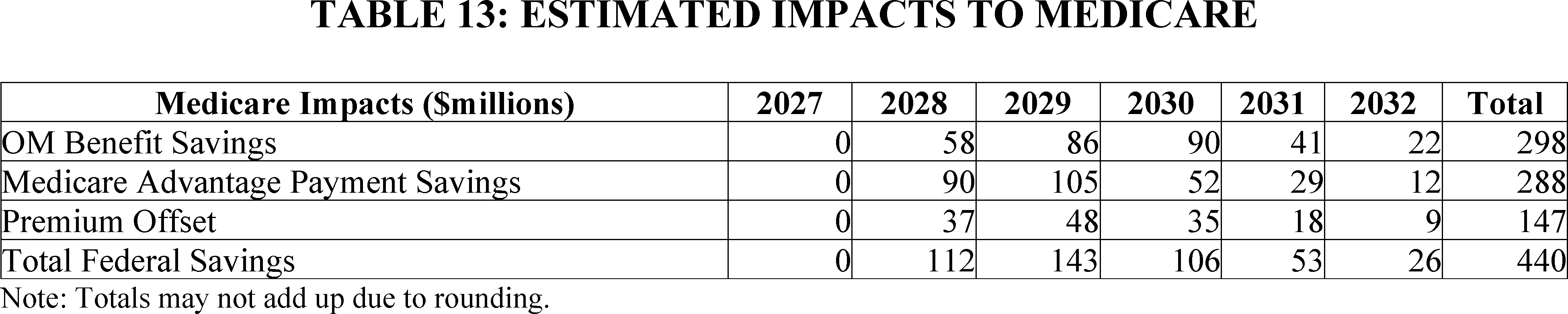
In addition to changes from the model resulting in reduced MA benchmarks and bids, MA plans will likely need to reduce supplemental benefits as well. Since the MA plans that bid below their benchmarks are paid a portion of this difference as an MA rebate, it follows that a reduction in benchmarks reduce the MA rebates. MA plans use these rebates for supplemental benefits, such as premium reductions or reductions in beneficiary cost-sharing, which would increase MA beneficiary out-of-pocket costs.
The model will result in beneficiary savings by reducing the Medicare Part B premium for all beneficiaries. Additionally, OM beneficiaries would see a reduced coinsurance on model drugs via the existing mechanism for adjusting the Medicare Part B coinsurance for drugs with an inflation rebate. MA plans must offer comparable cost sharing to OM beneficiaries and so MA beneficiaries would see benefit savings on their Medicare Part A and Part B benefits; however, these savings would be offset by reductions in supplemental benefits due to the reduction in MA benchmarks described in the previous paragraph. Table 14 shows impacts to beneficiaries on a calendar year basis. Note that beneficiary impacts conclude on March 31, 2032 as that represents the end of the GLOBE Model performance period.
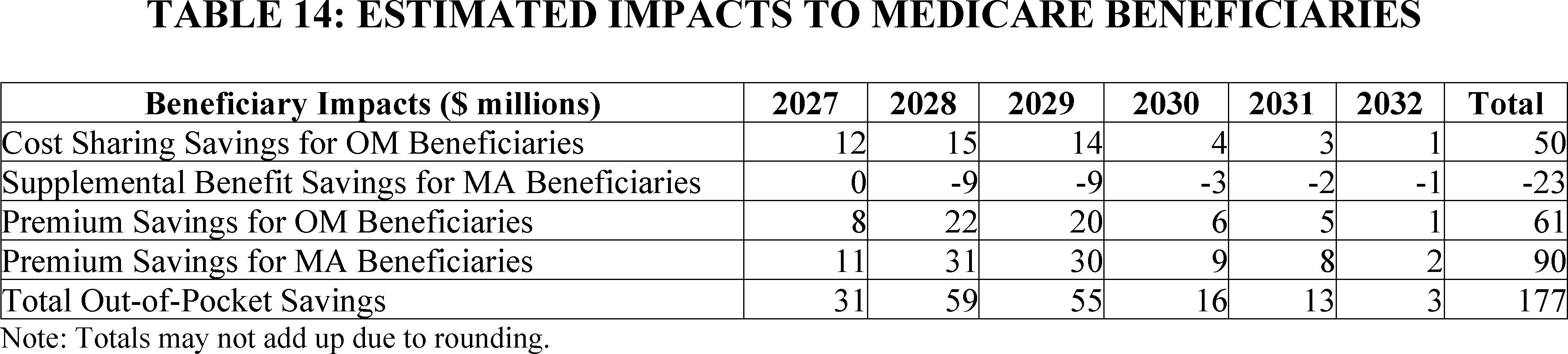
We also considered the following responses but either determined their impact would be small or that we lacked sufficient data to properly quantify the level of impact they would have on GLOBE Model rebates:
- We expect that manufacturers with drugs selected for the Negotiation Program would be less inclined to give discounts below the statutorily specified ceiling. We expect this effect to be small based on the ceilings specified by the IRA for Medicare Part B drugs.
- As 340B units are excluded from the calculation of the total GLOBE Model rebate amount, we would expect manufacturers to incentivize the increased utilization of these units. However, we do not believe there is much potential for this shift as most model drugs have a relatively low proportion of 340B units currently and the difference between 340B pricing and the benchmark prices for the model are unknown. Additionally, the mix of 340B and non-340B utilization may change organically over time, yielding changes to the number of excluded units from the GLOBE Model.
- There are incentives for manufacturers to raise list prices across all payers to counteract the lost revenue from the model. This reaction could create additional effects on Medicaid or Federal Marketplace spending. The likelihood of this response increases the higher spending is for a given drug outside of Medicare. We welcomed comments on the probability and magnitude of this response but did not receive any.
- Since drugs with an MFP that applies would be excluded from the model, we might expect manufacturers would try to change their pricing to become eligible for the Negotiation Program if they see it being more favorable for their reimbursement. Given the criteria for being selected for the Negotiation Program, we believe it would be difficult for manufacturers to achieve this. Additionally, the model does not impact reimbursement for all OM beneficiaries as negotiations would, so this response would require dramatic pricing differences to be favorable to manufacturers.
- The GLOBE Model does not include MA plans and so manufacturers may be inclined to assist in efforts to increase MA enrollment if they find MA reimbursement will be higher than OM. It is not clear how much more favorable MA reimbursement would be for manufacturers and so we have not included this in our estimates.
The following is a summary of the comments received and our responses.
Comment: A few commenters expressed concerns about the underlying assumptions of the initial regulatory impact analysis (RIA) and how the estimated benefits or costs were determined. Commenters also stated that the RIAs in GUARD and GLOBE appear to conflict in their assumptions leading to different potential impacts and outcomes for each model, and that CMS did not provide sufficient impact analysis to support demonstrating that the international pricing benchmark will reliably result in lower total costs net of manufacturer price concessions. Commenter shared concerns that the cost-saving projections depend heavily on the assumption that tying rebates to an international benchmark will lower net Medicare Part B drug spending.
Response: We thank the commenters for sharing their feedback on the initial RIA. We disagree that CMS did not account for major impacts of the GLOBE Model. Section IV.D. of the GLOBE ( printed page 63090) Model proposed rule (90 FR 60312 through 60318) explicitly identified broader potential financial consequences including price increases, white-bagging, increased OM utilization, and impact on MA and OM cost-sharing and premiums. Further, the GLOBE and GUARD Models are two separate CMS Innovation Center models that address different markets: the GLOBE Model addresses certain separately payable Medicare Part B physician administered drugs that are furnished to OM beneficiaries, whereas the GUARD Model addresses Part D drugs. The scope of drugs, beneficiaries, and participants therefore varies between the GLOBE Model and the GUARD Model as do the policies in each model. As such, we would not expect similar effects on the market or market participants, or the same set of assumptions to apply. Finally, we believe that the section IV.D. of the GLOBE Model proposed rule demonstrated that the international pricing benchmark would reliably result in lower total costs as illustrated in the modeling of the per unit Method I and per unit Method II GLOBE Model benchmarks for the illustrated 2024 GLOBE drug list in Table 4, where the per unit GLOBE Model rebate amount would be the greater of: (1) the difference between the specified amount (as determined under 42 CFR 427.302(b)) and the per unit GLOBE Model benchmark amount (as described in section II.G.3. of this final rule), if available; or (2) the difference between the specified amount (as determined under 42 CFR 427.302(b)) and the inflation-adjusted payment amount (as determined under 42 CFR 427.302(g)). This ensures net prices are equal to or lower than they would be for these drugs absent the model.
Comment: A few commenters urged CMS to more thoroughly assess the unintended consequences and overall costs of the GLOBE Model to Medicare, particularly whether it will truly reduce drug prices without harming beneficiary access.
Response: We thank the commenters for their input regarding potential unintended consequences and overall impacts of the GLOBE Model on Medicare. In section IV.D. of the GLOBE Model proposed rule (90 FR 60312 through 60318) and this final rule, CMS describes the potential direct and indirect impact of the GLOBE Model and how it may interact with other federal programs. Overall, we expect the GLOBE Model will lower overall net OM expenditures and out-of-pocket costs for patients through reduced drug costs. In section IV.A. of the GLOBE Model proposed rule (90 FR 60310 through 60311) and this final rule, CMS presents studies that show that high drug costs limit access to care and treatment. Consequently, we expect that by lowering drug costs and out-of-pocket costs, patients' well-being, fiscal security, and overall health will improve.
In section IV.D. of the GLOBE Model proposed rule (90 FR 60312 through 60318) and this final rule, CMS acknowledges uncertainty associated in estimating the impacts of the GLOBE Model, including manufacturer and other stakeholder behavior and pricing dynamics. Regulatory analysis requires forecasts about the future, and what the future holds is not known for certain. CMS estimates reflect the full range of how the benefits and costs of the rule might vary based on the information available at this time.
Comment: A commenter urges CMS to re-examine its projections on potential GLOBE Model savings and model the potential sets of manufacturer behavioral responses rather than assume static pricing trajectories will yield Medicare program savings.
Response: We thank the commenter for their input. We disagree that the estimated savings are static. In section IV.D. of the GLOBE Model proposed rule (90 FR 60312 through 60313) and this final rule, CMS describes its analysis which incorporates adjustments to account for certain behavioral responses that vary across time, and which focuses on the areas that are most likely to be affected by the GLOBE Model. For this reason, we disagree with the commenter's suggestion to re-examine its projections on the estimated GLOBE Model savings.
Comment: A few commenters suggested that the initial RIA did not account for administrative costs, including costs to providers to verify beneficiary cost-sharing, or costs to manufacturers to acquire proprietary data.
Response: In the GLOBE Model proposed rule (90 FR 60319) and this final rule, CMS acknowledges that administrative costs such as those involved with reading and understanding the rule, are not included because they are expected to be marginal for several reasons. Table 17 shows the aggregate 5-year burden for manufacturers to comply with this rule. This burden includes the time manufacturers spend reading and understanding requirements across different countries. We estimate the total burden to be $3.3 million over 5 years, with a low and high estimate of $0.2 to $10.3 million over 5 years. This results in an annual dollar burden of $0.7 million ($3.3/5), with a low and high estimate of $0.0 and $2.1 million. This annual burden when compared against the $80 million annualized savings presented in Table 10, is 0.8 percent of savings, with a low and high estimate of 0.3 and 2.6 percent. Furthermore, as discussed in section II.G.8. of this final rule, providers and suppliers will continue to buy and bill for GLOBE Model drugs as usual and receive separate payment under Medicare Part B, as applicable. Although CMS does not anticipate that providers will require additional support beyond the claims reimbursement process to ensure the accurate collection of coinsurance from their beneficiaries, as discussed in other parts of the final rule, CMS will disseminate key material and information to minimize potential administrative costs such as the GLOBE Model drug list along with each drug's cost sharing reduction percentage associated with each applicable quarter, and the list of ZIP codes to enable providers to prospectively identify which beneficiaries will receive the cost sharing.
In section II.G.1.a. of this final rule, we note that commercial data sources are widely used by interested parties within the biopharmaceutical industry, domestic and foreign governments, and commercial organizations, as well as the health technology assessment and drug pricing research communities. As such, it may be likely that manufacturers of GLOBE Model drugs have access to and familiarity with these existing data sources, and that any financial burden associated with access to such data source related to participation in the GLOBE Model would be minimal.
Comment: A couple of commenters urged CMS to evaluate and publicly disclose how tying U.S. drug prices to international benchmarks could affect ASP over time and potentially reshape the drug market, including impacts on patient access. They also raised concerns that changes to ASP calculations could create operational challenges for suppliers and call for analysis of effects both within and outside the GLOBE Model's scope.
Response: We thank the commenters for sharing their feedback on how the GLOBE Model might impact ASP, and potential operational challenges for suppliers which we interpret to mean that this could create additional administrative burdens not included in the initial RIA. In section IV.D. of the GLOBE Model proposed rule (90 FR 60244 and 60244), we noted that ASP is used as an input, through the specified ( printed page 63091) amount, in determining the per unit GLOBE Model rebate amount and as such should not be directly impacted by the GLOBE Model. The model does not change the Medicare Part B payment limit, including the add-on payment. However, we acknowledge that manufacturers may change list prices or price concessions in the U.S. across all payers to counteract the lost revenue from the model which could in turn indirectly impact the ASP amount. In section IV.D. of the GLOBE Model proposed rule (90 FR 60314), we discussed several expected behavioral responses including potential price increases during the GLOBE Model performance period. Further, in addition to discussing in the RIA several possible approaches to the proposed regulation including raising prices, we also welcomed comments on the probability and magnitude of manufacturers responding by raising list prices across all payers to counteract the lost revenue from the model. We have not received comments with respect to the probability or magnitude of changes in domestic prices nor in our analysis of this option in the RIA, in response to this request. We respond to commenters' concerns related to administrative costs in the preceding comment.
Comment: Many commenters raised concerns about the impacts on manufacturers and how they would respond strategically to the GLOBE Model in ways that could undermine its intended benefits or create market distortions that would offset the expected savings. These strategic responses may include increasing drug prices internationally, shifting costs to other markets such as increasing the prices of the GLOBE Model drug for commercial plans or increasing the prices of drugs in the U.S. that are outside of the GLOBE Model, altering launch, distribution or contracting strategies, or withdrawing from certain markets, including Medicare. A commenter also stated that CMS has not proposed a policy to address white-bagging.
Response: We thank the commenters for their concern that the GLOBE Model has the potential to motivate behavioral responses or other potential changes that would offset the savings of the GLOBE Model. Section IV.D. of the GLOBE Model proposed rule (90 FR 60314) discussed several expected behavioral responses including price increases, white bagging, increased use of OM utilization of prescription drugs, and acknowledges that these behavioral responses would offset potential savings. We decline to propose a policy to address white-bagging as we have considered this behavioral response.
Where possible we have estimated the impact of these responses on anticipated Medicare Savings as a percentage of Medicare Part B spending. We acknowledged in the GLOBE Model proposed rule that manufacturers may raise list prices across all payers to counteract the lost revenue from the model. We welcomed comments on the probability and magnitude of this response but did not receive any. We also acknowledge commenters' concerns that manufacturers could alter launch, distribution or contracting strategies, or withdraw from certain markets. However, we believe the GLOBE Model effects are time-limited and impacts a narrow population; therefore, the estimated impacts that would alter launch, distribution or contracting strategies, or withdrawing from certain markets such as Medicare are expected to be minimal. Further, the GLOBE Model does not impose direct burden on foreign governments. We note that the commenters did not explicitly comment on the quantified estimates in section IV.D. of the GLOBE Model proposed rule nor did they offer alternative estimates. We believe the GLOBE Model proposed rule has focused on the major behavioral responses. As we annually monitor the progress of the GLOBE Model, we will carefully assess what other responses are being made and may be addressed through future rulemaking.
Comment: A commenter stated that because non-340B and 340B drugs have different payment calculations, there is a potential concern that any change in the Medicare Part B benchmark may have an impact on 340B pricing and asked CMS to consider this issue in their analysis.
Response: We appreciate the commenter's concern that changes in the Medicare Part B benchmark may have on the 340B and non-340B programs. In sections II.N. (90 FR 60306) and IV.D. (90 FR 60312) of the GLOBE Model proposed rule, CMS stated that the GLOBE Model may interact with other federal programs such as the 340B program, the Veterans Health Administration, the Department of Defense, the Public Health Service, the Coast Guard, and Medicare. CMS describes potential indirect impacts on the 340B ceiling price and states that while manufacturer participants may have the incentive to shift utilization toward 340B units (as a result of 340B units being excluded from rebate amount calculations for the Medicare Part B Drug Inflation Rebate Program and the proposed GLOBE Model alternative rebate amount calculation), the extent of this shift is likely to be small since most GLOBE Model drugs have a relatively low proportion of 340B units.
Comment: Many commenters raised concerns about unintended consequences of the GLOBE Model, particularly its potential impact on MA plans. A commenter also urges CMS to provide additional information about how the GLOBE Model will impact Medigap plans.
Response: We thank the commenter for their input. In section IV.D. of the GLOBE Model proposed rule (90 FR 60314) and this final rule, CMS discusses the impact it estimates the GLOBE Model will have on MA plans and supplemental benefits offered by MA plans and acknowledges that GLOBE will likely reduce supplemental benefits to MA beneficiaries.
Comment: A commenter requested that CMS disclose the range of coinsurance reduction estimates under different assumptions.
Response: CMS shared a regulatory impact analysis in the GLOBE Model proposed rule that presented the estimated costs and benefits associated with the proposed policies that would have resulted in an overall cost sharing savings for OM beneficiaries of $1.4 billion over the duration of the model. In this final rule, the overall cost sharing savings for OM beneficiaries, updated to reflect the final rule policy changes summarized in IV.B. of this final rule, is $50 million as shown in Table 14. If we combine savings from cost sharing with the premium savings for OM beneficiaries of $61 million, the total out-of-pocket savings for OM beneficiaries is $111 million.
Comment: Many commenters believed that there would be minimal savings for beneficiaries, since most have supplemental insurance, and that savings may accrue mainly to the federal government, not patients. Commenters cited a study that suggests that only a very small percentage (~0.3 percent, or about 22,000 beneficiaries) would see out-of-pocket changes because it has been estimated that about 90 percent of beneficiaries enrolled in OM are also enrolled in supplemental insurance plans such as Medigap. Another commenter states that the GLOBE Model as proposed does not establish a clear and consistent pathway by which program-level savings translate into predictable, patient-centered affordability improvements.
Response: We thank the commenter for their input. CMS has designed the GLOBE Model to be limited in scope in order to test an alternative rebate approach for Medicare Part B drugs. In ( printed page 63092) section IV.D. of the GLOBE Model proposed rule (90 FR 60314) and this final rule, CMS also acknowledges that many of these OM beneficiaries are dual eligible status or have supplemental prescription drug coverage, resulting in a fraction of these GLOBE eligible beneficiaries realizing direct cost sharing reduction. While the share of beneficiaries may be small as a percentage of Medicare Part B beneficiaries, CMS believes that the cost sharing reduction for these beneficiaries is an important part of the GLOBE Model and has the potential to meaningfully increase access for these beneficiaries. Additionally, beneficiaries may see reduced Medicare Part B premiums regardless of whether they have supplemental insurance. As part of GLOBE Model implementation, CMS will post documents on the GLOBE Model website that provides information to beneficiaries and to providers on the cost sharing reduction amount for each GLOBE Model drug. Therefore, we believe the GLOBE Model has established a clear and consistent pathway to show how program-level savings translate into affordability improvements for patients.
Comment: A commenter recommended that CMS conduct and publish a formal Title VI disparate-impact analysis prior to implementation.
Response: On December 9, 2025, the Justice Department issued a final rule that ensures that the nation's federal civil rights laws are firmly grounded in the principle of equal treatment under the law by eliminating disparate-impact liability from its Title VI regulation.
Comment: Many commenters sought clarification from CMS regarding the interaction of the GLOBE Model with other CMS programs and agreements. They emphasized the need for CMS to clearly define whether participation in other models or MFN agreements would affect inclusion in GLOBE, noting that without this information, stakeholders cannot accurately assess impacts, and that if those products are not subject to the GLOBE Model it would affect savings for the Medicare Program and its beneficiaries. Commenters also warned that overlapping requirements across multiple programs could create uncertainty and unintended incentives affecting product development and market entry, particularly for smaller manufacturers. Additionally, commenters raised concerns that introducing new pricing models after prior agreements undermines business certainty and could disproportionately harm companies that relied on earlier negotiated terms.
Response: We thank the commenters for their input on the interaction of the GLOBE Model with existing CMS programs and agreements. In section II.M. of this final rule, we have provided responses to comments on how the GLOBE Model will overlap with other CMS Innovation Center models. In section IV. of this final rule, we provide an estimate of savings for the model that assumes that manufacturers with signed GENEROUS Model participation agreements will not participate in the GLOBE Model and reflects manufacturer participation estimates using the best available information at this time.
Final Decision: CMS has revised this section to incorporate relevant public comments and to align with the final policies set forth in this rule.
2. Estimated Impacts to Medicaid
While the GLOBE Model rebate does not apply to units from dual eligible beneficiaries as these units are excluded from the Medicare Part B Drug Inflation Rebate Program, dual eligible beneficiaries are included in the GLOBE Model beneficiary list and are eligible to receive the GLOBE Model beneficiary coinsurance adjustment. Dual eligible beneficiaries are people who are enrolled in both Medicare (Part A, Part B, or both) and Medicaid. Medicaid savings of the GLOBE Model would therefore be reflected via the reduced cost sharing and premiums that Medicaid pays on behalf of dual eligible beneficiaries in the model geographic areas. Based on historical experience we expect that 30 percent of the reduced cost sharing will come from dual eligible beneficiaries, with the Federal government retaining 57 percent of those savings and States retaining the rest. Based on historical experience we expect that approximately 19 percent of the Medicare Part B premiums are paid by Medicaid on behalf of dual eligible beneficiaries, with the Federal government retaining 57 percent of those savings and States retaining the rest. Table 15 shows Medicaid impacts on a calendar year cash basis.
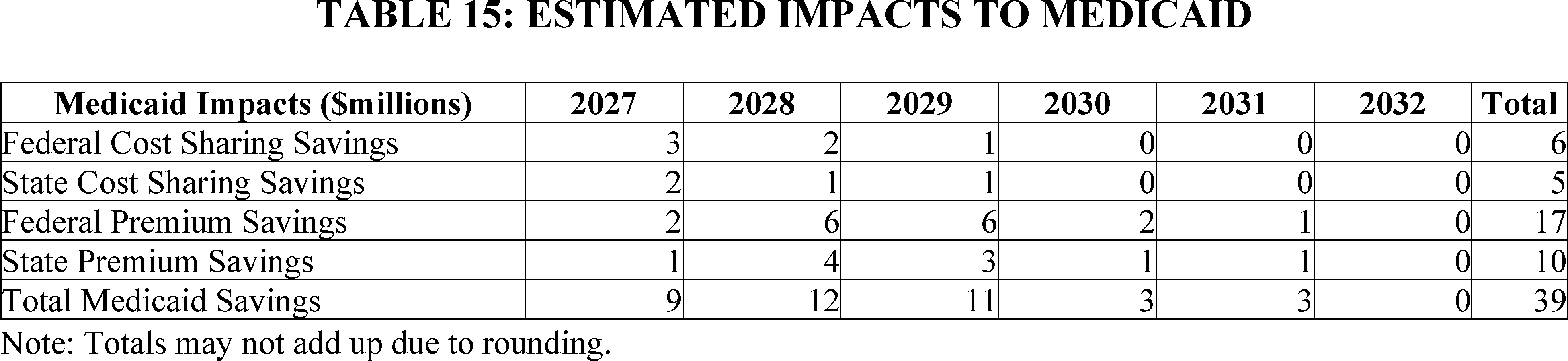
The following is a summary of the comments received and our responses.
Comment: A couple of commenters stated that the GLOBE Model may have spillover effects on Medicaid and dual eligible beneficiaries that should be considered.
Response: We thank the commenters for sharing their concern on the potential spillover impacts on Medicaid. In sections IV.D. (90 FR 60312) and II.N. (90 FR 60306) of the GLOBE Model proposed rule, CMS discussed potential impacts of the GLOBE Model on Medicaid. Specifically, CMS noted that, although not required as part of manufacturer participation in the GLOBE Model, to the extent that manufacturers reduce prices available to purchases and those prices would be included in a manufacturer's determination of the Medicaid Best Price, a manufacturer's Medicaid Best Price could potentially be lower and possibly increase Medicaid rebates. However, we do not expect such potential manufacturer behavioral response would result in a material impact on a manufacturer's Medicaid Best Price. Therefore, our estimate only reflects Medicaid savings related to the GLOBE Model via the reduced cost sharing and premiums that Medicaid pays on behalf of dual eligible beneficiaries in the model geographic areas. ( printed page 63093)
Final Decision: CMS has revised this section to incorporate relevant public comments and to align with the final policies set forth in this final rule.
3. Review of Paperwork (Information) Burden
As discussed in section III. of this final rule, Chapter 35 of title 44, United States Code, does not apply to the testing and evaluation of models under section 1115A of the Act. That is, models are exempt from paperwork (information) burden requirements. Nevertheless, and for discussional purposes only, we briefly review the main paperwork burden of this final rule and show it is marginal. The main information burden arises from voluntary manufacturer-reported submission of international net pricing information. The analysis of cost is summarized in Tables 16 and 17 with line items explained afterwards. Table 16 presents an analysis of items for which we have an experience basis for quantification. Table 17 discusses other items affecting the cost of submission requirements for which CMS has no prior experience on which to base quantification. To meaningfully deal with this, we assume each item would increase the total quantifiable burden by some factor; a range of factors is presented to account for our lack of precise quantification.
For Table 16, we take a conservative approach and estimate the paperwork burden for manufacturers of GLOBE Model drugs regardless of their participation status in the GENEROUS Model and therefore, do not account for waivers that may waive the requirements for mandatory participation of manufacturers of GLOBE Model drugs under § 513.100. For Table 17, our low estimate accounts for participation status in the GENEROUS Model and assume that manufacturers participating in the GENEROUS Model will not participate in the GLOBE Model.
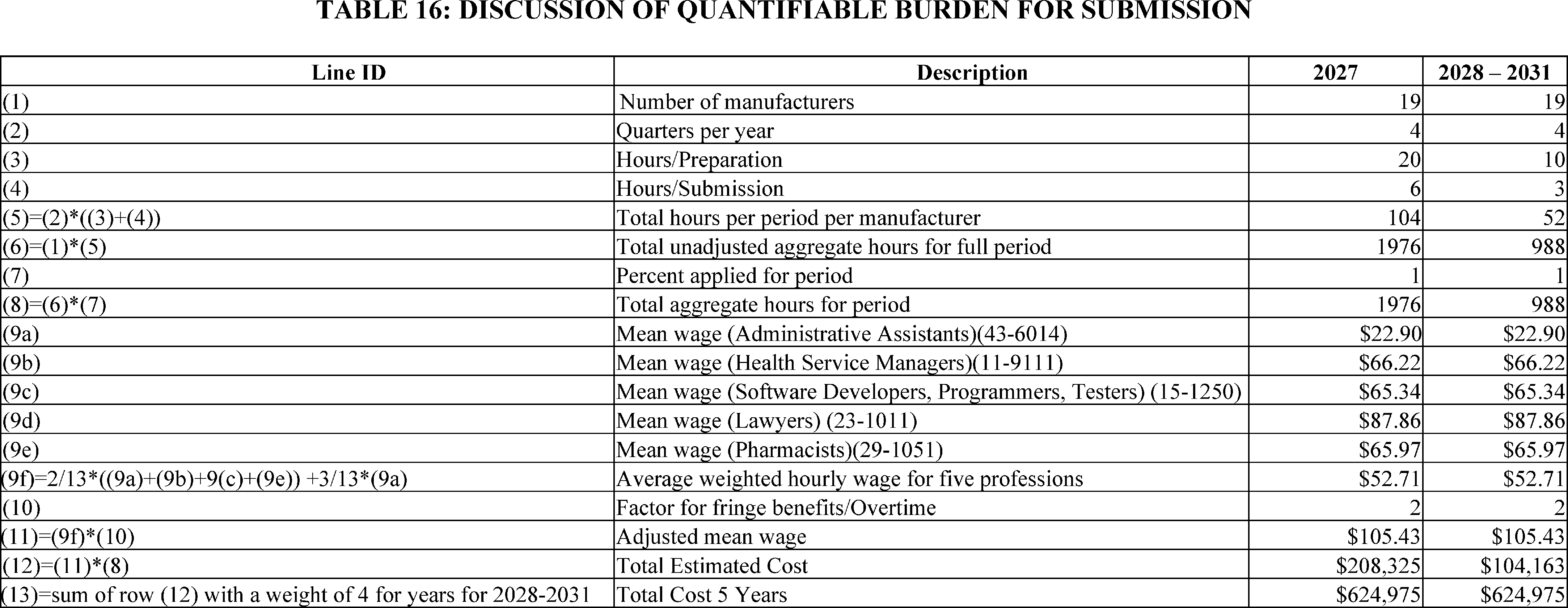
We next explain the various line items in sequential order.
Line Item 1: To receive coverage of their drugs by Medicare, manufacturers must comply with the requirements of 42 U.S.C. 1396r-8, 42 U.S.C. 256b, 38 U.S.C. 8126. As a subset of these manufacturers could be impacted by the GLOBE Model, we obtained a list of manufacturers, designated by labeler codes, of Medicare Part B rebatable drugs in 2024 as of June 2025. This list was based on initial, non-final data and there were 61 unique labeler codes on that list. Based on a hypothetical analysis of how many manufacturers would participate in the GLOBE Model using 2024 data, we concluded that the GLOBE Model would only apply to a subset of manufacturers of Part B rebatable drugs given the drug inclusions and exclusions described in section II.B. of this final rule. As a conservative estimate meant to include more manufacturers than likely would participate in the GLOBE Model, the proposed rule (90 FR 60316) used 40 manufacturers. However, as a result of both stakeholder comments and internal deliberations, a decision was reached to update § 513.130(c) to exclude: (1) a Part B rebatable drug that is designated as a drug for one or more rare diseases or conditions under section 526 of the Federal Food, Drug, and Cosmetic Act (21 U.S.C. 360bb) and for which the only approved indication (or indications) is for one or more such rare disease or conditions; (2) a Part B rebatable drug that is listed on the FDA Approved Cellular and Gene Therapy Products website; and (3) a Part B rebatable drug that is a plasma-derived product as set forth in 42 CFR 427.400. Therefore, based on the illustrative 2024 GLOBE Model drug list in Table 4 of this final rule, the number of manufacturers participating initially with GLOBE is estimated to be 19.[227] This number, which might fluctuate during the duration of the GLOBE Model, is used in this final rule for the estimate in Table 16, reflecting quantifiable information. A second table, Table 17, addresses the reasonable assumption that this number would fluctuate from year to year.
Line Items 3 and 4: The hours required for submission are split between preparation, including reading rules, gathering data, and so forth, and actual submission. We used similar estimates of submission to CMS from a Supporting Statement of the Manufacturer Submission ASP for Medicare Part B Drugs and Biologicals and Supporting Regulations in 42 CFR 414.800-806 (CMS-10110, OMB 0938-0921) from 2023. The supporting document listed 10 hours for ( printed page 63094) preparation and 3 hours for submission. However, we believe that extra hours would be required for the first year, and in the absence of more reliable data we simply doubled the 10 and 3.
Line Item 7: Based on comments in II.A. of this final rule, the GLOBE Model will begin on January 1, 2027, with the collection of voluntary manufacturer-submitted international drug net pricing data. The model will include 5 performance years, will begin on April 1, 2027 and ending March 31, 2032, during which the GLOBE Model beneficiary coinsurance and adjusted payments to providers and suppliers could apply and monitoring activities will occur. The model will also include a seven-year payment period, will begin on April 1, 2027, and will end on March 31, 2034, during which CMS will calculate, invoice, collect, and reconcile the GLOBE Model rebates for a performance year. Since the paperwork burden is associated with reporting, we use a full year for 2027 and full years for 2028-2031. Hence, the full period for each of these 5 years is used. Although there are other dates associated with the GLOBE Model, such as the period for beneficiary coinsurance payment adjustments, the performance, or the payment period, these do not directly affect the voluntary reporting by manufacturers which is the major driver of burden, and hence, these are not considered.
Lines 9a through 9f: The $ 22.90 is the mean wage obtained from the Bureau of Labor Statistics website for Secretaries and Administrative Assistants, Occupational Code 43-6014, for the latest year available at this time, 2024. Note that CMS still uses mean wages even though many agencies use median wages. However, replacing the mean by the median would not change the conclusion of negligibility. 43-6014 is the same occupational title used for estimates in OMB 0938-0921. However, we determined that this approach (using only administrative assistants) was overly simplified. While administrative assistants are appropriate staff for the 3 hours submission, we assume the preparation would involve a team of administrative assistants, health care managers, software engineers, lawyers, and pharmacists. The mean hourly wage of these five staff occupations for 2024 are displayed along with their occupational titles and code. The wages of these five staff are combined to produce a single mean hourly wage for the team. In the absence of further data, the weights assume that all five staff work equally in the 10 hours of preparation resulting in 2 hours per staff. The administrative staff exclusively work during the 3 hours of submission. Thus, the weights are five-thirteenths for administrative staff and two-thirteenths for each of the other staff.
Line 10: Per HHS guidance,[228] CMS uses a factor of 2 to account for overtime and fringe benefits.
Lines 11-13: These are computations as indicated in the row header. Minor errors are due to rounding once at the end rather than at each step.
We next turn to items for which we have no basis on which to quantify. The total analysis is presented in Table 17. As noted in Table 17, there are two non-quantifiable issues that have to be addressed.
New and departing participants: Each year, the group of GLOBE Model participants may change based on whether their drug meets the criteria for inclusion in the GLOBE Model. We have no way of estimating with accuracy whether a given manufacturer would be included or excluded in the GLOBE Model. For a high factor we assume that the number of participants might increase as much as 50 percent corresponding to a factor of 1.5. Although this is unlikely, it helps define a broad range of possible costs.
For a low estimate, we assume that manufacturers who are participating in the GENEROUS Model receive a waiver for the requirements of mandatory participation of manufacturers of GLOBE Model drugs under § 513.100 as further discussed in section II.M. of this final rule. Using the 2024 illustrative GLOBE Model drug list in Table 4 of this is final rule and our assumption of GENEROUS Model participation, we estimated that 4 manufacturers would participate in the GLOBE Model. This creates a low estimate of 20 percent (4/19). This contingency of joining the GENEROUS Model was not considered in the regulatory impact analysis in the GLOBE Model proposed rule but is plausible and therefore included in this final rule.
Reference Countries: If a manufacturer were to opt to report manufacturer-submitted data, they would do so for a set of reference countries, up to 19 countries, as discussed in section II.G.1.e. of this final rule. The 10 hours of preparation assumed in Table 16 provides time for each GLOBE Model participant to address marketing, pricing, and licensing requirements. But likely, this is different for different countries. We do not have enough information to quantify this. We approach the extra time as a factor by which we increase cost. For example, if we were to assume that the preparation time is the same 10 hours/country for 9 of the 19 reference countries, we would multiply the bottom line cost burden by a factor of 10 for those 9 reference countries. We would then incorporate the total preparation time and corresponding cost burden associated with the remaining 10 reference countries to arrive at the total cost burden. For example, if data on licensing, marketing, and pricing for each individual country are readily available, it might only require an extra 2 hours of work resulting in an increase of 15 percent (2/13). Therefore, we take 1.15 and 11 as the low and high estimates (where we rounded 10.5 downwards to obtain a wider range and similarly chose 11 over 10 to get a wider range) and insert an additional estimate in between these 2. In the GLOBE Model proposed rule we used a factor of 9.5 reflecting half the manufacturers; we have updated this 9.5 to 11 for greater clarity and transparency since the number of manufacturers entering or departing will be a whole number.
To obtain a range of adjusted bottom line estimates we multiply the factors together. For example, as discussed previously, if half the countries require the same amount of work (resulting in a maximum increasing factor of 11) and if the number of participants increases 50 percent (resulting in a factor of 1.5) then we multiply the bottom line number from Table 16, $624,975 by 16.5 (1.5 * 11) and obtain a high cost burden of $10.3 million as shown in Table 17. As shown on the bottom line of Table 17, the resulting range of estimates of cost burden is between roughly $0.1 million and $10.3 million.
( printed page 63095)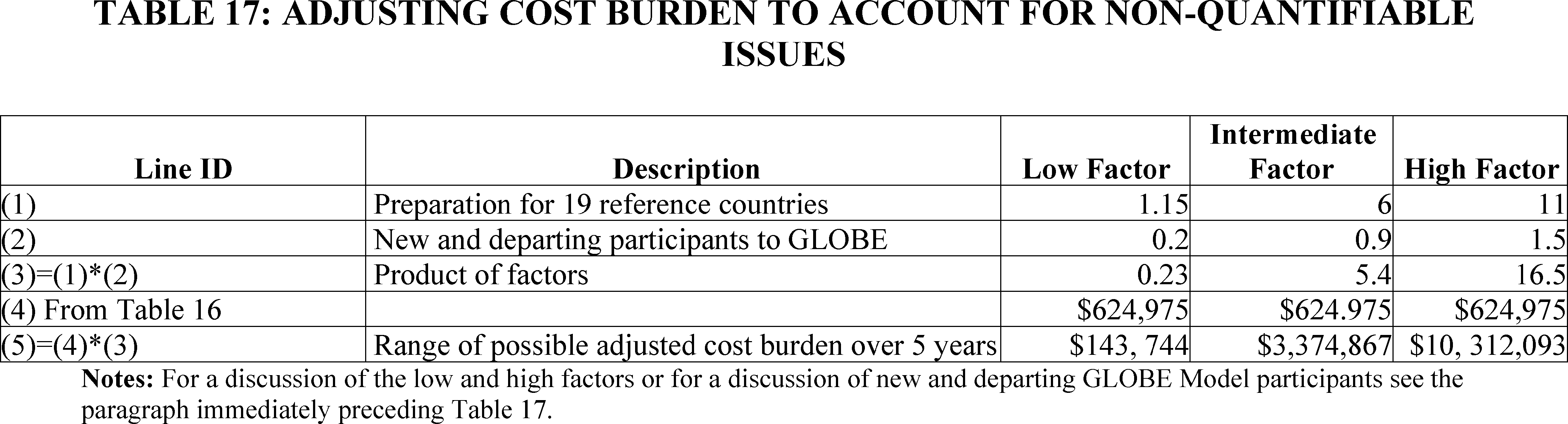
The following is a summary of the comments received and our responses.
Comment: Some commenters stated that the GLOBE Model reporting requirements would place significant burden on manufacturers.
Response: We thank the commenters for sharing their concern related to the burden of manufacturer net price reporting costs. CMS estimated the costs to manufacturers in the Globe Model proposed rule in section IV.D.3. of the GLOBE Model proposed rule (90 FR 60314) and this analysis is repeated in this final rule in Tables 16 and 17 to which further modifications and clarifications have been added. In addition, while new requirements are being added to manufacturers under the GLOBE Model, they are marginal and limited in scope as the GLOBE Model builds on the already existing framework created by the IRA. We therefore believe that manufacturers should be able to absorb these marginal costs of reporting when they choose to submit data to inform a Method II GLOBE Model benchmark calculation.
Final Decision: Based on the final inclusion criteria, CMS has determined that this final rule will not have a significant economic impact on paperwork burden for manufacturers. CMS has revised section IV.D. of this final rule to reflect the final policies established in this rule.
E. Final Regulatory Flexibility Analysis
The Regulatory Flexibility Act (RFA) requires agencies to analyze options for regulatory relief for small entities. For purposes of the RFA, small entities include small businesses, nonprofit organizations, and small governmental jurisdictions. Individuals and States are not included in the definition of a small entity. The RFA requires that CMS analyze regulatory options for small businesses and other entities unless CMS certifies that a rule will not have a significant economic impact on a substantial number of small entities. The analysis must include a justification concerning the reason action is being taken, the kinds and number of small entities the final rule affects and an explanation of any meaningful options that achieve the objectives with less significant adverse economic impact on the small entities.
HHS considers a significant impact on a substantial number of small entities, to be one with at least a 3 percent revenue effect on at least 5 percent of impacted small entities.[229] As discussed in section II. of this final rule, manufacturers that are GLOBE Model participants would pay GLOBE Model rebates to the Medicare Part B account in the Federal Supplementary Medical Insurance Trust Fund if the amount specified in section 1847A(i)(3)(A)(ii)(I) of the Act for a GLOBE Model drug exceeds a benchmark amount that would be based on available international drug net pricing information (as described in section II.G. of this final rule) and would not be less than any rebate owed under the Medicare Part B Drug Inflation Rebate Program. Our analysis includes the final exclusion criteria in § 513.130(c) to exclude a Part B rebatable drug from the GLOBE Model (1) that is designated as a drug for one or more rare diseases or conditions under section 526 of the Federal Food, Drug, and Cosmetic Act (21 U.S.C. 360bb) and for which the only approved indication (or indications) is for one or more such rare diseases or conditions, (2) that is a listed on the FDA Approved Cellular and Gene Therapy products website, and (3) that is a plasma-derived product as set forth 42 CFR 427.400. Our analysis shows that the final rule will impact one small firm, and the impact is estimated to represent 2.3 percent or less of that firm's annual revenue in the U.S. As such, the Secretary certifies that this final rule will not have a significant economic impact on a substantial number of small entities. This analysis, as well as other sections in this final rule, serves as the Final Regulatory Flexibility Analysis, as required by the RFA.
1. Description and Number of Affected Small Entities
Based on the final drug exclusion criteria set forth in § 513.130(c) and not considering manufacturer participation status in GENEROUS, we identified 19 manufacturers that would be associated with the illustrative 2024 GLOBE Model drugs from Table 4 of this final rule.[230] Using the financial data, we determined that 1 of these manufacturers would be considered small based on the SBA definition.[231] Based on a March 31, 2026 news release, we determined that the one small manufacturer is expected to be acquired by a large company and that this transaction is expected to close in the second quarter of 2026. Given this announcement and to recognize that not all announced merger and acquisition activities get finalized, our analysis assumes that one small manufacturer would be affected by the GLOBE Model. As the estimated impact to this one small manufacturer (2.3 percent or less of the firm's annual revenue in the U.S.) is not considered economically significant under HHS standards, we conclude that 0 percent of impacted small entities are significantly impacted and the estimated impact on this one small manufacturer meets the 0-5 ( printed page 63096) percent threshold of the RFA for non-significance.
We use financial and employment information publicly available on annual reports published on companies' websites or submitted to the Securities and Exchange Commission (SEC) for 2024 to identify revenue and employment information for the potentially affected companies.[232] We used the Internal Revenue Service's yearly average currency exchange rates for 2024 to convert revenue information into U.S. dollars when this information was provided in a foreign currency.[233]
Assuming that the announced consolidation of the two companies is not finalized, and using 2024 data, the identified small company employs 501-999 employees in the U.S. and reported revenue of $781.37 million. The potential GLOBE Model drug associated with this small entity is classified as immunological agent for which there are at least a dozen other drugs that are in the same therapeutic class as determined by the number of HCPCS Level II codes in the USP DC classification category in Table 4. Further, based on CMS expertise, the potential GLOBE Model drug associated with this small entity has therapeutically equivalent substitutes.
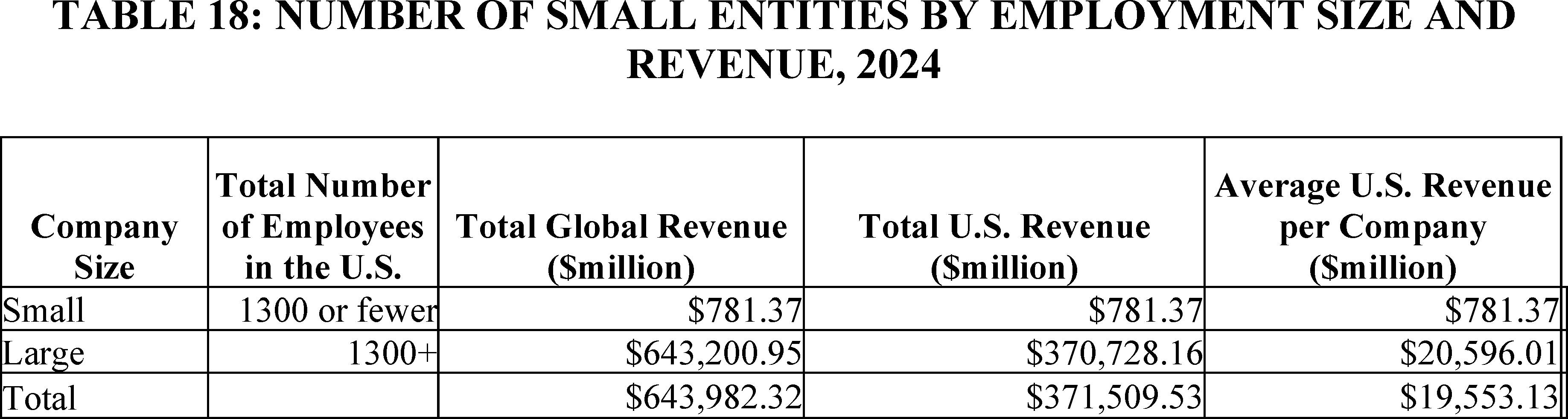
Final Decision: We did not receive comments in this section. We have updated this section to reflect our final drug inclusion and exclusion criteria at § 513.130.
2. Description of the Potential Impacts on Small Entities
CMS anticipates that payments to CMS in the form of GLOBE Model rebate amounts, if any, as set forth in § 513.500 of this final rule, will represent the largest impact to small entities, if any, affected by the GLOBE Model. However, as noted in section IV.E.1. of this final rule, based on the final selection criteria and updated analysis, the Secretary concludes that the final rule will not have a significant impact on a substantial number of small entities.
We estimate a potential impact assuming the consolidation of the two companies does not get finalized. To estimate a lower bound, we estimate that 0.0 percent of the estimated incremental GLOBE Model rebate amount would be associated with the small entity. The estimate of 0.0 percent was derived by calculating the ratio of small company rebate reliability to large company rebate reliability.[234] As the lower estimate is 0.0 percent based on the available data for that small manufacturer and to be conservative, we also estimate an upper bound using an average GLOBE Model rebate per company ($18.25 million), including both large and small manufacturers from the illustrative 2024 GLOBE Model Drug HCPCS Level II Codes List (Table 4). Using this estimate as an upper bound, we estimate that GLOBE Model rebates could represent up to 2.3 percent of a small entity's average revenue in the U.S. ($18.25 million/$781.37 million). Using the lower and upper bound estimates, and OACT's estimate of the incurred calendar year GLOBE Model rebates, we estimate the incremental GLOBE Model rebate amounts would range from $0.0 to $3.1 million per small entity over the model performance period. Table 19 presents the estimated incremental GLOBE rebate amounts for small entities and the corresponding impact on total revenue. Based on our analysis and using available data on total revenue and estimated incremental GLOBE Model rebates, CMS estimates that the estimated incremental GLOBE Model rebate amounts would represent less than 0.4 percent of small entities' total revenue, as measured in terms of revenue in the U.S. The administrative costs involved with reading and understanding this final rule are not included in these estimates. However, as noted in the RIA, these costs are estimated to be marginal.
In the GLOBE Model proposed rule (90 FR 60319), CMS noted that these estimates were based on available data which could change in the future and as such, the estimated impacts could vary. The estimates in this Final Regulatory Flexibility Analysis are based on the current status of rebatable drugs, employment, and revenue information using 2024 or other available data as of the publication of this final rule. Based on our updated analysis, the Secretary concludes that the final rule will not have a significant impact on a substantial number of small entities.

3. Other Potential Options To Reduce Adverse Burden on Small Entities
As discussed in introduction of this section (section IV.E. of this final rule), the RFA requires discussion of any meaningful options that achieve the objectives of the final rule with less significant adverse economic impact on the small entities. Therefore, this section discusses several such considerations.
In particular, we considered including limited price reductions for drugs selected for the Negotiation Program, increasing utilization of 340B units, changing list pricing information, changing incentives to participate in the Negotiation Program, and studying impacts to MA plans and Medicaid. In each case we either determined the impact to be small or that there was insufficient data to properly quantify their impact. We note that there is much uncertainty around the assumptions for these estimates.
In the GLOBE Model proposed rule (90 FR 60319), we welcomed comments on our estimate of significantly affected small manufacturers and the magnitude of estimated effects. We also welcomed comments on adjustments to the GLOBE Model that could be considered while preserving the innovative approach to payment in the GLOBE Model.
The following is a summary of the comments received and our responses.
Comment: Many commenters stated strong opposition to the GLOBE Model, indicating that it would disproportionately harm small and mid-sized biotechnology and pharmaceutical companies, weaken U.S. biotechnology leadership, disrupt R&D, and harm patient access directly. The commenters described that small and mid-sized companies lack scale, diversified portfolios, and negotiating leverage compared to large companies that may avoid impacts due to separate negotiations. The commenters described that small firms depend on external capital funding, downstream revenues, and on one or few products to finance their pipelines. The commenters added that the GLOBE Model would lead to revenue compression which would reduce their ability to fund early-stage research, as well as their ability to raise capital because lower expected reimbursement in the U.S. would translate into reduced investor confidence. The commenters stated that this could slow down development of gene therapies, biologics and rare disease treatments. The commenters also expressed other concerns including increased uncertainty, administrative burden, overlap with other existing programs, and limited evidence on improved affordability of access.
Response: We thank the commenters for their input on the potential impact to small business entities. Based on the updated drug exclusion criteria in § 513.130(c) and the updated analysis presented in section IV.E. of this final rule, CMS disagrees the GLOBE Model will disproportionately harm small and mid-sized biotechnology and pharmaceutical companies. The updated analysis indicates that only 1 potentially affected entity qualifies as small under the SBA definition, with GLOBE Model rebates representing no more than 2.3 percent of the small entity's average revenue-below the HHS significance threshold of 3 percent or more.[236] Because the estimated impact does not exceed 3 to 5 percent, the Secretary concludes that the GLOBE Model will not have a significant economic impact on a substantial number of entities.
Additionally, the GLOBE Model is a time-limited 5-year model that tests an innovative payment methodology on a subset of Part B rebatable drugs for a limited population—25 percent of OM Part B beneficiaries. The model's rebate obligation also reaches only drugs exceeding $100 million in OM Part B allowed charges over a 12-month period—a threshold reflecting substantial market penetration—and affects only the OM Part B market, leaving commercial, MA, and ex-U.S. revenues unaffected. Therefore, we disagree that the model will weaken U.S. biotechnology leadership, disrupt R&D, or slow down development of biologic treatments. We refer readers to the introduction of section II. and section II.B. of this final rule for our more comprehensive responses related to impacts on U.S. biotechnology leadership, R&D, and development of treatments. We also refer readers to sections II.E. and IV.D. of this final rule, for our responses related to mandatory participation of small and mid-sized companies and evidence on improved affordability for OM Part B beneficiaries.
Comment: A few commenters also expressed concern that the GLOBE Model would penalize small and mid-sized companies that rely on out-licensing or co-licensing agreements, and turn partnering or out-licensing into a “poison pill” for small and mid-sized companies. The commenters note that small firms do not have a physical presence outside of the U.S. and that they often license products internationally but do not control foreign pricing or net pricing data. Commenters cited survey results indicating that 75 percent of an organization's membership noted reliance on out-licensing agreements, and that companies do not have control over pricing.
Response: We thank the commenters for their input on the impact to small business entities and their reliance on out-licensing or co-licensing agreements. As finalized in this final rule, we are modifying the criteria for GLOBE Model drugs such that orphan-only [237] Part B rebatable drugs would be excluded from the model. As a result of this exclusion, the GLOBE Model's final rule identifies one small entity, down from two in the GLOBE Model proposed rule (90 FR 60318), and the estimated GLOBE Model rebates impact for small entities has decreased from up to 2.6 percent (90 FR 60318) down to 2.3 percent. We also believe that the exclusion of orphan-only drugs would significantly reduce the number of GLOBE Model drugs where the U.S. manufacturer or its affiliate does not sell international analogs of the GLOBE Model drug outside of the U.S. Based on our analysis of potential GLOBE Model drugs for performance year 1, we observed the U.S. manufacturer and manufacturer in a reference country are most often the same entity or affiliated entities. We recognize that there could be cases where the U.S. manufacturer of a GLOBE Model drug is not affiliated with the entity (or entities) that sell international analogs for a GLOBE Model drug in reference countries. To support manufacturers of GLOBE Model drugs, CMS is exploring options for technical support for manufacturers through the model helpdesk as discussed in section II.G. of this final rule. We refer readers to sections II.G.1.d. and II.G.6. of this final rule for our additional responses related to this out-licensing and co-licensing.
Comment: A commenter urged CMS to supplement its employee-count ( printed page 63098) threshold analysis with an additional criterion that includes the length of time that has elapsed since a manufacturer's first product to market. The commenter further stated that the GLOBE Model applies an arbitrary definition of “small” manufacturer and that the threshold of more than 1300 employees fails to consider the role of mid-sized biotech companies.
Response: We thank the commenter for their feedback on the criterion used to define a small entity in the Initial Regulatory Flexibility Analysis (section IV.E. of the GLOBE Model proposed rule). The definition of size used in this rule is based on the regulatory definitions and methodology presented in 13 CFR 121.201 on which the NAICS standard sizes are based. Moreover, as just indicated, these definitions are based on the methodology also presented there. Definitions are based on several factors including employee size and revenue. As such, we disagree CMS used an arbitrary definition of “small” and are retaining our methodology presented by these regulations.
Final Decision: As discussed in section IV.E.1. of this final rule, based on the final inclusion criteria and the expected consolidation of two companies, CMS has determined that this final rule will not have a significant economic impact on a substantial number of small entities. CMS has revised section IV.E.2. of this final rule accordingly to reflect the final inclusion criteria and the updated results of its analysis.
3. Actions Taken To Reduce Burden on Small Entities
Although as pointed out previously, the number of small entities impacted is 1, nevertheless, CMS considered a variety of options to reduce effect on small entities. More specifically the provisions require the following, each of which has the effect of reducing possible burden on small entities: (1) setting the spending threshold for inclusion in the model as discussed in section II.B. of this final rule at $100 million over a 12-month period (further specified in § 513.130) and (2) the new drug exclusion criteria for orphan-only drugs,[238] plasma-derived products as set forth in 42 CFR 427.400, and drugs listed by FDA as Approved Cellular and Gene Therapy products finalized in § 513.130(c).
For the purpose of thoroughness, we point out that CMS also considered other options to minimize the impact on small entities: (1) establishing a different spending threshold; (2) establishing an exemption process; and (3) establishing different compliance dates. However, we decided against implementing these for the following reasons.
- Spending threshold: As discussed in section II.B. of this final rule, CMS proposed to include drugs or biological products that meet the proposed definition of a GLOBE Model drug which would include a subset of Part B rebatable drugs that: (1) have the listed USP DC categories in Table 3 of this final rule; (2) are single source drugs or sole source biological products; (3) have a HCPCS Level II code with OM Part B spending greater than $100 million over a 12-month period (as further specified in proposed § 513.130(d)); and (4) are not excluded from the GLOBE Model as proposed in § 513.130(c). Based on the third criterion, CMS is excluding from the GLOBE Model those drugs with relative share of spending costs to drug spending lower than $100 million over a 12-month period. This spending threshold applies to all manufacturers irrespective of size. While lowering the spending threshold increases the number of drugs that could be included in the GLOBE Model, it also increases the number of small manufacturers that could potentially be impacted. For this reason, CMS proposed not to select a lower threshold. Further, increasing the threshold reduces both the number of small and large manufacturers and the number of drugs in the GLOBE Model. For example, a threshold of $125 million would exclude two manufacturers, both of which are considered large manufacturers (they employ more than 5,000 employees in the U.S.). Selecting a different spending threshold higher than $100 million would also reduce the estimated savings to the Medicare program and to beneficiaries and thereby shift the focus of the model test and limit the ability to evaluate the experiences of manufacturers of drugs with diverse characteristics.
- Exempting small entities: As discussed in section II.B.2. of this final rule, to avoid interactions with other initiatives and programs that focus on manufacturers of Medicare Part B drugs, CMS would exclude drugs assigned to HCPCS Level II codes when the Medicare Part B payment limit is based on a maximum fair price for drugs separately payable under Medicare Part B. Because small and large manufacturers could potentially be eligible for the proposed exclusion, we do not believe that additional processes for exemptions are needed. CMS sought comments on other factors or considerations regarding exemptions for small entities.
- Compliance dates: CMS also considered the flexibility of providing different compliance dates to small manufacturers. While creating significantly different compliance dates could provide more time for small manufacturers to comply, it could interfere with the statutory requirement of evaluating the model to determine whether savings have occurred.
In summary, because the purpose of the GLOBE Model is to test an alternative Medicare Part B drug inflation rebate amount calculation for GLOBE Model drugs using international drug pricing information to identify a benchmark that reflects prices paid in economically comparable countries, which CMS expects would reduce program expenditures for Medicare Part B while preserving or enhancing beneficiaries' quality of care, CMS therefore declined to propose the alternatives considered. We welcomed comments on the alternatives considered as well as other factors that could be considered to mitigate the impact on small manufacturers.
The following is a summary of the comments received and our responses.
Comment: A couple of commenters recommend CMS exempt small manufacturers to mitigate the potential impact. Commenters recommended several potential exemptions, including exempting from the model drug manufactured by companies with fewer than 500 employees and no prior commercialized products from the $100 million Medicare Part B threshold; considering the length of time elapsed since a manufacturer's first FDA product approval as a criterion for defining a small manufacturer; excluding manufacturers whose Medicare Part B prescription drug spending constitutes less than 1.0 percent of total Medicare Part B prescription drug spending; and raising the $100 million Medicare Part B allowed charges threshold for drugs as an alternative means of limiting the model's applicability to small manufacturers.
Response: We thank the commenters for the suggestion that we adopt an alternative policy to exempt small manufacturers. We respond to these comments in section II.E.1. of the final rule. Further, based on the updated analysis and final inclusion criteria in ( printed page 63099) this rule, we conclude that we do not anticipate that the final rule will have a significant economic impact on a substantial number of small entities. For these reasons we decline to adopt the alternative approaches suggested by the commenters.
Final Decision: Based on the final inclusion criteria and the updated findings set forth in sections IV.E.1. and IV.E.2. of this final rule, CMS has determined that exemptions for small entities are not warranted.
F. Effects on Small Rural Hospitals
Section 1102(b) of the Act requires CMS to prepare a regulatory impact analysis if a rule may have a significant impact on the operations of a substantial number of small rural hospitals. This analysis must conform to the provisions of section 604 of the RFA. For purposes of section 1102(b) of the Act, we define a small rural hospital as a hospital that is located outside of a metropolitan statistical area and has 100 or fewer beds.
Providers and suppliers who furnish GLOBE Model drugs to OM beneficiaries who are in the model cohort would not be GLOBE Model participants and would continue to buy and bill for GLOBE Model drugs as usual and receive separate payment under Medicare Part B if applicable. These providers and suppliers include hospital outpatient departments, physician practices, ambulatory surgical centers, pharmacies enrolled as durable medical equipment (DME) suppliers, and certain other provider and supplier types. When the GLOBE Model reduced beneficiary coinsurance applies, the portion of Medicare Part B allowed amount for a GLOBE Model drug paid by Medicare would be greater than the usual 80 percent. For example, if the Medicare Part B allowed amount under the GLOBE Model is $100 and the GLOBE Model beneficiary coinsurance percentage is 10 percent (instead of the usual 20 percent), the Medicare Part B program payment to the provider or supplier would be adjusted and would be $90 (instead of the usual $80) and the beneficiary financial responsibility would be $10.
According to 2025 data from the American Hospital Association [239] there are 6,093 hospitals in the U.S. Using data from 2021 and 2025, we estimate that there are 1,524 small rural hospitals in the U.S.[240] This represents 25 percent of all U.S. hospitals. We estimate that very small rural hospitals, those with up to 25 beds, represent almost 60 percent (or 869) of all small rural hospitals, followed by hospitals with 25-50 beds (N=331) and 51-100 beds (N=323). It has been estimated that rural hospitals represent about 10.8 percent of the total share of Medicare Part B spending,[241] and that Medicare Part B spending in all hospitals represented about 41 percent of total Medicare Part B spending in 2022 ($19.3 billion/$46.9 billion).[242] Assuming that these percentages have remained relatively unchanged, we estimate that slightly less than 4 percent ($1.71 billion) of total Medicare Part B drug allowed charges in 2024 are associated with very small rural providers and suppliers.[243] As noted previously, CMS anticipates that there would be some collaboration between manufacturers and providers to incentivize the increased use of white-bagging. However, small rural hospitals are not expected to experience increased use of white-bagging as for these facilities white-bagging may already be a reasonable solution.[244] We tentatively concluded that the GLOBE Model proposed rule, if finalized as proposed, would not have a significant impact on small rural hospitals. We sought comments on this conclusion, as well as data or other factors that had not been considered.
The following is a summary of the comments received and our responses.
Comment: A few commenters expressed concerns about the potential downstream effects and administrative burden of the GLOBE Model on small and rural providers operating on narrow margins. The commenters suggested that reduced reimbursement would risk discontinuing certain treatments for patients and that the additional compliance requirements would divert capacity away from patient care.
Response: We thank the commenters for sharing their concerns related to potential downstream effects and administrative burden on small and rural providers. The GLOBE Model does not change ASP or the add-on percentage (ASP + 6 percent). Additionally, if a GLOBE Model beneficiary receives a reduced coinsurance percentage, Medicare will make upward adjustments to the Medicare payment amount to providers and suppliers. Therefore, we do not expect impacts on margins of providers or suppliers or changes to reimbursement for GLOBE Model drugs.
Further, consistent with the Regulatory Flexibility Act in section IV.E. of this final rule, CMS concluded that it does not anticipate that the final rule will have a significant economic impact on a substantial number of small entities. CMS acknowledges that some administrative costs associated with reading and understanding the rule are not included in the Final Regulatory Impact Analysis but expects these costs to be marginal.
Final Decision: After consideration of the public comments received, the Secretary has determined that this final rule will not have a significant impact on small rural hospitals.
G. Unfunded Mandates Reform Act (UMRA)
Section 202 of UMRA also requires that agencies assess anticipated costs and benefits before issuing any rule whose mandates require spending in any 1 year of $100 million in 1995 dollars, updated annually for inflation. In 2026, that threshold is approximately $193 million. This final rule will not impose a mandate that would result in the expenditure by State, local, and Tribal Governments, in the aggregate, or by the private sector, of more than $193 million in any one year. However, this final rule will result in additional impacts that we do not quantify associated with changes in behavior. We requested comments, including on the potential magnitude of this impact and the extent to which it is a funded or unfunded mandate.
The following is a summary of the comments received and our responses.
Comment: A commenter urges CMS not to impose additional administrative burdens and unfunded mandates on pharmacies, pharmacists, or pharmacy personnel related to payment, reconciliation, reimbursement, reporting, or distribution. ( printed page 63100)
Response: We thank the commenter for input on this topic. In section II.G. of the GLOBE Model proposed rule (90 FR 60265) and consistent with the UMRA, CMS estimated that the GLOBE Model would not impose a mandate that will result in the expenditure by State, local, and Tribal Governments, in the aggregate, or by the private sector, of more than $193 million in any one year. In addition, CMS sought comment on the potential magnitude of additional impacts and the extent to which it is funded or unfunded. We did not receive any comments on these topics and are therefore finalizing this section with modification to update the threshold to 2026 dollars.
Final Decision: After consideration of the public comments received and its analysis, the Secretary has determined that this final rule will not impose a Federal mandate that will result in the expenditure by State, local, and Tribal Governments, in the aggregate, or by the private sector, exceeding the $193 million UMRA threshold in any one year.
H. Federalism
Executive Order 13132 establishes certain requirements that an agency must meet when it promulgates a final rule that imposes substantial direct requirement costs on State and local governments, preempts State law, or otherwise has Federalism implications. Since this final rule does not impose any substantial costs on State or local governments, preempt State law or have Federalism implications, the requirements of Executive Order 13132 are not applicable.
Final Decision: We did not receive comments related to Federalism implications and are finalizing this section without modification.
I. Unleashing Prosperity Through Deregulation
E.O. 14192, titled “Unleashing Prosperity Through Deregulation,” was issued on January 31, 2025, and requires that “any new incremental costs associated with new regulations shall, to the extent permitted by law, be offset by the elimination of existing costs associated with at least 10 prior regulations.” This final rule is exempt from otherwise-applicable requirements under E.O. 14192, per footnote 1 of OMB's Accounting Methods.[245]
Mehmet Oz, Administrator of the Centers for Medicare & Medicaid Services, approved this document on September 23, 2026.
List of Subjects in 42 CFR Part 513
- Administrative practice and procedure
- Health facilities
- Medicare
- Reporting and recordkeeping requirements
For the reasons set forth in the preamble the Centers for Medicare & Medicaid Services amends 42 CFR chapter IV by adding part 513 to read as follows:
PART 513—GLOBAL BENCHMARK FOR EFFICIENT DRUG PRICING (GLOBE) MODEL
- 513.100
- GLOBE Model participants.
- 513.110
- GLOBE Model geographic areas.
- 513.120
- Identification of GLOBE Model beneficiaries and comparison group.
- 513.130
- GLOBE Model drugs and excluded drugs.
- 513.200
- Definitions.
- 513.210
- Computation of GLOBE Model beneficiary coinsurance adjustment and adjusted Medicare payment for GLOBE Model drugs.
- 513.400
- Identification of the per unit GLOBE Model benchmark amount.
- 513.410
- Identification of the per unit Method I GLOBE Model benchmark.
- 513.420
- Identification of the per unit Method II GLOBE benchmark.
- 513.430
- Calculation of the GDP (PPP) adjuster.
- 513.500
- Calculation of the total GLOBE Model rebate amount and the incremental GLOBE Model rebate amount due.
- 513.510
- Calculation of the per unit GLOBE Model rebate amount and the incremental per unit GLOBE Model rebate amount.
- 513.520
- Identification of the total number of GLOBE Model billing units.
- 513.530
- Manufacturer payment responsibilities.
- 513.600
- Definitions.
- 513.610
- Submission and verification of international drug net pricing information.
- 513.620
- GLOBE Model data agreement.
- 513.700
- Definitions.
- 513.710
- GLOBE Model rebate reports and reconciliation-incremental approach.
- 513.720
- Suggestion of error.
- 513.730
- Manufacturer access to GLOBE Model rebate reports.
- 513.740
- Deadline and process for payment of incremental GLOBE Model rebate amount.
- 513.800
- Civil money penalty notice and appeals procedures.
- 513.900
- Quality measures.
- 513.910
- Beneficiary protections.
- 513.1000
- Waivers of Medicare program requirements for purposes of testing the GLOBE Model.
Subpart A—General Provisions
(a) Basis. This part implements the test of the Global Benchmark for Efficient Drug Pricing (GLOBE) Model under section 1115A of the Act. Except as specifically noted in this part, the regulations under this part do not affect payment, coverage, program integrity, or any other requirements that otherwise apply to providers of services, suppliers, and manufacturers under this chapter.
(b) Scope. This part sets forth the following:
(1) The manufacturers required to participate in the GLOBE Model and applicable requirements including, but not limited to, the requirement for manufacturers of GLOBE Model drugs to pay GLOBE Model rebates to the Federal Supplementary Medical Insurance Trust Fund for each calendar quarter during the model performance period when a GLOBE Model rebate is owed in accordance with § 513.510.
(2) The beneficiaries included in the GLOBE Model.
(3) The Part B rebatable drugs included in the GLOBE Model.
(4) The methodologies for establishing the GLOBE Model rebate amount.
(5) The methodologies for establishing the GLOBE Model beneficiary coinsurance percentage.
(6) The methodologies for establishing the Medicare Part B payment to providers of services and suppliers ( printed page 63101) when the GLOBE Model beneficiary coinsurance percentage applies.
(c) Duration. The GLOBE Model starts on January 1, 2027. Subject to paragraphs (c)(1), (2), and (3) of this section, the GLOBE Model has a test period consisting of a 5-year performance period and a 7-year payment period that are preceded by an initial reporting quarter.
(1) The first performance year begins on April 1, 2027, and the final performance year ends on March 31, 2032, unless sooner terminated in accordance with § 513.100(d)(4).
(2) The first payment year begins on April 1, 2027, and the final payment year ends on March 31, 2034, or upon the completion of all model payment activities, whichever is later, unless sooner terminated in accordance with § 513.100(d)(4).
(3) The initial reporting period for voluntary manufacturer-submitted international drug net pricing data begins on January 1, 2027, for the applicable ASP calendar quarter ending December 31, 2026.
(d) Severability. Were any provision of this part to be held invalid or unenforceable by its terms, or as applied to any person or circumstance, these provisions would be severable from this part and the invalidity or unenforceability would not affect the remainder thereof or any other part of this subchapter or the application of the provision to other persons not similarly situated or to other, dissimilar circumstances.
For the purpose of this part the following definitions are applicable unless otherwise stated:
Across country volume-weighted average GDP (PPP) adjusted net price per HCPCS billing unit means the volume-weighted average GDP (PPP) adjusted net prices in U.S dollars for all reference countries, where the weights are the sales volume in HCPCS billing units for each reference country. The across country volume-weighted average GDP (PPP) adjusted net price per HCPCS billing unit is obtained by the manufacturer by adding for all applicable international analogs in all reference countries the products of the net sales amounts in U.S. dollars multiplied by the corresponding reference country's GDP (PPP) adjuster and multiplied by the corresponding sales volume in HCPCS billing units and then dividing by the sum of the sales volume in HCPCS billing units for all applicable international analogs in all reference countries.
Add-on percentage amount means the amount of payment for a drug or biological product determined in accordance with section 1847A(b)(1)(B) of the Act above the amount determined in accordance with section 1847A(b)(4) of the Act.
Allowed charges has the same meaning set forth in 42 CFR 427.20.
Applicable ASP calendar quarter means the period that is 2 calendar quarters prior to the applicable calendar quarter.
Applicable calendar quarter has the same meaning set forth in 42 CFR 427.20.
Applicable threshold percentage means the percentage specified in § 513.400(d).
Average sales price (ASP) has the same meaning set forth in 42 CFR 427.20.
Billing and payment code has the same meaning set forth in 42 CFR 427.20.
Billing unit has the same meaning set forth in 42 CFR 427.20.
Biosimilar biological product for the United States has the same meaning set forth in 42 CFR 427.20.
CPI-U has the same meaning set forth in 42 CFR 427.20.
Country-level price means the unadjusted country-level price for a GLOBE Model drug at the unit of measurement delineated in the HCPCS Level II code long descriptor as calculated in accordance with § 513.410.
Currently in shortage has the same meaning set forth in 42 CFR 427.400.
Date of receipt means the calendar day following the day on which a report of a GLOBE Model rebate amount (as set forth in § 513.500(a) through (f)) is made available to the manufacturer of a GLOBE Model drug by CMS.
Drug shortage or shortage has the same meaning set forth in 42 CFR 427.400.
Final action claim has the same meaning set forth in 42 CFR 427.20.
FDA stands for Food and Drug Administration.
GDP stands for gross domestic product.
GDP (PPP) adjuster means the country specific adjuster as calculated in accordance with § 513.430.
GLOBE Model benchmark amount means the amount calculated in accordance with § 513.400.
GLOBE Model beneficiary means a Medicare beneficiary who has been identified by CMS as set forth in § 513.120 for inclusion in the model, added to the model cohort for all or a portion of the GLOBE Model performance period, and is furnished a GLOBE Model drug for which OM Part B makes separate payment under the model as determined by CMS.
GLOBE Model beneficiary coinsurance percentage means the applicable coinsurance percentage as determined under § 513.210.
GLOBE Model billing units means the billing units of the GLOBE Model drug furnished to a GLOBE Model beneficiary during the applicable calendar quarter, as identified by CMS as set forth in § 513.520(b).
GLOBE Model drug means a Medicare Part B rebatable drug described by a HCPCS Level II code included on the GLOBE Model Drug HCPCS Level II Codes List specified in § 513.130.
GLOBE Model eligible beneficiary means a Medicare beneficiary meeting the criteria in § 513.120(b)(1).
GLOBE Model Eligible Beneficiary List means the list recording the assignment of Medicare beneficiaries as eligible for the model cohort in accordance with § 513.120(b)(1).
GLOBE Model geographic areas means the set of ZIP Codes in the U.S., excluding U.S. territories, identified in accordance with § 513.110.
GLOBE Model participant means a manufacturer of a GLOBE Model drug that is required to participate in the GLOBE Model in accordance with § 513.100.
GLOBE Model payment period means the 7-year period beginning on April 1, 2027, through March 31, 2034, or upon the completion of all model payment activities, whichever is later, as specified in § 513.1(c).
GLOBE Model performance period means the 5-year period beginning on April 1, 2027, through March 31, 2032, as specified in § 513.1(c).
GLOBE Model test period means the period beginning on January 1, 2027 (the model start date) and ending on March 31, 2034, or upon the completion of all model payment activities, whichever is later, unless sooner terminated in accordance with § 513.100(d)(4).
HCPCS stands for Healthcare Common Procedure Coding System.
HCPCS billing units are the standardized measurement quantities (such as milligrams, milliliters, or individual items) used to determine how medical services, procedures, supplies, and drugs are quantified and billed for reimbursement under the Healthcare Common Procedure Coding System, where the billing quantity is calculated by dividing the total amount administered or provided by the unit of measurement defined for that specific HCPCS Level II code.
HCPCS dosage means the quantity of drug represented in one HCPCS billing ( printed page 63102) unit, which is the identifiable quantity of a drug or biological product associated with a billing and payment code (for example, a HCPCS Level II code), as established by CMS.
Inflation-adjusted payment amount means the amount determined under 42 CFR 427.302(g).
International biosimilar biological product means a biological product approved or licensed in a reference country under that reference country's regulatory framework under a pathway similar to section 351(k) of the Public Health Service (PHS) Act in the U.S.
International generic drug means a drug approved and marketed in a non-U.S. country under that non-U.S. country's regulatory framework under a pathway similar to section 505(j) of the Federal Food, Drug, and Cosmetic Act (FD&C Act) in the U.S.
International drug net pricing information means the data specified in § 513.610.
International originator drug means an original biological product or drug approved or licensed in a non-U.S. country under that non-U.S. country's regulatory framework under a pathway similar to section 351(a) of the PHS Act or approved under a pathway similar to section 505(c) of the FD&C Act in the U.S.
List price means the manufacturer's price (also known as the ex-factory price or undiscounted price offered by a manufacturer to a purchaser) at the presentation level for a calendar quarter (expressed in U.S. currency).
Manufacturer has the meaning set forth in section 1847A(c)(6)(A) of the Act and 42 CFR 427.20.
Manufacturer average sale price information means the information described in sections 1927(b)(3)(A)(iii) and 1847A(f)(2)(A) of the Act.
Manufacturer's average sales price has the same meaning as under 42 CFR 414.902 and means the price calculated and reported by a manufacturer under 42 CFR part 414, subpart J.
Method I GLOBE Model benchmark means the lowest per unit GDP (PPP) adjusted country-level price of the reference countries specified in § 513.310 for a GLOBE Model drug as determined in § 513.410.
Method II GLOBE Model benchmark means the volume-weighted average of the manufacturer's net pricing for sales within a set of reference countries specified in § 513.310 for a GLOBE Model drug as determined in § 513.420.
National Drug Code (NDC) has the same meaning set forth in 42 CFR 427.20.
Natural disaster has the same meaning set forth in 42 CFR 427.400.
Net sales price means the total net sales divided by the number of units sold for a calendar quarter (expressed in U.S. currency).
Not Otherwise Classified (NOC) has the same meaning set forth in 42 CFR 427.20.
OECD means Organisation for Economic Co-operation and Development.
OM stands for Original Medicare.
Other unique or unexpected event has the same meaning set forth in 42 CFR 427.400.
Part B rebatable drug has the same meaning as identified in 42 CFR 427.20.
Payment year means a 12-month period beginning on April 1 and ending on March 31 during the GLOBE Model test period.
Per unit GLOBE Model benchmark amount means the amount calculated in accordance with § 513.400.
Plasma-derived product has the same meaning set forth in 42 CFR 427.400.
Performance year (PY) means a 12-month period beginning on April 1 and ending on March 31 during the first 5 years of the GLOBE Model test period.
Presentation level means, for a scientific and nonproprietary name, a unique combination of dosage form, strength, route of administration, pack size, and packaging sold in a reference country.
Presentation unit means the product represented at the presentation level, unless otherwise specified by CMS to account for situations where labeling indicates that the quantity of drug product represented by the presentation level varies.
Provider means a “provider of services” as defined under section 1861(u) of the Act and codified at 42 CFR 400.202 of this chapter.
Reference country means a country that is identified under § 513.310(b).
Reference product means an FDA-licensed biological product approved under section 351(a) of the PHS Act against which a biosimilar biological product is evaluated in an application submitted to the FDA under section 351(k) of the PHS Act.
Single source drug has the same meaning set forth in 42 CFR 427.20.
Sold or marketed has the same meaning set forth in 42 CFR 427.20.
Sole source biological product means a biological product licensed by the FDA under a BLA under section 351(a) of the PHS Act and that, at time of evaluating for inclusion into the GLOBE Model for each applicable calendar quarter during the GLOBE Model performance period, is not the reference biological product, as defined in section 1847A(c)(6)(I) of the Act, for a biosimilar biological product licensed by the FDA under a BLA under section 351(k) of the PHS Act. The biosimilar biological product must be recognized in the FDA's most recent publication of “Lists of Licensed Biological Products with Reference Product Exclusivity and Biosimilarity or Interchangeability Evaluations” (the “Purple Book”) and be identified as sold or marketed as set forth in 42 CFR 427.20. At the time of evaluating inclusion in the GLOBE Model for each applicable calendar quarter during the GLOBE Model performance period, CMS uses FDA's NDC Directory, including historical information from NDC Directory files such as discontinued, delisted, and expired listings, provided by the FDA or published on the FDA website to identify whether the biosimilar biological product is being sold or marketed for purposes of the GLOBE Model.
Specified amount has the same meaning set forth in 42 CFR 427.20.
Supplier means a supplier as defined in section 1861(d) of the Act and codified at 42 CFR 400.202.
Unit has the same meaning set forth in 42 CFR 427.20.
U.S. originator drug means the original biologic and drug licensed or approved via section 351(a) of the PHS Act or submitted under section 505(b) and approved under section 505(c) of the Federal Food, Drug, and Cosmetic Act (FD&C Act). U.S. originator drugs are also sometimes called brand name drugs, reference listed drugs, or reference products.
U.S. stands for United States.
ZIP Code means a trademark of the United States Postal Service (USPS) created to coordinate mail handling and delivery. The USPS assigns ZIP Code ranges to regional post offices, which in turn assign ZIP Codes to delivery routes.
ZIP Code Tabulation Areas (ZCTAs) means approximate area representations of USPS five-digit Zonal Improvement Plan (ZIP) Code service routes that the Census Bureau creates using whole blocks to present statistical data from censuses and surveys.
Subpart B—Inclusion in the GLOBE Model
(a) GLOBE Model participants. The GLOBE Model requires participation by all manufacturers of GLOBE Model drugs that are furnished to a GLOBE Model beneficiary during the GLOBE Model performance period.
(b) GLOBE Model participant requirements during the GLOBE Model test period. During the GLOBE Model ( printed page 63103) test period described in § 513.1(c), GLOBE Model participants must do all of the following:
(1) Adhere to the GLOBE Model rebate invoicing and payment instructions in subpart H of this part and as established by CMS and its contractors responsible for providing GLOBE Model rebate reports and invoices, and processing GLOBE Model rebates, including without limitation those described in § 513.500, to ensure appropriate and accurate GLOBE Model rebate payments.
(2) Participate in GLOBE Model monitoring and evaluation activities in accordance with 42 CFR 403.1110(b), including collecting and reporting of “protected health information” as the Secretary determines is necessary to monitor and evaluate the GLOBE Model.
(3) If electing to submit international drug net pricing data, adhere to the requirements set forth in § 513.610 and the GLOBE Model data agreement (§ 513.620).
(c) GLOBE Model participant requirements prior to performance period 1. If electing to submit international drug net pricing data for the applicable ASP calendar quarter beginning October 1, 2026, a GLOBE Model participant must adhere to the requirements set forth in § 513.610 and the GLOBE Model data agreement (§ 513.620).
(d) GLOBE Model participant audit, record access, and record retention requirements and model termination —(1) Right to audit. The Federal Government, including CMS, HHS, and the Comptroller General, or their designees, has the right to audit, inspect, investigate, and evaluate any documents and other evidence regarding implementation of the GLOBE Model.
(2) Access to records. The GLOBE Model participant must maintain and provide the Federal government, including CMS, HHS, and the Comptroller General, or their designees, access to all such documents and other sufficient evidence to enable the audit, evaluation, inspection, or investigation of the implementation of the GLOBE Model, including without limitation, documents and other evidence regarding all the following:
(i) The accuracy of voluntarily submitted data reported to CMS as set forth in § 513.610 for the GLOBE Model.
(ii) Other CMS-identified program integrity issues.
(3) Record retention. The GLOBE manufacturer must maintain the documents and other evidence described in paragraph (d)(2) of this section for a period of 6 years from the last GLOBE Model rebate payment for the GLOBE Model manufacturer under the GLOBE Model or from the date of completion of any audit, evaluation, inspection, or investigation, whichever is later, unless—
(i) CMS determines that there is a special need to retain a particular record or group of records for a longer period and notifies the manufacturer at least 30 days before the normal disposition date; or
(ii) There has been a termination, dispute, or allegation of fraud or similar fault against the manufacturer in which case the records must be maintained for an additional 6 years from the date of any resulting final resolution of the termination, dispute, or allegation of fraud or similar fault.
(4) Termination of the GLOBE Model. (i) CMS may terminate the GLOBE Model for reasons including, but not limited to, the following:
(A) CMS determines that it no longer has the funds to support the GLOBE Model.
(B) CMS terminates the model in accordance with section 1115A(b)(3)(B) of the Act.
(ii) If CMS terminates the GLOBE Model, CMS provides written notice to the model participants specifying the grounds for model termination and the effective date of the termination.
(iii) As specified in section 1115A(d)(2) of the Act, termination of the model in accordance with section 1115A(b)(3)(B) of the Act is not subject to administrative or judicial review.
(a) Identification of GLOBE Model geographic areas. The GLOBE Model geographic areas are identified by ZIP Codes in the United States, excluding U.S. territories, that are aligned with ZCTAs that are randomly selected by CMS no later than 90 calendar days prior to the start of the model performance period. During the model performance period, if a ZIP Code that is within the GLOBE Model geographic areas is split or redesignated, the new ZIP Code is not reassigned to a GLOBE Model geographic area.
(b) Selection process. (1) The identified geographic areas are selected randomly based on the total Medicare population and expenditures, including Part B drug expenditures balanced on Medicare beneficiary population and Medicare expenditures nationwide.
(2) The identified GLOBE Model geographic areas must include ZIP Codes where approximately 25 percent of OM Part B beneficiaries have an address of record as set forth in § 513.120.
(c) No later than 75 calendar days prior to the start of the model performance period, CMS provides a table on the GLOBE Model website that lists the GLOBE model geographic areas by ZIP code.
(a) General. (1) The identification of GLOBE Model eligible beneficiaries and the comparison group is performed solely by CMS at certain points in time as determined by CMS and is not subject to review.
(2) CMS determines when the list of GLOBE Model eligible beneficiaries is created and updated, and the Medicare claims processing systems are updated with the most recent list of GLOBE Model eligible beneficiaries, the timing of such updates is not subject to review.
(3) For purposes of identifying a beneficiary's address in paragraph (b), CMS uses the beneficiary's address as recorded in CMS's Medicare Beneficiary Database (MBD), System No. 09-70-0536, as determined by CMS.
(b) Initial assignment of beneficiaries as eligible for the model cohort or comparison group. Subject to paragraph (d) of this section, approximately 30 days prior to model performance period using available Medicare program administrative information as determined by CMS, CMS—
(1) Identifies the Medicare beneficiaries who are enrolled in Medicare Part B, have Original Medicare Part B as their primary payer, and have an address of record within the GLOBE Model geographic areas selected for inclusion in the model at model start (as identified by CMS under § 513.110(c)), and adds such beneficiaries to the GLOBE Model Eligible Beneficiary List.
(2) Identifies Medicare beneficiaries who are enrolled in Medicare Part B, have Original Medicare Part B as their primary payer, and do not have an address of record within the GLOBE Model geographic areas selected for inclusion in the model, and assigns such beneficiaries as eligible for the comparison group.
(c) GLOBE Model Eligible Beneficiary List Updates. Subject to paragraph (d) of this section, periodically (not more frequently than monthly), using available Medicare program administrative information as determined by CMS, CMS identifies the Medicare beneficiaries who are—
(1) Enrolled in Medicare Part B, have Original Medicare Part B as their primary payer, and have an address of record within the GLOBE Model geographic areas selected for inclusion (as identified by CMS under ( printed page 63104) § 513.110(c)), are not yet included on the GLOBE Model Eligible Beneficiary List, and are not assigned as eligible for the comparison group. CMS adds such beneficiaries to the GLOBE Model Eligible Beneficiary List at the next cohort update; and
(2) On the GLOBE Model Eligible Beneficiary List who no longer meet the criteria for a GLOBE Model eligible beneficiary and removes such beneficiaries from the GLOBE Model Eligible Beneficiary List at the next update.
(d) Beneficiary exclusions. Subject to paragraph (d)(3) of this section, the following are not eligible for assignment to the GLOBE Model Eligible Beneficiary List or comparison group:
(1) Beneficiaries who do not have OM Part B as their primary payer; and
(2) Beneficiaries who are enrolled in a MA plan, section 1876 cost plan, section 1833 healthcare prepayment plans, or who have other group health coverage that is a primary payer (such as employer-sponsored health insurance).
(3) Beneficiaries who are identified by CMS as eligible for inclusion in the comparison group prior to model start remain eligible for the comparison group as determined by CMS.
(a) Subject to paragraph (b) of this section, for each applicable calendar quarter during the model performance period, CMS identifies the Part B rebatable drugs that are included in the GLOBE Model for purposes of—
(1) Application of the GLOBE Model coinsurance adjustment and adjusted Medicare payment as set forth in 42 CFR part 513, subpart C; and
(2) Determining total GLOBE Model rebate amounts as set forth in 42 CFR part 513 subpart F.
(b) GLOBE Model drugs. GLOBE Model drugs include Part B rebatable drugs (as identified by the applicable billing and payment code) in accordance with 42 CFR 427.101(a)(1)(ii) that meet all of the following criteria:
(1) Drugs or biological products listed as antigout agents, antineoplastics, blood products and modifiers, central nervous system agents, immunological agents, metabolic bone disease agents, or ophthalmic agents as specified in the United States Pharmacopeia Drug Classification (USP DC) categories.
(i) CMS identifies drugs or biological products that are Part B rebatable drugs at the start of the GLOBE Model as antigout agents, antineoplastics, blood products and modifiers, central nervous system agents, immunological agents, metabolic bone disease agents, or ophthalmic agents using the USP DC published in 2025 (USP DC 2025).
(ii) CMS identifies drugs or biological products that were not Part B rebatable drugs at the start of the GLOBE Model, but subsequently become Part B rebatable drugs, as antigout agents, antineoplastics, blood products and modifiers, central nervous system agents, immunological agents, metabolic bone disease agents, or ophthalmic agents identified using the latest, publicly available USP DC to identify their category.
(iii) CMS adds new USP DC categories that stem from the USP DC categories listed in paragraph (b)(1) of this section to the GLOBE Model inclusion criteria. CMS may make this determination based on a review of USP revision bulletins, revision histories, and corresponding change log information published by USP.
(2) Single source drugs or sole source biological products.
(3) Part B rebatable drugs with total OM Part B allowed charges greater than the applicable minimum spend threshold over a 12-month period ending 6 months prior to the start of the applicable calendar quarter, as determined by CMS under this paragraph and paragraph (d) of this section. If the Part B rebatable drug meets this criterion for an applicable calendar quarter, it continues to meet this criterion for all applicable calendar quarters thereafter during the model performance period, even if the OM Part B allowed charges falls below the applicable minimum spend threshold for any applicable calendar quarters thereafter during the model performance period.
(i) Minimum spend threshold. CMS calculates the applicable minimum spend threshold as follows—
(A) For the applicable calendar quarter beginning April 1, 2027, the applicable minimum spend threshold is equal to $100 million.
(B) Subject to paragraph (b)(3)(iii) of this section, for each subsequent applicable calendar quarter, the applicable minimum spend threshold is equal to the unrounded applicable minimum spend threshold for the preceding applicable calendar quarter increased by the percentage increase in the CPI-U for the specified 12-month period.
(ii) The specified 12-month period for an applicable calendar quarter is the consecutive 12-month period ending 6 months prior to the start of that applicable calendar quarter. If the percentage increase in the CPI-U for the specified 12-month period is not available, as determined by CMS, CMS uses the percentage increase in the CPI-U for the most recent consecutive 12-month period that is prior to the specified 12-month period for which data is available from the Bureau of Labor Statistics.
(iii) If the percentage increase in the CPI-U for the specified 12-month period for an applicable calendar quarter is negative, as determined by CMS, the percentage increase for such period is zero.
(iv) If the resulting amount under paragraphs (b)(3)(i)(B) of this section is not a multiple of $10, CMS rounds that amount to the nearest multiple of $10.
(4) Drug or biological products that are not excluded from the GLOBE Model under paragraph (c) of this section.
(c) Exclusions. (1) The following are excluded from the GLOBE Model:
(i) A Part B rebatable drug for applicable calendar quarters prior to the first applicable calendar quarter for which CMS identifies a specified amount under 42 CFR 427.302(b).
(ii) A Part B rebatable drug for which a maximum fair price (as defined in section 1191(c)(3) of the Act) under the Medicare Drug Price Negotiation Program is in effect.
(iii) A drug or biological product that is no longer a Part B rebatable drug during the duration of the GLOBE Model is removed for the applicable calendar quarter in which it is no longer a Part B rebatable drug.
(iv) A Part B rebatable drug that is designated as a drug for one or more rare diseases or conditions under section 526 of the Federal Food, Drug, and Cosmetic Act (21 U.S.C. 360bb) and for which the only approved indication (or indications) is for one or more such rare diseases or conditions.
(v) A Part B rebatable drug that is a product listed on the FDA Approved Cellular and Gene Therapy Products website.
(vi) A Part B rebatable drug that is a plasma-derived product as set forth in 42 CFR 427.400.
(2) [Reserved]
(d) Original Medicare (OM) Part B allowed charges. For a Part B rebatable drug for an applicable calendar quarter, CMS calculates the total OM Part B allowed charges for a consecutive 12-month period ending 6 months prior to the start of the applicable calendar quarter as follows:
(1) CMS identifies OM Part B final action claims with dates of service within the consecutive 12-month period ending 6 months prior to the start of the applicable calendar quarter that have ( printed page 63105) separately payable allowed charges greater than $0 for any HCPCS code used to describe the Part B rebatable drug as follows:
| Applicable calendar quarter beginning on | OM Part B final action claims with date of service from | OM Part B final action claims with date of service through |
|---|---|---|
| April 1, 2027 | October 1, 2025 | September 30, 2026. |
| July 1, 2027 | January 1, 2026 | December 31, 2026. |
| October 1, 2027 | April 1, 2026 | March 31, 2027. |
| January 1, 2028 | July 1, 2026 | June 30, 2027. |
| April 1, 2028 | October 1, 2026 | September 30, 2027. |
| July 1, 2028 | January 1, 2027 | December 31, 2027. |
| October 1, 2028 | April 1, 2027 | March 31, 2028. |
| January 1, 2029 | July 1, 2027 | June 30, 2028. |
| April 1, 2029 | October 1, 2027 | September 30, 2028. |
| July 1, 2029 | January 1, 2028 | December 31, 2028. |
| October 1, 2029 | April 1, 2028 | March 31, 2029. |
| January 1, 2030 | July 1, 2028 | June 30, 2029. |
| April 1, 2030 | October 1, 2028 | September 30, 2029. |
| July 1, 2030 | January 1, 2029 | December 31, 2029. |
| October 1, 2030 | April 1, 2029 | March 31, 2030. |
| January 1, 2031 | July 1, 2029 | June 30, 2030. |
| April 1, 2031 | October 1, 2029 | September 30, 2030. |
| July 1, 2031 | January 1, 2030 | December 31, 2030. |
| October 1, 2031 | April 1, 2030 | March 31, 2031. |
| January 1, 2032 | July 1, 2030 | June 30, 2031. |
(2) For the claims identified in paragraph (d)(1) of this section, CMS sums the allowed charges.
(e) GLOBE Model Drug HCPCS Level II Codes List. (1) Subject to paragraph (e)(2) of this section, prior to an applicable calendar quarter, CMS creates the GLOBE Model Drug HCPCS Level II Codes List for that applicable calendar quarter as follows:
(i) CMS adds all separately payable HCPCS Level II codes for a GLOBE Model drug identified in accordance with paragraphs (b) and (c) of this section to the GLOBE Model Drug HCPCS Level II Codes List for that applicable calendar quarter.
(ii) CMS identifies a United States Pharmacopeia Drug Classification category for each HCPCS Level II code.
(A) HCPCS Level II codes included in the initial GLOBE Model Drug HCPCS Level II Codes List retain their USP DC category for the entire model duration.
(B) New HCPCS Level II codes that were not in the previously published GLOBE Model Drug HCPCS Level II Codes List are assigned a United States Pharmacopeia Drug Classification category at the time of identification of the new HCPCS Level II codes for a GLOBE Model drug, based on the United States Pharmacopeia Drug Classification available then. After identification, the new HCPCS Level II codes retain their category for the remainder of the model duration.
(2) Revisions. As applicable, CMS revises the GLOBE Model Drug HCPCS Level II Codes List for an applicable calendar quarter to correct errors as determined by CMS.
(3) Publication. CMS makes the GLOBE Model Drug HCPCS Level II Codes List for an applicable calendar quarter available on the CMS GLOBE Model website.
Subpart C—Coinsurance Adjustment and Adjusted Medicare Payment for GLOBE Model Drugs
As used in this subpart, the following definitions apply:
GLOBE Model beneficiary coinsurance percentage means the applicable coinsurance percentage as determined under this subpart.
(a) General. CMS uses the methodology set forth in this section to calculate the GLOBE Model beneficiary coinsurance, the GLOBE Model beneficiary coinsurance percentage and associated adjusted Medicare payment for GLOBE Model drugs.
(b) Calculation of GLOBE Model beneficiary coinsurance adjustment. To calculate and determine if the GLOBE Model beneficiary coinsurance adjustment applies for separately payable units of a GLOBE Model drug furnished to a GLOBE Model beneficiary with respect to an applicable calendar quarter, when 42 CFR 410.152(m), 419.41(e), and 489.30(b)(6) as applicable apply, CMS uses the following steps:
(1) CMS identifies the lesser of the per unit GLOBE Model benchmark amount as set forth in § 513.400(c)(4) and the inflation-adjusted payment amount for the applicable calendar quarter determined under 42 CFR 427.302(g) as determined by CMS.
(2) If the payment amount as set forth in 42 CFR 427.201(b)(3) exceeds the amount identified in paragraph (b)(1) of this section, the GLOBE Model beneficiary coinsurance adjustment applies and the GLOBE Model beneficiary coinsurance is calculated by multiplying the amount identified in paragraph (b)(1) of this section by 0.20. In such case, the GLOBE Model beneficiary coinsurance is applied as a percent to the payment amount and the GLOBE Model beneficiary coinsurance percentage is calculated by dividing the GLOBE Model beneficiary coinsurance by the payment amount and rounding to the third decimal place.
(3) If the payment amount as set forth in 42 CFR 427.201(b)(3) does not exceed the amount identified in paragraph (b)(1) of this section, the adjustment to the beneficiary coinsurance set forth in paragraph (b)(2) of this section is not applied. In such case, the GLOBE Model beneficiary coinsurance is the coinsurance amount computed as set forth in 42 CFR 419.41(e) or 489.30(b)(1) as applicable.
(4) Application of the GLOBE Model beneficiary coinsurance adjustment. The applicable GLOBE Model beneficiary coinsurance adjustment is determined solely by CMS and administrative and judicial review is ( printed page 63106) precluded consistent with sections 1847A(i)(8) and 1115A(d)(2) of the Act.
(c) Identification of the adjusted Medicare payment amount. When the GLOBE Model beneficiary coinsurance adjustment applies, CMS calculates the adjusted Medicare payment amount for a GLOBE Model drug for an applicable calendar quarter as follows.
(1) Calculation of the adjusted Medicare payment amount. The product of the allowed amount multiplied by the GLOBE Model beneficiary coinsurance percentage is subtracted from the allowed amount. Subject to paragraph (c)(2) of this section, the result equals the adjusted Medicare payment amount.
(2) Limitation. The adjusted Medicare payment amount is subject to other claims adjustments and the Part B deductible.
(d) Exclusions. Any Part B rebatable drug that is excluded from the GLOBE Model for an applicable calendar quarter is not subject to the GLOBE Model beneficiary coinsurance adjustment set forth in paragraph (b) of this section and the adjusted Medicare payment amount set forth in paragraph (c) of this section.
Subpart D—GLOBE Model Data Sources
As used in this subpart, the following definitions apply:
Annual real GDP, for purposes of § 513.310(b), means, for a country, the total gross domestic product based on purchasing power parity (PPP) for a given year as estimated and available in the U.S. Central Intelligence Agency (CIA) World Factbook.
Real GDP per capita, for purposes of § 513.310(b), means, for a country, the total gross domestic product based on purchasing power parity (PPP) divided by the total population for the same year as estimated and available in the U.S. Central Intelligence Agency (CIA) World Factbook.
(a) General. CMS uses international drug pricing information from data sources, available to CMS at least 60 business days prior to the start of an applicable calendar quarter, meeting the requirements in paragraphs (c) and (d) of this section, for countries in the set of reference countries identified in paragraph (b) of this section.
(b) Set of reference countries. (1) Subject to paragraph (b)(6) of this section, CMS uses available international drug pricing information for countries that were non-U.S. OECD member countries as of October 1, 2025 with a real GDP per capita that is at least 60 percent of the U.S. real GDP per capita and an annual real GDP of at least $400 billion, as determined by CMS in accordance with this paragraph (b).
(2) Subject to the limitation specified in paragraph (b)(4) of this section, the real GDP per capita for a country is the most recent estimate of real GDP per capita based on purchasing power parity for that country for the year 2024 using data available in the U.S. Central Intelligence Agency (CIA) World Factbook as of October 1, 2025.
(3) Subject to the limitation specified in paragraph (b)(4) of this section, the annual real GDP for a country is the most recent estimate of annual real GDP based on purchasing power parity for that country for the year 2024 available in the U.S. Central Intelligence Agency (CIA) World Factbook as of October 1, 2025.
(4) The country's real GDP per capita and annual real GDP, and the U.S. real GDP per capita selected from the CIA World Factbook must be for the same calendar year and for the year 2024.
(5) CMS identifies countries with a real GDP per capita that is at least 60 percent of the U.S. GDP per capita by dividing the real GDP per capita for a country by the U.S. real GDP per capita and assessing the results.
(6) CMS identifies the set of reference countries for the GLOBE Model performance period prior to the start of performance year 1 using the U.S. CIA World Factbook data as available on October 1, 2025. The set of reference countries includes all of the following:
(i) Australia.
(ii) Austria.
(iii) Belgium.
(iv) Canada.
(v) Czech Republic.
(vi) Denmark.
(vii) France.
(viii) Germany.
(ix) Ireland.
(x) Israel.
(xi) Italy.
(xii) Japan.
(xiii) Netherlands.
(xiv) Norway.
(xv) South Korea.
(xvi) Spain.
(xvii) Sweden.
(xviii) Switzerland.
(xix) The United Kingdom.
(c) Identification of available international data sources used to identify the per unit Method I GLOBE Model benchmark— (1) General. For purposes of selecting a data source for each GLOBE Model drug for an applicable calendar quarter, CMS identifies available international drug pricing information data sources for the GLOBE Model drug, by aligning the GLOBE Model drug's assigned billing and payment code long description (including dosage form) with the data source's standardized method for identifying scientific names or nonproprietary names, dosage form, route of administration, other details within the billing and payment code long description, as applicable.
(i) CMS obtains data from one or more international drug pricing information data sources for purposes of identifying available international drug pricing information for the reference countries specified in paragraph (b) of this section and the U.S.
(ii) The data source must use a standardized method for identifying all of the following across countries within that data source, as determined by CMS:
(A) Drugs, such as using internationally recognized scientific and nonproprietary names.
(B) Dosage form and route of administration that at a minimum distinguishes among injectable, oral, and other forms of a drug, and other details within the billing and payment code long description, as applicable, such as using an internationally recognized nomenclature for pharmaceutical forms like the New Form Code classification.
(C) Strength or concentration expressed in internationally recognized measures such as milligrams or milliliters.
(D) Regulatory approval pathway that at a minimum distinguishes international originator drugs, international generic drugs, international biosimilar biological products, and U.S. originator drugs.
(iii) The data source must contain one of the following categories of international drug pricing information:
(A) Drug-specific sales data that represent actual or calculated prices paid to the manufacturer by wholesalers, distributors, and other purchasers (expressed in U.S. currency) and corresponding volume data, meaning quantity of units (for example, number of items or packages) sold.
(B) Drug-specific pricing data that represent actual or calculated list prices, ex-manufacturer prices, retail prices or other prices paid to the manufacturer by wholesalers, distributors, and other purchasers (expressed in U.S. currency) and corresponding volume data, meaning quantity of units (for example, number of items or packages) sold.
(C) Drug-specific pricing data that represent actual or calculated list prices, ex-manufacturer prices, retail prices or other prices paid to the manufacturer by ( printed page 63107) wholesalers, distributors, and other purchasers (expressed in U.S. currency).
(iv) The data source must have mechanisms in place to maintain, update, validate, and correct, if necessary, the international drug pricing information in the data source on at least a quarterly basis.
(v) The data source must be maintained by an organization that seeks to limit the lag inherent in data to no more than 90 days from the end of the calendar quarter for which drug pricing information is compiled to the time that the organization makes updates available to users of the data source.
(2) Selection of data source. Subject to paragraphs (c)(1) and (3) of this section, CMS selects a data source using the following hierarchy and uses this data source, if available, to identify the per unit Method I GLOBE Model benchmark as described in § 513.410.
(i) The data source contains drug-specific sales data and corresponding volume data for the applicable ASP calendar quarter from at least one country described in paragraph (b) of this section.
(ii) The data source does not have drug-specific sales data and corresponding volume data for the applicable ASP calendar quarter but contains drug-specific sales data and corresponding volume data for any prior calendar quarter beginning on or after April 1, 2025 from at least one country described in paragraph (b) of this section. If sales data and corresponding volume data from a prior calendar quarter are used, CMS uses sales data and corresponding volume data from the most recent calendar quarter for which both sales data and corresponding volume data are available.
(iii) The data source contains drug-specific pricing data and corresponding volume data for the applicable ASP calendar quarter from at least one country described in paragraph (b) of this section.
(iv) The data source does not contain drug-specific pricing data and corresponding volume data for the applicable ASP calendar quarter but contains drug-specific pricing data and corresponding volume data for any prior calendar quarter beginning on or after April 1, 2025 from at least one country described in paragraph (b) of this section. If pricing data and corresponding volume data from a prior calendar quarter are used, CMS uses pricing data and corresponding volume data from the most recent calendar quarter for which both sales data and corresponding volume data are available.
(v) The data source contains drug-specific pricing data for the applicable ASP calendar quarter from at least one country described in paragraph (b) of this section.
(3) If there is more than one data source for a GLOBE Model drug, CMS selects the data source at the highest level of the hierarchy that contains information from the highest number of countries described in paragraph (b) of this section and, if available, incorporates discounts, rebates, and other price concessions into the drug-specific pricing information. CMS does not use more than one data source for a GLOBE drug across countries.
(d) Identification of available manufacturer-submitted international drug net pricing data used to identify the per unit Method II GLOBE Model benchmark— (1) General. Subject to § 513.610 and the GLOBE Model data agreement (§ 513.620), for each GLOBE Model drug for an applicable calendar quarter as set forth in § 513.20, CMS assesses manufacturer-submitted submitted international drug net pricing data for the applicable ASP calendar quarter that was determined by CMS to be an applicable submission as set forth in § 513.610(a)(4).
(2) Determining availability of international drug net pricing data. For purposes of identifying available manufacturer-submitted international drug net pricing data for the countries specified in paragraph (b) of this section for a GLOBE Model drug for an applicable calendar quarter, CMS uses the following steps:
(i) CMS identifies the manufacturer-submitted international drug net pricing data for the applicable ASP calendar quarter (as set forth in § 513.20) that aligns with a GLOBE Model drug's HCPCS Level II code long descriptor (including scientific or nonproprietary name, dosage form, route of administration (if applicable), and other details within the billing and payment code long description), as determined by CMS.
(ii) When there is an applicable submission from each manufacturer of the GLOBE Model drug, CMS identifies international drug net pricing data that includes, as determined by CMS—
(A) Complete international drug product information that is consistent with the reported total quantity of drug in the pack size;
(B) Net pricing data elements for at least one of the countries specified in paragraph (b) of this section with across country volume-weighted average GDP (PPP) adjusted net price per HCPCS billing unit and sales volume in HCPCS billing units greater than zero; and
(C) The presentation level information is not for an international generic or international biosimilar biological product (as applicable for data for a country).
(3) Limitation. If CMS determines that manufacturer-submitted international drug net pricing data is not complete and valid per § 513.610, then such manufacturer-submitted international drug net pricing data is not available for purposes of § 513.420.
Subpart E—Determination of the Per Unit GLOBE Benchmark Amount
(a) General. The result of calculations in this subpart are rounded to the fifth decimal place except for the calculation in paragraph (c)(4) which are rounded to the third decimal place.
(b) Identification of the per unit GLOBE Model benchmark. Subject to available information as determined by CMS and paragraph (b)(3) of this section, for each applicable calendar quarter, CMS identifies and designates the greater of the following as the per unit GLOBE Model benchmark:
(1) The per unit Method I GLOBE Model benchmark (as determined in § 513.410).
(2) The per unit Method II GLOBE Model benchmark (as determined in § 513.420), as available, as the per unit GLOBE Model benchmark for a GLOBE Model drug for the applicable calendar quarter.
(3) Limitation. If CMS determines that neither a per unit Method I GLOBE Model benchmark nor a per unit Method II GLOBE Model benchmark is available, CMS identifies that the per unit GLOBE Model benchmark for the GLOBE Model drug for the applicable calendar quarter is not available.
(c) Calculation of the per unit GLOBE Model benchmark amount. For each applicable calendar quarter, for a GLOBE Model drug, when a per unit GLOBE Model benchmark is available as set forth in paragraph (b) of this section, CMS calculates the per unit GLOBE Model benchmark amount as follows:
(1) CMS multiplies the per unit GLOBE Model benchmark by the applicable threshold percentage as set forth in paragraph (d) of this section.
(2) CMS calculates the add-on percentage amount which is the dollar value of the add-on percentage included in the Medicare Part B payment limit for the HCPCS Level II code for the GLOBE Model drug as specified under section 1847A(b)(1)(B) of the Act for the ( printed page 63108) applicable calendar quarter. In general, the Medicare Part B payment limit is equal to the specified amount (as defined at 42 CFR 427.302(b)).
(3) CMS sums the amounts calculated in paragraphs (c)(1) and (2) of this section.
(4) CMS rounds the amount calculated in paragraph (c)(3) of this section to the third decimal place and identifies this amount as the per unit GLOBE Model benchmark amount.
(d) Applicable threshold percentage. When the per unit GLOBE Model benchmark is based on the per unit Method I GLOBE Model benchmark, the applicable threshold percentage is 102 percent. When the per unit GLOBE Model benchmark is based on the per unit Method II GLOBE Model benchmark, the applicable threshold percentage is 105 percent.
For each GLOBE Model drug, CMS identifies the per unit Method I GLOBE Model benchmark by identifying the lowest per unit GDP (PPP) adjusted country-level price using available international drug pricing information from available data sources, in accordance with § 513.310, as determined by CMS, and the methodology described in this section.
(a) Per unit country-level price. CMS identifies the per unit country-level price for each country specified in § 513.310(b), as available, using the following steps:
(1) Identify available international drug pricing information. Subject to paragraph (c) of this section, by country, using the data source selected in accordance with § 513.310(c)(2), CMS identifies available international drug pricing information for the GLOBE Model drug by aligning the GLOBE Model drug's HCPCS Level II code long description (including scientific or nonproprietary name, dosage form, route of administration (if applicable), and other details within the billing and payment code long description, as applicable) with the data sources' standardized method for identifying scientific names or nonproprietary names, dosage form, and route of administration (if applicable), as applicable. CMS extracts available international drug pricing information for the countries specified in § 513.310(b) and the U.S. from the selected international drug pricing information data source that, as determined by CMS—
(i) Represent the price of a U.S. originator drug or international originator drug (as applicable for data for a country);
(ii) Have complete package size information;
(iii) Represent scientific or nonproprietary name and dosage form and include route of administration (if applicable), that could be described by the GLOBE Model drug's HCPCS Level II code long descriptor; and
(iv) Have strength data.
(2) Apply data checks. As determined by CMS, CMS applies the following steps as applicable:
(i) Identify and discard extracted information as follows:
(A) When international drug pricing information with drug-specific sales data or pricing data and corresponding volume data are available, CMS excludes international drug sales and pricing data without both sales data or pricing data and corresponding volume data that are greater than zero.
(B) When the product information (for example, product strength or package size) is inconsistent or not verifiable with available product information such as product labeling or product approval information for that product.
(ii) [Reserved]
(3) Convert volume data to unit of measurement delineated in the HCPCS Level II code long descriptor. CMS converts the volume data to the unit of measurement delineated in the GLOBE Model drug's HCPCS Level II code long descriptor, as applicable.
(i) CMS adjusts the volume data, as applicable, before converting the volume data unit of measurement delineated in the GLOBE Model drug's HCPCS Level II code long descriptor when the data source shows the package size or a presentation level (dosage form or route of administration (if applicable)) that is inconsistent with the manufacturer's information about that product, as determined by CMS.
(ii) CMS limits the number of HCPCS billing units when—
(A) The available information (such as package labeling) indicates a limited quantity of drug is to be used from the presentation level; and
(B) The HCPCS dosage is per therapeutic dose, per dose, or per treatment.
(4) Calculate the per unit country-level price for the GLOBE Model drug by country. Using the international drug pricing information extracted, adjusted, and converted in accordance with paragraphs (a)(1) through (3) of this section, CMS calculates the per unit country-level price, using the calculation that is applicable.
(i) If an international drug pricing information data source with drug-specific sales data or pricing data and corresponding volume data is used, the applicable calculation is as follows:
(A) CMS removes pricing information at the dosage form and strength level for a country that falls below 5 percent of the average U.S. price as set forth in paragraph (d) of this section.
(B) Using remaining data, CMS sums the converted volume data (as specified in paragraph (a)(3) of this section) for the presentation levels of the applicable international analogs (as defined in § 513.600).
(C) Using remaining data, if drug-specific sales data is available, CMS sums the total sales for all the presentation levels for the applicable international analogs (as defined in § 513.600), and divides that sum by the sum determined in paragraph (a)(4)(i)(B) of this section, resulting in an average country-level price per unit, where the unit is the same unit delineated in the HCPCS Level II code long descriptor.
(D) Using remaining data, if drug-specific pricing data are available, for each extracted price for a presentation level of the applicable international analogs (as defined in § 513.600), CMS—
( 1) Divides the price by the number of HCPCS billing units for the presentation level of the applicable international analogs (as defined in § 513.600) by dividing the quantity of drug in the presentation level by the quantity of drug represented in the HCPCS dosage from the HCPCS Level II code long descriptor. CMS limits the number of HCPCS billing units as described in paragraph (a)(3)(ii) of this section as applicable.
( 2) Calculates the sum the products of the price per unit (as calculated in paragraph (a)(4)(i)(D)( 1) of this section) and the corresponding converted volume amount (as set forth in paragraph (a)(3) of this section), and divides that total by the sum determined in paragraph (a)(4)(i)(B) of this section, resulting in an average country-level price per unit, where the unit is the same unit delineated in the HCPCS Level II code long descriptor.
(ii) If an international drug pricing information data source with drug-specific pricing data is used, and the data source does not contain available volume data, the applicable calculation is as follows:
(A) For each extracted price, CMS calculates the number of HCPCS billing units for the presentation levels of the applicable international analogs (as defined in § 513.600) by dividing the quantity of drug in a presentation level by the quantity of drug represented in the HCPCS dosage from the HCPCS ( printed page 63109) Level II code long descriptor. CMS limits the number of HCPCS billing units as described in paragraph (a)(3)(ii) of this section as applicable.
(B) CMS divides the price by the number of HCPCS billing units in the presentation level (as calculated in paragraph (a)(4)(ii)(A) of this section), resulting in a price per unit where the unit is the same unit delineated in the HCPCS Level II code long descriptor.
(C) CMS removes pricing information at the dosage form and strength level for a country that falls below 5 percent of the average U.S. price as set forth in paragraph (d) of this section.
(D) Using remaining data, CMS calculates the sum of the price per unit (as calculated in paragraph (a)(4)(ii)(B) of this section) for each price that was identified as available as set forth in paragraph (a)(1) of this section and not removed as set forth in paragraph (a)(4)(ii)(B) of this section.
(E) CMS divides the sum calculated in paragraph (a)(4)(ii)(D) of this section by the number of prices identified as available as set forth in paragraph (a)(1) of this section and not removed as set forth in paragraph (a)(4)(ii)(C) of this section, resulting in an average price per unit where the unit is the same unit delineated in the HCPCS Level II code long descriptor.
(iii) CMS performs the applicable calculation for each country specified in § 513.310(b) for which international drug pricing information is available in the selected data source.
(b) Per unit GDP (PPP) adjusted country-level price for the GLOBE Model drug by country. CMS applies the applicable GDP (PPP) adjuster for the applicable ASP calendar quarter as identified in § 513.430 to each per unit country-level price identified as set forth in paragraph (a)(4) of this section to calculate the per unit GDP (PPP) adjusted country-level price by multiplying each per unit country-level price by the applicable GDP (PPP) adjuster for such country and rounds the result at the fifth decimal place.
(c) Per unit Method I GLOBE Model benchmark. (1) CMS identifies the lowest per unit GDP (PPP) adjusted country-level price for the international drug calculated in paragraph (b) of this section to the third decimal place and identifies the result as the per unit Method I GLOBE Model benchmark.
(2) For each Part B rebatable drug that becomes a GLOBE Model drug during the model performance period, CMS identifies the per unit Method I GLOBE Model benchmark for the earlier of—
(i) The first applicable calendar quarter for which the Part B rebatable drug is a GLOBE Model drug; or
(ii) The first applicable calendar quarter during the model performance period for which CMS identifies a per unit Method I GLOBE Model benchmark for the GLOBE Model drug.
(3) Subject to paragraphs (c)(4) and (5) of this section as applicable, the per unit Method I GLOBE Model benchmark for the GLOBE Model drug remains in place for each applicable calendar quarter thereafter until the end of the model performance period.
(4) When the per unit Method I GLOBE Model benchmark for a GLOBE Model drug is identified under paragraph (c)(2)(ii) of this section, for each subsequent applicable calendar quarter, CMS determines a per unit Method I GLOBE Model benchmark for that GLOBE Model drug for the first applicable calendar quarter during the model performance period for which such benchmark is available and applies such benchmark for that subsequent applicable calendar quarter and the remaining applicable calendar quarters until the end of the model performance period.
(5) When the data source selected in accordance with § 513.310(c)(2) makes updates to the international drug pricing information for international analogs for a GLOBE Model drug available to users within 90 days from the end of the calendar quarter for which drug pricing information is compiled, CMS uses the updated international drug pricing information as available, as determined by CMS, to identify the per unit Method I GLOBE Model benchmark amount for purposes of determining the per unit GLOBE Model rebate amount for such GLOBE Model drug, and for purposes of calculating the GLOBE Model beneficiary coinsurance adjustment as set forth in § 513.210(b).
(d) Average U.S. price. (1) Subject to paragraph (d)(2) of this section, using the U.S. drug pricing information extracted, adjusted, and converted in accordance with paragraphs (a)(1) through (3) of this section from the selected data source, CMS identifies the volume-weighted average U.S. price per unit using the calculation that is applicable, resulting in a volume-weighted U.S. price per unit, where the unit is the same unit delineated in the HCPCS Level II code long descriptor.
(i) If drug-specific sales data or pricing data and corresponding volume data are available, CMS uses the calculation steps in paragraph (a)(4)(i) of this section as applicable, except paragraph (a)(4)(i)(A) of this section is not applied.
(ii) If drug-specific pricing data are available and the data source does not contain available volume data, CMS uses the calculation steps in paragraph (a)(4)(ii) of this section as applicable, except paragraph (a)(4)(ii)(C) of this section is not applied.
(2) If the selected data source does not contain available U.S. pricing information, to identify the average U.S. price, CMS uses the most recently published Medicare Part B payment limit minus the add-on percentage amount for the HCPCS Level II code for the GLOBE Model drug for the calendar quarter before the applicable ASP calendar quarter.
For each applicable calendar quarter, when there is an applicable submission as set forth in § 513.610(a)(4) for a GLOBE Model drug, CMS identifies the per unit Method II GLOBE Model benchmark using available manufacturer-submitted international drug net pricing data for the applicable ASP calendar quarter, as identified by CMS in accordance with § 513.310(d), and the methodology described in this section.
(a) Identify available across country volume-weighted average GDP (PPP) adjusted net price per HCPCS billing unit. For the GLOBE Model drug, using available manufacturer-submitted international drug net pricing data for the applicable ASP calendar quarter (as identified by CMS in accordance with § 513.310(d)) for the applicable calendar quarter, CMS identifies the across country volume-weighted average GDP (PPP) adjusted net price per HCPCS billing unit where, using the basic data elements, the scientific or nonproprietary name, dosage form, route of administration (if applicable), and other details within the billing and payment code long description, as applicable, align with the HCPCS Level II code long descriptor for the GLOBE Model drug.
(b) Identify the per unit Method II GLOBE Model benchmark based on number of manufacturer submissions. Subject to paragraph (c) of this section, CMS identifies the per unit Method II GLOBE Model benchmark using the applicable steps as follows:
(1) When there is one manufacturer submission. CMS identifies the across country volume-weighted average GDP (PPP) adjusted net price per HCPCS billing unit data element as the per unit Method II GLOBE Model benchmark for the applicable calendar quarter.
(2) When there is more than one manufacturer submission. CMS calculates a volume-weighted average using data across all of the applicable submissions using the following steps: ( printed page 63110)
(i) Separately, for each applicable submission, CMS multiplies the across country volume-weighted average GDP (PPP) adjusted net price per HCPCS billing unit by the sum of the volume in HCPCS billing units. The sum of the volume of HCPCS billing units is calculated by summing the volume in HCPCS billing units in the applicable submission.
(ii) CMS sums the amounts calculated in paragraph (b)(2)(i) of this section.
(iii) CMS calculates the total volume by summing the volume in HCPCS billing units across all applicable submissions.
(iv) CMS divides the sum calculated in paragraph (b)(2)(ii) of this section by the total volume calculated in paragraph (b)(2)(iii) of this section.
(v) The resulting volume-weighted average is rounded at the third decimal place and is identified as the per unit Method II GLOBE Model benchmark for the applicable calendar quarter.
(c) Unavailable net pricing data. When CMS determines that manufacturer-submitted international drug net pricing data for an applicable calendar quarter (as set forth in § 513.20) is not available for purposes of § 513.420 as set forth in § 513.310(d)(3) or CMS is unable to identify an available across country volume-weighted average GDP (PPP) adjusted net price per HCPCS billing unit as set forth in paragraph (a) of this section, CMS identifies that the per unit Method II GLOBE Model benchmark is unavailable for such applicable calendar quarter.
(a) GDP (PPP) adjuster formula. Subject to paragraphs (b), (c), and (d) of this section, for a country, CMS calculates the GDP (PPP) adjuster by dividing the U.S. real GDP (PPP) per capita by the country's real GDP (PPP) per capita and rounds the result at the third decimal place. For a country, subject to paragraph (b) of this section, CMS calculates the real GDP per capita by dividing the total gross domestic product based on purchasing power parity (PPP) by the total population.
(b) Data used. Subject to the limitations specified in paragraphs (c) and (d) of this section, the GDP (PPP) per capita for a country is the most recent estimate of real GDP per capita at the start of the applicable ASP calendar quarter, as determined by CMS, using the total gross domestic product based on purchasing power parity (PPP) and the total population for the same year as estimated and available in the World Bank World Development Indicators GDP per capita PPP (current international) (NY.GDP.PCAP.PP.CD), if available, otherwise as available in the International Monetary Fund GDP per capita, current prices, purchasing power parity series.
(c) Limitations. (1) The country's real GDP (PPP) per capita and U.S. real GDP (PPP) per capita must be for the same year.
(2) The GDP (PPP) per capita used must be for the same year as the data used to calculate the per unit country-level price set forth in § 513.410(a)(4), if available, or the most recent earlier year available.
(d) Minimum ratio. In cases where the resulting ratio is less than 1.000, the GDP (PPP) adjuster is set to 1.000.
Subpart F—Determination of the Total GLOBE Model Rebate Amount for GLOBE Model Drugs
(a) Total GLOBE Model rebate amount. The total GLOBE Model rebate amount for a GLOBE Model drug for an applicable calendar quarter is equal to the product of the per unit GLOBE Model rebate amount of such drug, as determined under § 513.510(a), and the total number of GLOBE Model billing units, as identified by CMS as set forth in § 513.520.
(b) Incremental GLOBE Model rebate amount. The incremental GLOBE Model rebate amount for a GLOBE Model drug for an applicable calendar quarter is equal to the product of the incremental per unit GLOBE Model rebate amount of such drug, as determined under § 513.510(b), and the total number of GLOBE Model billing units, as identified by CMS as set forth in § 513.520.
(c) Apportionment of the incremental GLOBE Model rebate amount. When there is more than one manufacturer for a GLOBE Model drug for an applicable calendar quarter, CMS uses the proportion of manufacturer-reported ASP units as calculated by CMS in accordance with 42 CFR 427.301(b) or (c), as applicable, and reported by CMS in the Rebate Reports specified in 42 CFR 427.501 for a manufacturer to apportion the incremental GLOBE Model rebate amount to such manufacturer.
(d) Reducing the incremental GLOBE Model rebate amount for GLOBE Model drugs currently in shortage. (1) For an applicable calendar quarter when the total rebate amount determined under 42 CFR 427.301(a) is reduced as specified in 42 CFR 427.401, the incremental GLOBE Model rebate amount calculated in paragraph (c) of this section, if any is owed, is reduced using the following formula:
Equation 1 to Paragraph (d)(1)
Reduced incremental GLOBE Model rebate amount = the incremental GLOBE Model rebate amount multiplied by (1 minus “applicable percent reduction” determined under 42 CFR 427.401(b)(2)) multiplied by (“percentage of time drug was currently in shortage during the applicable calendar quarter” as determined in accordance with 42 CFR 427.401(b)(3)) added to the incremental GLOBE Model rebate amount multiplied by (1 minus “percentage of time drug was currently in shortage during the applicable calendar quarter” as determined in accordance with 42 CFR 427.401(b)(3)).
(2) CMS applies a reduction of the incremental GLOBE Model rebate amount determined in paragraph (d)(1) of this section to all the NDCs under the relevant billing and payment code as specified in 42 CFR 427.401(c).
(e) [Reserved]
(f) Other considerations for calculating the total GLOBE Model rebate amount and the incremental GLOBE Model rebate amount. The amounts calculated in paragraphs (a) through (d) of this section are rounded to the third decimal place.
(a) Calculate the per unit GLOBE Model rebate amount. (1) Subject to paragraph (a)(2) of this section, to calculate the per unit GLOBE Model rebate amount for a GLOBE Model drug for an applicable calendar quarter, CMS identifies the greater of the amounts specified in paragraphs (a)(1)(i) and (ii) of this section and rounds that amount to the second decimal place.
(i) The difference between the specified amount (as determined under 42 CFR 427.302(b)) and the per unit GLOBE Model benchmark amount (as determined under § 513.400(b)); or
(ii) The difference between the specified amount (as determined under 42 CFR 427.302(b)) and the inflation-adjusted payment amount (as determined under 42 CFR 427.302(g)).
(2) Limitations. (i) When the per unit GLOBE Model benchmark amount is not available as determined by CMS as set forth in § 513.400(b)(3), CMS identifies the per unit GLOBE Model rebate ( printed page 63111) amount by calculating the difference between the specified amount (as determined under 42 CFR 427.302(b)) and the inflation-adjusted payment amount (as determined under 42 CFR 427.302(g)).
(ii) The per unit GLOBE Model rebate amount is set at $0 when the amount identified as set forth in paragraph (a) of this section is less than $0.
(b) Calculate the incremental per unit GLOBE Model rebate amount. (1) Subject to paragraph (b)(2) of this section, for a GLOBE drug for an applicable calendar quarter, CMS calculates the incremental per unit GLOBE Model rebate amount by subtracting the per unit Part B rebate amount calculated as set forth in 42 CFR 427.302(a) from the amount calculated as set forth in paragraph (a) of this section. The result is the incremental per unit GLOBE Model rebate amount for the GLOBE drug for an applicable calendar quarter.
(2) Limitation. The incremental per unit GLOBE Model rebate amount is set to $0 when the amount calculated in paragraph (b)(1) of this section is less than $0.
(a) General. CMS identifies the total number of billing units as set forth in 42 CFR 427.303, as determined by CMS, before identifying GLOBE Model billing units.
(b) Identify GLOBE Model billing units. For an applicable calendar quarter for each GLOBE Model drug, from the total number of billing units that CMS identified in accordance with 42 CFR 427.303(b), CMS identifies billing units where, on the date of service, the beneficiary was identified by CMS as a GLOBE Model eligible beneficiary and for which OM Part B made separate payment under the model.
(c) Identify the total number of GLOBE Model billing units. The sum of the billing units identified as set forth in paragraph (b) of this section equals the total number of GLOBE Model billing units for the GLOBE Model drug for the applicable calendar quarter.
(a) General. For the purposes of the GLOBE Model, a manufacturer is defined in accordance with 42 CFR 427.20, in that the manufacturer has the meaning set forth in section 1847A(c)(6)(A) of the Act for a GLOBE Model drug as set forth in § 513.130.
(b) Multiple manufacturers linked to a single HCPCS Level II code. CMS apportions the total GLOBE Model rebate liability proportionally, based on each manufacturer's reported share of Medicare Part B units in that rebate quarter in accordance with § 513.500(c).
Subpart G—Manufacturer-Submitted International Net Pricing Information
As used in this subpart, the following definitions apply:
Authorized representative means an individual, designated by a manufacturer, as responsible for submitting international drug net pricing data, and who is also responsible for managing all communications related to such submission on behalf of the manufacturer. The authorized representative must also be legally authorized to bind the manufacturer to the terms and conditions contained within the data agreement.
Applicable international analog means a non-U.S. analog whose scientific or nonproprietary name, dosage form, and route of administration (if applicable) aligns with a GLOBE Model drug and that is sold in one or more reference countries specified in § 513.310(b) during the applicable ASP calendar quarter, excluding those identified in their respective country as a generic or biosimilar biological product according to the country's own regulations.
Average net-to-gross ratio means, for a reference country, the sum of net sales for the set of applicable international analogs in the reference country divided by the sum of gross sales for the same set of applicable international analogs in the same reference country.
Gross sales amount means for each sale of an applicable international analog the manufacturer made in that reference country to a purchaser, the amount of money owed to a manufacturer by the purchasers, before subtracting any discounts, rebates, or price concessions.
Non-U.S. country regulatory approval status means information relevant for CMS to determine whether each applicable international analog's regulatory approval status (according to the applicable reference country's regulatory framework) is an international generic (international non-originator drug), international biosimilar biological product (international non-originator drug), international originator drug, or other.
Net price level, with respect to sales of applicable international analogs, means all sales of the applicable international analogs in a reference country at the same price net of price concessions during the applicable ASP calendar quarter.
Net sales amount means for each sale of an applicable international analog the manufacturer made in that reference country to a purchaser, the amount of money owed by the purchaser exclusive of any price concessions. Each net sales amount has a corresponding sales volume in HCPCS billing units.
Price concession means the sum of the value of the following types of transactions and items whether at the time of sale or afterwards:
(1) Volume discounts: Volume discounts are also known as quantity discounts or bulk discounts where the price per unit is reduced when purchased in larger quantities.
(2) Prompt pay discounts: Prompt pay discounts, also known as early payment discounts, means any reduction in the total value of units purchased routinely offered to a purchaser when a payment is made within a specified timeframe and consistent with customary business practices for payment.
(3) Cash discounts: The term “cash discounts” refers to reductions on the price per unit when payment is made in cash. This may be facilitated through discount cards, coupons, or other agreements.
(4) Free goods: Free goods include samples or other benefits provided to purchasers or patients that are contingent on any purchase requirement.
(5) Chargebacks: This term refers to retrospective payments made from manufacturers to purchasers.
(6) Rebates: This term refers to reimbursements made by a manufacturer to a wholesaler or other purchaser, for the difference between the price the wholesaler or other purchaser initially paid for the product and the lower price at which the wholesaler or other purchaser sold the product.
(7) Other price concessions that lower the amount realized by the manufacturer.
Purchaser means the entities or organizations acquiring the drug product for subsequent sale within the pharmaceutical supply chain or for administration or dispensing to a human. It may include, among others, wholesalers, distributors, hospitals, pharmacies, and other healthcare providers and practitioners.
Volume-weighted net price means, exclusive of any price concessions, the volume-weighted average net price in U.S. dollars for a reference country where the weights are sales volume in HCPCS billing units. The volume-weighted net price for a reference ( printed page 63112) country is obtained by the manufacturer by adding the products of the net sales amounts in U.S. dollars multiplied by the corresponding sales volume in HCPCS billing units for the set of applicable international analogs in the reference country and then dividing by the sum of the sales volume in HCPCS billing units for the same set of applicable international analogs in the same reference country.
(a) General —(1) Timing of submission. The submission must be received by CMS no later than 30 calendar days after the end of the applicable ASP calendar quarter for which the manufacturer is making the submission.
(2) Scope of submission. Manufacturers may make a submission for one or more GLOBE Model drug(s). For each GLOBE Model drug, the submission must include applicable international analogs with sales in the reference countries specified in § 513.310(b) that occur during the applicable ASP calendar quarter for which they are making the submission. Manufacturers must ensure that any allocation and calculations are done in a manner consistent with the generally accepted accounting principles (GAAP), international financial reporting standards (IFRS), or other internationally recognized accounting approaches.
(3) Verification of manufacturer submissions. CMS conducts a review of all submissions for completeness and validity, upon which CMS may request additional data or information before finalizing its review and making a determination of completeness and validity.
(i) Completeness. To be verified for completeness, the submission must include all basic data elements, including presentation level information, as described in paragraph (b) of this section, and all net pricing data elements as described in paragraph (c) of this section, as well as fulfill the following requirements:
(A) Proper and full execution of the data agreement.
(B) Proper and full attestation by the manufacturer's authorized representative as described in paragraph (d)(2) of this section.
(C) The submission was done using the proper portal and all security requirements within.
(D) The submission was executed in the manner and form required by CMS.
(E) The submission includes supporting documentation that explains how each of the basic data elements described in paragraph (b) of this section and net pricing data elements described in paragraph (c) of this section contained within the submission were compiled or calculated and any reasonable assumptions that were applied.
(ii) Validity. CMS—
(A) Verifies the submitted international sales data and calculated pricing values are greater than zero and adhere to the data format requirements;
(B) Utilizes all available data sources and information to assess the extent to which the submission reflects international drug net pricing in the reference countries; and
(C) May choose to request additional supporting information or data or both from manufacturers before completing assessment of validity of the submission.
( 1) Manufacturer submission of additional supporting information or data or both must be submitted to CMS within 5 business days after the date of CMS's request for additional supporting information or data or both.
( 2) Failure to respond within 5 business days will result in CMS being unable to confirm the validity of the submission.
(4) Applicable submission. CMS determines that a submission is an applicable submission for purposes of § 513.420 if the submission—
(i) Is complete (as described in paragraph (a)(3)(i) of this section);
(ii) Includes the basic data elements as specified in paragraph (b) of this section, includes the net pricing data elements for one of the two options specified in paragraph (c) of this section; and
(iii) Is valid as determined by CMS as set forth in paragraph (a)(3)(ii) of this section.
(b) Basic data elements required. (1) Subject to paragraph (b)(3) of this section, a submission must include all the following basic data elements, including presentation level information:
(i) GLOBE Model drug brand name, scientific or nonproprietary name, and HCPCS Level II codes.
(ii) For every reference country where at least one applicable international analog was sold during the applicable ASP calendar quarter—
(A) Reference country name;
(B) For every applicable international analog sold in that country—
( 1) Scientific or nonproprietary name;
( 2) Brand name (all variations in international drug names);
( 3) Names of manufacturers, marketers, or licensees;
( 4) Non-U.S. country regulatory approval status (international originator drug or international non-originator drug);
( 5) Dosage form and route of administration (if applicable);
( 6) Strength or concentration;
( 7) Volume per item (for example, 10 ml in one vial);
( 8) Package type (for example, syringe, vial, ampule, etc.);
( 9) Number of items per package (for example, 10 vials in a package);
( 10) HCPCS dosage (CMS published data which are the quantity of drug represented in one HCPCS billing unit); and
( 11) Number of HCPCS billing units.
( i) The number of HCPCS billing units is calculated by dividing the quantity of drug in the package by the HCPCS dosage.
( ii) [Reserved]
(2) If for any of the basic data elements, third-party individuals and organizations were relied upon to gather, analyze, or submit data, this must be specified for each element and the third-party individual or organization identified.
(3) If a manufacturer is unable to include certain basic data elements in its submission, the manufacturer must submit supporting documentation, including any reasonable assumptions that were applied, to fully explain why such data element is not included.
(c) Net pricing data elements required. (1) A submission must exclude both the following:
(i) Sales for any international biosimilar biological products and international generic products (only have sales data for international originator drugs).
(ii) International drug net pricing data without both sales and volume data greater than zero.
(2) Subject to paragraph (c)(3) of this section, a submission must include net pricing data elements in complete fulfillment of one of the following net pricing data submission options. A manufacturer must select one of the net pricing data submission options for the duration of the model performance period:
(i) Streamlined option. (A) For every reference country where at least one applicable international analog was sold during the applicable ASP calendar quarter corresponding to the submission—
( 1) For every sale involving an applicable international analog aggregated at the net price level—
( i) Gross sales amount in the reference country currency and U.S. dollars rounded to 5 decimal places; ( printed page 63113)
( ii) Net sales amount in the reference country currency and U.S. dollars rounded to 5 decimal places; and
( iii) Sales volume—in HCPCS billing units.
( 2) Average net-to-gross ratio rounded to 5 decimal places for each reference country;
( 3) The exchange rate for currency conversion from the local currency of the reference country to U.S. dollars for the applicable ASP calendar quarter corresponding to the submission.
( i) The exchange rate comes from one of these exchange rate data sources and is rounded to 3 decimal places: World Bank Atlas, IMF exchange rates data, Federal Reserve Bank foreign exchange rates, or exchange rates from country-specific sources;
( ii) If the exchange rate data source uses an exchange rate frequency of less than annual, then the exchange rate is an average of exchange rates of the chosen frequency for the applicable ASP calendar quarter during which international sales occurred; and
( iii) The manufacturer applies the same exchange rate calculated in paragraph (c)(1)(i)(A)( 3)( ii) of this section to all net pricing data in a reference country for the applicable ASP calendar quarter.
( iv) The manufacturer reports which exchange rate data source was used and continues to use this exchange rate data source for subsequent submissions.
( 4) Volume-weighted net price in U.S. dollars rounded to 5 decimal places for each reference country; and
( 5) GDP (PPP) adjuster published by CMS at the beginning of each applicable calendar quarter.
(B) Across country volume-weighted average GDP (PPP) adjusted net price per HCPCS billing unit in U.S. dollars rounded to 3 decimal places across all the reference countries.
(ii) Limited option. (A) For every reference country where at least one applicable international analog was sold during the applicable ASP calendar quarter corresponding to the submission, and for every sale involving an applicable international analog aggregated at the reference country level—
( 1) Total gross sales amount for each reference country in the reference country currency and U.S. dollars rounded to 5 decimal places;
( 2) Total net sales amount for each reference country in the reference country currency and U.S. dollars rounded to 5 decimal places;
( 3) Average net-to-gross ratio for each reference country rounded to 5 decimal places for each reference country;
( 4) The exchange rate for currency conversion from the local currency of the reference country to U.S. dollars for the applicable ASP calendar quarter corresponding to the submission—
( i) The exchange rate comes from one of these exchange rate data sources and is rounded to 3 decimal places: World Bank Atlas, IMF exchange rates data, Federal Reserve Bank foreign exchange rates, or exchange rates from country-specific sources;
( ii) If the exchange rate data source uses an exchange rate frequency of less than annual, then the exchange rate is an average of exchange rates of the chosen frequency for the applicable ASP calendar quarter during which international sales occurred; and
( iii) The manufacturer applies the same exchange rates calculated in paragraph (c)(1)(ii)(A)( 3)( ii) of this section to all net pricing data in a reference country for the applicable ASP calendar quarter.
( iv) The manufacturer reports which exchange rate data source was used and continues to use this exchange rate data source for subsequent submissions.
( 5) Total sales volume—in HCPCS billing units—meaning the corresponding volume for the total net sales amount from paragraph (c)(1)(ii)(A)( 1) of this section;
( 6) Volume-weighted net price in U.S. dollars rounded to 5 decimal places for each reference country; and
( 7) GDP (PPP) adjuster published by CMS at the beginning of each applicable calendar quarter.
(B) Across country volume-weighted average GDP (PPP) adjusted net price per HCPCS billing unit in U.S. dollars rounded to 3 decimal places.
(3) If a manufacturer is unable to include certain net pricing data elements in its submission, the manufacturer must submit supporting documentation, including any reasonable assumptions that were applied, to fully explain why such data element is not included.
(d) Data integrity and quality assurance —(1) Corrections and restatements. Submitting manufacturers may provide corrections and restatements of applicable submissions, provided such corrections and restatements are made in accordance with the requirements in paragraphs (a) through (c) of this section and are submitted within 30 calendar days of the submission deadline, or if responding to a CMS request, within 5 business days of such request.
(2) Attestation requirements. (i) Each submission must include an attestation by the authorized representative certifying the completeness and accuracy of the data submission on behalf of the manufacturer and any third-party entities relied upon for gathering, analyzing, or submitting the net pricing data elements.
(ii) The attestation requires the authorized representative to do all of the following:
(A) Provide contact information.
(B) Attest that the—
( 1) Submission is accurate and complete to the best of the manufacturer's knowledge;
( 2) Submission is prepared in full compliance with all requirements of this section; and
( 3) Authorized representative has the authority to make such attestation on behalf of the manufacturer.
(e) Confidentiality and data protections. CMS maintains the confidentiality of information submitted under this section to the extent permitted by law and in accordance with applicable privacy and security requirements. Under an effectuated GLOBE Model data agreement, CMS would not disclose manufacturer-submitted international drug net pricing data in a form which discloses the identity of a specific manufacturer and their international drug net pricing and sales data except as CMS determines to be necessary to carry out §§ 513.210 and 513.500 (Computation of GLOBE Model beneficiary coinsurance percentage, adjusted Medicare payment for GLOBE, and GLOBE Model rebate).
(f) Submission platform and security requirements. (1) The authorized representative must do all of the following:
(i) Gain access to the Health Plan Management System (HPMS).
(ii) Comply with all encryption and submission requirements established by CMS.
(iii) Submit using the appropriate system and in the manner and form as determined by CMS.
(2) CMS may designate a different CMS system for submission, if necessary.
(a) General —(1) Voluntary submission. Manufacturers may elect to voluntarily submit manufacturer's international drug net pricing data, henceforth the submission, to CMS in accordance with the data requirements in paragraph (b) of this section.
(2) Use of the applicable submission. CMS uses applicable submissions, determined in accordance with paragraph (b) of this section, § 513.610(b) and (c), and as specified in the applicable executed data agreement, to identify the per unit Method II ( printed page 63114) GLOBE Model benchmark, subject to § 513.310(d) and § 513.420 for the applicable ASP calendar quarter corresponding to the submission.
(3) Requirements for a voluntary submission option of net pricing data elements.
(i) If a manufacturer elects to voluntarily submit manufacturer's international drug net pricing data, the manufacturer—
(A) Selects one submission option for net pricing data elements for all applicable international analogs to a GLOBE Model drug; and
(B) Except where paragraph (a)(3)(ii) of this section applies, a manufacturer continues to submit manufacturer's voluntary international drug net pricing data for the duration of the GLOBE Model so long as sales of applicable international analogs have occurred in any of the reference countries specified in § 513.310(b) for the applicable ASP calendar quarter.
(ii) After the data agreement specified in paragraph (b) of this section is effective, if a manufacturer chooses to no longer submit voluntary international drug net pricing data for GLOBE Model drug(s) for which the manufacturer has submitted voluntary international drug net pricing data and CMS has determined sales of applicable international analogs to such GLOBE Model drug(s) have occurred in the reference countries specified in § 513.310(b) for the applicable ASP calendar quarter, CMS may terminate the data agreement for all GLOBE Model drugs of the manufacturer. In accordance with paragraph (b) of this section, the manufacturer may also elect to terminate the data agreement.
(b) Data requirements —(1) Data agreement. Prior to the submission, the manufacturer must execute a data agreement with CMS that establishes the terms, conditions, and requirements related to the international drug net pricing data under this section. Once the data agreement is effective, it remains applicable for the duration of the GLOBE Model unless either the manufacturer or CMS terminates the agreement.
(2) [Reserved]
Subpart H—Reports of Rebate Amounts, Reconciliation, Suggestion of Error, and Payments
(a) General. This section applies to GLOBE Model drugs, for all applicable calendar quarters during the model performance years.
(b) GLOBE Model Preliminary Rebate Report. CMS provides a GLOBE Model Preliminary Rebate Report to each manufacturer of a GLOBE Model drug at least 1 month prior to the issuance of the GLOBE Model Rebate Report as set forth in paragraph (c) of this section for an applicable calendar quarter.
(1) The GLOBE Model Preliminary Rebate Report for each GLOBE Model drug includes the following information:
(i) The NDC(s) and billing and payment codes identified for the GLOBE Model drug as determined by CMS.
(ii) The total number of GLOBE Model billing units as set forth under § 513.520.
(iii) The total number of billing units as determined under 42 CFR 427.303.
(iv) The per unit Method I GLOBE Model benchmark as identified under § 513.410.
(v) The per unit Method II GLOBE Model benchmark, if available, as identified under § 513.420.
(vi) The per unit GLOBE Model benchmark amount as set forth in § 513.400.
(vii) The per unit GLOBE Model rebate amount as set forth in § 513.510(a).
(viii) The incremental per unit GLOBE Model rebate amount as set forth in § 513.510(b).
(ix) The applicable calendar quarter specified amount as determined under 42 CFR 427.302(b).
(x) The amount, if any, by which the specified amount as determined under 42 CFR 427.302(b) exceeds the inflation-adjusted payment amount under 42 CFR 427.302(g) for the Part B rebatable drug for the applicable calendar quarter, as set forth in 42 CFR 427.302.
(xi) The amount, if any, by which the specified amount as determined under 42 CFR 427.302(b) exceeds the per unit GLOBE Model rebate amount under § 513.510(a) for the GLOBE Model drug for the applicable calendar quarter as set forth in § 513.510(a)(1)(i).
(xii) The total GLOBE Model rebate amount as set forth in § 513.500(a).
(xiii) The incremental GLOBE Model rebate amount as determined in § 513.500(b).
(xiv) Any applied reductions as determined under 42 CFR part 513, subpart F.
(xv) The proportion of manufacturer-reported ASP units, if applicable.
(xvi) The reduced incremental GLOBE Model rebate amount, if applicable.
(xvii) The incremental or reduced incremental GLOBE Model rebate amount due, if any.
(xviii) Other data elements as determined by CMS.
(c) GLOBE Model Rebate Report. CMS provides a GLOBE Model Rebate Report to each manufacturer of a GLOBE Model drug no later than 8 months after the end of each applicable calendar quarter during a performance year.
(1) The GLOBE Model Rebate Report includes the information specified in paragraph (b) of this section, with the inclusion of any revisions to such information resulting from CMS's review of a Suggestion of Error as set forth in § 513.720, if applicable, and any CMS-determined recalculations in accordance with paragraph (d)(2) of this section.
(2) The GLOBE Model Rebate Report is the invoice of a manufacturer's incremental GLOBE Model rebate amount due or reduced incremental GLOBE Model rebate amount as determined under § 513.510, if any, for a GLOBE Model drug for an applicable calendar quarter.
(3) The manufacturer's incremental or reduced incremental GLOBE Model rebate amount due is reported as a dollar amount rounded to the nearest cent.
(d) Reconciliation of the incremental GLOBE Model rebate amount. CMS performs reconciliation of the incremental GLOBE Model rebate amount provided in a GLOBE Model Rebate Report specified in paragraph (c) of this section for an applicable calendar quarter during a model performance year in the following circumstances:
(1) Regular reconciliation. CMS performs one regular reconciliation of the incremental GLOBE Model rebate amount within 12 months of the date of receipt of the GLOBE Model Rebate Report for each applicable calendar quarter to include revisions to the information used to calculate the rebate amount set forth in paragraph (c)(1) of this section.
(i) Preliminary reconciliation. At least 1 month prior to the issuance of a report with the reconciled incremental GLOBE Model rebate amount for an applicable calendar quarter as set forth under paragraph (d)(1)(ii) of this section, CMS conducts a preliminary reconciliation of the incremental GLOBE Model rebate amount for an applicable calendar quarter based on the information set forth in paragraphs (b)(1)(i) through (xviii) of this section and provides the information via a Preliminary GLOBE Model Reconciliation Rebate Report set forth in paragraphs (b)(1) and (d)(1)(i)(A) through (J) of this section to the manufacturer of a GLOBE Model drug for the applicable calendar quarter, if applicable:
(A) Updated total number of GLOBE Model billing units attributed to GLOBE Model beneficiaries, as determined under § 513.520. ( printed page 63115)
(B) Updated per unit Method I GLOBE Model benchmark amount as determined under § 513.410 if any inputs are restated within the reconciliation run-out period.
(C) Updated per unit Method II GLOBE Model benchmark amount, if any, as determined under § 513.420 if any inputs are restated within the reconciliation run-out period.
(D) Updated per unit GLOBE Model rebate amount, if any, as set forth in § 513.510 if any inputs are restated within the reconciliation run-out period.
(E) Applicable calendar quarter specified amount as determined under 42 CFR 427.302(b), if any inputs are restated within the reconciliation run-out period.
(F) The amount by which the specified amount as determined under 42 CFR 427.302(b) exceeds the inflation-adjusted payment amount as determined under 42 CFR 427.302(g), if any inputs are restated in the reconciliation run-out period.
(G) Reconciled total GLOBE Model rebate amount as set forth in § 513.500, if any inputs are restated within the reconciliation run-out period.
(H) Reconciled incremental GLOBE Model rebate amount due as set forth in § 513.500(b), if any inputs are restated within the reconciliation run-out period.
(I) Reconciled reduced incremental GLOBE Model rebate amount, if applicable.
(J) The difference between the incremental GLOBE rebate amount due as specified on the GLOBE Model Rebate Report set forth in paragraph (c) of this section and the reconciled incremental GLOBE Model rebate amount as set forth in paragraph (d)(1)(i)(I) of this section.
(ii) GLOBE Model Reconciliation Rebate Report. With the inclusion of any additional revisions to such information resulting from CMS's review of a Suggestion of Error as set forth in § 513.720, if applicable, a report with the reconciled incremental GLOBE Model rebate amount is provided to each manufacturer of a GLOBE Model drug within 12 months after the issuance of the GLOBE Model Rebate Report described in paragraph (c) of this section.
(2) CMS identification of error and manufacturer misreporting. CMS may recalculate an incremental GLOBE Model rebate amount and provide the manufacturer of a Part B rebatable drug a GLOBE Model Reconciliation Rebate Report when—
(i) CMS identifies an agency error in the information specified in paragraphs (c) and (d)(1) of this section, including reporting system or coding errors, not later than 3 years from the date of receipt by a manufacturer of a reconciled incremental GLOBE Model rebate amount for the applicable calendar quarter; or
(ii) CMS determines at any time that the information used by CMS to calculate the incremental GLOBE Model rebate amount was inaccurate due to manufacturer misreporting.
(3) Impact of reconciliation on the incremental GLOBE Model rebate amount. A reconciliation as set forth in this paragraph (d) could result in an increase, decrease, or no change to the total GLOBE Model rebate amount, as determined under § 513.500, owed by a manufacturer for the applicable calendar quarter for the GLOBE Model drug compared to the amount described in the GLOBE Model Rebate Report described in paragraph (c) of this section or an amount described in a previous reconciliation.
(i) A GLOBE Model Reconciliation Rebate Report that is an increase to the incremental GLOBE Model rebate amount is the invoice for such additional amount due on the manufacturer's incremental GLOBE Model amount as determined under § 513.500 for a GLOBE Model drug for an applicable calendar quarter.
(ii) [Reserved]
(a) General. The manufacturer of a GLOBE Model drug may submit a Suggestion of Error about the information in their GLOBE Model Preliminary Rebate Reports and the report detailing the preliminary reconciliation of the incremental GLOBE Model rebate amount to CMS, for its discretionary consideration, if the manufacturer believes that there is a mathematical error or errors to be corrected before the GLOBE Model Rebate Report, or a subsequent reconciliation of the incremental GLOBE Model rebate amount, as applicable, is finalized.
(1) Administrative and judicial review is precluded consistent with section 1847A(i)(8) and section 1115A(d)(2) of the Act.
(2) [Reserved]
(b) Process of submission. Subject to the scope and timing requirements specified in paragraphs (a) and (c) of this section, manufacturers may submit the Suggestion of Error and provide supporting documentation (if applicable) as directed by CMS.
(c) Timing. A manufacturer must submit its Suggestion of Error for the applicable calendar quarter within 10 calendar days from the date of receipt of a GLOBE Model Preliminary Rebate Report or a preliminary reconciliation of an incremental GLOBE Model rebate amount using the method and process established by CMS in paragraph (b) of this section.
(d) Notice. (1) CMS includes any revisions to the calculation of the GLOBE Model rebate amount, if determined necessary by CMS based on the Suggestion of Error submitted under this section prior to issuance of the GLOBE Model Rebate Report as set forth in § 513.710(b) as well as any report of a reconciled GLOBE Model rebate amount as set forth in § 513.710(c)(1).
(2) CMS notifies the manufacturer whether CMS revised its calculation of the GLOBE Model rebate amount based on the Suggestion of Error.
(a) General. CMS establishes a method and process for a manufacturer of a GLOBE Model drug to do all of the following:
(1) Access the manufacturer's rebate reports as set forth in § 513.710, including any report of reconciled rebate amount.
(2) Submit a suggestion of error as set forth in § 513.720.
(3) Pay an incremental GLOBE Model rebate amount due.
(b) [Reserved]
(a) Rebate amounts owed by a manufacturer. For an incremental GLOBE Model rebate amount owed by a manufacturer, payment is due no later than 11:59 p.m. Pacific Time (PT) on the 30th calendar day after the date of receipt of information regarding the rebate amount on either of the following:
(1) A GLOBE Model Rebate Report as set forth in § 513.710.
(2) A report of a reconciled incremental GLOBE Model rebate amount as set forth in § 513.710(d).
(b) Failure to pay an incremental GLOBE Model rebate amount. Failure to pay an incremental GLOBE Model rebate amount due timely and in full may result in an enforcement action as described in 42 CFR part 513, subpart I.
(c) Refund to the manufacturer. If a reconciled incremental GLOBE Model rebate amount for an applicable calendar quarter as set forth in § 513.710(d) is less than what the manufacturer paid for that applicable calendar quarter, CMS initiates the process to provide a refund equal to the ( printed page 63116) excess amount paid within 60 days of the date of receipt of the report with such reconciled incremental GLOBE Model rebate amount.
Subpart I—Enforcement of Manufacturer Payment of GLOBE Model Rebate Amounts
(a) General. Under section 1847A(i)(7) of the Act and section 1128A of the Act as applicable, CMS may impose a civil money penalty on a manufacturer that fails to pay the incremental GLOBE model rebate amount as set forth in § 513.500 by the payment deadline as set forth in § 513.740(a) for such GLOBE Model drug for such applicable calendar quarter. The provisions of 42 CFR 427.600 regarding the imposition of civil money penalties and their respective appeals also apply with respect to this subchapter to the same extent as they are applicable with respect to 42 part 427, except that, in applying such provisions with respect to this subpart, any reference to 42 CFR 427.301(a) must be considered a reference to the incremental GLOBE Model rebate amount calculated in accordance with § 513.500.
(b) Bankruptcy. In the event that a manufacturer declares bankruptcy, as described in Title 11 of the United States Code, and as a result of the bankruptcy, fails to provide either the total GLOBE Model rebate amount owed or the total sum of civil money penalties imposed, the Government reserves the right to file a proof of claim with the bankruptcy court to recover the unpaid amount of the rebates and civil money penalties owed by the manufacturer.
Subpart J—Quality Strategy, Beneficiary Protections, and Compliance Activities
(a) General. Quality measures do not adjust GLOBE Model rebates, GLOBE Model beneficiary coinsurance percentages, or Medicare payments for GLOBE Model drugs and are used for monitoring purposes.
(b) Collection of quality measures. (1) CMS uses existing data sources, including claims-based measures, to the extent available.
(2) If CMS determines it is necessary, new surveys to a sample of manufacturers, providers and suppliers, and beneficiaries who receive a GLOBE Model drug may be conducted. A sample of non-GLOBE Model beneficiaries may also be surveyed.
CMS establishes procedures for collecting complaints from beneficiaries and providers about difficulties obtaining specific drugs during the GLOBE Model performance period.
Subpart K—Waivers
CMS waives the Medicare program requirements in the following provisions that are necessary solely for purposes of testing the GLOBE Model:
(a) Section 1847A(i)(3) of the Act and 42 CFR 427.302 and 427.301 as related to calculation of rebate amounts as necessary to permit testing of an alternative rebate amount calculation and coinsurance adjustment for certain units of GLOBE Model drugs.
(b) Section 1847A(i)(1) of the Act as related to the invoicing timing requirements as necessary to permit testing of an alternative invoicing procedure for GLOBE Model rebate amounts.
(c) Sections 1833(a)(1), 1833(a)(1)(S), 1833(a)(1)(EE), and 1833(t) of the Act and 42 CFR 410.152(m), 419.41(e), 489.30(b)(1), and 489.30(b)(6) related to beneficiary coinsurance and the Medicare payment portion of the allowed payment amount as necessary to permit testing of an alternative beneficiary coinsurance adjustment and adjusted payment to providers of certain units of GLOBE Model drugs.
Robert F. Kennedy, Jr.,
Secretary, Department of Health and Human Services.
Footnotes
1. Ellyn Maese, Gallup. U.S. Adults' Ability to Afford Healthcare at a Five-Year Low, June 17, 2026. Available at: news.gallup.com/poll/710942/adults-ability-afford-healthcare-five-year-low.aspx.
Back to Citation news.gallup.com/poll/710942/adults-ability-afford-healthcare-five-year-low.aspx
2. Centers for Medicare & Medicaid Services. CMS Program Statistics—Medicare Premiums, Table, MDCR Premiums 4. Available at: data.cms.gov/summary-statistics-on-use-and-payments/medicare-premium-reports/cms-program-statistics-medicare-premiums.
Back to Citation data.cms.gov/summary-statistics-on-use-and-payments/medicare-premium-reports/cms-program-statistics-medicare-premiums
3. These enrollment numbers include total Medicare Part B beneficiaries in OM Part B, Medicare Advantage plans, section 1876 cost plans, and section 1833 healthcare prepayment plans. OM Part B enrollment for 2016 and 2021 was 34 million and 31 million, respectively.
Back to Citation4. Centers for Medicare & Medicaid Services, Office of the Actuary. 2025 Annual Report of the Boards of Trustees of the Federal Hospital Insurance and Federal Supplementary Medical Insurance Trust Funds, June 2025. Available at: www.cms.gov/oact/tr/2025.
Back to Citation5. Piette, J., Langa, K., Kabeto, M., Vijan, S., Rosen, A., Choi, H., & Heisler, M. (2010). Hospitalizations and Deaths Among Adults With Cardiovascular Disease Who Underuse Medications Because of Cost: A Longitudinal Analysis. Medical Care, 48 (2), 87-94. doi.org/10.1097/MLR.0b013e3181c12e53.
 doi.org/10.1097/MLR.0b013e3181c12e53
6. Blanchard J, Madden JM, Ross-Degnan D, Gresenz CR, Soumerai SB. The relationship between emergency department use and cost-related medication nonadherence among Medicare beneficiaries. Ann Emerg Med. 2013 Nov;62(5):475-485. doi: 10.1016/j.annemergmed.2013.04.013. Epub 2013 May 28. PMID: 23726522; PMCID: PMC3812390.
Back to Citation7. Arnold Ventures, Commonwealth Fund, and PerryUndem. Drug Costs and Their Impact on Care, February 10, 2025. Available at: www.arnoldventures.org/stories/drug-costs-and-their-impact-on-care.
Back to Citation www.arnoldventures.org/stories/drug-costs-and-their-impact-on-care
8. Center for Opinion Research and I-MAK Survey. Understanding Americans' Top Concerns on Drug Pricing: Corporate Greed and Patent Reform. Available at: www.i-mak.org/survey/.
Back to Citation www.i-mak.org/survey/
9. Ehsan AN, Wu CA, Minasian A, et al. Financial Toxicity Among Patients With Breast Cancer Worldwide: A Systematic Review and Meta-analysis. JAMA Netw Open. 2023;6(2):e2255388. doi:10.1001/jamanetworkopen.2022.55388.
Back to Citation10. Sparks, G., Kirzinger, A., Montero, A., et al. Public Opinion on Prescription Drugs and Their Prices. KFF Poll Finding, October 4, 2024. Available at: www.kff.org/health-costs/public-opinion-on-prescription-drugs-and-their-prices/.
Back to Citation www.kff.org/health-costs/public-opinion-on-prescription-drugs-and-their-prices/
11. The Commonwealth Fund. Medicare's Affordability Problem: A Look at the Cost Burdens Faced by Older Enrollees. Issue Briefs, September 19, 2023. Available at: www.commonwealthfund.org/publications/issue-briefs/2023/sep/medicare-affordability-problem-cost-burdens-biennial.
 www.commonwealthfund.org/publications/issue-briefs/2023/sep/medicare-affordability-problem-cost-burdens-biennial
12. Arnold Ventures, Commonwealth Fund, and PerryUndem. Drug Costs and Their Impact on Care, February 10, 2025. Available at: www.arnoldventures.org/stories/drug-costs-and-their-impact-on-care.
Back to Citation13. Nekhlyudov, L., Madden, J., Graves, A. J., Zhang, F., Soumerai, S. B., & Ross-degnan, D. (2011). Cost-related medication nonadherence and cost-saving strategies used by elderly Medicare cancer survivors. Journal of Cancer Survivorship, 5 (4), 395-404. doi: 10.1007/s11764-011-0188-4
14. Zhang, J.X., and Meltzer, D.O. Longitudinal Progression of Cost-related Medication Non-Adherence Among Medicare Patients with Diabetes at High Risk of Hospitalization: The Role of Dual Eligibility. PLoS One, 2025, 20(8): e0329031. doi: 10.1371/journal.pone.0329031.
15. Cutler, R.L., Fernandez-Llimos, F., Frommer, M., Benrimoj, C, et al. Economic Impact of Medication Non-adherence by Disease Groups: A Systematic Review. BMJ Open, 2018, 8(1): e016982. doi: 10.1136/bmjopen-2017-016982.
Back to Citation16. Horn, D., Alpert, A., Duggan, M., Jacobson, M. The impact of immunotherapy on reductions in cancer mortality: Evidence from Medicare. Journal of Health Economics, 2026, 106. doi: 10.1016/j.jhealeco.2026.103115.
Back to Citation17. Cutler, R.L., Fernandez-Llimos, F., Frommer, M., Benrimoj, C, et al. Economic Impact of Medication Non-adherence by Disease Groups: A Systematic Review. BMJ Open, 2018, 8(1): e016982. doi: 10.1136/bmjopen-2017-016982.
Back to Citation18. Xcenda. Modeling the Population Outcomes of Cost-Related Non-adherence: Model Report, September 21, 2020. Available at: global-uploads.webflow.com/5e5972d438ab930a0612707f/5fa9bf4419f4da03a7daf190_WHPC-Xcenda_NonAdherence%20Population%20Model_Report_22Oct2020r.pdf.
Back to Citation global-uploads.webflow.com/5e5972d438ab930a0612707f/5fa9bf4419f4da03a7daf190_WHPC-Xcenda_NonAdherence%20Population%20Model_Report_22Oct2020r.pdf
19. Ramsey, Scott D., et al. Financial Insolvency as a Risk Factor for Early Mortality Among Patients With Cancer. Journal of Clinical Oncology, 2016, 34(9): 980-986. doi: 10.1200/JCO.2015.64.6620.
Back to Citation20. Ratios from this study are not adjusted for differences in purchasing power-adjusted GDP per capita. See Andrew W. Mulcahy, Christopher M. Whaley, Mahlet G. Tebeka, Daniel Schwam, Nathaniel Edenfield, and Alejandro Uriel Becerra-Ornelas, International Prescription Drug Price Comparisons: Current Empirical Estimates and Comparisons with Previous Studies, RAND Corporation, RR-2956-ASPEC, 2021. Available at: www.rand.org/pubs/research_reports/RR2956.html.
Back to Citation www.rand.org/pubs/research_reports/RR2956.html
21. Ratios from this study are not adjusted for differences in purchasing power-adjusted GDP per capita. Available at: pmc.ncbi.nlm.nih.gov/articles/PMC11147645/.
Back to Citation pmc.ncbi.nlm.nih.gov/articles/PMC11147645/
22. The G7 countries are Canada, France, Germany, Italy, Japan, the United Kingdom, and the U.S.
Back to Citation23. Office of the Assistant Secretary for Planning and Evaluation. Medicare FFS Part B and International Drug Prices: A Comparison of the Top 50 Drugs, 2020. Available at: aspe.hhs.gov/sites/default/files/migrated_legacy_files//197401/Part-B%20Drugs-International-Issue-Brief.pdf.
Back to Citation aspe.hhs.gov/sites/default/files/migrated_legacy_files//197401/Part-B%20Drugs-International-Issue-Brief.pdf
24. As established in section 1876 of the Act (42 U.S.C. 1395mm).
Back to Citation25. As established in section 1833 of the Act (42 U.S.C. 1395l).
Back to Citation26. As discussed in section II.E. of this final rule, manufacturers of GLOBE Model drugs will be model participants.
Back to Citation27. Overall Medicare Part B net spending savings are calculated by adding OM Part B benefit savings and MA payment savings and then subtracting the premium offset. Totals do not add up due to rounding. See section IV. of this final rule for the Final Regulatory Impact Analysis.
Back to Citation28. Note: Totals do not add up due to rounding. See section IV. of this final rule for the Final Regulatory Impact Analysis.
Back to Citation29. HDA Research Foundation. HDA 96th Edition HDA Factbook. The Facts, Figures, and Trends in Healthcare (2025-2026). Available at: www.hda.org/publications/.
Back to Citation www.hda.org/publications/
30. Dickson, S.R., and James, K.E. Medicare Part B Spending on Macular Degeneration Treatments Associated with Manufacturer Payments to Ophthalmologists. JAMA Health Forum, 2023, 4 (9): e232951. doi:10.1001/jamahealthforum.2023.2951.
31. Desai S., Sekimitsu, S., Rossin, E.J., Zebardast, N. Trends in Anti-Vascular Endothelial Growth Factor Original Medicare Part B Claims in the United States, 2014-2019. Ophthalmic Epidemio, 2024, 31(5): 468-477. doi: 10.1080/09286586.2024.2310854.
Back to Citation32. Measured by drug allowed charges.
Back to Citation33. Assistant Secretary for Planning and Evaluation. Medicare Part B Drug Pricing, June 9, 2023. Available at: aspe.hhs.gov/sites/default/files/documents/fb7f647e32d57ce4672320b61a0a1443/aspe-medicare-part-b-drug-pricing.pdf.
Back to Citation34. Centers for Medicare & Medicaid Services. CMS announces major savings for Medicare beneficiaries. Available at: www.cms.gov/newsroom/press-releases/cms-announces-major-savings-medicare-beneficiaries.
Back to Citation35. Centers for Medicare & Medicaid Services. 2021 Medicare Parts A & B Premiums and Deductibles. Available at: www.cms.gov/newsroom/fact-sheets/2021-medicare-parts-b-premiums-and-deductibles.
Back to Citation36. OMB Control Number 0938-0921, Centers for Medicare & Medicaid Services.
Back to Citation37. Best price is defined in section 1927(c)(1)(C) of the Act.
Back to Citation38. MedPAC. Medicare Part B Drug Payment Policy Issues, June 2017, Available at: www.medpac.gov/wp-content/uploads/import_data/scrape_files/docs/default-source/reports/jun17_ch2.pdf.
Back to Citation www.medpac.gov/wp-content/uploads/import_data/scrape_files/docs/default-source/reports/jun17_ch2.pdf
39. Not including the annual deductible.
Back to Citation40. Section 1833(t)(8)(C)(i) of the Act limits the amount of beneficiary copayment that may be collected for a procedure performed in a year to the amount of the inpatient hospital deductible for that year. This limit is $1,676 in 2025.
Back to Citation41. Centers for Medicare & Medicaid Services. Outpatient Services Payment for People with Medicare Part B, Revised May 2021. Available at: www.medicare.gov/publications/02118-Part-B-Outpatient-Services-Payment.pdf.
Back to Citation www.medicare.gov/publications/02118-Part-B-Outpatient-Services-Payment.pdf
42. In the CY 2027 PFS Proposed Rule (91 FR 44006), CMS proposed that skin substitute products licensed as a drug or biological product under section 351 of the PHS Act would be rebatable.
Back to Citation43. Qualifying biosimilar biological products are defined under section 1847A(b)(8)(B)(iii) of the Act and, during the applicable 5-year period, must have an ASP that is not more than the ASP of the reference biological product for a calendar quarter to qualify for an add-on amount equal to 8 percent of the payment amount calculated under section 1847A(b)(4) of the Act for the reference biological product.
Back to Citation44. This includes influenza, pneumococcal, hepatitis B, and COVID-19 vaccines, and monoclonal antibodies used for treatment or post-exposure prophylaxis of COVID-19.
Back to Citation45. Drugs submitted in an Abbreviated New Drug Application (ANDA) and approved under section 505(j) of the FD&C Act.
Back to Citation46. 42 CFR 427 Subpart B, Electronic Code of Federal Regulations. www.ecfr.gov/current/title-42/chapter-IV/subchapter-B/part-427. For applicable calendar quarters during 2023, the applicable threshold was $100.
Back to Citation47. “Medicare and Medicaid Programs; CY 2025 Payment Policies Under the Physician Fee Schedule and Other Changes to Part B Payment and Coverage Policies; Medicare Shared Savings Program Requirements; Medicare Prescription Drug Inflation Rebate Program; and Medicare Overpayments,” 89 FR 98228 through 98313 (December 9, 2024).
Back to Citation48. “Medicare and Medicaid Programs; CY 2026 Payment Policies Under the Physician Fee Schedule and Other Changes to Part B Payment and Coverage Policies; Medicare Shared Savings Program Requirements; and Medicare Prescription Drug Inflation Rebate Program,” 90 FR 49266 through 50481 (November 5, 2025).
Back to Citation49. “Medicare and Medicaid Programs; CY 2027 Payment Policies Under the Physician Fee Schedule and Other Changes to Part B Payment and Coverage Policies; Medicare Shared Savings Program Requirements; and Medicare Prescription Drug Inflation Rebate Program,” 91 FR 43842 through 44557 (July 16, 2026).
Back to Citation50. In accordance with section 1191(c)(3) of the Act, MFP means, with respect to a year during a price applicability period and with respect to a selected drug (as defined in section 1192(c) of the Act) with respect to such period, the price negotiated pursuant to section 1194 of the Act, and updated pursuant to section 1195(b) of the Act, as applicable, for such drug and year.
Back to Citation51. Assistant Secretary for Planning and Evaluation. Medicare Part B Drug Pricing, June 9, 2023. Available at: aspe.hhs.gov/sites/default/files/documents/fb7f647e32d57ce4672320b61a0a1443/aspe-medicare-part-b-drug-pricing.pdf.
Back to Citation52. Assistant Secretary for Planning and Evaluation. Medicare Part B Drug Pricing, Exhibit 3 Part B FFS drugs' share of Part B FFS spending, 2014 to 2021, June 9, 2023. Available at: aspe.hhs.gov/sites/default/files/documents/fb7f647e32d57ce4672320b61a0a1443/aspe-medicare-part-b-drug-pricing.pdf.
Back to Citation53. Generic drugs are submitted in an Abbreviated New Drug Application (ANDA) and approved under section 505(j) of the FD&C Act. For Medicare Part B FFS, generic drugs share the same HCPCS Level II code as the originator drug.
Back to Citation54. The three multi-source biological products in the top 20 Part B drugs by total Medicare Payments were Rituxan (rituximab), Remicade (infliximab), and Neulasta (pegfilgrastim).
Back to Citation55. Assistant Secretary for Planning and Evaluation. Medicare Part B Enrollee Use and Spending on Biosimilars, 2018-2023, January 2025. Available at: aspe.hhs.gov/sites/default/files/documents/be065dbbd1f866c65cf627995bd2ea56/biosimilars-medicare-part-b.pdf.
Back to Citation56. Medicare Part B FFS enrollment derived from Table V.B3 of the 2023 Annual Report of the Board of Trustees of the Federal Hospital Insurance and Federal Supplementary Medical Trust Funds. Available at: www.cms.gov/oact/tr/2023.
Back to Citation57. Assistant Secretary for Planning and Evaluation. Medicare Part B Drug Pricing, Exhibit 3 Part B FFS drugs' share of Part B FFS spending, 2014 to 2021, June 9, 2023. Available at: aspe.hhs.gov/sites/default/files/documents/fb7f647e32d57ce4672320b61a0a1443/aspe-medicare-part-b-drug-pricing.pdf.
Back to Citation58. Hyland MF, Sachs RM, Robillard L, Hayford TB, Bai G. Spending on and Use of Clinician-Administered Drugs in Medicare. JAMA Health Forum. September 8, 2023. Available at: jamanetwork.com/journals/jama-health-forum/fullarticle/2809283.
Back to Citation jamanetwork.com/journals/jama-health-forum/fullarticle/2809283
59. The average annual growth in number of Medicare Part B FFS beneficiaries was less than 2.5 percent from 2014 to 2021, so the change in Medicare Part B beneficiaries does not fully account for the average annual growth in Medicare Part B drug spending (9.2 percent annual growth). Instead, the increase during this period is more fully explained by increases in the prices of drugs, introduction of new drugs, changes in drug utilization, and changes in the mix of drugs than by increases in Medicare enrollment.
Back to Citation60. Centers for Medicare & Medicaid Services. CMS Program Statistics—Medicare Premiums, MDCR Premiums 4. Available at: data.cms.gov/summary-statistics-on-use-and-payments/medicare-premium-reports/cms-program-statistics-medicare-premiums.
Back to Citation61. These enrollment numbers include total Medicare Part B beneficiaries in Medicare Part B FFS, Medicare Advantage plans, section 1876 cost plans, and section 1833 healthcare prepayment plans. Medicare Part FFS enrollment for 2016 and 2021 were 34 million and 31 million, respectively.
Back to Citation62. Cottrill A, Cubanski J, Neuman T, Smith K. Seven Million People with Medicare Spend More Than 10% of Income on Part B Premiums—The Reconciliation Bill Could Drive the Number Higher. Kaiser Family Foundation (June 23, 2025). Available at: www.kff.org/medicare/issue-brief/seven-million-people-with-medicare-spend-more-than-10-of-income-on-part-b-premiums-the-reconciliation-bill-could-drive-the-number-higher/.
Back to Citation63. Centers for Medicare & Medicaid Services. 2025 Medicare Parts A & B Premiums and Deductibles, November 8, 2024. Available at: www.cms.gov/newsroom/fact-sheets/2025-medicare-parts-b-premiums-and-deductibles.
64. Neuman T, Cubanski J, Freed M. Monthly Part B Premiums and Annual Percentage Increases. Kaiser Family Foundation (January 12, 2022). Available at: www.kff.org/medicare/slide/monthly-part-b-premiums-and-annual-percentage-increases/.
65. Congressional Research Service. Medicare Part B: Enrollment and Premiums, 2021. CRS Report R40082. Available at: www.congress.gov/crs_external_products/R/PDF/R40082/R40082.48.pdf.
Back to Citation www.congress.gov/crs_external_products/R/PDF/R40082/R40082.48.pdf
66. Hyland MF, et al. Spending on and Use of Clinician-Administered Drugs in Medicare. JAMA Health Forum. 2023;4(9):e232941. doi:10.1001/jamahealthforum.2023.2941.
67. Assistant Secretary for Planning and Evaluation. Changes in the List Prices of Prescription Drugs, 2017 to 2023, October 6, 2023. Available at: aspe.hhs.gov/sites/default/files/documents/e24f630a33f0a0585337c65745904487/aspe-drug-price-tracking-brief.pdf.
Back to Citation68. The 32.4 percent and $136.2 billion was calculated using NHE Table 3: National Health Expenditures, by Source of Funds for out of pockets costs for years 2019 and 2024. Available at: www.cms.gov/data-research/statistics-trends-and-reports/national-health-expenditure-data/nhe-fact-sheet.
Back to Citation69. Beneficiaries with a full low-income subsidy, which is applicable to the Part D program only, see a 95% reduction in out-of-pocket spending, compared to beneficiaries without low-income subsidies. Shoemaker JS, Davidoff AJ, Stuart B, Zuckerman IH, et al. Eligibility and Take-up of the Medicare Part D Low-Income Subsidy. Inquiry 49, no. 3 (2012): 214-230. doi.org/10.5034/inquiryjrnl_49.03.04.
Back to Citation70. Dusetzina SB, Huskamp HA, Rothman RL, Pinheiro LC, Roberts AW, Shah ND, Walunas TL, Wood WA, Zuckerman AD, Zullig LL, Keating NL. Many Medicare Beneficiaries Do Not Fill High-Price Specialty Drug Prescriptions. Health Affairs (December 2021). doi.org/10.1377/hlthaff.2021.01742.
71. Anderer S. High Drug Costs Influence Nonadherence to Medications Among Older Adults. JAMA. Published online October 4, 2024; 332(16):1323. doi.org/10.1001/jama.2024.19690.
Back to Citation72. Nekui F, Galbraith AA, Briesacher BA, Zhang F, Soumerai SB, Ross-Degnan D, Gurwitz JH, Madden JM. Cost-related Medication Nonadherence and Its Risk Factors Among Medicare Beneficiaries. Medical Care. 2021;59(1):13-21. doi.org/10.1097/MLR.0000000000001458.
Back to Citation73. U.S. Government Accountability Office. Federal Trust Funds and Other Dedicated Funds: Fiscal Sustainability Is a Growing Concern for Some Key Funds. GAO-20-156. Washington, DC: GAO, January 2020. Available at: www.gao.gov/assets/gao-20-156.pdf.
Back to Citation www.gao.gov/assets/gao-20-156.pdf
74. Centers for Medicare & Medicaid Services, Office of the Actuary. 2025 Annual Report of the Boards of Trustees of the Federal Hospital Insurance and Federal Supplementary Medical Insurance Trust Funds, June 2025. Available at: www.cms.gov/oact/tr/2025.
Back to Citation75. The 32 countries compared to were Australia, Austria, Belgium, Canada, Chile, Czech Republic, Estonia, Finland, France, Germany, Greece, Hungary, Ireland, Italy, Japan, Latvia, Lithuania, Luxembourg, Mexico, Netherlands, New Zealand, Norway, Poland, Portugal, Slovakia, Slovenia, South Korea, Spain, Sweden, Switzerland, Turkey, and United Kingdom.
Back to Citation76. Mulcahey et al. calculated price indexes using U.S. volume weights to account for differences in volume and mix of drugs across countries.
Back to Citation77. Ratios from this study are not adjusted for differences in purchasing power-adjusted GDP per capita. See Andrew W. Mulcahy, Christopher M. Whaley, Mahlet G. Tebeka, Daniel Schwam, Nathaniel Edenfield, and Alejandro Uriel Becerra-Ornelas, International Prescription Drug Price Comparisons: Current Empirical Estimates and Comparisons with Previous Studies, RAND Corporation, RR-2956-ASPEC, 2021. Available at: www.rand.org/pubs/research_reports/RR2956.html.
Back to Citation78. Ratios from this study are not adjusted for differences in purchasing power-adjusted GDP per capita. Available at: pmc.ncbi.nlm.nih.gov/articles/PMC11147645/.
Back to Citation79. An international originator is an original biological product or drug approved or licensed in a non-U.S. country under that non-U.S. country's regulatory framework under a pathway similar to 351(a) of the PHS Act or approved under a pathway similar to section 505(c) of the FD&A Act in the U.S. Individual countries differ in the regulatory processes and standards governing approval of drugs and biologicals. Use of international drug pricing information in the proposed GLOBE Model should not be interpreted to connote FDA approval or to otherwise describe any scientific or regulatory relationship between U.S.-approved and non-U.S.-approved products.
Back to Citation80. Assistant Secretary for Planning and Evaluation. Medicare FFS Part B and International Drug Prices: A Comparison of the Top 50 Drugs, 2020. Available at: aspe.hhs.gov/sites/default/files/migrated_legacy_files//197401/Part-B%20Drugs-International-Issue-Brief.pdf.
Back to Citation81. These unadjusted price ratios of US to non-US OECD countries are taken from Table 4, Overall Ratios Spending for Matched Part B Drugs by Country, of this report: aspe.hhs.gov/sites/default/files/migrated_legacy_files/197401/Part-B%20Drugs-International-Issue-Brief.pdf. The reported price ratio was converted to a percentage. The report also adjusts for purchasing power-adjusted GDP per capita. After adjusting for purchasing power-adjusted GDP per capita, the adjusted US to non-US OECD country price ratio decreases to 1.53 (153 percent). This price ratio is also volume weighted.
Back to Citation82. These unadjusted price ratios of US to non-US OECD countries are taken from Table 4, Overall Ratios Spending for Matched Part B Drugs by Country, of this report: aspe.hhs.gov/sites/default/files/migrated_legacy_files/197401/Part-B%20Drugs-International-Issue-Brief.pdf. The reported price ratios were converted to a percentage. The report also adjusts for purchasing power-adjusted GDP per capita. The adjusted price ratio changes to 1.06 (106 percent) for Japan and 1.66 (166 percent) for France. These price ratios are also volume weighted.
Back to Citation83. Young, C.L., Frank, R.G., & Sachs, R. Brookings Institution. International reference pricing for prescription drugs, 2025. Available at: www.brookings.edu/articles/international-reference-pricing-for-prescription-drugs/.
Back to Citation www.brookings.edu/articles/international-reference-pricing-for-prescription-drugs/
84. U.S. originator drugs are the original biologics and drugs licensed or approved via section 351(a) of the Public Health Services Act or submitted under section 505(b) and approved under section 505(c) of the Federal Food, Drug, and Cosmetic Act (FD&C Act). U.S. originator drugs are also sometimes called brand name drugs, reference listed drug, or reference products.
Back to Citation85. Ramsey, Scott D., et al. Financial Insolvency as a Risk Factor for Early Mortality Among Patients With Cancer. Journal of Clinical Oncology, 2016, 34(9): 980-986. doi: 10.1200/JCO.2015.64.6620.
86. Horn, D., Alpert, A., Duggan, M., Jacobson, M. The impact of immunotherapy on reductions in cancer mortality: Evidence from Medicare. Journal of Health Economics, 2026, 106. doi: 10.1016/j.jhealeco.2026.103115.
Back to Citation87. Centers for Medicare & Medicaid Services. Bundled Payments for Care Improvement (BPCI) Initiative: General Information. Available at: www.cms.gov/priorities/innovation/innovation-models/bundled-payments. Under the BPCI, organizations entered into payment agreements that included financial and performance accountability for episodes of care.
Back to Citation88. Centers for Medicare & Medicaid Services. Part D Senior Savings Model. Available at: www.cms.gov/priorities/innovation/innovation-models/part-d-savings-model. This model tested the impact of enhanced alternative Part D plan options that offered lower out-of-pocket costs for insulin as supplemental benefits.
Back to Citation89. Centers for Medicare & Medicaid Services. 2024 Report to Congress. Available at: www.cms.gov/priorities/innovation/data-and-reports/2024/rtc-2024.
90. Centers for Medicare & Medicaid Services. CGT Model. Available at: www.cms.gov/priorities/innovation/innovation-models/cgt.
Back to Citation91. Regulatory Relief to Support Economic Recovery, Exec. Order No. 13924, 85 FR 31353 (May 22, 2020).
Back to Citation92. Orphan-only drug means a drug that is designated as a drug for only one or more rare diseases or conditions under section 526 of the Federal Food, Drug, and Cosmetic Act (21 U.S.C. 360bb) and for which the only approved indication (or indications) is for one or more such rare diseases or conditions. Refer to § 513.130(c) for the GLOBE Model drug exclusion criteria.
Back to Citation93. Hassol et al. (2021). Evaluation of the Oncology Care Model: Participants' perspectives. Abt Associates. Centers for Medicare & Medicaid Services, U.S. Department of Health and Human Services. www.cms.gov/priorities/innovation/data-and-reports/2021/ocm-ar4-eval-part-persp-report.
Back to Citation94. L&M Policy Research, LLC (2016). Evaluation of CMMI Accountable Care Organization Initiatives. Centers for Medicare & Medicaid Services, U.S. Department of Health and Human Services. www.cms.gov/priorities/innovation/files/reports/pioneeraco-finalevalrpt.pdf.
Back to Citation95. Lowell et al. (2018). Next Generation Accountable Care Organization (NGACO) Model Evaluation: First Annual Report. NORC at the University of Chicago. Centers for Medicare & Medicaid Services, U.S. Department of Health and Human Services. www.cms.gov/priorities/innovation/files/reports/nextgenaco-firstannrpt.pdf.
Back to Citation96. Marrufo et al. (2021). Comprehensive End-Stage Renal Disease Care (CEC) Model: Performance Year 4 Annual Evaluation Report. The Lewin Group. Centers for Medicare & Medicaid Services, U.S. Department of Health and Human Services. www.cms.gov/priorities/innovation/data-and-reports/2021/cec-annrpt-py4.
Back to Citation97. NORC. Evaluation Report 3: Evaluation of the ACO REACH Model, 2026. Available at: www.cms.gov/priorities/innovation/data-and-reports/2026/aco-reach-3rd-eval-report.
Back to Citation98. Beil et al. (2026). Accountable Health Communities (AHC) Model Evaluation: Final Report. RTI International. Centers for Medicare & Medicaid Services. Available at: www.cms.gov/priorities/innovation/data-and-reports/2026/ahc-final-report.
Back to Citation99. The Lewin Group. Kidney Care Choices (KCC) Model: Second Annual Evaluation Report, Performance Year 2023, 2026. Centers for Medicare & Medicaid Services. Available at: www.cms.gov/priorities/innovation/data-and-reports/2026/kcc-2nd-annual-report.
100. Negrusa et al. The Lewin Group. End-stage Renal Disease Treatment Choices (ETC) Model Second Annual Evaluation Report, January 2024. Centers for Medicare & Medicaid Services, U.S. Department of Health and Human Services. Available at: www.cms.gov/priorities/innovation/data-and-reports/2024/etc-2nd-eval-rpt.
Back to Citation101. Henke et al. The Lewin Group. CMS Bundled Payments for Care Improvement Advanced Model: Fifth Annual Evaluation Report, 2024. Centers for Medicare & Medicaid Services. Available at: www.cms.gov/priorities/innovation/data-and-reports/2024/bpci-adv-ar5.
Back to Citation102. Hill et al. Urban Institute. Strong Start for Mothers and Newborns Evaluation: Year 5 Project Synthesis (Volume 2: Awardee-Specific Reports, 2018. Centers for Medicare & Medicaid Services. Available at: downloads.cms.gov/files/cmmi/strongstart-prenatal-finalevalrpt-v2.pdf.
Back to Citation downloads.cms.gov/files/cmmi/strongstart-prenatal-finalevalrpt-v2.pdf
103. Hinde, J. M., et al. (2020). Did Arkansas' Medicaid Patient-Centered Medical Home Program Have Spillover Effects on Commercially Insured Enrollees? INQUIRY: The Journal of Health Care Organization, Provision, and Financing, 57. doi.org/10.1177/0046958019900753.
Back to Citation104. Overall Medicare Part B net spending savings are calculated by adding OM Part B benefit savings and MA payment savings and then subtracting the premium offset.
Back to Citation105. Congressional Budget Office. Research and Development in the Pharmaceutical Industry, April 2021. Available at: www.cbo.gov/system/files/2021-04/57025-Rx-RnD.pdf.
Back to Citation www.cbo.gov/system/files/2021-04/57025-Rx-RnD.pdf
106. The White House. Savings from Most-Favored-Nation Drug Pricing Policy, May 5, 2026. Available at: www.whitehouse.gov/research/2026/05/savings-from-most-favored-nation-drug-pricing-policy/.
107. Congressional Budget Office. Research and Development in the Pharmaceutical Industry, April 2021. Available at: www.cbo.gov/system/files/2021-04/57025-Rx-RnD.pdf.
Back to Citation108. Light, D., Warburton, R. Demythologizing the high costs of pharmaceutical research. BIOSOCIETIES 6, 34-50 (2011). doi.org/10.1057/biosoc.2010.40; Accessed: April 10, 2026.
109. M. Schlander et al., How Much Does It Cost to Research and Develop a New Drug? A Systematic Review and Assessment, 39 PHARMACOECONOMICS 1243 (2021), doi.org/10.1007/s40273-021-01065-y. Accessed: April 10, 2026.
Back to Citation110. O. Wouters, L. Berenbrok, M. He, Y. Li, & I. Hernandez, Association of Research and Development Investments With Treatment Costs for New Drugs Approved From 2009 to 2018, 5 JAMA 9, 2022, doi:10.1001/jamanetworkopen.2022.18623 (Accessed: June 15, 2026).
111. A. Angelis, R. Polyakov, O. Wouters, E. Torreele, M. McKee, High drug prices are not justified by industry's spending on research and development, 380 BMJ (2023), doi.org/10.1136/bmj-2022-071710 (Accessed: June 15, 2026).
Back to Citation112. E. Budish, B.N. Roin & H. Williams, Do firms underinvest in long-term research? Evidence from cancer clinical trials, 105 AM. ECON. REV. 2044 (2015), doi.org/10.1257/aer.20131176 (Accessed: May 12, 2026).
113. A.S. Kesselheim, J. Avorn & A. Sarpatwari, The High Cost of Prescription Drugs in the United States: Origins and Prospects for Reform, 316 JAMA 858 (2016), doi.org/10.1001/jama.2016.11237 (Accessed: May 12, 2026).
114. A. Kapczynski, C. Park & B. Sampat, Polymorphs and prodrugs and salts (oh my!): an empirical analysis of “secondary” pharmaceutical patents, 7 PLOS ONE e49470 (2012), doi.org/10.1371/journal.pone.0049470 (Accessed: May 12, 2026).
Back to Citation115. The Commonwealth Fund. U.S. Health Care from a Global Perspective, 2026, May 2026. Available at: www.commonwealthfund.org/publications/issue-briefs/2026/may/us-health-care-global-perspective-2026.
Back to Citation116. Centers for Medicare and Medicaid Services. EOM. Available at: www.cms.gov/priorities/innovation/innovation-models/eom.
Back to Citation117. This period is a restatement of what was proposed in the NPRM, so it reflects the proposed model timeline. CMS is finalizing a 5 year performance timeline of April 1, 2027 through March 31, 2032 and associated payment timeline of April 1, 2027 through March 31, 2034.
Back to Citation118. Through this final rule, as specified in § 513.1(c), the GLOBE Model test period will be January 1, 2027 through March 31, 2034.
Back to Citation119. Payment Years 6 and 7 are for rebate invoicing and reconciliation for Performance Years 4 and 5.
Back to Citation120. Drugs approved under an Abbreviated New Drug Application (ANDA) submitted under section 505(j) of the FD&C Act.
Back to Citation121. Biosimilar biological product is defined in section 1847A(c)(6)(H) of the Act as “a biological product approved under an abbreviated application for a license of a biological product that relies in part on data or information in an application for another biological product licensed under section 351 of the Public Health Service Act.”
Back to Citation122. See Section K. at 90 FR 49486.
Back to Citation123. Calculated from the “All” Category from Exhibit 5 of an ASPE 2023 Report (Nguyen, N., Olsen, A., Sheingold, S., and De Lew, N. Medicare Part B Drugs: Trends in Spending and Utilization, 2008-2021. Washington, DC: Assistant Secretary for Planning and Evaluation, June 2023. Available at: www.ncbi.nlm.nih.gov/books/NBK605978/pdf/Bookshelf_NBK605978.pdf).
Back to Citation www.ncbi.nlm.nih.gov/books/NBK605978/pdf/Bookshelf_NBK605978.pdf
124. Calculated by combining therapeutic types of Cancer, Immunosuppressive, Intravenous Immuno- globulin (IVIG), Rheumatoid Arthritis, Oral Cancer, and Osteoporosis from Exhibit 5 of an ASPE 2023 Report (Nguyen, N., Olsen, A., Sheingold, S., and De Lew, N. Medicare Part B Drugs: Trends in Spending and Utilization, 2008-2021. Washington, DC: Office of the Assistant Secretary for Planning and Evaluation, U.S. Department of Health and Human Services, June 2023. Available at: www.ncbi.nlm.nih.gov/books/NBK605978/pdf/Bookshelf_NBK605978.pdf).
Back to Citation125. Ophthalmologists are more likely to have prescribed or used drugs in the ophthalmic agents category.
Back to Citation126. Nekui F, Galbraith AA, Briesacher BA, Zhang F, Soumerai SB, Ross-Degnan D, Gurwitz JH, Madden JM. Cost-related Medication Nonadherence and Its Risk Factors Among Medicare Beneficiaries. Medical Care. 2021;59(1):13-21. doi.org/10.1097/MLR.0000000000001458.
127. Arnold Ventures, Commonwealth Fund, and PerryUndem. Drug Costs and Their Impact on Care. February 10, 2025. Available at: www.arnoldventures.org/stories/drug-costs-and-their-impact-on-care.
128. Fusco, N., et al. (2023). Cost-sharing and adherence, clinical outcomes, health care utilization, and costs: A systematic literature review. Journal of Managed Care & Specialty Pharmacy. 2023;29(1):4-16. doi.org/10.18553/jmcp.2022.21270.
Back to Citation129. The USP Drug Classification 2025 file can be found here: www.usp.org/health-quality-safety/usp-drug-classification-system.
Back to Citation www.usp.org/health-quality-safety/usp-drug-classification-system
130. Berkemeier, Fabian, Christopher Whaley, and James C. Robinson. Increasing Divergence in Drug Prices Between the United States and Germany After Implementation of Comparative Effectiveness Analysis and Collective Price Negotiations. Journal of Managed Care & Specialty Pharmacy 25, no. 12 (2019): 1310-17. doi.org/10.18553/jmcp.2019.25.12.1310.
131. Gong, Dan, Jonathan S. Chang, Miriam Barbany, et al. Comparison of United States and International Ophthalmic Drug Pricing. Ophthalmology (United States) 126, no. 10 (2019): 1358-65. doi.org/10.1016/j.ophtha.2019.04.018.
132. Vokinger, Kerstin N., Thomas J. Hwang, Paola Daniore, et al. Analysis of Launch and Postapproval Cancer Drug Pricing, Clinical Benefit, and Policy Implications in the US and Europe. JAMA Oncology (United States) 7, no. 9 (2021): e212026. doi.org/10.1001/jamaoncol.2021.2026.
Back to Citation133. Reference product is defined in section 1847A(c)(6)(l) of the Act as “biological product licensed under section 351 of the PHS Act that is referred to in application described in subparagraph (H) of the biosimilar biological product.” www.ssa.gov/OP_Home/ssact/title18/1847A.htm.
Back to Citation www.ssa.gov/OP_Home/ssact/title18/1847A.htm
134. Centers for Medicare & Medicaid Services. Medicare Drug Price Negotiation Program: Final Guidance, Implementation of sections 1191 through 1198 of the Act for Initial Price Applicability Year 2028 and Manufacturer Effectuation of the Maximum Fair Price in 2026, 2027, and 2028. September 30, 2025. Available at: www.cms.gov/files/document/ipay-2028-final-guidance.pdf.
135. In accordance with the IRA, CMS engages in good-faith negotiations with participating companies and uses statutory factors listed at section 1194(e) of the Act as the basis for negotiation of an MFP. A Primary Manufacturer of a selected drug that reached an agreement on a negotiated price, the MFP, must provide access to the MFP to MFP-eligible individuals and to pharmacies, mail order services, and other dispensing entities with respect to such MFP-eligible individuals who are dispensed such drug, and to hospitals, physicians, and other providers of services and suppliers with respect to such MFP-eligible individuals to whom they furnish or administer such drug.
Back to Citation136. Williamson, J, et al. Unveiling the impacts of FDA Breakthrough Therapy Designation: a dual-perspective examination of economic and developmental outcomes for biotechnology companies, Drug Discovery Today. 2024;29(4). doi: 10.1016/j.drudis.2024.103919.
Back to Citation137. Congressional Budget Office. Effects of Drug Price Negotiation Stemming From Title 1 of H.R. 3, the Lower Drug Costs Now Act of 2019, on Spending and Revenues Related to Part D of Medicare, October 11, 2019. Available at: www.cbo.gov/publication/55722.
Back to Citation138. Congressional Budget Office. Research and Development in the Pharmaceutical Industry. April 2021. www.cbo.gov/system/files/2021-04/57025-Rx-RnD.pdf.
Back to Citation139. The White House. Savings from Most-Favored-Nation Drug Pricing Policy, May 5, 2026. Available at: www.whitehouse.gov/research/2026/05/savings-from-most-favored-nation-drug-pricing-policy/.
140. Congressional Budget Office. Research and Development in the Pharmaceutical Industry, April 2021. Available at: www.cbo.gov/system/files/2021-04/57025-Rx-RnD.pdf.
Back to Citation141. Monge AN, Sigelman DW, Temple RJ, Chahal HS. Use of US Food and Drug Administration Expedited Drug Development and Review Programs by Orphan and Nonorphan Novel Drugs Approved From 2008 to 2021. JAMA Netw Open. 2022;5(11):e2239336. doi:10.1001/jamanetworkopen.2022.39336.
Back to Citation142. The White House. Savings from Most-Favored-Nation Drug Pricing Policy, May 5, 2026. Available at: www.whitehouse.gov/research/2026/05/savings-from-most-favored-nation-drug-pricing-policy/.
Back to Citation143. Andrew W. Mulcahy, Christopher M. Whaley, Mahlet G. Tebeka, Daniel Schwam, Nathaniel Edenfield, and Alejandro Uriel Becerra-Ornelas, International Prescription Drug Price Comparisons: Current Empirical Estimates and Comparisons with Previous Studies, RAND Corporation, RR-2956-ASPEC, 2021. Available at: www.rand.org/pubs/research_reports/RR2956.html.
Back to Citation144. This statistic is based on an evaluation of all 2024 OM Part B claims that would meet the proposed GLOBE Model inclusion and exclusion criteria and does not account for any geography distinctions. Refer to section II.F. of this final rule for discussion on the GLOBE Model geographic areas.
Back to Citation145. The minimum number of beneficiaries who used a drug selected for the Medicare Drug Price Negotiation Program for initial price applicability year 2026 was 20,000. Based on internal CMS analysis, if this was used as a threshold, then approximately 17 percent of all HCPCS Level II codes billed under Medicare Part B in 2024 would have met this criterion.
Back to Citation146. Food and Drug Administration. Cellular & Gene Therapy Products. Available at: www.fda.gov/vaccines-blood-biologics/cellular-gene-therapy-products.
Back to Citation www.fda.gov/vaccines-blood-biologics/cellular-gene-therapy-products
147. Food and Drug Administration. Approved Cellular and Gene Therapy Products. Available at: www.fda.gov/vaccines-blood-biologics/cellular-gene-therapy-products/approved-cellular-and-gene-therapy-products.
Back to Citation148. Food and Drug Administration. Approved Cellular and Gene Therapy Products. Available at: www.fda.gov/vaccines-blood-biologics/cellular-gene-therapy-products/approved-cellular-and-gene-therapy-products.
Back to Citation149. Berkemeier, Fabian, Christopher Whaley, and James C. Robinson. Increasing Divergence in Drug Prices Between the United States and Germany After Implementation of Comparative Effectiveness Analysis and Collective Price Negotiations. Journal of Managed Care & Specialty Pharmacy 25, no. 12 (2019): 1310-17. doi.org/10.18553/jmcp.2019.25.12.1310.
150. Gong, Dan, Jonathan S. Chang, Miriam Barbany, et al. Comparison of United States and International Ophthalmic Drug Pricing. Ophthalmology (United States) 126, no. 10 (2019): 1358-65. doi.org/10.1016/j.ophtha.2019.04.018.
151. Vokinger, Kerstin N., Thomas J. Hwang, Paola Daniore, et al. Analysis of Launch and Postapproval Cancer Drug Pricing, Clinical Benefit, and Policy Implications in the US and Europe. JAMA Oncology (United States) 7, no. 9 (2021): e212026. doi.org/10.1001/jamaoncol.2021.2026.
Back to Citation152. Ramsey, Scott D., et al. Financial Insolvency as a Risk Factor for Early Mortality Among Patients With Cancer. Journal of Clinical Oncology, 2016, 34(9): 980-986. doi: 10.1200/JCO.2015.64.6620.
153. Horn, D., Alpert, A., Duggan, M., Jacobson, M. The impact of immunotherapy on reductions in cancer mortality: Evidence from Medicare. Journal of Health Economics, 2026, 106. doi: 10.1016/j.jhealeco.2026.103115.
Back to Citation154. Orphan-only drug means a drug that is designated as a drug for only one or more rare diseases or conditions under section 526 of the Federal Food, Drug, and Cosmetic Act (21 U.S.C. 360bb) and for which the only approved indication (or indications) is for one or more such rare diseases or conditions. Refer to § 513.130(c) for the GLOBE Model drug exclusion criteria.
Back to Citation155. Centers for Medicare & Medicaid Services. What's a MAC. Available at: www.cms.gov/medicare/coding-billing/medicare-administrative-contractors-macs/whats-mac.
Back to Citation156. Individual countries differ in the regulatory processes and standards governing approval of drugs and biologicals. Use of international drug pricing information in the GLOBE Model should not be interpreted to connote FDA approval or to otherwise describe any scientific or regulatory relationship between U.S.-approved and non-U.S.-approved products.
Back to Citation157. The economic adjustment would be based on differences in gross domestic product and purchasing power between the U.S. and reference countries.
Back to Citation158. The statements, findings, conclusions, views, and opinions contained and expressed in the GLOBE Model proposed rule are based in part on data obtained under license from the following IQVIA information service(s): IQVIA MIDAS®. Copyright IQVIA. All Rights Reserved. The statements, findings, conclusions, views and opinions contained and expressed herein are not necessarily those of IQVIA or any of its affiliated or subsidiary entities.
Back to Citation159. IQVIA MIDAS Overview. Available at: www.iqvia.com/solutions/commercialization/data-and-information-management/midas.
Back to Citation www.iqvia.com/solutions/commercialization/data-and-information-management/midas
160. For information about The World Health Organization's Anatomical Therapeutic Chemical classification see: www.who.int/tools/atc-ddd-toolkit/atc-classification#:~:text=In%20the%20Anatomical%20Therapeutic%20Chemical,groups%20at%20five%20different%20levels.
Back to Citation www.who.int/tools/atc-ddd-toolkit/atc-classification#:~:text=In%20the%20Anatomical%20Therapeutic%20Chemical,groups%20at%20five%20different%20levels
161. IQVIA national audits and IQVIA MIDAS reflect local industry standard source of pack prices, which may be list price or average invoice price, depending upon the country and the available information; they do not take into account rebates or clawbacks, details of which are normally confidential, and therefore these estimated prices do not reflect net prices realized by the manufacturers. Sales values reflected in these IQVIA audits are calculated by applying such relevant pricing to the product volume data collected for, and reflected in, such audits. In addition, to allow the national audit sales values to be viewed at a common sales level, MIDAS applies a single average industry margin to the locally reported values. Prices derived from MIDAS data are therefore estimates, and IQVIA cautions against using prices in MIDAS data as metrics in their own right.
Back to Citation162. GlobalData. Data Lake-Pharmaceutical Prices (POLI) Available at: marketaccess.globaldata.com/product-solutions/data-lake-pharmaceutical-prices-poli/.
Back to Citation marketaccess.globaldata.com/product-solutions/data-lake-pharmaceutical-prices-poli/
163. NAVLIN by Eversana. Available at: www.navlin.com/products/navlin-price-access-data.
Back to Citation www.navlin.com/products/navlin-price-access-data
164. World Health Organization. International Nonproprietary Names Programme and Classification of Medical Products. International Nonproprietary Names (INN). Available at: www.who.int/teams/health-product-and-policy-standards/inn.
Back to Citation165. Individual countries differ in the regulatory processes and standards governing approval of drugs and biologicals. Use of international drug pricing information in the GLOBE Model should not be interpreted to connote FDA approval or to otherwise describe any scientific or regulatory relationship between U.S.-approved and non-U.S.-approved products.
Back to Citation166. Andrew W. Mulcahy, Daniel Schwam, Susan L. Lovejoy. International Prescription Drug Price Comparisons: Estimates Using 2022 Data, RAND Corporation. RR-2956-ASPEC, 2021b. Available at: pmc.ncbi.nlm.nih.gov/articles/PMC11147645/.
Back to Citation167. Individual countries differ in the regulatory processes and standards governing approval of drugs and biologicals. Use of international drug pricing information in the GLOBE Model should not be interpreted to connote FDA approval or to otherwise describe any scientific or regulatory relationship between U.S.-approved and non-U.S.-approved products.
Back to Citation168. OECD. Members and Partners. Available at: www.oecd.org/en/about/members-partners.html.
Back to Citation www.oecd.org/en/about/members-partners.html
169. The United States Central Intelligence Agency (CIA). The World Factbook, Country Comparisons-Real GDP per Capita. Information available at: www.cia.gov/the-world-factbook/field/real-gdp-per-capita/country-comparison/. On February 4, 2026, the CIA announced that the CIA World Factbook is no longer being published.
Back to Citation www.cia.gov/the-world-factbook/field/real-gdp-per-capita/country-comparison/
170. The United States Central Intelligence Agency (CIA). The World Factbook, Country Comparisons—Real GDP (Purchasing Power Parity). Information available at: www.cia.gov/the-world-factbook/field/real-gdp-purchasing-power-parity/country-comparison/. On February 4, 2026, the CIA announced that the CIA World Factbook is no longer being published.
Back to Citation171. The World Bank Group. Data. GDP per capita (current US$). Available at: data.worldbank.org/indicator/NY.GDP.PCAP.CD
Back to Citation data.worldbank.org/indicator/NY.GDP.PCAP.CD
172. International Monetary Fund. Datasets. Available at: www.imf.org/external/datamapper/datasets/WEO.
Back to Citation www.imf.org/external/datamapper/datasets/WEO
173. Non-US members of the G20 are Argentina, Australia, Brazil, Canada, China, France, Germany, India, Indonesia, Italy, Japan, Medico, Russia, Saudi Arabia, South Africa, South Korea, Turkey, and the United Kingdom.
Back to Citation174. World Health Organization. WHO-Listed Authority (WLA). Available at: www.who.int/initiatives/who-listed-authority-reg-authorities.
175. World Health Organization. Intellectual Property and Trade. WHO Response. Available at: www.who.int/health-topics/intellectual-property.
Back to Citation176. RAND Corp. Prescription Drug Prices in the U.S. Are 2.78 Times Those in Other Countries, Feb. 1, 2024). Available at: www.rand.org/news/press/2024/02/01.html.
Back to Citation177. RAND Corp. Prescription Drug Prices in the U.S. Are 2.78 Times Those in Other Countries, Feb. 1, 2024). Available at: www.rand.org/news/press/2024/02/01.html.
Back to Citation178. The World Bank Atlas refers to the methodology the World Bank uses to calculate gross national income per capita. The World Bank World Development Indicators refers to a database that contains a collection of current and historical information related to all aspects of development.
Back to Citation179. World Bank GDP per capita (PPP) series: data.worldbank.org/indicator/NY.GDP.PCAP.PP.CD.
Back to Citation180. International Monetary Fund GDP per capita (PPP) series. www.imf.org/external/datamapper/PPPPC@WEO/OEMDC/ADVEC/WEOWORLD.
Back to Citation181. GDP (PPP) means purchasing power parity (PPP)-adjusted per capita gross domestic product (GDP).
Back to Citation182. When there is more than one manufacturer submission for a GLOBE Model drug for an applicable calendar quarter, CMS calculates a volume-weighted average GDP (PPP) adjusted net price per HCPCS billing unit using data across all of the applicable submissions using the steps described in section II.G.2.b. of this final rule.
Back to Citation183. Individual countries differ in the regulatory processes and standards governing approval of drugs and biologicals. Use of international drug pricing information in the GLOBE Model should not be interpreted to connote FDA approval or to otherwise describe any scientific or regulatory relationship between U.S.-approved and non-U.S.-approved products.
Back to Citation184. Andrew W. Mulcahy, Christopher M. Whaley, Mahlet G. Tebeka, Daniel Schwam, Nathaniel Edenfield, and Alejandro Uriel Becerra-Ornelas, International Prescription Drug Price Comparisons: Current Empirical Estimates and Comparisons with Previous Studies, RAND Corporation, RR-2956-ASPEC, 2021. Available at:www.rand.org/pubs/research_reports/RR2956.html.
Back to Citation185. Orphan-only drug means a drug that is designated as a drug for only one or more rare diseases or conditions under section 526 of the Federal Food, Drug, and Cosmetic Act (21 U.S.C. 360bb) and for which the only approved indication (or indications) is for one or more such rare diseases or conditions. Refer to § 513.130(c) for the GLOBE Model drug exclusion criteria.
Back to Citation186. Andrew W. Mulcahy, Daniel Schwam, Susan L. Lovejoy. International Prescription Drug Price Comparisons: Estimates Using 2022 Data, RAND Corporation. RR-2956-ASPEC, 2021b. Available at: aspe.hhs.gov/reports/comparing-prescription-drugs.
Back to Citation187. This estimate is not based on international net pricing information, but it is calculated based on the volume-weighted average across countries using IQVIA MIDAS® data and GDP (PPP) adjusted. As described in this final rule, IQVIA national audits and IQVIA MIDAS® reflect local industry standard source of pack prices, which may be list price or average invoice price, depending upon the country and the available information; they do not take into account rebates or clawbacks, details of which are normally confidential, and therefore these estimated prices do not reflect net prices realized by the manufacturers. Sales values reflected in these IQVIA audits are calculated by applying such relevant pricing to the product volume data collected for, and reflected in, such audits. In addition, to allow the national audit sales values to be viewed at a common sales level, MIDAS applies a single average industry margin to the locally reported values. The drug price provided is an estimated price and its intended function is to convert volumes to sales—this estimated price is not intended to be used as a metric in its own right.
Back to Citation188. See www.fda.gov/drugs/drug-safety-and-availability/drug-shortages and www.fda.gov/vaccines-blood-biologics/safety-availability-biologics/cber-regulated-products-current-shortages.
Back to Citation189. As defined at proposed § 513.600 “non-U.S. country regulatory approval status” means information relevant for CMS to determine whether each applicable international drug's regulatory approval status (according to the applicable reference country's regulatory framework) is an international generic (international non-originator drug), international biosimilar biological product (international non-originator drug), international originator drug, or other. Individual countries differ in the regulatory processes and standards governing approval of drugs and biologicals. Use of international drug pricing information in the GLOBE Model should not be interpreted to connote FDA approval or to otherwise describe any scientific or regulatory relationship between U.S.-approved and non-U.S.-approved products.
Back to Citation190. Sean Ross, GAAP vs. IFRS: Key Differences Explained (Apr. 18, 2025), Available at www.investopedia.com/ask/answers/011315/what-difference-between-gaap-and-ifrs.asp (Last accessed August 27, 2025).
Back to Citation www.investopedia.com/ask/answers/011315/what-difference-between-gaap-and-ifrs.asp
191. The World Bank Atlas Method: Detailed Methodology, World Bank, Available at datahelpdesk.worldbank.org/knowledgebase/articles/378832-the-world-bank-atlas-method-detailed-methodology (Last accessed Sept. 24, 2025).
Back to Citation datahelpdesk.worldbank.org/knowledgebase/articles/378832-the-world-bank-atlas-method-detailed-methodology
192. IMF Data Explorer: Exchange Rate Data (4.0.1), International Monetary Fund, Available at data.imf.org/en/Data-Explorer?datasetUrn=IMF.STA:ER(4.0.1) (Last accessed Sept. 24, 2025).
Back to Citation data.imf.org/en/Data-Explorer?datasetUrn=IMF.STA:ER(4.0.1)
193. Foreign Exchange Rates—G.5A Annual, Board of Governors of the Federal Reserve System (Jan. 6, 2025), Available at www.federalreserve.gov/releases/g5a/current/ (Last accessed Sept. 24, 2025).
Back to Citation www.federalreserve.gov/releases/g5a/current/
194. Lam WY, Fresco P. Medication Adherence Measures: An Overview. Biomed Res Int. 2015:217047. pmc.ncbi.nlm.nih.gov/articles/PMC4619779/.
Back to Citation195. Food and Drug Administration. Drug Shortages. Available at: www.fda.gov/drugs/drug-safety-and-availability/drug-shortages.
Back to Citation196. Food and Drug Administration. Drug Shortages. Available at: www.fda.gov/drugs/drug-safety-and-availability/drug-shortages.
Back to Citation197. For information about the EOM, see: www.cms.gov/priorities/innovation/innovation-models/enhancing-oncology-model.
Back to Citation198. Standardized payments also exclude geographic differences and certain Medicare payment adjustments (for example, graduate medical education payments) to make Medicare payments comparable across providers nationwide. For more information, please see the CMS Payment Standardization Overview provided by the Research Data Assistance Center (ResDAC).
Back to Citation199. GENEROUS (GENErating cost Reductions fOr U.S. Medicaid) Model Request for Applications from Applicable Manufacturers Version: 2.1 Dated February 27, 2026. Available at: www.cms.gov/priorities/innovation/files/generous-rfa.pdf. For additional information on the GENEROUS Model see the model website at: www.cms.gov/priorities/innovation/innovation-models/generous.
Back to Citation200. Centers for Medicare & Medicaid Services. BALANCE (Better Approaches to Lifestyle and Nutrition for Comprehensive hEalth) Model. Available at: www.cms.gov/priorities/innovation/innovation-models/balance.
Back to Citation201. Centers for Medicare & Medicaid Services. HPMS Memos for WK 4 April 20-24. Available at: www.cms.gov/about-cms/information-systems/hpms/hpms-memos-archive-weekly/hpms-memos-wk-4-april-20-24.
Back to Citation202. For more information about the CMS Medicare GLP-1 Bridge is available at: www.cms.gov/medicare/coverage/prescription-drug-coverage/medicare-glp-1-bridge.
Back to Citation203. For more information about APMs and MIPS APMs see qpp.cms.gov/apms/overview.
Back to Citation qpp.cms.gov/apms/overview
204. Inhalation, infusion, instilled, implanted or injectable drugs.
Back to Citation205. For more information about the 340B ceiling price calculation see 340bpricing.hrsa.gov/Help/CoveredEntity/Ceiling%20Price%20Lookup/Ceiling%20Price%20Lookup.htm.
Back to Citation 340bpricing.hrsa.gov/Help/CoveredEntity/Ceiling%20Price%20Lookup/Ceiling%20Price%20Lookup.htm
206. Overall Medicare Part B net spending savings are calculated by adding OM Part B benefit savings and MA payment savings and then subtracting the premium offset.
Back to Citation207. Assistant Secretary for Planning and Evaluation. Comparing Prescription Drugs in the U.S. and Other Countries: Prices and Availability. Contractor Project Report, February 2024. Available at: aspe.hhs.gov/sites/default/files/documents/f96a072f8f82f3ba546abd52bfcaeb57/aspe-cover-idr-pricing-availability.pdf.
Back to Citation208. Measured by drug allowed charges.
Back to Citation209. Office of the Assistant Secretary for Planning and Evaluation. Medicare Part B Drugs: Trends in Spending and Utilization, 2008-2021, June 9, 2023. Available at: aspe.hhs.gov/sites/default/files/documents/fb7f647e32d57ce4672320b61a0a1443/aspe-medicare-part-b-drug-pricing.pdf.
Back to Citation210. Centers for Medicare & Medicaid Services. CMS announces major savings for Medicare beneficiaries. Available at: www.cms.gov/newsroom/press-releases/cms-announces-major-savings-medicare-beneficiaries.
Back to Citation211. Centers for Medicare & Medicaid Services. 2021 Medicare Parts A & B Premiums and Deductibles. Available at: www.cms.gov/newsroom/fact-sheets/2021-medicare-parts-b-premiums-and-deductibles.
Back to Citation212. HDA Research Foundation. HDA 96th Edition HDA Factbook. The Facts, Figures, and Trends in Healthcare (2025-2026). Available at: www.hda.org/publications/.
Back to Citation213. Dickson, S.R., and James, K.E. Medicare Part B Spending on Macular Degeneration Treatments Associated with Manufacturer Payments to Ophthalmologists. JAMA Health Forum, 2023, 4 (9): e232951. doi:10.1001/jamahealthforum.2023.2951.
214. Desai S., Sekimitsu, S., Rossin, E.J., Zebardast, N. Trends in Anti-Vascular Endothelial Growth Factor Original Medicare Part B Claims in the United States, 2014-2019. Ophthalmic Epidemio, 2024, 31(5): 468-477. doi.org/10.1080/09286586.2024.2310854.
Back to Citation215. Centers for Medicare & Medicaid Services. HHS Announces Cost Savings for 64 Prescription Drugs Thanks to the Medicare Prescription drug Inflation Rebate Program established by the Biden-Harris Administration's Lower Cost Prescription Drug Law, December 20, 2024. Available at: www.cms.gov/newsroom/press-releases/hhs-announces-cost-savings-64-prescription-drugs-thanks-medicare-prescription-drug-inflation-rebate.
Back to Citation216. Arnold Ventures, Commonwealth Fund, and PerryUndem. Drug Costs and Their Impact on Care. February 10, 2025. Available at: www.arnoldventures.org/stories/drug-costs-and-their-impact-on-care.
217. Center for Opinion Research and I-MAK Survey. Understanding Americans' Top Concerns on Drug Pricing: Corporate Greed and Patent Reform. Available at: www.i-mak.org/survey/.
218. Ehsan AN, Wu CA, Minasian A, et al. Financial Toxicity Among Patients With Breast Cancer Worldwide: A Systematic Review and Meta-analysis. JAMA Netw Open. 2023;6(2):e2255388. doi:10.1001/jamanetworkopen.2022.55388.
Back to Citation219. MedPAC. National Health Care and Medicare Spending. Section 1. National Health Care and Medicare Spending. July 2025. Available at: www.medpac.gov/wp-content/uploads/2025/07/July2025_MedPAC_DataBook_Sec1_SEC.pdf.
Back to Citation220. Ehsan AN, Wu CA, Minasian A, et al. Financial Toxicity Among Patients With Breast Cancer Worldwide: A Systematic Review and Meta-analysis. JAMA Netw Open. 2023;6(2):e2255388. doi:10.1001/jamanetworkopen.2022.55388.
221. Nekui F, Galbraith AA, Briesacher BA, Zhang F, Soumerai SB, Ross-Degnan D, Gurwitz JH, Madden JM. Cost-related Medication Nonadherence and Its Risk Factors Among Medicare Beneficiaries. Medical Care. 2021;59(1):13-21. doi.org/10.1097/MLR.0000000000001458.
Back to Citation222. MedPAC, Health Care Spending and the Medicare Program. A Data Book. July 2025. Available at: www.medpac.gov/wp-content/uploads/2025/07/July2025_MedPAC_DataBook_SEC.pdf.
Back to Citation223. MedPAC, Health Care Spending and the Medicare Program. A Data Book. July 2025. Available at: www.medpac.gov/wp-content/uploads/2025/07/July2025_MedPAC_DataBook_SEC.pdf.
Back to Citation224. Cutler, R.L., Fernandez-Llimos, F., Frommer, M., Benrimoj, C, et al. Economic Impact of Medication Non-adherence by Disease Groups: A Systematic Review. BMJ Open, 2018, 8(1): e016982. doi: 10.1136/bmjopen-2017-016982.
Back to Citation225. Ramsey, Scott D., et al. Financial Insolvency as a Risk Factor for Early Mortality Among Patients With Cancer. Journal of Clinical Oncology, 2016, 34(9): 980-986. doi: 10.1200/JCO.2015.64.6620.
Back to Citation226. At the time of this analysis and using the most current data available to CMS, the RIA includes international drug data from the same data source at the highest level of the hierarchy, namely data with drug-specific sales and corresponding volume as described in § 513.310(c)(2)(i). Specifically, the data source used included 17 of the 19 reference countries in § 513.310(b) that may be used in the GLOBE Model to identify a per unit GLOBE Model benchmark.
Back to Citation227. Assuming manufacturers who are participating in the GENEROUS Model receive a waiver for the requirements of mandatory participation of manufacturers of GLOBE Model drugs under § 513.100 as further discussed in section II.M. of this final rule, the number of remaining manufacturers of GLOBE Model drugs would be four. The information burden for four manufacturers is presented in Table 17.
Back to Citation228. Assistant Secretary for Planning and Evaluation. Guidelines for Regulatory Impact Analysis, 2016. Available at: aspe.hhs.gov/sites/default/files/private/pdf/242926/HHS_RIAGuidance.pdf.
Back to Citation229. Department of Health and Human Services. Guidance on Proper Consideration of Small Entities in Rulemaking of the U.S. Department of Health and Human Services, 2003. Available at: aspe.hhs.gov/reports/proper-consideration-small-entities-rulemakings-us-dhhs.
Back to Citation230. Assuming manufacturers who are participating in the GENEROUS Model receive a waiver for the requirements of mandatory participation of manufacturers of GLOBE Model drugs under § 513.100 as further discussed in section II.M. of this final rule, the number of remaining manufacturers of GLOBE Model drugs would be 4.
Back to Citation231. The SBA considers any “Pharmaceutical Preparation Manufacturing” firm (NAICS code 325412) with fewer than 1,300 employees as a small business.
Back to Citation232. Most companies self-identified as “global” and provided information separately for their global consolidated business and for the U.S. For purposes of this analysis, we use revenue and employment size information based on data reported for the U.S.
Back to Citation233. Internal Revenue Service. Yearly average currency exchange rates. Available at: www.irs.gov/individuals/international-taxpayers/yearly-average-currency-exchange-rates.
Back to Citation www.irs.gov/individuals/international-taxpayers/yearly-average-currency-exchange-rates
234. Using available data from Table 4 (Illustrative 2024 GLOBE Model Drug HCPCS Level II Codes List), we estimate that the small company would not have owed an incremental GLOBE Model rebate. CMS was unable to identify a per unit GLOBE Model benchmark for the small company's illustrative GLOBE Model drug—a per unit GLOBE Model benchmark was unavailable.
Back to Citation235. This estimated impact on small entities for Table 19 is based on the upper bound estimate that GLOBE Model rebates could represent up to 2.3 percent of a small entity's average revenue in the U.S.
Back to Citation236. Department of Health and Human Services. Guidance on Proper Consideration of Small Entities in Rulemakings of the U.S. Department of Health and Human Services, May 2003. Available at: aspe.hhs.gov/sites/default/files/documents/dd6288d1b8db19ee8a1f37b3ce775003/guidance-proper-consideration-hhs-2003-rulemaking.pdf.
Back to Citation237. Orphan-only drug means a drug that is designated as a drug for only one or more rare diseases or conditions under section 526 of the Federal Food, Drug, and Cosmetic Act (21 U.S.C. 360bb) and for which the only approved indication (or indications) is for one or more such rare diseases or conditions. Refer to § 513.130(c) for the GLOBE Model drug exclusion criteria.
Back to Citation238. Orphan-only drug means a drug that is designated as a drug for only one or more rare diseases or conditions under section 526 of the Federal Food, Drug, and Cosmetic Act (21 U.S.C. 360bb) and for which the only approved indication (or indications) is for one or more such rare diseases or conditions. Refer to § 513.130(c) for the GLOBE Model drug exclusion criteria.
Back to Citation239. American Hospital Association. Fast Facts on U.S. Hospitals, 2025. Available at: www.aha.org/system/files/media/file/2025/01/Fast-Facts-on-US-Hospitals-2025.pdf.
Back to Citation www.aha.org/system/files/media/file/2025/01/Fast-Facts-on-US-Hospitals-2025.pdf
240. American Hospital Association. Fast Facts on U.S. Rural Hospitals, 2023. Available at: www.aha.org/system/files/media/file/2023/12/Fast-Fact-on-US-Rural-Hospitals-2023-Infographic.pdf.
Back to Citation241. Avalere Health. CMS Site-neutral Payments Affect Share of Spending, January 10, 2024. Available at: advisory.avalerehealth.com/insights/cms-site-neutral-payments-affect-small-share-of-spending.
Back to Citation advisory.avalerehealth.com/insights/cms-site-neutral-payments-affect-small-share-of-spending
242. MedPAC. July 2025 Data Book Section 10: Prescription Drugs, Data Book, July 17, 2025. Available at: www.medpac.gov/wp-content/uploads/2025/07/July2025_MedPAC_DataBook_SEC.pdf.
Back to Citation243. We estimate the Medicare Part B spending for rural hospitals is 2024 is $2.053 billion (=$46.18 billion times 41 percent times 10.8 percent), and that the Medicare Part B spending for small rural hospitals is $1.74 billion (=$2.053 times 1524 divided by 1796, where $2.05 (in billions) represents the estimated Medicare Part B spending in 2024, 0.108 represents the share of Medicare Part B spending for rural hospitals, 1524 is the number of small rural hospitals, 1796 is the number of rural hospitals.
Back to Citation244. American Hospital Association. Health Insurer Specialty Pharmacy Policies Threaten Patient Quality of Care, March 2021. Available at: www.aha.org/system/files/media/file/2021/03/AOMarch8white-bagging-0221.pdf.
Back to Citation www.reginfo.gov/public/pdf/eo14192/Accounting_Methods_under_EO_14192.pdf