Department of the Treasury
Internal Revenue Service
- 26 CFR Part 54
- [TD 10058]
- RIN 1545-BR51
Department of Labor
Employee Benefits Security Administration
- 29 CFR Part 2590
- RIN 1210-AC30
Department of Health and Human Services
- 45 CFR Part 147
- [CMS-9882-F]
- RIN 0938-AV64
AGENCY:
Internal Revenue Service, Department of the Treasury; Employee Benefits Security Administration, Department of Labor; Centers for Medicare & Medicaid Services, Department of Health and Human Services.
ACTION:
Final rule.
SUMMARY:
These final rules set forth requirements that amend the regulations under the Public Health Service Act, the Employee Retirement Income Security Act of 1974, and the Internal Revenue Code regarding price transparency reporting requirements for non-grandfathered group health plans and health insurance issuers offering non-grandfathered group and individual health insurance coverage. Specifically, these final rules are intended to improve the standardization, accuracy, and accessibility of public pricing disclosures in line with the goals of Executive Order 14221, “Making America Healthy Again by Empowering Patients With Clear, Accurate, and Actionable Healthcare Pricing Information.” With respect to the In-network Rate and out-of-network Allowed Amount machine-readable files, these final rules aim to achieve these goals by adding new contextual files and additional data elements like product type, provider network name, and provider network identifier; changing the reporting level for aggregation of data; removing in-network rates for unlikely provider-to-service mappings; increasing the reporting period and lowering the claims threshold for out-of-network historical data; and reducing the reporting cadence. These final rules also aim to improve the findability of all publicly disclosed machine-readable files required under the Transparency in Coverage rules, including the prescription drug file, by requiring a text file containing contact information for the files, and a footer with website URLs. These final rules also require pricing information that is made available through an online consumer tool and on paper (upon request), to also be made available by phone, and establish that the satisfaction of such requirement also satisfies the requirements of section 114 of the No Surprises Act (including for grandfathered group health plans and health insurance issuers offering grandfathered group and individual health insurance coverage that are not otherwise subject to these final rules).
DATES:
These regulations are effective on December 7, 2026.
FOR FURTHER INFORMATION CONTACT:
Kendra May or Jeremy Rotner, Centers for Medicare and Medicaid Services, (301) 492-4293.
Colin Harmeyer or David Sydlik, Employee Benefits Security Administration, (202) 693-8335.
Alexander Krupnick, Internal Revenue Service, Department of the Treasury, (202) 317-5500.
Individuals interested in obtaining information from the Department of Labor (DOL) concerning employment-based health coverage laws may call the Employee Benefits Security Administration (EBSA) Toll-Free Hotline at 1-866-444-EBSA (3272) or visit the DOL's website ( www.dol.gov/agencies/ebsa). In addition, information from the Department of Health and Human Services (HHS) on private health insurance coverage and coverage provided by non-Federal governmental group health plans can be found on the Centers for Medicare & Medicaid Services (CMS) website ( www.cms.gov/marketplace), information on health care reform can be found at www.healthcare.gov, and information on surprise medical bills can be found at www.cms.gov/nosurprises.
 www.dol.gov/agencies/ebsa
 www.cms.gov/marketplace
 www.healthcare.gov
SUPPLEMENTARY INFORMATION:
I. Executive Summary
A. Purpose
The Departments of Labor, Health and Human Services (HHS), and the Treasury (collectively, the Departments) issued proposed requirements in the 2019 Transparency in Coverage proposed rules (2019 proposed rules) [1] and finalized the rules in 2020 (the 2020 final rules).[2] The rules aimed to provide consumers with price and benefit information that would enable them to better evaluate health care options and make cost-conscious decisions; reduce surprises in consumers' out-of-pocket costs for health care services; create a competitive dynamic that would begin to narrow price differences for the same services in the same health care markets; foster innovation by providing industry the information necessary to support informed, price-conscious consumers in the health care market; and, over time, potentially lower overall health care costs.[3]
The public disclosures made under the 2020 final rules led to the release of an enormous amount of previously hidden pricing data. However, post-implementation, the Departments received feedback from users of the machine-readable files emphasizing the need to address certain gaps in reporting, shrink file size by reducing duplication and removing unnecessary data, and improve the usability of the files.
On February 25, 2025, President Trump issued Executive Order 14221, “Making America Healthy Again by Empowering Patients With Clear, Accurate, and Actionable Healthcare Pricing Information” (Executive Order 14221).[4] Among other things, Executive Order 14221 directs the Departments to take all necessary and appropriate action, including issuing proposed regulatory action to promote more transparency in health care pricing information. To better inform a response to Executive Order 14221, on June 2, 2025, the Departments published a Request for Information (RFI) seeking the public's input on ways to effectively implement or amend the prescription drug machine-readable file requirement in the 2020 final rules including information on existing prescription drug file data elements, the ability of health plans to access necessary data for reporting, as well as state approaches and innovation.[5] The Departments plan to begin working to implement the prescription drug file in short order.
To address statutory requirements and fulfill their responsibility under Executive Order 14221, the Departments proposed to amend certain requirements of the 2020 final rules in the December ( printed page 63749) 23, 2025, Transparency in Coverage proposed rules (the proposed rules).[6] The proposed rules addressed what the Departments identified as three main barriers to fully achieving the goals of the 2020 final rules: inaccessibility due to the large size of the machine-readable files, data ambiguity due to lack of contextual information alongside the raw data, andareas of misalignment with the Hospital Price Transparency rules [7] that make comparing data across disclosures challenging. The proposed rules' Executive Summary further discussed the need for price transparency, including how it would benefit employers leveraging the data to lower their health care costs and app developers conducting analyses to offer pricing tools to individuals and employers, in addition to past regulatory and sub-regulatory action (section I.A.).[8]
After consideration of public comment to the proposed rules and to address the need for regulatory action, the Departments are finalizing these rules pursuant to the authority under section 2715A of the Public Health Service (PHS) Act, included in section 715 of the Employee Retirement Income Security Act (ERISA) and section 9815 of the Internal Revenue Code (Code), which provide that non-grandfathered group health plans and health insurance issuers offering non-grandfathered group or individual health insurance coverage must comply with section 1311(e)(3) of the Patient Protection and Affordable Care Act (Affordable Care Act).[9] This section of the Affordable Care Act addresses transparency in health coverage and imposes certain reporting and disclosure requirements on health plans that are seeking certification as qualified health plans (QHPs) that may be offered on an Exchange (as defined by section 1311(b)(1) of the Affordable Care Act).
The Departments are also finalizing these rules pursuant to the authority under the No Surprises Act, which amended chapter 100 of the Code, part 7 of ERISA, and title XXVII of the PHS Act. Among other protections, the No Surprises Act provides Federal protections against surprise billing by limiting out-of-network cost sharing and prohibiting balance billing in many of the circumstances in which surprise bills most frequently arise. Section 114 of the No Surprises Act, which added Code section 9819, ERISA section 719, and PHS Act section 2799A-4, requires group health plans and health insurance issuers to offer price comparison guidance by telephone and make a “price comparison tool” available on the plan's or issuer's website.
B. Summary of Costs and Cost Savings
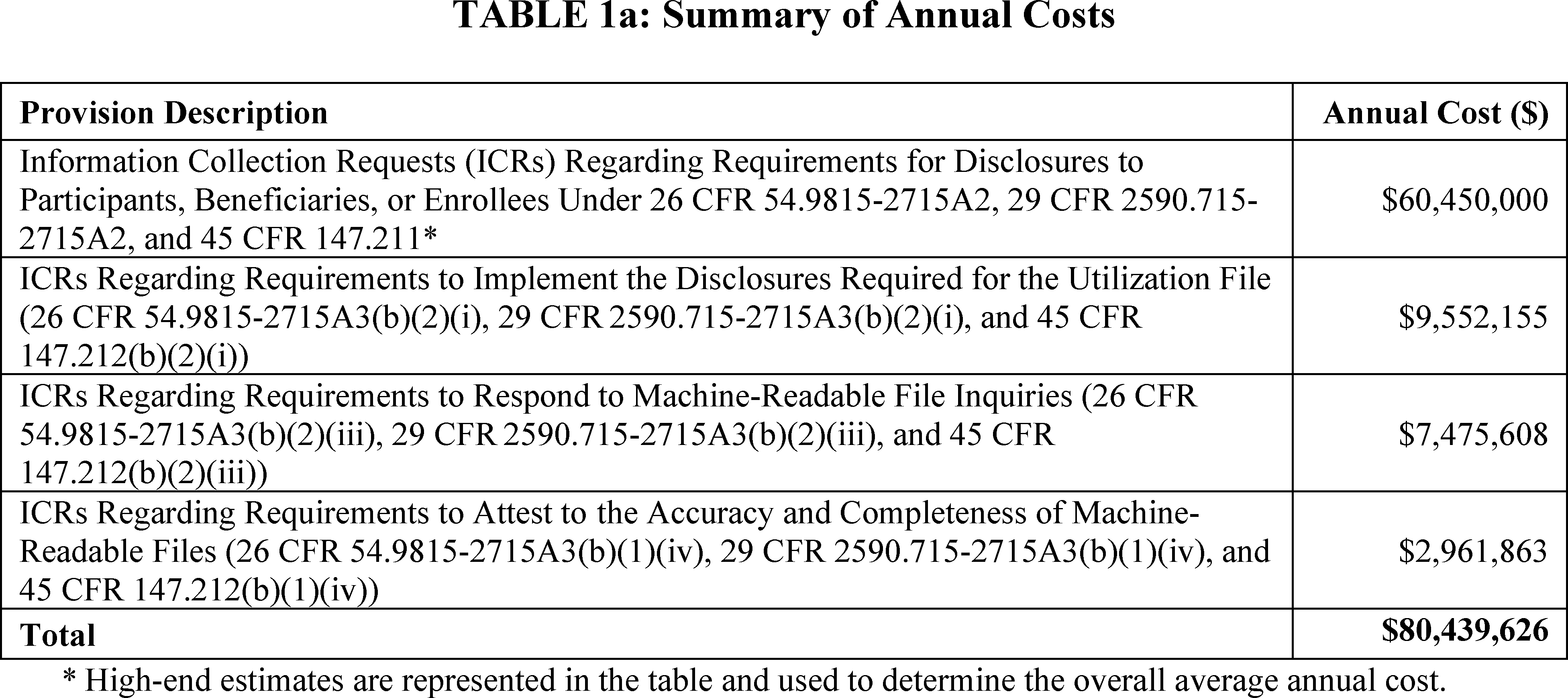
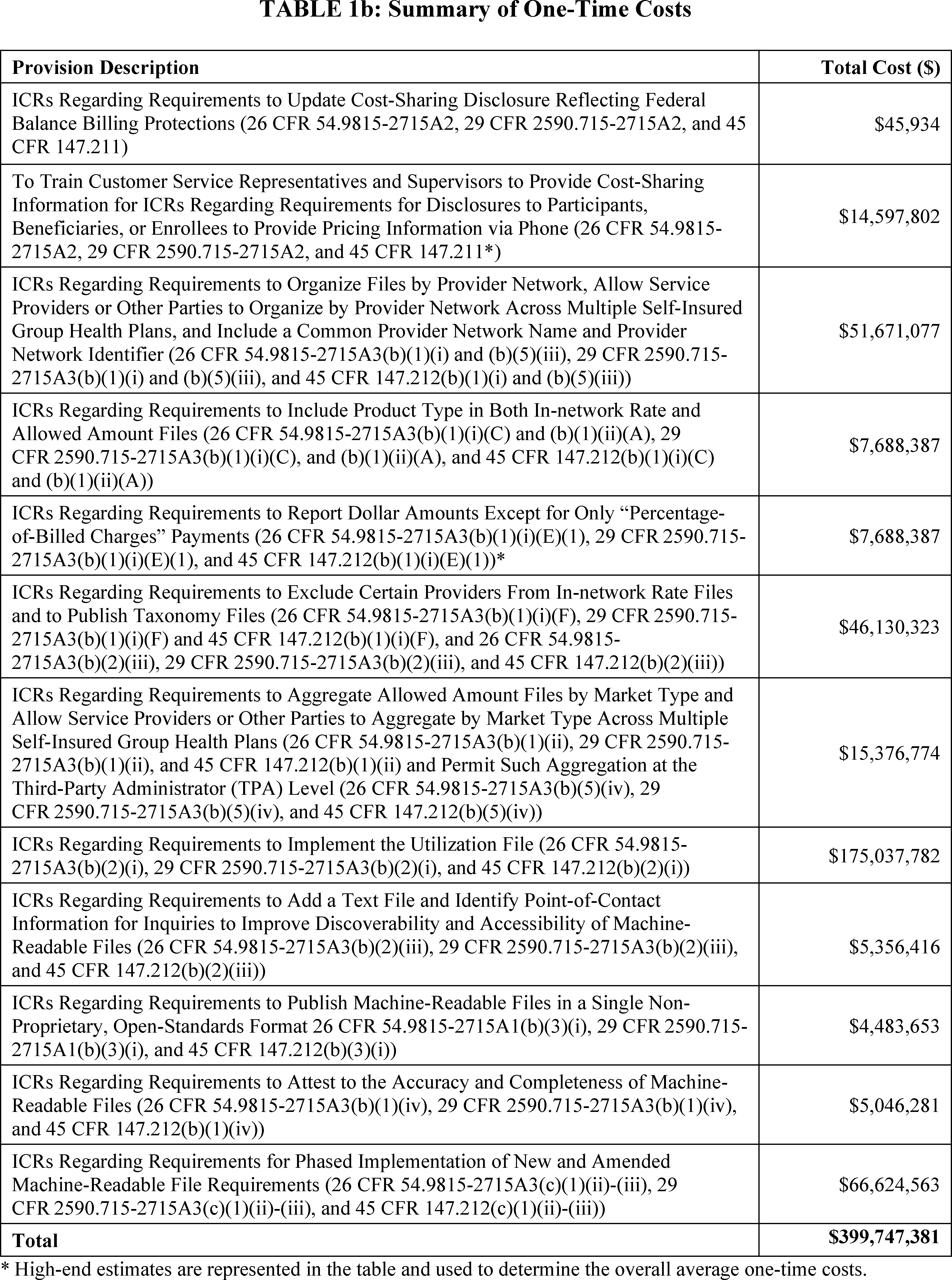
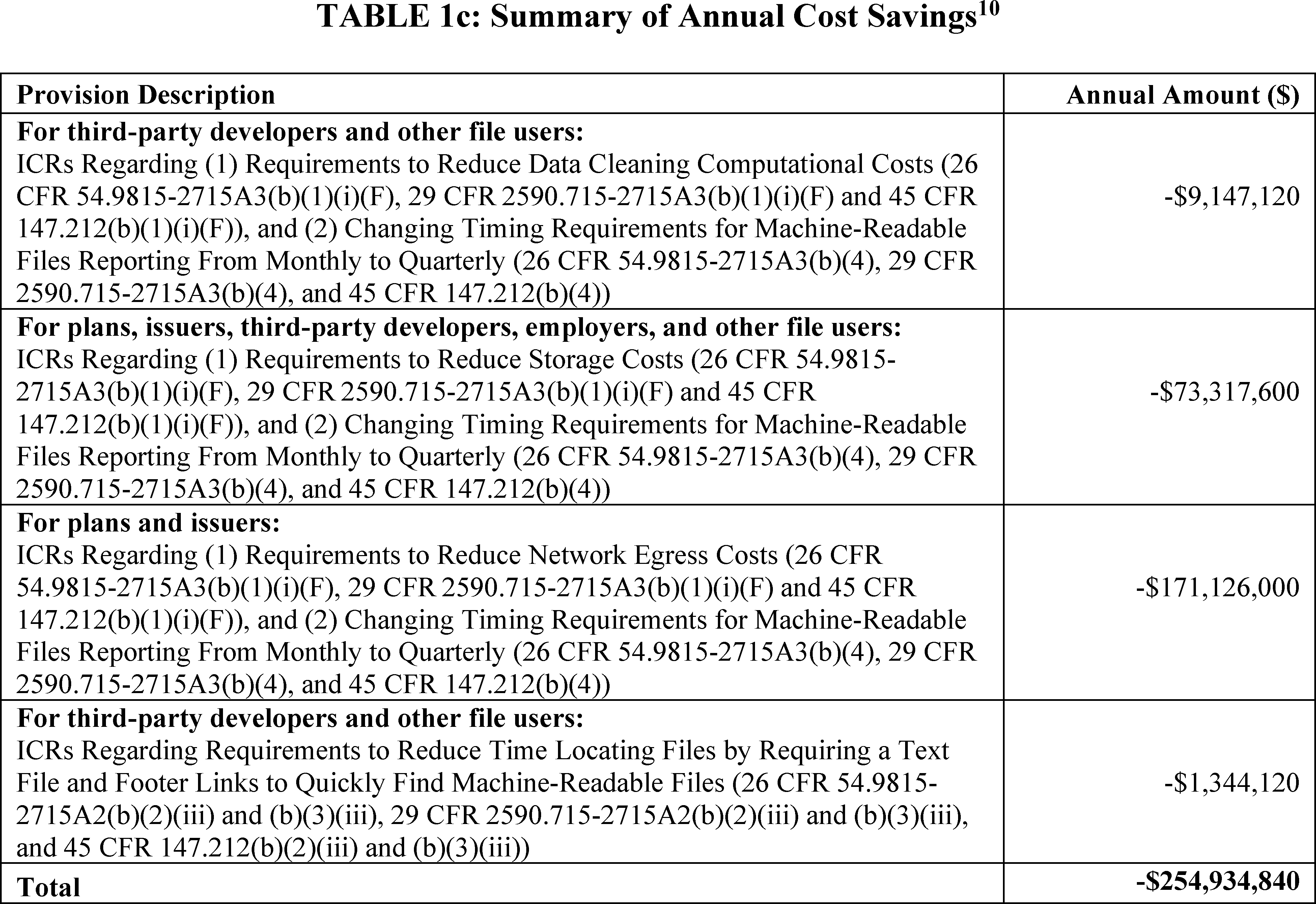
II. Background
A. Statutory Background and Enactment of the Affordable Care Act and the No Surprises Act
The Patient Protection and Affordable Care Act (Pub. L. 111-148) was enacted on March 23, 2010, and the Health Care and Education Reconciliation Act of 2010 (Pub. L. 111-152) was enacted on March 30, 2010 (collectively the Affordable Care Act). As relevant here, the Affordable Care Act reorganized, amended, and added to the provisions of part A of title XXVII of the PHS Act relating to health coverage requirements for group health plans and health insurance issuers. The term group health plan includes both insured and self-insured group health plans.
 Pub. L. 111-148
The Affordable Care Act also added section 715 to ERISA and section 9815 to the Code to include the provisions of part A of title XXVII of the PHS Act, PHS Act sections 2701 through 2728, into ERISA and the Code, making them applicable to group health plans and health insurance issuers providing coverage in connection with group health plans.
Section 2715A of the PHS Act, included in section 715 of ERISA and section 9815 of the Code, provides that plans and issuers must comply with section 1311(e)(3) of the Affordable Care Act, which addresses transparency in health coverage and imposes certain reporting and disclosure requirements for health plans that are seeking certification as qualified health plans that may be offered on an Exchange. A plan or coverage that is not offered through an Exchange (as defined by section 1311(b)(1) of the Affordable Care Act) is required to submit the information required to the relevant Secretary and the relevant State's insurance commissioner, and to make that information available to the public.
Title I of Division BB of the Consolidated Appropriations Act of 2021, which included the No Surprises Act, added new provisions applicable to plans and issuers in subchapter B of chapter 100 of the Code, part 7 of ERISA, and parts D and E of title XXVII of the PHS Act. As relevant here, section 107 of the No Surprises Act added new section 9816(e) of the Code, section 716(e) of ERISA, and section 2799A-1(e) of the PHS Act, which contain requirements for plans and issuers to include certain information, in clear writing, on any physical or electronic plan or insurance identification card issued to the participants or beneficiaries in the plan or coverage. This information includes any deductible applicable to such plan or coverage, any out-of-pocket maximum limitation applicable to such plan or coverage, and a telephone number and internet website address through which such individual may seek consumer assistance information.
Further, section 114 of the No Surprises Act added section 9819 of the Code, section 719 of ERISA, and section 2799A-4 of the PHS Act, which require plans and issuers to offer price comparison guidance by telephone and make available on the internet website of the plan or issuer a price comparison tool that (to the extent practicable) allows an individual enrolled under such plan or coverage, with respect to such plan year, such geographic region, and participating providers with respect to such plan or coverage, to compare the amount of cost sharing that the individual would be responsible for paying under such plan or coverage with respect to the furnishing of a specific item or service by any such provider. ( printed page 63752)
B. Executive Orders and Regulations
On June 24, 2019, President Trump issued Executive Order 13877, “Improving Price and Quality Transparency in American Healthcare to Put Patients First.” [11] Executive Order 13877 sought to improve transparency in health care and empower patients to make fully informed decisions about their health care. As Executive Order 13877 noted, “patients often lack both access to useful price and quality information and the incentives to find low-cost, high-quality care.” The “opaque pricing structures” may harm the market by protecting “powerful special interest groups, such as large hospital systems and insurance companies” while “leav[ing] patients and taxpayers worse off than would a more transparent system.” [12]
Executive Order 13877 directed the Departments to take action that would combat this issue by making meaningful price and quality information more broadly available to more Americans, thereby increasing competition, innovation, and value in the health care system. Specifically, section 3(b) of Executive Order 13877 directed the Secretaries of the Departments to issue an advance notice of proposed rulemaking, consistent with applicable law, soliciting comment on a proposal to require health care providers, health insurance issuers, and self-insured group health plans to provide or facilitate access to information about expected out-of-pocket costs for items or services to patients before they receive care.
To fulfill their responsibility under Executive Order 13877, the Departments proposed [13] and subsequently finalized the Transparency in Coverage rules in the 2020 final rules.[14] The 2020 final rules, published by the Departments on November 12, 2020, implemented section 2715A of the PHS Act, which requires group health plans and health insurance issuers offering group or individual health insurance coverage to comply with section 1311(e)(3) of the Affordable Care Act.
The 2020 final rules required non-grandfathered health plans and health insurance issuers offering non-grandfathered group or individual health insurance coverage to disclose cost-sharing information for all covered items and services to participants, beneficiaries, and enrollees through an internet-based self-service tool or, if requested by the individual, on paper. Those provisions of the 2020 final rules implemented paragraph (C) of section 1311(e)(3) of the Affordable Care Act.
The 2020 final rules also required non-grandfathered plans and health insurance issuers offering non-grandfathered group or individual health insurance coverage to disclose on a public website three separate machine-readable files containing certain information regarding health care pricing under the plan or coverage. Those provisions of the 2020 final rules, requiring plans and issuers to disclose in-network negotiated rates, out-of-network allowed amounts and the associated billed charges, and negotiated rates and historical net prices for prescription drugs, implemented paragraph (A) of section 1311(e)(3) of the Affordable Care Act. In particular, the provisions requiring the disclosure of out-of-network allowed amounts specifically implemented the requirement in section 1311(e)(3)(A)(vii) of the Affordable Care Act that require issuers of qualified health plans (QHPs) to provide information on “payments with respect to any out-of-network coverage.” In addition, the Secretary of HHS determined that requiring disclosure of payment information on in-network rates and prescription drugs was appropriate under section 1311(e)(3)(A)(ix) of the Affordable Care Act.
After the 2020 final rules were issued, interested parties used GitHub and other forums to bring to the Departments' attention specific questions related to implementation and compliance. In response, the Departments have issued Frequently Asked Questions (FAQs) [15] and technical guidance.[16]
On February 25, 2025, President Trump issued Executive Order 14221,[17] “Making America Healthy Again by Empowering Patients With Clear, Accurate, and Actionable Healthcare Pricing Information.” Executive Order 14221 stated that “[m]aking America healthy again will require empowering individuals with the best information possible to inform their life and healthcare choices” with the goal to “make more meaningful price information available to patients to support a more competitive, innovative, affordable, and higher quality healthcare system.” To that end, the Executive Order directs the Departments to “promote universal access to clear and accurate healthcare prices[;] . . . to improve existing price transparency requirements; increase enforcement of price transparency requirements; and identify opportunities to further empower patients with meaningful price information, potentially including through the expansion of existing price transparency requirements.” [18]
Section 3 of Executive Order 14221 directs the Secretaries of the Departments to rapidly implement and enforce the health care price transparency regulations issued pursuant to Executive Order 13877,[19] including action to: “(a) require the disclosure of the actual prices of items and services, not estimates; (b) issue updated guidance or proposed regulatory action ensuring pricing information is standardized and easily comparable across hospitals and health plans; and (c) issue guidance or proposed regulatory action updating enforcement policies designed to ensure compliance with the transparent reporting of complete, accurate, and meaningful data.” [20] To fulfill their responsibility under Executive Order 14221, on December 23, 2025, the Departments published the proposed rules to amend the 2020 final rules.
C. Statutory Background for Enforcement With Regard to the Affordable Care Act and the No Surprises Act
The enforcement responsibilities of HHS and the States, with respect to oversight of compliance with the Federal insurance market reforms, are set forth in the PHS Act. Pursuant to section 2723(a)(1) of the PHS Act, as amended by the No Surprises Act, States have primary enforcement authority over health insurance issuers regarding the provisions of parts A and ( printed page 63753) D of title XXVII of the PHS Act. Under this framework, HHS has enforcement authority over issuers in a State if the State indicates it cannot or will not enforce a provision (or provisions) of part A or D of title XXVII of the PHS Act, or the Secretary of HHS makes a determination that the State is failing to substantially enforce a provision (or provisions) of part A or D of title XXVII of the PHS Act.[21] HHS also has primary enforcement authority with respect to the same provisions over non-Federal governmental plans, such as those sponsored by State and local government employers.[22]
The Departments of Labor and the Treasury generally have primary enforcement authority over private sector employment-based group health plans. The Internal Revenue Service (IRS) has jurisdiction over certain church plans.
D. Public Comments Received in Response to the Proposed Rules
The Departments received comments from 132 commenters in response to the proposed rules from a wide variety of interested parties, including private citizens; consumer and advocacy organizations; employers and other plan sponsors; health information technology, health care consulting, and health care staffing companies; health care providers and facilities, and health systems; health insurance issuers; service providers, including third-party administrators (TPAs); trade and professional associations; and researchers and academics. Many commenters provided detailed feedback on multiple aspects of the proposed rules and in response to various specific comment solicitations included in the preamble to the proposed rules.
The Departments received many comments expressing general support for the proposed rules, stating that the proposals would help control health care costs and empower consumers to make more informed decisions by improving the accuracy and usability of Transparency in Coverage data, reducing administrative burden for plans and issuers, and aligning with the Hospital Price Transparency requirements. The Departments also received many comments supporting technical and structural changes, including moving to network-level reporting, standardizing file structures, requiring additional contextual information, moving to a quarterly reporting cadence, requiring footer links to the location of the machine-readable files, and excluding from the data set providers who are unlikely to provide services typically outside their scope of practice. The Departments also received several comments supporting alignment with the Hospital Price Transparency requirements, stating that such alignment would reduce duplication, facilitate comparisons, and support more meaningful analyses of health care cost drivers. The Departments respond to these comments in section III. of this preamble.
The Departments also received several comments expressing general disagreement with the proposed rules and concern with the Departments' broader approach to Transparency in Coverage, stating that the proposals leave significant gaps that would undermine the goals of the statute. Several commenters expressed concern that the proposed rules could reduce competition in concentrated health insurance markets and place insufficient emphasis on quality as a factor in health care decision-making and suggested that the Departments work directly with physicians and other providers to inform price transparency. The Departments also received several comments stating that, despite the proposed improvements, fundamental issues of machine-readable file incompleteness, ambiguity, and usability would persist and continue to hinder data interpretation. In addition, several commenters did not support the proposed rules because they believed the proposals would increase costs and administrative burden for group health plans, particularly small and regional plans, and make the machine-readable files more complex for users to access. The Departments also received several comments expressing concern that the proposed rules favor researchers and academics over the development of consumer decision-support tools and focus on price without including quality or outcomes data needed to inform consumer decision-making.
The Departments received many comments suggesting additional ways in which the Departments could use their statutory authority to strengthen the Transparency in Coverage requirements, particularly by reducing barriers to accessibility and improving data usability. The Departments received a few comments recommending standardized, plain-language, consumer-facing summaries that translate machine-readable file data into estimated out-of-pocket costs, including deductible status, coinsurance, and network tier information. The Departments also received a few comments noting that issuers relying on TPAs to comply with Transparency in Coverage requirements may face barriers to accessing their own data. A few commenters recommended requiring the establishment of a unified national standards authority, creation of a national database compiling machine-readable file rates, and expansion of reporting requirements to additional payers or coverage programs, such as Medicaid managed care plans and Medicare Advantage plans.
Many commenters requested the Departments increase their enforcement activity, including through an increased use of audits, warning letters, corrective action plans, and monetary fines. Additionally, a commenter encouraged the Departments to take steps to publicly disclose information related to non-compliance warnings, corrective action plans, and civil money penalties, similar to existing enforcement protocols under the Hospital Price Transparency requirements.
The Departments respond to these comments in more detail in the relevant subsections of section III. of this preamble. The Departments recognize that plans and issuers may need to examine contracts with TPAs to identify if changes are necessary to enable access to the data required under these final rules. The Departments are not requiring standardized summaries of estimated out-of-pocket costs, including deductible status, coinsurance, and network tier information, because the data in the machine-readable files are rates and historic billed charges only and cannot reflect an individual consumer's personalized estimated cost-sharing liability, including accumulators and deductible progress. Requiring this information to be made available in the machine-readable files would be duplicative of the personalized cost-sharing information available through the internet-based self-service tool.[23] Nevertheless, the Departments anticipate that researchers, employers, and other file users will use the machine-readable file data to analyze and compare health care prices and that third-party developers will build tools and apps that make the information more accessible and useful to consumers and other purchasers of health care, thereby promoting greater transparency for the broader public benefit.
The Departments appreciate commenters' suggestion to create a national database of compiled machine- ( printed page 63754) readable file negotiated rates and allowed amounts, but note that plans and issuers have been posting their files in an established manner for more than four years, creating consistency in their operations and for the public in finding the files. Additionally, findability will be further enhanced through the Text File as discussed in section III.C.8.d. of this preamble and the footer requirement as discussed in section III.C.10. of this preamble. Creating a new system to submit such information to the Departments would be overly burdensome in light of the other new requirements in these final rules. Further, rules regarding Medicaid managed-care and Medicare Advantage plans are beyond the scope of section 2715A of the PHS Act and these final rules.
A commenter noted that some payers have not meaningfully updated machine-readable file data in years and warned that without an enforcement mechanism tied to update frequency, the quarterly cadence risks allowing widespread noncompliance to persist.
A commenter recommended that the Departments clarify the distinct role of States and the Federal Government and their jurisdictions in enforcement responsibility. Another commenter recommended that the Departments assign primary enforcement authority to a Federal entity, such as the Center for Consumer Information and Insurance Oversight (CCIIO), to improve compliance with the Transparency in Coverage requirements. Another commenter encouraged the Departments to increase coordination with State departments of insurance.
A commenter requested that the Departments create a safe harbor or non-enforcement policy for employers who report non-compliance to the Departments, given that many health insurance purchasers hire service providers to handle their machine-readable file responsibilities. Another commenter wanted the Departments to require owners of the provider networks to share a complete and accurate set of health claims data with a self-insured plan sponsor and their service providers. A commenter requested that the Departments defer to States when regulating ERISA plans, as well as strengthen enforcement authority over ERISA plan administrators. A few commenters encouraged the Departments to establish new enforcement procedures, and one of these commenters criticized the Departments for relying on a discretion-based enforcement approach. A commenter encouraged the Departments to increase coordination with State departments of insurance.
The Departments look forward to the reforms put forth by these final rules helping achieve the promise of price transparency to empower Americans and lower costs. The Departments agree that enforcement of the Transparency in Coverage requirements is critical to the ongoing usefulness of the published data and share commenters' concerns about plans and issuers failing to maintain updated and accurate files as required. The Departments also recognize that there is continued public interest in learning about compliance and enforcement actions with respect to the Transparency in Coverage requirements.
The Departments have been engaged in compliance and enforcement efforts since the 2020 final rules requirements became effective. With the implementation of these final rules, the Departments will prioritize compliance and enforcement through existing authorities and will work to ensure that any enforcement actions will be transparent to the public.
Under chapter 100 of the Code, Part 7 of ERISA, and title XXVII of the PHS Act, as applicable, the Departments may require corrective actions and impose civil monetary penalties, or seek equitable or other forms of remedial relief [24] through voluntary compliance or otherwise, to the extent permitted under applicable law, when the Departments find violations through market conduct examinations and investigations of plans and issuers within their jurisdiction.
With respect to the commenter who requested clarity on which entities have enforcement authority, the Departments reiterate the applicable jurisdictions of enforcement authority stated at the beginning of section II.C. of this preamble. The Department of Labor has primary enforcement authority over ERISA plans. State regulators maintain enforcement authority over health insurance coverage offered by health insurance issuers in the group and individual markets unless the State notifies HHS that it has not enacted legislation to enforce or HHS determines that a State has failed to substantially enforce such requirements, as described in section 2723(a)(2) of the PHS Act and implementing regulations under 45 CFR 150 subpart B. HHS has direct enforcement authority over non-Federal governmental plans in all jurisdictions.
 45 CFR 150 subpart B
In response to the commenter who requested that the Departments require owners of provider networks to share a complete and accurate set of health claims data with a self-insured plan sponsor and their service providers, the Departments remind plans and issuers of the prohibitions on gag clauses under the Consolidated Appropriations Act, 2021. Specifically, section 9824 of the Code, section 724 of ERISA, and section 2799A-9(a)(1) of the PHS Act prohibit group health plans and health insurance issuers offering group health insurance coverage from entering into an agreement with a health care provider, network or association of providers, TPA, or other service provider offering access to a network of providers that would directly or indirectly restrict the plan or issuer from electronically accessing de-identified claims and encounter information or data for each participant, beneficiary, or enrollee in the plan or coverage upon request, consistent with certain Federal privacy regulations.[25]
With respect to the commenter who expressed concerns about employers' and self-insured plans' ability to comply with the requirements of these final rules, the Departments point to the special rules as finalized in this rule at 26 CFR 54.9815-2715A3(b)(5), 29 CFR 2590.715-2715A3(b)(5), and 45 CFR 147.212(b)(5), which articulate responsibility for group plans that enter into a written agreement with a health insurance issuer or a third party to provide the required machine-readable file information. If a self-insured plan sponsor is concerned that the plan's TPA may not be capable of fulfilling the requirements of the rule on its behalf, the plan should take all necessary steps to address such concern in its contract with the TPA.
The Departments received one comment seeking confirmation that, as stated in the preamble to the 2020 final rules,[26] “denominational health plans” are outside the scope of the Transparency in Coverage requirements. In the preamble to the 2020 final rules, the Departments stated that all plans subject to section 2715A of the PHS Act must comply with the rule's requirements. The Departments also stated that section 2715A of the PHS Act applies to group health plans and health insurance issuers offering group or individual health insurance coverage and not to, among others, “denominational health plans,” without defining the term. These final rules do not exclude denominational health plans that are church plans within the ( printed page 63755) meaning of section 3(33) of ERISA and section 414(e) of the Code because church plans are group health plans and the Departments have concluded that the statute provides no authority to exclude them.
Many commenters wanted the Departments to focus enforcement not just on whether the machine-readable files are being made publicly available, but to ensure that the data contained within the files are complete and accurate. Another commenter recommended Department-hosted “connectathon” events to validate Transparency in Coverage data. Many commenters urged stronger accountability for the validity and accuracy of the data by including attestation requirements, with commenters stating that, without such safeguards, the data would be of limited value to consumers.
In addition to the above enforcement tools, the Departments are finalizing an attestation requirement as an additional step to address the concerns about the accuracy of the information provided and help ensure its validity. The Departments discuss this and respond to the above comments in more detail in section III.C.7. of this preamble.
Many commenters submitted comments that were not within the scope of the policies proposed under the proposed rules, including comments on requirements related to the 2019 Hospital Price Transparency rule,[27] Advanced Explanation of Benefits,[28] the claims review process and timeline, enforcement of the No Surprises Act balance billing protections,[29] price transparency for Medicare plans, future rulemaking plans on additional price transparency policies, and quality data transparency.
After reviewing the comments received, the Departments are finalizing the proposed rules, with some changes in response to comments, as described in more detail later in this preamble, to make pricing information more accurate, more accessible, and more actionable.
E. Technical Amendments
These final rules include a series of technical amendments to the way group health plans and health insurance issuers offering group or individual health insurance coverage are referenced in 26 CFR 54.9815-2715A2 and 54.9815-2715A3, 29 CFR 2590.715-2715A2 and 2590.715-2715A3, and 45 CFR 147.211 and 147.212. In the 2020 final rules, the Departments generally adopted the convention of referring to those entities using the terms “group health plan” and “health insurance issuer” throughout the regulations, except that where the Departments referred to those entities more than once in the same paragraph, the terms “plan” and “issuer” were used after the initial instance. However, that convention was not applied evenly.
Therefore, in the proposed rules, the Departments proposed technical amendments to align the terms used to describe those entities with that convention in paragraphs (b)(1)(i)(A), (b)(1)(i)(B), (b)(2)(ii), (b)(3)(i), and (b)(3)(ii) of the internet-based self-service tool disclosure requirements in 26 CFR 54.9815-2715A2, 29 CFR 2590.715-2715A2, and 45 CFR 147.211; and paragraphs (b)(1)(i)(D), (b)(5)(i), and (b)(5)(ii) the machine-readable file disclosure requirements in 26 CFR 54.9815-2715A3, 29 CFR 2590.715-2715A3, and 45 CFR 147.212. The Departments did not receive any comments on these technical amendments and are therefore finalizing them as proposed. These changes are technical in nature and do not affect the rights or obligations of any plan, issuer, or other entity.
In addition, the Departments proposed to modify 26 CFR 54.9815-2715A3(b)(3)(ii), 29 CFR 2590.715-2715A3(b)(3)(ii), and 45 CFR 147.212(b)(3)(ii) to clarify, as written elsewhere in paragraphs (b)(3)(i) and (b)(3)(iii), the machine-readable files being described are in paragraphs (b)(1) and (2) of the section.
For consistency with Department of the Treasury and Department of Labor regulations, HHS is amending the section heading of 45 CFR 147.211 to “Transparency in coverage—required disclosures to participants, beneficiaries, and enrollees” instead of “Transparency in coverage—required disclosures to participants, beneficiaries, or enrollees.”
III. Overview of the Final Rules
A. Definitions
To support proposed amendments to the Allowed Amount File provision (discussed in more detail in section III.C.6. of this preamble) and to promote consistency in data organization, the Departments proposed to add new paragraphs 26 CFR 54.9815-2715A1(a)(2)(xi), 29 CFR 2590.715-2715A1(a)(2)(x), and 45 CFR 147.210(a)(2)(xi) to define the term “health insurance market” and to redesignate the paragraphs that follow accordingly.[30] The Departments proposed that “health insurance market” would mean, irrespective of State, one of the following:
- The individual market, as defined in45 CFR 144.103 (other than short-term, limited-duration insurance or individual health insurance coverage that consists solely of excepted benefits).
- The large group market, as defined in45 CFR 144.103 (other than coverage that consists solely of excepted benefits).
- The small group market, as defined in45 CFR 144.103 (other than coverage that consists solely of excepted benefits).
- For purposes of self-insured group health plans (other than account-based plans, as defined in26 CFR 54.9815-2711(d)(6)(i), 29 CFR 2590.715-2711(d)(6)(i), and 45 CFR 147.126(d)(6)(i), and plans that consist solely of excepted benefits), all self-insured group health plans maintained by the plan sponsor.
The Departments sought comment on this proposed definition. After consideration of public comments, the Departments are finalizing this definition with modifications that add cross-reference citations to the relevant definitions of excepted benefits for additional clarity. Specifically, the Departments are adding a cross-reference to the definition of excepted benefits in 45 CFR 148.220 to 26 CFR 54.9815-2715A1(a)(2)(xi)(A), 29 CFR 2590.715-2715A1(a)(2)(x)(A), and 45 CFR 147.210(a)(2)(xi)(A). This definition of the term applies to coverage in the individual health insurance market. The Departments also are adding a cross-reference to the definition of excepted benefits in 26 CFR 54.9831-1(c), 29 CFR 2590.732(c), or 45 CFR 146.145(b) to 26 CFR 54.9815-2715A1(a)(2)(xi)(B) through (D), 29 CFR 2590.715-2715A1(a)(2)(x)(B) through (D), and 45 CFR 147.210(a)(2)(xi)(B) through (D), respectively. This definition of the term applies to group health plans.
Several commenters supported the Departments' proposed definition of “health insurance market” for the purposes of the proposed amendments to the Allowed Amount File provision. These commenters expressed that clearly and consistently defining the health insurance market categories ( printed page 63756) would reduce ambiguity and variability in reporting. A few commenters also noted that delineating four separate markets and requiring separate out-of-network Allowed Amount machine-readable files for each market would support the comparability of the files and enable more accurate evaluation of affordability, network adequacy, and cost drivers across the system. A few commenters highlighted that this proposed definition aligns concepts of the Transparency in Coverage requirements with requirements included in the No Surprises Act. Another commenter stated that the proposed definition would provide additional information to the public about negotiated rates as they are anchored in qualifying payment amount (QPA) calculations and provide better insight to the Federal agencies tasked with enforcing QPA calculation requirements.
The Departments agree with commenters that the definition of the term “health insurance market” promotes consistent data organization across plans and issuers in the market-level Allowed Amount Files, for which the Departments are finalizing requirements, as discussed in section III.C.6. of this preamble, with modifications to cross-reference the relevant definitions of excepted benefits for clarity. The Departments also agree that clearly delineating each market included in the definition and requiring separate machine-readable files for each market supports the analytic value of these files.
A commenter disagreed with the Departments' proposed definition of “health insurance market.” The commenter expressed that including self-insured group health plans in the definition would lead to confusion for those plans as well as file users given the variability in State definitions of this term. The commenter recommended that self-insured group health plans be defined as “self-insured” separately from “health insurance market.” Additionally, another commenter recommended that the Departments use the term “health coverage market” rather than “health insurance market” given that the proposed definition includes self-insured group health plans.
The Departments acknowledge the commenter's concern about confusion regarding the variability in State definitions of the term, “health insurance market.” However, these final rules specify that the definition of “health insurance market” for the purposes of organizing the Allowed Amount Files is established “irrespective of the State.” Additionally, the Departments are not aware of any confusion among self-insured group health plans based on a similar definition of “insurance market” included in the method for calculating the QPA at 26 CFR 54.9816-6(a)(8), 29 CFR 2590.716-6(a)(8), and 45 CFR 149.140(a)(8).[31] The Departments have determined that employing similar definitions for purposes of calculating the QPA under the No Surprises Act and for the Transparency in Coverage regulations reduces burden on interested parties that must fulfill reporting requirements under both regulatory frameworks. To further clarify the definition, the Departments have added cross-reference citations to the relevant definitions of excepted benefits. Therefore, the Departments are finalizing the definition with those modifications.
B. Requirements for Disclosing Cost-Sharing Information to Participants, Beneficiaries, and Enrollees
1. Balance Billing Protection Statement
The Departments proposed to amend the balance billing protection statement that plans and issuers are currently required to include along with the required cost-sharing disclosures to participants, beneficiaries, and enrollees under 26 CFR 54.9815-2715A2(b)(1)(vii)(A), 29 CFR 2590.715-2715A2(b)(1)(vii)(A), and 45 CFR 147.211(b)(1)(vii)(A). The proposed amendments would require language in the balance billing protection statement that the cost-sharing information in the self-service tool does not account for potential additional amounts in situations where applicable State and Federal law allow out-of-network providers to bill participants, beneficiaries, or enrollees for the difference between a provider's billed charges and the sum of the amount collected from the plan or issuer and the amount collected from the participant, beneficiary, or enrollee in the form of a copayment, coinsurance, or deductible amount (the difference referred to as balance billing). These changes were proposed to reflect the existence of the Federal balance billing protections set forth in the No Surprises Act, which were not yet enacted when the current balance billing protection statement language was finalized in the 2020 final rules. This balance billing protection statement would not be required if the State in which the item or service was furnished prohibits all out-of-network providers from balance billing for all items and services payable by the group health plan or health insurance issuer.
The Departments sought comment on this proposal. After consideration of public comments, the Departments are finalizing the amendments to the balance billing protection statement as proposed.
Several commenters supported the proposed amendment to the balance billing protection statement language for the self-service tool. These commenters mentioned that this amendment would clarify patients' No Surprises Act protections and any remaining balance billing risk, giving patients clearer, actionable information to support informed decisions.
The Departments agree with commenters that amending the balance billing protection statement clarifies the protections patients have at both the State and Federal level and informs them of the potential for additional cost-sharing when using the self-service tool for estimates from an out-of-network provider.
A commenter opposed requiring plans and issuers to amend the balance billing protection statement. The commenter noted that statements should inform rather than overwhelm consumers, as excessive notifications can obscure cost information and reduce comprehension. A few other commenters requested flexibility in the wording plans and issuers are allowed to use and recommended the Departments allow plans and issuers to continue using existing disclaimer language, which currently communicates the core point that cost-sharing estimates may not reflect additional amounts that an out-of-network provider may bill when permitted by applicable law.
The Departments have determined that this balance billing protection statement increases comprehension by informing patients of the limits of the balance billing protections they may have under State and Federal laws, which will help mitigate unexpected health care costs when seeing an out-of-network provider. The Departments also note that the balance billing protection statement is an existing requirement and these final rules only amend the existing language to more accurately reflect consumers' rights under the No Surprises Act, which was not yet enacted when the current language in this statement was finalized in the 2020 final rules. The Departments also recognize that plans and issuers have existing balance billing protection statement language. The Departments note that paragraph (b)(1)(vii) does not require disclaimers to be reproduced verbatim. Plans and issuers may ( printed page 63757) continue to use existing disclaimer language to the extent that the language includes the required balance billing information as set forth in these final rules and is written in plain language, as defined in 26 CFR 54.9815-2715A1(a)(2)(xxi), 29 CFR 2590.715-2715A1(a)(2)(xx), and 45 CFR 147.210(a)(2)(xxi). This requirement is designed to ensure that each plan's or issuer's balance billing protection statement accurately describe the scope of the No Surprises Act balance billing protections. The Departments have determined that the balance billing protection statement as amended by these final rules sufficiently informs patients of their potential for additional costs when seeing an out-of-network provider.
2. New Required Method and Format for Disclosing Information to Participants, Beneficiaries, and Enrollees
The Departments proposed to add new 26 CFR 54.9815-2715A2(b)(2)(iii), 29 CFR 2590.715-2715A2(b)(2)(iii), and 45 CFR 147.211(b)(2)(iii) to require plans and issuers to make available to participants, beneficiaries, and enrollees, at their request, the cost-sharing estimates and other disclosures required under 26 CFR 54.9815-2715A2(b)(1), 29 CFR 2590.715-2715A2(b)(1), and 45 CFR 147.211(b)(1) via a telephone number. Under the proposal, the information required via a telephone number would be required to be accurate at the time of the request and provided at the time of the request. Plans and issuers would be required to use the same telephone number that Code section 9816(e), ERISA section 716(e), and PHS Act section 2799A-1(e), as added by section 107 of the No Surprises Act, require be indicated on any physical or electronic plan or insurance identification card issued to participants, beneficiaries, and enrollees for obtaining customer assistance. The Departments also proposed to redesignate paragraph (b)(2)(ii)(D) as new paragraph (b)(2)(iv) and amend paragraph (b)(2)(iv) to remove phone as an example of an alternative means for providing the disclosures by which a participant, beneficiary, or enrollee may request the disclosures required in paragraph (b)(1), because providing the disclosures by telephone is newly required under these rules.
In the proposed rules, the Departments also indicated their intention for these proposals to satisfy the No Surprises Act requirement that plans and issuers provide price comparison guidance by telephone, as set forth in Code section 9819, ERISA section 719, and PHS Act section 2799A-4. The Departments further explained that implementing this requirement would respond to feedback the Departments have received from participants, beneficiaries, and enrollees since the publication of the 2020 final rules, indicating a limited ability to receive cost-sharing information over the phone when requested from plans and issuers. Requiring plans and issuers to provide cost-sharing information in this way would further promote the price transparency goals of providing accurate, real-time pricing to consumers, and making that information accessible to more consumers.
In addition, at paragraph (b)(2)(iii), the Departments proposed to allow group health plans and health insurance issuers to limit the number of providers, about which cost-sharing information for covered items and services is provided, to no fewer than 20 providers per day. The Departments also proposed to require plans and issuers that choose to apply the 20 providers-per-day limit to disclose such limitation to the participant, beneficiary, or enrollee when the request for information is made for disclosures by phone. A similar 20-provider limit was already in place with respect to paper requests at 26 CFR 54.9815-2715A2(b)(2)(ii), 29 CFR 2590.715-2715A2(b)(2)(ii), and 45 CFR 147.211(b)(2)(ii). The Departments noted in the proposed rules that nothing precludes a participant, beneficiary, or enrollee from obtaining cost-sharing information from more than one method, consistent with the requirements for each method. Similarly, for consistency with the requirements for the paper method of delivery under the 2020 final rules, the Departments proposed to require plans and issuers to satisfy requests for cost-sharing information over the phone at the time of the request, and in accordance with the method and format requirements in paragraphs (b)(2)(i)(A) through (C), to ensure that participants, beneficiaries, and enrollees receive information as quickly as possible.
The Departments clarify that the 20-provider limit applies separately to the paper and phone methods. Accordingly, a plan or issuer must disclose cost-sharing information for no fewer than 20 providers by paper per day and no fewer than 20 providers by phone per day, if both are requested. However, there may be overlap with respect to the provider information provided via either method, to the extent a participant requests cost-sharing information both on paper and by phone for any of the same providers. There is no additional requirement that a plan or issuer avoid duplicative responses in that situation.
The Departments requested comment on whether this proposal should include phone service standards to ensure that consumers have access to timely and reliable information, including, in particular, what such standards should include and what parameters should be applied to each criterion. The Departments also requested comment on whether there are other relevant Federal, State, or local standards for phone service quality or any industry practices that the Departments should consider. After consideration of public comments, the Departments are finalizing these requirements as proposed, with minor, non-substantive edits to improve clarity.
Many commenters supported the Departments' proposal to require plans and issuers to make available to participants, beneficiaries, and enrollees, at their request, cost sharing estimates and other required disclosures by phone, noting that this approach aligns with existing obligations under the No Surprises Act, enhances transparency, and supports consumers' ability to plan for out-of-pocket costs and make more informed decisions about their health care. Several commenters emphasized that adding a phone option would help address barriers faced by consumers with limited internet access or lower digital literacy, including individuals residing in rural areas, and appreciated the Departments' efforts to provide multiple ways for individuals to obtain cost sharing information as a means of promoting equity and reducing disparities in access to health care pricing information. A commenter, while supportive of the proposal, expressed concern that this requirement could lead to higher plan costs that may ultimately be passed on to consumers in the form of increased premiums, and encouraged the Departments to explore a unified data center to handle phone requests. Another commenter expressed support for multi-modal access to price comparison tools, including digital platforms and telephonic assistance, but recommended that such access relies on a shared data architecture rather than parallel compliance builds, with a unified information backbone that feeds both digital and phone-based interfaces without duplicating reporting structures.
The Departments agree that aligning the Transparency in Coverage and the No Surprises Act requirements reduces regulatory burden for group health plans and health insurance issuers and minimizes confusion among payers and consumers regarding two overlapping statutory obligations. The Departments ( printed page 63758) also agree that the phone method of disclosing cost-sharing estimates helps address access concerns by providing an additional method for participants, beneficiaries, and enrollees, including those with lower digital literacy, limited internet access, and disparate geographic location, to obtain cost-sharing information and other required disclosures. The Departments are not pursuing a unified data center to handle phone requests in order to allow each plan or issuer to pursue its own approach to providing cost-sharing estimates over the phone. The Departments acknowledge concerns about potential increases in plan costs but have determined that the benefits of improved access to cost-sharing information justify any potential increases in costs, which the Departments expect would be marginal given that plans and issuers can rely on existing customer service processes to satisfy the requirement.
The Departments further emphasize that nothing in these final rules requires plans and issuers to build separate data systems or back-end infrastructure to support the requirements of the Transparency in Coverage disclosures to participants, beneficiaries, and enrollees across the required methods. The cost-sharing information required to be disclosed via phone is the same information required to be disclosed through the internet-based self-service tool and in paper form. Plans and issuers may use the same underlying data systems to generate cost-sharing information across all three modalities, provided the information disclosed meets the requirements of paragraph (b)(1) and (2), including that it is accurate at the time of the request.
A few commenters expressed concerns about the proposed 20-provider-per-day limit for phone disclosures. These commenters stated that verbally conveying cost-sharing estimates for up to 20 providers during a single call would be impracticable and time-intensive, and could increase the likelihood of consumer confusion, undermining the intended consumer experience. One of those commenters further noted that the higher limit could trigger unpredictable call volumes that reduce service quality for all callers. Some other commenters recommended that the Departments limit the requests to no more than 3 to 5 providers per phone call, while another commenter recommended a limit of 10 providers per business day, stating that this approach would better align with the practical constraints of phone-based interactions while still providing a meaningful ability for participants, beneficiaries, and enrollees to compare provider options.
In the 2020 final rules, the Departments established a limit of no fewer than 20 providers per request for paper-based disclosures. The Departments have determined the phone disclosure limit should be consistent with the paper limit to ensure that these primary alternatives to the internet-based self-service tool ensure consumers receive the same level of access to cost-sharing information regardless of whether they request it by paper or phone because the information is likely sourced in the same manner and only shared differently with the requestor, by paper, or read over the phone. Reducing the phone limit below the paper limit would create a disparity in access to information between these two comparable request-based methods that would disadvantage consumers who rely on the phone-based method, including those with limited digital literacy or limited internet access. The Departments acknowledge the possibility of consumer confusion from having to navigate through up to 20 providers over the phone, but plans and issuers are encouraged to work with consumers to provide cost-sharing estimates in the best way for each individual consumer, including reminding them that information is available by paper, or email, upon request. The Departments further clarify that the 20-provider-per-day limit applies on a per-operational-day basis—that is, per day on which the plans or issuers customer service call center is open and available to receive calls.
The Departments emphasize that the 20-provider limit, if adopted by a plan or issuer, will not necessarily result in cost-sharing information being provided for 20 providers on every call. It represents a maximum limit plans and issuers may impose for participants, beneficiaries, and enrollees who request information. The Departments expect that most consumers will seek relatively straightforward information, such as their out-of-pocket costs for a service from a specific provider or within a limited geographic area. The Departments agree with commenters about the possibility that some phone interactions may result in longer engagements, depending on the number of providers requested. However, the direct engagement afforded through phone interaction also provides an opportunity to ensure the consumer better understands the data and how to use it.
Several commenters opposed adopting additional phone-based service standards, stating that plans and issuers are already subject to customer service expectations, contractual requirements, and applicable State and Federal oversight. A commenter noted the difficulty of evaluating this proposal given that the Departments did not specify the standards under consideration and expressed concern that additional prescriptive requirements could increase cost and complexity without improving consumer access to pricing estimates. The commenter recommended not requiring plans to provide cost estimates on a 24-hour basis but rather allow plans and issuers to align hours of operation with existing customer service hours. Another commenter stated that the ability to fulfill requests by phone varies widely based on plan scale, technical capabilities, and the complexity of requests, and that promulgating one-size-fits-all standards would cause unintended consequences, wasteful expenditure, and administrative burden. A commenter expressed confidence that plans would take reasonable steps to provide the required information within reasonable timelines taking into consideration the facts and circumstances of plan administration and capabilities. Conversely, another commenter encouraged the Departments to finalize additional phone-based service standards and consider establishing clear performance expectations, such as tracking and reporting call wait times, to ensure that phone-based access is reliable and meets consumer needs.
The Departments agree with commenters that plans and issuers are already subject to customer service expectations, contractual requirements, and State oversight applicable to their overall consumer assistance operations. The Departments therefore decline to finalize additional standards beyond those proposed. The Departments have determined that plans and issuers are best positioned to set their own additional customer service standards, including based on standards they may already have in place for handling calls to the customer assistance number on the plan's or policy's identification card. Requiring additional standards, such as hours of operation, would likely be duplicative and unnecessarily burdensome.
A commenter requested that the Departments clearly articulate what operational change is required, noting that the proposal appears to formalize, and potentially expand, expectations for providing phone-based cost-sharing information. The commenter urged the Departments to clarify whether the proposed regulatory change codifies ( printed page 63759) existing practice or creates new obligations, stating that such clarification would allow plans and issuers to assess whether they are already in compliance with this requirement.
In the 2020 final rules, the Departments finalized phone-based cost-sharing disclosure as an optional means of providing the information required under paragraph (b)(1). Following enactment of the No Surprises Act, which requires plans and issuers to offer price comparison guidance by phone under Code section 9819, ERISA section 719, and PHS Act section 2799A-4, the Departments stated in FAQs Part 49 [32] that they expected to propose rulemaking requiring that the same pricing information that is available through the online tool or in paper form also be provided over the telephone upon request. These final rules codify that expectation by incorporating the phone disclosure requirement into the Transparency in Coverage regulations. For plans and issuers already providing cost-sharing information by phone consistent with the No Surprises Act and the guidance set forth in FAQs Part 49, this rule provides regulatory clarity by establishing a single, consolidated set of requirements across the online, paper, and phone disclosure modalities.
A commenter highlighted potential challenges regarding the operational readiness of service providers to provide real-time, accurate cost-sharing information, including potential underestimation of call volumes. Additionally, the commenter cautioned that service providers are likely to pass compliance costs onto plans through increased administrative fees rather than absorbing these reasonable costs.
As stated in prior rulemaking, including the 2020 final rules, and reiterated in the proposed rules, the obligation to comply with the disclosure requirements under 26 CFR 54.9815-2715A2, 29 CFR 2590.715-2715A2, and 45 CFR 147.211 rests with the group health plan or health insurance issuer offering coverage, even when the plan or issuer contracts with a service provider to perform certain functions on its behalf. The Departments recognize that service providers operating on behalf of plans and issuers may incur costs associated with implementing these requirements and may recover those costs through administrative fees. As discussed in section IV.A. of this preamble, the Departments assume that self-insured group health plans will rely on service providers to implement these requirements and, accordingly, estimate the costs of these changes as costs to plans' service providers. In addition, the Departments expect any resulting increases in administrative fees to be limited because the final requirements largely build on existing infrastructure, systems, and processes, including internet-based self-service tools that many plans, issuers, and service providers have already developed.
A few commenters raised issues outside the scope of the phone-based disclosure provision. A commenter noted that the accuracy of consumer-facing tools ultimately depends on the quality of the underlying machine-readable file data. Another commenter recommended that these final rules establish dispute protections for insured individuals who rely on phone-based cost-sharing estimates, similar to the good faith estimate protections available to uninsured individuals under the No Surprises Act. An additional commenter recommended that the Departments acknowledge in this preamble that price transparency is a necessary but insufficient condition for cost discipline and that the competitive benefit of transparency data depends on incentive alignment among intermediaries.
The Departments appreciate these comments but note that they are outside the scope of the phone disclosure provision finalized in this rule.
3. Compliance With Code Section 9819, ERISA Section 719, and PHS Act Section 2799A-4
The Departments proposed to add new 26 CFR 54.9815-2715A2(c)(7), 29 CFR 2590.715-2715A2(c)(7), and 45 CFR 147.211(c)(7) stating that a group health plan or health insurance issuer satisfies the requirements of Code section 9819, ERISA section 719, and the PHS Act section 2799A-4, as added by section 114 of the No Surprises Act, by providing the information required under paragraph (b)(1) of this section to participants, beneficiaries, and enrollees in accordance with the method and format requirements specified in paragraph (b)(2) of this section.
The Departments also proposed that grandfathered health plans and issuers offering grandfathered individual and group health insurance coverage may comply with the requirements of PHS Act 2715A, as codified in 26 CFR 54.9815-2715A2, 29 CFR 2590.716-2715A2 and 45 CFR 147.211, to satisfy the requirements of Code section 9819, ERISA section 719, and PHS Act section 2799A-4.
The Departments sought comment on all aspects of this proposal. After consideration of public comments, the Departments are finalizing these provisions as proposed.
A few commenters strongly supported the Departments' proposal to treat compliance with the Transparency in Coverage cost-sharing disclosure requirements as satisfying the No Surprises Act price comparison tool obligations under Code section 9819, ERISA section 719, and PHS Act section 2799A-4. These commenters stated that requiring plans and issuers to build two separate self-service tools would impose significant unnecessary operational burdens and duplicate infrastructure costs. A commenter noted that a single, unified self-service tool would be an administrative simplification that would allow health plans and issuers to direct implementation resources toward improving the availability and accuracy of cost-sharing estimates made available through their existing self-service tools. Other commenters emphasized that a single tool would prevent considerable consumer confusion and support a more consistent consumer experience across channels. Another commenter supported the proposed alignment of the Federal statutory requirements and noted appreciation that State law variations need not be addressed within this provision.
The Departments agree that maintaining two functionally equivalent but separately administered self-service tools would impose significant burdens on plans and issuers without a corresponding benefit to consumers. The Departments also agree that subjecting plans and issuers to overlapping regulatory obligations to build separate tools offering substantially similar information would be administratively inefficient and contrary to the consumer-oriented goals of these statutes.
The Departments note that the policy finalized in this provision is limited to the alignment of Federal requirements, and specifically, that plans and issuers providing the information in accordance with the Transparency in Coverage cost-sharing disclosure requirement regulations satisfies the Federal price comparison tool mandates set forth in Code section 9819, ERISA section 719, and PHS Act section 2799A-4, including for grandfathered group health plans and health insurance issuers offering grandfathered group and individual health insurance coverage ( printed page 63760) that are not otherwise subject to such requirements. The Departments clarify that satisfying the overlapping Federal statutory requirements does not alter, address, or preempt applicable State laws. Pursuant to section 2724(a) of the PHS Act, and consistent with the framework established in the 2020 final rules, State laws regulating health insurance issuers are not preempted except to the extent they prevent the application of Federal requirements. Therefore, health insurance issuers must continue to independently comply with any applicable State laws.
A commenter recommended that the Departments expand the tool requirements to mandate the disclosure of policies regarding the treatment of cost-sharing assistance. Specifically, the commenter requested that the Departments require group health plans and health insurance issuers to disclose the use of accumulator adjustment programs (AAPs), copay maximizers, and alternative funding programs (AFPs). The commenter also stated that providing this information would help patients and employers avoid benefit designs that may negatively impact patient access, adherence, and outcomes.
The Departments have determined that adding new, substantive disclosure elements to the Transparency in Coverage and No Surprises Act requirements, such as specific flags for AAPs, copay maximizers, or AFPs, is outside the scope of this rulemaking. The purpose of this provision is to align the existing operational requirements of the Transparency in Coverage and No Surprises Act tools, not to introduce new data elements. The Departments note that, under existing Transparency in Coverage regulations, plans and issuers are already required to provide a notice in plain language with the internet-based self-service tool disclosures that includes a statement “disclosing whether the plan counts copayment assistance and other third-party payments in the calculation of the participant's, beneficiary's, or enrollee's deductible and out-of-pocket maximum.” [33]
4. Applicability
The Departments proposed to revise 26 CFR 54.9815-2715A2(c)(1), 29 CFR 2590.715-2715A2(c)(1), and 45 CFR 147.211(c)(1) to state that the proposed amendments to paragraphs (b)(1)(i)(A), (b)(1)(i)(B), (b)(1)(vii)(A), (b)(2)(ii), (b)(3)(i), and (b)(3)(ii) and new paragraphs (b)(2)(iii) and (iv), and (c)(7) of these sections would apply for plan years (in the individual market, policy years) beginning on or after January 1, 2027. Until such time, the current provisions of paragraph (b) of these sections would continue to apply.
The Departments sought comment on this proposed applicability date. After consideration of comments, the Departments are finalizing the proposed applicability date but modifying the proposed language at 26 CFR 54.9815-2715A2(c)(1), 29 CFR 2590.715-2715A2(c)(1), and 45 CFR 147.211(c)(1) to convey that all provisions of these sections apply for plan years (in the individual market, for policy years) beginning on or after January 1, 2027, and until such date, plans and issuers must comply with 26 CFR 54.9815-2715A3 revised as of April 1, 2025, 29 CFR 2590.715-2715A3 revised as of July 1, 2025, and 45 CFR 147.211, revised as of October 1, 2025.
A few commenters commented on this proposal. A commenter supported the proposed applicability date as providing adequate implementation time, while a few other commenters recommended the Departments extend the applicability date, which commenters variously recommended delaying an additional 6 months or 12 months, to allow sufficient time to implement the operations, systems, vendor, and training changes necessary to comply with the new requirements. A few additional commenters stated that a fixed applicability date of plan or policy years beginning on or after January 1, 2027—depending on when the final rule is published in 2026—could result in insufficient time for group health plans and health insurance issuers to update their workflows to implement these provisions.
The Departments considered the proposed applicability date in light of the timing of the publication of these final rules. The Departments have determined that because the balance billing protection statement changes required under this section add to a preexisting disclosure requirement in accordance with current paragraph (b)(1)(vii)(A) [34] they require minimal additional time and effort. Furthermore, because group health plans and health insurance issuers already have customer service phone infrastructure in place, the Departments have determined the applicability date in these final rules allows sufficient time for implementation.
With regard to the requirement that plans and issuers make available via phone the cost-sharing estimates and other disclosures required under paragraph (b)(1) of this section, the Departments acknowledge that plans and issuers will need to make operational changes and train customer service representatives to comply with these requirements. However, as the Departments stated in the preamble to the proposed rules, plans and issuers have been anticipating that this method of disclosure would be required since 2021, when the Departments announced their intention to propose rules requiring that the same pricing information that is available through the Transparency in Coverage internet-based self-service tool or in paper form, as described in 26 CFR 54.9815-2715A2(b)(2), 29 CFR 2590.715-2715A2(b)(2), and 45 CFR 147.211(b)(2), must also be provided over the phone upon request, pursuant to Code section 9819, ERISA section 719, and PHS Act section 2799A-4, as added by section 114 of the No Surprises Act.[35] Therefore, the Departments expect many plans and issuers have already made progress toward meeting this requirement since then.
Additionally, as the Departments noted in the preamble to the proposed rules, group health plans and health insurance issuers are already required to include a telephone number through which participants, beneficiaries, and enrollees may seek consumer assistance information on physical or electronic plan or insurance identification cards under Code section 9816(e), ERISA section 716(e), and PHS Act section 2799A-1(e), as added by section 107 of the No Surprises Act.[36] Because new paragraph (b)(2)(iii) requires plans and issuers to leverage that existing telephone number to provide the required cost-sharing estimates and other disclosures, the Departments expect that much of the operations and systems, as well as vendors associated with the existing telephone number can ( printed page 63761) be leveraged for this purpose as well. For these reasons, the Departments are finalizing the applicability date as proposed to ensure consumers can timely access price comparison information over the phone.
Therefore, after consideration of these comments, the Departments have determined that the proposed applicability date for the amendments to paragraphs (b)(1)(i)(A), (b)(1)(i)(B), (b)(1)(vii)(A), (b)(2)(ii), (b)(3)(i), and (b)(3)(ii) and new paragraphs (b)(2)(iii), (b)(2)(iv), and (c)(7), is appropriate and reasonable.
C. Requirements for Public Disclosure of In-Network Rates and Historical Allowed Amount Data for Covered Items and Services From In- and Out-of-Network Providers
1. Provider Network-Level Reporting for the In-Network Rate Files
The In-network Rate File provision in the 2020 final rules at 26 CFR 54.9815-2715A3(b)(1)(i), 29 CFR 2590.715-2715A3(b)(1)(i), and 45 CFR 147.212(b)(1)(i) requires plans and issuers to make available on an internet website a machine-readable file that discloses in-network provider rates for covered items and services, with the exception of prescription drugs that are subject to a fee-for-service reimbursement arrangement. The Departments proposed to amend the introductory language of paragraph (b)(1)(i) to require plans and issuers to make available an In-network Rate File for each provider network maintained or contracted by the group health plan or health insurance issuer instead of for each coverage option offered by a group health plan or health insurance issuer. This proposed change was intended to reduce the size and total number of In-network Rate Files, allow file users to more efficiently aggregate and analyze the data, and align reporting more closely to how data is typically reported by hospitals pursuant to the Hospital Price Transparency rules [37] under 45 CFR part 180.
To make it easier for file users to determine in advance of downloading a provider network-level In-network Rate File whether it contains data of interest to them, the Departments proposed to redesignate paragraphs (b)(1)(i)(A) through (C) as paragraphs (b)(1)(i)(B) through (D), respectively, and add a new paragraph (b)(1)(i)(A) requiring each In-network Rate File to report the common provider network name for which negotiated rate information is included. To allow file users to cross-reference a particular plan or policy of interest to its in-network rates, the Departments proposed to amend redesignated paragraph (b)(1)(i)(B) to require plans and issuers to identify, for each provider network for which the group health plan or health insurance issuer must publish an In-network Rate File, each of the plan's or issuer's coverage options that use that network. The Departments also proposed to amend redesignated paragraph (b)(1)(i)(C) to specify that each In-network Rate File must include a billing code and a plain language description for each covered item or service included in the file, rather than under each coverage option offered by plans and issuers. Finally, the Departments proposed to amend redesignated paragraph (b)(1)(i)(D) to specify that all applicable rates must be included for each covered item or service included in the file, rather than for all items or services the plan or issuer covers, since not all applicable rates for items or services the plan or issuer covers are negotiated under a given provider network.
The Departments solicited comment on all aspects of these proposed requirements. After consideration of public comments, the Departments are finalizing these provisions largely as proposed, except that the Departments are adding in new paragraph (b)(1)(i)(B) a requirement that group health plans and health insurance issuers report a provider network identifier, which further redesignates proposed paragraphs (b)(1)(i)(B) through (D) as paragraphs (b)(1)(i)(C) through (E), respectively.
Many commenters supported the proposal to require one In-network Rate File per provider network (instead of per plan or policy) because commenters believe network-level organization would eliminate duplicative rates repeated across many health plans, substantially reduce file size and file counts, make data easier to download and process, better reflect how negotiated rates are operationally managed, better align payer disclosures with Hospital Price Transparency files, improve usability for employers and purchasers, and help clinicians understand network structures and track rate changes over time.
The Departments agree that organizing the In-network Rate File by provider network instead of individual plan or policy will result in the benefits commenters identified. As stated in the proposed rules, the size of the In-network Rate File can be highly dependent on how it is organized. Where multiple plans share the same negotiated rates under an umbrella provider network, organizing the In-network Rate Files by provider network rather than by each individual plan or policy in most cases decreases the size of the files, often significantly, while still maintaining data integrity. It likely also reduces the total number of In-network Rate Files because research indicates that there are far more plans and policies offered than there are distinct, separately managed provider networks.[38] Together, these anticipated reductions are expected to ease the processing burden on both file producers and file users and increase the usability for employers and purchasers. The Departments also agree with the commenters' assertion that network-level organization better reflects how negotiated rates are operationally managed, better aligns with hospital machine-readable files' data, and could help the public understand network structures and track rate changes over time.
In the proposed rules, the Departments sought comment on whether additional limitations on what constitutes a separate provider network should be required. Many commenters recommended the Departments adopt a ( printed page 63762) clear, prescriptive definition of “provider network” (including what constitutes a distinct network) because they were concerned that inconsistent payer interpretations would undermine comparability, complicate enforcement, and limit the usability of network-level reporting. A few commenters provided examples of the variability in issuer network definitions and contracting practices to illustrate the potential impacts of inconsistent network definitions (for example, issuers may define networks at the product level, geographically, or by line of business). Other commenters expressed concern that, without guardrails and clear definitions, network-level reporting could become overly fragmented or otherwise inconsistent. These commenters suggested that over-segmentation could mean a proliferation of small network files (potentially increasing overall file volume), under-segmentation could mean the inclusion of rates that do not apply to many enrollees, and inconsistent naming could prevent reliable cross-payer comparison. A few commenters also recommended that the Departments require plans and issuers to clearly indicate whether a file represents a base network or a derived network, while another commenter recommended that the Departments require a standardized network hierarchy or precedence field and/or logic to be reported to resolve overlapping networks.
The Departments did not define “provider network” in the proposed rules but instead instructed plans and issuers to define what constitutes a separate provider network according to their current business practices.[39] This is because, while the Departments acknowledge the possibility of variability among provider network definitions and a potential reduction in comparability among files, these provisions are intended to facilitate analysis of the reported data based on the provider network structures as designed by plans and issuers, rather than require a one-size-fits-all approach.
However, the Departments also acknowledge the possibility of over- and under-segmentation where plans and issuers rely solely on their current business practices without further guidance. Thus, in response to commenters seeking more clarity on what constitutes a provider network, under these final rules, the Departments clarify that each network should represent a single collection of contracted providers and corresponding in-network rates within a defined structure and represent the providers and rates for any member who accesses services while in-network. If variations among either participating providers or in-network rates exist, those variations constitute a separate network (for example, a derived network, which is a separate provider network that is leased from another issuer) and should therefore be reflected in a separate In-network Rate File. Lastly, the Departments recognize that networks can be layered, necessitating that base and derived networks be identified appropriately, and that other network hierarchies can exist as well. The Departments will specify an approach for reporting these network variations through future technical implementation guidance.
Regarding the proposal to require plans and issuers to include the common provider network name as part of their In-network Rate Files, the Departments sought comment on whether there is another term or code, in addition to or instead of the common provider network name, that would help producers or file users identify specific provider networks. Several commenters supported the requirement to include the common provider network name but expressed concern that relying primarily on provider network names may create ambiguity because payers may use different names (for example, one internal and one external) for the same network or similar names for different networks. A few commenters agreed that the network naming conventions should align with the external, consumer-facing marketing name of the network rather than an internal or publicly unknown name. A commenter recommended that the Departments publish guidance on network naming conventions to reduce ambiguity and facilitate cross-payer analysis. Several commenters recommended that the Departments require a standardized network identifier (or require a supplemental network identifier in addition to the common provider network name), because an identifier would support accurate aggregation and comparison, prevent users from treating distinct networks as interchangeable, and improve the ability to link negotiated rates to plan design information and other datasets.
The Departments agree that the common provider network name should be an external name most familiar to participants, beneficiaries, enrollees, and the public, as currently described in technical implementation guidance.[40] As noted in the proposed rules, the purpose of this requirement is to help file users identify specific provider networks, and provider network names used solely within a plan or issuer's internal operations are unlikely to be meaningful or recognizable to file users.[41] The Departments acknowledge commenters' concerns that relying on provider network names alone would create ambiguity because plans and issuers may use different names for the same network or similar names for different networks. However, the Departments are not inclined to direct how plans and issuers must name their networks, and support allowing plans and issuers freedom to maintain existing provider network names and to create new ones within their own existing frameworks. Requiring changes to provider network naming could cause downstream confusion for group health plan sponsors and consumers.
The Departments agree that a second network identifier, in addition to the common provider network name, could help relieve ambiguity by allowing file users to identify distinct networks that use the same or similar names, thus supporting accurate aggregation of in-network rates across multiple plans or policies that use the same network, and linking to other datasets. To that end, the Departments are finalizing at new paragraph (b)(1)(i)(B) the requirement that plans and issuers disclose a provider network identifier, in addition to the common provider network name. The Departments expect plans and issuers to use the existing network identifier used for internal tracking, which the Departments expect would be minimally burdensome to disclose. Instructions on how a plan or issuer may report the network identifier if no network identifier already exists will be provided through future technical implementation guidance.
A few commenters recommended that CMS convene a working group to standardize a network-identification process for networks and associated plans, similar to how Vehicle Identification Numbers for cars are created and managed. Under this recommendation, commenters explained, CMS would create a standard for network identification and assign, register, and manage these identifiers. Creating, standardizing, and managing a network identifier process is beyond the scope of these final rules; however, the Departments acknowledge that there ( printed page 63763) may be a benefit to having a standardized network identification process and may take it into further consideration.
Many commenters recommended a clear mapping of plans to provider networks, expressing concern that information could be lost in the transition from plan-level reporting to network-level reporting. Several of these commenters recommended requiring the Table of Contents File to identify the provider networks associated with a given plan. A few commenters suggested plans could be identified using the Employer Identification Number (EIN) and a few other commenters noted Health Insurance Oversight System (HIOS) identifiers (IDs) and group numbers could also identify correct plans and networks. Lastly, a few commenters suggested the Departments provide links to provider directories along with other required plan data.
The Departments agree that retaining plan-level data is essential to the usability of the In-network Rate File. The Table of Contents File is expected in the current technical implementation guidance (also referred to as Schema 2.0) if more than one plan or policy offered by an issuer or plan sponsor shares the same in-network rates. The Departments decline to require the Table of Contents File in regulation in order to maintain the Departments' flexibility to collaborate with industry on technical specifications for most efficiently reporting the required data under the In-network Rate file. For this new organization of the In-network Rate File by provider network as finalized in these rules, the Departments expect—and plan to clarify in future technical implementation guidance—that the In-network Rate File only includes data about contracted providers and their rates. All of the data for plans or policies that use that network (including HIOS, EINs, and group numbers, as appropriate) will be captured in the Table of Contents File, which serves as an external reference to the In-network Rate File. This approach allows seamless mapping of plans and policies to provider networks, while preventing inflated file sizes for the In-network Rate File. Lastly, while the Departments recognize the potential value in providing a link to provider directories because they can help consumers understand provider availability and access, the purpose of the In-network Rate File is to disclose contracted rates for providers by network, not to connect to consumer-facing provider directory information.
A commenter recommended that the In-network Rate Files explicitly exclude “rental networks” used solely to supplement a plan's primary network, stating that it would exponentially increase file size while providing information relevant to only a small fraction of utilization. The commenter requested the Departments clarify if plans may limit In-network Rate File disclosures to their primary contracted networks and if they are not required to include secondary rental network arrangements. Another commenter recommended the Departments specify which payer holds the contracts with providers for each network agreement represented by the In-network Rate Files, to help researchers understand each payer's relative market influence. Another commenter recommended the Departments clarify that network-level In-network Rate Files may be partitioned into multiple files or segments, suggesting that plans and issuers may face storage and bandwidth constraints when hosting files that represent large or national networks.
The Departments reiterate that an In-network Rate File must be published for each provider network maintained or contracted by the group health plan or health insurance issuer. Whether that network is rented or owned does not change the plan's or issuer's responsibility to publish rates for that provider network as the network is attached to the product(s) marketed by the plan or issuer and for which there is enrollment. This allows files to be developed independently across multiple provider networks—whether rented or owned—without expanding or increasing In-network Rate File size exponentially. The Departments also acknowledge the potential value to file users of disclosing when networks are owned versus rented but are not finalizing a requirement to include that data element at this time in order to maintain flexibility to engage with industry through GitHub on this issue. However, the Departments may consider adding an optional contextual “rented vs. owned” data element to identify network ownership in future technical implementation guidance. Further, both the 2020 final rules and these final rules, as well as Schema 2.0, allow plans and issuers to segment large files when necessary. The Departments recognize that this flexibility is particularly valuable for plans and issuers with large or national networks and intend to maintain it in future iterations of the schema.
Some commenters opposed the proposal to require an In-network Rate File for each provider network maintained or contracted by the group health plan or health insurance issuer. A commenter expressed concern that the proposal could require plans to create more machine-readable files as any change for a given plan, in either the in-network providers or their rates, would be seen as a new network and would require a new In-network Rate File. Another commenter stated that network-level files would reduce the precision of the data where the common provider network name is not granular enough to denote rate variation across employer-sponsored plans, narrow and tiered networks, point-solution carve-outs, and regional plan variants. Another commenter requested that the Departments permit voluntary reporting at the network level and allow plans and issuers to continue reporting In-network Rate Files at the plan level. Lastly, a commenter stated the network should be defined at the rate level as opposed to the provider level to better align with the hospital machine-readable files.
The Departments acknowledge that the proposal could cause plans to create more machine-readable files if they over-segment their provider networks; however, the Departments' clarification earlier in this section of this preamble that a provider network should reflect a single collection of contracted providers and corresponding in-network rates should guide appropriate segmentation. Similarly, this clarification should guide the approach to rate variations and—along with the required provider network identifier—should lessen the risk of reduced data precision due to relying on the common provider network name alone. In addition, organizing the In-network Rate File by provider network is a primary focus of these final rules, and all plans and issuers will be required to reorganize their In-network Rate Files in this manner to ensure consistency and comparability across the files, improve the usefulness of the data, and reduce file size. Lastly, the Hospital Price Transparency machine-readable files required under 45 CFR part 180 identify the standard charge rates a hospital has established with each payer. Aligning with the Hospital Price Transparency requirements would standardize price disclosures, allowing researchers and other file users to more accurately cross-reference and compare information. For these reasons, the Departments have determined this to be the preferred approach for reorganizing the In-network Rate File.
A few commenters made additional recommendations to the Departments regarding the In-network Rate File. A ( printed page 63764) commenter recommended that the Departments require plans and issuers to report data by provider type, stating that provider type data comparisons—such as assessing mental health and substance use care access and analyzing insurers' parity compliance—are necessary for understanding rates, but these comparisons are not possible without making provider types available. Another commenter expressed concern that many duplicate rates exist for the same service in the In-network Rate Files and recommended the Departments provide adequate differentiation of these rates. Several commenters also recommended contextual data elements to be added to the In-network Rate File that they believed would increase the precision of reported rates such as modifiers, multipliers, conditional clauses, outlier payment methodologies, outlier thresholds, carve-outs, bundled payment logic, capitation and global payment models, uniform service classifications, standard billing code types, and details on pricing and reimbursement methodologies especially for alternative reimbursement arrangements not supported by the schema. A few commenters asserted that inpatient outlier costs account for $100 billion in annual health care spending.
The Departments appreciate these commenters' recommendations and recognize that some of these contextual data elements could provide additional nuance to the rates, while others could address gaps in specificity. These suggested elements are implementation details best addressed in technical implementation guidance given they are highly fact specific. Current technical implementation guidance already addresses modifiers, multipliers, bundled arrangements, capitation and global payment models, uniform service classifications, standard billing code types, and details on pricing and reimbursement methodologies. Further technical guidance will be provided to instruct plans and issuers to provide individual rate details on items that could otherwise be obscured or inappropriately summarized within the In-network Rate Files, such as for certain multipliers and uniform service classifications. Conditional clauses are not currently captured within the structure of the machine-readable file schemas because they generally apply at the contract level rather than to a specific item or service. While the current technical implementation guidance does not address a standardized method for disclosure of outliers, wherein rates may change at high dollar thresholds, the Departments intend to provide additional guidance for Schema 3.0 to accommodate these arrangements, including stop-loss provisions, which are contractual terms designed to protect against excessively high billed charges. Disclosure of these provisions can provide greater transparency into how negotiated rates may be adjusted or applied in atypical or unusually high-cost scenarios.
The Departments also recognize the complexity of reporting carve-outs and are considering whether additional technical implementation guidance would improve consistency in reporting these arrangements. The Departments recognize that grouping provider types (for example, physician, nurse practitioner, etc.) together can make rates ambiguous. The Departments intend to address the means of referencing these provider types to their appropriate rates within the In-network Rate File through future technical implementation guidance in collaboration with industry to determine the most efficient approach. The Departments encourage interested parties to continue to engage the Departments on additional technical modifications to the In-network Rate File reporting on GitHub. Subsequent technical improvements will be addressed in future technical implementation guidance.
Lastly, as a clarification regarding plans without defined networks, as stated in the preamble to the 2020 rules, the Departments expect there will be no In-network Rate File for these types of arrangements because the plan or issuer does not have in-network providers as defined in these final rules.[42] Plans without defined networks will still be required to publish Allowed Amount Files.
2. HIOS Identifier and Product Type
In the proposed rules, the Departments proposed to amend the identifying coverage information that plans and issuers must disclose in the In-network Rate Files at redesignated 26 CFR 54.9815-2715A3(b)(1)(i)(B), 29 CFR 2590.715-2715A3(b)(1)(i)(B), and 45 CFR 147.212(b)(1)(i)(B), and in the Allowed Amount Files at 26 CFR 54.9815-2715A3(b)(1)(ii)(A), 29 CFR 2590.715-2715A3(b)(1)(ii)(A), and 45 CFR 147.212(b)(1)(ii)(A). Specifically, the Departments proposed to remove the requirement for plans and issuers to report the 14-digit HIOS ID or, if the 14-digit HIOS ID is not available, the 5-digit HIOS ID, and instead require them to report the HIOS ID associated with each coverage option for which data is being reported in a form and manner as specified in guidance issued by the Departments. The Departments did not propose to change the requirement that if no HIOS ID is available, plans and issuers must report the EIN. The Departments also proposed to add a requirement for plans and issuers to report the product type (for example, health maintenance organization (HMO) or preferred provider organization (PPO)) associated with the coverage option for which data is being reported. The Departments solicited comment on these proposed requirements. After consideration of comments, the Departments are finalizing these requirements largely as proposed, with the technical modification discussed in section III.C.1. of this preamble to redesignate proposed paragraph (b)(1)(i)(B) as paragraph (b)(1)(i)(C).The Departments are also adding a clarification that HMO and PPO are examples of product types and not an exhaustive list. Many commenters who submitted feedback on this proposal generally supported removing the 14-digit HIOS ID specificity from these final rules. A commenter interpreted the Departments' proposal to remove HIOS digit specificity as a proposal to remove the HIOS ID requirement altogether, stating that the 14-level HIOS ID is invaluable. Another commenter expressed concern that without the 14-digit HIOS ID, it would be hard to identify prices for individual health plans. The commenter recommended that plans and issuers include a crosswalk between networks and HIOS IDs in their Table of Contents Files, and when multiple rates exist within a network for the same service delivered by the same provider, the different HIOS IDs corresponding to each unique rate should be clearly identified. Yet another commenter requested that the Departments require plans and issuers to disclose the EIN of each company that purchases group health insurance coverage on the Small Business Health Options Program Marketplace, along with the HIOS Plan ID of coverage.
Under these final rules, plans and issuers are still required to report the HIOS ID, if they have a HIOS ID, to identify the plan or coverage. The Departments clarify that the addition of the common provider network name field, as discussed in section III.C.1. of this preamble, is a complement to the network-level reporting requirement for the In-network Rate Files and does not replace the HIOS ID as the primary identifier for group or individual health insurance coverage. The Departments ( printed page 63765) have determined that the 14-digit HIOS ID—the most granular identifier—is not always necessary to identify a coverage option. The Departments currently specify the number of HIOS digits in technical implementation guidance and plan to continue doing so at a level of granularity that best supports accurate plan identification while reducing duplicative data, which is a determination the Departments make in collaboration with the GitHub community. As explained in the proposed rules, the Departments have determined that this approach, rather than specifying the number of digits in regulation, better maintains the Departments' flexibility to determine appropriate technical reporting requirements and to make refinements in response to changes in technology or health care industry business practice.[43] The Departments anticipate limited risk that health plans will be unable to be identified, given that all plan data is currently captured in the Table of Contents File, which allows plans and issuers to combine common negotiated rates across multiple In-network Rate Files rather than publishing negotiated rates individually for each plan ID.
The Departments also acknowledge the value of capturing the EINs of small employers that purchase group health insurance coverage through the Small Business Health Options Program as the EIN would serve as the identifier when a HIOS ID may not be available but are not finalizing such a requirement at this time. The Departments are mindful that including additional requirements at this time could jeopardize plans' and issuers' ability to meet the implementation timelines being finalized in this rule and have determined it is appropriate to first assess the impact of the provisions being finalized before including additional data elements that could increase plan and issuer burden. The Departments will explore possible ways to implement this in the future.
With regard to the proposed requirement that plans and issuers include the product type of each plan or policy represented in an In-network Rate File, the Departments sought comment on whether possible inconsistency between State definitions of certain product types would present difficulties for plans and issuers in determining which product type to indicate or cause confusion among file users. The Departments also sought comment on whether self-insured plans generally identify benefit package options by product type, whether there is any existing nomenclature that self-insured plans could use to accurately identify the type of benefit arrangement being offered, and whether it is practical to extend this requirement to self-insured plans.
All commenters who provided feedback on the product type proposal supported it. A few commenters recommended that product type be included at the network level, not the plan or coverage option level, to minimize the likelihoods of duplicative data and increased file size. A few other commenters recommended that the Departments develop consistent definitions of different product types to ensure consistency in reporting. A commenter noted that terms like HMO or PPO can mean different things depending on context—in some cases, referring strictly to cost-sharing and referral mechanics at the plan level and, in others, reflecting a distinct network construct. The commenter recommended that the Departments clarify this distinction and provide a structured approach to ensure that product type is consistently represented as either a plan attribute, a network attribute, or both, where appropriate. Additionally, the commenter recommended that, with respect to self-funded employer plans, the Departments should encourage alignment with commonly accepted State-level product definitions to the extent feasible. The commenter shared that in the ERISA context, where self-insured plans are not formally required to be identified by product type, adopting a standardized nomenclature would improve consistency, reduce file user confusion, and enhance parity across fully-insured and self-funded arrangements.
The Departments acknowledge that group health plans and health insurance issuers may use product type inconsistently, as terms such as HMO or PPO can vary in meaning depending on context. Although HHS regulations at 45 CFR 144.103 (providing a definition for “product”) and 45 CFR 147.106(e)(3)(ii) (providing exceptions to guaranteed renewability requirements for uniform modifications of coverage) reference “product network types,” such as HMO, PPO, exclusive provider organization (EPO), point of service (POS), or indemnity, the Departments consider product type for purposes of these final rules to be a coverage option designation rather than a network-level designation. While the Departments do not define product type in these final rules, the Departments clarify here that terms such as HMO and PPO are examples of product types and are meant to be illustrative and non-exhaustive, given that plans and issuers may use other terms consistent with their own business practices and as required by applicable State law. These terms serve as meaningful indicators of benefit design structure at the plan or policy level, even where the precise meaning of these terms may vary depending on context. The Departments also understand that the vast majority of self-insured ERISA plans, which are not subject to State law definitions, use common labels such as HMO and PPO to describe their benefit offerings, as these terms are widely recognized and readily understood by employees. To that end, the Departments intend to develop future technical implementation guidance that will allow plans and issuers to select from a list of common product types and determine an alternative for reporting if there is no common product type to accurately describe the benefit offering.
After considering the public comments received, the Departments are finalizing the amendment to redesignated 26 CFR 54.9815-2715A3(b)(1)(i)(C), 29 CFR 2590.715-2715A3(b)(1)(i)(C), and 45 CFR 147.212(b)(1)(i)(C), and 26 CFR 54.9815-2715A3(b)(1)(ii)(A), 29 CFR 2590.715-2715A3(b)(1)(ii)(A), and 45 CFR 147.212(b)(1)(ii)(A) with the minor technical and clarifying amendments described above.
3. Percentage-of-Billed-Charges Arrangements
The Departments proposed to amend redesignated 26 CFR 54.9815-2715A3(b)(1)(i)(D)( 1), 29 CFR 2590.715-2715A3(b)(1)(i)(D)( 1), and 45 CFR 147.212(b)(1)(i)(D)( 1) to require that in-network rates must be reflected as dollar amounts except for contractual arrangements under which a plan or issuer agrees to pay an in-network provider a percentage of billed charges and is not able to assign a dollar amount to an item or service prior to a bill being generated. In such circumstances, plans and issuers would be required to report a percentage number, in lieu of a dollar amount, in the form and manner as specified in guidance issued by the Departments. The Departments solicited comment on this proposed requirement. After consideration of comments, the Departments are finalizing this requirement as proposed; however, other amendments to this section further redesignate this paragraph as paragraph (b)(1)(i)(E)( 1).
In the proposed rules, the Departments explained that, although ( printed page 63766) the 2020 final rules [44] generally require rates to be reported as dollar amounts regardless of payment model, interested parties identified ongoing challenges with certain alternative reimbursement arrangements, most notably with “percentage-of-billed-charges” contracts, under which a dollar amount cannot be determined prospectively because payment is defined as a fixed percentage of charges that are not known until after a claim is generated. In FAQs Part 53, the Departments established an enforcement safe harbor permitting percentage-based reporting for such alternative payment arrangements when dollar amounts could not be derived with accuracy.[45] In FAQs Part 61, the Departments rescinded the statement of enforcement discretion provided in FAQs Part 53 and clarified that the ability to report dollar amounts is a fact-specific determination and that enforcement discretion would be exercised on a case-by-case basis, without a categorical safe harbor, while also directing plans and issuers to continue following existing technical implementation guidance.[46] In response to continued feedback and the need for greater clarity and consistency in reporting, the Departments proposed to amend the In-network Rate File requirements to permit plans and issuers to report a percentage of billed charges in limited circumstances in the form and manner specified in guidance, while continuing to require dollar-based reporting wherever a dollar amount can be determined prospectively.
Many commenters supported the proposal to require that in-network rates be reflected as dollar amounts except for contractual arrangements under which the plan or issuer agrees to pay an in-network provider a percentage of billed charges and is not able to assign a dollar amount to an item or service prior to a bill being generated. These commenters stated that the proposed exception would preserve contractual accuracy while providing a pragmatic solution that removes ambiguity and prevents the disclosure of misleading dollar figures. Additionally, commenters highlighted that this proposal aligns with current guidance that recognizes situations where a precise dollar amount cannot be determined in advance.
The Departments agree with commenters that requiring in-network rates to be reflected as dollar amounts except for certain specific arrangements can remove ambiguity, preserve contractual accuracy, and prevent the disclosure of misleading dollar figures. The goal of these transparency disclosures is to reveal how group health plans' and health insurance issuers' contractual arrangements are currently structured, rather than trying to standardize a one-size-fits-all approach.
Several commenters offered alternatives to reporting only a percentage under these arrangements, stating that the proposed exception would provide limited value and would be inconsistently implemented without additional context. A few commenters recommended requiring plans and issuers to pair any reported percentage with dollar-based context derived from historical experience, such as historical price averages, average and median paid amounts over a 12-month lookback period or percentile-based allowed amounts, and estimated dollar amounts as required in the Hospital Price Transparency rules,[47] to make the information usable and comparable. A commenter recommended that plans and issuers be required to provide the average billed amount for a particular provider group along with the percentage number. Another commenter recommended that the Departments allow reporting of percentages when historical claims data for a service does not meet the minimum volume threshold necessary to support a reliable dollar estimate, rather than publishing an estimated dollar amount that may not reflect an accurate payment experience and could confuse users and potentially erode data integrity.
The Departments acknowledge the limitations of reporting an in-network rate only as a percentage and appreciate the suggestions to add additional claims-based data elements to provide context and clarity for percentage-of-billed-charges reporting. The Departments also acknowledge the commenter's suggestion to allow plans and issuers to disclose percentage-based rates when historical claims data for a service does not meet a minimum volume threshold. However, the Departments have determined that calculating a dollar-based value derived from historical claims, such as averages, estimates, or medians, would add considerable complexity to the In-network Rate File. The In-network Rate File is intended to contain prospective data for a specific time period to accurately reflect what payer-provider contractual arrangements look like. If the Departments were to require plans and issuers to include retrospective claims data from other systems into the In-network Rate File, it would add considerable burden to create the file. In addition, the information could reduce the usability of the file, as it would result in the file including both prospective data and historical billed charges that may not reflect future billed charges. This could create confusion about which data in the In-network Rate File reflects current contractual arrangements, as historical claims data is meant to be reflected in the Allowed Amount File only. Additionally, in contrast with the Hospital Price Transparency reporting approach where there is a singular provider (the hospital), calculating averages or medians across a large volume of providers with different billed charges is unlikely to provide meaningful or actionable information for file users.
A few commenters did not support the proposal, asserting that allowing an exception to reporting a dollar amount would result in disclosures that are confusing and not actionable. These commenters indicated that percentages ( printed page 63767) are difficult to interpret without the underlying billed charge, which is often unavailable, and therefore this type of disclosure would limit meaningful comparisons across plans and providers. A commenter expressed that posting negotiated rates as a percentage of billed charges directly undermines the intended purpose of the price transparency goals and that for a percentage-of-billed-charges rate to be meaningful, hospitals would have to disclose the price for that same service in their hospital pricing files. Another commenter expressed concern that allowing percentage-only reporting would create a transparency loophole and shift the burden to users to cross-reference other sources to estimate actual prices.
The Departments acknowledge these comments regarding the interpretability of percentage-of-billed-charges reporting without the availability of a billed charge amount. The Departments have determined that it is appropriate to codify the exception to reporting a dollar amount as specified in existing technical implementation guidance.[48] Since issuing this guidance, the Departments have continued to receive feedback from interested parties that arrangements where a dollar amount is unable to be determined in advance are not uncommon and should be reflected in the data.[49] Requiring plans and issuers to generate estimated dollar amounts when only a percentage of billed charges is available prospectively would introduce significant variability and limit the accuracy of the reported amount given differing underlying payment methodologies. In turn, this limited accuracy may impose more burden on users to interpret these amounts. The Departments understand that disclosing percentages without billed charges limits users' ability to view the base dollar amount a plan or issuer agrees to pay a provider, and thus limits price transparency in that manner. However, the Departments have determined that permitting this exception offers more transparency into plan and issuer activity than potentially imprecise estimates derived through various means. The Departments reiterate that plans and issuers must disclose rates as a dollar amount whenever a dollar amount can be calculated in advance, and the exception only applies under this narrow circumstance.
Finally, a few commenters recommended that the Departments codify the open text field guidance as described in FAQs Part 53 for alternative reimbursement arrangements.[50] While the Departments are not codifying the “additional information” field—also known as the open text field—in these final rules because it is an optional field for use only when applicable, the Departments clarify that the additional information field remains in the schema to allow plans and issuers to describe additional context to their contracting arrangements, including payment formulas or methodologies, if they cannot otherwise be captured in the existing standardized data elements of the schema.
4. Enrollment Totals
The Departments proposed to add new 26 CFR 54.9815-2715A3(b)(1)(i)(E), 29 CFR 2590.715-2715A3(b)(1)(i)(E), and 45 CFR 147.212(b)(1)(i)(E) to require group health plans and health insurance issuers to include in each In-network Rate File, current numerical enrollment totals, as of the date the file is posted, for each coverage option offered by a plan or issuer represented in the In-network Rate File. Such numerical enrollment totals would include the number of participants, beneficiaries, and enrollees (including all dependents) in the coverage option offered by a plan or issuer. In the proposed rules, the Departments explained that in response to feedback received since the publication of the 2020 final rules, additional data elements, such as plan enrollment numbers, that would allow users to weigh different plans and coverage options to understand their relative influence on the overall landscape of pricing in health insurance, would be in line with the goals stated in the 2020 final rules.[51] The Departments solicited comment on the feasibility of including the enrollment total as of the date the file is posted, whether an enrollment total on a different specified date would be more feasible for file producers and more useful to data users, and on the proposal in general.
After consideration of comments, the Departments are not finalizing the proposal to include numerical enrollment totals in the In-network Rate File.
Several commenters supported requiring group health plans and health insurance issuers to include the number of participants, beneficiaries, and enrollees (including dependents) for each coverage option represented in the In-network Rate File. These commenters stated that such enrollment data would improve the analytical usefulness of the files by providing more consistent contextual information about the reach of benefit arrangements, supporting analysis of market power and pricing trends, enabling comparison across plans and coverage options, and helping purchasers identify appropriate benchmark groups.
A few commenters recommended that the Departments consider including county-level enrollment counts to help researchers, regulators, and businesses to better understand relative market power and act upon enrollment data. A commenter urged the Departments to review methodologies on county-level enrollment as used in Medicare Advantage plans to see how they could be applied to the In-network Rate Files. Commenters also recommended clarifying enrollment attribution by limiting the total to individuals directly enrolled with the reporting plan or issuer to help avoid confusion arising from collaborative agreements across separate payer entities who share provider networks, and that multiple plans and issuers can provide a single member with network access.
Several commenters recommended reporting enrollment totals in the Table of Contents File or other plan level metadata rather than within each In-network Rate File, stating that a centralized approach would provide a more consistent reporting location, reduce duplication and reconciliation burden, and simplify implementation for plans and service providers. A commenter further recommended quarterly updates to the Table of Contents File and adding a standardized enrollment total field to the reporting plan object.
Several commenters did not support requiring plans and issuers to include the number of participants, beneficiaries, and enrollees (including dependents) for each plan or coverage option represented in the In-network Rate File. The commenters noted that enrollment and rate data reside in separate, incompatible systems, making ( printed page 63768) compliance operationally impracticable and adding complexity in reconciling the data since member-level systems are not available for machine-readable file generation. Another commenter expressed concern that requiring exact enrollment totals may create operational burden and reporting instability. The commenter noted that enrollment figures are inherently fluid and difficult to measure precisely at a single point in time and therefore recommended allowing rounded estimates to balance transparency goals with administrative feasibility, data consistency, and comparability across plans and issuers.
Finally, a commenter recommended that the Departments convene a structured workgroup of interested parties on enrollment reporting to support implementation and help troubleshoot operational issues prior to issuing final guidance for reporting enrollment totals.
The Departments agree with commenters' assessment of the operational difficulties in reporting enrollment numbers at the plan level and are also concerned that the differences in data systems, reporting methodologies, and reconciliation processes could increase the likelihood of inconsistent or inaccurate reporting across plans and issuers, thereby reducing the reliability and comparability of the data for users. After further consideration, the Departments are concerned that the potential value for certain uses of the enrollment counts are outweighed by the significant operational burden associated with implementing this requirement and updating the enrollment numbers quarterly, and potential unintended consequences to plans, issuers, and other businesses that could result from the disclosure of enrollment trends.
A few commenters supported requiring plans and issuers to include in each In-network Rate File current numerical enrollment totals “as of” the file posting date for each coverage option offered by a plan or issuer represented in the file. The commenters believed the “as of” file posting date is the clearest and most administratively feasible reference point for both file producers and data users. A few commenters recommended allowing a set date for reporting enrollment totals and recommended the date be the first day of the month preceding the filing quarter. The commenters believed this would reduce operational burden while still providing useful context for users. Another commenter urged the Departments to require annual enrollment reporting if it is infeasible or overly burdensome for plans and issuers to include enrollment totals as of the file posting date. A commenter recommended that the Departments set the enrollment total “as of” report date to the posting date of the previous In-network Rate File because they believed retrospective reporting would balance minimal uncertainty with offering users a more accurate representation.
Conversely, a few commenters did not support requiring plans and issuers to include enrollment totals as of any specific date for group health plans. The commenters noted that the enrollment total comprises multiple numbers that are built on separate data sources and requires time to compile, making near real-time reporting difficult.
A few commenters also expressed that enrollment numbers may be outdated by days or weeks which could mislead users, that enrollment totals are not necessary for an individual member to make provider cost comparisons, and that the information provides limited practical value for consumers. A few other commenters mentioned data accuracy concerns, which they believed would also increase the potential for misinterpretation. A commenter did not believe enrollment totals would fulfill the Departments' goal to enable users to build analytically sound and accurate comparisons of plans and issuers' enrollment data, nor would it reduce file size. Another commenter noted that enrollment data is already available for individual and small groups under the Unified Rate Review Template public use files.
The Departments have considered alternative reporting approaches, including in response to comments explaining that enrollment information is maintained in separate systems from other machine-readable file data and would need to be appended to the In-network Rate File. After consideration of those alternatives, the Departments agree with commenters who expressed concern that point-in-time enrollment reporting could quickly become outdated or misleading due to frequent enrollment fluctuations and retroactive eligibility adjustments. The Departments also agree that requiring the reporting of enrollment totals could increase operational complexity and create challenges related to data accuracy, consistency, and comparability across reporting entities. In addition, the Departments agree with commenters' concerns regarding the limited practical utility of enrollment information for consumers, while acknowledging that consumers are not typically the primary users of the In-network Rate Files. The Departments further recognize that publicly available sources may already provide certain enrollment-related information for portions of the health insurance market. For example, under the Prescription Drug Data Collection (RxDC) requirement, plans and issuers are required to report the number of participants, beneficiaries, and enrollees, as applicable, covered on the last day of the reference year for each plan or coverage.[52] The Departments acknowledge this requires only annual reporting of the previous year's enrollment totals, whereas the Transparency in Coverage proposed requirement would require quarterly reporting of enrollment numbers which would increase the operational complexity and data validity challenges as previously mentioned.
A few commenters recommended clarification regarding where enrollment totals should be reported in the machine-readable files to ensure consistency across plans and issuers and how the different machine-readable file production scenarios would handle the enrollment totals. A commenter urged the Departments to clarify which enrollment totals apply when an employer plan generates In-network Rate Files at a plan-level compared to when a vendor produces a network-level In-network Rate File that includes the employer health plan's information. Specifically, the commenter questioned whether plan-level reporting should reflect overall plan enrollment or enrollment for a particular plan design option.
The Departments acknowledge these requests for clarification but because the proposal to require numerical enrollment totals in the In-network Rate File is not being finalized in these rules, such clarification is not necessary.
A few commenters expressed concerns regarding how reporting enrollment totals could compromise sensitive business information and the ability for plans and issuers to negotiate fair rates. A commenter noted that providers and third parties already are using data from published machine-readable files in rate negotiations and expressed concern that adding enrollment data would increase the likelihood of that practice, allowing providers to further identify areas for leverage in rate negotiations. The commenter stated that increased costs related to such practices would be passed on to consumers, ultimately undermining the cost-containment goal of price transparency. A commenter ( printed page 63769) noted that without proper context, users of machine-readable files may incorrectly use enrollment figures to draw conclusions about provider networks or plan popularity, which could undermine, rather than enhance, meaningful transparency. A commenter expressed that the granularity of coverage-level enrollee reporting could raise privacy or competitive concerns for small employers. the commenter recommended a defined enrollment threshold to protect small populations without creating gaps in data for larger plans where privacy risk is negligible. A commenter recommended reporting enrollment at both the plan and network levels. Another commenter noted that network enrollment data information would better support employers with health benefit negotiations, which typically are done at the network level.
The Departments carefully considered commenters' concerns that reporting enrollment totals could have unintended consequences that expose business vulnerabilities such as limiting ability to negotiate effectively—especially for smaller entities—and lead to higher prices for consumers. The Departments note that the intention of the In-network Rate File is to reveal pricing by provider network. While enrollment counts might give context to prices, they are not directly price related. The Departments acknowledge comments recommending reporting at the network level instead of the coverage level, which could minimize the risk that parties would take advantage of enrollment information to negotiate higher rates. However, the Departments are persuaded that the operational, implementation, data reliability, and business vulnerability concerns raised by commenters outweigh the potential benefits of finalizing this proposal, regardless of how enrollment counts are reported. In particular, the Departments are concerned that requiring enrollment reporting could be unduly burdensome due to the separation of enrollment and rate data systems and may result in inconsistent or potentially misleading reporting. Accordingly, the Departments are not finalizing the proposed requirement to include enrollment totals in the In-network Rate Files.
5. Excluded Provider Information
The Departments proposed to add new 26 CFR 54.9815-2715A3(b)(1)(i)(F), 29 CFR 2590.715-2715A3(b)(1)(i)(F), and 45 CFR 147.212(b)(1)(i)(F) to the In-network Rate Files provision that would require group health plans and health insurance issuers to exclude from each In-network Rate File a provider and their negotiated rate (provider-rate combination) for an item or service, if the plan or issuer determines it is unlikely that such provider would be reimbursed for the item or service based on the scope of the provider's license or area of specialty. The Departments further proposed that plans and issuers must make such a determination using their internal provider taxonomy that is typically used during the claims adjudication process. The Departments determined that excluding provider-rate combinations that are not likely to result in a reimbursement is necessary to limit unnecessary information that inflates file size and limits the accessibility of the data in the In-network Rate File. The Departments also proposed to amend 26 CFR 54.9815-2715A3(b)(1)(i)(E)( 2), 29 CFR 2590.715-2715A3(b)(1)(i)(E)( 2), and 45 CFR 147.212(b)(1)(i)(E)( 2) to direct plans and issuers not to include an in-network provider's National Provider Identifier (NPI), Tax Identification Number (TIN), and Place of Service Code if that in-network provider would be excluded as specified in paragraph (b)(1)(i)(F) of this section.
The proposed rules set forth at paragraph (b)(1)(i)(F) would require plans and issuers to use their internal provider taxonomy that is typically used during the claims adjudication process to determine which provider-rate combinations to exclude from the In-network Rate File. The internal provider taxonomy is part of the claims adjudication workflow, in which the plan or issuer assesses whether the billed item or service (represented by a billing code) aligns with the specialty of the rendering provider (represented by a provider taxonomy code). If the specialty does not meet the plan's or issuer's requirements for that item or service, the claim may be denied. For example, the Departments expect that a plan's or issuer's internal provider taxonomy would be unlikely to reimburse a claim submitted for a heart surgery submitted from a podiatrist because the billing code associated with a heart surgery would not match with a taxonomy code for a podiatrist.
The Departments understand that it is standard business practice for the internal provider taxonomy maintained by a plan or issuer to identify provider specialties using the standardized code set established by the National Uniform Claim Committee (NUCC) or their own model derived from it.[53] The NUCC maintains standard provider taxonomy codes, which are used to define a provider's area of specialty.[54] Provider taxonomy codes are ten characters in length structured into three distinct “levels” including provider grouping, classification, and area of specialization.[55] The Departments understand that when a provider submits a claim for reimbursement to a plan or issuer, the provider must include their NUCC code and the billing code for the item or service along with certain other information. Plans and issuers then compare the NUCC provider taxonomy code and billing code included from the claim against their internal provider taxonomy mappings to determine if the claim can proceed through the next step of the payment adjudication process.
The Departments sought comment on all aspects of this proposal and were particularly interested in feedback from interested parties on whether there are plans or issuers that do not map provider specialties to billing codes within their claims adjudication process or use different code sets, and whether there could be a way to standardize the provider specialty-mapping-to-billing-code process. The Departments also sought comment on whether there are alternative approaches to excluding any provider that has a rate for an item or service that interested parties consider not to be a meaningful rate. The Departments also requested feedback from interested parties on the relative burdens and benefits of alternative approaches to both producers and file users. The Departments were also interested in any concerns that parties may have with a proposal to require plans and issuers to make such exclusions at all.
After consideration of public comments, the Departments are finalizing the requirements set forth at 26 CFR 54.9815-2715A3(b)(1)(i)(F), 29 CFR 2590.715-2715A3(b)(1)(i)(F), and 45 CFR 147.212(b)(1)(i)(F) and 26 CFR 54.9815-2715A3(b)(1)(i)(E)( 2), 29 CFR 2590.715-2715A3(b)(1)(i)(E)( 2), and 45 CFR 147.212(b)(1)(i)(E)( 2) as proposed, with one modification to require plans and issuers to exclude provider-rate combinations that are unlikely given the provider's specialty, according to either ( printed page 63770) the plan's or issuer's internal provider taxonomy or other internal rules used during the claims adjudication process.
Many commenters supported the proposals that would remove unlikely provider-rate combinations to decrease file size and increase data reliability and usability by removing “noise.” These commenters indicated that plans and issuers already utilize internal controls to map provider specialty or taxonomy to billing codes for the purposes of preventing payments when an item or service in a claim is inconsistent with the submitting provider's credentials. A few commenters asserted that removing unlikely provider-rate combinations should help employers make better purchasing decisions. A few other commenters added that finalizing this proposal would lead to reduced costs for compliance and system maintenance, and that a logical removal of implausible combinations represents a standardization that enhances usability without sacrificing transparency.
The Departments agree that requiring plans and issuers to exclude unlikely provider-rate combinations will lead to significant reductions in file size, increase the usability and reliability of the In-network Rate File data for providers, patients, and policymakers, and help employers make better purchasing decisions.
A few commenters, while supportive of the proposal, expressed concerns about implementation and emphasized the importance of clear instructions to plans and issuers on how to conduct the required provider-rate exclusions to avoid over-exclusion. A commenter noted that the exclusions would be administratively burdensome for owners of provider networks to implement and requested that the Departments provide technical assistance to these owners. Another commenter pointed out the potential for the provider-rate exclusion to appear in a non-standardized manner, given the potential differences in plans' and issuers' claims adjudication processes. A commenter requested that the Departments require plans and issuers to document the provider-rate combinations that are removed to increase the public's understanding of these exclusions. A few commenters encouraged the Departments to work with interested parties to identify the best way to design the parameters around provider-rate exclusions. Another commenter requested that the Departments go further and require plans and issuers to exclude negotiated rates from the In-network Rate File where plans or issuers have a reasonable belief that claims are no longer being submitted under the contract, including but not limited to instances where the plan or issuer has officially designated the contract as “dormant” or some other related term. However, a commenter recommended that the Departments permit plans and issuers to include a provider in the rate file for a specific service even if the provider has not historically performed the service within the network reflected in the file, which may be the case when the provider is in a multi-specialty group with combinations of TIN/EINs and NPIs. A commenter was concerned that implementor-defined taxonomy filters could result in data gaps, contributing to existing data usability issues.
The Departments intend to address many of these concerns through future technical implementation guidance to afford the Departments flexibility to determine appropriate technical reporting requirements and to make refinements in response to changes in technology and health care industry business practices. This future technical implementation guidance—in the form of contextual data attributes within schemas—will provide clear instructions to plans and issuers, and the iterative development process through community feedback on GitHub will allow file producers and file users to help the Departments minimize over-exclusions and address non-standard arrangements. The Departments have determined that requiring plans and issuers to separately document the provider-rate combinations that are excluded from the In-network Rate File is unnecessary given that file users can verify the exclusions through examining the Taxonomy and Utilization Files, as discussed in section III.C.8. of this preamble. The Departments emphasize that the provider-rate exclusion must be based on the plan's or issuer's determination that it is unlikely a provider would be reimbursed for an item or service given that provider's specialty. This does not include an unlikely reimbursement based on other reasons, such as a dormancy period. A claims adjudication system relying on taxonomic specialties may still be able to reimburse for a claim submitted by a previously dormant provider if it meets the provider specialty-billing code mapping, regardless of a lack of recent claims.
Additionally, the Departments note for clarity, that these final rules require a plan or issuer to exclude unlikely provider-rate combinations using its internal logic used during the claims adjudication process to determine whether to deny reimbursement for an item or service given the provider's specialty—whether that internal logic is an internal provider taxonomy or other internal rules used for this purpose. The “internal provide taxonomy” referenced in this requirement is distinct from the “Taxonomy File” referenced in the new requirement discussed in section III.C.8.c. of this preamble. The Taxonomy File must contain a plan's or issuer's internal logic used during the claims adjudication process to determine whether to deny reimbursement for an item or service given the provider's specialty—again, using an internal provider taxonomy or other internal rules used for this purpose—but reflected as pairings of billing codes and NUCC codes. The Departments therefore expect that plans and issuers may need to convert their internal rules into data suitable to be submitted in the Taxonomy File.
A commenter expressed concern that the proposed exclusion process would be used by issuers as a justification to improperly deny claims for the provision of services that may fall within a provider's lawful scope of practice but are not captured by the NUCC code set. The commenter requested that the Departments engage advanced practice provider organizations in reviewing and transparently validating the process used to determine which services are excluded for their respective specialties.
The Departments clarify that a plan's or issuer's determination of whether a provider is unlikely to be reimbursed for an item or service based on the provider's specialty must be made consistent with applicable law. This clarification recognizes that other provisions of Federal or State law may limit the circumstances in which a plan or issuer may distinguish among providers based on specialty, licensure, certification, or similar characteristics. For example, section 2706(a) of the PHS Act generally prohibits discrimination with respect to participation under a plan or coverage against a health care provider acting within the scope of the provider's license or certification under applicable State law. However, validating the process used to determine which services are excluded for their respective specialties is beyond the scope of these rules, which do not require plans and issuers to make any changes their claim adjudication processes or any rules they use to determine whether to deny reimbursement given the provider's specialty.
A commenter noted that the rule would prevent provider-rate combinations from other taxonomies being used as part of the process to ( printed page 63771) exclude unlikely provider-rate combinations but does not prevent posting a conversion factor or rate for procedures within the same specialty that are not performed and that this could lead to payers negotiating significantly lower rates with specialists for specific services they do not perform.
The Departments agree that a provider's taxonomy defines what they may be reimbursed for, not what they actually furnish. The Utilization File addresses this gap by identifying providers who submitted claims and received reimbursement (or would have been reimbursed but for cost-sharing liability) for items and services during the reporting period. This allows users to distinguish negotiated rates for items and services actually furnished from those that are not, without requiring plans to make service-level determinations about individual practices. The Departments will monitor whether the Utilization File serves this purpose effectively. The Departments also acknowledge that details about negotiated arrangements, such as conversion factors and rates, can vary among providers within the same specialty and could lead to ambiguous negotiated rates. To address this, the Departments continue to include an open text field in the schema to enable plans and issuers to clarify or account for these unique scenarios and will continue to evaluate the possibility of standardizing such arrangement details as the Departments monitor industry's implementation of the schema.
A few commenters cautioned against utilizing overly rigid filtering requirements to determine whether a specific provider is unlikely to be reimbursed for an item or service. This is because a highly granular NPI level reporting would require splitting apart NPI array values and would significantly fragment the provider references attribute, particularly where a multi-specialty physician group shares a set of negotiated rates and is represented by a single provider reference object in the file.
The Departments agree that the requirement to exclude unlikely provider-rate combinations may increase the technical complexity for reporting. Nevertheless, the Departments have determined that achieving the stated transparency goals of these rules requires this increased accuracy. The Departments intend to provide guidance for satisfying the requirement to exclude unlikely provider-rate combinations when contracts are negotiated for multiple provider groups through future technical implementation guidance in collaboration with industry to determine the most efficient approach.
Many commenters opposed the proposal to require plans and issuers to exclude unlikely provider-rate combinations because of operational challenges and burden. Several of these commenters noted that many plans do not use a uniform specialty-to-billing-code rule for all providers that can easily be repurposed into machine-readable file filtering, which could lead to unintentionally excluding meaningful provider-rate combinations. Additionally, these commenters noted that some plans and issuers do not have taxonomy code-based claims systems (using the location of care, instead, for example) or that this logic is held by payment integrity vendors instead of the plan or issuer, and creating a logic to capture the many nuances in claims adjudication possibilities would lead to a complex and resource-intensive undertaking to both develop and maintain on an ongoing basis. A commenter explained that the applicability of NUCC taxonomy codes in claims adjudication may involve complex branching logic based on factors such as whether the rendering clinician is a physician or a non-physician practitioner, and whether the clinician is double board certified. Another commenter noted that claims adjudication relies on a combination of historical utilization patterns, adjudication rules, and post-service validation, and not a static, pre-service determination of which provider types may bill for a given code. A commenter identified State requirements which may require customization for a single issuer's inclusion/exclusion of certain provider-rate combinations. Another commenter recommended that plans be permitted to use third-party data vendors or clinical appropriateness engines—not just their adjudication system—to identify and suppress irrelevant provider-rate combinations.
The Departments recognize that there is no uniform claims adjudication system and that plans and issuers may have different approaches to ensuring that claims are not approved for items or services that are not furnished by a provider in an appropriate specialty. The Departments additionally understand that claims adjudication processes are not static and that a set of pre-service rules may not always align with the post-service result when applied to a claim. However, the Departments understand that all plans and issuers include as part of their claims adjudication process a method for determining if the plan or issuer should deny reimbursement for an item or service because it was not furnished by a provider in an appropriate specialty, even though not all of these methods are organized as taxonomies that match billing codes with specialty codes. For example, the Departments expect that every plan and issuer has a process to ensure that it does not approve a claim for heart surgery performed by a podiatrist when the claim is otherwise identical to one submitted by a cardiac surgeon.
To account for the fact that some plans and issuers use internal rules other than a provider taxonomy to determine if the plan or issuer should deny reimbursement for an item or service because it was not furnished by a provider in an appropriate specialty, the Departments are finalizing paragraph (b)(1)(i)(F) to specify that a plan or issuer must exclude from its In-network Rate File provider-rate combinations for items or services that are unlikely to be reimbursed based on the provider's specialty according either to the plan's or issuer's internal provider taxonomy or other internal rules used to determine if the plan or issuer should deny reimbursement for an item or service based on the provider's specialty during the claims adjudication process. The Departments are also finalizing redesignated paragraph (b)(2)(ii) to specify that the Taxonomy File must include a plan or issuer's internal provider taxonomy, or other internal rules, used to determine if the plan or issuer should deny reimbursement for an item or service given the provider's specialty.
For plans and issuers using internal rules other than a provider taxonomy for determining whether to deny reimbursement due to provider specialty, the Departments expect that each method can be mapped to pairings of items and services with provider specialties, such that the plan or issuer can comply with the requirement to provide a Taxonomy File, as described in redesignated paragraph (b)(2)(ii). This mapping process will allow custom, internal provider taxonomies or other internal rules used to deny reimbursement given the provider's specialty, which may vary widely across plans and issuers, to be disclosed in a standardized format. As such, the Departments are requiring plans and issuers to document in the Taxonomy File a mapping of the relationships between items and services and provider specialties utilized in the claims adjudication process to the appropriate billing code and NUCC code, respectively, so file users can understand their unique approach to ( printed page 63772) excluding unlikely provider-rate combinations.
The Departments recognize that plans and issuers will incur a burden associated with establishing a system and process to remove unlikely provider-rate combinations from the In-network Rate File. However, based on comments, the Departments have determined that the collective benefits to file producers and users from reduced file sizes and increased clarity and usability significantly outweigh the burdens incurred, as discussed in sections IV.B.5. and V.D. of this preamble, and reduced file size is a goal for which many interested parties, including plans and issuers, have advocated since the first machine-readable files were published.
The Departments illustrate below how the excluded provider-rate requirement would work vis-à-vis the Taxonomy File in the scenario raised by commenters wherein a plan's or issuer's adjudication process relies on a combination of historical utilization patterns, adjudication rules, and post-service validation and not a static, pre-service determination of which provider types may bill for a given code.
The Departments agree that adjudication systems differ and often leverage dynamic rules engines, clinical edit software, and post-service validation rather than static, provider specialty lookup tables for each specialty and billing code combination. However, the goal of the Taxonomy File requirement is not to require plans and issuers to change their claim adjudication systems, nor is it to establish a standard system for denying reimbursement based on billing code-specialty pairings. Rather, the Taxonomy File is designed to provide consumers of the machine-readable files with a standardized legend to interpret the rules logic applied within the In-network Rate File.
Plans and issuers maintain the foundational data necessary to create the baseline Taxonomy File through things like provider credentialing records (which includes NPI and NUCC codes), pre-service determination or claim edit configurations, and historical claim databases. Where a plan relies on post-service adjudication, dynamic logic, or location of care, for example, rather than explicit taxonomy specialty edit rules, the plan can leverage the same empirical utilization patterns (for example, a 12-month lookback of historical claims data) combined with provider credentialing taxonomy sets to generate the required provider specialty-billing code pairings for the Taxonomy File.
As an example, consider a plan or issuer that uses any combination of the following: mapping internal provider types to NUCC taxonomy codes; performing empirical analysis on historical claims data; and extracting explicit provider specialty deterministic claim edit rules or other claim edit rules that work to ensure that a provider is not reimbursed for furnishing an item or service that is inappropriate given the provider's specialty. To create a Taxonomy File from these internal rules, the plan or issuer would need to take the following steps. First, the plan or issuer would need to derive specialty to billing code combinations from any internal rules it uses to determine whether to deny a claim for an item or service because it was not furnished by a provider in an appropriate specialty. Then, the plan or issuer would need to create a Taxonomy File from the derived output by mapping the specialty to billing code combinations to pairings of NUCC codes and billing codes.
As another example, for a plan or issuer that uses a payment integrity vendor or a clinical appropriateness engine as part of its claims adjudication process to deny reimbursement for an item or service because it was not furnished by a provider in an appropriate specialty, the taxonomic rules used by the vendor or engine are part of the plan's or issuer's internal provider taxonomy or other internal rules. Accordingly, any provider-rate combinations for items or services that are unlikely to be reimbursed given that provider's specialty pursuant to the vendor's or the clinical appropriateness engine's taxonomic rules must be excluded from the In-network Rate File. Similarly, those items or services and provider specialty combinations must be mapped to the appropriate billing code and baseline NUCC code and disclosed in the Taxonomy File. Note that, as discussed above, if the payment integrity vendor's or clinical appropriateness engine's rules used as part of the claims adjudication process are not already organized to associate items and services with provider specialties, those associations would first need to be derived from the rules before they can be mapped to billing codes and NUCC codes. The Departments expect the plan or issuer to work with such vendors to support the disclosure requirements. This may require contractual agreements between the parties to produce the required data in accordance with the required cadence. If a plan or issuer does not use a vendor or clinical appropriateness engine as part of its claims adjudication process for those purposes, then those tools are not part of the plan's or issuer's internal provider taxonomy or other internal rules and must not be used to determine which provider-rate combinations to exclude from the In-network Rate File or which billing code-NUCC code pairings to include in the Taxonomy File.
In response to the commenter who noted that State requirements may require customization for an issuer's inclusion or exclusion of certain provider-rate combinations, the Departments assume that a plan's or issuer's internal provider taxonomy or other internal rules used to determine if the plan or issuer should deny reimbursement for an item or service based on the provider's specialty account for applicable State requirements that require or prohibit reimbursement for an item or service due to the specialty of the provider that furnished it. The Departments expect that those requirements must inform the plan's or issuer's provider-rate exclusions, and therefore they must be appropriately represented in the Taxonomy File.
If the Departments become aware that there are plans and issuers whose claims adjudication processes do not have a way to deny reimbursement for an item or service because it was not furnished by a provider in an appropriate specialty, or whose internal provider taxonomy or other internal rules used to determine if the plan or issuer should deny reimbursement for an item or service given the provider's specialty cannot be mapped to unlikely provider-rate combinations or billing code-NUCC code pairings, the Departments will reconsider these requirements in the future to determine how such plans and issuers can comply.
Many commenters also opposed the proposal to require plans and issuers to exclude unlikely provider-rate combinations because of the potential to leave file users confused and confronted with incomplete information. A commenter advised that a provider contract may include a global list of rates even though a provider only submits claims for some of the items and services on the list. The commenter described this as an example of a permissive taxonomic mapping where a plan or issuer contracts with a multi-specialty provider group for all service codes that would likely need to be included to accommodate the wide range of services potentially delivered. Another commenter demonstrated that these exclusions would hide rate negotiations and make it harder for the public to understand contracts between ( printed page 63773) payers and providers. A commenter noted that removing such combinations increases the likelihood that consumers may be incorrectly informed that a provider is out-of-network. Another commenter cited evidence from current machine-readable file data indicating that a taxonomy-only approach can be simultaneously over-inclusive and under-inclusive because specialty labels are imperfect proxies for actual service delivery patterns. Another commenter advised the Departments to conduct an analysis to better understand the implications of removing provider-rate combinations based on plans' and issuers' internal taxonomy mapping on data quality and variance. A commenter recommended that the Departments not finalize any exclusion requirements and leave it to individual file users to apply plans' and issuers' Taxonomy Files to the In-network Rate Files to map out unlikely provider-rate combinations.
The Departments recognize the possibility of permissive taxonomic mappings that may over-include provider specialties and claims adjudication systems and the potential for over- and under-exclusion of unlikely provider-rate combinations. However, the Departments note that, if a plan or issuer does maintain a permissive taxonomic mapping, it will be revealed in the Taxonomy File and potentially verified with the Utilization File. For example, under the current reporting requirements, a plan or issuer may include a negotiated rate in the In-network Rate File for a podiatrist to perform a heart surgery even though the plan's claims adjudication system would be unlikely to process a reimbursement for that provider-service combination. Under these final rules, that provider-rate combination would likely appear in the Taxonomy File but would likely be excluded from the In-network Rate File because the plan's or issuer's internal provider taxonomy or other rules used during the claims adjudication process would likely not match podiatrists with heart surgery for purposes of reimbursement.
This excluded provider-rate combination would also be unlikely to appear in the Utilization File because it is unlikely a podiatrist would have performed a heart surgery and been reimbursed for it. File users can use the Utilization File to verify whether a plan or issuer improperly excluded provider-rate combinations from the In-network File. Specifically, if a file user identifies in the Utilization File providers that were reimbursed (or would be reimbursed but for cost-sharing liability, a modification from the proposed rule discussed in section III.C.8.b. of this preamble) for items or services for which they submitted claims during the plan or policy year, and these provider-rate combinations were included in the Taxonomy File but excluded from the In-network Rate file, that would indicate that the plan or issuer improperly excluded the provider-rate combination from the In-network Rate File. Additionally, the Departments note that the Utilization File is one tool for determining whether a provider is correctly identified as in-or out-of-network, alongside existing provider directories and other resources, and therefore requiring the removal of unlikely provider-rate combinations should not result in consumers receiving incorrect provider network information.
The Departments acknowledge that requiring plans and issuers to remove unlikely provider-rate combinations from the In-network Rate File could diminish the public's understanding of contracts between plans and issuers and providers. However, as discussed in the 2020 final rules, the In-network Rate File is meant to capture “rates that are used to determine cost-sharing liability, which is essential information upon which consumers would need to rely to make health care purchasing decisions,” [56] and not necessarily every component of a contract. Removing unlikely provider-rate combinations is expected to help achieve that goal, as it will reduce file size which will make it easier for users of the file to obtain the rate information necessary to make informed health care purchasing decisions.
The Departments do not agree that it is necessary to conduct an analysis of the impact of requiring plans and issuers to exclude unlikely provider-rate combinations and are instead taking into account information submitted by several commenters who conducted this type of analysis and revealed, in their comments to the proposed rules, significant file size reductions. As discussed in section IV.B.5. of the Collection of Information Requirements of these final rules, the Departments expect plans (or TPAs on behalf of plans) and issuers to be able to rely primarily on data they already maintain including listing their in-network providers together with the specialties of those providers, as well as the internal provider taxonomy or other internal rules used to determine if the plan or issuer should deny reimbursement for an item or service given the provider's specialty, which are needed to map provider specialties to the appropriate billing codes, as well as similar logic implemented within their claims adjudication systems to pend or deny claims that fall outside a provider's scope of practice. The Departments disagree that individual file users should have to apply Taxonomy Files to In-network Rate Files as an alternative to requiring plans and issuers to exclude unlikely provider-rate combinations, as this would retain large file sizes and impose unnecessary barriers to file users, who may not have the technological resources to conduct manual exclusions.
A few commenters noted that many health plan and issuer cost estimator tools rely on In-network Rate Files to provide personalized cost information to consumers and requested that any provider-rate exclusions applied to the In-network Rate File (by any approach) also apply to issuers' cost calculator tools. A commenter requested that the Departments allow plans and issuers to respond to the excluded provider-service requests with a clear, consumer-friendly message indicating that an estimate is not available for that provider-service pairing.
The 2020 final rules, as well as these final rules, do not require plans and issuers to use the data in the machine-readable files to generate cost-sharing estimates for the internet-based self-service tool. The results the internet-based self-service tool should generate are highly dependent on changing inputs (network status, deductible progress, etc.). The internet-based self-service tool's outputs are required to be accurate at the time of the participant's, beneficiary's, or enrollee's request under 26 CFR 54.9815-2715A2(b)(1), 29 CFR 2590.715-2715A2(b)(1), and 45 CFR 147.211(b)(1), whereas the In-network Rate and Allowed Amount Files will not reflect changes until the next quarter. As such, an internet-based self-service tool that relies on the latest file may be inaccurate during the three-month period between postings. If a plan or issuer chooses to utilize their machine-readable files to generate results for the internet-based self-service tool, they are still obligated to ensure that the information required to be disclosed to participants, beneficiaries, and enrollees is accurate at the time the request is made. The Departments expect that each plan's or issuer's internet-based self-service tool will provide accurate responses, including not listing providers in search results for services those providers would not render, regardless of what information appears in the machine-readable files.
Many commenters urged the Departments to consider alternative ( printed page 63774) approaches to removing unlikely provider-rate combinations, including, (1) several versions of a CMS-standardized specialty-to-code framework, (2) a hybrid approach combining TIN-level claims-based inclusion with provider specialty backstops and a more general exclusion process based on prior claims volume that would appear in the Utilization File, (3) adding a fee schedule object to the In-network Rate File schema which would expose the contractual relationship that produces unlikely provider-rate combinations, and (4) a mechanism which encompasses the scope of different provider specialties and which account for the evolving nature of health care service delivery. A few commenters expressed concern that regulators, brokers, and other data users may reach differing conclusions regarding whether plans and issuers are excluding the correct provider-rate combinations without a standardized exclusion policy. A few commenters requested that the Departments consider a standardized approach after monitoring the approaches plans and issuers use to determine which provider-rate combinations to exclude. A few commenters (both for the Excluded Provider Information and the Utilization File proposals) suggested limiting or excluding provider-rate combinations to those supported by at least one fully adjudicated claim within a specified lookback period or some variation of a claims-utilization based exclusion approach. The Departments address these comments in Alternatives Considered in section V.E.2. of this preamble.
The Departments disagree that the alternative approaches to removing unlikely provider-rate combinations would be effective. In section III.C.8.c. of this preamble, the Departments discuss why a CMS-standardized approach is unworkable at this time while acknowledging they intend to analyze the landscape of Taxonomy Files to determine if greater standardization is feasible and desirable in the future. The Departments have determined that a top-down standardized approach would result in under- and over-exclusions, which many commenters warned against, by trying to impose a one-size-fits-all approach on the significant differences among plans' and issuers' taxonomic and claims adjudication systems. The Departments also discuss the limitations of a claims-based process, which would include a hybrid approach, in section V.E.2. of this preamble. The Departments disagree with adding a fee schedule object to the In-network Rate File as it would not result in the desired file size reductions that excluding unlikely provider-rate combinations should achieve. The Departments will provide examples of excluding unlikely provider-rate combinations in technical implementation guidance and will continue to work with interested parties in the schema development process to support plans and issuers and file users in understanding how to implement this requirement.
6. Out-of-Network Allowed Amount Machine-Readable File
The Departments proposed to make several amendments to the Allowed Amount File provision at 26 CFR 54.9815-2715A3(b)(1)(ii), 29 CFR 2590.715-2715A3(b)(1)(ii), and 45 CFR 147.212(b)(1)(ii) to increase the amount of historical out-of-network claims data disclosed in the files, including a proposal to lower the threshold for including claims from 20 to 11 different claims per item or service, a proposal to increase the reporting period from 90 days to 6 months, a proposal to increase the lookback period from 180 days to 9 months, and a proposal to require reporting at the health insurance market level, rather than the plan or policy level. The Departments also proposed to remove the phrase “and provider” from paragraph (b)(1)(ii)(C) to clarify that the claims threshold pertains to the number of claims for an item or service overall for the file, not the number of claims for an item or service from a particular provider. Lastly, the Departments proposed to make conforming amendments in paragraphs (b)(1)(ii)(A) through (C) to indicate that each Allowed Amount File for a given health insurance market must include information aggregated across the coverage options offered by the plan or issuer in that market, rather than all coverage options offered by the plan or issuer. The Departments solicited comments on these proposed amendments. Many commenters generally supported the proposed changes to the Allowed Amount File, noting that they would increase the amount and usefulness of out-of-network claims data. Commenters expressed that these changes would enhance transparency, improve the usability and organization of the machine-readable files, and provide more meaningful visibility into out-of-network reimbursement patterns at the market level. The Departments agree with these commenters. After consideration of public comments, the Departments are finalizing these amendments as proposed. A discussion of the specific proposed changes to the Allowed Amount File and comments received is below.
a. Reducing the Claims Threshold
Since the publication of the 2020 final rules, the Departments have received feedback and observed that many plans and issuers produce Allowed Amount Files with limited to no out-of-network claims data, which the Departments have determined is due in part to the 20-claims threshold. Given the limited data available, file users are unable to perform meaningful analyses using out-of-network data.[57] This is because there are too many “gaps” in out-of-network data in the file, which occur whenever there are fewer than 20 claims for a specific out-of-network item or service for a given plan.
Therefore, to increase the volume of allowed amount data available, the Departments proposed to amend paragraph (b)(1)(ii)(C) to lower the minimum claims threshold for a particular item or service under a single plan or coverage to 11 different claims for a particular item or service in a single health insurance market. As the Departments explained in the preamble to the proposed rules,[58] the proposed 11-claims threshold aligns with the CMS cell suppression policy, which sets minimum thresholds for the display of CMS data by researchers or other custodians of CMS data sets, such as Limited Data Set (LDS) files.[59] The policy stipulates that no cell (such as admittances, discharges, patients, services, etc.) containing a value of 1 to 10 can be reported directly.[60] This policy is a safeguard designed to prevent the identification of individual Medicare or Medicaid beneficiaries when CMS data is shared publicly [61] and helps ensure compliance with Federal privacy laws, such as the Health Insurance Portability and Accountability Act (HIPAA) Privacy Rule,[62] by reducing the risk of re- ( printed page 63775) identification of individuals from aggregated data.
Many commenters supported the proposed 11-claims threshold. Several commenters noted that these changes address current data sparsity and would make it easier for plans and issuers to meet reporting requirements, improving the analytical usefulness of out-of-network disclosures and providing more complete insight into pricing patterns that directly affect patient financial exposure. A few commenters supported the proposed clarification that the claims threshold applies to the particular medical item or service that is furnished, and not the particular provider furnishing the service.
The Departments agree with these points in favor of the lowered claims threshold. As noted in the proposed rules, lowering the claims threshold will increase the volume of allowed amount data available and offer a new insight into the health care expenditures for out-of-network rates. The Departments also agree with commenters who supported the removal of “and provider” from the parenthetical language in paragraph (b)(1)(ii)(C). As noted in the proposed rules, this technical amendment will more clearly specify that the claims threshold pertains to the number of claims for an item or service overall for the file, not the number of claims for an item or service from a particular provider.
Several commenters opposed lowering the minimum claims threshold out of concern that it would increase the risk of re-identification for less frequently utilized, highly specific services, particularly in thinly populated geographies or small, specialized markets. A few of these commenters recommended the Departments establish necessary guardrails that protect patient privacy within low-volume markets. A commenter specifically recommended excluding markets or small self-insured plans with fewer than 300 enrollees. A commenter warned that plans and issuers may face additional expenses for enhanced cybersecurity measures and compliance with data privacy regulations if the Departments finalize the lower claims threshold. The commenter stated that plans and issuers would be required to ensure that their de-identification logic is updated for the 11-claims threshold in a manner that complies with the HIPAA Privacy Rule standards. Another commenter warned that lowering the claims threshold would significantly expand the data required to be disclosed and doing so would require substantial new quality assurance, system, and processing changes that would impose a large administrative burden.
The Departments acknowledge the concerns regarding privacy risks with the lowered claims threshold in the Allowed Amount File; however, as noted in the proposed rules, the Departments have determined that the proposed 11-claims threshold, when combined with the proposal to require aggregating data by health insurance market type, provides sufficient protection against the disclosure of sensitive patient information. The Departments appreciate the recommendation to establish additional guardrails for the purposes of privacy protections, but note that, as specified in current paragraph (b)(1)(ii)(C), disclosure of such information is not required if doing so would violate applicable health information privacy laws. This is consistent with paragraph (c)(3), which specifies that, among other things, nothing in 26 CFR 54.9815-2715A3, 29 CFR 2590.715-2715A3, or 45 CFR 147.212 alters or otherwise affects a plan's or issuer's duty to comply with requirements under other applicable State or Federal laws, including those governing the privacy or security of information required to be disclosed under this section. The Departments expect that the same data protections measures, including any cybersecurity safeguards and privacy compliance processes currently implemented to support existing disclosure requirements, will apply to the revised 11-claims threshold. Lowering the threshold does not necessitate the use of fundamentally different cybersecurity controls or substantial modifications to existing de-identification methodologies, as plans and issuers are already required under paragraph (c)(3) to maintain processes designed to comply with applicable privacy and security requirements, including those related to the protection of protected health information (PHI) and personally identifiable information.
Additionally, the Departments expect that lowering the threshold will require only limited operational changes because plans and issuers currently maintain systems and automated processes that identify and suppress data based on claim-count thresholds. Revising the threshold from its current level to 11 claims will generally require an update to existing threshold logic rather than the implementation of new systems or disclosure frameworks. Accordingly, the Departments have determined that this change will not result in additional burdens related to quality assurance, systems development, processing modifications, or administrative work beyond what is necessary to update existing operational processes.
A few commenters supported the proposal to lower the claims threshold but recommended further reducing the threshold to one claim. These commenters expressed concern that the reduction to 11 claims does not go far enough and would exclude some of the most expensive items and services which are often of interest to policymakers and researchers. A commenter recommended that the Departments require plans and issuers to segregate items and services billed by providers from items and services billed by facilities in the Allowed Amount File, noting that out-of-network facilities are generally not paid in the same way as out-of-network providers. Another commenter warned that with a lower claims threshold, Allowed Amount Files may include small claims counts and isolated high cost or atypical claims, which could introduce the risk of outlier-driven distortions. The commenter recommended that the Departments ensure there are methodological safeguards to prevent these distortions, which the commenter suggested could mislead consumers or third-party analysts.
The Departments decline to adopt a lower claims threshold than 11. The disclosure of out-of-network claims data with 10 or fewer claims may risk the exposure and identification of sensitive information, including patients' PHI, particularly when combined with other publicly available data. The Departments have determined that a claims threshold of 11, in addition to aggregating by health insurance market type and increasing the lookback and reporting periods, strikes the appropriate balance between preventing the disclosure of PHI and other sensitive information and ensuring the Allowed Amount File has a sufficient volume of data.
For segregating items and services billed by providers, while the Departments acknowledge there may be differences in payments between out-of-network providers and out-of-network facilities, the Departments decline to adopt this recommendation and note that the current Allowed Amount schema captures the place of service and also whether an item or service is furnished either by a provider (“professional”) or at a facility (“institutional”). That information should allow file users to analyze and compare allowed amounts and billed charges for items and services furnished by out-of-network providers against ( printed page 63776) those for items and services furnished by out-of-network facilities.
For the concern that small claims counts may distort the data, while the Departments recognize that file users use this data to conduct market analyses and that there may be unanticipated effects from the reported claims, the objective of these final rules is to enhance transparency by presenting actual payment amounts as they occur, without applying additional analyses. The Departments have determined that researchers and other file users are best positioned to identify which analytical methods are most appropriate for their needs, including whether those methods should suppress outliers or other extreme values. Additionally, the Departments have determined that the benefit of protecting against the disclosure of sensitive patient information outweighs the risk of potential impacts on market analyses. However, the Departments will monitor the effects of the lowered claim threshold and may consider revisiting this in the future.
b. Increasing the Reporting Period
The Departments also proposed to amend paragraph (b)(1)(ii)(C) to specify that group health plans and health insurance issuers would be required to include in the Allowed Amount File allowed amounts and billed charges with respect to covered items or services furnished by out-of-network providers during the 6-month time period that begins 9 months prior to the publication date of the file. This amendment would increase the reporting period from 90 days to 6 months and increase the lookback period from 180 days to 9 months. By approximately doubling the reporting period from 90 days to 6 months and increasing the lookback period by about 50 percent from 180 days to 9 months, the Departments expect that more out-of-network claims for items and services will meet the required threshold for reporting requirements, meaning there would be more data to populate the Allowed Amount Files.
The Departments sought comment on all aspects of this proposal. The Departments were particularly interested in feedback on the impact of the proposed amendment to the required reporting cadence (proposed to be quarterly as discussed in section III.C.10. of the proposed rules) on the proposed changes to the lookback period. For example, since the proposed quarterly reporting period would require reporting 6 months' worth of data every 3 months, the Departments sought comment on whether a potential duplication of out-of-network allowed amounts across multiple files would present any difficulties for the analysis of the data, such as calculating averages or annual amounts.
The Departments received several comments in favor of this proposal. These commenters pointed out that expanding the lookback and reporting periods would likely substantially increase the number of claims that meet the reporting threshold, significantly improving the robustness of the Allowed Amount File and providing a more complete insight into pricing patterns that directly impact patient financial exposure. A commenter, however, noted that while longer reporting periods may increase dataset size, they do not automatically enhance decision relevance and may include outdated payment dynamics. Another commenter recommended a longer reporting period of 1 year and lookback period of 15 months. A few commenters also recommended that the Departments provide implementation guidance to ensure plans and issuers can produce the allowed amount data consistently and file users can interpret overlapping periods appropriately.
The Departments agree with commenters that expanding the lookback and reporting periods will increase the amount of data reported in the Allowed Amount Files and provide a better insight into out-of-network pricing in the market. The Departments note that the Allowed Amount File is designed to provide a retrospective reporting of actual billed charges as opposed to the In-network Rate File which is designed to provide prospective pricing information. As a result, data staleness presents less concern for the Allowed Amount File because it reflects historical transactions, whereas contract dynamics and negotiated rates may evolve over time. The Departments have therefore determined that an extended reporting period of 6 months is necessary to address the current data sparsity in the Allowed Amount File. By increasing the existing reporting period from 90 days to 6 months and the lookback period from 180 days to 9 months, the Departments are attempting to account for variations that may exist in the reimbursement of out-of-network providers and to make the data more useful without imposing significant additional burden on plans and issuers. The Departments will continue to monitor the amount of data being disclosed and its accuracy with the new reporting period and lookback period and other changes finalized to determine if additional adjustments may be needed in the future.
In addition, shortly after the publication of these final rules, the Departments intend to release Schema version 3.0, which will include revised technical specifications to support the amendments finalized in these rules.
c. Aggregating Data by Requiring Reporting by Market Type
The Departments proposed to amend the introductory language in paragraph (b)(1)(ii) to require plans and issuers to report allowed amounts and historical billed charges at the health insurance market level, rather than for each plan or policy the plan or issuer offers.[63] Under the proposal, plans and issuers would publish one Allowed Amount File for each market in which they offer coverage, with data aggregated across the coverage options in that market. The Departments proposed definitions of “health insurance market” at 26 CFR 54.9815-2715A1(a)(2)(xi), 29 CFR 2590.715-2715A1(a)(2)(x), and 45 CFR 147.210(a)(2)(xi), as described in section III.A. of this preamble. The Departments explained in the proposed rules that this proposal would produce more populated Allowed Amount Files and improve downstream analytics and comparability of data within a given health insurance market. Additionally, the Departments explained that organizing this data by market type would reduce the total number of Allowed Amount Files and provide additional privacy protection because the data would no longer be tied as directly to a single plan or policy.[64] At the same time, the Departments acknowledged that market-level aggregation of out-of-network allowed amount data could reduce users' ability to connect a specific allowed amount or billed charge to a particular plan or policy, although plans and issuers would still be required to identify which plans or policies were represented in each file.[65] The Departments sought comment on this proposal, including on what additional information might be limited or lost by aggregating allowed amount and billed charges data by health insurance market type, and the potential importance of that information to price transparency.
Many commenters supported the proposal to aggregate Allowed Amount File reporting by market type, stating that this approach would increase the completeness and usability of out-of-network data, while reducing ( printed page 63777) fragmentation, reporting burden, and privacy risks. Specifically, these commenters expressed that this type of aggregation would support data analysis and comparison within and across market segments. These commenters agreed that such aggregation would lower the number of files to be reported and managed. Many commenters agreed with the Departments that current, plan-level Allowed Amount Files often contain little data which hinders meaningful analysis. A few commenters supported market-type aggregation to reduce the risk that file users could identify information protected by the HIPAA Privacy Rule reported by plans with low claims volume. A commenter recommended only aggregating below an enrollment threshold to ensure appropriate safeguards for protecting privacy, rather than broad suppression of allowed amount data. A commenter noted that publishing out-of-network rates at the health insurance market level is critical to the employer's fiduciary management of their health plan and health plan administrators.
The Departments agree that shifting to aggregation by market type will lead to improvements in completeness, access, and usability of the allowed amount data, while reducing the burden on plans and issuers in developing the Allowed Amount Files. Furthermore, aggregating by market type results in fewer Allowed Amount Files, which makes the data more manageable, while enhancing analytical operation and output. The Departments also agree that aggregation of this data will help plans with low claims volume meet reporting thresholds and reduce the risk that information protected by the HIPAA Privacy Rule will be identified. The Departments have concluded that market-type aggregation, as adopted here, strikes the best balance in enhancing allowed amount data quality and usability, while appropriately protecting privacy.
A few commenters opposed the proposed requirement for plans and issuers to aggregate allowed amount data by market type. A few of these commenters expressed concern that separating out-of-network allowed amount data by market type may lessen the utility of having all of a health plan's or issuer's data in one file, and that without clear standardized definitions, may make it difficult to assess how aggregation would affect data usability and comparability. A commenter noted that there is considerable variation of out-of-network programs and reimbursement schedules that self-insured plan sponsors may use and therefore did not agree that aggregating self-insured plan sponsors into one file would improve price transparency outcomes.
The Departments understand that aggregation of out-of-network allowed amount data, while providing many benefits, will reduce some granular details in the data, and by extension, the levels of interpretation and inference that can be drawn from the data. However, the Departments agree with the many commenters who supported market-level aggregation in the Allowed Amount Files, based on the benefits of market-level aggregation substantially outweighing any analytical downsides of such aggregation. The Departments have determined that any loss of granularity in the data, such as mapping back to specific health plans or contracts or having all of a health plan's or issuer's data in one file, does not diminish the benefits of transparency in coverage. Nevertheless, the Departments will monitor the effects of this rule change and may consider revisiting this in the future.
A few commenters emphasized that by allowing reporting by market type, allowed amount data would become more consistent and easier to leverage. One of these commenters also requested that the Departments be clear that market type was not the same as product type to ensure that the change would result in a significant reduction of files. Other commenters requested that the Departments provide clear, standardized market type definitions to ensure usability and minimize compliance variability. A commenter suggested expanding the proposed market definitions in 26 CFR 54.9815-2715A1(a)(2)(xi), 29 CFR 2590.715-2715A1(a)(2)(x), and 45 CFR 147.210(a)(2)(xi) to include individual market, small group market, mid-market fully insured, mid-market self-insured, large group fully insured, and large group self-insured.
The Departments agree that a clear and standardized set of market type definitions is important for consistency in reporting by market type and to avoid potential confusion with product type or other standard terminology for the Allowed Amount File. As such, and as discussed in section III.A. of this preamble, the Departments proposed to define the term “health insurance market” to refer to the individual market, large group market, small group market, and all self-insured group health plans maintained by the plan sponsor (other than account-based plans, as defined in 26 CFR 54.9815-2711(d)(6)(i), 29 CFR 2590.715-2711(d)(6)(i), and 45 CFR 147.126(d)(6)(i), and plans that consist solely of excepted benefits), with each market type including its own standardized definition based largely on existing Federal regulations.[66] As discussed in section III.A. of this preamble, the Departments are finalizing the definition of “health insurance market” with modifications to cross-reference the relevant definitions of excepted benefits for clarity at 26 CFR 54.9815-2715A1(a)(2)(xi), 29 CFR 2590.715-2715A1(a)(2)(x), and 45 CFR 147.210(a)(2)(xi). The Departments agree that allowing reporting by market type will allow allowed amount data to become more consistent and easier to leverage. Additionally, the Departments observe that “mid-market” is a term not currently defined in Federal regulations, but is casually used in commercial health insurance parlance to denote employer group health plans that have approximately 51-250 employees.[67] Industry distinctions between the mid-market and large group market are based primarily on differences in purchaser behaviors, and not on differences in product or network composition across these two segments. The Departments further observe that mid-market groups would be considered “large groups” under existing Federal and State definitions. To ensure consistency of definitions—and lacking specific reason to determine that adding mid-market categories would meaningfully enhance data aggregation or downstream analytics at this time—the Departments are finalizing the market-type definitions as proposed.
A few commenters expressed concerns that aggregating out-of-network allowed amount data by market type would create new operational challenges, and confusion, particularly in States that require the “merging” of individual and small group markets. A ( printed page 63778) commenter noted that aggregated market reporting can improve comparability and reduce administrative complexity as long as the consolidation does not obscure meaningful variation that file users rely upon for analytic purposes. A commenter recommended the Departments provide technical guidance or standardized templates, noting that doing so would ensure consistency and reduce confusion among plans and issuers.
The Departments recognize the concern regarding the potential for aggregation to obscure variations in data and will monitor the effects of this rule change through GitHub which provides an avenue to collect ongoing input from interested parties that can inform further schema iterations. Additionally, shortly after the publication of these final rules, the Departments intend to release Schema version 3.0, which will include revised technical specifications to support the amendments finalized in these rules. The Departments understand that a “merged market” generally means that a particular State combines the individual and small group segments for certain Federal and State regulatory purposes, most commonly for creating larger risk pools to stabilize rating.[68] However, even where a State has adopted a “merged market,” health insurance coverage generally would still fall within Federal definitions for either the individual market or the small group market for purposes of Federal law and the data from such coverage can be attributed to either the individual or small group market. The Departments have not identified a reason why data for purposes of the Allowed Amount File should be reported in a way that aligns with the way data for purposes of establishing a risk pool is reported.
A commenter suggested that adding data quality checks or validation requirements would enhance the usability and value of the out-of-network data.
The Departments acknowledge the importance of data quality checks and validation and are finalizing several changes that are expected to improve data quality and accuracy and allow additional time for data validation. For example, the Text File contact information requirement enables file users to more easily report issues and receive responses, as discussed in section III.C.8.d. of this preamble. The Departments are also finalizing a quarterly reporting cadence for In-network Rate and Allowed Amount Files, which several commenters noted will provide plans and issuers additional time for validation and quality assurance before posting, as discussed in more detail in section III.C.11. of this preamble. The Departments continue to solicit regular feedback from the community on data quality and validation issues and may consider including additional quality improvement measures in future guidance or rulemaking.
A few commenters requested that the Departments clarify how the independent dispute resolution (IDR) process decisions and awards should be represented in the files, cautioning that overly broad or unclear rules could undermine transparency and comparability.
The Departments appreciate the suggestion and will consider addressing this issue in future iterations of the technical implementation guidance. The Departments also note that IDR payment determinations are already subject to a different set of public use file disclosures under the No Surprises Act. Therefore, requiring plans and issuers to add this additional data to the Allowed Amount Files would be unnecessarily burdensome.[69]
A commenter suggested including information in the files on insurer revenue generated from out-of-network contracting, leased networks, or other negotiations. Another commenter recommended linking the out-of-network allowed amount data with additional network identifiers and plan information noting that product types are not always defined consistently across the industry.
The Departments appreciate the commenters' suggestions for additional information to be included in the Allowed Amount File and will monitor the effects of this rule change, including potentially adding data elements in the future, but have determined they are out of scope and decline to adopt these recommendations in these final rules.
A commenter suggested that geographic normalization of out-of-network allowed amount data is important to any downstream analytics comparing data across regions. Consequently, the commenter advocated for reporting reforms to ensure that geographic identifiers in the data are sufficient to allow for meaningful comparisons, while avoiding excessive granularity.
The Departments generally recognize the importance of geocoding in allowed amount data, to support a range of downstream analytics that may be important for price transparency. However, current Allowed Amount File requirements at paragraph (b)(1)(ii)(C)( 2) specify that each unique allowed amount included in a file must be associated with the NPI, TIN, and Place of Service Code for a corresponding out-of-network provider. The Departments have determined that the latter requirement already imposes meaningful geocoding on individual observations within allowed amounts data, since the NPIs and TINs are associated with providers who have specific locations of practice in the real world. Therefore, the Departments are not finalizing any changes to the geocoding requirements within the Allowed Amount File at this time. Going forward, the Departments will continue to solicit regular feedback from file users on specifications for the Allowed Amount File, including with regard to the adequacy of geocoding for specific downstream use cases.
7. Attestation
The Departments are finalizing at new 26 CFR 54.9815-2715A3(b)(1)(iv), 29 CFR 2590.715-2715A3(b)(1)(iv), and 45 CFR 147.212(b)(1)(iv) a requirement that a group health plan or health insurance issuer must attest, for each machine-readable file required under paragraphs (b)(1)(i) through (iii) and (b)(2)(i) and (ii) of these sections, that, to the best of its knowledge and belief, the plan or issuer has included all applicable information in accordance with the requirements of 26 CFR 54.9815-2715A3, 29 CFR 2590.715-2715A3, and 45 CFR 147.212, as applicable, and the information encoded is true, accurate, and complete as of the date in the file. This attestation requirement would go into effect in accordance with the applicability dates specified in 26 CFR 54.9815-2715A3(c), 29 CFR 2590.715-2715A3(c), and 45 CFR 147.212(c).
Of the commenters who addressed compliance and enforcement of Transparency in Coverage requirements, many requested that the Departments require plans and issuers to attest to the accuracy and completeness of their machine-readable files. Most of these commenters pointed to the existing Hospital Price Transparency requirement at 45 CFR 180.50(a)(3) as a model, both as an important compliance ( printed page 63779) and enforcement policy and also to further the goal of Executive Order 14221 to ensure that “pricing information is standardized and easily comparable across hospitals and health plans.” [70] These commenters noted that an attestation requirement creates a clear, objective compliance signal that reduces ambiguity for both payers and regulators. Several commenters emphasized that their ongoing analyses of machine-readable files from a wide variety of plans and issuers reveal consistent accuracy concerns, and requiring attestations would lead to more reliable files in the future. A commenter noted that after processing thousands of files they identified conflicting rates, missing providers, missing billing codes, and inconsistent network identifiers. Commenters referred to a January 2026 report from the State of Indiana [71] which identified issues in the machine-readable files including unnecessary duplication, multiple rate schedules for the same provider, multiple rates for the same services, missing or incorrect data, and invalid/non-standard codes. A few commenters added that plan and issuer attestations would better enable employers to rely on these disclosures when negotiating contracts and evaluating performance. Several commenters also proposed that the Departments require plans and issuers to attest to the accuracy of their machine-readable files, including through existing reporting channels like Form 5500 or similar established ERISA reporting. A few commenters suggested expanding use of the validator tool the Departments provide as part of their technical implementation guidance to assist with attestation.[72]
The Departments agree that an attestation requirement will improve the accuracy and reliability of the disclosures in the machine-readable files and promote better alignment between hospital and plan and issuer pricing disclosure requirements. It is also a logical extension of the proposals related to improving the accuracy of public pricing disclosures, and will help fulfill the objectives of Executive Order 14221. As several commenters noted, Executive Order 14221 tasks the Departments with ensuring price transparency reporting is “complete, accurate, and meaningful,” as well as “standardized and easily comparable across hospitals and health plans.” [73] Consequently, the proposed rules were designed to “improve the standardization, accuracy, and accessibility of public pricing disclosures in line with the goals of the Executive Order 14221.” Requiring plans and issuers to attest to the accuracy of their machine-readable files, to the best of their knowledge, is an extension of those proposed rules, and several commenters made it clear that they understood such a requirement would achieve this alignment. Furthermore, one of the goals of the proposed rules was to align the Hospital Price Transparency reporting requirements with Transparency in Coverage requirements for plans and issuers.[74] The Hospital Price Transparency reporting requirements contain an attestation requirement,[75] and, therefore, including a similar attestation requirement does not go beyond what is required in the Hospital Price Transparency reporting requirements. The Departments do not agree that Form 5500 or similar ERISA reporting requirements are appropriate, as they apply only to a subset of plans that are subject to these final rules. The Departments continue to update and make available the validator tool, but are not requiring it as part of the attestation, as it does not test the accuracy of the data in the schema but instead validates that the files are formatted correctly.
A primary goal of the Federal Government's initiatives on price transparency is to ensure that the public has access to accurate and actionable pricing information. Section 1311(e)(3)(A)(i) to (viii) of the Affordable Care Act outlines specific information and data that must be submitted to the Exchange, the Secretary of HHS, the relevant State insurance commissioner, and the public on an accurate and timely basis. The 2020 final rules extensively discussed the value of accurate pricing information for consumers. Additionally, in the 2020 final rules, the Departments noted an intention to “monitor the accuracy of the information provided through third-party developers and secondary entities and take information obtained through this monitoring into account for future regulatory action or guidance, as appropriate.” [76] Based on consistent feedback from interested parties and the Departments' internal analyses of machine-readable file data, the Departments have determined that additional regulatory action is needed to address the inaccuracies commenters detailed. The Departments note that this attestation requirement will not alter the underlying duty to disclose accurate and complete pricing information. Rather, it promotes accountability by requiring plans and issuers to certify compliance with those existing obligations. The Departments anticipate a small one-time burden to implement this requirement and low ongoing costs, as plans and issuers can automate much of the process of generating the attestation, as discussed in sections IV. and V. of this preamble.
Most commenters requesting that the Departments finalize an attestation requirement suggested that the attestation occur at a plan or issuer's executive level. This includes commenters who specifically requested executive-level attestations and commenters who recommended aligning with the Hospital Price Transparency attestation requirement, which specifies in 45 CFR 180.50(a)(3)(iv) that each hospital must encode the name of the hospital chief executive officer, president, or senior official designated to oversee the encoding of true, accurate, and complete data.
The Departments have determined that, as with the Hospital Price Transparency attestation provision, requiring plans and issuers to encode the identity of a chief executive officer, president, or senior official designated to oversee the encoding of true, accurate, and complete data is a reasonable and appropriate approach to increasing public confidence in the machine-readable file disclosures, and therefore the Departments adopt the same. The Departments expect, as discussed in the 2025 Hospital Price Transparency rules, that the designated attester would, as necessary, consult with staff with direct involvement in developing the machine-readable files, in order to accurately make the required attestation.[77] As with the Hospital Price Transparency attestation provision, the Departments' focus is on the truth, accuracy, and completeness of the pricing data included in the machine- ( printed page 63780) readable files.[78] Accordingly, the attestation requirement applies to the In-network Rate File, the Allowed Amount File, the Prescription Drug File, the Utilization File, and the Taxonomy File, which are the files that contain pricing and plan and provider identifying data.
A few commenters noted a concern with requiring a group health plan sponsor or a “renter” of a provider network to attest to the accuracy of the machine-readable files, given that employers do not possess the data that is required to go into the files. These commenters recommend that where a TPA or other service provider owns, manages, or maintains the provider network and negotiated rates, the TPA or other service provider whose executives are responsible for producing the machine-readable file should be required to make the attestation.
Under these final rules, plans and issuers may contract with other parties, such as TPAs, to provide the necessary data to comply with the Transparency in Coverage requirements on the plan's or issuer's behalf, as specified in redesignated paragraph (b)(5) in these final rules. To address how those special rules would work in the context of an attestation, the Departments specify in paragraph (b)(1)(iv)(C) that plans and issuers may satisfy the attestation requirements of paragraphs (b)(1)(iv)(A) and (B) by entering into a written agreement under which another party (such as a third-party administrator) makes the attestation required in paragraph (b)(1)(iv)(A) on behalf of the plan or issuer and encodes the name of the other party's chief executive officer, president, or senior official designated to oversee the encoding of true, accurate, and complete data, only if the plan or issuer has entered into an agreement with the other party to provide the information in paragraph (b), as described in paragraph (b)(5). With respect to insured group health plans, pursuant to the special rules in paragraph (b)(5)(i), a plan sponsor may enter into a written agreement with the issuer offering the coverage that requires the issuer to provide all applicable information required under paragraph (b), including the attestation required under paragraph (b)(1)(iv)(A), on behalf of the plan. In this scenario, if the issuer fails to do so, or such information in not accurate and complete in accordance with the attestation requirements in paragraph (b)(1)(iv), then the issuer, but not the plan, would be considered to violate the transparency disclosure requirements of 26 CFR 54.9815-2715A3, 29 CFR 2590.715-2715A3, and 45 CFR 147.212, as applicable. Alternatively, pursuant to the special rules in paragraph (b)(5)(ii), a plan or issuer may enter into a written agreement with a third party (such as a third-party administrator) that requires the third party to provide all applicable information required under paragraph (b), including the attestation required under paragraph (b)(1)(iv)(A), on behalf of the plan. In that scenario, if the third party fails to include all applicable information or such information is not accurate and complete in accordance with the attestation requirements in paragraph (b)(1)(iv), then the plan or issuer violates the transparency disclosure requirements of 26 CFR 54.9815-2715A3, 29 CFR 2590.715-2715A3, and 45 CFR 147.212, as applicable.
A commenter requested that the Departments make it clear that, for any government-regulated plans, disclosure of price information in the machine-readable file is material for purposes of payment and that an inaccurate machine-readable file can be a violation of the False Claims Act.
The False Claims Act is outside the scope of these final rules.
8. Contextual Files: Change-Log, Utilization, Taxonomy, and Text
In the proposed rules, the Departments proposed to require group health plans and health insurance issuers to publicly disclose, through machine-readable files, additional contextual information that would help file users better understand the public disclosures required under paragraph (b)(1)(i). These files, which include a Change-log File, Utilization File, and Taxonomy File, would contain information about the data within the In-network Rate and Allowed Amount Files. The Departments also proposed to require a contextual machine-readable file to help users find the In-network Rate, Allowed Amount, and prescription drug machine-readable files required under paragraph (b)(1) and proposed paragraph (b)(2)of this section, which the Departments proposed to identify as a Text File.[79] In particular, the Departments proposed to amend 26 CFR 54.9815-2715A3, 29 CFR 2590.715-2715A3, and 45 CFR 147.212 to redesignate paragraphs (b)(2) through (4) as paragraphs (b)(3) through (5), respectively, and to add new paragraph (b)(2) to require contextual files. Specifically, the Departments proposed to add new paragraphs (b)(2)(i) through (iv) requiring: a Change-log File at paragraph (b)(2)(i), a Utilization File at paragraph (b)(2)(ii), a Taxonomy File at paragraph (b)(2)(iii), and a Text File at paragraph (b)(2)(iv).
The 2020 final rules at 26 CFR 54.9815-2715A3(b), 29 CFR 2590.715-2715A3(b), and 45 CFR 147.212(b) require plans and issuers to make available on a public internet website the disclosure of health care pricing information in machine-readable files, in accordance with specific manner and format requirements. In particular, the Departments require plans and issuers to disclose in-network provider rates, out-of-network allowed amounts and the associated billed charges, and negotiated rates and historic net prices for prescription drugs. In the 2020 final rules, the Departments recognized the necessity of public disclosure of health care pricing information due to the variation in health care prices across the health care industry and the complexity of health insurance and health plan coverage.[80] While the price disclosures required in the 2020 final rules offered researchers and the broader public broad insight into the previously opaque world of contracts and pricing for health care services, there were still ambiguities in the data that prevented the public from gaining a more comprehensive understanding of health care industry pricing practices. These proposed additional files would help make the data disclosures of the machine-readable files required under paragraph (b)(1) more meaningful and accessible, which would promote greater transparency in health care pricing information. Under the proposal, plans and issuers would be required to prepare a Change-log File, a Utilization File, and a Taxonomy File for each In-network Rate File prepared under the proposed rules, and a single Text File to facilitate locating the other machine-readable files required under ( printed page 63781) the proposed rules. Under the proposed rules, each Change-log File would reflect changes in data from one In-network Rate File (prepared for a specific provider network) to the publishing of the next In-network Rate File; each Utilization File would reflect utilized covered items and services under the plans and policies represented in one In-network Rate File; and each Taxonomy File would represent the mapping of billing codes to internal provider taxonomy codes used as part of the claims adjudication process for the plans and policies represented in the In-network Rate File. Each Text File would direct users to the location of the machine-readable files required under paragraphs (b)(1) and (2) and provide contact information for an individual who can address inquiries and issues related to the required machine-readable files. To ensure this data would be imported and read by a computer system directly, without reliance on proprietary software, and to promote standardization, these contextual files would also need to be machine-readable, in the form and manner specified in guidance pursuant to proposed re-designated paragraph (b)(3)(i), unless otherwise specified in 26 CFR 54.9815-2715A3, 29 CFR 2590.715-2715A3, and 45 CFR 147.212.
a. Change-Log File
The Departments proposed to require, in new 26 CFR 54.9815-2715A3(b)(2)(i), 29 CFR 2590.715-2715A3(b)(2)(i), and 45 CFR 147.212(b)(2)(i), that plans and issuers must make available, in a machine-readable format, a Change-log File for each In-network Rate File, that identifies any changes made to the required information in the In-network Rate File since the immediately preceding published In-network Rate File. The proposed Change-log File would be required to be publicly posted in the form as specified in guidance issued by the Departments, consistent with redesignated and amended paragraph (b)(3) and discussed in section III.C.9. of the proposed rules. It would be required to be posted in accordance with the timing requirements proposed at redesignated paragraph (b)(4)(iii) and discussed in section III.C.10. of the proposed rules. Specifically, it would be required to be posted on the first day of the calendar-year quarter following the date on which the first In-network Rate File would be required to be posted under proposed paragraph (b)(4)(i).[81] The purpose of the proposed Change-log File would be to assist all file users in identifying changes to the required information in the In-network Rate File from one reporting period to the next. Pursuant to the proposed requirement to publish the In-network Rate File described at paragraph (b)(1)(i) quarterly, the updated Change-log File would also be required to be published quarterly, indicating whether or not there were changes compared to the previously published Change-log File. The Departments sought comment on whether to require a Change-log File and how to structure an effective Change-log File, including the preferred machine-readable format and which specific data elements should be required. The Departments also requested comment on whether the file should simply identify which information changed between reporting periods or additionally indicate how that information changed. Further, the Departments asked whether certain types of data changes should be excluded to maximize the usefulness of the reporting, and invited comment on the specific burdens plans and issuers would face for the different possibilities for a Change-log File.
After consideration of public comments, the Departments are not finalizing the requirement for plans and issuers to make available a Change-log File for each In-network Rate File.
Many commenters supported the proposal to require a Change-log File noting that it would improve the usability of the In-network Rate File and would make it easier to derive meaningful insights from spending, cost trends, and utilization. Commenters also pointed out that the Change-log File would reduce the administrative and financial burden for file users by creating a simple way to monitor updates in the relevant parts of massive datasets.
The Departments recognize the efficiencies a Change-log File could create for file users. The Departments also agree that the Change-log File may reduce the burden for file users. However, as discussed in more detail later in this section, it would create significant burden for plans and issuers to create and maintain the files. Furthermore, the Departments have determined that the other In-network Rate File requirements, as amended by these final rules, should reduce administrative burden to increase file accessibility thereby achieving some of the intended goals of the Change-log File.
A few commenters offered suggestions for how to implement the Change-log File requirement. A commenter recommended addressing the Change-log File requirements through technical implementation guidance rather than regulation to allow greater flexibility as the file evolves. Another commenter recommended the Departments provide clear and detailed requirements to ensure the Change-log File is useful, or alternatively, require plans and issuers to retain their files for 7 years so file users can compare versions themselves. Finally, a commenter recommended that the Departments develop a standardized template, informed by interested parties and users, to ensure consistency across plans and issuers and make Change-log outputs easier for users to navigate.
Many commenters recommended specific information or technical methodologies for the Change-log File or sought clarification on what information or formats would be required. A few commenters recommended that the Departments require plans and issuers to identify only the information that has changed, while others recommended that the Change-log File identify both the information that has changed and how it has changed. A few commenters recommended the Departments limit changes to provider participation and rate changes and to note them as “Added/Changed/Removed,” rather than a redline style comparison from one file to the next. A few commenters recommended that the Departments narrowly define what constitutes as a “change” and to exclude minor or non-substantive changes. Additionally, a few commenters recommended the required data to be captured at the provider-rate level rather than the plan level. Finally, a commenter recommended that the Change-log File should be limited to requiring plans and issuers to publicize which version of schema is being used for their In-network Rate File and to modify their Change-log File whenever the schema changes.
The Departments acknowledge the requests for additional technical details on creating a Change-log file. However, because the Departments are not finalizing the requirement to publish a Change-log File for the reasons discussed later in this section, such additional details are not necessary.
Many commenters did not support requiring plans and issuers to publish and update a Change-log File. These commenters largely noted that the burden of creating and maintaining these files outweighs the marginal value they would provide to file users. A few commenters further explained the operational complexities and burden that smaller and rural non-profit plans with limited resources would face if this requirement was finalized. A few commenters were concerned about how ( printed page 63782) any Change-log File would be audited for completeness and accuracy. A few commenters also pointed out that the information that would be shared in the Change-log File can already be found by comparing In-network Rate Files, with a commenter noting that other proposed provisions would reduce In-network Rate File size, which would make comparisons between files easier, preempting the need for an entirely new file to discern changes between subsequent In-network Rate Files.
The Departments understand commenters' concerns that creating and maintaining a Change-log File would be operationally complex and create burden for plans and issuers. The Departments agree that the information a Change-log File would capture can already be identified by comparing In-network Rate Files. Given that the provisions finalized in this rule reduce the size of the In-network Rate Files, the Departments agree with commenters that it will be easier for file users to track changes across In-network Rate Files over time. In particular, reducing the reporting frequency of the In-network Rate File, as described in section III.C.11. of this preamble, lowers storage, hosting, bandwidth, and maintenance costs while giving users more time to work with each updated In-network Rate File. Also, limiting the In-network Rate File to likely provider-rate combinations, as described in section III.C.5. of this preamble, substantially shrinks file size and eases processing demands. Additionally, organizing files at the provider network level, as described in section III.C.1. of this preamble, further reduces duplication and file volume, making the data much easier to download, store, and analyze while improving consistency and comparability across networks, specialties, and geographic areas. These provisions combined will significantly improve user experience, reduce time and processing effort, and make the files more accessible, rendering a Change-log File duplicative for tracking updates.
b. Utilization File
The Departments proposed to require at new paragraphs 26 CFR 54.9815-2715A3(b)(2)(ii), 29 CFR 2590.715-2715A3(b)(2)(ii), and 45 CFR 147.212(b)(2)(ii), that plans and issuers must make available in a machine-readable format an annual Utilization File for each In-network Rate File specified under paragraph (b)(1)(i), that includes, for the 12-month period that ends 6 months prior to the publication of each Utilization File: items and services covered under the plans or policies included in the files prepared as specified in proposed amended paragraph (b)(1)(i) for which a claim has been submitted and reimbursed, in whole or in part, and each in-network provider identified by the NPI, TIN, and Place of Service Code who was reimbursed, in whole or in part, for a claim for each covered item or service included, as specified in proposed paragraph (b)(2)(ii)(A) of this section. Plans and issuers would not be required to disclose the number of times that any given provider submitted a claim for any particular item or service, but rather only that a given provider submitted and was reimbursed, partially or in whole, for at least one claim for a covered item or service during the reporting period. The Utilization File would be required to be published in the form and manner specified in proposed redesignated paragraph (b)(3) and discussed in section III.C.9. of the proposed rule. Plans and issuers would be required to update and post the Utilization File in accordance with the timing requirements proposed at redesignated paragraph (b)(4)(iii) and discussed in section III.C.10. of the proposed rule. The Departments requested comments on this proposal. After consideration of public comments, the Departments are finalizing this requirement with two modifications: first, clarifying that claims that would be reimbursed but for cost-sharing liability must also be included when accounting for claims that were submitted and reimbursed; second, the lookback period to be for the most recent plan year (in the individual market, policy year) that ends at least 6 months prior to the date the Utilization File is made available as specified in paragraph (b)(4)(iii) instead of for the 12-month period that ends 6 months prior to the publication of each Utilization File. The Departments also amend this section to further redesignate this paragraph as paragraph (b)(2)(i).
Many commenters supported the proposal for a Utilization File, emphasizing that it would help file users differentiate between theoretical provider-service combinations and provider-service combinations that actually occur through paid claims. Several of these commenters added that the Utilization File would help with analyzing network adequacy (for example, self-insured plan sponsors who want to see which in-network providers are being utilized), accurate benchmarking of negotiated rates, and validating the information in the In-network Rate File. A few commenters agreed that use of NPI, TIN, and Place of Service Code in the Utilization File is appropriate for identifying providers and rates. A few commenters agreed that the Departments' proposal for a binary indicator of utilization, in which the Utilization File reflects only items and services and in-network providers for which at least one claim has been submitted and reimbursed, is sufficient to distinguish active provider-rate combinations.
The Departments agree with the commenters who identified that the value of the Utilization File is in elucidating which negotiated rates and services are being used in practice and making the overall Transparency in Coverage data disclosures more actionable. The Departments also agree that the privacy concerns from potentially identifying individual patients and the potential burden on plans and issuers to publish a larger volume of information are balanced through a binary indicator of utilization, which still protects against identifying individuals and requires less information to be published.
A few commenters encouraged the Departments to structure and describe the Utilization File in a manner that minimizes the risk of misinterpretation and clearly distinguishes historical claims activity from broader assessments of network adequacy or access to care. Another commenter encouraged the Departments to clearly articulate the intended purpose and limitations of the Utilization File so that employer plan sponsors and other interested parties understand how the data should, and should not, be used. A commenter requested that the Departments consider allowing issuers with multiple participating plans to satisfy the Utilization File requirement through a centrally produced file rather than requiring each individual plan to publish duplicative records for the same service.
The Departments appreciate commenters' feedback. The Departments will include feedback on the structure and limitations of the Utilization File through the future technical implementation guidance process on GitHub to help file producers. The purpose of the Utilization File is to identify which negotiated rates and services are being used, and to act as a check on the unlikely provider-rate combinations that plans and issuers are excluding. While the main purpose of the Utilization File is not to identify network adequacy, it can provide some information that would allow employer plan sponsors and other interested parties to better understand provider ( printed page 63783) service patterns and whether networks in specific geographic areas have larger pools of providers performing certain procedures. The Departments also reiterate that plans and issuers must publish a Utilization File for each In-network Rate File, organized at the provider-network level, as described in section III.C.1. of this preamble, which should help reduce duplication from plans that share provider networks.
A commenter recommended that the Departments require plans and issuers to include the median allowed amount per service in the Utilization File to help researchers rectify instances where a Hospital Price Transparency machine-readable file entry does not match a Transparency in Coverage machine-readable file entry. Another commenter added that the Departments should require further specificity for professional claims by requiring NPIs at the Type 1 level for the Rendering/Servicing provider and require disclosure of the service facility location information (Box 32 on the CMS-1500 claim form). A commenter requested clarification on what counts as a “claim that has been submitted and reimbursed, in whole or in part,” in situations where a provider performs a service and submits a claim which the plan or issuer does not pay because the consumer has not met their deductible.
The Departments do not agree with requiring plans and issuers to include the median allowed amount per service in the Utilization File because the Utilization File is meant to serve as a check on the excluded unlikely provider-rate combinations in the In-network Rate File, rather than to provide additional data disclosures. Also, the Departments clarify at 26 CFR 54.9815-2715A3(b)(2)(i)(A) and (B), 29 CFR 2590.715-2715A3(b)(2)(i)(A) and (B), and 45 CFR 147.212(b)(2)(i)(A) and (B) that plans and issuers should include claims from in-network providers for covered items and services that have been submitted but for which the plan or issuer does not pay because the participant, beneficiary, or enrollee has a cost-sharing liability, such as an unmet deductible, given that the plan or issuer would have reimbursed the provider and the claim would otherwise meet the standards for inclusion in the Utilization File but for the cost-sharing liability. The Departments will clarify the required NPI type in technical implementation guidance through sample schemas on GitHub.
A commenter recommended that the Departments require access to the Utilization File through Application Programming Interfaces (APIs).
The Departments recognize the benefits of API access to large volumes of information, but as discussed in section III.C.9. of this preamble, the Departments are not requiring the use of APIs at this time due to the substantial new development costs it would place on plans and issuers and the effectiveness of delivering the required information through the modified and redesignated file format requirements at 26 CFR 54.9815-2715A3(b)(3)(i), 29 CFR 2590.715-2715A3(b)(3)(i), and 45 CFR 147.212(b)(3)(i), which will increase file format standardization and improve accessibility.
A commenter noted that, if the internet-based self-service tool returned a result with a provider who has no reported volume for a specific code, a participant, beneficiary, or enrollee may be confused about whether the provider is active or available.
The 2020 final rules did not require, and the proposed rules did not propose, that plans and issuers use the data in the machine-readable files to generate cost-sharing estimates for the internet-based self-service tool. If a plan or issuer chooses to do so, they are still obligated to ensure that information required to be disclosed to participants, beneficiaries, and enrollees under 26 CFR 54.9815-2715A2(b)(1), 29 CFR 2590.715-2715A2(b)(1), and 45 CFR 147.211(b)(1) remains accurate at the time the request is made, with respect to a participant's, beneficiary's, or enrollee's cost-sharing liability for covered items and services, regardless of finalized changes to the In-network Rate File and Allowed Amount File in these final rules.
Many commenters opposed the proposal for a Utilization File, citing significant burden to create a new file that includes claims data from a separate system. Commenters also stated it would increase the overall size of data disclosures and duplicate existing claims reporting requirements. These commenters further indicated that the file would include no pricing or rate information and would be of limited use to consumers and regulators. Many commenters also cited privacy concerns from the possibility of identifying patients who are obtaining sensitive services, although a commenter who was supportive of the Utilization File overall recommended that the Departments nevertheless permit health plans to take reasonable steps to protect privacy for low-utilization items and services. A few commenters suggested that a more efficient approach to reduce the volume of unlikely provider-rate combinations from the In-network Rate File would be to specify that the In-network Rate File should only include negotiated rates where the provider submitted a claim during a specified lookback period, as discussed in section III.C.5. of this preamble.
The Departments acknowledge the burden associated with producing the Utilization File but have determined that it is largely a one-time cost, and the ongoing annual costs to update the file will not be a significant burden. The Departments recognize that the Utilization File will increase the overall volume of data disclosures but have determined that the increase will be offset by the reductions in the In-network Rate Files from removing unlikely provider-rate combinations, which the Utilization File is intended to verify. The Departments acknowledge that the Utilization File does not require new pricing disclosures and instead is intended to be a useful contextual addition to the In-network Rate File. The Departments disagree that the Utilization File will not be useful to consumers and regulators. Rather, the Departments have determined that the Utilization File is an essential component of the set of proposals, alongside the Excluded Provider Information provision and the Taxonomy File, that work in conjunction to remove duplicative and minimally useful information, while ensuring meaningful data disclosures. As explained in section III.C.5. of this preamble, if a file user identifies in the Utilization File providers that were reimbursed (or would be reimbursed but for cost-sharing liability) for items or services they submitted claims for during the plan or policy year, and these provider-rate combinations were included in the Taxonomy File but excluded in the In-network Rate File, that would indicate that the plan or issuer improperly excluded the provider-rate combination from the In-network Rate File. Removing unlikely provider-rate combinations from the In-network Rate File was a primary recommendation of interested parties, and the Utilization File enables verification of the accuracy of those excluded provider-rate combinations. Without being able to conduct this cross-check, the public would not know whether plans and issuers have properly excluded unlikely provider-rate combinations from the In-network Rate Files, resulting in questions regarding the reliability and usefulness of the overall disclosures. Additionally, the Departments determined that the Utilization File is less operationally complex and less expensive than the alternatives discussed in section V.E.2. of this preamble. ( printed page 63784)
The Departments recognize the potential privacy concerns that commenters raise but have determined that a binary indicator of utilization is a strong guardrail against the possibility of identifying individual patients. The Departments disagree that requiring plans and issuers to exclude negotiated rates for a provider who has not submitted a claim during a specified lookback period is sufficient to address unlikely provider-rate combinations. Doing so would result in the exclusion of claims submitted by newer providers and providers who perform rare services, which could result in a loss of useful plan-level data. The Departments emphasize that unlikely provider-rate combinations are being excluded from the In-network Rate File because these combinations were likely not thoroughly negotiated and therefore may not provide accurate pricing information. This would not be true of claims that were not submitted during a specified lookback period for other reasons. Additionally, file users would have no means of verifying the accuracy of these exclusions.
The Departments also proposed at 26 CFR 54.9815-2715A3(b)(2)(ii), 29 CFR 2590.715-2715A3(b)(2)(ii), and 45 CFR 147.212(b)(2)(ii), to require the Utilization File to include data for the 12-month period that ends 6 months prior to the publication date of each Utilization File, to allow for enough time for plans and issuers to complete the claims processing lifecycle including pre-claim submission, pre-claim payment, and payment determination and collection.[82]
A commenter endorsed a lookback period that includes items and services rendered within a recent 12-month period. A commenter opposed the proposed lookback period, stating that the value of the data captured with the longer lookback would not outweigh the potential distortions in data quality, and does not support this longer lookback. Another commenter suggested a longer delay of 9 or 12 months would be acceptable. A commenter recommended the lookback period be aligned with the one required for reporting Percentile Allowed Amounts in the Hospital Price Transparency machine-readable files (12-15 months). Another commenter suggested that the lookback period should cover approximately 18 months to 6 months prior to the data release (although this comment also encouraged the inclusion of volume data).
The Departments agree that a lookback period approximating 12 months should capture a sufficient amount of information while balancing burden concerns. The Departments have determined that, to promote consistency across plan and issuer Utilization Files, a lookback period aligned with the most recent plan or policy year, which is typically 12 months, that ends at least 6 months prior to the date the Utilization File is made available is an effective balance between allowing for enough time for plans and issuers to complete the claims processing lifecycle and avoiding potential distortion concerns from a longer lookback period that would include data that crosses plan years. Thus, after consideration of comments, the Departments are finalizing the requirement for the Utilization File to include data for the most recent plan year (in the individual market, policy year) that ends at least 6 months prior to the date the Utilization File is made available as specified in paragraph (b)(4)(iii).
The Departments received one comment recommending that aggregate data comparing claims submitted to claims paid—broken out by service type—would help determine whether contracted reimbursement levels translate into actual payment and access. The Departments appreciate the comment but note that it is out of scope.
c. Taxonomy File
In the proposed rules, the Departments proposed at new 26 CFR 54.9815-2715A3(b)(2)(iii), 29 CFR 2590.715-2715A3(b)(2)(iii), and 45 CFR 147.212(b)(2)(iii) to require plans and issuers to make available, in a machine-readable format, a Taxonomy File that includes the plan's or issuer's internal provider taxonomy, which maps items and services (represented by a billing code) to provider specialties (represented by specialty code which are derived from the NUCC) to determine if the plan or issuer should deny reimbursement for an item or service because it was not furnished by a provider in an appropriate specialty. The Departments designed this proposal to help file users understand how plans and issuers would determine which provider-rate combinations to exclude from the In-network Rate Files under proposed paragraph (b)(1)(i)(F). The Departments solicited comment on the Taxonomy File proposal, including whether there are other provider taxonomy code sets commonly used by plans and issuers other than the ones established by the NUCC or if there are other commonly used processes for plans and issuers to determine which providers should be reimbursed for which types of items and services, based on specialty, and which providers should not. The Departments also sought comment on how frequently plans and issuers update their internal taxonomy used during the claims adjudication process.
After consideration of comments, the Departments are finalizing the Taxonomy File with three modifications: first, adding that plans and issuers must base the Taxonomy File on their internal provider taxonomy or other internal rules used during the claims adjudication process to determine if the plan or issuer should deny reimbursement for an item or service based on the provider's specialty; second, specifying that the information provided in the Taxonomy File, regardless of whether it is based on an internal taxonomy or other internal rules, must be expressed as pairings of items and services (represented by billing codes) with provider specialties (represented by specialty codes which are derived from the Health Care Provider Taxonomy code set established by the National Uniform Claim Committee (NUCC)); and third, a technical modification renumbering the paragraph as 26 CFR 54.9815-2715A3(b)(2)(ii), 29 CFR 2590.715-2715A3(b)(2)(ii), and 45 CFR 147.212(b)(2)(ii) (from paragraph (b)(2)(iii), as proposed) to account for the Departments not finalizing the Change-log File requirements in proposed paragraph (b)(2)(i).
Many commenters supported the proposed Taxonomy File and the required disclosure of each plan's and issuer's provider-to-service mappings, citing the expected reductions in file size and improvements to the quality of the data in the In-network Rate File. These commenters also acknowledged that the Taxonomy File would be critical to understanding how plans and issuers conduct their exclusions of unlikely provider-rate combinations in the In-network Rate File. A commenter noted that the Taxonomy File would help ensure that providers are comparing the most appropriate contracted rates when multiple provider or taxonomy types may all render services using the same Current Procedural Terminology (CPT) or Healthcare Common Procedure Coding System (HCPCS) code sets.
The Departments agree that requiring the disclosure of the taxonomy mapping that drives the provider-rate exclusions in the In-network Rate File is essential for transparency. Without it, file users would be unable to evaluate whether the provider-rate exclusions from a ( printed page 63785) plan's or issuer's In-network Rate Files align with the internal provider taxonomy the plan or issuer uses during its claims adjudication process or whether data is being improperly omitted.
A few commenters, while supportive of the Taxonomy File overall, were concerned that the variety of plan and issuer taxonomies and associated claims adjudication systems could lead to further extraneous and limited-use data issues. A commenter emphasized that there are valid reasons for plans and issuers to maintain permissive billing code-provider-specialty mappings, such as multi-specialty group practices contracting for the wide range of services potentially delivered and accommodating for errors in providers' codes. Another commenter pointed out that not all claims adjudication platforms utilize sophisticated, granular taxonomy logic, and many systems are not nuanced enough to filter rates effectively. A commenter added that the Departments should be careful to avoid implying that taxonomy codes alone “authorize” or “prohibit” provision of specific services and clearly describe the semantics as administrative adjudication mapping logic (not clinical scope-of-practice rules).
The Departments acknowledge that the possibility of permissive mappings for multi-specialty group practices may lead to keeping a slightly higher volume of unlikely provider-rate combinations in the In-network Rate File than would be included if the Departments established a standardized taxonomy. However, as discussed in this section of this preamble, the Departments accept the possibility of larger file size as a result both because such permissive taxonomies will increase the insight into how plans and issuers are conducting their provider-rate exclusions and because other changes finalized in these rules will more substantially reduce file size.
Additionally, the Departments intend for the Taxonomy Files to reveal the various rules plans and issuers use to determine whether to deny reimbursement for an item or service based on the provider's specialty, both to effectively verify plans and issuers are excluding unlikely provider-rate combinations correctly and to offer researchers and other file users potentially valuable insights into the degree of standardization in these rules used by plans and issuers.[83] The Departments discuss the effects of permissive mapping systems and unique internal taxonomies more in section III.C.5. of this preamble. In addition, as discussed in section III.C.5. of this preamble, the Departments are modifying paragraph (b)(2)(ii) to account for the fact that some plans and issuers use internal rules other than a provider taxonomy that matches billing codes with specialty codes to determine whether to deny reimbursement for an item or service because it was not furnished by a provider in an appropriate specialty. Therefore, the Departments are finalizing paragraph (b)(2)(ii) to require that the Taxonomy File must include the plan's or issuer's internal provider taxonomy, or other internal rules, used to determine if the plan or issuer should deny reimbursement for an item or service based on the provider's specialty. The Departments are also finalizing paragraph (b)(2)(ii) to be more clear that, regardless of how the internal provider taxonomy or other rules used to determine whether to deny reimbursement given a provider's specialty are organized, that information must be expressed in the Taxonomy File as pairings of items and services (represented by billing codes) with provider specialties (represented by specialty codes which are derived from the Health Care Provider Taxonomy code set established by the National Uniform Claim Committee (NUCC)).
A commenter requested that the Departments require plans and issuers to include in the Taxonomy File additional data disclosures to enhance the public's understanding of negotiated rate information, including name, address, and specialties belonging to each individual in-network NPI.
The Transparency in Coverage requirements are designed to make public information that was previously unavailable. NPI-identifying information is publicly available in the National Plan and Provider Enumeration System (NPPES) data. As the Departments explained in the preamble to the 2020 final rules, the “lack of availability of provider names in the machine-readable files is not a significant concern. The Departments anticipate that third-party internet-based developers and other secondary entities will be able to link the NPIs in the machine-readable files to publicly available provider information.” [84] Additionally, requiring this information could significantly increase file size and would not be expected to provide commensurate benefit.
A few commenters supported the proposed requirement for plans and issuers to map their internal taxonomies to the NUCC code set as the standard baseline from which plans and issuers derive their particular taxonomic specialty mappings. A commenter requested that the Departments require specialty identifiers disclosed in required public files to correspond to valid NUCC taxonomy codes to ensure that any specialty identification used for public disclosure is consistently expressed using the NUCC taxonomy code set. Another commenter encouraged the Departments to work with NUCC to ensure that the most up-to-date published code set is used. Alternatively, a few commenters expressed concern with the NUCC code set as a viable baseline, noting that it is not an accurate reflection of provider scope of practice, many codes are out of date, and some taxonomy fields are often incorrect or incomplete in the NPPES NPI Registry. A commenter urged the Departments to consider mechanisms that are more encompassing of the scope of different provider specialties and that account for the evolving nature of health care service delivery.
Many commenters emphasized the necessity of a standardized set of provider specialty codes as a baseline for plans' and issuers' unique taxonomic systems. These commenters reported the widespread use of custom codes, which would make it hard for file users to compare exclusions and taxonomies across plans and issuers. In contrast, a few commenters questioned the validity and usefulness of the NUCC code set and related NPPES taxonomies as a baseline, pointing out that they may be out-of-date or inaccurate. A commenter requested clarification on whether payers must align to the NPI registry.
The Departments have determined that the NUCC code set is an effective baseline and industry standard from which many plans and issuers establish their internal taxonomies for the purpose of determining if the plan or issuer should deny reimbursement for an item or service based on the specialty of the provider that furnished it. As discussed in section III.C.5. of this preamble, a plan or issuer will be required to apply its internal provider taxonomy, or other internal rules, used in its adjudication process to determine whether to deny a claim based on provider specialty by mapping its item or service and provider specialty pairings to the appropriate billing and NUCC codes. The Departments clarify the expectation that any unique specialties a plan or issuer includes in their Taxonomy File must map to existing NUCC taxonomy codes. As discussed in section III.C.5. of this ( printed page 63786) preamble, if a plan or issuer uses internal rules other than a provider taxonomy to determine whether to deny a claim for an item or service because it was not furnished by a provider in an appropriate specialty, the plan or issuer would first need to derive specialty to billing code combinations from those internal rules before mapping them to the appropriate billing and NUCC codes. This traceability will help file users determine how a plan or issuer is conducting its unlikely provider-rate exclusions. The Departments recognize that the NUCC code set and NPPES data set, or particular aspects of them, may not be up to date or may contain missing information. However, the Departments' objective with the Taxonomy File is to make transparent, and to allow the public to verify, the system a plan or issuer uses in practice to determine whether to deny a claim based on provider specialty and in its In-network Rate File to remove unlikely provider-rate combinations. The Departments are requiring plans and issuers to utilize the NUCC code set because it is the most common and widely utilized set of definitions of provider specialty areas and therefore will likely be the easiest for plans and issuers to map their taxonomies or other internal rules to. The Departments acknowledge that plans and issuers may use portions of the NUCC code set that are outdated and may consider requiring plans and issuers to identify the version of the NUCC code set the plan or issuer is utilizing in future iterations of the files. As each plan's and issuer's taxonomy or other internal rules are revealed, the Departments and the public will be able to analyze and gain a deeper understanding of how standard (or unique) taxonomies are composed, and the Departments may consider that dynamic for future iterations of the Taxonomy File requirement. For now, the goal remains to gain transparency into the landscape of taxonomies as it currently exists.
The Departments also emphasize that the Utilization File can act as a further check on the Taxonomy File. If the Utilization File reveals that a plan or issuer reimburses a claim for which its provider-rate mapping does not appear in the Taxonomy File, that would indicate to file users that the Taxonomy File may not be complete, accurate, or up to date. The Departments clarify that a plan or issuer does not need to align their taxonomic mapping to the NPI registry.
A few commenters requested that the Departments require plans and issuers to disclose the methodology used to develop their internal provider taxonomy to provide greater clarity alongside the taxonomies themselves. Some commenters recommended allowing plans and issuers who do not use a provider taxonomy-to-service-code map during their claims adjudication process to post a provider taxonomy-to-service-code map based on a large normative claims data set.
The Departments appreciate the commenters' suggestion but emphasize that the goal of the Taxonomy File is to reveal plans' and issuers' billing code-provider specialty mappings or other internal rules to ensure that provider-rate combinations are excluded properly, not the underlying rationale behind plans' and issuers' claims adjudication processes. For plans and issuers that have not developed a formal billing-code-to-provider-specialty taxonomy, but instead rely on other internal rules to determine whether to deny claims for items or services given the provider's specialty, the methodology for creating a Taxonomy File is discussed in more detail in section III.C.5. of this preamble. The Departments will provide additional technical direction to plans and issuers on how to build their Taxonomy Files in collaboration with industry on GitHub.
A few commenters suggested that the Departments could increase confidence in the information in the Taxonomy File and, consequentially, the provider-rate exclusions in the In-network Rate File, by establishing audit procedures to verify that the billing code-provider specialty mappings are accurate representations of the plan's or issuer's claims adjudication process and allowing for the public to challenge inappropriate exclusions.
The Departments appreciate commenters' interest in ensuring that information included in the Taxonomy Files is accurate and reliable but have determined that existing compliance and enforcement procedures, as discussed in section II.D. of this preamble, are sufficient to ensure the integrity of the machine-readable files. An important layer of these procedures includes allowing the public to raise specific concerns of possible non-compliance with the Departments. The Departments encourage the public to continue to report compliance concerns on the CMS Price Transparency website.[85]
Several commenters proposed, as an alternative, that the Departments publish a single, standardized taxonomic list that all plans and issuers would use in support of the provider-rate exclusion process. One example shared by a commenter was a comprehensive but conservative national whitelist of taxonomy-to-service relationships. These commenters asserted that a standardized list would: (1) increase usability and comparability of the In-network Rate Files; and (2) create opportunities for third parties to aggregate and analyze information at scale. Another commenter noted that, because there could potentially be a high number of clinically appropriate edge cases within each plan's or issuer's internal taxonomy, the Taxonomy File would have to include each of those unique issuer-specific logics. Instead, that commenter proposed a set of narrowly defined guardrails and a limited exceptions pathway for uncommon but legitimate scenarios. Some commenters proposed as an alternative that the Departments adopt a standardized exclusion methodology, which would also affect the Excluded Provider Information proposal discussed in section III.C.5. of this preamble.
While the Departments acknowledge, and emphasize elsewhere in these final rules, the benefits and importance of standardized reporting criteria, the Departments have determined that requiring a standard taxonomy is premature at this stage and may limit the Departments' ability to achieve their higher-order goals. While the Departments acknowledge that standardization may eventually be beneficial, the Departments have determined that standardizing taxonomic disclosures effectively is not possible until the Departments better understand the differences in provider-specialty mapping (or other internal rules used during claims adjudication to determine whether to deny a claim given the provider's specialty) among plans and issuers. Based on the many comments indicating how plans and issuers build their taxonomies in non-standard ways, the Departments are concerned that requiring a one-size-fits-all approach could result in unacceptable data gaps, fail to sufficiently reduce file size, and reduce the ability of the public to fully understand the data in the machine-readable files. The Departments additionally noted in the proposed rules the opportunity for “researchers and other file users [to gain] potentially valuable insights into the degree of standardization in mapping used by plans and issuers, and how this varies ( printed page 63787) across different market types.” [86] This variety and nuance of each plan's and issuer's internal taxonomies or other internal rules is a feature that the Departments want to reveal both for the purposes of greater transparency and for the ability to refine requirements in future iterations of the Taxonomy File requirement.
A commenter suggested that plans and issuers make access to the Taxonomy File available through the use of an API. The Departments recognize the benefits of API access to large volumes of information, but as discussed in section III.C.9. of this preamble, the Departments are not requiring the use of APIs at this time due to substantial new development costs on plans and issuers and the effectiveness of delivering the required information through the modified and redesignated file format requirements at 26 CFR 54.9815-2715A3(b)(3)(i), 29 CFR 2590.715-2715A3(b)(3)(i), and 45 CFR 147.212(b)(3)(i) which will increase file format standardization and improve accessibility.
Many commenters disagreed with the proposal for a Taxonomy File, predominantly due to the burden of developing and producing the file and the fact that differences across plans and issuers would make data less usable and comparable. A few commenters added that the information the Taxonomy File would reveal goes beyond the scope of the transparency requirements by requiring information unrelated to pricing and contracted rates. A commenter was confident that the proposed requirements on plans and issuers at 26 CFR 54.9815-2715A3(b)(1)(i)(F), 29 CFR 2590.715-2715A3(b)(1)(i)(F), and 45 CFR 147.212(b)(1)(i)(F) to exclude provider-rate combinations, along with existing enforcement mechanisms, is sufficient to achieve the Departments' goals without the need for publishing a Taxonomy File. Another commenter suggested that the Taxonomy File was not the best approach to address the issue of unlikely provider-rate combinations but was not opposed to the Taxonomy File as an option. Another commenter believed that the problem of unlikely provider-rate combinations could be addressed by owners of provider networks voluntarily removing such combinations from their machine-readable files.
The Departments disagree that the information disclosed in the Taxonomy File goes beyond the scope of the transparency requirements and maintain that this information falls directly within the categories of information that plans and issuers can be compelled to disclose under section 1311(e)(3)(A) of the Affordable Care Act and section 2715A of the PHS Act.[87] The Taxonomy File provides essential contextual information for file users, the public, and ultimately consumers to better and more fully understand the disclosures in (and the exclusions from) the In-network Rate File. The extensive feedback from comments referenced throughout this preamble confirms this. Without the added context of the Taxonomy File, there would be a lack of transparency around the new provider-rate exclusions. The public would have no way of knowing if the providers listed in the file are actually unlikely to be reimbursed for furnishing the items or services they are paired with, which may leave the public with limited confidence in the actionability and reliability of the In-network Rate File. In addition to promoting the transparency of the required in-network rate disclosures, the Taxonomy File also serves as a way for the Departments and the public to hold plans and issuers accountable for the accuracy of the provider-rate exclusions in their In-network Files.
The Departments recognize that requiring a new machine-readable file imposes new burdens on plans and issuers through a one-time cost to update the programmatic code to exclude unlikely provider-rate combinations and to create and publish a new Taxonomy File. The Departments discuss these estimates in section IV.B. of this preamble and note that any additional ongoing costs associated with maintaining Taxonomy Files are expected to be minimal because the files are expected to rely primarily on existing internal taxonomy mappings and code sets, or other internal rules used to determine if the plan or issuer should deny reimbursement for an item or service based on the provider's specialty, that plans and issuers already maintain and periodically update as part of their normal claims adjudication and operational processes. Additionally, as the Departments explained in the 2020 final rules, “building the first machine-readable file will facilitate the automation of the process to build future files. In other words, the ability to produce subsequent files should be streamlined after completing initial development.” [88] The Departments have determined that the transparency benefits to the public from being able to validate plans' and issuers' provider-rate exclusions and gain confidence in the reliability of the information in their In-network Rate Files through the documentation in the Taxonomy File are critical and outweigh the burden.
The Departments also recognize, as discussed previously in this section, that there will be a great deal of variety across Taxonomy Files, and, while this may make comparison between plans and issuers challenging, the primary goal of this file is for file users to understand how plans and issuers determine which provider-rate combinations to include in the In-network Rate Files and which to exclude. Additionally, the data in the file will be organized in a standardized way (for example, billing code-NUCC code pairings), which the Departments expect will help minimize variability across files.
A commenter was concerned that file users would interpret the inclusion of a particular code in the Taxonomy File to guarantee that it is appropriate to bill for and should be paid in all instances. Another commenter was concerned that bad actors would take advantage of the publication of billing code-provider specialty mappings to commit fraud.
The Taxonomy File is meant to illustrate what could happen in the billing process, while the Utilization File, which the Departments are finalizing in paragraphs 26 CFR 54.9815-2715A3(b)(2)(i), 29 CFR 2590.715-2715A3(b)(2)(i), and 45 CFR 147.212(b)(2)(i), is meant to illustrate what happened with regard to claim reimbursement over the designated lookback period, as described in section III.C.11. of this preamble. The Departments acknowledge that taxonomy codes are “not used to define services rendered, but instead are used to define area of specialty.” [89] A particular code appearing in the Taxonomy File is meant to represent ( printed page 63788) that it would likely be accepted as part of the billing code-provider specialty mapping or other internal rules used to determine whether to deny reimbursement based on provider specialty. That is, it indicates that a plan or issuer would likely not deny payment for an item or service on the basis of the provider's specialty, and it does not indicate that a provider's specialty alone is sufficient to guarantee payment. File users can consult the Utilization File to determine whether any claims have been reimbursed for that billing code-provider specialty mapping. It is not immediately clear how bad actors would take advantage of the Taxonomy File to commit fraud.
The Departments received one comment recommending that the Departments require plans and issuers to post: (1) all claims for each provider (as currently occurs for Medicaid FFS, Medicaid MCO plans, Medicare FFS, and Medicare Advantage plans); and (2) calculations of weighted average reimbursement data by provider type. The Departments note that this comment is out of scope.
d. Text File
In the proposed rules, the Departments proposed to add paragraphs 26 CFR 54.9815-2715A3(b)(2)(iv), 29 CFR 2590.715-2715A3(b)(2)(iv), and 45 CFR 147.212(b)(2)(iv), requiring plans and issuers to post a plain text file in .txt format (Text File) in the root folder (the top-level directory on an electronic file system) of a plan's or issuer's website that would include: (1) the source page URL for the internet website that hosts machine-readable files required under paragraphs (b)(1) and (2); (2) a direct link to the URL for the machine-readable files required under paragraphs (b)(1) and (2); and (3) point-of-contact information including an up-to-date name, title, and email address for an individual who can address inquiries and issues related to the machine-readable files required under paragraphs (b)(1) and (2).[90] Under the proposal, this contact information must be prominently displayed on the same website where the machine-readable files are made available and be kept updated per the requirements in paragraph (b)(4)(vi) of this section. The Departments intended this information to allow users to more easily locate the plan's or issuer's machine-readable files, increasing both automated and non-automated access to the machine-readable files. Additionally, and as discussed in section III.C.10. of the proposed rules, the Departments proposed to add paragraph (b)(4)(vi) to require plans and issuers to post a Text File beginning on the first day of the calendar-year quarter following the applicability date under paragraph (c)(1) and subsequently update the Text File as soon as practicable but not later than 7 calendar days following a change in any of the information required under paragraph (b)(2)(iv) of the proposed rule.
The Departments requested comment on all aspects of this proposal, and in particular on whether the Departments should issue guidance regarding whether any standards are required to ensure that the identified point of contact for plans and issuers is responsive to inquiries submitted by file users (such as a timeline to respond to inquiries or designated hours of availability for phone contact, and, if so, the recommended timeline and designated hours) or whether additional forms of contact (such as a physical address) are necessary.
After consideration of comments, the Departments are finalizing this proposal with modifications to allow plans and issuers to provide a monitored email address for either an individual or a group dedicated to receiving and responding to inquiries and issues related to the machine-readable files required under paragraphs (b)(1) and (2) of this section, in lieu of requiring the point-of-contact information to include a specific named individual with their title. As explained in section III.C.8.a. of this preamble, the Departments are redesignating this proposal from paragraph (b)(2)(iv) to paragraph (b)(2)(iii) because the Change-log File proposal at paragraph (b)(2)(i) is not being finalized. The Departments are finalizing the other parts of paragraph (b)(2)(iv), redesignated as paragraph (b)(2)(iii), as proposed.
Many commenters supported the proposal to require a Text File in the root directory of a plan or issuer's website. Commenters noted that this approach would improve file discoverability by enabling automated file retrieval, reducing the time users spend manually navigating inconsistent website structures, and aligning with existing Hospital Price Transparency requirements. A commenter also stated that locating the standardized Text File in the root folder would reduce search costs for third-party developers and the public, ultimately making the disclosures actionable and more usable in practice.
The Departments agree that a standardized Text File in the root folder that includes the proposed data elements would significantly improve the discoverability and usability of machine-readable files, ultimately making the files more transparent to the public. In response to ongoing interested party feedback that file placement varies across plans and issuers and can be difficult to locate on a plan's or issuer's website, the Departments have determined that requiring a Text File at a consistent, predictable location addresses this barrier by providing a direct link to the machine-readable files and eliminates the need for users to navigate varied website structures. Additionally, as the Departments noted in the preamble to the proposed rules, this requirement is consistent with the approach adopted under the 2023 Hospital Price Transparency final rule, which requires hospitals to post a Text File in the root folder of the hospital's public website that includes a direct link to the hospital's machine-readable file.[91]
Several commenters urged the Departments to require plans and issuers to submit their Transparency in Coverage file locations, or the information contained in the root-level Text File, to CMS or DOL for inclusion in a centralized, publicly accessible DOL or CMS-hosted repository. These commenters cited multiple benefits, including improved file discoverability, reduced redundant web crawling, streamlined compliance monitoring, enhanced regulatory oversight, and greater permanence and authority of file location data. A few commenters noted that a centralized repository would reduce the burden on self-funded plans that lack the infrastructure to implement root-directory hosting independently. A commenter stated that a centralized repository would enhance the accountability of entities producing the machine-readable files and support the Departments in conducting compliance assessments more efficiently. Another commenter noted that this approach would reduce burdens on employers and other data users at a negligible cost to the Federal government and with no additional burden on group health plans, service providers, and issuers. A few commenters noted that centralized indexing of transparency file locations has proven feasible at the State level ( printed page 63789) and could be adopted at the Federal level.
The Departments have determined that establishing and maintaining the infrastructure necessary to support a centralized repository would require additional resources and costs that the Departments are unable to presently absorb. The Departments are, however, improving discoverability by requiring plans and issuers to disclose in the Text File, the source page URL for the website hosting the machine-readable files required under paragraphs (b)(1) and (2) of this section and, a direct link to that URL. As discussed in the preamble to the proposed rules, this provides users with a predictable location of where the machine-readable files are hosted, rather than requiring them to search through inconsistent website constructs. With respect to self-funded group health plans, the Departments note that they may contract with their service providers to satisfy this requirement per paragraph (b)(5)(ii). The required inclusion of the source page URL and a direct link to that URL in the Text File will allow users to more easily locate the plans or issuer's machine-readable files, increasing both automated and non-automated access to these files. The Departments are also finalizing the footer requirement, which further improves findability of the website hosting the machine-readable files, as discussed later in this section. The Departments will continue to evaluate centralized approaches as resources allow. The Departments acknowledge the possibility that a centralized repository would facilitate compliance and enforcement. While the requirements finalized in this rule do not establish a centralized repository, the standardized Text File and website footer significantly reduce the discoverability barriers noted by commenters by providing a consistent means of locating machine-readable files on each plan's or issuer's website. The requirements afford regulators, third-party developers, and the public the ability to identify missing or inaccurate files and report potential non-compliance. As a result, the Departments have determined it is both reasonable and efficient to continue to use existing processes to ensure compliance with the Code, ERISA, and PHS Act requirements that apply to group health plans and health insurance issuers, as discussed in section II.C. of this preamble.
Several commenters, while supportive of requiring plans and issuers to disclose clear point-of-contact information for error reporting and issue resolution related to machine-readable files, recommended the Departments modify this provision to allow plans and issuers the flexibility to include a designated email address or mailbox for a team that is responsible for responding to inquiries or issues, rather than the name and title of an individual employee. Commenters noted that most plans already manage technical and compliance inquiries through monitored group inboxes or teams to efficiently triage requests, regardless of staffing changes or turnover. A few commenters cited security concerns with listing an individual's name in a publicly accessible file. Another commenter noted that allowing plans and issuers to designate a specific group or office to respond to inquiries allows for cross-training and other staffing approaches to maximize resources rather than relying on a single individual. A commenter acknowledged this provision's alignment with the hospital machine-readable file requirements, noting that the more hospital and payer machine-readable files standards converge, the more the industry would be held to alignment and accountability as the norm, rather than the exception. A commenter characterized the individual point-of-contact requirement as an arbitrary, one-size-fits-all approach that fails to account for smaller or more efficient insurers.
Another commenter agreed that an email address would be the most effective way to contact a payer office or team responsible for the machine-readable file inquiries, rather than a telephone number or physical address. A commenter, while agreeing with the value of including contact information for someone knowledgeable about the files, recommended that CMS establish required response timeframes (for example, 10 business days) and minimum qualifications for designated points of contact to ensure they have actual technical knowledge.
The Departments agree with commenters that the goal of the point-of-contact information in the Text File—enabling the public to report technical issues or receive assistance with accessing or using the files—can be accomplished by a named individual or a dedicated group or team. As commenters noted, requiring the name, title, and email address of a specific individual may mean responses are delayed if the individual assumes a new role or is temporarily unavailable. The Departments expect that permitting a group or team of individuals to triage requests may help promote continuity and responsiveness, particularly where plans or issuers already have teams in place to handle technical and compliance inquiries. Therefore, rather than requiring the point-of-contact information to include a specific named individual with their title and email address, the Departments are modifying the point-of-contact requirement that was proposed in paragraph (b)(2)(iv)(C), and redesignated as paragraph (b)(2)(iii)(C) in these final rules, to allow plans and issuers the flexibility to designate a monitored email address for an individual or group dedicated to receiving and responding to inquiries and issues related to the machine-readable files. This change promotes better alignment with the point-of-contact requirement under the Hospital Price Transparency framework, which permits the use of a dedicated email address for this purpose.[92] This modification is also responsive to comments from a significant number of commenters who raised privacy, security and operational concerns with the named-individual requirement.
The change from an individual “who can address inquiries and issues” related to the machine-readable files to instead require a monitored email address for an individual or group “dedicated to receiving and responding to inquiries and issues” related to the machine-readable files reflects commenter feedback about the importance of an actively responsive contact, and clarifies that the Departments expect the point of contact to actually respond to the inquiries received, rather than just be able to respond. The Departments agree with commenters that an email address is the most efficient way to contact a plan or issuer and receive prompt responses to technical inquiries related to the machine-readable files, and therefore, are not finalizing additional parameters, such as response timeframes. Establishing a standard response timeframe, such as a 10-business-day requirement, may not account for the scope, scale, and complexity of potential inquiries that may vary significantly. In addition, this may strain existing technical resources and lead to incomplete responses, which would run counter to the goal of maintaining accurate and reliable information. The Departments understand that plans and issuers are best positioned to determine the response standards appropriate to their existing workflows, and many plans ( printed page 63790) may leverage existing monitored inboxes that already have response timeframes and other business processes in place. Under these final rules, and consistent with the flexibility described in paragraph (b)(3)(iv), nothing would prevent a group health plan or health insurance issuer that contracts with a service provider to provide the machine-readable files on their behalf from contracting with the service provider to include the service provider's contact information in the Text File and for the service provider to answer technical questions related to the files on behalf of the plan sponsor. However, if the service provider fails to include their point-of-contact information or to answer technical questions in compliance with redesignated paragraph (b)(2)(iii)(C), the plan or issuer would be considered to violate the transparency disclosure requirements of that paragraph. While the Departments have determined that it is unnecessary to establish specific minimum qualification requirements for the designated points of contact, the Departments stress that whoever receives and responds to inquiries and issues related to the machine-readable files must be familiar both with the requirements of 26 CFR 54.9815-2715A3, 29 CFR 2590.715-2715A3 and 45 CFR 147.212, as applicable, as well as how to access and use information in the machine-readable files.
A few commenters noted that the root-directory requirement is impractical for many self-funded employer plans, as most do not maintain public-facing websites and rely on service providers to host machine-readable files on their behalf. These commenters appreciated the Departments' acknowledgment that existing paragraph (b)(5)(ii) and proposed paragraph (b)(3)(iv) would allow such plans to contract with their service provider to meet machine-readable file requirements under this section but requested additional clarity on how the root-directory requirement applies to service provider-hosted files. Both commenters emphasized that clear accountability is necessary to avoid non-compliance. A commenter stated that when a service provider hosts files on behalf of a self-funded plan, regulatory accountability for data accuracy and completeness should remain with the plan sponsor, and that delegation of hosting should not equate to delegation of responsibility.
The Departments acknowledge that many self-funded group health plans do not maintain their own public websites. To address this, the Departments note that under the special rules at paragraph (b)(5)(ii), a group health plan or health insurance issuer may satisfy the requirements under paragraph (b) by entering into a written agreement under which another party, such as a service provider or health care claims clearinghouse, provides the information required by paragraph (b) in compliance with this section. Accordingly, a plan without its own public website can, through a written agreement, have the service provider post the Text File in the root folder on the service provider's public website on behalf of the plan. The Departments clarify that delegation of hosting responsibilities to a service provider through a written agreement does not alter the compliance obligations of the plan. The plan remains responsible for ensuring that the requirements of this section are met, regardless of which entity hosts the files.
A commenter recommended that the Table of Contents File become a mandatory component of the Transparency in Coverage framework, citing practical advantages related to file discovery and retrieval. The commenter noted that it is operationally efficient for the root file to point to a single Table of Contents File rather than to potentially hundreds or thousands of individual In-network Rate Files. The commenter stated that the Table of Contents File can serve as an index that organizes and references all underlying machine-readable files in a predictable and scalable manner, reducing clutter at the root level and providing a standardized entry point for both human users and automated systems.
The Departments emphasize that the root file does not need to point to every individual In-network Rate File and Allowed Amount File, only the location where those individual files can be found. As the Departments noted in section III.C.1. of this preamble, current technical implementation guidance specifies that a Table of Contents File is needed if more than one plan or policy offered by a plan or issuer shares the same in-network rates. The Departments plan to continue to refine this guidance in future iterations, as discussed in more detail in section III.C.1. of this preamble.
A commenter stated that much of the information provided in the proposed Text File is already publicly available through State requirements and member benefit accumulators, characterizing the proposal as largely duplicative. The commenter also stated that the internet-based self-service tool, which reflects a consumer's actual benefits, is the more useful option for consumers. The commenter encouraged the Departments to work with interested parties to determine the Text File format if the requirement is finalized.
The Text File serves as a findability tool designed to enable data users, including third-party developers, researchers, employers, and automated systems to locate the machine-readable files at a standardized, predictable location. By requiring plans and issuers to publish file locations in this consistent format, these final rules help ensure that the underlying data in the files are readily accessible to all members of the intended audience. The Text File does not serve the same function as consumer-facing cost tools or member benefit accumulators, which provide individualized cost estimates based on a consumer's specific plan benefits. Rather, the Text File will address the issues that file users experience in locating machine-readable files across plan's and issuer's websites. As the Departments explained in the 2020 final rules, these file users include researchers, legislators, and regulators, as well as application developers who could make the information usable and easily understood by all purchasers of health care items and services, such as individual consumers, employers, and government health care programs.[93] The Departments note that interested parties will have the opportunity to provide further feedback on the format of the Text File alongside other required machine-readable files requirements through GitHub, as part of the development of the future technical implementation guidance. For the reasons described above, the Departments do not agree that the Text File requirement is duplicative and are finalizing the requirement as proposed.
A commenter, while generally supportive of the Departments' efforts to improve findability, observed that Transparency in Coverage files are already more easily locatable than hospital files and tend to be generated and hosted by a small set of vendors or upstream carriers. The commenter noted that, given this dynamic, a standardized or shorter pathway to files may not provide as much benefit as was experienced from the Hospital Price Transparency framework.
While the Departments recognize that Transparency in Coverage machine-readable files are generated and hosted by a more concentrated set of entities than the Hospital Price Transparency files, the Departments continue to receive feedback from file users and other interested parties, including many of the commenters on the proposed ( printed page 63791) rules, that significant findability challenges persist across Transparency in Coverage data. Multiple commenters reported that plans and issuers continue to host files in inconsistent locations, use non-standard naming conventions, and fail to provide easily discoverable links. The Departments are confident that requiring a standardized Text File in a consistent root-level location will materially improve access for data users and that consistency across plans and issuers is important to the effectiveness of the transparency framework.
9. File Format
In the 2019 proposed rules, the Departments asked whether the required machine-readable files should be published in a single, specified, non-proprietary format, specifically JSON, noting that JSON is generally easily downloadable and may facilitate use of the data by developers and other file users.[94] In the 2020 final rules, however, the Departments declined to codify a single file type, explaining that rapid technological change supported preserving flexibility to identify technical specifications through implementation guidance rather than regulation. Accordingly, the 2020 final rules required that the files be made publicly available, free of charge, and without conditions, in a non-proprietary, open format, consistent with guidance issued by the Departments.
In the proposed rules, the Departments sought comment on whether the collective experience of file producers and file users since 2019 warranted greater standardization, including whether the machine-readable files should be published in a single non-proprietary, open-standards format, and whether that format should be JSON or CSV. The Departments explained that earlier technical guidance had contemplated multiple formats, including JSON, XML, and CSV, but that file developers had largely since converged on JSON, with internal analysis indicating that more than 90 percent of plans and issuers were already using that format. The Departments also sought comment on whether the required information in paragraphs (b)(1) and (2) should be required to be disclosed through an electronic data transfer technology, such as a publicly accessible API, as well as what standards should apply. The Departments also sought comment on whether the use of a standards-based API would benefit consumers, developers of consumer-facing applications, and other entities seeking to access this data.
In the preamble to the proposed rules, the Departments emphasized a strong inclination toward specifying a single, non-proprietary open-standards format in technical implementation guidance that would “reduce flexibility for plans and issuers in selecting alternate file formats but would further standardize reporting of critical health care pricing information” and added that “specifying a single format presents an important part of fully realizing the goals of price transparency and Executive Orders 13877 and 14221.” [95]
After considering the public comments received, the Departments have determined that restricting plans and issuers to a single publication format, to be specified in guidance issued by the Departments, is appropriate and beneficial to the ongoing production and use of the machine-readable files. The Departments have determined that this approach provides consistency by standardizing a single file format while preserving flexibility to adapt to future technological developments. Furthermore, the Departments intend to specify JSON as the required format for the In-network Rate File, Allowed Amount File, Utilization File, and Taxonomy File in guidance because, at this time, JSON best supports the current structure and exchange of Transparency in Coverage data and aligns with existing market implementation. The Text File, as described in section III.C.8.d. of this preamble, must be published in .txt format, which is also a single, non-proprietary, open standard. By contrast, the Departments have concluded based on comments received that it would be premature to adopt API requirements or standards in these final rules, and that further infrastructure development and community engagement is needed prior to the development of standards for any future API. Therefore, the Departments are redesignating 26 CFR 54.9815-2715A3(b)(2), 29 CFR 2590.715-2715A3(b)(2), and 45 CFR 147.212(b)(2) as 26 CFR 54.9815-2715A3(b)(3), 29 CFR 2590.715-2715A3(b)(3), and 45 CFR 147.212(b)(3) and amending redesignated 26 CFR 54.9815-2715A3(b)(3)(i), 29 CFR 2590.715-2715A3(b)(3)(i), and 45 CFR 147.212(b)(3)(i) to require that, unless otherwise specified in 26 CFR 54.9815-2715A3, 29 CFR 2590.715-2715A3, and 45 CFR 147.212, the machine-readable files described in paragraphs (b)(1) and (2), in addition to being made available in the form and manner specified by the Departments in guidance, must be made available in a single, non-proprietary, open-standard format, as specified in guidance.
A few commenters expressed general support for designating a particular file format for the machine-readable files without providing feedback on whether to do so in the Departments' proposed method of restricting plans and issuers to a single file format in regulatory text and then specifying the designated format in guidance. The Departments appreciate the commenters' support of the goal to make the disclosed data more uniform and usable and published in the file format that best serves the many audiences who use the machine-readable file data.
Many commenters discussed the pros and cons of the JSON file format, with most concluding that JSON would be the most logically required format, as it is the predominant format used by payers, aligns with the CMS schema validator, and provides a structure to represent relationships between plans, networks, providers, and rates. A few commenters noted it would be burdensome to require payers to use a different file format other than JSON, given its prevalence. A commenter recommended not allowing any formats other than JSON, while another commenter suggested JSON be required, with optionality for other file formats. A commenter wanted the Departments to align coding conventions and structural elements across plan and hospital transparency requirements. A commenter recommended the Departments designate Newline-Delimited JSON as the required format. A commenter concluded that JSON is an inefficient format for users with limited computing resources. Another commenter added that the files, as currently produced, are confusing and sometimes inaccessible.
The Departments have concluded that JSON offers significant advantages as a publication format for the machine-readable files. As discussed in the proposed rules, JSON is already the predominant format used in the market, with over 90 percent of plans and issuers having chosen JSON for their published machine-readable files (including an extremely small number using Newline-Delimited JSON). 96 ( printed page 63792) Because the overwhelming majority of plans and issuers already publish in JSON, and because downstream users have built significant ingestion and validation tooling around the existing JSON ecosystem, requiring a different format now would likely create significant transition costs for issuers, service providers, and file users. Commenters reinforced the Departments' determination that JSON, as a hierarchical format, is particularly well-suited to representing the complex and nested relationships reflected in Transparency in Coverage data, including relationships among plans, networks, providers, billing codes, and negotiated rates, without requiring extensive repetition of the same data values. The Departments agree with commenters that JSON's broad native support across programming languages and modern data tooling, and its usefulness across all phases of the Extraction, Transformation, Load (ETL) process, make it a highly effective publication format for these disclosures, and a practical format for downstream transformation by third-party developers, researchers, and regulators. On the technical side, the Departments recognize JSON as both self-describing and human-readable, which can help users understand the data structure by performing visual checks of JSON-formatted files. The Departments acknowledge that JSON may be a challenge for users with limited computing resources and may appear inaccessible as a result but note that there are free tools available to assist consumers in accessing and interacting with the files, and data in JSON format can be readily transformed into more accessible formats. For all these reasons, the Departments plan to designate JSON in guidance as the single, non-proprietary, open-source file format standard for the machine-readable files.
In discussing an alternative, a few commenters recommended that, if the Departments standardize on a single format, the Departments should adopt a relational CSV approach or tabular type (for example, denormalized, multiple linked tables), because commenters believed a relational CSV design could preserve hierarchical relationships while reducing file size and improving analytic usability. A few other commenters did not support the Departments standardizing machine-readable files to CSV or other “flat” tabular formats, because the commenters believed that CSV would require duplicative, denormalized structures to represent the Transparency in Coverage nested schema, thereby increasing file size and processing burden, and making the data less workable at scale. A commenter suggested the Departments undertake a full review of CSV before choosing it as a file format.
The Departments considered requiring or designating CSV, given that some researchers and file users may prefer to work with rectangular or table-based data structures. As discussed in the proposed rules, the Departments received feedback that some file users, especially researchers, migrate machine-readable file data from JSON to CSV to conduct analyses, and that CSV may be more familiar and visually accessible for some users.[97] However, the Departments disagree that CSV or other flat tabular formats are the most appropriate format for the machine-readable files. Given that the Transparency in Coverage data are large and structurally complex, and CSV does not natively represent nested relationships, the Departments remain concerned, as commenters indicated, that using CSV or any row-based flat file structure for publication of data of this scale would require extensive denormalization or other conventions to preserve those relationships. The Departments agree with the expectation that this would create substantial inefficiencies and repetition of shared values across very large numbers of rows, such that redundant data values would be repeated up to millions of times per file. The Departments agree with commenters who stated that requiring a transition from the current predominant JSON approach to a single alternative format (for example, CSV) would create significant technical complexity, implementation risk, and costs.
For these reasons, the Departments have determined that adopting CSV as the required file format would not lead to file size reductions or increased file usability. The Departments agree that data structure is an important consideration in determining how usable machine-readable file data will be for researchers, developers, and regulators. The Departments considered the commenters' view that linked-table or relational structures may simplify some downstream analytics and may make it easier for certain users to load data into common database or analytics tools. However, the Departments are not finalizing a requirement that the machine-readable files be published in a relational or rectangular structure. As discussed in the responses elsewhere in this section, the Departments have determined that the required publication format must be evaluated in light of the full range of uses and the underlying characteristics of the Transparency in Coverage data. As such, the Departments note this file format requirement using JSON helps the Transparency in Coverage machine-readable files more closely align with the Hospital Price Transparency requirements. Both rules use JSON as an allowable file format. Even though the Hospital Price Transparency requirements allow for JSON and CSV, this restriction to just a single file format brings the Transparency in Coverage rules more in alignment with the Hospital Price Transparency rule by narrowing the scope of permissible formats compared to when previously allowing any open-source format.
A few commenters discussed the pros and cons of the Parquet file format. A commenter believed it would make the most sense as a required format, another suggested the Departments review its merits and limitations before requiring it, and another recommended allowing Parquet as an optional or permitted format. A few commenters suggested that rectangular, linked tables, or relational data sets, would better serve the purpose of simplifying the machine-readable files. These commenters explained that Parquet files can be compressed, are compatible with analytics tools and programming languages, can represent nested data structures, and support efficient data reading and writing.
The Departments recognize that the Parquet file format has important advantages for certain downstream analytic uses and may be especially useful for some researchers and other users working with large datasets in mature analytics platforms. Parquet is a columnar, binary format that can reduce storage requirements, support efficient querying of large data sets, and improve reading and writing performance in some analytic environments. Parquet is generally better suited to later stages of the ETL process—particularly the loading and querying of already-transformed data in analytic environments—than to the initial public disclosure of raw Transparency in Coverage data for broad reuse across many use cases. Designating Parquet as the only acceptable file format would assume a common end-stage analytic use that is not shared by all file users. The Departments also remain concerned that requiring Parquet now would impose substantial transition costs, as discussed elsewhere in this section. In addition, JSON has other advantages over Parquet as a standard for the ( printed page 63793) machine-readable files, in that JSON is self-describing and human-readable, which helps users understand the data structure and perform visual checks, whereas Parquet is a binary format that is not human-readable, and working with it generally requires specialized software. The Departments therefore conclude that, while Parquet may be valuable for some downstream users after transformation, it is not the most appropriate required publication format for the machine-readable files at this time.
The Departments therefore agree that requiring a different single format, particularly CSV or Parquet, would be disruptive, and could undermine rather than improve standardization in the near term. Additionally, for all the reasons discussed in this section, the Departments have determined that a different single file format would not achieve the usability and standardization goals that JSON has achieved.
A commenter suggested that for smaller and less resourced plans, submitting rate contracts in lieu of a standardized file format would be preferred. Another recommended the Departments consider allowing plans and issuers to publish complete, unredacted provider contracts as an alternative to producing machine-readable JSON files.
The Departments acknowledge that some plans and issuers may face greater operational or technical difficulties than others in producing and maintaining machine-readable files, particularly where technical resources are limited. The benefit of the standardized machine-readable file format finalized here is that it improves the comparability, consistency, and practical usability of those disclosures across the market. Publishing underlying contracts instead of standardized machine-readable files would not provide the same uniform, machine-readable, and broadly reusable format for aggregation, validation, analysis, and consumer tool development that these final rules are intended to support.
A few commenters recommended that the Departments not specify a required file format and instead continue to allow format flexibility to plans and issuers. One of the commenters asserted that it is not necessary for the Departments to specify the file type, as there are widely available conversion tools that convert data represented in a standardized relational, rectangular structure to a different format of choice. A few commenters suggested that the Departments relay file format preferences in sub-regulatory formats instead of in rulemaking.
The Departments recognize the benefits of maintaining flexibility for plans and issuers to publish the machine-readable files in a variety of formats, and for users to engage with the files more easily in their preferred format. However, the Departments have determined that identifying a specific file format will improve data usability for the public. The Departments also disagree that the availability of conversion tools eliminates the need to specify a single publication format. While conversion tools may help some users transform the published data into their preferred analysis format, they do not eliminate the need for a consistent, standard publication format for purposes of validation, comparability, and broad market-wide usability. The Departments agree that maintaining the specific format requirement in guidance allows the Departments to respond more quickly to technological changes, implementation experience, and future improvements in data exchange methods, while establishing in regulation the clear expectation that the machine-readable files must be published in a single non-proprietary, open-source file format.
A few commenters recommended that plan-specific claims data be provided in standardized, X12 837-compatible electronic format.
The Departments have determined that this would introduce unnecessary complexity given that the X12 837-compatible electronic format is designed to convey patient-specific information at a transactional level, versus general negotiated rate information between payers and providers. As such, to switch to an X12 837-compatible electronic format would require extensive modifications or implementation guidance to achieve what the In-network Rate Files are designed to provide. Further, while the Allowed Amount Files are designed to provide some out-of-network claims information (that is, allowed amounts and billed charges) that are the output of claims processing, a similar amount of guidance to redact personally-identifiable information and other extraneous transactional information would ultimately transform such a format into something unrecognizable as a standard X12 837, eliminating any benefit to be gained by using such a standardized format, including re-using existing claims-processing software. Ultimately, the machine-readable files are reports of information that can be found in multiple payer systems and not just claims adjudication systems, and the Departments have determined that by reporting a standardized machine-readable file format that only includes the information necessary for the purpose of meeting the Transparency in Coverage disclosure requirements as specified under 26 CFR 54.9815-2715A3(b)(1), 29 CFR 2590.715-2715A3(b)(1), and 45 CFR 147.212(b)(1), payers have the flexibility to determine the best and most efficient way to produce the required information.
Many commenters supported the idea of requiring or enabling disclosure of rate information through a publicly accessible, standards-based API, because APIs would provide more usable, scalable, and programmatic access than downloading and processing very large machine-readable files. Several commenters specified that APIs should use the Fast Healthcare Interoperability Resources (FHIR) standard and specific FHIR-based implementation guides to support consistent implementation and cross-entity interoperability. A commenter suggested the Departments provide a central, standardized API for users to access machine-readable file data.
On the other hand, a few commenters expressed opposition to a requirement for API-based disclosure of Transparency in Coverage machine-readable file information at this time, because an API requirement would add cost, complexity, and security and operational risks, without clear incremental benefit over file posting. A few commenters stated that requiring API-based disclosure would introduce a fundamentally different operational model that would require plans and issuers to build and maintain new infrastructure and would introduce significant engineering complexity. A few commenters recommended the Departments delay considering a publicly accessible API requirement and instead revisit APIs in future notice-and-comment rulemaking, because commenters believed plans and issuers were already facing significant operational work to implement the proposed file restructuring and newly required files.
The Departments agree that requiring plans and issuers to make pricing data available through a standards-based API could ultimately spur competition and reduce the burden on application developers to innovate around providing more user-friendly and effective applications for consumers. However, the Departments also agree with commenters that the current ecosystem around the machine-readable files is insufficiently mature to specify what the core functions for future APIs ( printed page 63794) ought to be, and consequently, what the required architecture for APIs ought to look like. Moreover, the Departments have determined that any version of building out API requirements and standards would impose substantial new development costs on the issuer community, above and beyond the costs of the current machine-readable file requirements as specified under 26 CFR 54.9815-2715A3(b), 29 CFR 2590.715-2715A3(b), and 45 CFR 147.212(b), especially as plans and issuers are currently implementing other interoperability requirements. The Departments also have concerns regarding the longer-term burden required for the ongoing operation and maintenance of APIs. For example, large volumes of repeated data requests could strain a future API infrastructure drawing on machine-readable files and thereby create performance challenges. With regard to using FHIR as the appropriate standard for a Transparency in Coverage API, the Departments have determined that additional research and industry community input is required before a decision on a specific standard can be promulgated through rulemaking or technical guidance. Moreover, the Departments would want to engage a designated standards maintenance organization in helping to guide the Departments in any related API-standard setting before undertaking any future rulemaking or technical specifications regarding APIs. Therefore, the Departments are not finalizing a requirement that plans and issuers provide the rate information required under paragraphs (b)(1) and (2) through a publicly accessible API.
The Departments received a few out-of-scope comments. A commenter suggested that commercial contracts should remain free to negotiate prices within these classifications but should not be permitted to substitute proprietary grouping systems that defeat the comparability this rule is designed to create. Another commenter supported APIs as part of a broader request for interoperability, including for digital insurance cards and “connectathons.” The Departments do not respond to these comments because they are out of scope.
10. Required Method and Format for Disclosing Information to the Public
The Departments made several proposals related to the method and format of disclosing information to the public. As discussed in section III.C.8. of the proposed rules, the Departments proposed to redesignate paragraphs (b)(2) and (3) of 26 CFR 54.9815-2715A3, 29 CFR 2590.715-2715A3, and 45 CFR 147.212 as paragraphs (b)(3) and (4), respectively. The Departments proposed to add paragraph (iii) to redesignated paragraph (b)(3) to require that the source page URL for the internet website that hosts the machine-readable files required by paragraph (b)(1) and new paragraph (b)(2) must be included as a link in the footer on the home page of the group health plan's or health insurance issuer's website, as well as any page of the website that features a footer, that is labeled “Price Transparency” or “Transparency in Coverage” and links directly to the publicly available web page that hosts the link to the machine-readable files.[98] The Departments are finalizing new paragraph (b)(3)(iii) as proposed.
Many commenters supported the proposal to improve machine-readable file discoverability through a standardized website footer link. Commenters agreed that a standardized footer link would make it easier for users to locate the Transparency in Coverage machine-readable files, which support the Departments' broader goal of improving access and consistency across plans and issuers. A commenter characterized the footer link as a low-effort, consumer-facing improvement. A few commenters supported the alignment with the Hospital Price Transparency framework, noting that a standardized footer link would improve efficiency in locating health plan price files. A commenter noted that the footer link, in combination with the Text File, would prevent plans and issuers from being transparent in-name-only by burying information on their websites and instead require outward-facing transparency that meaningfully benefits consumers.
The Departments agree that a standardized footer link labeled, “Price Transparency” or “Transparency in Coverage” will provide a consistent, predictable navigation path for consumers and other users seeking access to plans and issuers' machine-readable files. Further, the Departments have determined that this requirement will promote consistency across pricing disclosure initiatives since this approach aligns with the Hospital Price Transparency framework at 45 CFR 180.50(d)(6)(ii), where standardizing the placement and labeling of these links were also intended to improve file accessibility. The Departments also agree with commenters that the footer link, together with the Text File requirement, will ensure that compliance with the machine-readable file requirements provides meaningful public access to the data.
A commenter recommended the Departments require the footer hyperlink to be labeled “Transparency in Coverage” rather than permitting “Price Transparency” as an alternative. The commenter noted that some plans currently use “Price Transparency” to describe member-facing shopping resources, including personalized cost estimator tools, and that consumers encountering a “Price Transparency” link may expect those tools rather than the file user-oriented machine-readable files. The commenter stated that a single, consistent label would reduce ambiguity across the market and improve navigation for both consumers and technical users.
The Departments are finalizing two label options, “Price Transparency” and “Transparency in Coverage,” to provide plans and issuers the flexibility to organize their price transparency information in a manner that is intuitive for their users. As an example, a plan may choose to consolidate its machine-readable files, consumer cost tools, and other pricing disclosures under a single “Price Transparency” heading or may choose to maintain a distinct “Transparency in Coverage” heading to differentiate the machine-readable files from other consumer-facing resources. In selecting one of the two permissible options, plans and issuers are encouraged to organize the linked content in a way that facilitates clear navigation for all of their respective users.
The Departments also proposed to add paragraph (iv) at redesignated 26 CFR 54.9815-2715A3(b)(3), 29 CFR 2590.715-2715A3(b)(3), and 45 CFR 147.212(b)(3), in line with guidance issued on April 19, 2022 in FAQs Part 55,[99] but extended to apply to issuers, such that any plan or issuer could satisfy the disclosure requirements of paragraph (b)(3)(iii) by entering into a written agreement under which another party posts the machine-readable files on its public website on behalf of the plan or issuer. The Departments determined that, for a plan or issuer that does not have a public website, it would be overly burdensome to require such ( printed page 63795) plan or issuer to create and maintain a website to satisfy this requirement. The Departments proposed extending this flexibility to issuers, which were not covered under the guidance in FAQs Part 55, so that this compliance option would be available to all entities subject to the requirements of paragraph (b)(3)(iii). Additionally, the Departments proposed that if the files are hosted on a service provider's website, and the plan or issuer does maintain a public website and chooses not to also post the files separately on its own public website, the plan or issuer would be required to provide a link on its own public website to the location where the files are made publicly available. This requirement would apply to a public website maintained by the plan or issuer and would not apply to a public website maintained by an employer or plan sponsor. This proposed new paragraph would also move part of current 26 CFR 54.9815-2715A3(b)(4)(iii), 29 CFR 2590.715-2715A3(b)(4)(iii), and 45 CFR 147.212(b)(4)(iii) addressing plans or issuers who do not have a website to new paragraph (b)(3)(iv) for clarity and alignment with other proposed changes. The Departments received no comments on this proposal and are finalizing it as proposed.
The Departments also proposed to redesignate paragraph (b)(2) as paragraph (b)(3), and proposed to make three changes: First, the Departments proposed to divide the existing language in paragraph (b)(2) into two paragraphs at redesignated paragraphs (b)(3)(i) and (ii); second, the Departments proposed to indicate at redesignated paragraph (b)(3)(ii) that the machine-readable files in paragraphs (b)(1) and (2) (instead of paragraph (b) generally, as currently written) must be available in a form and manner as specified in guidance issued by the Departments; third, the Departments proposed to amend redesignated paragraph (b)(3)(ii) to ensure that the machine-readable files remain publicly accessible to automated scripts and web crawlers as well as human users. The Departments are finalizing the first two changes as proposed and are finalizing the third with modifications to use consistent singular phrasing—“any person, automated script, or web crawler”—for grammatical clarity.
The Departments did not receive any comments on the first proposal to divide and redesignate paragraph (b)(2) and therefore are finalizing as proposed. The Departments also did not receive any comments on the second proposal to specify in redesignated paragraph (b)(3)(i) that the machine-readable files in paragraphs (b)(1) and (2) (instead of paragraph (b) generally, as currently written) must be available in a form and manner as specified in guidance issued by the Departments and are finalizing as proposed with the modification to do so unless otherwise specified in 26 CFR 54.9815-2715A3, 29 CFR 2590.715-2715A3, and 45 CFR 147.212. With regard to the third proposal, the Departments also did not receive any comments but are clarifying, to match the language in paragraphs (b)(3)(i) and (iii), that the machine-readable files in redesignated paragraph (b)(3)(ii) refer to the ones in paragraphs (b)(1) and (2).
The Departments proposed to amend redesignated paragraph (b)(3)(ii) to specify that the machine-readable files must remain publicly available and accessible to any person, automated scripts, or web crawlers free of charge and without conditions such as establishment of a user account, password, submission of personally identifiable information or other credentials, or blocking server configurations or firewalls to access the file. The Departments explained that requiring the machine-readable files to be available to both human and automated users would more directly align with the purpose of the files being in a machine-readable format. The Departments also provided examples of conditions that they would consider a barrier to file access including requiring a user to enter an EIN, TIN, or a plan name to access a specific file; requiring a user to encounter a “CAPTCHA,” [100] or a 403 error; [101] or limits on the number of downloads allowed by a user or at a time. The Departments stated that once a human user or automated web crawler arrives at the website of the plan or issuer, they should be able to identify the specific location of the files. The Departments determined that making this information more easily accessible to automated searches and data aggregation would help third parties to develop tools that further assist the public in understanding this information and capturing it in a meaningful way for making informed health care decisions.
Several commenters supported the requirement to ensure machine-readable file availability and accessibility to both manual and automated users, citing ongoing barriers to automated access such as non-crawlable URLs and download throttling, and the importance of explicit access to both human users and automated scripts. A few commenters cited the use of CAPTCHAs as an ongoing obstacle to automated access. A commenter noted that some plans and issuers impede automated access to their machine-readable files by blocking requests from IP address ranges from major cloud providers. Another commenter requested that the Departments clarify that “publicly available” means accessible via straightforward HTTP requests.
A commenter opposed the requirement to ensure that machine-readable files are available and accessible to both manual and automated users due to security concerns. The commenter requested that the Departments revise the proposed “without conditions” requirement to permit plans and issuers to implement reasonable technical safeguards. The commenter added that such a change risks eliminating widely used and accepted basic security and resiliency controls that are necessary for operating any public-facing infrastructure at scale.
The Departments agree that preserving automated and manual access to machine-readable files is key to ensuring availability of the machine-readable files as public information. The Departments are aware that access to the machine-readable files comes predominantly from automated systems and reaffirm that barriers limit accessibility. The Departments have observed instances of plans and issuers preventing users from accessing their full set of machine-readable files by requiring users to enter an EIN or HIOS identifier to access a single file at a time, when the intention has always been for a user to have direct access to all of a plan's or issuer's machine-readable files without obstruction. The Departments recognize that plans and issuers have an interest in utilizing security and resiliency strategies to maintain server uptime and the availability of the files for public download. However, the Departments understand that features that impede access to the machine-readable files, such as CAPTCHAs and rate limiting, result in a barrier to automated ingestion of machine-readable files and prohibit public users from effectively accessing the data and engaging with the files. Therefore, the Departments are not revising the ( printed page 63796) “without conditions” requirement. However, the Departments note that, as part of their enforcement, they will take into consideration whether a plan was trying to protect itself from distributed denial of service attacks in evaluating whether a plan or issuer was obstructing manual and automated access to the machine-readable files.[102]
11. Timing
In the proposed rules, under 26 CFR 54.9815-2715A3(b)(4), 29 CFR 2590.715-2715A3(b)(4), and 45 CFR 147.212(b)(4) (which the Departments proposed to be redesignated from paragraph (b)(3) as discussed in preamble section III.C.7. of the proposed rule), the Departments proposed to add new paragraphs to specify timing requirements for publishing each machine-readable file. In particular, the Departments proposed to amend redesignated paragraph (b)(4)(i) to require plans and issuers to update and post the In-network Rate and Allowed Amount Files required under paragraphs (b)(1)(i) and (ii), respectively, quarterly rather than monthly, beginning on the first day of the calendar-year quarter following the applicability date under paragraph (c)(1). The Departments sought comment on the benefits, drawbacks, and potential impact of the proposed change in the reporting cadence for the In-network Rate Files and the potential impact of the proposed change in reporting cadence for the Allowed Amount File. After considering comments on the proposal, the Departments are finalizing the timing requirements for the In-network Rate and Allowed Amount Files as proposed. The Departments are not finalizing the proposed timing requirements for the Change-log File; therefore, proposed paragraph (b)(4)(iii) is not being finalized, and proposed paragraphs (b)(4)(iv) through (vi) are finalized at paragraphs (b)(4)(iii) through (v), respectively. The Departments are also finalizing the timing for the Utilization File with modification, requiring it to be updated and posted annually beginning July 1, 2028. The Departments are finalizing the timing of the Taxonomy File and the Text File as proposed.
The majority of commenters on this proposal were generally supportive. Supportive commenters stated that the quarterly change would (1) reduce regulatory, administrative, and compliance burden; (2) decrease data churn; (3) stabilize data architecture; (4) free up resources for higher quality data preparation; and (5) create a more sustainable process while preserving price transparency objectives and the usefulness of the data. A commenter agreed that the proposed shift to quarterly reporting is reasonable but emphasized the general principle that patients, employers, and researchers deserve timely access to the data.
Most commenters who supported quarterly reporting for the In-network Rate File also supported quarterly reporting for the Allowed Amount File. A commenter supported quarterly reporting specifically for the Allowed Amount File but opined that while the shift reduces the frequency of file generation, the addition of utilization data increases the scope of the files, and that the net operational burden would likely be comparable to or less than current requirements. Several commenters supported quarterly reporting as an improvement to data usability, noting that the monthly reporting cadence creates noise, duplicates data, and makes it difficult to identify pricing trends or conduct longitudinal analyses. These commenters shared that monthly updates overtake some users' ability to process large files with little added value since negotiated rates generally do not change month to month. Commenters shared that a quarterly cadence would provide more stable, consistent snapshots, allowing consumers of the data to process fewer, more substantive updates rather than repeatedly ingesting largely identical datasets while reducing file bloat.
The Departments agree with commenters that the change to a quarterly reporting cadence for the In-network Rate and Allowed Amount Files will reduce the administrative burden on plans, issuers, and service providers. As the Departments explained in the preamble to the proposed rules, shifting to a quarterly reporting cadence for these files will help lower data storage and hosting costs, decrease bandwidth needs, and reduce ongoing maintenance expenses.[103] The Departments acknowledge and share the principle that patients, employers, and researchers deserve timely access to the data and find that the quarterly cadence strikes the appropriate balance between reducing significant operational burden of monthly reporting on plans and issuers and maintaining sufficiently current data. The Departments also agree that the reduced cadence will provide file users with more time to analyze the data, as some file users have shared they have difficulty keeping up with the pace of downloading and ingesting the file data monthly.[104]
Several commenters noted that the quarterly cadence provides plans and issuers additional time for validation and quality assurance before posting, improving the overall accuracy, quality, and completeness of the data. Commenters explained that the current monthly cadence does not provide plans and issuers with sufficient time to review and correct their files before the next update cycle, increasing the likelihood of errors and incomplete submissions. These commenters stated that a quarterly cadence may lead to fewer incomplete or broken files, higher overall file quality, and a decreased likelihood of inadvertent reporting errors. On the other hand, a commenter stated that monthly reporting gives plans and issuers the opportunity to identify and correct errors within a shorter window, and that under a quarterly reporting schedule, errors could leave file users without accurate information for an extended period.
The Departments anticipate that allowing plans and issuers two additional months between disclosures will ultimately result in improvements to the overall accuracy, quality, and completeness of the files. The additional time between reporting cycles will give plans and issuers more opportunity to review their files and conduct quality assurance, which may reduce errors prior to posting. Additionally, as discussed in section III.C.8.d. of this preamble concerning the Text File, the Departments are finalizing the proposal to require plans and issuers to provide, in prominent locations, an email address for an individual or group dedicated to receiving and responding to inquiries and issues related to the machine-readable files. While the quarterly cadence reduces the number of opportunities for correcting errors since there are fewer reporting cycles, the Text File requirement improves the ability of file users to reach the appropriate parties to address those corrections in a timely manner.
A few commenters expressed conditional support for quarterly reporting for the In-network Rate File, contingent on the concurrent finalization of standardized Change-log Files, specifically stating that the effectiveness of the quarterly file updates fully depend on how they are structured and implemented and that the combination of quarterly reporting ( printed page 63797) and a quarterly Change-log File would provide the right balance by allowing users to easily identify changes without having to download files monthly.
The Departments are not finalizing the Change-log File requirement for the reasons described in section III.C.8.a. of this preamble. Nevertheless, the Departments have determined that the quarterly reporting cadence is still optimal even without the Change-log File, due to the infrequency of data changes and the operational burden of monthly reporting, as discussed in the preamble to the proposed rules. The Departments find the changes being finalized in these rules collectively will significantly improve user experience, reduce processing time and effort, and make the files more accessible to the intended users of these files.
Commenters who opposed the proposed reduction in reporting frequency were primarily concerned that prices and provider networks can change more frequently than quarterly and that the proposal would introduce or worsen staleness in the data and reduce its reliability and usefulness. A commenter noted that the most meaningful rate updates tend to occur in February, July, August, and October, and that a quarterly cadence could delay visibility into those updates by up to 3 months, as contract negotiations follow a cadence that is better captured through monthly reporting. Another commenter expressed concern that newly contracted providers may appear in provider directories before their negotiated rates are reflected in the machine-readable files, warning that a quarterly cadence would lengthen these gaps. A few commenters expressed concern that a quarterly reporting schedule would result in outdated or inaccurate price estimates for consumers, with a commenter pointing to potential gaps in the internet-based self-service tool information required under 26 CFR 54.9815-2715A2(b)(1), 29 CFR 2590.715-2715A2(b)(1), and 45 CFR 147.211(b)(1).
As noted in the proposed rules, the Departments recognize that negotiated rates between issuers and health care organizations tend to change slowly over time and the quarterly reporting cadence would not meaningfully affect the accuracy of reported rates in the In-network Rate File for these entities.[105] Contracts generally last a year or more, with some multi-year contracts lasting 2 to 5 years.[106] Further, industry experience indicates that because only a small percentage of contracts change monthly, historical machine-readable file data continues to provide reasonable insights even when not updated on a monthly basis.[107] Although the Departments acknowledge the concern that meaningful rate updates may occur in February, July, August, and October, and that a quarterly cadence could delay visibility into those updates, the Departments find that any harm of a potential lag in data would be outweighed by the significant burden reduction and other reporting efficiencies achieved by moving from monthly to quarterly reporting. As such, the Departments have determined negotiated rates between health care organizations and issuers should not significantly change from month to month, so the proposed quarterly reporting cadence would not meaningfully affect the accuracy of reported rates in the In-network Rate File for these entities.[108] Further, while the Departments acknowledge the concern that newly contracted providers may appear in provider directories before their negotiated rates are reflected in the machine-readable files, the Departments encourage consumers to use the internet-based self-service tool for current and accurate provider participation and cost-sharing information, as this tool is maintained independently from the machine-readable files and is subject to separate requirements.
Neither the 2020 final rules, nor these final rules, require plans and issuers to use the data in the machine-readable files to generate cost-sharing estimates for the internet-based self-service tool and the Departments remind plans and issuers that the cost-sharing information required to be provided to participants, beneficiaries, and enrollees at their request through an internet-based self-service tool under 26 CFR 54.9815-2715A2(b)(1), 29 CFR 2590.715-2715A2(b)(1), and 45 CFR 147.211(b)(1) must be accurate at the time the request is made. A group health plan or health insurance issuer that provides inaccurate information, including because it relied on outdated machine-readable file data to populate its internet-based self-service tool, is out of compliance. Additionally, the Departments recognize the role third-party developers play in building consumer-facing tools and apps using machine-readable file data to ultimately make the data accessible and meaningful to consumers, and the Departments have concluded that the quarterly cadence does not undermine consumers' ability to shop for care using these apps.
A commenter opposed the quarterly reporting cadence, stating that for injectable drugs and other items with volatile pricing, prices change from month to month, sometimes significantly, and that reducing the reporting frequency would further widen the gap between the rates available in the files and the corresponding transaction prices.
The Departments did not propose to amend the reporting cadence for the prescription drug machine-readable file. To the extent injectable drugs and other items with volatile pricing are not subject to a fee-for-service arrangement (and are therefore required to be included in an In-network Rate File), the Departments have determined that the quarterly cadence is appropriate because the rates required in the In-network Rate File are established through contractual arrangements that do not change with the same frequency as prescription drugs subject to a fee-for-service arrangement.
Several commenters shared alternatives to the reporting cadence that were not monthly or quarterly. A few commenters recommended that the Departments consider requiring reporting every 6 months, stating that payers typically do not update rates more frequently than semi-annually and that semi-annual reporting would be more cost-efficient while still providing relevant and up-to-date data without substantially undermining accuracy or transparency. A few commenters recommended requiring the machine-readable files to be updated more frequently than quarterly in certain situations, such as by providing a parallel mechanism for more frequent updates where network changes occur or by requiring updates to negotiated rates within 30 days of a contract amendment, termination, or renewal. A commenter recommended maintaining the monthly reporting cadence until the burden impacts of schema changes can be assessed.
The Departments acknowledge the range of alternative reporting cadences suggested by commenters but find that the quarterly cadence strikes the most appropriate balance, as it is not excessively burdensome on plans and issuers while still maintaining sufficiently current data. The Departments find that while the quarterly cadence accomplishes a substantial burden reduction compared to monthly reporting, the incremental ( printed page 63798) burden reduction from moving to a semi-annual reporting cadence would not justify the impact to the timeliness of the data, as the period between updates would double from three to 6 months and risk mid-year contract changes going unreported for a longer period.
Further, deferring reductions to reporting frequency until after recommended structural schema changes are implemented would require plans and issuers to perform rework, thereby increasing the burden associated with the reporting cadence. Accordingly, the Departments are not adopting these alternatives.
A few commenters recommended that the files should be required to be posted on a specific day during the reporting period. A commenter recommended requiring files to be posted on the first of the second month of each calendar quarter, rather than the first of the first month of each calendar quarter, because machine-readable files posted around January 1 of each year reflect negotiated rates from the previous year. Another commenter recommended requiring a first of the month posting to ensure consistency and to provide a more predictable timeframe for error correction.
While the Departments agree with the underlying rationale for requiring first-of-the-month posting to ensure consistency, the Departments are not adopting a monthly cadence and instead are applying this same timing principle to the quarterly cadence, requiring files to be posted on the first day of each calendar-year quarter (January 1, April 1, July 1, and October 1). The Departments note that the rates published in the In-network Rate File are prospective, reflecting negotiated rates established through annual contracts that are in effect at the start of the applicable period and therefore do not result in data lag. The Departments are also not adopting the recommendation to shift the posting deadline to the first day of the second month of each quarter. As discussed in section III.C.4. of this preamble, the Departments are not finalizing the requirement to include numerical enrollment totals in the In-network Rate File. Because enrollment totals will not be required in the In-network Rate File, the Departments have determined that the remaining data elements can be compiled and validated for reporting on the first day of the calendar-year quarter without any expected data lag.
The Departments proposed in paragraph (b)(4)(ii) that the prescription drug machine-readable file would be required to be updated monthly, which would retain the requirement under current paragraph (b)(1)(iii). A few commenters supported keeping the prescription drug machine-readable file reporting cadence as monthly given the greater frequency of drug price changes. A commenter recommended the Departments require plans and issuers to post their prescription drug files once per year, at the beginning of their plan year, stating that more frequent reporting does not benefit consumers evaluating plans and their networks.
As stated in the preamble of the 2020 final rules, drug prices can fluctuate as often as daily,[109] so the Departments agree with commenters that a monthly cadence for the prescription drug file is more appropriate than a quarterly cadence. While an annual cadence might be sufficient for broad consumer understanding of network benefits, the goals of the prescription drug file are to provide consumers with pricing data and to reveal—for the first time—the pricing complexity of the prescription drug distribution chain. The Departments are also considering comments received on the request for information regarding the Prescription Drug Machine-Readable File Requirement in the Transparency in Coverage final rules [110] and are separately taking them into consideration to evaluate how to implement the Transparency in Coverage prescription drug disclosure requirements.
The Departments proposed to require at proposed paragraph (b)(4)(iii) that plans and issuers update the Change-log File under proposed paragraph (b)(2)(i) on the same day that each In-network Rate File described in paragraph (b)(1)(i) is required to be updated, except for the first In-network Rate File for which there would be no changes to report. The group health plan or health insurance issuer would be required to post their first Change-log File beginning on the first day of the calendar-year quarter following the date on which the first In-network Rate File would be required to be posted under paragraph (b)(4)(i). The Departments proposed to require that if there are no changes to an In-network Rate File since it was updated last, a Change-log File would still be required to be posted at that time indicating there are no changes for that quarter.
While there were many commenters who supported the proposal for a Change-log File and its quarterly posting, many commenters opposed the Change-log File requirement noting the potential for large file sizes, operational challenges, and the administrative and financial burden of creating the files, as well as concerns about the limited value these files might ultimately provide to file users. For these and other reasons described in section III.C.8.a. of this preamble, the Departments are not finalizing the proposal to require plans and issuers to make available a Change-log File for each In-network Rate File and are therefore not finalizing the proposed timing requirements for the Change-log File in proposed paragraph (b)(4)(iii).
The Departments proposed to require at paragraph (b)(4)(iv) that the Utilization File described in proposed new paragraph (b)(2)(ii) be updated and posted every 12 months after the initial posting. As discussed further in section III.C.8.b. of this preamble, the Departments are finalizing the Utilization File requirement with a modification to the lookback period to be for the most recent plan year (in the individual market, policy year) that ends at least 6 months prior to the date the Utilization File is made available and with a modification to the initial posting to begin on July 1, 2028.
The Departments did not receive comments on the proposed timing of the Utilization File. However, the Departments are finalizing an annual July 1 reporting cadence for the Utilization File in renumbered paragraph (b)(4)(iii) to account for finalizing the Utilization File lookback period in relation to a plan or policy year. Because most plans and coverage begin their new plan or policy year on January 1, requiring the file to be posted annually on July 1 means that files for most plans and policies will be posted 6 months following the end of the applicable plan or policy year. This allows plans and issuers a 6-month window, as proposed, to complete the claims processing lifecycle, including pre-claim submission, pre-claim payment, payment determination and collection, and prepare the file for posting.[111] For plans and policies that do not run from January 1 to December 31, the window to prepare the file for posting will be longer than 6 months. For example, the Utilization File for a plan that begins on July 1, 2028, and ends on June 30, 2029, is required to be posted on July 1, 2030. This approach strikes a balance between allowing plans and issuers sufficient time to gather the required information and prepare it for posting, and ensuring that Utilization Files for all plans and issuers will be updated or posted on the same ( printed page 63799) day, regardless of plan or policy year, so that file users know when to expect updates and can easily locate the most recent file.
The Departments proposed to require at paragraph (b)(4)(v) that plans and issuers update the Taxonomy File under paragraph (b)(2)(iii) and post such file beginning on the first day of the calendar-year quarter following the applicability date under paragraph (c)(1)(ii). If there are no changes to the taxonomy that impact the information required to be included in the In-network Rate File from one quarter to the next, the Taxonomy File would not be required to be updated. The Departments are finalizing the timing of the posting of the Taxonomy File in renumbered paragraph (b)(4)(iv) with a modification to specify that if there are no changes to the taxonomy that affect the information required in the machine-readable file required under paragraph (b)(1)(i) in a subsequent quarter, the Taxonomy File is still required to be posted, but not updated for that quarter.
A commenter recommended requiring the Taxonomy File to be updated whenever a plan's or issuer's internal taxonomy changes to guarantee the public has the most up-to-date information. While the Departments recognize the importance of accurate and timely taxonomy information, the Departments have determined that a plan's or issuer's internal taxonomy is unlikely to change to a significant degree between quarters and that the requirement to update the Taxonomy File with changes in the subsequent quarter sufficiently balances the burdens of updating and maintaining the file with the timeliness of accurate information. Additionally, the Taxonomy File is meant to provide additional context to the In-network Rate File, which is updated more frequently through a quarterly reporting cadence.
However, the Departments intended that the Taxonomy File would be required to be posted each quarter, even if there are no changes to the taxonomy that affect the information required in the In-network Rate File. To ensure that the regulation is clear on this point, the Departments are finalizing renumbered paragraph (b)(4)(iv) to specify that plans and issuers are required to post a Taxonomy File on a quarterly basis, even if there is no data to be updated from the prior quarter. This is a clarification, rather than a substantive modification. It will ensure that an accurate Taxonomy File can always be linked to the most recently published In-network Rate File, giving file users confidence that they can match information between the two files.
Finally, the Departments proposed in new paragraph (b)(4)(vi) to require that the Text File required under proposed paragraph (b)(2)(iv) of this section be initially posted on the first day of the calendar-year quarter following the applicability date under paragraph (c)(1) and updated and posted within 7 calendar days following a change in any of the information required under paragraph (b)(2)(iv). The Departments requested comment on whether 7 calendar days following a change provides sufficient time for plans and issuers to make the required update. The Departments are finalizing the timing to post the Text File at renumbered paragraph (b)(4)(v) as proposed.
A commenter sought clarification on whether the requirement would apply solely to changes in file location and contact information, or whether it would also require off-cycle or ad-hoc updates to file content outside the proposed quarterly cadence for In-network Rate Files, for example, when a rate changes or a new provider is contracted.
The Departments clarify that the 7-calendar-day update requirement under paragraph (b)(4)(v) will apply only to changes in the information required under paragraph (b)(2)(iii), specifically, the source page URL, the direct link to the machine-readable files, and the point-of-contact information. This requirement does not apply to updates to the content of other machine-readable files themselves.
After considering the public comments, the Departments are finalizing the amendment to redesignated paragraph (b)(4)(i) through (ii) as proposed. The Departments are not finalizing the requirement to provide a Change-log File and therefore are not finalizing the timing to provide a Change-log File as proposed in paragraph (b)(4)(iii). As a result, the Departments are finalizing paragraphs (b)(4)(iv) through (vi) at paragraphs (b)(4)(iii) through (v). The Departments are finalizing with modification the timing for the Utilization File at redesignated paragraph (b)(4)(iii) so that it must be updated and posted annually beginning on July 1, 2028. The Departments are finalizing with modification the timing of the Taxonomy File at redesignated paragraph (b)(4)(iv) and finalizing the Text File at redesignated paragraph (b)(4)(v) as proposed. See Table 2 for example initial and subsequent posting dates.
( printed page 63800)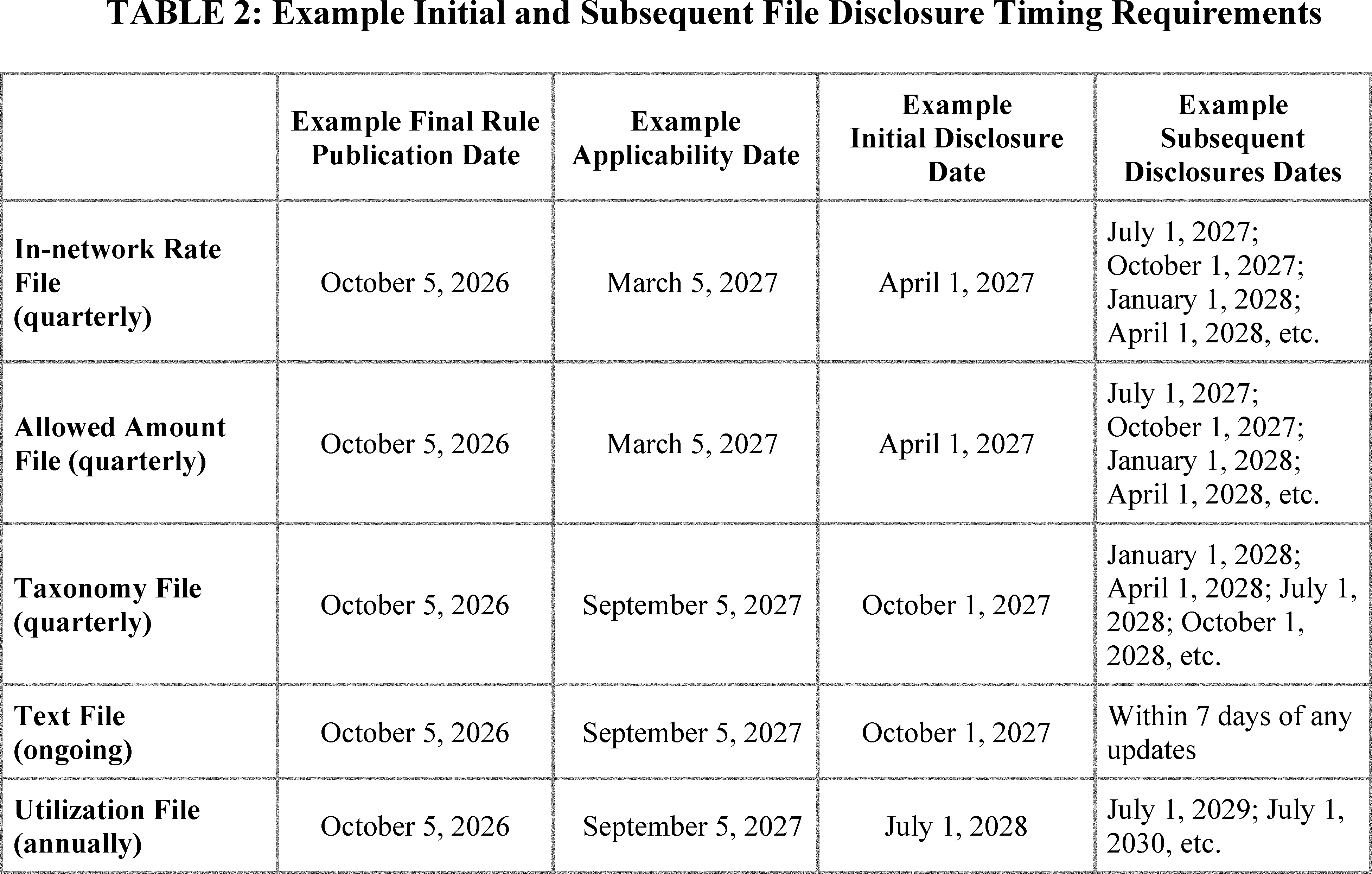
12. Special Rules To Prevent Unnecessary Duplication
The Departments proposed in 26 CFR 54.9815-2715A3, 29 CFR 2590.715-2715A3, and 45 CFR 147.212 to redesignate paragraphs (b)(4)(i) and (ii) as paragraphs (b)(5)(i) and (ii), respectively—each without any substantive changes to the existing policy established in the 2020 final rules. The Departments also proposed to add new paragraph (b)(5)(iii) to propose, under certain conditions, to allow self-insured group health plans to permit another party (pursuant to a contract) to make available in a single In-network Rate File, the information required under paragraph (b)(1)(i) for multiple plans, insurance policies, and contracts, including those offered by different plan sponsors with which the other party contracts and across health insurance markets that share the same provider network. In new paragraph (b)(5)(iii)(A), the Departments proposed the first condition, which is that each In-network Rate File made available for a provider network must include the required information under paragraph (b)(1)(i) for all covered items and services under each plan, insurance policy, or contract that uses the same provider network for which the In-network Rate File is made available. In new paragraph (b)(5)(iii)(B), the Departments proposed the second condition, which is that each proposed Change-log, Utilization, and Taxonomy File must include data from the same plans, insurance policies, or contracts that are represented in the corresponding In-network Rate File.
The Departments also proposed to redesignate certain language from current paragraph (b)(4)(iii) as paragraph (b)(5)(iv) and amend it to allow, under certain conditions, self-insured group health plans to permit another party (under a written agreement) to make available in a single Allowed Amount File the information required under paragraph (b)(1)(ii) for more than one self-insured group health plan, including those offered by different plan sponsors with which the other party contracts. For consistency in the application of the 11-claims threshold specified in paragraph (b)(1)(ii)(C), the Departments proposed in new paragraph (b)(5)(iv) that in order for a self-insured group health plan to take advantage of the special rule in that paragraph, the proposed 11-claim threshold must be applied to the aggregated data set.
Finally, the Departments proposed to redesignate other language from current paragraph (b)(4)(iii) as paragraph (b)(3)(iv), which would provide that the plan or issuer may enter into a written agreement with another party (such as a service provider) to post the machine-readable files on its public website on behalf of the plan or issuer, including if the plan or issuer does not have a website. However, if the files are posted on a service provider's website, and the plan or issuer maintains a public website but chooses not to host the files separately on its own public website, it must provide a link on its own public website to the location where the files are made publicly available. Because the Departments determined that this provision more logically belongs in redesignated paragraph (b)(3), the Departments proposed to move it to new paragraph (b)(3)(iv) with proposed amendments that are explained in section III.C.10. of this preamble.
After consideration of comments, the Departments are finalizing these amendments as proposed, with the following modifications: (1) The Departments are removing the reference to the Change-log File in paragraph (b)(5)(iii)(B), which is not being finalized, as discussed in section III.C.8.a. of this preamble; and (2) the Departments are finalizing certain non-substantive language edits to paragraphs (b)(5)(i) through (iii) to ensure clarity and consistency throughout the regulatory text.
Several commenters expressed support for the proposal in proposed paragraph (b)(5)(iii) to allow a self-insured group health plan to enter into an agreement with a service provider to make available an In-network Rate File ( printed page 63801) for each provider network used by more than one plan, insurance policy, or contract (including those offered by different plan sponsors with which the service provider has an agreement) and across different health insurance markets, subject to certain conditions, asserting that doing so will reduce total file count, eliminate duplication, and improve analysis. One of these commenters noted that it is appropriate that the contextual files include data for the same aggregated set of plans.
The Departments agree with commenters and reiterate the statement in the proposed rules that allowing self-insured group health plans to permit another party with which it contracts to combine In-network Rate File data by provider network and across different health insurance markets, subject to certain conditions, will reduce duplicate rate information and simplify analysis for file users.[112] The Departments continue to expect that organizing data by provider network will reduce file size and the overall number of files and make more meaningful information available to file users. The Departments also agree that for the Utilization and Taxonomy Files to be meaningful, they must include information from the same plans, insurance policies, or contracts represented in the corresponding In-network Rate File, including, as applicable, those offered by different plan sponsors and across different health insurance markets. As discussed in section III.C.8.a. of this preamble, the Departments are not finalizing the Change-log File requirement in proposed paragraph (b)(2)(i). Therefore, the Departments are finalizing paragraph (b)(5)(iii)(B) only with respect to the Utilization and Taxonomy Files, which the Departments are finalizing as discussed in sections III.C.8.b. and III.C.8.c. of this preamble, respectively.
A commenter recommended that the Departments ensure the proposals to allow self-funded plan data aggregation in the In-network Rate File do not create gaps in data coverage or accountability, while another commenter recommended there be traceability to the plans included in the aggregated file by including EINs or plan identifiers.
As discussed in section III.C.2., redesignated paragraph (b)(1)(i)(C) will require that an In-network Rate File includes an EIN if there is no HIOS ID available (as is the case for self-insured plans). The Departments acknowledge the commenter's concern about data gaps and confirm that all plan-level data, including the plan sponsor's EINs, will be populated in the Table of Contents File so that a user can identify the plans included in a combined file. As discussed in section III.C.1. of this preamble, Schema 2.0 currently expects plans and issuers to use a Table of Contents File if more than one plan or policy offered by a health insurance issuer or health plan shares the same in-network rates.
A commenter recommended that self-insured plan sponsors not be held liable for non-compliance when the plan sponsor is not the owner of the provider network, stating that the owner of the provider network produces a machine-readable file for a plan sponsor that is either “renting” the carrier's provider network or contracting with a third-party to access a provider network.
The Departments note that current paragraph (b)(4)(ii) (redesignated in these final rules as paragraph (b)(5)(ii)) specifies that if a plan or issuer contracts with another party (such as a service provider or health care claims clearinghouse) to disclose required machine-readable file information under paragraph (b) and the party with which it contracts fails to provide the information, the plan or issuer is considered to have violated the requirements of paragraph (b). The Departments did not propose and are not finalizing substantive changes to this requirement. As the Departments discussed in the 2020 final rules, plans and issuers are not required to enter into such agreements to comply with the public disclosure requirements of those final rules.[113] If a plan or issuer chooses to do so, it is ultimately the responsibility of the plan or issuer to ensure that the service provider provides the information required by those final rules.[114] This ensures the Departments retain a mechanism to enforce those final rules against the entities subject to their authority. Further, the Departments emphasize that this liability structure is standard for plans and issuers entering into written agreements to handle such responsibilities.[115]
A commenter requested the Departments confirm or consider revising the special rule for self-insured plans that use a vendor for in-network arrangements but also have supplemental carve-outs or other arrangements outside the standard network to be included in the aggregate reporting for the In-network Rate File.
The Departments encourage all self-insured group health plans that use the same provider networks to take advantage of the special rule in paragraph (b)(5)(iii) to streamline reporting. As discussed in section III.C.1. of this preamble, if variations among either participating providers or in-network rates exist, those variations constitute a separate provider network. The current technical implementation guidance allows a plan's information to be associated with multiple, layered provider networks that constitute the plan's complete coverage. This includes reflecting a base network with additional carve-out provider networks in their Table of Contents File.
Most commenters supported the proposal in redesignated paragraph (b)(5)(iv) to allow self-insured group health plans to permit another party with which it contracts, such as a service provider, to include the allowed amount and billed charge information required under paragraph (b)(1)(ii) in a single Allowed Amount File for more than one self-insured group health plan, including those offered by different plan sponsors with which the other party contracts, provided certain conditions are met. Commenters stated that the proposal would result in important simplification and cost-savings where multiple employer plan sponsors are all served by, and contracted with, the same vendor.
The Departments agree that the special rule in paragraph (b)(5)(iv) will allow streamlined reporting for self-insured group health plans while maintaining the market division grouping necessary to make the data more actionable for research and analysis as discussed in the proposed rules.[116]
A commenter supported the proposal that a self-insured group health plan may not take advantage of the special ( printed page 63802) rule under paragraph (b)(5)(iv) unless the proposed 11-claim threshold applies across all plans included in the Allowed Amount File. The commenter stated that allowing service providers to aggregate Allowed Amount Files across multiple self-insured group health plans offered by different sponsors, with the 11-claim threshold applied to the aggregated dataset rather than to each individual plan, would maximize out-of-network data volume, improve privacy protections, and reduce file proliferation.
The Departments agree with the commenter's anticipation of increased data volume and reiterate the expectation that this approach will better mitigate privacy concerns and minimize complexity in complying with Federal or State privacy laws as discussed in the proposed rules.[117]
A commenter stated that the Departments should clarify how the claims threshold is measured if the self-insured plan has multiple service providers. The commenter recommended that the threshold be based only on the information that is within the service provider's control, such that no service provider should be required to aggregate data from another service provider to meet this threshold.
The Departments agree with the commenter that a determination as to whether allowed amount and billed charge data should be omitted based on the 11-claims threshold, as specified in paragraph (b)(5)(iv), should be based only on the information that is within a service provider's control, as requiring plans to ensure information is exchanged between service providers would be difficult and unnecessarily burdensome.
13. Applicability
The Departments proposed to require under paragraph (c)(1) that the proposed amendments to the provisions of paragraph (b) of 26 CFR 54.9815-2715A3, 29 CFR 2590.715-2715A3, and 45 CFR 147.212 would apply 12 months following the date of publication of the final regulations in the Federal Register . The Departments proposed this applicability date to ensure that all plans and issuers would begin following the updated set of technical requirements at the same time, rather than according to plan or policy year. The Departments sought comment on this proposed applicability date.
After consideration of comments, the Departments are modifying the proposed applicability date under paragraph (c)(1) such that that the provisions of this section will apply beginning 5 months following the date of publication of the final regulations in the Federal Register , which is March 6, 2027, except for the contextual files under paragraph (b)(2) and their timing requirements under paragraphs (b)(4)(iii) through (v), and the website footer requirements under paragraph (b)(3)(iii), which will apply beginning 11 months following the date of publication of the final regulations in the Federal Register , which is September 6, 2027. Until those applicability dates, plans and issuers are required to comply with 26 CFR 54.9815-2715A3, revised as of April 1, 2025, 29 CFR 2590.715-2715A3, revised as of July 1, 2025, and 45 CFR 147.212, revised as of October 1, 2025. These final rules give plans and issuers 5 months following publication of the final rule to implement the changes related to the In-network Rate File, Allowed Amount File, and attestations, and 11 months following publication of the final rule to implement the contextual files and the website footer.
The Departments sought comment on the proposed applicability date, including whether 12 months following publication of final regulations would provide enough time for plans and issuers to comply with the amended provisions of paragraph (b) and whether there are particular challenges in complying with such applicability date compared to an applicability date based on plan or policy year.
A few commenters supported a 12-month transition as reasonable for interpreting requirements, updating mappings/designs, testing, and deploying, while also noting that implementation depends on technical guidance being available early enough to use that time effectively. However, many users of the data recommended making the applicability date earlier because they believed the Transparency in Coverage infrastructure has been operational since 2022 and the proposal largely refines existing requirements rather than requiring a “from-scratch” build. A few commenters reasoned that many proposed changes are mainly output restructuring or metadata additions (instead of new data generation), and that quarterly (vs. monthly) posting could offset operational burden. A few commenters recommended a shorter compliance runway (4 to 5 months) and stated it would create continuity with the recent 2026 OPPS Final Rule [118] for hospital machine-readable file update timelines and is feasible because payers and vendors have matured development pipelines after prior schema changes. They asserted that plans and issuers should likewise be held to a similar timeline, which would mean the applicability date for changes included in these final rules should be 5 months after the final rules' publication date at most.
The Departments agree that the final requirements are mainly refinements and restructuring of existing requirements and that the quarterly cadence should offset operational burden. Unlike the 2026 OPPS Final Rule,[119] which sets forth all the development requirements in regulation, the Transparency in Coverage development process has two stages—the rule sets forth the requirements stating what information must be disclosed, while the GitHub platform sets forth the schemas, which are the technical specifications for how the required information should be disclosed with collaboration and input from the developer community. Thus, implementation of these technical specifications requires time following rule publication for technical implementation guidance development on GitHub and then additional time for plans and issuers to build the files once the schemas are finalized.
In response to the many requests from commenters to accelerate the applicability timeline, the Departments have determined that certain provisions should be applicable 5 months after the publication date of these final rules in the Federal Register . These include the changes to In-network Rate File at paragraph (b)(1)(i) and the Allowed Amount File at paragraph (b)(1)(ii) along with their special rules under paragraph (b)(5), and their timing under paragraph (b)(4)(i); as well as the attestations under paragraph (b)(1)(iv) and the required method and format provisions under paragraphs (b)(3)(i), (ii), and (iv).
The Departments have determined that the implementation timeline for the In-network Rate and Allowed Amount Files can be accelerated given that plans and issuers are already producing these files and the proposed amendments primarily refine and restructure existing requirements, making 5 months sufficient to accomplish both GitHub collaboration and the building of the files. In addition, the Departments have determined an accelerated applicability date is appropriate for the method and format provisions described in section III.C.10. of this preamble, which involve only basic website modifications. ( printed page 63803)
Several plans and issuers opposed the 12-month applicability date following finalization of the rule and recommended an applicability date at least 18 months (and in one case 24 months) after release of final technical standards, rather than these final rules. These commenters reasoned the proposal introduces substantial operational workstreams (for example, changes in enrollment, the addition of new contextual files, structural modification to the existing machine-readable files, and time required for vendor or service provider coordination, including the design, development, testing, quality assurance, validation, and deployment of hosting and tooling updates), and that overlapping Federal requirements (interoperability, advanced explanations of benefits, new disclosure rules) compete for constrained technical resources. A few commenters added that these workforce constraints and vendor dependency chains limit how much timelines can be compressed without harming accuracy and reliability. A few commenters stated that plans and issuers cannot begin planning and development until all technical requirements, including Schema 3.0 data attributes, examples, and FAQs, are final. These commenters stated that late updates or changes to definitions, requirements, or technical guidance for Schema 1.0 and 2.0 required rework and created delays.
The Departments disagree that plans and issuers require 18 to 24 months following finalization of the schema requirements to implement these new provisions. Such an implementation runway would be significantly longer than that of the initial machine-readable file infrastructure following the 2020 final rules, which required a much larger effort to build. The Departments acknowledge that the proposed provisions impose new operational burden and that plans and issuers are subject to overlapping Federal requirements that may strain their personnel and infrastructure capacities. However, the Departments have determined that the applicability dates for these provisions are reasonable given that the new requirements are mainly refining and restructuring data, combined with the fact that the Departments are not finalizing the Change-log File or the enrollment totals provisions as described in sections III.C.8.a. and III.C.4., respectively, which commenters indicated would be operationally challenging.
The Departments are committed to making the data available to the public as soon as possible and have determined that the amendments to the machine-readable files can and should be fully implemented by the end of 2027. Since a 12-month applicability date would push implementation into 2028, the Departments are finalizing an 11-month applicability date to the new contextual files under paragraph (b)(2) and their timing under paragraph (b)(4)(iii) through (v), as well as the website footer under paragraph (b)(4)(iii). Eleven months provides plans and issuers adequate time to augment their workforce, if necessary, and aligns with the accelerated applicability recommended by many commenters for all files. The Departments disagree that plans and issuers cannot begin planning and development until all technical requirements, including Schema 3.0 data attributes, examples, and FAQs, are final. The intention of the Transparency in Coverage technical implementation process is to allow development to take place transparently—in real time with the GitHub community—as was the case following the publication of the 2020 final rules. Industry feedback on where and how data should be disclosed within the machine-readable files will inform the final specification, but file developers will have the initial draft schemas at the beginning of each phase's development window to start building towards. Development teams can begin planning data extraction from internal systems based on the known core elements, allowing implementation work to proceed in parallel with the technical implementation process. File developers do not need to wait until the very end of the process to start their builds; rather, development can and should begin before Schema 3.0 is formally finalized.
IV. Collection of Information Requirements
Under the Paperwork Reduction Act of 1995 (PRA), the Departments are required to provide notice in the Federal Register and solicit comment before an information collection request (ICR) is submitted to the Office of Management and Budget (OMB) for review and approval. These final rules contain ICRs that are subject to review by OMB. A description of these provisions is given in sections IV.A. and B. of this preamble, with estimates of the annual and one-time burdens summarized in Tables 35 and 36, respectively.
In the proposed rules, the Departments solicited public comment on the ICRs, including the following areas, as required by section 3506(c)(2)(A) of the PRA.
- The need for the information collection and its usefulness in carrying out the proper functions of an agency, including whether the information shall have practical utility.
- The accuracy of the Departments' estimate of the information collection burden, including the validity of the methodology and assumptions used.
- The quality, utility, and clarity of the information to be collected.
- Recommendations to minimize the information collection burden on the affected public, including automated collection techniques.
The Departments received several comments addressing these issues from plans and issuers, consumer and patient advocacy organizations, data analytics and informatics companies, and professional trade associations. A few commenters noted that burden estimates should better reflect real-world implementation costs and highlighted potential operational impacts associated with specific provisions, including changes to reporting thresholds and data requirements, as well as the need to account for continuous maintenance activities. A few other commenters also indicated that recurring burdens are undercounted, emphasizing that many requirements involve continuous maintenance and that some annual costs (such as those associated with Taxonomy Files) are not fully captured. A few commenters provided recommendations related to wage assumptions, consumer support burden estimates, and the overall methodology used to estimate burden. These comments, along with the Departments' responses, are discussed in sections IV.A. and IV.B. of this preamble.
Several commenters expressed concern that increased transparency requirements may create significant administrative and financial burdens that could be passed on to consumers in the form of higher premiums or costs if not paired with meaningful usability improvements. A few commenters noted that implementation burden could be substantial, potentially exceeding prior Transparency in Coverage updates, and recommended prioritizing high-value requirements and streamlining timelines and guidance.
The Departments acknowledge these concerns, including that estimated one-time implementation costs in the proposed rules may be substantial and that ongoing compliance may require additional effort and resources. After consideration of the comments regarding significant burden, the Departments have decided not to finalize certain requirements, including the requirement to add a Change-log File related to the In-network Rate File disclosures and the requirement to ( printed page 63804) include the current enrollment totals for each coverage option associated with the applicable In-network Rate File. As a result, these final rules reduce compliance burdens on plans and issuers while continuing to advance the Departments' underlying policy goals.
In addition, in response to public comments and as discussed in sections III.C.9. and III.C.7. of this preamble, respectively, the Departments are finalizing a requirement for plans and issuers to publish machine-readable files in a single non-proprietary, open-standards format, as well as a requirement to attest, to the best of their knowledge and belief, to the accuracy and completeness of the information contained in their machine-readable files. These requirements are intended to improve the consistency and reliability of machine-readable file disclosures while advancing the Departments' transparency objectives.
A commenter recommended applying stronger PRA-based burden governance, including evaluating the marginal utility of each requirement and conducting post-implementation reassessments. The Departments acknowledge this perspective but have determined that a requirement-by-requirement marginal utility analysis would be complex and impractical given data limitations and the interrelated nature of the provisions. The Departments acknowledge the value of post-implementation evaluation and will continue to consider interested parties' feedback and implementation experience in future policymaking efforts. In accordance with Executive Order 12866 [120] and Executive Order 14192,[121] the Departments have evaluated the overall costs, cost savings and benefits of these final rules and determined that they are expected to result in net cost savings over time, reflecting that aggregate cost savings outweigh the aggregate costs.
A commenter urged the Departments to consider the rule's impact on physicians, particularly solo and small physician practices, and explore future actions to address policies that may increase costs and limit access to care. The Departments acknowledge this concern but note that these final rules apply to plans and issuers rather than providers. The potential impact on applicable small entities is addressed in section V.F. of this preamble.
Taking these considerations into account, the Departments have evaluated these final rules in the broader context of their anticipated effects, including overall costs and benefits. The Departments have determined that these final rules will improve transparency and promote more efficient markets, support informed decision-making, and help mitigate potential cost pass-through to consumers over time. Furthermore, as discussed in section V.I. of this preamble, the Departments expect the requirements in these final rules to yield net cost savings over the long term. Therefore, the Departments have determined that these final rules, and the refinements made in response to comments, appropriately balance the goal of minimizing administrative burden with maximizing the impact and value of transparency requirements.
Wage Estimates
To estimate wages, the Departments used data from the Contract Awarded Labor Category (CALC) database tool [122] to calculate average labor costs associated with the burden and equivalent costs of the ICRs. The CALC tool was developed to assist acquisition professionals with market research and price analysis of labor categories under multiple U.S. General Services Administration and Veterans Administration (VA) contracts. While the Departments recognize that various methods exist for estimating fringe benefits and overhead costs, the CALC database was selected because, unlike Bureau of Labor Statistics (BLS) data, which is valuable for identifying broad labor market trends, the CALC tool is specifically designed to support market research for government procurement. It provides cost estimates for specific labor categories based on actual contract rates. More importantly, CALC data reflects fully burdened hourly rates, including both base pay and benefits, whereas BLS data reflects only base wages. The Departments determined that CALC's occupation-specific data better aligns with the skill sets and job functions necessary for implementing the requirements in these final rules and therefore provides a more suitable basis for estimating labor costs.
A few commenters recommended that the Departments' burden estimates reflect prevailing wage rates for relevant personnel. The Departments appreciate these comments and have revised the wage rate assumptions used in the burden estimates to better reflect prevailing market rates. The Departments have updated the wage assumptions used in the burden estimates by adopting median wages instead of the mean wages used in the proposed rules, as median wages are less influenced by outliers and better reflect typical compensation, resulting in more representative and reliable estimates of labor costs. Table 3 presents the fully burdened median hourly wage and occupations used in the Departments' estimates.
( printed page 63805)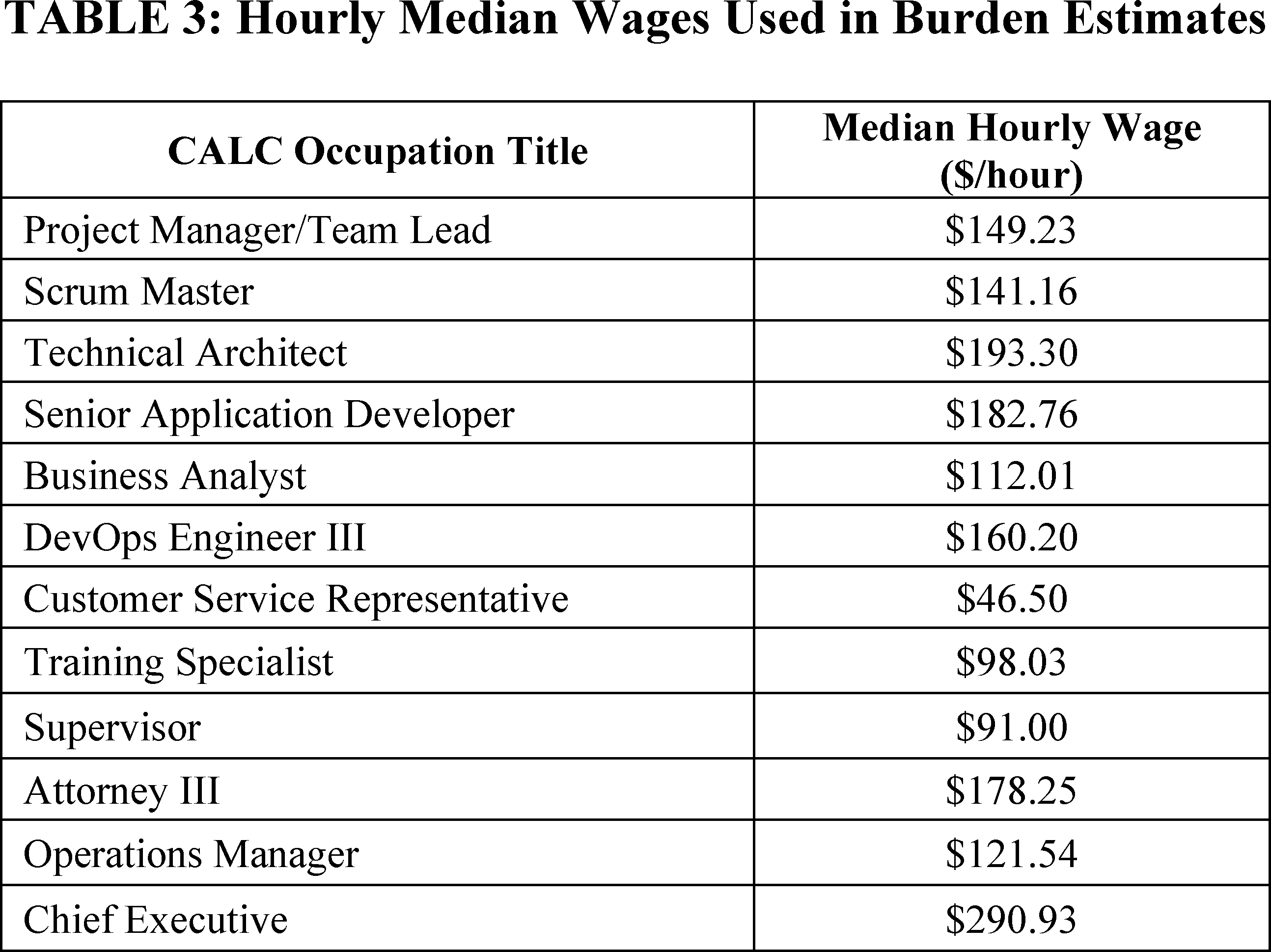
A. ICRs Regarding Requirements for Disclosures to Participants, Beneficiaries, and Enrollees Under 26 CFR 54.9815-2715A2, 29 CFR 2590.715-2715A2, and 45 CFR 147.211
In the proposed rules, the Departments proposed several amendments to the 2020 final rules to improve price transparency and strengthen consumer protections for participants, beneficiaries, and enrollees. Specifically, the Departments proposed revising the statement required under paragraph (b)(1)(vii)(A) to clarify that the cost-sharing information does not account for potential additional amounts in situations where applicable State and Federal law allow out-of-network providers to balance bill participants, beneficiaries, and enrollees. These revisions reflect the Federal balance billing protections introduced by the No Surprises Act, which were not in effect when the original provision was finalized.
The Departments are finalizing these revisions, as proposed. These changes will help ensure that participants, beneficiaries, and enrollees understand that cost-sharing estimates disclosed through their plan's or issuer's self-service tool may not account for additional amounts that could ultimately be owed to out-of-network providers.
In addition, the Departments proposed adding a new paragraph (b)(2)(iii) requiring plans and issuers to make cost-sharing information available by phone, consistent with requirements under the No Surprises Act. The Departments also proposed to require a telephone number for consumer assistance, as already required under Code section 9816(e), ERISA section 716(e), and PHS Act section 2799A-1(e), as added by section 107 of the No Surprises Act, to be indicated on any physical or electronic plan or insurance identification card issued to a participant, beneficiary, or enrollee.
The Departments are also finalizing these requirements as proposed. To reduce unnecessary administrative burden and prevent consumer confusion, providing the information as specified in paragraph (b)(1) and in the methods and formats as specified in paragraph (b)(2), as amended by these final rules, satisfies the price comparison tool requirements under section 114 of the No Surprises Act. These requirements apply to non-grandfathered group health plans and health insurance issuers offering non-grandfathered coverage in the group and individual markets.
As discussed in section V.C.3. of this preamble, the Departments assume that self-insured group health plans will depend on TPAs, including issuers providing administrative services only and non-issuer TPAs, to implement the requirements of these final rules. This assumption is based on the Departments' understanding that most self-insured group health plans already rely on TPAs to perform core administrative functions, such as enrollment and claims processing.[123] For those self-insured plans that choose to develop their own internet-based self-service tools, the Departments assume that they will incur costs and burdens similar to those estimated for issuers and TPAs. Accordingly, the Departments use issuers and TPAs as the unit of analysis for estimating the cost of these changes.
The Departments also assume that issuers and TPAs have already developed internet-based self-service tools, originally required for plan or policy years beginning on or after January 1, 2023, and will only need to modify these existing systems to comply with the final provisions. The Departments acknowledge that some interactive voice response programming work may be necessary, but the Departments expect the associated cost to be minimal.
As also noted in section V.C.3. of this preamble, the Departments estimate that approximately 1,303 issuers [124] and 205 TPAs [125] (a total of 1,508 entities) are expected to implement these final requirements. The Departments ( printed page 63806) acknowledge that actual costs may vary depending on factors such as the volume of providers and items or services for which cost-sharing information must be disclosed, and whether plans (or TPAs on behalf of plans) and issuers already have tools that fully or partially meet the final requirements or can be readily adapted. However, the Departments note that, in 2021, they announced their intention to propose rulemaking requiring that the same pricing information provided through the Transparency in Coverage internet-based self-service tool or in paper form be provided via phone.[126] Because the statutory requirements to offer price comparison guidance by telephone have been in place for plan years (in the individual market, policy years) beginning on or after January 1, 2022,[127] the Departments expected that many plans and issuers had already made progress toward meeting this requirement since then.
The Departments also assume that plans (or TPAs on behalf of plans) have already built self-service tools and will only be required to revise the existing statement disclosing that out-of-network providers may engage in balance billing, subject to applicable State and Federal laws. Although these updates build on existing infrastructure, they are expected to require a one-time cost for minor technical modifications including editing statement text, testing for quality assurance, and implementing the update. The Departments estimate that, on average, each issuer or TPA will require 10 minutes (approximately 0.17 hours) [128] of a Senior Application Developer's time (at $182.76 per hour) to update the statement. As shown in Table 4, across all 1,508 issuers and TPAs, the total one-time burden is estimated at 251 hours, with an associated cost of approximately $45,934.

1. High Impact for Providing Cost-Sharing Information via Phone
Under a scenario with increased call volume and duration (that is, high impact), the Departments anticipate that requiring cost-sharing information to also be accessible by phone could increase call volume and call duration to the plan's or issuer's customer support line. This anticipated increase may result from participants, beneficiaries, and enrollees who prefer verbal assistance or who have limited digital access or digital literacy.
In the proposed rules, the Departments estimated that, under high- and low-impact scenarios, a customer service representative would require 10 and 9 minutes per interaction, respectively, to provide the requested information and complete post-call documentation. However, a commenter expressed concern that these consumer-support burden assumptions are underestimated, noting that call center interactions are likely to be longer and more complex than estimated and that consumers typically compare fewer providers in practice.
The Departments acknowledge the commenter's concern that the consumer-support burden assumptions may be underestimated. However, the Departments have determined that the cost-sharing information requested over the phone is generally readily available through existing price comparison tools, and customer service representatives should be able to access and communicate that information without significant additional time.
Accordingly, the Departments have determined that the estimated average call duration of approximately 9 to 10 minutes, including post-call documentation, as presented in the proposed rules, is reasonable. The Departments recognize that call times may vary depending on the complexity of the inquiry; however, they have determined that, in many cases, consumers will seek relatively straightforward information, such as the cost of services from a specific provider and their expected out-of-pocket responsibility.
In addition, available data on customer service interactions related to health care services suggest that average call times are often shorter, typically ranging from approximately 4 to 8 minutes.[129] Although commenters stated that cost-sharing inquiries may involve greater complexity than typical health plan customer service calls, the Departments have determined that the higher estimated average call duration reasonably accounts for inquiries involving cost-sharing estimates that may be more complex than routine customer service calls. Taken together, these considerations support the reasonableness of the Departments' estimated average call duration.
Taking these factors and available evidence into account, the Departments continue to maintain that, under a high-impact scenario, for each issuer or TPA, ( printed page 63807) it will require 10 minutes [130] for a customer service representative (at $46.50 per hour) to speak with each consumer and provide the requested information and complete post-call documentation. Under the high impact scenario estimate, the Departments estimate there will be 7.8 million calls annually,[131] each issuer or TPA will receive approximately 5,172 calls per year, resulting in an estimated annual burden of 862 hours,[132] with an estimated associated cost of approximately $40,086. As shown in Table 5, the Departments estimate that for all 1,508 issuers and TPAs, the estimated total ongoing annual burden will be approximately 1,300,000 hours, with an estimated associated cost of $60,450,000 annually.[133]

2. Lower Impact Estimate for Providing Cost-Sharing Information via Phone
Under a scenario with less call volume and duration (that is, a lower-impact scenario), the Departments assume that a smaller subset of participants, beneficiaries, and enrollees will opt to request pricing information by phone. In this scenario, the Departments estimate that for each issuer or TPA it will take 9 minutes for a customer service representative (at $46.50 per hour) to speak with consumers and provide the requested information and complete post-call documentation. Assuming 3.9 million calls annually,[134] each issuer or TPA will receive approximately 2,586 calls per year, resulting in an estimated annual burden of 388 hours [135] with an estimated associated cost of approximately $18,039 per issuer or TPA. As shown in Table 6, across all 1,508 issuers and TPAs, the estimated total ongoing burden is approximately 585,000 hours, with a total annual cost of approximately $27,202,500.
( printed page 63808)
Plans (or TPAs on behalf of plans) and issuers will also incur a one-time burden and cost to train customer service representatives and their supervisors on this phone requirement. The Departments assume this requirement will not necessitate hiring additional full-time staff. Instead, the Departments expect issuers and TPAs to rely on existing customer service representatives and supervisors for this task.
For each issuer or TPA, the Departments estimate that one training specialist will spend 8 hours (at $98.03 per hour) to train 20 customer service representatives (totaling 160 hours at $46.50 per hour) and two supervisors (totaling 16 hours at $91 per hour) on how to respond to participants, beneficiaries, and enrollees seeking pricing information by phone. This results in a one-time burden of 184 hours per issuer or TPA, with an estimated associated cost of $9,680. As shown in Table 7, for all 1,508 issuers and TPAs, the total estimated one-time training hour burden is 277,472 hours, with a corresponding cost of approximately $14,597,802.
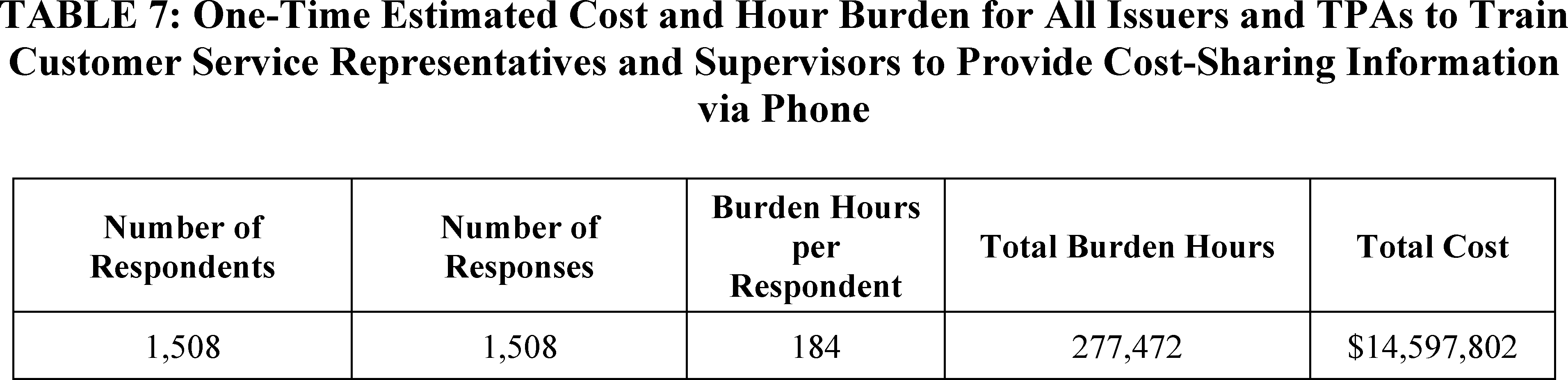
The Departments anticipate that, in the future, ongoing training costs associated with these phone requirements will be included into existing onboarding programs for new employees and included in the regular annual training provided to current staff. The Departments did not receive any comments regarding the ongoing training costs associated with these requirements.
B. ICRs Regarding Requirements for Public Disclosure Under 26 CFR 54.9815-2715A3, 29 CFR 2590.715-2715A3, and 45 CFR 147.212
In the proposed rules, the Departments proposed updates to the 2020 final rules intended to improve the accessibility, clarity, and usefulness of the public disclosures through machine-readable files. The proposed changes included requirements related to the content, format, organization, and publication frequency of the machine-readable files, as well as additional contextual and technical requirements intended to improve file usability and reduce operational complexity for file users.
The Departments received numerous comments on these proposals. As discussed in greater detail in section III.C. of this preamble, the Departments are finalizing many of the provisions as proposed or with modifications after considering public comments, while declining to finalize certain other proposed requirements.
For In-network Rate Files, these final rules require such files to be organized by provider network while also requiring reporting of a common provider network name and provider network identifier. These final rules also allow rates to be expressed as a percentage of billed charges when a dollar amount cannot be derived in advance as well as exclude providers unlikely to be reimbursed based on their scope of practice. The Departments are not finalizing the proposed requirement to report enrollment data due to operational, implementation, and data reliability concerns raised by commenters.
In addition, these final rules require plans and issuers to post several contextual machine-readable files: a Utilization File, a Taxonomy File, and a Text File, each with corresponding timing requirements. The Departments are finalizing these requirements with modifications to certain provisions, including modifying the Utilization File reporting period to align with the prior plan or policy year to avoid combining utilization data across reporting periods and modifying the Text File requirement to allow plans and issuers to include a monitored email address for inquiries related to the machine-readable files. However, the Departments are not finalizing the proposed Change-log File requirement due to concerns regarding the operational burden and implementation complexity associated with maintaining and publishing detailed records of file updates and revisions.
For the Allowed Amount Files, these final rules require data reporting at the market level instead of the individual plan level, lowering the claims threshold from 20 to 11, extending the reporting period from 90 days to 6 months, and increasing the lookback period from 180 days to 9 months to enhance the robustness of historical data.
Finally, these final rules also modify the technical requirements applicable to the machine-readable files by requiring files to be made available in a single, non-proprietary, open-standards format to improve accessibility and standardization across files. In addition, the Departments are finalizing a modified applicability timeline. While the proposed rules generally proposed that all requirements would become applicable 12 months after publication ( printed page 63809) of the final rules, these final rules instead adopt a phased applicability approach under which all requirements become applicable 5 months after publication of these final rules, except for the requirements regarding the Taxonomy File, Utilization File, Text File, and “findability” link requirement, which become applicable 11 months after publication.
Collectively, these changes are intended to strengthen transparency and improve the usefulness of publicly available pricing information and reduce unnecessary operational burden by streamlining certain reporting requirements and modifying or not finalizing requirements that commenters indicated could be overly complex or resource-intensive to implement.
As discussed in section V.C.3. of this preamble, the Departments assume that self-insured group health plans will depend on TPAs, including issuers providing administrative services only and non-issuer TPAs, to implement these updates, noting that some self-insured plans may choose to comply individually, likely incurring a similar hour burden.
The Departments recognize that some requirements may be integrated into existing operational processes, potentially reducing implementation burdens, though the Departments acknowledge that the extent of integration varies significantly across different requirements. Marginal modifications may include adjusting reporting thresholds from 20 to 11 claims, extending lookback and reporting periods, and adding website footer links, while higher-burden implementations likely include network-level file reorganization, creation of new contextual files (such as Taxonomy and Utilization Files), and implementation of provider-rate combination exclusion logic. Although some activities may align with routine system updates and maintenance cycles, the Departments provide detailed burden estimates for requirements involving substantial system modifications or new operational processes in sections IV.B.1. through 15. of this preamble.
1. ICRs Regarding Requirements To Organize Files by Provider Network, Allow Service Providers or Other Parties To Organize by Provider Network Across Multiple Self-Insured Group Health Plans, and Include a Common Provider Network Name and Provider Network Identifier (26 CFR 54.9815-2715A3(b)(1)(i) and (b)(5)(iii), 29 CFR 2590.715-2715A3(b)(1)(i) and (b)(5)(iii), and 45 CFR 147.212(b)(1)(i) and (b)(5)(iii))
The Departments proposed to amend 26 CFR 54.9815-2715A3(b)(1)(i), 29 CFR 2590.715-2715A3(b)(1)(i), and 45 CFR 147.212(b)(1)(i) to require plans and issuers to make an In-network Rate File available for each provider network they maintain or contract with and that is associated with the plan or policy being reported. The Departments also proposed to add new 26 CFR 54.9815-2715A3(b)(5)(iii), 29 CFR 2590.715-2715A3(b)(5)(iii), and 45 CFR 147.212(b)(5)(iii) to permit In-network Rate Files to be made available by provider network for multiple plans administered by service providers or other parties, including those offered by different plan sponsors and across different health insurance markets.
In response to public comments, the Departments are finalizing this requirement with a modification to add a new paragraph (b)(1)(i)(B) requiring plans and issuers to disclose a provider network identifier in addition to the common provider network name. As discussed in more detail in section III.C.1. of this preamble, the Departments agree with commenters who stated that requiring plans and issuers to report only a common provider network name might not be sufficient for file users to reliably identify, distinguish, and cross-reference provider networks across files and coverage options. This requirement as finalized will reduce ambiguity and enable file users to distinguish between provider networks with the same or similar names. The Departments expect that any associated burden will be minimal because plans and issuers already use provider network identifiers for internal tracking purposes.
As noted in the proposed rules, the Departments still maintain that the size of the In-network Rate File can be highly dependent on how it is organized. Where multiple plans share the same negotiated rates under an umbrella provider network, organizing the In-network Rate Files by provider network rather than by each individual plan or policy would, in most cases, decrease the size of the files, often significantly, while still maintaining data integrity.[136] Several commenters also agreed that this approach could reduce the total number of In-network Rate Files because there are far more plans and policies offered than there are distinct, separately managed provider networks.[137] The Departments have determined that, taken together, these reductions can ease processing burden on both file producers and file users and increase usability for employers and purchasers.
As discussed in section III.C.1. of this preamble, the Departments understand that many plans and issuers already leverage a Table of Contents File to organize their files, an approach that allows them to combine common negotiated rates across multiple In-network Rate Files, rather than publishing negotiated rates individually for each plan identifier. However, the Departments assume that few have fully implemented use of the Table of Contents File, and many have not adopted it at all.
For burden estimation, the Departments assume that no plans or issuers have adapted their In-network Rate File processes to align with this provision. While this may overstate the implementation burden for some, it provides a reasonable upper bound, ensuring the estimates cover the substantial and complex changes that most plans or issuers may need to make to comply with this requirement.
To implement this provision, plans (or TPAs on behalf of plans) and issuers will need to modify their In-network Rate File processes to produce files aggregated at the provider network level rather than the plan level, and to generate a crosswalk Table of Contents File that associates each coverage option with the corresponding provider network the plan or issuer maintains or contracts with. The implementation will involve a meaningful, one-time recoding effort to revise existing In-network Rate File processes. However, because the underlying data used to build the In-network Rate Files will not change, these revisions are expected to be incremental and build on the current process.
This finalized provision also requires, under new paragraphs (b)(1)(i)(A) and (b)(1)(i)(B), that each In-network Rate ( printed page 63810) File be associated with its common provider network name and the corresponding unique provider network identifier. In practice, this means plans (or TPAs on behalf of plans) and issuers will need to add new data elements and identify the source of the common provider network names within their systems of record so these can be included into the automated process for generating the required information for the Table of Contents and In-network Rate Files. However, the Departments assume that plans (or TPAs on behalf of plans) and issuers already have identified and captured these common provider network names and provider network identifiers as part of the related requirement to organize the In-network Rate Files by provider network. As a result, the Departments expect that any burden associated with disclosing these new data elements is accounted for in the burden estimate for organizing these files by provider network, with no additional burden anticipated.
The Departments estimate that issuers and TPAs will incur a one-time cost and burden to modify a plan's or issuer's current process for generating In-network Rate Files to disclose a discrete provider network name and the corresponding unique provider network identifier, and crosswalk those networks to applicable plans or policies. As shown in Table 8, the Departments estimate that, on average, each issuer or TPA will require 16 hours from a Project Manager or Team Lead (at $149.23 per hour), 80 hours from a Technical Architect (at $193.30 per hour), 80 hours from a Senior Application Developer (at $182.76 per hour), and 16 hours from a Business Analyst (at $112.01 per hour) to modify the plan's or issuer's current process, resulting in a one-time burden for each issuer or TPA of 192 hours with an estimated associated cost of $34,265. For all 1,508 issuers and TPAs, as shown in Table 9, the Departments estimate a total one-time burden of 289,536 hours, with an estimated associated cost of $51,671,077.
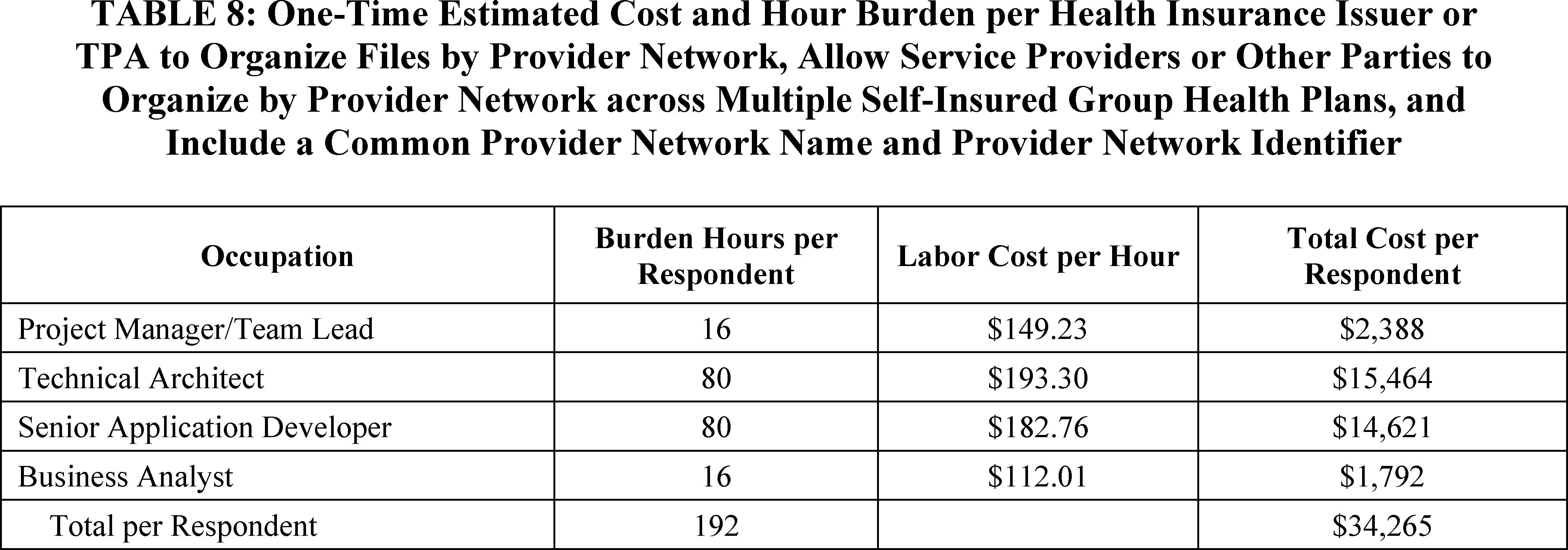
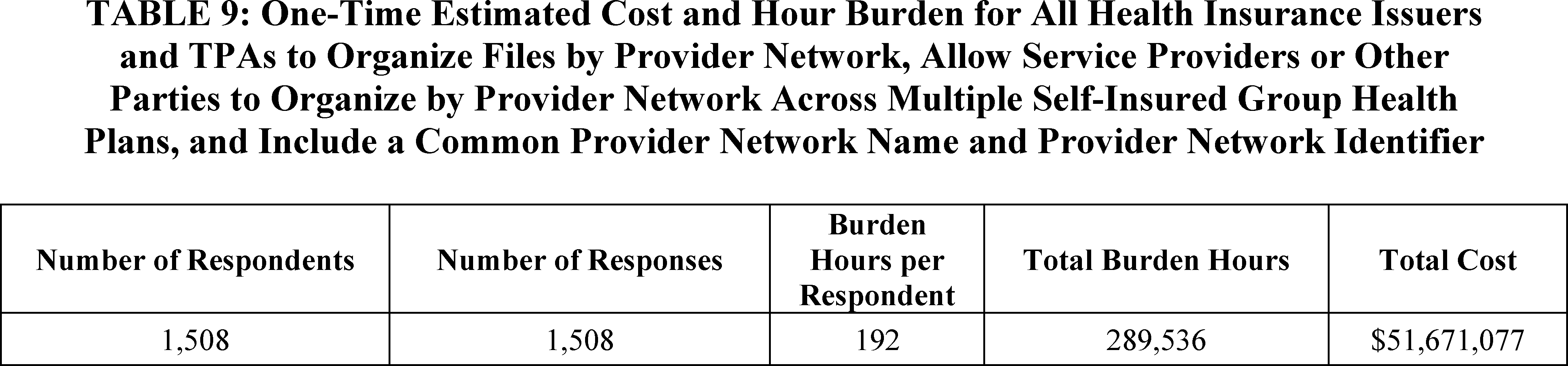
The Departments expect any additional ongoing burden with this requirement to be minimal, as it will involve only limited coding updates to account for and validate changes in the relationships reflected in the source files.
The Departments requested comment on the estimated cost and burden hours presented in this ICR, including any additional costs or challenges that may not have been identified. The Departments did not receive any comments on these estimates.
2. ICRs Regarding Requirements To Include Product Type in Both In-Network Rate and Allowed Amount Files (26 CFR 54.9815-2715A3(b)(1)(i)(C) and (b)(1)(ii)(A), 29 CFR 2590.715-2715A3(b)(1)(i)(C), and (b)(1)(ii)(A), and 45 CFR 147.212(b)(1)(i)(C) and (b)(1)(ii)(A))
The Departments proposed to amend redesignated paragraphs 26 CFR 54.9815-2715A3(b)(1)(i)(C) and (b)(1)(ii)(A), 29 CFR 2590.715-2715A3(b)(1)(i)(C), and (b)(1)(ii)(A), and 45 CFR 147.212(b)(1)(i)(C) and (b)(1)(ii)(A) to require plans and issuers to report the product type (for example, HMO or PPO) associated with each coverage option in both the In-network Rate File and the Allowed Amount File. Currently, there is no requirement for plans and issuers to include a product type in their machine-readable files. The only identifier currently required is the HIOS ID or the EIN when a HIOS ID is not available.
The Departments are finalizing this requirement as proposed. The Departments have determined that product type data is readily available to ( printed page 63811) most plans and issuers and that this requirement will only involve a one-time system update to include the product type variable in the machine-readable files. The estimate accounts for time and effort to access the data sources from which to populate the product type variable within the machine-readable files.
The Departments estimate a one-time cost and burden for plans (or TPAs on behalf of plans) and issuers to implement the required system automation updates. Each issuer or TPA, on average, will require 8 hours from a Project Manager or Team Lead (at $149.23 per hour), 8 hours from a Senior Application Developer (at $182.76 per hour), 8 hours from a Technical Architect (at $193.30 per hour), and 8 hours from a Business Analyst (at $112.01 per hour) to make the system updates and implement the requirements finalized in these rules. As shown in Table 10, this results in a total estimated one-time burden of 32 hours, with an associated estimated cost of $5,098 per issuer or TPA. As shown in Table 11, for all 1,508 issuers and TPAs, the Departments estimate a total one-time burden of 48,256 hours with an associated total cost of approximately $7,688,387.
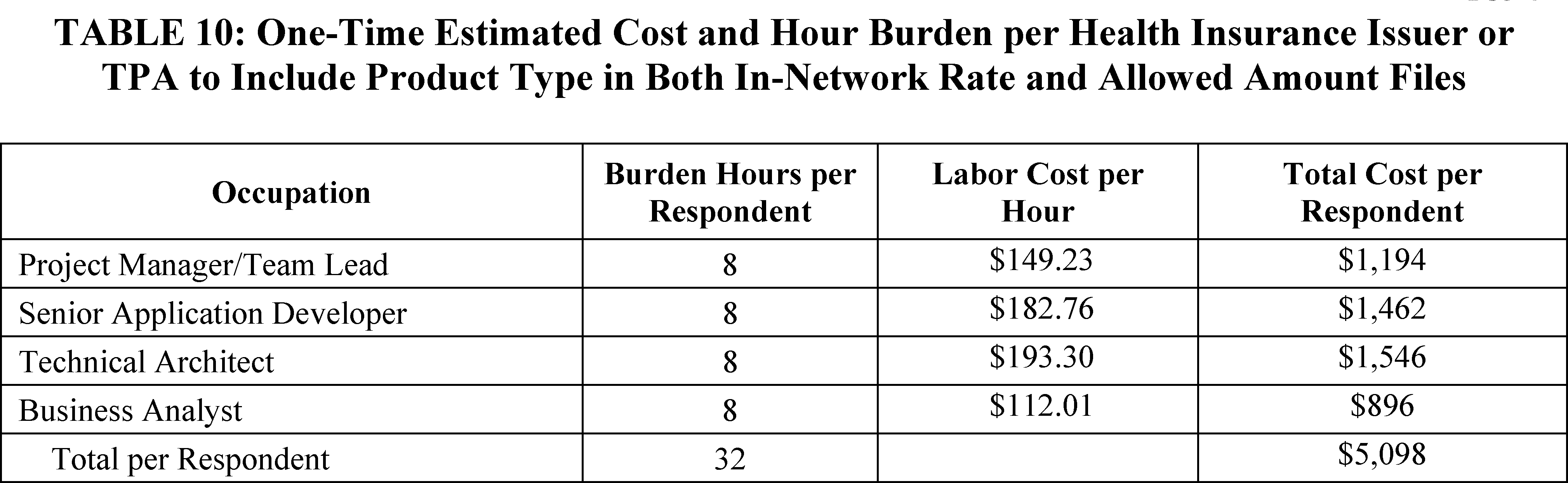

The Departments expect any additional ongoing burden with this requirement to be minimal.
The Departments requested comment on the estimated cost and burden hours presented in this ICR, including any additional costs or challenges that may not have been identified. The Departments did not receive any comments on these estimates.
3. ICRs Regarding Requirements To Report Dollar Amounts Except for Only “Percentage-of-Billed-Charges” Payments (26 CFR 54.9815-2715A3(b)(1)(i)(E)(1), 29 CFR 2590.715-2715A3(b)(1)(i)(E)(1), and 45 CFR 147.212(b)(1)(i)(E)(1))
The Departments proposed to amend redesignated 26 CFR 54.9815-2715A3(b)(1)(i)(E)( 1), 29 CFR 2590.715-2715A3(b)(1)(i)(E)( 1), and 45 CFR 147.212(b)(1)(i)(E)( 1) to clarify that plans and issuers are required to report in-network rates as a dollar amount, except when the contractual arrangement specifies payment as a percentage of billed charges and it is not possible to determine a dollar amount before the bill is generated. In those cases, the plan or issuer would instead be required to report the applicable percentage.
The Departments are finalizing this requirement as proposed. This requirement is intended to improve data quality by ensuring plans and issuers consistently use a percentage when the contract bases payment on a percentage of billed charges and plans and issuers cannot calculate a dollar amount in advance.
Since this requirement codifies an exception that permits reporting a percentage instead of a dollar amount when reflecting percentage-of-billed charges arrangements, the Departments expect that many plans and issuers may already be compliant with this requirement. However, because the Departments cannot determine the extent to which plans and issuers have already included any necessary modifications to their In-network Rate Files, the Departments estimate a one-time burden and cost associated with complying with this requirement.
For a low-end estimate, the Departments assume that 20 percent of plans (or TPAs on behalf of the plan) and issuers will need to make this one-time modification to their In-network Rate Files, while for a high-end estimate, it is assumed that all plans (or TPAs on behalf of the plan) and issuers will need to make this adjustment to their In-network Rate Files.
The Departments estimate, on average, each affected issuer or TPA will require 8 hours from a Project Manager or Team Lead (at $149.23 per hour), 8 hours from a Technical Architect (at $193.30 per hour), 8 hours of work from a Senior Application Developer (at $182.76 per hour), and 8 hours from a Business Analyst (at $112.01 per hour) to review their In-network Rate File generation code to determine if there are any instances where a non-dollar amount appears in the file and then make the necessary coding adjustments and validate the changes, resulting in an estimated one-time burden of 32 hours, ( printed page 63812) with an estimated associated cost of $5,098 per issuer or TPA, as shown in Table 12.
The Departments estimate that, under the low-end scenario, affected issuers and TPAs will incur a total one-time burden of 9,651 hours with an associated total cost of approximately $1,537,677. Under the high-end scenario, for all issuers and TPAs, the total one-time burden will be 48,256 hours with an associated total cost of approximately $7,688,387, as shown in Table 13.
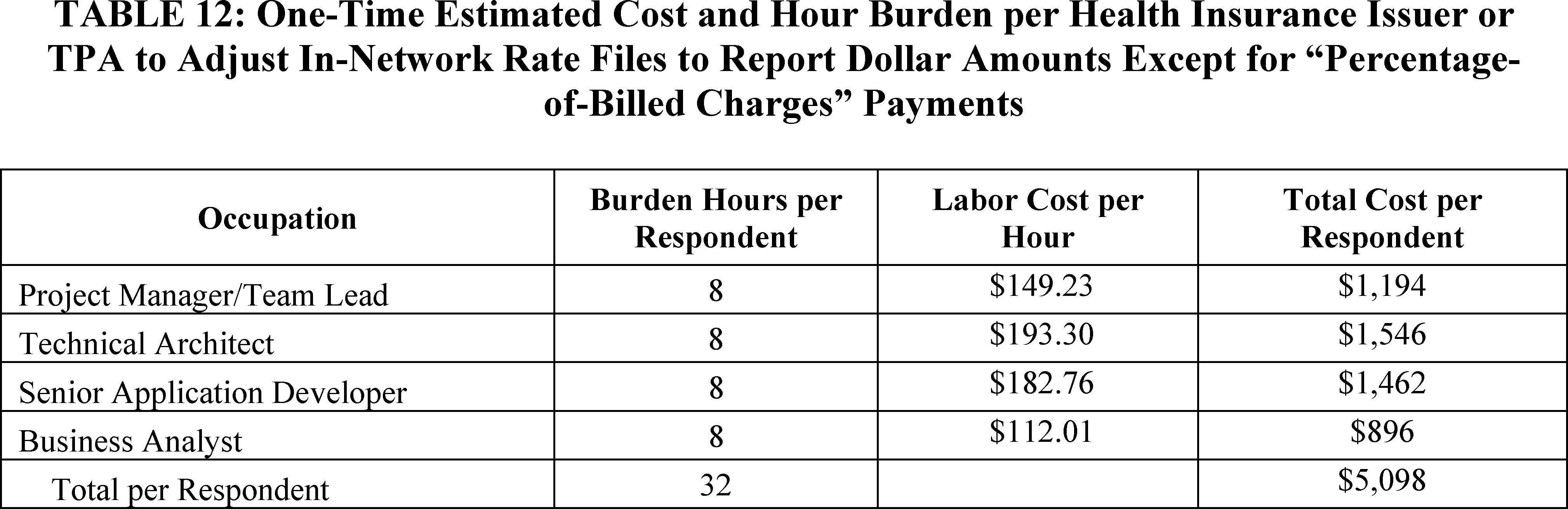
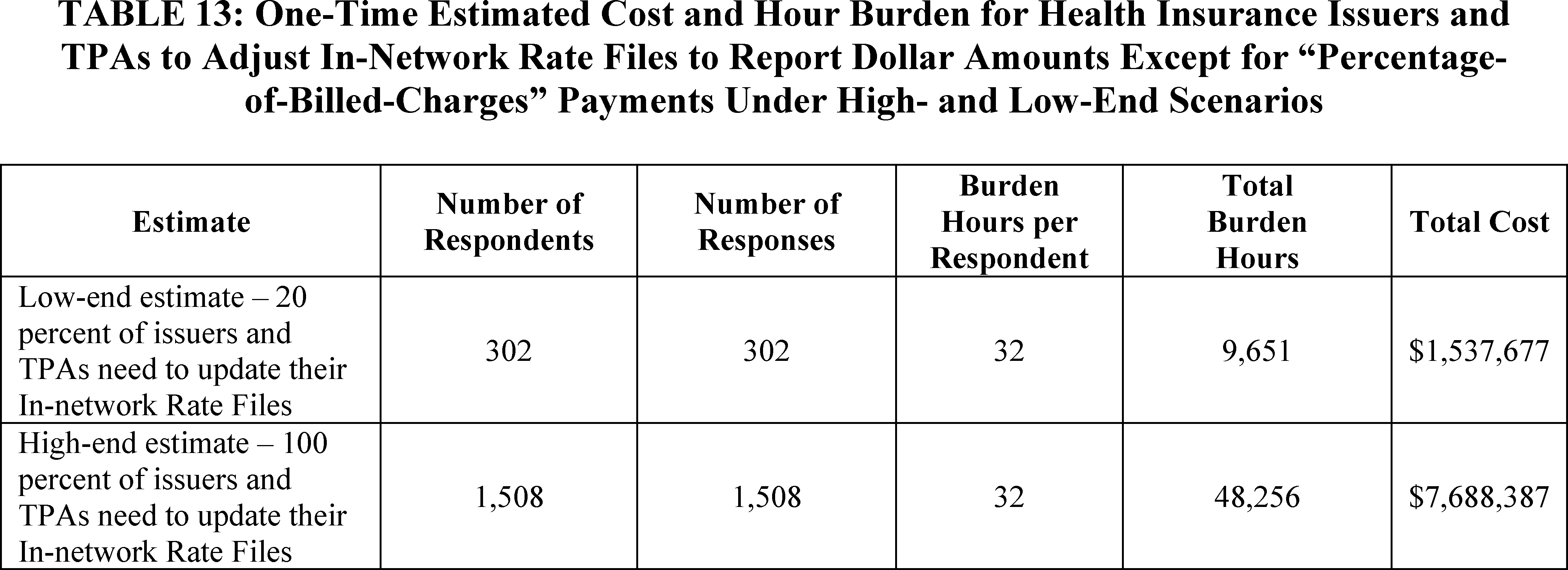
The Departments expect any additional ongoing costs related to the requirement that plans and issuers report in-network rates as a dollar amount, except when the contractual arrangement specifies payment as a percentage of billed charges and it is not possible to determine a dollar amount before the bill is generated, to be minimal.
The Departments requested comment on the estimated costs and burden hours presented in this ICR, including any additional costs or challenges that may not have been identified. The Departments did not receive any comments on these estimates.
4. ICRs Regarding Requirements To Report Required Enrollment Data
The Departments proposed to add a new provision at 26 CFR 54.9815-2715A3(b)(1)(i)(E), 29 CFR 2590.715-2715A3(b)(1)(i)(E), and 45 CFR 147.212(b)(1)(i)(E) that would require plans and issuers to include the current enrollment totals (number of individuals) for each coverage option associated with the applicable In-network Rate File, as of the date the file is posted.
Due to operational, implementation, data reliability, and business vulnerability concerns raised by commenters, as discussed in section III.C.4. of this preamble, the Departments are not finalizing the proposed requirement to report enrollment data. Accordingly, the corresponding burden estimates from the proposed rules are not included in the final burden estimates of these final rules.
5. ICRs Regarding Requirements To Exclude Certain Providers From In-Network Rate Files and To Publish a Taxonomy File (26 CFR 54.9815-2715A3(b)(1)(i)(F), 29 CFR 2590.715-2715A3(b)(1)(i)(F) and 45 CFR 147.212(b)(1)(i)(F), and 26 CFR 54.9815-2715A3(b)(2)(ii), 29 CFR 2590.715-2715A3(b)(2)(ii), and 45 CFR 147.212(b)(2)(ii))
In the proposed rules, the Departments proposed to amend the paragraph on required information under 26 CFR 54.9815-2715A3(b)(1)(i), 29 CFR 2590.715-2715A3(b)(1)(i), and 45 CFR 147.212(b)(1)(i) to increase access to and improve the usability of the data reported in the In-network Rate File, by adding new paragraph (b)(1)(i)(F). This new paragraph would require plans and issuers to exclude from their In-network Rate Files a provider's negotiated rate (provider-rate ( printed page 63813) combination) for an item or service if the plan or issuer determines it is unlikely that such provider would be reimbursed for such item or service given that provider's area of specialty according to the plan's or issuer's internal provider taxonomy used during the claims adjudication process. The Departments are finalizing this requirement with a modification of requiring plans and issuers to exclude provider-rate combinations that are unlikely given the provider's specialty according to the plan's or issuer's internal provider taxonomy or other internal rules used during the claims adjudication process.
In addition, the Departments proposed to add at 26 CFR 54.9815-2715A3(b)(2)(iii), 29 CFR 2590.715-2715A3(b)(2)(iii), and 45 CFR 147.212(b)(2)(iii) to require plans and issuers to publish a contextual machine-readable file, referred to as a Taxonomy File, that includes the plan or issuer's internal provider taxonomy, which maps items and services (represented by a billing code) to provider specialties (represented by specialty code) to determine if the plan or issuer should deny reimbursement for an item or service because it was not furnished by a provider in an appropriate specialty. This new file is intended to increase transparency by showing how decisions to exclude certain provider-rate combinations from the In-network Rate File were determined. The Departments are finalizing the Taxonomy File requirement as proposed with three modifications: first, adding that plans and issuers must base the Taxonomy File on their internal provider taxonomy or other internal rules used during the claims adjudication process to determine if the plan or issuer should deny reimbursement for an item or service based on the provider's specialty; second, specifying that the information provided in the Taxonomy File, regardless of whether it is based on an internal taxonomy or other internal rules, must be expressed as pairings of items and services (represented by billing codes) with provider specialties (represented by specialty codes which are derived from the Health Care Provider Taxonomy code set established by the National Uniform Claim Committee (NUCC)); and third, a technical modification renumbering the paragraph as 26 CFR 54.9815-2715A3(b)(2)(ii), 29 CFR 2590.715-2715A3(b)(2)(ii), and 45 CFR 147.212(b)(2)(ii).
Taken together, these provisions require plans and issuers to perform two specific tasks: (1) update their current programmatic code to exclude certain provider-rate combinations from the existing In-network Rate Files, and (2) create and publish a new Taxonomy File.
The Departments have determined that: (1) plans (or TPAs on behalf of plans) and issuers already maintain a complete listing of their in-network providers along with the specialties of those providers; (2) plans and issuers possess an internal provider taxonomy, or other internal rules, needed to map provider specialties to the appropriate billing codes; and (3) plans and issuers have implemented similar logic within their claims adjudication systems to pend or deny claims that fall outside a provider's scope of practice, for example, if a claim for brain surgery is submitted by a provider whose specialty does not align with that procedure.
Given this, the additional burden and cost required to automate the exclusion of certain provider-rate combinations is expected to include: (1) extracting and adapting the claims adjudication logic built off the plans' and issuers' internal provider taxonomy, or other internal rules, that determine whether a provider is authorized to bill for a particular service given the provider's specialty, for use in generating the In-network Rate File; (2) implementing an automated process to extract the in-network provider list along with their specialties from the plan's or issuer's system of record; and (3) modifying the programmatic logic of the In-network Rate File generation software to exclude provider-rate combinations for those that are not eligible to submit claims for specific services.
Additionally, posting a Taxonomy File will require plans (or TPAs on behalf of plans) and issuers to list each taxonomy code they use and specify the associated service codes (for example, CPT codes). These mappings are typically stored in a reference table used by issuer claims adjudication systems. Plans (or TPAs on behalf of plans) and issuers that use other internal rules during their claims adjudication process to determine whether to deny reimbursement for an item or services given the provider's specialty will need to map those rules to a taxonomy that matches specialty codes with billing codes. The Taxonomy File must be produced separately, in addition to each In-network Rate File.
To update the programmatic code to exclude certain provider-rate combinations from the existing In-network Rate File and to create and publish a new Taxonomy File, the Departments estimate a one-time cost and burden for plans (or TPAs on behalf of plans) and issuers. On average, each issuer or TPA will require 48 hours from a Project Manager or Team Lead (at $149.23 per hour), 48 hours from a Technical Architect (at $193.30 per hour), 48 hours from a Senior Application Developer (at $182.76 per hour), and 48 hours from a Business Analyst (at $112.01 per hour). As shown in Table 14, this results in a total estimated one-time burden of 192 hours per issuer or TPA, with an associated cost of approximately $30,590. For all 1,508 issuers and TPAs, as shown in Table 15, the Departments estimate a total one-time burden of 289,536 hours and a total cost of approximately $46,130,323.
( printed page 63814)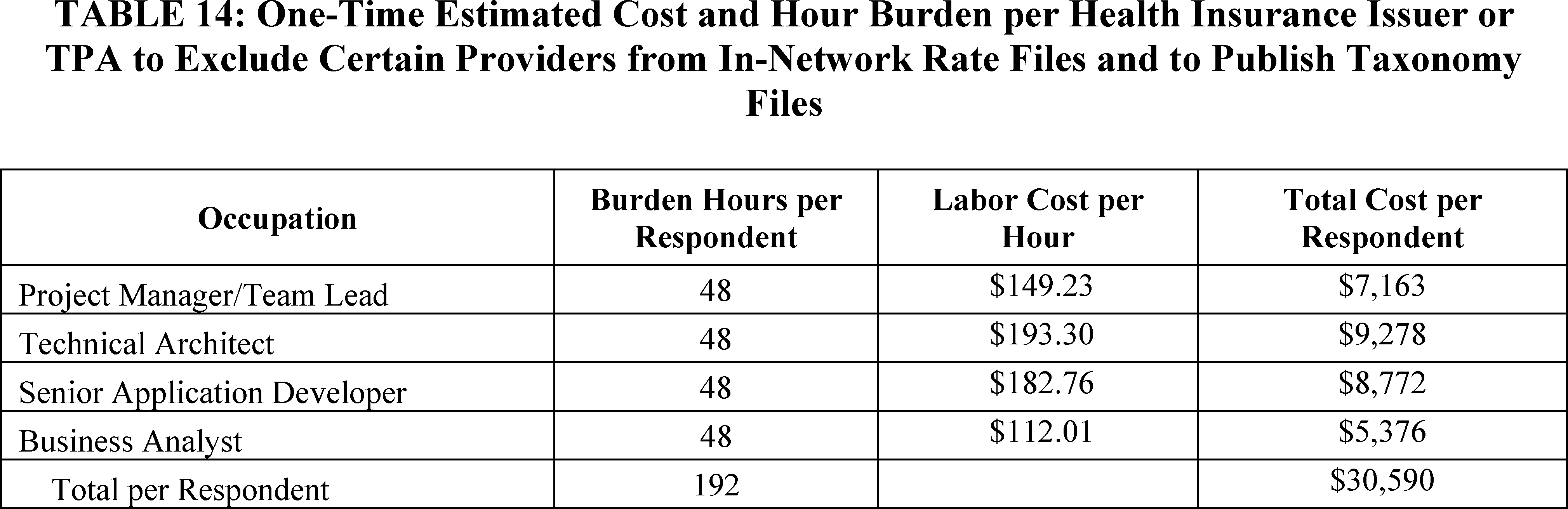
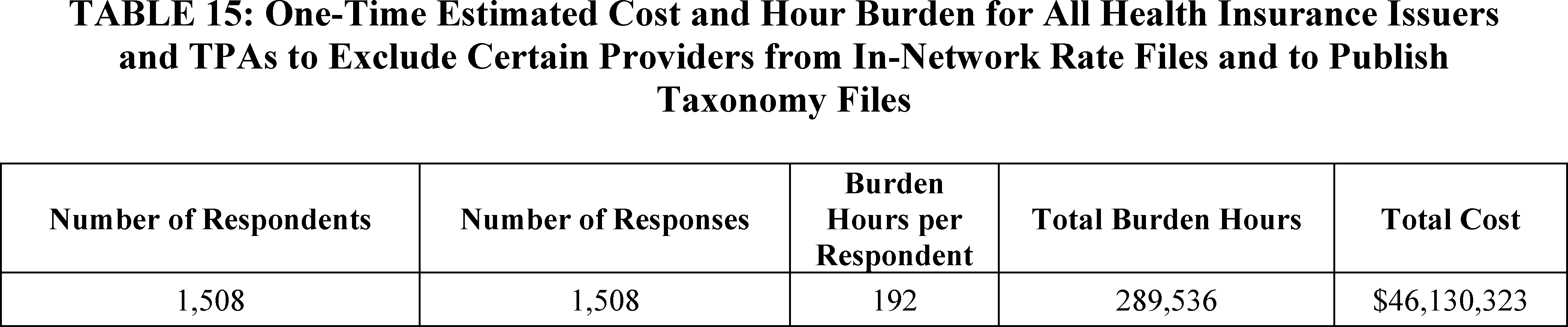
The Departments expect ongoing maintenance costs for the In-network Rate Files to include support for minor changes to the programming logic used to generate these files to be minimal.
The Departments requested comment on the estimated cost and burden hours presented in this ICR, including any additional costs or challenges that may not have been identified. A commenter noted that the ongoing costs associated with Taxonomy Files are not accounted for. The Departments acknowledge this comment but expect that any additional ongoing costs associated with maintaining Taxonomy Files will be minimal because the files are expected to rely primarily on existing data, mappings, code sets, and other internal rules that plans (or TPAs on behalf of plans) and issuers maintain and periodically update as part of their normal claims adjudication and operational processes. These existing resources may include listings of in-network providers and their specialties and internal provider taxonomies or other internal rules used to map provider specialties to appropriate billing codes, as well as similar programming logic used within claims adjudication systems to identify claims for items and services that may fall outside a provider's scope of practice.
6. ICRs Regarding Requirements To Lower Claims Reporting Threshold in the Allowed Amount File From 20 to 11 Claims (26 CFR 54.9815-2715A3(b)(1)(ii)(C), 29 CFR 2590.715-2715A3(b)(1)(ii)(C), and 45 CFR 147.212(b)(1)(ii)(C))
The Departments proposed to amend 26 CFR 54.9815-2715A3(b)(1)(ii)(C), 29 CFR 2590.715-2715A3(b)(1)(ii)(C), and 45 CFR 147.212(b)(1)(ii)(C) to require plans and issuers to include data in the Allowed Amount File for items and services provided under a single plan or coverage when there are 11 or more unique claims for that item or service in a single health insurance market, lowering the current threshold from 20 to 11 to expand the data available.
The Departments are finalizing this requirement as proposed. The Departments assume this requirement will not create additional burden for plans and issuers. Existing systems are currently designed to report out-of-network allowed amounts when there are more than 20 claims for a covered item or service within a relevant 90-day period. Lowering the threshold to 11 claims is expected to require only marginal system variable adjustments, with any associated costs absorbed into the routine system maintenance activities that plans (or TPAs on behalf of plans) and issuers already perform in the normal course of business. The change constitutes a standard simple administrative update, rather than a system redesign, and therefore does not necessitate additional infrastructure, a dedicated project budget, or significant developer time. The adjustment can be implemented by existing IT personnel as part of their routine operational duties, with no disruption and minimal costs.
A commenter expressed concern that lowering the claims threshold would significantly increase operational burden by expanding data volume, file size, and processing complexity, and would require additional validation, monitoring, and system adjustments. The Departments acknowledge this concern but have determined that, although the change may increase the data volume and file size for some plans and issuers, it is not expected to materially affect processing complexity given that the underlying processes for validation, monitoring, and file generation remain unchanged. Thus, the Departments have determined that this modification will only affect the threshold for inclusion, rather than the structure or logic of the files, and therefore expect any associated burden to be minimal. ( printed page 63815)
7. ICRs Regarding Expansion of Reporting and Lookback Periods for Allowed Amount Files From 90 Days to 6 Months and 180 Days to 9 Months (26 CFR 54.9815-2715A3(b)(1)(ii)(C), 29 CFR 2590.715-2715A3(b)(1)(ii)(C), and 45 CFR 147.212(b)(1)(ii)(C))
The Departments proposed to amend 26 CFR 54.9815-2715A3(b)(1)(ii)(C), 29 CFR 2590.715-2715A,3(b)(1)(ii)(C), and 45 CFR 147.212(b)(1)(ii)(C) to expand the data included in the Allowed Amount Files by requiring plans and issuers to report on items and services furnished by out-of-network providers over a 6-month reporting period starting 9 months before the file's publication date, replacing the current 90-day reporting period that begins 180 days prior to the file's publication date.
The Departments are finalizing this requirement as proposed. The Departments assume that extending the reporting period from 90 days to 6 months and the lookback period from 180 days to 9 months will not create additional burden for plans and issuers, as they currently have automated systems in production to report out-of-network allowed amounts. Implementing this change is expected to require only minimal system modifications to accommodate the updated reporting and lookback periods, with any associated costs absorbed into the routine system maintenance activities that plans (or TPAs on behalf of plans) and issuers already perform in the normal course of business.
As such, this change constitutes a standard simple administrative update, rather than a system redesign, and therefore does not necessitate additional infrastructure, a dedicated project budget, or significant developer time.
The Departments requested comment on the discussion of potential costs and burden associated with this proposed requirement, including any additional costs or challenges that may not have been identified. The Departments did not receive any comments on this aspect of the proposal.
8. ICRs Regarding Requirements To Aggregate Allowed Amount Files by Market Type and Allow Service Providers or Other Parties To Aggregate by Market Type Across Multiple Self-Insured Group Health Plans (26 CFR 54.9815-2715A3(b)(1)(ii), 29 CFR 2590.715-2715A3(b)(1)(ii), and 45 CFR 147.212(b)(1)(ii)) and Permit Such Aggregation at the TPA Level (26 CFR 54.9815-2715A3(b)(5)(iv), 29 CFR 2590.715-2715A3(b)(5)(iv), and 45 CFR 147.212(b)(5)(iv))
The Departments proposed to amend 26 CFR 54.9815-2715A3(b)(1)(ii), 29 CFR 2590.715-2715A3(b)(1)(ii), and 45 CFR 147.212(b)(1)(ii) to require plans and issuers to aggregate out-of-network data reporting by health insurance market, specifically by grouping plan-level data into one of four categories: (1) small group market, (2) individual market (other than short-term, limited-duration insurance or individual health insurance coverage that consists solely of excepted benefits, as defined in 45 CFR 148.220), (3) large group market, and (4) all self-insured group health plans maintained by the plan sponsor (other than account-based plans, as defined in 26 CFR 54.9815-2711(d)(6)(i), 29 CFR 2590.715-2711(d)(6)(i), and 45 CFR 147.126(d)(6)(i), and plans that consist solely of excepted benefits, as defined in 26 CFR 54.9831-1(c), 29 CFR 2590.732(c), and 45 CFR 146.145(b)). Under current technical reporting requirements, plans and issuers may, but are not required to, aggregate data across multiple plans or policies to meet public disclosure requirements for the Allowed Amount Files. The Departments also proposed to amend redesignated 26 CFR 54.9815-2715A3(b)(5)(iv), 29 CFR 2590.715-2715A3(b)(5)(iv), and 45 CFR 147.212(b)(5)(iv) to permit Allowed Amount Files to be aggregated by market type at the service provider level, rather than the plan level, for more than one self-insured group health plan, including those offered by different plan sponsors.
The Departments are finalizing these requirements as proposed. The Departments have determined that this requirement will not require plans (or TPAs on behalf of plans) and issuers to make substantial changes to how they currently generate Allowed Amount Files. Instead, it requires modifying the output so that, rather than producing a separate Allowed Amount File for each plan or policy, plans and issuers will aggregate data into a single file for each applicable market category. The four market categories, small group, large group, individual, and plans in self-insured group markets, are already well established under existing market-wide regulations, and plans and issuers can use existing data elements in their systems to classify each plan appropriately.[138]
The Departments estimate that plans (or TPAs on behalf of plans) and issuers will incur a one-time cost and burden to modify and update their existing Allowed Amount File processes to produce output files aggregated by market segment. On average, each issuer or TPA will require 16 hours from a Project Manager or Team Lead (at $149.23 per hour), 16 hours from a Technical Architect (at $193.30 per hour), 16 hours of work from a Senior Application Developer (at $182.76 per hour), and 16 hours from a Business Analyst (at $112.01 per hour) to complete this work. As shown in Table 16, this results in a total estimated one-time burden of 64 hours per issuer or TPA, with an associated cost of approximately $10,197. For all 1,508 issuers and TPAs, as shown in Table 17, the Departments estimate a total one-time burden of 96,512 hours and a total cost of approximately $15,376,774.
( printed page 63816)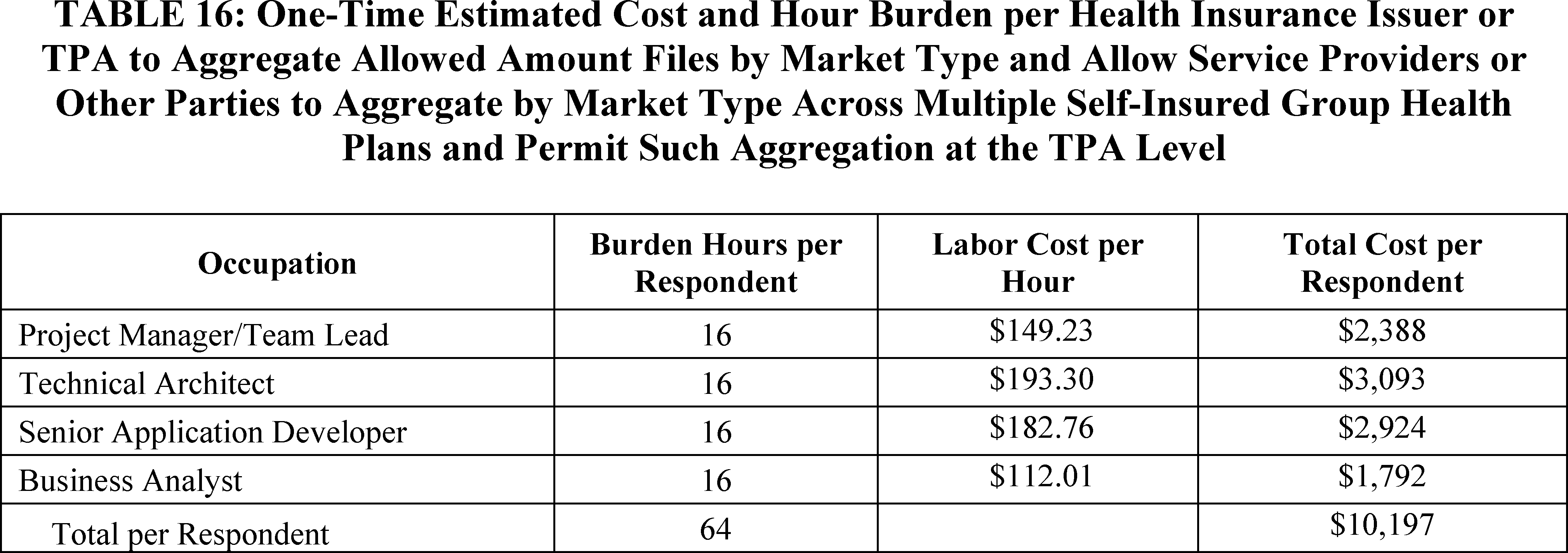
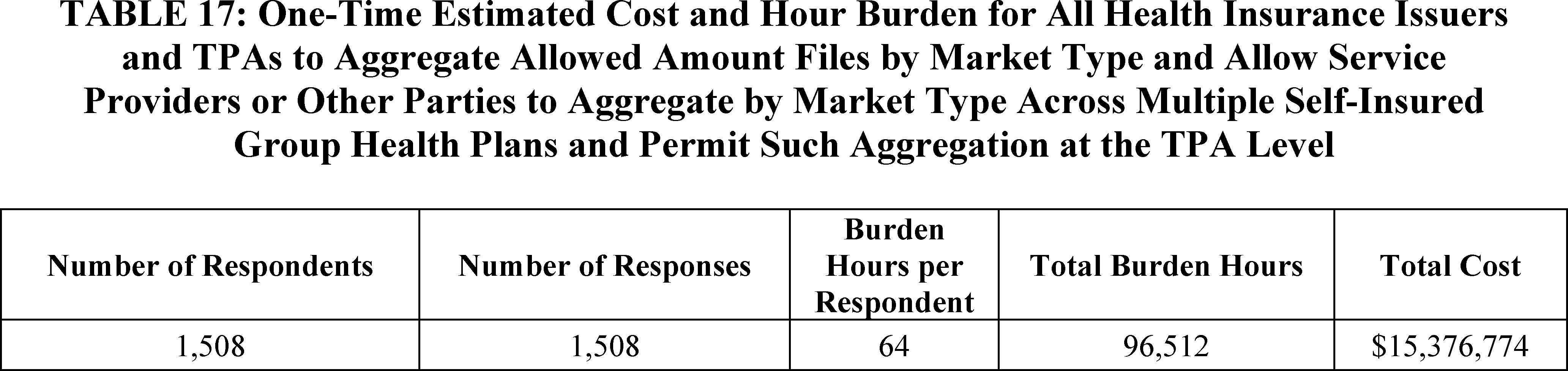
The Departments expect any additional ongoing costs related to aggregating Allowed Amount Files by market type, including allowing service providers or other parties to aggregate data across multiple self-insured group health plans to be minimal.
The Departments requested comment on the estimated costs and burden hours presented in this ICR, including any additional costs or challenges that may not have been identified. The Departments did not receive any comments on these estimates.
9. ICRs Regarding Requirements To Add a Change-Log File Related to the In-Network Rate File Disclosures
The Departments proposed to add a new provision under 26 CFR 54.9815-2715A3(b)(2)(i), 29 CFR 2590.715-2715A3(b)(2)(i), and 45 CFR 147.212(b)(2)(i) that would require plans and issuers to publish a Change-log File on a quarterly basis, on the same day the In-network Rate File is published, identifying all changes made since the previous version.
After consideration of the comments received, as discussed in section III.C.8.a. of this preamble, and further evaluation of the operational complexity and burden associated with this requirement, including the significant burden identified by commenters, the Departments are not finalizing the proposed requirement for plans and issuers to publish a Change-log File. Accordingly, the corresponding burden estimates from the proposed rules are not included in the final burden estimates of these final rules.
10. ICRs Regarding Requirements To Implement the Disclosures Required for the Utilization File (26 CFR 54.9815-2715A3(b)(2)(i), 29 CFR 2590.715-2715A3(b)(2)(i), and 45 CFR 147.212(b)(2)(i)).
The Departments proposed to add a new provision at 26 CFR 54.9815-2715A3(b)(2)(ii), 29 CFR 2590.715-2715A3(b)(2)(ii), and 45 CFR 147.212(b)(2)(ii) requiring a Utilization File which would require plans and issuers to list all items and services for which a claim has been submitted and reimbursed, in whole or in part by in-network providers and identify each provider who submitted claims for each item or service. The Departments also proposed that the Utilization File to include information from the 12-month period that ends 6 months prior to the publication of the Utilization File and be updated every 12 months.
In response to public comments, as discussed in section III.C.8.b. of this preamble, the Departments are finalizing this requirement with the modification of the Utilization File as new paragraph 26 CFR 54.9815-2715A3(b)(2)(i), 29 CFR 2590.715-2715A3(b)(2)(i), and 45 CFR 147.212(b)(2)(i) and by modifying the lookback period to include data from the previous plan or policy year, rather than the 12-month period ending 6 months prior to publication, to prevent files from including utilization data across plan or policy years. The Departments have determined that this modification does not materially affect the underlying assumptions used to estimate burden for this ICR and that any associated burden will be minimal.
The Departments assume that data for the new Utilization File is readily accessible to all plans and issuers through their existing claims databases. Posting a Utilization File requires plans and issuers to programmatically generate a list of each unique combination of provider NPI, TIN, and Place of Service Code from their claims database for in-network providers reimbursed for any covered item or service during a specified period. In addition to the one-time burden and cost associated with the initial coding effort to create the Utilization File, plans and issuers will incur annual ongoing operational burden and cost to produce the annual Utilization File, validate the data, store the Utilization File, and post ( printed page 63817) it to the designated public access location.
Because the process for generating the Utilization File is similar to the logic used for creating the Allowed Amount File, and existing programmatic logic could serve as a starting point for the creation of the Utilization File, the Departments assume the burden and cost will be lower than those originally estimated in the 2020 final rules for the development and implementation of the Allowed Amount File.
A few commenters noted that the burden associated with the Utilization File is overstated. They explained that the requirement represents an incremental extension of existing claims-based workflows and is significantly less complex than the original Allowed Amount File. They further emphasized that the Utilization File does not necessitate a new system and is updated annually rather than monthly.
The Departments thank the commenters for their insight and agree with their assessment that the burden associated with the Utilization File was overstated. A commenter recommended revising the estimated hours and costs downward. After reviewing the initial estimate based on commenters' input, the Departments acknowledge that certain previously estimated burden hours, particularly for roles such as for a Senior Application Developer and Technical Architect, were higher than necessary to implement the Utilization File. Accordingly, the Departments have revised the Utilization File burden estimate to better align with the estimates for the other newly required contextual files and updates to existing machine-readable files. As a result, the Departments have reduced the estimated one-time burden hours and costs downward to more accurately reflect the expected implementation burden.
Under the revised estimate, each issuer or TPA, on average, will require 80 hours from a Scrum Master (at $141.16 per hour), 160 hours from a Technical Architect (at $193.30 per hour), a total of 320 hours of work from two Senior Application Developers (at $182.76 per hour), 80 hours from a Business Analyst (at $112.01 per hour), and 40 hours from a DevOps Engineer III (at $160.20 per hour) to develop and complete the Utilization File. As shown in Table 18, this results in a total estimated burden of 680 hours per issuer or TPA, with an associated cost of approximately $116,073. For all 1,508 issuers and TPAs, as shown in Table 19, the Departments estimate a total one-time burden of 1,025,440 hours and a total cost of approximately $175,037,782.
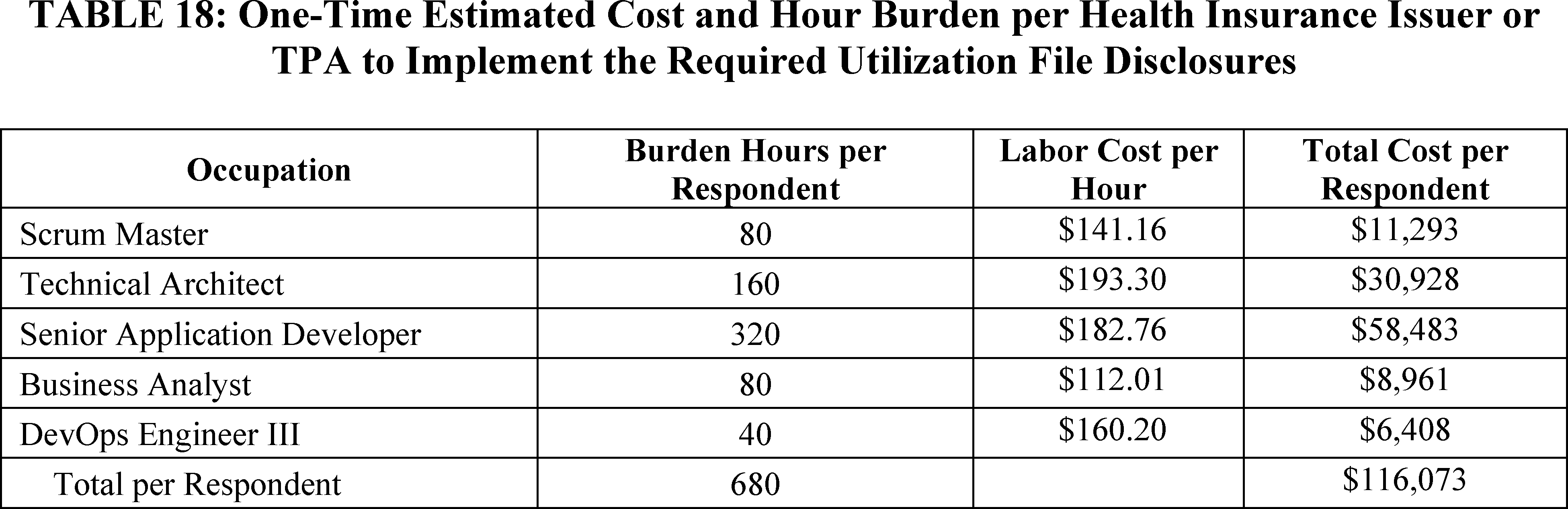

In addition to the one-time burden and cost estimated in Tables 18 and 19, plans (or TPAs on behalf of plans) and issuers will incur ongoing annual burden and cost to update the Utilization File. The Departments estimate that, on average, each issuer or TPA will annually require 6 hours from a Scrum Master (at $141.16 per hour), 16 hours of work from a Senior Application Developer (at $182.76 per hour), and 16 hours from DevOps Engineer III (at $160.20 per hour) to make the required updates. As shown in Table 20, this results in a total estimated annual burden of 38 hours per issuer or TPA, with an associated cost of approximately $6,334. For all 1,508 issuers and TPAs, as shown in Table 21, the Departments estimate a total ongoing annual burden of 57,304 hours and a total cost of approximately $9,552,155. The 3-year average costs and burden for this requirement are presented in Table 22.
( printed page 63818)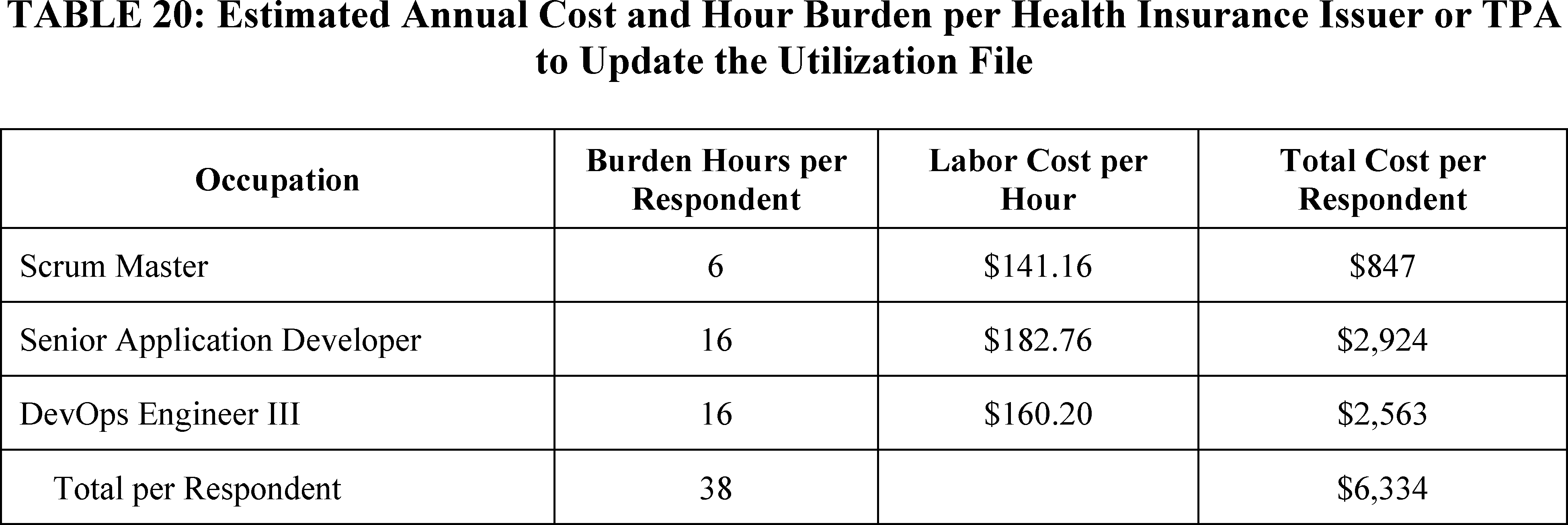

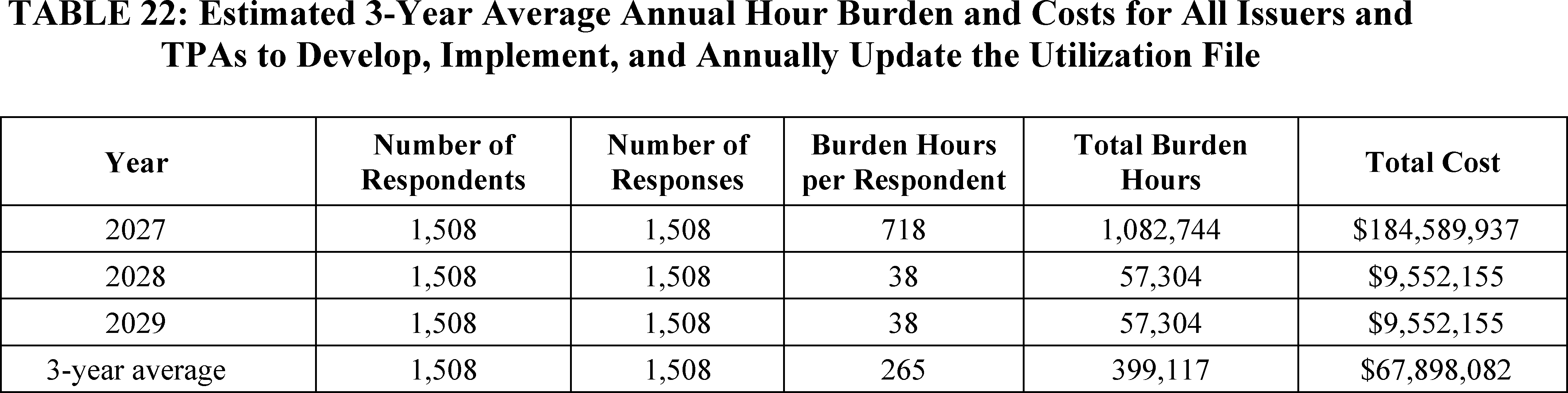
The Departments did not receive any comments on the estimated ongoing hours and costs for this provision.
11. ICRs Regarding Requirements To Add a Text File and Identify Point-of-Contact Information for Inquiries To Improve Discoverability and Accessibility of Machine-Readable Files, and Respond to Machine-Readable File Inquiries (26 CFR 54.9815-2715A3(b)(2)(iii), 29 CFR 2590.715-2715A3(b)(2)(iii), and 45 CFR 147.212(b)(2)(iii))
The Departments proposed to add new 26 CFR 54.9815-2715A3(b)(2)(iii), 29 CFR 2590.715-2715A3(b)(2)(iii), and 45 CFR 147.212(b)(2)(iii), which would establish a new requirement for plans and issuers to improve the accessibility of their machine-readable files. Under this proposal, plans (or TPAs on behalf of plans) and issuers would be required to generate a Text File that includes the URL of the page hosting the machine-readable files, a direct link to the machine-readable files themselves, and contact information, for the individual at the plan, issuer, or TPA that is responsible for the machine-readable files. This Text File would be required to be placed in the root folder of the public website domain selected to host the machine-readable files, without regard to the website's page structure. This proposed new requirement would align with similar provisions under the Hospital Price Transparency rules [139] at 45 CFR 180.50(d)(6) and is intended to enhance the discoverability, usability, and consistency of pricing information for participants, beneficiaries, and enrollees, third-party developers, researchers, and regulators.
As discussed in section III.C.8.d. of this preamble, the Departments are ( printed page 63819) finalizing this requirement with modifications to clarify that plans and issuers must provide a monitored email address for an individual or group responsible for receiving and responding to inquiries and issues related to the machine-readable files, in lieu of requiring the point-of-contact information to include a specific named individual with their title. The Departments have determined that this modification does not materially affect the burden estimate as plans and issuers may use an existing email address or establish a new dedicated inbox.
The Departments anticipate plans (or a TPA on behalf of plans) and issuers will incur a one-time development burden to update their systems to support the automated generation and publication of the required Text File. In addition to setting up the ability to produce the Text File, plans (or TPAs on behalf of plans) and issuers must identify point-of-contact information for the individual or group who will be available to address inquiries and issues related to the required machine-readable files and include this point-of-contact information in the Text Files. The plan or issuer will need to set up a mechanism to receive and respond to inquiries and issues, such an email box or online feedback form, on behalf of the identified point of contact.
The Departments estimate a one-time burden and cost for plans (or TPAs on behalf of plans) and issuers to develop, test, and implement the automation necessary to generate and post the required Text File in the root folder of their public website as well as set up a mechanism to receive and respond to inquiries and issues. On average, each issuer or TPA will require 8 hours of work from a Senior Application Developer (at $182.76), 8 hours from a Business Analyst (at $112.01 per hour), and 8 hours from a Project Manager or Team Lead (at $149.23 per hour). As shown in Table 23, this results in a total estimated one-time burden of 24 hours per entity, with an associated cost of approximately $3,552. Across all 1,508 issuers and TPAs, the Departments estimate a total one-time burden of 36,192 hours and a combined cost of approximately $5,356,416, as presented in Table 24.
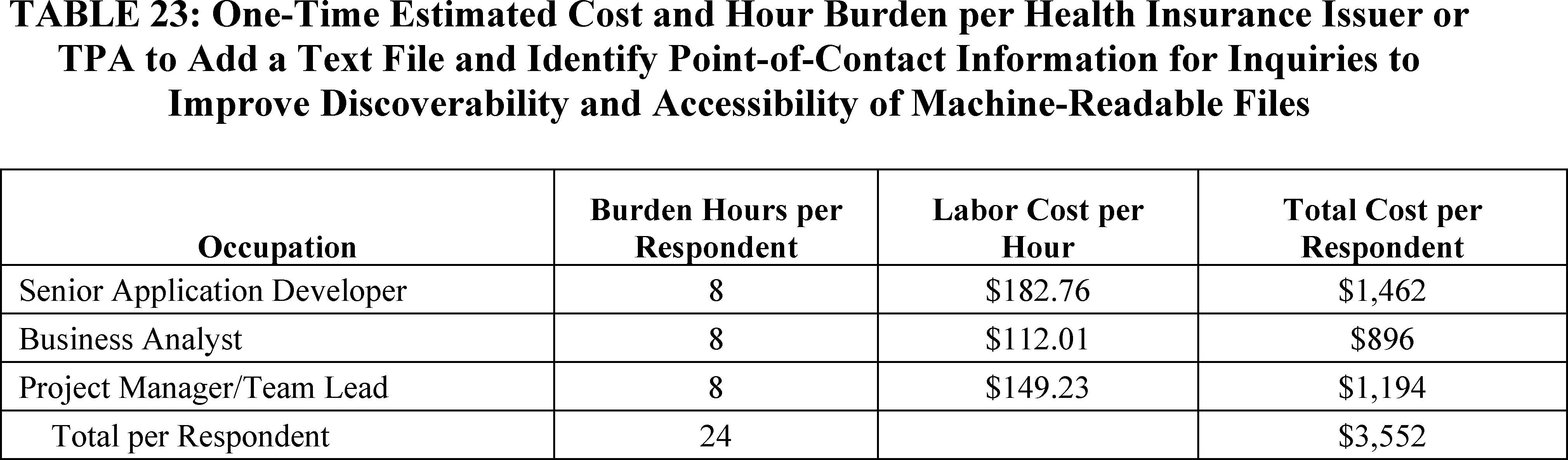
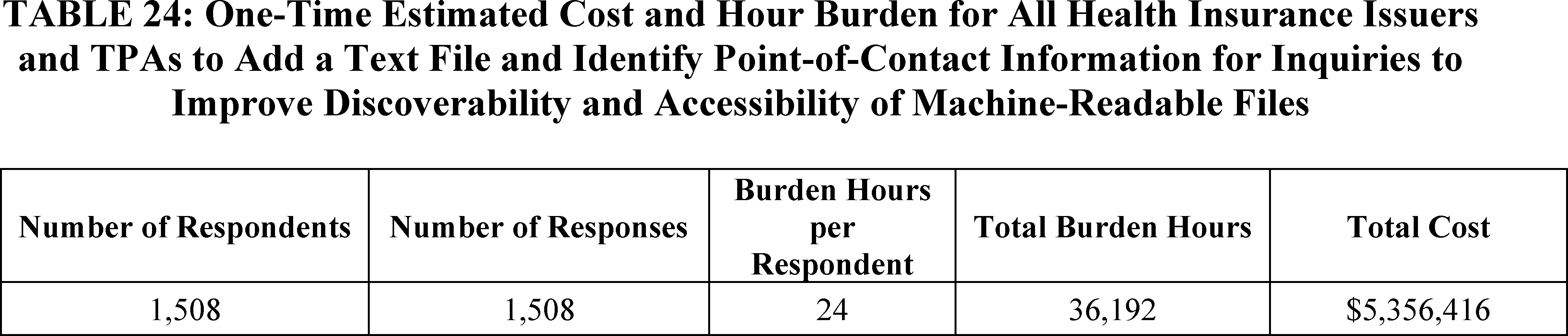
In addition to the one-time costs estimated in Tables 23 and 24, plans (or TPAs on behalf of plans) and issuers will incur ongoing annual burden and cost to respond to inquiries and issues on the machine-readable files. The Departments assume that each issuer and TPA will establish a team to triage, review, and respond to the inquiries. The Departments estimate that, on average each year, each issuer or TPA will receive approximately 30 inquiries. Addressing each inquiry is estimated to require 10 minutes of work per inquiry from an Attorney III (totaling 5 hours for 30 inquiries at $178.25 per hour), 20 minutes per inquiry from a Senior Application Developer (totaling 10 hours for 30 inquiries at $182.76), and 30 minutes per inquiry from a Project Manager/Team Lead (totaling 15 hours for 30 inquiries at $149.23 per hour). As shown in Table 25, this results in a total estimated annual burden of 30 hours per issuer or TPA, with an associated cost of approximately $4,957 for each issuer or TPA. As shown in Table 26, the Departments estimate a total ongoing annual burden of 45,240 hours and a total cost of approximately $7,475,608 for all 1,508 issuers and TPAs. The 3-year average burden hours and costs for this requirement are presented in Table 27.
( printed page 63820)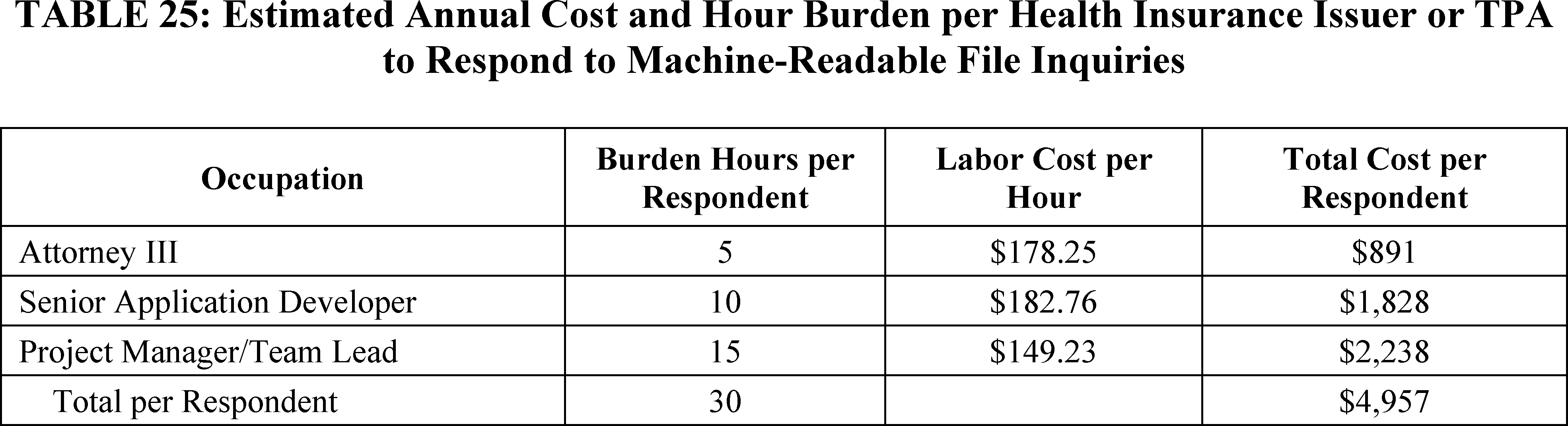

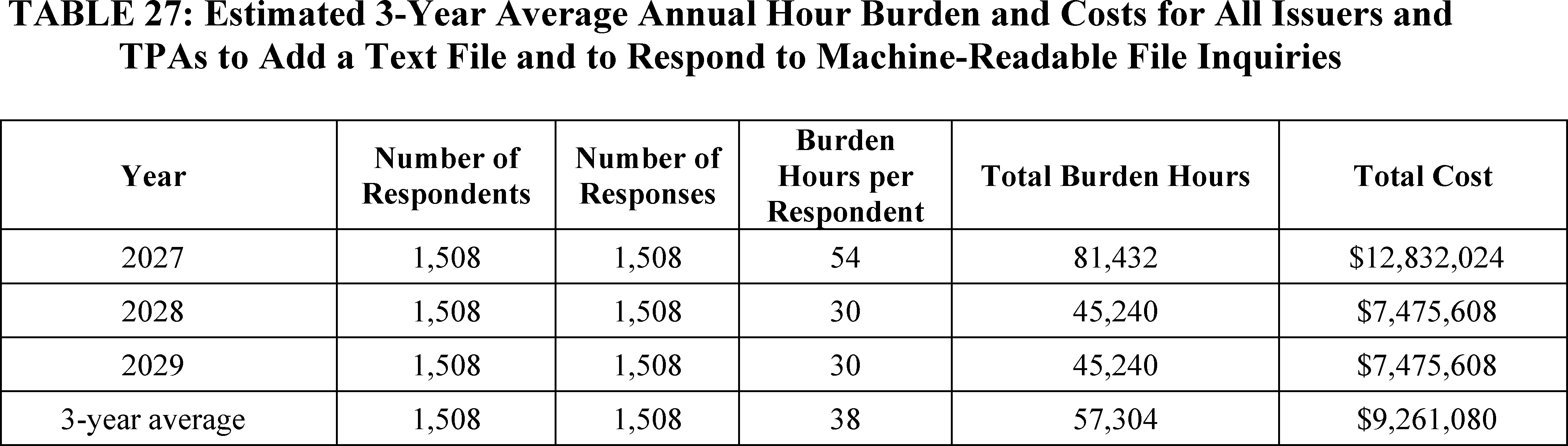
The Departments requested comment on the estimated cost and burden hours presented in this ICR, including any additional costs or challenges that may not have been identified. The Departments did not receive any comments on these estimates.
12. ICRs Regarding Requirements To Publish Machine-Readable Files in a Single Non-Proprietary, Open-Standards Format (26 CFR 54.9815-2715A1(b)(3)(i), 29 CFR 2590.715-2715A1(b)(3)(i), and 45 CFR 147.212(b)(3)(i))
The Departments are finalizing an amendment to 26 CFR 54.9815-2715A1(b)(3)(i), 29 CFR 2590.715-2715A1(b)(3)(i), and 45 CFR 147.212(b)(3)(i) to require, unless otherwise specified in 26 CFR 54.9815-2715A3, 29 CFR 2590.715-2715A3, and 45 CFR 147.212, plans and issuers to make machine-readable files available in a single non-proprietary, open-standards format, in a form and manner specified in technical implementation guidance. This requirement, which was discussed in the preamble of the proposed rules, along with a request for comment, builds on the 2020 final rules, which require machine-readable files to be publicly available in a non-proprietary, open format but did not mandate a single standardized format.
As discussed in section III.C.9. of this preamble, after considering public comments, the Departments have determined that greater standardization will improve usability, reduce data processing complexity, and enhance comparability across machine-readable files. The Departments explained that earlier technical guidance had contemplated multiple formats, including JSON, XML, and CSV, but that file developers had largely converged on JSON. Since implementation of the 2020 final rules, the Departments have observed that most plans and issuers are already using JSON, with internal analysis indicating that more than 90 percent currently use that format. The Departments have determined that requiring a single format will promote consistency, facilitate more efficient data use by developers and researchers, and reduce variation in file structure. Although some plans and issuers may incur transition costs to align with the specified format, the Departments expect the overall total costs to be limited given current industry practices and anticipate that standardization will reduce ongoing operational complexity over time.
As further discussed in section III.C.9. of this preamble, the Departments have determined that specifying the format in guidance, rather than regulation, provides flexibility to adapt to future technological developments while maintaining a consistent standard for publication. While the Departments will specify the required file format through guidance, the Departments currently intend to specify JSON as the required ( printed page 63821) format for the In-network Rate File, Allowed Amount File, Utilization File, and Taxonomy File, because it best supports the structure and exchange of Transparency in Coverage data. The Text File, as described in section III.C.8.d. of this preamble, must be published in .txt format, which is also a single, non-proprietary, open standard format.
Consistent with the Departments' findings, industry reports also indicate that JSON adoption exceeds 95 percent.[140] Accordingly, the Departments estimate one-time burden and costs only for the approximately 5-10 percent of plans and issuers expected to update their current machine-readable files to the JSON format. Based on this expectation, the Departments estimate the following one-time burden for this requirement.
On average, each issuer or plan (or TPA on behalf of a plan) will require 20 hours from a Project Manager/Team Lead ($149.23 per hour), 20 hours from a Scrum Master (at $141.16 per hour), 60 hours from a Technical Architect (at $193.30 per hour), 60 hours of work from a Senior Application Developer (at $182.76 per hour), 5 hours from a Business Analyst (at $112.01 per hour), and 5 hours from a DevOps Engineer III (at $160.20 per hour). As shown in Table 28, this results in a one-time estimated burden of 170 hours for each issuer or TPA, with an associated cost of approximately $29,732.
For the 151 affected issuers and TPAs [141] as shown in Table 29, the Departments estimate a total one-time burden of 25,636 hours and a total cost of approximately $4,483,653.
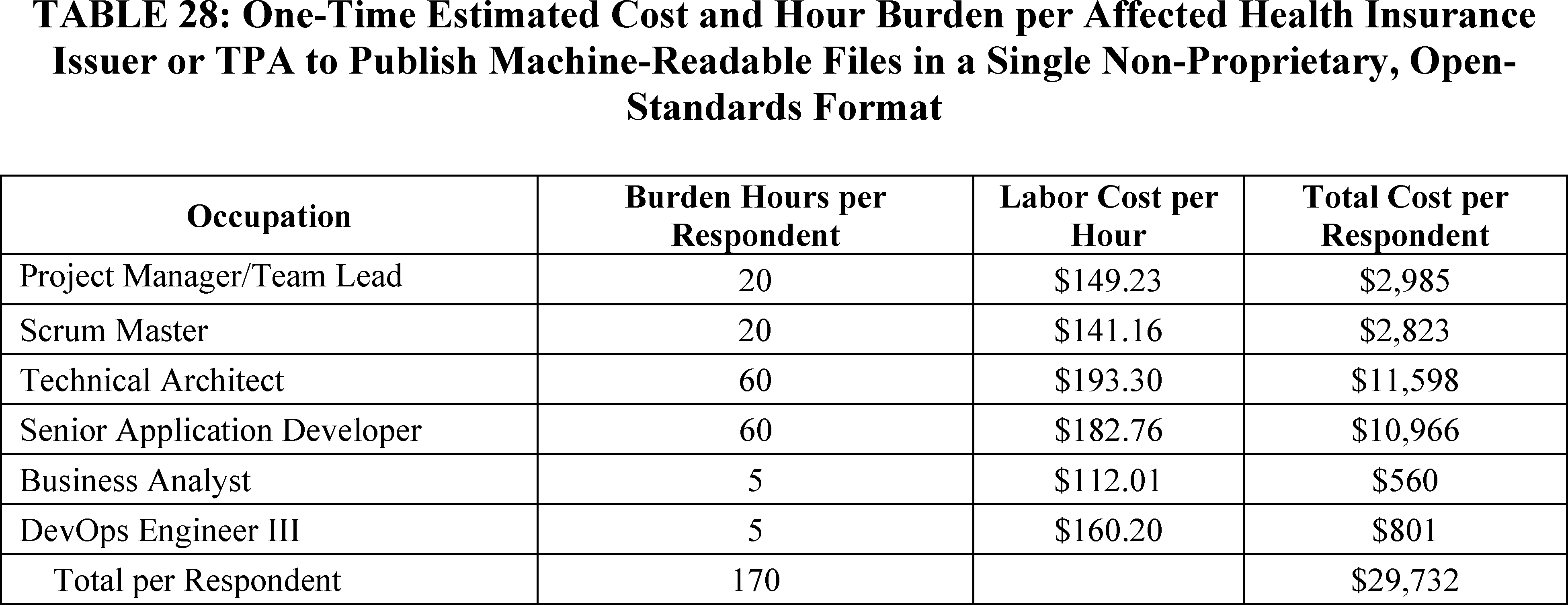
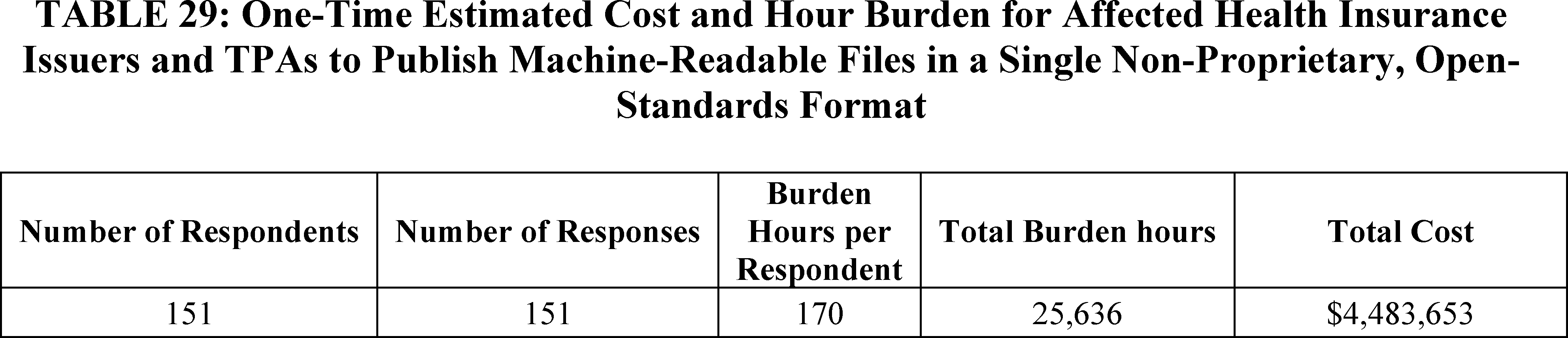
The Departments do not anticipate any ongoing costs associated with this requirement because, once implemented, plans and issuers are expected to maintain compliance using existing processes and systems without incurring additional recurring burden.
13. ICRs Regarding Requirements To Add a Price Transparency Footer Link on Website Directing Users to the Location of the Machine-Readable Files (26 CFR 54.9815-2715A3(b)(3)(iii), 29 CFR 2590.715-2715A3(b)(3)(iii), and 45 CFR 147.212(b)(3)(iii))
The Departments proposed to add a new requirement at 26 CFR 54.9815-2715A3(b)(3)(iii), 29 CFR 2590.715-2715A3(b)(3)(iii), and 45 CFR 147.212(b)(3)(iii) to improve user access to machine-readable files published under paragraphs (b)(1) and (2). Specifically, plans and issuers would be required to include a link to the internet domain where the machine-readable files are hosted on the footer of their website. This link would be required to appear on the home page and on any other page that includes a footer and must be labeled as “Price Transparency” or “Transparency in Coverage.”
The Departments are finalizing this requirement as proposed. The Departments anticipate that the burden associated with this requirement will be minimal, as it will involve only basic website modifications. ( printed page 63822)
The Departments requested comment on the discussion of potential costs and burden associated with this ICR in the proposed rules, including any additional costs or challenges that may not have been identified. The Departments did not receive any comments on this discussion.
14. ICRs Regarding Requirements To Attest to Machine-Readable Files (26 CFR 54.9815-2715A3(b)(1)(iv), 29 CFR 2590.715-2715A3(b)(1)(iv), and 45 CFR 147.212(b)(1)(iv))
As discussed in section III.C.7. of this preamble, the Departments are finalizing a requirement for group health plans and health insurance issuers to attest, to the best of their knowledge and belief, the accuracy and completeness of the information contained in their machine-readable files. The attestation requirement is intended to enhance confidence in the disclosures and further align the Transparency in Coverage requirements with the Hospital Price Transparency framework.
Specifically, the Departments are finalizing provisions at 26 CFR 54.9815-2715A3(b)(1)(iv), 29 CFR 2590.715-2715A3(b)(1)(iv), and 45 CFR 147.212(b)(1)(iv), which establish a new requirement for group health plans and health insurance issuers to include an attestation and related identifying information within each machine-readable file required under paragraphs (b)(1)(i) through (iii) and (b)(2)(i) and (ii) of these sections. Under these provisions, plans and issuers must attest that, to the best of their knowledge and belief, the machine-readable file includes all applicable information required under 26 CFR 54.9815-2715A3, 29 CFR 2590.715-2715A3, and 45 CFR 147.212, and that the information encoded in the file is true, accurate, and complete as of the date of the file. Plans and issuers must also encode the name of the chief executive officer, president, or other senior official designated to oversee the encoding of true, accurate, and complete data.
As discussed in section III.C.7. of this preamble and pursuant to the special rules to prevent unnecessary duplication in paragraph (b)(5), plans and issuers may satisfy the attestation requirements of paragraphs (b)(1)(iv)(A) and (B) through a written agreement with another party, such as a TPA, that prepares and publishes the machine-readable files on their behalf. Under such an arrangement, the TPA may make the attestation required under paragraph (b)(1)(iv)(A) and encode the name of its chief executive officer, president, or other designated senior official responsible for overseeing the truthfulness, accuracy, and completeness of the information contained in the machine-readable files.
The Departments anticipate that plans (or TPAs on behalf of plans) and issuers will incur a one-time burden to modify their existing machine-readable file generation processes to include the required attestation statement and the name of the designated senior official. Plans and issuers will also need to establish internal procedures for reviewing the machine-readable files and confirming that the required information has been included prior to publication.
To account for these activities, the Departments estimate a one-time burden and cost for plans (or TPAs on behalf of plans) and issuers to develop internal processes and procedures and the operational changes necessary to comply with the attestation requirement. Specifically, the Departments estimate that each issuer or TPA will require, on average, 16 hours of work from a Business Analyst (at $112.01 per hour), 8 hours from an Operations Manager (at $121.54 per hour), and 2 hours from a Chief Executive (at $290.93 per hour) to develop and update the necessary processes and procedures, review the updates, and review and attest to the accuracy and completeness of the information included in the machine-readable files. As shown in Table 30, this results in a total estimated one-time burden of 26 hours per entity, with an associated cost of approximately $3,346. Across all 1,508 affected issuers and TPAs, the Departments estimate a total one-time burden of 39,208 hours and a combined cost of approximately $5,046,281, as presented in Table 31.
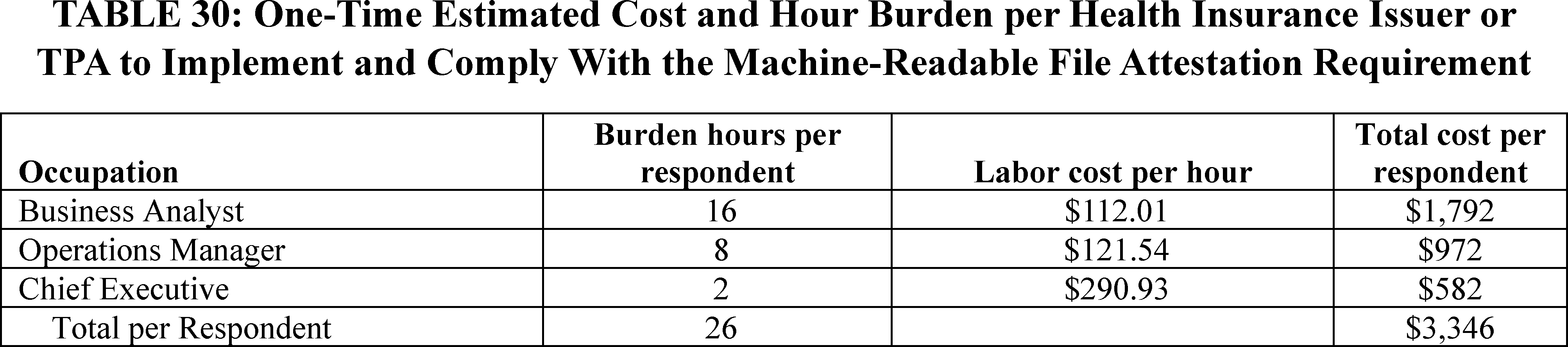

In addition to the one-time implementation burden, the Departments estimate an ongoing annual burden associated with maintaining compliance with the attestation requirement. Specifically, each issuer or TPA is expected to require, on average, 8 hours of work from a Business Analyst ($112.01 per ( printed page 63823) hour), 4 hours from an Operations Manager ($121.54 per hour), and 2 hours from a Chief Executive ($290.93 per hour) to review machine-readable files, make updates to internal procedures, periodically review the attestation information to ensure it remains accurate and current, validate information, and complete the annual attestation. As shown in Table 32, this results in an estimated ongoing annual burden of 14 hours per entity, with an associated cost of approximately $1,964 per issuer or TPA. Across all 1,508 affected issuers and TPAs, the Departments estimate a total ongoing annual burden of 21,112 hours and a combined annual cost of approximately $2,961,863 million, as presented in Table 33. The 3-year average costs and burden for this requirement are presented in Table 34.
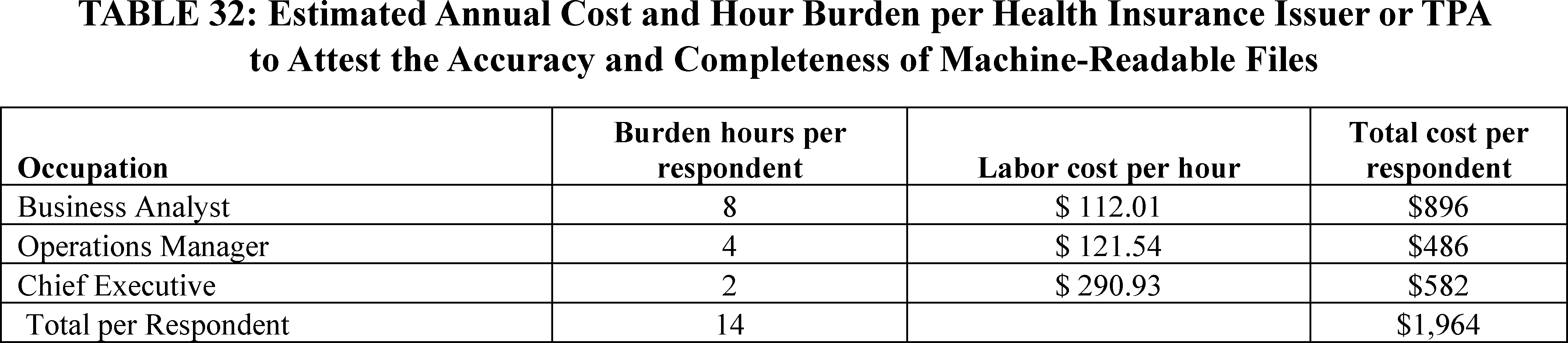

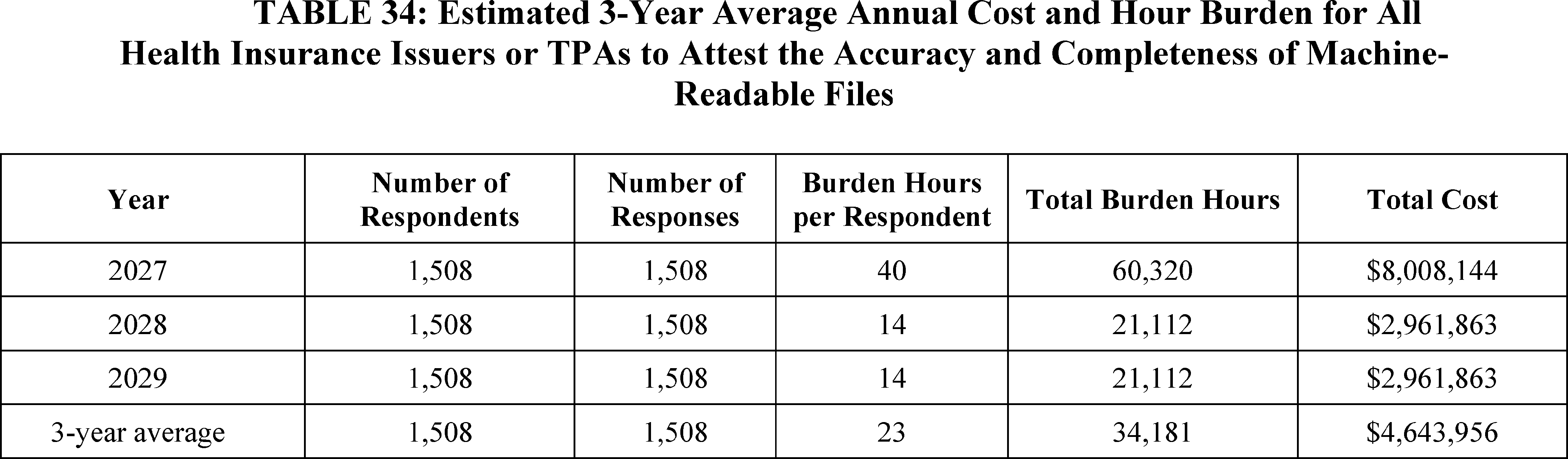
15. ICRs Regarding Requirements for Phased Implementation of New and Amended Machine-Readable File Requirements (26 CFR 54.9815-2715A3(c)(1)(ii)-(iii), 29 CFR 2590.715-2715A3(c)(1)(ii)-(iii), and 45 CFR 147.212(c)(1)(ii)-(iii))
In the proposed rules, the Departments proposed that the amendments to the Transparency in Coverage machine-readable file requirements would apply beginning 12 months after publication of these final rules in the Federal Register and sought comment on whether this timeframe would provide sufficient implementation time.
As discussed in section III.C.13. of this preamble, and after considering public comments, the Departments are finalizing a phased implementation approach. Under this approach, certain requirements become applicable 5 months after publication of these final rules in the Federal Register (Phase 1), while other requirements become applicable 11 months after publication (Phase 2). The Departments have determined that this phased approach appropriately balances commenter requests for accelerated implementation of requirements with the time necessary to implement newly established contextual files and related technical changes.
Phase 1 includes requirements related to excluded providers, provider network-level reporting, reporting of common provider network name and network identifier, reporting of percentage of billed charges, aggregation of Allowed Amount File data by market type with a lower claims threshold and longer reporting period, inclusion of product type and HIOS identifiers, quarterly reporting, and adoption of a single file format. Phase 2 includes the Taxonomy File and Utilization File for the In-network Rate File, as well as the ( printed page 63824) Text File and the “findability” link requirement applicable to both files.
The two phases have different applicability dates, which may create an overlap period during which plans and issuers must simultaneously implement Phase 1 requirements while continuing to prepare for Phase 2 requirements. Maintaining these concurrent implementation workstreams is expected to increase coordination across planning, systems development, file creation and testing, operational coordination, and other implementation activities. Accordingly, the overlap period may require plans and issuers to allocate additional staff and technical resources across multiple implementation timelines, which could increase administrative and operational costs during the transition period.
The Departments do not have detailed information regarding the staffing structures, operational processes, or resource allocation practices of affected plans and issuers and therefore cannot precisely estimate the incremental burden associated with these concurrent implementation efforts. For purposes of this analysis, the Departments assume a conservative 20 percent increase in labor hours and associated labor costs relative to total first-year implementation burden for activities occurring during the overlap period. This assumption is intended to account for the additional coordination, project management, testing, and operational effort required to support overlapping implementation timelines.
Accordingly, the Departments estimate that plans and issuers will incur approximately 435,259 hours, with associated costs of approximately $66,624,563, during the first year of implementation.[142] The Departments do not anticipate that the phased approach will impact ongoing costs. Ongoing costs are primarily driven by recurring reporting, data maintenance, and file updates, which are not expected to be duplicated as a result of overlapping implementation timelines. Rather, the phased approach affects the timing and sequencing of one-time implementation activities without increasing the overall magnitude of ongoing burden.
C. Submission of PRA Related Comments
The burden associated with the Transparency in Coverage disclosure requirements for HHS is currently approved under OMB control number 0938-1429 (CMS-10715, Transparency in Coverage).[143] HHS plans to revise this information collection request to account for the additional burden resulting from these finalized requirements. For the Departments of Labor and the Treasury, the related burden was submitted to OMB as Request for Common Form (RCF) submissions. Upon approval of the RCF submissions, both DOL and the Treasury will update and submit their respective information collection requests to reflect these finalized requirements. The Departments have submitted a copy of these final rules to OMB for its review of the associated information collection and recordkeeping requirements. These requirements are not effective until they have been approved by the OMB.
To obtain copies of the supporting statement and any related forms for the approved collections for control number 0938-1429, please visit CMS' website at www.cms.gov/Regulations-and-Guidance/Legislation/PaperworkReductionActof1995/PRA-Listing. To obtain copies of the supporting statement for control number 0938-1429, please go to www.RegInfo.gov or email the request to ebsa.opr@dol.gov and reference control number 0938-1429.
 www.RegInfo.gov
The Departments invited public comment on these information collection requirements in the proposed rules and have considered all comments received. Responses to these comments are addressed under each applicable ICR in section IV. of this preamble.
D. Summary of Ongoing and One-Time Burden Estimates for the Final Requirements
As shown in Tables 35 through 37, using high-end estimates, the Departments estimate that these finalized requirements will result in an ongoing burden of approximately 1.4 million hours annually, at a cost of approximately $80.4 million per year for all plans (or TPAs on behalf of plans) and issuers. In addition, these finalized requirements are expected to impose one-time implementation costs, totaling approximately 2.6 million hours and approximately $400 million across all plans (TPAs on behalf of plans) and issuers. Together, this represents a first-year burden of roughly 4 million hours and $480.4 million in associated costs.[144] In subsequent years, the burden is estimated at approximately 1.4 million hours and $80.4 million per year.
( printed page 63825)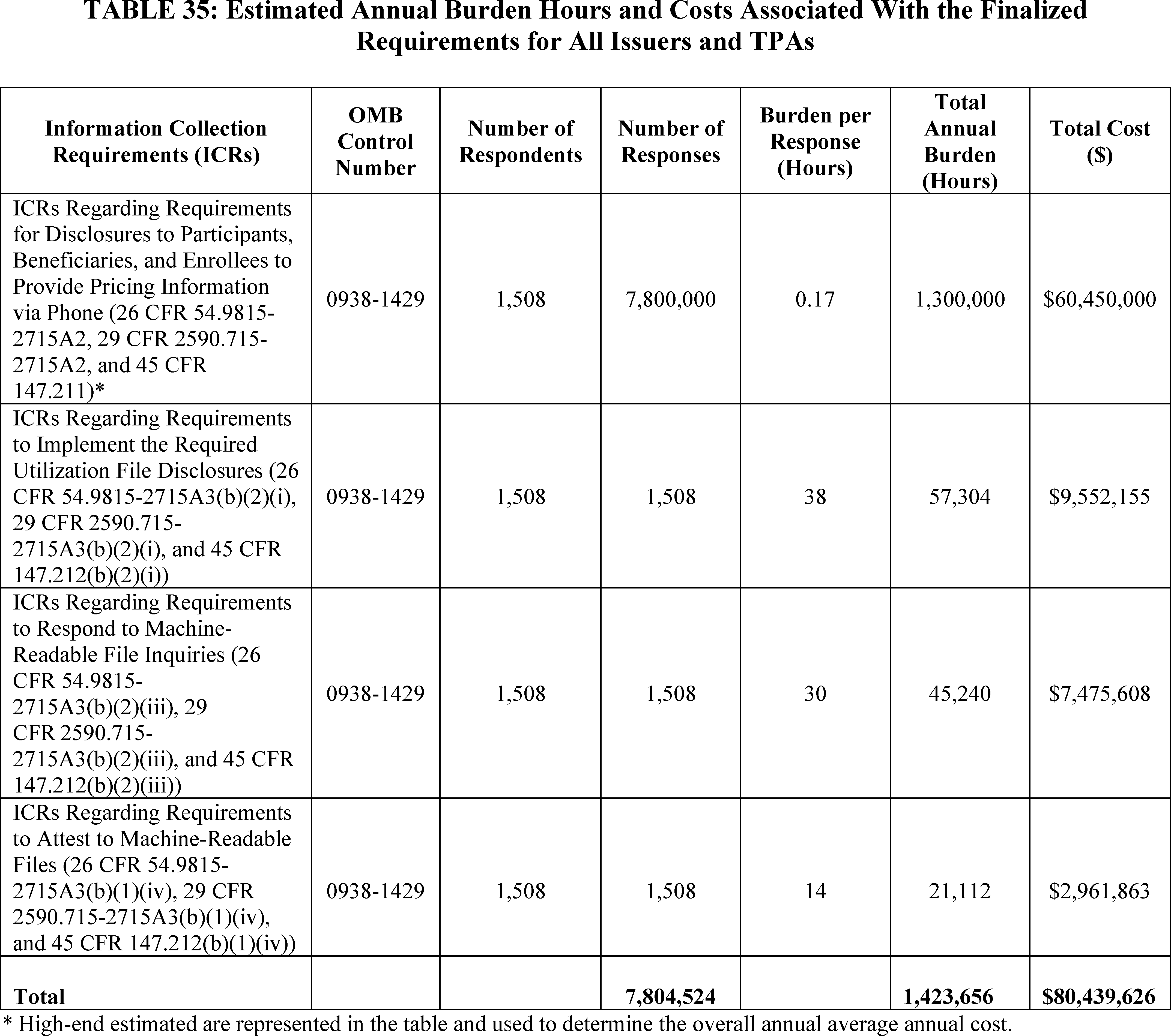
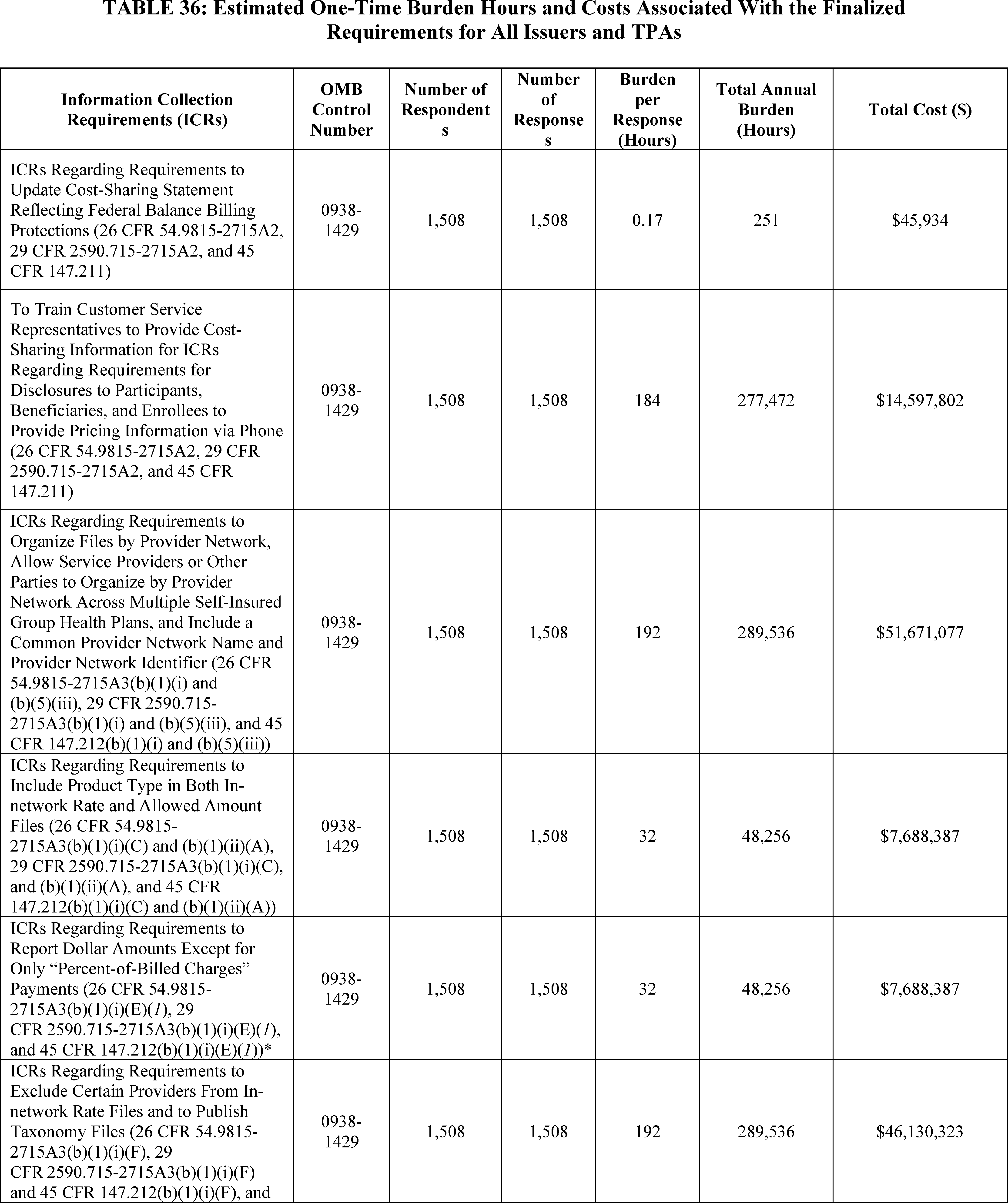
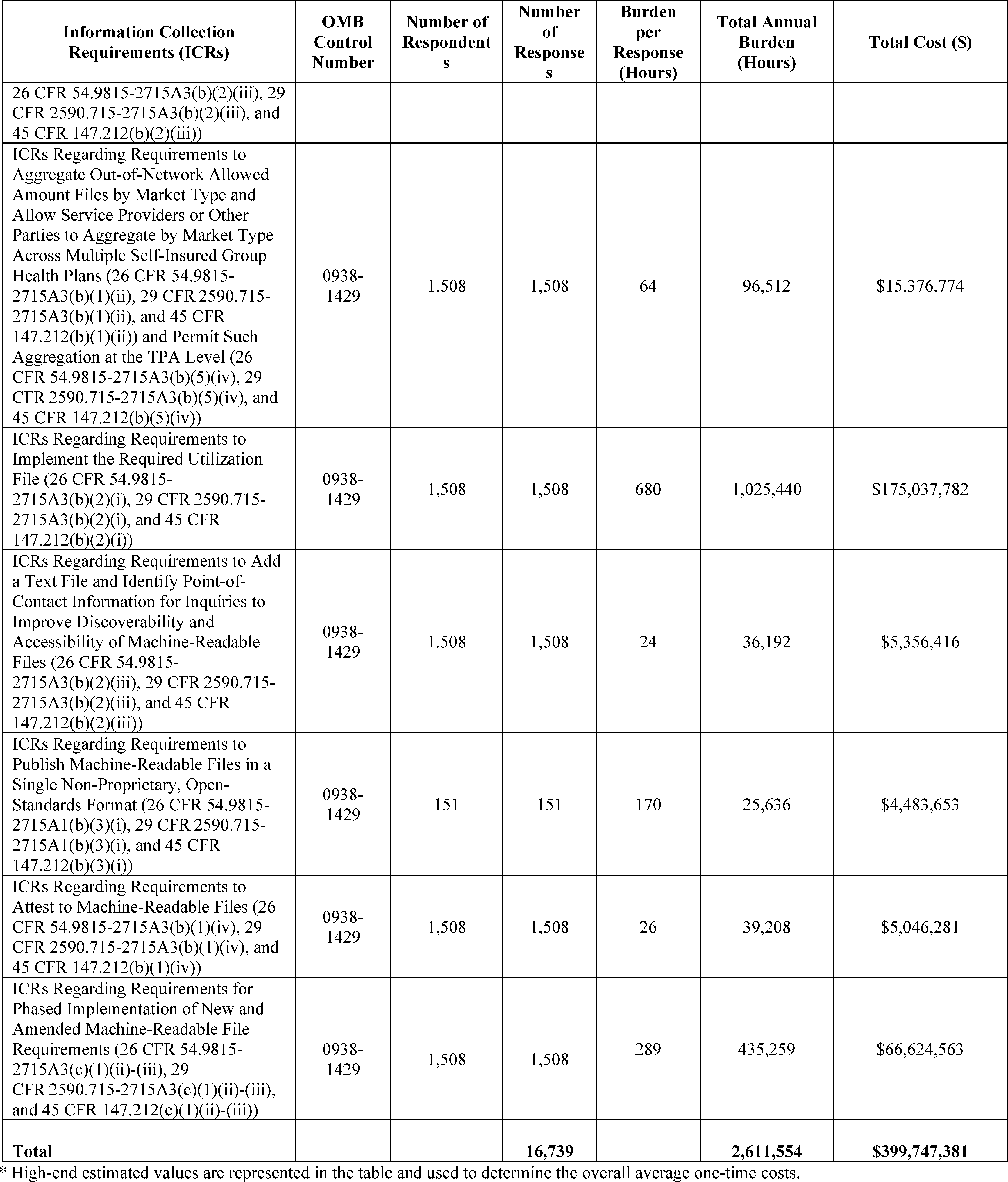
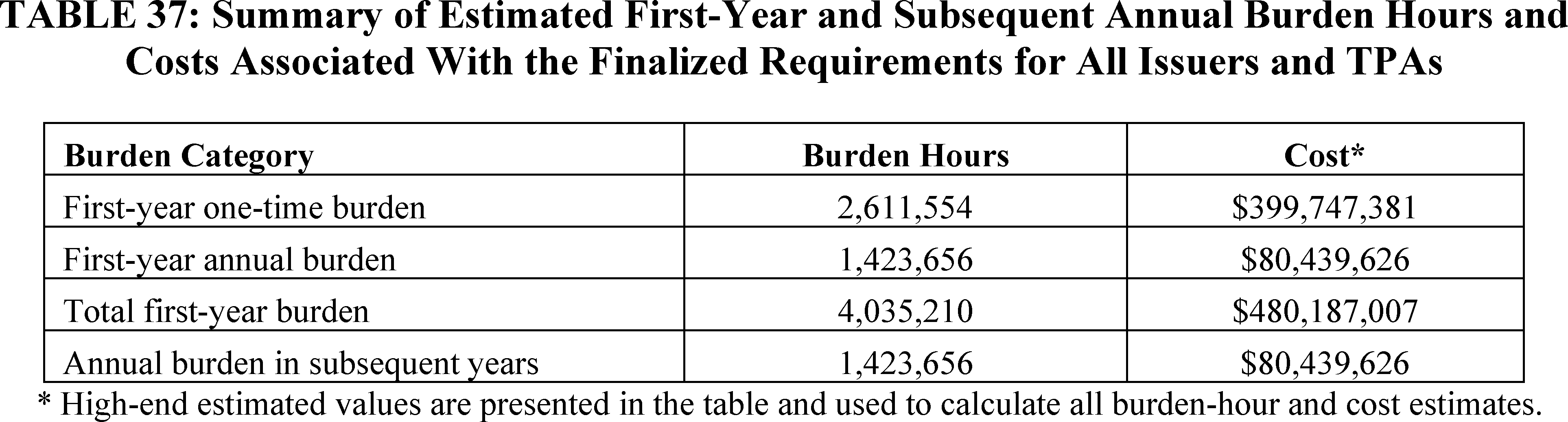
E. Allocation of Total Burden Hours to the Departments of Health and Human Services, Labor, and the Treasury
Based on their respective jurisdiction over plans and issuers, HHS is estimated to account for 50 percent of the total burden, while the Departments of Labor and the Treasury will each account for 25 percent. Tables 38 and 39 present each Department's share of the total one-time and on-going estimated burden hours needed to implement the final requirements.
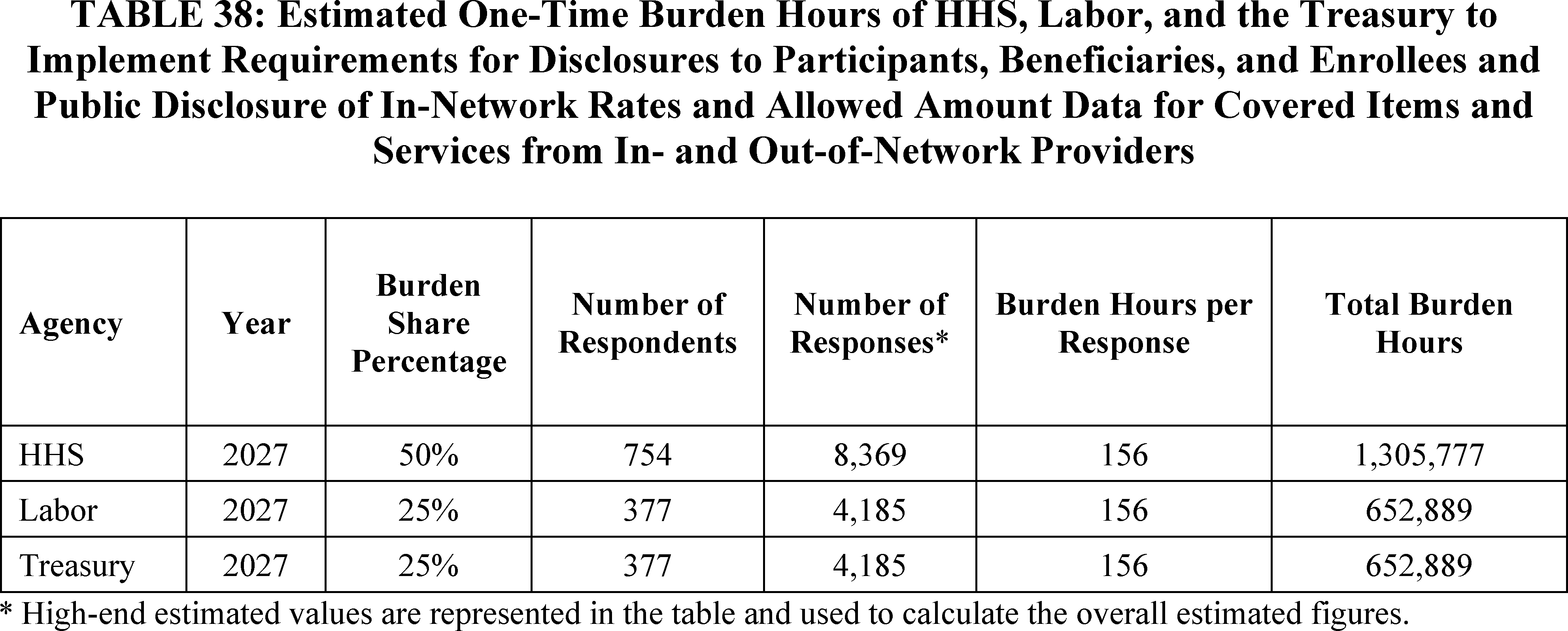
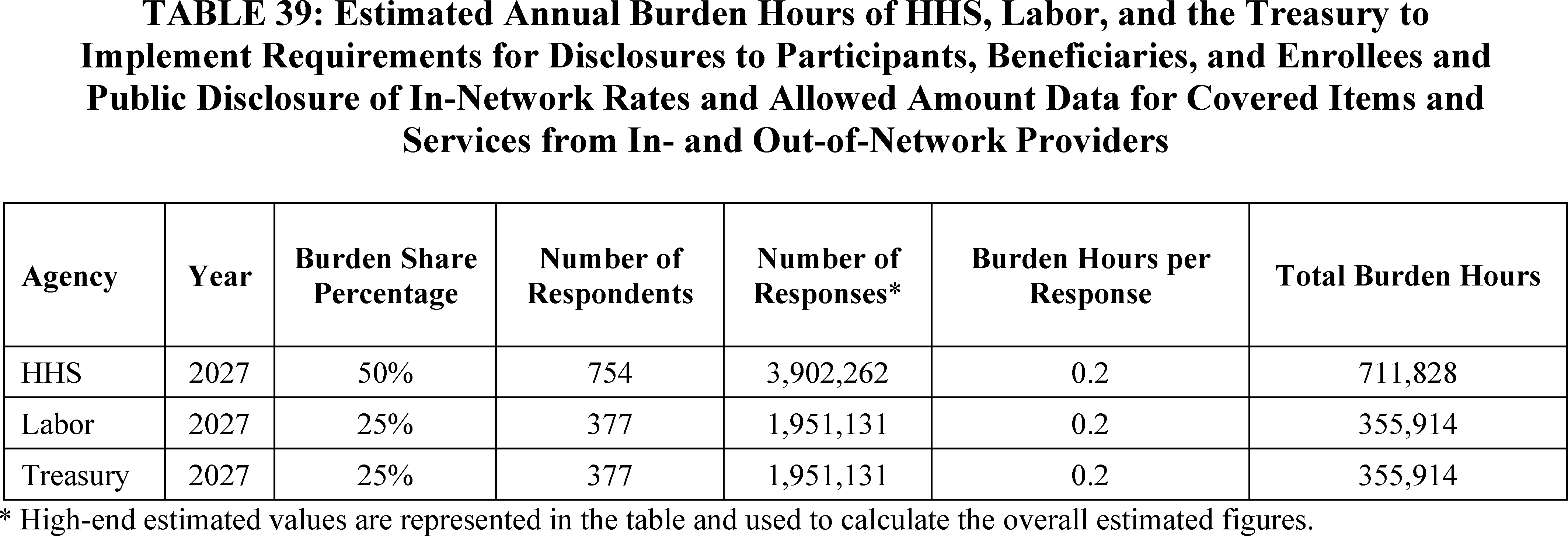
V. Regulatory Impact Analysis
A. Executive Orders 12866, 13563, and 14192
The Departments have examined the impacts of these final rules as required by Executive Order 12866, “Regulatory Planning and Review;” [145] Executive Order 13132, “Federalism;” [146] Executive Order 13563, “Improving Regulation and Regulatory Review”; [147] Executive Order 14192, “Unleashing Prosperity Through Deregulation”; [148] the Regulatory Flexibility Act (RFA); [149] section 1102(b) of the Social Security Act; section 202 of the Unfunded Mandates Reform Act of 1995 (March 22, 1995, Pub. L. 104-4); and the Congressional Review Act (5 U.S.C. 804(2)).
Executive Orders 12866 and 13563 direct agencies to assess all costs and benefits of available regulatory alternatives and, if regulation is necessary, to select those regulatory approaches that maximize net benefits (including potential economic, environmental, public health and safety, and other advantages; and distributive impacts).
Section 3(f) of Executive Order 12866 defines a “significant regulatory action” as any regulatory action that is likely to result in a rule that may: (1) have an annual effect on the economy of $100 million or more or adversely affect in a material way the economy, a sector of the economy, productivity, competition, jobs, the environment, public health or safety, or State, local, or Tribal governments or communities; (2) create a serious inconsistency or otherwise interfere with an action taken or planned by another agency; (3) materially alter the budgetary impact of entitlements, grants, user fees, or loan programs or the rights and obligations of recipients thereof; or (4) raise novel legal or policy issues arising out of legal mandates, or the President's priorities, or the principles set forth in this Executive order. A “significant regulatory action” is subject to review by OMB. An RIA must be prepared for a regulatory action that is significant under Executive Order 12866. Based on the Departments' estimates, OMB's Office of Information and Regulatory Affairs (OIRA) has determined these rules are significant under section 3(f)(1) of Executive Order 12866, and an RIA has been prepared. In addition, under Subtitle E of the Small Business Regulatory Enforcement Fairness Act of 1996 (also known as the Congressional Review Act), OIRA has determined that this rule is a major rule as defined under 5 U.S.C. 804(2). The Departments have provided an assessment of the potential costs, benefits, and transfers associated with this rule. In accordance with the provisions of Executive Order 12866, this regulation was reviewed by OMB. Additionally, tax regulatory actions issued by the U.S. Department of the Treasury are subject to the requirements of section 6 of Executive Order 12866 pursuant to the Memorandum of Agreement (MOA) (July 4, 2025) between the Treasury Department and OMB regarding review of tax regulations. As such, the Treasury portions of this rule were also reviewed by OMB and are also included into this RIA.
B. Need for Regulatory Action
These final rules amend and strengthen the existing regulations under sections 1311(e)(3) of the Affordable Care Act and 2715A of the PHS Act and are included in section 715 of ERISA and section 9815 to the Code to enhance price transparency reporting requirements for non-grandfathered group health plans and health insurance issuers offering non-grandfathered group and individual health insurance coverage. Consistent with the goals of Executive Order 14221, these final rules aim to provide patients with clear, accurate, and actionable pricing information.[150]
More broadly, these final rules seek to improve the quality, accuracy, and usability of publicly available pricing disclosures and cost-sharing information for participants, beneficiaries, and enrollees. They also address new Federal protections under the No Surprises Act and reduce duplicative reporting requirements.
The machine-readable file requirements further support these purposes by making underlying pricing data available in a standardized, accessible format that can be used by researchers, third-party developers, regulators, and other interested parties to develop consumer-facing tools, analyze market trends, and promote accountability. While machine-readable files are not typically used directly by individual participants, beneficiaries, or enrollees, they are an important mechanism for making pricing information more meaningful, comparable, and actionable across the health care market. These improvements will ultimately help participants, beneficiaries, and enrollees better understand their potential costs, support more informed decision-making, and promote greater competition among health care providers and insurers.
C. Affected Entities
This section of this preamble summarizes the number of plans, issuers, and participants, beneficiaries and enrollees that will be affected by these final rules. Table 40 summarizes the estimated number of affected entities and participants, beneficiaries, and enrollees subject to these final rules.
( printed page 63830)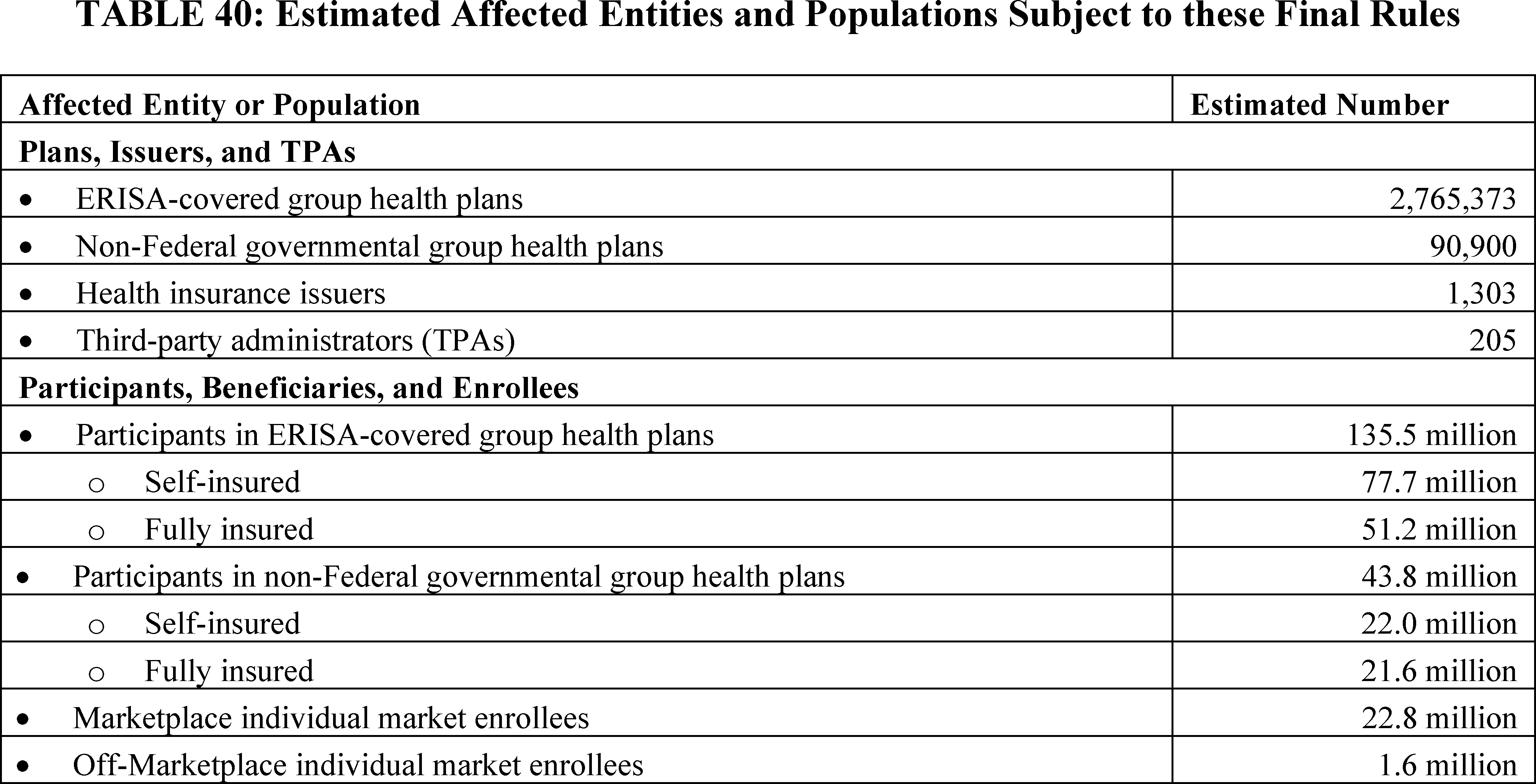
1. Group Health Plans
These final rules will affect ERISA-covered group health plans and non-Federal governmental group health plans, and certain church plans subject to the applicable provisions of the Internal Revenue Code. However, because the Departments do not have sufficient data to estimate the number of church plans, they are not included in the quantitative estimates presented in this section.
The Departments estimate there are approximately 2,765,373 ERISA-covered group health plans.[151] The Departments also estimate that these final rules are expected to affect 90,900 non-Federal governmental group health plans.[152] Of these plans, approximately 35.7 percent [153] (or 32,400) are self-insured,[154] and 64.3 percent (or 58,400) are fully funded.[155]
2. Participants, Beneficiaries, and Enrollees
The Departments estimate that there are 135.5 million participants in ERISA-covered group health plans, of which 77.7 million are in self-insured plans and 51.2 million are in fully funded plans.[156] There are also approximately 43.8 million participants in non-Federal governmental group health plans, of which 22.0 million are in self-insured plans and 21.6 million are in fully funded plans.[157] In addition, approximately 22.8 million individuals selected individual health insurance coverage through the Marketplaces during the 2026 Marketplace Open Enrollment Period.[158] An additional 1.6 million individuals are estimated to be enrolled in off-Marketplace individual market coverage.[159]
( printed page 63831)3. Issuers and TPAs
Finally, the Departments estimate that these final rules will affect 205 TPAs [160] and 1,303 issuers.[161] The Departments assume that fully-insured group health plans will rely on health insurance issuers, and self-insured group health plans will depend on TPAs, including issuers providing administrative services only and non-issuer TPAs, to implement the final updates to cost-sharing disclosures to participants, beneficiaries, and enrollees, as well as to implement the amended public disclosure requirements. This assumption is based on the Departments' understanding that most self-insured group health plans already rely on TPAs to perform core administrative functions, such as enrollment and claims processing.[162] The Departments use the term TPA in this section of this preamble to refer to any other party with which a self-insured group health plan has an agreement to provide services to meet the requirements in these final rules.
D. Detailed Economic Analysis
1. Impact Estimates of the Transparency in Coverage Provisions and Accounting Table
Consistent with Executive Order 12866 and OMB Circular A-4,[163] Table 41 depicts an accounting statement summarizing the Departments' assessment of the benefits, costs, cost savings and transfers associated with these final regulatory actions. The Departments are unable to quantify all of the benefits and costs associated with these final rules due to data limitations and uncertainty about how plans, issuers, and other interested parties may respond to these final requirements. The Departments do not anticipate that these final rules will result in new or additional administrative costs to the Departments. The accounting table separately reports gross annualized monetized costs and annualized monetized cost savings, which are combined to calculate the net annualized monetized costs/cost savings.[164]
( printed page 63832)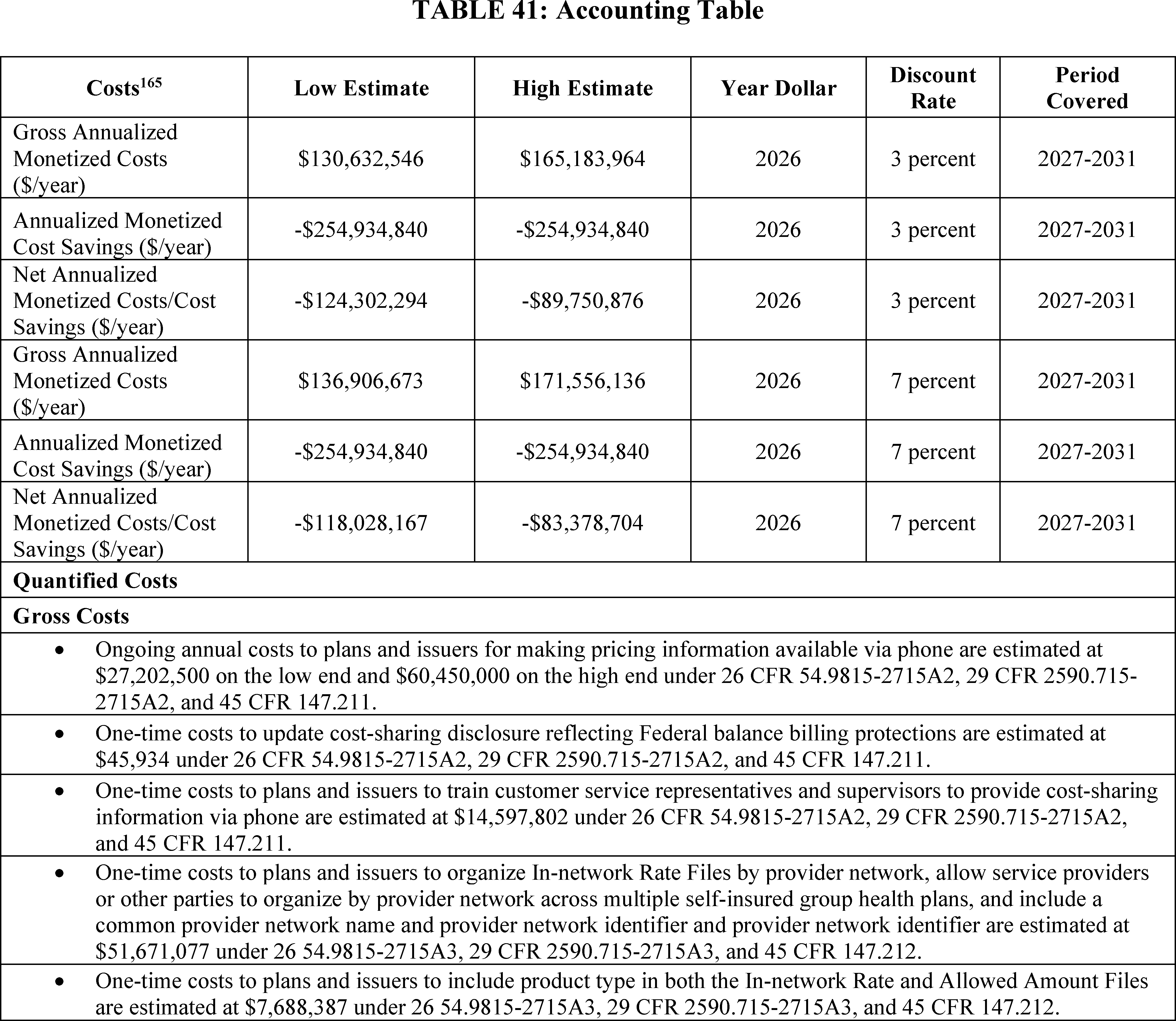
( printed page 63833)
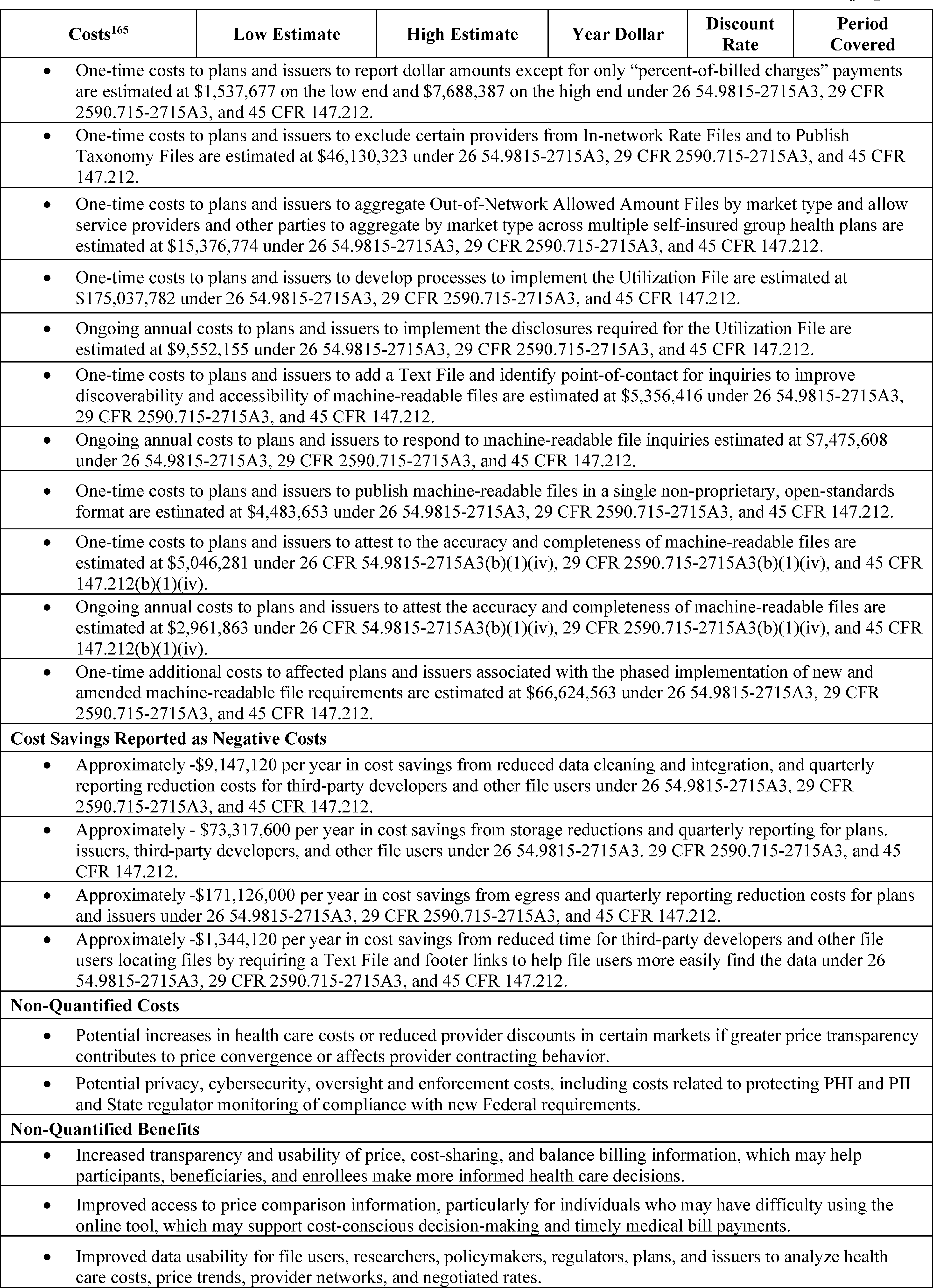
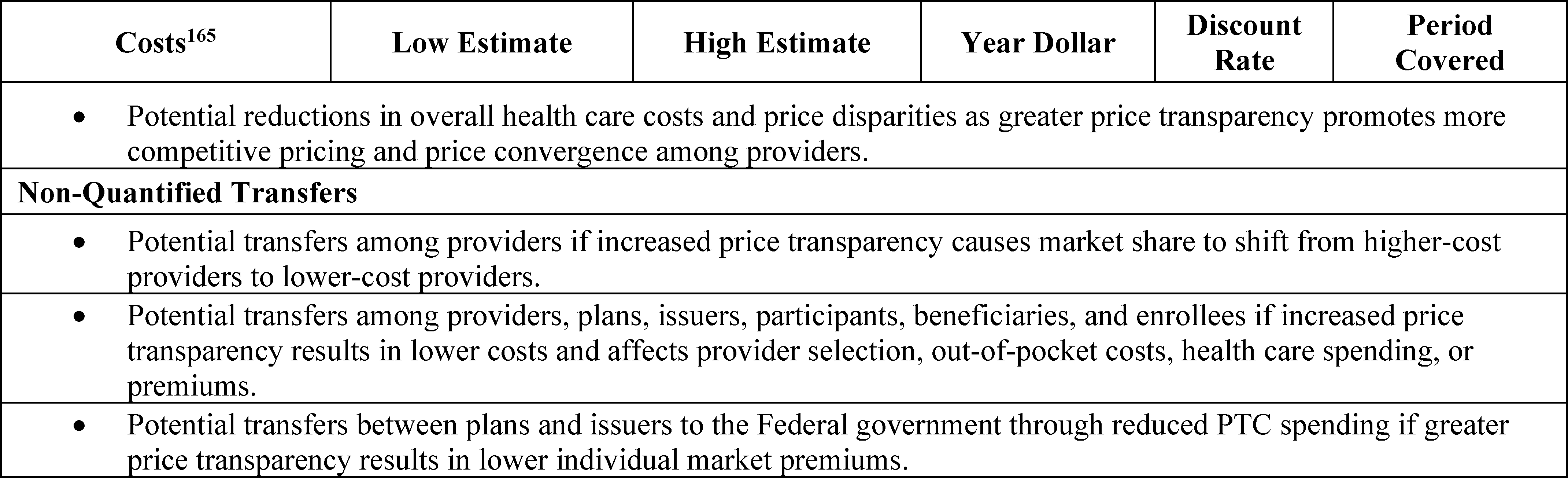
Since the implementation of the 2020 final rules, many group health plans and health insurance issuers have experienced higher-than-anticipated costs associated with generating, storing, and updating very large and complex machine-readable files. The Departments acknowledge these burdens, as well as the underestimation of such burdens in the 2020 final rules and have taken steps in these final rules to mitigate these burdens by requiring more efficient disclosure formats, clarifying data reporting structures and reducing duplicative data. In the proposed rules, the Departments sought comment on which burden estimates may have been underestimated and what data sources could be relied upon to better assess implementation impacts; however, the Departments did not receive comments specifically addressing those issues.
2. Requirements for Disclosures to Participants, Beneficiaries, and Enrollees Under 26 CFR 54.9815-2715A2, 29 CFR 2590.715-2715A2, and 45 CFR 147.211
a. Non-Quantified Benefits
The following paragraphs describe the non-quantified benefits of the amendments, finalized in these rules, to the requirement that plans and issuers disclose certain cost-sharing information to participants, beneficiaries, and enrollees through an internet-based self-service tool, including making pricing information available by phone, and amending the statement related to balance billing consistent with balance billing protections under the No Surprises Act.
(1) Informed Consumer
These final rules will enhance consumer access to critical cost-sharing information by expanding the available delivery methods and clarifying their scope. Requiring group health plans and issuers to provide cost-sharing estimates by phone using a telephone number found on any physical or electronic plan or insurance identification card issued to participants, beneficiaries, and enrollees ensures broader accessibility for all participants, beneficiaries, and enrollees, including those who prefer or rely on verbal communication due to visual impairments, limited literacy, or other challenges. By expanding access to this information, more participants, beneficiaries, and enrollees may be empowered to make cost-conscious decisions about their health care. This conclusion is consistent with a recent study indicating that transparent and accessible health care cost information empowers patients and providers to make more informed decisions and promotes consumer-driven health.[166] Although the study evaluated price transparency tools generally rather than telephone disclosures specifically, its findings underscore the importance of ensuring that pricing information is readily accessible to consumers.
In addition, the amendments adopted in these final rules to the currently required statement on balance billing will provide individuals with clearer information about the potential for out-of-network providers to charge additional amounts not reflected in the cost-sharing information provided to the individual, including the fact that there are protections against balance bills under Federal law. The amendments will also ensure that plans and issuers include this statement unless the plans or policies are offered in States that categorically prohibit balance billing.
(2) Timely Payment of Medical Bills
The amendments adopted in these final rules are designed to make cost-sharing information more accessible to participants, beneficiaries, and enrollees, and easier for participants, beneficiaries, and enrollees to understand and anticipate their health care costs. More transparency around potential health care costs by providing a new method for delivery via the phone and clearer information about potential balance billing and out-of-pocket costs is expected to increase participants', beneficiaries', and enrollees' overall awareness of their potential health care costs.
The Departments have determined that this increased transparency and awareness will help participants, beneficiaries, and enrollees better anticipate expenses and lead to more consistent and timely payment of medical bills. A TransUnion survey reported that 79 percent of individuals would be more likely to pay their medical bills promptly if they had out-of-pocket costs estimates before obtaining care.[167] Additionally, recent reports from hospital systems show that when patients receive clear, upfront cost estimates, they are more likely to make payments at the time of service. For example, the Surgery Center of Oklahoma achieved a 22-fold increase in point-of-service collections, from about $900,000 in 2007 to $20.5 million in 2017, after implementing an automated cost-estimation tool that provided transparent pricing before care.[168] Similarly, a Florida-based ( printed page 63835) hospital system that adopted real-time price estimates experienced a nearly 30 percent increase in point-of-service collections over 2 years.[169] This suggests that making cost-sharing information disclosures more accessible and understandable can support patients' financial planning, promote more timely payment of medical bills, and provide financial benefits for hospitals and other health care providers.
(3) Increased Competition Among Providers
The amendments finalized in these rules aim to empower consumers to make cost-conscious choices among health care providers by improving the accessibility and clarity of cost-sharing information for participants, beneficiaries, and enrollees. By requiring plans and issuers to provide cost-sharing estimates over the phone, in addition to online and in paper form, these final rules will ensure broader access to pricing information. In addition, a clearer statement about potential balance billing by out-of-network providers will further enhance transparency and give individuals a more complete picture of the potential financial obligations associated with different providers.
Evidence suggests that price transparency can lead to reduced health care costs and increased market pressure on higher-cost providers. Studies have shown that when consumers receive pricing information, particularly in combination with incentives such as lower cost-sharing, cash rewards, or premium reductions, they are more likely to choose lower-cost options. For example, a price transparency initiative that allowed consumers to compare magnetic resonance imaging (MRI) prices across facilities resulted in nearly a 19 percent average cost reduction per scan (approximately $220 in savings per scan) and decreased use of higher-cost hospital settings.[170] The study also found that price variations between hospital and non-hospital facilities for MRI scans decreased by 30 percent. This reduction was mainly driven by consumers switching to lower-cost options and competitive price adjustments by higher-cost facilities. Another study found that disclosure of negotiated prices stimulated provider competition and led to lower prices for shoppable services.[171] These findings support the Departments' determination that greater transparency can drive competition, encourage cost-conscious decision-making, reduce price disparities across the health care system, and potentially contribute to lowering overall health care costs.
Recent evidence on price convergence suggests that, to the extent convergence occurs, reductions in higher negotiated rates may exceed increases in lower negotiated rates. One analysis of negotiated rates for 37 common health care services at 234 unique hospitals across the 10 largest U.S. metropolitan areas found that higher-priced negotiated rates declined by 6.3 percent annually, while lower-priced negotiated rates increased by 3.4 percent annually, resulting in lower overall negotiated prices.[172]
As discussed in greater detail in section V.D.4.e. of this preamble, the empirical literature suggests that price transparency may reduce overall health care costs, although the effects may vary depending on market conditions, provider responses, consumer behavior, and how price transparency requirements are implemented. Additionally, upward price adjustments among lower-priced providers and changes in provider contracting behavior may still occur in certain markets. The Departments also recognize that although increased transparency may provide participants, beneficiaries, and enrollees with more information to compare prices across providers, individuals may not always change providers based on cost information alone. Other factors such as existing provider relationships, continuity of care, or provider availability may affect how consumers select their providers.
(4) Reduced Deadweight Loss [173] Through Improved Access to Cost-Sharing Information by Phone
The Departments anticipate that requiring plans and issuers to provide cost-sharing information by phone helps reduce information asymmetry in health care markets, particularly for individuals who are less likely to use online tools, have limited internet access or feel less comfortable accessing or interpreting information over the internet. For example, according to the Pew Research Center, while 75 percent of those 65 and older use the internet generally, less than 61 percent own a smartphone,[174] and 22 percent of these adults report never going online at all.[175] By improving access to real-time, personalized cost-sharing data for these populations, this requirement is expected to enable more consumers to compare prices and select lower-cost providers. This shift in behavior is expected to reduce overpayment for services and better align spending with consumers' willingness to pay, thereby decreasing the deadweight loss that results from information asymmetry.
Although quantifying these efficiency gains presents methodological challenges, economic literature supports the notion that improved price transparency can lead to behavioral changes and welfare improvements.[176] The Departments recognize the potential for meaningful economic benefits and requested comment on these benefits; however, no comments were received.
b. Costs
Section IV.A. of this preamble outlines the quantified costs associated with updating cost-sharing disclosures to reflect Federal balance billing protections, as described in 26 CFR 54.9815-2715A2(b)(1)(vii)(A), 29 CFR 2590.715-2715A2(b)(1)(vii)(A), and 45 CFR 147.211(b)(1)(vii)(A). The Departments assume that plans and issuers have already developed self-service tools and will only need to revise the statement to state that out-of-network providers may engage in balance billing, subject to applicable State and Federal laws. Although these ( printed page 63836) updates build on existing infrastructure, the Departments estimate that all plans (or TPAs on behalf of plans) and issuers will incur a one-time cost for minor technical modifications, with a total burden of 251 hours and an associated cost of approximately $45,934.
Section IV.A. of this preamble also outlines the quantified costs associated with providing the cost-sharing information, as described in 26 CFR 54.9815-2715A2(b)(1), 29 CFR 2590.715-2715A2(b)(1), and 45 CFR 147.211(b)(1), over the phone, as finalized in paragraph 26 CFR 54.9815-2715A2(b)(2)(iii), 29 CFR 2590.715-2715A2(b)(2)(iii), and 45 CFR 147.211(b)(2)(iii). As discussed in more detail in section IV.A. of this preamble, the Departments have provided both lower impact and higher impact cost estimates to account for varying call times. The Departments estimate that all plans (or TPAs on behalf plans) and issuers will incur a total, low-range, annual ongoing time burden of 585,000 hours with an associated estimated cost of $27,202,500, and a total, high-range, burden of 1,300,000 hours with and associated estimated cost of $60,450,000, to provide pricing information by phone.
The Departments have determined that plans and issuers will leverage their existing customer service call center infrastructure to provide cost-sharing information over the phone to reduce or eliminate any one-time burden and cost. While the Departments have determined many plans (or TPAs on behalf of plans) and issuers already provide some level of real-time phone-based cost-sharing information, they recognize that some plans and issuers may need to alter existing or develop new infrastructure and could incur additional one-time burden and cost to meet these requirements.
The Departments also anticipate that providing phone-based access will increase call duration and require plans (or TPAs on behalf of plans) and issuers to train customer service representatives and supervisors, resulting in a one-time burden of 277,472 hours and an estimated total cost of approximately $14,597,802.
The Departments assume that most self-insured group health plans will rely on TPAs to fulfill these requirements and that TPAs typically serve multiple clients, allowing for economies of scale, which could result in a lower burden and cost. Additionally, the Departments acknowledge that plans and issuers might choose to upgrade their communication systems voluntarily, such as adding mobile call features or real-time texting, which could involve upfront implementation costs but may also result in operational efficiencies or cost savings over time. However, the Departments are not able to estimate the extent to which plans and issuers may pursue such voluntary upgrades or the associated costs or savings.
The Departments recognize that expanding access to personalized pricing data, particularly via phone, may increase the risk of potential exposure of PHI and PII. As with internet-based disclosures, additional investments in security infrastructure, staff training on data protection, and consumer privacy tools may be necessary to mitigate the risk of unauthorized access or breaches. According to HIPAA Journal's 2025 Healthcare Data Breach Report, hundreds of millions of individuals were affected by health care data breaches involving 500 or more records reported to the Department of Health and Human Services Office for Civil Rights.[177] The report noted that, in 2024, a new record was set, with over 289 million individuals having their protected health information exposed or impermissibly disclosed. The report also stated that more than 700 large health care data breaches continue to be reported annually, with breaches plateauing in the range of 700 to 750 incidents per year, approximately two large health care data breaches per day. In 2025 alone, at least 61.5 million individuals had their protected health information exposed or impermissibly disclosed through reported breaches. As a result, complying with these provisions may necessitate additional safeguards to protect PHI and PII during phone-based interactions.
The Departments requested comment on these burden and cost estimates, including assumptions on disclosures to reflect Federal balance billing protections, call duration, customer service staffing, and the extent to which plans (or TPAs on behalf of plans) and issuers are already equipped to provide real-time cost-sharing information by phone. The Departments received numerous comments which are discussed in more detail in section IV.A. of this preamble.
While not quantified in this analysis, the Departments acknowledge that State regulators may incur administrative costs to review, monitor, or enforce compliance with these additional requirements. The Departments requested comment on any potential State-level impacts and any other burdens and costs that could be incurred by entities that would be affected by the provision of these final rules. No comments were received on these issues.
3. Requirements for Public Disclosure Under 26 54.9815-2715A3, 29 CFR 2590.715-2715A3, and 45 CFR 147.212
The following paragraphs describe the non-quantified benefits, as well as the quantified costs and cost savings of the final requirements to the disclosure of information related to in-network rates and historical out-of-network allowed amounts through machine-readable files.
a. Non-Quantified Benefits
(1) Stronger Market Leverage for Plans and Issuers
By requiring more streamlined, meaningful, and clear disclosure of in-network rates and detailed out-of-network data, the provisions in these final rules will better enable plans and issuers to compare their in-network rates and out-of-network coverage with those of competitors. The addition of contextual files, including the Taxonomy File and Utilization File, is expected to enhance the practical value of this data, helping plans and issuers see not just raw prices but also provider specialties, actual in-network utilization, and historical changes in rate information.
This will support plans and issuers in identifying gaps, trends, and outliers within their own networks and relative to the market. This enhanced transparency is expected to strengthen their ability to negotiate lower reimbursement rates with providers based on knowing what those providers have negotiated with other payers that are similarly situated within the market for the same items or services with other plans and issuers that are similarly situated within the market. However, as noted in section V.D.2.a.(3). of this preamble, the Departments also recognize the potential for this information to drive rates up if providers learn they are being paid less than other providers and use that information to seek higher negotiated rates.
By enhancing the transparency of out-of-network allowed amounts and historical billed charges, these provisions may facilitate broader adoption of private health insurance market reference-based pricing strategies. Specifically, the final requirements related to the Allowed Amount File are expected to provide the ( printed page 63837) public with clearer information on what out-of-network providers charge. This additional transparency can help plans, issuers, and other file users better identify lower-cost providers and benchmark reasonable prices, ultimately supporting strategies where participants, beneficiaries, or enrollees pay the difference when selecting higher-cost providers in circumstances where they have a meaningful choice among providers.
Plans and issuers may use such reference-based pricing structures to guide participants, beneficiaries, and enrollees toward lower-cost providers. While the Departments recognize that reference-based pricing may not apply uniformly (for example, some plans offer exemptions based on clinical need or geographic limitations), it has generally led to cost reductions. For instance, combining price transparency with reference-based pricing has led to significant shifts in consumer choice of facility, resulting in a 27 percent reduction in the average price paid per laboratory test and a 13 percent reduction in the average price paid per imaging test.[178]
The Departments also expect that these final rules may facilitate more efficient improvements to plan design by making pricing information more accessible, standardized, and usable. With clearer information on negotiated rates, out-of-network allowed amounts, billed charges, provider specialties, utilization, and historical changes in rate information, plans and issuers may be better positioned to assess relative prices across providers, services, and markets and to refine network design, benefit design, and cost-sharing structures accordingly. In the absence of these disclosure requirements, higher-priced plans, issuers, and providers may have little incentive to disclose pricing information in a consistent and usable format, which can limit transparency and hinder the ability of other market participants to identify inefficiencies, evaluate alternative options.
(2) Enhanced Regulatory Oversight, Market Monitoring, and Fiscal Effects
The Departments expect State and Federal regulators to gain efficiencies and insights from the data reporting pursuant to the amended disclosure requirements in these final rules. The final provisions will give regulators access to more streamlined, usable, and actionable in-network rates and out-of-network data, which may support more informed oversight of premium rate filings by enabling more effective monitoring of market trends and price variations. The final provisions may also help States monitor rates to identify collusive behaviors, as well as help establish benchmarks for negotiations with providers as part of State oversight activities related to coverage programs, ultimately strengthening regulatory oversight and promoting more competitive markets.
Recent analysis of proposed Federal price transparency legislation also illustrates that price transparency may have the potential to increase Federal revenue. One analysis estimated that the Patients Deserve Price Tags Act [179] could generate approximately $122 billion in additional Federal revenue over the 2026 through 2035 period, with estimates ranging from approximately $25 billion to $270 billion.[180] The analysis assumes that reductions in employer-sponsored insurance spending would reduce premiums and, over time, increase taxable wages, resulting in additional Federal income and payroll tax revenue. The estimated price effect was based on quantified effects from seven studies examining price transparency, reference pricing, and payment cap interventions in U.S. health care, with the range reflecting variation in the estimated effects across those studies. Although this analysis evaluates a broader set of price transparency policies and therefore cannot be used to estimate the fiscal effects of these final rules, it illustrates a potential mechanism through which the enhanced transparency requirements finalized in these rules could have broader economic and fiscal effects. To the extent these final rules increase competition and reduce health care spending and employer-sponsored insurance premiums, some of those reductions could ultimately be reflected in higher taxable wages and associated Federal tax revenues. The Departments have not quantified these potential effects.
(3) Increased Understanding and Empowered Consumers
These final rules aim to empower participants, beneficiaries, and enrollees by increasing transparency around what plans and issuers reimburse providers for covered items and services. By providing access to clearer, more streamlined, and more specific in-network rates, historical out-of-network allowed amounts, and billed charges, file users and ultimately health care consumers may be better equipped to understand how their choices of coverage and providers affect their costs. This transparency is expected to support more informed consumer decision-making when comparing plans or selecting providers.
Adding supporting contextual information to accompany the data is expected to enhance overall usability for third-party developers and other file users. As stated in the preamble to the 2020 final rules, the Departments expected third-party developers and other innovators to use the machine-readable file data to create “easy-to-use internet-based tools and mobile applications that will present information to laypersons in easy-to-understand, plain language that is sufficiently concise and well-organized,” [181] which will allow “consumers to consider price as a factor when making meaningful comparisons between different coverage options and providers.” [182]
The Departments are encouraged by the consumer-facing tools that have been built since implementation of the 2020 final rules and look forward to additional growth in this space following implementation of the enhancements in these final rules.
b. Costs
This section of the preamble provides both quantitative and qualitative analysis of the costs and cost savings associated with the Departments' final revisions to the requirements that plans and issuers make information regarding in-network negotiated rates and out-of-network allowed amounts available through machine-readable files on a public website.
(1) Quantified Costs
Section IV.B. of this preamble outlines the quantified costs associated with requirements for public disclosure of in-network rates and allowed amount data for covered items and services from in- and out-of-network providers, as described under 26 CFR 54.9815-2715A3, 29 CFR 2590.715-2715A3, and 45 CFR 147.212.
For In-network Rate Files, these final rules require plans and issuers to create a separate file for each provider ( printed page 63838) network, allow rates to be expressed as a percentage of billed charges when certain conditions are met, disclose the common provider network name, the provider network identifier, the product type of each plan or policy whose rates are included in the file and publish Taxonomy Files, and exclude providers unlikely to be reimbursed based on their scope of practice as well as allowing service providers to organize In-network Rate Files across multiple self-insured group health plans. The Departments estimate that all plans (or TPAs on behalf of plans) and issuers will incur a combined total one-time burden of 636,979 hours on the low end and 675,584 hours on the high end, with associated costs of approximately $107,027,465 and $113,178,175, respectively.[183] While these provisions involve a one-time cost to modify existing processes, the Departments expect that, once these updates are implemented, the ongoing burden related to these changes will be minimal, beyond current costs for monitoring and maintaining these processes.
For Allowed Amount Files, these final rules require data reporting at the market level instead of the individual plan or policy level, lowering the claims threshold from 20 to 11, extending the reporting period from 90 days to 6 months, and increasing the lookback period from 180 days to 9 months to enhance the robustness of historical data. The Departments estimate that all plans (or TPAs on behalf of plans) and issuers will incur a one-time burden of 96,512 hours, with associated costs of approximately $15,376,774. Lowering the claims threshold to 11 is expected to require only minor system adjustments, and the Departments anticipate minimal ongoing costs for maintaining and monitoring compliance. Similarly, extending the lookback and reporting periods are not expected to impose a significant additional burden, as the Departments expect only minimal system modifications to be needed, with associated costs absorbed into the routine system maintenance activities that plans (or TPAs on behalf of plans) and issuers already perform in the normal course of business. Ongoing costs for aggregating out-of-network Allowed Amount Files by market type are also expected to be minimal.
In addition, these final rules require plans and issuers to post several contextual machine-readable files: a Utilization File and a Text File, each with specific update and posting requirements. The Departments estimate a one-time burden of 1,061,632 hours for all plans (or TPAs on behalf of plans) and issuers, with associated costs of approximately $180,394,198 to implement the Utilization File requirements and add a Text File. The Departments further estimate an ongoing annual burden of 57,304 hours (costing approximately $9,552,155) to update the Utilization File and 45,240 hours (costing approximately $7,475,608) to respond to machine-readable file inquiries to improve discoverability and accessibility of the machine-readable files.
Once the initial implementation of the machine-readable file requirements is complete, the Departments expect ongoing updates to require minimal effort. While the Departments estimate ongoing costs associated with maintaining the Utilization File, as discussed in section IV.B.10. of this preamble, the Departments do not expect the Text File, the excluded-provider requirements, publication of the Taxonomy File, or the requirement to include a link to the internet domain hosting the machine-readable files on the website footer is expected to result in minimal ongoing costs beyond routine maintenance activities associated with existing machine-readable file reporting processes.
The Departments requested comment and data on how to better quantify these costs and have considered the comments received, which are addressed in section IV.B. of this preamble.
In addition, these final rules require plans and issuers to make machine-readable files available in a single non-proprietary, open-standards format, as specified in guidance issued by the Departments. The Departments estimate a one-time burden of 25,636 hours for plans (or TPAs on behalf of plans) and issuers, with associated costs of approximately $4,483,653 to implement this requirement, and do not anticipate ongoing costs, as this reflects a one-time update for a limited number of plans and issuers.
Finally, these final rules require plans and issuers to attest, to the best of their knowledge and belief, to the accuracy and completeness of the information contained in their machine-readable files. As discussed in section IV.B.14. of this preamble, the Departments estimate that plans (or TPAs on behalf of plans) and issuers will incur a one-time burden of 39,208 hours, with associated costs of approximately $5,046,281, to implement this requirement. The Departments further estimate an ongoing annual burden of 21,112 hours, with associated costs of approximately $2,961,863, to prepare, update, and maintain the required attestations each year.
In addition, because the Departments are adopting a phased implementation approach in these final rules, under which certain requirements become applicable 5 months after publication in the Federal Register (Phase 1), while others become applicable 11 months after publication (Phase 2), plans and issuers are expected to require additional resources during the overlap period. These activities include planning and design systems development, file creation and testing, operational coordination, and other implementation activities. As discussed in section IV.B.15. of this preamble, the Departments estimate an additional one-time burden of 435,259 hours for plans (or TPAs on behalf of plans) and issuers, with associated costs of approximately $66,624,563 to implement this requirement, and do not anticipate any recurring costs because the phased approach affects only the timing and sequencing of one-time implementation activities.
(2) Cost savings
(a) Reduced Data Cleaning and Integration Costs for Third-Party Developers and Other File Users
The Departments have determined that by reducing the complexity and inconsistency of data that currently require extensive data processing and reconciliation, these final rules will make machine-readable data both easier to locate and easier to process for third-party developers and other file users, such as academics, researchers, data engineers, and plans and issuers. These final rules will do this by requiring plans and issuers to publish contextual files including a Taxonomy File and a Utilization File; report at the provider network level rather than the plan or policy level; exclude providers that have in-network rates for items or services for which they are unlikely to ( printed page 63839) be reimbursed; add common provider network names and provider network identifiers, and product types; and standardize file locations with a Text File and footer links. The Departments anticipate that much of the burden currently involved in cleaning and processing the machine-readable files will be eliminated, since the files will contain more accurate data in smaller sizes. This is expected to reduce the time and resources that third-party developers and other file users spend removing duplicative and irrelevant data, which in turn will decrease the computational resources required for data cleaning and integration, further reducing overall costs.
In particular, the Departments estimate that the finalized provisions to require network-level reporting and specifying product types will meaningfully reduce data cleaning and integration costs for approximately 300 third-party developers and other file users,[184] including research shops and consultancies. Specifically, network-level reporting as finalized is expected to save about 40 hours per quarterly reporting cycle, or 160 hours annually. The inclusion of product types is expected to save an estimated 20 hours per quarterly cycle, or 80 hours annually. Together, these provisions are expected to save about 240 hours of analyst time per year for each third-party developer or other file user. Using a median hourly wage of $112.01 for a Business Analyst,[185] the Departments estimate total annual labor savings across all 300 third-party developers and other file users to be approximately $8.1 million.[186]
In addition, by requiring plans and issuers to exclude provider-rate combinations for items and services for which a provider is unlikely to be reimbursed, the Departments estimate a substantial reduction in the data volume that will be disclosed, compared to current volumes, leading to lower computational costs when processing the files. Assuming industry-wide disclosures currently total roughly 1,000,000 gigabytes (GB), equivalent to 1 petabyte (PB) [187] in size per month, the exclusion of these provider-rate combinations is expected to reduce file sizes by about 70 percent [188] to an estimated size of 300,000 GBs. While most cost savings will be associated with algorithms that process the data, which will reflect much higher actual computation savings, an absolute baseline can still be established.
Assuming an average compute cost of $0.015 per GB RAM-hour for general purpose usage,[189] the baseline monthly compute cost for 1 PB is estimated at roughly $334 [190] with an annual cost savings of $4,008. With a 70 percent reduction in file size, monthly compute costs are expected to decrease to approximately $100, yielding a monthly cost savings of $234, corresponding to an estimated annual savings of approximately $2,808 per third-party developer or other file user. Across 300 third-party developers and other file users, this equates to total annual cost savings of approximately $842,400.
These final rules shift the reporting frequency from monthly to quarterly for In-network Rate and Allowed Amount Files, reducing the total computational needs accordingly. This change reduces total annual downloads from 3,600 (300 third-party developers and users × 12 months) to 1,200 (300 third-party developers and users × 4 months), or an average of 100 downloads per month to be processed. Under quarterly reporting, the estimated annual industry-wide computational costs for the optimized files are estimated to be $120,000.[191] Relative to the monthly baseline, this cadence change combined with the file-size reduction yields an estimated $1,082,400 in total annual computational cost savings. Of this amount, approximately $842,400 is attributable to file-size optimization, while an additional $240,000 [192] results from the reduction in reporting frequency.
The Departments have determined that together these final provisions are expected to result in total annual savings of roughly $9.2 million ($8.1 million in labor savings plus $1.1 million in industry-wide storage cost savings from the shift to quarterly reporting) for third-party developers and other users of price transparency data, while supporting the intended goal of making price data more usable and actionable.
The Departments also expect that other finalized provisions, including the addition of common provider network names, provider network identifiers, the Taxonomy File, and the Utilization File, will further improve the usability and accessibility of the machine-readable files. However, the Departments did not separately quantify the savings associated with these provisions.
The Departments requested comment on the estimated potential cost and time savings from streamlining and standardizing the machine-readable files, and on whether these provisions would effectively result in reduced data processing burdens and costs for users. The Departments did not receive any comments on these estimates.
(b) Reduced Storage Costs for Plans, Issuers, Third-Party Developers, and Other Files Users
The Departments anticipate that the finalized provisions will result in storage cost savings for plans, issuers, third-party developers, and other file users by significantly decreasing the total volume of data needed to generate, store, and make the files available for download. These provisions will minimize data duplication and reduce both the number and size of the machine-readable files by changing the reporting cadence for both the In-network Rate File and the Allowed Amount File from monthly to quarterly, requiring reporting of negotiated rates at the provider network level rather than the plan or policy level, and excluding provider-rate combinations in the In-network Rate File for certain items and services.
The Departments have determined that these changes will lower ongoing storage, backup, and processing costs for the In-network Rate File, making it ( printed page 63840) easier and more cost-effective for third-party developers and other file users to download, build, and manage consumer-facing price comparison tools based on the machine-readable data.
As noted in section V.D.3.b.(2).(a). of this preamble, researchers have estimated that the combined monthly file sizes across industry for the In-network Rate Files are over 1 PB. The Departments estimate that the finalized provisions will reduce file sizes by approximately 70 percent, lowering the monthly data volume from about 1,000,000 GB to approximately 300,000 GB.
Using Amazon Web Services (AWS) S3 pricing as a benchmark, $0.023 per GB for the first 50 TB, $0.022 per GB for the next 450 TB, and $0.021 per GB beyond that,[193] storing 1 PB worth of data will result in an estimated baseline monthly storage cost savings of roughly $22,583 with an annual cost savings of approximately $270,996. With a 70 percent reduction in file size, monthly storage costs are expected to decrease to approximately $6,651 ($79,812 annually), yielding a monthly cost savings of $15,932 and an estimated annual cost savings of approximately $191,184. These cost savings are expected to apply for all plans and issuers.
Assuming 300 third-party developers and other file users download the files each month, total annual storage costs under current file size assumptions are estimated to be approximately $81,298,800.[194] With the 70 percent file-size reduction, the annual cost for all 300 third-party developers and other file users is expected to decrease to $23,943,600.[195] This results in an annual storage cost savings of roughly $57,355,200 [196] for the 300 third-party developers and other file users as result of file-size optimizations.
In addition, because these final rules also shift the reporting frequency from monthly to quarterly, total storage needs and corresponding savings are expected to be reduced accordingly. Under quarterly reporting, annual industry-wide storage cost for the reduced file size for the In-network Rate Files is estimated at $7,981,200.[197] Relative to the monthly baseline, this cadence change combined with the file-size reduction is expected to yield about $73,317,600 in total annual storage cost savings.[198] Of this amount, approximately $57,355,200 in storage cost savings can be attributed to file-size optimization, while an additional $15,962,400 is attributable to the reduction in reporting frequency.
The Departments requested comment on the assumptions made and the estimated storage cost savings for plans and issuers, third-party developers, and other users from reducing data volume. The Departments did not receive any comments on these estimates.
(c) Reduced Network Egress Costs for Plans and Issuers
In addition to the estimated savings from reduced storage requirements, the Departments anticipate that the final provisions would also lead to a reduction in bandwidth network costs for plans and issuers associated with making their machine-readable files available for download.
Using the estimates developed and discussed in section V.D.3.b.(2).(b). of this preamble, for the In-network Rate File, and applying AWS egress costs, which are fees for data transferred from AWS to the public internet, as a benchmark—the first 100 GB are free, followed by $0.09 per GB for the first 50 TB, $0.085 per GB for the next 40 TB, $0.07 per GB for the next 100 TB, and $0.05 per GB for any amount exceeding 150 TB [199] —the Departments estimate a monthly tiered egress cost of transferring 1 PB data to be approximately $53,800 with an estimated annual cost of roughly $645,600. With a 70 percent reduction in file size to 300,000 GB, monthly data transfer egress costs are expected to decrease to about $18,795, with estimated annual costs of approximately $225,600. This is expected to yield a monthly cost savings of $35,005 and annual cost savings of approximately $420,060 for all plans and issuers. These cost estimates assume a single data transfer, or download, each month.
The Departments expect that the files will be downloaded by many third-party developers and other file users. Assuming 300 third-party developers and other file users download the files each month, total annual egress costs under current file size assumptions are estimated to be nearly $194 million.[200] With the optimized file size estimates, the costs are expected to be reduced by about $68 million annually,[201] yielding total industry-wide cost savings of $126 million annually.[202]
Similar to reduced storage costs for plans and issuers discussed in section V.D.3.b.(2).(b). of this preamble, these final rules shift the reporting frequency from monthly to quarterly, which is expected to reduce total egress needs and corresponding costs. This change reduces total annual downloads from 3,600 (300 third-party developers and other file users × 12 months) to 1,200 (300 third-party developers and other file users × 4 months), or an average of 100 downloads per month. Under quarterly reporting, annual industry-wide egress costs for the optimized files are estimated to be about $22.6 million.[203] Relative to the monthly baseline, this cadence change combined with the file-size reduction is expected to yield about $171 million in total annual cost savings.[204] Of this amount, approximately $126 million egress cost savings is attributable to file-size optimization, while the additional $45 ( printed page 63841) million results from the reduction in reporting frequency.
The Departments requested comment on the assumptions made and anticipated egress cost savings for plans and issuers from reducing data volume and reporting cadence. The Departments did not receive any comments on these estimates.
(d) Reduced Time Locating the Files for Third-Party Developers and Other File Users
The Departments' decision to require plans and issuers to include a standardized Text File and to place a link to the web page that hosts the files in a footer on the plan's or issuer's home page are expected to make it easier for third-party developers and other file users, who currently face challenges navigating plan or issuer websites to find their machine-readable files, to more efficiently locate and access the data needed for their applications and analyses.
The time savings from locating files primarily stems from the requirement that plans and issuers include a standardized Text File that includes, among other things, the source page URL for the internet website that hosts the machine-readable files and a direct link to the URL for the machine-readable files, as well as the requirement that plans and issuers include a footer link in certain prominent locations that links directly to the internet website that hosts the machine-readable files. Additionally, the change from monthly to quarterly reporting is expected to reduce the number of times a file user will need to locate the In-network Rate and Allowed Amount Files to find updated information.
Together, the Departments estimate that these changes are expected to save about 10 hours of labor [205] quarterly (or 40 hours annually) for each third-party developer or file user, reflecting the reduced need to manually track down and verify file locations. Using an average hourly wage of $112.01 for a Business Analyst,[206] the Departments estimate that the total annual labor cost savings for all third-party developers and other file users will amount to approximately $1.3 million.[207]
The Departments requested comment on the assumptions and estimated burden and cost savings from making the machine-readable files easier to locate through standardized links. The Departments did not receive any comments on these estimates.
The Departments have determined that the provisions of these final rules will help reduce administrative complexity and advance the objective of making price transparency data more accessible, efficient, and actionable for participants, beneficiaries, and enrollees.
As shown in Table 42, the final provisions are expected to generate total annual cost savings of approximately $255 million for plans, issuers, third-party developers, and other users.
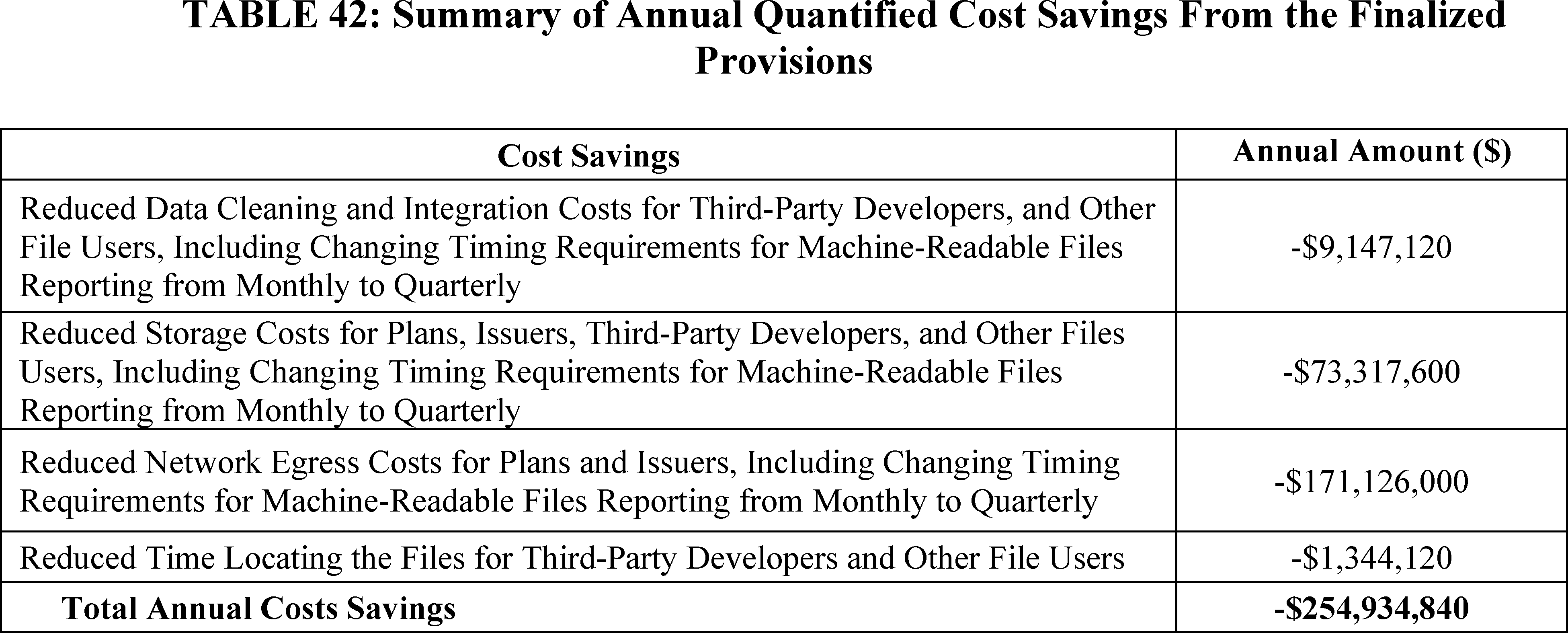
(3) Non-Quantified Costs for Public Disclosure of In-Network Provider Rates
These final provisions are expected to introduce meaningful improvements to the quality, clarity, and usability of In-network Rate Files, such as requiring files to be organized by provider network rather than by plan or policy, allowing for percentage-of-billed charges reporting when the dollar amount is not known in advance, adding contextual files like Taxonomy and Utilization Files, and excluding certain provider-rate combinations if it is unlikely that a provider would be reimbursed for an item or service given that provider's area of specialty. While these improvements are intended to help file users, tool developers, and regulators better navigate and interpret rate data, they may also create non-quantified operational and market-level costs for plans and issuers. ( printed page 63842)
Specifically, plans and issuers may face additional administrative and compliance costs from producing and maintaining more standardized machine-readable files. This may involve internal quality reviews, greater coordination across business units, as well as potential redesign of existing automated processes to create network-specific files and include new required data fields.
There is also a risk that improving the transparency of negotiated rates may cause some providers to raise their prices if they discover they are paid less than their peers. This response could contribute to price convergence rather than sustained downward pressure on costs, an effect observed in some transparency studies, where high prices fall slightly but lower prices rise, ultimately reducing overall savings. For instance, one study found that although price transparency has helped narrow price variation in health care, it has not consistently lowered overall prices. According to the study, the highest prices fell by 6.3 percent, while the lowest prices rose by 3.4 percent, and mid-range prices decreased only slightly by 1.1 percent.[208] While the study does not address the effect on average prices, these findings suggest that transparency can pressure high-cost providers to reduce prices but may also lead lower-cost providers to increase prices. A 2020 study also suggests that price transparency could facilitate tacit collusion, resulting in higher prices in markets that are not perfectly competitive, such as health care. In these markets, there are fewer sellers and higher barriers to entry for new competitors.[209]
Another potential cost stemming from increased transparency due to improvements in In-network Rate Files is the impact on a plan's or issuer's ability or incentive to develop and maintain a robust provider network. A provider network consists of health care providers that have entered into agreements with plans or issuers to deliver care at a negotiated rate, which the provider accepts as full payment. Plans and issuers often prefer their participants, beneficiaries, and enrollees to use in-network providers, as these providers meet the health plan's quality standards and agree to lower rates in exchange for the patient volume they will receive by being part of the network.[210] Some plans and issuers use narrow networks, which include a more limited group of providers. While these networks offer fewer in-network options to participants, beneficiaries and enrollees, they often result in lower monthly premiums and reduced out-of-pocket costs.[211] The Departments recognize that publicly disclosing negotiated rates may reduce the incentive for providers to enter into such contractual agreements, particularly in narrow networks, if they know those rates will be made public or if they are being offered lower than market rates. This could, in turn, limit network options available to plans and issuers.
Smaller issuers may be disproportionately affected by the improved transparency of negotiated rates, as they may be unable to match the higher rates that larger issuers can offer. In turn, smaller issuers may be forced to contract only with lower-cost providers, potentially leading to narrower networks and affecting participant, beneficiary, and enrollee access to care. Such network constraints may also make it more difficult for these issuers to fully comply with network adequacy standards described at 45 CFR 156.230 or applicable State standards. Ultimately, while the purpose of improving price transparency is to empower participants, beneficiaries, and enrollees and enhance market efficiency, the Departments acknowledge that these final provisions could, in some cases, reduce the ability or incentive of plans and issuers, especially smaller ones, to build and maintain robust networks that satisfy quality and access requirements.
(4) Non-Quantified Costs for Public Disclosure of Out-of-Network Allowed Amounts
The Departments recognize the potential costs arising from the expansion of data in the Allowed Amount Files. These may include the increased complexity and administrative burden of managing and reporting a larger volume of data over extended reporting and lookback periods, as well as at the broader health insurance market level rather than at the plan or policy level. Additionally, to account for the expanded handling of detailed claims data, plans and issuers may face additional expenses for enhanced cybersecurity measures and compliance with data privacy regulations. These potential costs are difficult to quantify given current data limitations, but the Departments acknowledge that they represent important considerations associated with implementing these final provisions.
The Departments requested comment and data on the potential magnitude of these non-quantified costs, including legal, operational, and network impacts, and how they may affect plan and issuer implementation, including information that may assist the Departments in estimating any additional burden and cost. However, the Departments did not receive comments that primarily addressed or provided information that would assist the Departments in quantifying these specific non-quantified costs.
4. Summary of Transfers
The requirements of these final rules, as discussed in section III. of this preamble, require plans and issuers to enhance the accuracy and usability of pricing information through improved machine-readable files, expand cost-sharing disclosure methods (including phone access), and streamline reporting requirements. As a result of these final requirements, the Departments expect various transfers to occur between plans and issuers; providers; participants, beneficiaries, and enrollees; and the Federal government. While the precise magnitude of these transfers is difficult to quantify due to varying market conditions and consumer behaviors, the directional effects and distributional impacts can be analyzed conceptually.
a. Transfer From Higher-Cost to Lower-Cost Providers
If participants, beneficiaries, and enrollees gain easier access to pricing information through enhanced machine-readable files and phone-based cost-sharing estimates, some consumers may switch from higher-cost to lower-cost providers for comparable services. This transfer occurs as consumer cost preferences result in shifts from providers who charge what consumers feel are above-market rates, to those offering what the consumer feels to be more competitive pricing. The magnitude of this transfer is expected to depend on several factors such as the degree of price variation between providers, consumer price sensitivity, ( printed page 63843) and relationships between consumers and providers.
Some evidence shows that in competitive markets, price ranges may narrow as lower-cost providers raise their prices to align with higher-cost competitors, potentially increasing costs.[212] Disclosing negotiated rates can enable providers to match each other's prices, which may further limit cost reductions or even lead to higher overall prices despite the increased transparency.[213] However, in some instances, increased transparency may lead higher-cost providers to face new pressure to lower costs, potentially decreasing costs.[214]
The Departments acknowledge that this transfer may be partially offset by potential price convergence effects, where lower-cost providers may increase their prices toward market averages once pricing becomes more transparent. However, the net effect is expected to favor more efficient providers and create competitive pressure for cost reduction across the market.
b. Transfer From Providers to Consumers Through Reduced Out-of-Pocket Spending
If consumers use enhanced pricing information to select lower-cost providers, their out-of-pocket expenses for health care services are expected to decrease, representing a transfer from the provider to the consumer. This transfer is facilitated by these final requirements to make cost-sharing information available by phone, which may particularly benefit populations who face barriers to using online tools, including older adults, individuals with disabilities, and those with limited internet access.
By expanding access to personalized pricing information, these consumers may make more cost-conscious health care decisions, resulting in lower deductibles, copayments, and coinsurance amounts. The magnitude of this transfer could vary significantly based on individual utilization patterns, plan design, and the availability of lower-cost alternatives within their provider networks. This shift is consistent with empirical findings that greater price transparency can help consumers make more cost-effective choices and encourage market competition.[215]
c. Transfer From Plans and Issuers to Participants, Beneficiaries, and Enrollees Through Potential Premium Reductions
If enhanced price transparency leads to systematic shifts toward lower-cost providers and overall reductions in health care spending, plans and issuers may experience lower claims costs, which could eventually translate to reduced premiums for participants, beneficiaries, and enrollees. That is, as plans and issuers experience lower medical costs due to participant, beneficiary, and enrollee price shopping, competitive pressure may lead to premium reductions to attract and retain enrollees. However, the magnitude of this transfer is expected to depend on several factors, including the degree of competition across different market segments and geographic areas (for example, urban vs. rural markets) and the rate at which consumer utilization patterns change.
d. Transfer From Plans and Issuers to Federal Government Through Reduced Premium Tax Credit (PTC)
If enhanced price transparency leads to lower premiums in the individual insurance market, PTC amounts would decline, resulting in reduced Federal PTC spending. Because the premium contributions for PTC-eligible consumers are generally determined as a percentage of household income, these consumers' out-of-pocket premium contributions would remain unchanged despite a reduction in PTC amounts. The magnitude of this transfer is expected to depend on the extent to which price transparency leads to competitive pressure and overall premium reductions, as well as the number of PTC-eligible consumers affected. For subsidized consumers, the net effect may be largely neutral, since their required premium contributions are based on income rather than plan cost; however, if they choose a lower-cost plan as premiums decrease, they could experience a net benefit. On the other hand, unsubsidized consumers would generally experience a positive impact from any premium reductions.
e. Transfer From Federal Government to Plans and Issuers Through Increased PTCs
Although the balance of the available evidence suggests that enhanced price transparency is more likely to reduce health care costs, the Departments also recognize that prices and premiums could increase in certain markets or as a result of implementation costs. To the extent that these effects increase premiums in the individual market, Federal PTC spending could increase, resulting in a potential transfer from the Federal government to plans and issuers through increased PTC payments. Such transfer could occur, for example, if the costs of implementing enhanced machine-readable file requirements, phone-based cost-sharing tools, and other transparency measures result in increased premiums. The magnitude and direction of any such transfer would depend on the extent to which these effects increase individual market premiums and corresponding PTC amounts.
The Departments also recognize potential Federal fiscal effects in the employer-sponsored insurance market. To the extent that these final rules result in higher premiums for employer-sponsored coverage, employers may increase spending on health benefits. If higher employer health benefit costs result in lower taxable wages, Federal income and payroll tax revenues could decrease. Conversely, to the extent that these final rules contribute to lower employer-sponsored premiums and higher taxable wages, Federal tax revenues could increase. The Departments consider these potential effects to be additional Federal fiscal effects rather than transfers to plans and issuers. The Departments acknowledge uncertainty in both the magnitude and timing of these potential transfers and Federal fiscal effects. However, the available empirical evidence generally suggests that greater price transparency is more likely to place downward pressure on health care prices and spending rather than resulting in increases. One study estimated that insurer price transparency could reduce medical expenditures for the privately insured population by approximately 6.9 percent, with estimated annual savings ranging from $17.6 billion to $80.7 billion.[216] Recent evidence on ( printed page 63844) price convergence also suggests that reductions in higher negotiated rates may exceed increases in lower negotiated rates. As discussed in section V.D.3.a.(3). of this preamble, one analysis of negotiated rates for 37 common health care services at 234 unique hospitals across the 10 largest U.S. metropolitan areas found that higher-priced rates declined by 6.3 percent annually, while lower-priced rates increased by 3.4 percent annually, resulting in lower overall prices.[217]
At the same time, other empirical studies have found that price transparency may result in upward price adjustments in certain markets. One randomized controlled trial evaluating a statewide outpatient price transparency tool found a 0.75 percent increase in billed charges, concentrated among lower-priced providers.[218] Another study examining state-mandated hospital price disclosure in Massachusetts and North Carolina found increases in outpatient imaging prices following disclosure of insurer-specific negotiated prices, with larger increases in markets with greater provider concentration.[219] These findings suggest that the effects of price transparency may vary depending on market conditions, provider responses, consumer behavior, and how price transparency requirements are implemented.
Given the limited empirical evidence specifically related to the transparency enhancements included in these final rules, the Departments have not quantified the magnitude of this potential transfer or the potential Federal tax revenue effects described above. Federal PTC expenditures could increase if the final requirements result in higher individual market premiums or decrease if the requirements contribute to lower premiums. Federal tax revenues could decrease if the final requirements result in higher employer-sponsored insurance premiums and associated reductions in taxable wages, or increase if the requirements contribute to lower employer-sponsored insurance premiums and associated increases in taxable wages.
The Departments requested comment on these potential transfers, including possible effects related to provider price convergence and market dynamics. Several commenters generally supported enhanced price transparency and stated that greater access to pricing information could help reduce health care costs. However, commenters did not specifically address potential transfers or provide information that would enable the Departments to quantify the potential transfers discussed in this section.
5. Uncertainty Analysis
The Departments recognize that the assumptions underlying the estimated costs and cost savings described in sections IV.A., IV.B., and V.D.3.b. of this preamble involve a degree of uncertainty. Differences in plan and issuer size, internal systems, and workflows may affect the resources required to implement these final requirements. The quality, structure, and reporting practices of existing files could also shape the extent of savings realized by third-party developers and other users. In addition, labor costs, technical implementation needs, and the pace of adopting new practices are likely to vary across the industry. External factors, such as market behavior, regulatory changes, or shifts in the number of file users, may further influence the overall impacts.
The Departments requested comment on uncertainties and welcomed data or information that could improve the accuracy of the estimates or help identify ways to address potential variability. Although several commenters raised concerns regarding implementation burden and operational complexity more generally, the Departments did not receive comments or data specifically addressing the sources of uncertainty identified, or otherwise materially reducing the uncertainty associated with these estimates.
6. Regulatory Review Cost Estimation
To comply with these final rules, affected entities must first review and understand the regulatory requirements. While plans and issuers are ultimately responsible for meeting these final requirements, the Departments expect, as assumed elsewhere, that the burden of compliance will fall primarily on issuers and TPAs, with only the largest self-insured plans likely to assume this responsibility directly. While the Departments do not have specific data on how many large, self-insured plans will opt to comply independently, such plans are expected to incur similar costs and burdens as issuers and TPAs in developing compliant tools and reviewing these final rules. Therefore, for purposes of estimating regulatory review costs, the Departments assume that a total of 1,508 issuers and plans (or TPAs on behalf of plans) will take on these responsibilities.
Additionally, the Departments expect States to review these final rules to prepare for oversight and enforcement duties. If these final rules impose administrative costs on private entities, such as the time required to review and interpret these final rules, the Departments estimate the costs associated with regulatory review. Given the difficulty in precisely determining how many entities will undertake such a review, the Departments assume that all plans (or TPAs on behalf of plans) and issuers, and States will need to review these final rules to comply.
The Departments acknowledge that this assumption may overstate or understate actual costs, as not all entities may conduct an in-depth review, and some may rely on external counsel or consultants. Nonetheless, the Departments have determined that using the total number of plans, issuers, and States provides a reasonable basis for estimating the regulatory review burden.
Using data from the Bureau of Labor Statistics' Occupational Employment and Wage Statistics,[220] the Departments assume that plans (or TPAs on behalf of plans) and issuers will rely on a Computer and Information Systems Manager (Code 11-3021) and a Lawyer (Code 23-1011) to review and interpret these final rules. For States, a Compliance Officer (Code 13-1041) is assumed to perform this task. Assuming an average reading speed of 200 words per minute and using BLS median wage data (including a 100 percent increase to account for the cost of fringe benefits and other indirect costs), the Departments estimate that each issuer or TPA will require approximately 4.4 hours of review by a Computer and Information Systems Manager (at $164.62 per hour) and 8.9 hours by a Lawyer (at $145.34 per hour). Based on these assumptions, the combined labor cost for all 1,508 issuers and plans (or TPAs on behalf of plans) is approximately $3,047,412.[221]
( printed page 63845)For States, it is estimated that a Compliance Officer will need approximately 8.9 hours (at $75.40 per hour) to review these final rules, resulting in a total cost of $34,135 across all 50 States and the District of Columbia. Accordingly, the total combined estimated cost of regulatory review for all plans, issuers, and State departments of insurance is approximately $3,081,547.[222]
E. Alternatives Considered
1. Disclosure of Claims Volume
The Departments considered adding a new content element under the In-network Rate File requirements at 26 CFR 54.9815-2715A3(b)(1), 29 CFR 2590.715-2715A3(b)(1), and 45 CFR 147.212(b)(1) requiring disclosure of claims volume for each negotiated rate for each provider for each item and service as an additional or alternative method of providing contextual plan and coverage usage information. The Departments also considered requiring plans and issuers in the Utilization File at 26 CFR 54.9815-2715A3(b)(2)(i), 29 CFR 2590.715-2715A3(b)(2)(i), and 45 CFR 147.212(b)(2)(i) to disclose the number of times that any given provider submitted a claim for any particular item or service. The Departments requested comment on this alternative.
Many commenters recommended that the Departments amend the proposed Utilization File to include claims volumes instead of a binary indicator of whether a claim for an item or service was reimbursed. These commenters identified the potential benefits for researchers, purchasers, and other file users in approaching contract negotiations and conducting more complex analyses, such as weighting prices by utilization to examine spending, focusing analyses on high-volume services, and distinguishing outlier prices. A few commenters encouraged the Departments to consult with interested parties on the best method for introducing claims volume into the Utilization File. A commenter suggested that group plans, their vendor partners, and issuers, already process and link historical claims data for the Allowed Amount File. Several commenters also noted that claims volume would help verify the exclusion of unlikely provider-rate combinations in the In-network Rate File.
Many commenters offered methods for the Departments to implement a requirement that claims volume be disclosed, including raw counts, aggregated counts, or volume bands. A few commenters recognized the privacy concerns related to associating providers with a small number of claims and suggested either that provider groups with between zero and ten cases should be categorized as “10 or fewer” or be suppressed entirely. Alternatively, they recommended that the Departments establish an enrollment threshold below which utilization data would be reported at the market-type level rather than the plan or network level. As another alternative, a commenter recommended the Departments require plans and issuers to publish a percentage of providers with zero utilization during a lookback period, rather than discrete counts. Another commenter stated that combining claims volume with the owner of the provider network's own internal taxonomy would negate the need for the Taxonomy File. A commenter wanted the additional data attributes of average charged amount, average remittance amount, denial count, and denial rate. Another commenter suggested including how many times the provider group has been reimbursed for a procedure during the lookback period.
Several commenters had a variety of recommendations for how to implement claims volume. These include clearly defining provider groups as a combination of TINs with their associated NPIs that collectively contract rates with the insurer; including claims volume at the provider group level instead of the provider level; including location-specific information; requiring plans and issuers to use a single provider reference route and a single identifier type (ideally NPI); reporting data by market type; requiring NPIs at the Type 1 level for the rendering/servicing provider and requiring disclosure of the service facility location for professional claims; structuring the utilization indicator (as claims volume) at the same structural level at which a negotiated rate object is connected to a provider reference group; implementing a provider support collection within the negotiated rate object, keyed or indexed by provider reference, where each entry contains support metrics such as historical claim count and lookback period; and expanding the provider reference object to convert each NPI into a structured NPI object that includes attributes such as specialty, credentials, and practice locations, which could then be referenced by the negotiated price object to indicate when prices vary based on specialty.
Many commenters opposed the use of claims volumes in the Utilization File. A commenter stated that it would make the Utilization File redundant because the claims-based standard would screen out provider-service pairings that have not resulted in reimbursement. A few commenters cited privacy concerns, with one noting that, for smaller group health plans, making public claims volume by provider and place of service for every item and service would have the potential to reveal sensitive, protected health information. A commenter noted that it would be very administratively burdensome.
The Departments acknowledge the potential benefits to different types of file users of including claims volume in the Utilization File or the In-network Rate File but are not finalizing such a requirement due to privacy concerns, the added burden to plans and issuers, and the potential to significantly increase the size of the Utilization Files. The Departments appreciate the recommendations for mitigating privacy concerns, but have determined that, even with such approaches, patients could remain exposed to a significant level of risk. In addition, the Departments are not convinced that claims volume information would provide greater value to file users in verifying the unlikely provider-rate exclusions in the In-network Rate File than a binary indicator, which is the approach the Departments are finalizing, as discussed in section III.C.5. of this preamble. Claims volume would be a large quantity of data for both plans and issuers to add to the files ( printed page 63846) (and continue to host on their servers) and for users to sift through, and for the purposes of understanding whether a provider is appropriately removed from the In-network Rate File, a claim volume of 100 provides the same usage indication as a claim volume of one. Therefore, the Departments are not finalizing requirements to disclose claims volume in either the In-network Rate File or the Utilization File.
2. Excluded Information
The Departments considered two alternative approaches to the final requirement that plans and issuers exclude from each In-network Rate File provider-rate combinations for an item or service for which a provider is unlikely to be reimbursed based on the provider's area of specialty, as determined using the plan's or issuer's internal provider taxonomy or other internal rules used to determine if the plan or issuer should deny reimbursement for an item or service based on the provider's specialty during the claims adjudication process.
The first approach involved requiring plans and issuers to run each combination of provider and item or service as a mock claim and only including in the In-network Rate File those mock claims that passed validation edits for appropriateness of that provider to perform the service. This differs from the process described in section III.C.5. of this preamble because a mock claims process would have required plans and issuers to process each potential provider-rate combination through their claims adjudication systems, rather than relying on their internal mapping of billing codes to exclude providers. The Departments explained that the former method would establish a clear standard and provide meaningful information, resulting in smaller In-network Rate Files that are far more accessible and manageable, but would have involved a significant initial and ongoing administrative and financial burden. The Departments requested but did not receive comments on this proposed alternative and are not adopting this alternative due to the significant administrative and operational burden and the inability of file users to verify the mock claim exclusions.
Second, the Departments explored the idea of requiring plans and issuers to create In-network Rate Files using negotiated rates based solely on historical claims data by identifying providers who have submitted claims for specific items or services. This method would have the benefit of a clear and reliable metric, claims history, which can be verified and documented, to exclude provider-rate combinations. It would also be direct and straightforward for plans and issuers to implement. The Departments requested comment on this proposed alternative.
A few commenters proposed limiting provider-service pairings to those supported by at least one fully adjudicated claim within a specified lookback period. A few commenters noted that a historical claims-based exclusion approach could wrongfully exclude newly contracted providers or claims for items and services related to rare and complex treatments that are not used frequently.
The Departments are not finalizing this alternative after determining that, because the In-network Rate File includes prospective information, excluding providers based on historical data could confuse file users and potentially exclude newer providers that have no claims history as well as providers who furnish items and services infrequently for rare conditions. The Departments have also determined that a historical claims-based approach would be operationally complex and less effective than the finalized approach of utilizing taxonomy data to identify and exclude unlikely provider-rate combinations. For additional discussion regarding claims volume considerations related to the finalized the Utilization File requirements, see section V.E.1. of this preamble.
3. Data Retention
As noted in the proposed rules, the Departments considered requiring plans and issuers to retain and publicly post Transparency in Coverage machine-readable files for a specified period, including up to 7 years, to facilitate longitudinal analysis of pricing trends and contractual data. The Departments recognized that historical data could provide value for researchers, policymakers, and other users by supporting historical benchmarking and analysis of negotiated rate trends over time.
However, the Departments have determined that requiring long-term public retention of machine-readable files would impose significant operational and financial burden on plans and issuers.[223] In particular, plans and issuers would need to maintain substantial additional data storage capacity, network bandwidth, indexing systems, and ongoing maintenance processes to support public access to large volumes of historical data. The Departments are also concerned that maintaining extensive archives of historical files could increase administrative complexity and create challenges related to data organization, discoverability, and long-term data integrity.
The Departments sought comment on the relative burdens and benefits of requiring files to be publicly posted for a specific period, including 7 years; whether public retention of prior files would continue to provide value if combined with the other proposed changes; and what retention period would provide sufficient value for file users without imposing an undue burden on plans and issuers. The Departments did not propose and are not finalizing any data retention requirements at this time.
A few commenters recommended that the Departments require plans and issuers to retain or archive Transparency in Coverage machine-readable files for a specified period. These commenters suggested that, beyond other proposals to reduce the number and size of machine-readable files, requiring plans and issuers to retain or archive these files would promote accountability for negotiated rate trajectories and ensure that historical data is available for longitudinal analysis and enforcement. A few commenters recommended a 7-year retention period, while another commenter recommended a 3-year retention period. Conversely, a commenter opposed long-term public retention of the machine-readable files, pointing to the increased storage, hosting, and data management costs associated with long-term retention, particularly given the size and volume of machine-readable files and the addition of the new proposed file types. The commenter recommended that the Departments limit required retention periods to the minimum duration necessary to support file usability and regulatory objectives, while avoiding unnecessary cost and infrastructure burden.
After careful consideration, including additional analysis of the costs associated with long-term data retention, the Departments have concluded that the benefits would not justify the operational and storage burdens associated with maintaining large volumes of historical data for public access over the long term.
In the proposed rules, the Departments estimated that the size of the In-network Rate Files, the main driver of annual storage costs, would decrease by approximately 70 percent, lowering the industry-wide monthly data volume from 1 petabyte to ( printed page 63847) approximately 300,000 GB,[224] based on the proposed changes to the In-network Rate File reporting cadence, structure, and content. The Departments are finalizing the proposed shift to a quarterly reporting cadence redesignated at 26 CFR 54.9815-2715A3(b)(4)(i), 29 CFR 2590.715-2715A3(b)(4)(i), and 45 CFR 147.212(b)(4)(i), reporting negotiated rates at the network level rather than plan and policy level at 26 CFR 54.9815-2715A3(b)(1)(i), 29 CFR 2590.715-2715A3(b)(1)(i), and 45 CFR 147.212(b)(1)(i), and excluding unlikely provider-rate combinations at 26 CFR 54.9815-2715A3(b)(1)(i)(F), 29 CFR 2590.715-2715A3(b)(1)(i)(F), and 45 CFR 147.212(b)(1)(i)(F).
Using AWS storage pricing ($0.023 per GB for the first 50 terabytes (TB), $0.022 per GB for the next 450 TB, and $0.021 per GB beyond that) as a benchmark, the monthly data storage cost for the initial 300,000 GB In-network Rate File across all plans and issuers is approximately $6,651. While a single quarter of data could cost approximately $6,651 per month to maintain, retaining a full year of quarterly disclosures (approximately 1,200,000 GB) would shift the majority of the storage into the lower-priced $0.021 per GB storage tier, resulting in an estimated annual storage cost of approximately $309,000.[225]
Although annual storage costs may appear modest under a one-year retention scenario, the burden increases substantially as data accumulates over multiple years. If the Departments were to require continuous retention of all In-network Rate files for a 7-year period, storage costs would compound significantly as the cumulative data volume steadily would continue to grow over time. By adding 300,000 GB of new data every quarter for 28 quarters, the industry-wide data footprint would grow to approximately 8.4 million GB (8.4 petabytes).[226] Under this scenario, monthly storage costs alone would reach approximately $176,950 by the end of the 7-year period,[227] resulting in estimated cumulative 7-year storage expenditures of approximately $7.71 million across all affected plans and issuers.[228]
The Departments also acknowledge there are Federal data retention requirements such as regulations related to the Federal independent dispute resolution process that generally require that covered data is retained for a minimum of 6 years from the date of the data's creation.[229] As such, if the Departments were to propose and finalize a similar data retention requirement regarding Transparency in Coverage, the cost associated with storing and maintaining quarterly data for the cumulative 6-year period could be significant. Therefore, due to this expected burden and additional feedback from commenters about this expected burden, the Departments did not propose and are not finalizing any data retention requirements at this time.
4. Deemed Compliance With Code Section 9819, ERISA Section 719, and PHS Act Section 2799A-4
The Departments indicated in FAQs Part 49 issued on August 20, 2021,[230] that the price comparison methods required by the No Surprises Act (codified in Code section 9819, ERISA section 719, and PHS Act section 2799A-4) are largely duplicative of the self-service tool described in the 2020 final rules. Accordingly, the Departments indicated their intent to propose rulemaking and requested comment regarding whether compliance with the self-service tool requirements of the 2020 final rules satisfies the analogous requirements set forth in Code section 9819, ERISA section 719, and PHS Act section 2799A-4.
As noted in the proposed rules, the Departments considered requiring plans and issuers to develop a separate cost comparison tool to fulfill the requirements of the No Surprises Act, which could provide consumers another avenue to shop for services and make informed health care decisions. However, as explained in the proposed rules, the Departments determined that such a proposal would likely impose significant costs on plans and issuers for having to build an entirely new technical infrastructure, with little additional benefit for participants, beneficiaries, and enrollees, given that the provisions of the No Surprises Act largely duplicate the requirements of the Transparency in Coverage rules.
Additionally, the Departments noted that there would be a significant risk of public confusion, as participants, beneficiaries, and enrollees might be unsure of which tool to use, whether the tools serve different purposes, or whether search results will differ. Following implementation of the 2020 final rules, the Departments received feedback from plans and issuers indicating that participants, beneficiaries, and enrollees expressed similar concerns about confusion when plans and issuers transitioned from a legacy self-service tool to a tool that complied with the requirements of the 2020 final rules.
A commenter indicated that they appreciated the Departments' efforts to streamline price comparison tool requirements to avoid duplication. The Departments also did not receive any comments supporting a requirement for an additional self-service tool. The Departments note that consolidating the requirements into a single tool provides operational benefits, allowing plans and issuers to focus their resources on improving the availability and accuracy of cost-sharing information. Ultimately, this alignment promotes administrative efficiency and ensures a streamlined consumer experience for participants, beneficiaries, and enrollees. For the reasons related to burden and consumer confusion discussed in the proposed rules, the Departments are not finalizing an additional self-service tool.
F. Regulatory Flexibility Act
The Regulatory Flexibility Act (RFA) (5 U.S.C. 601, et seq.) requires agencies to analyze options for regulatory relief of small entities, to prepare a final regulatory flexibility analysis, and to describe the impact of these final rules on small entities, unless the head of the agency can certify that the rule will not have a significant economic impact on a substantial number of small entities. The RFA generally defines a “small entity” as (1) a proprietary firm meeting the size standards of the Small Business Administration (SBA), (2) a not-for-profit organization that is not dominant in its field, or (3) a small government ( printed page 63848) jurisdiction with a population of less than 50,000. States and individuals are not included in the definition of “small entity.”
Consistent with HHS guidance regarding consideration of small entities under the Regulatory Flexibility Act [231] and with the approach adopted in prior HHS rulemakings, the Departments generally consider an economic impact to be “significant” if the rule's economic impacts represent 3 to 5 percent of the affected entities' revenues and consider a “substantial” number to be 5 percent or more of the affected small entities within an identified industry. For purposes of the RFA, small entities include small businesses, nonprofit organizations, and small governmental jurisdictions.
As discussed in section V.F.5. of this preamble, the Departments estimate that most affected entities qualify as small entities based on SBA small business size standards for the purposes of this RFA. The data and conclusions presented in this section constitute the Departments' final regulatory flexibility analysis under the RFA.
1. Statement of Need for, and Objectives of, the Rules
These final rules amend and strengthen the existing Transparency in Coverage regulations under sections 1311(e)(3) and 2715A of the PHS Act (included in the Code by section 9815 of the Code and into ERISA by section 715 of ERISA) to enhance price transparency reporting requirements for non-grandfathered group health plans and health insurance issuers offering non-grandfathered group and individual health insurance coverage. Consistent with the goals of Executive Order 14221, these final rules aim to provide patients with clear, accurate, and actionable pricing information.[232]
More broadly, these final rules amend the Transparency in Coverage requirements at 26 CFR 54.9815-2715A2, 29 CFR 2590.715-2715A2, and 45 CFR 147.211 to improve the quality, accuracy, and usability of publicly available pricing disclosures and cost-sharing information for participants, beneficiaries, and enrollees. The finalized provisions also amend 26 CFR 54.9815-2715A3, 29 CFR 2590.715-2715A3, and 45 CFR 147.212 to improve the organization and standardization of machine-readable files, enhance provider network reporting, require additional contextual information to facilitate interpretation of pricing data, expand disclosures related to out-of-network allowed amounts, and improve the discoverability and usability of Transparency in Coverage data. In addition, these final rules amend 26 CFR 54.9815-2715A2(b), 29 CFR 2590.715-2715A2(b), and 45 CFR 147.211(b) to align certain disclosure requirements with protections established under the No Surprises Act and reduce duplicative reporting requirements.
By making pricing data more meaningful and accessible, these final rules are expected to help participants, beneficiaries, and enrollees better understand their potential costs, support more informed decision-making, and promote greater competition among health care providers and insurers. The Departments also expect that these improvements will facilitate more effective use of pricing data by researchers, policymakers, employers, third-party developers, and other interested parties seeking to evaluate pricing patterns, market dynamics, and health care costs over time.
It is the Departments' intention that implementation of these provisions will improve the transparency, accessibility, and usefulness of pricing and cost-sharing information for participants, beneficiaries, enrollees, providers, researchers, and other interested parties.
2. Summary of Significant Issues
The Departments received comments indicating that small and regional health plans may be disproportionately impacted by these requirements. A commenter stated that the investment required to support the proposed Change-log File would be especially burdensome for regional, not-for-profit plans with limited resources. Another commenter also noted that large national carriers are less likely to face similar challenges, as they have already invested in machine-readable file production infrastructure and maintain more complex contractual and reporting systems. The commenter also stated that machine-readable file requirements may impose greater technical burden on smaller carriers and regional plans that lack the infrastructure necessary to generate and maintain detailed machine-readable files at the required frequency. In addition, the commenter suggested that reducing or eliminating certain requirements could lessen compliance burden for smaller carriers, new market entrants, and self-funded plans while still achieving the transparency objectives of the rule.
The Departments acknowledge that these final rules may impose greater operational and implementation burden on certain small entities, particularly smaller and regional plans with more limited technical and administrative resources.
3. Steps Taken To Minimize Costs to Small Entities
The Departments have taken steps to reduce potential burden, including not finalizing the proposed Change-log File and enrollment data reporting, as well as refining underlying assumptions used in estimating burden to better reflect expected implementation costs and operational burden. The Departments are also adopting several provisions in these final rules that are intended to reduce operational burden across all plans and issuers, including smaller entities. In particular, the Departments highlight the decisions to reduce duplication and file size by allowing plans and issuers to aggregate and report information by provider network and market types, as well as the decision to extend reporting periods for certain files. The Departments expect these changes to reduce implementation and operational costs, particularly for plans and issuers with fewer resources and limited variability among the products offered to their client base. For example, smaller independent insurers may maintain fewer provider networks and products than larger insurers with more varied and complex provider network agreements and therefore may benefit more substantially from the ability to consolidate machine-readable file reporting by provider network and market type.
In these final rules, the Departments are also retaining and expanding policies enabling plans and issuers to enter into written agreements with service providers to aggregate, generate, and post machine-readable files and related text files. These policies enable smaller group health plans and health insurance issuers to outsource key compliance functions to service providers that are better equipped to manage these activities. Smaller health plans, including self-insured group health plans, may rely on service providers to manage their provider network agreements and claims processing, so relying on these service providers to manage the generation of these plans' machine-readable files may facilitate a more efficient path to compliance.
( printed page 63849)4. Significant Alternatives
The regulatory alternatives considered in developing these final rules are discussed in section V.E. of this preamble. In evaluating these alternatives, the Departments considered their potential effects on small entities.
The Departments considered requiring plans and issuers to disclose claims volume in the In-network Rate File or Utilization File; requiring plans and issuers to use alternative methods for excluding unlikely provider-rate combinations from the In-network Rate File, including mock claims and historical claims data; requiring plans and issuers to retain machine-readable files long term; and requiring plans and issuers to develop of a separate price comparison tool to fulfill the requirements of the No Surprises Act. Although these alternatives could provide additional information, functionality, or analytical value, they would also impose additional administrative, technical, storage, and operational burdens on plans and issuers.
These additional burdens would likely disproportionately affect small entities that may have more limited technical, administrative, and financial resources. Accordingly, the Departments have determined that the approaches adopted in these final rules better balance the benefits of improved price information with minimizing unnecessary burden on small entities.
5. Affected Small Entities
These final rules affect health insurance issuers offering group or individual health insurance coverage.
For purposes of the RFA, the Departments have determined that health insurance companies are generally classified under the North American Industry Classification System (NAICS) code 524114 (Direct Health and Medical Insurance Carriers). According to SBA size standards, entities with average annual receipts of $47 million or less are considered small entities within this classification. Alternatively, some entities may fall under NAICS code 621491 (HMO Medical Centers), which has a size standard of $44.5 million or less in annual average receipts.
The Departments used the latest available data from the Census Bureau's Statistics of U.S. Businesses (SUSB) for 2022 233 and the applicable SBA small business size standards.234 Based on these data, the Departments estimate there are 1,217 affected firms across the relevant NAICS categories, of which 921 qualify as small entities under SBA standards, as shown in Table 43. The Departments use these estimates for purposes of the RFA analysis in these final rules.
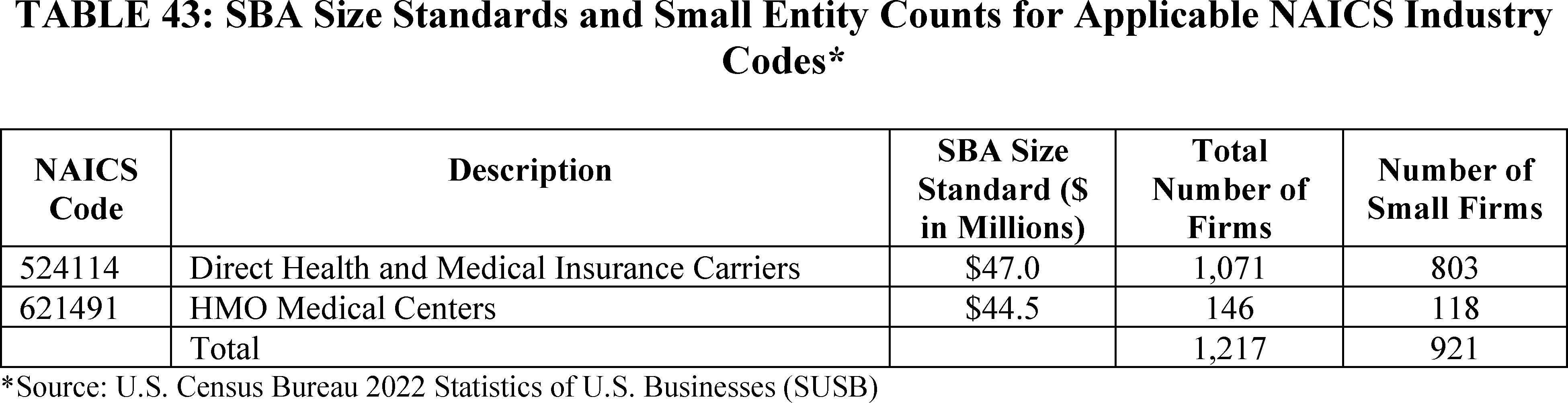
6. Impacts on Small Entities
As noted in section V.F. of this preamble, the Departments consider annual average economic impacts exceeding approximately 3 to 5 percent of revenues to constitute a significant economic impact on a substantial number of small entities. For purposes of this RFA analysis, the Departments evaluate whether compliance costs exceed approximately 3 to 5 percent of firm revenues to determine whether these final rules will have a significant economic impact on a substantial number of small entities. To conduct this analysis, the Departments analyzed revenue data for Direct Health and Medical Insurance Carriers and HMO Medical Centers that met the SBA small business size standards presented in Table 44, along with the implementation costs estimated in section IV. of this preamble.
To assess the ratio of compliance costs to revenues, the Departments used the total number of firms classified as small entities based on the 2022 SUSB data (n=921). The Departments then categorized these firms by receipts-based size category and calculated the share of small firms within each category, as shown in the “Percent of Small Firms” column in Table 44. Using corresponding revenue data from the 2022 SUSB data, the Departments calculated average annual revenues for firms within each size category.
( printed page 63850)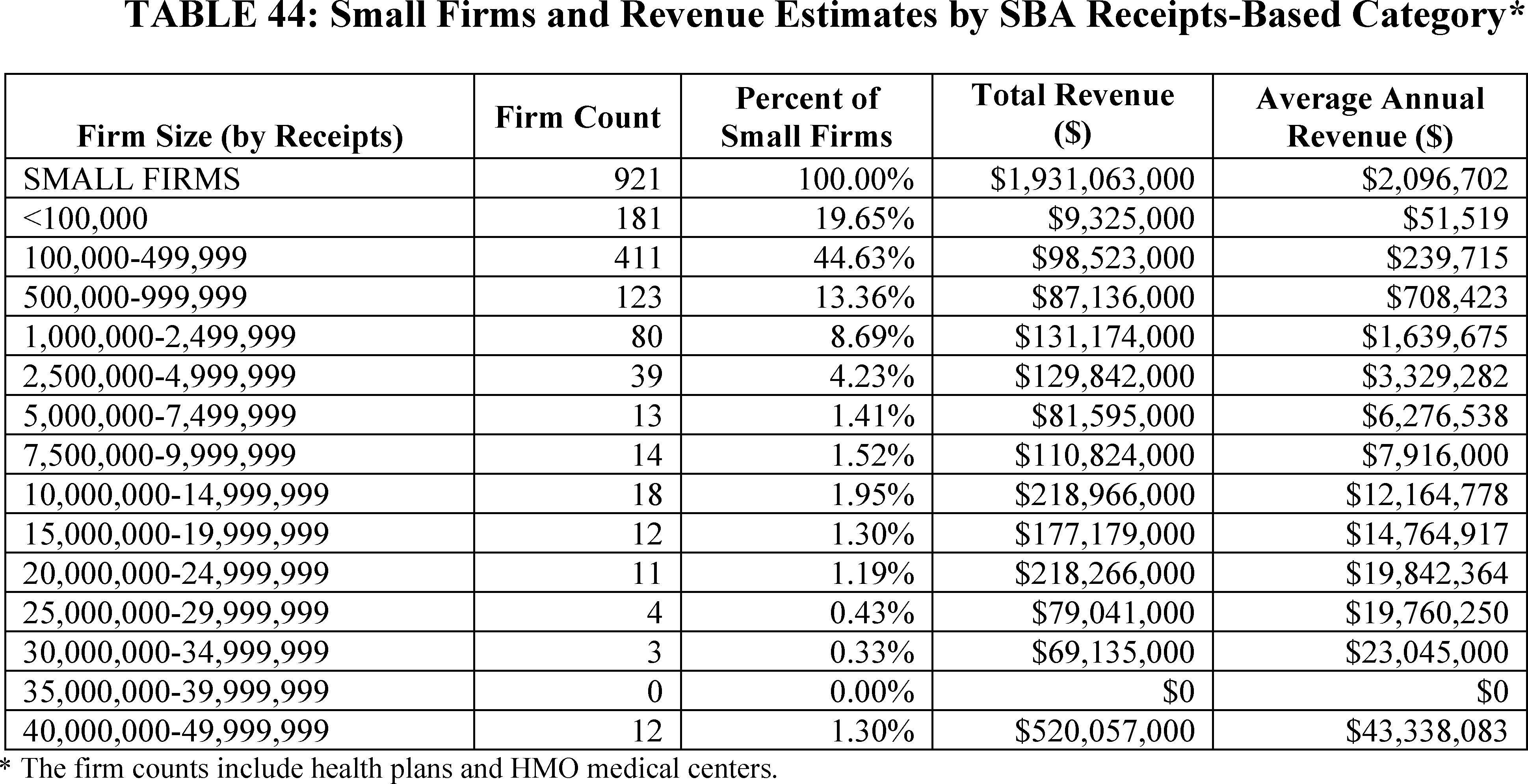
For purposes of estimating annualized cost for each firm, the Departments estimate a high-end industry cost of approximately $480,187,007 during the first year as discussed in section IV. of this preamble. In addition, plans and issuers are expected to incur approximately $3,047,412 in cost to review and understand the regulatory requirements as described in section V.D. of this preamble for a total first-year cost of approximately $483,234,418. Assuming these costs are distributed evenly across all 1,303 issuers and 205 TPAs, the estimated average high-end one-time per-entity costs will be approximately $320,447. This equal allocation is a simplifying assumption and is not intended to suggest that each entity will incur the same costs. Actual costs may vary depending on entity size, existing technical and administrative infrastructure, and the degree of operational changes necessary to comply with the final requirements.
In the proposed rules,[235] the Departments stated their expectation that fully-insured group health plans will rely on health insurance issuers whereas self-insured group health plans will depend on TPAs, including issuers providing administrative services only and non-issuer TPAs, to implement the requirements. The Departments also noted that some self-insured plans may choose to comply independently and would likely incur a similar hour burden. Accordingly, the estimated per-entity costs are intended to reflect the expected burden on issuers and TPAs responsible for implementing the final requirements on behalf of plans.
To assess the ratio of compliance costs to revenues, the Departments divided the estimated annualized cost per firm by the average annual revenue for firms within each receipts-based size category and expressed the result as a percentage. This percentage, shown in the “Compliance Cost-to-Revenue Ratio” column in Table 45, represents the estimated compliance cost burden relative to revenue for small firms due to these final rules. The Departments consider a “significant” economic impact to be compliance costs that amount to approximately 3 to 5 percent or more of affected entities' total revenues.
Based on the estimated compliance cost-to-revenue ratios shown in Table 45, the Departments expect these final rules to impose a significant economic impact on a substantial number of small entities, particularly among firms in lower receipts-based size categories where estimated compliance costs exceed approximately 3 to 5 percent of annual revenues. Specifically, approximately 861 of the 921 small entities identified in this analysis fall within receipts-based size categories below $10 million in annual revenue, where the estimated compliance cost-to-revenue ratios meet or exceed the Departments' significance threshold.
( printed page 63851)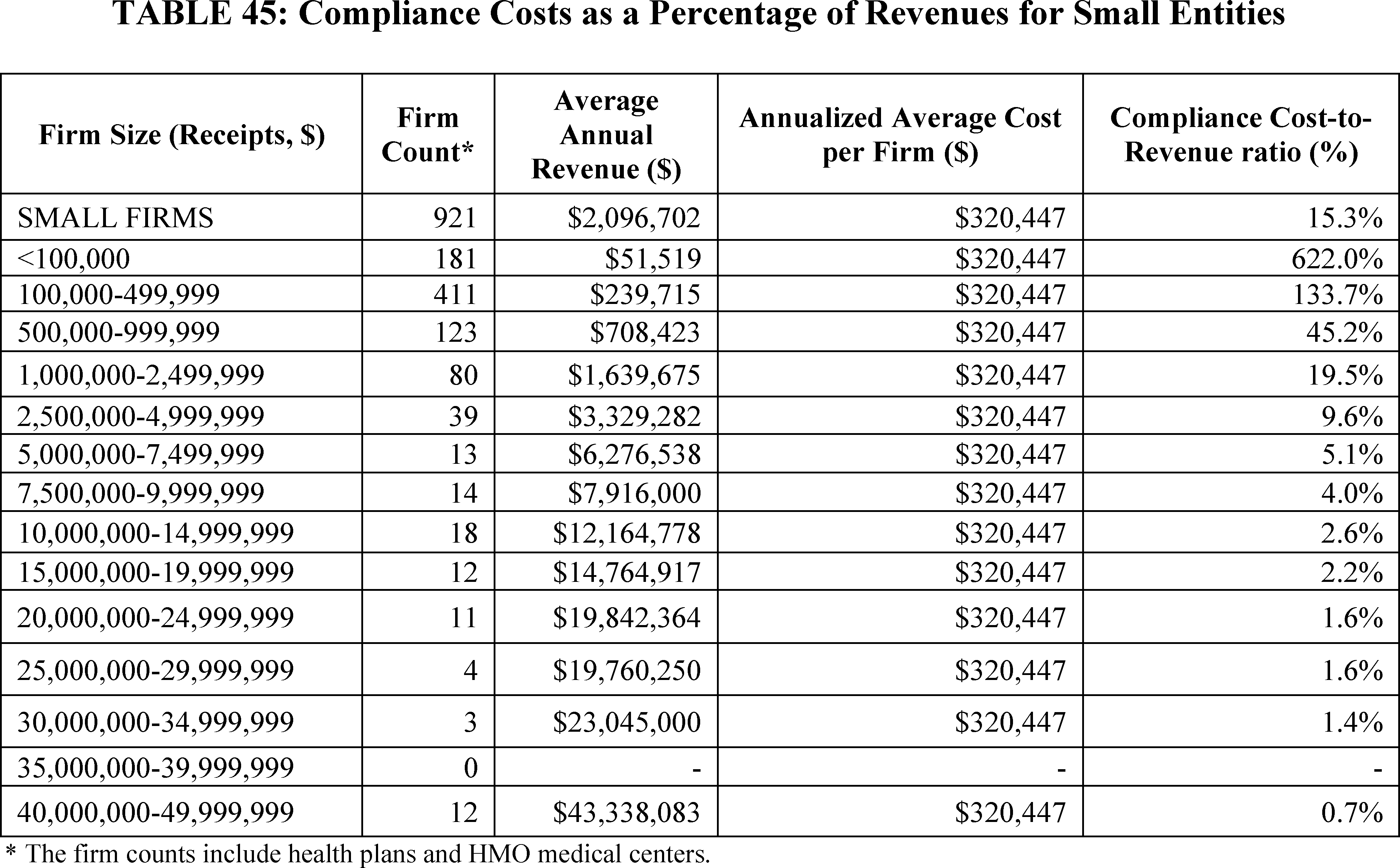
This conclusion differs from the assessment presented in the proposed rules, in which the Departments relied primarily on issuer-level MLR data to estimate the number of affected small entities and concluded that the proposed rules would not have a significant economic impact on a substantial number of small entities. In the proposed rules, the Departments used total premium revenue reported in MLR submissions to identify issuers below the applicable size threshold. The MLR-based analysis also accounted for whether entities were subsidiaries of larger organizations or had non-medical lines of business that could cause their total revenues to exceed the applicable SBA size standard. For purposes of these final rules, the Departments updated the analysis to rely on SUSB data and the applicable SBA size standards. SUSB data provide firm counts and receipts-based size categories by NAICS code, allowing the Departments to apply the relevant SBA size standards directly to firms in each of the relevant industries. The estimates derived from the two data sources are not directly comparable because the sources differ in scope, unit of analysis, and method of classifying small entities. The larger number of small entities identified using SUSB data reflects the broader firm-level scope of the final-rule analysis and does not indicate that the MLR data used in the proposed rules were inaccurate. As a result of this revised methodology and updated assumptions, the Departments estimate that these final rules may have a significant economic impact on a substantial number of small entities, particularly among entities in lower receipts-based size categories.
Some small plans and issuers may benefit from centralized functions that reduce the direct burden of compliance. In addition, based on 2024 MLR data, many of these entities are likely to have access to centralized administrative, operational, or compliance functions through affiliated parent organizations and may also have non-health lines of business that result in total revenues exceeding $47 million.[236] As a result, the estimated per-entity impacts presented in this analysis may overstate the burden experienced by individual entities.
The Departments also note that the analysis of impacts on small entities is based primarily on first-year implementation costs, which represent the largest share of the burden associated with these final rules as discussed in section IV. of this preamble. These first-year costs reflect one-time activities such as systems development, file creation and testing, operational coordination, and implementation planning. In subsequent years, plans and issuers are expected to incur primarily ongoing maintenance, reporting, and file update activities, which are substantially lower than the initial implementation burden. Accordingly, the Departments expect the economic impact of these final rules on small entities to decline significantly after the first year of implementation.
7. Duplication, Overlap, and Conflict With Other Rules and Regulations
The Departments do not anticipate that these final rules will duplicate, overlap, or conflict with other Federal rules or regulations. These final rules amend the Transparency in Coverage requirements to improve the quality, accuracy, and usability of pricing and cost-sharing disclosures, align certain requirements with protections established under the No Surprises Act, and reduce duplicative reporting requirements.
The Departments did not receive comments identifying any duplication, overlap, or conflict with other rules or regulations and conclude that these final rules do not create material ( printed page 63852) duplication, overlap, or conflict with other Federal requirements.
8. Small Rural Hospitals
Section 1102(b) of the Social Security Act (SSA) (42 U.S.C. 1302) requires agencies to prepare an RIA if a rule is expected to have a significant impact on the operations of a substantial number of small rural hospitals. This analysis must align with the provisions of section 604 of the RFA. For purposes of section 1102(b) of the SSA, the Departments define a small rural hospital as a hospital that is located outside of a metropolitan statistical area with fewer than 100 beds.
While these final rules are not anticipated to directly regulate small rural hospitals, the Departments acknowledge that the transparency requirements in these final rules may have indirect effects on these facilities through potential changes in negotiated rates and patient cost-sharing, market dynamics that could impact hospital revenues, particularly given that rural providers typically operate with thinner profit margins than their urban counterparts. At the same time, the Departments recognize that rural hospitals may also face lower levels of competition in certain areas, which could limit the extent of any indirect effects that result from these final rules. Therefore, the Departments have determined that any indirect effects are not expected to rise to the level of a significant impact on the operations of a substantial number of small rural hospitals.
G. Unfunded Mandates Reform Act (UMRA)
Section 202 of the Unfunded Mandates Reform Act of 1995 (UMRA) requires agencies to assess anticipated costs and benefits before issuing any rule that may result in expenditures of $100 million or more in any one year (in 1995 dollars), adjusted annually for inflation. For 2025, this threshold is approximately $187 million. These final rules include disclosure requirements that may impact private sector entities, such as health insurance issuers offering coverage in the individual and group health insurance markets and TPAs administering group health plans. In addition, States, local, or Tribal governments may incur costs related to enforcement of certain provisions. The Departments expect the total burden on State, local, or Tribal governments and the private sector to exceed the UMRA threshold. The RIA in section V. of this preamble constitutes the assessment of anticipated costs and benefits required by UMRA.
H. Federalism
Executive Order 13132 establishes certain requirements that an agency must meet when it issues a final rule that imposes substantial direct costs on State and local governments, preempts State law, or otherwise has federalism implications. Federal agencies issuing regulations that have federalism implications must consult with States and local officials and describe the extent of their consultation and the nature of the concerns of States and local officials in the preamble to the regulation.
The Departments have determined these final rules may have federalism implications because they have direct effects on the States, the relationship between the Federal Government and States, or on the distribution of power and responsibilities among various levels of government relating to the disclosure of health insurance coverage information to consumers.
Under these final rules, all non-grandfathered group health plans and health insurance issuers offering non-grandfathered group or individual health insurance coverage, including non-Federal governmental plans as defined in section 2791(d)(8)(C) of the PHS Act, are required to enhance the accessibility and transparency of cost-sharing and pricing information for a participant, beneficiary, or enrollee (or an authorized representative on behalf of such individual). Specifically, plans and issuers need to update statements to reflect Federal balance billing protections, make cost-sharing estimates available by phone, and clarify how to meet the requirements for price comparison tools. These final rules also require improvements to the format and accessibility of machine-readable files, expansion of required data elements, and adjustments to posting frequency and structure to ensure pricing data is more usable and understandable for consumers.
Federal standards developed under section 2715A of the PHS Act do not preempt any related States' standards relating to health insurance issuers that require pricing information to be disclosed to participants, beneficiaries, or enrollees, or otherwise publicly disclosed, except to the extent that such State disclosure requirements prevent the application of a requirement under these final rules.
The Departments have determined that these final rules may have federalism implications based on the required disclosure of pricing information, as they are aware of at least 33 States that have passed some form of price transparency legislation, such as all-payer claims databases, consumer-facing price comparison tools, and right to shop programs, with varying requirements regarding the scope and level of disclosure.[237] While some States provide prices for individual services, others report aggregated costs across providers or over time to reflect the cost of an episode of care. The methods of sharing this information also vary. For instance, California requires uninsured patients to receive price estimates upon request, whereas other States use websites or software applications to enable consumers to compare prices across providers. Only seven States have published pricing information of issuers on consumer-facing public websites.[238] Therefore, these final rules may require plans and issuers to disclose more detailed pricing information than some State laws currently mandate.
In general, through section 514, ERISA supersedes State laws to the extent that they relate to any covered employee benefit plan but preserves State laws that regulate insurance, banking, or securities. Furthermore, the preemption provisions of section 731 of ERISA and section 2724 of the PHS Act (implemented in 29 CFR 2590.731(a) and 45 CFR 146.143(a)) apply so that the provisions of Part 7 of ERISA and title XXVII of the PHS Act (including the amendments made by the Affordable Care Act) are not to be “construed to supersede any provision of State law which establishes, implements, or continues in effect any standard or requirement solely relating to issuers in connection with group health insurance coverage except to the extent that such standard or requirement prevents the application of a `requirement' of a Federal standard.” The Departments have interpreted State law to “prevent the application” of a PHS Act provision where the State law makes it impossible for an issuer to comply with title XXVII of the PHS Act.[239] The conference ( printed page 63853) report accompanying HIPAA indicates that this preemption is intended to be the “narrowest” preemption of State laws, and Health Care Financing Administration (HCFA) guidance similarly states that preemption is limited to the “narrowest” of circumstances.[240] States may therefore continue to apply State law requirements to health insurance issuers so long as such requirements do not prevent the application of the Affordable Care Act requirements that are the subject of this rulemaking. Accordingly, States have significant latitude to impose requirements on health insurance issuers that are more restrictive than the Federal law.
In compliance with the requirement of Executive Order 13132, which requires agencies to examine closely any policies that may have federalism implications or limit the policy making discretion of the States, the Departments have engaged in efforts to consult with and work cooperatively with affected States. These efforts have included participation in conference calls and events hosted by the National Association of Insurance Commissioners (NAIC), as well as direct engagement with State insurance officials. The Departments intend to act in a similar fashion in enforcing the Affordable Care Act, including the provisions of section 2715A of the PHS Act. While drafting these final rules, the Departments attempted to balance the States' interests in regulating issuers with the goal of enhancing price transparency nationwide. By doing so, the Departments have complied with the requirements of Executive Order 13132.
The Departments requested comment on any potential effects these requirements on States, including any duplicative burdens between State and Federal requirements and ways to address such burdens, if applicable. The Departments did not receive any comments on these issues.
In accordance with the requirements set forth in section 8(a) of Executive Order 13132, and by the signatures affixed to these final rules, the Departments certify that the Department of the Treasury, Employee Benefits Security Administration, and CMS have complied with the requirements of Executive Order 13132 for these final rules in a meaningful and timely manner.
I. Executive Order 14192, “Unleashing Prosperity Through Deregulation”
Executive Order 14192, titled “Unleashing Prosperity Through Deregulation,” was issued on January 31, 2025. Section 3(a) of Executive Order 14192 requires an agency, unless prohibited by law, to identify at least ten existing regulations to be repealed when the agency issues a new regulation. In furtherance of this requirement, section 3(c) of Executive Order 14192 requires that the new incremental costs associated with new regulations shall, to the extent permitted by law, be offset by the elimination of existing costs associated with prior regulations. A significant regulatory action (as defined in section 3(f) of Executive Order 12866) that would impose total costs greater than zero is considered an Executive Order 14192 regulatory action.
In the proposed rules, the Departments anticipated that these rules would qualify as an Executive Order 14192 regulatory action because total costs were estimated to be greater than zero for Executive Order 14192 accounting purposes. Upon further review, the Departments have determined that certain impacts erroneously characterized as quantified benefits are more appropriately classified as cost savings. These impacts correspond to categories of compliance costs and burdens that were calculated in the 2020 Transparency in Coverage final rules and that this rule would reduce or eliminate, including costs associated with the development, operation, maintenance, and updating of machine-readable files, as well as related data processing and reporting requirements. Because the quantified values reflect reductions in labor, computational, storage, data transfer, and other costs that plans, issuers, third-party developers, and other file users would otherwise incur to access, process, store, transmit, and maintain machine-readable file data, the Departments classify these impacts as cost savings for Executive Order 14192 accounting purposes.
Specifically, the Departments consider the estimated reductions in data cleaning and integration costs, storage costs and lower network egress expenses resulting from reducing the reporting frequency from monthly to quarterly to be cost savings for Executive Order 14192 accounting purposes. These savings are quantified and discussed in section V.D.3.c.(2). After incorporating this refinement, the Departments estimate that total costs are less than zero for Executive Order 14192 accounting purposes and therefore conclude that these rules are an Executive Order 14192 deregulatory action.
As indicated in section IV.D., these final rules will result in implementation costs of approximately $480.2 million for all plans and issuers, including both one-time implementation costs and first-year ongoing costs. Beginning in the second year and continuing thereafter, these final rules are expected to generate a net cost savings of approximately $174.5 million annually ($254.9 million in cost savings offset by $80.4 million in costs) across all plans and issuers. Using a perpetual time horizon and applying a 7 percent discount rate, the Departments estimate a present value (as of 2024) of net cost savings of approximately $1.73 billion (2024 dollars), assuming implementation begins in 2027 for all plans and issuers. On an annualized basis, the Departments estimate a net cost savings of approximately $121.1 million (2024 dollars) for all plans and issuers, discounted relative to 2024, at a 7 percent discount rate.
Although the rule will impose upfront implementation costs in the first year, the discounted value of cost savings exceeds the discounted value of costs over the period analyzed. Accordingly, the Departments conclude that these rules are an Executive Order 14192 deregulatory action for the purposes of meeting Executive Order 14192 requirements.
This final regulation is subject to the Congressional Review Act provisions of the Small Business Regulatory Enforcement Fairness Act of 1996 (5 U.S.C. 801 et seq.) and has been transmitted to the Congress and the Comptroller General for review.
List of Subjects
26 CFR Part 54
- Excise taxes
- Health care
- Pensions
- Reporting and recordkeeping requirements
29 CFR Part 2590
- Child support
- Employee benefit plans
- Health care
- Health insurance
- Infants and children
- Maternal and child health
- Penalties
- Pensions
- Privacy
- Reporting and recordkeeping requirements
45 CFR Part 147
- Aged
- Citizenship and naturalization
- Civil rights
- Health care
- Health insurance
- Individuals with disabilities
- Intergovernmental relations
- Reporting and recordkeeping requirements
- Sex discrimination
Frank J. Bisignano,
Chief Executive Officer, Internal Revenue Service.
Kevin Salinger,
Acting Assistant Secretary for Tax Policy, Department of the Treasury.
Daniel Aronowitz,
Assistant Secretary, Employee Benefits Security Administration.
Robert F. Kennedy, Jr.,
Secretary, Department of Health and Human Services.
Department of the Treasury
Internal Revenue Service
For the reasons stated in the preamble, the Department of the Treasury amends 26 CFR part 54 as set forth below:
PART 54—PENSION EXCISE TAXES
1. The authority citation for part 54 continues to read as follows:
Authority: 26 U.S.C. 7805, unless otherwise noted.
2. Section 54.9815-2715A1 is amended by—
a. Redesignating paragraphs (a)(2)(xi) through (xxii) as paragraphs (a)(2)(xii) through (xxiii), respectively; and
b. Adding new paragraph (a)(2)(xi).
The addition reads as follows:
(a) * * *
(2) * * *
(xi) Health insurance market means, irrespective of the State, one of the following:
(A) The individual market, as defined in 45 CFR 144.103 (other than short-term, limited-duration insurance or individual health insurance coverage that consists solely of excepted benefits, as defined in 45 CFR 148.220).
(B) The large group market, as defined in 45 CFR 144.103 (other than coverage that consists solely of excepted benefits, as defined in § 54.9831-1(c)).
(C) The small group market, as defined in 45 CFR 144.103 (other than coverage that consists solely of excepted benefits, as defined in § 54.9831-1(c)).
(D) For purposes of self-insured group health plans (other than account-based plans, as defined in § 54.9815-2711(d)(6)(i), and plans that consist solely of excepted benefits, as defined in § 54.9831-1(c)), all self-insured group health plans maintained by the plan sponsor.
3. Section 54.9815-2715A2 is amended by—
a. Revising paragraphs (b)(1)(i)(A) and (B), (b)(1)(vii)(A), and (b)(2)(ii) introductory text;
b. Redesignating paragraph (b)(2)(ii)(D) as paragraph (b)(2)(iv);
c. Adding paragraph (b)(2)(iii);
d. Revising newly redesignated paragraph (b)(2)(iv);
e. Revising paragraphs (b)(3)(i) and (ii) and (c)(1); and
f. Adding paragraph (c)(7).
The revisions and additions read as follows:
(b) * * *
(1) * * *
(i) * * *
(A) If the request for cost-sharing information relates to items and services that are provided within a bundled payment arrangement, and the bundled payment arrangement includes items or services that have a separate cost-sharing liability, the group health plan or health insurance issuer must provide estimates of the cost-sharing liability for the requested covered item or service, as well as an estimate of the cost-sharing liability for each of the items and services in the bundled payment arrangement that have separate cost-sharing liabilities. While plans and issuers are not required to provide estimates of cost-sharing liability for a bundled payment arrangement where the cost-sharing is imposed separately for each item and service included in the bundled payment arrangement, nothing prohibits plans or issuers from providing estimates for multiple items and services in situations where such estimates could be relevant to participants or beneficiaries, as long as the plan or issuer also discloses information about the relevant items or services individually, as required in paragraph (b)(1)(v) of this section.
(B) For requested items and services that are recommended preventive services under section 2713 of the Public Health Service Act (PHS Act), if the group health plan or health insurance issuer cannot determine whether the request is for preventive or non-preventive purposes, the plan or issuer must display the cost-sharing liability that applies for non-preventive purposes. As an alternative, a plan or issuer may allow a participant or beneficiary to request cost-sharing information for the specific preventive or non-preventive item or service by including terms such as “preventive,” “non-preventive,” or “diagnostic” as a means to request the most accurate cost-sharing information.
(vii) * * *
(A) A statement that the cost-sharing information provided pursuant to this paragraph (b)(1) does not account for potential additional amounts in situations where applicable State or Federal law allow out-of-network providers to bill participants or beneficiaries for the difference between a provider's billed charges and the sum of the amount collected from the group health plan or health insurance issuer and from the participants or beneficiaries in the form of a copayment, coinsurance, or deductible amount (the difference referred to as balance billing). This statement is not required if the State in which the item or service was furnished prohibits all out-of-network providers from balance billing for all items and services payable by the plan or issuer;
(2) * * *
(ii) Paper method. Information provided under this paragraph (b) must be made available in plain language, without a fee, in paper form at the request of the participant or beneficiary. In responding to such a request, the group health plan or health insurance issuer may limit the number of providers with respect to which cost-sharing information for covered items and services is provided to no fewer than 20 providers per request. The plan or issuer is required to:
(iii) Phone method. Information provided under this paragraph (b) must be made available at the request of the participant or beneficiary via a telephone number indicated on any physical or electronic plan or insurance identification card issued to a participant or beneficiary through which a consumer may seek customer assistance pursuant to Code section 9816(e). Such information must be accurate at the time of the request and must be provided at the time of the request. In responding to such a request, the group health plan or health insurance issuer may limit the number of providers with respect to which cost-sharing information for covered items and services is provided to no fewer ( printed page 63855) than 20 providers per day. The plan or issuer is required to:
(A) Disclose the applicable provider-per-day limit to the participant or beneficiary; and
(B) Provide the cost-sharing information, in accordance with the requirements in paragraphs (b)(2)(i)(A) through (C) of this section.
(iv) Alternative method. In circumstances where participants and beneficiaries request disclosure other than by the internet-based self-service tool, paper, or phone (for example, by email) group health plans and health insurance issuers may provide the disclosure through alternative means and satisfy the requirements of this section, provided the participant or beneficiary agrees that such disclosure through such means is sufficient to satisfy the request and the plan or issuer meets the timing requirements established under paragraph (b)(2)(ii)(C) of this section for paper method disclosure.
(3) * * *
(i) Special rule for insured group health plans. To the extent coverage under a group health plan consists of group health insurance coverage, the plan satisfies the requirements of this paragraph (b) if the plan requires the health insurance issuer offering the coverage to provide the information required by this paragraph (b) in compliance with this section under a written agreement. Accordingly, if an issuer and a plan sponsor enter into a written agreement under which the issuer agrees to provide the information required under this paragraph (b) in compliance with this section, and the issuer fails to do so, then the issuer, but not the plan, violates the transparency disclosure requirements of this paragraph (b).
(ii) Other contractual arrangements. A group health plan or health insurance issuer may satisfy the requirements under this paragraph (b) by entering into a written agreement under which another party (such as a pharmacy benefit manager or other third-party) provides the information required by this paragraph (b) in compliance with this section. Notwithstanding the preceding sentence, if a plan or issuer chooses to enter into such an agreement and the party with which it contracts fails to provide the information in compliance with this paragraph (b), the plan or issuer violates the transparency disclosure requirements of this paragraph (b).
(c) * * *
(1) This section applies for plan years beginning on or after January 1, 2027. Until the applicability date in the preceding sentence, plans and issuers are required to continue to comply with § 54.9815-2715A2, revised as of April 1, 2025.
(7) A group health plan or health insurance issuer that provides to the participant or beneficiary the information required under paragraph (b)(1) of this section, in accordance with the method and format requirements set forth in paragraph (b)(2) of this section, satisfies the requirements set forth in Code section 9819, ERISA section 719, and PHS Act section 2799A-4.
4. Section 54.9815-2715A3 is amended by—
a. Revising and republishing paragraph (b); and
f. Revising paragraph (c)(1).
The revisions and republications read as follows:
(b) Requirements for public disclosure of in-network provider rates for covered items and services, out-of-network allowed amounts and billed charges for covered items and services, negotiated rates and historical net prices for covered prescription drugs, and contextual information. A group health plan or health insurance issuer must make available on an internet website the information required under paragraphs (b)(1) and (2) of this section in machine-readable files, in accordance with the method and format requirements described in paragraph (b)(3) of this section, and that are updated as required under paragraph (b)(4) of this section.
(1) Required information. Machine-readable files required under this paragraph (b) that are made available to the public by a group health plan or health insurance issuer must include:
(i) An in-network rate machine-readable file for each provider network maintained or contracted by a group health plan or health insurance issuer that includes the required information under this paragraph (b)(1)(i) for all covered items and services under each coverage option offered by the plan or issuer that uses such provider network, except for prescription drugs that are subject to a fee-for-service reimbursement arrangement, which must be reported in the prescription drug machine-readable file pursuant to paragraph (b)(1)(iii) of this section. Each in-network rate machine-readable file must include:
(A) The common provider network name;
(B) The provider network identifier;
(C) For each coverage option offered by a group health plan or health insurance issuer that uses such provider network, the name; the Health Insurance Oversight System (HIOS) identifier, or, if no HIOS identifier is available, the Employer Identification Number (EIN); and the product type (for example, including but not limited to health maintenance organization or preferred provider organization);
(D) A billing code, which in the case of prescription drugs must be a national drug code (NDC), and a plain language description for each billing code for each covered item or service included in the machine-readable file;
(E) For each covered item or service included in the machine-readable file, all applicable rates, which may include one or more of the following: Negotiated rates, underlying fee schedule rates, or derived amounts. If a group health plan or health insurance issuer does not use negotiated rates for provider reimbursement, then the plan or issuer should disclose derived amounts to the extent these amounts are already calculated in the normal course of business. If the plan or issuer uses underlying fee schedule rates for calculating cost sharing, then the plan or issuer should include the underlying fee schedule rates in addition to the negotiated rate or derived amount. Applicable rates, including for both individual items and services and items and services in a bundled payment arrangement, must be:
( 1) Reflected as dollar amounts, with respect to each covered item or service that is furnished by an in-network provider. If the negotiated rate is subject to change based upon participant or beneficiary-specific characteristics, these dollar amounts should be reflected as the base negotiated rate applicable to the item or service prior to adjustments for participant or beneficiary-specific characteristics. For contractual arrangements under which a group health plan or health insurance issuer agrees to pay an in-network provider a percentage of billed charges and is not able to assign a dollar amount to an item or service prior to a bill being generated, plans and issuers must report a percentage number, in lieu of a dollar amount, in a form and manner as specified in guidance issued by the Department of the Treasury, the Department of Labor, and the Department of Health and Human Services.
( 2) Associated with the National Provider Identifier (NPI), Tax ( printed page 63856) Identification Number (TIN), and Place of Service Code for each in-network provider, except those specified in paragraph (b)(1)(i)(F) of this section;
( 3) Associated with the last date of the contract term or expiration date for each provider-specific applicable rate that applies to each covered item or service; and
( 4) Indicated with a notation where a reimbursement arrangement other than a standard fee-for-service model (such as capitation or a bundled payment arrangement) applies.
(F) A group health plan or health insurance issuer must exclude from each file under paragraph (b)(1)(i) of this section a provider and their negotiated rate (provider-rate combination) for an item or service if the plan or issuer determines it is unlikely that the provider would be reimbursed for the item or service given that provider's specialty according to the plan's or issuer's internal provider taxonomy or other internal rules used during the claims adjudication process.
(ii) For each health insurance market, as defined in § 54.9815-2715A1(a)(2)(xi), in which a group health plan or health insurance issuer offers a plan or coverage, an out-of-network allowed amount machine-readable file, including:
(A) For each coverage option offered by a group health plan or health insurance issuer in such health insurance market, the name and the HIOS identifier, or, if no HIOS identifier is available, the EIN; and the product type (for example, including but not limited to health maintenance organization or preferred provider organization);
(B) A billing code, which in the case of prescription drugs must be an NDC, and a plain language description for each billing code for each covered item or service under any coverage option offered by a group health plan or health insurance issuer in such health insurance market; and
(C) Aggregated unique out-of-network allowed amounts and billed charges with respect to each covered item or service under any coverage option offered by a group health plan or health insurance issuer in such health insurance market furnished by out-of-network providers during the 6-month time period that begins 9 months prior to the publication date of the machine-readable file (except that a plan or issuer must omit such data in relation to a particular item or service when compliance with this paragraph (b)(1)(ii)(C) would require the plan or issuer to report payment of out-of-network allowed amounts in connection with fewer than 11 different claims for payment of that item or service in a single health insurance market). Consistent with paragraph (c)(3) of this section, nothing in this paragraph (b)(1)(ii)(C) requires the disclosure of information that would violate any applicable health information privacy law. Each unique out-of-network allowed amount must be:
( 1) Reflected as a dollar amount, with respect to each covered item or service that is furnished by an out-of-network provider; and
( 2) Associated with the NPI, TIN, and Place of Service Code for each out-of-network provider.
(iii) A prescription drug machine-readable file, including:
(A) For each coverage option offered by a group health plan or health insurance issuer, the name and the 14-digit HIOS identifier, or, if the 14-digit HIOS identifier is not available, the 5-digit HIOS identifier, or, if no HIOS identifier is available, the EIN;
(B) The NDC and the proprietary and nonproprietary name assigned to the NDC by the Food and Drug Administration (FDA) for each covered item or service that is a prescription drug under each coverage option offered by a plan or issuer;
(C) The negotiated rates which must be:
( 1) Reflected as a dollar amount, with respect to each NDC that is furnished by an in-network provider, including an in-network pharmacy or other prescription drug dispenser;
( 2) Associated with the NPI, TIN, and Place of Service Code for each in-network provider, including each in-network pharmacy or other prescription drug dispenser; and
( 3) Associated with the last date of the contract term for each provider-specific negotiated rate that applies to each NDC; and
(D) Historical net prices that are:
( 1) Reflected as a dollar amount, with respect to each NDC that is furnished by an in-network provider, including an in-network pharmacy or other prescription drug dispenser;
( 2) Associated with the NPI, TIN, and Place of Service Code for each in-network provider, including each in-network pharmacy or other prescription drug dispenser; and
( 3) Associated with the 90-day time period that begins 180 days prior to the publication date of the machine-readable file for each provider-specific historical net price that applies to each NDC (except that a group health plan or health insurance issuer must omit such data in relation to a particular NDC and provider when compliance with this paragraph (b)(1)(iii)(D) would require the plan or issuer to report payment of historical net prices calculated using fewer than 20 different claims for payment). Consistent with paragraph (c)(3) of this section, nothing in this paragraph (b)(1)(iii)(D) requires the disclosure of information that would violate any applicable health information privacy law.
(iv) In each machine-readable file required under paragraphs (b)(1)(i) through (iii), and (b)(2)(i) and (ii) of this section, a plan or issuer:
(A) Must attest the following: To the best of its knowledge and belief, this plan or issuer has included all applicable information in accordance with the requirements of 26 CFR 54.9815-2715A3, and the information encoded is true, accurate, and complete as of the date in the file.
(B) Must encode the name of the plan's or issuer's chief executive officer, president, or senior official designated to oversee the encoding of true, accurate, and complete data as directed in paragraph (b)(1)(iv)(A) of this section.
(C) May satisfy the requirements of paragraphs (b)(1)(iv)(A) and (B) of this section by entering into a written agreement under which another party (such as a third-party administrator) makes the attestation required in paragraph (b)(1)(iv)(A) of this section on behalf of the plan or issuer and encodes the name of the other party's chief executive officer, president, or senior official designated to oversee the encoding of true, accurate, and complete data as directed in paragraph (b)(1)(iv)(A) of this section, only if the plan or issuer has entered into an agreement with the other party to provide the information in this paragraph (b) pursuant to the special rules in paragraph (b)(5) of this section.
(2) Required contextual files. A group health plan or health insurance issuer must make available in a machine-readable format:
(i) A utilization file, for each in-network rate machine-readable file specified in paragraph (b)(1)(i) of this section, that includes, for the most recent plan year that ends at least 6 months prior to the date the utilization file is made available as specified in paragraph (b)(4)(iii) of this section:
(A) Items and services covered under the plans or policies included in the files prepared as specified in paragraph (b)(1)(i) of this section for which a claim has been submitted and reimbursed (or would be reimbursed but for cost-sharing liability), in whole or in part; and
(B) Each in-network provider identified by the NPI, TIN, and Place of ( printed page 63857) Service Code who was reimbursed (or would be reimbursed but for cost-sharing liability), in whole or in part, for a claim for each covered item or service included as specified in paragraph (b)(2)(i)(A) of this section.
(ii) A taxonomy file, for each in-network rate machine-readable file prepared as specified in paragraph (b)(1)(i) of this section, which includes the group health plan's or health insurance issuer's internal provider taxonomy, or other internal rules, used to determine if the plan or issuer should deny reimbursement for an item or service based on the provider's specialty, as described in paragraph (b)(1)(i)(F) of this section. The information provided in the taxonomy file must be expressed as pairings of items and services (represented by billing codes) with provider specialties (represented by specialty codes which are derived from the Health Care Provider Taxonomy code set established by the National Uniform Claim Committee (NUCC)). Plans and issuers must use their internal provider taxonomy or other internal rules to determine whether to exclude certain provider-rate combinations from the in-network rate machine-readable file as specified in paragraph (b)(1)(i)(F) of this section.
(iii) A plain text file in a .txt format in the root folder (that is, the top-level directory on an electronic file system) of a group health plan's or health insurance issuer's website that includes:
(A) The source page URL for the internet website that hosts the machine-readable files required under paragraphs (b)(1) and (2) of this section;
(B) A direct link to the URL for the machine-readable files required under paragraphs (b)(1) and (2) of this section; and
(C) Point-of-contact information, including a monitored email address for an individual or group dedicated to receiving and responding to inquiries and issues related to the machine-readable files required under paragraphs (b)(1) and (2) of this section. This contact information (whether an individual or group) must be prominently displayed on the same website where the machine-readable files are made available and kept updated per the requirements in paragraph (b)(4)(v) of this section.
(3) Required method and format for disclosing information to the public. (i) Unless otherwise required by this section, the machine-readable files described in paragraphs (b)(1) and (2) of this section must be available in a single, non-proprietary, open-standards format, in a form and manner specified in guidance issued by the Department of the Treasury, the Department of Labor, and the Department of Health and Human Services.
(ii) The machine-readable files described in paragraphs (b)(1) and (2) of this section must be publicly available and accessible to any person, automated script, or web crawler free of charge and without conditions, such as establishment of a user account, password, submission of personally identifiable information or other credentials, or blocking server configurations or firewalls to access the file.
(iii) The source page URL for the internet website that hosts the machine-readable files required under paragraphs (b)(1) and (2) of this section must be included as a link in the footer on the home page of the group health plan's or health insurance issuer's website, as well as any page of the website that features a footer, that is labeled “Price Transparency” or “Transparency in Coverage” and links directly to the publicly available web page that hosts the link to the machine-readable files.
(iv) The group health plan or health insurance issuer may satisfy the requirements of paragraph (b)(3)(iii) of this section by entering into a written agreement under which another party (such as a third-party administrator) posts the machine-readable files described in paragraphs (b)(1) and (2) of this section on its public website on behalf of the plan or issuer, including if the plan or issuer does not have a website. However, if the files are posted on a service provider's website, and the plan or issuer maintains a public website but chooses not to host the files separately on its own public website, it must provide a link on its own public website to the location where the files are made publicly available.
(4) Timing. A group health plan or health insurance issuer must update the machine-readable files in accordance with the following timeframes and clearly indicate the date that the files were most recently updated:
(i) The in-network rate and out-of-network allowed amount machine-readable files required by paragraphs (b)(1)(i) and (ii) of this section must be updated and posted quarterly on the first day of each calendar-year quarter beginning with the first calendar-year quarter following the applicability date under paragraph (c)(1) of this section;
(ii) The prescription drug machine-readable file required by paragraph (b)(1)(iii) of this section must be updated monthly;
(iii) The utilization machine-readable file required under paragraph (b)(2)(i) of this section must be posted beginning on July 1, 2028, and updated and posted on an annual basis thereafter;
(iv) The taxonomy machine-readable file required under paragraph (b)(2)(ii) of this section must be updated and posted quarterly on the first day of each calendar-year quarter beginning with the first calendar-year quarter following the applicability date under paragraph (c)(1) of this section. If there are no changes to the taxonomy that affect the information required in the machine-readable file required under paragraph (b)(1)(i) of this section in a subsequent quarter, the taxonomy file is still required to be posted but not updated for that quarter; and
(v) The text file required by paragraph (b)(2)(iii) of this section must be posted on the first day of the first calendar-year quarter following the applicability date under paragraph (c)(1) of this section and subsequently updated and posted as soon as practicable but no later than 7 calendar days following a change in any of the information required under paragraph (b)(2)(iii) of this section.
(5) Special rules to prevent unnecessary duplication— (i) Special rule for insured group health plans. To the extent coverage under a group health plan consists of group health insurance coverage, the plan satisfies the requirements of this paragraph (b) if the plan requires the health insurance issuer offering the coverage to provide the information under a written agreement. Accordingly, if an issuer and a plan sponsor enter into a written agreement under which the issuer agrees to provide, on behalf of the plan, the information required under this paragraph (b) in compliance with this section, and the issuer fails to do so, then the issuer, but not the plan, violates the transparency disclosure requirements of this paragraph (b).
(ii) Other contractual arrangements. A group health plan or health insurance issuer may satisfy the requirements under this paragraph (b) by entering into a written agreement under which another party (such as a third-party administrator or health care claims clearinghouse) will provide, on behalf of the plan or issuer, the information required by this paragraph (b) in compliance with this section. Notwithstanding the preceding sentence, if a plan or issuer chooses to enter into such an agreement and the party with which it contracts fails to provide the information in compliance with this paragraph (b), the plan or issuer violates the transparency disclosure requirements of this paragraph (b). ( printed page 63858)
(iii) Special rule for self-insured group health plans with respect to the disclosure of in-network rate machine-readable files. A self-insured group health plan that enters into an agreement with another party described in paragraph (b)(5)(ii) of this section may permit such other party to make available in a single in-network rate machine-readable file as required under paragraph (b)(1)(i) of this section the information required under paragraph (b)(1)(i) of this section for each provider network used by more than one plan, insurance policy, or contract (including those offered by different plan sponsors with which that other party has an agreement) and across different health insurance markets if—
(A) Each in-network rate machine-readable file made available for a provider network includes the required information under paragraph (b)(1)(i) of this section for all covered items and services under each plan, insurance policy, or contract that uses the same provider network for which the in-network rate machine-readable file is made available; and
(B) Each of the self-insured group health plan's utilization and taxonomy machine-readable files include the information required under paragraphs (b)(2)(i) and (ii) of this section, respectively, for the same plans, insurance policies, or contracts (including those offered by different plan sponsors and across different health insurance markets, if applicable) represented in the corresponding in-network rate machine-readable files specified in paragraph (b)(1)(i) of this section.
(iv) Special rule for self-insured group health plans with respect to the disclosure of out-of-network allowed amount machine-readable files. A self-insured group health plan that enters into an agreement with another party described in paragraph (b)(5)(ii) of this section may permit such other party to make available the information required under paragraph (b)(1)(ii) of this section in a single out-of-network allowed amount file for more than one self-insured group health plan (including those offered by different plan sponsors with which the other party has an agreement), provided that the out-of-network allowed amount and billed charge data described in paragraph (b)(1)(ii)(C) of this section in relation to a particular item or service is omitted if it would require disclosure of out-of-network allowed amounts in connection with fewer than 11 different claims for payment of such item or service across all of the plans (including those offered by different plan sponsors) included in the out-of-network machine-readable file.
(c) * * *
(1)(i) Until the applicability date specified in paragraph (c)(1)(ii) of this section, plans and issuers are required to continue to comply with § 54.9815-2715A3, revised as of April 1, 2025.
(ii) The provisions of this section apply beginning March 6, 2027, except that paragraphs (b)(2), (b)(3)(iii), and (b)(4)(iii) through (v) of this section apply beginning September 6, 2027.
DEPARTMENT OF LABOR
Employee Benefits Security Administration
For the reasons stated in the preamble, the Department of Labor amends 29 CFR part 2590 as set forth below:
PART 2590—RULES AND REGULATIONS FOR GROUP HEALTH PLANS
5. The authority citation for part 2590 continues to read as follows:
Authority: 29 U.S.C. 1027, 1059, 1135, 1161-1168, 1169, 1181-1183, 1181 note, 1185, 1185a-n, 1191, 1191a, 1191b, and 1191c; sec. 101(g), Pub. L. 104-191, 110 Stat. 1936; sec. 401(b), Pub. L. 105-200, 112 Stat. 645 (42 U.S.C. 651 note); sec. 512(d), Pub. L. 110-343, 122 Stat. 3881; sec. 1001, 1201, and 1562(e), Pub. L. 111-148, 124 Stat. 119, as amended by Pub. L. 111-152, 124 Stat. 1029; Division M, Pub. L. 113-235, 128 Stat. 2130; Pub. L. 116-260, 134 Stat. 1182; Secretary of Labor's Order 1-2011, 77 FR 1088 (Jan 9, 2012).
6. Section 2590.715-2715A1 is amended by—
a. Redesignating paragraphs (a)(2)(x) through (xxi) as paragraphs (a)(2)(xi) through (xxii), respectively; and
b. Adding new paragraph (a)(2)(x).
The addition reads as follows:
(a) * * *
(2) * * *
(x) Health insurance market means, irrespective of the State, one of the following:
(A) The individual market, as defined in 45 CFR 144.103 (other than short-term, limited-duration insurance or individual health insurance coverage that consists solely of excepted benefits, as defined in 45 CFR 148.220).
(B) The large group market, as defined in 45 CFR 144.103 (other than coverage that consists solely of excepted benefits, as defined in § 2590.732(c)).
(C) The small group market, as defined in 45 CFR 144.103 (other than coverage that consists solely of excepted benefits, as defined in § 2590.732(c)).
(D) For purposes of self-insured group health plans (other than account-based plans, as defined in § 2590.715-2711(d)(6)(i), and plans that consist solely of excepted benefits, as defined in § 2590.732(c)), all self-insured group health plans maintained by the plan sponsor.
7. Section 2590.715-2715A2 is amended by—
a. Revising paragraphs (b)(1)(i)(A) and (B), (b)(1)(vii)(A), and (b)(2)(ii) introductory text;
b. Redesignating paragraph (b)(2)(ii)(D) as paragraph (b)(2)(iv);
c. Adding paragraph (b)(2)(iii);
d. Revising newly redesignated paragraph (b)(2)(iv);
e. Revising paragraphs (b)(3)(i) and (ii) and (c)(1); and
f. Adding paragraph (c)(7).
The revisions and additions read as follows:
(b) * * *
(1) * * *
(i) * * *
(A) If the request for cost-sharing information relates to items and services that are provided within a bundled payment arrangement, and the bundled payment arrangement includes items or services that have a separate cost-sharing liability, the group health plan or health insurance issuer must provide estimates of the cost-sharing liability for the requested covered item or service, as well as an estimate of the cost-sharing liability for each of the items and services in the bundled payment arrangement that have separate cost-sharing liabilities. While plans and issuers are not required to provide estimates of cost-sharing liability for a bundled payment arrangement where the cost-sharing is imposed separately for each item and service included in the bundled payment arrangement, nothing prohibits plans or issuers from providing estimates for multiple items and services in situations where such estimates could be relevant to participants or beneficiaries, as long as the plan or issuer also discloses information about the relevant items or services individually, as required in paragraph (b)(1)(v) of this section.
(B) For requested items and services that are recommended preventive services under section 2713 of the Public Health Service Act (PHS Act), if ( printed page 63859) the group health plan or health insurance issuer cannot determine whether the request is for preventive or non-preventive purposes, the plan or issuer must display the cost-sharing liability that applies for non-preventive purposes. As an alternative, a plan or issuer may allow a participant or beneficiary to request cost-sharing information for the specific preventive or non-preventive item or service by including terms such as “preventive,” “non-preventive,” or “diagnostic” as a means to request the most accurate cost-sharing information.
(vii) * * *
(A) A statement that the cost-sharing information provided pursuant to this paragraph (b)(1) does not account for potential additional amounts in situations where applicable State or Federal law allow out-of-network providers to bill participants or beneficiaries for the difference between a provider's billed charges and the sum of the amount collected from the group health plan or health insurance issuer and from the participants or beneficiaries in the form of a copayment, coinsurance, or deductible amount (the difference referred to as balance billing). This statement is not required if the State in which the item or service was furnished prohibits all out-of-network providers from balance billing for all items and services payable by the plan or issuer;
(2) * * *
(ii) Paper method. Information provided under this paragraph (b) must be made available in plain language, without a fee, in paper form at the request of the participant or beneficiary. In responding to such a request, the group health plan or health insurance issuer may limit the number of providers with respect to which cost-sharing information for covered items and services is provided to no fewer than 20 providers per request. The plan or issuer is required to:
(iii) Phone method. Information provided under this paragraph (b) must be made available at the request of the participant or beneficiary via a telephone number indicated on any physical or electronic plan or insurance identification card issued to a participant or beneficiary through which a consumer may seek customer assistance pursuant to ERISA section 716(e). Such information must be accurate at the time of the request and must be provided at the time of the request. In responding to such a request, the group health plan or health insurance issuer may limit the number of providers with respect to which cost-sharing information for covered items and services is provided to no fewer than 20 providers per day. The plan or issuer is required to:
(A) Disclose the applicable provider-per-day limit to the participant or beneficiary; and
(B) Provide the cost-sharing information, in accordance with the requirements in paragraphs (b)(2)(i)(A) through (C) of this section.
(iv) Alternative method. In circumstances where participants and beneficiaries request disclosure other than by the internet-based self-service tool, paper, or phone (for example, by email) group health plans and health insurance issuers may provide the disclosure through alternative means and satisfy the requirements of this section, provided the participant or beneficiary agrees that such disclosure through such means is sufficient to satisfy the request and the plan or issuer meets the timing requirements established under paragraph (b)(2)(ii)(C) of this section for paper method disclosure.
(3) * * *
(i) Special rule for insured group health plans. To the extent coverage under a group health plan consists of group health insurance coverage, the plan satisfies the requirements of this paragraph (b) if the plan requires the health insurance issuer offering the coverage to provide the information required by this paragraph (b) in compliance with this section under a written agreement. Accordingly, if an issuer and a plan sponsor enter into a written agreement under which the issuer agrees to provide the information required under this paragraph (b) in compliance with this section, and the issuer fails to do so, then the issuer, but not the plan, violates the transparency disclosure requirements of this paragraph (b).
(ii) Other contractual arrangements. A group health plan or health insurance issuer may satisfy the requirements under this paragraph (b) by entering into a written agreement under which another party (such as a pharmacy benefit manager or other third-party) provides the information required by this paragraph (b) in compliance with this section. Notwithstanding the preceding sentence, if a plan or issuer chooses to enter into such an agreement and the party with which it contracts fails to provide the information in compliance with this paragraph (b), the plan or issuer violates the transparency disclosure requirements of this paragraph (b).
(c) * * *
(1) This section applies for plan years beginning on or after January 1, 2027. Until the applicability date in the preceding sentence, plans and issuers are required to continue to comply with § 2590.715-2715A2, revised as of July 1, 2025.
(7) A group health plan or health insurance issuer that provides to the participant or beneficiary the information required under paragraph (b)(1) of this section, in accordance with the method and format requirements set forth in paragraph (b)(2) of this section, satisfies the requirements set forth in Code section 9819, ERISA section 719, and PHS Act section 2799A-4.
8. Section 2590.715-2715A3 is amended by—
a. Revising and republishing paragraph (b); and
b. Revising paragraph (c)(1).
The revisions and republications read as follows:
(b) Requirements for public disclosure of in-network provider rates for covered items and services, out-of-network allowed amounts and billed charges for covered items and services, negotiated rates and historical net prices for covered prescription drugs, and contextual information. A group health plan or health insurance issuer must make available on an internet website the information required under paragraphs (b)(1) and (2) of this section in machine-readable files, in accordance with the method and format requirements described in paragraph (b)(3) of this section, and that are updated as required under paragraph (b)(4) of this section.
(1) Required information. Machine-readable files required under this paragraph (b) that are made available to the public by a group health plan or health insurance issuer must include:
(i) An in-network rate machine-readable file for each provider network maintained or contracted by a group health plan or health insurance issuer that includes the required information under this paragraph (b)(1)(i) for all covered items and services under each coverage option offered by the plan or issuer that uses such provider network, except for prescription drugs that are subject to a fee-for-service ( printed page 63860) reimbursement arrangement, which must be reported in the prescription drug machine-readable file pursuant to paragraph (b)(1)(iii) of this section. Each in-network rate machine-readable file must include:
(A) The common provider network name;
(B) The provider network identifier;
(C) For each coverage option offered by a group health plan or health insurance issuer that uses such provider network, the name; the Health Insurance Oversight System (HIOS) identifier, or, if no HIOS identifier is available, the Employer Identification Number (EIN); and the product type (for example, including but not limited to health maintenance organization or preferred provider organization);
(D) A billing code, which in the case of prescription drugs must be a national drug code (NDC), and a plain language description for each billing code for each covered item or service included in the machine-readable file;
(E) For each covered item or service included in the machine-readable file, all applicable rates, which may include one or more of the following: Negotiated rates, underlying fee schedule rates, or derived amounts. If a group health plan or health insurance issuer does not use negotiated rates for provider reimbursement, then the plan or issuer should disclose derived amounts to the extent these amounts are already calculated in the normal course of business. If the plan or issuer uses underlying fee schedule rates for calculating cost sharing, then the plan or issuer should include the underlying fee schedule rates in addition to the negotiated rate or derived amount. Applicable rates, including for both individual items and services and items and services in a bundled payment arrangement, must be:
( 1) Reflected as dollar amounts, with respect to each covered item or service that is furnished by an in-network provider. If the negotiated rate is subject to change based upon participant or beneficiary-specific characteristics, these dollar amounts should be reflected as the base negotiated rate applicable to the item or service prior to adjustments for participant or beneficiary-specific characteristics. For contractual arrangements under which a group health plan or health insurance issuer agrees to pay an in-network provider a percentage of billed charges and is not able to assign a dollar amount to an item or service prior to a bill being generated, plans and issuers must report a percentage number, in lieu of a dollar amount, in a form and manner as specified in guidance issued by the Department of the Treasury, the Department of Labor, and the Department of Health and Human Services.
( 2) Associated with the National Provider Identifier (NPI), Tax Identification Number (TIN), and Place of Service Code for each in-network provider, except those specified in paragraph (b)(1)(i)(F) of this section;
( 3) Associated with the last date of the contract term or expiration date for each provider-specific applicable rate that applies to each covered item or service; and
( 4) Indicated with a notation where a reimbursement arrangement other than a standard fee-for-service model (such as capitation or a bundled payment arrangement) applies.
(F) A group health plan or health insurance issuer must exclude from each file under paragraph (b)(1)(i) of this section a provider and their negotiated rate (provider-rate combination) for an item or service if the plan or issuer determines it is unlikely that the provider would be reimbursed for the item or service given that provider's specialty according to the plan's or issuer's internal provider taxonomy or other internal rules used during the claims adjudication process.
(ii) For each health insurance market, as defined in § 2590.715-2715A1(a)(2)(x), in which a group health plan or health insurance issuer offers a plan or coverage, an out-of-network allowed amount machine-readable file, including:
(A) For each coverage option offered by a group health plan or health insurance issuer in such health insurance market, the name and the HIOS identifier, or, if no HIOS identifier is available, the EIN; and the product type (for example, including but not limited to health maintenance organization or preferred provider organization);
(B) A billing code, which in the case of prescription drugs must be an NDC, and a plain language description for each billing code for each covered item or service under any coverage option offered by a group health plan or health insurance issuer in such health insurance market; and
(C) Aggregated unique out-of-network allowed amounts and billed charges with respect to each covered item or service under any coverage option offered by a group health plan or health insurance issuer in such health insurance market furnished by out-of-network providers during the 6-month time period that begins 9 months prior to the publication date of the machine-readable file (except that a plan or issuer must omit such data in relation to a particular item or service when compliance with this paragraph (b)(1)(ii)(C) would require the plan or issuer to report payment of out-of-network allowed amounts in connection with fewer than 11 different claims for payment of that item or service in a single health insurance market). Consistent with paragraph (c)(3) of this section, nothing in this paragraph (b)(1)(ii)(C) requires the disclosure of information that would violate any applicable health information privacy law. Each unique out-of-network allowed amount must be:
( 1) Reflected as a dollar amount, with respect to each covered item or service that is furnished by an out-of-network provider; and
( 2) Associated with the NPI, TIN, and Place of Service Code for each out-of-network provider.
(iii) A prescription drug machine-readable file, including:
(A) For each coverage option offered by a group health plan or health insurance issuer, the name and the 14-digit HIOS identifier, or, if the 14-digit HIOS identifier is not available, the 5-digit HIOS identifier, or, if no HIOS identifier is available, the EIN;
(B) The NDC, and the proprietary and nonproprietary name assigned to the NDC by the Food and Drug Administration (FDA), for each covered item or service under each coverage option offered by a plan or issuer that is a prescription drug;
(C) The negotiated rates which must be:
( 1) Reflected as a dollar amount, with respect to each NDC that is furnished by an in-network provider, including an in-network pharmacy or other prescription drug dispenser;
( 2) Associated with the NPI, TIN, and Place of Service Code for each in-network provider, including each in-network pharmacy or other prescription drug dispenser; and
( 3) Associated with the last date of the contract term for each provider-specific negotiated rate that applies to each NDC; and
(D) Historical net prices that are:
( 1) Reflected as a dollar amount, with respect to each NDC that is furnished by an in-network provider, including an in-network pharmacy or other prescription drug dispenser;
( 2) Associated with the NPI, TIN, and Place of Service Code for each in-network provider, including each in-network pharmacy or other prescription drug dispenser; and
( 3) Associated with the 90-day time period that begins 180 days prior to the publication date of the machine- ( printed page 63861) readable file for each provider-specific historical net price that applies to each NDC (except that a group health plan or health insurance issuer must omit such data in relation to a particular NDC and provider when compliance with this paragraph (b)(1)(iii)(D) would require the plan or issuer to report payment of historical net prices calculated using fewer than 20 different claims for payment). Consistent with paragraph (c)(3) of this section, nothing in this paragraph (b)(1)(iii)(D) requires the disclosure of information that would violate any applicable health information privacy law.
(iv) In each machine-readable file required under paragraphs (b)(1)(i) through (iii), and (b)(2)(i) and (ii) of this section, a plan or issuer:
(A) Must attest the following: To the best of its knowledge and belief, this plan or issuer has included all applicable information in accordance with the requirements of 29 CFR 2590.715-2715A3, and the information encoded is true, accurate, and complete as of the date in the file.
(B) Must encode the name of the plan's or issuer's chief executive officer, president, or senior official designated to oversee the encoding of true, accurate, and complete data as directed in paragraph (b)(1)(iv)(A) of this section.
(C) May satisfy the requirements of paragraphs (b)(1)(iv)(A) and (B) of this section by entering into a written agreement under which another party (such as a third-party administrator) makes the attestation required in paragraph (b)(1)(iv)(A) of this section on behalf of the plan or issuer and encodes the name of the other party's chief executive officer, president, or senior official designated to oversee the encoding of true, accurate, and complete data as directed in paragraph (b)(1)(iv)(A) of this section, only if the plan or issuer has entered into an agreement with the other party to provide the information in this paragraph (b) pursuant to the special rules in paragraph (b)(5) of this section.
(2) Required contextual files. A group health plan or health insurance issuer must make available in a machine-readable format:
(i) A utilization file, for each in-network rate machine-readable file specified in paragraph (b)(1)(i) of this section, that includes, for the most recent plan year that ends at least 6 months prior to the date the utilization file is made available as specified in paragraph (b)(4)(iii) of this section:
(A) Items and services covered under the plans or policies included in the files prepared as specified in paragraph (b)(1)(i) of this section for which a claim has been submitted and reimbursed (or would be reimbursed but for cost-sharing liability), in whole or in part; and
(B) Each in-network provider identified by the NPI, TIN, and Place of Service Code who was reimbursed (or would be reimbursed but for cost-sharing liability), in whole or in part, for a claim for each covered item or service included as specified in paragraph (b)(2)(i)(A) of this section.
(ii) A taxonomy file, for each in-network rate machine-readable file prepared as specified in paragraph (b)(1)(i) of this section, which includes the group health plan's or health insurance issuer's internal provider taxonomy, or other internal rules, used to determine if the plan or issuer should deny reimbursement for an item or service based on the provider's specialty, as described in paragraph (b)(1)(i)(F) of this section. The information provided in the taxonomy file must be expressed as pairings of items and services (represented by billing codes) with provider specialties (represented by specialty codes which are derived from the Health Care Provider Taxonomy code set established by the National Uniform Claim Committee (NUCC)). Plans and issuers must use their internal provider taxonomy or other internal rules to determine whether to exclude certain provider-rate combinations from the in-network rate machine-readable file as specified in paragraph (b)(1)(i)(F) of this section.
(iii) A plain text file in a .txt format in the root folder (that is, the top-level directory on an electronic file system) of a group health plan's or health insurance issuer's website that includes:
(A) The source page URL for the internet website that hosts the machine-readable files required under paragraphs (b)(1) and (2) of this section;
(B) A direct link to the URL for the machine-readable files required under paragraphs (b)(1) and (2) of this section; and
(C) Point-of-contact information, including a monitored email address for an individual or group dedicated to receiving and responding to inquiries and issues related to the machine-readable files required under paragraphs (b)(1) and (2) of this section. This contact information (whether an individual or group) must be prominently displayed on the same website where the machine-readable files are made available and kept updated per the requirements in paragraph (b)(4)(v) of this section.
(3) Required method and format for disclosing information to the public. (i) Unless otherwise required by this section, the machine-readable files described in paragraphs (b)(1) and (2) of this section must be available in a single, non-proprietary, open-standards format, in a form and manner specified in guidance issued by the Department of the Treasury, the Department of Labor, and the Department of Health and Human Services.
(ii) The machine-readable files described in paragraphs (b)(1) and (2) of this section must be publicly available and accessible to any person, automated script, or web crawler free of charge and without conditions, such as establishment of a user account, password, submission of personally identifiable information or other credentials, or blocking server configurations or firewalls to access the file.
(iii) The source page URL for the internet website that hosts the machine-readable files required under paragraphs (b)(1) and (2) of this section must be included as a link in the footer on the home page of the group health plan's or health insurance issuer's website, as well as any page of the website that features a footer, that is labeled “Price Transparency” or “Transparency in Coverage” and links directly to the publicly available web page that hosts the link to the machine-readable files.
(iv) The group health plan or health insurance issuer may satisfy the requirements of paragraph (b)(3)(iii) of this section by entering into a written agreement under which another party (such as a third-party administrator) posts the machine-readable files described in paragraphs (b)(1) and (2) of this section on its public website on behalf of the plan or issuer, including if the plan or issuer does not have a website. However, if the files are posted on a service provider's website, and the plan or issuer maintains a public website but chooses not to host the files separately on its own public website, it must provide a link on its own public website to the location where the files are made publicly available.
(4) Timing. A group health plan or health insurance issuer must update the machine-readable files in accordance with the following timeframes and clearly indicate the date that the files were most recently updated:
(i) The in-network rate and out-of-network allowed amount machine-readable files required by paragraphs (b)(1)(i) and (ii) of this section must be updated and posted quarterly on the first day of each calendar-year quarter beginning with the first calendar-year quarter following the applicability date under paragraph (c)(1) of this section; ( printed page 63862)
(ii) The prescription drug machine-readable file required by paragraph (b)(1)(iii) of this section must be updated monthly;
(iii) The utilization machine-readable file required under paragraph (b)(2)(i) of this section must be posted beginning on July 1, 2028, and updated and posted on an annual basis thereafter;
(iv) The taxonomy machine-readable file required under paragraph (b)(2)(ii) of this section must be updated and posted quarterly on the first day of each calendar-year quarter beginning with the first calendar-year quarter following the applicability date under paragraph (c)(1) of this section. If there are no changes to the taxonomy that affect the information required in the machine-readable file required under paragraph (b)(1)(i) of this section in a subsequent quarter, the taxonomy file is still required to be posted but not updated for that quarter; and
(v) The text file required by paragraph (b)(2)(iii) of this section must be posted on the first day of the first calendar-year quarter following the applicability date under paragraph (c)(1) of this section and subsequently updated and posted as soon as practicable but no later than 7 calendar days following a change in any of the information required under paragraph (b)(2)(iii) of this section.
(5) Special rules to prevent unnecessary duplication— (i) Special rule for insured group health plans. To the extent coverage under a group health plan consists of group health insurance coverage, the plan satisfies the requirements of this paragraph (b) if the plan requires the health insurance issuer offering the coverage to provide the information under a written agreement. Accordingly, if an issuer and a plan sponsor enter into a written agreement under which the issuer agrees to provide, on behalf of the plan, the information required under this paragraph (b) in compliance with this section, and the issuer fails to do so, then the issuer, but not the plan, violates the transparency disclosure requirements of this paragraph (b).
(ii) Other contractual arrangements. A group health plan or health insurance issuer may satisfy the requirements under this paragraph (b) by entering into a written agreement under which another party (such as a third-party administrator or health care claims clearinghouse) will provide, on behalf of the plan or issuer, the information required by this paragraph (b) in compliance with this section. Notwithstanding the preceding sentence, if a plan or issuer chooses to enter into such an agreement and the party with which it contracts fails to provide the information in compliance with this paragraph (b), the plan or issuer violates the transparency disclosure requirements of this paragraph (b).
(iii) Special rule for self-insured group health plans with respect to the disclosure of in-network rate machine-readable files. A self-insured group health plan that enters into an agreement with another party described in paragraph (b)(5)(ii) of this section may permit such other party to make available in a single in-network rate machine-readable file as required under paragraph (b)(1)(i) of this section the information required under paragraph (b)(1)(i) of this section for each provider network used by more than one plan, insurance policy, or contract (including those offered by different plan sponsors with which that other party has an agreement) and across different health insurance markets if—
(A) Each in-network rate machine-readable file made available for a provider network includes the required information under paragraph (b)(1)(i) of this section for all covered items and services under each plan, insurance policy, or contract that uses the same provider network for which the in-network rate machine-readable file is made available; and
(B) Each of the self-insured group health plan's utilization and taxonomy machine-readable files include the information required under paragraphs (b)(2)(i) and (ii) of this section, respectively, for the same plans, insurance policies, or contracts (including those offered by different plan sponsors and across different health insurance markets, if applicable) represented in the corresponding in-network rate machine-readable files specified in paragraph (b)(1)(i) of this section.
(iv) Special rule for self-insured group health plans with respect to the disclosure of out-of-network allowed amount machine-readable files. A self-insured group health plan that enters into an agreement with another party described in paragraph (b)(5)(ii) of this section may permit such other party to make available the information required under paragraph (b)(1)(ii) of this section in a single out-of-network allowed amount file for more than one self-insured group health plan (including those offered by different plan sponsors with which the other party has an agreement), provided that the out-of-network allowed amount and billed charge data described in paragraph (b)(1)(ii)(C) of this section in relation to a particular item or service is omitted if it would require disclosure of out-of-network allowed amounts in connection with fewer than 11 different claims for payment of such item or service across all of the plans (including those offered by different plan sponsors) included in the out-of-network machine-readable file.
(c) * * *
(1)(i) Until the applicability date specified in paragraph (c)(1)(ii) of this section, plans and issuers are required to continue to comply with 29 CFR 2590.715-2715A3 revised as of July 1, 2025.
(ii) The provisions of this section apply beginning March 6, 2027, except that paragraphs (b)(2), (b)(3)(iii), and (b)(4)(iii) through (v) of this section apply beginning September 6, 2027.
DEPARTMENT OF HEALTH AND HUMAN SERVICES
For the reasons stated in the preamble, the Department of Health and Human Services amends 45 CFR part 147 as set forth below:
PART 147—HEALTH INSURANCE REFORM REQUIREMENTS FOR THE GROUP AND INDIVIDUAL HEALTH INSURANCE MARKETS
9. The authority citation for part 147 is revised to read as follows:
Authority: 42 U.S.C. 300gg through 300gg-63, 300gg-91, 300gg-92, and 300gg-114, as amended.
10. Section 147.210 is amended by—
a. Redesignating paragraphs (a)(2)(xi) through (xxii) as paragraphs (a)(2)(xii) through (xxiii), respectively; and
b. Adding paragraph (a)(2)(xi).
The addition reads as follows:
(a) * * *
(2) * * *
(xi) Health insurance market means, irrespective of the State, one of the following:
(A) The individual market, as defined in § 144.103 (other than short-term, limited-duration insurance or individual health insurance coverage that consists solely of excepted benefits, as defined in § 148.220).
(B) The large group market, as defined in § 144.103 (other than coverage that consists solely of excepted benefits, as defined in § 146.145(b)).
(C) The small group market, as defined in § 144.103 (other than coverage that consists solely of excepted benefits, as defined in § 146.145(b)).
(D) For purposes of self-insured group health plans (other than account-based plans, as defined in § 147.126(d)(6)(i), ( printed page 63863) and plans that consist solely of excepted benefits, as defined in § 146.145(b)), all self-insured group health plans maintained by the plan sponsor.
11. Section 147.211 is amended by—
a. Revising paragraphs (b)(1)(i)(A) and (B), (b)(1)(vii)(A), and (b)(2)(ii) introductory text;
b. Redesignating paragraph (b)(2)(ii)(D) as paragraph (b)(2)(iv);
c. Adding paragraph (b)(2)(iii);
d. Revising newly redesignated paragraph (b)(2)(iv);
e. Revising paragraphs (b)(3)(i) and (ii) and (c)(1); and
f. Adding paragraph (c)(7).
The revisions and additions read as follows:
(b) * * *
(1) * * *
(i) * * *
(A) If the request for cost-sharing information relates to items and services that are provided within a bundled payment arrangement, and the bundled payment arrangement includes items or services that have a separate cost-sharing liability, the group health plan or health insurance issuer must provide estimates of the cost-sharing liability for the requested covered item or service, as well as an estimate of the cost-sharing liability for each of the items and services in the bundled payment arrangement that have separate cost-sharing liabilities. While plans and issuers are not required to provide estimates of cost-sharing liability for a bundled payment arrangement where the cost-sharing is imposed separately for each item and service included in the bundled payment arrangement, nothing prohibits plans or issuers from providing estimates for multiple items and services in situations where such estimates could be relevant to participants, beneficiaries, or enrollees, as long as the plan or issuer also discloses information about the relevant items or services individually, as required in paragraph (b)(1)(v) of this section.
(B) For requested items and services that are recommended preventive services under section 2713 of the Public Health Service Act (PHS Act), if the group health plan or health insurance issuer cannot determine whether the request is for preventive or non-preventive purposes, the plan or issuer must display the cost-sharing liability that applies for non-preventive purposes. As an alternative, a plan or issuer may allow a participant, beneficiary, or enrollee to request cost-sharing information for the specific preventive or non-preventive item or service by including terms such as “preventive,” “non-preventive,” or “diagnostic” as a means to request the most accurate cost-sharing information.
(vii) * * *
(A) A statement that the cost-sharing information provided pursuant to this paragraph (b)(1) does not account for potential additional amounts in situations where applicable State or Federal law allow out-of-network providers to bill participants, beneficiaries, or enrollees for the difference between a provider's billed charges and the sum of the amount collected from the group health plan or health insurance issuer and from the participants, beneficiaries, or enrollees in the form of a copayment, coinsurance, or deductible amount (the difference referred to as balance billing). This statement is not required if the State in which the item or service was furnished prohibits all out-of-network providers from balance billing for all items and services payable by the plan or issuer;
(2) * * *
(ii) Paper method. Information provided under this paragraph (b) must be made available in plain language, without a fee, in paper form at the request of the participant, beneficiary, or enrollee. In responding to such a request, the group health plan or health insurance issuer may limit the number of providers with respect to which cost-sharing information for covered items and services is provided to no fewer than 20 providers per request. The plan or issuer is required to:
(iii) Phone method. Information provided under this paragraph (b) must be made available at the request of the participant, beneficiary, or enrollee via a telephone number indicated on any physical or electronic plan or insurance identification card issued to a participant, beneficiary, or enrollee through which a consumer may seek customer assistance pursuant to section 2799A-1(e)(3) of the PHS Act. Such information must be accurate at the time of the request and must be provided at the time of the request. In responding to such a request, the group health plan or health insurance issuer may limit the number of providers with respect to which cost-sharing information for covered items and services is provided to no fewer than 20 providers per day. The plan or issuer is required to:
(A) Disclose the applicable provider-per-day limit to the participant, beneficiary, or enrollee; and
(B) Provide the cost-sharing information, in accordance with the requirements in paragraphs (b)(2)(i)(A) through (C) of this section.
(iv) Alternative method. In circumstances where participants, beneficiaries, and enrollees request disclosure other than by the internet-based self-service tool, paper, or phone (for example, by email) group health plans and health insurance issuers may provide the disclosure through alternative means and satisfy the requirements of this section, provided the participant, beneficiary, or enrollee agrees that such disclosure through such means is sufficient to satisfy the request and the plan or issuer meets the timing requirements established under paragraph (b)(2)(ii)(C) of this section for paper method disclosure.
(3) * * *
(i) Special rule for insured group health plans. To the extent coverage under a group health plan consists of group health insurance coverage, the plan satisfies the requirements of this paragraph (b) if the plan requires the health insurance issuer offering the coverage to provide the information required by this paragraph (b) in compliance with this section under a written agreement. Accordingly, if an issuer and a plan sponsor enter into a written agreement under which the issuer agrees to provide the information required under this paragraph (b) in compliance with this section, and the issuer fails to do so, then the issuer, but not the plan, violates the transparency disclosure requirements of this paragraph (b).
(ii) Other contractual arrangements. A group health plan or health insurance issuer may satisfy the requirements under this paragraph (b) by entering into a written agreement under which another party (such as a pharmacy benefit manager or other third-party) provides the information required by this paragraph (b) in compliance with this section. Notwithstanding the preceding sentence, if a plan or issuer chooses to enter into such an agreement and the party with which it contracts fails to provide the information in compliance with this paragraph (b), the plan or issuer violates the transparency disclosure requirements of this paragraph (b).
(c) * * *
(1) This section applies for plan years (in the individual market, for policy years) beginning on or after January 1, ( printed page 63864) 2027. Until the applicability date in the preceding sentence, plans and issuers are required to continue to comply with § 147.211, revised as of October 1, 2025.
(7) A group health plan or health insurance issuer that provides to the participant, beneficiary or enrollee the information required under paragraph (b)(1) of this section, in accordance with the method and format requirements set forth in paragraph (b)(2) of this section, satisfies the requirements set forth in Code section 9819, ERISA section 719, and PHS Act section 2799A-4.
12. Section 147.212 is amended by—
a. Revising and republishing paragraph (b); and
b. Revising paragraph (c)(1).
The revisions and republications read as follows:
(b) Requirements for public disclosure of in-network provider rates for covered items and services, out-of-network allowed amounts and billed charges for covered items and services, negotiated rates and historical net prices for covered prescription drugs, and contextual information. A group health plan or health insurance issuer must make available on an internet website the information required under paragraphs (b)(1) and (2) of this section in machine-readable files, in accordance with the method and format requirements described in paragraph (b)(3) of this section, and that are updated as required under paragraph (b)(4) of this section.
(1) Required information. Machine-readable files required under this paragraph (b) that are made available to the public by a group health plan or health insurance issuer must include:
(i) An in-network rate machine-readable file for each provider network maintained or contracted by a group health plan or health insurance issuer that includes the required information under this paragraph (b)(1)(i) for all covered items and services under each coverage option offered by the plan or issuer that uses such provider network, except for prescription drugs that are subject to a fee-for-service reimbursement arrangement, which must be reported in the prescription drug machine-readable file pursuant to paragraph (b)(1)(iii) of this section. Each in-network rate machine-readable file must include:
(A) The common provider network name;
(B) The provider network identifier;
(C) For each coverage option offered by a group health plan or health insurance issuer that uses such provider network, the name; the Health Insurance Oversight System (HIOS) identifier, or, if no HIOS identifier is available, the Employer Identification Number (EIN); and the product type (for example, including but not limited to health maintenance organization or preferred provider organization);
(D) A billing code, which in the case of prescription drugs must be a national drug code (NDC), and a plain language description for each billing code for each covered item or service included in the machine-readable file;
(E) For each covered item or service included in the machine-readable file, all applicable rates, which may include one or more of the following: Negotiated rates, underlying fee schedule rates, or derived amounts. If a group health plan or health insurance issuer does not use negotiated rates for provider reimbursement, then the plan or issuer should disclose derived amounts to the extent these amounts are already calculated in the normal course of business. If the plan or issuer uses underlying fee schedule rates for calculating cost sharing, then the plan or issuer should include the underlying fee schedule rates in addition to the negotiated rate or derived amount. Applicable rates, including for both individual items and services and items and services in a bundled payment arrangement, must be:
( 1) Reflected as dollar amounts, with respect to each covered item or service that is furnished by an in-network provider. If the negotiated rate is subject to change based upon participant, beneficiary, or enrollee-specific characteristics, these dollar amounts should be reflected as the base negotiated rate applicable to the item or service prior to adjustments for participant, beneficiary, or enrollee-specific characteristics. For contractual arrangements under which a group health plan or health insurance issuer agrees to pay an in-network provider a percentage of billed charges and is not able to assign a dollar amount to an item or service prior to a bill being generated, plans and issuers must report a percentage number, in lieu of a dollar amount, in a form and manner as specified in guidance issued by the Department of the Treasury, the Department of Labor, and the Department of Health and Human Services.
( 2) Associated with the National Provider Identifier (NPI), Tax Identification Number (TIN), and Place of Service Code for each in-network provider, except those specified in paragraph (b)(1)(i)(F) of this section;
( 3) Associated with the last date of the contract term or expiration date for each provider-specific applicable rate that applies to each covered item or service; and
( 4) Indicated with a notation where a reimbursement arrangement other than a standard fee-for-service model (such as capitation or a bundled payment arrangement) applies.
(F) A group health plan or health insurance issuer must exclude from each file under paragraph (b)(1)(i) of this section a provider and their negotiated rate (provider-rate combination) for an item or service if the plan or issuer determines it is unlikely that the provider would be reimbursed for the item or service given that provider's specialty according to the plan's or issuer's internal provider taxonomy or other internal rules used during the claims adjudication process.
(ii) For each health insurance market, as defined in § 147.210(a)(2)(xi), in which a group health plan or health insurance issuer offers a plan or coverage, an out-of-network allowed amount machine-readable file, including:
(A) For each coverage option offered by a group health plan or health insurance issuer in such health insurance market, the name and the HIOS identifier, or, if no HIOS identifier is available, the EIN; and the product type (for example, including but not limited to health maintenance organization or preferred provider organization);
(B) A billing code, which in the case of prescription drugs must be an NDC, and a plain language description for each billing code for each covered item or service under any coverage option offered by a group health plan or health insurance issuer in such health insurance market; and
(C) Aggregated unique out-of-network allowed amounts and billed charges with respect to each covered item or service under any coverage option offered by a group health plan or health insurance issuer in such health insurance market furnished by out-of-network providers during the 6-month time period that begins 9 months prior to the publication date of the machine-readable file (except that a plan or issuer must omit such data in relation to a particular item or service when compliance with this paragraph (b)(1)(ii)(C) would require the plan or issuer to report payment of out-of-network allowed amounts in connection with fewer than 11 different claims for ( printed page 63865) payment of that item or service in a single health insurance market). Consistent with paragraph (c)(3) of this section, nothing in this paragraph (b)(1)(ii)(C) requires the disclosure of information that would violate any applicable health information privacy law. Each unique out-of-network allowed amount must be:
( 1) Reflected as a dollar amount, with respect to each covered item or service that is furnished by an out-of-network provider; and
( 2) Associated with the NPI, TIN, and Place of Service Code for each out-of-network provider.
(iii) A prescription drug machine-readable file, including:
(A) For each coverage option offered by a group health plan or health insurance issuer, the name and the 14-digit HIOS identifier, or, if the 14-digit HIOS identifier is not available, the 5-digit HIOS identifier, or, if no HIOS identifier is available, the EIN;
(B) The NDC, and the proprietary and nonproprietary name assigned to the NDC by the Food and Drug Administration (FDA), for each covered item or service that is a prescription drug under each coverage option offered by a plan or issuer;
(C) The negotiated rates which must be:
( 1) Reflected as a dollar amount, with respect to each NDC that is furnished by an in-network provider, including an in-network pharmacy or other prescription drug dispenser;
( 2) Associated with the NPI, TIN, and Place of Service Code for each in-network provider, including each in-network pharmacy or other prescription drug dispenser; and
( 3) Associated with the last date of the contract term for each provider-specific negotiated rate that applies to each NDC; and
(D) Historical net prices that are:
( 1) Reflected as a dollar amount, with respect to each NDC that is furnished by an in-network provider, including an in-network pharmacy or other prescription drug dispenser;
( 2) Associated with the NPI, TIN, and Place of Service Code for each in-network provider, including each in-network pharmacy or other prescription drug dispenser; and
( 3) Associated with the 90-day time period that begins 180 days prior to the publication date of the machine-readable file for each provider-specific historical net price that applies to each NDC (except that a group health plan or health insurance issuer must omit such data in relation to a particular NDC and provider when compliance with this paragraph (b)(1)(iii)(D) would require the plan or issuer to report payment of historical net prices calculated using fewer than 20 different claims for payment). Consistent with paragraph (b)(3) of this section, nothing in this paragraph (b)(1)(iii)(D) requires the disclosure of information that would violate any applicable health information privacy law.
(iv) In each machine-readable file required under paragraphs (b)(1)(i) through (iii), and (b)(2)(i) and (ii) of this section, a plan or issuer:
(A) Must attest the following: To the best of its knowledge and belief, this plan or issuer has included all applicable information in accordance with the requirements of 45 CFR 147.212, and the information encoded is true, accurate, and complete as of the date in the file.
(B) Must encode the name of the plan's or issuer's chief executive officer, president, or senior official designated to oversee the encoding of true, accurate, and complete data as directed in paragraph (b)(1)(iv)(A) of this section.
(C) May satisfy the requirements of paragraphs (b)(1)(iv)(A) and (B) of this section by entering into a written agreement under which another party (such as a third-party administrator) makes the attestation required in paragraph (b)(1)(iv)(A) of this section on behalf of the plan or issuer and encodes the name of the other party's chief executive officer, president, or senior official designated to oversee the encoding of true, accurate, and complete data as directed in paragraph (b)(1)(iv)(A) of this section, only if the plan or issuer has entered into an agreement with the other party to provide the information in this paragraph (b) pursuant to the special rules in paragraph (b)(5) of this section.
(2) Required contextual files. A group health plan or health insurance issuer must make available in a machine-readable format:
(i) A utilization file, for each in-network rate machine-readable file specified in paragraph (b)(1)(i) of this section, that includes, for the most recent plan year (in the individual market, policy year) that ends at least 6 months prior to the date the utilization file is made available as specified in paragraph (b)(4)(iii) of this section:
(A) Items and services covered under the plans or policies included in the files prepared as specified in paragraph (b)(1)(i) of this section for which a claim has been submitted and reimbursed (or would be reimbursed but for cost-sharing liability), in whole or in part; and
(B) Each in-network provider identified by the NPI, TIN, and Place of Service Code who was reimbursed (or would be reimbursed but for cost-sharing liability), in whole or in part, for a claim for each covered item or service included as specified in paragraph (b)(2)(i)(A) of this section.
(ii) A taxonomy file, for each in-network rate machine-readable file prepared as specified in paragraph (b)(1)(i) of this section, which includes the group health plan's or health insurance issuer's internal provider taxonomy, or other internal rules, used to determine if the plan or issuer should deny reimbursement for an item or service based on the provider's specialty, as described in paragraph (b)(1)(i)(F) of this section. The information provided in the taxonomy file must be expressed as pairings of items and services (represented by billing codes) with provider specialties (represented by specialty codes which are derived from the Health Care Provider Taxonomy code set established by the National Uniform Claim Committee (NUCC)). Plans and issuers must use their internal provider taxonomy or other internal rules to determine whether to exclude certain provider-rate combinations from the in-network rate machine-readable file as specified in paragraph (b)(1)(i)(F) of this section.
(iii) A plain text file in a .txt format in the root folder (that is, the top-level directory on an electronic file system) of a group health plan's or health insurance issuer's website that includes:
(A) The source page URL for the internet website that hosts the machine-readable files required under paragraphs (b)(1) and (2) of this section;
(B) A direct link to the URL for the machine-readable files required under paragraphs (b)(1) and (2) of this section; and
(C) Point-of-contact information, including a monitored email address for an individual or group dedicated to receiving and responding to inquiries and issues related to the machine-readable files required under paragraphs (b)(1) and (2) of this section. This contact information (whether an individual or group) must be prominently displayed on the same website where the machine-readable files are made available and kept updated per the requirements in paragraph (b)(4)(v) of this section.
(3) Required method and format for disclosing information to the public. (i) Unless otherwise required by this section, the machine-readable files described in paragraphs (b)(1) and (2) of this section must be available in a single, non-proprietary, open-standards format, in a form and manner specified ( printed page 63866) in guidance issued by the Department of the Treasury, the Department of Labor, and the Department of Health and Human Services.
(ii) The machine-readable files described in paragraphs (b)(1) and (2) of this section must be publicly available and accessible to any person, automated script, or web crawler free of charge and without conditions, such as establishment of a user account, password, submission of personally identifiable information or other credentials, or blocking server configurations or firewalls to access the file.
(iii) The source page URL for the internet website that hosts the machine-readable files required under paragraphs (b)(1) and (2) of this section must be included as a link in the footer on the home page of the group health plan's or health insurance issuer's website, as well as any page of the website that features a footer, that is labeled “Price Transparency” or “Transparency in Coverage” and links directly to the publicly available web page that hosts the link to the machine-readable files.
(iv) The group health plan or health insurance issuer may satisfy the requirements of paragraph (b)(3)(iii) of this section by entering into a written agreement under which another party (such as a third-party administrator) posts the machine-readable files described in paragraphs (b)(1) and (2) of this section on its public website on behalf of the plan or issuer, including if the plan or issuer does not have a website. However, if the files are posted on a service provider's website, and the plan or issuer maintains a public website but chooses not to host the files separately on its own public website, it must provide a link on its own public website to the location where the files are made publicly available.
(4) Timing. A group health plan or health insurance issuer must update the machine-readable files in accordance with the following timeframes and clearly indicate the date that the files were most recently updated:
(i) The in-network rate and out-of-network allowed amount machine-readable files required by paragraphs (b)(1)(i) and (ii) of this section must be updated and posted quarterly on the first day of each calendar-year quarter beginning with the first calendar-year quarter following the applicability date under paragraph (c)(1) of this section;
(ii) The prescription drug machine-readable file required by paragraph (b)(1)(iii) of this section must be updated monthly;
(iii) The utilization machine-readable file required under paragraph (b)(2)(i) of this section must be posted beginning on July 1, 2028, and updated and posted on an annual basis thereafter;
(iv) The taxonomy machine-readable file required under paragraph (b)(2)(ii) of this section must be updated and posted quarterly on the first day of each calendar-year quarter beginning with the first calendar-year quarter following the applicability date under paragraph (c)(1) of this section. If there are no changes to the taxonomy that affect the information required in the machine-readable file required under paragraph (b)(1)(i) of this section in a subsequent quarter, the taxonomy file is still required to be posted but not updated for that quarter; and
(v) The text file required by paragraph (b)(2)(iii) of this section must be posted on the first day of the first calendar-year quarter following the applicability date under paragraph (c)(1) of this section and subsequently updated and posted as soon as practicable but no later than 7 calendar days following a change in any of the information required under paragraph (b)(2)(iii) of this section.
(5) Special rules to prevent unnecessary duplication— (i) Special rule for insured group health plans. To the extent coverage under a group health plan consists of group health insurance coverage, the plan satisfies the requirements of this paragraph (b) if the plan requires the health insurance issuer offering the coverage to provide the information under a written agreement. Accordingly, if an issuer and a plan sponsor enter into a written agreement under which the issuer agrees to provide, on behalf of the plan, the information required under this paragraph (b) in compliance with this section, and the issuer fails to do so, then the issuer, but not the plan, violates the transparency disclosure requirements of this paragraph (b).
(ii) Other contractual arrangements. A group health plan or health insurance issuer may satisfy the requirements under this paragraph (b) by entering into a written agreement under which another party (such as a third-party administrator or health care claims clearinghouse) will provide, on behalf of the plan or issuer, the information required by this paragraph (b) in compliance with this section. Notwithstanding the preceding sentence, if a plan or issuer chooses to enter into such an agreement and the party with which it contracts fails to provide the information in compliance with this paragraph (b), the plan or issuer violates the transparency disclosure requirements of this paragraph (b).
(iii) Special rule for self-insured group health plans with respect to the disclosure of in-network rate machine-readable files. A self-insured group health plan that enters into an agreement with another party described in paragraph (b)(5)(ii) of this section may permit such other party to make available in a single in-network rate machine-readable file as required under paragraph (b)(1)(i) of this section the information required under paragraph (b)(1)(i) of this section for each provider network used by more than one plan, insurance policy, or contract (including those offered by different plan sponsors with which that other party has an agreement) and across different health insurance markets if—
(A) Each in-network rate machine-readable file made available for a provider network includes the required information under paragraph (b)(1)(i) of this section for all covered items and services under each plan, insurance policy, or contract that uses the same provider network for which the in-network rate machine-readable file is made available; and
(B) Each of the self-insured group health plan's utilization and taxonomy machine-readable files include the information required under paragraphs (b)(2)(i) and (ii) of this section, respectively, for the same plans, insurance policies, or contracts (including those offered by different plan sponsors and across different health insurance markets, if applicable) represented in the corresponding in-network rate machine-readable files specified in paragraph (b)(1)(i) of this section.
(iv) Special rule for self-insured group health plans with respect to the disclosure of out-of-network allowed amount machine-readable files. A self-insured group health plan that enters into an agreement with another party described in paragraph (b)(5)(ii) of this section may permit such other party to make available the information required under paragraph (b)(1)(ii) of this section in a single out-of-network allowed amount file for more than one self-insured group health plan (including those offered by different plan sponsors with which the other party has an agreement), provided that the out-of-network allowed amount and billed charge data described in paragraph (b)(1)(ii)(C) of this section in relation to a particular item or service is omitted if it would require disclosure of out-of-network allowed amounts in connection with fewer than 11 different claims for payment of such item or service across all of the plans (including those offered by different plan sponsors) included in ( printed page 63867) the out-of-network machine-readable file.
(c) * * *
(1)(i) Until the applicability date specified in paragraph (c)(1)(ii) of this section, plans and issuers are required to continue to comply with § 147.212 revised as of October 1, 2025.
(ii) The provisions of this section apply beginning March 6, 2027, except that paragraphs (b)(2), (b)(3)(iii), and (b)(4)(iii) through (v) of this section apply beginning September 6, 2027.
Footnotes
1. 84 FR 65464 (November 27, 2019).
Back to Citation2. 85 FR 72158 (November 12, 2020).
Back to Citation3. 85 FR 72158, 72160 (November 12, 2020).
Back to Citation4. Exec. Order No. 14221, 90 FR 11005 (February 28, 2025).
Back to Citation5. 90 FR 23303 (June 2, 2025).
Back to Citation6. 90 FR 60432 (December 23, 2025).
Back to Citation7. Medicare and Medicaid Programs: CY 2020 Hospital Outpatient PPS Policy Changes and Payment Rates and Ambulatory Surgical Center Payment System Policy Changes and Payment Rates. Price Transparency Requirements for Hospitals To Make Standard Charges Public, 84 FR 65524 (November 27, 2019); Medicare Program: Hospital Outpatient Prospective Payment and Ambulatory Surgical Center Payment Systems and Quality Reporting Programs; Price Transparency of Hospital Standard Charges; Radiation Oncology Model, 86 FR 63458 (November 16, 2021); Medicare Program: Hospital Outpatient Prospective Payment and Ambulatory Surgical Center Payment Systems; Quality Reporting Programs; Payment for Intensive Outpatient Services in Hospital Outpatient Departments, Community Mental Health Centers, Rural Health Clinics, Federally Qualified Health Centers, and Opioid Treatment Programs; Hospital Price Transparency; Changes to Community Mental Health Centers Conditions of Participation, Changes to the Inpatient Prospective Payment System Medicare Code Editor; Rural Emergency Hospital Conditions of Participation Technical Correction, 88 FR 81540 (November 22, 2023); Medicare Program: Hospital Outpatient Prospective Payment and Ambulatory Surgical Center Payment Systems; Quality Reporting Programs; Overall Hospital Quality Star Rating; Hospital Price Transparency; and Notice of Closure of a Teaching Hospital and Opportunity To Apply for Available Slots, 90 FR 53448 (November 25, 2025).
Back to Citation8. 90 FR 60432 (December 23, 2025).
Back to Citation9. Except that under section 2715A of the PHS Act, a plan or coverage that is not offered through the Exchange is only required to submit information to the applicable Secretary and the State insurance commissioner, and to make such information available to the public.
Back to Citation10. For purposes of the Summary of Annual Cost Savings table and Executive Order 14192, negative values reflect reductions in costs with respect to monetized cost savings.
Back to Citation11. Exec. Order No. 13877, 84 FR 30849 (June 27, 2019).
Back to Citation12. Id.
Back to Citation13. 84 FR 65464 (November 27, 2019).
Back to Citation14. 85 FR 72158 (November 12, 2020).
Back to Citation15. U.S. Department of Labor, U.S. Department of Health & Human Services & U.S. Department of the Treasury, FAQs About Affordable Care Act and Consolidated Appropriations Act, 2021 Implementation Part 49 (August 20, 2021), available at www.cms.gov/cciio/resources/fact-sheets-and-faqs/downloads/faqs-part-49.pdf and www.dol.gov/agencies/ebsa/about-ebsa/our-activities/resource-center/faqs/aca-part-49; FAQs About Affordable Care Act Implementation Part 53 (April 19, 2022), available at www.cms.gov/files/document/faq-part-53.pdf and www.dol.gov/agencies/ebsa/about-ebsa/our-activities/resource-center/faqs/aca-part-53; FAQs About Affordable Care Act Implementation Part 61 (September 27, 2023), available at www.cms.gov/files/document/faqs-about-affordable-care-act-implementation-part-61.pdf and www.dol.gov/agencies/ebsa/about-ebsa/our-activities/resource-center/faqs/aca-part-61.
Back to Citation16. Centers for Medicare & Medicaid Services, Transparency in Coverage, GitHub, available at github.com/CMSgov/price-transparency-guide (last visited June 15, 2026).
Back to Citation github.com/CMSgov/price-transparency-guide
17. Exec. Order No. 14221, 90 FR 11005 (February 28, 2025).
Back to Citation18. Id.
Back to Citation19. Exec. Order No. 13877, 84 FR 30849 (June 27, 2019).
Back to Citation20. Exec. Order No. 14221, 90 FR 11005 (February 25, 2025).
Back to Citation21. See PHS Act section 2723(a)(2) and (b)(1)(A); 45 CFR 150.203.
Back to Citation22. PHS Act section 2723(b)(1)(B).
Back to Citation23. 26 CFR 54.9815-2715A2(b)(2)(i), 29 CFR 2590.715-2715A2(b)(2)(i), and 45 CFR 147.211(b)(2)(i).
Back to Citation24. Including under ERISA section 502(a)(5).
Back to Citation25. As added by section 201 of title II (Transparency) of division BB of the Consolidated Appropriations Act, 2021.
Back to Citation26. 85 FR 72158, 72252 (November 12, 2020).
Back to Citation27. 83 FR 41141 (August 17, 2018).
Back to Citation28. Public Law 116-260 (Dec. 27, 2020).
Back to Citation29. Title I of Division BB of the Consolidated Appropriations Act, 2021.
Back to Citation30. 90 FR 60432, 60442 (December 23, 2025) (proposing to redesignate paragraphs (a)(2)(xi) through (xxii) as paragraphs (a)(2)(xii) through (xxiii) under 26 CFR 54.9815-2715A1 and 45 CFR 147.210; and to redesignate paragraphs (a)(2)(x) through (xxi) as paragraphs (a)(2)(xi) through (xxii) under 29 CFR 2590.715-2715A1).
Back to Citation31. 90 FR 60432, 60442 (December 23, 2025).
Back to Citation32. U.S. Department of Labor, U.S. Department of Health & Human Services & U.S. Department of the Treasury, FAQs About Affordable Care Act and Consolidated Appropriations Act, 2021 Implementation Part 49 (August 20, 2021), available at www.cms.gov/cciio/resources/fact-sheets-and-faqs/downloads/faqs-part-49.pdf and www.dol.gov/sites/dolgov/files/EBSA/about-ebsa/our-activities/resource-center/faqs/aca-part-49.pdf.
Back to Citation33. 26 CFR 54.9815-2715A2(b)(1)(vii)(D), 29 CFR 2590.715-2715A2(b)(1)(vii)(D), and 45 CFR 147.211(b)(1)(vii)(D).
Back to Citation34. U.S. Department of Labor, U.S. Department of Health & Human Services & U.S. Department of the Treasury, FAQs About Affordable Care Act and Consolidated Appropriations Act, 2021 Implementation Part 49 (August 20, 2021), available at www.cms.gov/cciio/resources/fact-sheets-and-faqs/downloads/faqs-part-49.pdf and www.dol.gov/sites/dolgov/files/EBSA/about-ebsa/our-activities/resource-center/faqs/aca-part-49.pdf.
Back to Citation35. See 90 FR 60432, 60446 (December 23, 2025); see also U.S. Department of Labor, U.S. Department of Health & Human Services & U.S. Department of the Treasury, FAQs about Affordable Care Act and Consolidated Appropriations Act, 2021 Implementation Part 49 (August 20, 2021), available at www.cms.gov/CCIIO/Resources/Fact-Sheets-and-FAQs/Downloads/FAQs-Part-49.pdf and www.dol.gov/sites/dolgov/files/EBSA/about-ebsa/our-activities/resource-center/faqs/aca-part-49.pdf.
Back to Citation36. See 90 FR 60432, 60447 (December 23, 2025).
Back to Citation37. Medicare and Medicaid Programs: CY 2020 Hospital Outpatient PPS Policy Changes and Payment Rates and Ambulatory Surgical Center Payment System Policy Changes and Payment Rates. Price Transparency Requirements for Hospitals To Make Standard Charges Public, 84 FR 65524 (November 27, 2019); Medicare Program: Hospital Outpatient Prospective Payment and Ambulatory Surgical Center Payment Systems and Quality Reporting Programs; Price Transparency of Hospital Standard Charges; Radiation Oncology Model, 86 FR 63458 (November 16, 2021); Medicare Program: Hospital Outpatient Prospective Payment and Ambulatory Surgical Center Payment Systems; Quality Reporting Programs; Payment for Intensive Outpatient Services in Hospital Outpatient Departments, Community Mental Health Centers, Rural Health Clinics, Federally Qualified Health Centers, and Opioid Treatment Programs; Hospital Price Transparency; Changes to Community Mental Health Centers Conditions of Participation, Changes to the Inpatient Prospective Payment System Medicare Code Editor; Rural Emergency Hospital Conditions of Participation Technical Correction, 88 FR 81540 (November 22, 2023); Medicare Program: Hospital Outpatient Prospective Payment and Ambulatory Surgical Center Payment Systems; Quality Reporting Programs; Overall Hospital Quality Star Rating; Hospital Price Transparency; and Notice of Closure of a Teaching Hospital and Opportunity To Apply for Available Slots, 90 FR 53448 (November 25, 2025).
Back to Citation38. See Jane M. Zhu, Yuehan Zhang, & Daniel Polsky, Networks in ACA Marketplaces Are Narrower for Mental Health Care Than for Primary Care, 36 Health Affairs 9 (September 5, 2017), available at www.healthaffairs.org/doi/10.1377/hlthaff.2017.0325 (finding, based on 2016 HealthCare.gov data, 531unique provider networks were used by 281 different issuers, covering 5,022 qualified health plans in the Federally-facilitated Marketplaces). The proposed rules included citations with incorrect authors' names. Those citations have been corrected in these final rules.
Back to Citation www.healthaffairs.org/doi/10.1377/hlthaff.2017.0325
39. 90 FR 60432, 60448 (December 23, 2025).
Back to Citation40. GitHub Users, GitHub Discussion: In-Network File #897, GitHub, available at github.com/CMSgov/price-transparency-guide/blob/master/schemas/in-network-rates/README.md#provider-reference-object (last updated January 8, 2026).
Back to Citation41. 90 FR 60432, 60448 (December 23, 2025).
Back to Citation42. 85 FR 72158, 72228 (November 12, 2020).
Back to Citation43. 90 FR 60432, 60449 (December 23, 2025).
Back to Citation44. 85 FR 72158, 72226 (November 12, 2020).
Back to Citation45. U.S. Department of Labor, U.S. Department of Health & Human Services & U.S. Department of the Treasury, FAQs about Affordable Care Act Implementation Part 53 (April 19, 2022), available at www.cms.gov/files/document/faqs-part-53.pdf and www.dol.gov/agencies/ebsa/about-ebsa/our-activities/resource-center/faqs/aca-part-53.
Back to Citation46. U.S. Department of Labor, U.S. Department of Health & Human Services & U.S. Department of the Treasury, FAQs about Affordable Care Act Implementation Part 61 (September 27, 2023), available at www.cms.gov/files/document/faqs-about-affordable-care-act-implementation-part-61.pdf and www.dol.gov/agencies/ebsa/about-ebsa/ouractivities/resource-center/faqs/aca-part-61; Centers for Medicare & Medicaid Services, Transparency in Coverage, GitHub, github.com/CMSgov/price-transparency-guide/blob/master/schemas/in-network-rates/README.md#additional-notes-1 (last updated January 8, 2026).
Back to Citation47. Medicare and Medicaid Programs: CY 2020 Hospital Outpatient PPS Policy Changes and Payment Rates and Ambulatory Surgical Center Payment System Policy Changes and Payment Rates. Price Transparency Requirements for Hospitals To Make Standard Charges Public, 84 FR 65524 (November 27, 2019); Medicare Program: Hospital Outpatient Prospective Payment and Ambulatory Surgical Center Payment Systems and Quality Reporting Programs; Price Transparency of Hospital Standard Charges; Radiation Oncology Model, 86 FR 63458 (November 16, 2021); Medicare Program: Hospital Outpatient Prospective Payment and Ambulatory Surgical Center Payment Systems; Quality Reporting Programs; Payment for Intensive Outpatient Services in Hospital Outpatient Departments, Community Mental Health Centers, Rural Health Clinics, Federally Qualified Health Centers, and Opioid Treatment Programs; Hospital Price Transparency; Changes to Community Mental Health Centers Conditions of Participation, Changes to the Inpatient Prospective Payment System Medicare Code Editor; Rural Emergency Hospital Conditions of Participation Technical Correction, 88 FR 81540 (November 22, 2023); Medicare Program: Hospital Outpatient Prospective Payment and Ambulatory Surgical Center Payment Systems; Quality Reporting Programs; Overall Hospital Quality Star Rating; Hospital Price Transparency; and Notice of Closure of a Teaching Hospital and Opportunity To Apply for Available Slots, 90 FR 53448 (November 25, 2025).
Back to Citation48. Centers for Medicare & Medicaid Services, Transparency in Coverage Price Transparency Guide, In-network Rates Negotiated Price Object, GitHub, available at github.com/CMSgov/price-transparency-guide/tree/master/schemas/in-network-rates#negotiated-price-object (last visited August 21, 2026).
Back to Citation49. 90 FR 60432, 60451 (December 23, 2025).
Back to Citation50. U.S. Department of Labor, U.S. Department of Health & Human Services & U.S. Department of the Treasury, FAQs about Affordable Care Act Implementation Part 53 (April 19, 2022), www.cms.gov/files/document/faqs-part-53.pdf and www.dol.gov/agencies/ebsa/about-ebs.
Back to Citation51. 85 FR 72158, 72161 (November 12, 2020); see also Gary Claxton, Lynne Cotter, & Shameek Rakshit, Challenges with Effective Price Transparency Analyses, Peterson-KFF Health System Tracker (February 25, 2025), www.healthsystemtracker.org/brief/challenges-with-effective-price-transparency-analyses/.
Back to Citation www.healthsystemtracker.org/brief/challenges-with-effective-price-transparency-analyses/
52. See 29 CFR 2590.725-4(a)(3) and 45 CFR 149.740(a)(3); see also26 CFR 54.9825-6T(a)(3) (expired).
Back to Citation53. The NUCC establishes and maintains standard provider taxonomy codes, which are used to define a provider's area of specialty. Provider taxonomy codes are ten characters in length structured into three distinct “levels” including provider grouping, classification, and area of specialization. See National Uniform Claim Committee, Health Care Provider Taxonomy, available at www.nucc.org/index.php/code-sets-mainmenu-41/provider-taxonomy-mainmenu-40 (last visited May 4, 2026).
Back to Citation www.nucc.org/index.php/code-sets-mainmenu-41/provider-taxonomy-mainmenu-40
54. See National Uniform Claim Committee, Health Care Provider Taxonomy, available at www.nucc.org/index.php/code-sets-mainmenu-41/provider-taxonomy-mainmenu-40 (last visited May 4, 2026).
Back to Citation55. See id.
Back to Citation56. 85 FR 72158, 72227 (November 12, 2020).
Back to Citation57. Matthew Robben, Learnings from MRF Land, Serif Health Blog (October 18, 2022), available at www.serifhealth.com/blog/learnings-from-mrf-land.
Back to Citation www.serifhealth.com/blog/learnings-from-mrf-land
58. 90 FR 60432, 60454-55 (December 23, 2025).
Back to Citation59. Centers for Medicare & Medicaid Services, Requesting Limited Data Set (LDS) Files, available at www.cms.gov/data-research/files-for-order/data-disclosures-and-data-use-agreements-duas/limited-data-set-lds (last modified Mar. 16, 2026); Research Data Assistance Center (ResDAC), CMS Cell Size Suppression Policy (January 26, 2024), available at resdac.org/articles/cms-cell-size-suppression-policy.
Back to Citation resdac.org/articles/cms-cell-size-suppression-policy
60. Id.
Back to Citation61. Id.
Back to Citation62. 45 CFR part 160 and subparts A and E of part 164.
Back to Citation63. 90 FR 60432, 60455 (December 23, 2025).
Back to Citation64. Id.
Back to Citation65. Id.
Back to Citation66. 90 FR 60432, 60442 (December 23, 2025).
Back to Citation67. Based on internal research, the Departments have found that variations on the term “mid-market” are used within the commercial insurance industry to refer to employer group health plans that are larger than small group plans, but that tend to be on the small side for large group plans. Different issuers and plans use varied definitions to pinpoint what would count as a mid-market group. See, for example, Sentara Health Plans, Employer Plan Sales Resources and Descriptions, available at www.sentarahealthplans.com/en/brokers/employer-plans/sales-resources-and-plan-descriptions (last visited June 1, 2026) (defining mid-market groups as having between 51 and 150 employees); BlueCross BlueShield of New Mexico, Mid-Market Group Plans, available at www.bcbsnm.com/producer/mid-market-group-insurance (last visited June 1, 2026) (defining mid-market groups as having between 51 and 150 employees); and Capital Blue Cross, Medium Group Plans, available at www.capbluecross.com/wps/portal/cap/employer/shop-group-plans/medium-plans/ppo-choice-select (last visited June 1, 2026) (defining “Medium Groups” as having between 51 and 99 employees).
Back to Citation www.sentarahealthplans.com/en/brokers/employer-plans/sales-resources-and-plan-descriptions
 www.bcbsnm.com/producer/mid-market-group-insurance
 www.capbluecross.com/wps/portal/cap/employer/shop-group-plans/medium-plans/ppo-choice-select
68. Section 1312(c) of the Affordable Care Act generally requires a health insurance issuer to consider all enrollees in all health plans (except grandfathered health plans) offered by such issuer to be members of a single risk pool for each of its individual and small group markets. States have the option to merge the individual and small group market risk pools in their states under section 1312(c)(3) of the Affordable Care Act. See also45 CFR 156.80.
Back to Citation69. Code section 9816(c)(7), ERISA section 716(c)(7), and PHS Act section 2799A-1(c)(7); see also Independent Dispute Resolution Reports, available at www.cms.gov/nosurprises/policies-and-resources/reports.
Back to Citation70. Exec. Order No. 14221, 90 FR 11005 (February 28, 2025).
Back to Citation71. Sachdev G, Lambert H. Re: Response to Executive Order 25-21 Increasing Freedom and Opportunity for Hoosiers by Improving Price Transparency in Healthcare, Indiana Department of Insurance (January 21, 2026), available at www.in.gov/gov/files/E.O.-25-21-Memo,-Executive-Summary,-and-Study.pdf.
Back to Citation www.in.gov/gov/files/E.O.-25-21-Memo,-Executive-Summary,-and-Study.pdf
72. See Centers for Medicare & Medicaid Services, Price Transparency Guide Validator, GitHub, github.com/CMSgov/price-transparency-guide-validator (last accessed May 13, 2026).
Back to Citation73. Exec. Order No. 14221, 90 FR 11005 (February 28, 2025).
Back to Citation74. 90 FR 60432, 60434-35 (December 23, 2025).
Back to Citation76. 85 FR 72158, 72220 (November 12, 2020).
Back to Citation77. 90 FR 53448, 54005 (November 25, 2025).
Back to Citation78. See 45 CFR 180.50(a)(3)(iii) and (iv).
Back to Citation79. The proposed rules proposed amendments to requirements related to the prescription drug machine-readable files, specifically: the requirement that plans and issuers must include a plain text file in a .txt format in the root folder of a plan's or issuer's website as described in section III.C.7.d. of the proposed rules and the requirements related to the method and format for disclosing information to the public as described in section III.C.9. of the proposed rules.
Back to Citation80. The 2020 final rules stated that “many consumers do not fully comprehend the basics of health coverage, much less the more complex facets of the health care system that can affect an individual's out-of-pocket cost for items and services, including: Its specialized billing codes and payment processes; the various specialized terms used in plan and coverage contracts and related documents (such as copayment and coinsurance); and the various billing and payment structures plans and issuers use to compensate providers and assign cost-sharing liability to individuals (for example, bundled payment arrangements).” 85 FR 72158, 72210 (November 12, 2020).
Back to Citation81. See Table 2 for an example.
Back to Citation82. FinThrive, Understanding the Claims Lifecycle: A Step-by-Step Guide (November 26, 2024), finthrive.com/blog/understanding-the-claims-lifecycle-a-step-by-step-guide.
Back to Citation finthrive.com/blog/understanding-the-claims-lifecycle-a-step-by-step-guide
83. 90 FR 60432, 60459 (December 23, 2025).
Back to Citation84. 85 FR 72158, 72225 (November 12, 2020).
Back to Citation85. Centers for Medicare & Medicaid Services, Health Plan Price Transparency: Contact Us, www.cms.gov/priorities/healthplan-price-transparency/overview/contact-us (last updated February 11, 2026).
Back to Citation86. 90 FR 60432, 60459 (December 23, 2025).
Back to Citation87. Section 1311(e)(3)(A)(i) through (viii) of the Affordable Care Act outlines specific information and data that must be submitted to the public and certain other entities on an accurate and timely basis. In addition, section 1311(e)(3)(A)(ix) of the Affordable Care Act requires health plans to submit “[o]ther information as determined appropriate by the Secretary.” As the Departments explained in the 2020 final rules, “the catchall provision is reasonably and best read as Congress' recognition that the Secretary of HHS (and, therefore, the Departments, by virtue of their joint authority under section 2715A of the PHS Act) would need broad flexibility to require the disclosure of information as appropriate to deliver the transparency necessary for consumers to understand their coverage options and for regulators to hold plans and issuers accountable. 85 FR 72158, 72167-68 (November 12, 2020).
Back to Citation88. 85 FR 72158, 72243 (November 12, 2020).
Back to Citation89. National Uniform Claim Committee, Health Care Provider Taxonomy, www.nucc.org/index.php/code-sets-mainmenu-41/provider-taxonomy-mainmenu-40 (last visited May 12, 2026).
Back to Citation90. The proposed rules proposed requirements in relation to the prescription drug machine-readable files at proposed paragraphs (b)(2)(iv) (relating to the proposed requirement to include a plain text file in a .txt format in the root folder of a plan's or issuer's website) and (b)(3) (relating to the method and format for disclosing information to the public) of 26 CFR 54.9815-2715A3, 29 CFR 2590.715-2715A3, and 45 CFR 147.212.
Back to Citation91. 90 FR 60432, 60460 (December 23, 2025) (citing 88 FR 81540 (November 22, 2023)).
Back to Citation92. See U.S. Department of Health & Human Services, Centers for Medicare & Medicaid Services (CMS), Hospital Price Transparency TXT File Frequently Asked Questions (FAQs), (August 29, 2024), available at www.cms.gov/files/document/hospital-price-transparency-txt-file-frequently-asked-questions-faqs.pdf.
Back to Citation93. 85 FR 72158, 72169 (November 12, 2020).
Back to Citation94. 84 FR 65464, 65481 (November 27, 2019).
Back to Citation95. 90 FR 60432, 60461 (December 23, 2025).
Back to Citation96. 90 FR 60432, 60461 (December 23, 2025). Newline-Delimited JSON (NDJSON) is a variation of JSON in which each line contains a single JSON object, while JSON has a single root object containing the entirety of the dataset. NDJSON files would not comply with the current schema version in technical implementation guidance.
Back to Citation97. 90 FR 60432, 60461 (December 23, 2025).
Back to Citation98. The proposed rules proposed requirements related to prescription drug machine-readable files at proposed paragraph (b)(3) (relating to the method and format for disclosing information to the public) of 26 CFR 54.9815-2715A3, 29 CFR 2590.715-2715A3, and 45 CFR 147.212.
Back to Citation99. See U.S. Department of Labor, U.S. Department of Health & Human Services & U.S. Department of the Treasury, FAQs about Affordable Care Act and Consolidated Appropriations Act, 2021 Implementation Part 55 (August 19, 2022), www.cms.gov/files/document/faqs-part-55.pdf and www.dol.gov/agencies/ebsa/about-ebsa/our-activities/resource-center/faqs/aca-part-55.
Back to Citation100. See IBM, What is CAPTCHA?, available at www.ibm.com/think/topics/captcha (last visited May 4, 2026) (“CAPTCHA stands for `completely automated public Turing test to tell computers and humans apart.' It refers to various authentication methods that validate users as humans, not bots, by presenting a challenge that is simple for humans but difficult for machines.”).
Back to Citation www.ibm.com/think/topics/captcha
101. See Mozilla, 403 Forbidden, available at developer.mozilla.org/en-US/docs/Web/HTTP/Reference/Status/403 (last updated July 4, 2025) (“The HTTP 403 Forbidden client error response status code indicates that the server understood the request but refused to process it.”).
Back to Citation developer.mozilla.org/en-US/docs/Web/HTTP/Reference/Status/403
102. See Cybersecurity and Infrastructure Agency, Understanding Denial-of-Service Attacks, www.cisa.gov/news-events/news/understanding-denial-service-attacks (last updated Feb. 1, 2021).
Back to Citation www.cisa.gov/news-events/news/understanding-denial-service-attacks
103. 90 FR 60432, 60464 (December 23, 2025).
Back to Citation104. Id.
Back to Citation105. Id.
Back to Citation106. Id.
Back to Citation107. Matthew Robben, MRF Processing Notes—October Edition, Serif Health (October 20, 2023), available at www.serifhealth.com/blog/mrf-processing-notes-october-edition.
Back to Citation108. 90 FR 60432, 60464 (December 23, 2025).
Back to Citation109. 85 FR 72158, 72244 (November 12, 2020).
Back to Citation110. 90 FR 23303 (June 2, 2025).
Back to Citation111. See 90 FR 60432, 60458 (December 23, 2025).
Back to Citation112. 90 FR 60432, 60466 (December 23, 2025).
Back to Citation113. 85 FR 72158, 72245 (November 12, 2020).
Back to Citation114. Id.
Back to Citation115. See 45 CFR 149.720(d)(2) (“ Other contractual arrangements. A group health plan or health insurance issuer offering group or individual health insurance coverage may satisfy the requirements under paragraph (a) of this section by entering into a written agreement under which one or more other parties (such as health insurance issuers, pharmacy benefit managers, third-party administrators, or other third parties) report some or all of the information required under paragraph (a) of this section in compliance with this section. Notwithstanding the preceding sentence, if a group health plan or health insurance issuer chooses to enter into such an agreement and the party with which it contracts fails to provide the information in accordance with paragraph (a) of this section, the plan or issuer violates the reporting requirements of paragraph (a) of this section.”); see also89 FR 77586, 77613 (September 23, 2024) (“Plans and issuers remain responsible for compliance with MHPAEA, and for ERISA-covered group health plans, fiduciaries, including TPAs or other service providers who are acting as fiduciaries, must work with plan sponsors and issuers to ensure that the plans and coverage they help establish and administer comply with the law.”).
Back to Citation116. 90 FR 60432, 60467 (December 23, 2025).
Back to Citation117. Id. at 60455.
Back to Citation118. 90 FR 53448 (November 25, 2025).
Back to Citation119. Id.
Back to Citation120. Exec. Order 12866, 58 FR 51735 (September 30, 1993).
Back to Citation121. Exec. Order 14192, 90 FR 9065 (January 31, 2025).
Back to Citation122. U.S. General Services Administration, Pricing Intelligence Suite, CALC information and wage rates, available at buy.gsa.gov/pricing/ (last visited August 13, 2026).
Back to Citation buy.gsa.gov/pricing/
123. Louise Norris, What is Self-Insured Health Insurance? Most Very Large Employers Self-Insure, Verywell Health (November 6, 2025), available at www.verywellhealth.com/what-is-self-insured-health-insurance-and-how-is-it-regulated-4688567.
Back to Citation www.verywellhealth.com/what-is-self-insured-health-insurance-and-how-is-it-regulated-4688567
124. The Departments' estimate of the number of health insurance companies and the number of issuers (issuer/State combinations) is based on medical loss ratio (MLR) reports submitted by issuers for the 2024 reporting year. Centers for Medicare & Medicaid Services, Medical Loss Ratio Data and System Resources (last updated Mar. 3, 2026), available at www.cms.gov/CCIIO/Resources/Data-Resources/mlr. Although the Departments' estimates in the proposed rules were based 2023 MLR data, the Departments have updated these estimates based on the latest available MLR data to improve their accuracy.
Back to Citation125. Estimated number of non-issuer TPAs, based on data derived from the 2016 Benefit Year Reinsurance Program contributions.
Back to Citation126. U.S. Department of Labor, U.S. Department of Health & Human Services & U.S. Department of the Treasury, FAQs about Affordable Care Act Implementation Part 49 (August 20, 2021), www.cms.gov/cciio/resources/fact-sheets-and-faqs/downloads/faqs-part-49.pdf and www.dol.gov/sites/dolgov/files/EBSA/about-ebsa/our-activities/resource-center/faqs/aca-part-49.pdf.
Back to Citation127. Code section 9819, ERISA section 719, and PHS Act section 2799A-4.
Back to Citation128. Unless otherwise specified, all burden-hour estimates in section IV. of this preamble were developed using an IGCE framework. The IGCE framework provides a structured approach for estimating the resources necessary to implement and maintain regulatory requirements by identifying the anticipated activities, appropriate labor categories, level of effort, and operational and technical resources associated with each requirement. The Departments used this framework to develop reasonable assumptions regarding the personnel and hours necessary for plans and issuers to complete each information collection activity, taking into account the nature and complexity of the required tasks. Additional information regarding IGCE tools and resources is available through the U.S. General Services Administration. See U.S. General Services Administration, IGCE (Independent Government Cost Estimate), buy.gsa.gov/pricing/ (last visited August 13, 2026).
Back to Citation129. Available industry data indicate that average handle times for health care-related customer service calls generally range from approximately 4 to 8 minutes, with reported averages of about 4.4 minutes (Dialog Health, www.dialoghealth.com/post/healthcare-call-center-statistics), 6.6 minutes (SpinSci, spinsci.ai/resources/what-is-average-handle-time-aht-in-healthcare), and 6 to 8 minutes (Zendesk, www.zendesk.com/in/blog/customer-service/satisfaction/average-handle-time/).
Back to Citation www.dialoghealth.com/post/healthcare-call-center-statistics
 spinsci.ai/resources/what-is-average-handle-time-aht-in-healthcare
 www.zendesk.com/in/blog/customer-service/satisfaction/average-handle-time/
130. According to a 2012 report by the Healthcare Financial Management Association, the average handle time for call centers generally ranges from 7 to 8 minutes. For purposes of this analysis, the Departments assume an additional 2 minutes will be needed for call documentation, resulting in an average handle time of 9 to 10 minutes. Accordingly, the Departments use 9 minutes as the lower bound and 10 minutes as the upper bound to estimate the potential impact of increased call times under the proposed disclosure requirements. Healthcare Financial Management Association, Ask the Expert: Setting Industry Standards for Call Center Activities (October 25, 2012), available at www.hfma.org/revenue-cycle/kpis/7256/.
Back to Citation www.hfma.org/revenue-cycle/kpis/7256/
131. According to data from the Congressional Research Service, the total insured population in private/commercial insurance, including employer-sponsored and individual market coverage, is projected to be approximately 156 million in 2023 (of the estimated 304 million insured individuals in 2023, approximately 148 million are covered by public programs, including Medicare, Medicaid, VA Care, and TRICARE. The remaining 156 million are covered under private/commercial insurance, including both employer-sponsored and individual market plans). The Departments estimate 5 percent of total calls will be shopping-related calls per year under the high-call time scenario. This estimate is informed by a KFF study ( www.kff.org/affordable-care-act/kff-survey-of-consumer-experiences-with-health-insurance/) in which 57 percent of adults contacted their insurance in 2023, with under 31 percent asking about out-of-pocket expenses—a subset of which could reasonably be considered shopping related calls. Considering that consumers contact plans via phone, online, in-person, or in writing, it was estimated that 25 percent of these contacts were by phone. Of these phone contacts, 10-20 percent of the 31 percent asking about out-of-pocket expenses were assumed to be shopping calls, resulting in an estimated range of 2.5 percent to 5 percent of total calls being shopping-related. Using the upper bound of 5 percent for the high-call time scenario, this results in approximately 7.8 million shopping-related calls per year. Congressional Research Service, U.S. Health Care Coverage and Spending (February 19, 2025), available at www.congress.gov/crs-product/IF10830.
Back to Citation www.kff.org/affordable-care-act/kff-survey-of-consumer-experiences-with-health-insurance/
 www.congress.gov/crs-product/IF10830
132. This calculation distributes the total workload across all 1,508 issuers and TPAs. At the industry level, there are 7,800,000 high-call time calls per year, with an average handle time of 10 minutes per call, resulting in 78,000,000 total minutes (1,300,000 hours). To compute the per-entity workload, the total calls are divided by the number of issuers and TPAs: 7,800,000/1,508 ≉ 5,172 calls per entity per year. Multiplying the per-entity calls by the 10-minute average handle time gives 51,724 minutes annually per entity, which converts to approximately 862 hours (51,724/60).
Back to Citation133. Throughout sections IV. and V. of this preamble, differences between subtotals, totals, and percentage calculations may occur due to rounding. As a result, figures presented in tables and accompanying text may not sum precisely.
Back to Citation134. According to data from the Congressional Research Service, the total insured population in private/commercial insurance, including employer-sponsored and individual market coverage, is projected to be approximately 156 million in 2023 (of the estimated 304 million insured individuals in 2023, approximately 148 million are covered by public programs, including Medicare, Medicaid, VA Care, and TRICARE. The remaining 156 million are covered under private/commercial insurance, including both employer-sponsored and individual market plans). The Departments estimate that 2.5 percent of total calls will be shopping-related calls per year under the low-call time scenario. This estimate is informed by a KFF study ( www.kff.org/affordable-care-act/kff-survey-of-consumer-experiences-with-health-insurance/) in which 57 percent of adults contacted their insurance in 2023, with under 31 percent asking about out-of-pocket expenses—a subset of which could reasonably be considered shopping related calls. Considering that consumers contact plans via phone, online, in-person, or in writing, it was estimated that 25 percent of these contacts were by phone. Of these phone contacts, 10-20 percent of the 31 percent asking about out-of-pocket expenses were assumed to be shopping calls, resulting in an estimated range of 2.5 percent to 5 percent of total calls being shopping-related. Using the lower bound of 2.5 percent for the low-call time scenario, this results in approximately 3.9 million shopping-related calls per year. Congressional Research Service, U.S. Health Care Coverage and Spending (Feb. 19, 2025), available at www.congress.gov/crs-product/IF10830.
Back to Citation135. This calculation distributes the total workload across all 1,508 issuers and TPAs. At the industry level, there are 3,900,000 low-volume calls per year, with an average handle time of 9 minutes per call, resulting in 35,100,000 total minutes (585,000 hours). To compute the per-entity workload, the total calls are divided by the number of issuers and TPAs: 3,900,000/1,508 ≉ 2,586 calls per entity per year. Multiplying the per-entity calls by the 9-minute average handle time gives 23,276 minutes annually per entity, which converts to approximately 388 hours (23,276/60).
Back to Citation136. 90 FR 60432, 60448 (December 23, 2025).
Back to Citation137. See Jane M. Zhu, Yuehan Zhang, & Daniel Polsky, Networks in ACA Marketplaces Are Narrower for Mental Health Care Than for Primary Care, 36 Health Affairs 9 (September 5, 2017), www.healthaffairs.org/doi/10.1377/hlthaff.2017.0325 (finding, based on 2016 HealthCare.gov data, 531 unique provider networks were used by 281 different issuers, covering 5,022 qualified health plans in the Federally-facilitated Marketplaces).
Back to Citation138. 26 CFR 54.9801-2, 29 CFR 2590.701-2, and 45 CFR 144.103, as applicable.
Back to Citation139. Medicare and Medicaid Programs: CY 2020 Hospital Outpatient PPS Policy Changes and Payment Rates and Ambulatory Surgical Center Payment System Policy Changes and Payment Rates. Price Transparency Requirements for Hospitals To Make Standard Charges Public, 84 FR 65524 (November 27, 2019); Medicare Program: Hospital Outpatient Prospective Payment and Ambulatory Surgical Center Payment Systems and Quality Reporting Programs; Price Transparency of Hospital Standard Charges; Radiation Oncology Model, 86 FR 63458 (November 16, 2021); Medicare Program: Hospital Outpatient Prospective Payment and Ambulatory Surgical Center Payment Systems; Quality Reporting Programs; Payment for Intensive Outpatient Services in Hospital Outpatient Departments, Community Mental Health Centers, Rural Health Clinics, Federally Qualified Health Centers, and Opioid Treatment Programs; Hospital Price Transparency; Changes to Community Mental Health Centers Conditions of Participation, Changes to the Inpatient Prospective Payment System Medicare Code Editor; Rural Emergency Hospital Conditions of Participation Technical Correction, 88 FR 81540 (November 22, 2023); Medicare Program: Hospital Outpatient Prospective Payment and Ambulatory Surgical Center Payment Systems; Quality Reporting Programs; Overall Hospital Quality Star Rating; Hospital Price Transparency; and Notice of Closure of a Teaching Hospital and Opportunity To Apply for Available Slots, 90 FR 53448 (November 25, 2025).
Back to Citation140. Carol Skenes, New year, renewed efforts, Turquoise Health (January 5, 2026), available at turquoise.health/resources/blog/new-year-renewed-efforts-for-understanding-the-cost-of-care.
Back to Citation turquoise.health/resources/blog/new-year-renewed-efforts-for-understanding-the-cost-of-care
141. The estimate of 151 affected issuers and TPAs is calculated as 10 percent of 1,508 issuers and TPAs (1,508 × 0.10 ≉ 151).
Back to Citation142. The estimated 435,259 hours and associated costs of $66,624,563 reflect a 20 percent adjustment to the high-end total first-year implementation burden estimates for the requirements in these final rules described in section IV.B.1 through 14., which total 2,176,295 total labor hours and $333,122,817 in associated costs.
Back to Citation143. Office of Management and Budget, Transparency in Pricing Information (CMS-10715), OMB control number 0938-1429 (October 14, 2021), available at www.reginfo.gov/public/do/PRAViewICR?ref_nbr=202410-0938-006.
Back to Citation144. First-year estimates combine one-time implementation and ongoing annual burdens: 4 million hours ≉ 2.6 million + 1.4 million and $480.4 million ≉ $400 million + $80.4 million.
Back to Citation145. Exec. Order No. 12866, 58 FR 51735 (September 30, 1993).
Back to Citation146. Exec. Order No. 13132, 64 FR 43255 (August 4, 1999).
Back to Citation147. Exec. Order No. 13563, 76 FR 3821 (January 18, 2011).
Back to Citation148. Exec. Order No. 14192, 90 FR 9065 (January 31, 2025).
Back to Citation149. Regulatory Flexibility Act, Public Law 96-354, 94 Stat. 1164 (Sep. 19, 1980).
Back to Citation150. Exec. Order No. 14221, 90 FR 11005 (February 28, 2025).
Back to Citation151. Based on the 2024 Medical Expenditure Panel Survey Insurance Component (MEPS-IC) and the 2022 County Business Patterns from the Census Bureau, EBSA estimates there are 2,765,373 ERISA-covered group health plans.
Back to Citation152. Based on data from the 2022 Census of Governments, there are 90,887 State and local entities. The Departments assume there is one plan per entity on average. Therefore, the Departments estimate that there are 90,887 non-Federal governmental plans. U.S. Census Bureau, 2022 Census of Governments, Organization Tables, www.census.gov/data/CEs/2022/econ/gus/2022-governments.html (last visited Dec. 8, 2025).
Back to Citation www.census.gov/data/CEs/2022/econ/gus/2022-governments.html
153. Agency for Healthcare Research and Quality, Medical Expenditure Panel Survey—Insurance Component, Table III.A.2.a. (2023), www.meps.ahrq.gov/data_stats/summ_tables/insr/national/series_3/2023/ic23_iiia_g.pdf.
Back to Citation www.meps.ahrq.gov/data_stats/summ_tables/insr/national/series_3/2023/ic23_iiia_g.pdf
154. This estimate is calculated as follows: 90,887 non-Federal group health plans x 35.7 percent = 32,447 self-insured, non-Federal governmental group health plans.
Back to Citation155. This estimate is calculated as follows: 90,887 non-Federal group health plans x 64.3 percent = 58,440 fully insured, non-Federal governmental group health plans.
Back to Citation156. U.S. Department of Labor, Employee Benefits Security Administration, Health Insurance Coverage Bulletin (August 30, 2024), www.dol.gov/sites/dolgov/files/EBSA/researchers/data/health-and-welfare/health-insurance-coverage-bulletin-2024.pdf.
Back to Citation157. Id.
Back to Citation158. Centers for Medicare & Medicaid Services, Marketplace 2026 Open Enrollment Period Report: National Snapshot (January 12, 2026), www.cms.gov/newsroom/fact-sheets/marketplace-2026-open-enrollment-period-report-national-snapshot-0.
Back to Citation159. KFF, How Individual Market Enrollment Changed with the Enhanced Premium Tax Credits (June 12, 2025), www.kff.org/affordable-care-act/how-individual-market-enrollment-changed-with-the-enhanced-premium-tax-credits/.
Back to Citation160. An “issuer/State combination” refers to a health insurance issuer and the State in which it offers coverage, such that the same issuer operating in multiple States is treated as separate issuer/State combinations. Centers for Medicare & Medicaid Services, 2024 Medical Loss Ratio Data, www.cms.gov/marketplace/resources/data/medical-loss-ratio-data-systems-resources (last updated Mar. 13, 2026).
Back to Citation161. The Departments' estimate of the number of health insurance companies and the number of issuers (issuer/State combinations) is based on medical loss ratio reports submitted by issuers for the 2024 reporting year. Centers for Medicare & Medicaid Services, Medical Loss Ratio Data and System Resources (last updated Mar. 3, 2026), www.cms.gov/CCIIO/Resources/Data-Resources/mlr.
Back to Citation162. Louise Norris, What is Self-Insured Health Insurance? Most Very Large Employers Self-Insure, Verywell Health (November 6, 2025), www.verywellhealth.com/what-is-self-insured-health-insurance-and-how-is-it-regulated-4688567.
Back to Citation163. Office of Management and Budget, Circular A-4: Regulatory Analysis (2003), trumpwhitehouse.archives.gov/sites/whitehouse.gov/files/omb/circulars/A4/a-4.pdf.
Back to Citation trumpwhitehouse.archives.gov/sites/whitehouse.gov/files/omb/circulars/A4/a-4.pdf
164. Unless otherwise specified, all costs estimates in section V. of this preamble were developed using an IGCE framework. The IGCE framework provides a structured approach for estimating the resources necessary to implement and maintain regulatory requirements by identifying the anticipated activities, appropriate labor categories, level of effort, and operational and technical resources associated with each requirement. The Departments used this framework to develop reasonable assumptions regarding the personnel and hours necessary for plans and issuers to complete each information collection activity, taking into account the nature and complexity of the required tasks. Additional information regarding IGCE tools and resources is available through the U.S. General Services Administration. See U.S. General Services Administration, IGCE (Independent Government Cost Estimate), buy.gsa.gov/pricing/ (last visited August 13, 2026).
Back to Citation165. For purposes of the accounting table and Executive Order 14192, negative values reflect reductions in costs with respect to monetized cost savings.
Back to Citation166. Niki Nourmohammadi & Gelareh Sadigh, Patients, Practice, and Price Transparency: The Impact of Disclosing Healthcare Costs on Consumer Decision-Making, 107 Clinical Imaging 110064 (2024), doi.org/10.1016/j.clinimag.2023.110064.
Back to Citation doi.org/10.1016/j.clinimag.2023.110064
167. Beth Kutscher, Consumers demand price transparency, but at what cost?, Modern Healthcare (June 23, 2015), www.modernhealthcare.com/article/20150623/NEWS/150629957/consumers-demand-price-transparency-but-at-what-cost.
Back to Citation www.modernhealthcare.com/article/20150623/NEWS/150629957/consumers-demand-price-transparency-but-at-what-cost
168. Christopher Cheney, Cost estimation drives huge increase in POS collections, HealthLeaders (February 1, 2018), www.healthleadersmedia.com/finance/cost-estimation-drives-huge-increase-pos-collections.
Back to Citation www.healthleadersmedia.com/finance/cost-estimation-drives-huge-increase-pos-collections
169. Sze-jung Wu, Gosia Sylwestrzak, Christiane Shah, & Andrea DeVries, Price transparency for MRIs increased use of less costly providers and triggered provider competition, 33 Health Affairs 1391, 1398 (2014), www.healthaffairs.org/doi/10.1377/hlthaff.2014.0168.
Back to Citation170. Id.
Back to Citation171. Angela Zhang, Khic-Houy Prang, Nancy Devlin, Anthony Scott, et al., The impact of price transparency on consumers and providers: A scoping review, 124 Health Policy 819, 825 (2020).
Back to Citation172. Turquoise Health, Is Price Transparency Helping? (October 25, 2024), s3.us-west-1.amazonaws.com/assets.turquoise.health/case_studies/Is+Price+Transparency+Helping+-+White+Paper+by+Turquoise+Health.pdf.
Back to Citation s3.us-west-1.amazonaws.com/assets.turquoise.health/case_studies/Is+Price+Transparency+Helping+-+White+Paper+by+Turquoise+Health.pdf
173. Deadweight loss refers to the economic inefficiency that arises when the consumption of a service deviates from the socially optimal level due to inaccurate pricing or insufficient information. In health care, lack of price transparency can lead patients to make suboptimal choices, either overpaying or postponing care, thereby decreasing overall economic welfare for both consumers and providers.
Back to Citation174. Michelle Faverio, Share of Those 65 and Older who are Tech Users has Grown in the Past Decade (January 13, 2022), Pew Research Center, www.pewresearch.org/short-reads/2022/01/13/share-of-those-65-and-older-who-are-tech-users-has-grown-in-the-past-decade. The share of those 65 and older who are tech users have improved at a rapid clip over the past decade and will continue to improve as more utilize online tools and resources.
Back to Citation www.pewresearch.org/short-reads/2022/01/13/share-of-those-65-and-older-who-are-tech-users-has-grown-in-the-past-decade
175. Andrew Perrin & Sara Atske, 7 percent of Americans Don't Use the internet. Who are They?, Pew Research Center (April 2, 2021), www.pewresearch.org/short-reads/2021/04/02/7-of-americans-dont-use-the-internet-who-are-they.
Back to Citation176. Yiquan Gu & Tobias Wenzel, Transparency, price-dependent demand and product variety, 110 Economics Letter s 216, 219 (Mar. 2011).
Back to Citation177. Steve Adler, 2025 Healthcare Data Breach Report, The HIPAA Journal (February 13, 2026), www.hipaajournal.com/2025-healthcare-data-breach-report/.
Back to Citation www.hipaajournal.com/2025-healthcare-data-breach-report/
178. Christopher Whaley, Timothy Brown, & James Robinson, Consumer responses to price transparency alone versus price transparency combined with reference pricing, 5 American Journal of Health Economics 227, 249 (2019).
Back to Citation179. Patients Deserve Price Tags Act, S. 2355, 119th Congress (2025), www.congress.gov/bill/119th-congress/senate-bill/2355.
Back to Citation180. Daniel Arnold & Christopher Whaley, Patients Deserve Price Tags: Independent Cost Savings Estimate, Center for Advancing Health Policy Through Research, Brown University School of Public Health (May 29, 2026), repository.library.brown.edu/studio/item/bdr:7dgwbwgp/.
Back to Citation repository.library.brown.edu/studio/item/bdr:7dgwbwgp/
181. 85 FR 72158, 72169 (November 12, 2020).
Back to Citation182. Id. at 72210.
Back to Citation183. The low-end estimate is calculated as: 289,536 hours ($51,671,077) [organizing files by provider network] + 48,256 hours ($7,688,387) [including product type in the In-network Rate and Allowed Amount Files] + 9,651 hours ($1,537,678) [reporting dollar amounts except for only “percent-of-billed charges” payments] + 289,536 hours ($46,130,323) [excluding certain providers from the In-network Rate Files and publishing Taxonomy Files] = 636,979 hours and $107,027,465. The high-end estimate is calculated as: 289,536 hours ($51,671,077) [organizing files by provider network] + 48,256 hours ($7,688,387) [including product type in the In-network Rate and Allowed Amount Files] + 48,256 hours ($7,688,387) [reporting dollar amounts except for only “percent-of-billed charges” payments] + 289,536 hours ($46,130,323) [excluding certain providers from the In-network Rate Files and publishing Taxonomy Files] = 675,584 hours and $113,178,175.
Back to Citation184. This estimate is based on discussions with a sample of third-party developers and other file users. From these discussions, the Departments estimated a total of approximately 300 third-party developers and other file users consuming the public disclosures associated with these rules.
Back to Citation185. U.S. General Services Administration, Pricing Intelligence Suite, CALC information and wage rates, buy.gsa.gov/pricing/ (last visited August13, 2026).
Back to Citation186. The total estimated annual labor savings is calculated by multiplying the 240 hours saved per third-party developer or other file user by the 300 affected users and the average hourly wage of $112.01 (240 × 300 × $112.01 = $8.1 million).
Back to Citation187. Christopher Whaley, Nandita Radhakrishnan, Michael Richards, Kosali Simon, et al., Understanding Health Care Price Variation: Evidence from Transparency-in-Coverage Data, 3 Health Affairs Scholar 2 (2025), doi.org/10.1093/haschl/qxaf011.
Back to Citation188. This estimate is based on internal analysis of existing data and feedback from interested parties. External sources, such as Serif Health, report rates exceeding 80 percent. Salman Mukhi, Zombie Hunting: Filtering Approaches for Price Transparency Data (Sep. 20, 2024), www.serifhealth.com/blog/zombie-hunting-filtering-approaches-for-price-transparency-data.
Back to Citation189. Amazon Web Services, Amazon EC2 On-Demand Pricing, aws.amazon.com/ec2/pricing/on-demand (last accessed May 5, 2026).
Back to Citation aws.amazon.com/ec2/pricing/on-demand
190. This is calculated using AWS t4g.xlarge throughput of 720 GB/hour and 16 GB of RAM. Total hours = Total data/Throughput = 1,000,000GB/720GB per hour ≉ 1,388.89 hours; GB-RAM-hours = RAM × Hours = 16GB × 1,388.89 hours ≉ 22,222 GB-RAM-hours; Total cost = GB-RAM-hours × Price per GB-RAM-hour = 22,222 × $0.015 ≉ $333.33.
Back to Citation191. Total computational costs for new files (300,000 GB) processed quarterly are calculated as $100 x 1,200 downloads per year = $120,000.
Back to Citation192. This is calculated by subtracting the total annual compute cost under quarterly reporting ($120,000) from the total annual compute cost under monthly reporting ($360,000): $360,000−$120,000 = $240,000.
Back to Citation193. Amazon Web Services, Amazon S3 pricing, aws.amazon.com/s3/pricing/ (last accessed May 5, 2026).
Back to Citation194. This is calculated by multiplying the current yearly cost to download multiplied by the number of third-party developers and other file users: $270,996 × 300 = $81,298,800.
Back to Citation195. This figure is calculated by multiplying the annual cost per user after the file-size reduction ($79,812) by the number of third-party developers and other file users (300): $79,812 × 300 = $23,943,600.
Back to Citation196. Annual storage savings of $57,355,200 is calculated by subtracting the total annual cost after file-size reduction ($23,943,600) from the total annual cost under current file-size assumptions ($81,298,800): $81,298,800−$23,943,600 = $57,355,200.
Back to Citation197. This is calculated by multiplying the reduced monthly storage cost ($6,651) by 4 quarterly reports and 300 third-party developers and other files: $6,651 × 4 × 300 = $7,981,200.
Back to Citation198. This is calculated by subtracting the total storage costs for the new, quarterly file downloads ($7,981,200) from the total storage costs for the current monthly downloads ($81,298,800): $81,298,800−$7,981,200 = $73,317,600.
Back to Citation199. Amazon Web Services, Amazon EC2 On-Demand Pricing, aws.amazon.com/ec2/pricing/on-demand/ (last accessed May 5, 2026).
Back to Citation200. At current file sizes, data transfer cost estimates are approximately $53,800 per month for 1 PB data. The Departments assume that 300 third-party developers and other file users each download one file per month (12 annually), resulting in 3,600 total downloads per year. Based on a cost of $53,800 per download, the estimated annual cost is approximately $193,680,000 ($53,800 × 3,600).
Back to Citation201. This is calculated as follows: Estimated size data transfer cost estimates for optimized files are $18,795 per month for transferring 300,000 GB. The Departments assume that 300 third-party developers and other file users each download one file per month (3,600 downloads each year). At this rate, the total annual cost is estimated at $67,662,000 ($18,795 × 3,600).
Back to Citation202. Estimated annual size data transfer cost savings are calculated by subtracting the total annual cost for the optimized 300TB files ($67,662,000) from the total annual cost for the original 1PB files ($193,680,000): $193,680,000−$67,662,000 = $126,018,000.
Back to Citation203. Total network costs for transferring new files (300,000 GB) on a quarterly basis are calculated by multiplying the monthly cost per file transfer ($18,795) by the total annual downloads (1,200): $18,795 × 1,200 downloads per year = $22,554,000.
Back to Citation204. Total network cost savings are calculated by subtracting the total annual network costs for the new files downloaded quarterly ($22,554,000) from the total annual costs for the current monthly downloads ($193,680,000): $193,680,000−$22,554,000 = $171,126,000.
Back to Citation205. The estimated 10 hours saved annually per organization is based on the assumption that, for each update, organizations review the prior month's links to locate files, and only a subset of those files requires additional effort to determine their posting location.
Back to Citation206. U.S. General Services Administration, Pricing Intelligence Suite, CALC information and wage rates, buy.gsa.gov/pricing/ (last visited August 13, 2026).
Back to Citation207. The total annual labor savings estimate is derived as follows: each of the approximately 300 third-party developers and other file users is estimated to save 10 hours of labor per quarterly reporting cycle as a result of the proposed standardized Text File and footer link, which facilitate easier file location. With four reporting cycles per year, this equates to 40 hours saved annually per third-party developer or other file user. Applying an average hourly wage for a Business Analyst of $112.01 results in an estimated annual savings of approximately $4,480 per third-party developer or other file user (40 hours × $112.01). When aggregated across the estimated 300 third-party developers and other file users, the total annual labor savings amount to approximately $1,344,120.
Back to Citation208. Forrest Xiao, The Healthcare Cost Conundrum: Prices are Stabilizing. Why are Expenses Still Rising?, Turquoise Health (October 31, 2024), blog.turquoise.health/the-healthcare-cost-conundrum/.
Back to Citation blog.turquoise.health/the-healthcare-cost-conundrum/
209. Robert Graboyes & Jessica McBirney, Price Transparency in Healthcare: Apply With Caution, Mercatus Center, George Mason University (August 19, 2020), www.mercatus.org/system/files/graboyes-price-transparency-mercatus-research-v1.pdf.
Back to Citation www.mercatus.org/system/files/graboyes-price-transparency-mercatus-research-v1.pdf
210. Elizabeth Davis, Health insurance provider network overview, Verywell Health (updated January 13, 2026), www.verywellhealth.com/health-insurance-provider-network-1738750.
Back to Citation211. Tracy Anderman, What to know about narrow network health insurance plans, Consumer Reports (Nov. 23, 2018), www.consumerreports.org/health-insurance/what-to-know-about-narrow-network-health-insurance-plans.
Back to Citation www.consumerreports.org/health-insurance/what-to-know-about-narrow-network-health-insurance-plans
212. Forrest Xiao, The Healthcare Cost Conundrum: Prices are Stabilizing. Why are Expenses Still Rising?, Turquoise Health (October 31, 2024), blog.turquoise.health/the-healthcare-cost-conundrum/.
Back to Citation213. David N. Bernstein & Jonathan R. Crowe, Price Transparency in United States' Health Care: A Narrative Policy Review of the Current State and Way Forward, 61 INQUIRY: The Journal of Health Care Organization, Provision, and Financing (2024).
Back to Citation214. Yujie Feng, Price Transparency in Healthcare: Bargaining Incentives and Patient Responses, 102 Journal of Health Economics (2025).
Back to Citation215. Zach Y. Brown, Equilibrium Effects of Health Care Price Information, 101 Review of Economics and Statistics 4 (2019); Christopher Whaley, Timothy Brown, & James Robinson, Consumer Responses to Price Transparency Alone Versus Price Transparency Combined with Reference Pricing, 5 American Journal of Health Economics 227 (2019).
Back to Citation216. Stephen T. Parente, Estimating the impact of new health price transparency policies, 60 Inquiry: The Journal of Health Care Organization, Provision, and Financing, (2023), journals.sagepub.com/doi/pdf/10.1177/00469580231155988.
Back to Citation journals.sagepub.com/doi/pdf/10.1177/00469580231155988
217. Turquoise Health, Is Price Transparency Helping? (2024), turquoise.health/resources/reports/is-price-transparency-helping-white-paper.
Back to Citation218. Kayleigh Barnes, Sherry A. Glied, Benjamin R. Handel & Grace Kim, The Impact of Price Transparency in Outpatient Provider Markets, National Bureau of Economic Research, Working Paper No. 32580 (2024), doi.org/10.3386/w32580.
Back to Citation219. Tong Guo, Xinyao Kong & Yanwen Wang, Mandating Transparency: Evidence from Hospital Price Disclosure (Mar. 25, 2026) (unpublished manuscript), SSRN, doi.org/10.2139/ssrn.6869224.
Back to Citation220. U.S. Bureau of Labor Statistics, Occupational Employment and Wage Statistics (OEWS) Tables (May 2024), www.bls.gov/oes/current/oes_stru.htm.
Back to Citation www.bls.gov/oes/current/oes_stru.htm
221. The estimated review time is based on an approximately 385-page final rule containing approximately 106,523 words. Assuming an average reading speed of 200 words per minute for double-spaced text, the Departments estimate that it would take approximately 533 minutes, or 8.9 hours, to review the entire final rule. The Departments assume that a Lawyer will review the entire final rule (8.9 hours), while a Computer and Information Systems Manager will review approximately half of the final rule (4.4 hours), reflecting the portions most relevant to technical and implementation requirements. Thus, each issuer or TPA is estimated to incur approximately 13.3 hours of review. Applying hourly wage rates of $145.34 for a Lawyer and $164.62 for a Computer and Information Systems Manager results in an estimated labor cost of approximately $2,021 per issuer or TPA, or approximately $3,047,412 across all 1,508 issuers and TPAs. The final page and word counts may vary as the final rule is prepared for publication; however, the Departments do not expect such variations to materially affect the estimated regulatory review burden or cost.
Back to Citation222. The Departments assume that a Compliance Officer will review the entire final rule (8.9 hours), using the review-time methodology described above, as State departments of insurance may need to understand the scope of the final requirements, assess their implications for regulated issuers, and determine how the requirements may affect State regulatory oversight and compliance activities. Applying an hourly wage rate of $75.40 for a Compliance Officer results in an estimated labor cost of approximately $669 per State, or approximately $34,135 across all 50 States and the District of Columbia. Combined with the approximately $3,047,412 in estimated review costs for issuers and plans (or TPAs on behalf of plans), the total estimated cost of reviewing the final rule is approximately $3,081,547.
Back to Citation223. 90 FR 60432, 60502 (December 23, 2025).
Back to Citation224. 90 FR 60496 (December 23, 2025).
Back to Citation225. The estimated annual storage cost of approximately $309,000 is calculated by applying AWS storage pricing tiers to 1,200,000 GB of quarterly disclosure data retained over a one-year period: (50,000 GB × $0.023 per GB × 12 months) + (450,000 GB × $0.022 per GB × 12 months) + (700,000 GB × $0.021 per GB × 12 months) = $13,800 + $118,800 + $176,400 = $309,000.
Back to Citation226. The estimated cumulative storage volume of approximately 8.4 million GB is calculated by assuming 300,000 GB of new data is added each quarter over a 7-year period: 300,000 GB × 28 quarters = 8,400,000 GB (8.4 petabytes).
Back to Citation227. The estimated monthly storage cost of approximately $176,950 at the end of the 7-year period is calculated by applying AWS storage pricing tiers to 8,400,000 GB of cumulative data storage: (50,000 GB × $0.023 per GB) + (450,000 GB × $0.022 per GB) + (7,900,000 GB × $0.021 per GB) = $1,150 + $9,900 + $165,900 = $176,950.
Back to Citation228. The estimated cumulative 7-year storage expenditure of approximately $7.71 million is calculated as follows: (($6,650 estimated initial monthly storage cost + $176,950 estimated monthly storage cost at the end of year 7) ÷ 2) × 84 months = approximately $7.71 million.
Back to Citation229. 26 CFR 54.9816-8(c)(viii), 29 CFR 2590.716-8(c)(viii), and 45 CFR 149.510(c)(viii).
Back to Citation230. U.S. Department of Labor, U.S. Department of Health & Human Services & U.S. Department of the Treasury, FAQs about Affordable Care Act Implementation Part 49 (August 20, 2021), www.cms.gov/cciio/resources/fact-sheets-and-faqs/downloads/faqs-part-49.pdf and www.dol.gov/sites/dolgov/files/EBSA/about-ebsa/our-activities/resource-center/faqs/aca-part-49.pdf.
Back to Citation231. Office of the Assistant Secretary for Planning and Evaluation, Guidance on Proper Consideration of Small Entities in Rulemakings of the U.S. Department of Health and Human Services (2023), aspe.hhs.gov/reports/proper-consideration-small-entities-rulemakings-us-dhhs.
Back to Citation aspe.hhs.gov/reports/proper-consideration-small-entities-rulemakings-us-dhhs
232. Exec. Order No. 14221, 90 FR 11005 (February 28, 2025).
Back to Citation233. U.S. Census Bureau, Statistics of U.S. Businesses (SUSB), www.census.gov/programs-surveys/susb.html (last visited May 8, 2026).
234. U.S. Small Business Administration, Table of Size Standards, www.sba.gov/document/support-table-size-standards (last visited May 8, 2026).
Back to Citation www.sba.gov/document/support-table-size-standards
235. 90 FR 60432, 60504 (December 23, 2025).
Back to Citation236. Based on data from MLR annual report for the 2024 MLR reporting year. See Centers for Medicare and Medicaid Services, Medical Loss Ratio Data and System Resources (last updated Mar. 3, 2026), www.cms.gov/CCIIO/Resources/Data-Resources/mlr. Although the Departments' estimates in the proposed rules were based 2023 MLR data, the Departments have updated these estimates based on the latest available MLR data to improve their accuracy.
Back to Citation237. National Conference of State Legislatures, Health Costs, Coverage and Delivery State Legislation Database, www.ncsl.org/health/health-costs-coverage-and-delivery-state-legislation (last updated May 19, 2026). To access the database, click “NCSL Database” and then filter under “Topic Search” for “Market” and then “Price Transparency and Cost Cont.” to see the total number of States that have adopted or enacted some form of price transparency legislation.
Back to Citation www.ncsl.org/health/health-costs-coverage-and-delivery-state-legislation
238. Melanie Evans, One State's Effort to Publicize Hospital Prices Brings Mixed Results, Wall Street Journal (June 26, 2019), www.wsj.com/articles/one-states-effort-to-publicize-hospital-prices-brings-mixed-results-11561555562.
Back to Citation www.wsj.com/articles/one-states-effort-to-publicize-hospital-prices-brings-mixed-results-11561555562
239. U.S. Department of Labor, U.S. Department of Health & Human Services & U.S. Department of the Treasury, FAQs about Affordable Care Act Implementation Part 54 (July 28, 2022), www.dol.gov/sites/dolgov/files/EBSA/about-ebsa/ our-activities/resource-center/faqs/aca-part-54.pdf and www.cms.gov/files/document/faqs-part-54.pdf.
Back to Citation240. HCFA Program Memorandum, The Relationship of Certain Types of State Laws to the Application of the Guaranteed Availability Requirements of the Health Insurance Portability and Accountability Act of 1996 (HIPAA) in the Small Group Market, Program Memorandum/Insurance Commissioners/Insurance Issuers, Transmittal No. 00-03 (June 2000), www.cms.gov/Regulations-and-Guidance/Health-Insurance-Reform/HealthInsReformforConsume/downloads/HIPAA-00-03.pdf.
Back to CitationBILLING CODE 3510-60-P
BILLING CODE 3510-60-C
[FR Doc. 2026-20447 Filed 10-5-26; 8:45 am]
BILLING CODE 4150-29-P; 4831-GV-P; 4169-69-P