Securities and Exchange Commission
- 17 CFR Parts 239, 249, 274, and 275
- [Release Nos. 33-11443; 34-106533; IA-7022; IC-36350; File No. S7-2026-28]
- RIN 3235-AN59
AGENCY:
Securities and Exchange Commission.
ACTION:
Proposed rule.
SUMMARY:
The Securities and Exchange Commission (the “Commission”) is proposing to amend the rule under the Investment Advisers Act of 1940 that provides an exemption from the statutory prohibition on registered investment advisers receiving compensation on the basis of a share of capital gains in or capital appreciation of an advisory client's account. Specifically, the proposed amendments would expand the ability of investment advisers to receive this compensation from clients that are registered management investment companies and business development companies (collectively, “regulated funds”), subject to certain conditions. The proposal would relatedly amend certain regulated fund registration and reporting forms to require separate disclosure of all performance-based compensation paid by regulated funds to their investment adviser. The proposed rule amendments would also allow investment advisers to receive this compensation from additional clients by revising the rule's “qualified client” definition to include investors that meet the “accredited investor” definition in Regulation D under the Securities Act of 1933. The proposal would relatedly make conforming amendments to certain other rules under the Investment Advisers Act of 1940 whose provisions reference the “qualified client” definition.
DATES:
This release was published in the Federal Register on October 6, 2026. Comments should be received on or before December 7, 2026.
ADDRESSES:
Comments may be submitted by any of the following methods:
Electronic Comments
- Use the Commission's internet comment form (www.sec.gov/comments/s7-202628/investment-adviser-performance-based-compensation-modernization); or
- Send an email torule-comments@sec.gov. Please include File Number S7-2026-28 on the subject line.
 www.sec.gov/comments/s7-202628/investment-adviser-performance-based-compensation-modernization
Paper Comments
- Send paper comments to Vanessa A. Countryman, Secretary, Securities and Exchange Commission, 100 F Street NE, Washington, DC 20549-1090.
All submissions should refer to File Number S7-2026-28. This file number should be included on the subject line if email is used. To help the Commission process and review your comments more efficiently, please use only one method of submission. The Commission will post all comments on the Commission's website ( www.sec.gov/comments/s7-202628/investment-adviser-performance-based-compensation-modernization). Do not include personally identifiable information in submissions; you should submit only information that you wish to make available publicly. The Commission may redact in part or withhold entirely from publication submitted material that is obscene or subject to copyright protection.
Studies, memoranda, or other substantive items may be added by the Commission or staff to the comment file during this rulemaking. A notification of the inclusion in the comment file of any such materials will be made available on the Commission's website. To ensure direct electronic receipt of such notifications, sign up through the “Stay Connected” option at www.sec.gov to receive notifications by email.
A summary of the proposal of not more than 100 words is posted on the Commission's website ( www.sec.gov/comments/s7-202628/investment-adviser-performance-based-compensation-modernization).
FOR FURTHER INFORMATION CONTACT:
Daniel Levine, Neema Nassiri, Lawrence Pace, Senior Counsels; Robert Holowka, Assistant Director, at (202) 551-6787, Investment Adviser Regulation Office; Pamela Ellis, Senior Counsel; Blair Burnett, Branch Chief; Brian McLaughlin Johnson, Assistant Director, at (202) 551-6792, Investment Company Regulation Office, Division of Investment Management, Securities and Exchange Commission, 100 F Street NE, Washington, DC 20549-8549.
SUPPLEMENTARY INFORMATION:
The Commission is proposing for public comment amendments to the following rules and forms:
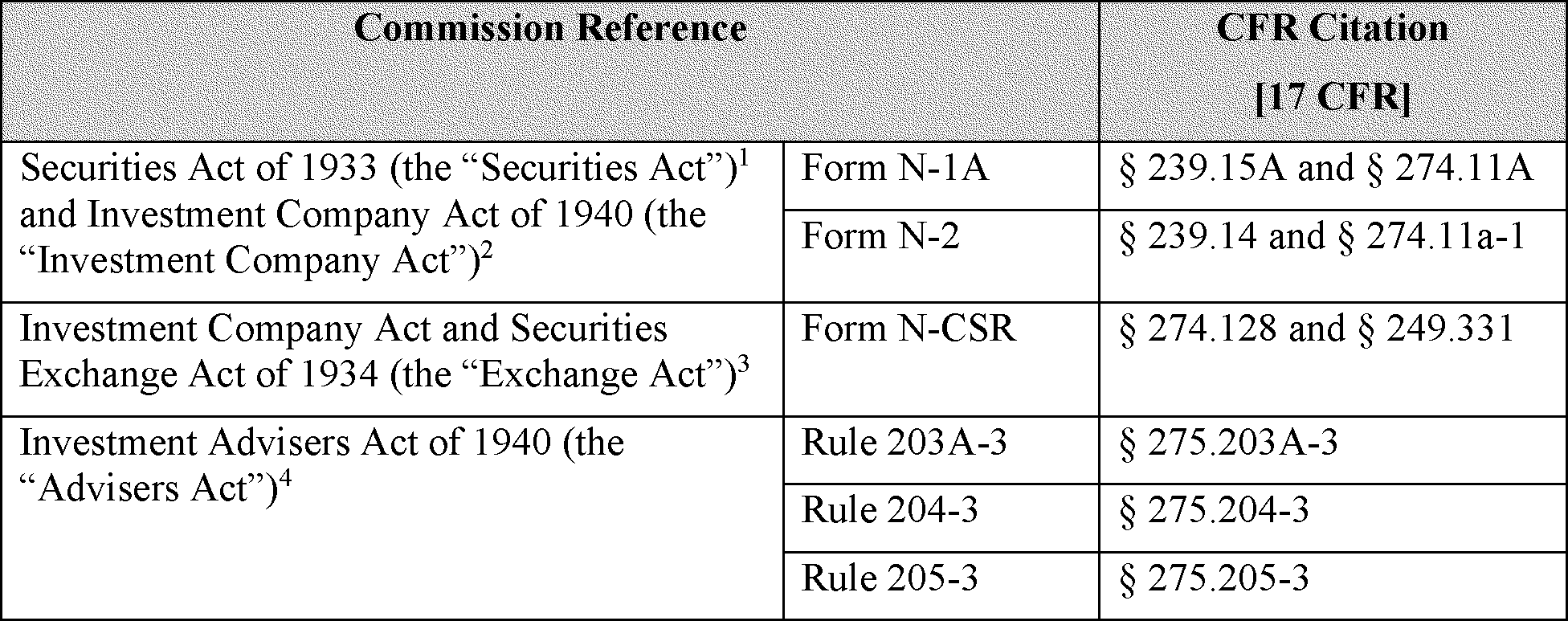
Table of Contents
I. Introduction and Background
A. Overview of Section 205 and Rule 205-3
1. Section 205: 1940 Enactment and 1970 Amendments
2. Initial Rule 205-3 Adoption and Subsequent Section 205 Amendments
3. Current Rule 205-3
B. Performance-Based Compensation: Current Practices
II. Discussion
A. Expansion of the Ability of Investment Advisers To Charge Performance-Based Compensation to RICs and BDCs
1. Scope of Amended Exception
2. Conditions
3. Disclosure Related to Performance-Based Compensation
B. Additional Amendments to the “Qualified Client” Definition
1. Incorporation of the “Accredited Investor” Definition
2. Removal of the Assets Under Management Test
3. Amending References to the “Qualified Client” Definition in Rule 203A-3, Rule 204-3 and Form ADV
C. Client Look-Through
D. Compliance Period
III. Economic Analysis
A. Introduction
B. Economic Baseline
1. Regulatory Baseline
2. Affected Parties
3. Performance-Based Compensation: Current Market Practices
C. Benefits and Costs
1. Changes to the Qualified Client Definition
2. Amending References to the Qualified Client Definition
3. Performance Fee Disclosure for Regulated Funds
4. Aggregate Monetized Benefits and Costs
D. Effects on Efficiency, Competition, and Capital Formation
1. Efficiency
2. Competition
3. Capital Formation
E. Reasonable Alternatives Considered
1. Performance Fees Only on Realized Capital Gains
2. Performance Fee on Capital Gains for Contracts With a Subset of Regulated Funds
3. Additional Conditions for the Fund Board Channel
4. Disclosure Alternatives
F. General Request for Comment
IV. Paperwork Reduction Act Analysis
A. Summary of the Collections of Information
B. Summary of the Proposed Amendments' Estimated Effects on the Collections of Information
1. Form N-1A PRA Estimates
2. Form N-2 PRA Estimates
3. Form N-CSR PRA Estimates
C. Changes in Paperwork Burdens Under the Proposed Amendments
D. Request for Comments
V. Initial Regulatory Flexibility Analysis
A. Reasons for and Objectives of the Proposed Actions
1. Proposed Amendments to Rule 205-3
2. Proposed Amendments to Forms N-1A, N-2, and N-CSR
B. Legal Basis
C. Small Entities Subject to the Rule Amendments
D. Projected Reporting, Recordkeeping, and Other Compliance Requirements
1. Proposed Rule 205-3 Amendments
2. Proposed Disclosure and Reporting Requirements
E. Duplicative, Overlapping, or Conflicting Federal Rules
1. Proposed Amendments to Rule 205-3
2. Proposed Amendments to Forms N-1A, N-2, and N-CSR
F. Significant Alternatives
G. Request for Comment
VI. Congressional Review Act
VII. Other Matters
Statutory Authority
I. Introduction and Background
The asset management industry has expanded significantly in recent decades, driven by evolving investor demands and the availability of a broader range of investment opportunities across public and private markets. Asset managers today employ an increasingly wide array of investment strategies and offer those strategies through multiple investment products, including, among others, regulated funds, private funds, separately managed accounts, and direct advisory recommendations to individual clients.
As the variety of investment products and their delivery channels have grown, both institutional and individual investors have increasingly sought to access alternative investment assets and to construct more diversified investment portfolios than in the past. The Commission is committed to identifying ways to reduce unnecessary regulatory obstacles to investment product innovation, allowing for the broadening of investor choice available in today's asset management industry while appropriately addressing risks associated with increasingly diverse portfolio compositions and operations.
As part of this commitment, the Commission is proposing amendments to the “qualified client” definition and other provisions in rule 205-3 under the Advisers Act that would expand the ability of registered investment advisers and certain of their clients, including regulated funds under certain conditions and investors that meet the “accredited investor” definition in Regulation D under the Securities Act, to enter into performance-based compensation arrangements calculated on the basis of a share of capital gains in or capital appreciation of an advisory client's account. We anticipate that such expansion would allow a wider range of advisers to offer regulated funds, enable the introduction of more investment strategies into regulated funds, and separately expand the availability of investment opportunities to accredited investors in pools or separately managed accounts. In addition, the proposal would amend certain forms under the Investment Company Act to require disclosure of all performance-based compensation to shareholders of regulated funds, including compensation based on interest, ordinary income, or dividends. As the “qualified client” definition is also referenced in the definition of “investment adviser representative” in rule 203A-3 and the exceptions to a registered investment adviser's brochure supplement delivery requirement in rule 204-3 under the Advisers Act, we also propose conforming amendments to these rules.[5]
The use of performance-based compensation has long been a common and defining characteristic of investment strategies that are associated with private funds, such as hedge fund, private equity, and venture capital strategies, which generally include private market strategies as well as complex or differentiated public market strategies.[6] Because registered investment advisers and their private fund clients are largely able to enter into and tailor performance-based compensation arrangements, these types of alternative investment strategies have, as a practical matter, been limited to the private fund industry, reducing access to a limited group of eligible investors. Therefore an adviser may be incentivized to allocate its potentially higher performing investment strategies and opportunities to this limited group of investors. This situation results in a structural disadvantage for retail investors, as it may disincentivize capable advisers from allocating potentially higher performing strategies to regulated funds or, in some cases, from launching or maintaining regulated funds altogether.
Performance-based compensation can offer a rational and effective means to define and align adviser and investor goals, especially as arrangements have evolved over time through commercial practice to commonly include features and terms designed to more closely ( printed page 63678) align adviser and investor interests.[7] Expanding the ability for advisers to charge performance fees could incentivize advisers currently operating in the private markets to bring diverse strategies to a wider group of clients and investors, including investors in regulated funds. Accordingly, the proposed amendments are designed to modernize the regulatory framework related to performance-based compensation, facilitate capital formation in the public and private markets by promoting innovation in regulated fund structures, and expand investor choice, while maintaining appropriate investor protections and safeguards.
As discussed below, Congress amended the Advisers Act in 1970 to authorize the Commission to exempt any person or transaction (or class of persons or transactions) from any provision of the Advisers Act, if and to the extent such exemption is necessary or appropriate in the public interest and consistent with the protection of investors and the purposes fairly intended by the policy and the provisions of the Advisers Act.[8] In granting such authority to the Commission, Congress specifically contemplated its potential application to the performance fee prohibition in section 205 under the Advisers Act.[9] Congress also amended the Advisers Act in 1996 to authorize the Commission to exempt any person or transaction (or class thereof) specifically from the performance fee prohibition in section 205, provided that the exemption relates to an advisory contract with “any person that the Commission determines does not need the protections” of the prohibition “on the basis of such factors as financial sophistication, net worth, knowledge of and experience in financial matters, amount of assets under management, relationship with a registered investment adviser, and such other factors as the Commission determines are consistent with” section 205.[10] Over decades, the Commission has used these authorities to expand the use of performance fees by registered investment advisers, and this proposal continues on that path.
A. Overview of Section 205 and Rule 205-3
Section 205(a)(1) of the Advisers Act generally prohibits an investment adviser registered or required to be registered with the Commission from receiving compensation on the basis of a share of capital gains in or capital appreciation of an advisory client's account.[11] These restricted performance-based compensation arrangements are commonly referred to as “performance fees” because they compensate advisers based on the investment performance of a client's account rather than on another basis, such as the aggregate value of the assets in a client's account.[12] For example, an advisory fee calculated as a percentage of the investment gains in a client's account over a period of time ( e.g., twenty percent of an account's gains over the last year) is a performance fee, while an advisory fee calculated as a percentage of the total value of a client's account ( e.g., two percent of such client's assets) is not a performance fee.
Although performance fees can be structured in various amounts and forms, section 205(a)(1) functions to broadly prohibit a registered investment adviser from entering into, extending, renewing, or in any way performing an investment advisory contract that provides for any performance fees to the adviser, however that performance fee is expressed or calculated, unless that advisory contract qualifies for an exception or exemption to the prohibition on performance fees. Statutory exceptions to the prohibition are provided in sections 205(b)(1) through (b)(5) of the Advisers Act,[13] and the Commission has authority to promulgate exemptions to the prohibition under sections 205(e) and/or 206A thereof. Pursuant to these authorities, the Commission previously adopted and amended rule 205-3 as a generally available exemption to the statutory performance fee prohibition set forth in section 205(a)(1).
1. Section 205: 1940 Enactment and 1970 Amendments
The prohibition on performance fees in section 205(a)(1) has been part of the Advisers Act since its original enactment by Congress in 1940 (originally as section 205(1) thereof). Legislative history indicates that the prohibition was included because of Congressional concern that performance fee arrangements (then typically called “profit-sharing” arrangements) would by their nature incentivize investment advisers to take inappropriate risks with their clients' funds, rather than because of evidence of actual abuse or misconduct in the advisory industry related to performance fees at that time.[14] Specifically, because performance fee arrangements generally provided an adviser with additional fees when its client had investment gains but did not decrease the adviser's compensation when the client had investment losses, performance fees were viewed by some as encouraging advisers to speculate excessively with their clients' funds.[15]
( printed page 63679)Although the performance fee prohibition for registered investment advisers has been in the Advisers Act since its enactment in 1940, the prohibition was, in practice, narrow in scope for two reasons:
- First, the Advisers Act provided a registration exemption for investment advisers whose only clients were registered investment companies, and the performance fee prohibition did not extend to advisers that were not required to register with the Commission.
- Second, for advisers that were registered, or required to register, with the Commission, the Advisers Act excepted from the performance fee prohibition advisory contracts with investment companies registered under the Investment Company Act.
These were intentional decisions. The original bill did not include these exceptions, but the final Advisers Act excepted contracts with investment company clients from the performance fee prohibition, with legislative history suggesting Congress ultimately responded to industry input that performance fees closely linked the interests of investment company investors and advisers “throughout the life of the investment,” and that the basis of advisory compensation should not be limited by statute if clearly and adequately disclosed to investors.[16]
In the decades following the enactment of the Investment Company Act and the Advisers Act, the registered investment company industry grew dramatically from under $450 million in assets and 300,000 investors in 1940 to over $45 billion in assets and 4 million investors by the end of 1966.[17] This dramatic growth and accompanying perceptions of prevalent excessive fee and expense practices in the industry, especially related to the then-popular “go-go funds” that aggressively sought short-term gains with high portfolio turnover and related transaction costs, prompted both Congress and the Commission to take a hard look at the registered fund industry and investor protections under the securities laws more broadly.[18] Congress directed the Commission to comprehensively review and conduct a study on the registered fund industry, and the Commission in turn requested the securities research unit of the Wharton School of Finance and Commerce to broadly examine the industry in 1958.
This examination resulted in the transmittal to the Commission in 1962 of Wharton's “A Study on Mutual Funds,” which generally found that advisory fees paid by registered funds often bore little relation to the actual cost of the advisory services provided or to investment performance.[19] The Wharton report was immediately followed by a special study by the Commission's staff that focused its attention on problematic distribution practices and excessive sales charges in the registered fund industry.[20]
This review effort culminated in the Commission's submission to Congress in 1966 of its Report on the Public Policy Implications of Investment Company Growth (the “PPI Report”), which recommended, among a broader package of comprehensive reforms to fee and expense practices, the extension of the Advisers Act's performance fee prohibition to advisory contracts with registered investment companies.[21] Although the PPI Report did not contain any specific examples of abuse or misconduct relating to performance fees at registered investment companies, the Commission nonetheless recommended that Congress amend the Advisers Act to remove its exceptions for advisers to registered investment companies, and explained that doing so with respect to the performance fee prohibition would complement the Commission's primary recommendation at the time to incorporate a general standard of reasonableness into the Investment Company Act for advisory compensation paid by registered investment companies.[22] Combined with this reasonableness standard, the extension of the performance fee prohibition to advisory contracts with registered investment companies would, according to the Commission, permit “capital gains and appreciation of a registered investment company [to] be taken into account as a factor in setting the amount of the fee of its investment adviser, [notwithstanding that] such fee could not be tied directly to such gains or appreciation.” [23]
Shortly afterward, bills were introduced in Congress that would largely implement the Commission's recommendations discussed above, including the extension of the performance fee prohibition to investment advisory contracts with registered investment companies.[24] In Congressional hearings on these bills, it was generally acknowledged that the types of performance fee arrangements “that would be barred by section 205(1) . . . are not common in the investment company industry, but some do exist, and the number of [such] contracts appears to be increasing.” [25]
Notwithstanding the view that performance fees were generally uncommon for investment companies and the fact that the Commission's 1966 PPI Report had not included any specific examples of abuse, there was an effort to justify the extension of the performance fee prohibition by broadly ( printed page 63680) referencing the legislative history from the Investment Company Act's and Advisers Act's original enactments.[26] The Commission's Chairman at the time echoed the earlier characterization of performance fees as a `heads, I win; tails, you lose' arrangement and opined that performance fees inherently lead to excessive risk-taking by investment advisers, such that Congress should act to “protect fund clients” in the growing investment company industry and “insulate investment company shareholders from arrangements that give investment managers a direct pecuniary interest in pursuing high risk investment policies.” [27]
The proposed extension of the performance fee prohibition to advisory contracts with registered investment companies was met with some scrutiny and skepticism by the investment advisory industry and other stakeholders, including criticism that the proposal had received insufficient deliberation and that prohibiting performance-based compensation was inconsistent with the Commission's recognition in other contexts that the quality of investment advisory services is ultimately reflected by performance. One investment adviser objected that “[a]s far as we can determine little or no attention has been directed to the proposed amendments [to the performance fee prohibition] either during the hearings, in the press or otherwise.” [28] After discussions with the Investment Company Institute and other industry representatives, Congress added a narrow exception for a limited type of performance-based fee (commonly called a “fulcrum fee”) to the pending extension of the performance fee prohibition to registered investment companies.[29]
Under the new fulcrum fee exception, advisory contracts that based any part of the adviser's compensation on a percentage of a company's (or other client's) capital gains or appreciation would be prohibited, but fulcrum fees that increased and decreased proportionately on the basis of the company's investment performance (over a specified period and measured against an appropriate securities index or other appropriate measure of performance) would be permissible. Using a fulcrum fee, an adviser would thus be permitted to receive its “baseline” fee only at the point that the fund's performance equaled the index or other appropriate measure. Fulcrum fees were intended to address the notion that an adviser with a performance fee arrangement did not face any downside and share in the otherwise excessive risk that might be incentivized by performance-based compensation.
Despite further objections from some stakeholders,[30] Congress enacted a version of the bill extending the prohibition on performance fees to advisory contracts with registered investment companies, with a narrow exception for fulcrum fees.[31] However, Congress also amended the Advisers Act to include new section 206A, which authorized the Commission, by rulemaking on its own motion or by order upon application, to exempt conditionally or unconditionally any person or transaction (or class or classes of persons or transactions) from any provision in the Advisers Act, if and to the extent such exemption is necessary or appropriate in the public interest and consistent with the protection of investors and the purposes fairly intended by the policy and the provisions of the Advisers Act.[32] This broad exemptive authority was intended to provide the Commission with greater flexibility to appropriately administer the Advisers Act in light of the broader coverage of the Advisers Act to investment advisers of registered investment companies, and it accordingly mirrored the general exemptive authority that the Commission already had with respect to the Investment Company Act under section 6(c) thereof.[33]
Congress specifically contemplated the potential application of section 206A's exemptive authority to exempt persons in appropriate circumstances from the registration requirements of section 203 and from the performance fee prohibition in section 205, each of which were newly being applied to advisers of registered investment companies.[34]
( printed page 63681)Over the next decade, the Commission used its exemptive authority under section 206A to issue several orders conditionally exempting certain performance fee arrangements in advisory contracts with certain clients.[35] These conditional exemptions were generally subject to objective client eligibility requirements relating to both minimum client income or net worth and minimum amounts invested with the adviser.
In 1980, Congress added another statutory exception to the performance fee prohibition, permitting advisers to business development companies (“BDCs”) to include performances fee arrangements in their advisory contracts, provided that the fee did not exceed 20% of the BDC's net realized capital gains over a defined period and the BDC did not have other incentive compensation structures in place.[36] This exception was part of broader legislation to incentivize venture capital investing in small businesses and accordingly allowed BDCs, which were engaged in that type of investment, to receive performance-based compensation similar to that charged by advisers to private venture capital funds, subject to meaningful structural constraints designed to align adviser and investor interests.
2. Initial Rule 205-3 Adoption and Subsequent Section 205 Amendments
Based partly on its experience using its authority under section 206A to approve individual exemptive orders related to performance fees, the Commission used its rulemaking authority thereunder in 1985 to propose and adopt a generally applicable exemptive rule to the performance fee prohibition as rule 205-3 under the Advisers Act.[37] As originally adopted, rule 205-3 permitted an adviser to charge performance fees to a client that had at least $500,000 in assets under management with the adviser or had a net worth of at least $1,000,000, departing from some of the Commission's earlier orders that had required both a minimum client net worth and a minimum investment amount as conditions for exemptive relief.[38] If the client was a private or registered investment company or business development company, rule 205-3 required the adviser to “look through” the company and apply these net worth and investment minimums to each of its equity owners. This requirement expressly covered clients that were registered investment companies, which were thus provided with their first alternative to the statutory fulcrum fee exception for performance fee arrangements with their advisers.[39] The Commission “concluded that it is consistent with the protection of investors and the purposes of the [Advisers] Act to permit clients who are financially experienced and able to bear the risks associated with performance fees to have the opportunity to negotiate compensation arrangements which they and their advisers consider appropriate.” [40] To provide “alternate safeguards to the statutory prohibition,” however, rule 205-3 at the time also required that performance fee contracts include certain provisions concerning the appropriate calculation of performance fees, and that advisers provide certain disclosures to their clients regarding potential conflicts of interest, the periods and any index used to measure performance for purposes of the fee, and, if relevant to the fee's calculation, the valuation of unrealized appreciation of securities for which market quotations are not readily available.[41]
In 1992, the staff of the Commission's Division of Investment Management (the “Division”) issued a report recommending that the existing exemptions from the performance fee prohibition be expanded to generally permit performance fees in advisory contracts with institutions or otherwise financially sophisticated clients, as well as with foreign clients, whether sophisticated or unsophisticated.[42] In the report, the Division acknowledged that the “existing exemptions . . . preclude the use of performance fees in advisory contracts in a number of situations, even where the clients are institutions and otherwise sophisticated.” [43] In particular, whereas the fulcrum fee exception requires advisers to “structure their performance fee arrangements to increase and decrease proportionately[, m]any institutional investors, however, prefer to structure performance fee arrangements with a low base fee, with satisfactory performance resulting in additional compensation,” which arrangement “does not qualify as a fulcrum fee.” [44] In this regard, the Division expressed its view that, “where a client appreciates the risk of performance fees and is in a position to protect itself from overreaching by the adviser, the determination of whether such fees provide value is best left to the client.” [45] With respect to sophisticated and unsophisticated foreign clients, the Division stated its belief that the Advisers Act's performance fee prohibition “likely reduce[s] the ability of domestic advisers to compete effectively with foreign advisers in foreign markets” where performance fees may not be restricted.[46]
The Division explained these views by acknowledging various criticisms of the performance fee prohibition, noting that the prohibition “always has been controversial.” [47] These included criticisms that performance fee arrangements rationally align advisory and client interests by linking adviser compensation to client investment performance, encourage the establishment of new and smaller advisory firms, incentivize advisers to service smaller client accounts that may otherwise not have access to advisory services, and function to reduce advisory costs during periods of market decline.[48] The Division concluded that it “believe[d] that some of the criticisms of the performance prohibition [were] valid and that modification of the ( printed page 63682) prohibition is warranted.” [49] Consequently, the Division recommended that Congress amend section 205 to specifically authorize the Commission to unconditionally exempt advisory contracts with any person whom the Commission determines to not need the protections of the prohibition and contracts with foreign clients.
Four years later, in 1996, Congress amended the Advisers Act to add new statutory exceptions for advisory contracts with clients that are companies excepted from the definition of “investment company” by section 3(c)(7) of the Investment Company Act or that are foreign residents, as well as new section 205(e).[50] Following the Division's earlier recommendation, section 205(e) provides that the Commission may conditionally or unconditionally exempt any person or transaction (or class or classes of persons or transactions) from the performance fee prohibition in section 205(a)(1), provided that the exemption relates to an advisory contract with “any person that the Commission determines does not need the protections” of the prohibition “on the basis of such factors as financial sophistication, net worth, knowledge of and experience in financial matters, amount of assets under management, relationship with a registered investment adviser, and such other factors as the Commission determines are consistent with” section 205.[51] As the Commission has noted, the definition of “person” under section 202 of the Advisers Act includes companies, which in turn includes investment companies, for purposes of section 205.[52]
3. Current Rule 205-3
Shortly following the addition of section 205(e) to the Advisers Act in 1996, the Commission used its expanded rulemaking authority to propose (in 1997) and adopt (in 1998) amendments to rule 205-3, giving shape to the rule in its current form.[53] These amendments eliminated the specific contractual and disclosure requirements relating to performance fees that were previously explained in 1985 as “alternative safeguards” to the statutory prohibition, because the Commission ultimately viewed these requirements as in practice “hav[ing] inhibited the flexibility of advisers and their clients in establishing performance fee arrangements beneficial to both parties” and, moreover, as unnecessary in light of the other protections provided by the Advisers Act.[54] The amendments also expanded the eligibility criteria for clients to which investment advisers could charge performance fees, with clients that satisfied the new eligibility criteria referred to by the rule as “qualified clients.”
Under rule 205-3 as amended in 1998, qualified clients to which an investment adviser may charge a performance fee include: (1) clients that meet a minimum net worth or assets-under-management requirement, with the threshold amounts from original rule 205-3 inflation-adjusted from $1,000,000 to $1,500,000 for the net worth test and from $500,000 to $750,000 for the assets-under-management test; [55] (2) clients that are “qualified purchaser[s]” under section 2(a)(51)(A) of the Investment Company Act; and (3) clients that are certain executive officers or employees of the adviser who actively participate in the investment activities of the adviser, similar to the category of “knowledgeable employees” eligible to invest in section 3(c)(1) and 3(c)(7) companies in accordance with rule 3c-5 under the Investment Company Act.[56] With respect to the addition of qualified purchasers as a category of clients eligible for performance fees, the Commission explained that, although persons that have the $5,000,000 in investments required to be a qualified purchaser under section 2(a)(51)(A) generally should separately satisfy the lower minimum net worth or minimum assets-under-management thresholds under rule 205-3, they may in certain cases not meet the lower thresholds because of different approaches to accounting for indebtedness between these provisions.[57] In light of the 1996 amendments' addition of section 3(c)(7) companies ( i.e., privately-offered qualified purchaser pools) to the statutory exceptions for the performance fee, the addition of qualified purchasers themselves to rule 205-3 filled an eligibility gap to provide qualified purchasers and their advisers with the flexibility to enter into performance fee contracts outside of the context of a section 3(c)(7) private fund.[58] Regarding the addition of certain knowledgeable employees as a category of qualified clients, the Commission stated that an adviser's officers and “employees who actively participate in the investment activities of the adviser are likely to be sophisticated financially and do not need the protections of the performance fee prohibition,” [59] consistent with its authority under section 205(e) to consider “whether a client may not need the protections of the performance fee prohibition by virtue of the client's relationship with the adviser,” in addition to other criteria.[60]
The Commission retained “look-through” treatment for clients that are private or registered investment companies or business development companies, requiring each equity owner thereof that would be charged a performance fee to fall into one of the three categories of qualified client in order for the company itself to be a qualified client under the rule.[61] Some commenters objected to the application of the look-through requirement in contexts where the financial sophistication of an independent fund representative could be expected to adequately protect investors' interests by enabling the negotiation of performance fees at arm's length with the adviser, consistent with the exemption provided by rule 205-3.[62] Although the Commission did not expressly disagree with this view, the Commission determined “not to eliminate the look through provision of the rule at this time” but clarified that it would still “entertain requests for relief from the application of the look through provision in circumstances where the policies and purposes of ( printed page 63683) section 205 of the Advisers Act would not be served by its application.” [63]
In 2011, the Dodd-Frank Wall Street Reform and Consumer Protection Act (“Dodd-Frank Act”) amended section 205(e) of the Advisers Act to provide that, by July 21, 2011, and every five years thereafter, the Commission shall, by order, adjust for the effects of inflation the dollar amount thresholds included in rules issued under section 205(e), rounded to the nearest multiple of $100,000.[64] As of June 29, 2026, the dollar amount threshold of the assets-under-management test is $1,400,000, and the dollar amount threshold for the net worth test is $2,700,000.[65]
B. Performance-Based Compensation: Current Practices
The current exceptions to and exemptions from the performance fee prohibition have led to a patchwork of permitted performance fee arrangements and practices in the asset management industry. As detailed above, current section 205 and rule 205-3 under the Advisers Act operate to permit certain performance fee arrangements largely conditioned on the relevant advisory client's legal type or form ( e.g., the legal classification of a client fund managed by the adviser), rather than on an investor's ability to evaluate and bear the risks of an investment product with performance fees.[66] Specifically, the current use of performance fees can depend on the following classifications:
- whether the client is a registered investment company or any person (other than a trust, governmental plan, collective trust fund, or separate account referred to in section 3(c)(11) of the Investment Company Act, which covers most employee benefit plans) with at least $1 million in assets managed by the adviser,provided that in each instance an appropriate fulcrum fee is used;
- whether the client is a BDC,provided that the performance fee is structured to meet specific statutory conditions;
- whether the client is a section 3(c)(7) qualified-purchaser private fund;
- whether the client is a non-U.S. resident; or
- whether the client (or its equity owners, as applicable) is a “qualified client,”e.g., a high net worth individual with a separately managed account.
These exceptions to and exemptions from the performance fee prohibition conditioned on a client's legal classification have in practice confined the use of performance fees behind the requirements for such classifications, including applicable investor eligibility requirements. Particularly, the use of performance fees has long been a defining characteristic of the private fund industry, which has experienced tremendous asset growth over the last decades.[67] Investors that do not meet the eligibility requirements for these performance-fee investment products have had limited opportunities for exposure to their underlying investment strategies and for participation in their asset growth.[68]
However, performance fee arrangements have come to reflect a matured industry practice that can offer a rational and effective means of aligning adviser and investor interests, as well as incentivizing outperformance and rewarding specialized advisory expertise. This is particularly true as performance fees have evolved over time through commercial negotiations to commonly include features designed to mitigate the prospect of conflicted or otherwise excessive risk-taking and more closely align adviser and investor interests ( e.g., distribution waterfalls with preferred return and high-water mark rates, catch-ups, and agreed-upon valuation procedures, as applicable to the particular investment strategy). Although initially developed through negotiations between advisers and sophisticated institutional investors, these features have since become commonly adopted across performance fee arrangements offered to private fund investors.[69]
Private funds that are offered exclusively to investors that are “qualified purchasers” with generally at least $5,000,000 in investments in accordance with section 3(c)(7) of the Investment Company Act fall under the broad statutory exception to the performance fee prohibition set forth in section 205(b)(4) of the Advisers Act. As such, performance fee arrangements are most commonly and freely used in section 3(c)(7) qualified-purchaser private funds, causing investment strategies generally associated with performance fees, such as private equity, hedge fund, and venture capital strategies, to be offered largely through these types of clients (and hence through some of the most investor eligibility-restricted investment products).
Unlike section 3(c)(7) private funds, private funds that are offered to fewer than one hundred persons in accordance with section 3(c)(1) of the Investment Company Act do not generally qualify for a statutory exception under section 205(b) of the Advisers Act. Instead, a section 3(c)(1) private fund and its adviser can rely on the client-identification or “look-through” provision in rule 205-3(b) to enter into a performance fee arrangement if each of the fund's relevant equity owners is a “qualified client” under the rule ( e.g., a person with at least $1,400,000 managed by the adviser or a net worth of at least $2,700,000, or a knowledgeable employee of the adviser).[70] Similar to section 3(c)(1) private funds, a regulated fund and its investment adviser may likewise currently enter into a performance fee arrangement if each of the regulated fund's relevant equity owners is a “qualified client” under rule 205-3.
Because section 3(c)(1), like section 3(c)(7), requires that a relying fund “is not making and does not presently propose to make a public offering of its securities,” section 3(c)(1) funds are generally privately offered to U.S. investors in reliance on section 4(a)(2) of the Securities Act and the non-exclusive safe harbors and exemptions provided by Regulation D.[71] Private ( printed page 63684) offerings to U.S. investors in reliance on rule 506(b) of Regulation D may be made to up to 35 non-accredited investors (in any 90-calendar-day period) and to an unlimited number of “accredited investors,” a definition that includes, among other qualifying criteria, entities with over $5,000,000 in assets or investments and individuals with net worths of over $1,000,000 (excluding their primary residence) or incomes of over $200,000 (individually) or $300,000 (with a spouse or spousal equivalent).[72] Some private funds have also begun to rely on rule 506(c) of Regulation D, which requires that the issuer take reasonable steps to verify accredited investor status of all investors and does not permit any non-accredited investors. Section 3(c)(1) private funds that rely on Regulation D and seek to enter into performance fee arrangements are thus generally subject to separate qualified client and accredited investor asset tests to determine investor eligibility. In addition to these distinct investor eligibility requirements, the requirement that a section 3(c)(1) fund have not more than one hundred beneficial owners necessarily limits the potential scale of these funds, which may limit the incentive for investment advisers to sponsor investment products that utilize them and, in turn, the ultimate availability of these investment products to investors.
The option to use a fulcrum fee in accordance with section 205(b)(2)(B) of the Advisers Act may be available with respect to section 3(c)(1) private funds (if their advisory contracts relate to assets of at least $1,000,000) and regulated funds. However, the inflexibility of the fulcrum fee model and its concomitant operational risks have contributed to its lack of substantial adoption in the industry. Based on available industry data, in 2026 only approximately 1% of registered funds used a fulcrum fee, indicating the model's limited appeal as a practical matter.[73]
Specifically, the symmetrical nature of the fulcrum fee model can lead to unanticipated operational consequences for an adviser and its fund client. The model requires that the fulcrum fee “provide for increases and decreases in compensation which are proportionate to each other,” so that the potential upside performance adjustment must equal the potential downside performance adjustment in absolute terms.[74] As a result, the potential for unpredictable changes in a fund's net assets (upon which a fulcrum fee must be calculated) because of factors other than its relative performance ( e.g., due to a general declining or rising asset environment that impacts the fund's portfolio to a different extent than it does its chosen benchmark or due to fund redemptions or purchases over the period) can in practice make the total advisory fees paid by the fund unpredictable.[75] Accordingly, fund advisers may face pressure to increase their fulcrum fee's base fee ( i.e., the fee earned when performance is equivalent to the fund's benchmark index) and/or limit the possible extent of their upside and downside performance adjustments in order to ensure more reliably that they receive a level of compensation adequate to continue their advisory operations in an economically feasible manner. Otherwise, they risk receiving a minimal level of compensation—or even zero or negative compensation, depending on the applicable fulcrum fee and performance adjustment schedule—that could be inadequate to meet an adviser's own ongoing expenses necessary for its continued operation and provision of services to its client funds, which can in turn precipitate their closures and liquidations. Although unpredictable changes in a client fund's net assets can impact the compensation level of any fund adviser with an asset-based fee, including advisory fees that are not performance fees, the fulcrum fee's requirement for strictly proportional performance adjustments can exacerbate these impacts and heighten the risk of receiving inadequate compensation to address operational challenges.[76]
Additionally, the frequency of compensation under a fulcrum fee model can likewise cause operational difficulties, as the fulcrum fee exception generally requires that the period used for calculating the base fee must be the same as the period used for purposes of calculating the performance adjustment.[77] This can cause a mismatch between the operational needs of the adviser to receive compensation more regularly ( e.g., quarterly) than may be desired for a meaningful performance period ( e.g., yearly). Although rule 205-2(c) under the Advisers Act provides some flexibility in this respect to use a rolling performance period for purposes of calculating the performance adjustment while using the most recent subperiod of that performance period for purposes of calculating the base fee,[78] the use of two different periods can in practice result in actual fees that greatly differ from the predictable advisory fees that advisers and funds may anticipate.
In sum, the fulcrum fee model's inflexibility has limited its adoption among regulated funds. More broadly, as a result of the general statutory prohibition on performance fees paired with the rigidity of the fulcrum fee exception, the regulated fund industry has been prevented from developing more competitive fee structures, including, for instance, adapting features from performance fee arrangements that have evolved in the private fund industry to address the prospect of conflicted or otherwise excessive risk-taking that originally animated the performance fee prohibition. Instead, advisory fees for registered investment companies are ( printed page 63685) generally based solely on their net asset value, where an adviser's compensation is principally a function of their client funds' size, which, while reflecting asset accumulation that can result from strong performance, may not isolate investment performance as a direct driver of compensation.
Allowing other kinds of performance fees for registered investment companies would provide investors with the opportunity to select funds where adviser compensation is more directly tied to investment performance and ultimately the returns generated for shareholders. For instance, allowing advisers to be compensated commensurate with the investment gains they generate for shareholders rather than solely based on accumulated assets may promote capital formation in capacity-constrained strategies, where advisers limit assets under management to preserve investment efficacy, but where meaningful return opportunities nonetheless exist.[79]
II. Discussion
A. Expansion of the Ability of Investment Advisers To Charge Performance-Based Compensation to RICs and BDCs
The proposal would amend the qualified client definition in rule 205-3 to expand the ability of investment advisers to regulated funds to enter into investment advisory contracts with performance-based compensation arrangements, provided the following conditions are satisfied:
- The performance-based compensation does not exceed 20% of the regulated fund's net gains over a specified period;
- The regulated fund satisfies rule 0-1(a)(7) under the Investment Company Act (the “fund governance standards”); and
- The regulated fund's board, including a majority of independent directors, determines that the performance-based compensation arrangement is in the best interest of the regulated fund and its shareholders and makes specific findings regarding the arrangement's appropriateness, structure, and investor protection features.
As discussed above, the prohibition in section 205(a)(1) of the Advisers Act was primarily designed to protect investors who lack the sophistication and bargaining power to evaluate performance fees from the prospect of excessive risk-taking by investment advisers.[80] Regulated funds operate within a comprehensive regulatory framework that provides for a number of investor protections, including, among other features, board oversight, shareholder approval rights, leverage limits, and mandatory disclosure and reporting obligations. Notably, with respect to advisory compensation, the Investment Company Act requires regulated fund boards to annually evaluate and approve the reasonableness of the advisory fees paid to the regulated fund's adviser.[81] The proposed amendments would leverage the existing investor protection framework under the Investment Company Act and the Advisers Act and incorporate conditions tailored to mitigate the risks associated with performance-based compensation arrangements.
1. Scope of Amended Exception
The proposed rule amendments would apply to investment advisers of a registered management investment company or BDC.[82] The amended rule would therefore apply to investment advisers of open-end management investment companies (“registered open-end funds”), such as exchange-traded funds and mutual funds, as well as registered closed-end management investment companies, such as interval funds and tender offer funds. The proposed amendments would apply to investment advisers of regulated funds that are listed for trading on an exchange and those that are unlisted.
We are not, however, proposing to include contracts with unit investment trusts (“UITs”) within the scope of the proposed amendments. Unlike management investment companies and BDCs, UITs are organized under a trust indenture or similar instrument and do not have a board of directors or other governing body responsible for ongoing management of the trust. Because the proposed amendments are premised on the existence of a board of directors capable of exercising ongoing oversight, we have not proposed to extend the scope of the amendments to contracts with UITs. In addition, we are not proposing to include within the scope of the rule amendments contracts with separate accounts that are registered management investment companies offering variable annuity contracts registered on Form N-3 because such separate accounts typically function as pass-through vehicles that allocate contract holder assets to underlying management investment companies registered on Form N-1A, where active portfolio management occurs and to which the proposed amendments would already apply.
Although section 205(b)(3) of the Advisers Act provides an exception to the prohibition on charging performance-based compensation for certain contracts with BDCs, our proposal would allow investment advisers of BDCs to rely on the amended rule. We do not see a basis to differentiate between contracts with BDCs and contracts with registered management investment companies for purposes of the proposed amendments, as BDCs employ investment strategies similar to those of many registered management investment companies and are subject to a substantially similar regulatory framework, which includes the requirement to have a board of directors.
We are not proposing to limit the availability of performance-based compensation arrangements to contracts with registered closed-end funds or BDCs that focus their investments in private markets. Currently, performance-based compensation arrangements are most closely associated with private market-oriented strategies, such as private equity, private credit, hedge fund strategies, or other alternative asset approaches. Registered closed-end funds and BDCs, rather than registered open-end funds, typically have been perceived as better suited to holding relatively less-liquid private market assets because the liquidity and daily valuation and redeemability requirements for registered open-end funds restrict their ability to allocate a significant portion of their portfolio to less-liquid private market assets. There are varying degrees of liquidity associated with exempt offering products, however. For example, hedge fund strategies, which typically charge both management and performance fees, tend to be more liquid relative to private equity fund strategies, which also commonly charge performance fees. 83 ( printed page 63686) Similarly, innovative regulated funds formed as registered open-end funds could offer complex and differentiated strategies that rely heavily on manager skill, warranting performance-based compensation paid to the adviser. Accordingly, we are proposing to expand the ability of investment advisers to include performance fees in investment advisory agreements with all regulated funds, including registered open-end funds.
We request comment on the scope of the proposed rule amendments that would expand the ability of investment advisers to regulated funds to enter into investment advisory contracts with performance-based compensation arrangements.
1. Should the proposed rule amendments apply to contracts with all regulated funds, or just some subset of regulated funds? For example, should we explicitly exclude registered open-end funds from the amended rule and limit the scope of the proposed amendments to investment advisory agreements with registered closed-end funds and BDCs, considering that these regulated fund types are currently most associated with investing in private markets? Should the proposed amendments apply both to exchange-listed and unlisted regulated funds? Should the rule exclude regulated funds employing passive or index-tracking strategies?
2. Are there operational or administrative challenges unique to registered open-end funds that would make compliance by their advisers with the proposed amendments difficult or impracticable? For example, given that registered open-end funds continuously issue and redeem shares on a daily basis, are there structural or operational characteristics of registered open-end funds that present particular difficulties in implementing or administering performance fee arrangements? If so, how should the proposed rule amendments account for these challenges, and should the Commission consider alternative compliance frameworks or exemptions tailored to the operational realities of registered open-end fund structures?
3. Is there a basis to exclude investment advisers of BDCs from relying on the amended rule? Why or why not?
4. Should the proposed rule amendments apply to UITs? If so, how should the proposed amendments be modified to account for the structural differences between UITs and management investment companies and BDCs?
5. The proposed rule amendments would not apply to contracts with separate accounts that are registered management investment companies offering variable annuity contracts registered on Form N-3. These separate accounts typically allocate contract holder assets to underlying management investment companies where the active portfolio management occurs, and thus do not generally have an investment adviser whose managerial skills are relevant to the strategy. Should contracts with separate accounts that are registered management investment companies be included in the proposal? Why or why not? Are there any special considerations that would be important to address if such registered management investment companies were included in the proposal?
6. Should the Commission provide guidance on “capital gains” or “capital appreciation” or any other terms used in section 205(a) or rule 205-3 or define those terms by rule? Are there ways in which performance-based compensation calculated using risk-adjusted, market-relative returns (such as alpha) could be structured in a manner that falls outside the statutory scope of capital gains and capital appreciation under section 205(a)(1)? If so, what specific methodological, contractual, or economic features would distinguish such metrics from capital gains and capital appreciation?
2. Conditions
The proposed rule amendments would expand the ability of investment advisers to include performance fees in investment advisory agreements with regulated funds, permitting the adviser to align its economic incentives with the interests of the regulated fund and its shareholders by linking a portion of the adviser's compensation to the fund's investment performance. The proposed rule amendments would subject the adviser to certain conditions that are designed to protect regulated funds and their shareholders.[84] By conditioning compliance on limiting the maximum level of performance fees, mandating independent board oversight, and requiring a board determination that the compensation arrangement serves the best interests of the fund and its shareholders, the proposed rule amendments are intended to mitigate the potential for excessive risk-taking and speculation that prompted Congress to apply the general prohibition in section 205 of the Advisers Act to advisory agreements with regulated funds. We discuss each of the conditions below.
a. The Performance-Based Compensation Does Not Exceed 20% of the Regulated Fund's Net Gains Over a Specified Period
The current statutory exception on the performance fee prohibition for BDCs reflects a congressional judgment that investment advisers to certain investment vehicles should be permitted to receive performance fees, subject to certain conditions that protect investors from excessive fees.[85] Specifically, Section 205(b)(3) permits an investment adviser to a BDC to receive compensation based on a share of capital gains, not to exceed 20% of realized capital gains upon the funds of the BDC over a specified period or as of definite dates (computed net of all realized capital losses and unrealized capital deprecation). Congress calibrated the 20% ceiling to the then-prevailing market practice for private equity and venture capital funds, while providing investors with a statutory limit above which performance fees could not be increased by contractual negotiation.[86] In addition, considering that venture capital and private equity funds typically compensate managers through performance fees triggered upon the realization of portfolio gains, Congress designed section 205(b)(3) to apply only to the realized gains of BDCs.[87]
The proposal draws on this statutory framework as the conceptual foundation for a new condition in the amended rule, which would allow compensation to the investment adviser on the basis of a share of the capital gains upon, or the capital appreciation of, the funds of a regulated fund, subject to a ceiling of 20% of net capital gains or net capital appreciation over a specified period or as of definite dates.[88] Unlike section 205(b)(3), as applicable to BDCs, the proposed rule amendments would allow an investment adviser to calculate performance fees on net realized and net unrealized capital appreciation. This modification allows flexibility for investment advisers to align their compensation with the total-return experience of investors who typically ( printed page 63687) redeem (or tender shares for repurchase) from regulated funds at net asset value (a price that reflects current unrealized appreciation and depreciation on a mark-to-market basis).[89]
The clause “over a specified period or as of definite dates,” which appears in section 205(b)(3) and which we propose to incorporate into the amended rule's exemptive conditions, requires that the advisory contract specify a defined measurement period or reference dates over which net capital appreciation is calculated and against which the adviser's entitlement to performance-based compensation is determined. This measurement window can be a rolling period, such as the fiscal year, a cumulative period calculated from a specified inception date, or discrete valuation dates at periodic intervals. The rule does not propose to mandate a minimum measurement period, consistent with the flexibility afforded by the statutory text in section 205(b)(3).[90]
We request comment on the proposed condition that the performance-based compensation to an adviser for a regulated fund does not exceed 20% of the fund's net capital gains or net capital appreciation over a specified period or as of definite dates.
7. Should the amended rule allow advisers to regulated funds to enter into advisory agreements that include performance fees that exceed 20% of the fund's net capital gains? Conversely, should the proposal include a lower cap ( e.g., 10% or 15% of a regulated fund's net capital gains)? Why or why not?
8. Should the amended rule allow advisers to regulated funds to charge performance fees on unrealized gains in addition to realized gains or should the proposed rule permit advisers to regulated funds to charge performance fees on realized gains only? Why or why not?
9. Should investment advisers to BDCs be permitted to charge performance-based compensation on net unrealized capital gains, consistent with the proposed amendments to rule 205-3, or should they be limited to charging performance-based compensation only on net realized gains, as provided by the statutory exception in section 205(b)(3) of the Advisers Act?
10. The proposed amendments would require that performance fees for regulated funds be calculated over “a specified period” or “as of definite dates,” but do not prescribe a minimum measurement period or minimum interval between measurement dates. Should the amended rule require a specific time period or minimum measurement period over which net capital appreciation is calculated? For instance, should the rule mandate a quarterly, semi-annual, or annual measurement period? Would a mandated minimum measurement period better protect investors by preventing advisers from structuring short measurement windows that obscure volatility or diminish the practical effect of high-water mark and loss carryforward protections? Are those investor protection benefits outweighed by any reduction in flexibility for regulated funds with structural or liquidity reasons to assess performance on a shorter cadence? For regulated funds that currently pay performance fees to their advisers on capital gains or capital appreciation, what measurement periods are typically used in practice, and would a required annual minimum measurement period be consistent with or disruptive to those existing arrangements?
b. Compliance With the Fund Governance Standards
Regulated funds are typically organized and operated by an investment adviser that is responsible for the day-to-day operations of the fund. The adviser is a separate and distinct entity from the regulated fund it advises. This framework presents inherent conflicts of interest and potential for abuses that the Investment Company Act and the Commission have addressed in different ways. The primary manner in which the Investment Company Act and the rules thereunder address this conflict is by giving regulated fund boards, in particular disinterested or “independent” directors, an important role in fund governance to look after the interests of regulated fund shareholders and provide an independent check upon the fund's adviser.[91] This framework encourages directors to bring to the boardroom a high degree of rigor and skeptical objectivity to the evaluation of management and its plans and proposals. Certain exemptive rules under the Investment Company Act include a condition that requires regulated funds to comply with rule 0-1(a)(7) under the Investment Company Act, a set of requirements intended to reinforce board independence (the “fund governance standards”).[92] The fund governance standards require that:
- A majority of a regulated fund's board is made up of independent directors;
- The independent directors of the regulated fund select and nominate any other independent directors;
- Any person who acts as legal counsel for the independent directors of the regulated fund is an independent legal counsel as defined in the fund governance standards;
- The board of directors evaluates at least once annually the performance of the board of directors and the committees of the board of directors, which evaluation must include a consideration of the effectiveness of the committee structure of the fund board and the number of funds on whose boards each director serves;
- The independent directors meet at least once quarterly in a session at which no directors who are interested persons of the fund are present; and
- The independent directors have been authorized to hire employees and to retain advisers and experts necessary to carry out their duties.
These fund governance standards, collectively, are designed to enhance the independence and effectiveness of independent directors and currently are conditions to commonly used exemptive rules under the Investment Company Act that rely on the independent judgment and scrutiny of directors, including independent directors, in overseeing activities that involve inherent conflicts of interest between the funds and their managers.[93] Section 205 of the Advisers Act generally prohibits investment advisers from receiving compensation based on a share of capital gains or capital appreciation of a client's funds. The proposed amendments to rule 205-3 would expand the exemption from this ( printed page 63688) prohibition. Consistent with our practice of applying the fund governance standards to other exemptive rules that rely on independent director oversight to address conflicts of interest between regulated funds and their management, we propose to apply the fund governance standards as a condition of the proposed expansion of relief to regulated funds. Compliance with the fund governance standards is appropriate in the context of the negotiation and review of a performance fee arrangement between a regulated fund and its investment adviser that is subject to the proposed amendments to rule 205-3 because a board with a majority of independent directors is better positioned to represent the interest of the fund by more effectively mitigating the potential conflicts of interest inherent in performance fee arrangements. Therefore, proposing to require a regulated fund's board to satisfy the fund governance standards as a condition to the fund being a “qualified client” is intended to help ensure appropriate board oversight of any conflicts of interest associated with a performance fee arrangement proposed by the adviser.
We request comment on the proposed requirement that a regulated fund satisfy the fund governance standards as a condition to meeting the definition of a qualified client under the amended rule.
11. Would requiring the regulated fund's board to satisfy the fund governance standards, as a condition to being treated as a qualified client, enhance the independence and effectiveness of the board in negotiating any performance fee arrangement with the fund's adviser?
12. Is the proposed condition that a regulated fund comply with the fund governance standards appropriate? Would it be appropriate to remove reference to the fund governance standards and simply rely on the current requirement that the board of directors, including a majority of disinterested directors, approve the investment advisory contract?
13. Are there certain requirements in the fund governance standards that the proposal should exclude? For instance, should the rule require that disinterested directors meet at least once quarterly in a session at which no directors who are interested persons of the fund are present, as is currently required in the fund governance standards? Alternatively, are there additional fund governance standards we should require in light of the specific conflicts involved in negotiating a performance fee arrangement?
c. Determination by the Board of Directors
The final condition in the proposed rule amendments would require a regulated fund's board of directors to determine, as part of its approval and annual review of an investment advisory contract required under section 15(c) of the Investment Company Act, that the performance-based compensation arrangement is in the best interest of the regulated fund and its shareholders, and to make specific findings regarding the arrangement's appropriateness, structure, and investor protection features.[94]
Section 15(c) of the Investment Company Act requires that the initial approval, and any annual continuance, of an investment advisory contract by a regulated fund be approved by a majority of the fund's board, including a majority of directors who are not interested persons of the adviser.[95] In discharging this responsibility, the board must request and evaluate such information as may be reasonably necessary to evaluate the terms of the advisory contract.[96]
Courts and Commission guidance have stated that this evaluation should encompass what are commonly referred to as the Gartenberg factors, which include the nature, extent, and quality of services provided by the investment adviser; the investment performance of the regulated fund and the investment adviser; the costs of the services and the profitability of the advisory relationship to the adviser; economies of scale; and comparisons of advisory fees and services with those of other advisers to similarly situated funds.[97] This annual evaluation process is further reinforced by section 36(b) of the Investment Company Act, which imposes a fiduciary duty on an investment adviser of a regulated fund with respect to the receipt of compensation for services paid by the fund or its shareholders.[98] Because performance-based compensation is a component of the total advisory fee paid to an investment adviser, it is necessarily within the board's existing obligations under both sections 15(c) and 36(b). To the extent applicable, boards already consider performance fees as part of their review of the adviser's total compensation under these provisions.
Section 15(c) contemplates that a fully informed board, particularly its non-interested directors, will scrutinize the regulated fund's advisory relationship on an annual basis, supported by all information reasonably necessary to evaluate the terms of the advisory agreement.[99] For purposes of actions under section 36(b), courts are instructed to give a board's approval of a particular advisory fee arrangement under section 15(c) such consideration as is deemed appropriate under all the circumstances, which may include considerable weight where the board has engaged in a fully informed process in which it requested and considered all material information bearing on the relevant factors identified in Gartenberg.[100] Our proposal builds on this framework. By requiring that the board's findings related to the performance fee arrangement be made as part of its section 15(c) review, we are anchoring the timing of the board's review of performance-based compensation to its established section 15(c) process as a matter of practical expediency and to promote coherent, integrated board oversight of the advisory relationship and compensation. This integrated review framework would help ensure that the board evaluates the performance-based compensation within the same deliberative framework that governs all other material terms of the advisory contract, and would help ensure that the appropriateness of a performance fee arrangement will be reassessed annually as the regulated fund's performance, strategy, portfolio composition, and valuation complexity evolve over time. In addition, this approach would allow the board's evaluation of any performance fee arrangement to also include the evaluation of the aggregate ( printed page 63689) advisory fee burden on fund shareholders, considering that the total cost borne by shareholders reflects the combined effect of any performance fee and base management fee, among other expenses.[101]
The findings required by the proposed amendments to rule 205-3, however, are not simply a restatement of what sections 15(c) and 36(b) already require, nor are they intended to be redundant with those existing obligations. Rather, the proposed rule 205-3 conditions are designed to operate independently of, and in addition to, the board's existing statutory duties, by requiring findings that are more particularized to the specific features of the performance fee arrangement. For example, the proposed rule amendments would require the board to make specific written findings regarding adequacy of investor protection features in the compensation arrangement, such as considerations of a preferred return or a high-water mark. These are targeted findings about the design of the performance fee itself and go beyond the general assessment of whether the adviser's total compensation is excessive or the product of arm's-length bargaining, which is the focus of the Gartenberg analysis under section 15(c) and the judicial standard under section 36(b). In other words, while sections 15(c) and 36(b) require a regulated fund's board to evaluate whether the adviser's compensation, considered as a whole, is reasonable and not excessive, the conditions in proposed rule 205-3 require the board, as part of the 15(c) process, to determine whether the features of the performance fee arrangement are appropriately designed and the arrangement is in the best interests of the regulated fund and its shareholders.
The proposed condition requiring that a regulated fund's board, including a majority of independent directors, determines that a performance-based compensation arrangement is in the best interests of the fund and its shareholders provides important investor protections. Unlike an asset-based advisory fee, a performance-based fee could create an economic incentive for an investment adviser to pursue strategies or assume portfolio risks that it might not otherwise take in the absence of the contingent compensation opportunity. This asymmetric incentive structure, where the adviser participates in upside gains but does not share in the downside losses, has the potential to misalign the interests of the adviser with those of fund shareholders. To the extent an adviser would like to rely on the exemptive rule, requiring an affirmative best-interest finding by the board, grounded in written findings addressing certain factors relevant to the evaluation of performance fees, is designed to provide a check against the regulated fund being managed on behalf of the adviser or other affiliated persons of the regulated fund rather than on behalf of its shareholders.
The proposed best interest determination requirement reflects the Commission's view that the board is best positioned to assess whether the specific contours of a proposed compensation arrangement are appropriate for a given regulated fund. This condition is not intended to operate as a basis for Commission staff to substitute their judgment for that of a diligently engaged board. Just as with the section 15(c) process, to the extent that directors have meaningfully considered the relevant factors and obtained sufficient information to evaluate the performance fee arrangement, their approval of the arrangement is entitled to considerable weight. Separately, the “best interests of the regulated fund and its shareholders” in this context is not intended to apply to each regulated fund shareholder individually, but rather to the shareholders generally.
The proposed best interest finding by the board would be required to include a written finding addressing the appropriateness of a performance-based compensation arrangement considering such factors as the regulated fund's investment strategy and valuation practices.[102] With respect to a fund's investment strategy, a board would generally need to consider whether the adviser is managing the fund's assets in a manner consistent with the fund's stated strategies, and should be attentive to whether the compensation structure may be incentivizing the adviser to take on excessive risk in pursuit of higher fees to the detriment of fund shareholders. Boards generally also would need to consider whether an adviser may be increasing the volatility of the fund's portfolio beyond what is consistent with the fund's stated investment objectives and strategies, whether to enhance the prospect of exceeding a performance threshold or to influence the timing of when performance fees are earned or crystallized, and whether the arrangement could harm shareholders by exposing them to risks that may not be reflected in the fund's disclosures. Under the proposed best interests finding, a board would need to consider, for example, whether the adviser's portfolio construction, use of leverage, or concentration of positions has materially shifted in a manner that appears inconsistent with the fund's investment strategy, particularly during periods proximate to performance fee measurement dates.
Performance-based compensation arrangements are most closely associated with private market-oriented strategies or other complex or differentiated strategies, such as private equity, private credit, or liquid strategies employing relative value, long/short equity, market arbitrage, or other active management techniques. Because these strategies aim to generate risk-adjusted outperformance and rely heavily on manager skill, compensation contingent on investment results may be reasonably justified. Unlike asset-based management fees, which compensate an adviser based solely on the size of assets under management and may therefore incentivize growth of a fund without regard to investment outperformance of a benchmark, a performance fee, if properly structured, can align the interests of the adviser and fund shareholders by tying a portion of the adviser's compensation to returns that genuinely exceed a meaningful benchmark or create risk-adjusted outperformance. By contrast, fund board approval of a performance fee arrangement in connection with the fund tracking a broad-based securities market index, where the investment strategy is passive or formulaic in nature and where excess returns above a market benchmark are neither the stated objective nor a realistic expectation, would generally seem unjustifiable.
The proposal's requirement that the board make written findings assessing the appropriateness of the compensation arrangement considering the regulated fund's valuation practices is important. For instance, where a fund holds assets for which there are no readily available market quotations, such as many private market investments, the risk that performance-based compensation would be calculated on valuations that depend on subjective inputs is elevated, and the board would need to assess the appropriateness of a performance fee, or the design of any proposed performance fee, given the inherently subjective ( printed page 63690) nature of the valuation of such private market portfolio securities.
This obligation is familiar to boards of regulated funds, as the Investment Company Act and rules thereunder currently require regulated fund boards to oversee a fund's valuation process.[103] The Commission has made clear that this oversight obligation is not passive.[104] Boards are expected to apply a level of scrutiny commensurate with the degree to which the fair value of the regulated fund's portfolio depends on subjective inputs and assumptions rather than objective market-based measures.[105] Accordingly, a regulated fund that invests primarily in private market assets for which no readily available market quotation exists should demand more intensive board oversight of the valuation process relative to a fund whose portfolio consists principally of exchange-traded or other readily marketable securities. The proposed rule condition is designed to complement the existing valuation oversight framework in rule 2a-5 under the Investment Company Act, with particular emphasis on the risks that could arise when fair value of portfolio assets serves as the basis for calculating performance-based compensation.
In addition, the proposed amendments would require the board's written findings to address the basis upon which performance fees are calculated and, specifically, whether fees are determined with reference to realized gains, unrealized gains, or both.[106] This distinction is of material significance to fund shareholders and implicates fairness considerations that the board should evaluate with reference to the particular structural characteristics of the fund:
- On one hand, calculating performance fees on unrealized appreciation and depreciation may better align the investment adviser's compensation with the actual economic experience of fund shareholders, because shareholders in many types of regulated fund structures purchase and redeem shares at net asset value and therefore benefit or suffer from changes in portfolio value that include unrealized components. For these types of regulated funds, a strictly realized-gains-only performance fee could create a misalignment between when the adviser is compensated and when shareholders actually experience the economic results being compensated. Moreover, limiting performance fees to realized gains could create incentives for investment advisers to prematurely dispose of higher performing positions to achieve a higher performance fee, potentially to the detriment of fund shareholders who might otherwise benefit from continued appreciation in those positions.
- On the other hand, the inclusion of unrealized appreciation in the performance fee base could introduce meaningful risks to shareholders. For instance, when a portfolio asset lacks a readily available market quotation, upward movements in the fair value of the illiquid asset could inflate a performance fee base without corresponding economic realization. This risk of such an asset could be compounded in the near term, as shareholders may bear asymmetric performance fees on unrealized appreciation that is subsequently reversed, eroding net asset value without any mechanism for recovery absent contractual protections. Boards should be alert to valuation practices that inflate the performance fee base without corresponding economic substance. For example, a regulated fund's acquisition of private fund interests at a discount to net asset value, followed by an immediate mark to full net asset value calculated by the private fund, can artificially accelerate reported returns and, by extension, performance fee accrual.[107]
The proposed board oversight conditions are intended to provide a framework to guide boards in evaluating whether a regulated fund's valuation practices produce performance fee outcomes that are truly reflective of fund performance and are in the best interests of the fund and its shareholders.
The board's evaluation of the basis upon which performance fees are calculated would also need to account for the structural relationship between the regulated fund's net asset value and any price at which shareholders are able to transact in fund shares, if different from a price based on net asset value. For instance, the board's evaluation may be more complex for exchange-listed regulated funds, whose shares trade on a secondary market at prices that may diverge materially from net asset value. In many cases, such secondary market trading is the only way investors are able to buy and sell the fund's shares. Where a listed regulated fund's shares trade at a persistent discount to net asset value (common for many exchange-listed registered closed-end funds), a performance fee calculated on net asset value may impose a fee burden on fund shareholders that is disconnected from the economic experience of those shareholders in the secondary market. A shareholder who purchased shares at a discount to net asset value and continues to hold at a discount has not realized, and may never realize, the net asset value appreciation on which the performance fee is based. Boards of exchange-listed regulated funds should therefore consider whether performance fee calculations based on net asset value are appropriately calibrated to the actual returns experienced by shareholders transacting in the secondary market, and whether additional structural protections, such as a discount-adjusted fee calculation or enhanced hurdle rate, would be warranted to address this potential misalignment.
While the Commission does not prescribe a single approach, in evaluating whether a performance fee arrangement is in the best interests of the regulated fund and its shareholders, the board would have to consider, and therefore its written findings would have to reflect, an evaluation of the relevant structural features of the regulated fund and their relationship to the performance fee arrangement and the extent to which the proposed performance fee arrangement equitably aligns adviser compensation with shareholder outcomes across the range of circumstances in which shareholders may transact.
A regulated fund's board also would be required to make written findings addressing the measurement period over which performance is assessed.[108] The length of the performance fee measurement period can have a significant impact on the alignment of adviser compensation with fund performance and the interests of shareholders. The measurement period that may be appropriate for a given fund may depend, among other things, on the fund's investment strategy and the time horizon over which the fund's returns are anticipated. A fund's liquidity profile and portfolio turnover, among other factors, may bear on whether a ( printed page 63691) shorter or longer measurement period is consistent with the nature of the fund's investments and the interests of its shareholders.[109] Boards should evaluate the length of the measurement period holistically and in connection with other investor protection features that are incorporated into the performance fee arrangement and could mitigate some of the risks associated with shorter measurement periods ( e.g., high-water marks or loss carryforward mechanisms). Accordingly, the board's written findings should reflect a considered assessment of whether the measurement period, viewed in the context of the overall fee arrangement, is appropriate for the fund and consistent with the best interests of its shareholders.
Lastly, the proposed amendments would require the board's written findings to address the adequacy of any investor protection features embedded in the performance-based compensation arrangement to protect the interests of shareholders, including, where no investor protection features are present, the basis for concluding that the compensation arrangement is adequate to protect the interests of shareholders.[110] Common investor protection features in performance arrangements include preferred returns, hurdles, high-water marks, and/or loss carryforward mechanisms. These structural protections are well-established features of private fund performance fee arrangements and have been refined over decades of negotiations between institutional investors and private fund managers. The development of many of these features postdates the prohibition on performance-based compensation in section 205 of the Advisers Act, and therefore Congress may not have considered these tools when contemplating the prohibition as applied to advisory contracts with regulated funds. Preferred returns and hurdle rates establish a minimum return threshold that must be achieved before any performance-based compensation accrues to the manager. They operate as a floor that is designed to ensure investors receive a baseline return on their investment before the manager participates in profits.[111] High-water mark provisions and/or loss carryforward mechanisms require that any prior losses be fully recovered before additional performance fees may be charged, thereby preventing an adviser from repeatedly extracting performance fees during periods of volatile performance without regard to the investors' cumulative experience.[112]
The implementation of one or more of these features would protect the interest of shareholders because these features would directly counteract the most acute forms of investment adviser overreach that performance-based compensation can generate ( e.g., payment of performance fees attributable to unrealized gains that are never realized, fee layering across volatile performance cycles, and the misalignment of adviser compensation with shareholder capital accumulation over time). The Commission recognizes, however, that no single mechanism is universally appropriate for all regulated fund strategies and structures. Accordingly, the proposed amendments do not mandate the use of any particular feature or mechanism in all circumstances. The board is best positioned to evaluate the benefits and drawbacks of any investor protection feature as applied to the individual strategy and structure of the regulated fund. If no investor protection features are included in the performance-based compensation arrangement, the proposed amendments would require that the board's determination include written findings that address the basis for concluding that the compensation arrangement is adequate to protect the interests of shareholders without such investor protection features.
In aggregate, the proposed conditions are designed to permit the adviser to align its economic incentives with shareholders' interests, while mitigating the risks that led Congress to include the general prohibition on performance-based compensation in section 205 of the Advisers Act, namely, that such compensation arrangements would incentivize investment advisers to take excessive risks with client funds to the detriment of fund shareholders. The proposed conditions create a structured, board-centered governance process through which advisers to regulated funds may access performance-based compensation arrangements in a manner that is consistent with investor protection and the purposes of the Advisers Act. The principles-based approach in the proposed amendments draws on the accumulated market experience that has shaped performance fee practices in the private fund context for decades but is also designed to ensure that regulated fund boards have the tools to evaluate and accommodate future innovation in performance fee structures.
We request comment on the proposed condition requiring that the regulated fund's board determine that the performance-based compensation arrangement is in the best interest of the regulated fund and its shareholders and make specific findings regarding the arrangement's appropriateness, structure, and investor protection features.
14. Should the proposal explicitly require that the board conduct a comparative analysis, such as requiring that the board determine that the performance fee structure is more beneficial to shareholders than a conventional asset-based only fee arrangement?
15. The proposed rule amendments would require that the board's written findings be made as part of the regulated fund's annual review and approval of an investment advisory contract under section 15(c) of the Investment Company Act. Should the rule instead require that the board's written findings be made more frequently than annually, for example, on a semi-annual or quarterly basis? Are there circumstances where a more frequent determination by the board would be warranted to protect the interests of fund shareholders; for instance, where a regulated fund's performance fee is calculated over a shorter measurement period?
16. Should a regulated fund's initial approval and any annual continuance of a performance fee arrangement be subject to heightened procedural requirements, such as a supermajority vote of the independent directors or a shareholder vote? Should the proposed rule amendments require the board to retain independent fee consultants or financial advisors when evaluating performance fee arrangements? ( printed page 63692)
17. Should the rule affirmatively enumerate categories of fund strategies for which an adviser would be categorically ineligible to charge performance fees under the exemption, rather than leaving this determination to the discretion of the regulated fund's board? For example, should the rule exclude regulated funds employing passive or index-tracking strategies? Alternatively, should the Commission define or offer further guidance on the boundary between complex and differentiated strategies that may rely heavily on manager skill and passive or formulaic strategies where performance fees may be less appropriate?
18. To what degree should the proposed rule amendments specifically address performance fees for regulated funds investing in strategies with highly heterogeneous or mixed asset compositions? For example, a regulated fund that invests most of its assets in private market investments but also maintains a liquidity sleeve of money market instruments or large-capitalization equity securities. Should the proposed condition require that performance-based compensation be calculated only with respect to the portion of the regulated fund's portfolio attributable to private market or alternative asset strategies? Is a blended or sleeve-based performance fee structure administratively workable for regulated funds and their service providers, including funds with multi-manager structures?
19. Should the rule require that portfolio investments subject to unrealized gain-based performance fee calculations be independently valued by a qualified independent third-party valuation agent prior to any payment of performance fees to the adviser attributable to such portfolio investments? Alternatively, should the rule condition payment of any performance fee based on unrealized gains on the board's affirmative finding that the fund's valuation methodology is sufficiently objective and verifiable to support performance fee calculations?
20. In cases where the performance fee base includes unrealized appreciation on assets for which no readily available market quotation exists, is there a heightened risk that the adviser's application of the fair value determination framework established under rule 2a-5 under the Investment Company Act, including its use of FASB ASC Topic 820 methodologies, would fail to sufficiently address the conflicts of interest introduced by charging performance fees on capital gains or capital appreciation? Are there specific aspects of the FASB ASC Topic 820 framework, such as its reliance on unobservable inputs or its use of management assumptions and estimates commonly applied to private market investments, that, when coupled with the risks inherent in charging a performance fee, give rise to particular conflicts of interest that may negatively impact the reliability of fair value estimates as a basis for performance fee calculations? Are there certain incremental safeguards that advisers should be required to put in place to address such conflicts? Alternatively, should the proposed rule amendments condition the ability of an investment adviser to charge performance fees to a regulated fund on the regulated fund's portfolio consisting entirely of assets for which readily available market quotations exist, or, more broadly, on the regulated fund's entire portfolio consisting of assets classified as level 1 or level 2 assets under the FASB ASC Topic 820 fair value hierarchy?
21. The proposed rule amendments would require the board's written findings to address the adequacy of investor protection features embedded in the performance-based compensation arrangement, such as preferred return, hurdles, high-water marks, and/or loss carryforward mechanisms. Should the rule mandate the inclusion of one or more of these investor protection features as a categorical requirement for reliance on the proposed rule, rather than leaving their inclusion to board discretion subject to a written findings requirement?
22. The proposed rule amendments would require that the board's written findings address the adequacy of investor protection features in the performance-based compensation arrangement but would not prescribe a specific form or level of detail for those written findings. Should the Commission provide additional guidance, or establish minimum content requirements, regarding the form and substance of the board's written findings, such as by requiring that the findings specifically identify and respond to any material conflicts of interest identified by the board in connection with its evaluation of the performance fee arrangement?
23. Should the amendments include specific provisions governing the treatment of accrued or anticipated performance fees in the event of the board's termination of an adviser? If so, what form should such provisions take, and how should they be structured to appropriately balance the board's fiduciary obligations to fund shareholders with the adviser's interest in receiving earned compensation? For example, where a board terminates an adviser for cause (such as for fraud, willful misconduct, or a material breach of the advisory agreement), should the amended rule provide that the adviser forfeit some or all accrued but unpaid performance fees, or should the rule distinguish between fees that have already crystallized and those that are merely anticipated? Conversely, where a board terminates an adviser without cause ( e.g., as part of a strategic management decision, to transition to a different adviser, or following a change in the fund's investment mandate), the adviser may have a stronger claim to compensation reflecting value it has already created for the regulated fund even if that value has not yet been realized or crystallized into a payable fee. Should the Commission provide guidance identifying factors boards should consider when evaluating adviser termination in light of accrued or anticipated performance fee obligations, or are these matters better left to private contract between the regulated fund and the adviser?
3. Disclosure Related to Performance-Based Compensation
a. Prospectus Disclosure
Currently, regulated funds are required to disclose in their prospectuses information about the investment advisory fees paid to the fund's adviser, including any performance-based compensation. Unlike section 205 of the Advisers Act and rule 205-3 thereunder, the scope of the prospectus disclosure requirements related to performance-based compensation are not limited to compensation based solely on capital gains or appreciation. They also encompass fees based on other performance measures, such as interest, ordinary income, or dividends. We are proposing to maintain this approach.[113] The proposal would require a regulated fund to provide more particularized prospectus disclosure in two locations about any performance-based compensation paid to the investment adviser:
- Fee table: the proposal would add a distinct line item regarding any performance-based compensation paid to the adviser or its affiliates, while also alerting the investor about the variability of the performance fees and providing a cross-reference to the more ( printed page 63693) complete discussion about the performance fees provided later in the prospectus.[114] In addition, the proposal would require that the expense example reflect any performance fees; [115] and
- Management discussion: the proposal would require a detailed description of the performance fee arrangement, including a graphical representation illustrating the calculation of the performance fee across a range of hypothetical performance scenarios.[116]
To help implement the proposal's investor protection goals and safeguards discussed above, the proposed disclosure would augment the current registration form requirements that require that a regulated fund provide disclosure in its prospectus and statement of additional information about the compensation of its investment advisers, including performance-based compensation.[117] These amendments are designed to enhance transparency for investors about performance fees paid to the adviser and to complement our proposed amendments to rule 205-3 under the Advisers Act by providing disclosure regarding the expanded ability for regulated funds to pay performance fees based on capital gains or appreciation.[118] Without the amendments, as discussed below, it may be difficult for an investor to easily determine that the adviser is paid a performance fee, which is a material part of the cost structure of the advisory fee, as the performance fee would not be disclosed separately in the regulated fund's fee table.[119] Requiring separate disclosure about the fees that the regulated fund may pay to its adviser would assist an investor in making an informed investment decision as well as enhance the ability of an investor to compare regulated funds.
Fee Table Disclosure
Regulated funds are currently required to disclose certain key information about the funds' fees and expenses in a standardized fee table in their prospectus. The fee table is designed to help investors understand the costs associated with investing in a regulated fund and to facilitate comparisons across funds. The instructions to the fee table require funds to disclose “management fees,” as a line item that encompasses all fees paid to the investment adviser for managing the fund's portfolio, including any fees that are based on the fund's performance.[120] The instructions to the prospectus fee table do not currently require a regulated fund to separately identify, as a distinct line item or caption within the fee table, the portion of management fees attributable to performance-based compensation as distinguished from asset-based advisory fees. As a result, if such fees are not separately identified, investors in regulated funds that could charge performance fees may not be able to readily discern from the fee table the extent to which the total management fees they bear reflect asset-based charges exclusively versus fees that would vary with fund performance, potentially obscuring a material aspect of the fund's cost structure and limiting investors' ability to make fully informed investment decisions and to fully compare funds. Some regulated funds where the adviser receives performance fees have developed a practice of including separate disclosure in their fee tables about such fees.[121] The practice of separating performance fees from management fees results in enhanced transparency to investors about performance fees, and thus we are proposing to require separate line-item disclosure in the fee table about performance fees paid to a regulated fund's adviser, to the extent applicable.
Specifically, we are proposing to require that a regulated fund add a caption to its prospectus fee table titled “performance fees.” This caption would disclose that the regulated fund has an investment advisory agreement that includes performance-based compensation which may be payable to the investment adviser or its affiliates.[122] The performance fees caption would be located directly below and indented equally to the “management fees” caption in the fee table. The regulated fund would be required to disclose the performance fee paid to the adviser during the prior fiscal year as a percentage of the value of the shareholder's investment, for Form N-1A disclosure, or as a percentage of net assets attributable to common shares, for Form N-2 disclosure.
A regulated fund that may pay its adviser performance fees under its investment advisory agreement also would be required to add a footnote to the fee table that would provide concise information about the performance fees with a cross-reference to where the investor could find additional information about the performance fees. Specifically, the footnote would explain briefly the basis on which performance fees are imposed and that performance fees may be substantially higher or lower because these fees are based on the performance of the registrant, which may fluctuate over time.[123] Performance fees are variable, and the footnote disclosure would alert the investor to this variability. In addition, consistent with the Commission's layered disclosure framework, the footnote would include a cross-reference to the more complete disclosure about the performance fees which would be provided later in the prospectus.[124] The proposed prospectus fee table amendments also would address New Funds, as defined in each registration statement form, that will pay their advisers performance fees and existing regulated funds that newly determine to pay their advisers performance fees. [125] ( printed page 63694) The proposed amendments would provide that a New Fund, as defined in Form N-1A and Form N-2, would be able to show zero performance fees paid to the investment adviser or its affiliates.[126] A New Fund has no or a limited track record and therefore would not have performance information on which to base its disclosure of performance fees paid to the adviser. Following the regulated fund's first fiscal year, however, a regulated fund with a performance fee arrangement would be required to disclose in the fee table the performance fee paid to the investment adviser or its affiliates during the prior fiscal year.[127] Further, if there are any changes to the annual fund operating expenses disclosure in the fee table that would materially affect the information disclosed in the fee table, which would include the performance fee disclosure for an existing regulated fund that newly determines to pay its adviser performance fees, the regulated fund would be required to restate the expense information using the current fees as if they had been in effect during the previous fiscal year.[128] Accordingly, existing funds ( i.e., funds that do not qualify as “New Funds” as defined in Form N-1A and Form N-2) that adopt a performance fee arrangement, would disclose in the fee table the performance fee that would have been payable to their investment adviser had the performance fee arrangement been in place during the previous fiscal year and would disclose in a footnote to the fee table that the expense information in the table has been restated to reflect current fees.[129]
To implement our proposed performance fees line-item disclosure, we are proposing to amend the definition of “Management Fees” in the fee table instructions to exclude any fees based on the fund's performance.[130] Therefore, the regulated fund's base management fees would be presented separately from any performance-based compensation in the fee table.
Further, we are proposing to require that the fee table expense example include performance fees, to the extent applicable.[131] We recognize that the expense example currently includes management fees, which are defined to include any performance fees. Our proposed requirement is designed to ensure the expense example would reflect the performance fees shown in the fee table line item and would parallel that disclosure requirement.[132]
Requiring separate disclosure regarding performance fees in the prospectus fee table would alert an investor in an easily accessible location and reader-friendly format that performance fees may be payable to the regulated fund's adviser. In addition, because regulated funds already are required to tag their fee tables using the Inline eXtensible Business Reporting Language (“XBRL”), fee table disclosure about performance-based compensation, including the footnote to the fee table and the expense example, would be included in the Interactive Data Files that are required to be submitted to the Commission.[133] The Commission would make taxonomy changes to reflect the disclosure revisions. The Interactive Data Files provide a structured, machine-readable data language, which would make the fee table disclosure about performance fees more readily available and easily accessible for aggregation, comparison, filtering, and other analysis.
Further, our proposed prospectus fee table disclosure about performance fees would be included in a registered open-end fund's summary prospectus, as applicable.[134] A registered open-end fund may satisfy its prospectus delivery obligations by sending or giving a summary prospectus to investors.[135] Most open-end funds satisfy their prospectus delivery requirements with summary prospectuses.
Performance Fee/Management Discussion Disclosure
Currently, in addition to fee table disclosure, the registration statement forms for regulated funds require a description of the investment adviser's compensation, including whether the compensation will be based on a percentage of average net assets.[136] While this disclosure is important, it is not explicitly tailored to dovetail with the requirements of the proposed amendments to rule 205-3 discussed above.[137]
Specifically, if the investment adviser's compensation includes a performance fee, the regulated fund would be required to disclose the following:
- The rate of the performance fee and the basis on which it is calculated, including whether the fee is determined with reference to realized or unrealized gains, investment income, or any combination thereof;
- Whether the performance fee is calculated on the fund's total investment return before or after deducting fees, commissions or expenses;
- The measurement period over which the performance fee is assessed;
- A description of any features that limit or condition the payment of a performance fee to the investment ( printed page 63695) adviser, including, but not limited to, any preferred return, hurdle rate, high-watermark, loss carryforward mechanism, or any other features that limit or condition the payment of a performance fee to the investment adviser; and
- A graphical representation that illustrates the calculation of the performance fee across a range of hypothetical performance scenarios.[138]
We designed these disclosure requirements to help investors evaluate the principal components of the performance fee arrangement.[139]
Further, while not currently required to do so by the registration statement forms, many regulated funds include graphical representations in their prospectuses to explain how their performance fee is calculated. These representations are helpful in explaining the multiple components that may be part of such fees. Our proposal would codify this practice.[140]
We request comment on the proposed prospectus disclosure requirements regarding performance-based compensation.
24. Form N-1A and Form N-2 require disclosure about all types of performance-based compensation, including compensation based on measures other than capital gains or capital appreciation. Consistent with section 205 of the Advisers Act, however, Form ADV defines performance-based fees as fees based on capital gains on or capital appreciation of the assets of the client.[141] Should the Commission revise the definition of performance-based fees in Form ADV to include other measures of performance besides capital gains or capital appreciation?
25. Currently, management fees are defined, for purposes of the prospectus fee table line-item disclosure, as including performance fees. Under our proposal, the definition of management fees would be revised to exclude performance fees for the fee table line-item disclosure. Would our proposal to exclude performance fees from the definition of management fees and require distinct disclosure of performance fees in the fee table be helpful to investors and provide transparency about the amount of any performance fees? Would there be complications or difficulties with separating performance fees from the management fee line-item in the prospectus fee table? Should we require a different presentation for performance fees in the fee table instead? Please explain.
26. We are proposing to require that the performance fees shown in the fee table be based on the performance fees that were payable to the investment adviser or its affiliates during the regulated fund's most recent prior fiscal year, accompanied by disclosure about fee variability in both a footnote to the fee table and elsewhere in the prospectus. Is this approach appropriate, or would such an approach be misleading to investors? Alternatively, are there other approaches to disclosing the amount of performance fees payable to the investment adviser or its affiliates that would be more appropriate? For example, should the Commission instead require disclosure in the fee table of an average of the performance fees paid over a multi-year period, such as three years?
27. Is the proposed fee table disclosure and the accompanying footnote to the fee table regarding performance fees necessary in light of the information required by proposed Item 10(a)(ii)(B) of Form N-1A and proposed Instruction 2 to Item 9.1.b.(3) of Form N-2?
28. Should we require additional particularized fee table disclosure about fulcrum fees? For example, should we require that regulated funds with fulcrum fee arrangements include line-item disclosure below the performance fees that would disclose the base fee and any performance adjustments associated with the fulcrum fee? Are there additional ways that would facilitate investor understanding about the fulcrum fee in the fee table?
29. We are proposing to require that the basis on which the performance fee is imposed be disclosed briefly in a note to the fee table. Would the proposed note about the basis on which the performance fee is imposed help to facilitate investor understanding about the performance fee and assist the investor in making an informed choice about the regulated fund? Why or why not?
30. We are proposing to require that the distinct performance fees line-item disclosure in the fee table be located directly below the management fees line-item. Are there other places in the fee table where the performance fees line-item should be located?
31. A New Fund, as defined in its registration statement form, that has an investment advisory agreement under which performance fees may be payable to investment adviser or its affiliates would be able to show zero performance fees payable to its investment adviser or its affiliates on the performance fees line-item in the fee table. The proposal would require an existing registered open-end or closed-end fund that newly adopts a performance fee arrangement to disclose in the fee table the performance fee that would have been payable to its investment adviser had the performance fee arrangement been in place during the previous fiscal year. Is this approach appropriate? Alternatively, should we permit the existing regulated fund to show zero performance fees in the fee table, similar to the approach for a New Fund?
32. When presenting the expense examples in Form N-1A and Form N-2, rather than basing any performance fees included in the examples on the amount of the performance fees reflected in the fee table, should the examples instead include the performance fee amounts that would be paid under the stated assumption of a 5 percent annual return and/or an alternative or additional assumed return rate, such as the fund's hurdle rate or another rate sufficient to trigger the performance fee, to ensure that performance fees are captured in the example?
33. Should the Commission require that regulated funds disclose to shareholders, in plain English and with numerical specificity, the amount of performance fees paid or accrued during each reporting period that are attributable to unrealized appreciation and realized gains separately? Should this disclosure be required elsewhere, such as in annual reports for registered open-end funds?
34. Forms N-1A and N-2 currently require that a regulated fund submit an interactive data file to the Commission that includes the prospectus fee table. The data file is designed to facilitate timely availability of important information in a structured format to investors, their investment professionals, and other data users. For data aggregators, the data file allows them to quickly process data and related analysis and to share the analysis with investors. Would having an interactive data file that includes performance fees as a distinct fee table line-item be ( printed page 63696) helpful to investors, investment professionals and other data users?
35. The Commission has granted exemptive relief to sponsors to operate actively managed exchange-traded funds (“ETFs”) that do not provide daily portfolio transparency. Under the terms of the exemptive relief, each non-transparent ETF uses a standard risk legend in its prospectus, fund website, and marketing materials that highlight certain differences between non-transparent ETFs and fully transparent ETFs. Would a similar risk legend for regulated funds that highlight the performance fees as compared to regulated funds without performance fees in a standard format be useful for investors, particularly investors in registered open-end funds who may not be familiar with performance fees? For example, this risk legend could address how a regulated fund with performance fees may create additional risks for investors such as the performance fee being payable even if the regulated fund is losing money; that basing performance fees on unrealized gains may create risks for investors in funds that invest primarily in securities or other assets for which market quotations are not readily available; that the performance fees may create an incentive for the adviser to make investments on the regulated fund's behalf that are risky or more speculative than would be the case absent such a compensation arrangement; that the regulated fund with the performance fees may be more expensive than a regulated fund without performance fees; and that these additional risks may be greater in uncertain market conditions. If so, should the legend include a cross-reference to prospectus disclosure about the performance fee?
36. We are proposing to require that a regulated fund include a graphical representation of the performance fee that would include the principal components of the performance fee. Would such a graphical representation aid investors in understanding the economic impact of performance fee arrangements, and are there particular design requirements or standardization elements we should mandate to ensure comparability across registrants? For example, should we require that the graphical representations depict standard scenarios such as a market that has a 10% percent investment return, a negative 10% investment return, and a no investment return? What should the design and/or standard elements be that we mandate across registrants? For instance, should we require that the graphical depiction be in the form of a bar chart, or some other format? Should we require the graphical depiction be reflected in another location in addition to the prospectus, such as on the fund's website?
37. Should the Commission require funds to supplement the required graphical representation with a dynamic or interactive model or spreadsheet that would allow investors to input their own assumptions and observe the resulting performance fee calculations in real time? Should funds be required to provide such an interactive tool, for example, through the fund's website with a link to the interactive tool provided in the fund's prospectus? Would an interactive model provide meaningful additional value to investors beyond the static graphical representation? What are any operational, cost, or compliance burdens associated with creating and maintaining an interactive tool?
38. Our proposed prospectus disclosure requirements about performance fees that may be paid to a regulated fund's adviser are designed to complement the proposed amendments to rule 205-3 under the Advisers Act. Are there other disclosure factors that we should consider requiring in the regulated fund's management discussion about the performance fee that would be helpful to investors?
b. Form N-CSR Disclosure
Form N-CSR, a combined reporting form used by registered management investment companies to transmit shareholder reports to the Commission as well as to report corporate governance and financial data, requires a registered management investment company to provide disclosure about the basis for the board's approval of its investment advisory contract. Specifically, under Item 11 of Form N-CSR, if a fund's board of directors has approved any investment advisory contract during the fund's most recent half-year, the fund is required to discuss in reasonable detail the material factors and the conclusions that formed the basis of the board's approval, including the factors relating to the approval of the advisory fee and any other amounts paid by the registrant to the adviser.[142] Although the current disclosure requirements of Item 11 of Form N-CSR require disclosure regarding a board's approval of advisory contracts with a performance fee of any kind, we are proposing to amend Item 11 to include more particularized disclosure regarding the approval of performance fees based on capital gains in or capital appreciation of a regulated fund whose investment adviser charges the regulated fund a performance fee pursuant to the conditions of proposed rule 205-3(c)(1)(iv).[143] These particularized disclosure requirements under proposed Item 11(3) of Form N-CSR would mirror the written findings that we are proposing that the board would be required to make when it determines that such performance fees are in the best interests of the regulated fund under proposed Advisers Act rule 205-3. This disclosure would be useful for investors because it would provide them with meaningful insight into the board's reasoning and analysis in approving a performance fee arrangement that could impact their returns.
We request comment on the proposed Form N-CSR requirements regarding performance-based compensation.
39. Would the proposed amendments to Item 11 of Form N-CSR be helpful to investors? Why or why not? Are there additional or different disclosure items about performance fees that registrants should be required to disclose on Form N-CSR? If so, what are those disclosures?
40. Disclosures on Form N-CSR are available to investors through the Commission's EDGAR website but are not required to be sent directly to a regulated fund's shareholders. Proxy statements, however, are required to be sent directly to a regulated fund's shareholders. Should the Commission require that the proposed particularized disclosure regarding the approval of performance fees based on capital gains or capital appreciation on Form N-CSR instead be, or also be, included in a proxy statement on Schedule 14A filed in connection with a regulated fund's shareholder meeting? Why or why not?
B. Additional Amendments to the “Qualified Client” Definition
In addition to the proposed amendments expanding the qualified client definition to include regulated funds that meet certain conditions, the proposal would amend rule 205-3 to modernize the “qualified client” definition by expanding eligibility to include investors that satisfy the “accredited investor” definition under Regulation D.[144] Specifically, the proposed changes would amend the definition of “qualified client” to include natural persons or entities that meet the “accredited investor” definition and relatedly would remove the “qualified client” definition's ( printed page 63697) separate net worth test,[145] as well as its assets-under-management test.[146] These amendments would harmonize the regulatory framework governing access to private funds by enabling advisers to funds that already limit their investors to accredited investors ( e.g., section 3(c)(1) private funds that rely on Regulation D) to enter into performance fee arrangements without needing to additionally limit investor eligibility by applying a separate qualified client standard. By amending the existing definition of qualified client, the proposed amendments would provide accredited investors, intended to capture persons whose financial sophistication renders the protections of the Securities Act's registration process unnecessary,[147] with greater access to investment products that include performance fees.
Because the “qualified client” definition is referenced in the definition of “investment adviser representative” in rule 203A-3 and in the exceptions to a registered investment adviser's brochure supplement delivery requirement in rule 204-3 under the Advisers Act, the proposal would include conforming amendments to these rules.
1. Incorporation of the “Accredited Investor” Definition
The proposal would amend the “qualified client” definition to include any natural person or company (other than a “private investment company”) [148] that an investment adviser reasonably believes is an “accredited investor” at the time of entering into an investment advisory contract with such person or company.[149] Currently, the qualified client and accredited investor definitions use distinct eligibility thresholds. The qualified client definition uses a $1,400,000 assets-under-management test and a $2,700,000 net worth test in the alternative, while certain prongs of the accredited investor definition use a $1,000,000 net worth (excluding primary residence) test and a $200,000 ($300,000 with a spouse) income test in the alternative but does not include an assets-under-management test.[150] The qualified client definition uses a single net worth threshold for natural persons and entities, while the accredited investor definition includes a net worth test for natural persons (as noted above) and separate $5,000,000 total assets (or investments, as applicable) tests for entities.[151] Additionally, the dollar thresholds in the qualified client definition are subject to periodic inflation adjustments at five-year intervals, whereas the accredited investor definition is not subject to inflation adjustment.
Because of these distinct qualification thresholds under the current regulatory framework, an investor may qualify as an accredited investor and thus be eligible to invest in a section 3(c)(1) private fund that relies on Regulation D to offer its interests (as well as other issuers that rely on Regulation D), but may not meet the definition of a “qualified client” necessary to invest in a section 3(c)(1) fund with a performance fee, given its higher eligibility thresholds. This effectively prevents some accredited investors from investing in section 3(c)(1) private funds that have performance fee arrangements despite being otherwise qualified under Regulation D. Including accredited investors in the definition of a “qualified client” would remove this higher bar on investing in section 3(c)(1) private funds with performance fees, which should improve access to investment products with performance fees for accredited investors.
Additionally, the proposed changes would simplify the application of the qualified client standard with respect to funds that already limit their investor eligibility to accredited investors by making it unnecessary to screen potential investors under a separate qualified client standard in order to charge performance fees. According to Form ADV reporting, as of the end of 2025, approximately 75% of section 3(c)(1) private funds that rely on Regulation D and are managed by registered investment advisers limit their sales to investors who meet the definition of qualified clients under the current rule.
In addition to section 3(c)(1) private funds that rely on Regulation D, separately managed accounts of accredited investors (as well as other types of advisory services to accredited investors) would be eligible for performance fee arrangements under the proposed amendments. Although the proposed amendments would not specify conditions in order for an adviser to enter into a performance fee arrangement with an accredited investor client (other than that the client be an accredited investor), an adviser's services would remain in this context subject to its fiduciary obligations, as well as its other obligations under the federal securities laws. The extent and nature of advisory compensation, including any performance fees, are material facts relating to an advisory relationship, about which an adviser must make full and fair disclosure in order to satisfy its fiduciary duty.[152] As the Commission has stated before, in applying this fiduciary principle, “the specific obligations that flow from the adviser's fiduciary duty [will] depend upon what functions the adviser, as agent, has agreed to assume for the client, its principal.” [153] With respect to ( printed page 63698) separately managed accounts of clients who are not accredited investors and are not otherwise qualified clients under the proposed amendments, performance fee arrangements would continue to be prohibited.
An additional benefit of including accredited investors in the definition of a qualified client would be to recognize measures of financial sophistication that go beyond monetary thresholds or employment with the adviser as means for meeting the qualified client standard. In particular, the accredited investor definition includes “[a]ny natural person holding in good standing one or more professional certifications or designations or credentials from an accredited educational institution that the Commission has designated as qualifying an individual for accredited investor status.” [154] The Commission used this authority in 2020 to designate as accredited investors individuals holding in good standing the General Securities Representative license (Series 7), the Private Securities Offerings Representative license (Series 82), and/or the Investment Adviser Representative license (Series 65), and may designate other professional certifications or designations or credentials in the future as appropriate.[155] As such, including accredited investors as qualified clients would address the current standard's exclusion of persons with professional certifications or designations or credentials who may not meet the rule's current net worth, assets-under-management or knowledgeable employee tests but nonetheless can reasonably be expected to have sufficient knowledge and experience in financial and business matters to evaluate the merits and risks of a prospective investment with performance fees.
The Commission has stated that the “accredited investor” definition under Regulation D is intended to capture persons whose financial sophistication renders the protections of the Securities Act's registration process unnecessary.[156] Likewise, the Commission has characterized rule 205-3 as intended to appropriately provide “flexibility in structuring performance fee arrangements with clients who are financially sophisticated or have the resources to obtain sophisticated financial advice regarding the terms of these arrangements.” [157] Although the monetary qualification thresholds for natural persons in the accredited investor definition are lower than the thresholds in the qualified client definition, accredited investor status is already recognized as a measure for financial sophistication that is sufficient to indicate whether an investor needs the protections of the Securities Act's registration process or not. An investor who is sufficiently financially sophisticated to render the protections of the Securities Act's registration process unnecessary is also, in the Commission's view, sufficiently financially sophisticated to evaluate and bear the risks of an investment product with performance fees, so as to not need the protections of the Advisers Act's performance fee prohibition.
Although the Commission declined to extend eligibility as a qualified client to persons that satisfied the accredited investor definition when originally adopting rule 205-3 in 1985,[158] the nature and profile of the risks associated with performance fees arrangements have significantly evolved with their development in the private fund industry over the intervening decades. Performance fee arrangements have matured to commonly include features designed to address the prospect of excessive risk-taking that animated early concerns regarding the use of performance fees.[159] At the same time, the potential impact of excluding accredited investors from accessing investment products with performance fees has grown considerably, given the tremendous asset growth of the private markets and the increasing proportion of investment strategies and opportunities that are now primarily offered through the private fund industry.[160] Considering these significant developments since rule 205-3's original adoption, it is in our view no longer necessary for the protection of investors to impose greater restrictions under rule 205-3 to access investment products with performance fees than are imposed under Regulation D to access private investment products.
In connection with including accredited investors in the qualified client definition, the proposal would remove from the definition of qualified client the existing net worth test, which is currently set at $2.7 million.[161] As the accredited investor definition already contains a net worth standard, with natural persons qualifying as accredited investors if their net worth (individually or with spouse or partner) is over $1 million (excluding their primary residence), the existing net worth standard in the qualified client definition would conflict with the use of the accredited investor standard. We recognize that certain entity investors would under the proposal be subject to the investments or assets tests (in each case requiring in excess of $5 million) set forth in the accredited investor definition,[162] where they would have otherwise used the $2.7 million net worth or $1.4 million assets-under-management tests set forth in the current qualified client definition. However, we expect that the number of entity investors that meet the definition of a qualified client under either the net worth or the assets-under-management tests but that are not accredited investors may be minimal as a practical matter, and we request comment in this regard below. Furthermore, to the extent that contractual relationships are ( printed page 63699) entered into prior to the effective date of the amendments if adopted, the changes ( i.e., addition of accredited investor definition to the definition and removal of the net worth and assets under management tests) 7would not generally apply retroactively to such contractual relationships, subject to the transition rules set forth in rule 205-3.[163]
Finally, the proposal also would remove the existing inflation adjustment provision from rule 205-3. Under current rule 205-3(e), the Commission adjusts the net worth test and assets-under-management test every five years by order.[164] Because the proposal would remove these tests from the qualified client definition, the inflation adjustment provision in rule 205-3 would become inapplicable.
We request comment on whether the Commission should amend the “qualified client” definition in rule 205-3 to incorporate accredited investors under Regulation D.
41. Would amending rule 205-3 as proposed to incorporate accredited investors into the definition of “qualified client” be appropriate? Are there alternative tests or thresholds (monetary or otherwise) that the Commission should consider for this purpose?
42. Would the proposed amendments to close the eligibility gap between accredited investors and qualified clients for purposes of the performance fee prohibition provide investors with greater access to private market opportunities in practice? Would advisers that sponsor investment products seek to expand their offerings to the newly eligible group?
43. Would the proposed amendments broaden the pool of eligible investors for private offerings generally or would the impact be mostly confined to the pool of potential section 3(c)(1) private fund investors?
44. Do accredited investors in practice have a sufficient level of financial sophistication to evaluate and bear the risks of an investment product with performance fees, so as to not need the protections provided by the Advisers Act's performance fee prohibition? Are the existing qualified client thresholds more appropriate with respect to investor qualification and protection against the risks of performance fees?
45. Should we include any specific contractual requirements for performance fee arrangements with accredited investors and, if so, which?
46. Is the removal of the net worth test from the qualified client definition appropriate? To what extent, if any, would a separate net worth test not conflict with the net worth test that is in the accredited investor definition?
47. Is the dollar amount threshold of the net worth test in the accredited investor definition a more appropriate measure for the financial sophistication necessary to not need the protection provided by the Advisers Act's performance fee prohibition? If not, how should the Commission modify the proposal or what alternatives should it consider? For example, should the Commission maintain the dollar amount threshold of the net worth test in the qualified client definition?
48. What types of and how many entity investors, if any, would meet the net worth test (or assets under management test) in the existing qualified client definition but not meet the qualification thresholds to be an accredited investor? Should the Commission retain the current net worth test in the definition?
49. Are there private fund sponsors for which the proposed amendments could lead to an increased (or decreased) use of rule 506(c) under Regulation D? If so, please describe why and how the proposed amendments could be expected to impact the use of rule 506(c) by these private fund sponsors.
2. Removal of the Assets Under Management Test
The proposal would remove the existing assets-under-management test in the qualified client definition, which is currently $1.4 million.[165] Removing the assets-under-management test may simplify the rule without meaningfully reducing the number of clients that currently meet the qualified client definition, given the expansion of eligibility to accredited investors generally.
We request comment on whether the Commission should remove the assets-under-management test from the qualified client definition in connection with the other proposed amendments to rule 205-3 described above.
50. Given the proposed amendments to incorporate accredited investors as qualified clients, would the assets-under-management test still be a meaningful distinct test for meeting the definition of a qualified client? Should the Commission retain the current assets-under-management test in the definition of a qualified client?
51. Are there investors that would no longer qualify as a qualified client because the investor previously relied on the assets-under-management test and would now be subject to either the income or net worth test (in the case of a natural person) or the investments or assets test (in the case of an entity) to be an accredited investor (and therefore qualify as a qualified client)? If so, how common is this scenario?
3. Amending References to the “Qualified Client” Definition in Rule 203A-3, Rule 204-3 and Form ADV
The definition of “qualified client” in rule 205-3(d)(1)—as proposed, rule 205-3(c)(1)—is currently also referenced in the definition of “investment adviser representative” in rule 203A-3(a)(3)(i) under the Advisers Act, the exceptions to a registered investment adviser's brochure supplement delivery requirement in rule 204-3(c)(2)(iii) under the Advisers Act, and the definition of a “high net worth individual” for purposes of Form ADV reporting. The proposal would include technical conforming amendments to rules 203A-3(a)(3)(i) and 204-3(c)(2)(iii) under the Advisers Act to replace the existing references to the “qualified client” definition in rule 205-3(d)(1) with references instead to rule 205-3(c)(1), corresponding to the proposed redesignation of current paragraph (d)(1) to (c)(1). Additionally, because the proposed changes to the underlying “qualified client” definition would impact the scope of rule 203A-3 as well as the information that would be reportable on Form ADV, we request comment below on whether these references to the “qualified client” definition should be substantively amended.
a. The “Investment Adviser Representative” Definition in Rule 203A-3
Section 203A of the Advisers Act preempts most state regulatory requirements for SEC-registered investment advisers and their ( printed page 63700) supervised persons,[166] but permits a state to license, register, or otherwise qualify an “investment adviser representative” who has a place of business in the state.[167] Under the current definition of “investment adviser representative” in rule 203A-3(a)(1), supervised persons of registered investment advisers are not deemed to be investment adviser representatives and are thus not subject to state qualification requirements if they have no more than five clients that are natural persons (other than “excepted persons”) or no more than ten percent of their clients are natural persons (again, other than “excepted persons”).[168] Rule 203A-3(a)(3)(i) defines “excepted person” to mean “a natural person who is a qualified client as described in [rule 205-3(d)(1)].” [169]
We propose to retain this reference in rule 203A-3(a)(3)(i) to the “qualified client” definition but to amend it to refer to rule 205-3(c)(1), corresponding to the proposed redesignation of current paragraph (d)(1) to (c)(1). Section 203A and section 205(e) under the Advisers Act were adopted by Congress together in 1996, and as the Commission has previously explained, Congress reasonably could have expected persons with whom the Commission permits advisers to enter into performance fee arrangements pursuant to its authority under section 205(e) to similarly not need the protections of the state qualification requirements for investment adviser representatives under section 203A.[170] The proposal would retain this connection and continue to treat qualified clients for purposes of the performance fee prohibition as also excepted persons for purposes of the investment adviser representative requirements.
As a consequence of retaining this reference and the proposed amendments to generally incorporate the definition of “accredited investor” under Regulation D into the definition of “qualified client,” excepted persons for purposes of the “investment adviser representative” definition would include natural persons that are accredited investors. Under this approach, investors deemed sufficiently financially sophisticated to forgo the protections of the Securities Act's registration process would similarly be considered sufficiently financially sophisticated to forgo the protections of state qualification requirements.[171] Thus expanding the category of excepted persons for purposes of determining whether a supervised person is an investment adviser representative may result in some supervised persons no longer being subject to state licensing requirements to which they are currently subject.
We request comment on whether the Commission should adopt as proposed or substantively amend the reference in rule 203A-3 to the “qualified client” definition.
52. What would be the expected impacts of expanding excepted persons for purposes of the “investment adviser representative” definition to include natural persons that are accredited investors? How many supervised persons, overall and/or at an individual firm, would this cause to be excluded from status as an investment adviser representative and thus to no longer be subject to state licensing requirements?
53. Instead of retaining the reference to qualified clients in the definition of “excepted person” in rule 203A-3(a)(3)(i), should we amend this definition to replace and/or modify its reference to qualified clients? For example, should we replace the reference with the criteria of the current “qualified client” definition, so as to preserve the current operation of rule 203A-3 and leave it unimpacted by the proposed amendments to the “qualified client” definition? Should we modify the reference, so that only certain types of accredited investors could ultimately be deemed as excepted persons ( e.g., those who qualify by virtue of the “accredited investor” definition's monetary net worth or income tests)?
b. The Exception to the Brochure Supplement Delivery Requirement in Rule 204-3(c)(2)(iii)
Rule 204-3 requires that each adviser firm brochure be accompanied by brochure supplements providing information about the advisory personnel on whom the particular client receiving the brochure relies for investment advice.[172] The brochure supplements contain, among other things, information about the educational background, business experience, and any disciplinary history of the supervised persons who provide advisory services to the client.[173] However, advisers are not required to deliver brochure supplements to clients who are “an officer, employee, or other person related to the adviser that would be a `qualified client' of your firm under [rule 205-3(d)(1)(iii)].” [174] Under current rule 205-3(d)(1)(iii), qualified clients include clients that are certain executive officers or employees of the adviser.[175] The Commission adopted this exception because “[s]ophisticated clients are likely to request this type of information, even if not affirmatively provided by an investment adviser.” [176] We propose to retain this reference and make a conforming amendment, so that the provision would refer to rule 205-3(c)(1)(ii), corresponding to the proposed redesignation of current paragraph (d)(1)(iii) to (c)(1)(ii). Because the referenced prong of the “qualified client” definition would not be impacted by the proposed amendments beyond this redesignation, this conforming amendment would not have any substantive effect on the number of clients that would be exempted from receiving the brochure supplement.
We request comment on whether the Commission should revise as proposed or make other amendments to the reference in rule 204-3(c)(2)(iii) to the “qualified client” definition.
54. Instead of retaining the reference to “qualified client” in the exception to the brochure supplement delivery ( printed page 63701) requirement in rule 204-3(c)(2)(iii), should we amend this definition in any way? Why or why not?
c. Reporting in Form ADV
Form ADV is the investment adviser registration form and exempt reporting adviser reporting form filed with the Commission under the Advisers Act. Form ADV contains several references to the term “qualified client,” either directly or indirectly via additional defined terms. The term “qualified client” is defined as “A client that satisfies the definition of qualified client in SEC rule 205-3.” [177] The term “high net worth individual” is defined as “An individual who is a qualified client or who is a `qualified purchaser' as defined in section 2(a)(51)(A) of the Investment Company Act of 1940.” [178] Relatedly, the number of “high net worth individual” clients is used as a reference point for how the term “investment adviser representative” is defined.[179] Finally, Question 5 of the General Instructions references “qualified clients” when a filer is determining if it can file an umbrella registration.[180]
We are not proposing any amendments to Form ADV, but the meaning of these terms would change. Accordingly, filers may need to alter how they complete some of the questions on Form ADV. For example, in Part 1A, Item 5, the form asks how many of an adviser's employees are registered with one or more state securities authorities as investment adviser representatives. We anticipate that this number could decline for some filers based on the underlying changes to the definition of an “investment adviser representative.” Item 5 also asks about the number of clients who are high net worth individuals and individuals who are not high net worth individuals. Under the proposal to incorporate the definition of “accredited investor” under Regulation D into the definition of “qualified client,” we anticipate that filers would generally record more high net worth individuals and fewer individuals who are not high net worth individuals.
We request comment related to Form ADV reporting in connection with our proposed amendments to the definition of “qualified client.”
55. Would it be burdensome for filers of Form ADV to adjust their reporting, either as an initial matter or going forward, based on the proposed amendments to the qualified client definition?
56. How would the proposed amendments to the qualified client definition alter the amount or quality of data that filers provide on Form ADV?
57. Are there any changes that we should make to Form ADV in connection with the proposed amendments to the definition of “qualified client”? Why or why not?
C. Client Look-Through
The proposal would amend the form of the current client “look-through” provision, without altering the ultimate function of this provision.[181] Currently, the “look-through” provision set forth in rule 205-3(b) provides that, in the case of a section 3(c)(1) private investment company or a regulated fund, each equity owner thereof (except for the investment adviser and any other equity owners not charged a fee on the basis of a share of capital gains or capital appreciation) will be considered a “client” of the adviser for purposes of rule 205-3(a). As a result of this provision, when determining the qualified client status of a section 3(c)(1) private fund or a regulated fund, an adviser must look through the fund to determine whether each applicable equity owner of the fund would be a qualified client.
The proposal would remove the existing client “look-through” provision and instead add two new provisions, which would together function similarly to the existing “look-through” provision. Under these two provisions, a section 3(c)(1) private investment company or regulated fund would be a qualified client if each equity owner thereof, other than an equity owner with respect to which a performance fee is not provided for, meets the definition of a qualified client.[182] In this way, the amendments would specify conditions for a section 3(c)(1) private fund or regulated fund to itself be a qualified client, rather than require that each of the fund's equity owners be identified as a “client” for purposes of the rule, as under current rule 205-3(b). This change is intended to reflect that, in the case of a fund client, an adviser's “client” under the Advisers Act and the rules thereunder is the fund itself rather than the equity owners of the fund.[183]
We request comment on the proposed amendments to the “look-through” provision in rule 205-3.
58. Should the Commission make the proposed amendments to the “look-through” provision set forth in rule 205-3?
59. As noted above, unlike the current “look-through” provision, the proposal would not specifically except “the investment adviser entering into the contract” from the qualified client test, as investment advisers would generally be qualified clients due to their inclusion in the definition of “accredited investor.” Should the Commission instead retain the specific reference to “the investment adviser entering into the contract”? If so, why?
D. Compliance Period
We propose to provide a 12-month compliance period for regulated funds to come into compliance with the proposed amendments to Forms N-1A, N-2, and N-CSR, if adopted. The proposed 12-month compliance period would give investment advisers and regulated funds sufficient time to adjust their prospectus and shareholder report disclosures to comply with the proposed amendments to the forms.
Notwithstanding this compliance period, any adviser and regulated fund that relies on new paragraph (c)(1)(iv) of the proposed amendments to rule 205-3 must rely on the amended rule as amended in its totality and must comply with the proposed amendments to Forms N-1A, N-2, and N-CSR at the time it first relies on that provision.
We request comment on the proposed compliance period.
60. Is the proposed compliance period appropriate? Is a longer or shorter period necessary to allow advisers and regulated funds to comply with one or more of these particular amendments? If so, which proposed amendments, and what would be an appropriate compliance period?
III. Economic Analysis
A. Introduction
The Commission is mindful of the economic effects, including the costs ( printed page 63702) and benefits, of the proposed amendments. Section 2(c) of the Investment Company Act, section 202(c) of the Advisers Act, section 2(b) of the Securities Act, and section 3(f) of the Exchange Act provide that when the Commission is engaging in rulemaking that requires us to consider or determine whether an action is necessary or appropriate in or consistent with the public interest, the Commission shall also consider whether the action will promote efficiency, competition, and capital formation, in addition to the protection of investors.[184] The analysis below addresses the likely economic effects of the proposed amendments, including the anticipated benefits and costs of the amendments and their likely effects on efficiency, competition, and capital formation.[185] The Commission also discusses the potential economic effects of certain alternatives to the approaches taken in this proposal.
The Commission is proposing amendments to rule 205-3 and Forms N-1A, N-2, and N-CSR that would:
1. Expand the ability of investment advisers to charge performance-based compensation on capital gains or capital appreciation (“performance fees on capital gains”) to regulated funds, provided that certain requirements related to fund governance are met; [186]
2. Expand the ability of investment advisers to charge performance fees on capital gains to regulated and private funds with shareholders that are accredited investors and to other non-fund clients that meet the definition of accredited investor;
3. Require separate disclosure of all performance-based compensation paid by regulated funds; and
4. Require a written determination by the board that the performance fee is in the best interests of the fund and its shareholders.
Performance-based compensation arrangements commonly allow advisers the opportunity to participate in the upside resulting from their management of a client's portfolio. Such agreements are often associated with strategies that are more complex and require more specialized knowledge or a higher degree of involvement from an investment adviser.[187] Investment strategies that are generally associated with performance fees on capital gains may help investors diversify their portfolios and improve their risk-adjusted returns.[188] However, currently these strategies are not equally available to all investors, as less wealthy investors have fewer avenues to access these strategies compared to high net worth individuals and institutional investors. The current regulatory framework, among other factors, has contributed to this unequal access among investors because it allows advisers to charge performance fees on capital gains only to wealthier clients and funds consisting of such clients. As a result, less affluent investors are generally excluded from strategies often associated with performance fees on capital gains, such as those with exposure to private equity or more complex public equity strategies.
However, these less affluent investors are generally not excluded from participation in other strategies that may be as complex. For example, access to strategies with performance compensation tied to other measures, such as interest income, has generally not been restricted to a particular set of investors or adviser clients because performance compensation based on income is not prohibited, regardless of how complex such a strategy may be.[189] As another example, access to equity BDC strategies, which may also be complex, has also not been restricted to a particular set of investors, because advisers to BDCs can take advantage of a statutory exception to the performance fee prohibition.[190] Moreover, while less affluent accredited investors are generally not prohibited from investing in section 3(c)(1) private funds that rely on Regulation D, the advisers to these funds are not permitted to charge these investors performance fees on capital gains unless these investors also meet generally more stringent financial thresholds in the qualified client definition.
As such, the regulatory landscape for investor access to certain strategies or vehicle structures with performance compensation agreements is driven by performance measures and vehicle type, and not necessarily by investors' financial sophistication.[191] This may lead to inefficient investment decisions for less affluent investors. In particular, these investors may have aggregate portfolios that are less efficiently constructed compared to those of higher-net-worth individuals and institutional investors, because such portfolios exclude alternative asset strategies—despite their similar complexity to other options available to them—that may offer diversification benefits and thereby increase risk-adjusted returns.[192]
The proposal aims to mitigate disparate access to these investments by allowing investment advisers to charge performance fees on capital gains to a wider pool of investors, thereby lowering barriers to advisory contracts with less affluent investors and with funds that have such investors. First, the proposed amendments would provide advisers flexibility in the implementation of performance fee contracts with regulated funds that either (i) meet the proposed governance requirements without restricting a fund's investor base,[193] or (ii) restrict their investor base to investors that satisfy the requirements of the qualified client definition, which would be expanded to include accredited ( printed page 63703) investors. This flexibility could lead to the creation of new regulated funds, whether offering strategies currently unavailable to investors in the regulated fund space or more conventional strategies, to the extent that advisers seek to charge performance fees on capital gains. Second, the proposed amendments would allow advisers to 3(c)(1) funds and separately managed accounts to admit accredited investors that do not currently meet the qualified client definition or to create new 3(c)(1) funds or separately managed accounts that admit such investors.[194]
In doing so, the proposed amendments could improve investors' access to strategies typically associated with performance fees on capital gains, such as certain alternative public market strategies and private market strategies,[195] within regulated and private funds.[196] Moreover, lowering the barriers for investment advisers to enter into advisory contracts with performance fees on capital gains may improve the ability of advisers to design more incentive-compatible contracts, meaning that the interests of advisers would be more aligned with the interests of investors, because advisers acting in their own self-interest to increase their compensation could also produce positive outcomes for fund investors through enhanced investment returns. The incentives these compensation arrangements provide may improve risk-adjusted returns for investors, to the extent that such incentive-based compensation does not result in risk-shifting behavior for fund advisers.[197] However, while exposure to such strategies can increase expected risk-adjusted returns, less affluent investors that are less familiar with these risks may position themselves sub-optimally.
The proposed disclosure requirements for regulated funds would make it easier to discern the contribution of performance fees to fund expenses over time and across funds and would make disclosure of performance fees more uniform across regulated funds, which may reduce investor search costs. This, in turn, may reduce the risk of a mismatch between investor preferences and investor choice, and may help investors make more efficient investment decisions.
Many of the benefits and costs discussed below are difficult to quantify because the data needed to do so are not currently available. For example, we cannot quantify the degree to which various types of regulated funds would adopt performance fees on capital gains, or the degree to which investors would choose to invest in such funds. While the staff has attempted to quantify economic effects where possible, much of the discussion is qualitative. Accordingly, we seek comment on all aspects of the economic analysis, especially any data or information that would enable quantification of the proposal's economic effects.[198]
B. Economic Baseline
The baseline against which the costs, benefits, and the effects on efficiency, competition, and capital formation of the proposed amendments are measured consists of the current regulatory framework, the current state of the market, and market participants' current practices.[199]
1. Regulatory Baseline
a. Performance Compensation
Registered investment advisers may enter into advisory contracts with different types of clients, such as registered funds, BDCs, private funds, or individual clients. Under the Advisers Act, a registered investment adviser generally may not be compensated on the basis of a share of capital gains in or capital appreciation of an advisory client's account.[200] Compensation arrangements based on other measures of performance, such as interest, ordinary income, or dividends, are not prohibited by section 205(a)(1) and are therefore outside the scope of the proposed amendments to rule 205-3 for investment advisers.
The general prohibition on performance fees on capital gains has several exceptions. First, a statutory exception permits agreements with registered funds, or with other accounts with $1 million or more under management, that provide for performance fees symmetrically structured as fulcrum fees.[201] Under this exception, an adviser may charge a fee that increases and decreases proportionately on the basis of the accounts' investment performance measured against an appropriate securities index or other appropriate measure of performance. An adviser would thus receive its full “baseline” fee when the accounts' performance equaled that index or other appropriate measure, additional compensation for outperformance, and symmetrically reduced compensation for underperformance.[202]
Second, section 205(b)(3) of the Advisers Act provides a statutory exception to the prohibition on performance fees on realized capital gains of externally-managed BDCs, allowing these funds to pay performance-based compensation up to 20 percent of net realized capital gains.[203] An adviser relying on this ( printed page 63704) statutory exception cannot charge performance-based compensation on unrealized gains.
Third, rule 205-3 provides an exemption from the general prohibition on performance fees on capital gains when the client entering into the contract is a qualified client. The rule establishes several paths by which a natural person or a company is considered a qualified client: the client has at least $1.4 million in assets under management with the adviser; [204] the adviser reasonably believes the client has a net worth exceeding $2.7 million; [205] the client is a “qualified purchaser”; [206] or the client is a knowledgeable employee of the adviser.[207] When the adviser's client is a registered investment company, BDC, or a 3(c)(1) private investment company, the qualified client designation applies on a look-through basis to each of the fund's equity holders that are charged a fee on the basis of capital gains or capital appreciation (the “look-through” provision).[208] These vehicles are discussed below in relation to the qualified client exception.
Registered Investment Companies and BDCs.[209] Rule 205-3(b) requires that, when an adviser's client is a registered investment company, under the look-through provision, all underlying equity holders must meet the definition of a qualified client. Similarly, under the look-through provision, advisers to a BDC can treat the BDC as a qualified client (instead of relying on the broad statutory exception provided to them in section 205(b)(3) of the Advisers Act) if all underlying equity holders of the BDC are qualified clients. Separately, the Investment Company Act does not permit regulated funds to issue different share classes based on differences in advisory fees, including performance fees.[210] Thus, the current regulatory framework requires that registered investment companies and BDCs paying performance fees on capital gains to their investment advisers restrict their entire investor base to qualified clients, because performance fees are paid at the fund level rather than by individual investors.
Private Funds. Private investment companies are funds that are excepted from the definition of an investment company pursuant to section 3(c)(1) or 3(c)(7) of the Act.[211] Advisers to 3(c)(1) private funds can charge performance fees on capital gains only to fund investors that are qualified clients.[212] Unlike regulated funds, however, 3(c)(1) funds may generally have performance fees that vary across investors. 3(c)(1) funds are limited to a maximum of 100 beneficial owners (or, in the case of a qualifying venture capital fund, 250 persons).[213] Advisers to 3(c)(1) funds with performance fees on capital gains are required to assess the qualified client status of each investor.[214] In addition to the qualified client restriction applicable to 3(c)(1) funds paying performance fees on capital gains, 3(c)(1) funds that offer interests pursuant to Regulation D exempt offerings are also required to limit their investors to accredited investors (and up to 35 non-accredited investors for offerings relying on 506(b)).[215]
b. Accredited Investor Definition
Individuals may qualify as accredited investors by: (i) having net worth over $1 million, excluding primary residence (individually or with spousal equivalent); [216] (ii) having income over $200,000 (individually) or $300,000 (with spouse or spousal equivalent) in each of the prior two years, with a reasonable expectation of reaching the same income level in the current year; [217] (iii) holding in good standing one or more professional certifications or designations or credentials from an accredited educational institution that the Commission has designated as qualifying an individual for accredited investor status; [218] (iv) being directors, ( printed page 63705) executive officers, or general partners of the issuer selling the securities; [219] (v) for investments in a private fund, being “knowledgeable employees” of the fund as defined in rule 3c-5(a)(4) under the Investment Company Act.[220] Entities may qualify as accredited investors by meeting one of the following criteria: (i) financial institutions such as banks, insurance companies, registered investment companies, business development companies, broker-dealers, investment advisers, and employee benefit plans, among others; [221] (ii) corporations, partnerships, limited liability companies, Massachusetts or similar business trusts, 501(c)(3) organizations, and trusts, not formed for the specific purpose of acquiring the securities offered, with total assets in excess of $5 million; [222] (iii) entities in which all equity owners are accredited investors; [223] (iv) “family offices” with assets under management in excess of $5 million and their “family clients”; [224] and (v) entities of a type not otherwise listed, not formed for the specific purpose of acquiring the securities offered, owning investments in excess of $5 million.[225] Issuers of private funds relying on rule 506(b) of Regulation D are required to have a reasonable belief that purchasers of securities sold in the offering are accredited investors or furnish certain information to non-accredited investor purchasers.[226] Issuers relying on rule 506(c) may only sell to accredited investors and must take reasonable steps to verify that purchasers of securities sold in the offering are accredited investors.[227]
c. Fund Board Requirements and Performance Fee Disclosure
Section 15(c) of the Investment Company Act requires that the initial approval, and any annual continuance, of an investment advisory contract by a regulated fund be approved by a majority of the fund's board, including a majority of directors who are not interested persons of the adviser.[228] In discharging this responsibility, the board must request and evaluate such information as may be reasonably necessary to evaluate the terms of the advisory contract.[229] The Investment Company Act, however, does not prescribe a particular form of advisory compensation, such as whether it should be based on a percentage of assets under management, on the fund's performance, or on some other basis.
Regulated funds that currently pay their advisers any type of performance fees, including fulcrum fees or asymmetric performance fees on capital gains or income, are required to disclose such fees on Forms N-1A (registered open-end funds) and N-2 (registered closed-end funds and BDCs) as part of the overall Management Fees line in the fee table. However, the instructions to the prospectus fee table do not currently require a registered fund to separately identify, as a distinct line item or under a subheading within the fee table, the portion of the management fees attributable to performance-based compensation.[230]
In addition to fee table disclosure, the registration statement forms for regulated funds require a description of the investment adviser's compensation, including whether it is based on a percentage of average net assets and, if not, the basis of the compensation, such as a performance fee.[231] Regulated funds are also currently required to disclose in Form N-CSR information about the basis upon which the board approved the advisory fee under section 15(c) of the Investment Company Act.[232]
Unlike regulated funds, private funds are not required to make standardized public disclosures. However, as with other private placements, private fund offerings are subject to various antifraud provisions, including section 17(a) of the Securities Act, section 10(b) of the Exchange Act and rule 10b-5 thereunder. Investment advisers are likewise subject to prohibitions under sections206(1), (2), and (4) of the Advisers Act on employing any device, scheme, or artifice to defraud clients or prospective clients, engaging in any transaction, practice, or course of business that operates upon any client or prospective client as a fraud or deceit, or engaging in any act, practice, or course of business that is fraudulent, deceptive, or manipulative.[233] Additionally, all registered investment advisers, including those that advise private fund clients, must disclose elements of their compensation on Form ADV, Part 2, including whether they or their supervised persons are compensated on the basis of capital gains or capital appreciation of client assets.[234] While ScheduleD of FormADV requires extensive fund-level disclosures, these disclosures do not include information about fees actually paid to the adviser for each fund.
d. References to the “Qualified Client” Definition
Currently, the definition of “qualified client” is referenced in certain rules and Form ADV. First, Form ADV requires investment advisers to report the number of high net worth individuals, and the definition of a high net worth individual is tied to the qualified client ( printed page 63706) definition.[235] In addition, Question 5 of the General Instructions to Form ADV references “qualified clients” when a filer is determining if it can file an umbrella registration.
Second, the qualified client definition is used for purposes of determining whether a supervised person meets the federal definition of an “investment adviser representative” in rule 203A-3. Under this rule, supervised persons of registered investment advisers are not deemed to be investment adviser representatives—and thus are not subject to state qualification requirements—if they have five or fewer clients that are natural persons (other than “excepted persons”) or ten percent or less of their clients are natural persons (other than “excepted persons”). Rule 203A-3 defines “excepted persons” as natural persons who are qualified clients under rule 205-3(d)(1).[236]
Third, the qualified client definition is used for purposes of determinations for the exceptions to the brochure supplement delivery in rule 204-3.[237] The rule provides that no brochure supplement need be delivered to a client who is an officer, employee, or similar person related to the adviser and who would be a “qualified client” of the adviser under rule 205-3(d)(1)(iii).[238]
2. Affected Parties
a. Registered Investment Advisers
The proposed amendments would affect registered investment advisers that enter into advisory contracts with different types of clients. Table 1 presents the number of advisers and their aggregate regulatory assets under management (RAUM) by client type.
( printed page 63707)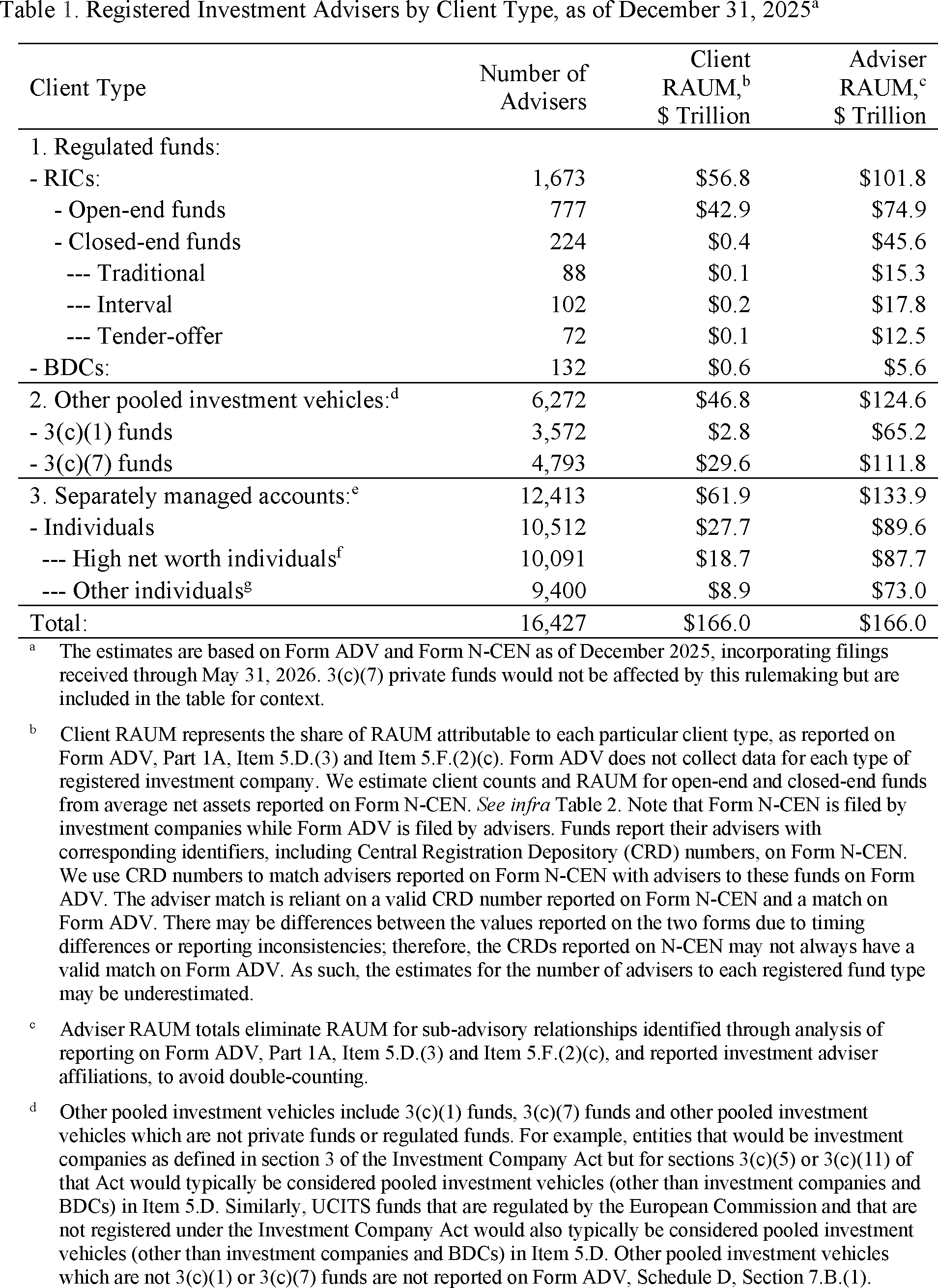
As of December 31, 2025, there were 16,427 advisers registered with the Commission. Among advisers to registered funds, approximately 22.2 percent advise only registered funds; approximately 13.5 percent of advisers to 3(c)(1) funds advise only 3(c)(1) funds; and approximately 20.4 percent advise individual clients only. ( printed page 63708)
b. Regulated Funds
The proposed amendments would affect funds that are regulated by the Commission, including RICs and BDCs and their investors. Table 2 presents the number of funds and net assets under management by category of registered investment company.

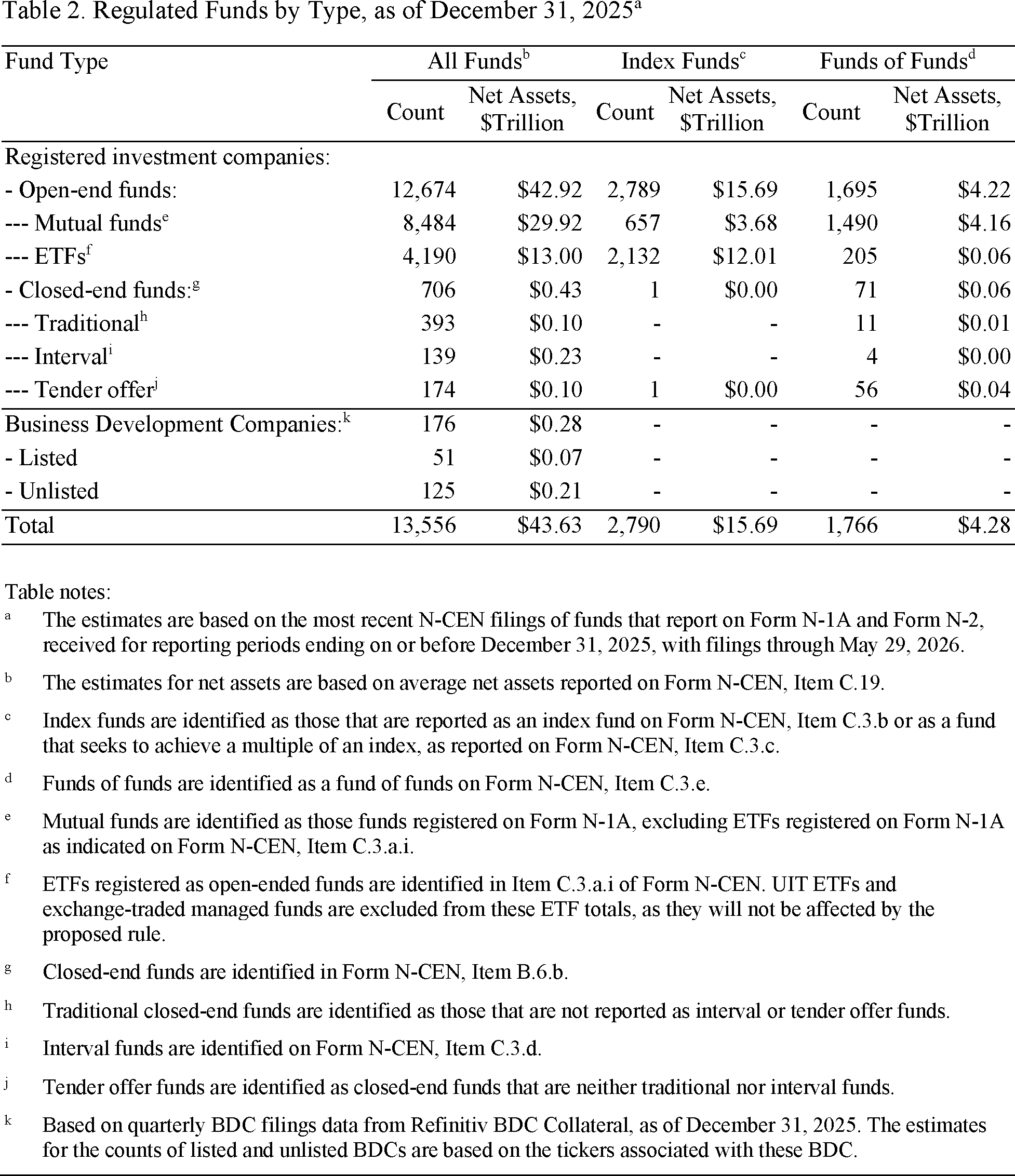
As of December 31, 2025, there were 13,556 regulated funds representing approximately $43.6 trillion in cumulative net assets. Out of these funds, 20.6 percent were index funds representing approximately 36 percent of cumulative net assets, and 13 percent were funds of funds representing approximately 9.8 percent of cumulative net assets.
c. Private Funds
The proposed amendments would affect private funds and their investors. Table 3 presents the distribution of private funds by exclusion and strategy.
( printed page 63710)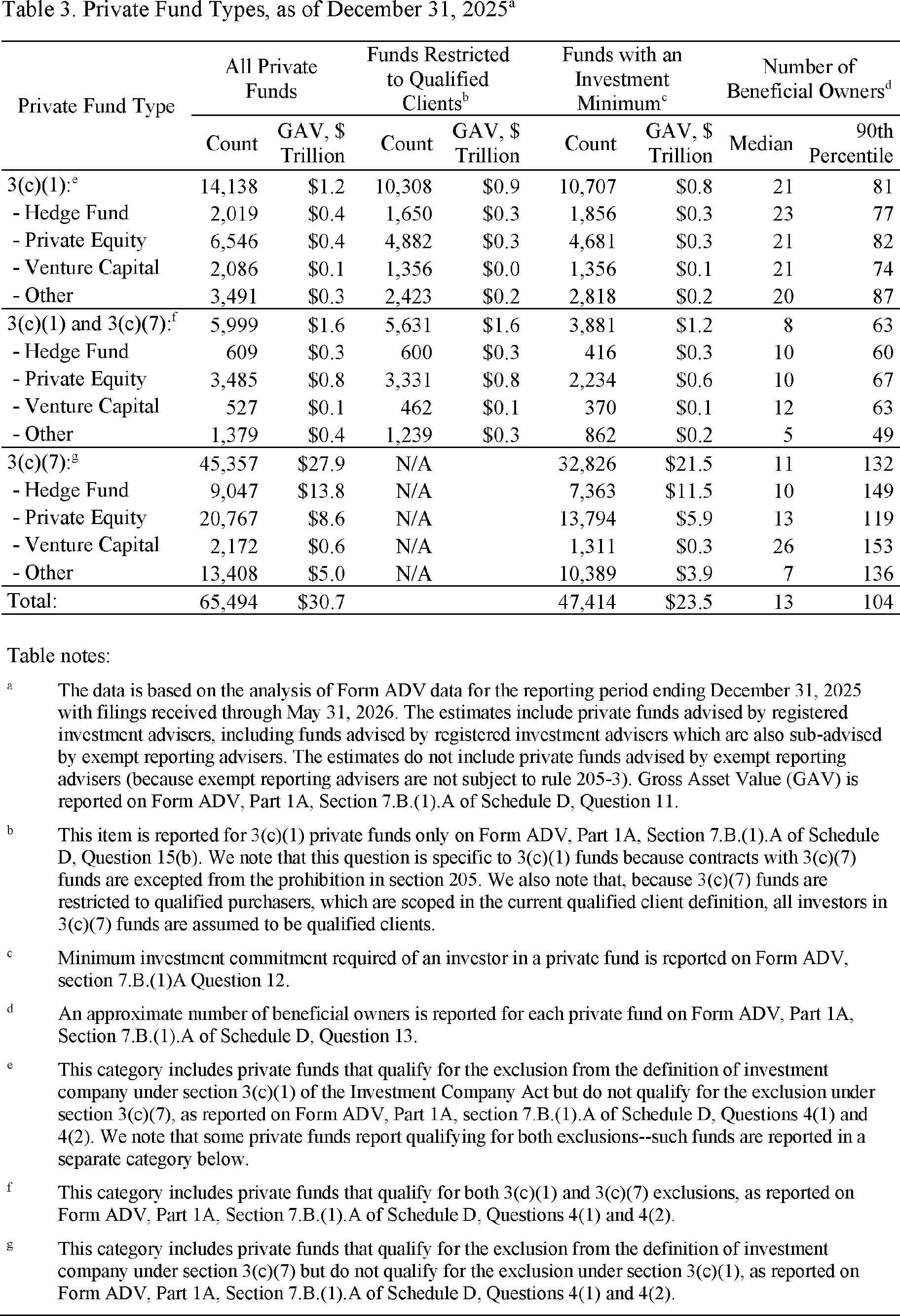
We estimate that, out of $30.7 trillion in cumulative gross assets held by 65,494 private funds, approximately 21.6 percent of funds are funds relying on the 3(c)(1) exclusion exclusively. These funds represent approximately 3.8 percent of cumulative gross assets held by private funds. In addition, approximately 9.2 percent of funds rely on both the 3(c)(1) and 3(c)(7) exclusions. These funds represent approximately 5.3 percent of cumulative gross assets held by private funds. We estimate that approximately 75 percent of 3(c)(1) funds rely on Regulation D.[239] We also estimate that approximately 21.1 percent of funds relying on the 3(c)(1) exclusion exclusively are private funds of funds, representing approximately 22.6 percent of cumulative gross assets held by section 3(c)(1) funds.
3. Performance-Based Compensation: Current Market Practices
a. Rationale and Design
When investors delegate asset management to investment advisers, their interests may not automatically align with those of the adviser. In particular, when advisers are compensated based on the level of assets under management, such a compensation structure may create incentives that may not necessarily align with the goal of maximizing investor returns. For example, advisers may have an incentive to prioritize asset gathering or an incentive to unnecessarily avoid risk if doing so maintains or increases their assets under management. Various direct and indirect (implicit) incentive mechanisms exist to address this misalignment.[240] While academic literature is mixed on which form of managerial incentives is optimal for aligning adviser and client interests,[241] managerial incentives can materially affect adviser behavior and investor outcomes and may be an important driver of performance.[242]
Among these mechanisms, performance-based compensation is one of the most direct tools for aligning adviser and client interests because it ties adviser compensation to investment outcomes. Performance-based compensation may take various forms, including fees, carried interest, or deferred compensation tied to performance.[243] Further, performance-based compensation can be structured symmetrically or asymmetrically. Symmetric performance compensation ( e.g., a fulcrum fee) adjusts in both directions relative to a base fee rate—it increases when performance exceeds the benchmark and decreases when the portfolio underperforms, such that the adviser shares in both outperformance and underperformance.
Asymmetric performance compensation is triggered only when a portfolio outperforms ( e.g., relative to a high-water mark, a hurdle rate, or a benchmark) and does not impose a corresponding reduction in compensation when the portfolio underperforms. This structure creates a payoff for the adviser similar to that of a call option, where the option is exercised only when the gain exceeds the strike price (a benchmark or a hurdle rate). Therefore, asymmetric performance compensation can incentivize excessive risk-taking on the part of an adviser—because volatility increases the likelihood of a higher performance fee—and exposes investors to increased risk of loss.[244] The academic literature is mixed, however, as to whether asymmetric performance fees lead to increased risk-taking on the part of advisers.[245]
( printed page 63712)This issue is more pronounced for strategies where returns are driven by capital appreciation, such as equity strategies, where advisers have greater control over the timing of disposition of depreciating assets. By delaying such dispositions, an adviser can avoid realizing a loss that would reduce or eliminate any current period performance compensation based on realized capital gains, while delaying any such reduction in compensation resulting from future losses, which may exacerbate excessive risk-taking. In contrast, when an adviser receives performance compensation on income, such as interest income, any asset underperformance that results in a default or delinquency on a loan would reduce interest income and, with it, the adviser's performance fees. Because such interest income cannot be timed, advisers cannot increase the likelihood of a large performance compensation payout through excessive risk-taking without also increasing the likelihood that the income stream from underlying assets would be eroded due to their increased default probabilities. Therefore, advisers with compensation tied to income may be less incentivized to take excessive risk than advisers with compensation tied to capital gains.
Advisory contracts that include a performance fee commonly feature investor protections designed to align managerial incentives with investor interests. For instance, many such arrangements stipulate that an adviser may collect performance fees only on returns above a “high-water mark,” which is the fund's prior peak NAV. Advisory contracts may also feature clawback provisions that make a previously paid performance fee subject to recoupment when current performance erodes past gains. In addition, performance fee arrangements may include hurdle rates, which are minimum performance thresholds that can be numeric or tied to a specific benchmark. A benchmark used to determine a performance fee can be an important factor for investor outcomes.[246]
The structure of performance compensation arrangements and associated investor protections may depend on a fund's or account's lifespan, liquidity profile, and strategy type, among other things. For example, for drawdown funds, which are funds with a finite lifespan that do not permit investor redemptions, performance compensation is charged based on realized gains because investments are held until realization. While performance compensation may be collected on a deal-by-deal basis, such contracts for drawdown funds typically include clawback provisions, such that previously distributed compensation is returned if aggregate realized performance at fund termination falls short. In contrast, performance compensation for funds that permit periodic redemptions and do not have a fixed life (evergreen funds) may be based on unrealized gains, which introduces the risk that compensation collected on mark-to-market gains may later be reversed. For these funds, a high-water mark can serve as a stronger investor protection mechanism because it prevents the payment of performance compensation on the same unrealized gains multiple times. In addition, the frequency of compensation crystallization and the length of the measurement period are important features of performance compensation arrangements for evergreen funds. The less frequently performance compensation is locked in and paid, and the longer the measurement period, the lower the risk that performance compensation is paid on gains that are subsequently reversed.
b. Structural Constraints on Performance Compensation Design
The ability of investment advisers to implement performance compensation contracts depends on whether a fund is a regulated fund or a private fund. Private funds may be organized as limited partnerships, in which the general partner typically is an affiliate of the adviser, and the investors are limited partners.[247] The terms governing performance compensation for a partnership are set out in the fund's operating agreement (as well as the adviser's advisory contract with the fund), and each investor individually agrees to the terms of the agreement upon subscription. The fund's operating agreement typically permits advisers and investors to negotiate modifications to performance compensation arrangements through side letters, which are bilateral agreements between the general partner or adviser (or both) and the investor. As such, performance compensation obligations may differ at the investor level within the same fund. Private funds employ different mechanisms to subject individual fund investors to the payment of performance compensation, in order to account for an individual investor's performance experience rather than the fund's aggregate performance. For example, funds structured as limited partnerships generally account for each partner's individual capital account on the fund's books. Performance compensation attributable to the general partner is computed for each capital account relative to each partner's contributions, distributions, and profit and loss allocations.[248]
In regulated funds, the advisory contract is between the fund as an entity and the investment adviser. Individual investors are not parties to this contract—instead, the fund's board of directors acts as the representative of shareholder interests and reviews and approves the advisory contract on their behalf annually. As such, fund investors cannot individually negotiate performance compensation terms.[249] This structural difference has implications for how performance compensation is assessed and borne by investors in regulated funds.
In particular, in regulated funds, performance compensation is assessed on the fund itself and, therefore, accrues in liabilities of the fund. Rule 2a-4 for open-end funds requires fund expenses, including any investment advisory fees, to be reflected in the NAV at which investors transact, with estimates of the accrued amounts used when the actual value is not available. Separately, FASB ASC Topic 946, Financial Services—Investment Companies, requires that ( printed page 63713) performance fees be accrued based on actual performance through the accrual date, meaning that performance fees must be accrued in fund liabilities as they are incurred. This requirement applies to all regulated funds.[250] As such, investors in regulated funds that pay performance fees bear the performance fee costs through NAV reductions rather than through direct charges.[251] This has two implications.
First, in practice, performance compensation cannot be assessed or charged at the individual investor level, and mechanisms that allocate performance compensation owed by individual investors that are available to private funds cannot be implemented to account for individual investors' experiences in regulated funds. This, in turn, results in a free-rider problem among regulated fund shareholders. Because performance fees reduce a fund's NAV uniformly across all outstanding shares, regardless of the time investors subscribed to the fund, investors who subscribe at different times would not have net-of-fee returns that account for their individual investment experience, in contrast to how they would be in many private funds. In particular, investors who subscribe midway through a measurement period participate in all the gains after their subscription, but the performance fee they bear is based only on a portion of the gains rather than their full gains, which may result in a lower effective fee rate for those investors for that period compared to what is stated in the fund's advisory contract.[252] Therefore, the structural inability of registered funds to implement investor-level equalization mechanisms produces an inherent inequality among investors—investors in the same fund may bear different effective performance fees depending on the timing of their subscriptions or redemptions. This is in contrast to private funds where investors pay performance fees based on their own performance experience.
Second, because the final performance fee cannot be determined until the end of a measurement period, the amount of accrued performance fee has to be estimated each time that NAV calculation is performed. In particular, because the accrued fee estimate may be reversed if performance reverses within the period, investors who enter or exit the fund in the middle of the period may bear impacts from fees that are ultimately not paid. This effect is more pronounced for funds that are required to calculate their NAV daily. For closed-end regulated funds that allow periodic repurchases, the estimation effect is less pronounced and may not be present at all, if the NAV calculation is aligned with the frequency of repurchases.
c. Distribution Channels
Access to a fund depends on the channels through which it is distributed, and these channels differ in how readily investors can purchase interest in a particular fund. Private funds are distributed only by the fund sponsor or a placement agent, and investors are generally admitted to the fund by subscribing directly, rather than purchasing the fund through an intermediary.
On the other hand, regulated funds can sometimes be purchased directly through the fund's principal underwriter or transfer agent, or through an investment adviser or broker-dealer, which can vary in cost and accessibility. For example, accounts receiving recommendations or advice, whether through a broker-dealer or through a registered investment adviser, are typically charged higher costs and in general require higher account minimums, compared to self-directed brokerage accounts.
We understand that unlisted regulated closed-end funds that make periodic or discretionary repurchase offers are generally not available for self-directed purchase through a brokerage platform.[253] Accordingly, in practice, these funds can be purchased primarily by subscribing directly with the fund's transfer agent or through a financial professional (either a broker-dealer or investment adviser). This limitation could be due to operational constraints of self-directed brokerage platforms. For example, if a fund restricts investors to a particular set ( e.g., to qualified clients or accredited investors), we understand that self-directed brokerage platforms are generally not equipped with automated systems that would perform and track the required investor eligibility checks—which is in contrast to a financial professional at a broker-dealer or an investment adviser. As another example, a self-directed brokerage platform may be built on a system that assumes daily redeemability, and funds that do not issue redeemable shares ( e.g., interval funds or tender-offer funds) generally cannot be transacted through the ordinary self-directed order flow.[254]
These operational constraints may compound for retirement plans, specifically defined contribution plans, because recordkeeping systems are built on daily participant-level valuation and daily processing of contributions, loans, and distributions (which are applied proportionally to portfolio holdings). Closed-end funds are accordingly rare on defined contribution plan menus as standalone options for investors. While a plan may obtain exposure to a target-date or balanced fund that holds closed-end funds in its portfolio, investor access to regulated funds that do not issue redeemable shares may currently be hindered by operational constraints of fund intermediaries. ( printed page 63714)
d. Market Practices and Investor Access to Alternative Strategies
(1) Private Funds
Currently, performance-fee arrangements are most closely associated with private funds, which employ various strategies such as private equity, private credit, and hedge fund strategies. Advisers to private funds may charge performance fees based on capital gains or other measures, such as income and dividends, to participate in the profits generated by their investment activities. Although various academic studies suggest that private funds may offer superior risk-adjusted returns to investors,[255] these funds vary in their accessibility to investors.
3(c)(7) private funds are restricted to qualified purchasers only and predominantly serve institutional investors (the Advisers Act prohibition on performance fees based on capital gains does not apply to 3(c)(7) funds and the proposed amendments would not affect advisory contracts with such funds). 3(c)(1) private funds are open to individual investors but are generally restricted to accredited investors (if the fund relies on Regulation D) or accredited investors that are also qualified clients (if the fund's adviser relies on both Regulation D and the exemption for qualified clients in rule 205-3 in order to charge performance fees on capital gains). Because the qualified client definition generally has more stringent thresholds than the accredited investor standard, in practice most 3(c)(1) funds are available to accredited investors that are also qualified clients. We estimate that approximately 72.9 percent of 3(c)(1) funds require their investors to be qualified clients.[256] As a result, less affluent accredited investors have limited access to these investment opportunities.
Private funds may also restrict their investor set by imposing an investment minimum. We estimate that approximately 75.7 percent of private funds relying exclusively on the section 3(c)(1) exclusion require minimum investments to participate in the fund.[257] Table 4 reports information on these minimum investments as reported on Form ADV.
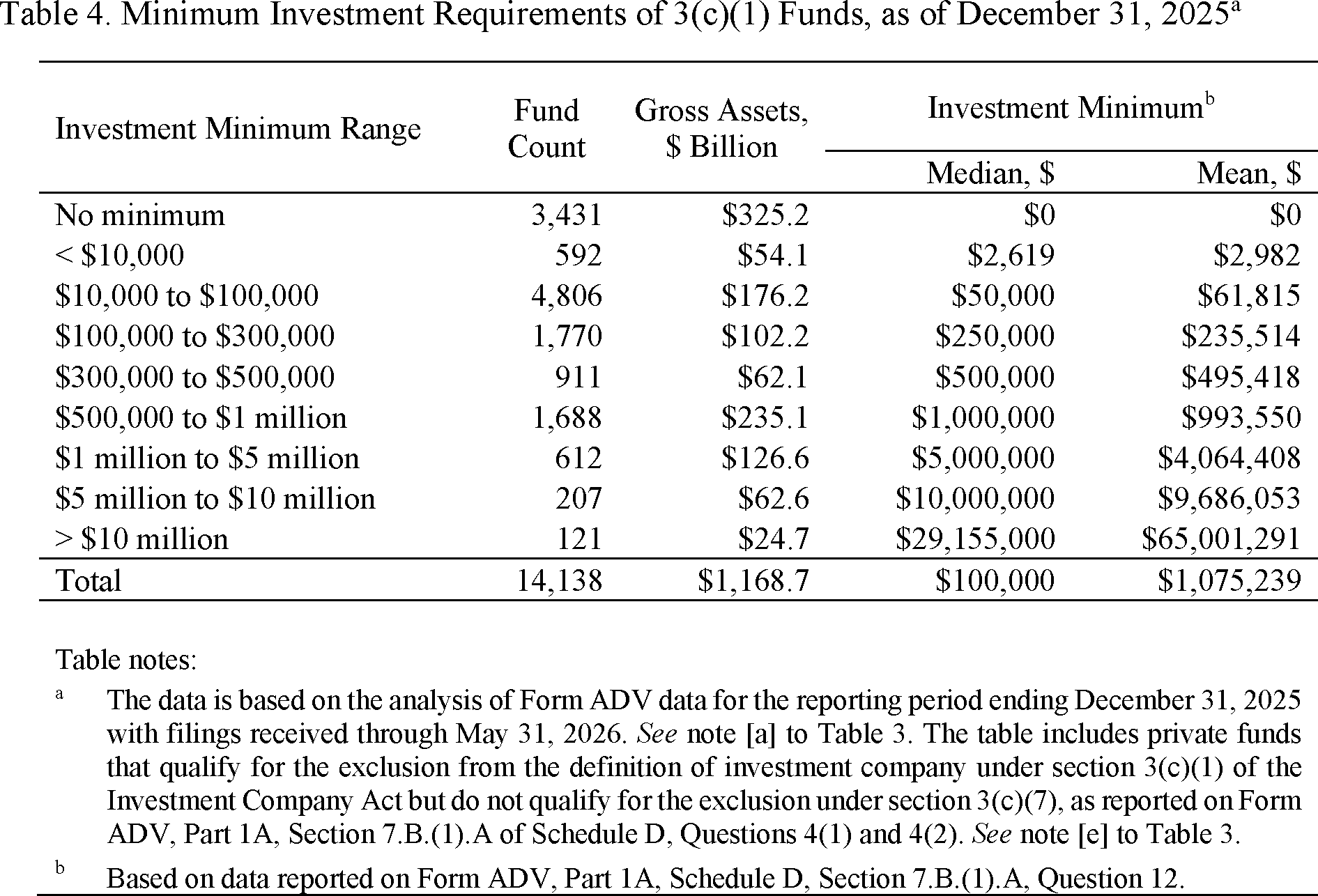
We estimate that out of 14,138 private funds relying on the 3(c)(1) exclusion exclusively, approximately 28.5 percent either do not require an investment minimum or require a minimum less than $10,000. These funds represent approximately 32.4 percent of cumulative gross assets reported by private funds relying on the 3(c)(1) exclusion exclusively. Less affluent accredited investors may be unable to meet higher investment minimums, ( printed page 63715) regardless of whether those funds restrict their client base to qualified clients or not.
(2) Separately Managed Accounts
In contrast to regulated and private funds that are managed on behalf of a group of investors, separately managed accounts are managed directly for individual clients.[258] Each separately managed account owner directly owns underlying portfolio investments and has transparency into those investments and portfolio transactions. Similarly to mutual funds and ETFs, separately managed accounts offer various investment strategies; however, direct asset ownership allows for portfolio customization, such as an investor's ability to impose a unique set of guidelines for investment allocation or the investor's ability to use customized tax treatment to avoid the forced realization of capital gains or losses that can occur with mutual fund share ownership, such as in-kind account funding ( e.g., transfer of a security from another account into a separately managed account without selling it). Direct ownership of portfolio assets also provides investors with full transparency of portfolio holdings and account transactions.
Together, transparency and customization benefits for investors may translate into operational challenges for investment advisers: the more customized accounts an adviser manages, the more operationally burdensome it can become to employ strategies, track compliance, and provide detailed reports on holdings, performance, and transaction activity to each account holder.[259] Because of this potential limitation on economies of scale, for the same level of aggregate client assets managed by an adviser, it may be less operationally complex to manage a small number of large separately managed accounts than many smaller separately managed accounts. Generally, smaller accounts allow limited customization and may focus on public market strategies that replicate mutual fund portfolios managed by the same adviser or portfolios tracking an index (“direct indexing”).[260]
Retail-oriented separately managed accounts typically carry higher expenses and may therefore underperform their institutional counterparts on a net return basis, according to a recent study.[261] In addition, separately managed accounts often require substantial investment minimums, with thresholds for institutional accounts starting at $100,000 and thresholds for retail accounts ranging between $50,000 and $100,000, according to a recent academic study.[262]
Advisers to retail-oriented separately managed accounts typically charge fees based on a stated percentage of assets under management, rather than a performance fee.[263] For example, a subset of separately managed accounts is offered through wrap fee programs,[264] where investors are charged a single, bundled “wrap” or “model” fee for investment advice, brokerage services, administrative expenses, and other fees and expenses.[265]
(3) Regulated Funds
Regulated funds offer a variety of strategies to investors, historically focusing on public markets, and vary in their adoption of performance fees. Although advisers to regulated funds have been permitted to charge symmetric performance fees (fulcrum fees), the use of fulcrum fees remains limited in recent years. We estimate that at least 85 active mutual funds pay fulcrum fees.[266] Of these funds, 72 are reported as equity funds, 9 as fixed income funds, 3 as allocation funds, and 1 as a hybrid fund.[267]
In recent years, regulated funds began offering more complex alternative strategies to investors and entering into advisory contracts with asymmetric performance fees on both income gains and capital gains. Regulated closed-end ( printed page 63716) funds such as interval funds, tender-offer funds, and BDCs are primarily associated with such performance fees in the regulated fund space. We estimate that out of 706 closed-end funds, at least 95 funds report paying performance fees on either income gains, capital gains, or based on another measure.[268] The range of strategies available through these vehicles may be limited by advisers' compensation preferences, as current market practices favor fee structures that are more compatible with certain investment approaches than others.[269]
BDCs. BDCs are permitted higher leverage than closed-end funds and are permitted to pay performance fees on capital gains under certain conditions without restricting their investor base.[270] As such, BDCs adopt performance fees at a higher rate compared to other regulated funds. We estimate that 152 out of 176 BDCs (representing nearly 100 percent of cumulative BDC net assets) pay performance fees (on either income gains or capital gains) to their advisers.[271] In addition, we estimate that, among unlisted BDCs, there are 102 private BDCs (representing approximately 42.9 percent of cumulative BDC net assets) that voluntarily restrict their investor base to accredited investors.[272]
While BDCs can generally invest in both the equity and debt of small and mid-sized U.S. companies, one study finds that publicly traded BDCs currently specialize primarily in private credit.[273] The same study finds that nearly all BDCs specializing in private credit charge a 20 percent performance fee on cumulative net investment income above a defined hurdle rate and that the compensation structure of BDCs resembles that of a traditional private equity fund,[274] with one notable difference: management fees are typically charged on gross AUM (which includes leverage) rather than on net assets.[275] This results in BDCs having lower net-of-fees risk-adjusted returns compared to private equity funds with the same before-fee performance and level of borrowings. According to the study, retail investors generally sort into BDCs that engage in more hybrid financing and charge higher fees, and institutional investors sort into private equity-affiliated BDCs. A separate report finds that most BDCs have performance fees based on both net investment income and capital gains.[276]
Interval Funds. Interval funds conduct repurchases at scheduled intervals and are subject to a debt-to-asset ratio limit of 1/3 , which is a more restrictive leverage limit than that for BDCs.[277] A recent academic study finds that interval funds invest in a broader range of asset classes than BDCs.[278] According to the study, almost 60 percent of interval fund investors are retail investors, and the median minimum investment requirement is $2,500. Another report finds that funds representing approximately 20 percent of interval fund assets require investment minimums less than $100,000, while the rest require investment minimums above $100,000, with 47 percent of interval fund assets in funds requiring a minimum investment over $1 million.[279] Similar to the strategies of BDCs, private credit and real estate are the most prominent strategies among interval funds. The authors find that retail investors in interval funds realize superior returns relative to exchange-traded benchmarks only when they co-invest alongside large and more sophisticated investors. The study estimates that 17.5 percent of interval funds pay performance fees on interest and dividend income.[280] We estimate that at least 29.5 percent (41 out of 139) of interval funds pay performance fees on either capital gains or income.[281]
Tender-Offer Funds. In contrast to BDCs and registered interval funds, registered tender-offer funds are primarily offered to accredited investors and qualified clients. Like interval funds, tender-offer funds are subject to a debt-to-assets ratio limit of 1/3; like most BDCs, they conduct repurchases on a discretionary basis. The same study finds that around 70 percent of tender-offer funds are offered to high net worth individuals, while around 22 percent are offered to retail investors.[282] The study estimates that 44 percent of tender-offer funds pay performance fees on interest and dividend income.[283] We estimate that 33 out of 174 of tender-offer funds pay performance fees on either capital gains or income.[284]
Because tender-offer funds are not required to have a fixed repurchase schedule like interval funds, this type of regulated fund may offer a better match between the limited fund liquidity offered to investors and the illiquidity of investments in private companies. For example, a recent study indicates that 57 percent of tender-offer fund assets are in public and private equity, while only 16 percent of interval fund assets are in public and private equity.[285]
Open-End Funds. Certain regulated open-end funds, including mutual funds ( printed page 63717) and ETFs, currently offer alternative strategies. These funds primarily offer exposure to established private firms and are more restricted than BDCs and closed-end funds in their ability to utilize leverage. However, liquidity and daily valuation and redeemability requirements for registered open-end funds restrict their ability to allocate a significant portion of their portfolio to less-liquid private market assets.
Certain investment strategies may also be available to investors in regulated funds via regulated funds of private funds. However, such structures may be more expensive for investors, compared to funds directly investing in alternative strategies,[286] to the extent that the advisory fees, including performance fees, that acquired funds pay to their advisers are significant. Regulated funds are required to disclose as a separate line item any acquired fund fees incurred indirectly by the fund as a result of its investment in certain other funds.[287]
e. Market Practices for Performance Compensation Disclosure
While advisers to private funds are not required to make standardized public disclosures regarding the offering terms for private funds, they must comply with certain SEC requirements (if applicable), such as filing Form D for offerings relying on Regulation D, and they are subject to the antifraud provisions of the federal securities laws.[288] While private placement offering memoranda typically include detailed information concerning fund strategy, terms, fees, liquidity provisions, potential conflicts, and risk factors, unlike the disclosures required of registered investment companies, private fund disclosures are neither standardized nor generally as comprehensive, making cross-offering comparison more difficult for investors. For instance, while there are reporting templates for fees, expenses, and carried interest in the private equity industry,[289] adoption of these templates is not a regulatory requirement and may depend in part on the bargaining power of fund investors. Because such disclosures are generally provided only to current and certain prospective fund investors, comparing expenses and potential risks across private funds may involve more significant search costs for investors.
Regulated funds that have performance fees (either on capital gains or income) may present these fees inconsistently in their disclosures on Forms N-1A and N-2, because these forms do not require funds to list performance fees separately in the fee table; instead, performance fees are reported in an aggregate line item together with other investment advisory fees. As a result, some regulated funds that pay performance fees have developed the practice of including separate disclosure of those fees in their fee tables.[290] For example, a regulated fund may include a footnote in its fee table indicating that the reported management fee includes a performance adjustment and disclosing the base fee level absent that adjustment.
C. Benefits and Costs
1. Changes to the Qualified Client Definition
Rule 205-3 permits investment advisers to charge performance fees on capital gains to clients that are qualified clients.[291] The current definition of a qualified client includes natural persons and companies with at least $2.7 million in net worth (excluding primary residence) or at least $1.4 million in assets managed by the adviser; certain officers and employees of the adviser; and qualified purchasers. Additionally, a regulated or private fund can meet the qualified client definition only if each equity owner (except for private fund owners not charged a performance fee) also does so, a requirement known as the “look-through” provision.
The proposed changes to rule 205-3 would expand the qualified client definition. Specifically, the changes would: (i) replace the net worth and assets-under-management tests with the “accredited investor” test for natural persons and companies; [292] (ii) include regulated funds that meet certain conditions; [293] and (iii) remove the existing look-through provision and embed a similar provision directly into the definition.[294] As a result, the expanded definition of a qualified client would newly include:
(1) Natural persons or companies that are accredited investors;
(2) Regulated funds each of whose equity owners is an accredited investor; [295]
(3) Regulated funds that satisfy the following conditions:
- The compensation does not exceed 20 percent of net capital gains;
- The fund complies with the fund governance standards; and
- The fund's board determines that the performance-based compensation arrangement is in the best interest of the regulated fund and its shareholders and makes specific findings regarding the arrangement's appropriateness, structure, and investor protection features;
(4) 3(c)(1) funds provided that each equity owner that is charged performance compensation based on capital gains is an accredited investor.
The proposed changes to the qualified client definition would expand investor access to investment strategies with performance fees on capital gains through two channels. The first channel (“accredited investor channel”) would ( printed page 63718) allow advisers to charge accredited investors a performance fee on capital gains directly through advisory contracts or indirectly through regulated or private funds in which each of the underlying equity owners is an accredited investor. As a result, investors that meet the definition of an accredited investor but do not meet the current qualified client definition (“less affluent accredited investors”) would be newly included within the proposed qualified client definition.
The second channel (“fund board channel”) would permit advisers to charge a regulated fund a performance fee on capital gains if the fund meets specified investor-protection conditions, regardless of whether fund investors meet the accredited investor definition. As a result, any investor would qualify to access regulated funds that pay a performance fee on capital gains. This could increase access to such strategies for investors who do not meet either the current qualified client definition or the accredited investor definition (“non-accredited investors”), and who are generally excluded from registered fund strategies that carry a performance fee on capital gains.
While we anticipate that the adoption of strategies with performance fees on capital gains would vary by client type and investor base, certain overarching economic considerations apply more generally. We discuss these considerations first, followed by effects particular to each client type.
a. General Considerations
The number of investors that would be able to invest in products with performance fees on capital gains would increase as a result of the proposed amendments. This is because the monetary thresholds for investors to qualify as qualified clients under current rule 205-3 are generally more stringent than those for accredited investor status.[296] In particular, individual investors with at least $1 million in net worth qualify as accredited investors, while individuals and companies with at least $2.7 million in net worth meet the current qualified client definition.[297] Accredited investor status can also be met through income thresholds, regardless of net worth level, in contrast to the current qualified client definition, which does not incorporate income thresholds. In addition, certain individuals qualify as accredited investors by virtue of holding designated professional certifications that can serve as proxies for financial sophistication ( i.e., the General Securities Representative (Series 7), Private Securities Offerings Representative (Series 82), or Investment Adviser Representative (Series 65) licenses), rather than by satisfying a wealth- or income-based threshold.[298] These investors do not currently meet the qualified client definition, to the extent that they do not otherwise meet the net worth or assets under management thresholds of the qualified client definition and they are not certain officers or employees of the adviser.[299]
The proposal to include accredited investors in the qualified client definition would bring less affluent accredited investors within the pool of clients eligible to be charged a performance fee on capital gains. A recent report analyzes the data reported in the 2022 Survey of Consumer Finances (SCF) [300] and estimates that approximately 24.3 million (18.5 percent) of U.S. households qualify for accredited investor status and that approximately 16.4 million (12.5 percent) of U.S. households meet the $1 million net worth threshold of the accredited investor definition.[301] Using the same data, we estimate that approximately 29.6 percent of all accredited investors—approximately 7.2 million U.S. households—have a net worth of at least $2.7 million and would meet the current qualified client definition.[302] Accordingly, we estimate that approximately 17.1 million U.S. households qualifying as accredited investors do not currently meet the net worth test of the qualified client definition and would meet the definition of qualified client under the proposal.
The proposed fund board channel could also bring non-accredited investors within the pool of investors eligible to access investment products associated with performance fees on capital gains. The potential number of investors reached through this channel is considerably broader: in principle, the fund board channel could extend to all U.S. households, to the extent that regulated funds relying on this channel ( printed page 63719) would be made available to non-accredited investors.
The proposed amendments would also remove the $1.4 million in assets under management test from the qualified client definition. Because accredited investor criteria are not tied to a specific level of assets managed by a particular investment adviser, investors who are not accredited investors but currently meet the qualified client definition by virtue of the $1.4 million managed assets test would be excluded from the proposed qualified client definition.[303] This may occur for non-accredited investors with substantial liabilities that reduce their net worth below the $1 million threshold in the accredited investor definition. However, we do not expect this group of investors to be large because non-accredited investors generally may not participate in exempt offerings, including those made by private funds.
A more diverse pool of investment options may become available to more investors as a result of the proposed changes to the qualified client definition. For example, the proposed amendments could lead to the creation of new regulated funds offering broader exposure to various markets and strategies to less affluent accredited investors and non-accredited investors,[304] as well as new 3(c)(1) private funds to the extent that sponsors find it profitable to operate such funds at the scale attainable by an investor base that includes less affluent accredited investors. This could allow investors to more efficiently select investments that meet their goals.[305] To the extent that newly available strategies would enhance portfolio returns, investors could benefit from adding them to their portfolios. For example, to the extent that the current prohibition on performance fees on capital gains places constraints on advisers to regulated funds in offering private equity strategies and limits the investment options to primarily income-based private market strategies,[306] the proposal may promote the creation of regulated funds that offer exposure to private equity strategies with performance fees on capital gains, which could increase investors' risk-adjusted returns.[307]
While performance fees on capital gains are most commonly associated with private market strategies, the proposed amendments to rule 205-3 would permit any regulated fund adhering to the proposed conditions to charge such fees. Agreements providing for a regulated fund's adviser to be compensated based on capital gains could benefit fund investors by rewarding portfolio management that increases the fund's returns.[308] Some investors may additionally prefer to invest in regulated funds in which a larger percentage of fees is contingent on the funds' performance.
While the number of investors that would be able to invest in funds whose advisers charge performance fees on capital gains could increase, we cannot estimate how many new and existing funds would become available to the investors who currently do not meet the definition of qualified client. For example, to the extent that advisers have reasons to restrict the shareholder base to more affluent investors beyond the current constraints on charging performance fees on capital gains to non-qualified clients,[309] an adviser could continue to restrict the fund's shareholder base. One avenue through which advisers can do so is establishing investment minimums for funds and accounts they advise.[310]
Nonetheless, to the extent that access to more complex investment strategies would expand as a result of the proposed amendments, such expanded access carries certain risks associated with those strategies. For instance, investment strategies that are commonly associated with performance fees, such as private market strategies, generally offer lower liquidity and less valuation transparency to investors, and may employ more leverage, compared to their public counterparts.[311] While exposure to risk can increase expected risk-adjusted returns, investors unfamiliar with these risks may position themselves sub-optimally or face unexpected losses. Thus, one possible cost of expanding the pool of investors is the potential for uninformed or insufficiently informed investing by newly eligible investors. To the extent that advisers may offer inferior strategies while charging performance fees to less wealthy investors who are less familiar with such strategies, those investors may be negatively affected. In addition, less wealthy investors may experience higher search costs for high-quality advisers, and thus may not realize the same net returns as wealthier investors, to the extent that less wealthy investors are limited to products offered by lower-quality advisers. For example, a recent study suggests that the returns realized by individual investors investing in private equity funds vary significantly depending on their wealth level.[312] In particular, the most affluent ( printed page 63720) investors have returns that are nine percentage points (in risk-adjusted public market equivalent) higher compared to the least affluent investors. This result is primarily explained by variation in investment adviser quality—wealthier clients match with better-performing advisers—and differences in fees (including intermediation costs) also contribute to the effect. The study also indicates that, after accounting for advisers' fees, the least wealthy investors did not achieve higher returns relative to the public markets.[313] To the extent that wealthier investors match with better advisers because they are able to provide more upfront capital required for higher-performing strategies, and to the extent that wealthier investors have greater bargaining power to negotiate performance fees, less affluent investors may continue to be excluded from higher-performing strategies offered by high-quality advisers. In addition, to the extent that strategies newly available to less affluent investors would be offered by lower-quality advisers, such investors may experience a decrease in risk-adjusted returns. Further, to the extent that adding performance fees would increase funds' operating expenses without a corresponding increase in risk-adjusted returns that would generate offsetting cash flows, and to the extent that funds would need to deplete their liquid assets to pay these operating expenses, funds with performance fees may have less liquid assets compared to funds with the same strategies that do not pay performance fees.
The proposed amendments would allow performance fees on both realized and unrealized capital gains. Certain strategies, such as income-based strategies where realized gains on income occur when interest payments from portfolio assets are made, or certain vehicle types, such as private funds with lockup periods where performance fees are not paid until the capital gains are realized, can more easily accommodate performance fees on realized gains. By contrast, vehicles with frequent subscriptions and redemptions that have strategies that do not post substantial realized gains as frequently, such as equity strategies, are able to accommodate performance fees based on unrealized gains. As such, advisers to regulated funds that pursue equity strategies may be at a structural disadvantage relative to advisers of funds with income strategies, given that equity strategies generate capital appreciation primarily through unrealized gains in the short term. Therefore, permitting performance fees on unrealized gains may level the playing field for advisers to regulated funds with equity strategies by better aligning their incentive structure to that of advisers to income strategies. This, in turn, may benefit investors in regulated funds, to the extent that it would expand the range and quality of strategies offered in the regulated fund space.
Estimating unrealized gains can be complex and may depend on many assumptions underlying the fair value of an investment for which market quotations are not readily available: the less information about an investment is available in the market, the more complex fair value estimation becomes. Investors may not fully understand this process and the risks it poses, as it requires specialized knowledge, and, therefore, they may underestimate the risks related to valuation of complex products. For example, for open-end funds (both private and regulated), undesirable outcomes may arise when a fund purchases equity assets ( e.g., a private equity stake) in a secondary market at a discount to the NAV of such assets. In particular, at the time of the purchase, the asset's value is recorded at cost. However, when a fund applies the NAV practical expedient to estimate fair value, the fund may recognize an immediate unrealized gain equal to the difference between the asset's cost and its NAV.[314] As a result, advisers may have an incentive to allocate disproportionately large amounts of investor capital to such assets and record gains for the fund without any change to the fundamental characteristics of the underlying assets, because these unrealized gains may trigger a performance fee. However, if the fund later must accommodate redemptions or fund operating expenses, such as management or performance fees, by selling these assets in the same secondary market at a discount, remaining investors would absorb the loss, which may in turn trigger further redemptions and additional losses.[315]
We anticipate these potential risks would be mitigated by the safeguards accompanying each channel. The proposed conditions for relying on the fund board channel would mitigate these risks in the regulated fund space by limiting the magnitude of performance fees as a percentage of net capital gains,[316] by requiring compliance with fund governance standards, and by requiring a best-interest determination by regulated fund boards.[317] For the accredited investor channel, any expansion in investor access would affect less affluent accredited investors who are already eligible to invest in exempt offerings (including in 3(c)(1) private funds) and who are recognized as having a degree of financial sophistication that may better position them to evaluate the risks of complex investment strategies than non-accredited investors.[318] Additionally, to the extent that fund boards (for regulated funds) or investors in 3(c)(1) funds and separately managed accounts negotiate provisions such as high-water marks and hurdle rates (as applicable), these risks could be further mitigated. Together, these conditions would provide advisers with appropriate incentives to maximize risk-adjusted returns for their clients without encouraging excessive risk-taking.
b. Regulated Funds
Investors in regulated funds that cannot adopt asymmetric performance fees on capital gains may be at a disadvantage compared to investors in funds whose advisers can freely charge performance fees to these funds. This is because an inability to charge ( printed page 63721) asymmetric performance fees may discourage capable advisers from allocating their best-performing strategies to regulated funds, and because fulcrum fees are associated with higher operational risk to advisers and, therefore, do not provide strong enough incentives to bring such strategies to regulated funds.[319]
Expanding the ability to charge performance fees could similarly lead advisers currently operating in the private markets to bring strategies into the regulated fund wrapper by providing an alternative to the fulcrum fee structure for performance-based compensation. It would also allow advisers to regulated funds with strategies that are already available in regulated funds to enter into agreements that provide for compensation that varies asymmetrically with the fund's performance, potentially better aligning advisers' interests with those of regulated funds' shareholders by incentivizing advisers to maximize fund returns. Accordingly, the proposed amendments could promote innovation in regulated funds and expand investor choice.
Advisers to regulated funds considering advisory agreements that provide for compensation based on capital gains would choose through which channel to implement a performance fee on capital gains: some may choose the accredited investor channel and others may choose the fund board channel. For example, it could be more feasible for advisers to open-end funds and listed closed-end funds to implement performance fees via the fund board channel, to the extent that investor-level conditions prevent certain intermediaries from offering funds restricted to a particular set of investors on such platforms.[320] On the other hand, for advisers to regulated funds that primarily market and distribute their funds through intermediaries and prefer higher initial investments, it could be less costly to implement performance fees on capital gains via the accredited investor channel.
Non-accredited investors in funds that would choose to implement performance fees on capital gains through the fund board channel may be less familiar with these fee structures than accredited investors,[321] may not fully understand the associated risks related to financial products that include performance fee structures,[322] and may be less well positioned to bear any increased risks relative to accredited investors. However, the proposed conditions for reliance on the fund board channel are designed to address these concerns by requiring that the board, as part of its 15(c) process, evaluate the specific structural features of the performance fee arrangement and make particularized findings. This approach would help ensure that the performance fee arrangement is reassessed annually as the regulated fund's performance, strategy, portfolio composition, and valuation complexity evolve over time.
The proposed best interest finding by the board would also be required to include a written finding addressing the appropriateness of a performance-based compensation arrangement in light of the fund's investment strategy and valuation practices.[323] In addition, the proposal would amend Item 11 of Form N-CSR to include more particularized disclosure regarding the approval of performance fees on capital gains to mirror these written findings. Together, these requirements would help safeguard shareholders' interests and reinforce the board's oversight of adviser compensation arrangements.
While exposure to novel strategies, such as private market strategies or strategies that are similar to those of hedge funds, may improve risk-adjusted returns of investors in regulated funds, the extent to which these investors would be able to capture these returns may be limited by several factors. First, due to liquidity and leverage constraints of regulated funds, the implementation of strategies that are similar to those of private funds may not be feasible, as such strategies may require long lock-up periods (in the case of private equity funds) or high leverage usage ( e.g., in some hedge fund strategies). Where liquid alternative strategies can be implemented, such strategies may yield lower net-of-fees risk-adjusted returns, which could turn out to be similar to returns of strategies already available to the general public.[324] This return offset effect would be the strongest for funds with more restrictive liquidity and leverage requirements, such as registered open-end funds with daily subscriptions and redemptions. Conversely, net-of-fees risk-adjusted returns of regulated funds with the least restrictive liquidity and leverage requirements, such as BDCs and tender-offer funds, may have more potential for higher net-of-fees risk-adjusted returns compared to those of strategies already available to the general public. Therefore, we anticipate that return-enhancing benefits of the proposed amendments would primarily affect investors in registered closed-end funds because closed-end funds are generally more suited to less liquid investments such as private market strategies.
While the proposal would also allow advisers to regulated funds with more conventional strategies to enter into agreements that provide for compensation that varies asymmetrically with the fund's performance, many registered open-end fund strategies may not be deemed by fund boards to be appropriate candidates for performance fees. For example, a performance fee on capital gains would be difficult to justify for a fund that tracks a market index—because the strategy is largely mechanical to implement, there is limited basis for measuring adviser outperformance.[325] As another example, a performance fee on capital gains would be difficult to justify for a registered fund of funds, to the extent the underlying funds already pay performance fees.[326] Lastly, a performance fee on capital gains would be difficult to justify for a fund investing in primarily fixed-income securities, such as money market funds or bond funds, because usually the gains of such funds are primarily income gains rather than capital gains.[327] Moreover, as many ( printed page 63722) such funds already compete on management fees, adding additional fees may make a fund less attractive to new and existing investors and potentially lead to shareholder attrition, because net-of-fees risk-adjusted returns may decrease.[328] This effect may be reinforced as the implementation of performance fees on capital gains in open-end funds produces unequal outcomes among investors, where investors in the same fund may bear different effective performance fees depending on the timing of their subscriptions or redemptions.[329] Therefore, we anticipate that the uptake of performance fees on capital gains in existing open-end funds would be limited.
To the extent that regulated funds would choose to pay performance fees on capital gains, shareholders of funds that pay performance fees based on unrealized gains may be at risk of paying performance fees that do not correspond to future realized gains. Regulated funds with equity strategies would be most affected by this part of the proposal, as equity strategies primarily have unrealized gains. However, funds with income strategies may also be affected, to the extent that advisers would choose to charge performance fees on both income and capital gains. In particular, the proposal would permit adviser contracts with registered funds, in which compensation based on interest or income is already permissible, to also include a performance fee on realized or unrealized gains, provided the conditions of the proposed rule are satisfied. This effect would be less pronounced for BDCs because advisers to BDCs can already charge performance fees on realized capital gains, to the extent that they qualify for the statutory BDC exclusion. The proposal would allow them to also charge fees on unrealized capital gains.[330]
Because BDCs primarily invest in credit instruments, unrealized capital gains may be a smaller part of their total return.[331] To the extent that BDCs continue to invest primarily in credit instruments, we do not expect this part of the proposal to have a significant effect on access to alternative strategies in the regulated fund space. This is because advisers to BDCs can already charge performance fees on both income gains and realized capital gains, provided that performance-based compensation does not exceed 20 percent of net realized capital gains over a defined period and the BDC does not have other incentive compensation structures in place.[332] However, to the extent that boards and investors of existing BDCs approve adding unrealized gains to the performance fee calculation, those investors may pay higher fees. On the other hand, to the extent that BDCs are already more expensive to investors than other funds offering similar strategies and additional fees may result in investor attrition, this amendment may not result in BDCs adopting additional performance fees.[333]
In addition, to the extent that BDCs are currently limited in their range of strategies because of the current prohibition on performance fees based on unrealized capital gains, BDC advisers may expand the range of strategies they offer as a result of the proposal, and such a broader array of strategies may benefit investors. In particular, because certain equity strategies, such as private equity, do not post realized gains often, and BDCs are permitted to pay performance fees only on realized capital gains currently, advisers to BDCs may not be sufficiently incentivized to offer private equity strategies (because capital gains would be realized only upon a sale of portfolio companies, which typically does not occur in the short term).
A regulated fund's compliance with the fund governance standards of rule 0-1(a)(7) is a condition of relying on the fund board channel. Funds that already satisfy these standards would not incur incremental governance costs, to the extent they choose to implement performance fees on capital gains. We estimate that there are at least 8,336 registered funds that currently satisfy the fund governance standards.[334] Funds that do not currently satisfy fund governance standards and choose to implement performance fees on capital gains through the fund board channel would experience a cost increase. These costs could include one-time costs related to restructuring fund boards and governance processes (such as the costs of a shareholder vote to add independent directors), as well as ongoing costs, such as additional director fees, costs of additional board meetings, and costs of counsel to the independent directors. One report indicates that, as of year-end 2024, 89 percent of fund complexes reported that independent directors held 75 percent or more of seats on boards at the complex, indicating that fund boards are overwhelmingly independent.[335] The same report states that 95 percent of fund complexes report that independent directors are represented either by dedicated counsel or by counsel separate from the adviser's counsel.[336] To the extent these regulated funds would choose to adopt performance fees on capital gains through the fund board channel, they will not incur the one-time costs of adding additional directors or the costs of independent director counsel.
In addition to meeting the fund governance standards, an existing regulated fund that adopts a performance fee on capital gains would generally need to obtain shareholder approval of the amended advisory contract under section 15(c) of the ( printed page 63723) Investment Company Act and would incur the associated costs of preparing a proxy statement, soliciting proxies, and conducting a shareholder meeting. These are one-time costs that would vary with the fund's shareholder base and distribution structure, and they would not be incurred by newly organized funds that include a performance fee in their initial advisory contract.
Funds that choose to implement performance fees on capital gains through the fund board channel would experience compliance costs. We estimate that the ongoing costs would amount to $83,881 per fund per year.[337] Funds that would choose to implement performance fees through the accredited investor channel would experience compliance costs related to establishing the accredited investor status of fund shareholders. Funds that already charge asymmetric performance fees on capital gains and currently need to determine whether investors meet the definition of qualified client may experience a cost reduction because, under the proposal, funds operating through the accredited investor channel would need to assess only accredited investor status for their investors, rather than both accredited investor status and qualified client status, as the current framework requires.
c. Private Funds
Section 3(c)(1) private funds that rely on Regulation D generally limit their investors to accredited investors under the baseline.[338] However, under rule 205-3, advisers to 3(c)(1) funds may not charge performance fees to investors who, despite being accredited investors, do not meet the qualified client definition—for example, because they lack $2.7 million in net worth, $1.4 million in assets under management with the adviser, or satisfaction of another prong of the current definition.
The proposed inclusion of accredited investor status as a basis for satisfying the qualified client standard would harmonize the regulatory frameworks governing access to private funds by enabling advisers to funds that already limit their investors to accredited investors to enter into performance fee arrangements without separately applying the qualified client standard.
As a result, more 3(c)(1) funds may become available to accredited investors, providing them with a wider set of investment options and the potential for diversification benefits offered by those funds' strategies.[339] This expanded access could increase investors' exposure to certain risks associated with private funds. For example, private funds generally offer less liquidity to investors than registered investment companies and other funds ( e.g., public BDCs) that are available to investors without eligibility restrictions.[340]
Aligning the accredited investor and qualified client thresholds would reduce the cost burden associated with establishing the eligibility of new investors in 3(c)(1) funds. In particular, advisers to 3(c)(1) funds that rely on rules 506(b) and 506(c) to exempt their offerings from registration under the Securities Act generally must either have a reasonable belief that their investors are accredited investors (under rule 506(b)) or take reasonable steps to verify that their investors are accredited investors (under rule 506(c)). Separately, however, advisers to these funds must verify that fund investors that will be charged performance fees also are qualified clients. The proposed amendments would render that separate analysis unnecessary, as an accredited investor would be a qualified client.
However, we anticipate that the magnitude of these economic effects on accredited investors may be limited. Because 3(c)(1) funds are generally limited to 100 investors, advisers to these funds may prefer investors with a higher net worth than an accredited investor who does not meet the current qualified client standard, because such investors with higher net worth may be able to commit larger amounts of capital both initially and as more investment opportunities arise. Additionally, large capital commitments may open opportunities for better deals within the private equity space, which in turn may increase the risk-adjusted returns of a fund. As a result, accredited investors that do not meet the current qualified client definition may not represent sufficient assets, either now or in the future, for advisers to justify creating 3(c)(1) funds designed specifically for these investors or to open 3(c)(1) funds to these investors in addition to investors that meet the current qualified client definition. As such, advisers to 3(c)(1) funds may continue to set investment minimums that would in practice exclude less affluent accredited investors, particularly those whose net worth or income is near or below the applicable accredited investor monetary thresholds.[341] We estimate that approximately 31 percent of 3(c)(1) funds require minimum investments of $10,000 or less, and 59.3 percent require an average investment minimum size of $100,000 or less.[342] This suggests that there nevertheless is meaningful scope for private funds to accommodate relatively small investments.
d. Separately Managed Accounts
Although the proposed amendments would newly include less affluent accredited investors within the qualified client definition and permit them to enter into direct advisory contracts that include a performance fee on capital gains, we do not expect that investment opportunities for less affluent accredited investors through separately managed accounts would increase significantly. This is because we do not anticipate that less affluent accredited investors would individually represent sufficient assets for advisers to justify the operational costs of separately managed accounts offering strategies that are typically associated with performance fees.[343] Because advisers to retail-oriented separately managed accounts do not employ a market practice of charging performance fees on separately managed accounts with limited customization and because the proposed amendments would not alter advisers' ability to scale customized separately managed accounts for smaller accounts, we do not expect that there would be a substantial change in this market practice.[344] In addition, to the extent that advisers introduce performance fees for retail-oriented separately managed accounts as a result of the proposed ( printed page 63724) amendments, we do not expect that investor demand for these products would increase, and we do not anticipate that investor access to strategies typically associated with performance fees on capital gains would increase significantly through separately managed accounts.
2. Amending References to the Qualified Client Definition
The qualified client definition is currently also referenced in the definition of investment adviser representative in rule 203A-3(a)(3)(i) under the Advisers Act, the exceptions to a registered investment adviser's brochure supplement delivery requirement in rule 204-3(c)(2)(iii) under the Advisers Act, and the definition of a “high net worth individual” for purposes of Form ADV reporting.[345] The proposal would include technical conforming amendments to rules 203A-3(a)(3)(i) and 204-3(c)(2)(iii) under the Advisers Act to replace the existing references to the “qualified client” definition in rule 205-3(d)(1) with references instead to rule 205-3(c)(1), corresponding to the proposed redesignation of current paragraph (d)(1) to (c)(1).[346]
With respect to rule 204-3, because the referenced prong of the qualified client definition would not be impacted by the proposed amendments beyond the proposed redesignation of rule 205-3(d)(1) to rule 205-3(c)(1), the conforming amendment would not have any substantive effect on the number of clients that would be exempted from receiving the brochure supplement.[347]
With respect to rule 203A-3, the proposed expansion of the qualified client definition would broaden the category of excepted persons, meaning that a greater number of clients would not count toward the thresholds that trigger investment adviser representative status. As a result, some supervised persons who are currently subject to state licensing and qualification requirements may no longer be subject to those requirements. This would reduce ongoing compliance costs for affected supervised persons and their firms. However, investors working with such supervised persons may lose the investor-protection benefits related to the state qualification requirements that currently apply to their supervised persons, such as examination requirements, state oversight, and bonding requirements, among other things.[348]
Because the definition of high net worth individuals on Form ADV is based on the qualified client definition, the proposed changes would require all advisers with individual clients to reclassify which of their clients are high net worth for reporting purposes, regardless of whether an adviser is affected by the proposed changes to rule 205-3.[349] We estimate that, as of December 31, 2025, approximately 64 percent of registered investment advisers report advising individual clients,[350] and, therefore, would be subject to the Form ADV reporting changes, regardless of whether they charge performance fees on capital gains or not. As a result, the high net worth individual data reported on Form ADV would no longer be necessarily representative of any particular level of net worth, because accredited investor status can be met based on non-net-worth-related qualifications, which would reduce the usefulness of this data for monitoring trends in advisers' client net worths over time.
Together, the conforming amendments would impose one-time costs on advisers related to updating their internal systems that track clients and client suitability questionnaires, as well as their systems for preparing Form ADV, regardless of whether an adviser is otherwise affected by the proposed changes to rule 205-3.
3. Performance Fee Disclosure for Regulated Funds
The proposal would require regulated funds to provide more detailed prospectus disclosure on Forms N-1A and N-2 about performance-based compensation paid to the investment adviser.[351] In particular, regulated funds would be required to disclose performance fees as a separate line item in the fee table [352] and to reflect performance fees in the required expense example demonstrating the cost of investing in the fund over various time horizons.[353] In addition, the proposed amendments would require a detailed description of the performance fee arrangement, including a graphical representation illustrating the calculation of the performance fee in the management discussion section of Forms N-1A and N-2.[354] We estimate that the proposed disclosure requirements would result in an ongoing annual cost increase of $8,487 per fund for both N-1A and N-2 filers.[355]
a. Scope of the Proposed Amendments
In contrast to section 205 of the Advisers Act and rule 205-3, the scope of the proposed prospectus disclosure requirements related to performance fees would not be limited to compensation based solely on capital gains or appreciation; it also would encompass performance fees based on other performance measures, such as interest, ordinary income, or dividends. The proposed changes to the disclosure requirements would apply to any type of performance fee paid to the fund's adviser, including both symmetric and asymmetric performance fees on capital gains and performance fees based on other measures, such as interest income. As a result, all regulated funds that pay performance fees to their advisers would be subject to the proposed disclosure requirements—including funds that would otherwise not be affected by the proposed amendments to rule 205-3, such as regulated funds that pay fulcrum fees, regulated funds that pay performance compensation not based on capital gains, and BDCs that pay performance fees on capital gains in reliance on the statutory exception rather than the “look-through” provision in rule 205-3.
b. Prospectus Fee Table
Currently, funds that pay performance fees are required to present them in a line item for management fees aggregated with base management fees,[356] which represents the total advisory fee. However, the current ( printed page 63725) requirements for the example accompanying the fee table do not require a presentation of performance fees disaggregated from the total advisory fees paid.[357] As such, the current requirement to present advisory fees inclusive of any performance adjustment aggregates information that could be material for some investors. While some regulated funds have developed a practice of reporting performance fees separately from other advisory fees, either in the fee table or in the notes to the table, the detail and salience of such disclosure may vary across funds because it is voluntary. This inconsistency may affect investors' ability to choose regulated funds efficiently and in accordance with their investment and risk-tolerance objectives. In addition, while performance fee data for some regulated funds is available through third-party data aggregators, these data are not standardized and may therefore be outdated, incomplete, or inconsistently available across funds or over time, which may contribute to inefficient investment decisions.
Further, BDCs already provide performance fee disclosures in periodic reports, some of which are in an Interactive Data File ( i.e., tagged in Inline XBRL, a machine-readable data language).[358] Specifically, BDCs disclose in an Interactive Data File investment advisory, management, and service fees in the statement of operations, with notes describing the rate, base, and method of fee computation, as well as any fee reductions, reimbursements, or offsets.[359] Additionally, while not part of the Interactive Data File, any material performance fees must be explained and quantified in the Management's Discussion and Analysis of Financial Condition and Results of Operations section, particularly where they materially affect earnings or cash flow.[360] As a result, performance fee information for BDCs is available in periodic reports and, for those disclosures in the Interactive Data File, generally more accessible to investors and information intermediaries, such as data aggregators and financial analysts.
The proposal to require all regulated funds to report performance fees in a separate line item of the fee table and the related example would enhance the transparency and salience of the performance fees. This may increase investor awareness and could lead to a reduction in these fees, to the extent that they are higher than those of other funds with similar strategies.[361]
Moreover, because fee table disclosures in Forms N-1A and N-2 are required to be tagged in Inline XBRL,[362] the proposed performance fee disclosures in the fee table, including the caption and the associated note, would also be required to be tagged in Inline XBRL, making this information easier to access and analyze for investors, Commission staff, and information intermediaries such as financial analysts and data aggregators.[363] Research from the operating company context suggests that XBRL requirements lower information processing costs, leading to lower informational asymmetry, greater price efficiency, enhanced artificial intelligence capabilities, and other market effects.[364]
However, because the fee table requires fund expenses to be expressed as a percentage of average net assets, and because performance fees are generally not designed to be proportional to fund size, presenting past performance fees as a percentage of net assets may limit some of the benefits of fee table disclosures for investors. In addition, because the fee table requires showing only the fees paid during the most recent fiscal year, if a fund with a performance compensation arrangement did not perform in a way that would trigger a performance fee ( e.g., it did not have capital gains or did not outperform an established benchmark or a preferred return), the fund would report “zero” in the line for performance fees, which may create potential confusion for investors. In addition, because the expense example is required to assume a five percent annual return, funds with a performance fee arrangement where the hurdle rate or a benchmark return generally exceeds five percent would not necessarily include performance fee expenses in the example (to the extent that the assumed five percent annual return would be below the hurdle rate or benchmark). This may limit the usefulness of the required example for illustrating the operating costs of a fund with a performance fee arrangement and may lead to investor confusion and inefficient investment decisions.
Because the fee table is primarily aimed at helping investors make informed decisions about whether to invest or remain invested in a fund, presenting actual performance fees paid rather than the performance fee arrangement itself may lead to inefficient investment decisions, as investors may underestimate the potential range of the contribution of performance fees to the fund's operating expenses. However, the proposed layered disclosure approach would mitigate these concerns: the required footnote would alert investors about fee variability and direct them to the prospectus discussion, which would include a graphical representation of the performance fee across a range of hypothetical scenarios, including the cases where a zero is reported in the fee table or where the fee table example does not capture potential performance fees.[365] While investors may pay more attention to information that is presented more prominently in the disclosure,[366] the layered approach ( printed page 63726) would leverage the existing framework for the fee table and related discussion already used across regulated funds and would be less costly compared to an entirely different disclosure format for performance fee where the implementation costs would likely outweigh the incremental benefits of more prominent performance fee disclosure.
The proposed disclosure requirements would lead to new costs for funds that pay performance fees or those funds' advisers, which might be passed on to fund investors. Depending on the current disclosure practices of regulated funds that already pay performance fees, the increase in compliance burdens would vary. For example, compliance costs for funds that already disclose performance fees as a separate line item would not increase. We estimate that 142 regulated funds reporting on Form N-2 already report performance fees separately in XBRL format.[367]
By contrast, regulated funds that pay performance fees but do not separately disclose them or such funds' advisers would experience a bigger increase in compliance burdens as a result of the proposed disclosures, which might be passed on to the funds' investors. Because regulated funds are already tagging the fee table, the incremental cost of the tagging requirement for additional disclosures would be minimal.
c. Prospectus Discussion of Performance Compensation
While the current instructions to Form N-1A and Form N-2 require a fund that pays performance fees to describe the basis for these fees, they do not provide a list of specific items to disclose.[368] This may result in varying disclosure practices across funds that pay performance fees, with some funds providing more or less detail on the methodology for calculating the performance fee. The proposed amendments would require a standardized list of performance fee items in the discussion in Forms N-1A and N-2.[369] Disclosure of this information in a more standardized format could help investors better assess particular features of a fund's performance fee agreement with its adviser, including the presence or absence of certain protective features that determine when a performance fee applies and at what level.
Requiring a graphical representation illustrating the performance fee across a range of hypothetical scenarios would aid investors in understanding the mechanics and complexities of performance fee arrangements at regulated funds in which they are considering an investment. It would also aid investors in comparing adviser compensation structures across funds, which in turn could facilitate more efficient matching of investors to advisers. For instance, an investor seeking exposure to a particular market strategy would be better equipped to assess the magnitude and potential variability of fund operating expenses depending on whether the advisory contract includes certain features, such as a hurdle rate, or whether fees are assessed on realized or unrealized gains. This may aid investors in comparing fund cost structures and allow them to make a more informed choice among funds with similar strategies based on their preferences regarding the potential variability of fund expenses.[370]
4. Aggregate Monetized Benefits and Costs
Throughout this economic analysis, we have estimated monetized benefits and costs per affected entity. In this section, we present aggregate measures of these monetized effects across entities and time. These aggregates include only benefits and costs that are monetized in the economic analysis and thus do not encompass all of the proposed amendments' benefits and costs. In particular, we were unable to monetize the main benefits of the proposal. As discussed qualitatively above, the proposal may improve investor access to strategies typically associated with performance fees on capital gains; and the incentives such compensation arrangements provide may improve risk-adjusted returns for investors. We also were unable to monetize certain costs that are discussed qualitatively above. For example, while exposure to risk can increase expected risk-adjusted returns, investors unfamiliar with these risks may position themselves sub-optimally or face unexpected losses. Finally, we note that benefits or costs may vary across entities depending on their existing practices and whether those practices continue after the proposed amendments.
a. Initial and Annual Aggregate Monetized Benefits and Costs
Table 5 reports costs that are monetized in this economic analysis, aggregated across affected entities and instances of compliance each year. To aggregate these monetized effects we use estimates of the number of affected parties [371] and burdens under the Paperwork Reduction Act in section IV (“PRA”).[372] We estimate that the proposed rule would result in aggregate annual costs for covered entities of approximately $62,563,223.[373]
( printed page 63727)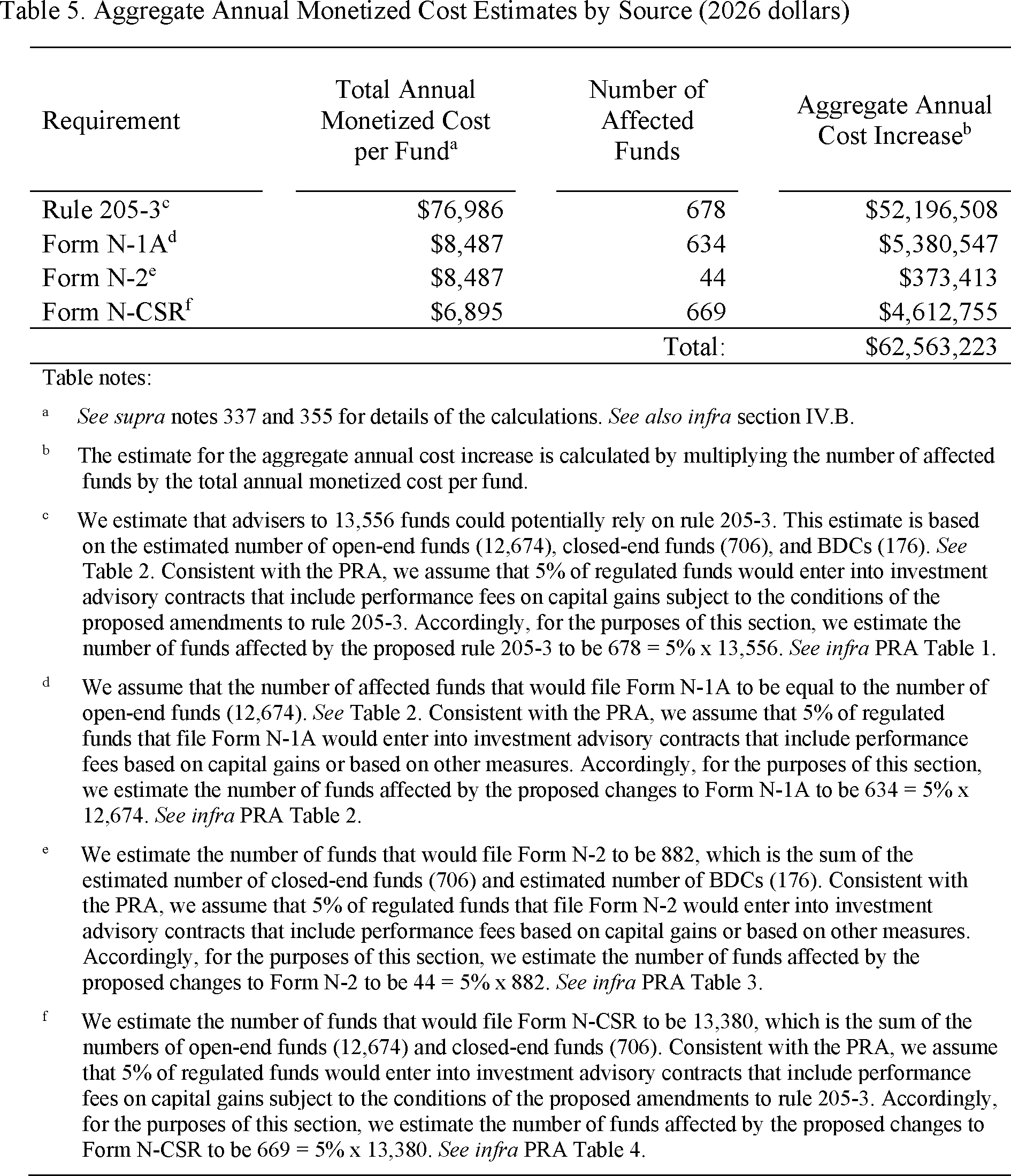
b. Present Values and Annualized Values of Aggregate Monetized Benefits and Costs
Consistent with the requirements of Executive Order 12866, the Commission reports estimated total monetized benefits and costs for all affected entities in two additional ways specified in OMB Circular A-4.[374] The two presentations are intended to address the fact that the various benefits and costs of the proposed rule would not all accrue at the same point in time, and that benefits and costs realized sooner are generally more valuable than those that occur later in time.[375]
We report (1) the present values of expected benefits and costs that are monetized in our Economic Analysis, aggregated across all affected entities, over a 10-year time horizon, starting in 2026, and (2) the annualized values over the same time horizon, derived from the present values. This time horizon represents the period over which the principal benefits and costs that are monetized in the Economic Analysis are expected to accrue.[376] The present values and annualized values account for the timing of benefits and costs through discounting, which is a procedure that accounts for the time value of money.[377]
Table 6 reports the present values of the aggregate annual monetized costs from Table 5. The analysis uses annual real discount rates of three percent and seven percent over a 10-year time horizon, starting in 2026.[378] Table 6 does not show a present discounted value for benefits of the proposed rule because no benefits were monetized. In addition, we estimate that the present value of total monetized costs is about $541,622,982 using a three percent discount rate and about $454,537,408 using a seven percent discount rate.
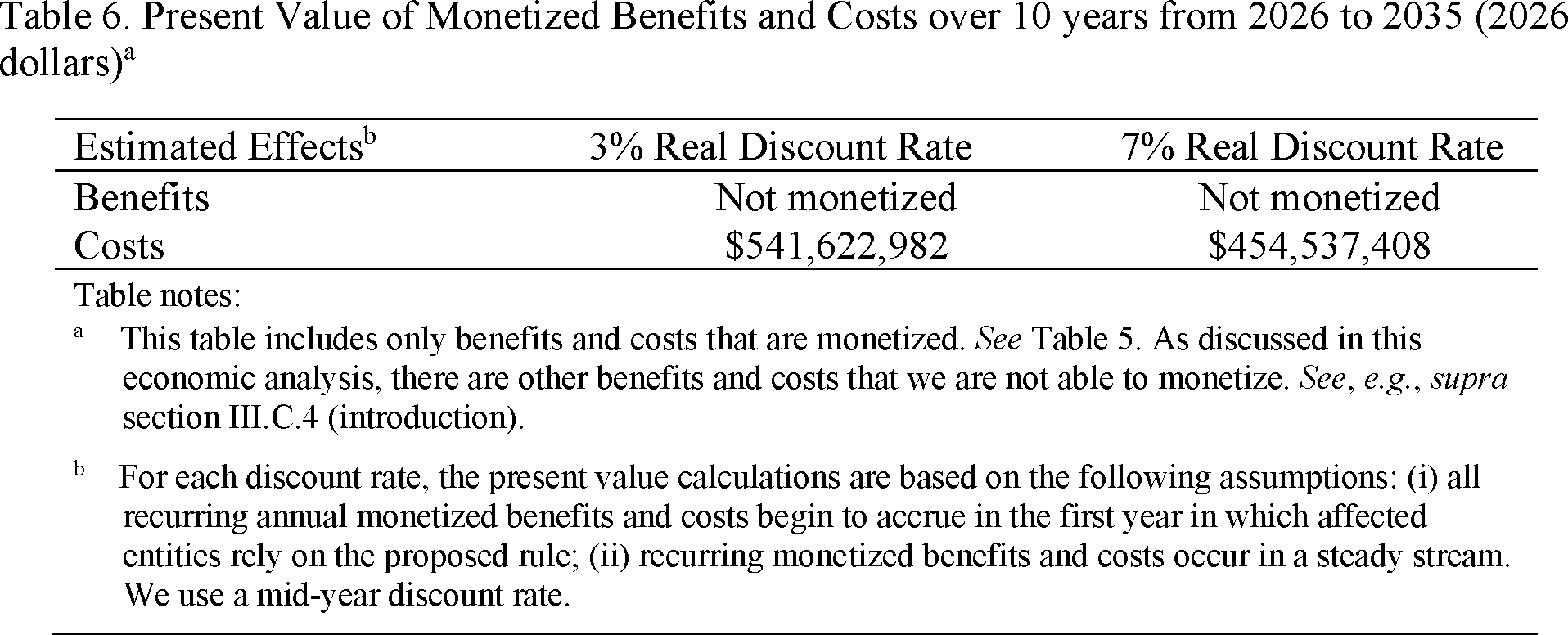
Table 7 reports annualized aggregate monetized benefits and costs using real discount rates of 3 percent and 7 percent over a 10-year horizon.[379] The lump sum present values of aggregate monetized benefits and costs reported in Table 6 are converted in Table 7 into a constant stream of annualized benefits and costs over a 10-year time horizon, starting in 2026.[380] Annualized benefits and costs may differ from an aggregation of the recurring monetized annual benefits and costs discussed earlier in the Economic Analysis because they incorporate the timing of benefits and costs, through discounting, and combine one-time and recurring benefits and costs.[381] Table 7 does not provide a value for annualized total monetized benefits because no benefits were monetized for this analysis. We estimate that annualized total monetized costs are about $62,563,223 per year using a three percent discount rate and about $62,563,223 per year using a seven percent discount rate.
( printed page 63729)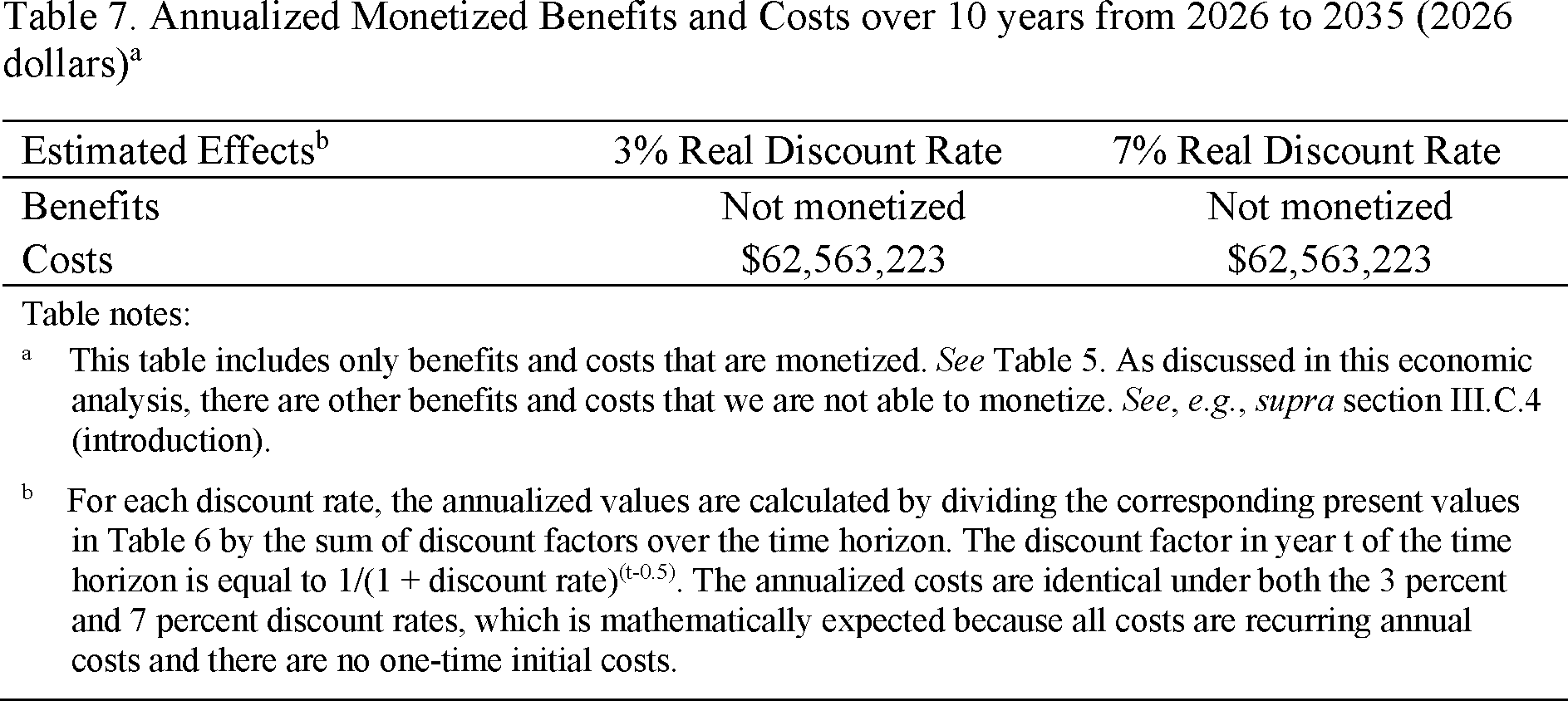
D. Effects on Efficiency, Competition, and Capital Formation
1. Efficiency
The proposed amendments could better align investors' portfolios with their preferences and improve allocative efficiency. To the extent that the proposed amendments to rule 205-3 incentivize advisers to offer regulated funds with strategies that cannot be currently accessed by less affluent investors and to the extent that these strategies offer risk-return combinations not otherwise replicable through existing investment options, investors in these funds may be better able to construct portfolios that improve expected investment return given their individual risk tolerances. The amendments to rule 205-3 may also improve allocative efficiency to the extent that adviser talent and the investment strategies offered by advisers can be better matched with an appropriate fund structure and investors.
The proposed amendments expanding the qualified client definition to include accredited investors could similarly increase the set of strategies available to accredited investors by providing further incentive for advisers to 3(c)(1) private funds to admit these investors.[382] In particular, these changes could allow investors to better achieve exposures to certain return-enhancing factors that are more readily available through private fund strategies. For instance, investors with longer investment horizons and greater willingness to tolerate illiquidity, who currently may have limited access to vehicles that harvest any such premium, could have more options to construct portfolios that potentially benefit from it.
These efficiency gains may be offset, however, to the extent that performance fees on unrealized gains distort the allocation of capital across assets. As discussed in section III.B.3.a, permitting performance fees on unrealized gains may create an incentive for advisers to favor assets whose recorded value can be increased without a corresponding change in fundamental value ( e.g., acquiring assets in the secondary market and marking them up to net asset value under the practical expedient) because the resulting mark-to-market gains may trigger a performance fee. To the extent advisers allocate capital on the basis of an asset's capacity to generate such recorded gains rather than its expected risk-adjusted return, the proposed amendments could reduce allocative efficiency. In addition, valuations of funds holding less liquid assets that are inherently difficult to value may cause investors to over- or under-allocate to those funds, further reducing any efficiency gains from the proposed amendments. The proposed conditions for the fund board channel (including the cap on performance fees, the fund governance standards, and the board's valuation-related findings) are designed to mitigate these effects, though the degree to which they would do so in practice is uncertain.
Additionally, the proposed amendments to Forms N-1A and N-2 requiring more detailed disclosure of performance fees may allow investors to more efficiently evaluate performance fee information when considering investments in regulated funds. As such, these disclosures could facilitate more efficient matching between investors and advisers that both prefer compensation structures more closely aligned with fund performance, which could contribute to the allocative efficiency gains discussed above. As these disclosures would apply to all forms of performance-based advisory compensation in regulated funds, including compensation not directly affected by the proposed amendments to rule 205-3, they may better enable a market consensus regarding appropriate forms of compensation across different strategies, investment vehicles, and investor characteristics. For instance, if investors in certain strategies would tend to prefer symmetric performance fees, the disclosures would better enable these investors to select funds accordingly, which in turn would provide a signal to fund sponsors offering funds with those strategies. Alternatively, if advisers to funds in certain strategies require higher management fees to offset the downside risk inherent in symmetric performance fees, the proposed disclosures would make such information more readily available to investors.
2. Competition
The proposed amendments may affect competition in various ways. First, the proposed amendments may affect competition among investment advisers. To the extent that performance fees may attract new advisers to the regulated fund space, competition may increase among advisers in that space. In particular, advisers to registered funds may face incentives to compete on fees, offering quality, or other dimensions. To the extent that these funds face agency problems (such as misaligned incentives ( printed page 63730) between fund advisers and investors),[383] increased competition could incentivize fund boards to implement measures to address them. However, differences in economies of scale and other structural differences between smaller and larger investment advisers may produce asymmetric effects from the proposed amendments, which in turn could affect the competitive balance between them. Larger fund advisers, which generally benefit from economies of scale, may more readily promote and launch new funds and attract investor capital relative to smaller fund advisers. As a result, smaller advisers may be less able to compete in providing individual investors with exposure to private fund strategies, which may in turn weaken their overall competitive position.
Relatedly, the advisers best positioned to bring capital-gains-oriented and other private market strategies into the regulated fund space may be established alternative asset managers with existing private fund track records in those strategies. To the extent such managers expand into the regulated fund space more readily than smaller or traditional asset managers, the proposed amendments could contribute over the longer term to greater concentration among regulated fund advisers, which would partially offset the competitive benefits described above. The magnitude of this effect is uncertain and would depend on the degree to which smaller advisers are able to develop competitive private market offerings in the regulated fund space.
Second, competition among regulated funds offering different private market strategies may increase. In particular, returns in private equity strategies frequently take the form of capital gains. Because the current regulatory framework prohibits asymmetric performance fees on capital gains except under certain circumstances, including fees paid by qualified clients, advisers cannot enter into performance-based compensation agreements with funds pursuing a private equity strategy without restricting their investor base to more affluent clients.[384] By contrast, the current regulatory framework does not prohibit advisers from charging performance fees based on income, which more commonly comprises fund returns in private credit strategies. This gives regulated funds offering private credit exposure a competitive advantage relative to regulated funds offering private equity exposure to investors. The proposed amendments would increase competitive parity between these private market strategies offered in the regulated fund space. As a result, the number of new closed-end funds offering private equity strategies may increase. This may in turn promote fee competition among funds offering private market strategies, which could benefit fund investors by improving after-fee risk-adjusted returns.
Third, competition may increase between regulated funds and private funds offering similar strategies. By permitting advisers to regulated funds to charge performance fees on capital gains to a broad investor base, the proposed amendments could allow regulated funds to offer certain capital-appreciation strategies ( e.g., private equity strategies) and other strategies that have in practice been available primarily through private funds. To the extent regulated funds can offer these strategies with the additional investor protections, transparency, and liquidity associated with the Investment Company Act framework, they may compete with private funds for investor capital, which could benefit investors by expanding the range of vehicles through which comparable strategies are available. Conversely, private fund advisers in strategy categories that have not previously faced a regulated fund competitor may experience increased competitive pressure. The direction and magnitude of these effects would depend on the extent to which regulated fund structures can replicate the return characteristics of private fund strategies, which are limited by the liquidity and leverage constraints discussed in section III.B.3.d.
Fourth, competition between BDCs and closed-end funds may increase as a result of the proposed amendments. BDCs have a broad statutory exception to the prohibition on charging performance fees on capital gains, while closed-end funds charging these fees generally must restrict their investor base to qualified clients. As a result, advisers currently have a greater incentive to pursue certain private market strategies in BDCs rather than in closed-end funds. The proposed amendments may thus make closed-end funds more competitive with BDCs.
Fifth, the proposed amendments to Forms N-1A and N-2 could promote competition with respect to fund adviser compensation. The amendments to the fee tables may make it easier for investors to determine the sources of a regulated fund's overall expenses.[385] In particular, for funds that pay performance-based compensation, the amended tables may make clearer the portion of total fund expenses that derives from fund over- or under-performance, as applicable. In doing so, the proposed table may better allow fund investors to assess the cost of investing in the fund in light of its recent performance, and similarly may better enable investors to project fund expenses in potential performance scenarios. By making this information available in the fee tables of registered open- and closed-end funds in their Form N-1A and N-2 filings, respectively, and in the Form N-2 filings of BDCs, the proposed amendments would require regulated funds to provide investors with information that may help promote competition among funds in terms of both advisory fee levels and structure.
Sixth, competition between regulated funds and other investment vehicles available to investors through retail channels (such as collective investment trusts (CITs) within the 401(k) space) may be affected. To the extent that CITs currently offer private market strategies that newly created regulated funds would also offer, regulated funds may become more competitive within the retirement space for investors who value the additional protection that regulated funds provide. On the other hand, to the extent that regulated funds would become relatively more expensive compared to CITs as a result of this proposal, such funds may become less competitive with CITs.[386]
3. Capital Formation
The proposed amendments would promote capital formation to the extent that increased investor access to private fund strategies, including those investing in private markets, results in new investor capital channeled to operating companies. This effect may occur through two related channels: the demand side, as more investors could gain access to regulated and private funds pursuing private market strategies, and the supply side, as advisers could become more willing to offer certain strategies in the regulated fund space. ( printed page 63731)
On the demand side, some inflows to private markets that could result from the proposed amendments would be redirected from existing investment options and thus would have a neutral effect on aggregate capital formation. To the extent, however, that the availability of previously inaccessible investment options increases the risk-adjusted returns of investors' portfolios, investors may increase their total investments, channeling additional capital to both private and public companies.[387] The net effect on aggregate capital formation would depend on the degree to which investors substitute between public and private investment vehicles rather than expand their overall investment.
On the supply side, the proposed amendments may expand the set of strategies offered in regulated funds, particularly for capacity-constrained strategies in which advisers limit fund size to preserve expected performance. For such strategies with reduced scale, asset-based fees may not adequately compensate the adviser, creating an incentive to deploy the strategy outside the regulated fund space or not at all in a regulated vehicle. By permitting asymmetric performance fees on capital gains, the proposed amendments would allow advisers to be compensated in proportion to returns generated, which may reduce this disincentive. To the extent this results in regulated vehicles that raise capital that would not otherwise have been raised in the regulated fund space (rather than capital redirected from private funds or other existing options), the effect would contribute to capital formation beyond what the demand-side channel alone would produce. The magnitude of this supply-side effect would depend on the number of advisers pursuing capacity-constrained strategies that would find a regulated fund structure attractive under the proposed framework, which we are unable to estimate.
In addition, capital formation effects from the proposed amendments would depend on whether investor access is constrained via channels unrelated to the prohibition on performance fees on capital gains, such as high investment minimums that less affluent accredited investors could not meet, or continued limited access to distribution channels for offerings of vehicles with more complex strategies. To the extent that these other channels would constrain investors' ability to access new strategies, the effects on capital formation may be reduced.
E. Reasonable Alternatives Considered
1. Performance Fees Only on Realized Capital Gains
As an alternative, we could have proposed an exemption from the section 205(a)(1) prohibition for performance fees only on realized gains instead of an exemption for performance fees on both realized and unrealized gains. Under this alternative, regulated fund investors would be less prone to the risk of overpaying performance fees because NAVs of funds with equity strategies are primarily based on unrealized gains, which could be reversed in the future.
Charging performance fees only on realized gains may also reduce an incentive for fund managers to overstate values of underlying portfolio investments and an incentive to allocate disproportionately large amounts of investor capital to assets whose value can show instant gains if the value is recorded at NAV, but the asset is purchased at a discount.[388] The alternative of a blanket prohibition on basing performance fees on unrealized gains would closely align with the current regulatory environment for BDCs.
In addition, allowing performance fees on unrealized gains in the private fund context but not in advisory contracts with regulated funds could be an approach that is more tailored to the level of the above risks in different vehicles. For example, as discussed in section III.B.3.b, regulated funds cannot implement mechanisms that would account for the individual experience of a fund investor, and investors of regulated funds would pay performance fees indirectly through NAV reductions (which are the same across fund investors regardless of subscription or redemption time), in contrast to private funds. For certain private funds, such as private equity funds, performance fees are typically subject to clawback provisions, which reduce the relevance of the valuation concerns related to unrealized gains. However, open-end fund shares are redeemable daily, and clawback provisions may be difficult to implement in that context. Therefore, the risks associated with including unrealized gains as a base for performance fees are increased for open-end funds with portfolio holdings that do not have widely available prices, such as less liquid assets that are challenging to value.
However, permitting performance fees only on realized gains may result in several issues. First, a performance fee on realized gains only would compensate the adviser on a basis that does not correspond to the economic experience of investors who transact at NAV, which reflects unrealized appreciation and depreciation on a mark-to-market basis for many strategies, potentially misaligning adviser compensation with the returns that investors actually realize. Second, this alternative could create incentives for advisers to prematurely dispose of portfolio positions in order to trigger a performance fee, reducing risk-adjusted returns of investors who could benefit from continued appreciation in these positions. Third, this alternative may disadvantage advisers to regulated funds pursuing equity strategies (where investor returns are generated primarily through unrealized capital appreciation rather than through frequent realization of capital gains) relative to advisers pursuing income-based strategies (where gains occur regularly through interest and dividend payments). Permitting performance fees on unrealized gains would address this structural disadvantage and may expand the range and quality of strategies available to regulated fund investors.
2. Performance Fee on Capital Gains for Contracts With a Subset of Regulated Funds
As alternative approaches, we could have limited the proposed amendments to closed-end funds only or to the fund board channel only for closed-end funds. For example, investors in closed-end funds may face a lower risk of overpaying performance fees on capital gains relative to investors in open-end funds. As discussed in section III.B.3.b, because the final performance fee cannot be determined until the end of the performance measurement period, regulated funds must estimate the amount of accrued performance fees at each NAV calculation.[389] Because open-end funds are required to calculate NAV daily, they need to estimate accrued performance fees at each daily calculation, which increases the frequency a fund must estimate accrued fees. In contrast, because closed-end fund investors do not transact at daily prices and NAV calculations for repurchases can be better aligned with the performance measurement period, accrued performance fee estimates reflected in the closed-end fund's NAV are more aligned with the actual performance of the fund. Therefore, an ( printed page 63732) alternative to restrict the proposed amendments to rule 205-3 to closed-end funds only could reduce investors' exposure to the frequency of estimating accrued performance fees. In addition, to the extent that the costs of estimating accrued performance fees are passed on to investors, investors would experience lower costs under this alternative.
Similarly, an alternative of further restricting the proposed amendments to rule 205-3 to the fund board channel only for closed-end funds could provide a more uniform set of investor protections to regulated fund investors, relative to an approach that also permits a regulated fund to enter into advisory contracts featuring performance fees on capital gains through the accredited investor channel. Under this alternative, all regulated funds paying performance fees on capital gains would be subject to the proposed governance conditions, thereby applying these investor protection conditions to all regulated fund investors, including accredited investors.
However, with respect to restricting performance fees on capital gains to closed-end funds only, the proposed board requirements, including the best interest finding, are designed specifically to address the risks associated with performance fees on capital gains in regulated funds, including the estimation and overpayment risks described above. To the extent that fund boards of open-end funds would not approve advisory contracts with performance fees on capital gains where these risks are not adequately mitigated, the proposed conditions would operate as a functional restriction without the need for a categorical restriction to closed-end funds only. Similarly, for open-end regulated funds that would implement performance fees through the accredited investor channel, the requirement that each equity owner be an accredited investor would restrict access to investors who are already recognized as having a degree of financial sophistication sufficient to evaluate the risks of performance fee arrangements, providing an analogous investor protection through investor eligibility rather than board oversight. Therefore, such a categorical restriction would not create additional benefits to investors while it would introduce additional regulatory complexity for fund advisers. Similarly, to the extent that advisers to regulated funds would prefer the fund board channel because it may be more feasible for implementing performance fees on capital gains given the potential operational and distribution constraints,[390] a categorical restriction to the fund board channel only may not add meaningful investor protections beyond what the proposed conditions already aim to provide. In particular, mandating the fund board channel for all regulated funds, including those that primarily serve accredited investors, would impose the costs and operational complexity of the board governance conditions on funds and advisers for whom the accredited investor channel is operationally better suited, without a corresponding investor protection benefit for accredited investors who are already subject to a separate eligibility standard designed to protect their interests.
3. Additional Conditions for the Fund Board Channel
As an alternative, we could have proposed additional conditions for regulated fund boards choosing adviser contracts with performance fees on capital gains, such as requiring a regular approval of the advisory contract by shareholder vote ( e.g., annually) or requiring an evaluation of the performance fee arrangement by an independent consultant. These alternatives could provide additional safeguards, such as an unbiased assessment of the arrangement, benefitting regulated fund investors. However, such approaches may be challenging in practice because of their related costs.
4. Disclosure Alternatives
a. Performance Fee Disclosures
As an alternative to the proposed management discussion amendments, we could have proposed a structured disclosure for various performance fee arrangement components, either in registration forms or funds' ongoing disclosures, such as Form N-CEN or other forms. For example, we could have proposed Inline XBRL disclosure for: (i) whether the fund has a performance compensation arrangement (Yes or No); (ii) if yes, the basis of performance compensation (income, realized capital gains, unrealized capital gains, or a combination thereof); (iii) the frequency of payment or accrual, or measurement period; (iv) whether a hurdle rate applies; (v) the percentage of profit subject to the performance fee; (vi) whether a catch-up provision applies; (vii) the dollar or percentage amount of fee paid; and (viii) any other material structural features of the performance fee arrangement. For example, some funds already use custom XBRL tags to report certain components of their performance fee arrangements, such as hurdle rates.
Under this alternative, performance fee information would be easily accessible to investors and information intermediaries in a standardized, machine-readable format. Structured XBRL disclosure would enable systematic comparison of performance fee arrangements across funds, reduce investor search costs, and facilitate Commission staff examination and analysis. This approach would also complement the proposed fee table disclosure by providing granular, field-level data that the fee table's line-item format cannot capture.
However, structured XBRL disclosure of individual performance fee components would impose significant initial implementation burdens on regulated funds and their service providers, requiring the application of new elements from updated data taxonomies and adjustment of tagging infrastructure. More importantly, the nuanced and varied nature of performance fee arrangements (including the interaction among hurdle rates, high-water marks, measurement periods, and fee calculation bases) may not be adequately captured in a binary or categorical structured format. The proposed management discussion requirements, which require a narrative description and graphical representation of the performance fee arrangement, may be better suited to conveying the complexity and variability of these arrangements, which could be difficult to compare to one another.
b. Other Disclosures
As an alternative, we could have proposed to require regulated funds to disclose whether they have minimum investment requirements and the amount of any such minimum, which could be consistent with the goals of the proposed structured disclosure of performance fees—although investment minimums are already disclosed in prospectuses and statements of additional information (similarly to performance fees), they are not disclosed in a structured format that is readily aggregable or comparable across funds. This alternative may complement investor analysis of performance fee arrangements because it could allow investors to consider performance fees in conjunction with practical barriers to accessing regulated funds paying performance fees, reducing investors' search costs when it comes to choosing funds that offer alternative strategies. This is because even if an investor meets the proposed qualified client ( printed page 63733) threshold and would therefore be eligible to invest in a fund that pays performance fees on capital gains, investment minimums may represent a comparable practical barrier to access.
Investment minimums are currently reported for private funds on Form ADV in a structured, machine-readable format, aiding in systematic analysis of practical access barriers for investors across the private fund universe. However, regulated funds do not have such a requirement, and investment minimum requirements are presented in a non-structured format in prospectuses and statements of additional information, which are not readily aggregable. Currently, data on investment minimums is inconsistently available across regulated funds. For example, third-party aggregators ( e.g., Morningstar) provide data points related to investment minimums for regulated funds. In addition, recent research has analyzed these data for a subset of regulated funds.[391]
Nonetheless, the primary objective of the proposed amendments related to disclosure is to improve disclosure of performance fee arrangements. Requiring disclosure of investment minimums for regulated funds, while potentially useful to investors, could entail implementation costs for regulated funds that could be passed on to investors.
F. General Request for Comment
We request comment on all aspects of the economic analysis of the proposed amendments. To the extent possible, we request that commenters provide supporting data and analysis with respect to the benefits, costs, and effects on competition, efficiency, and capital formation of adopting the proposed amendments or any reasonable alternatives. In particular, we ask commenters to consider the following questions:
1. What additional qualitative or quantitative information should be considered as part of the baseline for the economic analysis of these amendments?
2. Are the benefits and costs of the proposed amendments accurately characterized? If not, why not? Should any of the costs or benefits be modified? What, if any, other costs or benefits should be taken into account? If possible, please offer ways of estimating these benefits and costs. What additional considerations can be used to estimate the benefits and costs of the proposed amendments?
3. Are the benefits and costs of the proposed amendments to the qualified client definition accurately characterized? If not, why not? What, if any, other costs or benefits should be taken into account? If possible, please offer ways of estimating these benefits and costs.
4. Are the effects on competition, efficiency, and capital formation arising from the proposed amendments accurately characterized? If not, why not?
5. Are the economic effects of the above alternatives accurately characterized? If not, why not? Should any of the costs or benefits be modified? What, if any, other costs or benefits should be taken into account?
6. Are the economic effects of the alternative approaches to disclosure adequately characterized? If not, why not? Should any of the costs or benefits be modified? What, if any, other costs or benefits should be taken into account?
7. Are there other reasonable alternatives to the proposed amendments that should be considered? What are the costs, benefits, and effects on competition, efficiency, and capital formation of any other alternatives?
8. What effects would the proposed changes have on (1) investment options available to investors if certain asset classes are not available or are less available in open-end vehicles; and (2) the markets for those underlying assets, including, but not limited to, private markets?
9. How likely is it that open-end fund managers will choose to offer new strategies as a result of the proposed amendments? Relatedly, how likely is it that investors will move assets from private funds to regulated funds in response to the proposed amendments?
10. How likely is it that existing regulated funds would implement performance fees on capital gains? What would be the costs of doing so? What would be the benefits? Are certain fund types more likely to implement performance fees on capital gains?
11. How likely are regulated funds to implement performance fees on capital gains via the fund board channel? Would this channel be less or more costly compared to the accredited investor channel?
12. How many regulated funds would implement performance fees on capital gains via each channel?
13. Are there data sources or data sets that can help refine the estimates of the benefits and costs associated with the proposed amendments? If so, please identify them.
14. Are there data sources that can help us estimate the aggregate number of affected investors with more accuracy? If so, please identify them.
15. Which third-party service providers would be affected the most by the proposed amendments? Please explain why. If possible, please provide data on the number and size of such entities.
16. What would be the costs to advisers of reclassifying their high net worth clients on Form ADV as a result of the proposed change to the qualified client definition? Are there ways to reduce those costs while still achieving the goals of the proposal?
17. Are there costs or benefits associated with the proposed conforming amendments to rule 203A-3 and rule 204-3 that we have not identified or adequately considered?
IV. Paperwork Reduction Act Analysis
A. Summary of the Collections of Information
Certain provisions of the proposed amendments contain “collection of information” requirements within the meaning of the Paperwork Reduction Act of 1995 (“PRA”).[392] We are submitting the proposed collections of information to the Office of Management and Budget (“OMB”) for review in accordance with the PRA.[393] The hours and costs associated with preparing and filing the forms and responses required under the applicable rules constitute paperwork burdens imposed by each collection of information. An agency may not conduct or sponsor, and a person is not required to comply with, a collection of information unless it displays a currently valid OMB control number. Compliance with the information collections is mandatory or mandatory to receive benefits. Responses are not kept confidential.
The proposed amendments to rule 205-3 under the Advisers Act would result in a new collection of information requirement under the PRA, as follows:
- “Rule 205-3 under the Investment Advisers Act of 1940—Exemption from the compensation prohibition of section 205(a)(1) for investment advisers.” OMB has not yet assigned control numbers for this title.
The titles for the existing collections of information are:
- “Form N-1A under the Investment Company Act of 1940 and the Securities Act of 1933, Registration Statement of Open-End Management Investment ( printed page 63734) Companies” (OMB Control No. 3235-0307);
- “Form N-2 under the Investment Company Act of 1940 and the Securities Act of 1933, Registration Statement of Closed-End Management Companies” (OMB Control No. 3235-0026); and
- “Form N-CSR under the Securities Exchange Act of 1934 and under the Investment Company Act of 1940, Certified Shareholder Report of Registered Management Investment Companies” (OMB Control No. 3235-0570).
The forms and rules listed above were adopted under the Securities Act, the Exchange Act, the Investment Company Act, and/or the Advisers Act. A description of the proposed amendments, including the need for the information and its proposed use, as well as a description of the likely respondents and a discussion of the potential economic effects of the proposed amendments can be found in sections II and III above.
B. Summary of the Proposed Amendments' Estimated Effects on the Collections of Information
We estimate below the changes in paperwork burden as a result of the proposed amendments. These estimates represent the average burden for all respondents, both large and small. In deriving our estimates, we recognize that the burdens will likely vary among individual respondents based on a number of factors, including the number of investment advisers and regulated funds electing to rely on the proposed exemption permitting investment advisers to include performance fees in investment advisory agreements with regulated funds, the number of regulated funds that pay any performance fees to their investment adviser, as well as the size and complexity of their business. These estimates include the time and the cost of preparing and reviewing disclosure and filing documents. We believe that some respondents would experience costs in excess of this average and some respondents would experience less than the average costs. Our methodologies for deriving these estimates are discussed below. For purposes of this PRA analysis, the burden is generally allocated between burden hours and costs. The cost burden generally reflects the portion of the burden carried by outside professionals, while the burden hours generally reflect the portion of the burden carried by the issuer internally.
Rule 205-3 PRA Estimates
As of December 31, 2025, there were approximately 13,556 regulated funds. We estimate that 5 percent of regulated funds would enter into an investment advisory contract with an investment adviser that includes a performance-based compensation arrangement subject to the conditions of the proposed amendments to rule 205-3. As a result, 678 regulated funds and their investment advisers would be subject to the proposed determination amendments to rule 205-3 under the Advisers Act. The proposed amendments to rule 205-3 would require one response per year. The table below summarizes our PRA annual burden estimates associated with the amendments to rule 205-3.
( printed page 63735)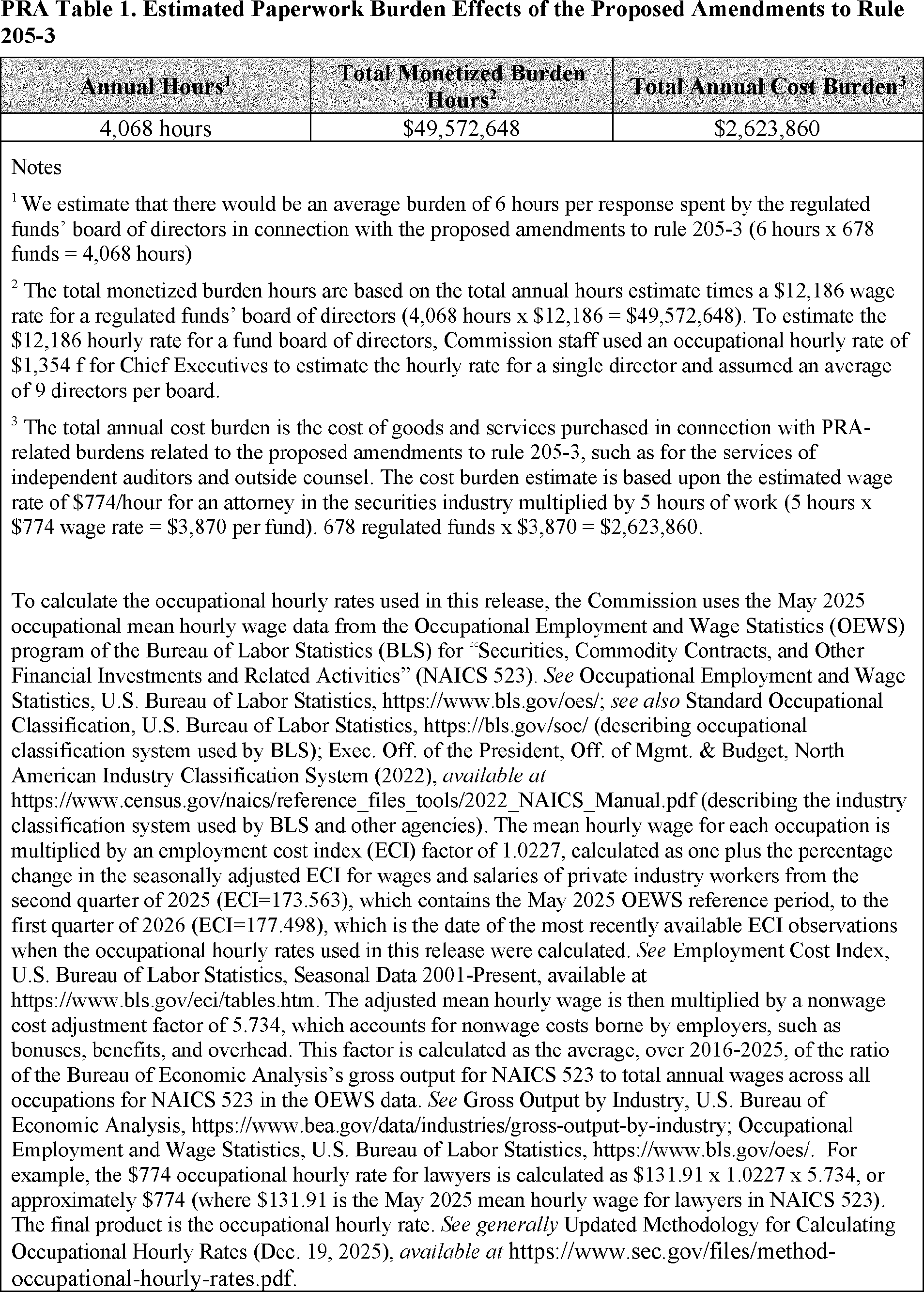
1. Form N-1A PRA Estimates
As of December 31, 2025, there were approximately 12,674 regulated funds that file Form N-1A. We estimate that 5 percent of these regulated funds would enter into an investment advisory contract with an investment adviser that includes a performance-based compensation arrangement based on capital gains or based on other measures. As a result, we estimate that 634 regulated funds will be subject to the enhanced disclosure regarding performance-based compensation paid to the investment adviser on Form N-1A. The table below summarizes our PRA annual burden estimates associated with the amendments to Form N-1A.
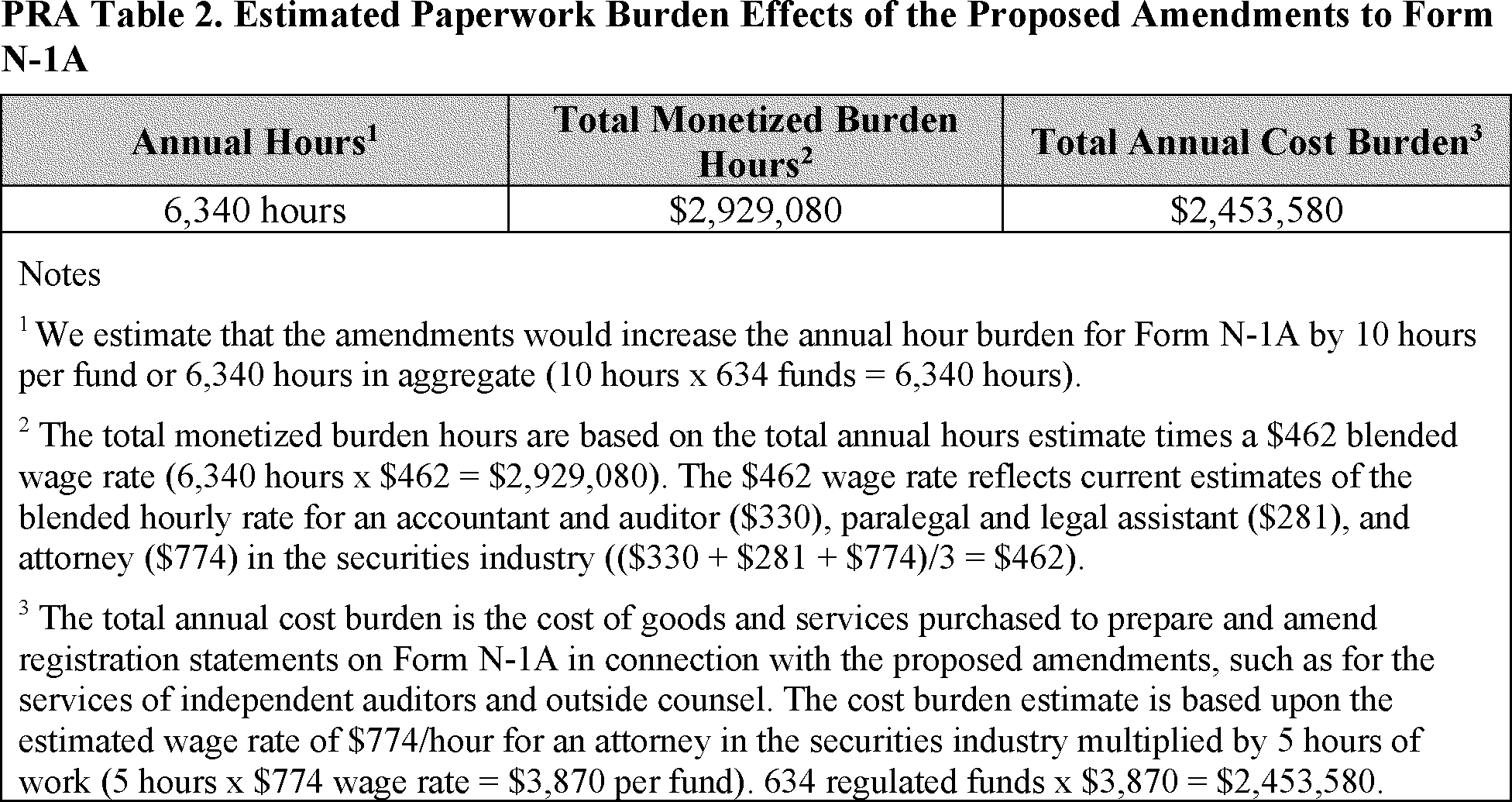
2. Form N-2 PRA Estimates
As of December 31, 2025, there were approximately 882 regulated funds that file Form N-2. We estimate that 5 percent of these funds would enter into an investment advisory contract with an investment adviser that includes a performance-based compensation arrangement based on capital gains or based on other measures. As a result, we estimate that 44 regulated funds will be subject to the enhanced disclosure regarding performance-based compensation paid to the investment adviser on Form N-2. The table below summarizes our PRA annual burden estimates associated with the amendments to Form N-2.
( printed page 63737)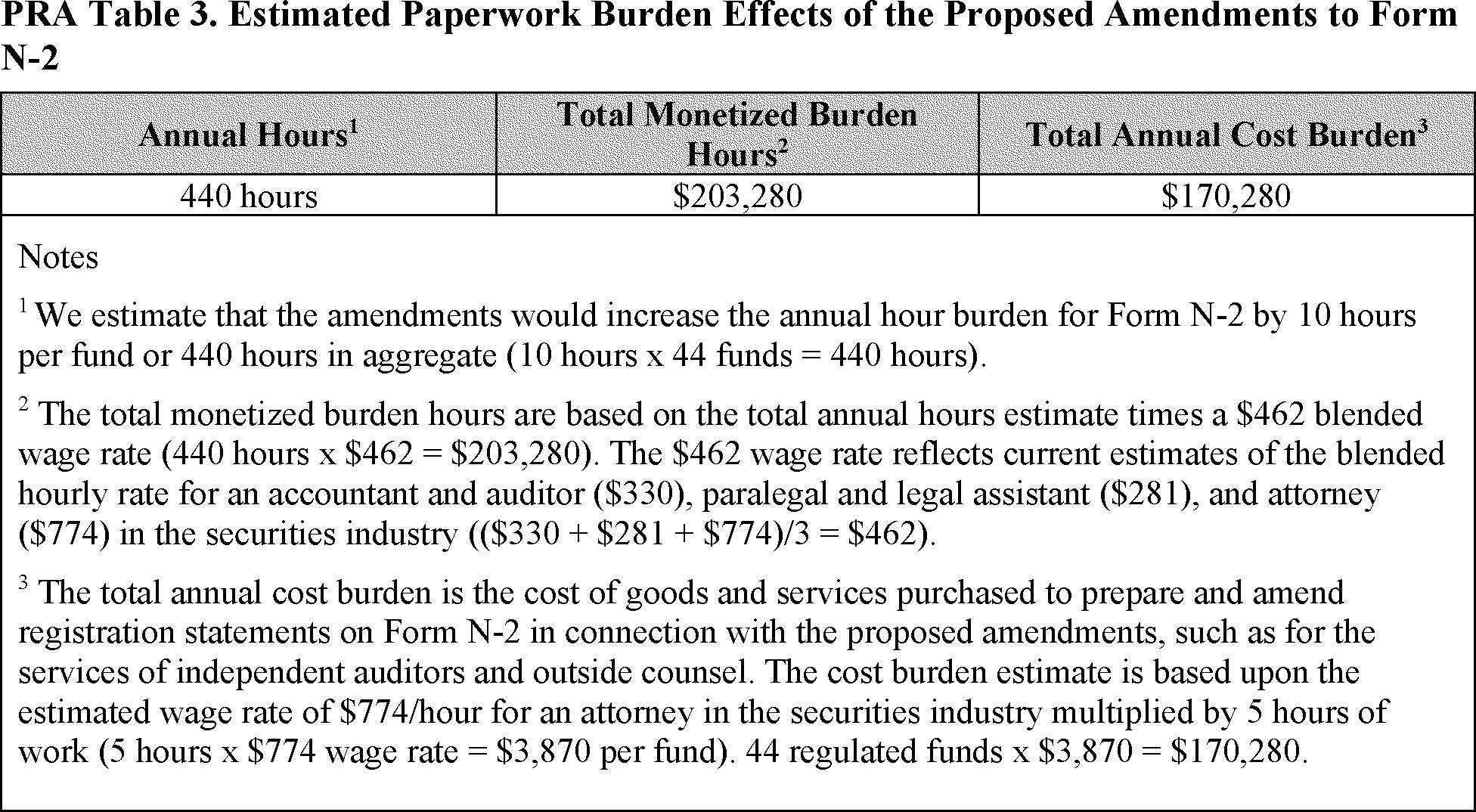
3. Form N-CSR PRA Estimates
We estimate that 669 regulated funds would be subject to the particularized disclosure requirements regarding the approval of performance fees based on capital gains in or capital appreciation of a regulated fund whose investment adviser charges the regulated fund a performance fee pursuant to the conditions of proposed rule 205-3(c)(1)(iv). This estimate is based on the number of regulated funds (except for BDCs, which do not file Form N-CSR) that would pay its investment adviser a performance fee based on capital gains or capital appreciation of the regulated fund pursuant to the conditions of proposed rule 205-3(c)(1)(iv).[394] The table below summarizes our PRA annual burden estimates associated with the amendments to Form N-CSR.
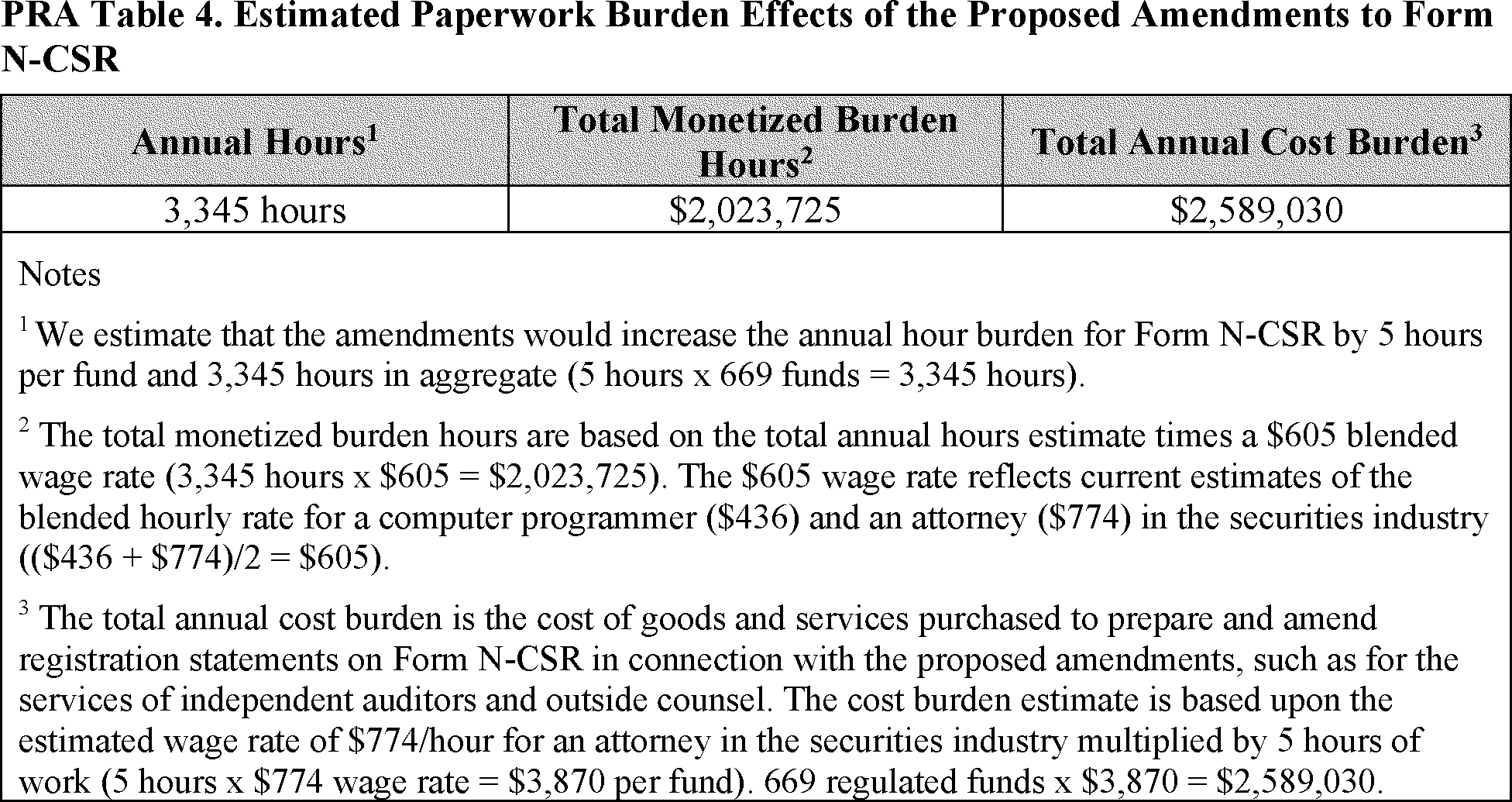
C. Changes in Paperwork Burdens Under the Proposed Amendments
The following PRA Table 5 summarizes the current and requested paperwork burdens and calculates the changes to affected information collections' estimated responses and total burdens under the proposed amendments.
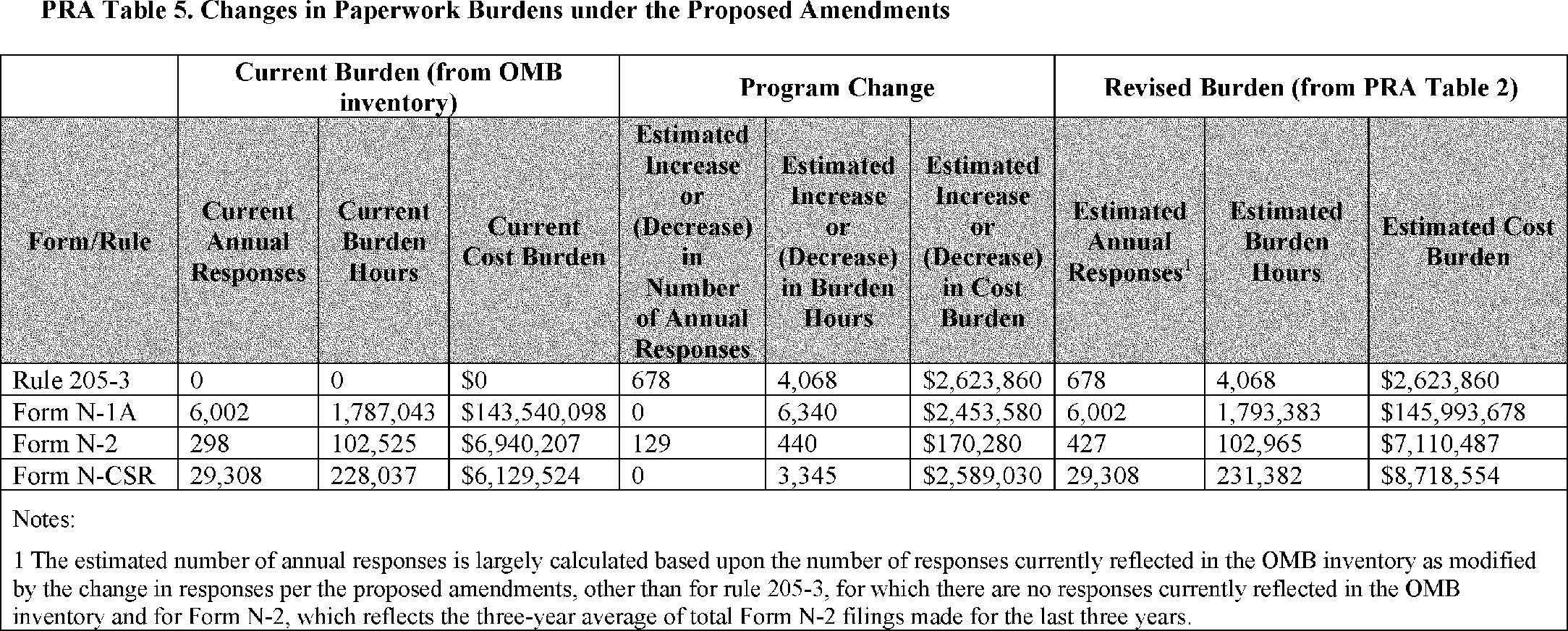
D. Request for Comments
Pursuant to 44 U.S.C. 3506(c)(2)(B), we request comment in order to:
 44 U.S.C. 3506(c)(2)(B)
- Evaluate whether the proposed changes to the collections of information are necessary for the proper performance of the functions of the Commission, including whether the information will have practical utility;
- Evaluate the accuracy of our estimates of the changes in burden hours and cost burden that would result from adoption of the proposed amendments;
- Determine whether there are ways to enhance the quality, utility, and clarity of the information to be collected;
- Evaluate whether there are ways to minimize the burden of the collections of information on those who respond, including through the use of automated collection techniques or other forms of information technology; and
- Evaluate whether the proposed amendments would have any effects on any other collection of information not previously identified in this section.
Any member of the public may direct to us any comments concerning the accuracy of these burden estimates and any suggestions for reducing these burdens. Persons submitting comments on the collection of information requirements should direct their comments to the OMB Desk Officer for the Securities and Exchange Commission, MBX.OMB.OIRA.SEC_desk_officer@omb.eop.gov, and should send a copy to Vanessa A. Countryman, Secretary, Securities and Exchange Commission, using any of the methods in the ADDRESSES section, with reference to File No. 2026-28. Requests for materials submitted to OMB by the Commission with regard to these collections of information should be in writing, refer to File No. 2026-28, and be submitted to the Securities and Exchange Commission, Office of FOIA Services, 100 F Street NE, Washington, DC 20549-2736. OMB is required to make a decision concerning the collections of information between 30 and 60 days after publication of this release. Consequently, a comment to OMB is best assured of having its full effect if OMB receives it within 30 days after publication.
V. Initial Regulatory Flexibility Analysis
The Commission has prepared the following Initial Regulatory Flexibility Analysis (“IRFA”) in accordance with section 3(a) of the Regulatory Flexibility Act (“RFA”).[395] It relates to proposed amendments to rules 203A-3(a)(3)(i), 204-3(c)(2)(iii), and 205-3 under the Advisers Act and Forms N-1A, N-2, and N-CSR under the Investment Company Act (collectively, the “proposed amendments”).
A. Reasons for and Objectives of the Proposed Actions
1. Proposed Amendments to Rule 205-3
We are proposing amendments to rule 205-3, a generally applicable exemptive rule to the performance fee prohibition under the Advisers Act that provides an exception to the prohibition for clients that satisfy the definition of “qualified client” within the rule. The current rule defines a “qualified client” in one of three ways: (1) a natural person or company that meets a minimum net worth or assets-under-management requirement; (2) a natural person or company that is a “qualified purchaser” under section 2(a)(51)(A) of the Investment Company Act; and (3) a natural person that is a certain executive officer or employee of the investment adviser who actively participates in the investment activities of the adviser. We are proposing amendments to rule 205-3 to expand the definition of a “qualified client” to include (1) regulated funds that satisfy certain conditions and (2) natural persons or entities that meet the “accredited investor” definition under Regulation D. The proposed amendments are designed to enhance, simplify, and modernize the regulatory framework related to performance-based compensation, as well as to facilitate access for a wider group of investors to investment strategies and products that include performance-based compensation ( printed page 63739) arrangements, while maintaining appropriate investor protections and safeguards.
In addition, the proposal would include technical conforming amendments to rules 203A-3(a)(3)(i) and 204-3(c)(2)(iii) under the Advisers Act to replace the existing references to the “qualified client” definition in rule 205-3(d)(1) with references instead to rule 205-3(c)(1), corresponding to the proposed redesignation of current paragraph (d)(1) to (c)(1).
2. Proposed Amendments to Forms N-1A, N-2, and N-CSR
We are also proposing amendments to Forms N-1A and N-2, the forms on which registered open-end funds and registered closed-end funds and BDCs, respectively, are required to disclose information about performance-based compensation paid to the investment adviser. Currently, regulated funds are required to disclose certain key information about the fund's fees and expenses in a standardized fee table in their prospectus. In addition to fee table disclosure, the registration statement forms for regulated funds require a description of the investment adviser's compensation. The proposal would require (1) a distinct line item to the fee table regarding performance-based compensation paid to the adviser, to the extent applicable; and (2) a detailed description of the performance fee arrangement, including a graphical representation illustrating the calculation of the performance fee later in the prospectus. These proposed amendments are designed to enhance transparency by requiring clearer disclosure of performance-based advisory fees in the prospectus.
In addition, Form N-CSR, a combined reporting form used by registered management investment companies to transmit shareholder reports to the Commission as well as to report corporate governance and financial data, requires a registered management investment company to provide disclosure about the basis for the board's approval of its investment advisory contract. We are proposing to amend Form N-CSR to require more particularized disclosure regarding the approval of performance fees based on capital gains in or capital appreciation of a regulated fund whose investment adviser charges the regulated fund a performance fee pursuant to the conditions of proposed rule 205-3(c)(1)(iv). This disclosure would be useful for investors because it would provide them with meaningful insight into the board's reasoning and analysis in approving a performance fee arrangement that could impact their returns. It would also be useful for Commission staff in reviewing compliance with the proposed rules.
The reasons for, and objectives of, the proposed amendments are discussed in more detail in sections I and II, above. The burdens of these requirements on small advisers are discussed below as well as above in sections III and IV, which discuss the burdens on all advisers. The professional skills required to meet these specific burdens are also discussed in section IV.
B. Legal Basis
The Commission is proposing the rule and form amendments contained in this document under the authority set forth in the Advisers Act, particularly sections 203A, 204, 205(e), 206A, 206(4), and 211(a) thereof, the Investment Company Act, particularly sections 6, 8, 24, 30, 31, 37, 38, 59, and 63 thereof; the Securities Act, particularly sections 5, 7, 10, 19(a), and 28 thereof; and the Securities Exchange Act of 1934, particularly sections 12, 13(a), 14, 15(d), 23(a), 35A, and 36 thereof.
C. Small Entities Subject to the Rule Amendments
The proposed amendments would affect registered investment advisers, registered investment companies, and BDCs, including entities that are considered to be a small business or small organization (each, a “small entity”) for purposes of the RFA. For the purposes of the RFA, under the Advisers Act, an investment adviser generally is a small entity if it: (1) has assets under management having a total value of less than $25 million; (2) did not have total assets of $5 million or more on the last day of the most recent fiscal year; and (3) does not control, is not controlled by, and is not under common control with another investment adviser that has assets under management of $25 million or more, or any person (other than a natural person) that had total assets of $5 million or more on the last day of its most recent fiscal year.[396] Under the Investment Company Act, an investment company is a small entity if, together with other investment companies in the same group of related investment companies, it has net assets of $50 million or less as of the end of its most recent fiscal year.[397] Based on Commission filings, we estimate that there are approximately 66 investment companies [398] and 466 SEC-registered advisers [399] that are small entities. The number of small entities that would be affected by the proposed amendments to rule 205-3 would generally depend on the number of small entities that would rely on the exemptive rule to charge performance fees. It is not mandatory that any small entity comply with the proposed amendments, as the proposed amendments operate as an exemption from an otherwise applicable statutory prohibition and imposes no affirmative obligations on any adviser or regulated fund that does not seek to avail itself of the exemption. To the extent a small entity would charge performance fees, even if not by availing itself of the proposed exemptive rule, it would then be required to make the applicable disclosures in Forms N-1A, N-2, and/or N-CSR, as appropriate.
D. Projected Reporting, Recordkeeping, and Other Compliance Requirements
1. Proposed Rule 205-3 Amendments
Proposed amendments to rule 205-3 would impose certain compliance requirements on investment advisers, including those that are small entities, to the extent they enter into performance-based compensation arrangements with certain clients. All registered investment advisers to regulated funds that enter into ( printed page 63740) investment advisory contracts that include performance-based compensation arrangements based on capital gains would be required to comply with the proposed amendments' conditions for reliance on the expanded exemptions to from performance fee prohibition. The proposed amendments are summarized in this IRFA. In addition, the proposal would include technical conforming amendments to rules 203A-3(a)(3)(i) and 204-3(c)(2)(iii) under the Advisers Act to replace the existing references to the “qualified client” definition in rule 205-3(d)(1) with references instead to rule 205-3(c)(1), corresponding to the proposed redesignation of current paragraph (d)(1) to (c)(1). All of these proposed requirements are also discussed in detail, above, in sections I and II, and these requirements and the burdens on respondents, including those that are small entities, are discussed above in sections III and IV (the Economic Analysis and PRA Analysis, respectively) and below. The professional skills required to meet these specific burdens are also discussed in section IV.
As discussed above, there are approximately 466 advisers currently registered with us that are small entities, and we estimate that 5 percent of advisers registered with us would be subject to the proposed amendments to rule 205-3. We therefore estimate that approximately 23 advisers that are small entities would be impacted by the proposed amendments to rule 205-3.
2. Proposed Disclosure and Reporting Requirements
The proposed amendments to Forms N-1A, N-2, and N-CSR would impose certain disclosure and reporting requirements on regulated funds, including those that are small entities, to the extent they enter into any performance-based compensation arrangements with an adviser. All regulated funds that enter into investment advisory contracts that include performance-based compensation arrangements, including arrangements based on measures other than capital gains, would be required to disclose performance-based advisory fees in the prospectus fee table and provide detailed information regarding performance fee arrangements later in the prospectus. In addition, regulated funds whose investment adviser charges the regulated fund a performance fee based on capital gains in or capital appreciation of the fund pursuant to the conditions of proposed rule 205-3(c)(1)(iv) would need to include particularized disclosure regarding the approval of performance fees on Form N-CSR. The proposed amendments are summarized in this IRFA. All of these proposed requirements are also discussed in detail, above, in sections I and II, and these requirements and the burdens on respondents, including those that are small entities, are discussed above in sections III and IV (the Economic Analysis and PRA analysis, respectively) and below. The professional skills required to meet these specific burdens are also discussed in section IV.
As discussed above, there are approximately 66 regulated funds that are small entities, and we estimate that 5 percent of regulated funds would be subject to the proposed amendments to Forms N-1A, N-2, and N-CSR. We therefore estimate that approximately three regulated funds that are small entities would be impacted by the proposed amendments to Forms N-1A, N-2, and N-CSR.
E. Duplicative, Overlapping, or Conflicting Federal Rules
1. Proposed Amendments to Rule 205-3
Section 205(a)(1) of the Advisers Act prohibits registered investment advisers from entering into, extending, or performing advisory contracts that provide for performance fees on the basis of a share of capital gains in or capital appreciation of an advisory client's account. Statutory exceptions to the prohibition are provided in sections 205(b)(1) through (b)(5) of the Advisers Act, and the Commission has authority to promulgate exemptions from the prohibition under sections 205(e) and/or 206A thereof. One of those exceptions, section 205(b)(3), permits an investment adviser to a BDC to receive compensation based on a share of capital gains, not to exceed 20 percent of realized capital gains upon the funds of the BDC over a specified period or as of definite dates (computed net of all realized capital losses and unrealized capital deprecation). This existing statutory exception differs from our proposed amendment to rule 205-3, which would permit an investment adviser to a BDC to charge performance fees based on net realized and net unrealized capital gains or appreciation. We do not think that this difference in approach would conflict with the statute because the proposed amendment would require the investment adviser and BDC to meet certain other conditions and disclosure requirements that are designed to protect the fund and its shareholders.
Additionally, section 15(c) of the Investment Company Act requires that the initial approval, and any annual continuance, of an investment advisory contract by a regulated fund be approved by a majority of the fund's board, including a majority of directors who are not interested persons of the adviser. In addition, section 10(a) of the Investment Company Act requires that 40% of any regulated fund's board be composed of disinterested directors. Relatedly, rule 0-1(a)(7) under the Investment Company Act contains certain fund governance standards to enhance the independence and effectiveness of independent directors. The proposed amendments to rule 205-3 would leverage sections 15(c) and 10(a) and rule 0-1(a)(7) under the Investment Company Act to help strengthen investor protections and fund and adviser oversight. Therefore, there are no duplicative, overlapping, or conflicting Federal rules with respect to the proposed amendments to rule 205-3.
Furthermore, there are no federal rules that are duplicative, overlapping, or conflicting with the proposed technical conforming amendments to rules 203A-3(a)(3)(i) and 204-3(c)(2)(iii) under the Advisers Act to replace the existing references to the “qualified client” definition in rule 205-3(d)(1) with references instead to rule 205-3(c)(1), corresponding to the proposed redesignation of current paragraph (d)(1) to (c)(1).
2. Proposed Amendments to Forms N-1A, N-2, and N-CSR
The instructions to both Forms N-1A and N-2 require registered open-end funds and registered closed-end funds and BDCs, respectively, to disclose “management fees,” a line item that encompasses all fees paid to the investment adviser for managing the fund's portfolio, including any fees that are contingent on the fund's performance. The instructions to the prospectus fee table do not currently require a regulated fund to separately identify, as a distinct line item or caption within the fee table, the portion of management fees attributable to performance-based compensation as distinguished from asset-based advisory fees. Our proposed amendments to Forms N-1A and N-2 would add a caption to the prospectus fee table, where applicable, titled “performance fees” to disclose to the investor any performance-based compensation payable to the investment adviser.
Similarly, the current versions of both forms require a regulated fund to describe the investment adviser's ( printed page 63741) compensation, including whether the compensation will be based on a percentage of average net assets, but they do not separately address performance fees and how such fees may be calculated. Our proposed amendments would require tailored disclosure about performance fees. Given that performance fees are different from base management fees, the proposed amendments to Forms N-1A and N-2 do not conflict with the existing disclosure regime.
Lastly, Form N-CSR currently requires a registered management investment company to provide disclosure about the basis for the board's approval of its investment advisory contract. We are proposing to amend Form N-CSR to require particularized disclosure regarding the approval of performance fees based on capital gains in or capital appreciation of a regulated fund whose investment adviser charges the regulated fund a performance fee pursuant to the conditions of proposed rule 205-3(c)(1)(iv). Generally, the investor protection benefits of the disclosure provisions of the proposed amendments justify the additional costs of their application.
F. Significant Alternatives
The RFA directs the Commission to consider significant alternatives that would accomplish our stated objectives, while minimizing any significant adverse impact on small entities. We considered the following alternatives for small entities in relation to the proposed amendments to rules 205-3, 203A-3(a)(3)(i), and 204-3(c)(2)(iii) and Forms N-1A, N-2, and N-CSR: (i) differing compliance or reporting requirements that take into account the resources available to small entities; (ii) the clarification, consolidation, or simplification of compliance and reporting requirements under the proposed rule for such small entities; (iii) the use of performance rather than design standards; and (iv) an exemption from coverage of the proposed rule, or any part thereof, for such small entities.
Regarding the first and fourth alternatives, the Commission believes that establishing different compliance, reporting, or disclosure requirements for small entities, or exempting small entities from the proposed amendments, or any part thereof, would be inappropriate under these circumstances. Because the protections of the Advisers Act, Investment Company Act, and Securities Act are intended to benefit equally clients or investors of both large and small entities, it would be inconsistent with the purposes of the Advisers Act, Investment Company Act, and Securities Act to specify different requirements for small entities under the proposed amendments. As discussed above, we believe that the proposed amendments would result in multiple benefits. For example, the proposed amendments could provide investors with opportunities to gain exposure to expanded investment strategies and to participate in their asset growth. At the same time, the proposed conditions and disclosures are intended to align the investment adviser's economic incentives with the interests of a regulated fund and its shareholders or with other advisory clients and mitigate the potential for excessive risk-taking and speculation. We believe that these benefits should benefit clients of smaller entities as well as larger entities. In addition, as discussed above, our staff would use the corresponding information that advisers or regulated funds would document or disclose to help prepare for examinations of investment advisers and regulated funds. Establishing different conditions or types of disclosures for large and small entities that serve many types of investors would negate these benefits.
Regarding the second alternative, we believe the current proposal is clear and that further clarification, consolidation, or simplification of the compliance requirements is not necessary. As discussed above: the proposed amendments would expand the ability for investment advisers to regulated funds to enter into investment advisory contracts that include performance-based compensation arrangements, provided they meet three specific conditions, and would require specific disclosures on Forms N-1A, N-2, and N-CSR, as appropriate, about performance-based compensation. These provisions would modernize our regulatory programs to reflect and enhance investment product innovation and the ever-broadening investor choice available in today's asset management industry, while also taking into account the risks associated with increasingly diverse portfolio compositions and operations. The proposed amendments also would amend the definition of “qualified client” to include natural persons or entities that meet the “accredited investor” definition and remove the “qualified client” definition's separate net worth test and assets-under-management test, thereby harmonizing the regulatory framework governing access to private funds by enabling advisers to funds that already limit their investors to accredited investors ( e.g., section 3(c)(1) private funds that rely on Regulation D) to enter into performance fee arrangements without needing to apply a separate qualified client standard.
Regarding the third alternative, we determined to use design standards rather than performance standards. Performance standards allow for increased flexibility in the methods firms can use to achieve the objectives of the requirements. Design standards specify the behavior or manner of compliance that regulated entities must adopt. While the proposed amendments to rule 205-3 would expand the ability of registered investment advisers and certain of their clients to enter into performance-based compensation arrangements—and would not dictate their terms—they would impose specific conditions and restrictions, to meet the proposed exemption, and the proposed amendments to Forms N-1A, N-2, and N-CSR would impose certain related disclosures. These conditions, restrictions, and disclosures are principles-based and narrowly tailored to protect regulated funds and their shareholders, and to be consistent with the purposes fairly intended by the policy and provisions of the Advisers Act and the Investment Company Act.
G. Request for Comment
The Commission encourages written comments on the matters discussed in this IRFA. We request comment on the number of small entities that would be subject to our proposal and whether our proposal would have any effects that have not been considered. We request that commenters describe the nature of any effects on small entities subject to our proposal and provide empirical data to support the nature and extent of such effects. We also request comment on the estimated compliance burdens of our proposal and how they would affect small entities.
VI. Congressional Review Act
For purposes of Subtitle E of the Small Business Regulatory Enforcement Fairness Act of 1996 (also known as the Congressional Review Act),[400] the Commission must seek OMB's determination as to whether a final regulation constitutes a “major rule.” Under the Congressional Review Act, a rule is considered “major” where, if adopted, it results in or is likely to result in:
- An annual effect on the U.S. economy of $100 million or more; ( printed page 63742)
- A major increase in costs or prices for consumers or individual industries; or
- Significant adverse effects on competition, investment, or innovation.[401]
To help inform OMB's determination as to whether any final rule that results from the proposal would be a “major rule,” the Commission solicits comment and data on:
- The potential effect of the proposed amendments on the U.S. economy on an annual basis;
- Any potential increase in costs or prices for consumers or individual industries; and
- Any potential adverse effect on competition, investment, or innovation.
Commenters are requested to provide empirical data and other factual support for their views to the extent possible, to inform OMB's determination regarding whether any final rule following this proposal is likely to be a “major rule” for the purposes of the Congressional Review Act.
VII. Other Matters
This action is an economically significant regulatory action under section 3(f)(1) of Executive Order 12866 and has been reviewed by OMB, consistent with Executive Order 14215. This action, if finalized as proposed, is expected to be an Executive Order 14192 deregulatory action.
Statutory Authority
The Commission is proposing the rule and form amendments contained in this document under the authority set forth in the Advisers Act, particularly sections 203A, 204, 205(e), 206A, 206(4), and 211(a) thereof; the Investment Company Act, particularly sections 6, 8, 24, 30, 31, 37, 38, 59, and 63 thereof; the Securities Act, particularly sections 5, 7, 10, 19(a), and 28 thereof; and the Securities Exchange Act of 1934, particularly sections 12, 13(a), 14, 15(d), 23(a), 35A, and 36 thereof.
List of Subjects
17 CFR Part 239
 17 CFR Part 239
- Reporting and recordkeeping requirements
- Securities
17 CFR Part 249
- Brokers
- Fraud
- Reporting and recordkeeping requirements
- Securities
17 CFR Part 274
- Investment companies
- Reporting and recordkeeping requirements
- Securities
17 CFR Part 275
- Reporting and recordkeeping requirements; Securities
Text of Proposed Rules and Rule and Form Amendments
For the reasons set out in the preamble, the Commission proposes to amend title 17, chapter II of the Code of Federal Regulations as follows:
PART 239—FORMS PRESCRIBED UNDER THE SECURITIES ACT OF 1933
1. The authority citation for part 239 continues to read, in part, as follows:
Authority: 15 U.S.C. 77c, 77f, 77g, 77h, 77j, 77s, 77z-2, 77z-3, 77sss, 78c, 78 l, 78m,78n, 78o(d), 78o-7 note, 78u-5, 78w(a), 78 ll, 78mm, 80a-2(a), 80a-3, 80a-8, 80a-9, 80a-10, 80a-13, 80a-24, 80a-26, 80a-29, 80a-30, and 80a-37; and sec. 107, Pub. L. 112-106, 126 Stat. 312, unless otherwise noted.
PART 249—FORMS, SECURITIES EXCHANGE ACT OF 1934
2. The authority citation for part 249 continues to read, in part, as follows:
Authority: 15 U.S.C. 78a et seq. and 7201 et seq.;12 U.S.C. 5461 et seq.;18 U.S.C. 1350; Sec. 953(b), Pub. L. 111-203, 124 Stat. 1904; Sec. 102(a)(3), Pub. L. 112-106, 126 Stat. 309 (2012); Sec. 107, Pub. L. 112-106, 126 Stat. 313 (2012), and Sec. 72001, Pub. L. 114-94, 129 Stat. 1312 (2015), unless otherwise noted.
Section 249.331 is also issued under 15 U.S.C. 78j-1, 7202, 7233, 7241, 7264, 7265; and 18 U.S.C. 1350.
3. Amend Form N-CSR (referenced in §§ 249.331 and 274.128) by:
a. Revising Item 11.
Note:
Form N-CSR is attached as Appendix A to this document. Form N-CSR will not appear in the Code of Federal Regulations.
PART 274—FORMS PRESCRIBED UNDER THE INVESTMENT COMPANY ACT OF 1940.
4. The authority for part 274 continues to read as follows:
Authority: 15 U.S.C. 77f, 77g, 77h, 77j, 77s, 78c(b), 78l, 78m, 78n, 78n-1, 78o(d), 80a-8, 80a-24, 80a-26, 80a-29, and sec. 939A, Pub. L. 111-203, 124 Stat. 1376, unless otherwise noted.
5. Amend Form N-1A (referenced in §§ 239.15A and 274.11A) by:
a. Revising Item 3; and
b. Revising Item 10; and
c. Redesignate Instructions 3(b) through 3(f) to 3(c) through 3(g) to Item 3 of Form N-1A.
Note:
Form N-1A is attached as Appendix B to this document. Form N-1A will not appear in the Code of Federal Regulations.
6. Amend Form N-2 (referenced in §§ 239.14 and 274.11a-1) by:
a. Revising Item 3;
b. Redesignate Instruction 11 as Instruction 12 to Item 3 of Form N-2;
c. Redesignate Instruction 12.d. as Instruction 12.e. to Item 3 of Form N-2; and
d. Revising Item 9.
Note:
Form N-2 is attached as Appendix C to this document. Form N-2 will not appear in the Code of Federal Regulations.
PART 275-RULES AND REGULATIONS, INVESTMENT ADVISERS ACT OF 1940
7. The general authority citation for part 275 continues to read, in part, as follows:
Authority: 15 U.S.C. 80b-2(a)(11)(G), 80b- 2(a)(11)(H), 80b-2(a)(17), 80b-3, 80b-4, 80b- 4a, 80b-6(4), 80b-6a, and 80b-11, unless otherwise noted.
8. Amend § 275.203A-3 by revising paragraph (a)(3)(i) to read as follows:
(i) “Excepted person” means a natural person who is a qualified client as described in § 275.205-3(c)(1).
9. Amend § 275.204-3 by revising paragraph (c)(2)(iii) to read as follows:
(iii) Who is an officer, employee, or other person related to the adviser that would be a “qualified client” of your firm under § 275.205-3(c)(1)(ii).
10. Revise and republish § 275.205-3 to read as follows:
(a) General. The provisions of section 205(a)(1) of the Act (15 U.S.C. 80b-5(a)(1)) will not be deemed to prohibit an investment adviser from entering into, performing, renewing or extending an investment advisory contract that provides for compensation to the investment adviser on the basis of a share of the capital gains upon, or the capital appreciation of, the funds, or any portion of the funds, of a client, Provided, That the client entering into the contract subject to this section is a qualified client, as defined in paragraph (c)(1) of this section.
(b) Transition rules —
(1) Registered investment advisers. If a registered investment adviser entered into a contract and satisfied the conditions of this section that were in effect when the contract was entered into, the adviser will be considered to satisfy the conditions of this section; Provided, however, that if a natural person or company who was not a party ( printed page 63743) to the contract becomes a party (including an equity owner of a private investment company advised by the adviser), the conditions of this section in effect at that time will apply with regard to that person or company.
(2) Registered investment advisers that were previously not registered. If an investment adviser was not required to register with the Commission pursuant to section 203 of the Act (15 U.S.C. 80b-3) and was not registered, section 205(a)(1) of the Act will not apply to an advisory contract entered into when the adviser was not required to register and was not registered, or to an account of an equity owner of a private investment company advised by the adviser if the account was established when the adviser was not required to register and was not registered; Provided, however, that section 205(a)(1) of the Act will apply with regard to a natural person or company who was not a party to the contract and becomes a party (including an equity owner of a private investment company advised by the adviser) when the adviser is required to register.
(3) Certain transfers of interests. Solely for purposes of paragraphs (b)(1) and (b)(2) of this section, a transfer of an equity ownership interest in a private investment company by gift or bequest, or pursuant to an agreement related to a legal separation or divorce, will not cause the transferee to “become a party” to the contract and will not cause section 205(a)(1) of the Act to apply to such transferee.
(c) Definitions. For the purposes of this section:
(1) The term qualified client means:
(i) A natural person who, or a company (other than a private investment company, as defined in paragraph (c)(3) of this section) that, the investment adviser entering into the contract (and any person acting on his behalf) reasonably believes either:
(A) Is an accredited investor as defined in rule 501(a) of Regulation D under the Securities Act of 1933 (17 CFR 230.501(a)) at the time the contract is entered into; or
(B) Is a qualified purchaser as defined in section 2(a)(51)(A) of the Investment Company Act of 1940 (15 U.S.C. 80a-2(a)(51)(A)) at the time the contract is entered into;
(ii) A natural person who immediately prior to entering into the contract is:
(A) An executive officer, director, trustee, general partner, or person serving in a similar capacity, of the investment adviser; or
(B) An employee of the investment adviser (other than an employee performing solely clerical, secretarial or administrative functions with regard to the investment adviser) who, in connection with his or her regular functions or duties, participates in the investment activities of such investment adviser, provided that such employee has been performing such functions and duties for or on behalf of the investment adviser, or substantially similar functions or duties for or on behalf of another company for at least 12 months;
(iii) A private investment company, as defined in paragraph (c)(3) of this section, Provided, that each equity owner of any such company (except equity owners with respect to which compensation on the basis of a share of capital gains or capital appreciation is not provided for) meets the requirements of paragraph (c)(1) of this section; or
(iv) A regulated fund, Provided, that each equity owner of any such regulated fund meets the requirements of paragraph (c)(1) of this section, or that the following conditions are satisfied:
(A) The compensation to the investment adviser on the basis of a share of the capital gains upon, or the capital appreciation of, the funds, or any portion of the funds, of the regulated fund, does not exceed 20% of the regulated fund's net capital gains or net capital appreciation over a specified period or as of definite dates;
(B) The board of directors of the regulated fund satisfies the fund governance standards defined in rule 0-1(a)(7) under the Investment Company Act of 1940 (15 U.S.C. 270.0-1(a)(7)); and
(C) As part of the regulated fund's annual review and approval of an investment advisory contract required under section 15(c) of the Investment Company Act of 1940 (15 U.S.C. 80a-15(c)), the board of directors, including a majority of directors who are not interested persons of the regulated fund, determine that the compensation to the investment adviser on the basis of a share of the capital gains upon, or the capital appreciation of, the funds, or any portion of the funds, of the regulated fund, is in the best interests of the regulated fund and its shareholders. Such determination must include written findings addressing:
( 1) The appropriateness of such compensation arrangement considering such factors as the regulated fund's investment strategy and valuation practices;
( 2) The basis upon which such compensation is calculated, including the measurement period over which performance is assessed, and whether such compensation is determined with reference to realized gains, unrealized gains, or both; and
( 3) The adequacy of any investor protection features in such compensation arrangement to protect the interests of shareholders ( e.g., a preferred return or hurdle that requires a specified return or yield to be achieved before the investment adviser may receive compensation, or a high-watermark or loss carryforward mechanism that allows shareholders to recoup losses before compensation is paid to the investment adviser), including, where no such investor protection features are present, the basis for concluding that the compensation arrangement is adequate to protect the interests of shareholders.
(2) The term company has the same meaning as in section 202(a)(5) of the Act (15 U.S.C. 80b-2(a)(5)), but does not include a company that is required to be registered under the Investment Company Act of 1940 but is not registered.
(3) The term private investment company means a company that would be defined as an investment company under section 3(a) of the Investment Company Act of 1940 (15 U.S.C. 80a-3(a)) but for the exception provided from that definition by section 3(c)(1) of such Act (15 U.S.C. 80a-3(c)(1)).
(4) The term executive officer means the president, any vice president in charge of a principal business unit, division or function (such as sales, administration or finance), any other officer who performs a policy-making function, or any other person who performs similar policy-making functions, for the investment adviser.
(5) The term regulated fund means a management investment company registered under the Investment Company Act of 1940, or a business development company, as defined in section 202(a)(22) of the Act (15 U.S.C. 80b-2(a)(22), but does not include separate accounts that are registered management investment companies offering variable annuity contracts registered on Form N-3.
By the Commission.
Dated: September 30, 2026.
Vanessa A. Countryman,
Secretary.
Appendix A—Form N-CSR
Item 11. Statement Regarding Basis for Approval of Investment Advisory Contract
(3) If the investment advisory contract approved by the board provides for compensation to the investment adviser on the basis of a share of the capital gains upon, or the capital appreciation of, the funds, or any portion of the funds, of the Fund (a ( printed page 63744) “performance fee”), and the board made the findings required under rule 205-3(c)(1)(iv) under the Investment Advisers Act of 1940 (17 CFR 275.205-3(c)(1)(iv)), discuss in reasonable detail the factors and the conclusions with respect to the approval of such contract that formed the basis for the board's determination that the performance fee is in the best interests of the Fund and its shareholders, including:
(A) The appropriateness of the performance fee arrangement, considering such factors as the Fund's investment strategy and valuation practices;
(B) The basis upon which the performance fee is calculated, including the measurement period over which performance is assessed, and whether the performance fee is determined with reference to realized gains, unrealized gains, or both; and
(C) The adequacy of investor protection features in the performance fee arrangement, such as a preferred return or hurdle rate that requires a specified return or yield to be achieved before the investment adviser may receive a performance fee, or a high-water mark or loss carry forward mechanism that allows shareholders to recoup losses before a performance fee is paid to the investment adviser, including where no such investor protection features are present, the basis for concluding that the performance fee arrangement is adequate to protect the interests of shareholders.
Appendix B—Form N-1A
Part A—Information Required In a Prospectus
Item 3. Risk/Return Summary: Fee Table
Instructions
3. Annual Fund Operating Expenses.
(a) “Management Fees” include investment advisory fees (excluding any fees based on the Fund's performance), any other management fees payable to the investment adviser or its affiliates, and administrative fees payable to the investment adviser or its affiliates that are not included as “Other Expenses.”
(b) If the Fund is subject to investment advisory fees payable to the investment adviser or its affiliates that are based on the performance of the Fund (“performance fees”), disclose these fees in a caption to the “Annual Fund Operating Expenses” portion of the table directly below and indented equally to the caption titled “Management Fees.” Title the additional caption: “Performance Fees.” The basis on which performance fees are imposed should be described briefly in a note to the table. The note should provide a cross-reference to the discussion in Item 10(a)(1)(ii)(B) for a more complete description of the performance fee. The note also should explain that performance fees may be substantially higher or lower because these fees are based on the performance of the Fund, which may fluctuate over time.
4. Example.
(f) Reflect any performance fee, consistent with instruction 3(b), above, to the extent applicable.
(g) Include the second 1-, 3-, 5-, and 10-year periods and related narrative explanation only if a sales charge (load) or other fee is charged upon redemption.
6. New Funds. For purposes of this Item, a “New Fund” is a Fund that does not include in Form N-1A financial statements reporting operating results or that includes financial statements for the Fund's initial fiscal year reporting operating results for a period of 6 months or less. The following Instructions apply to New Funds.
(c) A New Fund may show zero performance fees payable to the investment adviser or its affiliates in the performance fees caption of the fee table. Thereafter, the Fund must show the performance fees paid to the investment adviser or its affiliates during the prior fiscal year as a percentage of the value of your investment.
Item 10. Management, Organization, and Capital Structure
(a) Management.
(1) Investment Adviser.
(i) Provide the name and address of each investment adviser of the Fund, including sub advisers. Describe the investment adviser's experience as an investment adviser and the advisory services that it provides to the Fund.
(ii) Describe the compensation of each investment adviser of the Fund as follows:
(A) If the Fund has operated for a full fiscal year, state the aggregate fee paid to the adviser for the most recent fiscal year as a percentage of average net assets. If the Fund has not operated for a full fiscal year, state what the adviser's fee is as a percentage of average net assets, including any breakpoints.
(B) If the investment adviser's compensation includes a performance fee, provide the following information:
(1) the rate of the performance fee and the basis upon which it is calculated, including whether the fee is determined with reference to realized gains, unrealized gains, investment income, or any combination thereof;
(2) whether the performance fee is calculated on the Fund's total investment return before or after deducting fees, commissions or expenses;
(3) the measurement period over which the performance fee is assessed;
(4) a description of any features that limit or condition the payment of a performance fee to the investment adviser, including, but not limited to, any preferred return, hurdle rate, high-water mark, loss carryforward mechanism, or any other features that limit or condition the payment of a performance fee to the investment adviser; and
(5) a graphical representation that illustrates the calculation of the performance fee across a range of hypothetical performance scenarios.
(C) If any portion of the investment adviser's compensation is not based on a percentage of average net assets and is not a performance fee, describe the basis of the adviser's compensation.
(iii) Include a statement, adjacent to the disclosure required by paragraph (a)(1)(ii) of this Item, that a discussion regarding the basis for the board of directors approving any investment advisory contract of the Fund is available in the Fund's reports filed on Form N-CSR, and providing the period covered by the most recent Form N-CSR report that includes this discussion.
Appendix C—Form N-2
Part A—Information Required in a Prospectus
Item 3. Fee Table and Synopsis
Instructions
Annual Expenses
7. a. “Management Fees” include investment advisory fees (excluding any component thereof based on the performance of the Registrant), any other management fees payable to the investment adviser or its affiliates, and administrative fees payable to the investment adviser or its affiliates not included as “Other Expenses,” and any expenses incurred within the Registrant's own organization in connection with the research, selection, and supervision of investments. Where management fees are “tiered” or based on a “sliding scale,” they should be calculated based on the fund's asset size after giving effect to the anticipated net proceeds of the present offering. With respect to a best-efforts offering with breakpoints, assume the maximum fee will be payable.
b. In lieu of the information about management fees required by Item 3.1, a business development company with a fee structure that is not based solely on the aggregate amount of assets under management should provide disclosure concerning the fee arrangement to allow investors to assess its impact on the Registrant's expenses; a business development company may use any appropriate expense categories and may include items that may not, for accounting purposes, be treated as expenses. A business development company with special fee arrangements should provide a cross-reference, where applicable, to the discussion in Item 9.1.a of special management compensation plans.
c. If the Registrant is subject to investment advisory fees payable to the investment adviser or its affiliates that are based on the performance of the Registrant (“performance fees”), disclose these fees in a caption to the “Annual Expenses” portion of the table directly below and indented equally to the caption titled “Management Fees.” Title the ( printed page 63745) additional caption: “Performance Fees.” The basis on which performance fees are imposed should be described briefly in a note to the table. The note should provide a cross-reference to the discussion in Item 9.1.b for a more complete description of the performance fee. The note also should explain that performance fees may be substantially higher or lower because these fees are based on the performance of the Registrant, which may fluctuate over time.
A New Fund may show zero performance fees payable to the investment adviser or its affiliates in the performance fees caption of the fee table. Thereafter, the Registrant must show the performance fees paid to the investment adviser during the prior fiscal year as a percentage of the net assets attributable to common shares.
11. a. Base the percentages of “Annual Expenses” on amounts incurred during the Registrant's most recent fiscal year, but include in expenses amounts that would have been incurred absent expense reimbursement or fee waiver arrangements. If the Registrant has changed its fiscal year and, as a result, the most recent fiscal year is less than three months, use the fiscal year prior to the most recent fiscal year as the basis for determining “Annual Expenses.”
b. If there have been any changes in “Annual Expenses” that would materially affect the information disclosed in the table:
(1) Restate the expense information using the current fees as if they had been in effect during the previous fiscal year; and
(2) In a footnote to the fee table, disclose that the expense information in the table has been restated to reflect current fees.
c. A change in “Annual Fund Expenses” means either an increase or decrease in expenses that incurred during the most recent fiscal year or that is expected to occur during the current fiscal year. A change in “Annual Fund Expenses” does not include a decrease in annual expenses as a percentage of assets due to economies of scale or breakpoints in a fee arrangement resulting from an increase in the Registrant's assets.
Example
12. For purposes of the Example in the table:
d. reflect any performance fee, consistent with instruction 7.c. above, to the extent applicable; and
13. New Fund. A “New Fund” is a Registrant that does not include in Form N-2 financial statements reporting operating results or that includes financial statements for the Registrant's initial fiscal year reporting operating results for a period of 6 months or less.
Item 9. Management
1. General. Describe concisely how the business of the Registrant is managed, including:
b. Investment Advisers. For each investment adviser of the Registrant:
(3) a description of its compensation; and
Instructions.
1. State generally what the adviser's fee is or will be as a percentage of average net assets, including any break-point. It is not necessary to include precise details as to how the fee is computed or paid.
2. If the adviser's compensation includes a performance fee, provide the following information:
a. the rate of the performance fee and the basis upon which it is calculated, including whether the fee is determined with reference to realized gains, unrealized gains, investment income, or any combination thereof;
b. whether the performance fee is calculated on the Registrant's total investment return before or after deducting fees, commissions or expenses;
c. the measurement period over which the performance fee is assessed;
d. a description of any features that limit or condition the payment of a performance fee to the adviser, including, but not limited to, any preferred return, hurdle rate, high-water mark, loss carryforward mechanism, or any other features that limit or condition the payment of a performance fee to the adviser; and
e. a graphical representation that illustrates the calculation of the performance fee across a range of hypothetical performance scenarios.
3. If any portion of the adviser's fee is not based on a percentage of average net assets and is not a performance fee, describe the basis of the adviser's compensation.
Footnotes
1. 15 U.S.C. 77a et seq.
2. 15 U.S.C. 80a et seq.
3. 15 U.S.C. 78a et seq.
4. 15 U.S.C. 80b et seq.
Back to Citation5. See also infra section II.B.3.c. (noting that the proposed amendments to the qualified client definition would expand the meaning of “high net worth individual” as defined in Form ADV).
Back to Citation6. Performance-based compensation has in practice also been used in the context of separately managed accounts of eligible clients, including for advisory services with respect to more traditional investment strategies.
Back to Citation7. See infra section I.B. for examples of these features and terms.
Back to Citation8. Investment Company Act Amendments of 1970, Public Law 91-547, § 26, 84 Stat. 1413 (1970) (codified at 15 U.S.C. 80b-6a).
Back to Citation9. See Investment Company Amendments of 1969: Analysis of S. 34, 91st Cong., 1st Sess. 29 (1969) (“Under proposed section 206A, the Commission would in appropriate cases be able to exempt persons from the registration requirements of proposed section 203 and from the ban on performance-based advisory compensation in proposed section 205(1) of the Advisers Act if and to the extent such action is appropriate in the public interest and consistent with the protection of investors and the policy of the [A]ct.”); S. Rep. No. 184, 91st Cong., 1st Sess. 46 (1969); H.R. Rep. No. 1382, 91st Cong., 2d Sess. 42 (1970).
Back to Citation10. National Securities Markets Improvement Act of 1996, Public Law 104-290, § 210, 110 Stat. 3416 (1996) (“NSMIA”) (codified at 15 U.S.C. 80b-5(e)).
Back to Citation12. Unless otherwise specified, the term “performance fee” is used herein to refer to those types of compensation arrangements based on capital gains or capital appreciation that are prohibited by section 205(a)(1) under the Advisers Act. Compensation arrangements based on other measures of performance—such as, for example, interest, ordinary income, or dividends—are not prohibited by section 205(a)(1) and are not referred to as or otherwise within the meaning of “performance fees” as used herein.
Back to Citation13. Per the statutory exceptions set forth in sections 205(b)(1) through (b)(5), section 205(a)(1)'s general prohibition against performance fees does not apply to: (1) advisory contracts that provide for compensation based on the total value of a fund's account averaged over a definite period, or as of definite dates or taken as of a definite date; (2) provided that an appropriate “fulcrum fee” (as discussed below) is used in each instance, (A) advisory contracts with registered investment companies and (B) advisory contracts relating to the investment of assets in excess of $1,000,000 with persons other than trusts, governmental plans, collective trust funds, or separate accounts as referred to in section 3(c)(11) of the Investment Company Act; (3) advisory contracts involving business development companies, subject to certain conditions; (4) advisory contracts with a company that exempted is from the definition of an investment company under section 3(c)(7) of the Investment Company Act; and (5) advisory contracts with persons who are not residents of the United States.
Back to Citation14. See H.R. Rep. No. 2639, 76th Cong., 3d Sess. 29 (1940); S. Rep. No. 1775, 76th Cong., 3d Sess. 22 (1940).
Back to Citation15. See SEC, Investment Trusts and Investment Companies, H.R. Doc. No. 477, 76th Cong., 2d Sess. 30 (1939) (summarizing an industry survey and a public conference held by the Commission on February 11, 1938, in which an industry representative asserted that performance fees encourage advisers to recommend a degree of risk that investors themselves would not knowingly undertake, as advisers have “everything to gain . . . and nothing to lose”); see also Investment Trusts and Investment Companies: Hearings on S. 3580 before a Subcomm. of the Senate Comm. on Banking and Currency, 76th Cong., 3d Sess. 319-320 (1940) (“1940 Senate Hearings”) (testimony from Director Schenker of the then-SEC Investment Company Division that “it was virtually . . . the unanimous consensus of the industry that what you ought to abolish is these profit-sharing abuses in the industry: `If you make any money, you turn part of it over to me; but if you lose, I don't lose anything.' ”); S. Rep. No. 1775, 76th Cong., 3d Sess. 22 (1940) (“Individuals assuming to act as investment advisers at present can enter profit-sharing contracts which are nothing more than `heads I win, tails you lose' arrangements.”).
Back to Citation16. See 1940 Senate Hearings, supra note 15, at 664, 1055.
Back to Citation17. See SEC, Report on the Public Policy Implications of Investment Company Growth, H.R. Rep. No. 2337, 89th Cong., 2d Sess. 2 (1966) (“PPI Report”); Mutual Fund Legislation of 1967: Hearings before the Comm. on Banking and Currency on S. 1659, 90th Cong., 1st Sess. 125 (1967) (“1967 Senate Hearings”).
Back to Citation18. See, e.g., Securities Act Amendments of 1964, Public Law 88-467, 78 Stat. 565 (1964). Cf. Chairman Manuel S. Cohen, SEC, Address at the 1968 Conference on Mutual Funds: The “Mutual” Fund (Mar. 1, 1968) (“Chairman Cohen Address”) (“The regulatory scheme devised in 1940, when the industry was in its infancy, reached the grosser forms of abuses, such as embezzlement and the more obvious form of overreaching. It seems evident that it is now important to deal with more subtle abuses which may flow from overcharging and overreaching which traditional disclosure techniques are ineffective to reach.”).
Back to Citation19. See Wharton School of Finance and Commerce, A Study of Mutual Funds, H.R. Rep. No. 2274, 87th Cong., 2d Sess. (1962).
Back to Citation20. See SEC, Report of Special Study of the Securities Markets, H.R. Doc. No. 95, 88th Cong., 1st Sess. (1963). Staff reports and other staff documents (including those cited herein) represent the views of Commission staff and are not a rule, regulation, or statement of the Commission. Furthermore, the Commission has neither approved nor disapproved these documents and, like all staff statements, they have no legal force or effect, do not alter or amend applicable law, and create no new or additional obligations for any person.
Back to Citation21. See PPI Report, supra note 17, at 344-45.
Back to Citation22. See id. (“This amendment would complement the Commission's recommendations . . . that the Investment Company Act be amended to incorporate a standard of reasonableness for compensation paid by investment companies for services furnished by those who occupy a fiduciary relationship to such companies.”).
Back to Citation23. Id. at 345.
Back to Citation24. 1967 Senate Hearings, supra note 17, at 897.
Back to Citation25. S. Rep. No. 1351, 90th Cong., 2d Sess. 43-45 (1967). The Commission's views at the time that performance fee arrangements at registered investment companies were increasing was based on an increase in the registration of such companies, which coincided with litigation where a federal court found that a New York Stock Exchange rule prohibiting advisory services “based on the profits realized” did not apply to registered investment companies. SEC, 35th Annual Report, 14-15, 141-42 (1969) (“1969 SEC Annual Report”). The Commission subsequently furnished Congress with information that, out of 137 registered investment companies with performance fee arrangements, 48 allowed the adviser to earn a bonus for good performance without imposing a penalty for poor performance, and another 45 had performance fee arrangements where the potential rewards were substantially greater than the penalties. Mutual Fund Amendments: Hearings before the Subcomm. on Commerce and Finance of the House Comm. on Interstate and Foreign Commerce on H.R. 11995, S. 2224, H.R. 13754 and H.R. 14737, 91st Cong., 1st Sess. 207 (1969).
Back to Citation26. Cf. Chairman Cohen Address, supra note 18 (“[F]ee structure has provided a real opportunity for the exercise of the ingenuity for which fund managers have established an enviable reputation. . . . A current and developing fashion seems to be the performance fee. An appealing case can be made for the proposition that the man who does well for the fund he manages is entitled to extra compensation measured by the quality of his performance. But, apart from the problem of establishing appropriate yardsticks against which to measure performance, a difficult problem which has not as yet been resolved, we must not overlook the dangers inherent in certain types of incentive fees which led the Congress in the Investment Advisers Act of 1940 to prohibit compensation for investment advisers based on a percentage of the gains achieved by their clients. These considerations are equally matters of concern in the investment company area today.”).
Back to Citation27. See 1967 Senate Hearings, supra note 17, at 111. Because advisory contracts with private clients were not excepted under section 205 at the time, the Commission also characterized the extension as making applicable to advisers of registered investment companies the prohibition on performance fees then-applicable to advisers of private clients. 1969 SEC Annual Report, supra note 25, at 15.
Back to Citation28. Investment Company Amendments Act of 1969: Hearings before the Comm. on Banking and Currency, 91st Cong., 1st Sess. 421 (1969) (“1969 Senate Hearings”). Cf. 1967 Senate Hearings, supra note 17, at 253 (“The Commission . . . indicates that in the securities field, the quality of service means performance. . . . Despite this recognition of the significance of relating compensation to performance the Commission apparently is reluctant to put this relationship into practice. It has recommended that the Investment Advisers Act be amended to outlaw compensation on the basis of a share of capital gains or appreciation of the funds—although such a fee clearly would be most directly tied to performance. This suggests an odd discrepancy between recommended theory and recommended practice.”) (from “Implications of the Rate-Making Proposals of the SEC in the Mutual Fund Industry” by Sidney Robbins, Professor of Finance, Graduate School of Business, Columbia University).
Back to Citation29. See Investment Company Act Amendments of 1967: Hearings before the Subcomm. on Commerce and Finance of the House Comm. on Interstate and Foreign Commerce on H.R. 9510, H.R. 9511, 90th Cong., 1st Sess. 79 (1968) (noting that the shift from an absolute prohibition on performance fees to permitting a fulcrum fee occurred subsequent to discussions with the Investment Company Institute).
Back to Citation30. See, e.g., 1969 Senate Hearings, supra note 28, at 422 (“[T]he real problem today should not be fear of the `heads I win, tails you lose' investment adviser, since even without prohibitory legislation, the present competitive nature of the business would make it hard for such an adviser to survive. The real danger is that a misunderstanding of the fundamental problem and a lack of interest on the part of much of the mutual fund industry could effectively destroy the incentives available to the `put your money where your mouth is' type of money manager, the investment adviser who is not afraid to tie his fees to his investment results. There is no question that such type of adviser poses a competitive threat to the more traditional fund manager whose fees depend solely upon the amount of money managed. It is understandable, therefore, that the Investment Company Institute and many other spokesmen for the industry might not be overly concerned with the proposed amendments to section 205.”) (statement of John M. Hartwell, President of Hartwell Management Co.).
Back to Citation31. Investment Company Act Amendments of 1970, Public Law 91-547, 25, 84 Stat. 1413 (1970) (codified at 15 U.S.C. 80b-5(b)(1)). The exception for appropriate fulcrum fees is available with respect to an advisory contract with a client that is a registered investment company or any person “except a trust, governmental plan, collective trust fund, or separate account referred to in section 3(c)(11) of [the Investment Company Act],” provided that the advisory contract with such a person relates to the investment of assets in excess of $1 million.
Back to Citation32. Id. at § 26 (codified at 15 U.S.C. 80b-6a).
Back to Citation33. See, e.g., H.R. Rep. No. 1351, 90th Cong., 2d Sess. 43-45 (1967); Investment Company Amendments of 1969: Analysis of S. 34, 91st Cong., 1st Sess. 29 (1969) (“The proposed amendment [to add new section 206A] would be the counterpart of section 6(c) of the Investment Company Act, which gives the Commission broad power to exempt any person, transaction, or security from any provision of that statute. The flexibility which this amendment would introduce into the administration of the Advisers Act is appropriate in view of the broader coverage provided for by this bill.”).
Back to Citation34. See id. (“Under proposed section 206A, the Commission would in appropriate cases be able to exempt persons from the registration requirements of proposed section 203 and from the ban on performance-based advisory compensation in proposed section 205(1) of the Advisers Act if and to the extent such action is appropriate in the public interest and consistent with the protection of investors and the policy of the [A]ct.”); S. Rep. No. 184, 91st Cong., 1st Sess. 46 (1969); H.R. Rep. No. 1382, 91st Cong., 2d Sess. 42 (1970).
Back to Citation35. See, e.g., Foster Management Company, Investment Advisers Act Rel. Nos. 646 (Nov. 1, 1978), 43 FR 52313 (Notice of Application) and 651 (Nov. 28, 1978), 16 SEC Docket 316 (Order); Weiss, Peck & Greer, Investment Advisers Act Rel. Nos. 623 (Mar. 28, 1978), 43 FR 14193 (Notice of Application) and 625 (Apr. 25,1978), 14 SEC Docket 946 (Order); Connecticut Mutual Life Ins. Co., Investment Advisers Act Rel. Nos. 459 (May 7, 1975), 40 FR 20992 (Notice of Application) and 461 (June 5, 1975), 16 SEC Docket 316 (Order).
Back to Citation36. See section 205(b)(3) of the Advisers Act; see also Small Business Investment Incentive Act of 1980, Public Law 96-477, 94 Stat. 2275 (1980).
Back to Citation37. See Conditional Exemption to Allow Registered Investment Advisers to Charge Fees Based Upon a Share of the Capital Gains or Capital Appreciation of a Client's Account, Investment Advisers Act Rel. No. 961, March 15, 1985 [50 FR 11718 (March 25, 1985)] (“1985 Proposal”); Exemption to Allow Registered Investment Advisers to Charge Fees Based Upon a Share of the Capital Gains or Capital Appreciation of a Client's Account, Investment Advisers Act Rel. No. 996 (Nov. 14, 1985) [50 FR 48556 (Nov. 28, 1985)] (“1985 Adoption”).
Back to Citation38. See 1985 Proposal, supra note 37, at n.15.
Back to Citation39. Original rule 205-3(b)(2).
Back to Citation40. 1985 Adoption, supra note 37, at 48558.
Back to Citation41. Id.
Back to Citation42. Division of Investment Management, SEC, Protecting Investors: A Half Century of Investment Company Regulation 237-250 (1992) (“Protecting Investors Report”).
Back to Citation43. Id. at 245.
Back to Citation44. Id. at 246.
Back to Citation45. Id. at 245.
Back to Citation46. Id. at 247.
Back to Citation47. Id. at 239.
Back to Citation48. Id. at 239-40. The Protecting Investors Report also acknowledged views in support of the performance fee prohibition, noting, for instance, that “supporters of the prohibition . . . challenge whether there is any basis, theoretical or actual, for believing that performance fees will improve performance.”
Back to Citation49. Id. at 240.
Back to Citation50. NSMIA, supra note 10 (codified at 15 U.S.C. 80b-5(b)(4), (b)(5) and (e)). With respect to excepting section 3(c)(7) private funds, the Commission noted that “[t]he level of sophistication of the investors in a qualified purchaser pool suggests that this kind of issuer should be allowed to enter into a fee arrangement that is not a fulcrum fee.” The Securities Investment Promotion Act of 1996: Hearing before the Comm. on Banking, Housing, and Urban Affairs on S. 1815, 104th Cong., 2d Sess. 42 (1996).
Back to Citation52. See Exemption to Allow Investment Advisers to Charge Fees Based Upon a Share of Capital Gains Upon or Capital Appreciation of a Client's Account, Investment Advisers Act Rel. No. 1682 (Nov. 13, 1997) [62 FR 61882 (Nov. 19, 1997)] (“1997 Proposal”), at n.13; Investment Advisers Act Rel. No. 1731 (July 15, 1998) [63 FR 39022 (July 21, 1998)], at n.9 (“1998 Adoption”).
Back to Citation53. See 1997 Proposal and 1998 Adoption, supra note 52.
Back to Citation54. See 1997 Proposal, supra note 52, at n.21 and accompanying text; 1998 Adoption, supra note 52, at 39023.
Back to Citation55. See discussion of later inflation adjustments infra at notes 64-65 and accompanying text.
Back to Citation56. Rule 205-3(d)(1)(i)-(iii); see also 1998 Adoption, supra note 52, at 39025. Similar to the definition of “knowledgeable employee” in rule 3c-5 under the Investment Company Act, this category of “qualified client” includes an executive officer, director, trustee, general partner, or person serving in a similar capacity, of the investment adviser, as well as certain other employees who participate in investment activities and have performed such functions for at least 12 months.
Back to Citation57. See 1997 Proposal, supra note 52, at n.28; 1998 Adoption, supra note 52, at n.22.
Back to Citation58. See 1998 Adoption, supra note 52, at n.23 and accompanying text.
Back to Citation59. Id. at text following n.27.
Back to Citation60. See id. at n.24 and accompanying text.
Back to Citation61. Rule 205-3(b).
Back to Citation62. See 1998 Adoption, supra note 52, at n.32.
Back to Citation63. See 1998 Adoption, supra note 52, at n.32 and accompanying text.
Back to Citation64. Public Law 111-203, 418, 124 Stat. 1376 (2010).
Back to Citation65. Order Approving Adjustment for Inflation of the Dollar Amount Tests in Rule 205-3 under the Investment Advisers Act of 1940, Investment Advisers Act Rel. No. 6961 (April 28, 2026) [91 FR 23520 (May 1, 2026)] (“2026 Inflation Adjustment Order”).
Back to Citation66. As noted above, compensation arrangements based on measures of performance other than capital gains or capital appreciation are also not prohibited, such as with respect to investment strategies where gains are sought primarily in the form of interest, ordinary income, or dividends. See supra note 12.
Back to Citation67. Based on Form ADV reporting data, as of the end of 2025, private fund assets have increased from $11.9 trillion to $36.8 trillion in the preceding ten years alone.
Back to Citation68. Cf. Democratizing Access to Alternative Assets for 401(k) Investors, E.O. 14330 (Aug. 7, 2025) [90 FR 38921 (Aug. 12, 2025)] (stating that the vast majority of investors in employer-sponsored defined-contribution plans “do not have the opportunity to participate, either directly or through their retirement plans, in the potential growth and diversification opportunities associated with alternative asset investments” and directing the Commission to “facilitate access to investments in alternative assets,” including “consideration of revisions to existing SEC regulations and guidance relating to accredited investor and qualified purchaser status”).
Back to Citation69. Cf. Institutional Limited Partners Association, ILPA Principles 3.0: Fostering Transparency, Governance and Alignment of Interests for General and Limited Partners (June 2019).
Back to Citation70. Investors that are qualified clients by virtue of their status as qualified purchasers are eligible to invest in a section 3(c)(7) qualified-purchase private fund rather than a section 3(c)(1) private fund.
Back to Citation71. 17 CFR 230.500-508 (“Regulation D”).
Back to Citation72. Rule 501(a) of Regulation D. In addition to the net worth and income criteria, the current accredited investor definition includes individuals who are directors, executive officers, or general partners of the issuer; are a “family client” of a “family office”; hold certain professional certifications; or are “knowledgeable employees” of the issuer (if the issuer is a private fund). See Rule 501(a)(4), (10), (11), and (13). For entities, in addition to entities with over $5,000,000 in assets or investments, certain financial institutions, certain insurance companies, business development companies, entities in which all of the equity owners are accredited investors, and “family offices” are also accredited investors. See Rule 501(a)(1), (2), (8), and (12).
Back to Citation73. This approximation is derived from an assessment of data obtained from Morningstar Direct as of June 10, 2026.
Back to Citation74. S. Rep. No. 184, 91st Cong., 1st Sess. 45 (1969).
Back to Citation75. See, e.g., Redmond Growth Fund, Inc., SEC No-Action Letter (pub. avail. Apr. 30, 1974) (granting no-action letter to a fund in connection with its transition to a fulcrum fee arrangement, where its adviser would not receive any advisory fee and would pay monies to the fund, if the performance adjustment resulted in a total advisory fee of less than zero). See also Andrew J. Donohue, Speech by Staff: Keynote Address at the Independent Directors Council Investment Company Directors Conference (Nov. 12, 2009) (“What advisers sometimes fail to realize, however, is that when the base fee is calculated on current level net assets, the adviser runs the risk of having to reimburse the fund when there is a significant decline in assets coupled with poor performance”).
Back to Citation76. See J. W. Murphy et al., Mutual Fund Performance Fees: Perspectives After More Than 40 Years, The Investment Lawyer, Vol. 26, No. 5 (May 2019) (discussing some of the practical issues faced by advisers and fund boards that seek to implement fulcrum fees).
Back to Citation77. See section 205(b)(2)(B) and rule 205-2(b).
Back to Citation78. See rule 205-2(c). In effect, rule 205-2(c) provides that the periods for calculating the fulcrum fee's base fee and its performance adjustment may differ if: (1) the performance-related portion of the fee is computed on the basis of net asset value averaged over a rolling period ( e.g., 12, 24 or 36 months); (2) the base fee is computed on the basis of net asset value averaged over the most recent subperiod of the performance period ( e.g., a month, quarter or semi-annual period); and (3) the total advisory fee ( i.e., both the base fee and the performance adjustment) is paid at the end of each subperiod.
Back to Citation79. For example, advisers pursuing investments in public market small- or micro-capitalization companies may limit the total assets deployed in such strategies, as large inflows can impair execution. Under a fee structure based solely on net asset value, an adviser's compensation in such a strategy would be inherently constrained by the capacity limitation, potentially rendering the strategy economically unattractive to offer in a regulated fund notwithstanding its return potential. A performance fee would allow the adviser to be compensated in proportion to the returns generated for shareholders, independent of the strategy's asset ceiling.
Back to Citation80. See supra section I.A.
Back to Citation81. See section 15(c) of the Investment Company Act.
Back to Citation82. See proposed rule 205-3(c)(5).
Back to Citation83. See 17 CFR 279.9 (Form PF) (defining “hedge fund,” in part, to mean “[a]ny private fund . . . with respect to which one or more investment advisers (or related persons of investment advisers) may be paid a performance fee or allocation calculated by taking into account unrealized gains. . .”).
Back to Citation84. See proposed rule 205-3(c)(1)(iv).
Back to Citation85. See supra note 36 and accompanying text.
Back to Citation86. H.R. Rep. No. 96-1341, at 21-22 (1980) (stating that the establishment of the BDC in the Small Business Investment Incentive Act of 1980 “seeks to remove burdens on venture capital activities that create unnecessary disincentives to the legitimate provision of capital to small businesses”).
Back to Citation87. Id.
Back to Citation88. See proposed rule 205-3(c)(1)(iv)(A).
Back to Citation89. See infra section II.A.2.c. (discussing the regulated fund board's responsibility to make written findings addressing the basis upon which any performance-based compensation is determined with reference to realized gains, unrealized gains, or both).
Back to Citation90. See proposed rule 205-3(c)(1)(iv)(C)(2); see also infra note 108 and accompanying text (discussing a proposed requirement for the board to make written findings related to the measurement period over which performance fees are assessed).
Back to Citation91. See Burks v. Lasker, 441 U.S. 471, 484 (1979); see also Protecting Investors Report, supra note 42, at pp. 255-256.
Back to Citation92. See rule 0-1(a)(7); see also Role of Independent Directors of Investment Companies, Investment Company Act Rel. No. 24816 (Jan. 2, 2001) [66 FR 3734 (Jan. 16, 2001)] (“2001 Independent Directors Adopting Release”) at text following n.20 (stating that the “amendments are designed to increase the ability of independent directors to perform their important responsibilities under each of these [exemptive] rules”). Investment Company Governance Technical Amendment, Investment Company Act Rel. No. 36282 (Aug. 4, 2026) [91 FR 50707 (Aug. 6, 2026)] (adopting technical amendments to rule 0-1(a)(7) under the Investment Company Act that reflect the 2006 vacatur by a Federal court of appeals of certain 2004 amendments to the fund governance standards).
Back to Citation93. See 2001 Independent Directors Release, supra note 92, at n.20 and accompanying text.
Back to Citation94. See proposed rule 205-3(c)(1)(iv)(C).
Back to Citation95. Sections 15(a) through (c) of the Investment Company Act.
Back to Citation96. Section 15(c); see also Commission Interpretation Regarding Standard of Conduct for Investment Advisers, Advisers Act Rel. No. 5248 (June 5, 2019) [84 FR 33669 (July 12, 2019)] (stating that under section 206 of the Advisers Act, an investment adviser has an affirmative, independent obligation to disclose to its client all material information regarding conflicts of interest, including any conflict that may arise from the structure of advisory compensation arrangements).
Back to Citation97. Gartenberg v. Merrill Lynch Asset Mgmt., Inc., 694F.2d 923 (2d Cir. 1982); Jones v. Harris Assocs. L.P., 559 U.S. 335, 348 (2010) (“ Jones”); see also Disclosure Regarding Approval of Investment Advisory Contracts by Directors of Investment Companies, Securities Act Rel. No. 8433 (June 23, 2004) [69 FR 39797 (June 30, 2004)], at n 31.
Back to Citation98. See 15 U.S.C. 80a-35(b); see also Jones, 559 U.S. at 348.
Back to Citation99. Jones, 559 U.S. at 348 (quoting Burks v. Lasker, 441 U.S. 471, 482 (1979)). Section 15(c) requires that such approval come by the vote of a majority of directors, who are not parties to such contract or agreement or interested persons of such party.
Back to Citation100. Jones, 559 U.S. at 351 (“Where a board's process for negotiating and reviewing investment-adviser compensation is robust, a reviewing court should afford commensurate deference to the outcome of the bargaining process.”).
Back to Citation101. Regulated funds have an existing obligation to retain any documents or written information considered by the board in approving the terms of an investment advisory contract under section 15(c) of the Investment Company Act, including board meeting minutes memorializing the directors' consideration of the contract. See rules § 270.31a-1(b)(4) and § 270.31a-2(a)(6). This also would include materials related to the board's findings related to performance fees under the proposed amendments to rule 205-3.
Back to Citation102. See proposed rule 205-3(c)(1)(iv)(C)(1).
Back to Citation103. See rule 2a-5 under the Investment Company Act.
Back to Citation104. See Good Faith Determination of Fair Value, Investment Company Act Rel. No. 34128 (Dec. 3, 2020) [86 FR 748 (Jan. 6. 2021)], at text following n.209.
Back to Citation105. See id., at text accompanying n.213 (stating that “[a]s the level of subjectivity increases and the inputs and assumptions used to determine fair value move away from more objective measures, we expect that the board's level of scrutiny would increase correspondingly.”).
Back to Citation106. See proposed rule 205-3(c)(1)(iv)(C)(2).
Back to Citation107. This typically involves a fund relying on the practical expedient to use net asset value to estimate fair value, subject to certain criteria. See Financial Accounting Standards Board (“FASB”) Accounting Standards Codification (“ASC”) Topic 820-10-35-59 through 35-62. This practice is sometimes referred to as “NAV squeezing.”
Back to Citation108. See proposed rule 205-3(c)(1)(iv)(C)(2).
Back to Citation109. Cf. Alt. Inv. Mgmt. Ass'n, AIMA Global Investor Board Perspectives: Alignment of Interests and Fee Preferences (Oct. 7, 2022) (noting that most investors in hedge funds surveyed prefer that performance fees be paid no more frequently than annually, while acknowledging that “there can be considerable differences in the crystallisation frequencies applied by different hedge fund strategies—mainly due to the variety of fund liquidity terms used across the universe of hedge fund strategies.”).
Back to Citation110. See proposed rule 205-3(c)(1)(iv)(C)(3).
Back to Citation111. The board should consider whether the arrangement employs a “hard hurdle,” under which the performance fee is calculated only on returns in excess of the threshold or a “soft hurdle,” which permits the adviser to earn a performance fee on all profits once the threshold is cleared.
Back to Citation112. Boards should consider incorporating features within the performance fee arrangement that are common in contracts between institutional investors and private fund managers, to the extent applicable or useful for the fund structure/strategy. For example, including a provision in the investment advisory agreement that accrued performance fees be held in escrow rather than distributed immediately to the adviser would preserve the adviser's ability to satisfy any loss recovery obligations or clawbacks if subsequent fund performance deteriorates.
Back to Citation113. Accordingly, the use of “performance-based compensation” or “performance fees” in this section II.A.3.a includes fees paid to the adviser based on all performance measures, consistent with the existing disclosure requirements in Form N-1A and Form N-2.
Back to Citation114. See proposed Instruction 3(b) to Item 3 of Form N-1A; proposed Instruction 7.c. to Item 3 of Form N-2.
Back to Citation115. See proposed Instruction 4(f) to Item 3 of Form N-1A; proposed Instruction 12.d. to Item 3 of Form N-2.
Back to Citation116. See proposed Item 10(a)(1)(ii)(B) of Form N-1A; proposed Instruction 2. to Item 9.1.b.(3) of Form N-2.
Back to Citation117. See Items 10 and 19 of Form N-1A; Items 9 and 20 of Form N-2; see supra sections II.A.1 and II.A.2. This disclosure would complement information regulated funds currently provide on performance fees, including the current requirement for a regulated fund that charges a performance fee to disclose, in notes to the fund's financial statements, how the performance fee was calculated and the amount of the performance fee that was paid during the reporting period. See, e.g., FASB ASC Topic 850-10-50-1; rule 4-08(k) of Regulation S-X [17 CFR 210.4-08].
Back to Citation118. Unlike the disclosure required in the initial adoption of rule 205-3 in 1985 and subsequently removed from the 1998 amendments to rule 205-3, our proposed disclosure requirements would be applicable only to performance fee arrangements with regulated funds and are designed to provide retail investors with the information necessary to understand the performance fee arrangement. See supra section I.A.3.
Back to Citation119. See infra note 122 and accompanying text.
Back to Citation120. See Instruction 3(a) to Item 3 of Form N-1A; Instruction 7.a. to Item 3 of Form N-2. These instructions apply to fulcrum fees and any other compensation arrangements based on measures of performance.
Back to Citation121. See, e.g., Blackstone Private Multi-Asset Credit and Income Fund (Investment Company Act File No. 811-23996); Carlyle Tactical Private Credit Fund (Investment Company Act File No. 811-23319); Hamilton Lane Private Assets Fund (Investment Company Act File No. 811-23509).
Back to Citation122. See proposed Instruction 3(b) to Item 3 of Form N-1A; proposed Instruction 7.c. to Item 3 of Form N-2.
Back to Citation123. See proposed Instruction 3(b) to Item 3 of Form N-1A; proposed Instruction 7.c. to Item 3 of Form N-2.
Back to Citation124. See, e.g., Tailored Shareholder Reports for Mutual Funds and Exchange-Traded Funds; Fee Information in Investment Company Advertisements, Investment Company Act Rel. No. 34731 (Oct. 26, 2022) [87 FR 72758 (Nov. 25, 2022)] at section I.A.2.; see also proposed Instruction 3(b) to Item 3 of Form N-1A; proposed Instruction 7.c. to Item 3 of Form N-2.
Back to Citation125. See Instruction 6 to Item 3 of Form N-1A (defining a new fund as a “Fund that does not include in Form N-1A financial statements reporting operating results or that includes financial statements for the Fund's initial fiscal year reporting operating results for a period of 6 months or less”) and proposed Instruction 13. to Item 3 of Form N-2.
Back to Citation126. See id. Further, a regulated fund that is subject to a performance fee but that did not pay a performance fee to its adviser in the prior fiscal year would show zero performance fees paid in the line item disclosure and would include the note to the fee table required by proposed Instruction 3(b) to Item 3 of Form N-1A and proposed Instruction 7.c. to Item 3 of Form N-2.
Back to Citation127. See proposed Instruction 6(c) to Item 3 of Form N-1A and proposed Instruction 7.c. to Item 3 of Form N-2.
Back to Citation128. See renumbered Instruction 3(e)(ii)(A) to Item 3 of Form N-1A; see also proposed Instruction 11.b.1 to Item 3 of Form N-2.
Back to Citation129. See proposed renumbered Instruction 3(e)(ii)(B) to Item 3 of Form N-1A; see also proposed Instruction 11.b.2 to Item 3 of Form N-2. As in proposed renumbered Instruction 3(e)(iii) to Item 3 of Form N-1A, proposed Instruction 11.c to Item 3 of Form N-2 would explain that a change in “Annual Fund Expense” means either an increase or a decrease in expenses that occurred during the most recent fiscal year or that is expected to occur during the current fiscal. A change in “Annual Fund Expenses” would not include a decrease in annual expenses as a percentage of assets due to economies of scale or breakpoints in a fee arrangement resulting from an increase in the Registrant's assets.
Back to Citation130. See proposed Instruction 3(a) to Item 3 of Form N-1A; proposed Instruction 7.a. to Item 3 of Form N-2.
Back to Citation131. See proposed Instruction 4(f) to Item 3 of Form N-1A; proposed Instruction 12.d. to Item 3 of Form N-2.
Back to Citation132. Because the examples in Form N-1A and Form N-2 require registrants to assume a 5 percent annual return, there may be circumstances in which a regulated fund would not reflect a performance fee in the example. For instance, if a New Fund, for which past performance does not exist and the performance fee is only payable on returns exceeding a hurdle rate or benchmark return that is greater than 5 percent, the assumed 5 percent annual return would not trigger a performance fee obligation, and therefore no performance fee would be reflected in the example.
Back to Citation133. See General Instruction C.3.(g) to Form N-1A; General Instruction I. to Form N-2.
Back to Citation134. See 17 CFR 230.498 (rule 498 under the Securities Act). Only certain disclosure items are included in the summary prospectus. While fee table disclosure is included in the summary prospectus, the discussion about management, organization, and capital structure required by Item 10 of Form N-1A is not included in the summary prospectus.
Back to Citation135. A summary prospectus uses a layered disclosure approach designed to provide investors with key information about the registered open-end fund in a concise more reader-friendly presentation, with access to more detailed information available online, or delivered in paper or electronic format upon request. See Enhanced Disclosure and New Prospectus Delivery Option for Registered Open-End Management Investment Companies, Investment Company Act Rel. No. 28584 (Jan. 13, 2009) [74 FR 4546 (Jan. 26, 2009)].
Back to Citation136. See Item 10(a)(1)(ii)(A) of Form N-1A; Instruction 1 to Item 9.1.b.(3) of Form N-2. These disclosure items are not required to be included in the interactive data files submitted to the Commission.
Back to Citation137. See supra section II.A.2; see also proposed rule 205-3(c)(1)(iv)(C).
Back to Citation138. See proposed Item 10(a)(1)(ii)(B) of Form N-1A; proposed Instructions 2.a.-2.e. to Item 9.1.b.(3) of Form N-2.
Back to Citation139. See proposed rule 205-3(c)(1)(iv)(C). Further, regulated funds are currently required to disclose in Form N-CSR [17 CFR 274.128] information about the basis upon which the board approved the advisory fee under section 15(c) of the Investment Company Act. See Item 11 of Form N-CSR; see also Item 13 of Form N-CSR. The disclosure on Form N-CSR also would provide investors with information about the board's evaluation of these factors.
Back to Citation140. See proposed Item 10(a)(1)(ii)(B)(5) of Form N-1A; proposed Instruction 2.e. to Item 9.1.b.(3) of Form N-2.
Back to Citation141. See section 205(a) of the Advisers Act; see Glossary of Terms to Form ADV, definition no. 48.
Back to Citation142. See Item 11 of Form N-CSR.
Back to Citation143. See supra section II.A.2.
Back to Citation144. Rule 501 of Regulation D, supra note 71.
Back to Citation145. Rule 205-3(d)(1)(ii)(A).
Back to Citation146. Rule 205-3(d)(1)(i).
Back to Citation147. See Accredited Investor Definition, Securities Act Rel. No. 10824 (Aug. 26, 2020) [82 FR 64234 (Oct. 9, 2020)], at n.7 and accompanying text; Regulation D Revisions; Exemption for Certain Employee Benefit Plans, Securities Act Rel. No. 6683 (Jan. 16, 1987) [52 FR 3015 (Jan. 30, 1987)]. See also SEC v. Ralston Purina Co., 346 U.S. 119, 125 (1953) (taking the position that the availability of the Section 4(a)(2) exemption “should turn on whether the particular class of persons affected needs the protection of the Act. An offering to those who are shown to be able to fend for themselves is a transaction `not involving any public offering' ”).
Back to Citation148. Current rule 205-3(d)(3) (as proposed, rule 205-3(c)(3)) defines “private investment company” to include companies that would be “investment companies” under the Investment Company Act but for the exception provided by section 3(c)(1) thereof. The proposed amendments would exclude a “private investment company” from gaining status as a qualified client solely by virtue of its own status as an accredited investor. Instead, pursuant to proposed rule 205-3(c)(1)(iii), a private investment company may qualify as a qualified client if each of its equity owners (other than those with respect to which compensation on the basis of a share of capital gains or capital appreciation is not provided for) separately qualify as qualified clients, e.g., if each is separately an accredited investor. See infra section II.C.
Back to Citation149. See proposed rule 205-3(c)(1)(i)(A). Under Regulation D, a person is an “accredited investor” if that person either comes within one or more eligibility categories or is reasonably believed by the issuer to do so. See rule 501(a). The requirement under the proposed amendments to rule 205-3 that the adviser “reasonably believe” a person to be an “accredited investor” in order for it to be a “qualified client” is not intended to duplicate or otherwise layer the reasonable belief standard set forth in Regulation D. Instead, it is intended to ensure that such standard reaches and applies to the adviser for purposes of rule 205-3.
Back to Citation150. See rule 501(a)(5) and (a)(6). See also supra note 72 (discussing prongs of the accredited investor definition that are not based on net worth or income).
Back to Citation151. See rule 501(a)(5); see also rule 501(a)(1), (3), (7), (9) and (12).
Back to Citation152. See, e.g., Commission Interpretation Regarding Standard of Conduct for Investment Advisers, Investment Advisers Act Rel. No. 5248 (June 5, 2019) [84 FR 33669 (July 12, 2019)].
Back to Citation153. Id. at text accompanying n.28 (“For example, the obligations of an adviser providing comprehensive, discretionary advice in an ongoing relationship with a retail client ( e.g., monitoring and periodically adjusting a portfolio of equity and fixed income investments with limited restrictions on allocation) will be significantly different from the obligations of an adviser to a registered investment company or private fund where the contract defines the scope of the adviser's services and limitations on its authority with substantial specificity ( e.g., a mandate to manage a fixed income portfolio subject to specified parameters, including concentration limits and credit quality and maturity ranges).”).
Back to Citation154. See rule 501(a)(10).
Back to Citation155. See, e.g., Order Designating Certain Professional Licenses as Qualifying Natural Persons for Accredited Investor Status, Securities Act Rel. No. 10823 (Aug. 26, 2020) [85 FR 64234 (Oct. 9, 2020)]; see also Potential Designation of Chartered Financial Analyst Designation as Qualifying Natural Persons for Accredited Investor Status, Potential Designation of Certified Financial Planner Certification as Qualifying Natural Persons for Accredited Investor Status,Potential Designations of the Investment Banking Representative License (Series 79) and the Research Analyst License (Series 86 and Series 87) as Qualifying Natural Persons for Accredited Investor Status, Potential Designation Designate of Passage of an Accredited Investor Exam to Be Developed by FINRA as Qualifying Natural Persons for Accredited Investor Status, and Potential Designation of U.S. Certified Public Accountants License as Qualifying Natural Persons for Accredited Investor Status published elsewhere in this issue of the Federal Register .
Back to Citation156. See supra note 147 and accompanying text.
Back to Citation157. 1985 Adoption, supra note 37, at 48557.
Back to Citation158. In the adopting release for original rule 205-3, the Commission stated that it declined to extend client eligibility to any natural person who met the then-minimum $200,000 individual income test for the purpose of qualifying as an “accredited investor” under Regulation D of the Securities Act of 1933. The Commission explained its adoption of the $500,000 assets-under-management and $1 million net-worth tests as proposed based on its view that these “alternative eligibility tests . . . will provide sufficient flexibility to advisers and clients while adequately protecting investors within the policies and purposes of the Advisers Act.” 1985 Adoption, supra note 37, at 48558.
Back to Citation159. See supra notes 68-70 and accompanying text. We have historically recognized that requiring specific contractual requirements for performance fee arrangements can inhibit the flexibility of advisers and their clients in structuring performance fee arrangements that may benefit both parties. See supra notes 53-54 and accompanying text. The proposed amendments likewise would not mandate any specific contractual requirement for performance fee arrangements with accredited investors. Additionally, we note that Item 6 of Form ADV Part 2A requires a registered investment adviser that charges performance-based fees or that has a supervised person who manages an account that pays such fees to disclose this fact. If such an adviser also manages accounts that are not charged a performance fee, the item also requires the adviser to discuss the conflicts of interest that arise from its (or its supervised person's) simultaneous management of these accounts, and to describe generally how the adviser addresses those conflicts.
Back to Citation160. See supra note 67 and accompanying text.
Back to Citation161. Rule 205-3(d)(1)(ii)(A); 2026 Inflation Adjustment Order, supra note 65.
Back to Citation162. Rule 501(a)(1), (3), (7), (9), and (12).
Back to Citation163. See rule 205-3(c)(1) (“If a registered investment adviser entered into a contract and satisfied the conditions of this section that were in effect when the contract was entered into, the adviser will be considered to satisfy the conditions of this section; Provided, however, that if a natural person or company who was not a party to the contract becomes a party (including an equity owner of a private investment company advised by the adviser), the conditions of this section in effect at that time will apply with regard to that person or company.”).
Back to Citation164. See section 205(e) of the Advisers Act ; see also 2026 Inflation Adjustment Order, supra note 65.
Back to Citation165. See rule 205-3(d)(1)(i); 2026 Inflation Adjustment Order, supra note 65. In connection with removing the “net worth” and “assets under management” tests, the proposal would also remove rule 205-3(d)(5) (defining the term “most recent order”) and rule 205-3(e) (setting forth the inflation adjustment mechanism) as these two elements of rule 205-3 would also become unnecessary.
Back to Citation166. Section 202(a)(25) of the Advisers Act defines “supervised person” to include “any partner, officer, director (or other person occupying a similar status or performing similar functions), or employee of an investment adviser, or other person who provides investment advice on behalf of the investment adviser and is subject to the supervision and control of the investment adviser.”
Back to Citation167. See section 203A(b)(1)(A) of the Advisers Act.
Back to Citation168. Supervised persons who do not on a regular basis solicit, meet with, or otherwise communicate with clients of the investment adviser or who provide only impersonal investment advice are excluded from the definition of an “investment adviser representative.” See rule 203A-3(a)(2). Supervised persons are not required to count clients that are not residents of the United States. See rule 203A-3(a)(4).
Back to Citation169. See Exemption for Investment Advisers Operating in Multiple States; Revisions to Rules Implementing Amendments to the Investment Advisers Act of 1940; Investment Advisers With Principal Offices and Places of Business in Colorado or Iowa, Investment Advisers Act Rel. No. 1733 (July 17, 1998) [63 FR 39708 (July 24, 1998)]; Rules Implementing Amendments to the Investment Advisers Act of 1940, Investment Advisers Act Rel. No. 1633 (May 15, 1997) [62 FR 28112 (May 22, 1997)] (“The Commission believes that such individuals [who are permitted with their investment advisers to enter into performance fee arrangements] similarly do not need the protections of state qualification requirements. Because of the historical treatment of wealthy and sophisticated individuals under the federal securities laws, Congress reasonably could have expected these persons not to be considered retail investors.”).
Back to Citation170. See id. at nn.111-112 and accompanying text (discussing why the Commission looked to the performance fee prohibition to determine the scope of excepted persons for the original adoption of rule 203A-3); see also NSMIA, supra note 10.
Back to Citation171. See supra notes 147, 155-156 and accompanying text.
Back to Citation172. See Amendments to Form ADV, Investment Advisers Act Rel. No. 3060 (Jul. 28, 2010) [75 FR 49234 (Aug. 12, 2010)] (“Brochure Supplement Adopting Release”), at n.213 and accompanying text.
Back to Citation173. See id. at text following n.213.
Back to Citation174. Rule 204-3(c)(2)(iii).
Back to Citation175. See supra note 56.
Back to Citation176. Brochure Supplement Adopting Release, supra note 172, at 49251.
Back to Citation177. Form ADV, Glossary of Terms.
Back to Citation178. Id.
Back to Citation179. See id.
Back to Citation180. See Form ADV, General Instruction 5.
Back to Citation181. See rule 205-3(b).
Back to Citation182. See proposed rule 205-3(c)(1)(iii) and (c)(1)(iv). Proposed rule 205-3(c)(1)(iii) would provide that a private investment company is a qualified client only if each equity owner thereof is a qualified client, except for equity owners with respect to which compensation on the basis of a share of capital gains or capital appreciation is not provided for. Unlike current rule 205-3(b), this provision would not also refer to an “investment adviser entering into the contract.” This language would be unnecessary under the proposed amendments because investment advisers would be qualified clients due to their inclusion in the definition of “accredited investor.” See rule 501(a)(1) of Regulation D. In addition, proposed rule 205-3(c)(1)(iv) would not include the exception for equity owners not charged a performance fee because regulated funds may not vary the terms of the advisory fee from shareholder to shareholder. See section 18(a) of the Investment Company Act; see also rule 18f-3 under the Investment Company Act.
Back to Citation183. Id.
Back to Citation184. See 15 U.S.C. 80a-2(c), 80b-2(c), 77b(b),78c(f).
Back to Citation185. Concurrently with this proposal, the Commission is separately proposing amendments to, among other things, allow closed-end management investment companies and business development companies to make repurchase offers to shareholders at net asset value at periodic intervals pursuant to a fundamental policy. See Interval Fund Modernization ; Expansion of Multiple Share Class Relief to Registered Closed-End Management Investment Companies and Business Development Companies, Rel. No. 33-11444 (Sep. 30, 2026) 2026 (“Interval Fund Modernization Proposal”). The Commission has considered whether there are interactive effects between this proposal and the Interval Fund Modernization Proposal and has concluded that, if adopted as proposed, there would be no substantial impact on the proposal from the Interval Fund Modernization Proposal.
Back to Citation186. Throughout the Economic Analysis, we use the term “performance fees on capital gains” to refer to performance-based compensation based on capital gains or capital appreciation.
Back to Citation187. See infra section III.B.3.a.
Back to Citation188. See infra notes 192 and 195 and accompanying discussion.
Back to Citation189. Specifically, both private equity strategies (which mainly generate capital gains) and private credit strategies (which mainly generate gains from income) can be complex and may result in excessive risk-taking by a fund adviser due to misaligned incentives between adviser and fund investors. However, performance fees on income are not currently prohibited.
Back to Citation190. See section 205(b)(3) of the Advisers Act; see also infra section III.B.1.a. We note that BDCs can rely on this exception provided that the fee does not exceed 20% of the BDC's net realized capital gains over a defined period.
Back to Citation191. However, while advisers that charge performance fees to BDCs and to funds with strategies where performance compensation is based on measures other than capital gains or capital appreciation do not have explicit regulatory constraints on their investor base, investor access to these vehicles may still be constrained by fund-imposed investment minimums or as a result of limited availability of certain funds across distribution channels. See infra section III.B.3.c for a discussion of fund distribution channels; see also infra section III.B.3.d for a discussion of investment minimums. The proposed amendments would not address investment minimums or distribution channels for regulated funds.
Back to Citation192. Portfolio diversification refers to investing in different asset classes and asset types to reduce overall portfolio risk associated with price volatility. Adding investments with returns that have a low correlation with those of the other portfolio investments would make the expected portfolio return less volatile. To that extent, a return adjusted for risk (risk-adjusted return) could increase.
Back to Citation193. See proposed rule 205-3(c)(1)(iv).
Back to Citation194. 3(c)(1) private funds are limited to 100 investors, which may limit the willingness of fund advisers to admit less affluent accredited investors that likely would commit less capital than investors satisfying the current qualified client definition. See infra sections III.B.1.a and III.B.3.d.
Back to Citation195. As used herein “private market strategies” refers to: (i) strategies that directly or indirectly invest in private markets, and (ii) hedge fund-like strategies, which commonly utilize leverage, derivatives, and short-selling, and may invest in both public and private markets.
Back to Citation196. The proposed amendments would expand the ability of advisers to enter into contracts with performance fees on capital gains in separately managed accounts to clients that meet the definition of accredited investor. However, we do not anticipate a meaningful increase in usage of performance fees in this space, as adviser compensation for management of retail-oriented separately managed accounts generally does not include performance-based compensation. See infra sections III.B.3.d and III.C.1.d.
Back to Citation197. See infra section III.B.3 for a discussion of the literature.
Back to Citation198. See infra section III.F.
Back to Citation199. See, e.g., Nasdaq v. SEC, 34 F.4th 1105, 1111-14 (D.C. Cir. 2022). This approach also follows SEC staff guidance on economic analysis for rulemaking. See SEC Staff, Current Guidance on Economic Analysis in SEC Rulemaking (Mar. 16, 2012), available at www.sec.gov/divisions/riskfin/rsfi_guidance_econ_analy_secrulemaking. (“The economic consequences of proposed rules (potential costs and benefits including effects on efficiency, competition, and capital formation) should be measured against a baseline, which is the best assessment of how the world would look in the absence of the proposed action.”); id. at 7 (“The baseline includes both the economic attributes of the relevant market and the existing regulatory structure.”).
Back to Citation200. See 15 U.S.C. 80b-5(a)(1). This prohibition also applies to advisers required to be registered with the Commission but does not apply to exempt reporting advisers. As such, exempt reporting advisers may be compensated on the basis of a share of capital gains in, or capital appreciation of, an advisory client's account.
Back to Citation201. See 15 U.S.C. 80b-5(b).
Back to Citation202. See also supra note 29 and accompanying text.
Back to Citation203. Section 2(a)(48) of the Investment Company Act (15 U.S.C. 80a-2) defines a BDC as a domestic closed-end company that operates for the purpose of making investments in the securities specified in Section 55(a) of the Investment Company Act (15 U.S.C. 80a-54) and that makes available significant managerial assistance to the issuers of those types of securities. BDCs may be publicly traded, non-traded but publicly offered, and privately offered (relying on Regulation D). A BDC may be internally or externally managed. An externally managed BDC must enter into an advisory agreement which would be subject to the Advisers Act. BDCs can rely on either the issuer tender rule under the Exchange Act (rule 13e-4) for investor repurchases and have discretionary or irregular repurchase intervals or on rule 23c-3 under the Investment Company Act to make periodic repurchase offers as a fundamental policy and/or to make discretionary repurchase offers no more frequently than once every two years. BDCs are permitted to lever equity capital up to a 200% debt-to-equity ratio, which corresponds to leverage of approximately 66.7% of total capital under the Small Business Credit Availability Act of 2018 (15 U.S.C. 80a-60(a)(1)).
Back to Citation204. See rule 205-3(d)(1)(i); see also 2026 Inflation Adjustment Order, supra note 65.
Back to Citation205. See rule 205-3(d)(1)(ii)(A); see also 2026 Inflation Adjustment Order, supra note 65.
Back to Citation206. See rule 205-3(d)(1)(ii)(B). Section 2(a)(51)(A) of the Investment Company Act defines a “qualified purchaser”. This definition is generally more stringent than the definition of a “qualified client”.
Back to Citation207. See rule 205-3(d)(1)(iii).
Back to Citation208. See rule 205-3(b).
Back to Citation209. Registered investment companies may be open-ended or closed-ended. Open-end funds offer daily subscriptions and redemptions, while closed-end funds may vary in their share repurchase programs. Among closed-end funds, tender-offer funds rely on the issuer tender rule 13e-4 under the Exchange Act for investor repurchases and may have discretionary or irregular repurchase intervals. Interval funds rely on rule 23c-3 under the Investment Company Act for investor repurchases and must conduct repurchases at scheduled intervals. Under the Investment Company Act, open-end funds are prohibited from issuing senior securities other than bank borrowing and must maintain asset coverage of at least 300% with respect to such borrowings (leverage of approximately 33.3%). Closed-end funds are similarly subject to a 300% asset coverage requirement for senior securities representing indebtedness but are not limited to bank borrowings and may also issue preferred stock, subject to a separate asset coverage requirement of at least 200%. See 15 U.S.C. 80a-18(a)(1)(A)-(B), 15 U.S.C.80a-18(f)(1).
Back to Citation210. Specifically, sections 18(a)(1) and 18(f)(1) restrict the issuance of “senior securities” by closed-end and open-end registered investment companies, respectively. Section 61(a) applies the restrictions in section 18(a) to BDCs. Open-end registered investment companies may issue multiple share classes by relying on exemptive rule 18f-3, but this rule does not permit share classes based on differences in advisory fees, including performance fees. See rule 18f-3(a)(1)(iii). Likewise, while exemptive relief may be granted for registered closed-end funds and BDCs to offer multiple share classes, the exemptive conditions to obtain this relief require compliance with rule 18f-3, and thus have not allowed for share classes based on differences in advisory fees. See e.g., Ares Core Infrastructure Fund, et al., Investment Company Act Rel. No. 35523 (Apr. 8, 2025); Antares Strategic Credit Fund, et al., Investment Company Act Rel. No. 35528 (Apr. 9, 2025); Jefferies Credit Management LLC and Jefferies Credit Partners BDC Inc., Investment Company Act Rel. No. 35527 (Apr. 9, 2025); Carlyle Global Credit Investment Management L.L.C., et al., Investment Company Act Rel. No. 35534 (Apr. 14, 2025).
Back to Citation211. See rule 205-3(d)(3). Funds excepted under section 3(c)(7) of the Investment Company Act are only permitted to admit investors that are qualified purchasers as defined under 2(a)(51)(A), and such funds are statutorily excepted from the Advisers Act's performance fee prohibition (and thus are not included in rule 205-3) in accordance with section 205(b)(4) thereof.
Back to Citation212. See rule 205-3(b).
Back to Citation213. A beneficial owner means any natural person or company whose securities are counted toward the 100-person limit under section3(c)(1), including a company whose holdings are treated as a single owner unless it holds 10% or more of the issuer's outstanding voting securities and including any person who acquires securities through an involuntary transfer such as legal separation, divorce, or death. See 15 U.S.C. 80a-3(c)(1) and17 CFR 270.3c-1(b).
Back to Citation214. See rule 205-3(b).
Back to Citation215. Rule 506(b) of Regulation D permits private funds to admit up to 35 non-accredited investors (in any 90-calendar-day period) that, either alone or with a purchaser representative, meet the legal standard of having sufficient knowledge and experience in financial and business matters to be capable of evaluating the merits and risks of the prospective investment. See 17 CFR 230.506(b). Funds must disclose the number of non-accredited investors in a notice that they are required to file with the Commission on Form D within 15 days after the first sale of securities in the offering. See 17 CFR 230.503(a). Offerings made in reliance on rule 506(c), which permits issuers to engage in general solicitation and advertising, requires that all purchasers be accredited investors and that the issuer takes reasonable steps to verify their accredited investor status. See 17 CFR 230.506(c).
Back to Citation216. See rule 501(a)(5) of Regulation D. The rule contains detailed provisions regarding the treatment of primary residence debt in calculating net worth.
Back to Citation217. See rule 501(a)(6) of Regulation D.
Back to Citation218. See rule 501(a)(10) of Regulation D. In 2020, the Commission issued an order designating the General Securities Representative license (Series 7), Private Securities Offerings Representative license (Series 82), and Investment Adviser Representative license (Series 65) as qualifying a holder of such licenses in good standing for accredited investor status. See Order Designating Certain Professional Licenses as Qualifying Natural Persons for Accredited Investor Status, Release No. 33-10823 (Aug. 26, 2020) [85 FR 64234 (Oct. 9, 2020)]. The Commission is considering potentially designating each of the following as qualifying natural persons for accredited investor status under Rule 501(a)(10): (1) chartered financial analyst (CFA); (2) chartered financial planner (CFP); (3) FINRA Series 79 and Series 86 and 87; (4) individuals that pass an accredited investor exam to be developed by FINRA; and (5) certified public accountant (CPA). As the result, the number of persons qualifying as accredited investors could increase. See Potential Designation of Chartered Financial Analyst Designation as Qualifying Natural Persons for Accredited Investor Status, Potential Designation of Certified Financial Planner Certification as Qualifying Natural Persons for Accredited Investor Status, Potential Designations of the Investment Banking Representative License (Series 79) and the Research Analyst License (Series 86 and Series 87) as Qualifying Natural Persons for Accredited Investor Status, Potential Designation Designate of Passage of an Accredited Investor Exam to Be Developed by FINRA as Qualifying Natural Persons for Accredited Investor Status, and Potential Designation of U.S. Certified Public Accountants License as Qualifying Natural Persons for Accredited Investor Status published elsewhere in this issue of the Federal Register .
Back to Citation219. See rule 501(a)(4) of Regulation D. The rule also includes directors, executive officers, or general partners of a general partner of the issuer.
Back to Citation220. See rule 501(a)(11) of Regulation D. This category applies only where the issuer would be an investment company but for the exclusion provided by section 3(c)(1) or 3(c)(7) of the Investment Company Act.
Back to Citation221. See rules 501(a)(1) and 501(a)(2) of Regulation D. Employee benefit plans qualify as accredited investors if: (a) the investment decision is made by a plan fiduciary that is a bank, savings and loan association, insurance company, or registered investment adviser; (b) the plan has total assets in excess of $5 million; or (c) the plan is self-directed with investment decisions made solely by accredited investors. See 17 CFR 230.501(a)(1).
Back to Citation222. See rules 501(a)(3) and 501(a)(7) of Regulation D. Trusts must additionally have their purchase directed by a sophisticated person as described in rule 506(b)(2)(ii). See 17 CFR 230.501(a)(3); 17 CFR 230.501(a)(7).
Back to Citation223. See rule 501(a)(8) of Regulation D.
Back to Citation224. See rules 501(a)(12) and 501(a)(13) of Regulation D. As used therein, “family office” and “family client” are as defined in rule 202(a)(11)(G)-1 under the Advisers Act. The family office must additionally not be formed for the specific purpose of acquiring the securities offered, and the prospective investment must be directed by a person with sufficient knowledge and experience to evaluate the merits and risks of the prospective investment.
Back to Citation225. See rule 501(a)(9) of Regulation D. As used therein, “investments” is as defined in rule 2a51-1(b) under the Investment Company Act.
Back to Citation226. See rule 501(a) of Regulation D; rule 502(b) of Regulation D. If the issuer is selling to non-accredited investors such investors must possess such knowledge and experience in financial and business matters that they are capable of evaluating the merits and risks of the prospective investment, and the issuer may only sell to 35 such non-accredited purchasers in offerings under rule 506(b) in any 90-calendar-day period. See rule 506(b)(2).
Back to Citation227. See rule 506(c) of Regulation D.
Back to Citation228. Sections 15(a) through (c) of the Investment Company Act.
Back to Citation229. See section 15(c) of the Investment Company Act. See also supra section II.A.2.c.
Back to Citation230. See Instruction 3(a) to Item 3 of Form N-1A; Instruction 7 to Item 3 of Form N-2.
Back to Citation231. See Item 10(a)(1)(ii) of Form N-1A; Instruction 1 to Item 9.1.b.(3) of Form N-2. See also Form N-1A Item 10(A)(1)(ii)(B); Instruction 2 of Item 9.1.b.(3) of Form N-2.
Back to Citation232. See Item 11 of Form N-CSR; see also Item 13 of Form N-CSR.
Back to Citation233. Under section 206(4) of the Advisers Act, the Commission is authorized to “by rules and regulation define, and prescribe means reasonably designed to prevent, such acts, practices and courses of business as are fraudulent, deceptive or manipulative.”
Back to Citation234. See Form ADV, Part 2, Item 6.
Back to Citation235. See Form ADV, Glossary of Terms. Part 1A, Item 5.D. of Form ADV requires advisers to categorize their clients ( e.g., individuals, banks, pension plans) and to identify high net worth individuals as a separate subset of individuals. Relatedly, the number of “high net worth individual” clients is used as a reference point for how the term “investment adviser representative” is defined. See also supra section II.B.3.c.
Back to Citation236. See 17 CFR 275.203A-3(a)(3)(i). See also supra section II.B.3.a.
Back to Citation237. See 17 CFR 275.204-3(c)(2)(iii). The rule implements the brochure (Part 2A) and brochure supplement (Part 2B) delivery obligations. See also supra section II.B.3.b.
Back to Citation238. The rule likewise also provides exemptions from delivery requirements (i) where no firm brochure is required ( e.g., certain investment company clients) and (ii) where the client receives only impersonal advice.
Back to Citation239. This estimate is based on responses to Questions 4 and 21 of Section 7.B.(1) in Schedule D of Form ADV. Section 3(c)(1) funds may also rely on exclusions from registration under the Securities Act other than Regulation D, such as Regulation S (with respect to non-U.S. offerings) or section 4(a)(2) of the Securities Act directly. Section 3(c)(1) of the Investment Company Act generally requires that a relying issuer “is not making and does not presently propose to make a public offering of its securities.”
Back to Citation240. Direct incentive mechanisms include managerial ownership in the fund, performance-based compensation, threat of dismissal if the portfolio performs poorly, compensation contracts between the advisers and sub-advisers, among others. For example, although investment advisers of regulated funds are limited in charging performance fees to the funds they advise, individual portfolio managers, who are employees of the adviser, are not restricted in receiving compensation linked to fund performance from the adviser. As such, a practice for asymmetric, option-like performance-based incentives for individual portfolio managers has developed to be the predominant compensation for portfolio managers in the mutual fund sector. For example, one academic study uses data for 4,597 U.S. mutual funds from 2006 and 2011 and finds that portfolio manager compensation is directly tied to fund investment performance for 79% of the funds in the sample. See Linlin Ma, Yuehua Tang, and Juan‐Pedro Gomez, Portfolio Manager Compensation in the U.S. Mutual Fund Industry, 74.2 J. Fin. 587-638 (2019) (Ma, Tang, and Gomez (2019)). While this study concerns portfolio managers' compensation rather than that of registered investment advisers themselves, it highlights the role that performance-based pay has in design of compensation structures that may better align interests of advisers and their employees with those of investors. Examples of indirect incentive mechanisms include the relationship between performance and flows (inferior performance discourages capital inflow) and investor sophistication (the more sophisticated investors are, the better they can monitor and discipline adviser risk-taking behavior).
Back to Citation241. For example, some studies suggest that portfolio manager ownership in the fund mitigates managers' incentives to engage in risk-taking behavior and that actively-managed mutual funds with greater managerial ownership are associated with lower levels of risk and better performance. See, e.g., Ajay Khorana, Henri Servaes, Lei Wedge, Portfolio Manager Ownership and Fund Performance: An Empirical Analysis, 85(1) J. Fin. Econ. 179-204 (2007); Linlin Ma, and Yuehua Tang, Portfolio Manager Ownership and Mutual Fund Risk Taking, 65.12 Mgmt. Sci. 5518-34 (2019). Another study finds that investor sophistication and the threat of dismissal serve as substitutes for explicit performance-based incentives for portfolio managers. The same study does not find significant evidence of differences in future fund performance associated with any particular compensation arrangement, which is consistent with optimal contract equilibrium (performance-based compensation is optimal when agency conflicts are severe enough and suboptimal when agency conflicts are less severe because of the costs associated with performance-based compensation). As a result, authors do not find evidence of a relation between the type of portfolio manager compensation and subsequent fund performance. See Ma, Tang, and Gomez (2019). See also supra note 240.
Back to Citation242. See, e.g., Michael C. Jensen, and Kevin J. Murphy, Performance Pay and Top-Management Incentives, 98(2) J. Pol. Econ. 225-64 (1990); Bing Liang, On the Performance of Hedge Funds, 55.4 Fin. Analysts J. 72-85 (1999); Vikas Agarwal, Naveen D. Daniel, and Narayan Y Naik, Role of Managerial Incentives and Discretion in Hedge Fund Performance, 64.5 J. Fin. 2221-56 (2009). For a comprehensive review of studies of performance in private equity funds, see Na Dai, Empirical Research on Private Equity Funds: A Review of the Past Decade and Future Research Opportunities, 2-3 Rev. Corp. Fin., 427-50 (2022). See also Florian Fuchs et al., Should Investors Care Where Private Equity Managers Went to School?, Rev. Corp. Fin. (2022).
Back to Citation243. Carried interest is a form of performance-based compensation where a portion of profits is allocated to a general partner before the remaining profits are distributed to limited partners. Deferred compensation refers to an arrangement where a portion of adviser's performance-based compensation is held back and paid at a later date, subject to certain conditions, generally tied to future performance.
Back to Citation244. A key insight from an option pricing theory is that the value of a call option increases with the volatility of the underlying asset. See Fischer Black and Myron Scholes, The Pricing of Options and Corporate Securities, 81 J. Pol. Econ. 637 (1973). This is because higher volatility increases the probability that the underlying asset's value will exceed the strike price, generating a payout; while the downside for the option holder remains fixed at zero (because the option expires unexercised if the underlying asset's value remains below the strike price). Similarly, with an asymmetric performance fee, an adviser benefits from increased portfolio volatility—higher volatility increases the likelihood that the portfolio will outperform its benchmark or hurdle rate, generating a fee payout—while the corresponding downside remains fixed at zero if the increased volatility causes the portfolio to underperform (because the performance fee payout would simply equal to zero). This dynamic can incentivize an adviser to take on excessive portfolio risk at the expense of investors.
Back to Citation245. For example, some theoretical and empirical studies have found that both management fees and asymmetric performance fees can create incentives to increase the risk of a portfolio. See, e.g., Jennifer N. Carpenter, Does Option Compensation Increase Managerial Risk Appetite?, 55.5 J. Fin. 2311-31 (2000); Suleyman Basak, Anna Pavlova, and Alexander Shapiro, Optimal Asset Allocation and Risk Shifting in Money Management, 20.5 Rev. Fin. Stud. 1583-1621 (2007). Other studies find different results. For example, one study covers European mutual funds (UCITS) that charge performance fees, most of which are asymmetric, and finds that funds with performance fees generally do not take more risk overall relative to other funds but they may increase risk in the second half of the year when the sensitivity of changes in the performance fee contract payoffs to changes in risk is highest. See Henri Servaes and Kari Sigurdsson, The Costs and Benefits of Performance Fees in Mutual Funds, 50 Fin. Intermediation, 100959 (2022).
Back to Citation246. See, e.g., Richard Evans et al., Peer Versus Pure Benchmarks in the Compensation of Mutual Fund Managers, 59.7 J. Fin. & Quantitative Analysis 3101-38 (2024); Anna Pavlova and Taisiya Sikorskaya, Benchmarking Intensity, 36.3 Rev. Fin. Stud. 859-903 (2023); Juan Sotes-Paladino and Fernando Zapatero, Carrot and Stick: A Role for Benchmark-Adjusted Compensation in Active Fund Management, 52 J. Fin. Intermediation 100981 (2022).
Back to Citation247. In addition to limited partnerships, private funds may be organized as limited liability companies or corporations, among other forms. Regardless of organizational form, its operating agreement will set out the terms of performance compensation, and investors agree to such terms upon subscription.
Back to Citation248. Some other examples are series accounting, where each investor subscription creates a separate series of fund interests with its own cost basis and high-water mark, and equalization accounting, where incoming investors subscribe at NAV plus or minus an adjustment. Series accounting and equalization accounting are typically used for funds structured as corporations.
Back to Citation249. In addition, all shares of the same class must be treated identically under section 18(i) of the Investment Company Act; therefore, performance compensation cannot vary within a share class.
Back to Citation250. See FASB ASC Topic 946-20-25-10.
Back to Citation251. We note that, because performance compensation in regulated funds is allocated to fund investors through NAV reductions, certain forms of performance-based compensation, such as carried interest, are not practicable in the regulated fund context. This is because carried interest is a preferential profit allocation that is attainable in funds structured as partnerships. For regulated funds, which generally are structured as corporations or trusts, profits and distributions flow through share ownership and, therefore cannot differ within the same share class. Therefore, when discussing regulated funds, we assume that performance-based compensation is structured as a performance fee.
Back to Citation252. For example, consider a fund with a 20% performance fee relative to the fund's high-water mark, crystallized annually. Assume that the fund's high-water mark is $100 at the beginning of the year. Investor A subscribes at the start of the year at a NAV of $100. At mid-year, the fund's investments have appreciated by $10, and a $2 performance fee is accrued, resulting in a NAV increase of $10−$2 = $8 and a NAV of $108. Investor B subscribes at this price. By year-end, the fund's investments appreciate by another $10, and an additional $2 of performance fees accrues. At this point, the fee is crystallized, and the NAV is $116. Because the performance fee is based on appreciation at the fund level, Investors A and B experience different effective performance fees. In particular, Investor A bears $4 in performance fees on $20 = $120−$100 of her gains or exactly the stated 20% performance fee. Investor B, however, bears $2 on $12 = $120−$108 of her gains, resulting in an effective performance fee of just 16.7%. This difference arises because the high-water mark is set at the fund level ($100) rather than at Investor B's entry price ($108), meaning Investor B does not bear a $2 fee on the $10 gain already included in the NAV at her subscription, yet still benefits from this gain. In effect, Investor A's early capital generated returns that Investor B captured at a discount.
Back to Citation253. See e.g., Morningstar Manager Research, Jason Kephart, Jack Shannon and Brian Moriarty, The State of Semiliquid Funds 2025 (June 24, 2025; revised July 1, 2025), available at www.morningstar.com/content/cs-assets/v3/assets/blt9415ea4cc4157833/bltcf5a9d2acb058df7/68652d27e8e8e649c55d114e/The_State_of_Semiliquid_Funds_2025_(revised_July_1_4 p.m.).pdf.
Back to Citation www.morningstar.com/content/cs-assets/v3/assets/blt9415ea4cc4157833/bltcf5a9d2acb058df7/68652d27e8e8e649c55d114e/The_State_of_Semiliquid_Funds_2025_(revised_July_1_4
254. For example, open-end fund orders are processed through Fund/SERV operated by National Securities Clearing Corporation whose automated model depends on the daily redeemability. Orders for funds whose shares are not redeemable, therefore, need to be processed through a separate infrastructure such as Alternative Investment Product service offered by DTCC or through a manual subscription process.
Back to Citation255. See, e.g., David T. Robinson and Berk A. Sensoy, Do Private Equity Fund Managers Earn Their Fees? Compensation, Ownership, and Cash Flow Performance, 26 Rev. Fin. Stud. 2760 (2013). See also Harris et al., Private Equity Performance: What Do We Know? J. of Fin. (2014), finding performance in a sample of 1,400 buyout funds, in which advisers participate “carry” in the upside of profitable deals, consistently outperformed the S&P 500 net of fees by more than 3% annually. Results for venture capital funds are mixed, with these funds outperforming public equities in the 1990s but underperforming them in the early 2000s. See also Kosowski et al., Do Hedge Funds Deliver Alpha? A Bayesian and Bootstrap Analysis, J. of Fin. Econ. (2007), finding that top hedge fund performance cannot be explained by luck and that hedge fund performance persists at annual horizons. Other studies suggest that this outperformance of private funds only compensates investors for illiquidity or other risks they bear in their investment. See e.g., Franzoni et al., Private Equity Performance and Liquidity Risk, J. of Fin. (2012). See also Sorensen et al., Valuing Private Equity, Rev. of Fin. Stud. (2014).
Back to Citation256. See Table 3. We note that this estimate is for all 3(c)(1) funds, regardless of whether they pay performance fees on capital gains or not.
Back to Citation257. Id.
Back to Citation258. As used in this Economic Analysis, the term “separately managed accounts” refers to managed investment advisory accounts, consistent with the use of the term in Part 1A, Item 5.K.(1) of Form ADV. See note [e] to Table 1 above.
Back to Citation259. In addition, different separately managed accounts may have different service providers, such as administrators and custodians, which thwarts centralized workflow for investment advisers. See Richard B. Evans et al., Diseconomies of Scale in Quantitative and Fundamental Investment Styles, J. of Fin. & Quantitative Analysis, 58(6), 2417-2445 (2023). Authors use data on separately managed accounts to compare economies of scale between accounts implementing fundamental (more complex and customized process) and quantitative (more algorithmic) investment approaches and find that separately managed accounts with fundamental strategies exhibit greater diseconomies of scale than those with quantitative strategies.
Back to Citation260. For example, an industry report by Cerulli Associates estimates that, as of year-end 2024, direct indexing strategies account for 37.6% of manager-traded assets reported by SMA asset managers. See Cerulli Associates, Direct Indexing Assets Close Year-End 2024 at $864.3 Billion (Apr. 10, 2025), www.cerulli.com/press-releases/direct-indexing-assets-close-year-end-2024-at-864.3-billion (last accessed Aug.14, 2026).
Back to Citation www.cerulli.com/press-releases/direct-indexing-assets-close-year-end-2024-at-864.3-billion
261. See Martin Rohleder et al., Do Investor Types Matter? A Comparative Analysis of Separate Account Characteristics and Performance, 43(1) Rev. of Fin. Econ., 95-110 (2025). Authors analyze a sample of 4720 actively-managed U.S. domestic equity separately managed accounts for the period July 1998 to June 2022 and find that, with an equal-weighted annualized alpha of 1.76%, institutional accounts exhibit a significantly higher performance than their mixed (1.39%) or pure retail (1.30%) counterparts. See also Howard Jones, Jose Vicente Martinez, and Alexander Montag, What Twins Tell us about the Performance of Separate Accounts, Mutual Funds, and Their Investors (May 28, 2025), available at dx.doi.org/10.2139/ssrn.3883499 (retrieved from SSRN Elsevier database).
Back to Citation dx.doi.org/10.2139/ssrn.3883499
262. See Martin Rohleder, et al., Do Investor Types Matter? A Comparative Analysis of Separate Account Characteristics and Performance, 43 Rev. Fin. Econ. 95 (2025). Authors find that a median investment minimum for retail account is $100,000 and the median investment minimum for institutional account is $3 million. Authors use Morningstar's definition of a retail investor. As an example, Fidelity's minimums for separately managed accounts range between $100,000 and $350,000, depending on the strategy. See Fidelity, What Is a Separately Managed Account and How Does It Work? www.fidelity.com/learning-center/trading-investing/separately-managed-accounts (last accessed Aug. 16, 2026). As another example, Nuveen's minimums for separately managed accounts range between $100,000 and $250,000 for fixed income strategies. See, Nuveen, Investing in Separately Managed Accounts, documents.nuveen.com/Documents/Nuveen/Default.aspx?uniqueid=7bef76e2-7f63-4148-a371-d7551bdf2c31 (last accessed Aug. 16, 2026). See also e.g., Hartford Funds, Model-Delivery SMAs, www.hartfordfunds.com/products/core-equity-SMA-strategy.html (last accessed Aug. 14, 2026).
Back to Citation www.fidelity.com/learning-center/trading-investing/separately-managed-accounts
 documents.nuveen.com/Documents/Nuveen/Default.aspx?uniqueid=7bef76e2-7f63-4148-a371-d7551bdf2c31
 www.hartfordfunds.com/products/core-equity-SMA-strategy.html
263. See, e.g., Clearwater, A Guide to Separately Managed Accounts, cwan.com/resources/blog/guide-to-separately-managed-accounts/ (last accessed Aug. 16, 2026); Nuveen, Investing in Separately Managed Accounts, documents.nuveen.com/Documents/Nuveen/Default.aspx?uniqueid=7bef76e2-7f63-4148-a371-d7551bdf2c31 (last accessed Aug. 16, 2026); JPMorgan, Portfolios Made Personal, am.jpmorgan.com/content/dam/jpm-am-aem/americas/us/en/smas/bro-sma.pdf (last accessed Aug. 16, 2026). As another example, gross annual advisory fees for Fidelity's separately managed accounts range between 0.2% and 0.7%, depending on the strategy. See Fidelity, What Is a Separately Managed Account and How Does It Work? www.fidelity.com/learning-center/trading-investing/separately-managed-accounts (last accessed Aug. 16, 2026).
Back to Citation cwan.com/resources/blog/guide-to-separately-managed-accounts/
 am.jpmorgan.com/content/dam/jpm-am-aem/americas/us/en/smas/bro-sma.pdf
264. Rule 204-3(g)(5) defines a wrap fee program as an advisory program under which a specified fee or fees not based directly upon transactions in a client's account is charged for investment advisory services (which may include portfolio management or advice concerning the selection of other investment advisers) and the execution of client transactions. See 17 CFR 275.204-3.
Back to Citation265. See, e.g., Axos Invest, Wrap Fee Program Brochure, www.axos.com/documents/axos-invest-wrap-fee-program (last accessed Aug. 16, 2026); Merrill Lynch, Wrap Fee Program Brochure, olui2.fs.ml.com/Publish/Content/application/pdf/GWMOL/mliap-wrap-fee-program-brochure-adv2a.pdf (last accessed Aug. 16, 2026); TIAA, TIAA Personal Portfolio Wrap Fee Program Disclosure Brochure, www.tiaa.org/public/pdf/t/TIAA_Personal_Portfolio_Fee_Wrap_Program_Disclosure_Brochure_FormADV.pdf (last accessed Aug. 16, 2026).
Back to Citation www.axos.com/documents/axos-invest-wrap-fee-program
 olui2.fs.ml.com/Publish/Content/application/pdf/GWMOL/mliap-wrap-fee-program-brochure-adv2a.pdf
 www.tiaa.org/public/pdf/t/TIAA_Personal_Portfolio_Fee_Wrap_Program_Disclosure_Brochure_FormADV.pdf
266. This estimate is based on data reported in Morningstar Direct as of June 10, 2026. Fulcrum fees are reported among other performance fees without a separate designation; however, based on a review of selected filings, fulcrum fees are typically reported as performance adjustments to the “basic” management fee, expressed as a percent of a fund's net assets ( e.g., ± 0.20% of average net assets over the performance period). For the purpose of this estimate, we assume that any performance fee paid by an open-end fund is a fulcrum fee.
Back to Citation267. Based on Morningstar's broad categories.
Back to Citation268. This estimate is based on the data reported in Morningstar Direct as of June 10, 2026 and performance fee data reported on Form N-2, as of Aug. 25, 2026. For Form N-2 data, we use the number of regulated funds that used the “IncentiveFeesPercent” Inline XBRL tag to identify a performance fee disclosed on Form N-2, Item 3 (Fee Table and Synopsis) in one or more filings beginning January 1, 2025. See Closed-End Fund (CEF) 2026 Taxonomy Guide, available at xbrl.sec.gov/cef/2026/cef-taxonomy-guide-2026-03-16.pdf.
Back to Citation xbrl.sec.gov/cef/2026/cef-taxonomy-guide-2026-03-16.pdf
269. See sections I.B and III.B.3 for a discussion of these limitations.
Back to Citation270. See section III.B.1.a. BDCs are permitted a debt-to-assets ratio of up to 2/3 . BDCs also can operate under rule 23c-3 as interval funds. In practice, however, most use the Exchange Act rule 13e-4 framework for discretionary tender offers.
Back to Citation271. The estimate is based on quarterly BDC filings data from Refinitiv BDC Collateral, as of December 31, 2025, and staff review of selected filings.
Back to Citation272. Id. Private BDCs are a subset of unlisted BDCs. Private BDCs do not file Form N-2. The “private” BDC designation is based on cross checking registration filings and designation of “BDC Type” in the Refinitiv BDC Collateral dataset.
Back to Citation273. Most BDCs make income-generating loans to middle-market firms (domestic operating companies with unlisted shares). See, e.g., David T. Robinson and Melanie Wallskog, The Growth of Private Lending and Retail Access to Alternative Investments, Nat'l Bureau of Econ. Rsch. Working Paper No. 34617 (2026).
Back to Citation274. Id. The study finds that performance compensation for BDCs closely resembles the carried interest commonly charged by general partners in private equity, both in magnitude and structure, with hurdle rates and catch-up provisions similar to what is observed in traditional private equity funds.
Back to Citation275. Id. Authors use an unbalanced panel of 53 publicly traded BDCs spanning 2001 to 2023 (667 year-fund observations) and find that the mean and median incentive fees were 19.33% and 20%, respectively.
Back to Citation276. See Mayer Brown, BDC Facts and Stats: (2025), www.mayerbrown.com/-/media/files/perspectives-events/publications/2025/06/bdc---factsstats-(2025).pdf%3Frev=644a03d6db80415e9da067a9aba85de6 (last accessed Aug. 12, 2026).
Back to Citation www.mayerbrown.com/-/media/files/perspectives-events/publications/2025/06/bdc---factsstats-(2025).pdf%3Frev=644a03d6db80415e9da067a9aba85de6
277. See section III.B.1. Closed-end funds are subject to a debt-to-assets ratio limit of 1/3 .
Back to Citation278. See Stefano Pegoraro, Sophie Shive, and Rafael Zambrana, Democratizing Illiquid Assets: Liquidity Transformation and Performance in Interval Funds (June 12, 2025), available at dx.doi.org/10.2139/ssrn.5365061 (retrieved from SSRN Elsevier database) (Pegoraro et. al (2025)). The study identifies interval fund share classes as “retail” or “high net worth” based on descriptions in the funds' prospectuses and amendments.
Back to Citation279. See Figure S6, Investment Company Institute, The Closed-End Fund Market, 2025, ICI Rsch. Perspective (Apr. 2026), www.ici.org/system/files/2026-04/per-32-03.pdf (last accessed Aug. 14, 2026).
Back to Citation www.ici.org/system/files/2026-04/per-32-03.pdf
280. See Pegoraro et. al (2025).
Back to Citation281. See supra note 268. See also Table 2.
Back to Citation282. See Pegoraro et. al (2025).
Back to Citation283. Id.
Back to Citation284. The number of tender-offer funds paying performance fees may be underestimated, as it includes only the funds who voluntarily report performance fees on a separate line of the fee table using the “IncentiveFeesPercent” Inline XBRL tag. See supra note 268. See also Table 2.
Back to Citation285. See Figure 11, Investment Company Institute, The Closed-End Fund Market, 2025, ICI Rsch. Perspective (Apr. 2026), www.ici.org/system/files/2026-04/per-32-03.pdf (last accessed Aug. 14, 2026). Public/private equity includes hedge fund equity and venture capital strategies. For interval funds, this category also includes a small number of funds of hedge funds.
Back to Citation286. This approach layers on fund-of-fund management fees or performance fees, which can erode overall performance. See e.g., Stephen J. Brown, William N. Goetzmann and Bing Liang, Fees on Fees in Funds of Funds, 2 J. Inv. Mgmt. 39-56 (2004). Also see Andrew Ang, Matthew Rhodes-Kropf, and Rui Zhao, Do Funds-of-Funds Deserve Their Extra Fees? 4 J. Inv. Mgmt. 6 (2008), arguing that funds-of-funds add value given the limited set of direct hedge fund investments an investor with limited capital could make absent the fund-of-funds vehicle.
Back to Citation287. See Form N-1A Item 3 Instruction 3.(f); Form N-2 Item 3 Instruction 10. These Items define an acquired fund as any company in which the regulated fund invests has invested (or for purposes of Form N-2, “intends to invest”) that is either an investment company or that would be an investment company under section 3(a) of the Investment Company Act but for the exceptions to that definition provided for in sections 3(c)(1) and 3(c)(7) of the Investment Company Act.
Back to Citation288. See rule 503 of Regulation D; 15 U.S.C. 78j(b); 17 CFR. 240.10b-5.
Back to Citation289. For instance, the Institutional Limited Partners Association maintains/publishes a reporting template for private equity funds to provide quarterly reports on fees and fund performance. See ILPA, ILPA Reporting Template, ilpa.org/industry-guidance/templates-standards-model-documents/ilpa-templates-hub/ilpa-reporting-template/ (last accessed Aug. 14, 2026).
Back to Citation ilpa.org/industry-guidance/templates-standards-model-documents/ilpa-templates-hub/ilpa-reporting-template/
290. See supra section II.A.3.
Back to Citation291. We note that advisers may charge performance fees on capital gains based on the statutory exceptions for BDCs and for fulcrum fees. See section III.B.1.a for description of these exceptions. This rulemaking does not address these exceptions.
Back to Citation292. The definition of accredited investor includes, among other qualifying criteria, individuals with net worth above $1,000,000 (excluding primary residence) or incomes of over $200,000 (individually) or $300,000 (with a spouse or partner) in each of the two most recent years. See sections II.B and III.B.1.a and supra notes 72 and 220 discussing the qualifying criteria for accredited investor status.
Back to Citation293. See supra section II.A.2.
Back to Citation294. See supra section II.C. The proposed changes to reformulate the look-through provision would not alter its ultimate function and, as such, would not impose new requirements on funds, as regulated and private funds would continue to meet the qualified client definition for purposes of the performance fee prohibition if each equity owner (except for owners not charged a performance fee) satisfies the requirements of the qualified client definition.
Back to Citation295. We note that, in contrast to private funds, regulated funds are not permitted to vary advisory fees, including performance fees, among their shareholders. Therefore, if a regulated fund implements an advisory contract with a performance fee in reliance on the look-through provision of the rule 205-3, in practice, the advisory fee would be reflected in the fund's NAV and would pass through to all fund shareholders via NAV reductions. See supra section III.B.3.b.
Back to Citation296. The accredited investor status can be met by satisfying one of several criteria, including both monetary and non-monetary criteria, similarly to how the current qualified client definition can be satisfied through different criteria. See supra note 220 and accompanying text.
Back to Citation297. We note that the accredited investor definition has a $5 million in investments threshold for non-financial companies. In principle, non-financial companies that rely on the $2.7 million net worth test to meet the current qualified client definition may be bound by the higher $5 million in investments threshold to qualify as an accredited investor. However, we do not expect this case to be frequent in practice, as companies that are not accredited investors generally would not be permitted to invest in private funds unless they are among a small number of non-accredited investors that rule 506(b) of Regulation D permits to admit. See supra notes 222, 224, and 225 and accompanying text.
Back to Citation298. See also supra note 220 discussing notices to designate individuals holding certain professional licenses or certifications.
Back to Citation299. A recent study estimates that out of 1.7% of U.S. individuals who qualify as accredited investors based on specialized expertise, 61% do not qualify under other criteria for accredited investor status. See Katherine Carman and Alycia Chin, Accredited Investors in the US Population, 9(1) Fin. Planning Rev., e70023 (Feb. 13, 2026) (“Carman and Chin (2026)”). As such, to the extent that these professional certification holders do not already meet one or more of the criteria of the current qualified client definition, these investors would be newly scoped in as qualified clients.
Back to Citation300. The Survey of Consumer Finances (SCF) is a triennial cross-sectional survey of U.S. families published by the Board of Governors of the Federal Reserve System. The survey collects information on families' balance sheets, income, net worth, credit use, and other financial outcomes. The data is available at Board of Governors of the Federal Reserve system, Survey of Consumer Finances (SCF), (last updated Apr. 5, 2024), www.federalreserve.gov/econres/scfindex.htm.
Back to Citation www.federalreserve.gov/econres/scfindex.htm
301. See Securities and Exchange Commission, SEC Statistics & Data Visualizations: Qualifying Households under Accredited Investor Financial Criteria (Aug. 12, 2025), www.sec.gov/data-research/statistics-data-visualizations/qualifying-households-under-accredited-investor-financial-criteria. We estimate the number of U.S. households that satisfy the financial qualifications as a proxy for the number of natural persons who would qualify financially as accredited investors. We note that another study with individual as unit of analysis uses the data from the January 2024 wave of THRIVE panel, a nationally representative, longitudinal survey panel maintained by the Office of Investor Research at the US Securities and Exchange Commission, and finds a different estimate of 9.7% for the number of accredited investors that meet the $1 million net worth threshold of the accredited investor definition. See Carman and Chin (2026).
Back to Citation302. The number of qualified clients based on the net worth threshold ($2.7 million) was estimated by aggregating the sample weights of the U.S. households that reported net worth excluding home equity, greater than $2.7 million, assuming there is, at least, one individual from the household that meets the threshold. Total number of U.S. households was estimated by aggregating the sample weights of all the U.S. households that participated in the survey. The fraction of the U.S. households that meet the qualified client definition based on the $2.7 million net worth threshold is estimated by dividing the number of the U.S. households that meet the qualified client net worth threshold by the estimated total number of U.S. households. Net worth is defined as the difference between household assets and household debt. Based on the SCF's definitions, assets include all financial assets (stocks, bonds, mutual funds, cash and cash management accounts, retirement assets, life insurance, managed assets like trusts and annuities, and other financial assets like deferred compensation, royalties, futures, etc.) and non-financial assets; debt includes mortgage and home equity loans, lines of credit, credit card debt, installment loans including vehicle loans, margin loans, pension loans, and other debt ( e.g., loans against insurance). The estimate excludes the value of the household's principal residence and any outstanding mortgages associated with the principal residence.
Back to Citation303. We do not have information or data about how many investors fall into this category.
Back to Citation304. We anticipate that, in the regulated fund space, the primary mechanism affecting investors' access to a broader range of strategies would be new funds offering strategies that are currently unavailable to these investors. While we recognize that existing regulated funds that do not charge performance fees on capital gains could, with board and shareholder approval, implement a performance fee (but keep the adviser and the strategy the same as before) as a result of the proposed amendments, we do not anticipate that this would be a significant channel. We also recognize that existing regulated funds could, with board and shareholder approval, change their strategies or merge with other funds to accommodate performance fees as a result of this proposal. For the purposes of this discussion, we also refer to these funds as new funds; however, we do not anticipate that this would be a significant channel.
Back to Citation305. We note that less affluent accredited investors in private funds may face higher costs relative to wealthier investors. For instance, given that many private funds require minimum investment amounts, less affluent accredited investors may need to invest through funds-of-funds to obtain exposure to multiple private funds. This approach layers on fund-of-fund management fees or performance fees, which can erode overall performance. See e.g., Stephen J. Brown, William N. Goetzmann and Bing Liang, Fees on Fees in Funds of Funds, 2 J. Inv. Mgmt. 39-56 (2004). But see Andrew Ang, Matthew Rhodes-Kropf, and Rui Zhao, Do Funds-of-Funds Deserve Their Extra Fees? 4 J. Inv. Mgmt. 6 (2008), arguing that funds-of-funds add value given the limited set of direct hedge fund investments an investor with limited capital could make absent the fund-of-funds vehicle.
Back to Citation306. See section III.B.3.d. See also note 285 and related text.
Back to Citation307. As discussed in infra section III.C.1.b, we anticipate that registered closed-end funds would be better suited to provide private market exposure given the liquidity and leverage limitations on registered open-end funds.
Back to Citation308. See, e.g., Jennifer Huang, Kelsey D. Wei and Hong Yan, Participation Costs and the Sensitivity of Fund Flows to Past Performance, 62(3) J. of Fin (2007). See also Judith Chevalier and Glenn Ellison, Risk Taking by Mutual Funds as a Response to Incentives, 105(6) J. Pol. Econ. 1167-1200 (1997).
Back to Citation309. For example, if it is operationally less burdensome to have fewer investors, an adviser may prefer higher capital commitments per investor.
Back to Citation310. Regulated and private funds can set investment minimums without regulatory restrictions. See section III.B.3.c for the discussion of practices related to the minimum investment requirements.
Back to Citation311. See section III.B.3 for a more detailed discussion. See also e.g., Ben Bates, Retail Access to Private Markets: What Are the Risks? (Feb. 18, 2026), available atdx.doi.org/10.2139/ssrn.5381902 (retrieved from SSRN Elsevier database); William W. Clayton and Elisabeth de Fontenay, Private Equity for All: The Paradoxical Push to Democratize Private Markets (Feb. 28, 2026), available at corpgov.law.harvard.edu/2026/02/28/private-equity-for-all-the-paradoxical-push-to-democratize-private-markets/; Michael Ewens and Jacob Faber, Liquid Claims on Illiquid Assets: The Economics of Retail Access to Private Markets, Ctr. for Open Sci., No. 5897u_v1. (2026).
Back to Citation corpgov.law.harvard.edu/2026/02/28/private-equity-for-all-the-paradoxical-push-to-democratize-private-markets/
312. See Cynthia Ballochet al., Democratizing Private Markets: Private Equity Performance of Individual Investors (June 25, 2026), available at papers.ssrn.com/sol3/papers.cfm?abstract_id=5319498. The study finds that the most affluent individual investors in private equity funds outperform the least affluent individual investors by 9 percentage points in risk-adjusted public market equivalent. The public market equivalent measure compares the returns generated by an investment relative to a hypothetical investment made in public equities. The study finds evidence suggesting that less affluent investors have worse advisers that deliver persistently lower returns, and that those investors pay significantly higher fees (including intermediation costs), compared to more affluent individual investors. See also Steven N. Kaplan and Antoinette Schoar, Private Equity Performance: Returns, Persistence, and Capital Flows, 60 J. Fin. 1791 (2005).
Back to Citation papers.ssrn.com/sol3/papers.cfm?abstract_id=5319498
313. Id. See also Robert S. Harris et al. Has Persistence Persisted in Private Equity? Evidence from Buyout and Venture Capital Funds, 81 J. Corp. Fin. 102361 (2023). This study shows similar results for wealth-performance gap for venture capital funds.
Back to Citation314. See also supra note 107. This process is typically referred to as “NAV squeezing” and has recently become a growing concern in the secondary market for private equity stakes. See, e.g., EDHEC, Evergreens: The Tree That Never Sheds, A Closer Look at Performance, Risk, and Valuation Practices in Private Equity Evergreens (October 2025), available at edhecinfraprivateassets.com/wp-content/uploads/2025/10/2025_private_equity_evergreens.pdf.
Back to Citation edhecinfraprivateassets.com/wp-content/uploads/2025/10/2025_private_equity_evergreens.pdf
315. Id. The study estimated that since 2021, more than 70% of gains across SEC-registered evergreen funds, which primarily invest in private equity through secondary markets, remain unrealized, with the number exceeding 90% for newer funds.
Back to Citation316. See supra section II.A.2.a.
Back to Citation317. See supra sections II.A.2.b and II.A.2.c.
Back to Citation318. Accredited investors are already deemed under the federal securities laws to have sufficient financial sophistication to participate in private offerings without the full protections afforded to the general investing public. To the extent that this determination reflects meaningful differences in financial sophistication, accredited investors may be relatively better equipped to assess and negotiate the terms of performance fee arrangements.
Back to Citation319. See supra section III.B.3.
Back to Citation320. See discussion in section III.B.3.c.
Back to Citation321. See discussion in section III.B.3 and note 278.
Back to Citation322. See e.g., Itzhak Ben-David, Jiacui Li, Andrea Rossi & Yang Song, What Do Mutual Fund Investors Really Care About?, 35 Rev. Fin. Stud. 1723 (2022). The authors suggest that investors do not engage in sophisticated learning about managers' alpha.
Back to Citation323. See proposed rule 205-3(c)(1)(iv)(C)(1).
Back to Citation324. See, e.g., Michael Ewens, and Jacob Faber, Liquid claims on illiquid assets: The economics of retail access to private markets, Center for Open Science, No. 5897u_v1. (2026). See also supra note 274.
Back to Citation325. We estimate that, as of December 31, 2025, approximately 22% of open-end funds, representing approximately 36.6% of cumulative open-end fund net assets, are index funds.
Back to Citation326. We estimate that, as of December 31, 2025, approximately 13.4% of open-end funds, representing approximately 9.8% of cumulative open-end fund net assets, are funds of funds.
Back to Citation327. We estimate that, as of December 31, 2025, approximately 2.4% of open-end funds, representing approximately 17.8% of cumulative open-end fund net assets, were money market funds. These estimates are based on the data reported in a recent staff report, reflecting data collected from Form N-CEN filings received through May 13, 2026 for reporting periods from December 2019 through December 2025. See Annual Registered Investment Company Update, Report of the Staff of the Division of Investment Management's Analytics Office of the U.S. Securities and Exchange Commission, available at www.sec.gov/files/annual-registered-investment-company-update-20260512.pdf (last accessed Aug. 25, 2026). We also estimate that approximately 26.7% of mutual funds representing 20.3% of aggregate mutual fund assets, 25.3% of ETFs representing 18.3% of aggregate ETF assets, and 49.7% of closed-end funds representing 51.4% of aggregate closed-end fund assets invest primarily in taxable and municipal bonds. These estimates are based on the data reported in a recent staff report and are based on Form N-CEN filings received for reporting periods from January 2025 through December 2025. See Registered Fund Statistics for period ending December 2025, Report of the Staff of the Division of Investment Management's Analytics Office of the U.S. Securities and Exchange Commission, available at www.sec.gov/files/investment/im-investment-registered-fund-statistics-202512.pdf (last accessed Aug. 24, 2026). The report defines prevalent asset class if the fractional allocation toward an asset class is greater than 75%.
Back to Citation328. See section III.B.3.
Back to Citation329. See section III.B.3.b.
Back to Citation330. See proposed rule 205-3(c)(1)(iv).
Back to Citation331. See supra section III.B.3.d(3).
Back to Citation332. See section 205(b)(3) of the Advisers Act; see also Small Business Investment Incentive Act of 1980, Public Law 96-477, 94 Stat. 2275 (1980).
Back to Citation333. See supra notes 274 and 275 and accompanying discussion.
Back to Citation334. A fund must satisfy the board governance standards if it relies on one or more of the following exemptive rules: rule 10f-3(c)(11), rule 12b-1(c), rule 15a-4(b)(2)(vii), rule 17a-7(f), rule 17a-8(a)(4), rule 17d-1(d)(7)(v), rule 17e-1(c), rule 17g-1(j)(3), rule 18f-3(e), or rule 23c-3(b)(8). The estimates for funds relying on rules 10f-3(c)(11), rule 17a-7(f), rule 17a-8(a)(4), and rule 17e-1(c) are derived from Form N-CEN, Item C.7, which asks funds to report reliance on certain statutory exemptions and rules under the Investment Company Act. For reliance on rule 18f-3(e), we use the number of authorized share classes reported in Item C.2.a as a proxy, treating any fund reporting more than one authorized class as relying on rule 18f-3. Item C.7 does not separately enumerate rule 12b-1, rule 17d-1(d)(7), or rule 17g-1, so reliance on these three rules is not reflected in this estimate. To the extent funds rely on these rules without also relying on one of the other rules on this list, the estimate understates the true count. Item C.7 also does not distinguish reliance on rule 15a-4(b)(2) from reliance on rule 15a-4 generally; we therefore use reported reliance on rule 15a-4 as a proxy, which may overstate reliance on the (b)(2) provision specifically. For rule 23c-3 we use the interval fund indicator reported in Item C.3.d, which is defined as a closed-end management investment company that makes periodic repurchases of its shares pursuant to rule 23c-3. The estimate is based on each fund's most recently filed Form N-CEN for reporting periods ending on or before December 31, 2025, with filings through May 29, 2026. Funds relying on multiple exemptions are counted only once.
Back to Citation335. See Independent Directors Council, “ Overview of Fund Governance Practices”, available atwww.idc.org/system/files/2025-10/25-idc-overview-of-fund-governance-practices.pdf. (last accessed Aug. 13, 2026).
Back to Citation www.idc.org/system/files/2025-10/25-idc-overview-of-fund-governance-practices.pdf
336. Id.
Back to Citation337. This estimate is the sum of monetized internal and external burdens for the proposed rule 205-3 requirements and the proposed Form N-CSR requirements. The estimated burden for the proposed rule 205-3 requirements is based on an annual internal burden hours increase of 6 hours per fund, monetized at a blended rate of $12,186 and an annual external burden hours increase of 5 hours per fund, monetized at $774 wage rate: (6 × $12,186) + (5 × $774) = $76,986. See infra section IV.B, PRA Table 1. The estimated burden for the proposed Form N-CSR requirements is based on an annual internal burden hours increase of 5 hours per fund, monetized at a blended rate of $605 and an annual external burden hours increase of 5 hours per fund, monetized at $774 wage rate: (5 × $605) + (5 × $774) = $6,895. See infra section IV.B, PRA Table 4.
Back to Citation338. See section III.B.1.a.
Back to Citation339. See supra sections III.B.3 and III.C.1 for a more detailed discussion of benefits offered by strategies that are associated with performance fees.
Back to Citation340. Venture capital and private equity funds require investors to commit their capital for several years, with the complete investment returned (subject to the possibility of losses) only when the portfolio companies are sold and the fund retires. Hedge funds often redeem investors periodically, but redemptions are often conditional on the availability of liquidity, which depends on market conditions and whether other investors seek to redeem as well. Secondary markets for the shares of private funds are not widespread.
Back to Citation341. See supra section III.B.1.
Back to Citation342. See supra Table 4.
Back to Citation343. See supra section III.B.3.d(2).
Back to Citation344. Id.
Back to Citation345. See supra section III.B.1.d.
Back to Citation346. See also supra section II.B.3.
Back to Citation347. See also supra section II.B.3.b.
Back to Citation348. State registration of investment adviser representatives allows state securities regulators to monitor and examine their activities pursuant to applicable state securities laws. Investment adviser representatives may also be required to pass the Uniform Investment Adviser Law Examination (Series 65) or the Uniform Combined State Law Examination (Series 66), administered by FINRA on behalf of North American Securities Administrators Association (NASAA). Some states require investment adviser representatives to maintain a surety bond, providing a source of recovery for investors in the event of misconduct.
Back to Citation349. Advisers would need to revise their answers to Item 5.D. of Part 1A of Form ADV.
Back to Citation350. See Table 1.
Back to Citation351. See supra section II.A.3.
Back to Citation352. See proposed Form N-1A Item 3 Instruction 3.(b) and Form N-2 Item 3 Instruction 7.c.
Back to Citation353. See proposed Form N-1A Item 3 Instruction 4.(f) and proposed Form N-2 Item 3 Instruction 11.(d).
Back to Citation354. See proposed Form N-1A Item 10.(a)(1)(ii)(B) and proposed Form N-2 Item 9.1.b.(3) Instructions 2 and 3.
Back to Citation355. This estimate is based on the sum of annual internal burden hours increase of 10 hours per fund, monetized at a blended rate of $462 and annual external burden hours increase of 5 hours per fund, monetized at $774 wage rate: (10 × $462) + (5 × $774) = $8,487. See infra section IV.B, PRA Tables 2 and 3.
Back to Citation356. See Form N-1A Item 3 Instruction 3.(a); Form N-2 Item 3 Instruction 7.a.
Back to Citation357. See section II.A.3 and III.B.3.b.
Back to Citation358. See Form 10-K and rule 405 of Regulation S-T.
Back to Citation359. See 17 CFR 210.6-07.
Back to Citation360. See 17 CFR 229.303. See also Commission Guidance Regarding Management's Discussion and Analysis of Financial Condition and Results of Operations, Securities Act Rel. Nos. 33-8350, 34-48960 (Dec. 19, 2003), 82 FR 75056 (Dec. 29, 2003).
Back to Citation361. For example, a recent academic study uses a sample of open-end U.S. domestic equity mutual funds between 1998 and 2015 and estimates that, as a result of the 2004 SEC requirement to include the dollar amount of fund fees in shareholders' reports, retail fund fees decreased by 0.27% during the five years after the rule change compared to the five years before. The author suggests that the rule change made fund fees more salient among investors, forcing mutual funds to decrease fees. See Parida, Sitikantha Parida, The impact of salient fees: Evidence from the mutual fund market, 92 Int'l Rev. Fin. Analysis 103058 (2024).
Back to Citation362. See General Instruction C.3.g to Form N-1A; General Instruction I to Form N-2; 17 CFR 232.405(a)(3).
Back to Citation363. See, e.g., Yu Cong et al., Are XBRL Files Being Accessed? Evidence from the SEC EDGAR Log File Dataset, 32 J. Info.Sys.3 (2018); Chunhui Liu et al., XBRL's Impact on Analyst Forecast Behavior: An Empirical Study, 33 J. Acct. Pub. Pol. 1 (2014); Jo Guo of Morningstar, Using XBRL: A Data Aggregator's Perspective, available at www.xbrl.org/guidance/using-xbrl-a-data-aggregators-perspective/.
Back to Citation www.xbrl.org/guidance/using-xbrl-a-data-aggregators-perspective/
364. See, e.g., Xin Luo et al., Initial Evidence on the Market Impact of the iXBRL Adoption, 37 Acct. Horizons 143 (2023); Ju-Chun Yen and Tawei Wang, The Association Between XBRL Adoption and Market Reactions to Earnings Surprises, 29 J. Info. Sys. 51 (2015); Yi Dong et al., Does Information-Processing Cost Affect Firm-Specific Information Acquisition? Evidence from XBRL Adoption, 51 J. Fin. & Quant. Analysis 435 (2016); Marcelo Farr et al., Can AI Be Trusted with Financial Data? (Sept. 15, 2025), available at ssrn.com/abstract=5316518 (retrieved from SSRN Elsevier database); Revathy Ramanan, Why Structured Data and Definitions Vastly Outperform Unstructured PDFs in LLM Analysis, XBRL (Dec. 19, 2024), available at www.xbrl.org/why-structured-data-and-definitions-vastly-outperform-unstructured-pdfs-in-llm-analysis/; Yanan Zhang et al., XBRL Adoption and Expected Crash Risk, 38 J. Acct. Pub. Pol. 1 (2019).
Back to Citation ssrn.com/abstract=5316518
365. See supra section II.A.3.a and infra section III.C.3.c.
Back to Citation366. For example, academic studies suggest that investor confusion or reduced understanding of the key elements of the disclosure are likely to increase as disclosure documents become longer, more complex, or more reliant on narrative text. See, e.g., Samuel B. Bonsall and Brian P. Miller, The Impact of Narrative Disclosure Readability on Bond Ratings and the Cost of Debt, 22 Rev. Acct. Stud. 608 (2017) and Alistair Lawrence, Individual Investors and Financial Disclosure, 56 J. Acct. & Econ. 130 (2013). Also see Tailored Shareholder Reports for Mutual Funds and Exchange-Traded Funds; Fee Information in Investment Company Advertisements, Investment Company Act Rel. No. 34731 (Oct. 26, 2022) [87 FR 72758 (Nov. 25, 2022)] at section IV.C.1 and IV.C.2 for a review of literature related to investor attention.
Back to Citation367. Based on Form N-2 data as of Aug. 25, 2026. The estimate is based on the number of regulated funds that used the “IncentiveFeesPercent” Inline XBRL tag to identify a performance fee disclosed on Form N-2, Item 3 (Fee Table and Synopsis) in one or more filings beginning January 1, 2025. See Closed-End Fund (CEF) 2026 Taxonomy Guide, available at xbrl.sec.gov/cef/2026/cef-taxonomy-guide-2026-03-16.pdf.
Back to Citation368. Basis refers to the overall methodology for calculating the performance fee. For example, the underlying metrics used to calculate the fee ( e.g., is the fee charged on realized gains only, unrealized gains, or some combination of those), any benchmark that is used to measure performance against, whether the calculation is based on net or gross profits, etc.
Back to Citation369. See proposed Form N-1A Item 10.(a)(1)(ii)(B); proposed Form N-2 Item 9.1.b.(3).2. This additional information includes: the rate of the performance fee and the basis upon which it is calculated, including whether the fee is determined with reference to realized gains, unrealized gains, investment income, or any combination thereof; whether the performance fee is calculated on the fund's total investment return before or after deducting fees, commissions or expenses; the measurement period over which the performance fee is assessed; a description of any features that limit or condition the payment of a performance fee to the investment adviser, including, but not limited to, any preferred return, hurdle rate, high-water mark, loss carryforward mechanism, or any other features that limit or condition the payment of a performance fee to the adviser; and a graphical representation that illustrates the calculation of the performance fee across a range of hypothetical performance scenarios.
Back to Citation370. See supra note 367 discussing literature on how investor understanding varies based on disclosure presentation.
Back to Citation371. See supra section III.B.2.
Back to Citation372. See infra section IV.
Back to Citation373. See infra Table 7 for present value of monetized benefits and costs over 10 years.
Back to Citation374. See E.O. No. 12866 (Sept. 30, 1993), 58 FR 51735, 51741 (Oct. 4, 1993) (requiring agencies to provide an analysis of benefits, costs, and regulatory alternatives to OIRA for significant regulatory actions); OMB, Circular A-4, at 31-34, 45 (Sept. 17, 2003) (providing guidance to agencies regarding compliance with E.O. 12866); see alsoE.O. No. 14215 (Feb. 18, 2025), 90 FR 10447, 10448 (Feb. 24, 2025) (requiring all Federal agencies, including the Securities and Exchange Commission, to comply with E.O. No. 12866). In addition, E.O. 14192 requires agencies to provide their best approximation of the total costs or savings associated with each new regulation or repealed regulation consistent with the analyses required by E.O. 12866. See E.O. No. 14192 (Jan. 31, 2025), 90 FR 9065, 9066 (Feb. 6, 2025).
Back to Citation375. See Circular A-4, at 32.
Back to Citation376. See Id. at 31 (stating that “[t]he ending point should be far enough in the future to encompass all the significant benefits and costs likely to result from the rule”). For the purposes of this analysis, we assume the effective date of the proposed rule, as well as the start year for the analysis's time horizon, is the present year. The analysis uses calendar years and accounts for the compliance periods included in the release ( see note [a] in Table 5).
Back to Citation377. See id. at 32 (“The Rationale for Discounting”) and 45 (“Treatment of Benefits and Costs over Time”); see also OIRA, Regulatory Impact Analysis: A Primer, at 11 (Aug. 15, 2011), available at www.reginfo.gov/public/jsp/Utilities/circular-a-4_regulatory-impact-analysis-a-primer.pdf (“To provide an accurate assessment of benefits and costs that occur at different points in time or over different time horizons, an agency should use discounting. Agencies should provide benefit and cost estimates using both 3 percent and 7 percent annual discount rates expressed as a present value as well as annualized.”); Harvey S. Rosen & Ted Gayer, Public Finance 151 (8th ed. 2008) (defining present value as “the value today of a given amount of money to be paid or received in the future”).
Back to Citation www.reginfo.gov/public/jsp/Utilities/circular-a-4_regulatory-impact-analysis-a-primer.pdf
378. This approach is consistent with OMB Circular A-4. See Circular A-4, at 31-34 (stating that, “[f]or regulatory analysis, [agencies] should provide estimates of net benefits using both 3 percent and 7 percent” discount rates and discussing why those rates are reasonable default rates). Also, we use a mid-year discount rate. See OMB, Circular A-94, at 21-22 (Oct. 19, 1992) (stating that, “When costs and benefits occur in a steady stream, applying mid-year discount factors is more appropriate.”).
Back to Citation379. This approach is consistent with the recommended treatment of benefits and costs over time in Circular A-4. See id. at 45 (“You should present annualized benefits and costs using real discount rates of 3 and 7 percent”).
Back to Citation380. For each discount rate, the annualized monetized benefits (costs, respectively) in Table 6 represent the constant annual stream of benefits (costs, respectively) whose present value over the time horizon equates the corresponding present value in Table 5. See note [a] in Table 6, for additional calculation details.
Back to Citation381. The annualized benefits and costs present these values over the 10-year time horizon, starting in the present year.
Back to Citation382. See supra section III.C.1.c.
Back to Citation383. See supra section III.B.3.
Back to Citation384. See supra section III.B.1.
Back to Citation385. See proposed Form N-1A Item 3 Instruction 3.(b) and proposed Form N-2 Item 3 Instruction 7.c.
Back to Citation386. For example, recent academic studies document a shift from mutual funds to CITs in the 401(k) space and suggest that CITs are adopted due to lower fees. See e.g., Jiaxing Tian, and Jiahong Shi, Why Mutual Funds Decline in 401(k)s (September 18, 2024), available at ssrn.com/abstract=4960502 (retrieved from SSRN Elsevier database); also see e.g., Alexey Vasilenko, Veronika Krepely Pool, Nicolas P.B. Bollen, and Irina Stefanescu, Asset Reclassification and Mutual Fund Flows (June 18, 2026), available at ssrn.com/abstract=6963739 (retrieved from SSRN Elsevier database).
Back to Citation387. As hedge funds, which are privately offered, generally invest primarily in public securities, any investor capital net of fees that would be allocated to hedge funds from public vehicles would not decrease the total capital available to public companies.
Back to Citation388. See supra section III.C.1.a.
Back to Citation389. See supra sections III.B.3.b and III.C.1.a.
Back to Citation390. See supra section III.B.3.c.
Back to Citation391. See, e.g., ICI Research Perspective, The Closed-End Fund Market, 2025, available at www.ici.org/system/files/2026-04/per-32-03.pdf (last accessed Jul. 8, 2026).
Back to Citation392. 44 U.S.C. 3501 through 3521.
Back to Citation393. 44 U.S.C. 3507(d) and 5 CFR 1320.11.
Back to Citation394. 5 percent of 13,376 funds = 669 funds.
Back to Citation396. 17 CFR 275.0-7. In a separate rulemaking, the SEC is proposing to increase the thresholds for an investment adviser to qualify as a small entity (the “Small Entity Proposal”). Under the Small Entity Proposal, an investment adviser would generally be a small entity for purposes of the Advisers Act and the RFA if the adviser (1) has assets under management of less than $1 billion, (2) did not have total assets of $5 million or more on the last day of the most recent fiscal year, and (3) does not control, is not controlled by, and is not under common control with another investment adviser that has assets under management of $1 billion or more, or any person (other than a natural person) that had total assets of $5 million or more on the last day of the most recent fiscal year, all thresholds of which would have a mechanism for future inflation adjustments. See Amendments to the “Small Business” and “Small Organization” Definitions for Investment Companies and Investment Advisers for Purposes of the Regulatory Flexibility Act, Release No. IA-6935 (Jan. 7, 2026) and proposed 17 CFR 275.0-7.
Back to Citation397. See 17 CFR 270.0-10(a); see also Small Entity Proposal. Under the Small Entity Proposal, an investment company would generally be a small entity for purposes of the Investment Company Act and the RFA if the investment company, together with other investment companies in the same family of investment companies, has net assets of $10 billion or less as of the end of its most recent fiscal year. The Commission encourages commenters to review the proposal to determine whether it might affect their comments on this IRFA.
Back to Citation398. This estimate is derived from an analysis of data obtained from Morningstar Direct and data reported to the Commission ( e.g., N-PORT, N-CSR, 10-Q and 10-K) as of Dec. 2025 (estimate includes 27 registered open-end funds, 34 registered closed-end funds, and 5 BDCs).
Back to Citation399. Based on a review of Form ADV filings for the reporting period ending December 2025, with filings received through March 31, 2026.
Back to Citation400. See 5 U.S.C. chapter 8.
Back to Citation401. See 5 U.S.C. 804(2) (defining “major rule”).
Back to Citation