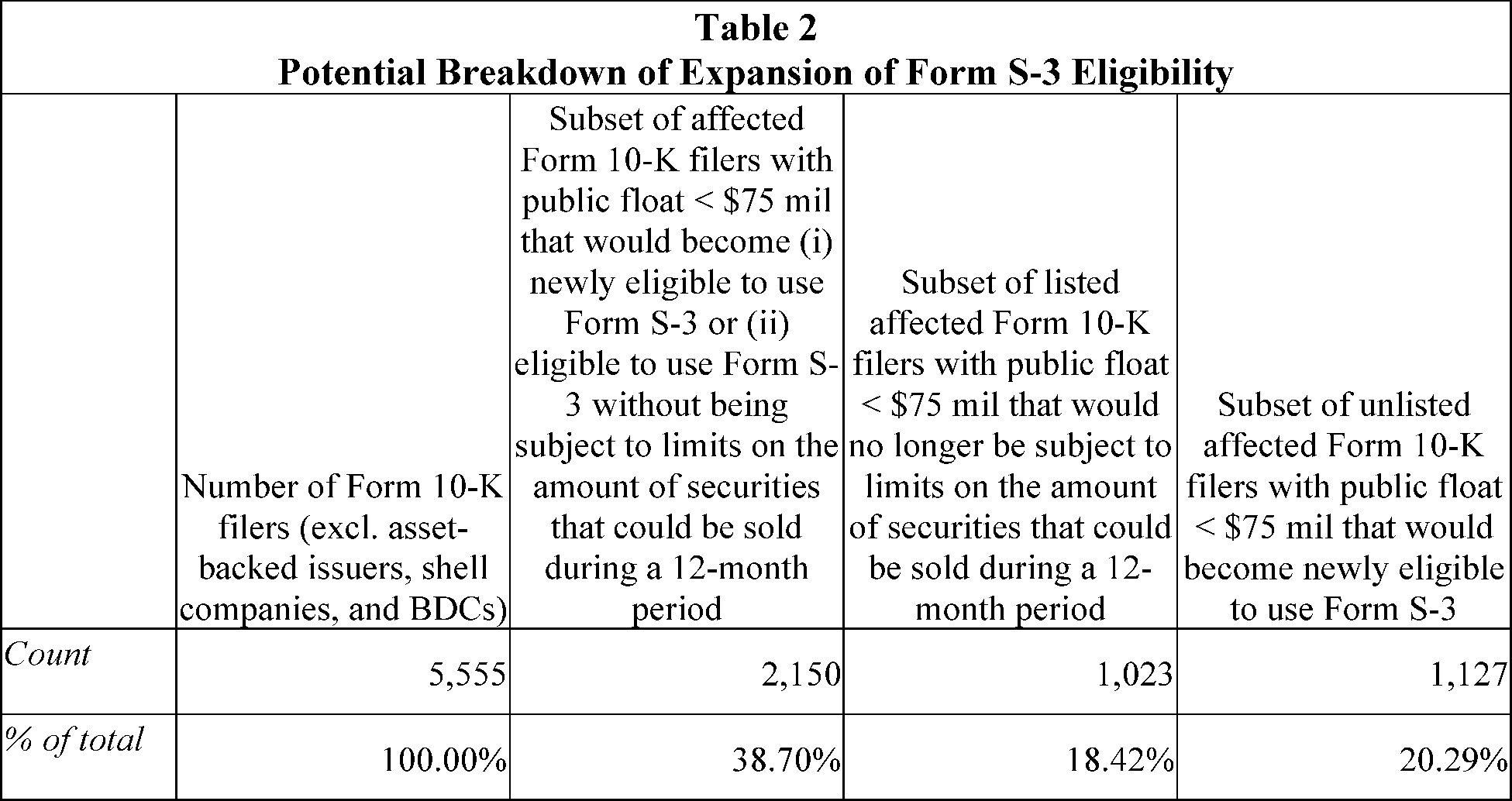
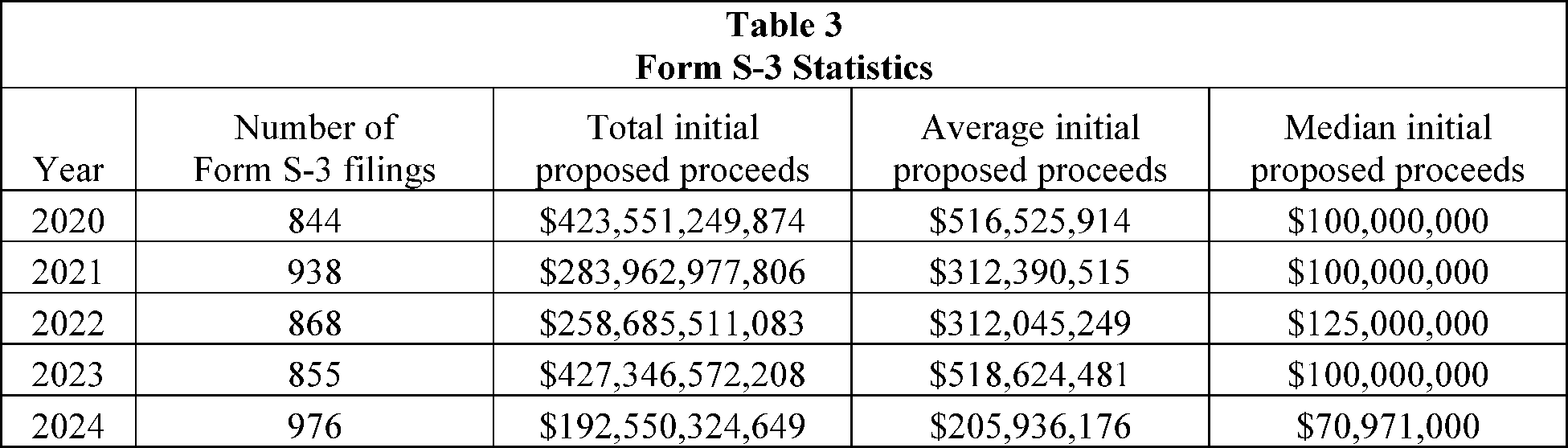
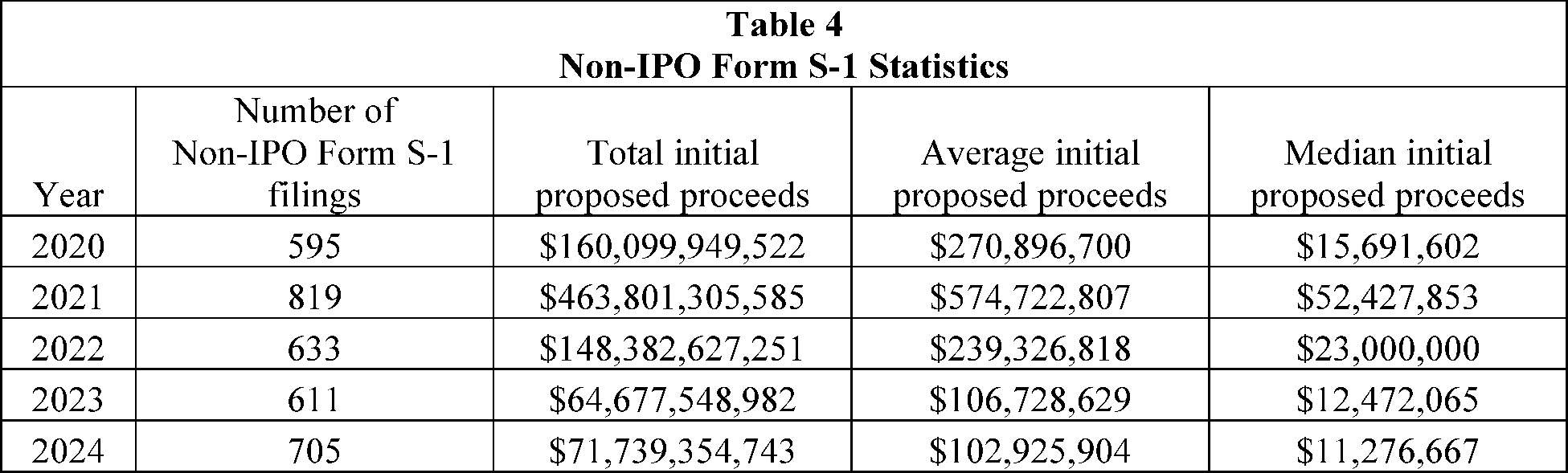
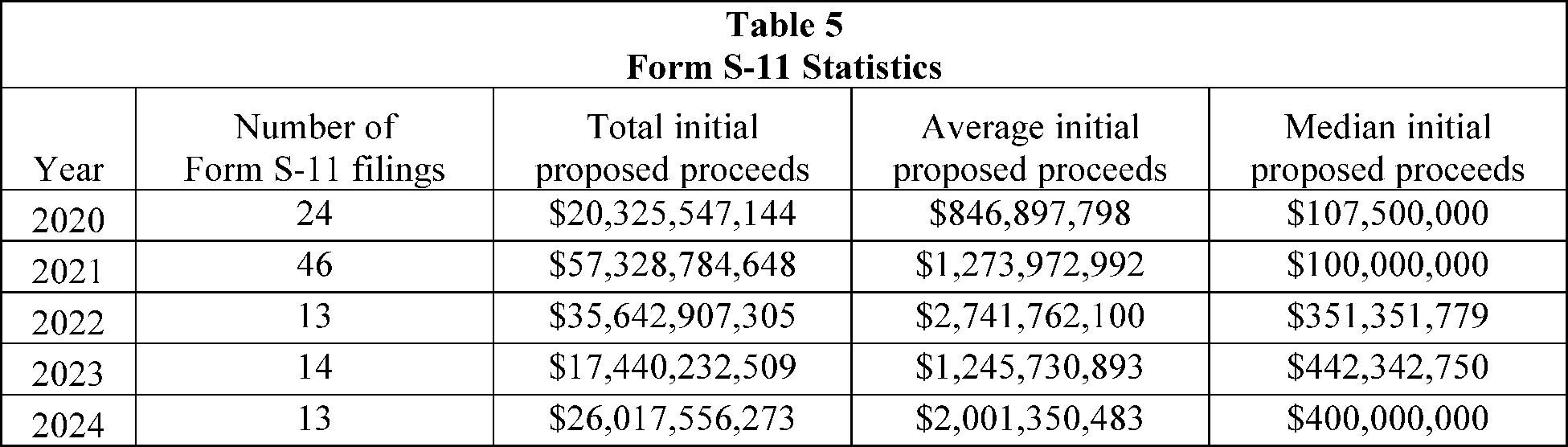
The Securities and Exchange Commission ("Commission") is proposing amendments that are intended to facilitate capital formation in the public securities markets. Specifically, t...
The Securities and Exchange Commission (“Commission”) is proposing amendments that are intended to facilitate capital formation in the public securities markets. Specifically, the proposed amendments would make Form S-3 and the ability to conduct shelf offerings available to significantly more issuers, extend certain benefits currently reserved for “well-known seasoned issuers” to a broader set of issuers, and modernize Form S-1 by expanding the ability to incorporate information by reference into that form. The proposed amendments also would make conforming changes to the registration, communication, and offering process for certain business development companies and registered closed-end investment companies that register securities on Form N-2. We also are proposing to amend the communication rules to permit broad-based advertising for certain insurance products. In addition, we are proposing certain other amendments that are intended to modernize certain rules. Finally, to mitigate the costs and complexity of conducting a registered offering, the proposed amendments would preempt State securities law registration and qualification requirements for all registered offerings.
DATES:
Comments should be received on or before July 27, 2026.
ADDRESSES:
Comments may be submitted by any of the following methods:
Send an email torule-comments@sec.gov.
Please include File Number S7-2026-17 on the subject line.
Paper Comments
Send paper comments to Vanessa A. Countryman, Secretary, Securities and Exchange Commission, 100 F Street NE, Washington, DC 20549-1090.
All submissions should refer to File Number S7-2026-17. This file number should be included on the subject line if email is used. To help the Commission process and review your comments more efficiently, please use only one method of submission. The Commission will post all submitted comments on the Commission's website (
https://www.sec.gov/rules-regulations/public-comments/s7-2026-17). Do not include personally identifiable information in submissions; you should submit only information that you wish to make available publicly. The Commission may redact in part or withhold entirely from publication submitted material that is obscene or subject to copyright protection.
Studies, memoranda, or other substantive items may be added by the Commission or staff to the comment file during this rulemaking. A notification of the inclusion in the comment file of any such materials will be made available on the Commission's website. To ensure direct electronic receipt of such notifications, sign up through the “Stay Connected” option at
www.sec.gov
to receive notifications by email.
Mark W. Green, Senior Special Counsel, or Isabel Rivera, Special Counsel, Office of Rulemaking, Division of Corporation Finance, at (202) 551-3430, Matt McNair, Senior Adviser to the Chief Counsel, Office of Chief Counsel, Division of Corporation Finance, at (202) 551-3500, Pamela Ellis, Senior Counsel; Blair Burnett, Bradley Gude, Branch Chiefs; or Brian McLaughlin Johnson, Assistant Director, at (202) 551-6792, Investment Company Regulation Office, Division of Investment Management; U.S. Securities and Exchange Commission, 100 F Street NE, Washington, DC 20549.
SUPPLEMENTARY INFORMATION:
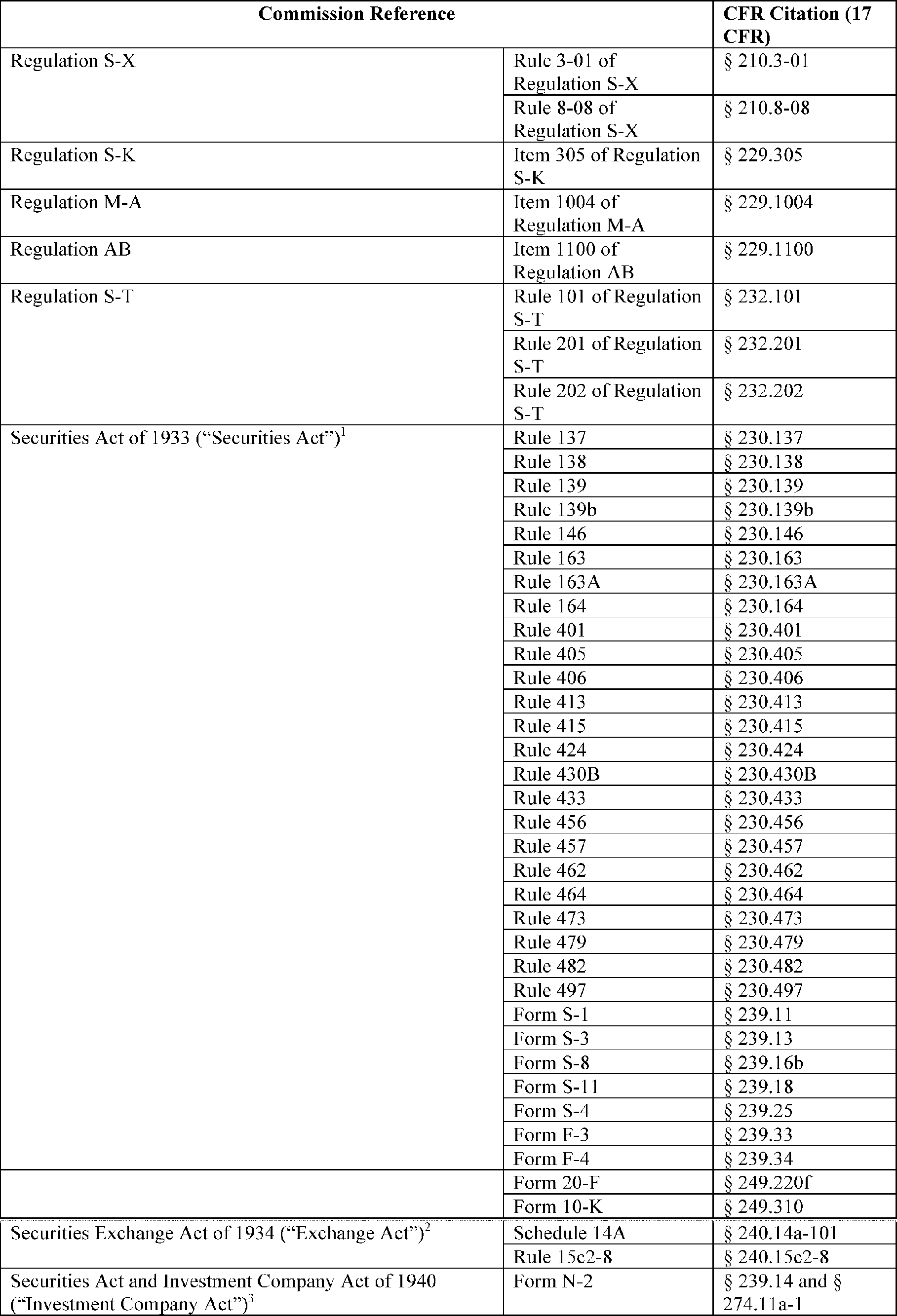
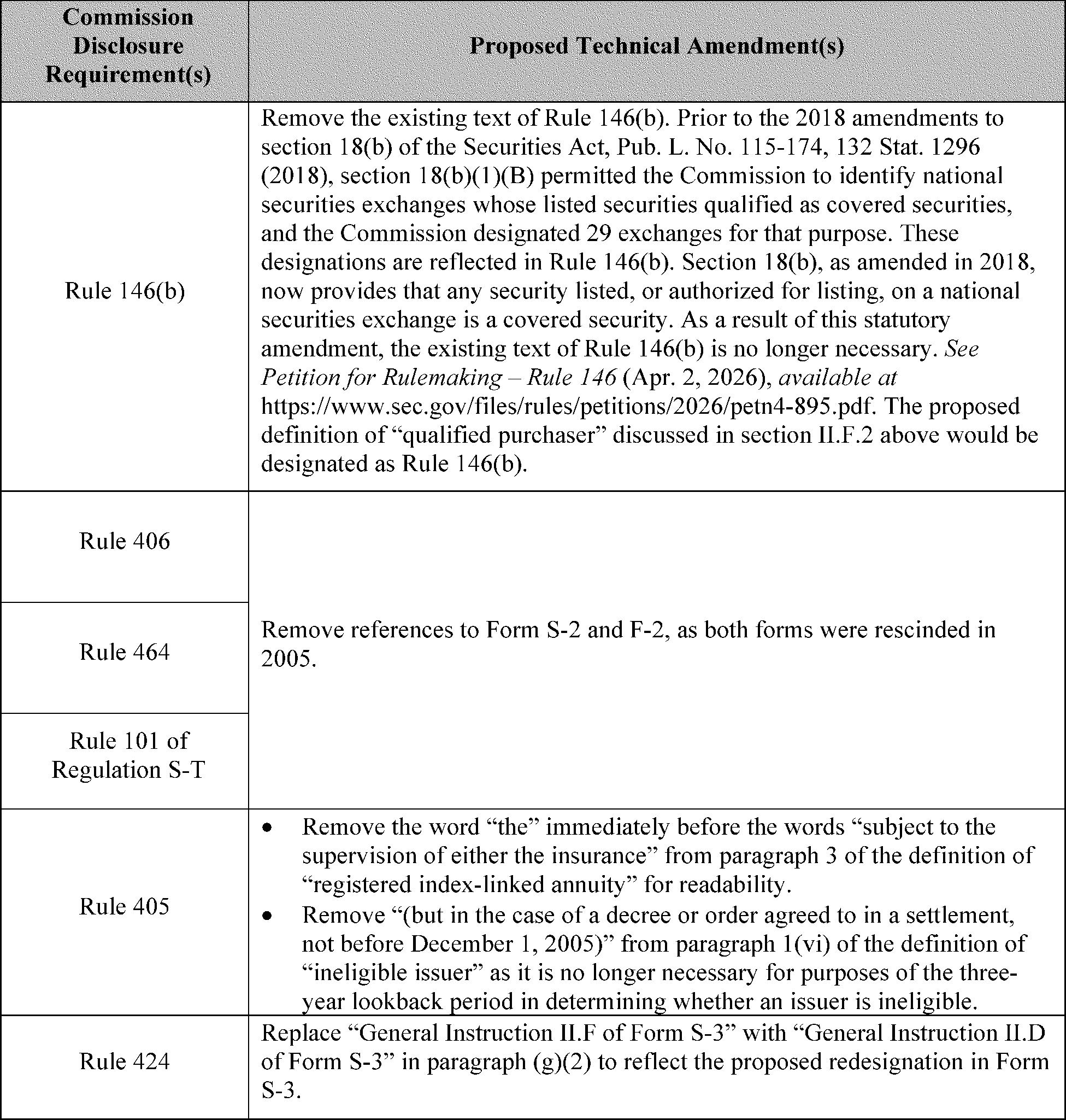
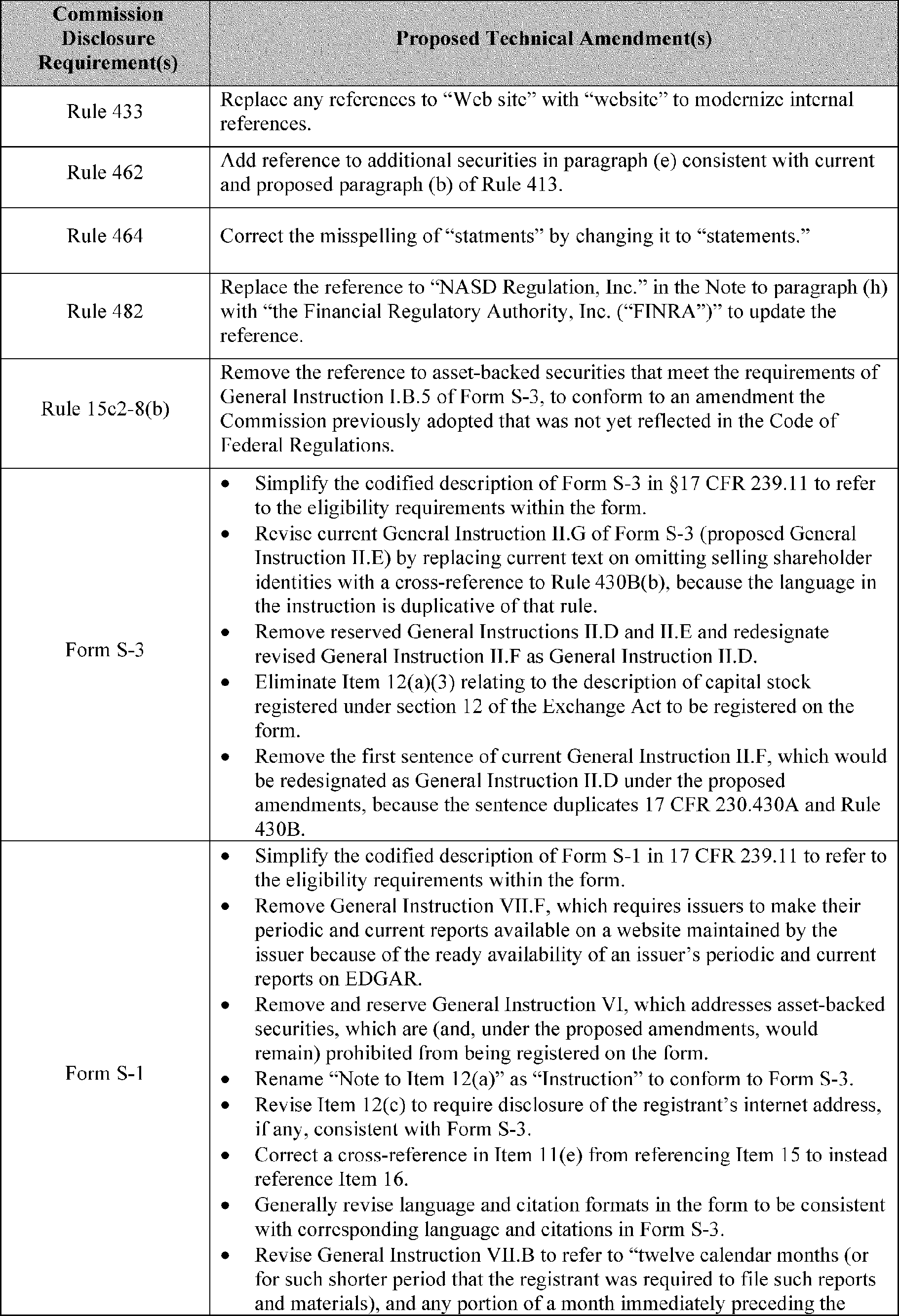
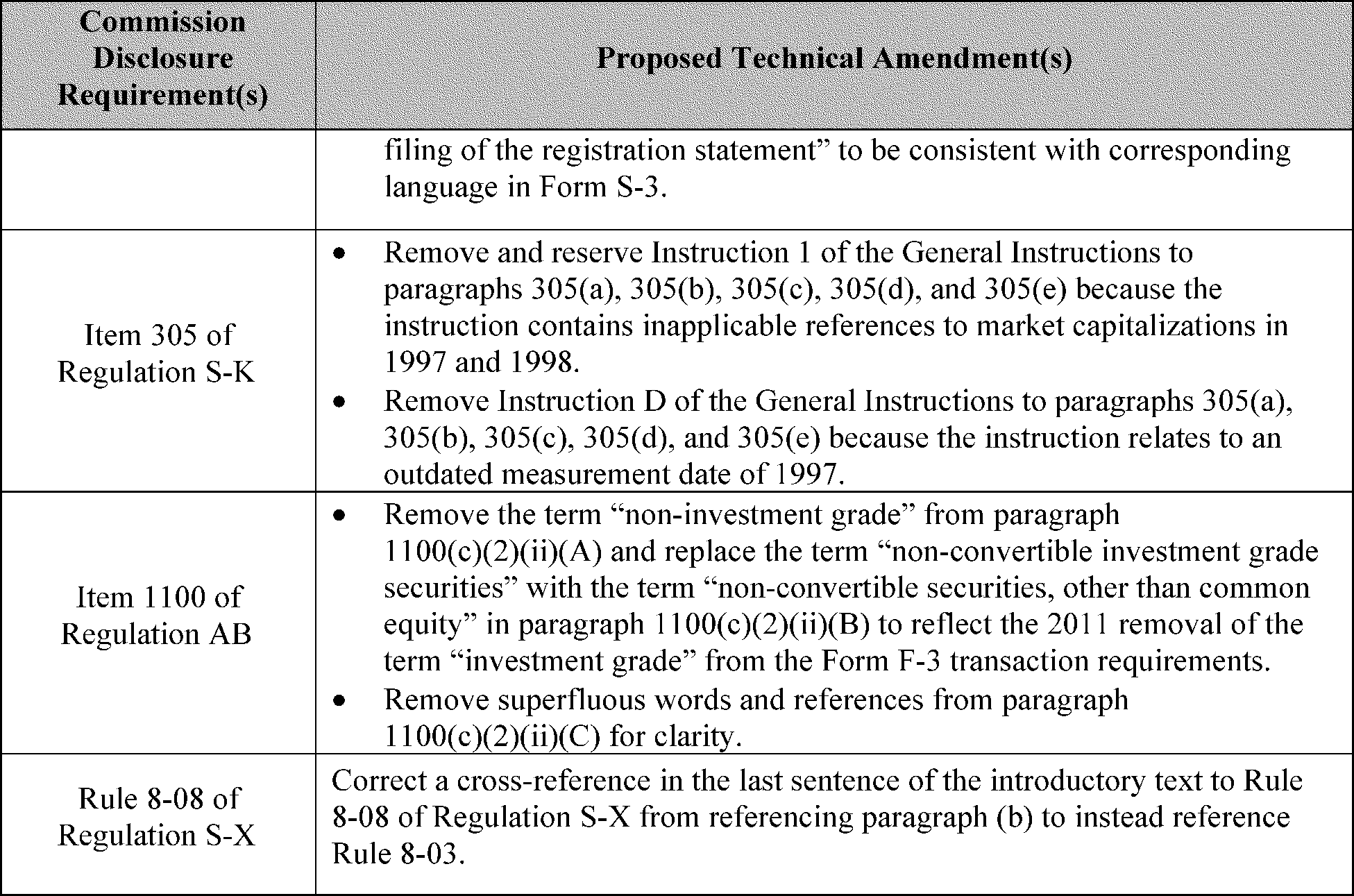
We are proposing to amend the following rules and forms:
( printed page 31023)
( printed page 31024)
Table of Contents
I. Introduction
A. Overview of the Proposed Amendments
B. Eliminating Public Float Requirements and Other Indicia of Market Following
II. Discussion of Proposed Amendments
A. Form S-3
1. Background
2. Proposed Amendments
B. The Enhanced Registration and Communication Benefits
1. Background
2. Proposed Amendments
C. Form S-1
1. Background
2. Proposed Amendments
D. Business Development Companies and Closed-End Funds
1. Background
2. Proposed Amendments
E. Registered Non-Variable Annuity Advertising
1. Background
2. Proposed Amendments
F. Preemption of State Securities Law Registration and Qualification
1. Background
2. Proposed Amendments
G. Other Rule Amendments
1. Delaying Amendments
2. Elimination of Certain Conditions Relating to Age of Financial Statements
3. Conforming and Technical Amendments
III. Other Matters
IV. Economic Analysis
A. Overview
B. Baseline
1. Form S-1 and Form S-3 Issuers
2. Form N-2 and Insurance Company Issuers
C. Benefits and Costs
1. Benefits and Costs of Proposed Amendments to Form S-3 Eligibility
2. Benefits and Costs of Amendments to Eligibility for the Enhanced Registration and Communication Benefits
3. Benefits and Costs of Amendments to Incorporation by Reference in Form S-1
4. Benefits and Costs of Amendments to Preempt State Regulation and Qualification
5. Business Development Companies, Closed-End Funds, and Registered Non-Variable Annuity Advertising
6. Benefits and Costs of Proposed Amendments to Rule 473 and Regulation S-X
7. Other Commission Proposals
8. Aggregate Monetized Benefits and Costs
D. Effects on Efficiency, Capital Formation, and Competition
1. Effects on Efficiency
2. Effects on Capital Formation
3. Effects on Competition
E. Reasonable Alternatives
1. Retain and Modify the Public Float-Based Conditions for Form S-3 Eligibility and WKSI Status
2. Retain WKSI Definition and Use an Alternative Measure of Whether an Issuer is “Well-Known”
F. Request for Comment
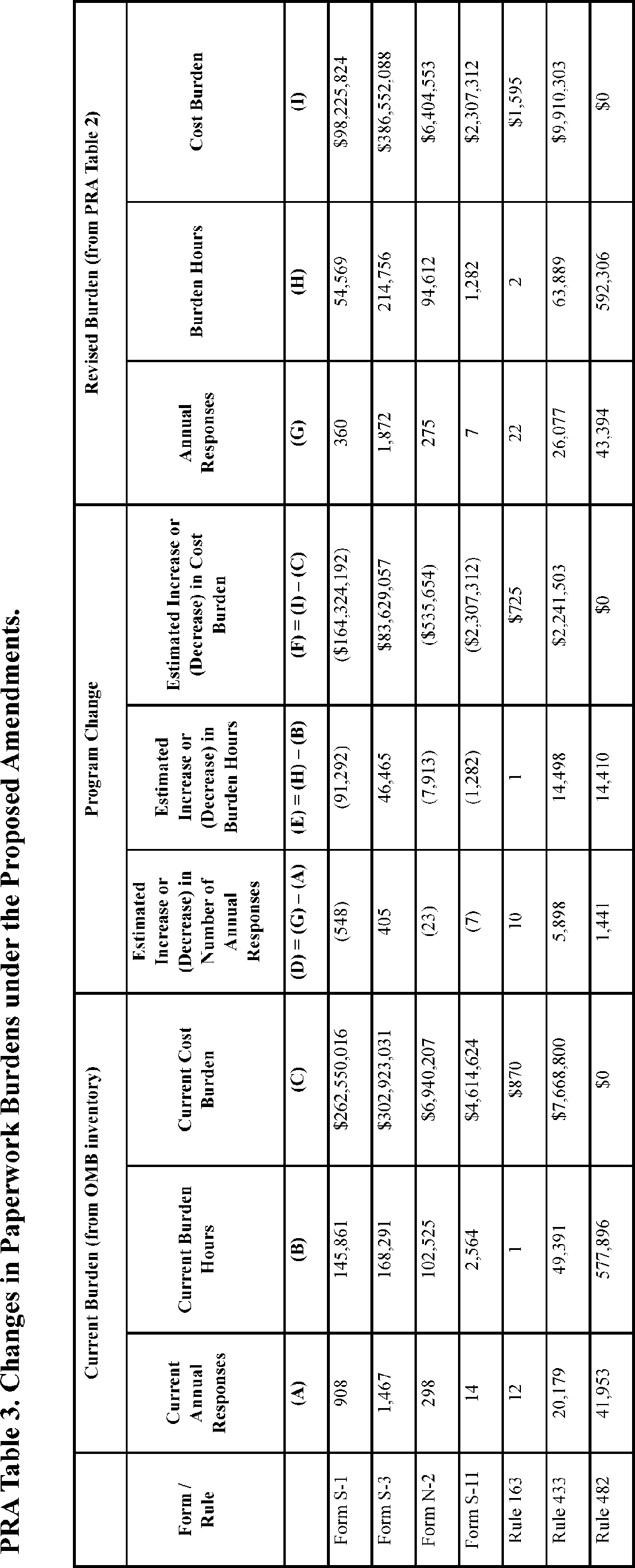
V. Paperwork Reduction Act
A. Summary of the Collections of Information
B. Summary of the Proposed Amendments' Estimated Effects on the Collections of Information
C. Incremental and Aggregate Burden and Cost Estimates
D. Request for Comment
VI. Congressional Review Act
VII. Initial Regulatory Flexibility Act Analysis and Regulatory Flexibility Act Certification
A. Initial Regulatory Flexibility Act Analysis
1. Reasons for, and Objectives of, the Proposed Action
2. Legal Basis
3. Small Entities Subject to the Proposed Amendments
4. Projected Reporting, Recordkeeping, and Other Compliance Requirements
5. Duplicate, Overlapping, or Conflicting Federal Rules
6. Significant Alternatives
B. Request for Comment
C. Certification Relating to Issuers of Registered Non-Variable Annuities
Statutory Authority
I. Introduction
We are proposing amendments that are intended to facilitate capital formation in the public securities markets. To achieve that goal, the proposed amendments would amend certain of our Securities Act rules and forms to provide issuers with greater flexibility to determine the timing and structure of their registered offerings and reduce the costs of conducting a registered offering by, among other things, simplifying and modernizing the applicable rules and forms.[4]
The Commission's longstanding, three-part mission is to protect investors, maintain fair, orderly, and efficient markets, and facilitate capital formation. Over the years, the Commission has engaged in various rulemakings with the express goal of facilitating capital formation.[5]
Some of those rulemakings focused specifically on facilitating capital formation with respect to registered offerings.[6]
As the Commission has recognized, the public capital markets offer several benefits to issuers and investors alike.[7]
For
( printed page 31025)
example, the Commission has noted that issuers can raise capital through the public markets on more favorable terms as compared to the private markets.[8]
This is due, in large part, to the “substantial pricing discounts that private investors often demand to compensate them for the relative illiquidity of the restricted shares they are purchasing” in exempt offerings.[9]
Both issuers and their investors benefit from this characteristic of the public markets because investors “may be less subject to the risk of dilution in the value of their shares if the companies in which they invest are able to meet more of their capital needs in the public markets.” [10]
Investors in registered offerings also enjoy additional benefits and protections. As compared to exempt offerings, issuers conducting registered offerings are required to provide their investors with more robust disclosures, and those disclosures are subject to enhanced liability standards.[11]
Although these requirements may increase compliance costs and litigation risks for issuers, those issuers ultimately may benefit from a lower cost of capital due, in part, to investors' reduced risk perception with respect to registered offerings.[12]
When pursuing the goal of facilitating capital formation, the Commission also has sought to ensure investors remain appropriately protected.[13]
To the extent there is a trade-off between efforts to facilitate capital formation and protect investors, the Commission has calibrated its rules with an eye towards balancing those two goals.
This proposal is intended to achieve the benefits associated with increased capital formation in the public securities markets. At the same time, we are committed to ensuring that investors remain appropriately protected. We recognize, however, that several aspects of our current Securities Act rules and forms, while intended to help protect investors at the time they were adopted, may now have the unintended effect of unduly inhibiting capital formation in today's markets. We believe, therefore, that it is appropriate to recalibrate certain of our rules and forms to ensure that they do not unduly restrict issuers' abilities to raise capital in a timely, efficient manner via a registered offering.
A. Overview of the Proposed Amendments
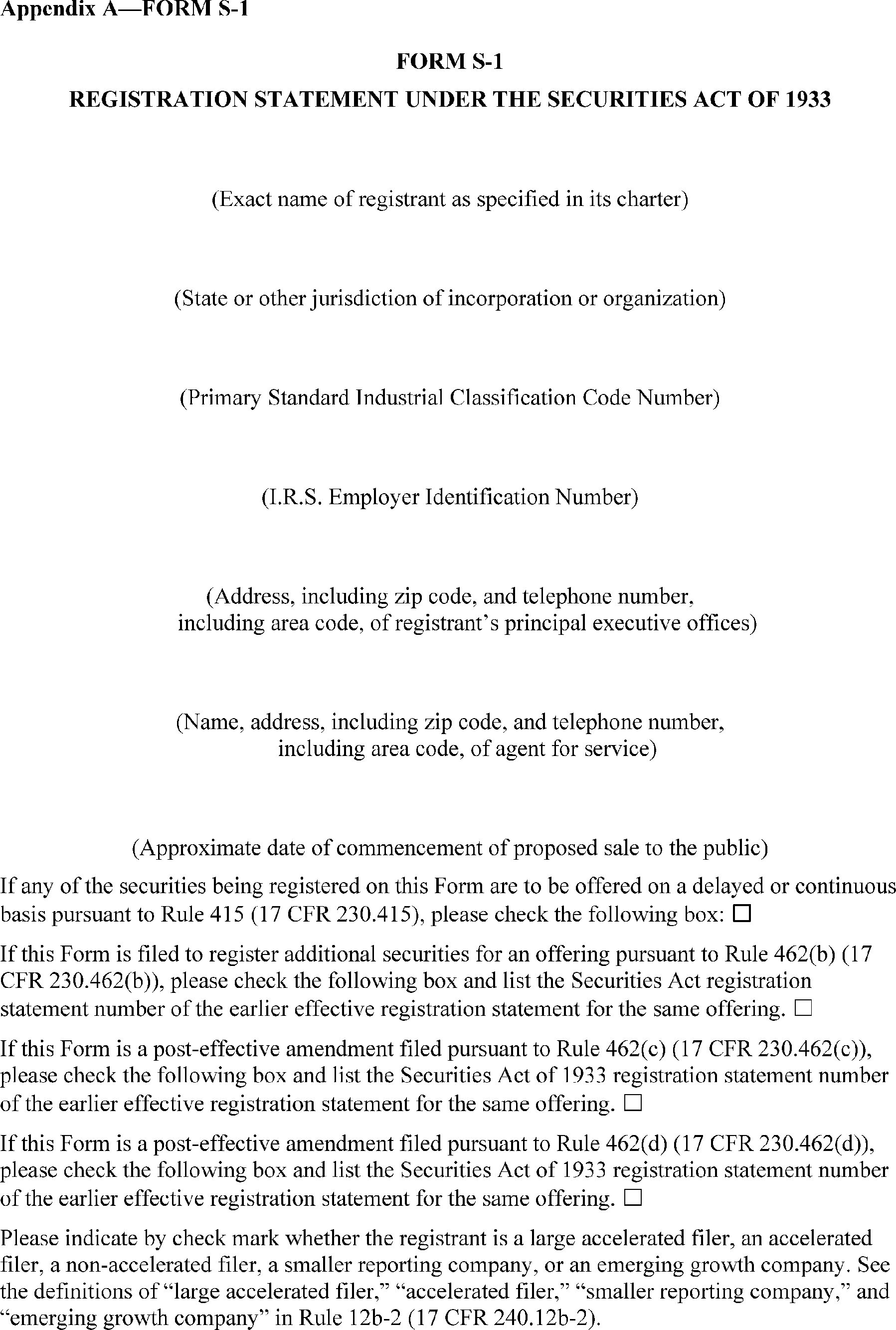
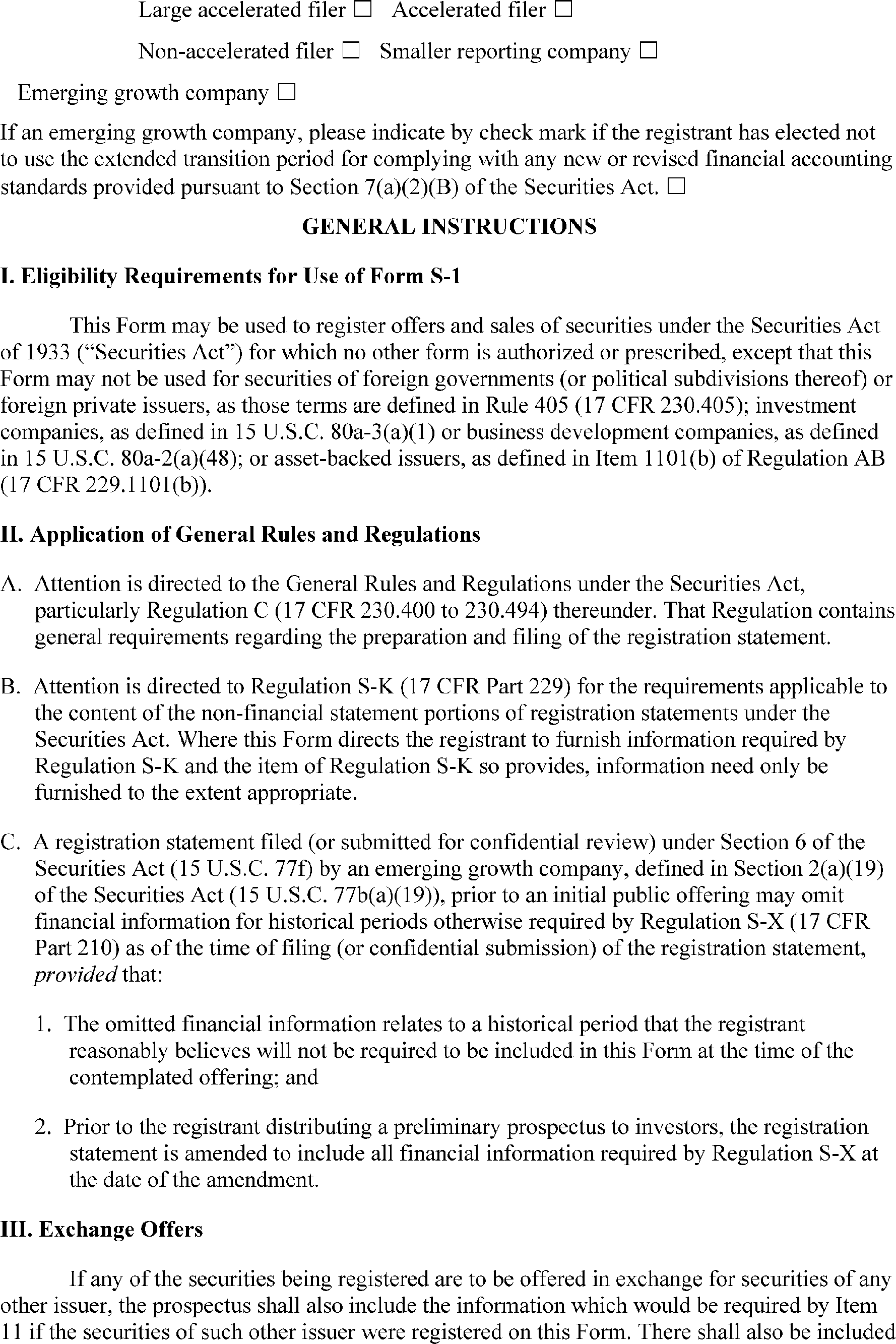
As discussed in more detail in section II below, the proposed amendments can be separated into several categories. First, we are proposing to revise Form S-3's eligibility requirements to allow a broader range of issuers to conduct offerings using the form, including delayed primary offerings (which, for purposes of this release, we refer to as “shelf offerings”) [14]
and at the market (“ATM”) primary offerings. Notably, the proposed amendments would eliminate the following eligibility requirements in Form S-3:
The issuer must have filed all the material required to be filed pursuant to section 13, 14, or 15(d) of the Exchange Act for a period of at least 12 calendar months immediately preceding the filing of the registration statement (which we refer to as the “One-Year Seasoning” requirement); and
The aggregate value of the issuer's voting and non-voting common equity held by non-affiliates (i.e.,
“public float”) must be $75 million or more to offer an unlimited amount of securities on Form S-3.[15]
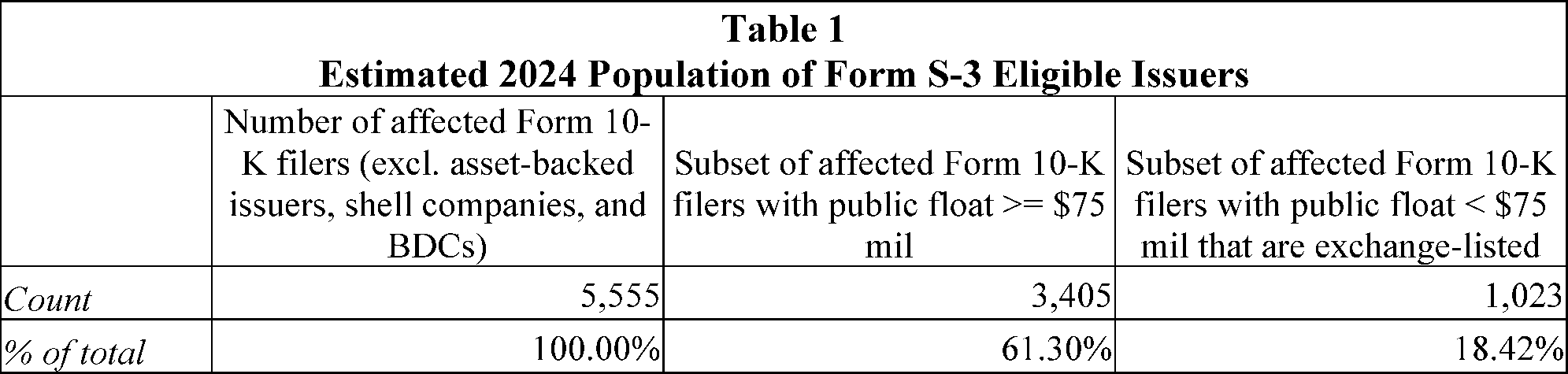
These proposed changes would significantly expand the population of issuers eligible to offer an unlimited amount of securities on Form S-3. Specifically, we estimate that there could be an increase of over 60 percent in the number of issuers eligible to offer an unlimited amount of securities on Form S-3.[16]
As discussed in section II.A below, these newly eligible issuers would benefit from the cost savings and capital raising efficiencies and flexibilities associated with the ability to use Form S-3 and conduct shelf offerings.
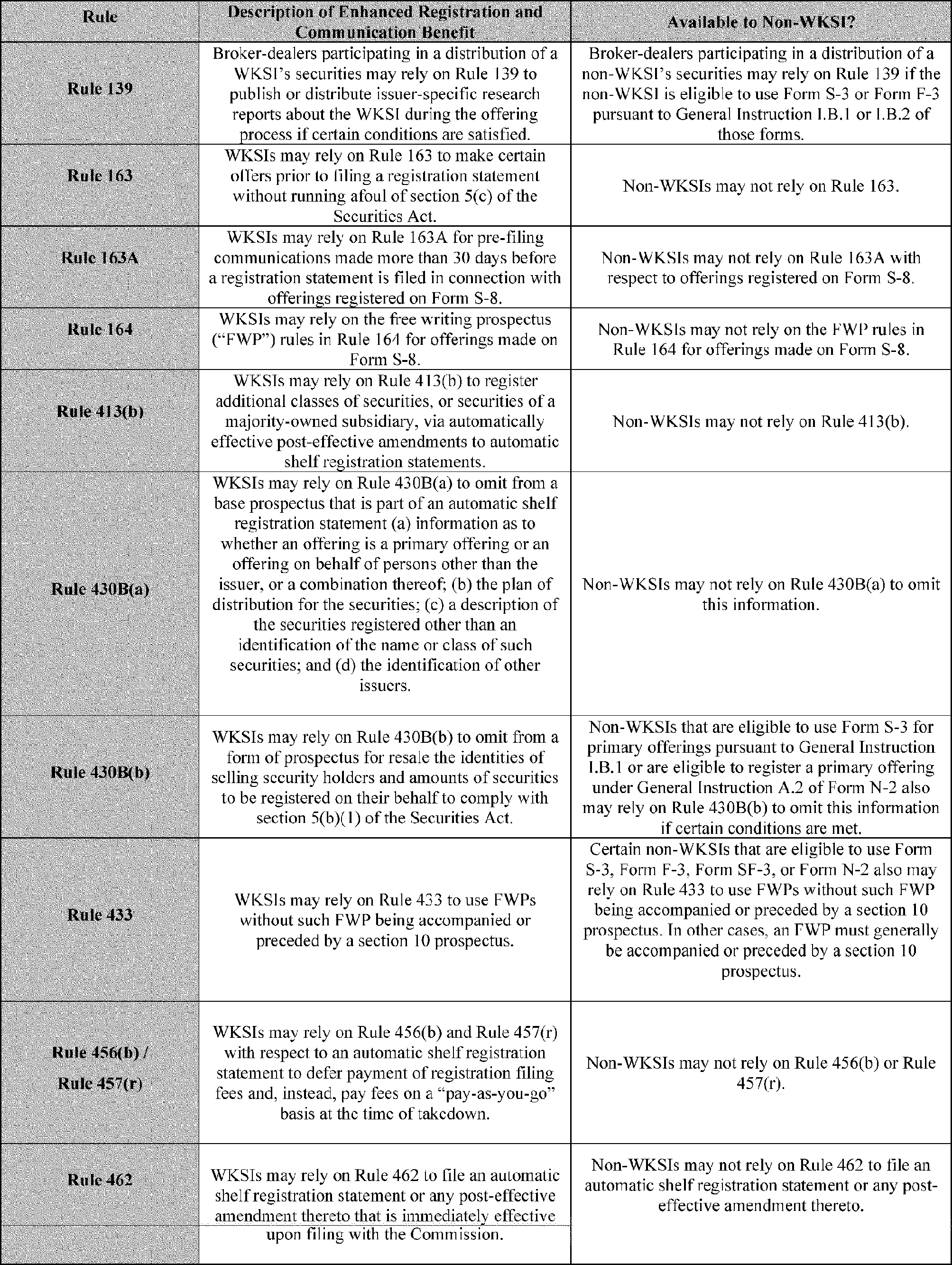
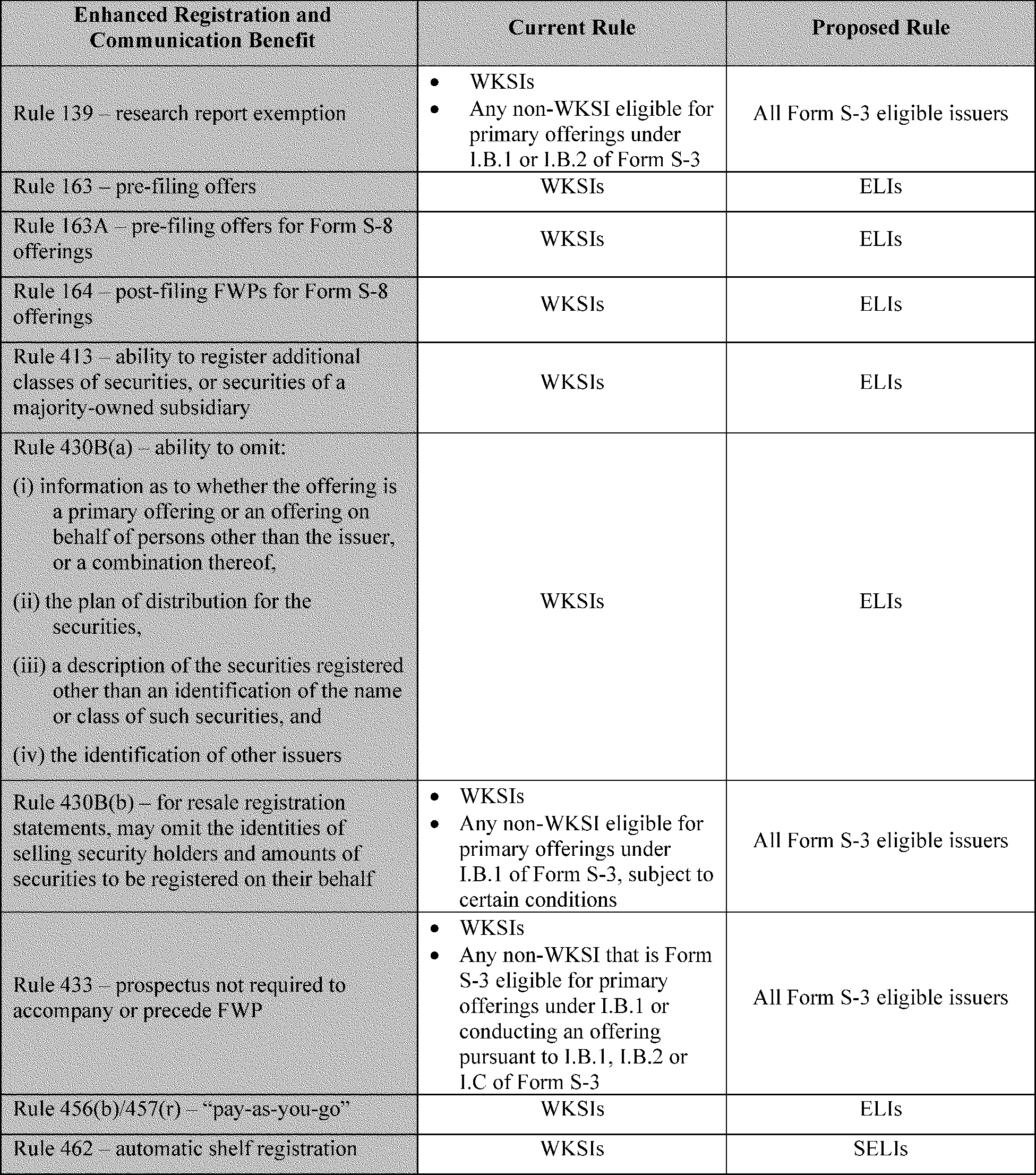
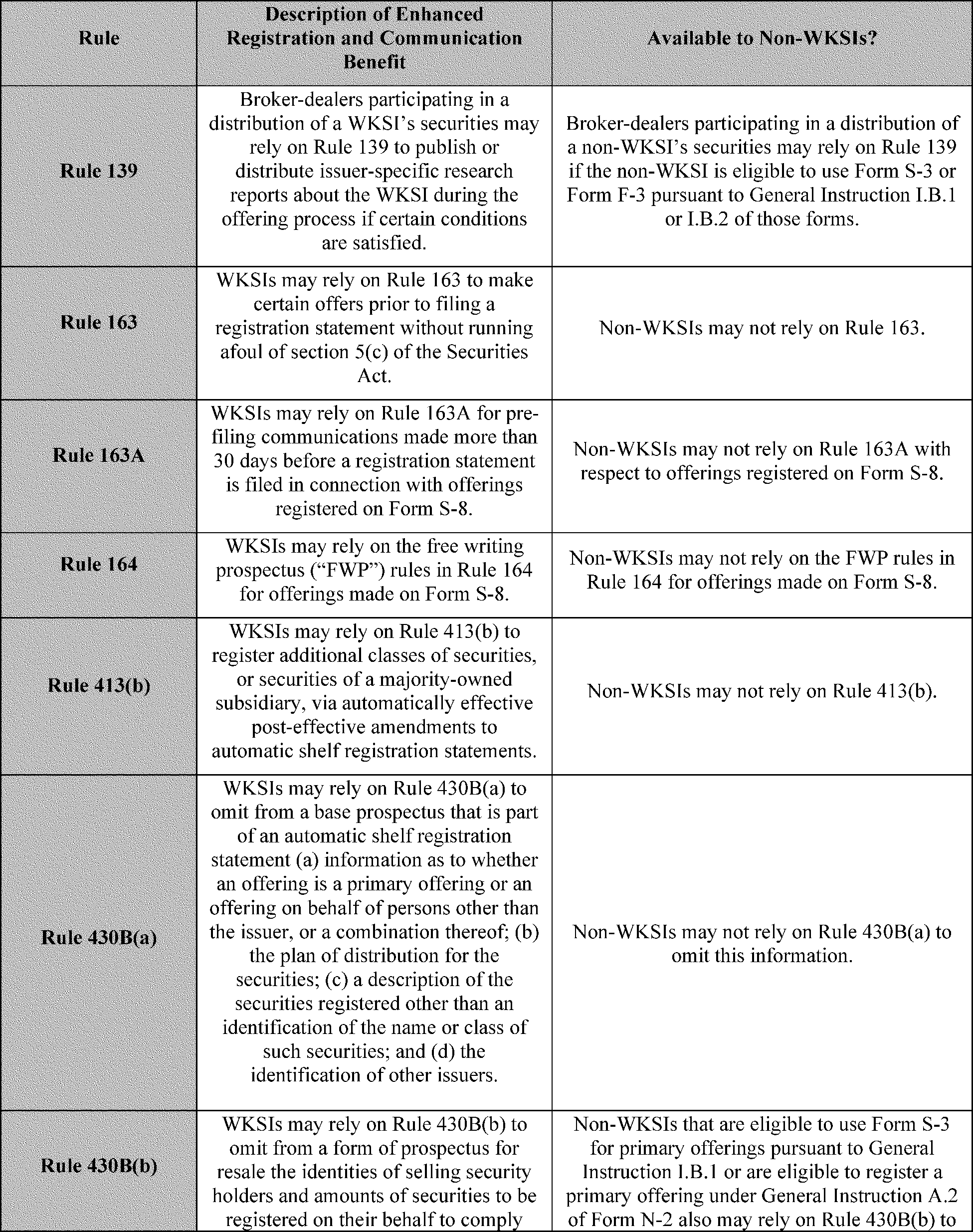
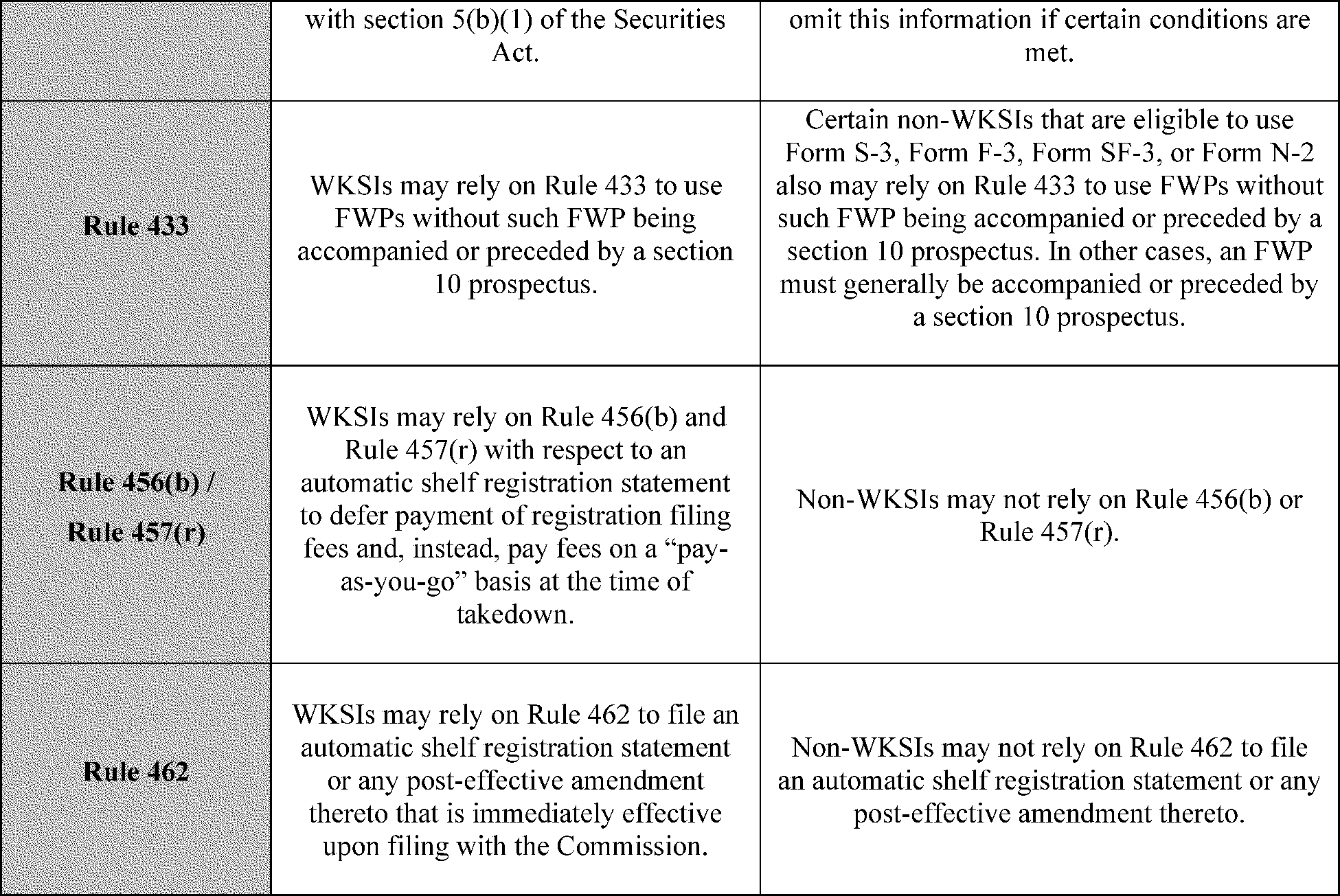
Second, we are proposing to extend certain benefits currently reserved for “well-known seasoned issuers” (“WKSIs”) and other seasoned issuers (which we refer to as the “Enhanced Registration and Communication Benefits”) to a larger set of issuers.[17]
Those benefits, which are discussed in section II.B below, are intended to further the Commission's longstanding goal of “facilitat[ing] capital formation, and possibly lower[ing] the cost of
( printed page 31026)
capital, by improving access to the public capital markets.” [18]
Currently, in order to be a WKSI (and, in turn, qualify for all of the Enhanced Registration and Communication Benefits), an issuer must, among other things, either have a public float of $700 million or more or have issued at least $1 billion aggregate principal amount of non-convertible securities, other than common equity, in primary offerings for cash, not exchange, registered under the Securities Act. Under the proposed amendments, issuers would not be required to meet either of these metrics in order to qualify for the Enhanced Registration and Communication Benefits. Instead, under the proposed amendments, issuers generally would qualify for those benefits if they are eligible to use Form S-3 and have at least one class of common equity securities listed on a national securities exchange.[19]
Thus, as a result of the proposed amendments, we estimate that there could be an increase of over 200 percent in the number of issuers eligible for all of the Enhanced Registration and Communication Benefits.[20]
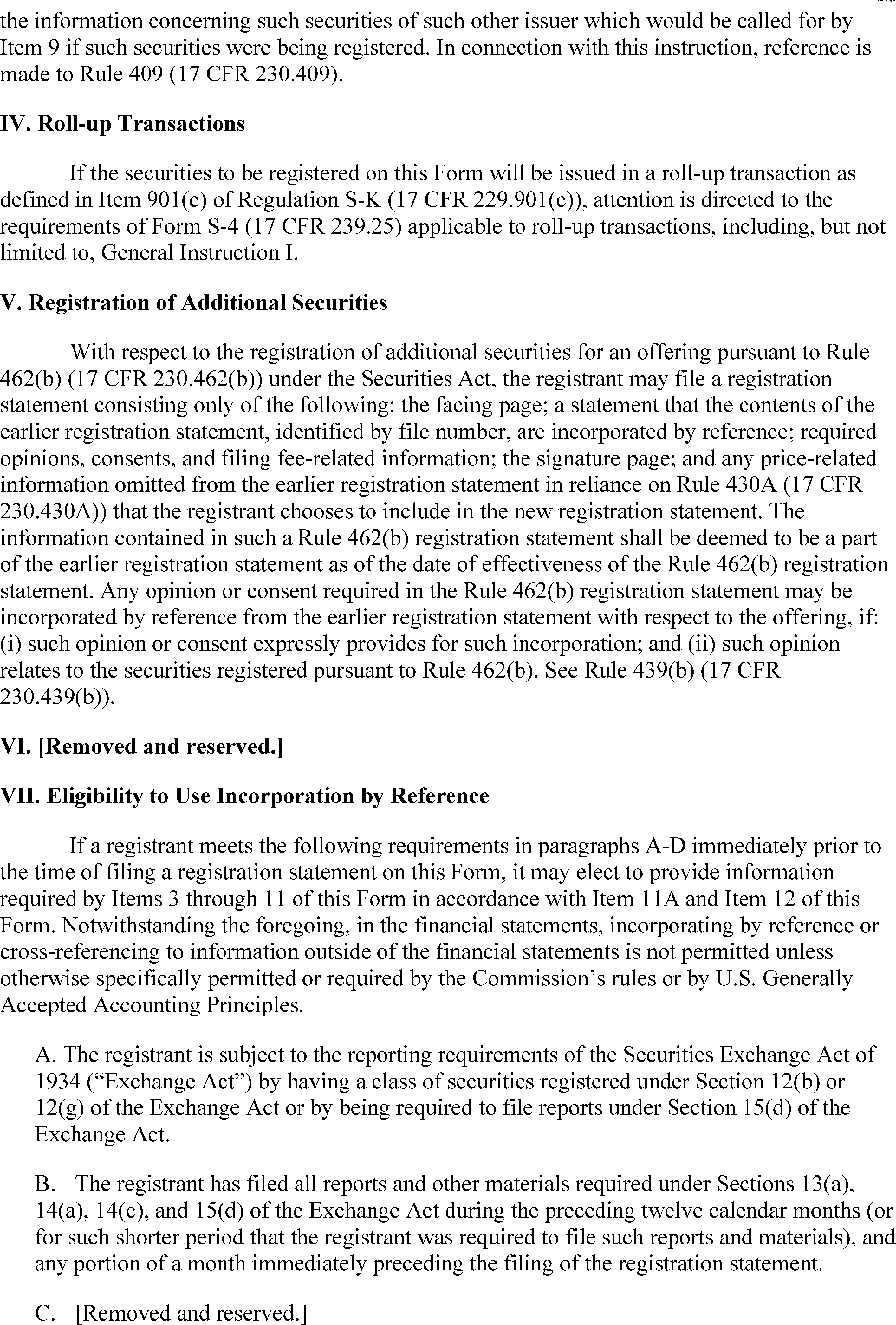
Third, we are proposing to revise Form S-1 to expand issuers' abilities to incorporate by reference information filed before (
i.e.,
backward incorporation by reference) and after (
i.e.,
forward incorporation by reference) the effective date of the registration statement. As discussed in section II.C below, the ability to backward incorporate currently is limited to issuers that, among other things, have filed an annual report for their most recently completed fiscal year. The ability to forward incorporate currently is limited to issuers that, among other things, are smaller reporting companies (“SRCs”).[21]
Under the proposed amendments, issuers that meet Form S-1's requirements to incorporate by reference would be able to backward incorporate regardless of whether they had filed an annual report for their most recently completed fiscal year and forward incorporate regardless of whether they are an SRC. This would allow a greater number of issuers to enjoy the cost savings associated with incorporation by reference, with an estimated increase of up to 106 percent in the number of issuers eligible to forward incorporate on Form S-1.[22]
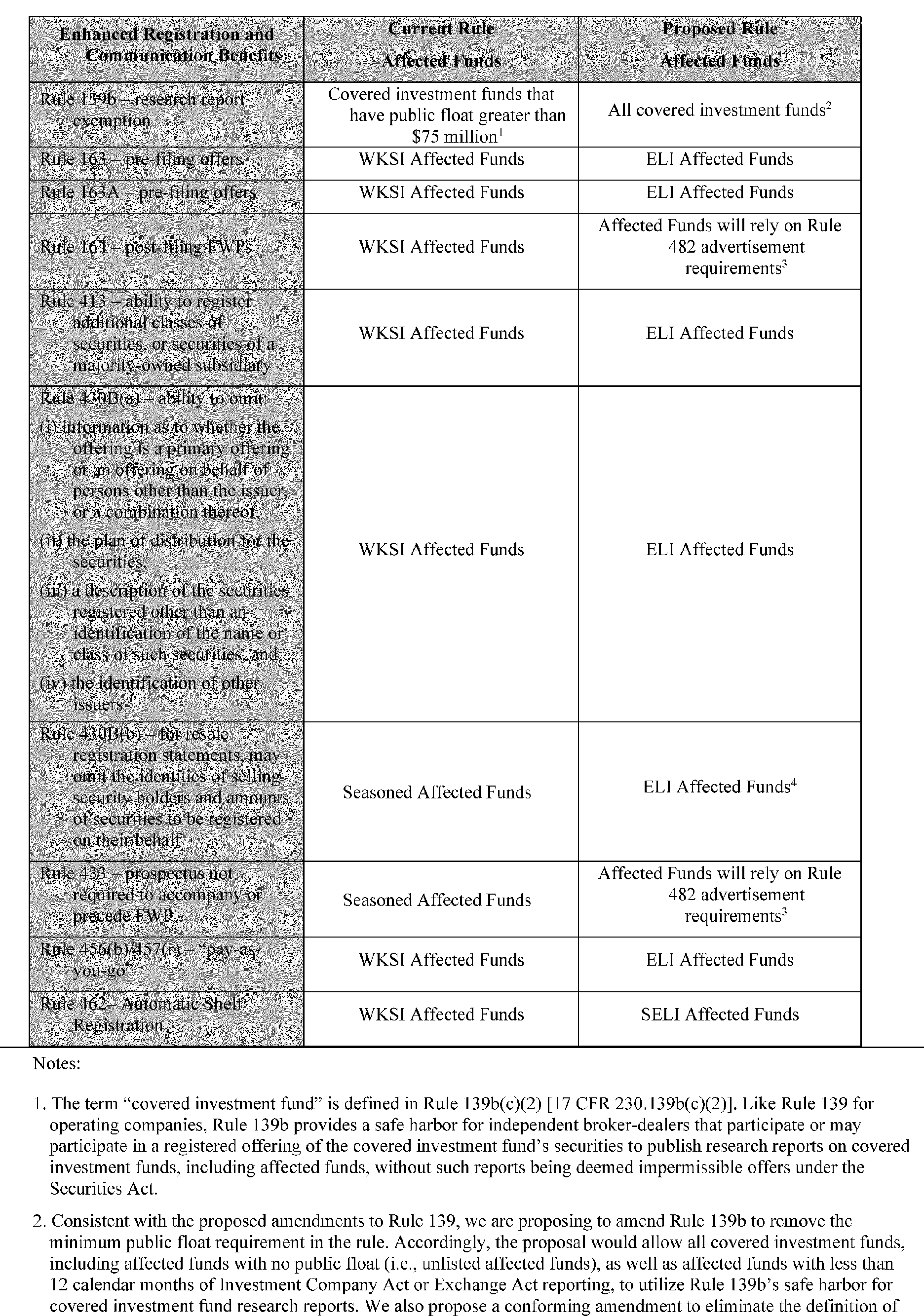
Fourth, in addition to the proposed amendments to the registration process for issuers that register securities on Form S-1 and Form S-3, we are also proposing to modify the registration, communication, and offering process for certain business development companies (“BDCs”) and registered closed-end investment companies (“registered CEFs”, collectively with BDCs, “affected funds”) that register securities on Form N-2, broadening their access to shelf offerings and the Enhanced Registration and Communication Benefits. These amendments would allow a greater number of affected funds to raise capital more efficiently and would provide more affected funds flexibility to manage the timing of their offerings in response to market opportunities.
Fifth, we are proposing to amend Rule 482 and other related rules to permit broad-based advertising relating to certain insurance products as discussed in more detail in section II.E below.
Sixth, under section 18(b)(3) of the Securities Act,[23]
we are proposing to define “qualified purchaser” such that State securities law registration and qualification requirements would be preempted with respect to any registered offering. As discussed in section II.F below, such preemption currently applies to registered offerings in which the securities being offered and sold are listed or approved for listing on a national securities exchange. Preemption currently does not, however, apply to registered offerings of unlisted securities. The proposed amendment, therefore, would eliminate the costs associated with complying with numerous states' registration and qualification requirements for registered offerings of unlisted securities.
Finally, we are proposing certain other amendments that are intended to modernize our rules. We discuss those proposed amendments in section II.G below.[24]
We invite and encourage interested parties to submit comments on any aspect of the proposed amendments. When commenting, please include the reasoning in support of your position or recommendation and provide any supporting documentation or data.
B. Eliminating Public Float Requirements and Other Indicia of Market Following
As noted in section I.A above, the proposed amendments would overhaul the criteria used to determine whether an issuer can use Form S-3 or the Enhanced Registration and Communication Benefits. For example, the proposed amendments would eliminate the requirements that issuers exceed a specified public float or amount of registered debt issued threshold to be eligible to offer an unlimited amount of securities on Form S-3 or to qualify for all of the Enhanced Registration and Communication Benefits. The proposed amendments also would eliminate the One-Year Seasoning requirement for Form S-3 eligibility.
These proposed amendments are intended to expand the population of issuers eligible to use Form S-3 and the Enhanced Registration and Communication Benefits. As discussed in section II.A.1 below, this goal is consistent with several prior Commission rulemakings. We recognize, however, that the proposed amendments also would, in many ways, represent a departure from the Commission's historical approach. An issuer's eligibility to use Form S-3 has, since the form's inception, depended on whether the issuer satisfies the Exchange Act seasoning and minimum public float requirements.[25]
Similarly, since the Commission adopted the Enhanced Registration and
( printed page 31027)
Communication Benefits, an issuer's ability to use those benefits has been conditioned, in part, on whether the issuer exceeds either a minimum public float or amount of registered debt issued threshold.[26]
In adopting rules and forms permitting short-form and shelf registration and the Enhanced Registration and Communication Benefits, and in periodically reconsidering the requirements issuers must meet to qualify for some of those benefits, the Commission has sought to reduce issuers' costs of raising capital while maintaining investor protection.[27]
The proposed amendments are intended to reflect the Commission's experience since it adopted or last amended the rules, including a reassessment of how best to protect investors in a manner that does not unduly limit issuers' access to short-form and shelf registration and the Enhanced Registration and Communication Benefits.
As the Commission has previously recognized, public securities offerings provide investors with benefits and protections not available in the private markets. The existing eligibility requirements, including the One-Year Seasoning and public float requirements, are intended to protect investors. Those eligibility requirements, however, also limit the number of issuers that may utilize Form S-3 and the Enhanced Registration and Communication Benefits, thus prompting some issuers to raise capital through other means, such as an exempt offering or private financing, in lieu of conducting a registered offering. Because registered offerings often ultimately benefit issuers and investors alike, we believe it is appropriate to expand significantly the population of issuers eligible to use Form S-3, conduct shelf and ATM offerings, and qualify for the Enhanced Registration and Communication Benefits so as to encourage more registered offerings, provided that appropriate investor protections are maintained.
The proposed changes to these eligibility requirements also are intended to reflect technological advancements and developments in the financial markets since the Commission adopted short-form registration, shelf registration, and the Enhanced Registration and Communication Benefits. The Commission has stated that the eligibility criteria in Form S-3 “are based on the Commission's belief that information about companies using the form already is known or is so readily available that it need not be repeated in a prospectus.” [28]
The Commission historically relied on that criteria—in particular, the Exchange Act reporting history and minimum public float requirements—as indicia of whether an issuer was widely followed and, in turn, whether information about the issuer had been sufficiently disseminated into the marketplace such that short-form registration was appropriate.[29]
The Commission relied on a similar rationale in conditioning the ability to use the Enhanced Registration and Communication Benefits on an issuer's ability to meet the specified public float or registered debt thresholds.[30]
When short-form registration was first introduced in 1967, Commission filings were submitted and available only in paper copy. The Commission attempted to facilitate broader distribution of this information by contracting with an outside company to create and distribute microfiche copies to designated Commission public reference rooms,[31]
but obtaining copies of these documents was cumbersome and expensive. Notably, an individual had to either make paper copies in the Commission's public reference rooms or order copies from service bureaus which, in turn, had to make and sell paper copies as requested.[32]
Thus, because it was difficult for investors to obtain information about an issuer, the Commission sought to ensure that, for companies using short-form registration, there was “wide dissemination of information about such companies in the market place” and that “securities analysts [would] follow companies of this size.” [33]
In the intervening years, technological developments have transformed how information is disseminated into the marketplace and facilitated widespread access to issuer information. For example, issuers today must make their Commission filings electronically through the Commission's Electronic Data Gathering, Analysis, and Retrieval system (“EDGAR”),[34]
which makes these filings immediately available to the investing public without charge.[35]
In addition, corporate news is disseminated in an electronic world, and issuers today make their Commission filings and other company information available through recognized electronic channels of distribution, including their websites and other digital technologies. Today's investors can access and follow publicly filed information about an issuer for low or no cost in real time and on demand.
Further, although Commission filings have been available to the investing public electronically, free of charge, through EDGAR since the mid-1990s and were available to investors in 2005 when the Commission adopted the Enhanced Registration and Communication Benefits and in 2007 when the Commission last considered eliminating the public float requirement
( printed page 31028)
in Form S-3,[36]
we believe such information has become even more widely accessible in the intervening years. Whereas only 71 percent of U.S. adults used the internet in 2007 and only 47 percent had a broadband connection at home,[37]
today 96 percent use the internet and 79 percent have a broadband connection at home.[38]
In addition, today approximately 91 percent of Americans own a smartphone compared to just 35 percent in 2011.[39]
Thus, a greater number of investors can retrieve investment information from nearly anywhere and nearly anytime. Moreover, the Commission improved investor access to this information in 2019 by requiring active hyperlinks to information incorporated by reference into registration statements and prospectuses.[40]
As a result, today's investors can now more easily and rapidly access Commission filings on EDGAR and via issuer websites, as well as other issuer-related information that is available through other electronic channels, at significantly lower cost than in the past.[41]
Because of the ease with which investors may obtain Exchange Act disclosure documents and other information about an issuer, we believe that eligibility to use Form S-3 and the Enhanced Registration and Communication Benefits should not depend on the extent of an issuer's market following, including analyst coverage (
e.g.,
by reference to its public float or initial Exchange Act seasoning).[42]
Instead, we believe a more appropriate criterion is whether investors can readily obtain issuer-specific information that is incorporated by reference into a prospectus and the related registration statement to make an informed investment decision. If an issuer is current and timely with respect to its Exchange Act reporting obligations, then an investor's ability to obtain such issuer-specific information will not depend on the length of the issuer's Exchange Act reporting history or the amount of the issuer's public float. In the pre-EDGAR era, it may have been important to include eligibility requirements for short-form registration that “assure[d] that sufficient information about registrants using the form [was] available to the investing public through the Exchange Act reporting system.” [43]
Today, however, the public availability of all issuers' Exchange Act reports in EDGAR effectively addresses the concerns that animated those requirements. We believe, therefore, that eligibility for Form S-3 and the Enhanced Registration and Communication Benefits no longer should be conditioned on an issuer's Exchange Act reporting history, public float, or amount of registered debt issued.
That said, consistent with the Commission's investor protection mandate, we are not proposing to expand eligibility to use Form S-3 or the Enhanced Registration and Communication Benefits to all issuers. For example, under the proposed amendments, issuers would be eligible to use most of the Enhanced Registration and Communication Benefits only if they are eligible to use Form S-3 and are exchange-listed. Further, although use of Form S-3 would not be conditioned on an issuer having satisfied the One-Year Seasoning requirement under the proposed amendments, use of the form would be conditioned on an issuer being current and timely with respect to all the material required to be filed pursuant to sections 13(a), 14(a), 14(c), and 15(d) of the Exchange Act during the preceding 12 calendar months, or such shorter period that the issuer was required to file such reports and materials. The proposed amendments also would prohibit issuers from using Form S-3 (and, therefore, the Enhanced Registration and Communication Benefits) if they are within a category of issuers we believe pose greater investor protection concerns, including those issuers that potentially present the highest risk of non-compliance with Securities Act and Exchange Act disclosure requirements. We discuss each of these aspects of the proposed amendments in more detail below.
II. Discussion of Proposed Amendments
A. Form S-3
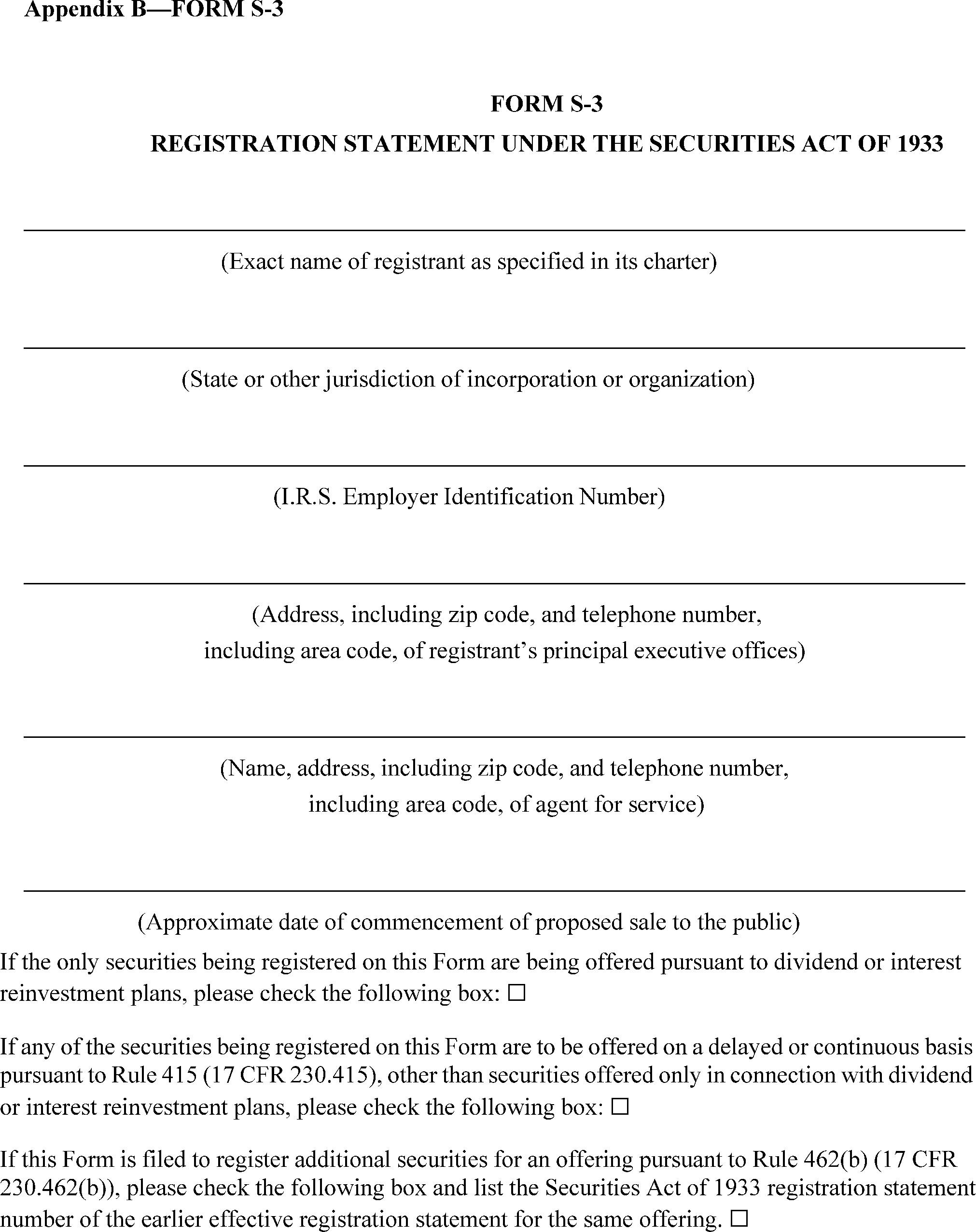
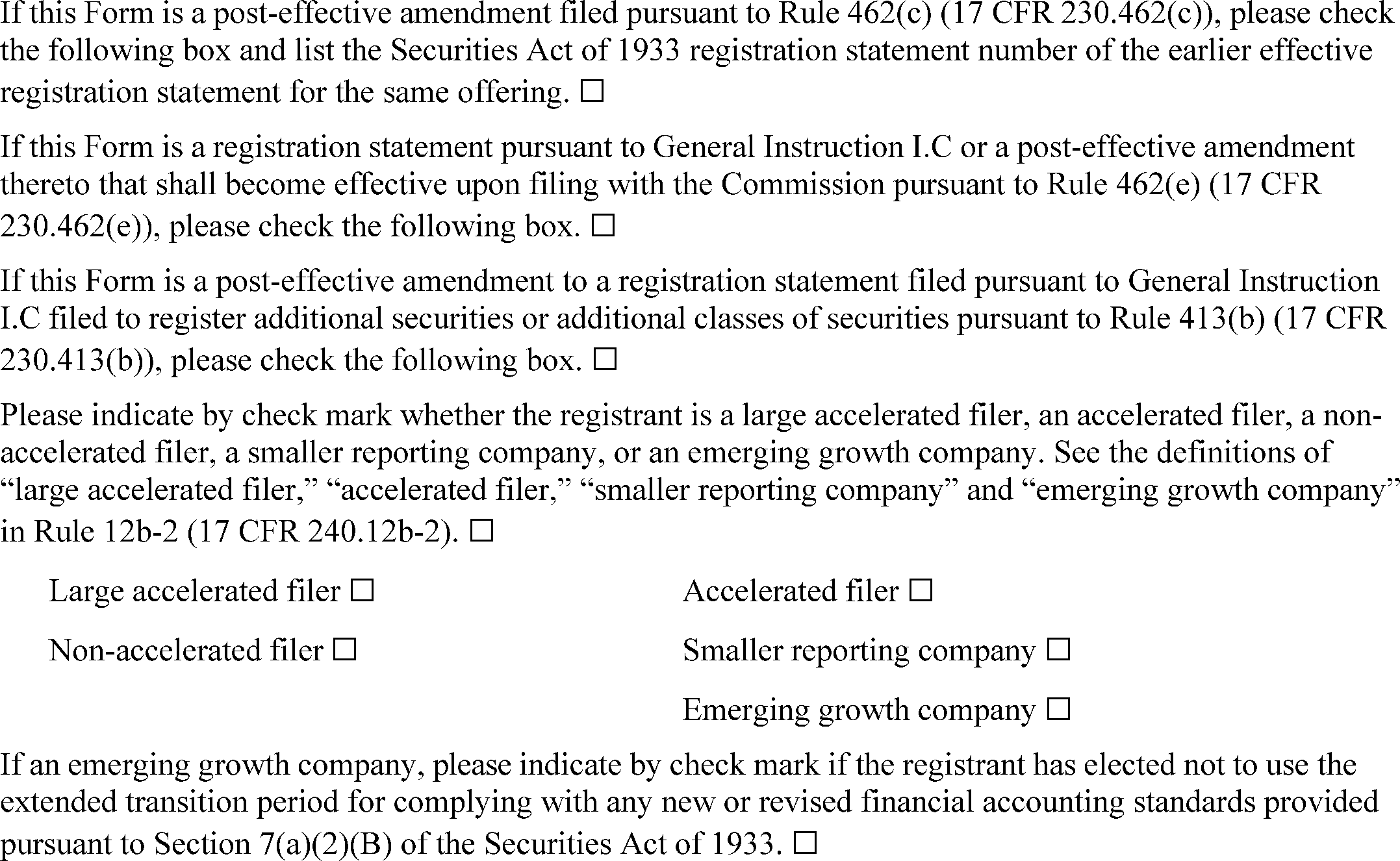
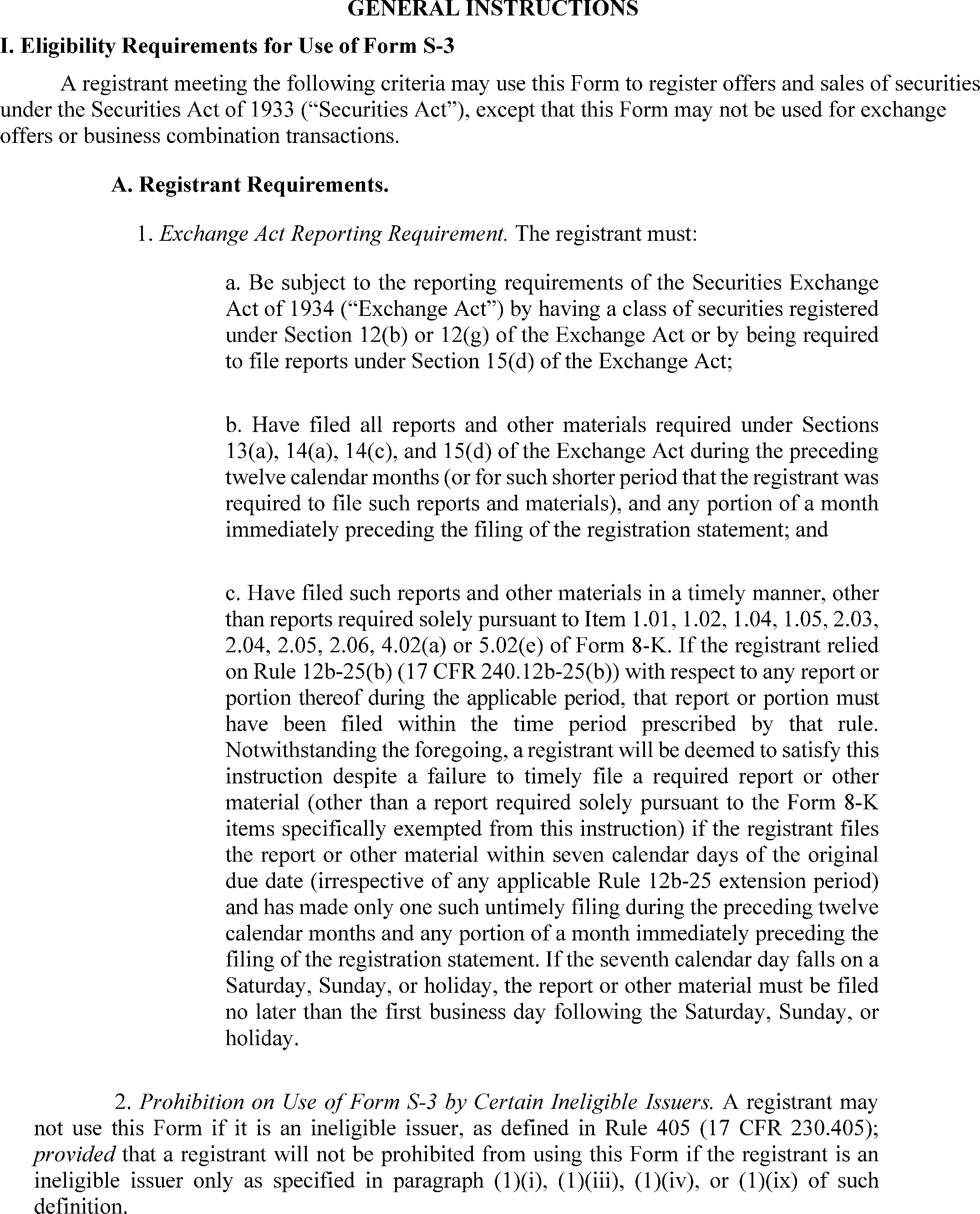
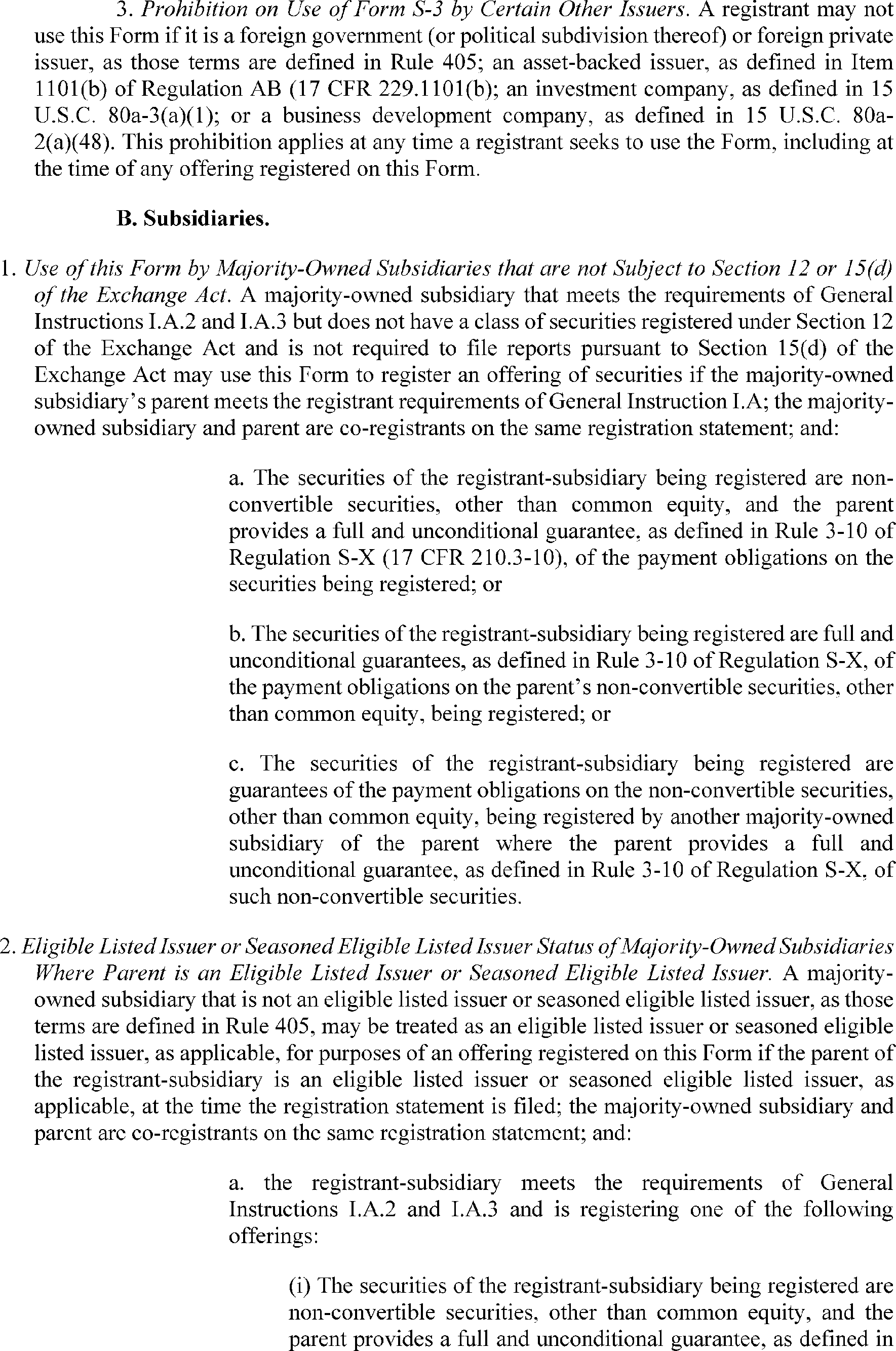
We are proposing to amend Form S-3 to revise its eligibility requirements. In addition, we are proposing certain other amendments to Form S-3 that would simplify and modernize the form. Taken together, these proposed amendments are intended to allow a greater number of issuers the flexibility to access the public securities markets quickly by using Form S-3 while also ensuring that investors remain appropriately protected. Form S-3, as it would read under the proposed amendments, is attached to this release as Appendix B.
1. Background
a. Eligibility To Use Form S-3 and Conduct Shelf Offerings
Form S-3 is a short-form registration statement that eligible issuers can use to register offerings under the Securities Act. The ability to use Form S-3 can confer significant advantages on eligible companies seeking to raise capital through the public markets. Notably, an issuer that is Form S-3 eligible for primary offerings is permitted to conduct shelf offerings—that is, offerings made on a delayed basis—under Rule 415.[44]
Rule 415 provides
( printed page 31029)
issuers with considerable flexibility to access the public securities markets from time to time in response to changes in the market and the issuer's capital needs. Issuers that are eligible to conduct shelf offerings under Rule 415 are permitted to register securities offerings prior to planning any specific offering and, once the registration statement is effective, issue securities in one or more offerings without waiting for further Commission or staff action.
By having more control over the timing of their offerings, eligible issuers can take advantage of desirable market conditions, thus allowing them to raise capital on more favorable terms (such as a higher equity price or lower debt interest rate). As a result, the ability to sell securities “off the shelf” as needed gives issuers a financing alternative that may be more advantageous for them than other available methods, such as private placements with securities priced at discounted values based in part on their relative illiquidity.
One of the primary advantages of Form S-3 is the ability to omit from the prospectus included in a registration statement at the time of effectiveness (the “base prospectus”) certain information, including, for WKSIs, information as to whether an offering is a primary or secondary offering, the plan of distribution for the securities, a description of the securities to be offered other than an identification of the name or class of such securities, and the identification of other issuers.[45]
An issuer can instead provide this information at the time that it is actually conducting an offering, after its terms have been determined. The ability to omit information from the base prospectus at the time of effectiveness, therefore, enables issuers to conduct shelf offerings.
In addition, Form S-3 permits the required information to be backward and forward incorporated by reference to a company's disclosure in its Exchange Act filings. The ability to forward incorporate allows for automatic updating of the registration statement.[46]
By contrast, a company without the ability to forward incorporate must file a prospectus supplement to update information or, in certain cases, file a post-effective amendment to its registration statement to prevent information in the registration statement from becoming outdated and to update for fundamental changes to the information set forth in the registration statement.[47]
Issuers that are ineligible to file on Form S-3 often register their offerings on Form S-1, which has far fewer eligibility requirements than Form S-3.[48]
Issuers filing registration statements on Form S-1 are not permitted to register shelf offerings under Rule 415 and therefore cannot register securities in advance of an actual offering. Thus, as compared to conducting a shelf offering on Form S-3, it is more challenging (and, in some instances, likely not feasible) for Form S-1 registrants to take advantage of favorable market opportunities, as they must prepare and file a registration statement at the time of an expected offering and await Commission or staff action before offering or selling securities. Further, Form S-1 permits certain issuers to backward incorporate. Form S-1 currently does not, however, permit issuers other than SRCs to forward incorporate, which therefore requires a company to update the registration statement through prospectus supplements and post-effective amendments.[49]
To use Form S-3, an issuer must meet the form's registrant requirements,[50]
which generally pertain to the issuer's reporting history under the Exchange Act, as well as at least one of the form's transaction requirements.[51]
Form S-3's registrant requirements (which are enumerated in General Instruction I.A of Form S-3) specify that to use the form, an issuer must satisfy each of the following:
U.S. Issuer.
The issuer must be organized under the laws of the United States or any State or territory or the District of Columbia and have its principal business operations in the United States or its territories.[52]
Exchange Act Reporting.
The issuer must have a class of securities registered pursuant to section 12(b) or 12(g) of the Exchange Act or be required to file reports pursuant to section 15(d) of the Exchange Act.[53]
One-Year Seasoning.
The issuer must have been subject to the requirements of section 12 or 15(d) of the Exchange Act for a period of at least 12 calendar months immediately preceding the filing of the registration statement.[54]
Current in Exchange Act Reporting.
The issuer must have filed all the material required to be filed pursuant to section 13, 14, or 15(d) of the Exchange Act for a period of at least 12 calendar months immediately preceding the filing of the registration statement.[55]
Timely in Exchange Act Reporting.
The issuer must have filed in a timely manner all reports required to be filed during the 12 calendar months and any portion of a month immediately preceding the filing of the registration statement, other than specified reports on Form 8-K.[56]
Certain Failures to Make Payments and Defaults.
The issuer must have not, since the end of the last fiscal year for which certified financial statements of the issuer and its consolidated subsidiaries were included in a report filed pursuant to section 13(a) or 15(d) of the Exchange Act: (a) failed to pay any dividend or sinking fund installment on preferred stock; or (b) defaulted (i) on any installment or installments on indebtedness for borrowed money, or (ii) on any rental on one or more long-term leases, which defaults in the aggregate are material to the financial position of the issuer and its consolidated and unconsolidated subsidiaries, taken as a whole.[57]
Electronic Filings.
The issuer must have filed with the Commission all required electronic filings.[58]
Interactive Data Files.
The issuer must have submitted electronically to the Commission all Interactive Data
( printed page 31030)
Files [59]
required to be submitted pursuant to 17 CFR 232.405 during the 12 calendar months and any portion of a month immediately preceding the filing of the registration statement on Form S-3 (or for such shorter period of time that the issuer was required to submit such files).[60]
Foreign issuers, other than foreign governments, also can use Form S-3 if they satisfy all the registrant requirements, other than the “U.S. Issuer” eligibility requirement, and file the same Exchange Act reports as a domestic issuer.[61]
In addition, successor issuers are permitted to use Form S-3 if they meet certain conditions.[62]
Form S-3's transaction requirements (which are enumerated in General Instruction I.B of Form S-3) specify that the form can be used for primary offerings only under the following circumstances:
General Instruction I.B.1—Primary Offerings by Certain Registrants.
An issuer may register any primary offering of its securities on the form if, among other requirements, the issuer's public float is $75 million or more.
If an issuer does not have a public float of at least $75 million, it may nevertheless register the following primary offerings on Form S-3:
○
General Instruction I.B.2—Primary Offerings of Non-Convertible Securities Other than Common Equity.
An issuer may register a primary offering of non-convertible securities other than common equity, provided the issuer: (1) has issued at least $1 billion in non-convertible securities, other than common equity, in primary offerings for cash registered under the Securities Act over the prior three years; (2) has outstanding at least $750 million of non-convertible securities, other than common equity, issued in primary offerings for cash registered under the Securities Act; (3) is a wholly-owned subsidiary of a WKSI; or (4) is a majority-owned operating partnership of a real estate investment trust (“REIT”) that qualifies as a WKSI.
○
General Instruction I.B.4—Rights Offerings, Dividend or Interest Reinvestment Plans, and Conversions or Warrants and Options.
An issuer may register securities to be offered upon exercise of outstanding rights, under a dividend or interest reinvestment plan, or upon the conversion of outstanding convertible securities or the exercise of outstanding warrants or options, if certain conditions are met.
○
General Instruction I.B.6—Limited Primary Offerings by Certain Other Registrants.
An issuer that is not a shell company may register any primary offering if it is exchange-listed and the aggregate market value of securities sold by or on behalf of the issuer under the instruction during the 12 months immediately prior to, and including, the sale is no more than one-third of the issuer's public float.
Form S-3's transaction requirements specify that the form can be used for resale offerings only under the following circumstances:
General Instruction I.B.1—Primary Offerings by Certain Registrants.[63]
An issuer may register resales of outstanding securities if the issuer has a public float of at least $75 million.
General Instruction I.B.3—Transactions Involving Secondary Offerings.
If an issuer does not have a public float of at least $75 million, resales of outstanding securities can be registered on Form S-3 if the securities are listed on a national securities exchange or quoted on the automated quotation system of a national securities association.[64]
In addition, General Instruction I.B.5 provides that Form S-3 may not be used to register offerings of asset-backed securities, as defined in 17 CFR 229.1101(c).
Finally, Form S-3 has instructions that specify circumstances under which certain subsidiaries are eligible to use the form.[65]
In addition to the permissible offerings by subsidiaries identified in General Instruction I.B.2 (with respect to wholly-owned subsidiaries of WKSIs and majority-owned operating partnerships of REITs that qualify as WKSIs), General Instruction I.C provides that majority-owned subsidiaries may register certain offerings on Form S-3 if:
the issuer-subsidiary itself meets the registrant requirements and the applicable transaction requirement; [66]
the parent of the issuer-subsidiary meets the registrant requirements and the conditions of General Instruction I.B.2 are met; [67]
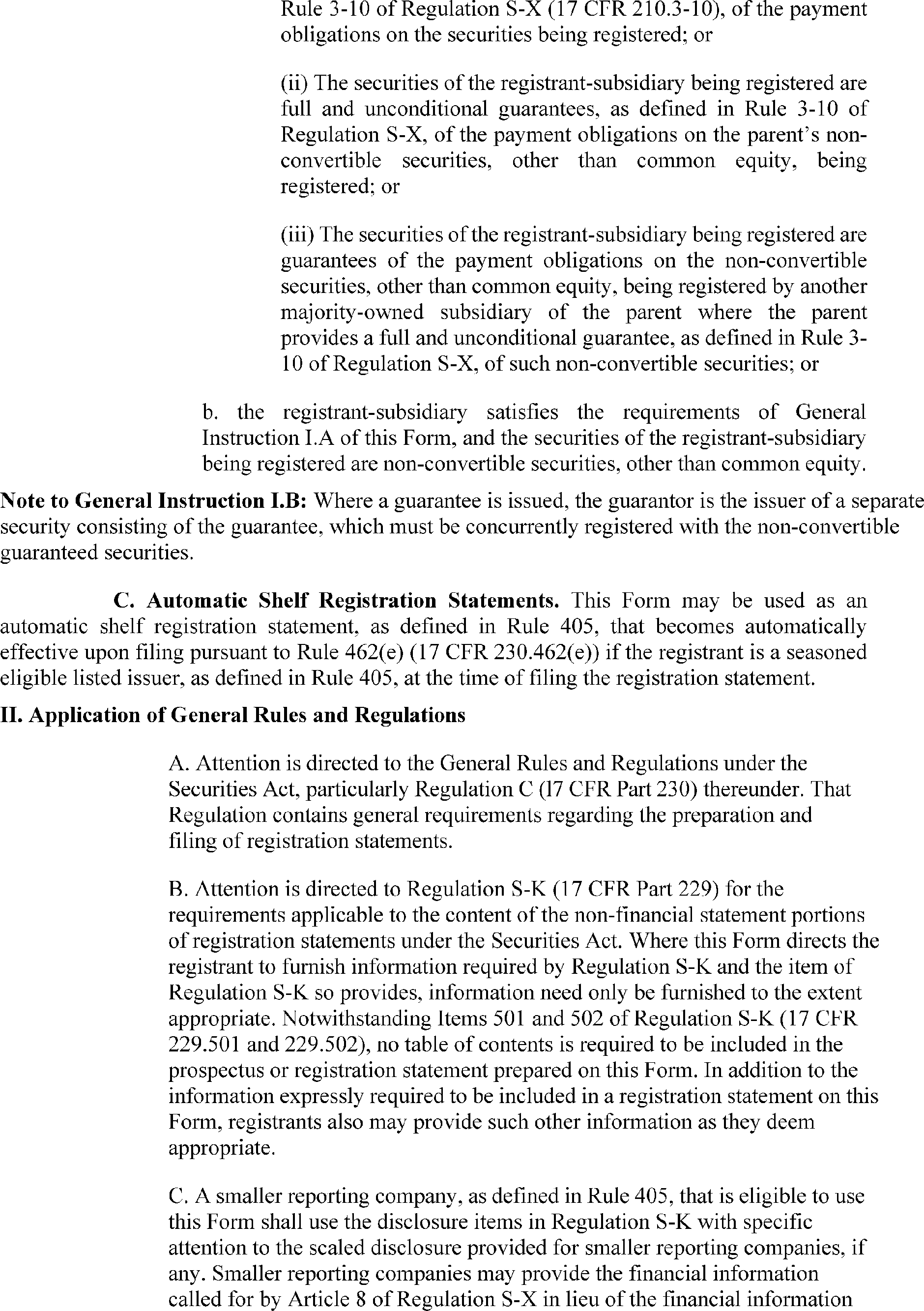
the parent of the issuer-subsidiary meets the registrant requirements and the applicable transaction requirement, and provides a full and unconditional guarantee, as defined in17 CFR 210.3-10 (“Rule 3-10 of Regulation S-X”), of the payment obligations on the securities being registered, and the securities being registered are non-convertible securities, other than common equity; [68]
the parent of the issuer-subsidiary meets the registrant requirements and the applicable transaction requirement, and the securities of the issuer-subsidiary being registered are full and unconditional guarantees, as defined in Rule 3-10 of Regulation S-X, of the payment obligations on the parent's non-convertible securities, other than common equity, being registered; [69]
or
the parent of the issuer-subsidiary meets the registrant requirements and the applicable transaction requirement, and the securities of the issuer-subsidiary being registered are guarantees of the payment obligations on the non-convertible securities, other than common equity, being registered by another majority-owned subsidiary of the parent where the parent provides a full and unconditional guarantee, as defined in Rule 3-10 of Regulation S-X, of such non-convertible securities.[70]
For convenience, throughout the remainder of this release, we refer to the offerings involving parent or subsidiary guarantees permitted under General Instructions I.C.3, I.C.4, and I.C.5 as “Guarantee-Related Offerings.”
b. History of Short-Form Registration
The Commission first introduced short-form registration “in the nature of
( printed page 31031)
an experiment” with Form S-7 in 1967.[71]
Unlike other forms, Form S-7 permitted eligible issuers to omit certain information about the issuer, such as property descriptions, pending legal proceedings, and director and executive compensation. To use the form, issuers had to have a class of equity securities registered under section 12(b) or (g) of the Exchange Act and had to be current and timely in their Exchange Act reporting for at least five years.[72]
Issuers also had to satisfy other qualitative criteria related to business continuity,[73]
board stability,[74]
solvency,[75]
financial performance,[76]
and dividend coverage.[77]
The rationale for this short-form registration statement was that the omitted information was already available through the issuer's Exchange Act reports, making its inclusion in the registration statement unnecessary.[78]
Over time, the Commission has periodically amended its rules and forms to broaden the availability of short-form registration and shelf offerings. In the Commission's 1969 Disclosure Policy Study led by Commissioner Francis Wheat (often referred to as the “Wheat Report”), the Commission recommended a “substantial expansion” of short-form registration.[79]
In response, the Commission broadened short-form eligibility by decreasing Form S-7's five-year Exchange Act reporting requirement to three years and eliminating or easing certain qualitative criteria.[80]
That same year, the Commission further expanded short-form registration by adopting Form S-16, which increased the scope of offerings available to issuers eligible to use Form S-7.[81]
Specifically, Form S-16 allowed these issuers to register secondary offerings of securities listed on a national securities exchange, conversions of convertible securities, and warrant exercises.[82]
Unlike Form S-7, Form S-16 allowed incorporation by reference of an issuer's Exchange Act reports, including forward incorporation, and required fewer disclosures.[83]
In 1976, the Commission again amended Form S-7 to extend its availability—and, by extension, that of Form S-16—to a larger number of issuers.[84]
The amendments made Form S-7 available to issuers with a class of
debt
securities registered under section 12(b) as well as issuers with a section 15(d) reporting obligation. They also permitted use by successor issuers and certain majority-owned subsidiaries of Form S-7 eligible parents, while broadening eligibility by reducing the Exchange Act reporting timeliness requirement from three years to one year. In addition, the amendments eliminated the board stability and dividend coverage requirements and eased the financial performance requirement.[85]
The Commission also retained certain safeguards—including the requirement that issuers have filed all Exchange Act reports for 36 months—“to assure that sufficient information about registrants using the form is available to the investing public through the Exchange Act reporting system.” [86]
In 1978, the Commission further expanded the scope of short-form registration by amending Form S-16 to permit primary cash underwritten offerings by any Form S-7 eligible issuer with a public float of at least $50 million.[87]
The amendments also allowed offerings by majority-owned subsidiaries whose securities were fully and unconditionally guaranteed by a parent meeting the $50 million public float threshold. The Commission characterized these amendments as “extremely important,” noting that they were expected to “reduce registration costs and thus the costs of raising capital, facilitate timely access to the capital markets, make more meaningful the periodic reporting requirements of the Exchange Act and eliminate needless duplication of disclosure which results in increased costs to investors.” [88]
At the same time, the Commission explained that the $50 million public float requirement was intended to limit eligibility to “a small top tier of companies . . . which usually provide high quality corporate communication documents, including [Exchange] Act reports, and whose corporate information is widely disseminated because members of this class of registrants are widely followed by debt and equity analysts.” [89]
( printed page 31032)
In 1982, the Commission replaced Forms S-7 and S-16 with Forms S-2 and S-3 as part of adopting the “integrated disclosure system.” [90]
Form S-2 allowed any issuer that had been an Exchange Act reporting company for at least 36 months (and had timely filed its reports during the prior 12 calendar months) to register any transaction, other than an exchange offer, on a short-form basis.[91]
Similar to Form S-7, instead of providing all required disclosures directly in the prospectus, issuers that qualified to use the form could choose to either (i) deliver a copy of the annual report to security holders with the prospectus or (ii) present issuer-oriented information comparable to that required to be included in such annual report in the prospectus. In either case, the more complete issuer information required by the form was incorporated by reference into the prospectus from the issuer's most recent annual report on Form 10-K. Form S-2 did not permit forward incorporation; accordingly, updating amendments (which required Commission or staff action to become effective) had to be filed for ongoing offerings.[92]
As initially adopted, Form S-3 permitted registration of any primary or secondary offering if the issuer had, among other requirements: (1) been subject to Exchange Act reporting for at least 36 months; (2) timely filed its Exchange Act reports for the 12 months prior to filing the registration statement; and (3) at least $150 million in public float, or, alternatively, at least $100 million in public float if the annual trading volume of such stock was at least three million shares.[93]
An issuer also could register certain specific transactions on Form S-3 without regard to public float, including primary offerings of investment grade non-convertible debt or preferred stock, secondary offerings of a class of securities listed on a national securities exchange or quoted on the Nasdaq interdealer quotation system, rights offerings to shareholders, offerings of securities issuable upon exercise of warrants or upon conversion of other outstanding securities, and offerings pursuant to dividend and interest reinvestment plans.[94]
The Commission adopted Form S-3 “in reliance on the efficient market theory,” [95]
with registrant and transaction requirements designed to “relat[e] short-form registration to the existence of widespread following in the marketplace.” [96]
Based on commenter input, the Commission explained that “a test based on the registrant's [public] float . . . is an appropriate measure of marketplace following” and determined that “a [public] float of $150 million is the appropriate level at which short-form registration should be allowed.” [97]
c. History of Shelf Registration
At the same time it adopted Forms S-2 and S-3 in 1982, the Commission also adopted Rule 415 as a “temporary rule.” [98]
Rule 415 conditionally permitted shelf registration and codified Commission staff practice that had informally permitted shelf registration prior to that time.[99]
The Commission permanently adopted Rule 415 in 1983 after it concluded that the rule “has operated efficiently and has provided registrants with important benefits in their financings, most notably cost savings.” [100]
In doing so, the Commission acknowledged commenters' concerns regarding the “adequacy of disclosure and due diligence” [101]
and addressed those concerns by “limiting the Rule to primary offerings of securities qualified to be registered on Form S-3 or F-3 and to traditional shelf offerings.” [102]
The Commission noted that “[t]he integrated disclosure system addresses concerns about the quality and timeliness of disclosure by ensuring that the marketplace is provided with a continuous stream of high quality corporate information about registrants widely followed in the marketplace.” [103]
The Commission further stated that “[f]or registrants not eligible to use short form registration, . . . concerns about disclosure and due diligence outweigh the benefits of Rule 415.” [104]
( printed page 31033)
In 1992, the Commission amended Form S-3 to make it and, by extension, shelf registration, available to a broader group of issuers and classes of transactions.[105]
It increased the pool of eligible issuers by shortening the requisite Exchange Act reporting history from 36 to 12 months for most issuers and reducing the public float requirement from $150 million to $75 million.[106]
In proposing these amendments, the Commission cited the success of Form S-3 and the integrated disclosure system over the previous 10 years, which had “achieved their intended effects of providing issuers efficient access to the public securities markets without compromising investor protection” and “improvement in the quality of ongoing Exchange Act reporting.” [107]
Among other things, the Commission noted that the amendments “would provide significant cost savings, efficiency and flexibility for many issuers” and, with respect to the expanded access to shelf registration, “allow[ ] significantly greater numbers of issuers the flexibility to access the public securities markets on demand without having to obtain additional clearance from the Commission's staff,” which would “remove unnecessary regulatory obstacles to capital raising.” [108]
The 1992 amendments also permitted shelf registration of debt, equity, and other securities on an unallocated basis and provided for immediate effectiveness of Form S-3 registration statements for dividend and interest reinvestment plans.[109]
The Commission suggested that unallocated offerings may promote greater use of shelf offerings, especially for common stock offerings. In this regard, the Commission noted “[t]he limited use of shelf registration for common stock,” which it attributed to “concerns by registrants about the market effects from the overhang created by such registration, as well [as] concerns that the market would view even a registration statement for possible future sales of common stock as signaling management's view that the price of the stock has reached a peak.” [110]
The Commission addressed these concerns by allowing issuers to identify the types of securities covered by the registration statement without having to identify the specific amount (either number of shares or dollar amount) of each category to be offered (these registration statements are commonly referred to as “universal shelf registration statements”).
The Commission further liberalized the shelf registration process in several ways in a 2005 rulemaking titled “Securities Offering Reform.” [111]
First, the Commission permitted a new category of issuers, referred to as WKSIs, greater flexibility in registering their securities offerings by allowing them to file shelf registration statements on Form S-3 that are automatically effective upon filing with the Commission.[112]
Second, the Commission adopted rules allowing WKSIs using automatic shelf registration statements to pay filing fees at any time (
i.e.,
either in advance of a takedown or on a “pay-as-you-go” basis at the time of each takedown).[113]
The “pay-as-you-go” model enabled WKSIs to file shelf registration statements without specifying a total dollar amount of securities to be offered. Third, the Commission eliminated a provision in Rule 415 that limited the amount of securities that could be registered for certain primary offerings on Form S-3 to an amount reasonably expected to be offered and sold within two years.[114]
Fourth, WKSIs were permitted to add new classes of securities or securities of an eligible subsidiary to an already effective automatic shelf registration statement by post-effective amendment.[115]
Finally, the amendments eliminated certain limitations imposed on ATM offerings by seasoned issuers.[116]
To further enhance issuers' access to the public markets, the Commission in 2007 again amended the eligibility requirements of Form S-3.[117]
These amendments allowed an even greater number of issuers to conduct primary securities offerings on the form, and, in turn, to conduct shelf offerings. Significantly, under these amendments, an issuer could use Form S-3 to conduct primary shelf offerings without regard to the size of its public float or the rating of its debt to be offered if it satisfied the form's registrant requirements, was not a shell company, was exchange-listed, and did not sell more than the equivalent of one-third of its public float in primary offerings over any period of 12 calendar months.
In further extending Form S-3 eligibility to a broader group of issuers and allowing the use of Form S-3 without regard to an issuer's public float, the Commission stated its “belie[f] that extending Form S-3 short-form registration to additional issuers should enhance their ability to access the public securities markets.” [118]
The Commission also noted “that such a measure would greatly enhance smaller public companies' access to capital in the securities markets, with far less burden and cost.” [119]
In adopting these amendments, the Commission emphasized “the great advances in the electronic dissemination and accessibility of company disclosure transmitted over the internet in the last several years.” [120]
The Commission, therefore, was “persuaded that the technological advances that have revolutionized communications between companies and the market should allow us to ease the Form S-3 eligibility standards without undermining investor protection or the integrity of the markets.” [121]
Nonetheless, the Commission stated that it was not prepared at that time “to allow unlimited use of this form for
( printed page 31034)
primary offerings by companies who do not have at least $75 million in public float.” [122]
In that regard, the Commission noted certain concerns related to allowing smaller public companies to use shelf registration. Those concerns included “that the securities of smaller public companies are comparatively more vulnerable to price manipulation than the securities of larger public companies, and may also be more prone to financial reporting error and abuses” and “that the disclosure obligations and liability imposed by the federal securities laws on smaller public companies are comparable, but not identical, to the largest reporting companies.” [123]
In part due to those concerns, the Commission stated that only a “modest expansion of Form S-3 . . . eligibility” was warranted at that time.[124]
The Commission further explained, however, that it “may revisit the appropriateness of the form restrictions at a later time if our experience with this revised requirement suggests issuer eligibility for primary offerings on Form S-3 . . . should be further revised.” [125]
The Commission has not further expanded shelf offerings or Form S-3 eligibility since 2007.
d. Public Views on Expanding Form S-3 Eligibility
Over the years, some market participants have advocated for expanding Form S-3 eligibility to reduce compliance costs in connection with registered offerings and to promote capital formation. Those commentators have proposed different methods for accomplishing this objective.
For example, in 2006, the Commission's Advisory Committee on Smaller Public Companies recommended allowing all Exchange Act reporting companies that had been reporting for at least one year and were listed on a national securities exchange or quoted in the over-the-counter market to use Form S-3.[126]
In response to a 2011 Commission proposing release, one commenter recommended eliminating Form S-3's transaction requirements and permitting its use by issuers that had reliably filed Exchange Act reports for at least one year.[127]
Participants at the Commission's 2012 Government-Business Forum on Small Business Capital Formation recommended permitting “all public companies (regardless of public float or exchange-traded status) to utilize Form S-3 for primary and secondary offerings” or eliminating the one-third limit under General Instruction I.B.6 for exchange-listed issuers.[128]
In 2015, another commentator supported making Form S-3 available to any issuer current in its Exchange Act reporting obligations, regardless of public float.[129]
At the “Small Cap Policy Roundtable: Reassessing the Framework for Small Public Companies” hosted by the Commission's Office of the Advocate for Small Business Capital Formation, some participants recommended reconsideration of: (1) the One-Year Seasoning requirement and the requirement to have a Form 10-K on file to use Form S-3; (2) the $75 million public float requirement in General Instruction I.B.1 and raising the related one-third limit in General Instruction I.B.6; (3) whether failing to file a Form 8-K should result in a 12-month ineligibility to use Form S-3; and (4) whether it makes sense to lose Form S-3 eligibility over a limited omission of XBRL tags.[130]
Also in 2025, the New York City Bar Association recommended that all exchange-listed issuers be permitted to register offerings in any amount on Form S-3.[131]
More recently, a participant at the Commission's annual Small Business Forum recommended that the Commission consider shortening the One-Year Seasoning requirement, eliminating or reducing the $75 million public float requirement in General Instruction I.B.1, and eliminating or reducing the 12-month ineligibility that results from a late Form 8-K filing.[132]
Various others commentators have recommended modernizing the registration process or shelf eligibility without specifying the manner for doing so.[133]
There also have been legislative attempts to expand access to Form S-3 by allowing all exchange-listed issuers to register any offering on the form, regardless of public float, and to allow non-exchange-listed issuers to register on Form S-3 primary offerings of up to one-third of their public float.[134]
Opponents of these proposals, however, cautioned that such changes could “allow companies to avoid SEC staff review and risk increased fraud and market manipulation, particularly for non-exchange traded companies.” [135]
( printed page 31035)
2. Proposed Amendments
We are proposing to amend Form S-3's registrant requirements and to eliminate the form's transaction requirements [136]
to simplify and expand eligibility, thereby allowing significantly more issuers to avail themselves of the form's flexibility to access the public securities markets on demand.[137]
With respect to the registrant requirements, the proposed amendments would eliminate the “One-Year Seasoning,” “Certain Failures to Make Payments and Defaults,” “Electronic Filings,” and “Interactive Data Files” eligibility requirements described above.[138]
The proposed amendments would retain the “Current in Exchange Act Reporting” and “Timely in Exchange Act Reporting” requirements and would add two new registrant requirements prohibiting a subset of “ineligible issuers,” as that term is defined in Rule 405, and certain other types of issuers (as discussed in section II.A.2.a.v below) from using Form S-3.
With respect to the transaction requirements, the proposed amendments would eliminate those requirements, including the requirement in General Instruction I.B.1 that the issuer have a public float of $75 million or more to offer an unlimited amount of securities for cash on Form S-3. As such, any issuer that meets the proposed registrant requirements would be eligible to use Form S-3 for any primary or secondary offering of the issuer's securities.[139]
Each of the proposed amendments is discussed, in turn, below.[140]
a. Form S-3 Registrant Requirements
i. Exchange Act Reporting (One-Year Seasoning, Current, and Timely Requirements)
We propose to eliminate the One-Year Seasoning requirement (which currently is in General Instruction I.A.3(a)) that requires an issuer to have been an Exchange Act reporting company for at least 12 calendar months prior to filing a Form S-3 because, as discussed in section I.B above, we believe an investor's ability to obtain issuer-specific information in Exchange Act reports does not depend on the length of an issuer's reporting history. Rather, the ability to obtain such information depends on whether an issuer is current and timely with respect to its reporting obligations. Under the proposed amendments, an issuer would immediately become eligible to use Form S-3 upon having a class of securities registered pursuant to section 12(b) or 12(g), or becoming subject to section 15(d), of the Exchange Act.[141]
Although we are proposing to eliminate the One-Year Seasoning requirement, we are proposing to retain the Current and Timely in Exchange Act Reporting requirements.[142]
Specifically, proposed General Instruction I.A.1.a would set forth the requirement that an issuer be subject to the Exchange Act's reporting requirements, and proposed General Instructions I.A.1.b and c, respectively, would set forth the Current and Timely in Exchange Act Reporting requirements. Accordingly, under the proposed amendments, Form S-3 eligibility would be contingent on (among other things) an issuer being subject to the Exchange Act's reporting requirements and having timely filed all reports and other materials required to be filed under sections 13(a), 14(a), 14(c), and 15(d) of the Exchange Act, other than specified reports on Form 8-K, during the preceding 12 calendar months and any portion of a month immediately preceding the filing of a Form S-3, or, if an issuer had been subject to such requirements for less than 12 calendar months, during the time the issuer had been required to file such reports and materials.[143]
( printed page 31036)
We continue to believe issuers must be current and timely with respect to their Exchange Act reports at the time of filing a registration statement on Form S-3 because short-form and shelf registration are premised on the availability of information about an issuer.[144]
If an issuer is not current in its Exchange Act reporting obligations, then the issuer-specific information that may be needed to make an investment decision would not be available. Moreover, where Exchange Act reports that are required to be incorporated by reference into a Form S-3 have not been filed, the issuer likely would not be in compliance with section 10 of the Securities Act.[145]
Further, we believe that conditioning Form S-3 eligibility on the timely filing of Exchange Act reports establishes a compelling incentive for issuers to timely file their Exchange Act reports, thereby helping ensure continuous availability of issuer-specific information even after the shelf registration statement has become effective and in the period during which an issuer conducts its offerings and at other times.
Consistent with the Commission staff's current practice of not objecting to use of Form S-3 when an untimely filing has been made under certain limited circumstances, we also propose to amend the form's instructions to provide that an issuer would remain Form S-3 eligible notwithstanding an untimely filing having been made during the relevant lookback period so long as: (a) the filing was made within seven calendar days of the original due date (where 17 CFR 240.12b-25 (“Rule 12b-25”) applies, the seven calendar days would be calculated from the filing's original due date and not from the end of the time period prescribed under Rule 12b-25 [146]
) and (b) the issuer made only one untimely filing during the relevant lookback period.[147]
We want to encourage issuers to make their Exchange Act filings on a timely basis. At the same time, however, we believe loss of Form S-3 eligibility can be a disproportionately harsh consequence for a single untimely filing during a 12-month period. Accordingly, we propose to permit issuers to remain Form S-3 eligible when the conditions described herein are satisfied. We believe a seven-day period provides a reasonable amount of time to file the missed report or other material while helping ensure investors receive necessary information within a reasonable timeframe.
The One-Year Seasoning requirement may make registered offerings less attractive or feasible for new Exchange Act reporting companies. Currently, such issuers must file a new Securities Act registration statement on Form S-1 for any registered offerings conducted during their first year of being an Exchange Act reporting company despite having already filed a Securities Act or Exchange Act registration statement through which the issuer became an Exchange Act reporting company that contained much of the same information that would be in the new Form S-1. Further, these newly public companies cannot conduct shelf offerings, making it difficult for them to take advantage of favorable market conditions to efficiently raise capital from the public markets or to meet unexpected capital needs during this one-year period. Eliminating the One-Year Seasoning requirement would allow issuers to use Form S-3 and conduct shelf offerings immediately after becoming an Exchange Act reporting company.[148]
We recognize that eliminating the One-Year Seasoning requirement may raise concerns about extending Form S-3 eligibility to issuers without a demonstrated ability to comply with their Exchange Act reporting obligations. Specifically, there may be a view that issuers are more likely to become delinquent in their Exchange Act reporting obligations during their first year as a reporting company and, therefore, they should not be able to use Form S-3 until they have demonstrated an ability to comply with the Exchange Act. Despite these concerns, we do not believe an initial seasoning period is necessary.
Consistent with the Commission's longstanding approach, the essential aspect of Form S-3 and shelf eligibility is whether requisite information about an issuer is available to investors at the time they make an investment decision. Although there is a risk that an issuer without a demonstrated ability to comply with its Exchange Act reporting obligations will become delinquent in its reporting obligations while it has an effective registration statement on Form S-3, we do not believe this possibility alone should preclude an issuer from filing a Form S-3 at a time when it is otherwise eligible to do so as there are other investor protection measures in place.[149]
To the extent an issuer were to
( printed page 31037)
become delinquent before conducting a takedown from a shelf registration statement, it would still have to assess whether the registration statement contained all of the required information and whether the prospectus contained all information required under the Securities Act.[150]
Further, as discussed below, failure to provide the material information required to be included in the registration statement would raise liability concerns under the Federal securities laws. Our proposed prohibition of certain ineligible issuers from using Form S-3, as discussed in section II.A.2.a.iv below, also may help address concerns about the types of issuers that may pose a higher risk of non-compliance with their Exchange Act reporting obligations.
Under the proposed amendments, some issuers using Form S-3 may have shorter Exchange Act reporting histories than Form S-3 eligible issuers do today. Nonetheless, we do not believe that such potential differences in issuers' Exchange Act reporting histories would pose heightened investor protection risks. As an initial matter, all Form S-3 issuers would be required to incorporate by reference (or otherwise disclose) the same issuer-related information and remain subject to the same liability standards as today.[151]
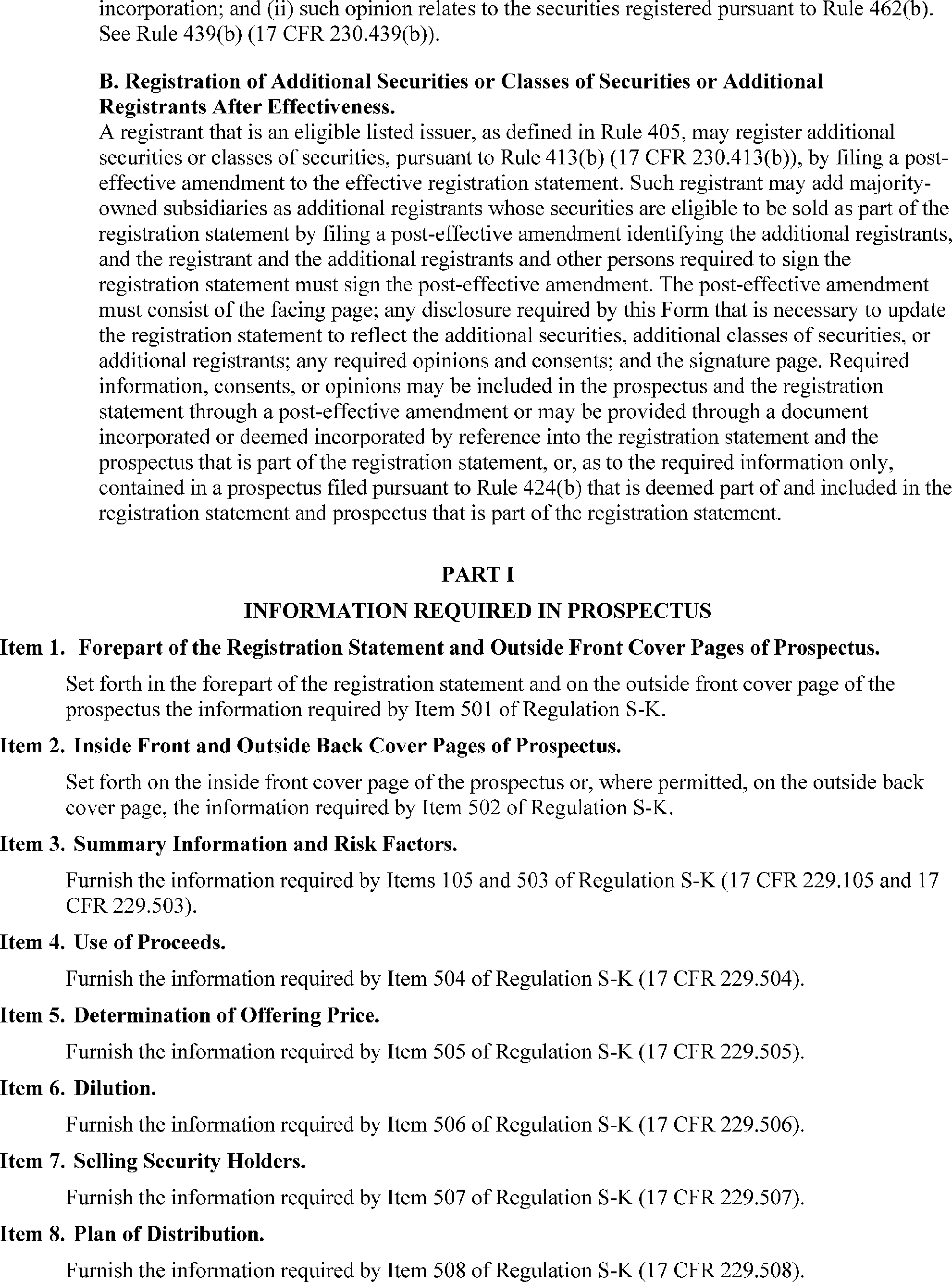
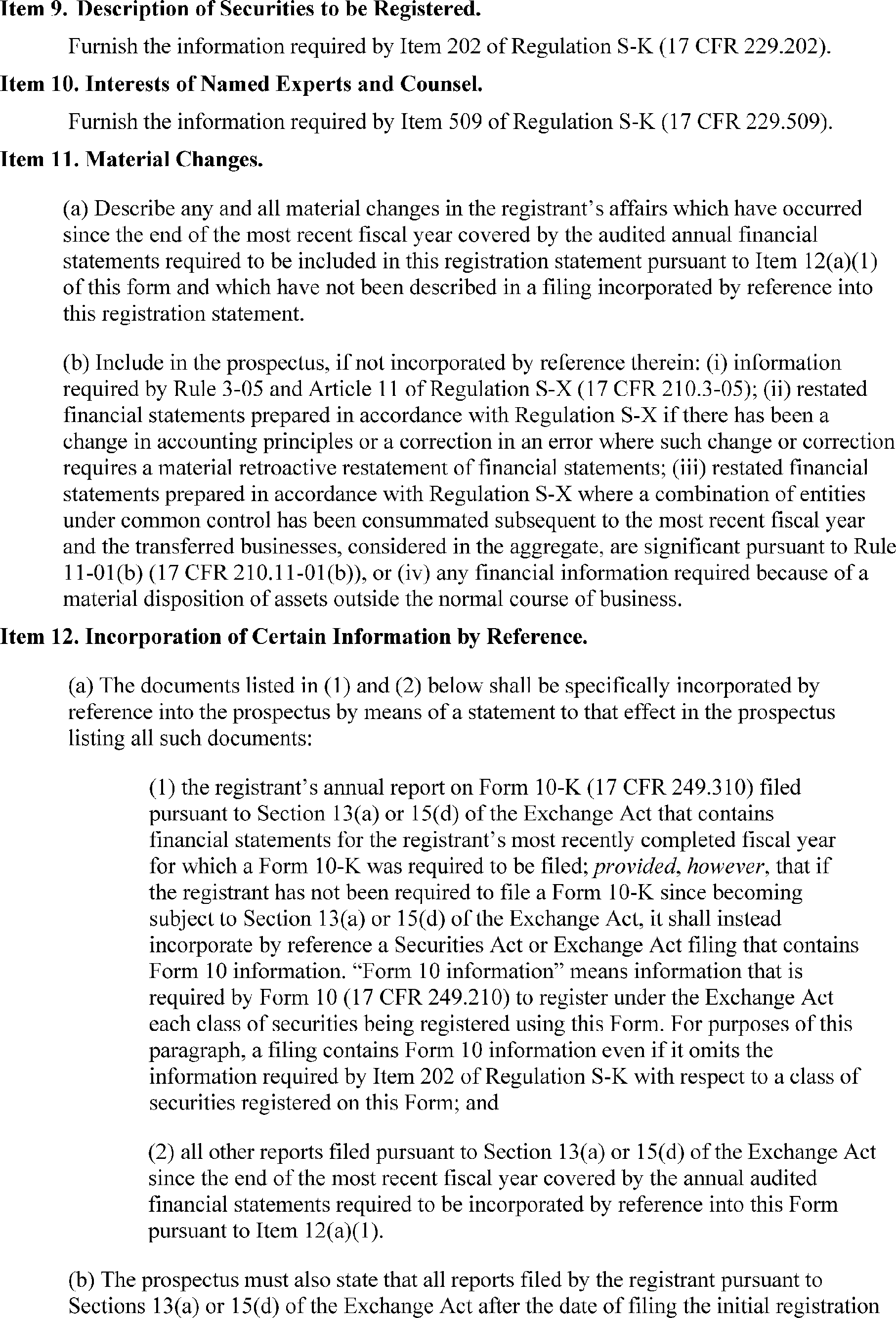
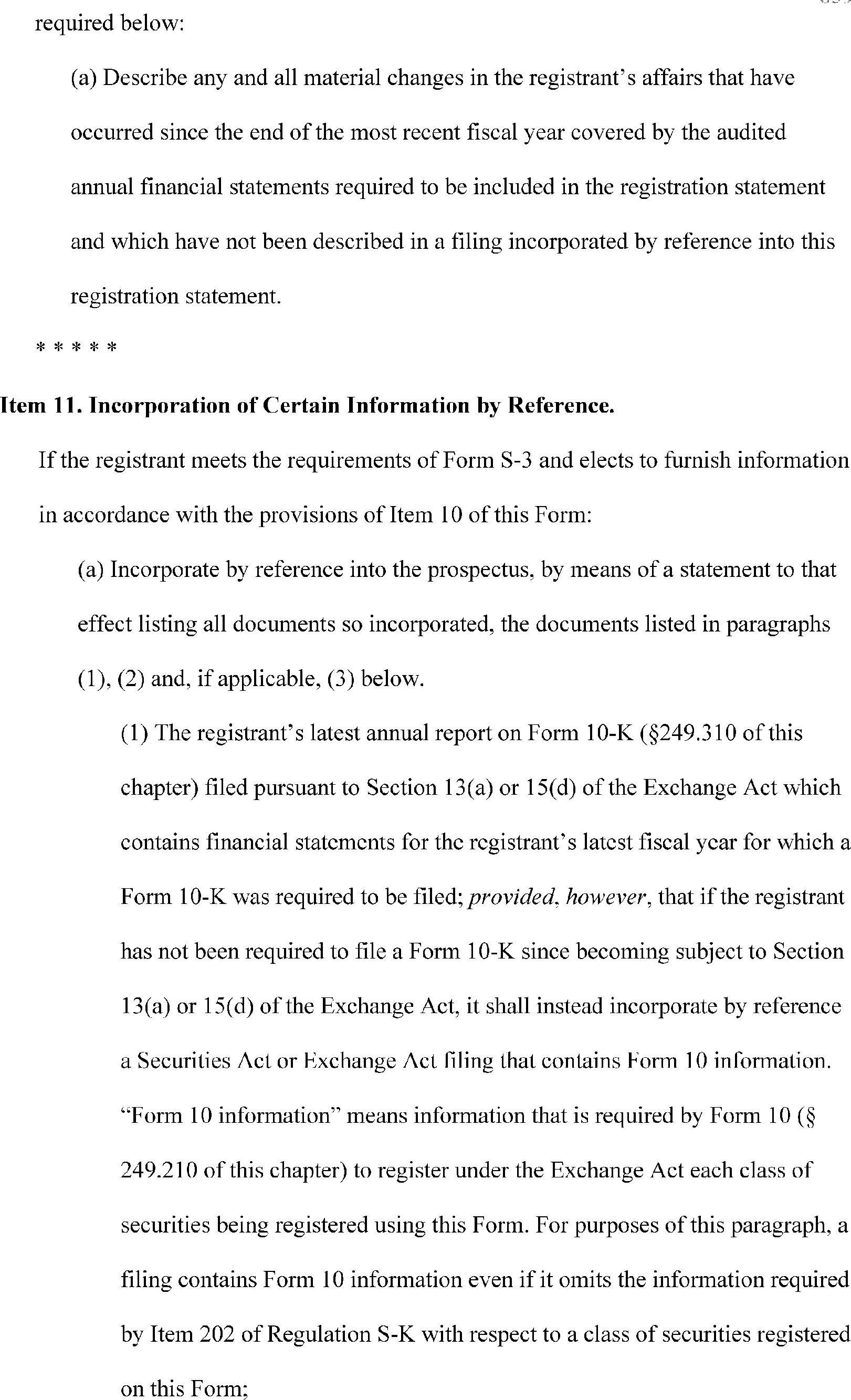
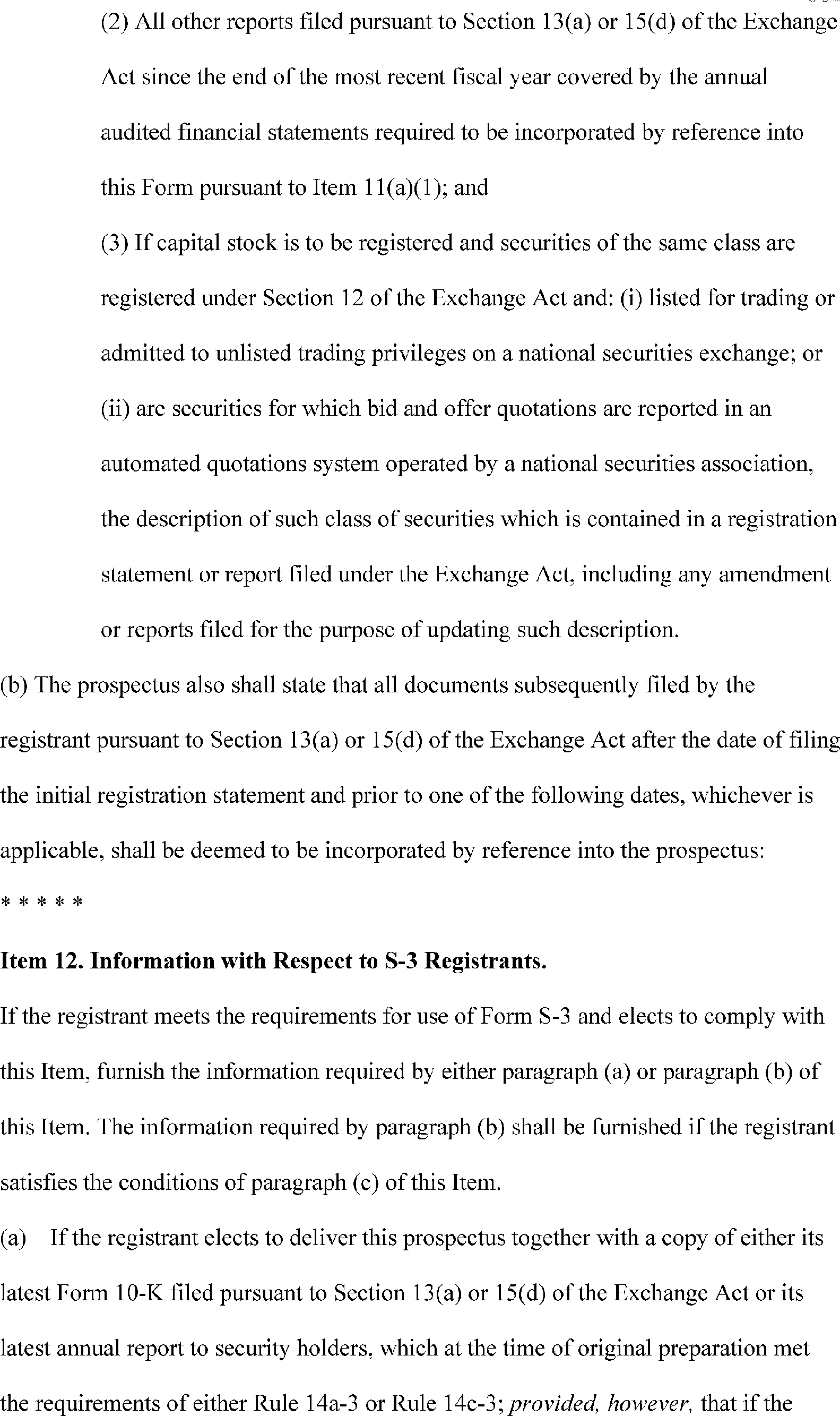
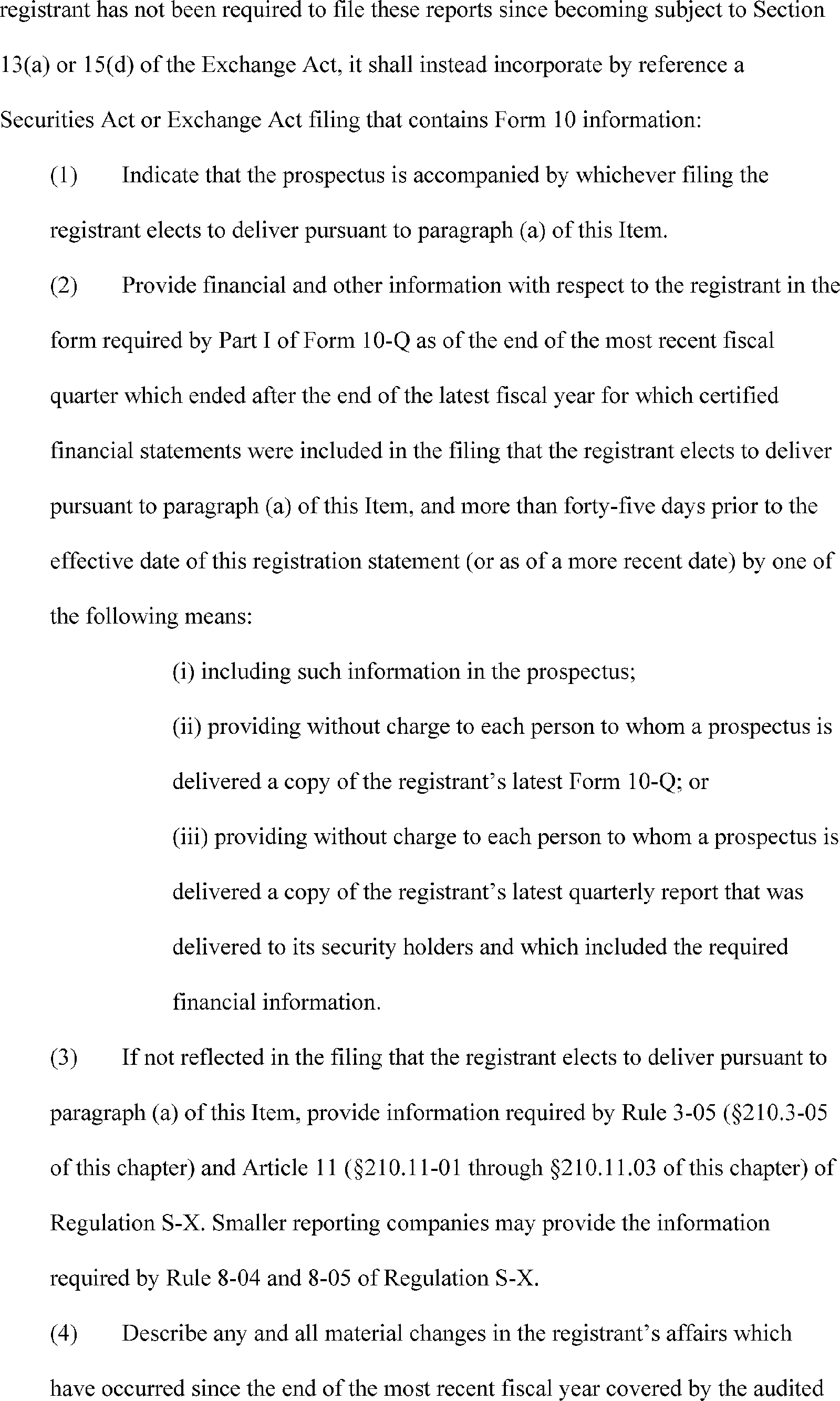
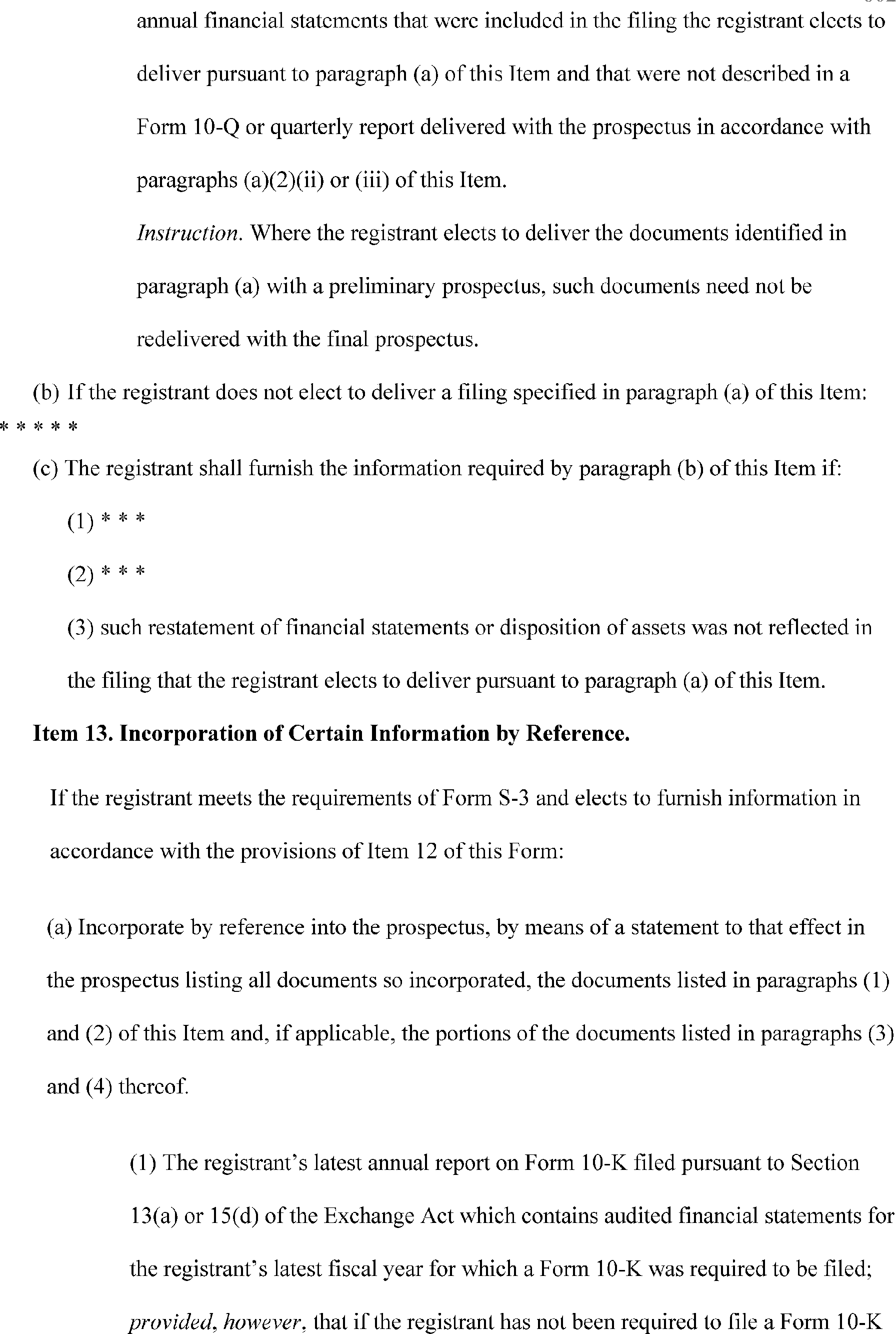
For example, currently Item 12(a)(1) of Form S-3 requires an issuer to incorporate by reference its latest annual report on Form 10-K that contains audited financial statements for the registrant's latest fiscal year for which a Form 10-K was required to be filed and any Exchange Act reports filed since the end of such fiscal year. Under the proposed amendments, an issuer that had not been required to file a Form 10-K since becoming subject to section 13(a) or 15(d) of the Exchange Act would instead incorporate by reference a Securities Act or Exchange Act filing that contains “Form 10 information” [152]
with all financial statements required by Regulation S-X. In addition, issuers would be required to provide “such further material information, if any, as may be necessary to make the required statements, in the light of the circumstances under which they are made, not misleading.” [153]
Under Item 11(a) of Form S-3 (as revised by the proposed amendments), issuers also would be required to describe any and all material changes in the issuer's affairs which have occurred since the end of the most recent fiscal year covered by the audited annual financial statements required to be included in the registration statement pursuant to Item 12(a)(1) that have not been described in a filing incorporated by reference into the registration statement. Further, to the extent an issuer had not yet been required to file a Form 10-K, Commission staff would have had the opportunity to review the information disclosed in the Securities Act or Exchange Act registration statement through which the issuer became an Exchange Act reporting company and which would be incorporated by reference into the prospectus.
Finally, other requirements under the Federal securities laws are designed to ensure investors are adequately protected and receive the information necessary to make an informed investment decision in connection with a registered securities offering. For example, under the Securities Act, anyone who acquires an issuer's securities in a registered offering has a private right of action under section 11 and a purchaser has a private right of action under section 12(a)(2). Section 11 liability exists for untrue statements of material fact or omissions of material facts required to be included in a registration statement or necessary to make the statements in the registration statement not misleading at the time the registration statement became effective.[154]
Importantly, underwriters,
( printed page 31038)
experts such as accountants, an issuer's directors, and other signatories can be held strictly liable for material misstatements or omissions; [155]
thus, these parties are incentivized to ensure an issuer's disclosures are free of material misstatements or omissions, thereby helping to protect investors.[156]
Under section 12(a)(2), sellers have liability to purchasers for offers or sales by means of a prospectus or oral communication that includes an untrue statement of material fact or omits to state a material fact necessary to make the statements made, based on the circumstances under which they were made, not misleading. Moreover, section 17(a) of the Securities Act provides, among other things, that it shall be unlawful for any person in the offer or sale of a security to obtain money or property by means of any untrue statement of a material fact or any omission to state a material fact necessary to make the statements made, in light of the circumstances under which they were made, not misleading. Thus, to the extent that there may be a higher risk of delinquency by issuers with shorter Exchange Act reporting histories, and less historical information for investors to review when an issuer has been subject to the Exchange Act's reporting requirements for a shorter period of time, the Federal securities laws generally require that issuers provide investors with information about an issuer that is necessary to make an informed investment decision and provide remedies to investors when these disclosure standards are not satisfied. We believe that investors will continue to be protected by these liability provisions of the Federal securities laws and receive material information even in the absence of an initial Exchange Act seasoning requirement.
For these reasons, we propose to eliminate the One-Year Seasoning requirement.
Request for Comment
1. We are proposing to eliminate the One-Year Seasoning requirement in General Instruction I.A.3(a) that requires an issuer to have been an Exchange Act reporting company for at least 12 calendar months before becoming eligible to use Form S-3. Should we adopt the amendment as proposed? If not, please explain why the One-Year Seasoning requirement is necessary.
2. Instead of eliminating the One-Year Seasoning requirement altogether, should we shorten the required seasoning period? If yes, what would be an appropriate seasoning period and why?
3. Notwithstanding the proposal to eliminate the One-Year Seasoning requirement, we are proposing to require issuers to be subject to the Exchange Act's reporting requirements and current and timely in their Exchange Act reporting obligations during the 12 calendar months (or such shorter period that the issuer has been subject to the Exchange Act's reporting requirements) and any portion of a month immediately preceding the filing of a Form S-3. Should we retain these requirements as proposed?
4. As discussed in section II.A.2.a.i and footnote 148 above, the proposed amendments would allow issuers to use Form S-3 and conduct shelf offerings immediately after becoming an Exchange Act reporting company. Would this aspect of the proposed amendments alter market practice with respect to initial public offerings (“IPOs”)? For example, would the proposed amendments affect the need for, or use of, an overallotment option (
i.e.,
“greenshoe”), given the proposed ability to use Form S-3 for follow-on primary offerings after the completion of the IPO? If so, are there any investor protection concerns resulting from such a change in market practice? Would the proposed amendments affect how issuers choose to go public? For example, would the proposed ability to use Form S-3 for shelf offerings immediately after becoming a reporting company affect the extent to which direct listings would be used by companies as a means of going public?
5. As discussed in footnote 55, Form S-3 currently requires (and under the proposed amendments, would continue to require) an issuer to have been timely in its Exchange Act reports “during the twelve calendar months and any portion of a month immediately preceding the filing of the registration statement.” Should we revise this standard to instead require only a 12-month (or one-year) lookback? Under this alternative approach, an issuer intending to file a Form S-3 on July 19, 2026, for example, would need to have been current and timely in its Exchange Act filings—other than specified Form 8-K reports—from July 19, 2025 through July 19, 2026 (rather than from July 1, 2025 through July 19, 2026). Why or why not?
6. We are proposing to amend Form S-3's instructions to provide that an issuer would remain eligible to use the form notwithstanding an untimely filing having been made during the relevant lookback period so long as: (a) the filing was made within seven calendar days of the original due date and (b) the issuer had only one untimely filing during the relevant lookback period. Should we adopt the amendment as proposed? Would a shorter or longer period than seven calendar days be appropriate? For example, should the period be 10 business days rather than seven calendar days? Are there other conditions that we should include in this proposed instruction?
7. Under the proposed amendments, an issuer would be required to be subject to the Exchange Act's reporting requirements. Should issuers that voluntarily comply with the reporting requirements of section 13(a) or 15(d) be eligible to use Form S-3 if they have filed all reports and materials that would otherwise be required of an issuer subject to the Exchange Act's reporting requirements?
8. Should we amend our rules to require reassessing of Form S-3 eligibility each time an issuer conducts a shelf takedown to help ensure issuers remain current and timely and investors have available all required information at the time they make an investment decision?
9. Under the proposed amendments to Item 12(a)(1) of Form S-3, an issuer that was not yet required to file a Form 10-K since becoming subject to section 13(a) or 15(d) of the Exchange Act would instead have to incorporate by reference a Securities Act or Exchange Act filing that contains Form 10 information with respect to each class of securities to be registered on Form S-3. The term “Form 10 information” would
( printed page 31039)
be defined as the information required by Form 10 to register under the Exchange Act each class of securities to be registered on the Form S-3. The proposed amendments also would provide that a filing contains Form 10 information even if it omits the information required by Item 202 of Regulation S-K with respect to a class of securities registered on this Form. Should we adopt the amendments as proposed? Is it necessary to specify that the Form 10 information need not include the information required by Item 202 of Regulation S-K? Should similar treatment be permitted for other Form 10 disclosure requirements? Why or why not?
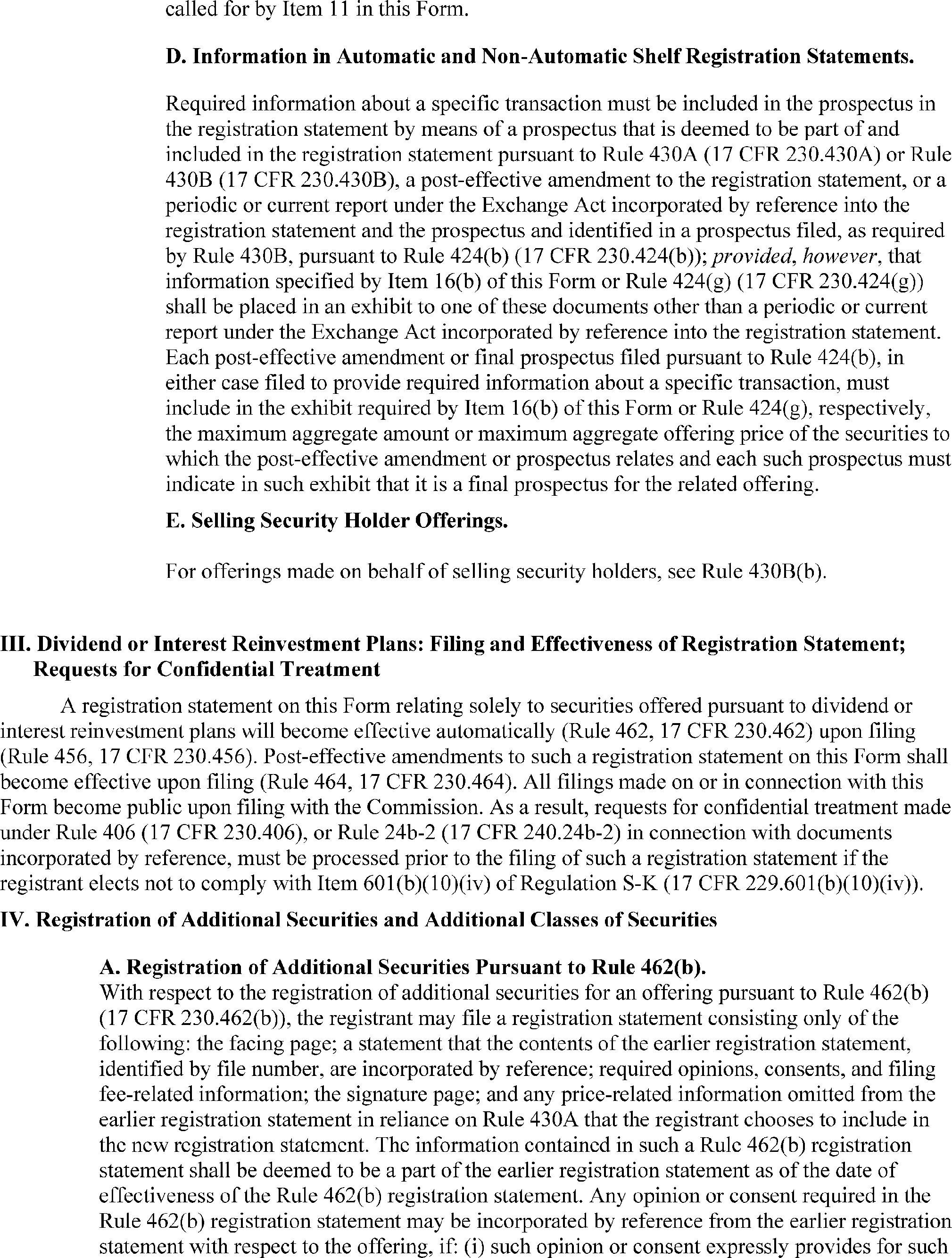
10. We propose to amend Item 12(b) of Form S-3 to eliminate the requirement for forward incorporation by reference of proxy or information statements, or other material, filed under section 14(a) or 14(c) of the Exchange Act. We also propose to eliminate Item 12(b)'s reference to section 13(c) of the Exchange Act. Should we adopt the amendments as proposed?
11. We propose to amend Item 12(b) of Form S-3, consistent with prior staff guidance, to clarify that all Exchange Act reports filed pursuant to sections 13(a) and 15(d) “after the date of filing the initial registration statement and prior to the termination of the offering” would be deemed to be incorporated by reference into the prospectus. Should we adopt the amendment as proposed?
12. We propose to amend Item 12(d) of Form S-3, which currently permits the information required in response to Items 3 through 11 of the form to be incorporated by reference from filings made pursuant to section 13(a), 14, or 15(d) of the Exchange Act, to permit such information to be incorporated from any Securities Act or Exchange Act filing. Should we adopt the amendment as proposed?
ii. Certain Failures To Make Payments and Defaults
We propose to eliminate the “Certain Failures to Make Payments and Defaults” requirement for Form S-3 eligibility. As explained in section II.A.1 above, the Commission initially conditioned short-form registration on satisfaction of certain factors addressing the “quality” of the issuer, among other requirements. Over time, however, the Commission reduced or eliminated certain of those requirements.[157]
In 1982, when the Commission adopted Form S-3, it kept the Certain Failures to Make Payments and Defaults requirement from Form S-7 without explanation.[158]
The Commission had previously expressed the view that qualitative requirements are not appropriate criteria for short-form eligibility.[159]
Specifically, in 1981, after seeking comment on whether to prohibit issuers that were “financially troubled” from using Form S-2, the Commission explained that “the use of tests measuring the ‘quality of a registrant’ . . . is inconsistent with the basic precept of registrant classification under Forms S-3, S-2, and S-1, namely, the extent information about a registrant has been disseminated in the marketplace and the accuracy of such information.” [160]
We believe that eliminating this criterion is consistent with the Commission's prior statement.
We agree with the Commission's 1981 statement and, therefore, are proposing that Form S-3 eligibility no longer be conditioned on an issuer satisfying the Certain Failures to Make Payments and Defaults requirement. We view that requirement as the type of qualitative measure the Commission previously deemed inappropriate. In our view, such criteria are inconsistent with the principle of short-form registration, and Form S-3 eligibility should instead focus on an issuer's status as a current and timely Exchange Act reporting company.
We also believe a specific eligibility requirement in Form S-3 related to defaults on financial obligations is unnecessary because the Commission's disclosure requirements should provide investors with the information necessary to evaluate an issuer's financial health. For example, issuers are required to provide financial statements covering a minimum of two fiscal years [161]
and to accompany such financial statements with management's discussion and analysis that “provide[s] material information relevant to an assessment of the financial condition and results of operations of the registrant including an evaluation of the amounts and certainty of cash flows from operations and from outside sources.” [162]
Issuers also are required to file a Form 8-K within four business days of certain types of defaults, including specified defaults in connection with various off-balance sheet arrangements.[163]
In addition, issuers must disclose information about dividends paid on preferred stock (and other equity securities) as well as certain default-related matters, including defaults in principal, interest, sinking fund provisions, or redemption provisions with respect to any issue of securities or credit agreements, or any breach of covenant of a related indenture or agreement.[164]
Accordingly, investors should have the information necessary about an issuer's financial condition, including defaults, to make an informed investment decision with respect to offerings conducted by that issuer pursuant to Form S-3, making the Certain Failures to Make Payments and Defaults requirement superfluous.
Request for Comment
13. Should the Commission eliminate the Certain Failures to Make Payments and Defaults requirement, as proposed? If not, please explain why.
iii. Electronic Filings and Interactive Data Files
We propose to eliminate the Electronic Filings and Interactive Data Files requirements. General Instruction I.A.7(a) conditions Form S-3 eligibility on an issuer having “[f]iled with the Commission all required electronic filings.” This provision was added to Form S-3 in connection with EDGAR's implementation in 1993, which required issuers to file their registration statements and reports electronically on EDGAR.[165]
General Instruction I.A.7(b) requires an issuer to have “[s]ubmitted electronically to the Commission all Interactive Data Files required to be submitted pursuant to [17 CFR 232.405] . . . during the twelve calendar months and any portion of a month immediately preceding the filing of the registration statement on this Form.” This provision was added to Form S-3 in connection with the Commission's initial adoption of the Interactive Data File requirements in 2009.[166]
Each of these provisions
( printed page 31040)
appears to have been added to the registrant requirements of Form S-3 to incentivize compliance with newly adopted Commission rules; specifically, the transition from paper to electronic filings and the requirement to provide structured data in an Interactive Data File for the first time.[167]
We are proposing to eliminate these registrant requirements because we believe they are no longer necessary. While the electronic filing provision may have helped encourage issuers who had been accustomed to making their filings in paper to instead make their filings electronically when EDGAR was first introduced more than 30 years ago, we believe issuers are now fully accustomed to the electronic filing process, and we are not aware of issuers commonly attempting to submit mandated electronic filings in paper. Today, all companies must make their Commission filings electronically through EDGAR, and mandated electronic filings are not accepted in paper form, absent a hardship exemption.[168]
In addition, a mandated electronic Exchange Act report that was submitted in paper would not be considered to have been filed with the Commission unless a hardship exemption applied; if resubmitted electronically after the requisite deadline, such material would be untimely, and the issuer may be ineligible to use Form S-3.[169]
For these reasons, we believe the electronic filing provision in General Instruction I.A.7(a) is no longer necessary as a condition to Form S-3 eligibility.[170]
We also believe that the Interactive Data File provision is no longer necessary to induce compliance with the Commission's Interactive Data File requirements. Since 2009, the Commission's rules have required companies to provide the information from the financial statements in their registration statements and periodic and current reports in structured format using eXtensible Business Reporting Language (“XBRL”).[171]
In 2018, the Commission began requiring the use of Inline XBRL for financial statement information.[172]
Subsequently, the Commission has required additional disclosures to be made using XBRL and Inline XBRL.[173]
We believe issuers are now sufficiently accustomed to complying with the Commission's Interactive Data File requirements such that conditioning Form S-3 eligibility on compliance with these requirements is no longer necessary. Accordingly, we propose to eliminate this Form S-3 eligibility requirement.[174]
Request for Comment
14. We are proposing to eliminate the registrant requirements in General Instruction I.A.7 of Form S-3 that require an issuer to have filed with the Commission all electronic filings and Interactive Data Files. Should we adopt the amendments as proposed? If not, please explain why.
iv. Prohibition on Use of Form S-3 by Certain Ineligible Issuers
Although the proposed amendments would extend the benefits of Form S-3 and shelf registration to a broader group of issuers, we seek to do so only to the extent the amendments are consistent with investor protection. We do not believe it is appropriate to expand Form S-3 eligibility to certain categories of issuers that may pose greater potential for non-compliance with the Federal securities laws. Accordingly, in addition to conditioning Form S-3 eligibility on an issuer being an Exchange Act reporting issuer that is current and timely with respect to its Exchange Act filings, the proposed amendments also would prohibit certain “ineligible issuers,” as defined in Rule 405, from using the form.[175]
Under proposed new General Instruction I.A.2 (which would be titled “Prohibition on Use of Form S-3 by Certain Ineligible Issuers”), an issuer would not be eligible to use Form S-3 if:
The issuer is a “BSP issuer,” which the proposed amendments would define in Rule 405 as an issuer that is, or during the past three years the issuer or any of its predecessors was: (1) a blank check company as defined in17 CFR 230.419(a)(2) (“Rule 419(a)(2)”); [176]
(2) a shell company, other than a business combination related shell company, each as defined in Rule 405,[177] provided, however,
that an issuer, other than a foreign private issuer, as defined in Rule 405,[178]
would not be deemed to be a
( printed page 31041)
shell company solely because during the past three years either the issuer or any of its predecessors was a “special purpose acquisition company (SPAC),” as defined in 17 CFR 229.1601(b) (“Item 1601 of Regulation S-K”); [179]
or (3) an issuer in an offering of penny stock as defined in 17 CFR 240.3a51-1; [180]
Within the past three years, the issuer or any entity that at the time was a subsidiary [181]
of the issuer was convicted of any felony or misdemeanor described in paragraphs (i) through (iv) of section 15(b)(4)(B) of the Exchange Act; [182]
Within the past three years, the issuer or any entity that at the time was a subsidiary of the issuer was made the subject of any judicial or administrative decree or order arising out of a governmental action that: (1) prohibits certain conduct or activities regarding, including future violations of, the antifraud provisions of the Federal securities laws; (2) requires that the person cease and desist from violating the antifraud provisions of the Federal securities laws; or (3) determines that the person violated the antifraud provisions of the Federal securities laws;provided, however,
that an issuer only would be ineligible to use Form S-3 under this provision if the prohibition, requirement, or determination is based on an untrue, false, or misleading statement of a material fact or an omission to state a material fact necessary in order to make the statements made, in light of the circumstances under which they were made, not misleading, in each case in violation of the applicable antifraud provision and arising from a registration statement filed under the Securities Act, the Investment Company Act, or section 12 of the Exchange Act, any offering materials provided to purchasers in connection with an offering exempt from the registration requirements of the Securities Act, or a filing required by section 13(a), 14(a), 14(c), or 15(d) of the Exchange Act or the Commission's rules thereunder; [183]
The issuer has filed a registration statement that is the subject of any pending proceeding or examination under section 8 of the Securities Act or has been the subject of any refusal order or stop order under section 8 of the Securities Act within the past three years; [184]
or
The issuer is the subject of any pending proceeding under section 8A of the Securities Act in connection with an offering.[185]
These categories of issuers have been viewed historically as unsuited for certain types of short-form registration and other offering-related accommodations or ineligible for certain disclosure-related relief.[186]
For instance, the Commission has stated that penny stock and blank check offerings, as well as shell companies, may give rise to certain disclosure and offering-related abuses.[187]
In addition, Congress has expressed concerns with these issuers and imposed limits on their ability to utilize certain disclosure and offering-related benefits.[188]
Congress and the Commission also have imposed restrictions on certain felons and other bad actors in connection with certain types of securities offerings when deemed necessary and appropriate.[189]
For example, the offering exemptions
( printed page 31042)
under Regulation D,[190]
Regulation A,[191]
and Regulation Crowdfunding [192]
are unavailable for an offering by an issuer if, among other things, an issuer, any of its predecessors, or any affiliated issuer is subject to certain administrative orders, industry bars, injunctions involving certain securities law violations, or specified criminal convictions.[193]
As noted above,[194]
a “BSP issuer,” as we propose to define that term in Rule 405, would be prohibited from using Form S-3. Under the proposed amendments, however, an issuer that otherwise would be barred from using Form S-3 solely because it or its predecessor was a “special purpose acquisition company (SPAC),” as defined in Item 1601(a) of Regulation S-K, during the prior three years would be excepted from the three-year lookback for shell companies and, therefore, able to use Form S-3 if it was not a shell company at the time the issuer filed the form. In our view, former SPACs (which initially were formed specifically for the purpose of identifying a private target and that have successfully completed a de-SPAC transaction by combining with such a target) should be eligible to use Form S-3 to the same extent as a newly public company that conducted a traditional IPO. This is consistent with the Commission's stated goal when it adopted rules for SPACs in 2024.[195]
Accordingly, issuers that otherwise would be barred from using Form S-3 solely because of their former SPAC status would be eligible to use the form, assuming they satisfied the form's other eligibility requirements.[196]
In addition, as noted above,[197]
an issuer would be prohibited from using Form S-3 if, within the past three years, either the issuer or one of its subsidiaries was the subject of certain judicial or administrative decrees or orders arising out of governmental actions. Under the proposed amendments, however, for purposes of Form S-3 eligibility, an issuer would be an “ineligible issuer” under paragraph (vi) of the definition in Rule 405 only if the relevant prohibition, requirement, or determination is based on an untrue, false, or misleading statement of a material fact or an omission to state a material fact necessary in order to make the statements made, in light of the circumstances under which they were made, not misleading, in each case in violation of the applicable antifraud provision and arising from a registration statement filed under the Securities Act, the Investment Company Act, or section 12 of the Exchange Act, any offering materials provided to purchasers in connection with an offering exempt from the registration requirements of the Securities Act, or a filing required by section 13(a), 14(a), 14(c), or 15(d) of the Exchange Act or the Commission's rules thereunder. This proposed amendment reflects our belief that Form S-3 eligibility should depend on whether investors can readily obtain issuer-specific information to make an informed investment decision. As such, the proposed amendment is intended to limit application of paragraph (vi) of the definition of “ineligible issuer,” for purposes of Form S-3 eligibility, to the types of antifraud violations that are most likely to suggest that the issuer may pose a greater risk of non-compliance with Exchange Act reporting requirements (
i.e.,
disclosure-based violations arising out of a registration statement, offering materials provided to purchasers in connection with an exempt offering, or certain Exchange Act filings).[198]
Although Form S-3 has not previously included a disqualifying provision similar to proposed new General Instruction I.A.2 (with the exception of shell companies being unable to rely on General Instruction I.B.6), we believe it would be appropriate for the protection of investors to prohibit the specified categories of issuers from using Form S-3.[199]
This is due to the additional accommodations that would be afforded by our proposed amendments and our view that these categories of issuers may pose a greater risk of non-compliance with Exchange Act reporting requirements and, therefore, present greater potential for abuse. We believe these types of issuers, therefore, should not be eligible to conduct offerings that are not subject to staff review (
i.e.,
shelf offerings). Instead, we believe the staff should have the opportunity to review those issuers' offerings (by requiring, for example, those issuers to use Form S-1 rather than Form S-3), as staff review may mitigate risks of non-compliance and potential abuse. In proposing these restrictions on the use of Form S-3, we note that some commenters have previously stated that excluding certain categories of issuers from specific registration and other offering-related benefits is appropriate.[200]
Although we recognize that the proposed amendment would not eliminate all potential risks that may arise from the proposed expansion of Form S-3, we believe this restriction would address a significant area of risk.
The Commission has adopted a number of measures over the years to address concerns related to certain types of “BSP issuers.” Examples include Rule 419, which imposes certain
( printed page 31043)
requirements on offerings by blank check companies issuing penny stock, prohibitions on the use of Form S-8 by shell companies,[201]
restrictions on the ability to rely on 17 CFR 230.144 to resell restricted securities,[202]
deemed underwriter status for certain parties involved in business combination transactions involving a shell company,[203]
and the imposition of specific disclosure requirements for an issuer that completes a transaction that causes it to cease being a shell company.[204]
We believe, however, that those types of provisions do not address the higher risk of non-compliance with Exchange Act reporting requirements that these issuers present. For that reason, we are proposing to prohibit the use of Form S-3 by BSP issuers. We seek comment on the appropriateness of the proposed amendments, including whether each category of issuer we have identified should be prohibited from using Form S-3 and whether the three-year lookback period that applies to certain types of issuers is necessary.[205]
Request for Comment
15. We are proposing to prohibit use of Form S-3 by certain “ineligible issuers,” including BSP issuers, issuers previously convicted of certain felonies and misdemeanors, issuers subject to a decree or order involving a violation of the antifraud provisions of the Federal securities laws, issuers that have been subject to any refusal order or stop order under section 8 of the Securities Act within the past three years, and issuers that are subject to pending proceedings or examinations under section 8 or 8A of the Securities Act. Should we adopt the amendments as proposed? If not, please explain why and suggest alternative methods for protecting investors the Commission could consider.
16. Alternatively, should these issuers be permitted to use Form S-3 if they meet the other conditions of the Form, but not be permitted to avail themselves of the Enhanced Registration and Communication Benefits that we propose to extend to Form S-3 eligible issuers, as discussed in section II.B.2 below?
17. Are there any categories of issuers we are proposing to prohibit from using Form S-3 that should not be prohibited solely on the basis of issuer type? Are there any categories of issuers we are not proposing to prohibit from using Form S-3 that should be excluded?
18. Under the proposed amendments, certain ineligible issuers would not be eligible to use Form S-3 until three years after the issuer had ceased being a “BSP issuer,” or since the date of the issuer's conviction of the enumerated felonies and/or misdemeanors, or since the date the issuer had entered into a decree or order involving a violation of the antifraud provisions of the Federal securities laws, or since the date of any refusal or stop order under section 8 of the Securities Act. We note that under current Instruction I.B.6 of Form S-3, there is only a one-year lookback period regarding shell company status. Is the proposed three-year prohibition appropriate? Would a shorter or longer ineligibility period be more appropriate?
19. If we adopt the proposed prohibition on the use of Form S-3 by certain ineligible issuers, should issuers be ineligible to use Form S-3 based on actions that occurred before the date on which the requirement becomes effective? Or, similar to certain disqualification provisions for Regulation A in 17 CFR 230.262, should an issuer only be ineligible based on actions that occurred on or after the date on which the requirement becomes effective? If we did limit the prohibition to actions that occurred on or after the date on which the requirement becomes effective, how would that affect an issuer's eligibility for the Enhanced Registration and Communication Benefits, given the fact that in order to be eligible for all of those benefits today as a WKSI, an issuer must not be an “ineligible issuer”?
20. Should other types of issuers, other than those we have identified, be ineligible to use Form S-3? For example, should issuers that are the subject of a going concern audit opinion or those in bankruptcy be ineligible to use the form? Would such requirements be consistent with the Commission's previously expressed views that factors related to the quality of an issuer are not appropriate considerations for Form S-3 eligibility, as discussed in section II.A.2.a.ii above?
21. If the proposed amendments were adopted, should issuers that were Form S-3 eligible prior to adopting the amendments remain eligible to use the form with respect to any existing effective Form S-3 registration statement even if they fall within one of the categories of ineligible issuer at the time the new rules become effective? Alternatively, should there be a transition period during which such issuers would retain their Form S-3 eligibility but after which their eligibility would be assessed anew? If so, what is the appropriate duration of such transition period?
22. Under the proposed amendments, an issuer that was formerly a SPAC would be excepted from the three-year lookback for shell companies and, therefore, eligible to use Form S-3 if the issuer was not a SPAC at the time of filing the registration statement, had not otherwise previously been a shell company, and otherwise met the form's requirements. Should we adopt the amendment as proposed? Should SPACs be eligible to use Form S-3 prior to identifying a target and completing a de-SPAC transaction notwithstanding their shell company status?
23. Form S-8 prohibits issuers from using the form if they are a shell company or if they were a shell company during the previous 60 calendar days. Should we carve out former SPACs from this 60-calendar day lookback period in Form S-8, similar to the carveout for former SPACs in the proposed definition of BSP issuer?
24. Under the proposed new Form S-3 eligibility criteria, an issuer would be ineligible to use Form S-3 if, within the past three years, the issuer or any entity that at the time was a subsidiary of the issuer was convicted of certain felonies or misdemeanors or was made the subject of judicial or administrative decrees or orders arising out of certain governmental actions. Should this criterion apply to both the issuer and its subsidiaries, as proposed, or should it apply only to the issuer itself? Alternatively, should it apply to certain, but not all, subsidiaries? If so, how should we differentiate between subsidiaries?
25. Under the proposed amendments, for purposes of Form S-3 and Short-Form N-2 eligibility, an issuer would be an “ineligible issuer” under paragraph (vi) of the definition in Rule 405 only if the relevant prohibition, requirement, or determination is based on an untrue, false, or misleading statement of a material fact or an omission to state a material fact necessary in order to make the statements made, in light of the circumstances under which they were made, not misleading, in each case in violation of the applicable antifraud provision and arising from a registration
( printed page 31044)
statement filed under the Securities Act, the Investment Company Act, or section 12 of the Exchange Act, any offering materials provided to purchasers in connection with an offering exempt from the registration requirements of the Securities Act, or a filing required by section 13(a), 14(a), 14(c), or 15(d) of the Exchange Act or the Commission's rules thereunder. Should we adopt this amendment as proposed? Would the proposed amendments limit application of paragraph (vi) of the definition of “ineligible issuer,” for purposes of Form S-3 and Short-Form N-2 eligibility, to the types of antifraud violations that are most likely to suggest that the issuer may pose a greater risk of non-compliance with Exchange Act reporting requirements (
i.e.,
disclosure-based violations arising out of a registration statement, offering materials provided to purchasers in connection with an exempt offering, or certain Exchange Act filings), as intended? In addition to the registration statements and Exchange Act filings enumerated in the proposed amendment, for purposes of Form S-3 and Short-Form N-2 eligibility, should paragraph (vi) of the definition of “ineligible issuer” also cover prospectuses that do not form part of a registration statement (
e.g.,
free writing prospectuses)? Finally, for purposes of Form S-3 and Short-Form N-2 eligibility, paragraph (vi) of the definition of “ineligible issuer” would apply to antifraud violations arising out of disclosures in reports that are both “furnished” and “filed” with the Commission. Should we instead limit the applicability of paragraph (vi) of the definition of “ineligible issuer,” for purposes of Form S-3 and Short-Form N-2 eligibility, to only antifraud violations arising out of reports that are “filed”?
26. Under Rule 405, an issuer may seek a waiver of ineligible issuer status “upon a showing of good cause that it is not necessary under the circumstances that the issuer be considered an ineligible issuer.” Currently, issuers may seek such waivers for purposes of qualifying as a WKSI. As discussed in footnote 175, under the proposed amendments, issuers would be able to seek such waivers for purposes of Form S-3 eligibility. Should issuers be permitted to request such a waiver for purposes of Form S-3 eligibility, as proposed? Is there an alternative approach we should take that would avoid the need for such waivers? For example, should issuers remain eligible to use Form S-3 despite being classified as an ineligible issuer, provided they have not held that status during a specified prior period? If so, what would be an appropriate lookback period? Are there other alternatives we should consider?
v. Prohibition on Use of Form S-3 by Certain Other Issuers
We are proposing new General Instruction I.A.3, which would be titled “Prohibition on Use of Form S-3 by Certain Other Issuers.” The proposed instruction would prohibit the following types of issuers from using Form S-3: (1) a foreign government (or a political subdivision thereof) or a foreign private issuer (“FPI”) as those terms are defined in Rule 405; (2) an asset-backed issuer, as defined in 17 CFR 229.1101(b); (3) an investment company, as defined in 15 U.S.C. 80a-3(a)(1); and (4) a BDC, as defined in 15 U.S.C. 80a-2(a)(48). Under the proposed instruction, these types of issuers would be prohibited from using Form S-3 at any time, including at the time of any offering registered on the form.[206]
As to FPIs, current General Instruction I.A.5 of Form S-3 allows foreign issuers, other than foreign governments, to use Form S-3 if they satisfy all the registrant requirements, other than the “U.S. Issuer” requirement,[207]
provided they file the same reports with the Commission under section 13(a) or 15(d) of the Exchange Act as a domestic registrant. Foreign issuers that qualify as FPIs are permitted to use Form S-3 if they satisfy this instruction.[208]
We are proposing to prohibit FPIs from using Form S-3 through proposed new General Instruction I.A.3 in light of the FPI Concept Release.[209]
Given our ongoing evaluation in this area, we believe it is prudent not to extend the benefits of the proposed amendments to FPIs at this time, prior to completion of our more comprehensive review of the FPI framework. We seek comment on whether to adopt the instruction as proposed. We believe, however, there would be minimal impact from the proposed amendment. For example, we note that very few FPIs currently are eligible to use Form S-3.[210]
Further, under our proposed amendments, FPIs would continue to be able to use Form F-3, which is available only to FPIs.[211]
This includes both FPIs that report on FPI-specific Exchange Act forms (
e.g.,
Form 20-F and Form 6-K) and FPIs that report on domestic Exchange Act forms (
e.g.,
Form 10-K, Form 10-Q, and Form 8-K). Form F-3 has eligibility requirements similar to current Form S-3, including registrant requirements [212]
and transaction requirements.[213]
And, notably, Form F-3 provides eligible issuers with benefits similar to Form S-3, including short-form and shelf registration.[214]
Thus, we
( printed page 31045)
believe the continued availability of Form F-3 would further mitigate any impact from the proposed amendment prohibiting FPIs from using Form S-3.
As to asset-backed issuers, the proposed amendment is intended to preserve the prohibition on the use of Form S-3 for offerings of asset-backed securities that appears in current General Instruction I.B.5. In adopting Form SF-3,[215]
the Commission intended that such issuers would use that form (rather than Form S-3) as a short-form registration statement and to conduct shelf offerings.[216]
Finally, as to investment companies and BDCs, Form S-3 currently does not expressly prohibit such issuers from using the form. These issuers, however, must use other forms adopted by the Commission for investment companies and BDCs.[217]
Request for Comment
27. Should we adopt General Instruction I.A.3 as proposed?
28. As discussed in footnote 206, under the proposed amendments, an issuer would not be able to conduct takedowns on Form S-3 if it was not a type of ineligible issuer specified in General Instruction I.A.3 at the time it filed a Form S-3 or at the time of the update under section 10(a)(3) of the Securities Act, but subsequently became one of those issuers. Should the prohibition in General Instruction I.A.3 apply at any time, as proposed, rather than being assessed only at the time of the filing of a Form S-3 and at the time of the update under section 10(a)(3) of the Securities Act?
29. We are proposing to amend Form S-3 to no longer allow FPIs to use the form. Should we adopt the amendment as proposed? If not, please explain why.
30. We note that very few FPIs appear to be eligible to use Form S-3 currently. Would there be significant disruptions to those FPIs who are currently eligible if we were to amend Form S-3 to no longer allow them to use the form, as proposed? Should FPIs that are currently eligible to use Form S-3 instead continue to be eligible to use the form for at least some period of time? If so, what is the appropriate time period?
31. As discussed in footnote 211, the proposed amendments would allow foreign issuers (other than foreign governments and FPIs) to remain eligible to use Form S-3 as long as they satisfy the form's eligibility requirements, in part, because those issuers are not able to use Form F-3. Should Form S-3 remain available for foreign issuers, other than foreign governments and FPIs?
vi. Successor Registrants
We are proposing to eliminate current General Instruction I.A.6 of Form S-3, which provides that successor registrants may use the form if certain conditions are met.[218]
This instruction allows a successor registrant to take into account a predecessor's Exchange Act reporting history in determining whether the successor registrant satisfies the requirements of current General Instruction I.A.3; specifically, whether the successor registrant could be treated as having been current and timely in its Exchange Act reporting obligations for a period of 12 calendar months immediately preceding the filing of a Form S-3 when the successor registrant itself has not been subject to the Exchange Act's reporting requirements for the requisite amount of time.[219]
We are proposing to eliminate this instruction because we believe it would no longer be necessary under the proposed amendments, as issuers would no longer need to have been subject to the Exchange Act's reporting requirements for a minimum amount of time before becoming eligible to use Form S-3. Nevertheless, we seek comment on whether it is appropriate to eliminate this successor registrant provision.[220]
We recognize that an issuer could become a successor registrant to a predecessor that was delinquent in its Exchange Act reporting obligations prior to or at the time of the succession. Under the proposed amendments, the successor registrant would nevertheless be eligible to use Form S-3 because the successor registrant would not be required to consider the predecessor's reporting history for purposes of determining Form S-3 eligibility.[221]
Although a successor registrant would succeed to the predecessor's Exchange Act reporting obligations,[222]
the successor registrant would be treated as a new Exchange Act reporting company for purposes of determining Form S-3 eligibility and, accordingly, would only need to consider its own Exchange Act reporting history.[223]
Request for Comment
32. We are proposing to eliminate the successor registrant provision currently in General Instruction I.A.6 of Form S-3. Should we adopt the amendment as proposed? If not, please explain why.
33. Under the proposed amendments, a successor registrant would not be required to take into account a predecessor's reporting history for purposes of determining Form S-3 eligibility. Accordingly, an issuer that becomes a successor registrant to a predecessor that was delinquent in its Exchange Act reporting obligations would nevertheless be eligible to use Form S-3 as long as the successor registrant was current and timely in making its Exchange Act filings. Should we instead require a successor registrant to take into account a predecessor's reporting history when determining Form S-3 eligibility? Does the proposed approach (
i.e.,
not requiring a successor registrant to take into account a predecessor's reporting history) create the potential for abuse by an issuer seeking to regain Form S-3 eligibility more quickly? Would either the proposed approach or the alternative approach (
i.e.,
requiring a successor registrant to take into account a predecessor's reporting history) result in unnecessary complexity and subsequent requests for interpretive guidance?
b. Form S-3 Transaction Requirements
In addition to the proposed amendments to the registrant requirements described in section II.A.2.a above, we are proposing to eliminate Form S-3's transaction requirements that currently appear in General Instruction I.B such that any issuer that meets the proposed registrant
( printed page 31046)
requirements would be eligible to use Form S-3.[224]
Currently, issuers are eligible to register offerings on Form S-3 if they satisfy the registrant requirements and at least one of the transaction requirements. One of the transaction requirements is that an issuer's public float is $75 million or more.[225]
Issuers that satisfy the registrant requirements and the $75 million public float requirement can register any primary or secondary offering for cash on Form S-3. Issuers that do not satisfy the $75 million public float requirement may nevertheless register certain transactions on Form S-3, as discussed in section II.A.1.a above, if they satisfy one of the other transaction requirements. In light of our proposal to eliminate the $75 million public float requirement, we also are proposing to eliminate the other transaction requirements of Form S-3 because those requirements would become unnecessary, as they are relevant only for issuers that do not meet the current $75 million public float requirement. We first address our proposed elimination of the public float requirement, and then we address our proposed elimination of the other transaction requirements.
i. $75 Million Public Float
We are proposing to eliminate the $75 million public float requirement in current General Instruction I.B.1. As discussed in section II.A.1.b above, the Commission historically relied on a minimum public float requirement as a proxy for whether an issuer was widely followed and, in turn, whether information about the issuer disclosed in Exchange Act reports rather than in the prospectus had been sufficiently disseminated into the marketplace such that short-form registration was appropriate. We now believe, however, that Form S-3 eligibility should be based on the ability to readily obtain issuer-specific information in Exchange Act reports and not, in part, on the amount of an issuer's public float. For the same reasons as discussed in section II.A.2.a above, we believe the ability to obtain such information depends on whether an issuer is current and timely with respect to its reporting obligations. Thus, under the proposed amendments, an issuer that satisfies the registrant requirements—including the Current and Timely in Exchange Act Reporting requirements—would be eligible to use Form S-3 for any primary or secondary offering of the issuer's securities, without regard to the amount of its public float.[226]
The proposed amendment is intended to facilitate capital formation in the public markets which, as noted above, may benefit issuers and investors alike.[227]
The $75 million public float requirement limits certain issuers' abilities to take advantage of the efficiencies associated with the use of Form S-3 and, as a result, may limit their ability to raise capital in a timely, efficient manner via a registered offering. Issuers that do not meet the form's eligibility requirements may look instead to other financing alternatives such as exempt offerings or registered offerings that could have less favorable terms that could create significant dilution to the shareholder base or possibly cause them to forgo certain securities offerings altogether.[228]
As noted in section I.A above, we estimate that eliminating the $75 million public float requirement could result in an increase of over 60 percent in the number of issuers eligible to offer an unlimited amount of securities on Form S-3.[229]
At the same time, when taking into account the Form S-3 registrant requirements we are proposing to retain and add, we believe that the proposed amendment would be consistent with investor protection. As noted above, we no longer believe it is necessary to rely on public float as a proxy for investors' access to an issuer's Exchange Act information for purposes of determining Form S-3 eligibility.[230]
Instead, we believe that maintaining the Current and Timely in Exchange Act Reporting requirements, as well as prohibiting certain types of issuers (as described in section II.A.2.a.v above) from using Form S-3, would help protect against potential abuses associated with the proposal to eliminate the minimum public float requirement. As compared to the existing Form S-3 eligibility requirements, we believe the proposed amendments would better balance the goals of protecting investors without unduly inhibiting capital formation.
We recognize that when the Commission amended Form S-3 in 2007 to permit limited primary offerings by certain issuers whose public float was less than $75 million,[231]
the
( printed page 31047)
Commission considered whether to eliminate the $75 million public float requirement altogether and decided to retain it.[232]
The Commission highlighted certain investor protection concerns associated with eliminating altogether the $75 million minimum public float requirement and determined that the requirement reflected an appropriate balance between capital formation with investor protection. As discussed above, the proposed amendments are intended to reflect the Commission's experience since it last adopted or amended the rules, including a reassessment of how best to achieve investor protection in a manner that does not unduly limit issuers' access to short-form and shelf registration. Nonetheless, we acknowledge and address the concerns that the Commission expressed in 2007 about modifying the $75 million public float requirement and expanding access to Form S-3 beyond what the Commission did in that rulemaking.
One concern that the Commission expressed in 2007 related to the potential for price manipulation and financial reporting errors and abuse posed by smaller issuers.[233]
While the proposed amendments would not completely eliminate these concerns with respect to securities of issuers that would become newly eligible to use Form S-3, we believe they would help address them in a meaningful way. Specifically, certain issuers that pose greater market manipulation and disclosure risks would, under the proposed amendments, be prohibited from using Form S-3, including BSP issuers, as we propose to define that term in Rule 405, and certain “bad actors.” [234]
As discussed in section II.A.2.a.iv, we believe Commission staff should have the opportunity to review those issuers' offerings (by requiring, for example, those issuers to use Form S-1 rather than Form S-3), as staff review may mitigate risks of non-compliance and other potential abuses. In addition, we believe the antifraud and antimanipulation rules under the Exchange Act, including 17 CFR 240.10b-5 (“Rule 10b-5”), Regulation M,[235]
and Regulation SHO,[236]
address concerns about price manipulation in a more appropriate and targeted manner than conditioning Form S-3 eligibility on a minimum public float requirement.
We also acknowledge, as the Commission did in 2007, concerns regarding the expansion of Form S-3 eligibility to smaller issuers given the different disclosure requirements and liability standards between smaller and larger issuers.[237]
While we recognize the distinction in disclosure standards, we agree with the Commission's 2007 view that the disclosure requirements applicable to smaller issuers are sufficiently comparable to those governing larger issuers such that expansion of Form S-3 eligibility would not adversely affect investors.[238]
Although the Commission in 2007 expressed a potential concern with expanding Form S-3 further than it did given the disclosure differences, our proposed amendments are informed by approximately 18 years of experience with Form S-3 registration statements filed by SRCs and 14 years of experience with emerging growth companies that are eligible to provide certain scaled disclosures in their Securities Act and Exchange Act filings. The Commission's scaled disclosure requirements are intended to promote capital formation by reducing compliance costs for certain issuers while maintaining investor protection. Despite the differences between the two regimes, the Commission's disclosure requirements are intended to ensure that all issuers provide material information to investors necessary to make an informed investment decision, while accounting for the costs and burdens of producing such disclosures.[239]
Accordingly, we do not believe that differences in the applicable disclosure requirements should limit the Securities Act registration forms available to a particular issuer.
Further, while the Commission's previous concerns regarding distinctions in liability were focused on the fact that issuers implicated in that rulemaking were not yet fully subject to section 404 of the Sarbanes-Oxley Act of 2002 (“Sarbanes-Oxley”), we believe it is time to reassess those concerns.[240]
Today, while non-accelerated filers, as defined in 17 CFR 240.12b-2, and emerging growth companies are not required to provide an auditor's attestation report in compliance with section 404(b) of Sarbanes-Oxley,[241]
all issuers that have filed or are required to file an annual report are required to provide management's attestation report in compliance with section 404(a) of Sarbanes-Oxley.[242]
We also note that Form S-3 is not currently limited to issuers that are subject to the auditor attestation requirements. For example, emerging growth companies and non-accelerated filers are currently permitted to use Form S-3.[243]
In addition, we are unaware of any indication from Congress that it
( printed page 31048)
intended for section 404(b) of Sarbanes-Oxley to serve as a condition to an issuer's ability to use Form S-3. Accordingly, we do not believe it is necessary to limit expansion of Form S-3 eligibility based on whether an issuer is subject to section 404(b) of Sarbanes-Oxley.
We also note that the Commission in 2007 expressed concern about “the unique set of investment risks posed by smaller public companies in the context of shelf registration, which provides speed and flexibility to issuers, but at the same time may limit Commission and underwriter involvement in the registration process.” [244]
We recognize the investor protection benefits associated with Commission staff and underwriter involvement in the registration process, especially with respect to relatively large offerings.[245]
We also acknowledge that fewer registered offerings may be subject to Commission staff review under the proposed amendments. Although Commission staff would retain the ability to review registration statements before they became effective, Rule 424 prospectuses filed for individual takedowns from shelf offerings generally are not reviewed by the staff.[246]
Under current rules, issuers using Form S-1 are only permitted to register continuous offerings that commence promptly upon effectiveness of the registration statement. A separate registration statement would be required for a new offering to be made in the future. Each Form S-1 may be subject to selective staff review before going effective. If these issuers could instead conduct shelf offerings on Form S-3, they could conduct takedowns without staff review of the specific offering terms disclosed in Rule 424 prospectuses.
Under our proposal, however, the staff would retain the ability to review certain filings. For example, our proposal would not affect the staff's ability to conduct a selective review of Form S-3 registration statements that are not automatic shelf registration statements if it chooses to do so. While the specific deal terms of a particular takedown are not typically disclosed in a base prospectus, and therefore an offering may be conducted without the staff having previously reviewed offering specifics associated with shelf takedowns that are disclosed in a Rule 424 prospectus, the staff may still review the Exchange Act reports that are incorporated by reference into the Form S-3 prior to acceleration of the effective date. In addition, pursuant to section 408 of Sarbanes-Oxley, “the Commission shall review disclosures made by issuers . . . includ[ing] their financial statements . . . no less frequently than once every three years.” [247]
These reviews afford the staff an opportunity to evaluate and comment on the adequacy of an issuer's filings that are incorporated by reference into an issuer's short-form registration statements. Moreover, we believe that the liability provisions under the Federal securities laws that apply to shelf registration statements help protect against material misstatements and omissions from prospectuses used in connection with shelf takedowns.[248]
In addition, we acknowledge that shelf registration can present some challenges for underwriters in performing their due diligence activities.[249]
Despite these challenges and concerns, we note that underwriters have been conducting due diligence under compressed timelines in the context of shelf offerings for many years.[250]
We also note that underwriters can be held strictly liable under sections 11 and 12(a)(2) of the Securities Act for any material misstatements or omissions made in connection with a registered offering, except to the extent they can demonstrate that they conducted adequate due diligence or exercised reasonable care, respectively. They also can be held liable under section 10(b) of the Exchange Act and Rule 10b-5 promulgated thereunder. As a result, underwriters will continue to be incentivized to conduct thorough due diligence for purposes of establishing an affirmative defense to disclosure liabilities under sections 11 and 12(a)(2) of the Securities Act,[251]
and to negate an inference of fraud under Rule 10b-5.[252]
To that end, we expect underwriters and issuers will develop market practices that would allow underwriters to conduct the necessary due diligence while still allowing issuers to benefit from the greater flexibility that our proposed amendments will provide with respect to registered offerings.
Finally, we note that although the Commission in 2007 “ease[d] the Form S-3 eligibility standards” in part based on “the technological advances that have revolutionized communications between companies and the market,” it ultimately decided to “retain[ ] public float as a factor in determining the extent of short-form eligibility” in part because of the limitations of technology.[253]
As previously discussed, information has become only more widely accessible and used, and absorbed into the market even more rapidly, since 2007.[254]
More
( printed page 31049)
significantly, however, the Commission's reticence in 2007 to eliminate public float appeared to be due, in part, to its continued reliance on public float “as an approximate measure of a stock's market following and, consequently, the degree of efficiency with which the market absorbs information and reflects it in the price of a security.” [255]
As noted above, our proposed amendments reflect a shift away from this historical approach, as we believe that Form S-3 eligibility should depend on whether investors can readily obtain issuer-specific information to make an informed investment decision and not on the degree of an issuer's public following or the extent to which information has been absorbed into the market.
For these reasons, we propose to eliminate the $75 million minimum public float requirement.
ii. Other Transaction Requirements
As discussed in section II.A.1.a above, Form S-3 has several other transaction requirements in addition to the $75 million public float requirement in General Instruction I.B.1. Issuers only would need to rely on these other transaction requirements to the extent they do not meet the $75 million public float requirement in General Instruction I.B.1.
For example, an issuer with less than $75 million in public float may rely on General Instruction I.B.2 to register a specific type of offering (
i.e.,
primary offering of non-convertible securities other than common equity) if the issuer meets the requirements of that instruction (as well as the Form S-3 registrant requirements).[256]
Similarly, an issuer with less than $75 million in public float may register any primary offering under General Instruction I.B.6 if the issuer is exchange-listed and is not a shell company and if the aggregate market value of securities sold by or on behalf of the issuer under the instruction during the 12 months immediately prior to, and including, the sale is no more than one-third of the issuer's public float.
Because issuers only need to rely on these other transaction requirements if they do not satisfy the $75 million public float requirement in General Instruction I.B.1, and because we are proposing to eliminate that minimum public float requirement, we also propose to eliminate the other transaction requirements in General Instructions I.B.2 through 6.[257]
We also are proposing to make certain conforming changes to other parts of Form S-3 (
e.g.,
in the form's “Calculation of Filing Fee Tables”) and certain other rules and forms that currently reference one or more of the transaction requirements. Those conforming changes are discussed in section II.G.3 below.
Request for Comment
34. We are proposing to eliminate Form S-3's transaction requirements that currently appear in General Instruction I.B, including the requirement that an issuer have a $75 million public float to conduct unlimited primary offerings, such that any issuer that meets the proposed registrant requirements would be eligible to use Form S-3. Should we adopt the amendments as proposed? If not, please explain.
35. Should we retain a minimum public float requirement? If so, what are the benefits of retaining such a requirement? Is the extent to which an issuer is widely followed or the degree to which information about an issuer has been absorbed into the marketplace a relevant factor for assessing whether an issuer should be able to use Form S-3 and/or conduct shelf offerings?
36. If we retain the minimum public float requirement, is $75 million the appropriate threshold for such a requirement, or should we adopt a minimum public float requirement with a different dollar threshold?
37. Rather than eliminating the $75 million minimum public float requirement in General Instruction I.B.1, should we instead amend General Instruction I.B.6 or any other instructions in General Instruction I.B? For example, should we remove the “exchange-listing” requirement from General Instruction I.B.6? Alternatively, should we raise the “one-third of public float” cap under that instruction?
38. As discussed in footnote 227 above, we recognize that eliminating the public float requirement would allow issuers without a public float—such as non-traded REITs, which currently register offerings on Form S-11—to use Form S-3 (to the extent they satisfy the form's eligibility requirements). We also recognize that, under current staff interpretation, issuers otherwise required to use Form S-11 may file on Form S-3 if they meet Form S-3's eligibility requirements and provide the disclosures specified in Items 13 through 16 of Form S-11. Should we codify that staff interpretation by, for example, amending Form S-3 to require those issuers to provide the disclosures specified in Items 13 through 16 of Form S-11? Should we consider making any changes to those disclosure requirements? Are there other real estate-related disclosures that we should consider requiring in Form S-3 to ensure that investors in these issuers, including non-traded REITs, receive all material information necessary to make an informed investment decision? For example, should Form S-3 require these issuers to provide the disclosures called for by Industry Guide 5,[258]
as supplemented by CF Disclosure Guide Topic No. 6? Would any of those disclosures be inapplicable with respect to an offering on Form S-3? For example, would the Item 20.D undertaking of Industry Guide 5 [259]
need to be amended? If the Item 20.D undertaking of Industry Guide 5 is no longer necessary when using Form S-3, should we consider any amendments to 17 CFR 210.11-01(b)(4), which includes the application of the Item 20.D undertaking of Industry Guide 5 as a condition to its application?
39. See the preceding request for comment. As an alternative to our proposal, should we prohibit issuers that are required to use Form S-11 (
i.e.,
REITs and other issuers whose business is primarily that of acquiring and holding for investment real estate or interests in real estate or interests in other issuers whose business is primarily that of acquiring and holding real estate or interest in real estate for investment) from using Form S-3? If so, what would be the impact of that prohibition and what amendments should we make, if any, to Form S-11 to account for the unavailability of Form S-3 to those issuers? For example, should we amend Form S-11 to permit forward incorporation in that form?
( printed page 31050)
40. We have addressed certain potential concerns associated with expanding the pool of issuers eligible to conduct offerings on Form S-3, including shelf offerings. These concerns include the lack of staff review of takedowns and a shorter amount of time for underwriters to conduct due diligence in connection with shelf offerings due to the shorter offering window. Do the various liability provisions under the Federal securities laws and other investor protection-based mechanisms that would be retained or added under the proposed amendments adequately address these concerns? Would the lack of staff review affect the quality and accuracy of disclosures in these registered offerings?
41. Are there other concerns we have not addressed that we should consider? If so, do the proposed amendments adequately address such concerns? If not, how should we address those concerns?
42. If the proposed amendments were adopted, would underwriters have difficulty performing adequate due diligence for shelf offerings of issuers with smaller market capitalizations in comparison to issuers with larger market capitalizations? If so, in what ways does the due diligence process differ for smaller issuers compared to larger issuers such that the proposed amendments pose a greater risk to the due diligence process for smaller issuers (
i.e.,
those with a public float of less than $75 million that would become newly eligible to use Form S-3 without restrictions on the amount that can be raised)?
43. As discussed in section II.A.2.a.v above, we are proposing to prohibit certain types of issuers from using Form S-3 to reduce risks associated with expanding Form S-3 eligibility. Taking those proposed amendments into account, would those proposed amendments adequately reduce risks associated with the proposal to eliminate Form S-3's transaction requirements?
c. Form S-3 Eligibility of Majority-Owned Subsidiaries
We propose to replace existing General Instructions I.C.3, I.C.4, and I.C.5 with new General Instruction I.B.1 to Form S-3. This would permit certain majority-owned subsidiaries [260]
that are not Exchange Act reporting companies to nonetheless continue to register Guarantee-Related Offerings on a parent's Form S-3, provided their parent is eligible to use the form and the parent and subsidiary are identified on the registration statement as co-registrants.[261]
Exchange Act reporting majority-owned subsidiaries that do not satisfy the Current and Timely in Exchange Act Reporting requirements or that are prohibited from using Form S-3 under proposed General Instruction I.A.2 (
i.e.,
because they are one of the types of “ineligible issuers” specified in that proposed instruction) or I.A.3 (
i.e.,
because they are an FPI, asset-backed issuer, investment company, or BDC) would not be able to rely on proposed General Instruction I.B.1 to conduct an offering on Form S-3 by virtue of their relationship with a Form S-3 eligible parent.
While we acknowledge that a broader group of majority-owned subsidiaries could use a parent's Form S-3 in reliance on these instructions because a greater number of parent issuers would become Form S-3 eligible, we propose to preserve this treatment of majority-owned subsidiaries because we believe it would benefit investors and promote efficient capital formation in the context of parent-subsidiary financing.[262]
For example, investors may benefit when a guarantee is issued, as it can help mitigate the default risk associated with a parent or subsidiary's debt offering.[263]
They also may benefit when these offerings are registered—rather than conducted on an exempt basis—because they receive disclosures about the parent and subsidiary that might not be provided in unregistered offerings, and such disclosures are subject to section 11 and 12(a)(2) liability. In addition, majority-owned subsidiaries that register their debt-like securities or guarantees become subject to the ongoing reporting requirements of section 15(d), helping ensure investors remain informed about the subsidiary.[264]
At the same time, issuers may benefit from an improved credit rating stemming from the guarantee, which can lower borrowing costs.
We also propose to eliminate other instructions that currently allow wholly- or majority-owned subsidiaries to rely on a parent's Form S-3 eligibility to conduct certain offerings because they would no longer be necessary due to our other proposed amendments to Form S-3. Specifically, we propose to eliminate General Instructions I.B.2(iii), I.B.2(iv), I.C.1, and I.C.2 because issuers that generally rely on these provisions likely would become eligible to use Form S-3 under the proposed amendments and no longer would need to rely on these instructions. Eliminating these instructions, therefore, would help simplify Form S-3 without unduly impacting the scope of registrants eligible to use the form. We discuss in greater detail below why each of these instructions would no longer be necessary.
As noted in section II.A.1.a above, General Instruction I.B.2(iii) permits a wholly-owned subsidiary of a WKSI, and General Instruction I.B.2(iv) permits a majority-owned operating partnership of a REIT that qualifies as a WKSI, to register on Form S-3 the offer and sale of non-convertible securities, other than
( printed page 31051)
common equity. To rely on General Instruction I.B.2(iii) or (iv), an issuer must satisfy the registrant requirements under General Instruction I.A, including the requirement that the issuer be subject to the Exchange Act's reporting requirements and be current and timely with respect to its Exchange Act filings.[265]
Under the proposed amendments, these Exchange Act reporting subsidiaries would become independently eligible to use Form S-3 if they meet the Current and Timely in Exchange Act Reporting requirements and are not prohibited from using Form S-3 under proposed General Instruction I.A.2. Accordingly, we do not believe it is necessary to retain current General Instruction I.B.2(iii) or (iv).
In addition, we are proposing to eliminate General Instruction I.C.1, which currently permits a majority-owned subsidiary to use Form S-3 if “the registrant-subsidiary itself meets the Registrant Requirements and the applicable Transaction Requirement.” Even under Form S-3's existing eligibility requirements, this instruction is unnecessary because a majority-owned subsidiary that meets the current Form S-3 registrant and transaction requirements could use the form without relying on this instruction. The same is true under the proposed amendments. As such, we do not find it necessary to retain General Instruction I.C.1.
Finally, we are proposing to eliminate current General Instruction I.C.2, which permits a majority-owned subsidiary to use Form S-3 if “the parent of the registrant-subsidiary meets the Registrant Requirements and the conditions of Transaction Requirements B.2 (Primary Offerings of Non-Convertible Securities Other than Common Equity) are met.” We believe this instruction would become superfluous under the proposed amendments because, in accordance with our understanding of current market practice, majority-owned subsidiaries do not rely on General Instruction I.C.2 unless they are themselves Exchange Act reporting companies. Accordingly, all such issuers would become independently eligible to use Form S-3 under the proposed amendments and, therefore, would no longer need to rely on General Instruction I.C.2.[266]
We seek comment, however, as to whether any such issuers would be ineligible to use Form S-3 under the proposed amendments and the extent to which the proposed amendments could impose undue burdens on such issuers.[267]
Request for Comment
44. We are proposing to relocate the substance of General Instructions I.C.3, I.C.4, and I.C.5 to proposed General Instruction I.B.1. Should we relocate these instructions as proposed? Alternatively, should we delete these instructions? For example, would these provisions no longer be necessary in light of the broader reforms to Form S-3 eligibility criteria we are proposing? Are there risks associated with this approach that we have not discussed and should consider? Are there any issuers that currently rely on these instructions that are not Exchange Act reporting companies?
45. We are proposing to eliminate current General Instructions I.B.2(iii) and (iv). Should we eliminate these instructions as proposed? Are there any issuers that currently rely on these instructions that would not be eligible to use Form S-3 under the proposed amendments?
46. We are proposing to eliminate current General Instructions I.C.1 and I.C.2. Should we eliminate these instructions as proposed? To what extent do issuers rely on the existing instructions? For example, are there any issuers that currently rely on these instructions that would not be eligible to use Form S-3 under the proposed amendments? If so, what are the anticipated regulatory burdens on these issuers stemming from the proposed amendments?
47. In light of the proposed expansion to Form S-3 eligibility, which would make Form S-3 available to a greater number of issuers including majority-owned subsidiaries, should we no longer allow subsidiaries to rely on a parent's Form S-3 status to conduct offerings on the form? Would this benefit issuers and other market participants by, for example, simplifying Form S-3? Would this affect the issuance of guarantees in debt offerings? If so, what would be the impact on investors and issuers?
48. Instead of limiting the types of offerings that can be conducted by majority-owned subsidiaries in reliance on a parent's Form S-3 status to Guarantee-Related Offerings, should we allow majority-owned subsidiaries to register any type of offering? If so, what types of investor protection measures should be implemented? For example, should the subsidiaries be required to be co-registrants with the parent on the same registration statement?
49. We propose to clarify that, for a Guarantee-Related Offering on Form S-3 where a majority-owned subsidiary relies on its parent's Form S-3 eligibility, the offering must be registered on the parent's Form S-3 registration statement. Should we adopt the amendment as proposed? Would this requirement differ from existing market practice? Would this requirement impede capital formation with respect to these Guarantee-Related Offerings?
50. Item 12(c) of Form S-3 contains several requirements for an issuer that seeks to incorporate by reference into its registration statement, including that it must: state that it will provide to each person to whom a prospectus is delivered copies of the documents incorporated by reference, and that it will provide these reports or documents upon written or oral request and without charge; provide the contact information where requests for those documents must be made; identify the reports and other information that it files with the Commission; state that the Commission maintains a website that contains reports, proxy and information statements, and other information regarding issuers that file electronically with the Commission and state the address of that site; and disclose its internet address, if available. Is each of these requirements necessary? Should
( printed page 31052)
all or any of them be removed? Please explain why.
d. ATM Offerings
Rule 415(a)(4) defines “at the market offering” as “an offering of equity securities into an existing trading market for outstanding shares of the same class at other than a fixed price.” [268]
An issuer must be eligible to register a primary offering on Form S-3, Form F-3, or Form N-2 to register a primary ATM offering.[269]
Expanding Form S-3 eligibility, therefore, would increase the population of issuers eligible to conduct primary ATM offerings.[270]
Issuers often view an ATM offering as an attractive method of raising capital because of the flexibility it affords them in the offering process.[271]
Thus, as with the proposed amendments to Form S-3, expanding access to primary ATM offerings could facilitate capital formation. At the same time, expanding access to primary ATM offerings also may present or exacerbate some of the investor protection concerns discussed in section II.A.1 above with respect to the proposed amendments to Form S-3 eligibility.[272]
To address such concerns, the Commission staff historically has not objected to registration of ATM offerings if the issuer's securities are listed on a national securities exchange or qualify for the OTCQX Best Market tier or OTCQB Venture Market tier of the OTC Link alternative trading system (“OTC Link ATS”).[273]
By contrast, the staff has objected to ATM offerings of securities that are, for example, on a tier of the OTC Link ATS with reduced eligibility criteria, such as the OTCID Basic Market [274]
or Pink Limited Market. The staff's distinction between securities in the OTCQX Best Market and OTCQB Venture Market tiers of the OTC Link ATS, on the one hand, and those in other tiers of the OTC Link ATS, on the other hand, has been based on the qualification and issuer reporting criteria of the OTCQX and OTCQB tiers, including the general requirement that annual financial statements be audited by an auditor registered with the Public Company Accounting Oversight Board, as well as minimum bid price requirements, minimum shareholder requirements, and minimum public float requirements.[275]
The staff also has distinguished these two tiers from others based on the number of securities quoted, dollar volume, share volume, trading volume per quoted security, and the number of market makers in these tiers.
To ensure the proposed amendments would expand access to ATM offerings (and, therefore, facilitate capital formation) in a manner that is consistent with investor protection, we propose to amend Rule 415(a)(4) to limit eligibility to conduct ATM offerings to securities listed or traded only in specified markets.[276]
Specifically, we are proposing to amend Rule 415(a)(4) to specify that the term “trading market” means that the securities are listed and traded on a national securities exchange or, if not listed and traded on a national securities exchange, the securities are traded in a market designated by the Commission.[277]
The proposed
( printed page 31053)
amendment also would provide a non-exclusive list of attributes that the Commission would consider in determining whether to designate a market, including the market's: (1) information reporting requirements, including whether annual financial statements are required to be audited by an auditor registered with the Public Company Accounting Oversight Board; (2) minimum bid price requirements; (3) minimum shareholder requirements; (4) minimum public float requirements; (5) number of securities quoted; (6) dollar volume; (7) share volume; (8) trading volume per quoted security; and (9) number of market makers. We believe these attributes are important for determining whether a market may be designated as a “trading market” for purposes of Rule 415(a)(4) because they would protect investors in ATM offerings by helping to ensure both adequacy of information about the issuer and sufficient market liquidity.[278]
The existence of all the listed attributes would not be requisite to a designation, and no single attribute would be required or dispositive. Designation of markets would be done on a case-by-case basis by the Commission, and the Commission would make its determination regarding designation upon consideration of all the facts pertaining to a particular market.
Based on the proposed attributes and their current eligibility criteria,[279]
we believe that an offering of securities that qualify for the OTCQX Best Market tier or OTCQB Venture Market tier of the OTC Link ATS would continue to qualify as offerings into an existing “trading market” for purposes of Rule 415(a)(4). The proposed designation mechanism in Rule 415(a)(4), however, would give us the flexibility to subsequently recognize additional markets as a “trading market” or withdraw recognition of the OTCQX or OTCQB tiers if their eligibility criteria or operations change or if such tiers undergo rebranding or name changes. Any determinations to recognize a market as a “trading market,” or withdraw a market's status as a “trading market,” would be based on the criteria described in the preceding paragraph.
Request for Comment
51. The proposed amendments to Rule 415(a)(4) would limit ATM offerings to those conducted on specified trading markets. Under the proposal, the term “trading market” would be defined to mean a market on which securities are listed and traded on a national securities exchange or, for securities not so listed and traded, a market designated by the Commission. Should ATM offerings be limited to trading on national securities exchanges and markets designated by the Commission? Should other markets, or other tiers of the OTC Link ATS, such as OTCID, be designated as “trading markets”? Should the “trading markets” designated by the Commission be limited to alternative trading systems or markets or tiers of an alternative trading system? Are the proposed attributes to be considered in connection with a designation determination appropriate? Should other criteria be considered? If so, what criteria?
52. Would the proposed amendments meaningfully expand issuer access to ATM offerings while maintaining appropriate investor protection? Are there potential risks to investors that we should consider? What investor protection concerns, if any, would permitting an issuer to conduct a primary ATM offering within its first year of being an Exchange Act reporting company raise?
53. Instead of setting up a process in Rule 415(a)(4) for the Commission to designate which markets constitute a “trading market,” should Rule 415(a)(4) identify the OTCQX Best Market and OTCQB Venture Market tiers of OTC Link ATS as “trading markets” for purposes of Rule 415(a)(4)? If we take this approach, how should we address the risk that by identifying specific markets as “trading markets” (
i.e.,
OTCQX Best Market and OTCQB Venture Market tiers of OTC Link ATS) in the rule text, our rule may become outdated if, for example, the eligibility criteria for, or the names of, those markets change? Are there tiers or markets of other alternative trading systems that we should consider identifying as “trading markets”?
54. As discussed in footnote 269, we are not proposing to amend or eliminate the requirement in Rule 415(a)(5) to file a new registration statement every three years with respect to securities offerings registered on an automatic shelf registration statement or conducted pursuant to Rule 415(a)(1)(vii), (ix), or (x). Should we amend or eliminate this requirement?
B. The Enhanced Registration and Communication Benefits
We are proposing to extend the Enhanced Registration and Communication Benefits, including automatic shelf registration, to a larger set of issuers. These proposed amendments are intended to provide a greater number of issuers the flexibility to access the public securities markets on demand using automatic shelf registration statements and to benefit from other offering-related flexibilities while also ensuring that investors remain appropriately protected. We also are proposing to amend the definition of WKSI in Rule 405 so that it would no longer apply to domestic issuers.
1. Background
In 2005, as part of Securities Offering Reform, the Commission adopted rules that modified and advanced significantly the registration, communication, and offering processes under the Securities Act.[280]
In determining which issuers should be eligible to utilize those rules, the Commission categorized issuers into the following four tiers: “non-reporting issuers,” “unseasoned issuers,” “seasoned issuers,” and “well-known seasoned issuers” (or “WKSIs”).[281]
The tier into which an issuer fell depended on its Exchange Act reporting history and market following (as evidenced by its public float or participation in the debt markets), with WKSIs requiring the most extensive Exchange Act reporting history and market following. Relatedly, an issuer's eligibility to use the benefits that the Commission adopted depended on the tier into which it fell, with WKSIs being granted the greatest flexibility.
( printed page 31054)
An issuer may qualify as a WKSI if, as of the date on which its status as a WKSI is determined, it:
Meets the registrant requirements of General Instruction I.A of Form S-3 or Form F-3, or General Instruction A.2.a and A.2.b of Form N-2,[282]
and either:
○ as of a date within 60 days of its eligibility determination date, has a public float of $700 million or more; or
○ as of a date within 60 days of its eligibility determination date, has issued in the last three years, at least $1 billion aggregate principal amount of non-convertible securities, other than common equity, in primary offerings for cash, not exchange, registered under the Securities Act.[283]
Is a majority-owned subsidiary of a parent that is a WKSI where the following securities are to be registered:
○ non-convertible securities (other than common equity) of the majority-owned subsidiary that are fully and unconditionally guaranteed by the parent; or
○ the securities of the majority-owned subsidiary are guarantees of:
non-convertible securities (other than common equity) of the parent; or
non-convertible securities (other than common equity) of another majority-owned subsidiary that also are guaranteed by the parent; or
○ the securities of the majority-owned subsidiary meet the conditions of General Instruction I.B.2 of Form S-3 or Form F-3.[284]
Among other things, WKSI status also is conditioned on the issuer not being an “ineligible issuer,” as that term is defined in Rule 405.[285]
The following table sets forth the Enhanced Registration and Communication Benefits currently available to WKSIs and notes whether those benefits are available to non-WKSIs.
( printed page 31055)
( printed page 31056)
In Securities Offering Reform, the Commission anticipated that these benefits would “facilitate capital formation, and possibly lower the cost of capital, by improving access to the public capital markets.” [286]
The Commission stated that issuers meeting the definition of WKSI would “have an Exchange Act record, a broad following of their Exchange Act filings, and the contemplated attention directed to their Exchange Act reports by analysts and institutional investors, and the staff of the Division of Corporation Finance that will produce the greatest likelihood of Exchange Act reports that not only are reliable but also are broadly scrutinized by investors and the markets.” [287]
Thus, the Commission's adoption of these new Securities Act rules, along with the conditions that an issuer must meet to use those rules, reflected its attempt to facilitate capital formation consistent with investor protection. The Commission stated “that it would be appropriate to revisit the thresholds in a few years.” [288]
The Commission has not, however, revisited those thresholds since they were adopted more than 20 years ago.
2. Proposed Amendments
As discussed in section I.B above, and for many of the same reasons we are proposing to amend the Form S-3 eligibility requirements, we also believe it is appropriate to revise the eligibility requirements to qualify for the Enhanced Registration and Communication Benefits. Specifically, we are proposing to replace the WKSI eligibility criteria, including criteria based on public float and amount of registered debt, with new requirements. These proposed amendments are intended to expand the population of issuers that are eligible for some or all of the Enhanced Registration and Communication Benefits currently available to WKSIs and certain other issuers, thereby reducing the costs of engaging in registered offerings for these newly eligible issuers. At the same time, the proposed amendments would retain important investor protections and preserve the tier-based framework for categorizing issuers that the Commission described in Securities Offering Reform, albeit with different criteria for determining which issuers are eligible for some or all of the Enhanced Registration and Communication Benefits.
a. Eligible Listed Issuer and Seasoned Eligible Listed Issuer Categories
We are proposing to eliminate the WKSI definition (as it relates to all issuers other than FPIs [289]
) and establish two new categories of issuers: Eligible Listed Issuer (“ELI”) and Seasoned Eligible Listed Issuer (“SELI”), both of which would be defined in Rule 405. We are proposing to define an ELI as an issuer that meets Form S-3's proposed registrant requirements and is exchange-listed (which, as noted in footnote 19 above, would require the issuer to have at least one class of common equity securities listed on a national securities exchange). We are proposing to define a SELI as an ELI that has been subject to the Exchange Act's reporting requirements for a period of at least 12 calendar months and any portion of a month immediately preceding the relevant measurement date.[290]
Thus, with respect to the Enhanced Registration and Communication Benefits, the proposed amendments essentially would eliminate the three current categories of issuers—“unseasoned issuers,” “seasoned issuers,” and “WKSIs”—and create three new tiers: (1) Form S-3 eligible issuers, (2) ELIs, and (3) SELIs. Issuers that are not Form S-3 eligible would not be able to use any of the Enhanced Registration and Communication Benefits.[291]
Under the proposed amendments, the determination date for whether an issuer qualifies as an ELI or SELI would be the latest of:
The date the issuer files a registration statement on Form S-3;
The date of the most recent amendment to a Form S-3 made to comply with section 10(a)(3) of the Securities Act (or if such amendment has not been made within the time period required by section 10(a)(3), the date on which such amendment is required); or
If the issuer has not filed or amended a registration statement to comply with section 10(a)(3) of the Securities Act for 16 months, the date of filing its most recent annual report on Form 10-K or Form 20-F (or if such report has not been filed by its due date, such due date).
These determination dates would be consistent with those currently applied to WKSIs. As a result, ELI and SELI status would be determined on an approximately annual basis. As is the case with WKSIs today, because eligibility would be determined only on these dates, an issuer would remain eligible to use the Enhanced Registration and Communication Benefits even if an intervening event would otherwise cause it to lose ELI or SELI status between determination dates.[292]
We believe limiting eligibility determinations to approximately once per year gives market participants greater certainty regarding an issuer's ability to use these benefits. Under the proposed amendments, SELIs would be the only type of issuer that would be eligible for automatic shelf registration (a benefit for which only WKSIs currently are eligible). As the “top” tier of issuers under our proposed framework, SELIs also would be eligible for all the benefits available to ELIs and Form S-3 eligible issuers.
Further, under the proposed amendments, certain other benefits—which currently are available only to WKSIs—would be available to all ELIs. Specifically, ELIs would be eligible to rely on Rules 163, 163A, 164, 413, 430B(a),[293]
456(b), and 457(r) regardless
( printed page 31057)
of how long they have been subject to Exchange Act reporting requirements. Those rules would provide ELIs with the following benefits:
The ability to exercise greater flexibility with respect to pre-filing and post-filing communications.[294]
The ability to register additional securities or additional classes of securities, including securities of majority-owned subsidiaries, by filing a post-effective amendment to a non-automatic shelf registration statement before the issuer satisfies the 12-month Exchange Act reporting requirement to be a SELI.[295]
The ability to omit information as to whether an offering is a primary offering or an offering on behalf of persons other than the issuer, or a combination thereof, the plan of distribution for the securities, a description of the securities registered other than an identification of the name or class of such securities, and the identification of other issuers.[296]
The ability to pay filing fees at the time of the takedown, rather than at the time of filing a Form S-3.[297]
ELIs also would be eligible for all the benefits available to Form S-3 eligible issuers.
Finally, under the proposed amendments, certain other benefits—which currently are available to both WKSIs and certain non-WKSIs—would be available to all Form S-3 eligible issuers. Specifically, Rules 139, 430B(b), and 433 would be available to all Form S-3 eligible issuers regardless of whether they are exchange-listed. Those rules would provide Form S-3 eligible issuers with the following benefits:
The ability of broker-dealers participating in a distribution of securities to issue an issuer-specific research report about the issuer or any of its securities without such report constituting an “offer”; [298]
The ability to omit the identities of selling security holders and amounts of securities to be registered on their behalf; [299]
and
The ability to use an FWP without it being preceded or accompanied by a prospectus.[300]
The following table lists the Enhanced Registration and Communication Benefits and compares the types of domestic issuers that would qualify for these benefits under current rules versus under the proposed amendments: 301
( printed page 31058)
Consistent with our proposed amendments to the Form S-3 eligibility requirements, these proposed amendments are intended to facilitate streamlined access to the public markets for more Exchange Act reporting issuers and promote efficient and flexible capital formation for a greater number of such issuers.[302]
As noted in section IV below, in 2024, approximately 36 percent of Exchange Act reporting issuers were WKSIs and, therefore, were eligible to rely on all Enhanced Registration and Communication Benefits. Under our proposed amendments, approximately 74 percent of Exchange Act reporting issuers in 2024 would be SELIs and, therefore, eligible to rely on all of the Enhanced
( printed page 31059)
Registration and Communication Benefits. Since the Commission adopted the Enhanced Registration and Communication Benefits over 20 years ago, they have helped facilitate capital formation as the Commission anticipated in Securities Offering Reform.[303]
We believe, therefore, that expanding the population of issuers eligible for those benefits would further promote capital formation by reducing the costs of capital in connection with registered offerings for a larger set of issuers.[304]
While the proposed amendments would significantly expand the population of issuers eligible to file automatic shelf registration statements and take advantage of other Enhanced Registration and Communication Benefits, we seek to do so only to the extent such revisions do not compromise investor protection. Accordingly, we propose to retain or add important investor protection requirements, including requiring compliance with the Current and Timely in Exchange Act Reporting requirements in Form S-3 and prohibiting use of these accommodations by certain ineligible issuers. By requiring that ELIs and SELIs meet the Form S-3 eligibility requirements, issuers that would newly qualify for the Enhanced Registration and Communication Benefits would continue to be subject to ineligibility triggers related to: (i) BSP issuer status; (ii) criminal convictions; (iii) antifraud related decrees and orders; (iv) section 8 proceedings and orders; and (v) pending section 8A cease and desist proceedings.[305]
We also seek to protect investors by limiting the majority (and most significant) of these benefits to exchange-listed issuers and, in the case of automatic shelf registration, to issuers that are exchange-listed and have satisfied a one-year Exchange Act seasoning requirement.
Under the proposed amendments, an issuer's ability to avail itself of these benefits would no longer be dependent on its public float or the amount of debt issued in registered offerings. For the reasons discussed above,[306]
we do not believe the extent of an issuer's market following should determine which issuers should qualify for these benefits. Instead, we believe the more appropriate consideration is whether investors can readily obtain issuer-specific information through the issuer's Exchange Act reports. Further, to the extent that the Commission intended the WKSI public float and registered debt thresholds to serve an investor protection function (
i.e.,
by limiting the availability of the Enhanced Registration and Communication Benefits to larger companies whose offerings may pose less of a risk to investors as compared to smaller companies [307]
), we believe that our proposed ELI criteria would achieve this goal in a more targeted manner (
i.e.,
by requiring an issuer be exchange-listed in order to qualify as an ELI). In addition to excluding many types of “ineligible issuers,” we believe that eligibility for the Enhanced Registration and Communication Benefits should depend on the availability of adequate and accurate information about an issuer in order for investors to make an informed investment decision.[308]
Accordingly, issuers would need to be current and timely in their Exchange Act reporting obligations to qualify for any of these benefits. This requirement would be achieved by requiring issuers to be eligible to use Form S-3, which itself would be conditioned, as today, on an issuer being current and timely in its Exchange Act reporting obligations.
Further, we believe it would be appropriate to limit eligibility for most of the Enhanced Registration and Communication Benefits to exchange-listed issuers. Exchanges, through their continued listing standards, may help further facilitate and promote dissemination of material information about an issuer into the marketplace allowing investors to readily obtain issuer-specific information, thereby adding an additional layer of investor protection.[309]
For example, exchange-listed issuers are required to promptly disclose any material information that would reasonably be expected to affect the value of an issuer's securities or influence investors' decisions.[310]
In addition, exchange-listed issuers are required to provide notice of such disclosure to the exchanges at least 10 minutes prior to public announcement
( printed page 31060)
if the information involves certain events.[311]
Among other things, this prior notice allows the exchanges to assess whether it is necessary or appropriate to implement a trading halt to allow full dissemination of the news to the public and to maintain an orderly trading market. Moreover, the exchanges foster Exchange Act reporting compliance because continued listing is contingent on compliance with these reporting obligations.[312]
Issuers that become delinquent in their Exchange Act reporting can become subject to delisting proceedings and, when left uncorrected, delisted.[313]
Accordingly, exchange-listed issuers are incentivized to comply with their reporting obligations to maintain their listing.
We also are proposing to condition SELI status, and in turn automatic shelf registration, on satisfaction of a 12-calendar month Exchange Act seasoning requirement,[314]
consistent with the current requirements for WKSI status.[315]
Although we do not believe a seasoning requirement is necessary for purposes of Form S-3 eligibility generally, we are not prepared to extend automatic shelf registration to all Form S-3 eligible issuers at this time. Retaining the seasoning requirement for the ability to file automatic shelf registration statements would give the staff an opportunity to monitor an issuer's Exchange Act reporting compliance during that first year. This incremental expansion also would give the Commission an opportunity to evaluate the appropriateness of a seasoning requirement and to consider whether future revision or elimination of this requirement would be appropriate.[316]
We recognize that these proposed amendments represent a departure from the Commission's prior approach, particularly with respect to the public float and registered debt thresholds currently necessary to qualify for the Enhanced Registration and Communication Benefits. We believe, however, that removing these thresholds and replacing them with alternative criteria would help facilitate capital formation while, at the same time, helping ensure that investors remain appropriately protected. In this regard, we believe that replacing the public float and registered debt thresholds with an exchange-listing requirement would allow more issuers to access the public markets quickly and efficiently while protecting investors by helping ensure investors have access to the information necessary to make informed investment decisions. In addition, this proposed incremental expansion of the Enhanced Registration and Communication Benefits to a broader group of issuers would give the Commission an opportunity to monitor and re-evaluate expansion of these benefits in the future.
b. Availability of Enhanced Registration and Communication Benefits to Majority-Owned Subsidiaries
Our proposed amendments would permit majority-owned subsidiaries of ELIs and SELIs to avail themselves of the Enhanced Registration and Communication Benefits, including the ability to register on an automatic shelf registration statement, under the same general circumstances in which a majority-owned subsidiary of a WKSI currently may do so (as set forth in paragraphs (1)(ii)(A), (1)(ii)(B)(1), (1)(ii)(B)(2), and (1)(ii)(C) of the current WKSI definition in Rule 405). Specifically, we propose treating majority-owned subsidiaries as ELIs or SELIs, even if they do not independently qualify as such, and extending the Enhanced Registration and Communication Benefits to them, in certain registered offerings when their parent is an ELI or SELI.
Under proposed General Instruction I.B.2 of Form S-3, a majority-owned subsidiary that is not an ELI or SELI would be treated as an ELI or SELI based on its parent's status if the majority-owned subsidiary and parent are co-registrants on the same registration statement and:
The majority-owned subsidiary meets the requirements of proposed General Instructions I.A.2 and I.A.3 of Form S-3 [317]
and is registering a Guarantee-Related Offering on Form S-3; or
The majority-owned subsidiary is independently eligible to use Form S-3 [318]
and is registering non-convertible securities, other than common equity, on Form S-3.[319]
If the parent were an ELI, but not a SELI, the majority-owned subsidiary could be treated as an ELI with respect to the offering, but not a SELI. In this situation, in addition to utilizing the benefits available to all Form S-3 eligible issuers, the majority-owned subsidiary would be eligible to use Rules 163, 163A, 164, 413, 430B(a), 456(b), and 457(r) with respect to the offering. If the parent were a SELI, the majority-owned subsidiary could be treated as a SELI with respect to the offering. In this situation, in addition to utilizing the benefits available to all Form S-3 eligible issuers and ELIs, the issuer could register the offering on an automatic shelf registration statement with the parent as a co-registrant.
As previously noted in this section, the proposed amendments generally are intended to preserve the current ability of majority-owned subsidiaries of WKSIs to qualify for the Enhanced Registration and Communication Benefits. At the same time, we recognize that the number of majority-owned subsidiaries that would be newly
( printed page 31061)
eligible for those benefits by virtue of their parent's eligibility could increase significantly. For example, the proposed expansion of the issuers eligible for the Enhanced Registration and Communication Benefits (from WKSIs to ELIs and SELIs) could, in turn, expand the population of majority-owned subsidiaries eligible for those benefits. In addition, under paragraph (1)(ii)(C) of the WKSI definition, other than with respect to Guarantee-Related Offerings, majority-owned subsidiaries of WKSIs may be treated as WKSIs only to the extent that they meet the conditions of existing General Instruction I.B.2 of Form S-3.[320]
Under the proposed amendments, majority-owned subsidiaries would not be required to meet these requirements, which would further expand their ability to qualify for the Enhanced Registration and Communication Benefits by virtue of their parents' eligibility.
In light of the proposed expansion of the population of majority-owned subsidiaries eligible for the Enhanced Regulation and Communication Benefits by virtue of their parents' eligibility, we believe it is appropriate to extend those benefits to majority-owned subsidiaries only when they are conducting an offering that is registered on the parent's registration statement. We believe that requiring these offerings to be registered on the parent's registration statement, consistent with existing rules,[321]
serves an important investor-protection function. In this regard, a parent and its principal executive officer or officers, principal financial officer, comptroller or principal accounting officer, and a majority of its board of directors or persons performing similar functions must sign the registration statement.[322]
These signatories, among others, assume liability under section 11 of the Securities Act for any material misstatements or omissions in the registration statement (subject to a due diligence defense for all parties other than an issuer) and will thereby be held accountable to investors for the accuracy of the disclosures in the registration statement. Parents also may be liable under section 12(a)(2) of the Securities Act,[323]
section 17(a) of the Securities Act,[324]
section 10(b) of the Exchange Act,[325]
and Rule 10b-5.[326]
Because a parent would take on liability for offerings by majority-owned subsidiaries registered on the parent's registration statement, we believe such parent would be incentivized to ensure that the registration statement is free of material misstatements and omissions and that the offering process is not abused.[327]
As a result, although there may be more majority-owned subsidiaries that qualify for these benefits under the proposed amendments compared to today, we believe the requirement to conduct these offerings on the parent's registration statement would help ensure investors are appropriately protected.
c. Elimination of WKSI Category of Issuer for Domestic Issuers
Finally, we propose to retain the WKSI definition in Rule 405 but amend the definition to clarify that only FPIs could qualify as WKSIs. Because our proposal would extend the Enhanced Registration and Communication Benefits to issuers based on factors other than the WKSI criteria (
e.g.,
whether the issuer is exchange-listed) and according to new issuer categories (
i.e.,
Form S-3 eligible issuers, ELIs, and SELIs), the current WKSI definition would become superfluous for domestic issuers. In light of our concept release soliciting public comment on the definition of FPI,[328]
we are not proposing to extend the benefits of the proposed amendments to FPIs. We expect there to be minimal impact from excluding FPIs from the proposed amendments as very few FPIs would qualify for the expanded benefits under the proposed amendments based on our understanding that a small number of such issuers currently are eligible to use Form S-3.[329]
The proposed amendments would apply to foreign issuers, other than foreign governments and FPIs.
Request for Comment
55. We are proposing to replace three current categories of domestic issuers—“unseasoned issuers,” “seasoned issuers,” and “WKSIs”—with three new categories of issuers: “Form S-3 eligible issuers,” “eligible listed issuers,” and “seasoned eligible listed issuers.” In addition, we are proposing to extend the Enhanced Registration and Communication Benefits, including automatic shelf registration, to a larger set of domestic issuers by replacing the current WKSI criteria, including criteria based on public float and amount of registered debt, with new requirements. Should we adopt the amendments as proposed? If not, please explain.
56. We propose to establish determination dates for assessing ELI and SELI status that are consistent with those currently used for WKSI status. Should we adopt this approach as proposed? Alternatively, should issuers be required to evaluate ELI and SELI status more frequently; for example, each time they seek to use an Enhanced Registration and Communication Benefit?
57. Should we expand access to the Enhanced Registration and Communication Benefits even further than proposed? For example, should all Form S-3 eligible issuers also be eligible for all of the Enhanced Registration and Communication Benefits? Alternatively, should we make some of the Enhanced Registration and Communication Benefits available to all issuers conducting registered offerings (
i.e.,
not only to issuers that would be Form S-3 eligible, ELIs, or SELIs under the
( printed page 31062)
proposed amendments)? For example, should we amend Rule 413 to allow all issuers conducting registered offerings to register additional securities or additional classes of securities, including securities of majority-owned subsidiaries, by filing a post-effective amendment to a registration statement?
58. Should we expand issuers' access to other communication rules beyond those included in the Enhanced Registration and Communication Benefits? For example, should we expand access to 17 CFR 230.163B or 17 CFR 230.169 to a broader set of issuers? [330]
59. Rather than eliminating the WKSI definition (as it relates to all issuers other than FPIs) as proposed, should we retain it but reduce the public float and registered debt-based thresholds to expand WKSI eligibility? If so, what would be an appropriate threshold under each test? Alternatively, should we replace those criteria with other indicia of market following or potentially reduced risk to investors? For example, should we base the Enhanced Registration and Communication Benefits on the issuer's Exchange Act filer status?
60. Under the proposed amendments, an issuer would qualify as an ELI if it met the proposed registrant requirements of Form S-3 and had a class of common equity securities listed on a national securities exchange, and an issuer would qualify as a SELI if it met the requirements to be an ELI and had been subject to the Exchange Act's reporting requirements for at least 12 calendar months. Should we adopt the amendments as proposed?
61. For purposes of the proposed definition of “eligible listed issuer,” the term “exchange-listed” would mean that an issuer has a class of common equity securities listed on a national securities exchange. Is it appropriate to limit “exchange-listing” to only those issuers with a class of common equity securities listed on a national securities exchange, or should “exchange-listed” also include issuers with another class of securities (
e.g.,
debt or preferred equity) listed on a national securities exchange?
62. Should an issuer be excluded from ELI or SELI status if its exchange-listed securities are the subject of a trading suspension, if it is the subject of a delisting notice, or if delisting proceedings have commenced?
63. Although the net result of the proposed amendments would be to expand the number of issuers eligible for the Enhanced Registration and Communication Benefits, we recognize that some issuers today may be WKSIs but not qualify as an ELI or SELI because they do not have a class of common equity securities listed on a national securities exchange. For those issuers, should we provide a transition period during which they would remain eligible for the Enhanced Registration and Communication Benefits but after which their eligibility would be assessed anew? If so, what is the appropriate duration of that transition period?
64. Under the proposed amendments, all Form S-3 eligible issuers would be eligible to rely on Rules 139, 430B(b), and 433, regardless of whether they were exchange-listed; ELIs would be eligible to rely on Rules 163, 163A, 164, 413, 430B(a), 456(b), and 457(r), in addition to the rules available to all Form S-3 eligible issuers, regardless of how long they had been subject to Exchange Act reporting requirements; and SELIs would be eligible to use automatic shelf registration statements, in addition to all benefits available to all Form S-3 eligible issuers and ELIs. Should we adopt the amendments as proposed?
65. We are proposing to keep the 12-calendar month Exchange Act reporting seasoning requirement for purposes of qualifying for automatic shelf registration as a SELI. Should we adopt the amendment as proposed? If not, please explain.
66. As discussed in footnote 290, the 12-calendar month Exchange Act reporting seasoning requirement to be a SELI would require an issuer to have been subject to the Exchange Act's reporting requirements for 12 calendar months and any portion of a month immediately preceding the relevant measurement date. Should we revise this standard to instead require only a 12-month (or one-year) lookback? Under this alternative approach, an issuer that became subject to the Exchange Act's reporting requirements on July 19, 2025 would satisfy the seasoning requirement for purposes of assessing whether it is a SELI on July 19, 2026 (rather than August 1, 2026). Why or why not?
67. We are proposing to permit certain majority-owned subsidiaries to be treated as ELIs or SELIs, as applicable, with respect to specified offerings registered on a parent's registration statement if the subsidiary's parent is an ELI or SELI, including the ability to conduct these specified offerings on a parent's automatic shelf registration statement if the parent qualifies as a SELI. Should we adopt the amendments as proposed? If not, please explain.
68. Except for majority-owned subsidiaries conducting Guarantee-Related Offerings, the proposed amendments would require a majority-owned subsidiary to be independently Form S-3 eligible in order to be treated as an ELI or SELI based on its parent's status as such in certain offerings. To be independently Form S-3 eligible under the proposed amendments, an issuer must, among other things, be subject to the Exchange Act's reporting requirements. Should majority-owned subsidiaries that are not Exchange Act reporting companies, but that comply with proposed General Instruction I.B.1 of Form S-3, be eligible to be treated as an ELI or SELI based on their parents' status as such, as proposed?
69. The proposed amendments would require that a majority-owned subsidiary must be conducting certain registered offerings on its parent's registration statement on Form S-3 in order to be treated as an ELI or SELI based on its parent's status as such. Would this requirement be consistent with current market practice in this context, including with respect to an offering by a majority-owned subsidiary of non-convertible securities, other than common equity, that is not guaranteed by the parent?
70. We are proposing to remove the first sentence of Rule 430B(a), which specifies that an issuer eligible to rely on that rule may omit from the prospectus information that is unknown or not reasonably available to the issuer pursuant to Rule 409. Should we adopt the amendment as proposed?
71. We are proposing to remove from Rule 430B(b) the provision that permits issuers conducting a registered resale pursuant to Rule 415(a)(1)(i) to “omit the information specified in paragraph (a)” of Rule 430B if those issuers are eligible to conduct primary offerings on Form S-3 or Form F-3 pursuant to proposed General Instruction I.B.1, or are eligible to conduct primary offerings under proposed General Instruction A.2 of Form N-2. Should we adopt the amendment as proposed?
72. We are proposing to eliminate the WKSI definition as it applies to domestic issuers and foreign issuers (other than foreign governments and FPIs) but retain it for FPIs. Should we adopt the amendment as proposed? If not, please explain. If we amend the definition of “well-known seasoned issuer” in Rule 405 to note that only an FPI can be a WKSI, as proposed, should
( printed page 31063)
we also amend the other rules and forms that would continue to refer to WKSIs to note that only FPIs can be WKSIs?
73. We are proposing to revise current General Instruction II.G of Form S-3 by replacing its current text with a cross-reference to Rule 430B(b) and relocating it to proposed General Instruction II.E. Should we adopt the amendment as proposed?
74. We are proposing to amend Form 10-K to add check boxes requiring issuers to identify whether they are an FPI that is a WKSI, an ELI, or a SELI. Should we adopt this amendment as proposed?
75. In the Filer Status Proposal, we are proposing to amend Item 1B of Form 10-K to require all registrants to disclose material unresolved comments on Exchange Act filings issued by Commission staff. If that proposed amendment is not adopted, should we amend Item 1B of Form 10-K to include SELIs as an additional category of issuers subject to this requirement? Alternatively, should we amend Item 1B of Form 10-K to include ELIs (and not just SELIs) as an additional category of issuers subject to this requirement?
C. Form S-1
We are proposing to modernize Form S-1 with respect to an issuer's ability to backward incorporate and forward incorporate on that form. These proposed amendments are intended to allow a larger population of issuers to backward and forward incorporate on Form S-1 to avoid the duplicative disclosure and additional compliance costs that they otherwise would incur and, as a result, facilitate capital formation in a manner that is consistent with investor protection. Form S-1, as it would read under the proposed amendments, is attached to this release as Appendix A.
1. Background
Form S-1 is the default form that issuers can use to register securities offerings under the Securities Act. Form S-1 is referred to as the “default” form because it may be used by any issuer, other than foreign governments and asset-backed issuers,[331]
for an offering for which no other form is authorized or prescribed and without any additional eligibility requirements. Form S-1 permits issuers to backward incorporate previously filed Exchange Act reports if they satisfy the form's eligibility criteria to incorporate by reference. Form S-1 does not, however, permit issuers other than SRCs to automatically update information in the prospectus via forward incorporation of their Exchange Act filings.
General Instruction VII of Form S-1 sets forth the requirements an issuer must meet to be eligible to incorporate by reference. All issuers that meet those requirements are permitted to backward incorporate. Items 11A and 12 of Form S-1 contain related provisions (as discussed below), and Item 12(b) of Form S-1 addresses forward incorporation.
General Instruction VII specifies that an issuer must satisfy each of the following requirements to be eligible to incorporate by reference:
Exchange Act Reporting.
The issuer is required to file reports pursuant to section 13 or 15(d) of the Exchange Act.[332]
Current in Exchange Act Reporting.
The issuer has filed all the reports and other materials required to be filed pursuant to sections 13(a), 14, or 15(d) of the Exchange Act during the preceding 12 months (or for such shorter period that the issuer was required to file the reports and materials).[333]
Annual Report Filed.
The issuer has filed an annual report required to be filed pursuant to section 13(a) or 15(d) of the Exchange Act for its most recently completed fiscal year.[334]
Blank Checks, Shells, Penny Stocks, and Business Combinations.
The issuer is not:
○ And during the past three years neither the issuer nor any of its predecessors was:
A blank check company as defined in Rule 419(a)(2);
A shell company, other than a business combination related shell company, each as defined in Rule 405; or
An issuer for an offering of penny stock as defined in 17 CFR 240.3a51-1.
○ Registering an offering that effectuates a business combination transaction as defined in 17 CFR 230.165(f)(1).[335]
Successor Issuers.
An issuer that is a successor is deemed to have satisfied all the above requirements, except those related to blank check and shell companies and penny stock offerings, if:
○ Its predecessor and it, taken together, satisfy the above requirements, provided that the succession primarily was to change the predecessor's state of incorporation or form a holding company, and the successor issuer's assets and liabilities were substantially the same as the predecessor's when the succession occurred; or
○ All predecessors met the above requirements when the succession occurred, and the successor issuer has continued to do so since the succession.[336]
internet Access to Exchange Act Reports:
The issuer makes its reports filed pursuant to section 13 or 15(d) of the Exchange Act that are incorporated by reference pursuant to Item 11A or 12 of Form S-1 readily available and accessible on a website maintained by or for the issuer that contains information about the issuer.[337]
Item 11A provides that an issuer that elects to backward incorporate pursuant to General Instruction VII must describe material changes in the issuer's affairs that have occurred since the end of the latest fiscal year for which audited financial statements were included in the latest Form 10-K except to the extent described in a Form 10-Q or Form 8-K.
Item 12 generally addresses what an issuer that elects to incorporate by reference must do in addition to any update Item 11A requires. Item 12(a) requires an issuer that backward incorporates to state in the prospectus that it specifically incorporates by reference the following:
The issuer's latest annual report on Form 10-K filed pursuant to section 13(a) or 15(d) of the Exchange Act that contains financial statements for the issuer's latest fiscal year for which a Form 10-K was required to have been filed; [338]
and
All other reports filed pursuant to section 13(a) or 15(d) of the Exchange Act or proxy or information statements filed pursuant to section 14 of the Exchange Act since the end of the fiscal year covered by the Form 10-K required to be incorporated by reference.[339]
Item 12(b) provides that an SRC also is permitted to forward incorporate. If an SRC elects to do so, it must state in the prospectus that all documents it later files pursuant to sections 13(a), 13(c), 14, or 15(d) of the Exchange Act before it terminates the offering are deemed incorporated by reference.
Finally, Item 12(c) requires an issuer that elects to incorporate by reference to do the following:
State that it will provide to each person to whom a prospectus is delivered copies of documents incorporated by reference, and that it
( printed page 31064)
will provide these reports or documents upon written or oral request and without charge; [340]
Provide the name, address, telephone number, and email address, if any, to which the request for these reports or documents must be made; [341]
Specify the issuer's website address where the reports and other documents may be accessed; [342]
Identify the reports and other information it files with the Commission; [343]
and
State that the Commission maintains a website that contains filed reports, proxy and information statements, and other information and provide the Commission's website address.[344]
In 2005, as part of Securities Offering Reform, the Commission amended Form S-1 to add the option to backward incorporate “as part of [its] initiatives to integrate further the Exchange Act and Securities Act.” [345]
The Commission noted that commenters “strongly supported” permitting backward incorporation and that “[s]ome commenters suggested that Form S-1 . . . should allow forward incorporation by reference.” [346]
Some of the commenters that supported permitting forward incorporation cited, as a basis for their support, ready access to filings incorporated by reference,[347]
no significant risk of decreased information,[348]
no reason to distinguish between previously filed and to-be-filed Exchange Act reports,[349]
and “cost and timing benefits to issuers . . . greatly outweigh[ing] any detriment to investors from the exclusion from the written registration statement of the information . . . incorporated by reference.” [350]
The Commission declined to adopt forward incorporation at that time “[b]ecause the purpose of the proposal was not to extend short-form registration to all reporting issuers, but to further integrate disclosures under the Securities Act and Exchange Act without impacting investor protection.” [351]
In 2016, the Commission adopted interim final rules that, among other things, amended Form S-1 to provide SRCs the option to forward incorporate.[352]
The Commission adopted these rules to implement section 84001 of the Fixing America's Surface Transportation (“FAST”) Act.[353]
Several commenters on the interim final rules favored extending forward incorporation to all issuers on Form S-1.[354]
Some commenters stated that it would be anomalous to permit SRCs to forward incorporate but not allow larger issuers to do so [355]
given the ease,[356]
speed,[357]
and reliability [358]
of access to issuers' filings on EDGAR.[359]
Finally, in 2019, the Commission amended Form S-1 by “restrict[ing] . . . the ability . . . to cross-reference and incorporate by reference information into the financial statements,” stating “[w]e think these changes will reduce potential confusion and make it less cumbersome for investors to determine what pieces of financial statements form a set of audited or reviewed financial statements.” [360]
2. Proposed Amendments
We are proposing to amend Form S-1's incorporation by reference provisions by (1) eliminating the requirement in General Instruction VII.C that the issuer must have filed an annual report for its most recently completed fiscal year (as well as revising related provisions in General Instruction VII.D.1 and Items 11A, 12(a)(1), and 12(a)(2) of Form S-1 accordingly and eliminating General Instruction VII.E of Form S-1) and (2) amending Item 12(b) of Form S-1 to expand forward incorporation to all issuers that otherwise meet the incorporation by reference requirements. We also are proposing to amend General Instruction I of Form S-1 to no longer allow FPIs to use the form.
Similar to the proposed amendments to Form S-3, the proposed amendments to Form S-1 would expand the population of issuers eligible for short-form registration, as described in section I.A.1.b above.[361]
While we recognize that the proposed amendments would depart from the Commission's current approach, we believe that they would facilitate capital formation consistent with investor protection for the reasons discussed below.
a. Incorporation by Reference
We are proposing to eliminate General Instruction VII.C, which specifies that an issuer must have filed a Form 10-K for its most recently completed fiscal year to be eligible to use incorporation by reference in Form S-1.[362]
As a result of this requirement, issuers that conduct an offering on Form S-1 prior to filing a Form 10-K for their most recently completed fiscal year cannot use incorporation by reference and, instead, must include the information directly in the registration statement. We believe this instruction is inconsistent with the informational requirements of Form S-1. In this regard, we note that Exchange Act reporting companies are not required to update third-quarter interim financial statements until after the 45th day following the fiscal year end or, if certain conditions are met, the 90th day for non-accelerated filers and SRCs, the 75th day for accelerated filers, and the 60th day for large accelerated filers.[363]
( printed page 31065)
Because issuers are permitted to conduct offerings on Form S-1 during these periods despite not having filed a Form 10-K for the most recently completed fiscal year, we do not believe incorporation by reference should be conditioned on having filed a Form 10-K for the most recently completed fiscal year. Instead, we believe issuers should be able to incorporate by reference the Form 10-K for the year immediately preceding the most recently completed fiscal year until the date on which the annual audited financial statements for the most recently completed fiscal year are required to be disclosed in the registration statement.
The proposed amendment would allow issuers that are not eligible to use Form S-3 to use incorporation by reference prior to filing a Form 10-K for an issuer's most recently completed fiscal year. It also would permit an issuer to use incorporation by reference during its first year as an Exchange Act reporting company when it had not yet been required to file a Form 10-K.[364]
We believe it is appropriate to remove this eligibility requirement for the same reasons we believe it is appropriate to eliminate the One-Year Seasoning requirement for Form S-3 eligibility.[365]
In addition, this proposed change is intended to reduce the costs of preparing a registration statement on Form S-1 (including when an issuer is ineligible to use Form S-3 [366]
) by eliminating duplicative disclosure and reducing additional compliance costs that it otherwise would incur as a result of directly including the disclosure in the registration statement. We also believe that under this proposed amendment, investors would be adequately protected for the same reasons we believe they would be if we eliminated the One-Year Seasoning requirement for Form S-3 eligibility.[367]
Relatedly, we would retain other provisions in Form S-1 that would, among other things, require the issuer to be current in its Exchange Act reports, disallow BSP issuers from using incorporation by reference,[368]
and ensure investors have access to the reports and other materials incorporated by reference.
Further, in connection with our proposal to eliminate General Instruction VII.C—the result of which would be to allow issuers to use incorporation by reference immediately after becoming subject to Exchange Act reporting requirements—we also are proposing to amend General Instruction VII.D and Items 11A, 12(a)(1), and 12(a)(2) of Form S-1.
We propose to amend General Instruction VII.D.1 by replacing the current text with a provision that would render ineligible for incorporation by reference on Form S-1 a “BSP issuer” as proposed to be defined in Rule 405. The provision would render ineligible all the same issuers that General Instruction VII.D.1 currently does, except that an issuer would not be rendered ineligible solely because during the past three years either the issuer or any of its predecessors was a special purpose acquisition company (SPAC), as defined in Item 1601(b) of Regulation S-K, for the reasons discussed in section II.A.2.a.v.
We propose to amend Items 11A, 12(a)(1), and 12(a)(2) of Form S-1 as follows:
Amend Item 11A to require an issuer to describe any and all material changes in the registrant's affairs which have occurred since the end of the most recent fiscal year covered by the audited annual financial statements required to be included in the Form S-1 pursuant to Item 11(e) of Form S-1 and that have not been described in a Form 10-Q or Form 8-K filed under the Exchange Act. The form currently requires disclosure of such changes that have occurred since the end of the latest fiscal year for which audited financial statements were included in the latest Form 10-K, but, as proposed, we would eliminate the current incorporation by reference condition that the issuer has filed a Form 10-K for the most recently completed fiscal year.
Amend Item 12(a)(1) to require an issuer to incorporate by reference a Form 10-K that contains financial statements for the issuer's most recently completed fiscal year but, if the issuer has not yet filed such a Form 10-K, instead require it to incorporate by reference a Securities Act or Exchange Act filing that contains Form 10 information. “Form 10 information” would be defined as information that is required by Form 10 to register under the Exchange Act each class of securities the Form S-1 is registering.[369]
The form currently requires incorporation by reference of the financial statements for the latest fiscal year for which a Form 10-K was required to have been filed, but, as proposed, we would eliminate the current incorporation by reference condition that the issuer has filed a Form 10-K for the most recently completed fiscal year.
Amend Item 12(a)(2) to require an issuer to incorporate by reference all reports filed pursuant to section 13(a) or 15(d) of the Exchange Act since the end of the most recent fiscal year covered by the audited annual financial statements required to be included in the Form S-1 pursuant to proposed Item 12(a)(1) of Form S-1. The form currently requires incorporation by reference of all reports filed pursuant to section 13(a) or 15(d) of the Exchange Act or proxy or information statements filed pursuant to section 14 of the Exchange Act since the end of the fiscal year covered by the Form 10-K that is required to be incorporated by reference pursuant to Item 12(a)(1), but, as proposed, Item 12(a)(1) no longer would require a Form 10-K to be incorporated by reference.[370]
( printed page 31066)
These proposed amendments to Items 11A, 12(a)(1), and 12(a)(2) are intended to reduce the burden on issuers using Form S-1. At the same time, these proposed amendments are intended to ensure that such issuers provide their investors with the same information as required under current rules when they provide the information required by Form S-1 directly in the registration statement.
We also propose to eliminate General Instruction VII.E, which establishes when a successor registrant is deemed to satisfy certain other requirements of General Instruction VII for purposes of determining eligibility to use incorporation by reference in Form S-1.[371]
In our view, if we adopt our proposal to eliminate General Instruction VII.C's requirement to have filed an annual report for the most recently completed fiscal year, issuers would no longer need to rely on General Instruction VII.E for purposes of establishing eligibility to use incorporation by reference in Form S-1. In that case, a successor issuer that had not yet filed an annual report for the most recently completed fiscal year would not need to rely on the predecessor having filed such an annual report for purposes of establishing eligibility to use incorporation by reference. As long as the issuer was current in its Exchange Act reporting requirements and met the other requirements of General Instruction VII, it would be eligible to incorporate by reference. While we recognize that an issuer could become a successor registrant to a predecessor that was delinquent in its Exchange Act reporting obligations prior to or at the time of the succession, we believe a successor issuer would only need to consider its own Exchange Act reporting history for reasons similar to those discussed in section II.A.2.a.vi above.[372]
Further, we are proposing to amend Item 12(b) of Form S-1 to provide that
any
issuer that is permitted to backward incorporate by reference would be permitted to forward incorporate, whereas Form S-1 currently permits only SRCs to forward incorporate. This proposed change is intended to enable all Form S-1 issuers to forward incorporate and, as a result, would allow more issuers to avoid duplicative disclosure and additional compliance costs that result from post-effective amendments and prospectus supplement updates. We believe that there would be no loss in investor protection from extending forward incorporation as proposed because forward incorporated filings would be readily accessible on EDGAR and issuers would be required to incorporate by reference (or otherwise disclose) and take liability for the same issuer-related information as under current rules.[373]
Finally, extending forward incorporation as proposed would eliminate the current anomalous approach of permitting SRCs to forward incorporate but prohibiting larger issuers from doing so.[374]
Item 12(b) also currently provides that an issuer that forward incorporates must state in its prospectus that all documents it files later pursuant to sections 13(a), 13(c), 14, or 15(d) of the Exchange Act, prior to terminating the offering, will be deemed incorporated by reference into the prospectus. We are proposing to amend Item 12(b) to remove the references to sections 13(c) and 14 of the Exchange Act.[375]
Section 13(c) provides, “If in the judgment of the Commission any report required under subsection (a) is inapplicable to any specified class or classes of issuers, the Commission shall require in lieu thereof the submission of such reports of comparable character as it may deem applicable to such class or classes of issuers.” We are not aware of the Commission having previously relied on section 13(c) to exempt any specified class or classes of issuers from any report(s) required by section 13(a). To the extent the Commission has exercised such authority or does so in the future, however, we believe that any reports filed by a class of issuers that are prescribed pursuant to the Commission's authority under section 13(c) would be deemed to be filed in accordance with section 13(a). Accordingly, we are proposing to eliminate the reference to section 13(c).
Request for Comment
76. We are proposing to eliminate the General Instruction VII.C requirement that an issuer must have filed an annual report for its most recently completed fiscal year to be permitted to incorporate by reference on Form S-1. We also are proposing to make related changes to Items 11A and 12(a)(1) that essentially would require issuers to incorporate by reference a filing made with the Commission pursuant to the Securities Act or Exchange Act that contains the audited annual financial statements required to be included in the Form S-1 pursuant to Item 11(e) of Form S-1 and update business information and reflect material changes in the registrant's affairs since the end of the most recent fiscal year covered by the audited annual financial statements required to be included in the Form S-1 pursuant to Item 11(e) of Form S-1. Should we adopt these amendments as proposed? If not, please specify which we should not adopt and explain why not.
77. Should we require an issuer that has filed an annual report on Form 10-K that contains the audited annual financial statements required to be included in the Form S-1 pursuant to Item 11(e) of Form S-1 to incorporate by reference that Form 10-K rather than any document filed under the Securities Act or Exchange Act that contains such financials?
78. Should we retain other requirements to incorporate by reference or permit any filer to backward or forward incorporate if it complies with the requirements of Item 11A and 12 of Form S-1 as proposed to be revised?
79. We are proposing to amend General Instruction VII.D.1's incorporation by reference eligibility requirement with text that is substantively equivalent except, as proposed, an issuer would not be rendered ineligible solely because during the past three years either the issuer or any of its predecessors was a special purpose acquisition company
( printed page 31067)
(SPAC), as defined in Item 1601(b) of Regulation S-K. Should we adopt this amendment as proposed?
80. We are proposing to eliminate General Instruction VII.E, which establishes when a successor registrant is deemed eligible to use incorporation by reference in Form S-1. Under the proposed amendments, a successor registrant would not be required to take into account a predecessor's reporting history for purposes of determining eligibility to use incorporation by reference in Form S-1. Accordingly, an issuer that becomes a successor registrant to a predecessor that was delinquent in its Exchange Act reporting obligations would nevertheless be eligible to use incorporation by reference in Form S-1 as long as the successor registrant was current and timely in making its Exchange Act filings and satisfied the other requirements of General Instruction VII. Should we instead require a successor registrant to take into account a predecessor's reporting history when determining eligibility to use incorporation by reference in Form S-1? Does the proposed approach create the potential for abuse by an issuer seeking to incorporate by reference?
81. We also are proposing to amend Item 12(b) of Form S-1 to extend the ability to forward incorporate to all issuers. Should we adopt this amendment as proposed? If not, please explain why not.
82. As discussed in section II.C.1 above, Item 12(c) of Form S-1 requires that an issuer seeking to incorporate by reference into its registration statement must: (1) state that it will provide to each person to whom a prospectus is delivered copies of the documents incorporated by reference, and that it will provide these reports or documents upon written or oral request and without charge; (2) provide the contact information where requests for those documents must be made; (3) specify the issuer's website address where the reports and documents may be accessed; and (4) identify the reports and other information that it files with the Commission. Our proposed amendments would move the requirement to specify the issuer's website address where the incorporated reports and other documents may be accessed from Item 12(c)(1)(v) to proposed Item 12(c)(2)(iii) and revise it to simply require the issuer's website address, if any. As noted with respect to that general instruction, we believe there is no need to require an issuer to post incorporated documents on its own website due to their ready availability on EDGAR. Should we adopt the amendment as proposed? Are each of these requirements necessary? Should all or any of them be removed? Please explain why.
83. As discussed in section II.A.2.a.v above, we are proposing to amend the Form S-3 eligibility requirements to prohibit certain types of “ineligible issuers” from using Form S-3. Those types of issuers, therefore, would be unable to conduct shelf offerings under Rule 415(a)(1)(x). Under the proposed amendments, however, with the exception of BSP issuers, these issuers would be able to forward incorporate information into Form S-1, including in the context of continuous offerings conducted on that form. Does the ability to forward incorporate information into Form S-1 (especially in the context of continuous offerings) present the same investor protection concerns as the ability to conduct a shelf offering on Form S-3? We note, for example, that an issuer may fundamentally change the terms of a continuous offering via an Exchange Act report that is forward incorporated into Form S-1 and, therefore, is not reviewed by Commission staff. If this does present the same investor protection concerns, should the eligibility requirements to forward incorporate on Form S-1 be more consistent with the eligibility requirements to use Form S-3? For example, should we require that to forward incorporate on Form S-1 an issuer not only be current, as proposed, but also be timely in its filings under Section 13 or 15(d) of the Exchange Act (subject to the Form 8-K exceptions as in Form S-3)? If we do align those two sets of eligibility requirements, what types of issuers would avail themselves of the proposed expansion of the ability to forward incorporate on Form S-1?
84. Should BSP issuers be precluded from backward or forward incorporating into Form S-1, as is currently the case? See current General Instruction VII of Form S-1. Why or why not?
85. Under 17 CFR 243.100 (“Rule 100 of Regulation FD”), when an issuer, or any person acting on its behalf, discloses material nonpublic information regarding that issuer or its securities to specified persons, it must publicly disclose that information simultaneously if intentional and promptly if non-intentional, via a method specified by 17 CFR 243.101(e) (
i.e.,
a Form 8-K furnished to or filed with the Commission or another method or methods reasonably designed to provide broad, non-exclusionary distribution to the public). Under 17 CFR 243.103(a) (“Rule 103(a) of Regulation FD”), for purposes of Forms S-3, S-8, SF-3, and N-2, a failure to make a public disclosure required solely by Rule 100 of Regulation FD does not affect whether an issuer is deemed current or timely, as applicable, in its filings under Section 13 or 15(d) of the Exchange Act. Should we expand Rule 103(a) of Regulation FD to include Form S-1 because it requires an issuer to be current in these filings to incorporate by reference?
b. Foreign Private Issuers, Investment Companies, and BDCs
Finally, we are proposing to amend Instruction I of Form S-1 to no longer allow FPIs to use the form for the same reasons we are proposing to amend Form S-3 to no longer allow FPIs to use that form. Given the Commission's ongoing evaluation of whether the definition of FPI appropriately balances the protection of investors with the promotion of capital formation, we believe it is prudent not to extend the benefits of the proposed amendments to FPIs at this time, prior to completion of the Commission's more comprehensive review of the FPI framework.[376]
We expect there to be minimal impact from the proposed amendment based on our understanding that few FPIs file on domestic forms [377]
and because FPIs may file on Form F-1. Nevertheless, we seek comment on whether to amend this instruction in this manner.
We also are proposing to amend General Instruction I of Form S-1 to expressly prohibit investment companies and BDCs from using that form because these issuers are required to use other forms adopted by the Commission for investment companies and BDCs.[378]
Request for Comment
86. We are proposing to amend Form S-1 to no longer allow FPIs to use the form. Should we adopt the amendment as proposed?
87. We are proposing to amend Form S-1 to expressly prohibit investment companies and BDCs from using the form. Should we adopt the amendment as proposed?
D. Business Development Companies and Closed-End Funds
In addition to amending the registration and offering process for issuers that register securities on Form S-1 and Form S-3 (which we refer to in
( printed page 31068)
this section as “operating companies”), the proposed amendments would extend similar modifications to the registration and offering process for BDCs and registered CEFs under the Securities Act.[379]
The proposed amendments would build on amendments the Commission adopted in 2020, as directed by Congress, that streamlined the registration process for affected funds in parity with operating companies.[380]
Consistent with Congress' directive in 2018, the amendments we are proposing are designed to provide parity across the registration, offering, and communication rules for affected funds and operating companies, where appropriate.
As discussed in more detail below, the proposed amendments would treat categories of affected funds differently just as categories of operating companies are treated differently under the proposal. For example, some of the proposed amendments would apply to all affected funds—that is, all BDCs and registered CEFs—while others only to affected funds that are exchange-listed. The proposal also would maintain the current offering framework for certain unlisted affected funds (
e.g.,
most interval funds, tender offer funds, and non-traded BDCs) because such funds rely on a funds-specific rule under the Securities Act designed to accommodate their offering structure.[381]
Specifically, as it relates to affected funds, the proposed amendments would:
Extend the eligibility requirements to use the short-form shelf registration statement on Form N-2 (“Short-Form N-2”), allowing a broader group of exchange-listed affected funds to more quickly and efficiently respond to market opportunities; and
Extend certain benefits currently reserved for WKSIs (which we refer to in this release as the “Enhanced Registration and Communication Benefits”), including automatic shelf registration and pre-filing and post-filing communication flexibility, to a larger set of affected funds.
1. Background
a. Shelf Offerings (Seasoned Affected Funds)
As described in section II.D, in 2020, the Commission adopted reforms to the offering process for affected funds that were designed to allow them to generally use the same offering rules available to operating companies where feasible.[382]
Accordingly, as is the case with operating companies, affected funds seeking to conduct shelf offerings may utilize Rule 415(a)(1)(x), the provision for offerings made on a delayed basis.[383]
And, notwithstanding that affected funds typically register their offerings on Form N-2, as with operating companies, the eligibility of affected funds to make shelf offerings under Rule 415(a)(1)(x) depends upon their ability to meet the registrant and transaction requirements in General Instruction I.A and I.B of Form S-3.[384]
Issuers, including affected funds, can meet the transaction eligibility requirements of Form S-3 for a primary offering if the issuer's public float is $75 million or more.[385]
Similarly, issuers generally will meet the registrant eligibility requirements of Form S-3 if they have timely filed all reports and other materials required under the Exchange Act during the prior 12 calendar months.[386]
With regard to registered CEFs only, the fund also must have been registered under the Investment Company Act for at least 12 calendar months immediately preceding the filing of the registration statement and have timely filed all reports required to be filed under section 30 of the Investment Company Act during that time.[387]
We have previously described affected funds that are able to meet these criteria as “seasoned affected funds.” [388]
Seasoned affected funds have the option to register securities by filing Short-Form N-2, which functions like a Form S-3 registration statement as applied to operating companies. Like operating companies, seasoned affected funds can also rely on certain Securities Act rules, such as Rule 430B, to omit certain information from their base prospectus and later provide that information in a prospectus filed pursuant to Rule 424(b) or in a subsequent Exchange Act report incorporated by reference into the prospectus and statement of additional information (“SAI”).[389]
This capability allows seasoned affected funds to avoid the need to file post-effective amendments in most cases.
b. WKSIs
Currently, as with operating companies, affected funds that qualify as WKSIs have additional flexibilities regarding the offering process beyond those afforded to seasoned affected funds.[390]
For example, a WKSI can register unspecified amounts of different types or classes of securities on an automatic shelf registration statement without specifying a total dollar amount to be allocated among the various types or classes of securities.[391]
An automatic shelf registration statement and any amendments to the registration statement will be effective immediately upon filing.[392]
Automatic shelf
( printed page 31069)
registration provides WKSIs with significant flexibility to take advantage of market windows, structure terms of securities on a real-time basis to accommodate investor demand, and determine or change the plan of distribution in response to changing market conditions. WKSIs using an automatic shelf registration statement further benefit by being able to pay filing fees at any time in advance of a shelf takedown or on a “pay-as-you-go” basis at the time of each takedown off the shelf registration statement in an amount calculated for that takedown.[393]
These Enhanced Registration and Communication Benefits also include the ability to omit certain additional information from the base prospectus and to exercise greater flexibility with respect to pre-filing and post-filing communications.
To qualify as a WKSI, affected funds generally must meet the registrant requirements of Form S-3 and generally must have at least $700 million in public float.[394]
An affected fund is not eligible for WKSI status if, among other bases: (1) it is not current and timely in its Exchange Act and Investment Company Act reports, or (2) it is the subject of a judicial or administrative decree or order arising out of a governmental action involving violations of the antifraud provisions of the Federal securities laws (the “antifraud prong” of the ineligible issuer definition).[395]
c. Rule 486 Offerings (Unlisted Funds)
Certain affected funds, including most interval funds and many BDCs, do not list their securities on an exchange and thus do not have public float. As a result, these affected funds generally cannot satisfy the transaction requirements necessary to be considered a seasoned affected fund or a WKSI and thus cannot make shelf offerings under Rule 415(a)(1)(x). Instead, Rule 415(a)(1)(ix) and (xi) are the provisions that unlisted affected funds use to conduct delayed or continuous offerings of their securities. Rule 415(a)(1)(ix) allows affected funds to engage in continuous offerings but does not allow delayed (or “shelf”) offerings and is typically used by unlisted tender offer funds and certain non-traded BDCs. Rule 415(a)(1)(xi) allows unlisted affected funds that make periodic repurchase offers pursuant to Rule 23c-3 (
i.e.,
interval funds) to engage in delayed or continuous offerings.
The Commission has established a tailored registration process for these funds under 17 CFR 230.486 (“Rule 486”).[396]
Rule 486 is designed to provide affected funds that do not qualify as seasoned affected funds or WKSIs with many of the same benefits available to operating companies and affected funds that qualify as seasoned issuers and WKSIs, including the ability to raise capital more efficiently as the opportunity arises. Unlisted affected funds registering shares under Rule 415(a)(1)(ix) (
e.g.,
tender offer funds) and interval funds registering shares under Rule 415(a)(1)(xi) rely on Rule 486 to file post-effective amendments and certain registration statements that are either immediately effective upon filing under Rule 486(b) or automatically effective 60 days after filing under Rule 486(a).[397]
These unlisted affected funds, like seasoned affected funds and WKSIs, therefore also have the ability to update their registration statements with filings that are automatically effective and thus are able to raise capital as the need arises without first having to file and have Commission staff review and declare effective an update to the fund's registration statement.
Consistent with the proposed amendments to Form S-3, we are proposing to amend certain eligibility requirements that determine which affected funds may file on Short-Form N-2. The proposed amendments are designed to simplify the form and expand eligibility, thereby allowing more affected funds to take advantage of the flexibility to access the public securities markets on demand. Specifically, Short-Form N-2 would be available for affected funds that qualify as ELIs or SELIs which we propose to define in Rule 405 (herein referred to as “ELI affected funds” and “SELI affected funds,” respectively).
The proposed amendments to Rule 405 would define an ELI as an issuer that meets Form S-3's proposed registrant requirements and is exchange-listed. As discussed in sections II.A.2.a and II.A.2.b above, we are proposing to amend Form S-3 eligibility by removing the One-Year Seasoning requirement and by eliminating the form's transaction requirements, including the requirement that a registrant has at least $75 million in public float. Accordingly, and in parity with the amendments proposed for operating companies, an affected fund that is exchange-listed would qualify as an ELI, provided that it has timely filed all required Exchange Act and Investment Company Act reports during the preceding 12 calendar months, or such shorter period that the affected fund had been required to file such reports. Consistent with the proposed amendments for operating companies, the amendments also would prohibit certain “ineligible issuers,” as defined in Rule 405, from using Short-Form N-2.[398]
As is the case for operating companies, technological developments have helped transform how information is disseminated into the marketplace and helped facilitate widespread access to information about affected funds. While Commission filings have been electronically available since the mid-1990s, internet and smartphone adoption have dramatically expanded since the Commission last considered increasing flexibility to the framework
( printed page 31070)
for registered securities offering, enabling investors to access Commission filings instantly from anywhere at minimal cost.[399]
This widespread accessibility has mitigated the information disparity concerns that originally justified restricting Form S-3 and Short-Form N-2 eligibility based on the extent of an issuer's market following (as evidenced by the issuer's public float and reporting history). Thus, we no longer believe that the extent of an affected fund's market following is a necessary consideration for Short-Form N-2 and shelf eligibility. Instead, the more appropriate consideration is whether investors can readily obtain issuer-specific information that can be incorporated by reference into a prospectus and the related registration statement to make an informed investment decision.
An affected fund's Exchange Act and Investment Company Act filings provide the basic source of information to the market, and investors in the secondary market use that information in making their investment decisions. Quarterly portfolio holdings disclosures on Form N-PORT and semi-annual reports on Form N-CSR, for example, provide key information to the market that is analyzed in a similar manner to how market participants analyze financial statements for operating companies to determine changes in prospects for growth and performance. In contrast to the proposed framework for operating companies, however, Short-Form N-2 and shelf registration eligibility would be reserved for affected funds that are exchange-listed (
i.e.,
ELI affected funds and SELI affected funds). As discussed in more detail below, unlike operating companies, unlisted affected funds have a tailored registration process that, although different in certain respects from that of operating companies, provides many of the same benefits, including the ability to raise capital more efficiently as the opportunity arises.[400]
Under the proposed amendments, an affected fund would qualify as a SELI if it meets the ELI definition and has been subject to Exchange Act and Investment Company Act reporting requirements for a period of at least 12 calendar months. Just as with operating companies, under the proposed amendments, only SELI affected funds would be eligible for automatic shelf registration (a benefit for which only WKSIs currently are eligible). Although we do not believe an initial seasoning requirement is necessary for purposes of Short-Form N-2 eligibility generally, we are not proposing to extend automatic shelf registration to all ELI affected funds at this time. This one-year seasoning condition would give the staff an opportunity to monitor an affected fund's Exchange Act and Investment Company Act reporting compliance during that first year prior to the affected fund's ability to use automatic shelf registration on Short-Form N-2.
Certain other benefits that are currently only available to affected funds that qualify as WKSIs would be available to ELI affected funds (
i.e.,
affected funds that are exchange-listed, regardless of whether they have been Exchange Act/Investment Company Act reporters for 12 calendar months). These benefits include, among other features, the ability to exercise greater flexibility with respect to pre-filing communications, the ability to omit certain information from a base prospectus, and the ability to pay filing fees at the time of the takedown. We are not, however, proposing to extend to affected funds certain Enhanced Registration and Communication Benefits that the proposed amendments would extend to a broader range of operating companies. This is because either a fund-specific rule currently applies the benefit to affected funds, or the benefit, as applied to operating companies, is not applicable to the equivalent category of affected funds. The following table lists the Enhanced Registration and Communication Benefits and compares the types of affected funds that qualify for these benefits under current rules versus the types of affected funds that would qualify for these benefits under the proposed amendments:
( printed page 31071)
( printed page 31072)
The proposed amendments are designed to streamline the registration and communication process for affected funds in parity with operating companies where feasible. By eliminating the transaction requirements in Form S-3 (including the public float requirement in General Instruction I.B.1), the proposed amendments would allow a greater number of affected funds to raise capital more efficiently and would provide more affected funds flexibility to manage the timing of their offerings in response to market opportunities. At the same time, the proposed amendments would include important investor protections and preserve the tier-based framework for categorizing affected funds that the Commission described in the CEF Offering Reform Adopting Release, albeit with different criteria for determining which issuers are eligible to use the Enhanced Registration and Communication Benefits.
b. Maintain Rule 486 Offering Framework (Unlisted Affected Funds)
We are not proposing to expand the eligibility criteria to use Short-Form N-2 to unlisted affected funds. As described in section II.D.1.c above, the Commission has established under Rule 486 a tailored registration process for affected funds that do not list their securities on an exchange.[401]
Following the 2020 CEF Offering Reform Adopting Release, this framework allows unlisted affected funds registering offerings under Rule 415(a)(1)(ix) (
e.g.,
tender offer funds) and unlisted interval funds registering offerings under Rule 415(a)(1)(xi) to rely on Rule 486 to file post-effective amendments and certain registration statements that are either immediately effective upon filing under Rule 486(b) or automatically effective 60 days after filing under Rule 486(a). This framework was designed to provide unlisted affected funds with many of the same efficiencies available to operating companies that currently qualify as WKSIs and seasoned issuers, such as automatic and immediate effectiveness for amendments to bring financial statements up to date under section 10(a)(3) of the Securities Act, allowing such affected funds to efficiently maintain effective registration statements while they engage in continuous or delayed offerings. This framework continues to offer unlisted affected funds with a comparable offering framework to that which would be afforded to exchange-listed affected funds under the proposed amendments. Unlisted affected funds therefore would continue to rely on the Rule 486 registration and offering process.
Request for Comment
88. Is the proposed expansion of the eligibility criteria for affected funds to utilize Short-Form N-2 to include affected funds that qualify as ELIs or SELIs under amended Rule 405 appropriate? Why or why not? Would this proposed expansion, including the proposal to eliminate the requirement that funds have a minimum public float, be beneficial to affected funds and/or their shareholders? Why or why not?
89. Do the proposed amendments provide functional parity between operating companies and affected funds as they relate to the registration and offering process? Why or why not? Are there other revisions the Commission should make to achieve that objective?
90. The proposal would retain the 12-month Exchange Act and Investment Company Act reporting seasoning requirement for purposes of qualifying for automatic shelf registration as a SELI affected fund. Should we adopt the amendment as proposed? Why or why not?
91. Does Rule 139 provide any benefits to operating companies that should also be provided to covered investment funds in Rule 139b? The proposed amendments to Rule 139b would expand the rule's scope to include unlisted registered investment companies and unlisted BDCs (including unlisted registered open-end funds). Should Rule 139b apply to unlisted affected funds and unlisted open-end investment companies? Why or why not?
92. Does Rule 433 provide any advantages to affected funds that Rule 482 would not provide? Should affected funds, or a certain subset of affected funds, be permitted to rely on Rule 433 rather than, or in addition to, Rule 482? Why or why not?
93. Do affected funds currently rely on Rule 430B(b) to omit information from their Short-Form N-2 related to resales by a person other than the affected fund? Why or why not? Should the scope of the proposed amendments to Rule 430B(b) include affected funds?
94. The proposal would expand the universe of affected funds that may defer payment of registration filing fees and, instead, pay fees on a “pay-as-you-go” basis at the time of takedown. Is this expansion appropriate? Why or why not?
95. Rule 24f-2 under the Investment Company Act allows certain registered investment companies, such as mutual funds, ETFs, and interval funds, to register an indefinite amount of securities upon their registration statements' effectiveness and pay registration fees based on their annual net issuance of shares. Should we permit additional categories of issuers to pay registration statement fees on an annual net basis as under Rule 24f-2 (or on a “pay-as-you-go” basis)? For example, should tender offer funds be permitted to pay registration fees in this manner? Are funds that have historically made periodic tender offers voluntarily—but for which these offers are not a fundamental policy—
( printed page 31073)
sufficiently similar to interval funds or open-end funds such that their paying registration fees under Rule 24f-2 would be appropriate?
96. Does Rule 486 provide unlisted affected funds with a comparable offering framework to that which would be afforded to exchange-listed issuers under the proposed amendments? Are there any features that would be available to exchange-listed affected funds that should be available for unlisted affected funds relying on Rule 486? Should we, for example, permit unlisted affected funds relying on Rule 486 to forward incorporate certain Exchange Act and Investment Company Act reports into their prospectus, allowing these funds to avoid the need to file post-effective amendments in many cases?
97. Should we permit a broader group of affected funds to rely on Rule 486? Why or why not? If we permitted exchange-listed affected funds to rely on Rule 486, would affected funds that would be eligible to file a Short-Form Form N-2 choose to use Rule 486(b) to update their registrations statements, or would they choose to update it through Exchange Act reports incorporated by reference?
98. General Instruction F.3.b of Form N-2 currently provides that an issuer that forward incorporates must state in its prospectus that all documents it files later pursuant to sections 13(a), 13(c), 14, or 15(d) of the Exchange Act, prior to terminating the offering, will be deemed incorporated by reference into the prospectus. In parity with the proposed amendments to Form S-3, the proposal would amend General Instruction F.3.b of Form N-2 to remove the reference to section 13(c) of the Exchange Act because we are not aware of the Commission having previously relied on section 13(c), which allows the Commission to exempt any specified class or classes of issuers from any report(s) required by section 13(a). Should we adopt this amendment as proposed? If not, please explain why not.
E. Registered Non-Variable Annuity Advertising
We are proposing to amend the advertising provisions applicable to certain types of insurance products by permitting insurance companies to utilize Rule 482 under certain circumstances for broad-based advertising and making certain conforming changes to other rules as discussed below. This action would provide for a consistent advertising framework for these products.
1. Background
On July 1, 2024, the Commission adopted rule and form amendments to provide a tailored form to register the offerings of registered index-linked annuities (“RILAs”) and registered market value adjustment annuities (“registered MVA annuities,” and collectively with RILAs, “registered non-variable annuities”) to enhance the disclosures made to investors about these products as well as to make the registration process for these offerings similar to that for variable annuities (the “registered non-variable annuity rulemaking”).[402]
A RILA is one of several types of annuity contracts offered by insurance companies. A RILA investor's gains or losses are based, at least in part, on whether a selected benchmark, typically an index, goes up or down over a set period of time. These annuities also have a “bounded return structure,” meaning that the annuity usually will limit an investor's losses when the index goes down, but at the cost of limiting that investor's gains when the index goes up. Registered MVA annuities are annuity contracts that offer fixed investment options and apply market value adjustments (“MVAs”) to amounts withdrawn from a fixed option before the end of the fixed option's term, where the offering is required to be registered with the Commission because of the MVA.
The registered non-variable annuity rulemaking required insurance companies to register offerings of non-variable annuities on Form N-4, the form used to register most variable annuities under the Investment Company Act and register the offerings of their securities under the Securities Act. Form N-4 is designed to provide investors with product-specific information about annuity contracts and uses a layered disclosure framework. A variable annuity is an annuity product under which an investor receives interests in a separate account, which is an investment company subject to substantive regulation under the Investment Company Act. Variable annuities, like registered non-variable annuities, are retirement products where any investment gains will grow on a tax-deferred basis and that include certain insurance features, such as the ability to turn account value into a stream of periodic income payments. Due to their similarities with variable annuities, among other reasons, the Commission applied the variable annuity registration, filing, and disclosure framework to registered non-variable annuities.[403]
The offering process and disclosure requirements for registered non-variable annuities therefore are generally consistent with the requirements for variable annuities.[404]
Before the registered non-variable annuity rulemaking, in contrast, insurance companies registered offerings of non-variable annuities with the Commission under the Securities Act on either Form S-3 or Form S-1.[405]
As part of the registered non-variable annuity rulemaking, the Commission considered whether to apply the specialized advertising rules for registered investment companies, including variable annuity separate accounts,[406]
to registered non-variable annuities because that rulemaking was otherwise generally applying the registration, disclosure, filing, prospectus delivery, and communication requirements for registered investment companies to registered non-variable annuities. Specifically, the Commission considered applying Rule 482 to registered non-variable annuities based on commenters' responses to its request
( printed page 31074)
for comment. However, the Commission ultimately determined not to take action at that time as any expansion of Rule 482 would benefit from further consideration.
Rule 482 permits registered investment companies to provide advertisements or other sales material (“advertisements”) to investors without being accompanied or preceded by a statutory prospectus (“prospectus delivery requirements”) pursuant to certain requirements.[407]
This provides flexibility for investment companies to advertise, including broad-based advertisements like television advertisements for variable annuities where delivering a prospectus before or contemporaneously with the advertisement is impractical. Because Rule 482 does not currently apply to them even though they register with the Commission using the identical registration statement form as variable annuities, registered non-variable annuity advertisements continue to rely on the FWP provisions of Rule 433. However, Rule 433, as amended in the registered non-variable annuity rulemaking, permits a registered non-variable annuity issuer to advertise without satisfying the prospectus delivery requirement only if the issuer would otherwise be eligible to register certain offerings on Form S-3, notwithstanding its required use of Form N-4 to register offerings of the registered non-variable annuity.[408]
To meet the eligibility requirements of Form S-3, an insurance company must have timely filed certain reports required under the Exchange Act, even though insurance companies could rely on the exemption from these reporting requirements in Rule 12h-7.[409]
An insurance company eligible to rely on Rule 12h-7 therefore must determine whether to rely on that rule's exemption or to file Exchange Act reports solely to meet Form S-3's eligibility requirements in order to advertise more flexibly under Rule 433.
2. Proposed Amendments
After further consideration, we are now proposing to amend Rule 482 to apply it to the advertisements for registered non-variable annuities, as defined by Rule 405.[410]
The proposal would permit a registered non-variable annuity issuer to engage in broad-based advertising for the registered non-variable annuity, such as through print advertisements, television commercials, and similar media, without needing to satisfy Form S-3's eligibility requirements or adhere to the prospectus delivery requirements of Rule 433, subject to certain conditions. This action would provide a consistent advertising framework for all registered non-variable annuities by permitting all issuers and intermediaries of registered non-variable annuities to utilize Rule 482 for their advertisements in the same way that issuers and intermediaries of variable annuities can today.[411]
A consistent advertising framework is appropriate given that registered non-variable annuities and variable annuities are registered on the same form and thus investors in these annuities have access to similar information about the annuity and its issuer. Providing a consistent framework for combination contracts (
i.e.,
annuity contracts that include index-linked, variable, and/or fixed options, including fixed options subject to an MVA), in particular, would be efficient for insurance companies that otherwise would have to apply conflicting requirements related to advertising a single annuity contract. This result also removes a distinction in treatment based on the Exchange Act reporting status of the issuer. The ability to advertise a registered non-variable annuity should not turn on whether the insurance company has filed Exchange Act reports that the Commission has determined in Rule 12h-7 may be unnecessary. Our proposal is designed to provide greater flexibility to advertise and, as a result, communicate with prospective investors, while also ensuring important investor protections.
We are proposing three key changes to Rule 482 to put in place tailored requirements for the advertisements of registered non-variable annuities.[412]
Under the proposal, an insurance company would not be permitted to rely on Rule 482 with respect to a communication that contained performance information of a RILA.[413]
In the registered non-variable annuity rulemaking, the Commission discussed its concern that showing the performance of a RILA may be misleading to investors.[414]
Further, the Commission sought comment on the decision at that time not to amend Rule 482 to include RILAs due to the difficulty in applying rule 482's standardized performance requirements to RILAs and the rule's inconsistencies with current RILA advertising practices.[415]
These challenges directly relate to the design of RILAs themselves and have prevented the Commission from developing standardized performance requirements for RILAs similar to performance presentation requirements for variable annuities and other open-end investment companies that are the focus of Rule 482. For example, RILAs typically limit investor gains as the index's performance improves (“upside rates”) in exchange for some protection from losses if the
( printed page 31075)
index's performance declines (“downside rates”), all over a set period of time (“crediting period”). Because upside rates for new crediting periods under a RILA may change daily (or in most cases, weekly or monthly), and may also vary depending on the date of contract purchase, the contract's distribution channel, or the election of certain contract features, past performance is irrelevant to current investors who are not able to invest at the past upside rates in their new crediting period. Past performance is similarly irrelevant with respect to RILAs where the downside rates may change frequently. In addition, to the extent that a RILA is using a point-to-point index crediting methodology, which compares the performance of the index on one date to the performance of the index on another date, that RILA's return to an investor would be particularly sensitive to the specific date the investor purchased the RILA and when the crediting period ends for the index-linked option chosen by the investor.[416]
This further increases the likelihood of a current investor's investment experience deviating from the historical performance of a given RILA, even when that RILA had similar terms to those currently offered.[417]
Similarly, industry stakeholders likewise have been unable to develop consensus standards on the presentation of RILA performance and have suggested that the Commission could condition the use of Rule 482 with regards to RILA advertisements with a prohibition on including past performance for RILAs without adverse impacts in that RILA issuers do not utilize such performance metrics in RILA advertisements.[418]
Although under the proposal Rule 482 would not be applicable to RILA advertisements containing performance data about the annuity itself, the proposal would not prevent the inclusion of historical performance data of an
index
to explain how a RILA works in advertisements, provided the index's performance is presented in a manner that complies with the requirements for RILA prospectus disclosure relating to historical index performance.[419]
This provision would require that the advertisement show a bar chart of the index's annual returns for each of the last 10 calendar years (or life of the index if less than 10 years) and provide a hypothetical example alongside each index return that reflects the return after applying a five percent cap and a −10 percent buffer. In addition, the bar chart must be preceded by a legend explaining that the performance of the index is not the performance of the RILA.[420]
These items are designed to provide context for the RILA and to help ensure that the advertisement is not misleading, consistent with prior Commission guidance on this topic.[421]
Presenting historical index information alone without this information could mislead investors into thinking that the historical rates of returns of the index are what they would have received had they invested in the RILA.
Under the proposal, and like Rule 482's requirements for advertisements for variable annuities, if a registered non-variable annuity advertisement includes fee or expense figures, or states that there are no fees or expenses associated with the registered non-variable annuity, the advertisement also would be required to include the maximum amount of any sales load, or any other non-recurring fee, potential loss from a contract adjustment and annual contract expenses, if any, based on the method required to be used to show fees and expenses in the registered non-variable annuity's prospectus, and presented at least as prominently as any other fee or expense information included in the advertisement.[422]
For example, a registered non-variable annuity advertisement providing fees and expenses would also be required to show, as a percentage, the maximum loss resulting from a negative contract adjustment.[423]
We propose to include registered non-variable annuity advertisements that state that there are no fees or expenses associated with the annuity in this provision as in those cases the annuity may still be subject to potential losses from a contract adjustment.
Further, similar to variable annuity advertisements that include fee and expense figures, any fee and expense information contained in a registered non-variable annuity advertisement would be required to be as of the date of the insurance company's most recent prospectus for the registered non-variable annuity.[424]
The proposal also would require that any RILA advertisement providing fee or expense figures or stating that there are no fees or expenses associated with the RILA include two statements, one to the effect that, in addition to the fees and expenses described or notwithstanding that there are no fees or expenses, the insurance company limits the amount an investor can earn on the RILA and that as a result, the investor's returns may be lower than the index's returns. The other would be a statement to the effect that, in return for accepting this limit on index gains, the investor will receive some protection from index losses. These proposed statements are based on the disclosure that is required in the prospectus fee table for a RILA, and is designed to alert the investor of the unique and ongoing trade-offs associated with RILAs and to help ensure that the advertisement would not be misleading.[425]
While RILA investors
( printed page 31076)
are not typically charged direct ongoing fees or expenses, RILAs do typically limit an investor's ability to participate in upside performance. This approach is also consistent with Rule 156(b)(4), which provides that representations about fees or expenses associated with an investment in a registered non-variable annuity could be misleading “because of statements or omissions made involving a material fact, including situations where portrayals of the fees and expenses associated with an investment in the fund or registered non-variable annuity omit explanations, qualifications, limitations, or other statements necessary or appropriate to make the portrayals not misleading.”
Consistent with the requirements for other Rule 482 advertisements, registered non-variable annuity advertisements would also be required to be filed with either the Commission or FINRA.[426]
This would permit appropriate regulatory oversight of these advertisements, consistent with variable annuity advertisements. It is also consistent with recommendations made by commenters in the registered non-variable annuity rulemaking.[427]
It would also be consistent with current practice as the Commission understands that many insurance companies currently voluntarily file registered non-variable annuity advertisements with FINRA.
Registered non-variable annuity advertisements would be subject to the other requirements of Rule 482 that apply to all advertisements that utilize that rule. In particular, the advertisement would be required to include a statement that advises an investor to consider the investment objectives, risks, and charges and expenses of the registered non-variable annuity carefully before investing, explains that the prospectus (and, if available, the summary prospectus) contains this and other information about the registered non-variable annuity, identifies a source from which an investor may obtain a prospectus (and, if available, the summary prospectus), and states that the prospectus (and if available, the summary prospectus) should be read carefully before investing.[428]
If the advertisement is used prior to effectiveness of the registration statement or determination of the public offering price, it would be required to include a subject to completion legend found in 17 CFR 230.481(b)(2).[429]
The advertisement also would not be permitted to contain or be accompanied by any application by which a prospective investor may invest in the registered non-variable annuity.[430]
The advertisement, as a prospectus, would also be subject to the legibility requirements of 17 CFR 230.420. The registered non-variable annuity advertisements would also be subject to Rule 482's presentation requirements.[431]
These are long-standing investor protections that are as applicable to registered non-variable annuities as they are to variable annuities and other products subject to these requirements.
Registered non-variable annuity advertisements, and other sales literature such as supplemental sales literature,[432]
would continue to be subject to Rule 156, which provides guidance on whether a statement involving a material fact is misleading in sales literature, depending on an evaluation of the context in which it is made.[433]
The Commission has previously offered guidance on the application of Rule 156 in the specific context of registered non-variable annuities that may continue to provide assistance in considering whether a particular representation involving a material fact is misleading.[434]
Request for Comment
99. Would the proposed amendments enhance the communications available to investors with respect to registered non-variable annuity communications while also ensuring important investor protections? Are there other considerations or goals that the Commission should evaluate?
100. Should we, as proposed, rescind the exception in Rule 433 that permits Form S-3 eligible registered non-variable annuity issuers to use FWPs without the prospectus delivery requirement given that all registered non-variable annuity issuers would be permitted to use Rule 482 instead? Is there a reason to retain the exception?
101. Should Rule 482 be limited in application to RILA advertisements that do not include performance data of the annuity as proposed? Are there other approaches that the Commission could take to ensure that the advertisements containing performance information would not be materially misleading? For example, is there a way to standardize RILA past performance information?
102. Is it clear what constitutes performance data of a RILA? Should performance data, as proposed, be considered to be the historic or hypothetical performance of the RILA or any element of the RILA?
103. Is it appropriate to condition the use of historical index performance on it being presented in a manner consistent with RILA prospectus requirements? Would it be practical to provide the required disclosure in advertisements? Are there more appropriate ways to ensure that it is clear this information is not related to the RILA's performance?
104. Should we require the disclosure on fees and expenses, as proposed, including alerting the investor about the limits that the insurer imposes on the investor's returns in exchange for the investor receiving some protection from index losses? Is it important to alert investors about these limits on gains in a RILA advertisement?
105. Should we, as proposed, require that registered non-variable annuity advertisements be filed with the Commission or FINRA? Should such a requirement be limited to certain types of advertisements, and what types of advertisements for registered non-variable annuities should be required to be filed? Alternatively, should registered non-variable annuity advertisements be required to be filed
( printed page 31077)
only? with FINRA? Should we adopt the conforming amendments to Rule 497, as proposed?
106. Are there any particular considerations to be made with regard to the application of the other requirements of Rule 482 to registered non-variable annuity advertisements?
107. Are there any particular considerations that we should give in applying Rule 482 to advertisements for registered MVA annuities?
F. Preemption of State Securities Law Registration and Qualification
Section 18(a) of the Securities Act provides that States may not require registration or qualification of “covered securities.” [435]
Section 18(b)(3) of the Securities Act states that a security “is a covered security with respect to the offer or sale of the security to qualified purchasers, as defined by the Commission by rule.” [436]
We are proposing to add a new definition of “qualified purchaser” under section 18(b)(3) of the Securities Act to preempt State securities law registration and qualification requirements with respect to any registered offering under the Securities Act.[437]
Defining “qualified purchaser” as we propose would result in “covered security” status for securities offered and sold in connection with a registered offering, thereby preempting State securities law registration and qualification requirements for such offerings. The proposed amendment is intended to lower the cost of a registered offering of unlisted securities (
i.e.,
securities that are not listed or approved for listing on a national securities exchange) and, as a result, facilitate capital formation in a manner that is consistent with investor protection.
1. Background
Section 18(a) of the Securities Act provides, in relevant part, that no law, rule, regulation, order, or other administrative action of any State (or political subdivision thereof) requiring (or with respect to) the registration or qualification of securities or securities transactions shall directly or indirectly: (1) apply to a covered security or to a security that will be a covered security upon completion of the transaction; (2) prohibit, limit, or impose any conditions upon the use of any offering document that is prepared by or on behalf of the issuer, among other things; or (3) prohibit, limit, or impose any conditions based on the merits of such offering or issuer, upon the offer or sale of any covered security.[438]
Notwithstanding the preemption provided by section 18(a), section 18(c) of the Securities Act preserves State authority with respect to “covered securities” in several ways. Pursuant to section 18(c), States: (1) retain jurisdiction to investigate and bring enforcement actions with respect to fraud or deceit or unlawful conduct by brokers or dealers; (2) may require the filing of any document filed with the Commission (together with annual or periodic reports of the value of securities sold or offered to be sold to persons located in such State, if such sales data is not included in documents filed with the Commission), solely for notice purposes and the assessment of any fee, together with a consent to service of process and any required fee; and (3) have the power to suspend the offer or sale of securities within the State as a result of the failure to submit any required filing or fee permitted by section 18.[439]
Section 18(b) of the Securities Act enumerates several types of securities that are covered securities. For example, under section 18(b)(1)(A), the term “covered securities” includes securities that are listed or approved for listing on a national securities exchange.[440]
The term “covered securities” also includes securities that are issued by an investment company registered under the Investment Company Act.[441]
In addition, section 18(b)(4)(A) [442]
provides that a security is a “covered security” with respect to secondary sales that are exempt pursuant to section 4(a)(1) [443]
or 4(a)(3) [444]
of the Securities Act if the issuer files reports under section 13 or 15(d) of the Exchange Act. Importantly, under section 18(b)(3), the term “covered securities” also includes securities sold to “qualified purchasers,” as defined by the Commission. Section 18(b)(3) further provides that the Commission may “define the term `qualified purchaser' differently with respect to different categories of securities, consistent with the public interest and the protection of investors.”
Currently, the term “covered securities” does not encompass all securities offered and sold pursuant to a registered offering. Many securities offered and sold pursuant to a registered offering are covered securities because they are listed or approved for listing on a national securities exchange or are issued by a registered investment company. Many unlisted securities offered or sold pursuant to a registered offering, however, currently are not covered securities. These offerings, therefore, are currently subject to State securities law registration and qualification requirements. For instance, non-traded BDCs that issue securities publicly do not list their shares on a national securities exchange nor are they registered investment companies (instead they are companies that have elected to be subject to certain provisions of the Investment Company Act). Accordingly, the securities issued by non-traded BDCs, unlike the securities issued by exchange-listed BDCs or registered investment companies, currently are not “covered securities” under section 18(b) of the Securities Act.
State securities law registration and qualification requirements are intended to protect investors. Those requirements, however, also raise the cost of accessing the capital markets.[445]
Issuers must comply with the registration and qualification requirements for each state in which the securities are offered and sold.[446]
State securities laws have varying frameworks that often are based on one or more model acts.[447]
Further, issuers seeking to sell securities in merit-review states must satisfy potentially different substantive standards for each state or
( printed page 31078)
risk being unable to sell in that state, which could impact issuers' ability to raise capital and investors' ability to access the capital markets.[448]
Consequently, attempting to comply with State securities law registration and qualification requirements may involve interacting with multiple states, retaining “blue sky” counsel, and addressing varying complex provisions and potentially duplicative requirements, all of which may lead to transactional delays.
As discussed in more detail in the next section, registered offerings often are national in nature. Thus, absent preemption, issuers engaging in such offerings may be required to bear the costs of complying with several states' registration and qualification requirements. We believe these costs are likely to be unduly burdensome in the context of a registered offering in light of the national nature of registered offerings and the investor protections that the Federal securities laws provide for such offerings.
2. Proposed Amendments
To address the concerns described in section II.F.1 above, we are proposing to use our authority under section 18(b)(3) to add a new definition of “qualified purchaser” to preempt State securities law registration and qualification requirements with respect to any offering of securities registered under the Securities Act. Specifically, we are proposing to add the term “qualified purchaser” to Rule 146 and, for purposes of section 18(b)(3), define the term to include any person to whom securities are offered or sold pursuant to an offering registered under the Securities Act.[449]
As a result, these securities would be “covered securities” and, consequently, exempt from State securities law registration and qualification requirements.[450]
For the reasons discussed in more detail below, we believe this proposed amendment would be consistent with the public interest and the protection of investors.
The proposed definition is intended to enhance efficiency, reduce compliance costs, and promote capital formation by reducing redundant regulatory oversight, thereby simplifying the process for conducting registered offerings of unlisted securities.[451]
We believe this goal is consistent with the legislative intent underlying the preemption provisions in section 18. Congress established these provisions when it enacted the National Securities Markets Improvement Act of 1996 (“NSMIA”).[452]
The legislative history suggests that Congress intended for these provisions to “eliminate the costs and burdens of duplicative and unnecessary regulation by, as a general rule, designating the Federal government as the exclusive regulator of national offerings of securities.” [453]
Further, the Commission has understood the policy underlying NSMIA's enactment to suggest that States should “generally retain their authority to regulate small, regional, or intrastate securities offerings.” [454]
Registered offerings are not geographically limited under the Federal securities laws and often involve offers and sales to investors without regard to their location. As such, registered offerings are inherently national in nature. This can make the review and qualification of registered offerings a difficult and inefficient task to conduct on a state-by-state basis. The Commission has previously observed that offerings made through the internet could result in an issuer potentially violating State securities laws absent preemption of State-level registration and qualification requirements.[455]
We believe preemption is necessary and appropriate to allow issuers to communicate with potential investors across State lines and publish offering materials on the internet, which often occurs within the ordinary course of a registered offering (including as a result of the Commission's electronic filing requirements with respect to Securities Act registration statements [456]
).
The proposed amendments would be consistent with the public interest and protection of investors. In particular, the Federal securities laws applicable to registered offerings contain investor protections that address potential concerns regarding the preemption of State securities law registration and qualification requirements.[457]
These investor protections include, for example, the following:
Registration statement disclosure requirements that include, among other requirements, risk factors, audited financial statements, and management's discussion and analysis of financial condition and results of operations; [458]
Liability for material misstatements and omissions in a registration statement under specified circumstances; [459]
Potential Commission staff review of Securities Act registration statements and other filings made in connection with a registered offering;
Post-registration periodic reporting requirements and additional requirements for interim current event updates that include, in some instances, risk factors, management's discussion and analysis of financial condition and results of operations, annual audited financial statement, and principal executive officer and principal financial officer certification requirements; [460]
( printed page 31079)
Liability for periodic and interim report material misstatements and omissions under specified circumstances; [461]
and
Recurring staff review of periodic and interim reports.[462]
Further, as noted in section II.F.1 above, notwithstanding the fact that our proposed amendment would preempt State securities law registration and qualification requirements, States would retain other authority under section 18(c) that would help ensure investors in registered offerings remain appropriately protected.[463]
Finally, to the extent preemption is a contributing factor to an issuer's decision to engage in an exempt rather than registered offering of unlisted securities, removing that factor, as proposed, could lead to more registered offerings with their correspondingly greater investor protections.
Request for Comment
108. Should we define “qualified purchaser” as proposed? If not, please explain why not.
109. What are the specific costs and burdens of complying with State securities law registration and qualification requirements for issuers conducting registered offerings of unlisted securities? Please describe and quantify any such costs and burdens and their significance.
110. Are there potentially significant transactional delays associated with complying with State qualification and registration requirements? If so, please describe those delays and how the qualification and registration requirements cause those delays.
111. Section 18(b)(3) allows us to define the term “qualified purchaser” differently with respect to different categories of securities. Rather than preempting all registered offerings as proposed, should we instead preempt only certain types of registered offerings? For example, should we limit the definition to registered offerings of equity securities?
G. Other Rule Amendments
1. Delaying Amendments
a. Background
Section 8(a) of the Securities Act provides that registration statements filed under that Act shall become effective on the 20th day after filing or such earlier date as the Commission shall determine. Section 8(a) also specifies that the filing of an amendment to a registration statement establishes a new filing date and restarts the 20-day period. Prior to 1961, it was the practice of issuers to file technical or so-called “delaying” amendments to prevent registration statements from becoming effective through the lapse of time.
In 1961, the Commission adopted Rule 473 to allow issuers to delay the effectiveness of a registration statement without the need to file one or more amendments to the registration statement.[464]
Rule 473 allows issuers to include a legend on the facing page of the registration statement that serves the purpose of delaying effectiveness of the registration statement until either (1) the issuer files an amendment specifically stating that the registration statement will become effective in accordance with section 8(a) of the Securities Act or (2) until the Commission accelerates the effectiveness of the registration statement. This legend is colloquially referred to as a “delaying amendment.”
Although the delaying amendment procedure generally has worked well, it also may be viewed as an unnecessary regulatory approach that can sometimes create regulatory uncertainty and unnecessarily increase burdens on issuers and Commission staff. For example, issuers have at times inadvertently failed to include delaying amendments on the facing page of a registration statement, requiring the issuer to make an additional filing solely for the purpose of adding the delaying amendment. In some cases where a delaying amendment has been omitted, the registration statement has become effective before the omission was discovered, prematurely subjecting the issuer to section 15(d)'s reporting obligations and risking commencement of stop order proceedings, which imposes burdens on issuers and Commission staff.
b. Proposed Amendments
To address the concerns described in section II.G.1.a above, we are proposing to amend Rule 473. Specifically, we would revise Rule 473 to provide that effectiveness of a registration statement filed with the Commission, other than those that become automatically effective in accordance with our rules and forms,[465]
would be deemed to be delayed, unless the issuer included on the registration statement's facing page a legend stating that the registration statement is to become effective in accordance with the provisions of section 8(a) of the Securities Act. Under the proposed amendment, issuers would no longer need to include a delaying amendment for purposes of delaying a registration statement's effectiveness. An issuer desiring a registration statement to become effective on the twentieth day after filing would affirmatively notify the Commission and the staff by including the legend described in section II.G.1.a above on the facing page of the registration statement. We believe that requiring issuers to affirmatively state their reliance on section 8(a) would help simplify the regulatory process on issuers and Commission staff and provide greater certainty regarding an issuer's intent.
Request for Comment
112. Should the Commission amend Rule 473 as proposed? Are there reasons not to amend the rule in the manner proposed?
113. Are there other Commission rules or forms that we should amend to reflect the proposed amendment to Rule 473?
2. Elimination of Certain Conditions Relating to Age of Financial Statements
a. Background
The requirements concerning the age of financial statements included in a registration statement or proxy statement are contained in 17 CFR 210.3-12 (“Rule 3-12 of Regulation S-X”) for non-SRCs and 17 CFR 210.8-08 (“Rule 8-08 of Regulation S-X”) for SRCs. Under each of these rules, registrants are not required to provide,
( printed page 31080)
in a registration statement or proxy statement, audited financial statements for the most recently completed fiscal year when the date of effectiveness of such registration statement or mailing date of such proxy statement falls within the first 45 days after such fiscal year end (which we refer to in this release as a “grace period”).[466]
Under Rule 3-12(b) of Regulation S-X, a registrant's grace period may be extended by an additional 14 to 44 days, depending on the registrant's filer status,[467]
if it meets three conditions set forth in Rule 3-01(c) of Regulation S-X:
The registrant files annual, quarterly, and other reports pursuant to section 13 or 15(d) of the Exchange Act and all reports due have been filed;
For the most recent fiscal year for which audited financial statements are not yet available, the registrant reasonably and in good faith expects to report income attributable to the registrant, after taxes; and
For at least one of the two fiscal years immediately preceding the most recent fiscal year the registrant reported income attributable to the registrant, after taxes.
Under Rule 8-08(b) of Regulation S-X, an SRC may receive an additional 45-day grace period to file such updated annual financial statements if it meets three similar conditions:
If the SRC is a reporting company, all reports due must have been filed;
For the most recent fiscal year for which audited financial statements are not yet available, the SRC reasonably and in good faith expects to report income from continuing operations attributable to the registrant before taxes; and
For at least one of the two fiscal years immediately preceding the most recent fiscal year the SRC reported income from continuing operations attributable to the registrant before taxes.[468]
We refer to the additional grace periods provided in Rule 3-01(c) and Rule 8-08(b) of Regulation S-X as “extended grace periods.”
The conditions imposed under Rule 3-01(c) and Rule 8-08(b) of Regulation S-X may result in a situation in which loss-generating issuers—which may have a greater need for capital but are ineligible for the extended grace periods—incur greater compliance costs in connection with filing a registration statement or conducting certain proxy solicitations than higher-income registrants.[469]
Specifically, such registrants may face unnecessary delays in raising capital via registered offerings, or completing strategic transactions through a proxy solicitation, or otherwise incur additional costs associated with expediting the preparation of audited annual financial statements for the most recently completed fiscal year before they would otherwise be required in an annual report on Form 10-K.
b. Proposed Amendments
We are proposing to eliminate the income-related conditions in Rules 3-01(c)(2) and (3) and 8-08(b)(2) and (3) of Regulation S-X.[470]
As a result, under the proposed amendments, an SRC that is either an Exchange Act reporting company that has filed all reports due or is a non-reporting company would have 90 days after its fiscal year end to provide audited annual financial statements for its most recently completed fiscal year, regardless of the timing of a registration or proxy statement, unless such financial statements become available earlier. Additionally, a non-SRC Exchange Act reporting company that has filed all required reports would be required to provide annual audited financial statements in a registration statement no later than its Form 10-K due date, which is based on its filer status.
These proposed amendments are intended to address the concerns described in section II.G.2.a above and reduce the costs of conducting registered offerings and certain proxy solicitations by expanding the population of issuers eligible for the extended grace periods. The existing conditions limit certain issuers' ability to avail themselves of the extended grace periods, requiring these issuers to prepare audited financial statements earlier than they otherwise would be required. The proposed amendments, therefore, may promote capital formation and facilitate other strategic transactions without compromising investor protection. In addition, harmonizing when a registration or proxy statement is required to include audited annual financial statements with the annual report deadline for most issuers may simplify compliance and, in turn, reduce burdens on those issuers.[471]
With respect to Rules 3-01(c)(2) and (3) and 8-08(b)(2) and (3) of Regulation S-X, we no longer believe the availability of an extended grace period should be conditioned on an issuer's profitability.[472]
Instead, the more appropriate consideration is whether the issuer discloses all information necessary for investors to make an informed investment decision, and we
( printed page 31081)
do not believe an issuer's ability to provide such information is dependent on its degree of profitability. In this regard, the income conditions do not necessarily improve the accuracy or usefulness of financial or other disclosures or otherwise protect investors; they merely restrict an issuer's ability to raise capital or commence a business combination or similar transaction based on whether or not the issuer is profitable, which does not affect the reliability or transparency of the information within the financial statements. Moreover, we also believe these income-related tests can disproportionately restrict access to capital for issuers that may need it most. For these reasons, conditioning access on profitability may disproportionately affect these issuers and their shareholders without a corresponding investor benefit.
In addition, consistent with our rationale for proposing to eliminate the “Certain Failures to Make Payments and Defaults” requirement for Form S-3 eligibility,[473]
we believe that conditioning the availability of the extended grace periods on an issuer's profitability to be an inappropriate qualitative measure. We also believe those conditions are unnecessary because the Commission's disclosure requirements should provide investors the information necessary to evaluate an issuer's financial health.[474]
Accordingly, we propose to eliminate the income conditions in Rules 3-01(c)(2) and (3) and 8-08(b)(2) and (3) of Regulation S-X.
Request for Comment
114. Should we adopt the proposal to eliminate the income-related conditions in Rule 3-01(c)(2) and (3) and Rule 8-08(b)(2) and (3) of Regulation S-X to receive an extended grace period before a registration or proxy statement must include audited annual financial statements for the most recently completed fiscal year? Why or why not?
115. We are proposing to eliminate the income-related conditions in Rule 3-01(c)(2) and (3) and Rule 8-08(b)(2) and (3) of Regulation S-X. Should we also eliminate the requirement in Rule 3-01(c)(1) and Rule 8-08(b)(1) of Regulation S-X that an issuer that is a reporting company must be current in Exchange Act reporting to be eligible for an extended grace period? Why or why not? Similarly, should we require any additional conditions for either an SRC or a non-SRC to receive an extended grace period?
3. Conforming and Technical Amendments
The table below describes each of our conforming amendments to rules and forms in response to the proposed amendments discussed herein.
( printed page 31082)
( printed page 31083)
( printed page 31084)
( printed page 31085)
The table below describes each of the non-substantive, technical amendments proposed in connection with the proposed amendments.
( printed page 31086)
( printed page 31087)
Request for Comment
116. Should we make these conforming and technical amendments as proposed?
117. Are there other conforming or technical amendments that we should make including, for example, in connection with the proposed elimination of the Form S-3 transaction requirements (or any of the other proposed amendments)?
III. Other Matters
This action is an economically significant regulatory action under section 3(f)(1) of Executive Order 12866 and has been reviewed by the Office of Management and Budget. This action, if finalized as proposed, is expected to be an Executive Order 14192 deregulatory action.
IV. Economic Analysis
We are attentive to the costs imposed by, and the benefits obtained from, the proposed amendments.[475]
The discussion below addresses the potential economic effects of the proposed amendments, including the likely benefits and costs, as well as the likely effects on efficiency, competition, and capital formation. We also analyze the potential costs and benefits of reasonable alternatives to the proposed amendments.
A. Overview
By reducing regulatory barriers associated with registered offerings for many issuers, the proposed amendments are expected to promote capital formation in the public securities markets. These proposed amendments, which range from broadening the population of issuers eligible to use Form S-3 and the Enhanced Registration and Communication Benefits to expanding issuers' abilities to incorporate by reference on Form S-1, are intended to give issuers more flexible, cost-effective, and faster channels, such as shelf registration, for raising capital.
Expanding issuers' abilities to use Form S-3 and the Enhanced Registration and Communication Benefits has been shown to lower the cost of capital for many issuers in a number of ways, such as facilitating capital raising during more favorable market conditions, lowering illiquidity penalties, and mitigating pre-issue selling pressure.[476]
By further enabling the ability of issuers to communicate more freely with the market at the time of capital formation, the proposed amendments could enable issuers to provide more timely and relevant information to investors precisely when capital is being raised. In turn, this could reduce information asymmetry and support more efficient price discovery. Therefore, enhanced communications at this pivotal moment not only empower investors to make better-informed decisions, but they also help issuers to reach a broader investor base and potentially achieve more favorable pricing. To further safeguard investors, the proposed amendments would prohibit certain issuers that may pose a higher risk of non-compliance with Exchange Act reporting requirements from using Form S-3.
( printed page 31088)
It is possible that smaller issuers could pose a greater risk of information asymmetry and that expanding Form S-3 eligibility to such issuers could raise concerns about adverse selection and moral hazard. Empirical studies of previous reforms to shelf registration, however, have found little to no evidence supporting these risks. To the extent smaller issuers may tend to have less publicly available information about them,[477]
we nonetheless believe our proposed amendments to Form S-3 are appropriate. As discussed in section I.B above, we believe Form S-3 eligibility should depend on whether investors can readily obtain issuer-specific information that is incorporated by reference into a prospectus and the related registration statement to make an informed investment decision. Thus, if an issuer is current and timely with respect to its Exchange Act reporting obligations, then an investor's ability to obtain such issuer-specific information will not depend on the issuer's size.
We also are proposing certain other amendments, including revising Rule 473, eliminating certain conditions in Regulation S-X relating to the age of financial statements, and proposing a new definition of “qualified purchaser” to preempt State securities law registration and qualification requirements with respect to all registered offerings. We address these proposed amendments as well in this economic analysis.
B. Baseline
The baseline against which the costs, benefits, and effects on efficiency, competition, and capital formation of the proposed amendments are measured consists of the current state of the market and the current regulatory framework with respect to registered offerings.[478]
The parties affected by the proposed amendments include certain Exchange Act reporting issuers, registered CEFs, BDCs, and investors. Below we provide information about the current nature of the affected parties. Because the affected issuers face different requirements to register new offerings, we discuss Form N-2 (registered CEFs and BDCs) and insurance company issuers and the remaining affected issuers separately.
1. Form S-1 and Form S-3 Issuers
a. Affected Parties
The proposed amendments would affect certain issuers of registered offerings in several ways. First, more issuers would become eligible to use Form S-3 to register securities offerings under the Securities Act. Second, issuers currently limited to raising up to one-third of their public float on Form S-3 would be eligible to register and sell unlimited amounts of securities. Third, several benefits currently reserved for WKSIs and other seasoned issuers (
i.e.,
the Enhanced Registration and Communication Benefits) would be extended to more issuers. Fourth, the ability to backward and forward incorporate by reference on Form S-1 would be extended to more issuers. Fifth, all securities offered and sold in a registered offering would be preempted from State securities law registration and qualification requirements.
We use information from reporting issuers that filed a Form 10-K [479]
in calendar year (“CY”) 2024 to estimate the number of issuers that are eligible to use Form S-3 under the current rules as well as the number of issuers that are not eligible under the current rules but would be eligible under the proposed amendments. These estimates are based on information that we could reasonably quantify, including public float [480]
and exchange-listed status.[481]
These estimates do not account for all current Form S-3 eligibility requirements, such as the Current and Timely in Exchange Act Reporting requirements.[482]
These estimates also do not account for all Form S-3 eligibility requirements under the proposed amendments (including, as previously noted, the Current and Timely in Exchange Act Reporting requirements).[483]
Therefore, the estimates may not accurately quantify the number of issuers currently eligible to use Form S-3 or the number of issuers currently ineligible to use Form S-3 that would become eligible to use the form under the proposed amendments. We excluded BDCs from the analyses in this section, as we discuss them in section IV.B.2 below. We also excluded asset-backed issuers from our analyses as these issuers currently are not eligible to use Form S-3 (and would remain ineligible under the proposed amendments).[484]
Finally, we excluded current shell companies because they would be ineligible to use Form S-3 under the proposed amendments. We note that any shell company that is currently eligible to use Form S-3 would become ineligible under the proposed amendments. We identified 288 shell companies that filed a Form 10-K in CY 2024, of which 76 shell companies had a public float of at least $75 million. None of these shell companies, however, filed a Form S-3 in CY 2024.
As reported in Table 1, there were 5,555 Exchange Act reporting companies (excluding asset-backed issuers, shell companies, and BDCs) that filed a Form 10-K in 2024. Of these issuers, we estimate that 3,405 were eligible to use Form S-3 under General Instruction I.B.1 because they had a public float of $75 million or more.
[485]
( printed page 31089)
We identify an additional 1,023 issuers with a public float less than $75 million that are eligible to use Form S-3 pursuant to General Instruction I.B.6 because they are not shell companies and are exchange-listed.[486]
The aggregate market value of securities sold by or on behalf of these issuers under General Instruction I.B.6, however, cannot exceed one-third of their public float over a rolling 12-month period.[487]
Separately, we examine the effect of the One-Year Seasoning requirement. Out of the 5,555 Form 10-K filers in our baseline, 152 of them had been an Exchange Act reporting company for less than 12 months as of when they filed their Form 10-K in CY 2024.[488]
These issuers therefore do not meet the One-Year Seasoning requirement and are currently ineligible to use Form S-3 until they have been an Exchange Act reporting company for at least 12 months.
Table 2 presents estimates for issuers that are currently ineligible to use Form S-3 (
i.e.,
unlisted issuers with public float less than $75 million) but would become eligible under the proposed amendments, as well as issuers currently subject to the one-third limit under General Instruction I.B.6 that would no longer be subject to such limits under the proposed amendments.[489]
Based on public float and exchange-listed status, we estimate that 1,127 issuers currently ineligible to use Form S-3 could become eligible under the proposed amendments and 1,023 issuers currently subject to the one-third limit would no longer face that limit under the proposed amendments. Taken together,
we estimate that Form S-3 eligibility without capital raising limits would be extended to 2,150 additional issuers under the proposed amendments.
( printed page 31090)
Table 3
provides statistics on Form S-3 usage in CY 2020 through CY 2024. There were 976 Form S-3 filings (excluding amendments) that were made in CY 2024. The total amount of proceeds that issuers registered for offerings through these Form S-3 filings made in 2024 was $193 billion, with an average (median) of $206 million ($71 million) per filing.[490]
With respect to Form S-1, we identified 933 filings (excluding amendments) that were filed in CY 2024. Because the proposed amendments primarily pertain to follow-on offerings, we provide statistics for Form S-1 filings that were identified as not being related to IPOs.[491]
Table 4 provides statistics on Form S-1 usage between CY 2020 and CY 2024 that did not pertain to IPOs (“non-IPO Form S-1 filings”). There were 705 non-IPO Form S-1 filings in 2024 with combined initial proposed proceeds of roughly $72 billion and an average (median) of $103 million ($11 million) per filing.[492]
Of the 705 non-IPO Form S-1 filings, 75 filings (roughly
( printed page 31091)
11 percent) were filed by issuers with a public float of $75 million or more. While some or all of these issuers may not have been eligible to use Form S-3 due to reasons beyond the public float requirement,[493]
some of them could have chosen to use Form S-1 instead of Form S-3. Still, it is evident that Form S-3 is generally preferred over Form S-1 to raise capital.
As noted in section II.A.2.b.i., by eliminating the public float requirement, the proposed amendments would allow certain REITs without a public float, which currently register offerings on Form S-11, to use Form S-3.[494]
Table 5 provides statistics on Form S-11 usage between CY 2020 and CY 2024. There were 13 initial Form S-11 filings that were filed in CY 2024. The total amount of proceeds that issuers registered for offering through the initial Form S-11 filings made in 2024 was $26 billion, with an average (median) of $2 billion ($400 million) per filing.[495]
With respect to WKSIs and other seasoned issuers, we estimate the number of issuers currently eligible for some or all of the Enhanced Registration and Communication Benefits as well as the number of issuers currently not eligible for those benefits but that would become eligible under the proposed amendments.[496]
We identified the current population of WKSIs by reviewing Form 10-K filings in CY 2024 to see how many issuers had self-identified as a WKSI via a check box in their Form 10-K.[497]
As reported in Table 6, there were 2,039 Form 10-K filers (excluding asset-backed issuers, shell companies, and BDCs) that self-reported as WKSIs in CY 2024. One thousand eight hundred thirty-three, or roughly 90 percent, of these WKSIs have a public float of $700 million or more, suggesting that the other 206, or 10 percent, of them met the other requirements of the current WKSI definition: either (i) issued at least $1 billion aggregate principal amount of non-convertible securities, other than common equity, in the last three years, or (ii) are majority-owned subsidiaries of parents that are WKSIs and are conducting certain specified registered offerings.[498]
The remaining 215 Form 10-K filers with a public float of $700 million or more that did not identify as WKSIs may not have qualified as a WKSI because they do not meet certain Form S-3 eligibility requirements (
e.g.,
the issuer has failed to file a report in a timely manner during the preceding 12 calendar months or has defaulted on indebtedness or a long-term lease), or they are considered an ineligible issuer under Rule 405.
( printed page 31092)
Table 7 estimates the number of issuers that would be eligible for the Enhanced Registration and Communication Benefits under the proposed amendments. There were 4,203 issuers that would likely be ELIs under the proposed amendments and qualify for most of the Enhanced Registration and Communication Benefits (
i.e.,
all of the benefits other than automatic shelf registration), and 4,114 of these ELIs would likely also be SELIs under the proposed amendments and qualify for all Enhanced Registration and Communication Benefits (including automatic shelf registration).[499]
These estimates are based on exchange-listed status and how long the issuers have been subject to the Exchange Act's reporting requirements for reporting companies—not including asset-backed issuers, shell companies, or BDCs—that filed a Form 10-K in CY 2024.[500]
These estimates do not incorporate factors that we could not reasonably quantify, such as whether issuers were current and timely in Exchange Act reporting, and therefore may overstate the actual number of potential ELIs and SELIs.
The proposed amendments are expected to affect issuers differently based on their current Form S-3 eligibility and WKSI status. For example, current WKSIs that file domestic reports already qualify to use Form S-3 and already may use all of the Enhanced Registration and Communication Benefits. Therefore, the direct impact of the proposed amendments on most current WKSIs should be minimal. Some current WKSIs that file domestic reports, however, would become ineligible for some of the Enhanced Registration and Communication Benefits under the proposed amendments.[501]
Table 8 reports that, of the 4,203 issuers that would likely be ELIs under the proposed amendments, 1,855 are WKSIs and therefore currently are eligible for all of the Enhanced Registration and Communication Benefits. Based on the 2,039 WKSIs reported in Table 6, this suggests that up to 184 WKSIs [502]
could potentially lose some of the Enhanced Registration and Communication Benefits because they would not be ELIs under the proposed amendments. This effect would be mitigated, however, to the extent that these WKSIs are majority-owned subsidiaries of ELIs or SELIs under the proposed amendments and are conducting certain specified registered offerings.[503]
The effect would be mitigated further to the extent these issuers choose to list on a national securities exchange. The remaining 2,348 issuers that would likely be ELIs under the proposed amendments, but are not currently WKSIs, would become newly eligible for many of the Enhanced Registration and Communication Benefits under the proposed amendments. Further, 1,012 of these issuers that currently are eligible to conduct only limited primary offerings on Form S-3 of up to the equivalent of one-third of their public float over any period of 12 calendar months under General Instruction I.B.6 would become eligible to use Form S-3 without such limits and also likely would be ELIs and, therefore, eligible for some or all of the Enhanced Registration and Communication Benefits under the proposed amendments.[504]
The ELIs that have been subject to the Exchange Act's reporting requirements for a period of at least 12 calendar
( printed page 31093)
months would also be SELIs. Of the 4,114 issuers that would likely be SELIs under the proposed amendments, 1,852 of them currently are WKSIs and therefore already are eligible for the benefits that would be available to SELIs under the proposed amendments.[505]
The remaining 2,262 issuers that are not currently WKSIs would be newly eligible for all of the Enhanced Registration and Communication Benefits under the proposed amendments. Further, 951 of these issuers that currently are eligible to conduct only limited primary offerings on Form S-3 of up to the equivalent of one-third of their public float over any period of 12 calendar months under General Instruction I.B.6 would become eligible to use Form S-3 without such limits and also likely would be SELIs and therefore eligible for all of the Enhanced Registration and Communication Benefits.
Currently, WKSIs can file automatic shelf registration statements on Form S-3 (which have the submission type Form S-3ASR in EDGAR). Table 9 presents the number of Form S-3 filings and the number of automatic shelf registration statements on Form S-3 filed by WKSIs during CY 2024. The data suggests that WKSIs tend to use automatic shelf registration statements, as 92 percent of the Form S-3 filings by WKSIs were automatic shelf registration statements.[506]
There were 44 Form S-3 filings that were made by WKSIs that were not automatic shelf registration statements. It is not entirely clear why automatic shelf registration was not used in these instances, but two possibilities are that some or all of these self-reported WKSIs were not in fact WKSIs at the time of filing the registration statement, or that the issuers were WKSIs but elected not to utilize automatic shelf registration for other reasons.
( printed page 31094)
b. Current Regulatory Requirements
Consistent with the discussion in section II above, this section provides a general overview of the applicable regulatory requirements.
i. Form S-3
Form S-3 is a short-form registration statement currently available to issuers that satisfy the form's registrant requirements and at least one of the form's transaction requirements.[507]
As discussed in section II.A.1.a above, an issuer must satisfy the current registrant requirements related to U.S. Issuer status,[508]
Exchange Act Reporting,[509]
One-Year Seasoning,[510]
Current in Exchange Act Reporting,[511]
Timely in Exchange Act Reporting,[512]
Certain Failures to Make Payments and Defaults,[513]
Electronic Filings,[514]
and Interactive Data Files requirements.[515]
Foreign issuers, other than foreign governments, currently can use Form S-3 if they satisfy all the registrant requirements, other than the “U.S. Issuer” eligibility requirement, and file the same Exchange Act reports as domestic issuers.[516]
Additionally, successor registrants may use Form S-3 if specific conditions are met.[517]
In addition to satisfying the registrant requirements, an issuer also must satisfy at least one of Form S-3's transaction requirements in order to use the form. For example, under current General Instruction I.B.1, an issuer may register any primary offering of its securities on the form if, among other requirements, the issuer's public float is $75 million or more. If an issuer does not have a public float of $75 million or more, it may still use Form S-3 if it meets one of the other transaction requirements. For example, under current General Instruction I.B.6, an issuer that is not a shell company may register any primary offering if it is exchange-listed and the aggregate market value of securities sold by or on behalf of the issuer under the instruction during the 12 months immediately prior to, and including, the sale is no more than one-third of the issuer's public float.
The ability to use Form S-3 confers several benefits on eligible issuers. For example, issuers eligible to use Form S-3 for primary offerings are permitted to conduct immediate, continuous or delayed offerings (including “at the market” offerings) under Rule 415 [518]
and omit certain information from the base prospectus under Rule 430B.[519]
Additionally, Form S-3 permits issuers to backward and forward incorporate by reference its Exchange Act filings.
ii. WKSI Eligibility
An issuer may qualify as a WKSI if, as of the date on which its status as a WKSI is determined, it:
Meets the registrant requirements of General Instruction I.A of Form S-3 or Form F-3, or General Instruction A.2.a and A.2.b of Form N-2,[520]
and either:
○ as of a date within 60 days of its eligibility determination date, has a public float of $700 million or more; or
○ as of a date within 60 days of its eligibility determination date, has issued in the last three years, at least $1 billion aggregate principal amount of non-convertible securities, other than common equity, in primary offerings for cash, not exchange, registered under the Securities Act.
Is a majority-owned subsidiary of a parent that is a WKSI where the following securities are to be registered:
○ non-convertible securities (other than common equity) of the majority-owned subsidiary that are fully and unconditionally guaranteed by the parent; or
○ the securities of the majority-owned subsidiary are guarantees of:
non-convertible securities (other than common equity) of the parent; or
non-convertible securities (other than common equity) of another majority-owned subsidiary that also are guaranteed by the parent; or
○ the securities of the majority-owned subsidiary meet the conditions of General Instruction I.B.2 of Form S-3 or Form F-3.[521]
Among other things, WKSI status also is conditioned on the issuer not being an “ineligible issuer,” as that term is defined in Rule 405.[522]
If an issuer qualifies as a WKSI, it is eligible to use all of the Enhanced Registration and Communication Benefits. The following table sets forth the Enhanced Registration and Communication Benefits currently available to WKSIs and notes whether those benefits are available to non-WKSIs:
( printed page 31095)
( printed page 31096)
iii. Form S-1
Issuers that are ineligible to file on Form S-3 often register their offerings on Form S-1, which has fewer eligibility requirements than Form S-3. Form S-1 is the default form that issuers can use to register securities offerings under the Securities Act. Form S-1 is referred to as the “default” form because it may be used by any issuer, other than foreign governments and asset-backed issuers, for an offering for which no other form is authorized or prescribed and without any additional eligibility requirements.
There are some other differences between Form S-1 and Form S-3. For example, issuers filing registration statements on Form S-1 are not permitted to register primary shelf offerings under Rule 415 and therefore cannot register securities in advance of an actual offering. Form S-1 permits issuers to backward incorporate previously filed Exchange Act reports if they satisfy the form's eligibility criteria to incorporate by reference.
General Instruction VII of Form S-1 sets forth the requirements an issuer must meet to be eligible to incorporate by reference. All issuers that meet those requirements are permitted to backward incorporate. Items 11A and 12 of Form S-1 contain related provisions (as discussed in section IV.C.3 below), and Item 12(b) of Form S-1 addresses forward incorporation. In order to be eligible to incorporate by reference on Form S-1, an issuer currently must meet the following requirements: Exchange Act Reporting; Current in Exchange Act Reporting; [523]
Annual Report Filed; [524]
Blank Checks, Shells, Penny Stocks, and Business Combinations; [525]
and internet Access to Exchange Act Reports.[526]
In addition, successor registrants may incorporate by reference on Form S-1 if specific conditions are met.[527]
Form S-1 does not, however, permit issuers other than SRCs to automatically update information in the prospectus via forward incorporation of their Exchange Act filings.
iv. Definition of Covered Security and Preemption of State Securities Law Registration and Qualification
Section 18(a) of the Securities Act provides, in relevant part, that no law, rule, regulation, order, or other administrative action of any State (or political subdivision thereof) requiring (or with respect to) the registration or qualification of securities or securities transactions shall directly or indirectly: (1) apply to a covered security or to a security that will be a covered security upon completion of the transaction; (2) prohibit, limit, or impose any conditions upon the use of any offering document that is prepared by or on behalf of the issuer, among other things; or (3) prohibit, limit, or impose any conditions based on the merits of such offering or issuer, upon the offer or sale of any covered security.[528]
Currently, the term “covered securities” does not encompass all securities offered and sold pursuant to a registered offering. Many securities offered and sold pursuant to a registered offering are covered securities because they are listed or approved for listing on a national securities exchange. Any unlisted securities offered or sold pursuant to a registered offering,
( printed page 31097)
however, would not be covered securities. Those offerings, therefore, would be subject to State securities law registration and qualification requirements. As a result, issuers conducting those offerings may need to comply with multiple and potentially disparate registration and qualification requirements in each State where they offer or sell securities.[529]
v. Rule 473
Section 8(a) of the Securities Act provides that registration statements filed under that Act shall become effective on the twentieth day after filing or such earlier date as the Commission shall determine. Section 8(a) also specifies that the filing of an amendment to a registration statement establishes a new filing date and restarts the 20-day period. Rule 473 allows issuers to include a legend on the facing page of the registration statement that serves the purpose of delaying effectiveness of the registration statement until either: (1) the issuer files an amendment specifically stating that the registration statement will become effective in accordance with section 8(a) of the Securities Act, or (2) until the Commission accelerates the effectiveness of the registration statement. This legend is colloquially referred to as a “delaying amendment.”
vi. Rules 3-01(c)(2) and (3) and 8-08(b)(2) and (3) of Regulation S-X
Registrants currently are not required to provide, in a registration statement or proxy statement, audited financial statements for the most recently completed fiscal year when the date of effectiveness of such registration statement or mailing date of such proxy statement falls within the first 45 days after such fiscal year end (“grace period”).[530]
Under Rule 3-12(b) of Regulation S-X, a non-SRC's grace period may be extended by an additional 14 to 44 days, depending on the registrant's filer status if it satisfies three conditions.[531]
Those three conditions require that the registrant is current in Exchange Act reporting, reasonably expects to report income for the most recent fiscal year, and has reported income in at least one of the two preceding fiscal years.[532]
Under Rule 8-08(b) of Regulation S-X, an SRC's grace period may be extended by an additional 45 days if it meets three similar conditions.[533]
c. Other Proposed Commission Rulemakings That Could Affect the Proposed Amendments
Concurrently with these proposed amendments, the Commission separately is proposing amendments to streamline filer statuses for Exchange Act reporting companies. If adopted as proposed, the Filer Status Proposal would establish two primary categories of filer statuses: (1) large accelerated filers (“LAFs”) and (2) non-accelerated filers (“NAFs”).[534]
The Filer Status Proposal would increase the public float threshold to become an LAF from $700 million to $2 billion in public float and increase the seasoning threshold to become an LAF from 12 to 60 consecutive calendar months. The Filer Status Proposal would establish that registrants that do not qualify as LAFs would be classified as NAFs.
Additionally, the Filer Status Proposal would extend to all NAFs the scaled disclosure and other accommodations currently available to SRCs and emerging growth companies [535]
These accommodations would include less burdensome financial and executive compensation disclosures, omission of certain disclosures, simplified governance disclosures, and exemption from the auditor attestation requirement for internal control over financial reporting (“ICFR”).[536]
Finally, the Filer Status Proposal would create a subcategory for the smallest non-accelerated filers, defined as those with total assets below $35 million as of the end of an issuer's two most recent second fiscal quarters, and extend their deadlines for filing periodic reports.[537]
Additionally, the Commission recently issued the Semiannual Reporting Proposal to amend the rules related to periodic reporting under the Exchange Act to allow certain reporting companies to meet their interim reporting obligations by filing either quarterly reports or semiannual reports at the election of the company.[538]
If adopted as proposed, a reporting company that elects semiannual reporting would file one semiannual report and one annual report for each fiscal year. Registrants that elect to report quarterly would continue to file quarterly and annual reports, as under the current procedures for reporting companies.
2. Form N-2 and Insurance Company Issuers
a. Affected Parties
The proposed amendments would affect registered CEFs and BDCs. We estimated that, based on CY 2025 data, there were 871 funds that would be affected, including 699 registered CEFs and 172 BDCs. To estimate the number of registered CEFs, we rely on data extracted from Form N-CEN filings. We identify 378 registered CEFs that were exchange-listed in 2025. There were 321 unlisted registered CEFs in 2025, including 138 interval funds. The average net assets of the exchange-listed registered CEFs is approximately $597 million, while the average net assets of the unlisted registered CEFs is approximately $631 million.[539]
Based on trading data as of December 31, 2025, 358 of the listed registered CEFs have public float greater than $75 million (
i.e.,
one of the transaction requirement thresholds for primary offering under the Short-Form N-2 registration instruction), and 89 of those funds have public float greater than $700 million (
i.e.,
the WKSI public float threshold).[540]
We use data from Form 10-K filings in 2025 to estimate the number of BDCs. We identify 53 exchange-listed BDCs and 119 unlisted BDCs. The average net assets of the exchange-listed BDCs is approximately $1.4 billion, and the average of their total assets is $2.9 billion. Of these listed BDCs, 40 have a public float greater than $75 million and
( printed page 31098)
22 have a public float above $700 million.[541]
Table 10 provides information
about the characteristics of Form N-2 filings by different categories of affected funds for filings from January 1, 2022 to December 31, 2025.542
( printed page 31099)
( printed page 31100)
During the analysis window, 626 effective Form N-2 family filings were identified across four registrant categories. Unlisted registered CEFs accounted for the largest share of filing activity (323 filings, 52 percent), followed by exchange-listed registered CEFs (184 filings, 29 percent), exchange-listed BDCs (70 filings, 11 percent), and unlisted BDCs (49 filings, eight percent).
Across all fund types, 82 percent of filings (512 of 626) relied on Rule 415 for delayed or continuous offerings. Rule 415 usage comprised the vast majority of Form N-2 filing activity, representing 90 percent of exchange-listed CEFs, 76 percent of unlisted CEFs, 86 percent of exchange-listed BDCs, and 84 percent of unlisted BDCs. General Instruction A.2 qualification was present in 88 percent of exchange-listed CEF filings and 77 percent of exchange-listed BDC filings, compared to two percent and six percent for their unlisted counterparts, respectively.
Regarding automatic shelf registration under General Instruction B (Rule 462(e)), 26 percent of exchange-listed CEF filings and 41 percent of exchange-listed BDC filings used automatic shelf procedures, compared to less than one percent of unlisted CEF filings and six percent of unlisted BDC filings.
The overall mean registered amount ($791 million) substantially exceeded the median ($29 million). This imbalance was most pronounced for unlisted BDCs, where the mean was $4.3 billion against a median of $2.5 billion. For both listed and unlisted CEFs, the median registered amount was $1 million. Only 52 filings (eight percent) were declared effective pursuant to section 8(c), with the practice concentrated in unlisted CEFs (30 filings) and listed CEFs (19 filings). Post-effective amendments under Rule 413(b) were rare, with only three filings, all by exchange-listed CEFs.
Table 11 provides information about the characteristics of registrants by different categories of affected funds from Form N-2 filings from January 1, 2022 to December 31, 2025.[544]
( printed page 31101)
This analysis is based on a registrant-level dataset of 538 unique entities that filed effective Form N-2 registration statements during the period window. Unlisted registered CEFs constitute the largest category (317 registrants, 59 percent), followed by exchange-listed registered CEFs (150 registrants, 28 percent), exchange-listed BDCs (43 registrants, eight percent), and unlisted BDCs (28 registrants, five percent). Nearly half of the registrants (256 issuers (48 percent)) are new entrants, a trend driven mostly by unlisted CEFs, where 240 of 317 registrants (76 percent) were new entrants. In contrast, new registrants represent only four percent of exchange-listed CEFs and no exchange-listed BDCs.
A.2 qualification is present for 96 percent of exchange-listed CEFs and 91 percent of exchange-listed BDCs, compared to one percent of unlisted CEFs and 11 percent of unlisted BDCs. WKSI eligibility shows similar pattern: 23 percent of exchange-listed CEFs and 51 percent of exchange-listed BDCs qualify, while one unlisted CEF and three unlisted BDCs do. Listed BDCs have the highest WKSI rate of any category.
Interval fund status is heavily concentrated among unlisted CEFs. Of the 153 interval funds registrants, 151 (99 percent) are unlisted CEFs and two are exchange listed CEFs. Interval funds registrants represent 48 percent of all unlisted CEF registrants. Emerging Growth Companies (EGCs) is concentrated among BDCs, with 17 of 28 unlisted BDCs and five of 43 exchange-listed BDC registrants classified as EGCs.
The proposed amendments would also affect registered RILAs and registered MVA annuities. As of December 31, 2025, there were 168 RILAs registered with the Commission issued by 30 insurance companies.[545]
There were also 175 registered MVA annuities registered with the
( printed page 31102)
Commission issued by 18 insurance companies.[546]
b. Current Regulatory Requirements
Registered CEFs and BDCs register offerings with the Commission on Form N-2. Registered CEFs and BDCs generally are eligible to use a Short-Form N-2 (pursuant to General Instruction A.2 of Form N-2) if they meet certain filing and reporting requirements and have a public float of $75 million or more.[547]
A short-form registration statement on Form N-2 functions like a Form S-3 registration statement does for operating companies, with registered CEFs and BDCs permitted to register any of the securities offerings that operating companies are permitted to register on Form S-3.[548]
For example, registered CEFs or BDCs can file short-form registration statements to register shelf offerings, including automatic shelf registration statements that are filed by entities that qualify as WKSIs,[549]
and can satisfy Form N-2's disclosure requirements by incorporating by reference information from the issuer's periodic reports. Further, registered CEFs and BDCs that meet the eligibility requirements are able to use the process operating companies follow to file prospectus updates pursuant to Rule 424(f).[550]
Also like operating companies, registered CEFs and BDCs that meet the eligibility requirements are able to rely on Rule 430B in order to omit certain information from their registration statements and rely on the prospectus to provide the omitted information.[551]
Finally, registered CEFs and BDCs are allowed to take advantage of certain Enhanced Registration and Communication Benefits available to operating companies, such as communications safe harbors for certain factual business information and forward-looking information, and the ability to pay filing fees at the time of the takedown.[552]
Insurance companies register offerings of RILAs and MVA annuities with the Commission on Form N-4, the form used to register most variable annuities under the Investment Company Act and register the offerings of their securities under the Securities Act. Although they register with the Commission using the identical registration form as variable annuities, registered non-variable annuity advertisements rely on the FWP provisions of Rule 433. Rule 433 permits a registered non-variable annuity issuer to advertise without satisfying the prospectus delivery requirement only if the issuer would otherwise be eligible to register certain offerings on Form S-3, notwithstanding its use of Form N-4 to register offerings of the non-variable annuity.[553]
Rule 482 applies to registered variable annuity offerings. Rule 482 permits registered investment companies to provide advertisements or other sales material to investors without being accompanied or preceded by a statutory prospectus pursuant to certain requirements. The flexibility provided by Rule 482 allows investment companies to advertise, including broad-based advertisements for variable annuities where delivering a prospectus before or contemporaneously with the advertisement is impractical. Finally, Rule 497 requires advertisements of registered variable annuity offerings to be filed with either the Commission or FINRA.
C. Benefits and Costs
In this section, we consider the potential benefits and costs of the proposed amendments and their likely effects on efficiency, competition, and capital formation. Many of the benefits and costs are difficult to quantify or estimate with any degree of certainty. For example, it is difficult to quantify with precision the extent to which the proposed amendments would promote future use of Form S-3 or Form N-2. Similarly, there is some uncertainty regarding the effect of certain provisions in the proposed amendments would have on investor protection. Therefore, much of the discussion is qualitative in nature but, where possible, we provide quantitative estimates of the potential benefits and costs of the proposed amendments.
1. Benefits and Costs of Proposed Amendments to Form S-3 Eligibility
Eliminating the $75 million public float requirement and all transaction requirements under General Instruction I.B would allow a broader range of issuers to use Form S-3 to conduct any type of primary or secondary offering, except for exchange offers and business combination transactions. Specifically, the proposed amendments would benefit two categories of issuers: (1) 1,127 issuers that cannot currently use Form S-3 for primary offerings because they have a public float of less than $75 million and do not have a class of common equity securities listed on a national securities exchange (and, therefore, cannot conduct limited primary offerings under General Instruction I.B.6); and (2) 1,023 issuers that are currently eligible to conduct only limited primary offerings under General Instruction I.B.6, which limits the amount of securities that can be sold in a primary offering on Form S-3 to no more than one-third of an issuer's public float over any period of 12 calendar months.
a. Benefits
The proposed elimination of all transaction requirements, in conjunction with the proposed removal of the One-Year Seasoning and other eligibility requirements, would reduce the cost of capital for affected issuers, enhance their ability to raise capital, and broaden their access to investment opportunities that would otherwise be infeasible due to cost of capital constraints. These issuers would be able to conduct shelf and ATM offerings without a regulatory offering limit, thereby increasing their ability to access the public securities markets from time to time in response to changes in the market and the issuer's capital needs. They would be eligible to register securities offerings prior to planning any specific offering and, once the registration statement is effective, issue securities in one or more offerings without waiting for further Commission or staff action. By having more control over the timing of their offerings, these issuers would be able to take advantage of favorable market conditions, thus allowing them to raise capital on more favorable terms (such as a higher equity price or lower debt interest rate) and adjust key offering terms quickly.
[554]
( printed page 31103)
Research on the effects of the Baby Shelf Adopting Release indicates that issuers of equity in shelf offerings were able to complete their offerings more quickly, as individual takedowns from shelf registration statements generally are not reviewed by Commission staff (unlike offerings on FormS-1, which require staff action before securities may be offered or sold).[555]
Research also suggests that the ability to conduct shelf offerings creates option value—such as the flexibility to defer or abandon offerings—which becomes more valuable for issuers with higher volatility (
i.e.,
more uncertainty in market conditions).[556]
In addition, we expect that these proposed amendments would enable smaller issuers to raise more capital through public offerings than they otherwise would be able to if they sought other financing alternatives, such as conducting exempt offerings. These issuers could also avoid pricing discounts often associated with exempt offerings to compensate for the illiquidity of restricted securities.[557]
Recent studies reveal that prior Commission amendments expanding Form S-3 eligibility to smaller issuers have resulted in meaningful declines in offering discounts (
i.e.,
the discount of the offering price relative to the market price).[558]
Specifically, researchers have found that following the Baby Shelf Adopting Release, issuers with less than $75 million in public float experienced a significant reduction in offering discounts relative to issuers unaffected by that change.[559]
This decrease in issuers' cost of capital was accompanied by increased public equity issuances and a transition away from reliance on exempt offerings, specifically, private investments in public equity (“PIPEs”).[560]
Notably, the net effect of this transition was an increase in equity issued.[561]
If newly Form S-3 eligible issuers [562]
behave similarly to those issuers affected by the Baby Shelf Adopting Release and choose to utilize shelf offerings—meaning the proposed amendments facilitate more efficient capital raising [563]
—we can expect significant reductions in the cost of capital for these smaller issuers.
In addition, a lower cost of capital may enable newly Form S-3 eligible issuers to use proceeds from shelf offerings for additional investments and strategic activities. In particular, for companies facing time-sensitive investment opportunities, shelf offerings provide a mechanism to secure funding from investors more quickly and potentially at a lower cost. A study of the Baby Shelf Adopting Release found that affected issuers—
i.e.,
issuers that became eligible to conduct limited primary offerings on Form S-3 under General Instruction I.B.6—increased investment activity by channeling proceeds from shelf offerings into capital expenditures.[564]
As some researchers have observed, meeting near-term cash obligations is a key motive of follow-on equity offerings.[565]
Other investment-related uses and strategic activities that are positively influenced by a lower cost of capital include expanding inventories, financing acquisitions, and reducing long-term debt.[566]
Moreover, because shelf offerings also enable issuers to more effectively raise capital at favorable prices, even if they do not have an immediate use for the funds, issuers can increase their cash reserves during periods of favorable market conditions, and then later deploy this capital to pursue investment opportunities, acquisitions, or other strategic initiatives as they arise without the need to return to the market under (potentially) less favorable conditions. This flexibility would be especially valuable for issuers during periods of volatile markets or when the timing of investment opportunities is uncertain.
Increased ability to conduct shelf offerings can also help mitigate pre-issue selling pressure (
i.e.,
net selling unrelated to issuer fundamentals that affects short-term, but not long-term, prices) and reduce manipulative trading by market participants external to the
( printed page 31104)
issuer.[567]
Research suggests that pre-issue selling pressure, which disadvantages issuers, can stem from traders selling existing holdings to free up cash and create space in their portfolio for newly issued shares, or from attempts to depress market prices to influence the offering price.[568]
Issuers conducting accelerated offerings,[569]
particularly overnight follow-on offerings (with zero trading days between announcement and issuance), benefit from technological advancements [570]
and information dissemination that allow them to avoid much of this selling pressure and issue shares closer to the pre-announcement price.[571]
Other studies find that shelf offerings are effective tools against manipulative short selling (as opposed to informed short selling), which typically exacerbates offering discounts.[572]
In addition to the capital market-driven benefits of expanding Form S-3 eligibility, issuers would likely realize direct cost savings from shelf offerings. Shelf offerings generally involve lower underwriting fees and reduced professional service expenses, such as legal and accounting costs.[573]
The proposed amendments would allow a greater number of issuers to offer securities directly into the marketplace, via ATM equity offerings, without relying on the traditional underwriting or syndication process.[574]
Research further supports these cost savings, noting that shelf offerings can improve the ability to engage alternative underwriters, which enhances issuers' bargaining power and promotes competition among investment banks, ultimately driving down fees.[575]
Moreover, eligibility to use Form S-3 provides issuers with the ability to file a short-form registration statement, which has lower costs as compared to a registration statement that does not permit incorporation by reference.
In some circumstances, issuers conducting shelf offerings may not experience all of the benefits discussed in this section. We note, for example, that one of the key drivers of these benefits is the speed with which issuers may complete shelf offerings. If information asymmetry between an issuer and its potential investors is high, however, such issuer may lack sufficient visibility or ready demand for its shares as its offering may be viewed by investors as “under-certified.” [576]
Such information asymmetry is more common in smaller companies, which may tend to have less publicly available information about them.[577]
In these
( printed page 31105)
cases, issuers may find it more advantageous to pursue a fully marketed offering,[578]
which can boost demand and support a higher offering price.[579]
Such fully marketed offerings, however, can take some time, thereby limiting some of the speed-related benefits of shelf registration.
The proposed amendments are also expected to provide several benefits for investors. For follow-on equity offerings, the resulting lower cost of capital ultimately accrues to current investors while reducing dilution for existing shareholders.[580]
For affected issuers that would, absent the ability to conduct a shelf offering pursuant to the proposed amendments, rely on exempt offerings to raise capital, both current and prospective investors benefit from the enhanced disclosure and liability standards associated with registered offerings. In addition, the proposed prohibition on certain ineligible issuers from using Form S-3, as discussed in section II.A.2.a.iv above, would help protect investors by preventing offerings by issuers that may pose a higher risk of non-compliance with their Exchange Act reporting obligations.
b. Costs
While the proposed amendments would provide issuers and investors with certain benefits discussed above, we acknowledge that they could also give rise to several costs. Each of these potential costs is addressed, in turn, below.
First, while the proposed amendments would extend the ability to conduct shelf offerings to more issuers, they also would prohibit certain “ineligible issuers,” as defined in Rule 405, from using Form S-3. These “ineligible issuers” could include issuers that currently are eligible to use Form S-3 but would become ineligible under the proposed amendments. These issuers, therefore, could lose the attendant benefits they currently enjoy.[581]
Second, eliminating the minimum public float requirement and the One-Year Seasoning requirement would result in smaller issuers that may have less publicly available information (for example, voluntary disclosures, analysts, and media coverage) and a less extensive Exchange Act reporting history becoming newly eligible for Form S-3. Such issuers may have greater information asymmetry between themselves and investors.[582]
Greater information asymmetry between an issuer and its investors tends to increase the risk of adverse selection and moral hazard by issuers. However, the proposed amendments would help address this risk by retaining the Current and Timely in Exchange Act Reporting requirements. Those requirements help to ensure that issuers provide their investors with information necessary to make an informed investment decision and, therefore, help to mitigate information asymmetry with respect to material information.[583]
Third, not all newly eligible Form S-3 issuers may conduct shelf offerings for productive purposes, such as financing positive net present value investment opportunities, or other needs like alleviating tight financial conditions.[584]
As researchers have observed, market-timing motivations, especially under conditions of high information asymmetry, can prompt issuers to conduct offerings when they believe their shares are overvalued.[585]
Investors who purchase such overvalued shares may incur losses when prices revert to valuations as dictated by fundamental financial metrics, effectively transferring wealth from new shareholders to existing ones. Some research suggests, however, that shelf equity offerings do not readily lead to opportunistic timing by issuers.[586]
Nonetheless, certain risks remain. For example, there is a risk that some newly Form S-3 eligible issuers may use shelf offerings to quickly finance lower-quality acquisitions, which is a phenomenon recognized in some research literature.[587]
Fourth, by enabling newly Form S-3 eligible issuers to transition away from PIPE transactions, the anticipated increase in shelf offerings—and corresponding reduction in PIPE usage—as mentioned in the discussion of the benefits, could also reduce the level of monitoring and due diligence associated with these offerings (as opposed to if these issuers were to use PIPEs). Some researchers have noted that the speed at which shelf offerings occur can limit underwriters' ability to perform comprehensive due diligence because of the time constraints inherent with shelf takedowns.[588]
In contrast,
( printed page 31106)
some research indicates that PIPEs may mitigate information asymmetry and agency problems.[589]
Therefore, according to those researchers, greater reliance on shelf offerings at the expense of PIPEs could exacerbate risks of adverse selection and moral hazard.[590]
As noted in section IV.A above, however, empirical studies of previous reforms to shelf registration have found little to no evidence supporting these risks.
Fifth, one potential consequence of worsened adverse selection and moral hazard is an increase in issuer behavior that results in harm to investors, such as pump-and-dump schemes or other forms of fraud and insider manipulation.[591]
Some issuers may exploit expanded Form S-3 eligibility to place more offerings that lead to excessive share dilution. These types of issuer behavior, which can occur more easily when there is less Commission staff review and underwriter diligence,[592]
can lead to investor harm and more investor litigation against issuers that misuse the speed and flexibility afforded by shelf registration. However, historical data on class action lawsuits following the Baby Shelf Adopting Release show no material increase in litigation.[593]
Nevertheless, if the proposed amendments enable shelf registration for issuers with a known history of misconduct or elevated fraud risk, investor harm could rise. The proposed amendment to exclude certain “ineligible issuers” from Form S-3 eligibility would help mitigate this concern.
Finally, as discussed in section II.A.2.a.vi, the proposed amendments would allow issuers that are successor registrants to predecessors that are delinquent in their Exchange Act reporting obligations—and, therefore, ineligible to use Form S-3—to use Form S-3 despite the predecessor's delinquencies. We realize that an issuer may take measures to more quickly regain Form S-3 eligibility, but we believe the likely associated costs (for example, legal, accounting, administrative, and concerns from investors) and reputational impacts would deter issuers from taking such measures.
The proposed amendments also would eliminate the Electronic Filings and Interactive Data Files requirements for Form S-3 eligibility, which were designed to incentivize the transition from paper to electronic filings and to provide structured data in an Interactive Data File for the first time.[594]
Because issuers must now make their Commission filings electronically via EDGAR, we believe the Electronic Filings requirement is no longer necessary as a condition to Form S-3 eligibility. Similarly, as discussed in section II.A.2.a.iii above, we believe issuers are now sufficiently accustomed to complying with the Commission's Interactive Data File requirements such that conditioning Form S-3 eligibility on compliance with these requirements is no longer necessary. We expect these changes to lead to a more simplified regulatory framework for issuers and should create no costs for investors.
With respect to FPIs that file the same reports with the Commission under section 13(a) or 15(d) of the Exchange Act as a domestic registrant, the proposed amendments would exclude these entities from being able to use Form S-3.[595]
We expect the impact of this change to be minimal in terms of both benefits and costs as such FPIs can continue to use Form F-3, which has similar eligibility requirements and benefits in terms of short-form and shelf registration.
2. Benefits and Costs of Amendments to Eligibility for the Enhanced Registration and Communication Benefits
In addition to the significant benefits stemming from expansion of Form S-3 eligibility, there are important benefits associated with extending the Enhanced Registration and Communication Benefits to additional issuers. Under the proposed amendments, some of these benefits would be available to all Form S-3 eligible issuers, while others would be available only to ELIs and SELIs, with automatic shelf registration reserved exclusively for SELIs.
a. Benefits
Under the proposed amendments, the following categories of issuers that are not currently eligible for the Enhanced Registration and Communication Benefits would become eligible for some or all of these benefits:
Listed and unlisted issuers that currently are not eligible to conduct primary offerings under General Instruction I.B.1 of Form S-3 that would become eligible to conduct primary offerings on that form; and
Exchange-listed issuers that currently are Form S-3 eligible but are not WKSIs.
Under the proposed amendments, all Form S-3 eligible issuers would be eligible for some of the Enhanced Registration and Communication Benefits. ELIs would be eligible for all of these benefits, with the exception that only ELIs that qualify as SELIs would be eligible for automatic shelf registration.[596]
Each of these issuers
( printed page 31107)
would face fewer restrictions with respect to registered offerings and pre- and post-filing communications in connection with those offerings. These benefits are discussed below.
First, the proposed amendments would expand the group of issuers eligible to use Rule 413 to register additional securities or additional classes of securities, including securities of a majority-owned subsidiary, via automatically effective post-effective amendments. This benefit, which is currently limited to WKSIs, would be available to ELIs and SELIs. These issuers would benefit from this expansion by avoiding the time and costs associated with preparing and filing a new, separate registration statement for the purpose of registering additional securities or additional classes of securities, including securities of a majority-owned subsidiary. This flexibility would allow a greater number of issuers to align their capital raising needs with market conditions or financing goals. For example, they would be able to add one or more subsidiary guarantees to a debt offering, if market conditions require. Moreover, because the post-effective amendment to an automatic shelf registration statement would be automatically effective upon filing, SELIs would benefit from expedited execution and certainty in timing their offerings.
Second, the proposed amendments would expand the group of issuers eligible to omit from the registration statement at the time of effectiveness the following information in reliance on Rule 430B(a):
information as to whether an offering is a primary offering or an offering on behalf of persons other than the issuer, or a combination thereof;
the plan of distribution for the securities;
a description of the securities registered other than an identification of the name or class of such securities; and
the identification of other issuers.
The ability to rely on Rule 430B(a), which is currently limited to WKSIs and would be extended to all ELIs and SELIs under the proposed amendments, facilitates an issuer's ability to conduct a shelf offering. Accordingly, issuers that become newly eligible to rely on Rule 430B(a) would gain additional registration benefits, including the ability to execute offerings more efficiently when market conditions are favorable, greater flexibility to structure offerings in response to market dynamics, and reduced administrative burdens by permitting certain information to be added later through a prospectus supplement, post-effective amendment, or an Exchange Act report that is incorporated by reference into the prospectus.
Third, the proposed amendments also would expand to all Form S-3 eligible issuers the ability—with respect to resale registration statements—to omit the identities of selling security holders and amounts of securities to be registered on their behalf at the time of effectiveness in reliance on Rule 430B(b). This information can be added after effectiveness by post-effective amendment, prospectus supplement, or an Exchange Act report incorporated by reference into the prospectus. Currently, this benefit is available only to WKSIs and certain Form S-3 eligible issuers. The ability to omit this information from the initial registration statement offers issuers a more convenient method to identify selling security holders in registration statements because they can defer disclosure of this information until the time of the offering at which point there will be greater certainty as to the identities of the selling security holders. The omission of this information and whether the offering is primary or secondary can be beneficial for selling shareholders who can rapidly sell their shares in a registered offering during favorable market conditions.[597]
Fourth, the proposed amendments to Rules 456(b) and 457(r) would broaden access for ELIs and SELIs to pay registration fees on a “pay-as-you-go” basis, allowing issuers to defer payment until a takedown occurs and pay only the amount due for that offering. For issuers newly eligible for this option, the benefits include cost savings from no longer having to pay fees upfront for all potential takedowns—fees that may prove excessive if the full registered amount is not utilized. In cases where no takedowns occur (
i.e.,
the Form S-3 filing does not lead to any shelf offering), which some research indicates is relatively common,[598]
“pay-as-you-go” eliminates wasted fees entirely.[599]
For cases where the fully registered amount is used in subsequent offerings, issuers benefit from pay-as-you-go from the standpoint of the time-value of money saved by not paying the whole fee upfront. Because issuers do not have to pay these fees upfront, issuers can also benefit from this proposed amendment by registering a broader variety and greater amount of securities. This could enable issuers to maximize their future capital-raising options by registering multiple classes or types of securities without the cost of paying fees for securities that may never be offered. For issuers with access to automatic shelf registration, however, this particular benefit may be more limited, because even if issuers choose not to register all classes or types of securities on an automatic shelf registration statement, they can always do so later on subsequent Forms S-3ASR because they will be automatically effective.
Fifth, the proposed amendments also would expand automatic shelf registration, which is currently limited to WKSIs, to all SELIs. For these newly eligible SELIs, Form S-3 filings could become effective immediately upon filing, providing them with the ability to conduct registered offerings without Commission staff review that might otherwise occur with other Securities Act registration statements (such as a Form S-1 or a non-automatically effective Form S-3 [600]
). Research shows that automatic shelf registration grants issuers maximum flexibility and speed for raising capital, with many offerings completed overnight.[601]
This flexibility and speed can also lower the cost of capital because automatic shelf registration can prevent market overhang,[602]
which can create downward pressure on share price as the market anticipates future dilution
( printed page 31108)
after the filing of a registration statement. Issuers that are concerned can reduce the window for overhang by using automatic shelf registration to minimize the time between registration and offering and avoid a prolonged period of market overhang. As a result of the proposed amendments, automatic shelf registration would facilitate immediate market access and promote efficient capital formation for a greater number of issuers.
Sixth, the proposed amendments to certain rules governing pre- and post-filing communications would allow a greater number of issuers to communicate more freely about an offering before and after a registration statement is filed by extending these benefits to ELIs.[603]
Seventh, the proposed amendment to Rule 139 would permit a broker or dealer participating in an offering to publish issuer-specific research reports about a broader group of issuers (
i.e.,
any Form S-3 eligible issuer) without such reports being treated as “an offer for sale or offer to sell” securities that are the subject of an offering pursuant to a registration statement if the requirements of that rule are satisfied.
This more relaxed communications environment would benefit more issuers by allowing them and their agents (
e.g.,
a broker-dealer that is participating or will participate in the registered offering of the issuer's securities) to share offering-related information and market their securities to prospective investors through a broader range of communication channels, such as FWPs and electronic road shows.[604]
Research indicates that such permissive communication rules, which are to be expanded to additional issuers under the proposed amendments, have historically enhanced the information environment, producing a number of positive effects that facilitate capital formation for issuers and analysis of investment opportunities by investors.[605]
The specific positive effects include increases in both the quantity and accuracy of management earnings forecasts (
i.e.,
lower error and bias), more disclosures through Form 8-K filings, and higher stock returns in the weeks preceding the offering date, with no evidence of post-issue reversals in stock returns.[606]
According to research, reduced information asymmetry—which, in such research, often was achieved through voluntary disclosure of proprietary information—has been shown to significantly improve the offering price.[607]
Further effects of diminished information asymmetry include narrower bid-ask spreads, greater market depth, and improved analyst forecast accuracy.[608]
These improvements to the information environment are associated with smaller stock price declines for issuers around the time of a follow-on offering announcement.[609]
For issuers with access to automatic shelf registration, research suggests that the ability to use FWPs, which allows such issuers to communicate with investors more freely without concerns about potential section 5 violations, further enhances the rapid process of conducting a registered offering via automatic shelf registration.[610]
Issuers may not use the Enhanced Registration and Communication Benefits to provide additional voluntary disclosures to the extent they view existing mandatory disclosure requirements of material information (
e.g.,
Form 8-K) as sufficient or to the extent they conclude that their costs associated with voluntarily disclosing such information exceed the corresponding benefits.[611]
b. Costs
While the proposed amendments offer significant benefits, they may also involve some potential costs. First, expanded access to the Enhanced Registration and Communication Benefits could create opportunities for some issuers to mislead the market. Newly eligible issuers might misuse these benefits by, for instance, conditioning the market—“hyping” their offering—at the expense of investors who could experience inferior returns post-issuance.[612]
Research indicates that issuers have, in the past, taken advantage of these communication tools by releasing a disproportionate amount of positive information in the period leading up to an offering.[613]
We note, however, that issuer liability for false or misleading statements applies to all of the pre-filing and post-filing communications. In addition, investors also would have the
( printed page 31109)
benefit of the complete prospectus in connection with any eventual sales. These should mitigate the risk of certain issuers misleading the market.
Second, similar concerns as described above relating to adverse selection and moral hazard are also salient here, especially in the context of automatic shelf registration statements. As noted in the Securities Offering Reform Adopting Release, issuers may have less incentive to correct deficient disclosure in Exchange Act reports or in the registration statement itself than they would if their registration statements were subject to pre-effective staff review.[614]
We believe this concern is mitigated by the requirement to disclose any unresolved staff comments on periodic and current reports that were issued more than 180 days prior to the fiscal year end covered by the report, that the issuer considers material, and that remain unresolved at the time of filing the annual report.[615]
Finally, depending on issuer type and offering terms, expanded access to these benefits could lead to greater share dilution from additional offerings that might not occur under the current baseline as issuers are more likely to conduct dilutive issuances if barriers to entry (
e.g.,
costs associated with Commission staff review of a registration statement) are decreased.
While there are concerns about adverse selection and moral hazard (
e.g.,
issuers potentially taking advantage of expanded access to the Enhanced Registration and Communication Benefits to introduce fraudulent investment opportunities to investors), there are several reasons to expect such behavior to be limited. According to research, the history of shelf registration shows that, when there is too much information asymmetry associated with the investment opportunities provided by shelf offerings, the market simply backs away despite the option for issuers to conduct shelf offerings.[616]
For instance, if the issuer chooses to omit information about whether the shelf offering is primary versus secondary, then the increased risk of adverse selection can induce some investors to shy away. If this holds back a sufficient amount of investor demand, then the issuer may choose a different financing channel or simply provide the additional information sought by these investors.
Here, it is important to recognize that the proposed amendments are not forcing issuers to choose one form of financing over another. As such, issuers would still be able to use other financing channels (such as PIPEs) even under the proposed amendments to the extent they view those as comparatively favorable. This implies that, if the proposed amendments expand access to shelf offerings and the Enhanced Registration and Communication Benefits to an issuer that investors do not sufficiently understand or trust when presented with an accelerated offering by that issuer, then the issuer may end up using a different route of raising capital (
e.g.,
PIPE) due to severe offering discounts or simply a lack of investor interest.[617]
Research on the Enhanced Registration and Communication Benefits and shelf offerings provides evidence that, in both equity and debt markets, investors may request discounts when they have limited familiarity with a particular issuer or with that issuer's pattern of capital raising.[618]
These findings relate to information asymmetries rather than to the regulatory framework itself for shelf offerings, which has been in place for many years. As the proposed amendments would expand eligibility to a set of smaller issuers that historically have not utilized Enhanced Registration and Communication Benefits, it is possible that some of these issuers could still face investor uncertainty during accelerated offerings, particularly where investors have had limited prior interaction with the issuer or where underwriters have less time to conduct due diligence. In such cases, market participants might employ contractual or procedural safeguards to mitigate these information frictions. For instance, in the bond markets, researchers have found that the growth of bond covenants and standardization is a market-driven solution (in lieu of traditional due diligence) to help issuers facilitate rapid access to public debt markets when permitted by their WKSI status.[619]
Similarly, for issuers that would be newly eligible for shelf offerings and the Enhanced Registration and Communication Benefits under the proposed amendments, if these frictions arise, market and issuer responses (
e.g.,
additional disclosure, underwriter safeguards, or, where appropriate, use of existing alternative financing channels discussed in the baseline) can mitigate investor protection concerns. Accordingly, while the proposed amendments expand access to Enhanced Registration and Communication Benefits, adoption and offering choices can still be influenced by issuer characteristics and market conditions.[620]
( printed page 31110)
3. Benefits and Costs of Amendments to Incorporation by Reference in Form S-1
The proposed amendments would permit incorporation by reference in Form S-1 beyond the set of issuers described in the baseline.[621]
The immediate benefit to affected issuers would be cost savings from not having to provide otherwise duplicative statements and avoiding associated compliance burdens. While investors would have access to the same set of information as under current rules, they may incur additional search costs to the extent they need to track down and locate relevant information through other documents. As researchers have shown, these search costs could be a barrier to accessing publicly available information.[622]
For instance, for some investors, piecing together disparate chunks of information could prove challenging.[623]
We note that this challenge has been mitigated by the Commission's adoption of a requirement to include an active hyperlink to information incorporated by reference into a registration statement or prospectus,[624]
the prevalence of internet access described in section II.B above, and the increasing role of artificial intelligence tools that aid investors in summarizing and compiling information.[625]
4. Benefits and Costs of Amendments To Preempt State Regulation and Qualification
The proposed amendments would add a new definition of “qualified purchaser” under section 18(b)(3) of the Securities Act to preempt State securities law registration and qualification requirements with respect to any registered offering under the Securities Act. The proposed definition of “qualified purchaser” would extend “covered security” status to securities of unlisted issuers offered and sold in connection with a registered offering, thereby preempting State securities law registration and qualification requirements for those offerings.
a. Benefits
The proposed preemption of State securities law registration and qualification requirements would eliminate the burdens of multiple State-level reviews for the same registered offering, resulting in a more streamlined offering process for registered offerings. This change would likely reduce issuers' time and compliance costs, making it less expensive to raise capital as well as accelerating the offering process.[626]
Each jurisdiction may have its own requirements, which typically include: (i) filing State administrative forms and other paperwork necessary for compliance with State securities law registration requirements; (ii) adhering to disclosure standards; and (iii) in some states, requirements based upon the merits of the offering or issuer.[627]
We do not have data to estimate costs of complying with State securities law registration and qualification requirements for registered offerings. In a previous rulemaking, however, the Commission received an estimate that for offerings made in reliance on the Regulation A exemption, an issuer seeking State securities law registration in 50 states would incur $50,000 to $70,000 in filing fees and $80,000 to $100,000 in legal fees.[628]
Additionally, a 2012 GAO report found that compliance with State securities law registration and qualification requirements was among the factors contributing to the infrequent use of Regulation A by small businesses, before the Commission preempted such requirements for purchasers in Regulation A Tier 2 offerings in 2015.[629]
Similarly, a whitepaper showed that issuers seeking to raise up to $1 million and up to $5 million in exempt offerings under Regulation D from 2009 to 2017 overwhelmingly relied on 17 CFR 230.506(b) (pursuant to which State securities law registration and qualification is preempted) even though such amounts could be raised (without preemption) under 17 CFR 230.504 (“Rule 504”) and since rescinded 17 CFR 230.505 (“Rule 505”) of Regulation D.[630]
Because registered offerings are often national in nature, another potential benefit of the proposed preemption of State securities law registration and qualification requirements is that issuers could broaden their search for investors across multiple states without the costs associated with registration and qualification, thereby accessing a larger investor pool at a lower cost than available without preemption. For investors, this can also mean a reduction in regulatory frictions that might otherwise limit or delay their participation. These benefits may be more pronounced for larger offerings, which typically seek a broader investor base and are more likely to span multiple states. In addition, preempting State securities law registration and qualification requirements could benefit investors in registered offerings if issuers' cost savings are ultimately passed on to them in the form of improved offering terms. We lack comprehensive, independent data to
( printed page 31111)
estimate the precise magnitude of these potential benefits.
Additionally, investors would benefit if the proposed amendments led to an increase in registered offerings. Registered offerings generally have more robust disclosure requirements than unregistered offerings and additional liability protections under the Securities Act.
b. Costs
We recognize that preempting State securities law registration and qualification requirements may remove an additional layer of investor protection provided by the State review process. This may include additional investor protections arising from the resources of State regulators that may help detect fraud and facilitate additional disclosure. In addition, merit-based review conducted by some states may, in some cases, offer investor protections distinct from the Commission staff's disclosure-based review program for registered offerings.[631]
However, these concerns could be mitigated by the investor protections that the Federal securities laws provide for offerings registered under the Securities Act. States also will retain jurisdiction to bring anti-fraud enforcement actions.[632]
If, however, investors perceive greater investment risk as a result of preemption (
e.g.,
reduced oversight from lack of State regulatory review), issuers may face a higher cost of capital.
5. Business Development Companies, Closed-End Funds, and Registered Non-Variable Annuity Advertising
a. Business Development Companies and Closed-End Funds
In addition to amending the registration and offering process for issuers that register securities on Form S-1 and Form S-3, the proposed amendments would extend similar modifications to the registration and offering process for affected funds under the Securities Act. The proposed amendments would build on amendments the Commission adopted in 2020, that streamlined the registration process for affected funds in parity with issuers that register securities on Form S-1 and Form S-3.[633]
Specifically, the proposed amendments would:
Extend the eligibility requirements to use Short-Form N-2 to a broader group of exchange-listed affected funds to more quickly and efficiently respond to market opportunities; and
Extend the Enhanced Registration and Communication Benefits, including automatic shelf registration and pre-filing and post-filing communications flexibility, to a larger set of affected funds.
Preempt State securities law registration and qualification requirements for non-traded BDCs that issue securities publicly, by redefining the term “qualified purchaser” to include securities offered and sold through a registered offering.
Permit ELI affected funds (i.e.,
all exchange-listed BDCs and registered CEFs) to forward incorporate by reference on Form N-2.
Revise Rule 473 to provide that registrants, including those who use Form N-2, would no longer need to include a delaying amendment for purposes of delaying a registration statement's effectiveness.
Because the proposed amendments are designed to provide parity across the registration, offering, and communications rules for affected funds and issuers that register securities on Form S-1 and Form S-3 where appropriate, the benefits and costs of the amendments we are proposing for affected funds are as described for issuers that register securities on Form S-1 and Form S-3, in section IV.C.1 and section IV.C.2.
b. Registered Non-Variable Annuity Advertising
We are proposing to amend Rule 482 to make its provisions applicable to the advertisements of registered non-variable annuities, as defined by Rule 405 under the Securities Act. The proposal would permit a registered non-variable annuity issuer or intermediary to engage in broad-based advertising for the registered non-variable annuity without needing to adhere to the prospectus delivery requirements, subject to certain conditions.
i. Benefits
This action would provide a consistent advertising framework for all registered non-variable annuities by permitting all issuers and intermediaries of registered non-variable annuities to utilize Rule 482 for their advertisements in the same way that issuers and intermediaries of variable annuities can today. Providing a consistent framework would be efficient for insurance companies and intermediaries that otherwise would have to apply conflicting requirements.[634]
The proposed amendments are designed to provide greater flexibility to advertise and, as a result, communicate with prospective investors, while also ensuring important investor protections. Providing insurance companies and intermediaries with greater flexibility in communicating with prospective investors could benefit investors in multiple ways. For example, certain investors, while aware of variable annuities, simply may not be aware of non-variable annuities as investment options. Communication could lead to greater investor awareness of non-variable annuities as an investment option and also facilitate investor comparison of variable and non-variable annuities. To the extent that investors become more aware of non-variable annuities as an investment option and are better able to compare variable and non-variable annuities, investors may be more likely to make more informed decisions that better align with their investment goals.
The proposed amendments could also benefit insurance companies and intermediaries. The proposed amendments would allow issuers and intermediaries to advertise non-variable annuities in ways in which delivering a prospectus before or contemporaneously with the advertisement is impractical (
e.g.,
magazine or newspaper advertisements, television advertisements). Further, by permitting all issuers and intermediaries of registered non-variable annuities to utilize Rule 482 for their advertisements in the same way that issuers and intermediaries of variable annuities can today, the proposed amendments would provide a consistent advertising framework for all registered variable and non-variable annuities. A consistent advertising framework could provide efficiencies for issuers and intermediaries that offer both non-variable and variable products as well as for issuers and intermediaries that offer combination contracts.[635]
( printed page 31112)
ii. Costs
The proposed amendments could lead to certain additional costs for issuers and intermediaries. For example, registered non-variable annuity advertisements would be required to be filed with either us or FINRA. We understand that many insurance companies currently voluntarily file registered non-variable annuity advertisements with FINRA.[636]
As discussed in section II.E., the proposed amendments also would require certain disclosure and legibility requirements and not permit advertisements to contain or be accompanied by any application by which a prospective investor may invest in a registered non-variable annuity. Because they would already have systems and processes in place to comply with Rule 482, the costs associated with complying with these provisions are expected to be mitigated for insurance companies that currently offer products subject to the rule.
6. Benefits and Costs of Proposed Amendments to Rule 473 and Regulation S-X
a. Amendments to Rule 473
The proposed amendments would revise Rule 473 to provide that effectiveness of a registration statement filed with the Commission, other than one that becomes automatically effective in accordance with our rules and forms, would be deemed to be delayed unless the issuer included on the registration statement's facing page a legend stating that the registration statement is to become effective in accordance with the provisions of section 8(a) of the Securities Act. This change effectively means that issuers would no longer need to include a delaying amendment for purposes of delaying a registration statement's effectiveness so as to provide the Commission staff time to review the registration statement.[637]
The proposed amendments would reduce the risk of being prematurely subject to section 15(d) reporting obligations and would eliminate administrative burdens, including stop order proceedings, that may result from the inadvertent omission of a delaying amendment. If an issuer wants its registration statement to become effective on the twentieth day after filing, the proposed amendments would require the issuer to affirmatively notify the Commission and the staff by including the legend described above on the facing page of the registration statement. We view this change to Rule 473 to be beneficial to issuers by streamlining compliance and lowering the risk of procedural mistakes, thereby simplifying the regulatory process without creating additional costs for either issuers or investors.
b. Amendments to Reg S-X
The proposed amendments to Rule 3-01(c) and Rule 8-08(b) of Regulation S-X seek to modify requirements with regards to the age of financial statements included in a registration statement or proxy statement for non-SRCs and SRCs, respectively. Specifically, by removing the income-based conditions necessary to receive an extension to the grace period for audited financial statements for the most recently completed fiscal year, the proposed amendments would benefit issuers that do not meet the income-related conditions who may currently need to raise capital but are not eligible for these extended grace periods. This also may help reduce delays for issuers raising capital via registered offerings, or completing strategic transactions through a proxy solicitation, and may help such issuers avoid incurring additional costs associated with expediting the preparation of audited annual financial statements for the most recently completed fiscal year before they would otherwise be required in an annual report on Form 10-K.
The proposed amendments to Rule 3-01(c) and Rule 8-08(b) of Regulation S-X could, however, result in costs for investors. Issuers with no income would be able to take advantage of the extended grace periods and would have more time to provide audited financial statements for the most recently completed fiscal year, which may lead to investors having delayed access to those audited financial statements compared to today and less information with which to make an investment decision. Issuers also may be adversely affected to the extent investors require a discount to compensate for the delay in receiving audited financial information.
These potential costs may be mitigated, however, by several factors. For example, issuers would continue to be required to disclose material information on Form 8-K—such as entry into or termination of a material agreement,[638]
entry into bankruptcy or receivership,[639]
the acquisition or disposition of a significant amount of assets,[640]
material impairments,[641]
or a restatement of previously issued financial statements [642]
—ensuring that material developments are disclosed to the market prior to or during the extended grace period. In addition, financial results for the fiscal year may be disseminated via earnings releases prior to the extended grace period, providing investors with timely financial results even before audited financial statements are filed. Further, investors could benefit to the extent an extended period to complete an audit enhances audit quality, thereby improving the overall reliability of the financial statements. Together, these factors may help mitigate the risk of investor harm associated with the potential delays in the availability of audited financial statements under the proposed amendments.
7. Other Commission Proposals
The Commission contemporaneously has proposed amendments to streamline filer statuses for Exchange Act reporting companies. Additionally, the Commission recently proposed amendments that would permit registrants to provide a single semiannual report instead of three quarterly reports. In this subsection, we discuss the potential interactions these proposals could have with the economic costs and benefits of this proposal.
a. Potential Interactions With Filer Status Proposed Amendments
The proposed amendments would expand issuer eligibility to use Form S-3, conduct shelf offerings, and use the Enhanced Registration and
( printed page 31113)
Communication Benefits. These changes would operate alongside the Filer Status Proposal, which, if adopted as proposed, would shift more issuers into NAF status and extend to them existing accommodations, such as scaled financial and executive compensation disclosures, omission of certain disclosures, simplified governance disclosures, no auditor ICFR attestation, and, for the smallest of these issuers, extended filing deadlines. The proposed amendments discussed in this proposal are designed to lower the cost of conducting a registered offering for small or unseasoned issuers while the Filer Status Proposal would reduce regulatory burdens for many of those same companies. Together, the two proposals could make capital raising through registered offerings less costly for affected issuers—one by easing offering-related frictions, and the other by reducing compliance burdens. Thus, the combined effect of the two proposals could be to further increase the incentive for certain companies to go public or remain public.
Conversely, the Filer Status Proposal could result in higher information asymmetries between certain companies and investors as well as among investors (
i.e.,
through reduced disclosure requirements and no auditor ICFR attestation). Such information asymmetries could result in higher agency costs and lower informational efficiency of prices for issuers that are also affected by the proposed amendments.
For example, one interaction between the two proposals could be their combined impact on newly eligible Form S-3 issuers that would also have a change in filer status under the Filer Status Proposal. These issuers potentially could provide more scaled information, have longer filing deadlines, and no longer need to provide auditor attestation, which could lead to greater information asymmetry. To the extent that changes to filer status result in greater information asymmetry between certain issuers and investors, the benefits of Form S-3 eligibility, as discussed above, could be more limited as some issuers could face difficulty obtaining a lower cost of capital from conducting a shelf offering in an environment where investors have less information on hand about such issuers. Nonetheless, issuers could mitigate this effect by providing additional information beyond what is required by regulation. In addition, as noted in section II.A.2.b.i above, the Commission's disclosure requirements are intended to ensure that all issuers provide material information to investors necessary to make an informed investment decision, while accounting for the costs and burdens of producing such disclosures. Accordingly, we do not believe that differences in the applicable disclosure requirements should limit the Securities Act registration forms available to a particular issuer.
The magnitude of the impact of the Filer Status Proposal on newly eligible Form S-3 issuers also would depend on a company's current reporting burdens based on its current filer status. For instance, current SRCs already receive many of the accommodations that would be extended to other companies under the Filer Status Proposal. Of the 2,150 affected Form 10-K filers with public float below $75 million reported in Table 2, roughly 85 percent of them were SRCs. This suggests that the Filer Status Proposal may have a limited effect on most newly eligible Form S-3 filers.
Additionally, the proposed amendments would extend the Enhanced Registration and Communication Benefits to newly defined ELIs and SELIs,[643]
with automatic shelf registration reserved for SELIs. Newly eligible Form S-3 issuers would be able to rely on a subset of these benefits.[644]
The Filer Status Proposal, meanwhile, would reclassify more issuers as NAFs, meaning they would be subject to scaled disclosure, have no auditor attestation of ICFR, and have extended filing timelines. In combination, these changes could alter how a wider range of Form S-3 eligible and exchange-listed issuers communicate with the market and conduct shelf takedowns, while providing scaled disclosures than under the current filer status framework.
For example, an exchange-listed issuer that currently is not a WKSI (
e.g.,
is below the current $700 million float threshold) may qualify as an ELI under the proposed amendments, gaining access to pre- and post-filing communication tools and FWPs, and—if seasoned—automatic shelf registration as a SELI. If that issuer also shifts to NAF status under the Filer Status Proposal, it would combine the expanded Enhanced Registration and Communication Benefits with scaled disclosure obligations. These communication tools and FWPs may offset the information loss from a decrease in required disclosure about issuers. On the other hand, the risk of adverse selection and moral hazard potentially could increase when required disclosures are scaled back and investors become wary about offerings based on publicity. This potentially could lead to a reduction in investor demand for accelerated offerings, such as shelf offerings, but issuers could mitigate this effect by providing additional information beyond what is required by regulation.
Another interaction relates to the Filer Status Proposal's expansion of NAF status and the accompanying extension of filing deadlines for issuers newly designated as NAFs. In particular, issuers that become NAFs and small non-accelerated filers could utilize these longer reporting deadlines (together with the scaled disclosures described above), which could provide additional flexibility in managing the timing of ongoing updates to their registration statements. For example, an issuer eligible to use Form S-3 and relying on forward incorporation could update its registration statement on a longer reporting cycle.[645]
However, the longer filing deadlines also could increase the likelihood that newly designated NAFs remain current and timely in their Exchange Act reports, which would remain requirements for Form S-3 eligibility. Although the amendments operate independently, taken together they could reduce the cost of registering shelf offerings, decrease the burden of ongoing reporting, and lower the disclosure risks associated with takedowns, potentially influencing the cadence of issuers' capital-raising activity.
b. Potential Interactions With Semiannual Reporting Proposed Amendments
If adopted as proposed, the Semiannual Reporting Proposal would provide Exchange Act reporting companies the option of filing interim reports on a semiannual basis rather than on a quarterly basis. Companies that choose to report on a semiannual
( printed page 31114)
basis would likely experience cost savings as they would be required to provide fewer interim reports. Additionally, fewer interim reports could increase the likelihood that companies remain current and timely in their Exchange Act reporting. Meanwhile, the proposed amendments would increase flexibility in capital raising for certain issuers. The expanded issuer eligibility to use Form S-3, ability to conduct shelf offerings, and ability to use the Enhanced Registration and Communication Benefits combined with the option to transition to semiannual reporting could make capital raising through registered offering less costly for affected issuers, which could encourage more issuers to go public or remain public.
At the same time, less frequent disclosure of interim reports could increase information asymmetry to the extent that information is delayed or lost. For example, under both proposed amendments, an issuer electing semiannual reporting could continue to use Form S-3 while only submitting one, rather than three, interim reports. As a result, the timeliness of information incorporated in offering materials potentially could decrease. Additionally, an issuer eligible to use Form S-3 that elects semiannual reporting would be able to forward and backward incorporate, and with less frequent reporting. The result could be registration statements and prospectuses being updated less often. This possibly could lessen the informational value of incorporated materials, thereby potentially increasing information asymmetry and investor search costs. The differences in reporting frequency under the Semiannual Reporting Proposed Amendments—quarterly for some issuers and semiannual for others—could make it more challenging for investors to compare issuers, especially among Form S-3 eligible issuers that may operate on different reporting cadences or change their reporting frequency from year to year. These changes could lead to reduced comparability across issuers using Form S-3 with various reporting cadences, which could require investors to undertake greater effort to evaluate trends and align disclosures across issuers.
8. Aggregate Monetized Benefits and Costs
Throughout this economic analysis, we have estimated monetized benefits and costs for certain proposed amendments to forms and rules. In this section, we present aggregate measures of these monetized effects. These totals include only benefits and costs that are monetized in the economic analysis and thus do not encompass all of the proposed amendments' benefits and costs.
a. Annual Aggregate Monetized Benefits and Costs
Tables 10 and 11 report the benefits and costs, respectively, that are monetized in this economic analysis, aggregated across all affected entities and instances of filing each year. To aggregate these monetized effects, we use estimates of the number of affected filings [646]
and burdens under the Paperwork Reduction Act of 1995 [647]
(the “PRA”) in section V. Consistent with these estimated burdens, there are no initial monetized costs or benefits that would accrue immediately upon adoption of the proposed rules (
i.e.,
at Time 0). Under the proposed amendments, benefits and costs are incurred by newly eligible issuers that elect to take advantage of the increased flexibility to conduct a registered offering. Estimates of changes in the number of filings and in the time necessary to complete filings are based on assumptions about how current filers may change their behavior as a result of the proposed amendments.[648]
The burden estimates are averages, and individual issuers' benefits and costs may differ depending on their size and other characteristics.
In Table 10, we estimate that the total aggregate annual monetized benefit is $273,800,954.
( printed page 31115)
( printed page 31116)
In Table 11, we estimate that the total aggregate annual monetized cost is $175,783,022. Under the proposed amendments, certain costs—particularly the cost to file on Form S-3—would be incurred only by those issuers that would have had to previously comply with more costly requirements.
( printed page 31117)
( printed page 31118)
b. Present Values and Annualized Values of Aggregate Monetized Benefits and Costs
Consistent with the requirements of Executive Order 12866, the Commission reports estimated total monetized benefits and costs for all affected entities in two additional ways specified in OMB Circular A-4.[649]
The two presentations are intended to address the fact that the various benefits and costs of the proposed amendments would not accrue at the same point in time; rather, benefits and costs that accrue sooner are generally more valuable than those that occur later in time.[650]
We report (1) the present values of expected benefits and costs that are monetized in our economic analysis, aggregated across all affected entities, over a 10-year time horizon, starting in 2026, as well as (2) the annualized values over the same time horizon that are derived from the present values. This time horizon represents the period over which the principal benefits and costs that are monetized in the economic analysis are expected to accrue.[651]
The present values and annualized values account for the timing of benefits and costs through discounting, which is a procedure that accounts for the time value of money.[652]
Table 12 reports the present values of the aggregate monetized benefits and costs from Tables 10 and 11, combining initial and annual monetized benefits and costs. The analysis uses annual real discount rates of three percent and seven percent over a 10-year time horizon, starting in 2026.[653]
We estimate that the present value of total monetized benefits is $2,370,352,456 using a three percent discount rate and $1,989,232,173 using a seven percent discount rate. We estimate that the present value of total monetized costs is $1,521,790,599 using a three percent discount rate and $1,277,107,467 using a seven percent discount rate.
Table 13 reports annualized aggregate monetized benefits and costs using real discount rates of three percent and seven percent over a 10-year horizon.[654]
The lump sum present values of aggregate monetized benefits and costs reported in Table 12 are converted in Table 13 into a constant stream of annualized benefits and costs over a 10-year time horizon, starting in 2026.[655]
Annualized benefits and costs may differ from an aggregation of the recurring monetized annual benefits and costs discussed earlier in the economic analysis because they incorporate the timing of benefits and costs, through discounting, and combine one-time and recurring benefits and costs.[656]
Because the annual aggregated monetized benefits and costs reported in Tables 10 and 11 are identical in every year of the
( printed page 31119)
10-year time horizon and because there are no initial benefits or costs at Time 0, the annualized aggregate monetized benefits and costs in Table 13 are the same as the annual aggregate monetized benefits and costs in Tables 10 and 11. We estimate that annualized total monetized benefits are $273,800,954 per year using a three percent discount rate and $273,800,954 per year using a seven percent discount rate. We estimate that annualized total monetized costs are $175,783,022 per year using a 3 percent discount rate and $175,783,022 per year using a 7 percent discount rate.
D. Effects on Efficiency, Capital Formation, and Competition
1. Effects on Efficiency
The proposed amendments are intended to provide issuers with greater flexibility to determine the timing and structure of their registered offerings, extend certain benefits currently reserved for WKSIs and other seasoned issuers to a larger set of issuers, and reduce the costs of conducting a registered offering. As a result, we expect the proposed amendments, if adopted, to increase the efficiency of public companies in accessing public capital markets. For example, currently, certain companies are unable to take advantage of the benefits offered by using Form S-3, including the ability to conduct shelf offerings. The ability to register securities that may be taken off-the-shelf as needed, without prior staff review, provides a powerful tool for capital formation because it allows companies the flexibility to take advantage of desired market conditions efficiently and upon short notice. More generally, companies may be able to raise capital more cheaply and quickly, and on more favorable terms, than would otherwise be the case.[657]
Consequently, we anticipate that this proposal, if adopted, would lead to efficiencies in capital formation, as certain issuers would be able to raise more capital through the public markets rather than through exempt offerings.
At the same time, we have also considered the potential that the proposed amendments might result in certain additional market costs that could limit the efficiencies realized. For example, it has been suggested that extending the benefits of shelf registration to an expanded group of companies will limit the Commission staff's direct involvement in offerings that would not otherwise be done via takedowns of securities off-the-shelf and could therefore pose some risk to investors.[658]
In addition, the short time horizon of shelf offerings also may reduce the time that participating underwriters have to apply their independent scrutiny and judgement to an issuer's prospectus disclosure. By reducing Commission staff and underwriter oversight, there is a risk that these securities offerings may be more vulnerable to abuses. Also, the proposed amendments would not eliminate concerns related to potential manipulative practices with respect to securities of issuers that would become newly eligible to use Form S-3. If there is a perception that securities offered via shelf registration by a newly eligible issuer are more prone to concerns related to information asymmetry between issuers and investors because of the lack of prior involvement by Commission staff, this may reduce investor confidence in these offerings generally. This could, in turn, mitigate the efficiency benefits of the proposed amendments. For the reasons discussed in section II.A.2.b, we believe the mitigating effect, if any, would be small.[659]
In addition to the proposed changes affecting shelf registration and capital formation, the proposed amendments are also intended to provide a consistent framework with greater flexibility to advertise for all registered non-variable annuities by permitting all issuers and intermediaries of registered non-variable annuities to utilize Rule 482 for their advertisements in the same way as issuers and intermediaries of variable annuities. We expect the proposed amendments, if adopted, to increase the efficiency with which investors make their investment decisions and the efficiency with which issuers and intermediaries advertise non-variable annuities.[660]
2. Effects on Capital Formation
As discussed above, we expect the proposed amendments, if adopted, to increase the efficiency of public companies in accessing public capital markets. Greater efficiency in accessing these markets could increase demand for public capital and, in turn, promote capital formation in public markets. The extent of this increase would likely depend on two factors: (1) the extent to which issuers would shift from raising capital using exempt offerings to raising capital using registered offerings; and (2) the extent to which issuers that, under the baseline, would not otherwise raise capital—either through registered
( printed page 31120)
or exempt offerings—choose to do so using a registered offering.
As discussed in section I, the Commission has noted that issuers can raise capital through the public markets on more favorable terms as compared to the private markets.[661]
Under the baseline, however, some public companies may choose exempt offerings because they are less costly when factoring in regulatory burdens or lack of flexibility associated with registered offerings. Improving the efficiency of registered offerings could “tip the scale,” leading issuers that would otherwise rely on exempt offerings to opt for registered offerings instead. Such a shift could increase the overall amount of capital raised. To the extent that it does not, it would still reflect capital formation at a lower cost and with greater transparency.
If, under the baseline, some companies either do not raise capital or raise less capital using registered offerings due to regulatory burdens or lack of flexibility associated with registered offerings, then increasing the efficiency of registered offerings may prompt those companies to increase their use of registered offerings, leading to an increase in capital formation. In particular, reducing offering-related frictions may make registered offerings a more practical option for a broader range of companies, including those that previously viewed such offerings as too costly or burdensome. Notwithstanding an increase in the efficiency of registered offerings, certain issuers (
e.g.,
issuers with greater information asymmetry between issuers and investors) may continue to raise capital using methods other than a registered offering, limiting an increase in capital formation.[662]
Even in such cases, the proposed amendments would still provide issuers with a more flexible menu of capital formation options, allowing them to select the approach that best aligns with their needs and circumstances.
Also, as discussed above, we expect the proposed amendments, if adopted, to increase the efficiency with which investors make their investment decisions related to non-variable annuities and the efficiency with which issuers and intermediaries advertise non-variable annuities. The proposed amendments could, as a result, lead to investment in non-variable annuities by investors who currently do not invest in non-variable annuities. To the extent that an increase in the demand for non-variable annuities is caused by investors shifting away from variable annuities or other investments that entail investment in the underlying funds (which, in turn, invest in a portfolio of securities), there could be a reduction in capital formation.[663]
3. Effects on Competition
Increasing the efficiency of public companies in accessing public capital markets could make it easier for smaller issuers to access public capital, potentially increasing the number of issuers that conduct registered offerings in the market. To the extent competition is affected by the number of market participants, a larger issuer base could lead to enhanced competition among issuers. At the same time, however, a decrease in the number of issuers using methods other than registered offerings to raise capital could lead to reduced competition among those issuers.
Further, increasing the efficiency with which public companies access public capital markets may induce more companies to go public. As the number of public companies grows and competition for investment intensifies, those that are more innovative and efficient would likely attract more capital. The resulting competitive pressure could drive companies to improve productivity and reduce costs, potentially passing savings on to consumers through lower prices.[664]
Alternatively, increased competition could spur companies to differentiate themselves by offering higher-quality products and services that better meet consumer demands. Additionally, if more companies go public, there could be an increase in competition among underwriters as well as among listing exchanges, potentially reducing the cost of the IPO process as well as the cost of exchange listing. These dynamics could support a more competitive environment across both issuers and intermediaries.
The proposed amendments would also create a consistent advertising framework for all registered non-variable annuities and variable annuities. The consistent advertising framework could increase competition by allowing non-variable annuities to advertise on an equal basis with variable annuities. By leveling the regulatory playing field, the amendments may enable a broader range of annuity providers to compete for investor attention and market share.
E. Reasonable Alternatives
In this section, we present certain reasonable alternatives and a discussion of their benefits and costs relative to the proposed amendments.
1. Retain and Modify the Public Float-Based Conditions for Form S-3 Eligibility and WKSI Status
As an alternative to the proposed amendments, for both Form S-3 eligibility requirements and the conditions to qualify as a WKSI (assuming that the WKSI definition is retained), the Commission could revise the dollar amounts in the existing public float-based thresholds. This approach would be consistent with the Commission's historical approach of periodically adjusting these thresholds. However, retaining any fixed public float threshold in the Form S-3 eligibility requirements and the conditions to qualify as a WKSI would create a situation where the new threshold could, at some point, no longer be viewed as a reasonable measure of a reporting issuer's market following, with widely-followed issuers not being able to use Form S-3 or automatic shelf registration statements unless the Commission again reassesses and amends the public float threshold.[665]
Moreover, any fixed public float threshold (in nominal terms) can become misaligned in the presence of dollar inflation, which in turn leads to periodic reassessment to remain aligned with economic conditions. The proposed amendments, by contrast, are not tied to a fixed threshold that may over time become less appropriate and instead focus on (1) the reporting timeliness and compliance with the Federal securities laws (among other characteristics) of the particular issuer that seeks to use Form S-3 and (2) whether the issuer is exchange-listed if an issuer seeks to conduct an automatic shelf offering (or avail itself of the other benefits currently reserved for WKSIs).
( printed page 31121)
2. Retain WKSI Definition and Use an Alternative Measure of Whether an Issuer Is “Well-Known”
As an alternative to the proposed amendments, the Commission could retain the current WKSI definition and replace the current public float-based requirement with other conditions to determine whether an issuer can qualify for the benefits currently reserved for WKSIs. For example, when adopting the WKSI definition in 2005, the Commission stated that “[h]igh levels of analyst coverage, institutional ownership, and trading volume are useful indicators of the scrutiny that an issuer receives from the market, although no one statistic can fully capture the extent to which an issuer is followed by the market.” [666]
Similarly, the Commission noted that “commenters suggested alternative ways to measure whether an issuer should be considered a well-known seasoned issuer, including average daily trading volume or institutional ownership measures.” [667]
The Commission could use one of those alternative measures in the WKSI definition. If the Commission uses, for instance, a particular dollar amount of average daily trading volume, however, it may need to regularly review or update that measure for continuing appropriateness, as market conditions, trading patterns, and issuer characteristics evolve over time.
F. Request for Comment
We request comment on all aspects of our economic analysis, including the potential costs and benefits of the proposed amendments and alternatives thereto, and whether the proposed amendments, if adopted, would promote efficiency, competition, and capital formation or have an impact on investor protection. In addition, we seek comment on alternative approaches to the proposed amendments and the associated costs and benefits of these approaches. Commenters are requested to provide empirical data, estimation methodologies, and other factual support for their views, in particular, on costs and benefits estimates. Specifically, we seek comment with respect to the following questions:
118. Have we correctly characterized the benefits and costs to any entity in the above analysis? Are there any other effects that should be considered? Please provide supportive data to the extent available.
119. Have we correctly characterized the effects on efficiency, competition, and capital formation from the proposed amendments? Are there any other effects that should be considered? Please provide supportive data to the extent available.
120. Are there other alternative approaches to registered offerings that we should consider? If so, what are they and what would be the associated costs or benefits associated with these alternative approaches?
121. Are there any sources of data that could provide a more precise estimation of the potential compliance costs that registrants may incur if the proposed rules are adopted? If so, please provide them.
122. Is there data on direct cost savings (
e.g.,
underwriter fees, legal, and accounting costs) associated with shelf offerings versus non-shelf offerings? If so, please provide them. Similarly, is there data on fees that other types of professionals may charge in offerings that could be affected by the proposed amendments, including fees charged by placement agents in ATM offerings and PIPEs? If so, please provide them.
123. Have we accurately described the affected filer populations (including N-2 filers)? Are there other affected parties that our analysis should consider?
124. Does the baseline appropriately reflect the current regulatory requirements and reporting practices for each form and insurance company issuers?
125. Is there data on cost of complying with state-level registration/qualification requirements for registered offerings?
126. Are there meaningful search costs associated with incorporation by reference used in registration statements (
e.g.,
Form S-1 and Form S-3)?
127. The Commission seeks comment on the potential economic effects of permitting REITs to use Form S-3 without a public float requirement, including impacts on capital formation, cost of capital, market liquidity, issuance timing, investor decision-making, demand for REIT-specific data and disclosures, and any associated risks or efficiencies. Please provide data, analysis, or examples supporting your views.
128. Are the benefits and costs as they relate to the registration and offering process different for affected funds as compared to operating companies? Why or why not?
129. Is our understanding that many insurance companies currently voluntarily file registered non-variable annuity advertisements with FINRA correct? If not, to what extent do insurance companies voluntarily file advertisements with FINRA?
130. To what extent do insurance companies already have systems and processes in place to comply with Rule 482?
131. Are there issuers who see advantages of using Form S-1 (instead of Form S-3) for marketing purposes in relation to a follow-on offering?
132. Could the proposed amendments affect competition among investors? As the costs of certain offerings decrease, could there be an increase in competition by investors to participate in those offerings? In addition, insofar as the proposed amendments alter the flow of information, could competition among investors be affected based on how quickly and efficiently they can process the new information flows? To what extent could these effects on competition impact capital formation?
V. Paperwork Reduction Act
A. Summary of the Collections of Information
Certain provisions of our rules, schedules, and forms that would be affected by the proposed amendments contain “collection of information” requirements within the meaning of the PRA. We are submitting the proposed amendments to the Office of Management and Budget (“OMB”) for review and approval in accordance with the PRA and its implementing regulations.[668]
The hours and costs associated with preparing and filing the forms and responses required under the applicable rules constitute paperwork burdens imposed by each collection of information.[669]
An agency may not conduct or sponsor, and a person is not required to comply with, a collection of information requirement unless it displays a currently valid OMB control number. Compliance with the information collections is mandatory. Responses to the information collections are not kept confidential, and there is no mandatory retention period for the information disclosed. The titles for the affected collections of information are:
Form S-1 (OMB Control No. 3235-0065);
Form S-3 (OMB Control No. 3235-0073);
Form S-11 (OMB Control No. 3235-0067);
Form N-2 (OMB Control No. 3235-0026);
Rule 163 (OMB Control No. 3235-0619);
( printed page 31122)
Rule 433 (OMB Control No. 3235-0617); and
Rule 482 (OMB Control No. 3235-0565).
The forms and rules listed above were adopted under the Securities Act, the Exchange Act, and/or the Investment Company Act. A description of the proposed amendments, including the need for the information and its proposed use, as well as a description of the likely respondents and a discussion of the potential economic effects of the proposed amendments can be found in sections II and IV above.
B. Summary of the Proposed Amendments' Estimated Effects on the Collections of Information
The following PRA Table 1 summarizes the estimated effects of the proposed amendments on the paperwork burdens associated with the affected forms and rules.
( printed page 31123)
( printed page 31124)
( printed page 31125)
( printed page 31126)
( printed page 31127)
( printed page 31128)
For other collections of information, we have not estimated a paperwork burden effect as a result of the proposed amendments even though the proposed amendments could potentially affect such collections of information. We have not estimated a paperwork burden effect for those collections of information generally because either the effect would be overly speculative or because we are seeking to err on the side of being conservative with respect to our estimates (
i.e.,
erring on the side of overstating burdens rather than understating them). For example, Form S-4 generally permits an issuer that meets specified Form S-3 eligibility requirements to incorporate by reference required information. Similarly, Form S-4 generally permits an issuer to incorporate by reference information about a company it is acquiring if the target company meets specified Form S-3 eligibility requirements. As noted in section II.G.3 above, we propose conforming amendments to Form S-4 provisions to reflect the proposed amendments to Form S-3. Collectively, these proposed changes could enable issuers that file Form S-4 to incorporate by reference more frequently and, as a result, reduce the burden on such issuers. In the interest of being conservative, we are not estimating a reduction in burden for Form S-4.
C. Incremental and Aggregate Burden and Cost Estimates
We estimate below the incremental and aggregate change in paperwork burden as a result of the proposed amendments. These estimates represent the average burden for all issuers, both large and small. In deriving our estimates, we recognize that the burdens will likely vary among individual respondents based on a number of factors, including the size and complexity of their business. These estimates include the time and the cost of preparing and reviewing disclosure, filing documents, and retaining records. We believe that some issuers would experience costs in excess of this average and some issuers would experience less than the average costs. Our methodologies for deriving these estimates are discussed in section V.B above.
For purposes of this PRA analysis, the burden is generally allocated between burden hours and costs. The cost burden generally reflects the portion of the burden carried by outside professionals, while the burden hours generally reflect the portion of the burden carried by the issuer internally. The following PRA Table 2 summarizes the estimated total annual number of responses, the average burden hours per response, and the average cost burden per response for each information collection affected by the proposed amendments and, using those amounts, calculates the estimated total annual burden hours and total annual cost burden associated with each affected collection of information under the proposed amendments. The total annual burden hours and cost burdens are rounded to the nearest whole number, and the burden hours per response and cost burden per response are rounded to the second decimal point.
( printed page 31129)
( printed page 31130)
The following PRA Table 3 summarizes the current and requested paperwork burdens and calculates the changes to affected information collections' estimated responses and total burdens under the proposed amendments.
Evaluate whether the proposed changes to the collections of information are necessary for the proper performance of the functions of the Commission, including whether the information will have practical utility;
Evaluate the accuracy of our estimates of the changes in burden hours and cost burden that would result from adoption of the proposed amendments;
Determine whether there are ways to enhance the quality, utility, and clarity of the information to be collected;
Evaluate whether there are ways to minimize the burden of the collections of information on those who respond, including through the use of automated collection techniques or other forms of information technology; and
Evaluate whether the proposed amendments would have any effects on any other collection of information not previously identified in this section.
Any member of the public may direct to us any comments concerning the accuracy of these burden estimates and any suggestions for reducing these burdens. Persons submitting comments on the collection of information requirements should direct them to the OMB Desk Officer for the Securities and Exchange Commission,
MBX.OMB.OIRA.SEC_desk_officer@omb.eop.gov,
and send a copy to, Vanessa A. Countryman, Secretary, Securities and Exchange Commission, using any of the methods in the
ADDRESSES
section, with reference to File No. S7-2026-17. Requests for materials submitted to OMB by the Commission with regard to the collection of information should be in writing, refer to File No. S7-2026-17 and be submitted to the Securities and Exchange Commission, Office of FOIA Services, 100 F Street NE, Washington DC 20549-2736. OMB is required to make a decision concerning the collections of information between 30 and 60 days after publication of this release. Consequently, a comment to OMB is best assured of having its full effect if OMB receives it within 30 days of publication.
VI. Congressional Review Act
For purposes of Subtitle E of the Small Business Regulatory Enforcement Fairness Act of 1996 (also known as the Congressional Review Act),[681]
the Commission must seek OMB's determination as to whether a final regulation constitutes a “major rule.” Under the Congressional Review Act, a rule is considered “major” when, if adopted, it results or is likely to result in: (1) an annual effect on the U.S. economy of $100 million or more; (2) a major increase in costs or prices for consumers or individual industries; or (3) significant adverse effect on competition, investment, or innovation.[682]
To help inform OMB's determination as to whether any final rule that results from the proposal would be a “major rule,” we solicit comment and data on: (1) the potential effect of the proposed amendments on the U.S. economy on an annual basis; (2) any potential increase in costs or prices for consumers or individual industries; and (3) any potential adverse effect on competition, investment, or innovation. Commenters are requested to provide empirical data and other factual support for their views to the extent possible.
VII. Initial Regulatory Flexibility Act Analysis and Regulatory Flexibility Act Certification
When an agency issues a rulemaking proposal, the Regulatory Flexibility Act (“RFA”) [683]
requires the agency to prepare and make available for public comment an Initial Regulatory Flexibility Analysis (“IRFA”) that will describe the impact of the proposed amendments on small entities, unless the Commission certifies that the rule, if adopted, would not have a significant economic impact on a substantial number of small entities. In section VII.A, we have prepared, and made available for public comment, the following IRFA, in accordance with the RFA. This IRFA relates to proposed amendments described in section II above. In section VII.B, we have prepared a certification relating to issuers of registered variable annuities.
A. Initial Regulatory Flexibility Act Analysis
1. Reasons for, and Objectives of, the Proposed Action
The proposed amendments are intended to facilitate capital formation in the public securities markets while ensuring investors remain appropriately protected. The proposed amendments would do the following:
Revise Form S-3's eligibility requirements to increase the number of issuers eligible to conduct offerings using the form, including shelf offerings and ATM primary offerings;
Extend Enhanced Registration and Communication Benefits to a larger set of issuers;
Revise Form S-1 to expand an issuer's ability to backward incorporate and forward incorporate on that form;
Modify the registration, communications, and offering process for certain business development companies and registered closed-end investment companies that register securities on Form N-2, broadening their access to shelf offerings and Enhanced Registration and Communication Benefits;
Define “qualified purchaser” under section 18(b)(3) of the Securities Act such that State securities law registration and qualification requirements would be preempted with respect to any registered offering; and
Make certain other changes that are intended to modernize our rules.
The reasons for, and objectives of, the proposed amendments are discussed in more detail in section II above. We separately address the proposal to amend the communications rules to permit broad-based advertising relating to registered non-variable annuities in section G below.
2. Legal Basis
The amendments contained in this release are being proposed under the authority set forth in the Securities Act, particularly sections 5, 7, 10, 18, 19(a), and 28 thereof, the Exchange Act, particularly sections 12, 13, 14, 15, 23(a), 35A and 36 thereof, and the Investment Company Act, particularly sections 6, 8, 23, 24, 30, 31, 37, and 38 thereof.
3. Small Entities Subject to the Proposed Amendments
The proposed amendments would affect some issuers that are small entities. The RFA defines “small entity” to mean “small business,” “small organization,” or “small governmental jurisdiction.” [684]
For purposes of the RFA, under 17 CFR 230.157 and 17 CFR 240.0-10(a), an issuer, other than an investment company, is a “small business” or “small organization” if it had total assets of $5 million or less on the last day of its most recent fiscal year and is engaged or proposing to engage in an offering of securities not exceeding $5 million.[685]
We estimate that there are
( printed page 31132)
761 issuers that file with the Commission, other than investment companies, that may be considered small entities and are potentially affected by the proposed amendments.[686]
An investment company is a small entity if, together with other investment companies in the same group of related investment companies, it has net assets of $50 million or less as of the end of its most recent fiscal year.[687]
We estimate that there are approximately five BDCs and 34 registered CEFs that are small entities.[688]
4. Projected Reporting, Recordkeeping, and Other Compliance Requirements
If adopted, the proposed amendments would provide operating companies and, to the extent applicable, affected funds with broader access to:
Shelf and ATM primary offerings on Form S-3 and Form N-2;
Enhanced Registration and Communication Benefits;
Forward and backward incorporation by reference on Form S-1; and
Preemption of State securities law registration and qualification requirements.
The proposed amendments should reduce compliance costs for small entities and other issuers newly eligible for these enhanced flexibilities and benefits.
The proposed amendments would apply to small entities to the same extent as other entities, regardless of size. Compliance with certain provisions affected by the proposed amendments would require the use of professional skills, including accounting and legal skills. We refer to the discussion of the proposed amendments' economic effects on all affected parties, including small entities, in section IV and section V above.
5. Duplicate, Overlapping, or Conflicting Federal Rules
We do not believe the proposed amendments would duplicate, overlap, or conflict with other existing Federal rules.
6. Significant Alternatives
The RFA directs us to consider alternatives that would accomplish our stated objectives, while minimizing any significant adverse impact on small entities. In connection with the proposed amendments, we considered the following alternatives:
Establishing different compliance or reporting requirements or timetables that take into account the resources available to small entities;
Clarifying, consolidating, or simplifying compliance and reporting requirements under the rules for small entities;
Using performance rather than design standards; and
Exempting small entities from all or part of the requirements.
The proposed amendments are intended to facilitate capital formation in the public securities markets while ensuring that investors are adequately protected. We believe the proposed amendments should reduce compliance costs for smaller and other entities in connection with conducting public offerings and are equally appropriate for issuers of all sizes that are engaged in public offerings. As a result, we do not believe it appropriate to propose different compliance or reporting requirements or timetables for small entities; clarify, consolidate, or simplify compliance and reporting requirements for small entities; or exempt small entities from the proposed amendments. We have used design rather than performance standards in connection with the proposed amendments to promote clarity and comparability.
B. Request for Comment
We encourage the submission of comments with respect to any aspect of this IRFA. In particular, we request comments regarding:
The number of small entities that may be affected by the proposed amendments;
The existence or nature of the potential impact of the proposed amendments on small entities discussed in the analysis;
How the proposed amendments could further lower the burden on small entities; and
How to quantify the impact of the proposed amendments.
Comments will be considered in the preparation of the Final Regulatory Flexibility Analysis, if the proposed amendments are adopted, and will be placed in the same public file as comments on the proposed amendments themselves.
C. Certification Relating to Issuers of Registered Non-Variable Annuities
Pursuant to 5 U.S.C. 605(b), we hereby certify that the proposed amendments that would permit insurance companies to utilize Rule 482 under certain circumstances and make certain changes to other rules as discussed in section II.E above would not, if adopted, have a significant economic impact on a substantial number of small entities. We are proposing these amendments pursuant to the authority set forth in the Securities Act, particularly sections 5, 10(b), 19(a), and 28 of the Securities Act [15 U.S.C. 77e, 77j(b), 77s(a), and 77z-3]. This certification only applies to the proposed amendments applicable to advertisements for registered non-variable annuities.
For purposes of the Securities Act and the Regulatory Flexibility Act, generally an issuer other than an investment company will be considered a small entity if it has total assets of $5 million or less on the last day of its most recent fiscal year and is engaged or proposing to engage in an offering of securities not exceeding $5 million.[689]
Issuers of registered non-variable annuities are not investment companies and, based on a review of EDGAR filings of such issuers, we do not expect any of these issuers will be treated as small entities.[690]
For this reason, we certify that the proposed amendments would not, if adopted, have a significant economic impact on a substantial number of small entities.
The Commission encourages written comments on the certification. The Commission solicits comment as to whether the proposed rule could have an effect on small entities that has not been considered. The Commission asks that commenters describe the nature of any impact on small entities and
( printed page 31133)
provide empirical data to support the extent of the impact.
Statutory Authority
We are proposing the rule and form amendments contained in this document under the authority set forth in sections 5, 7, 10, 18, 19(a), and 28 of the Securities Act, as amended; sections 12, 13, 14, 15, 23(a), 35A, and 36 of the Exchange Act, as amended; and sections 6, 8, 23, 24, 30, 31, 37, and 38 of the Investment Company Act.
For the reasons stated in the preamble, the Commission proposes to amend Title 17, Chapter II, of the Code of Federal Regulations as follows:
PART 210—FORM AND CONTENT OF AND REQUIREMENTS FOR FINANCIAL STATEMENTS, SECURITIES ACT OF 1933, SECURITIES EXCHANGE ACT OF 1934, INVESTMENT COMPANY ACT OF 1940, INVESTMENT ADVISERS ACT OF 1940, AND ENERGY POLICY AND CONSERVATION ACT OF 1975
1. The authority citation for part 210 continues to read as follows:
(c) The instruction in paragraph (b) of this section is also applicable to filings, other than on Form 10-K or Form 10, made after 45 days but within the number of days of the end of the registrant's fiscal year specified in paragraph (i) of this section if the registrant files annual, quarterly, and other reports pursuant to section 13 or 15(d) of the Securities Exchange Act of 1934 (15 U.S.C. 78m or 78o(d)) and all reports due have been filed.
* * * * *
(i) * * *
(1) * * *
(i) 60 days for large accelerated filers (as defined in § 240.12b-2 of this chapter);
* * * * *
3. Amend § 210.8-08 by revising it to read as follows:
At the date of filing, financial statements included in filings other than filings on Form 10-K must be not less current than the financial statements that would be required in Forms 10-K and 10-Q if such reports were required to be filed. If required financial statements are as of a date 135 days or more before the date a registration statement becomes effective or proxy material is expected to be mailed, the financial statements shall be updated to include financial statements for an interim period ending within 135 days of the effective or expected mailing date. Interim financial statements must be prepared and presented in accordance with § 210.8-03 of this chapter.
(a) When the anticipated effective or mailing date falls within 45 days after the end of the fiscal year, the filing may include financial statements only as current as of the end of the third fiscal quarter;
Provided, however,
that if the audited financial statements for the recently completed fiscal year are available or become available before effectiveness or mailing, they must be included in the filing.
(b) If the effective date or anticipated mailing date falls after 45 days but within 90 days of the end of the smaller reporting company's fiscal year, the smaller reporting company is not required to provide the audited financial statements for such year end;
Provided, however,
that if the smaller reporting company is a reporting company, all reports due must have been filed.
PART 229—STANDARD INSTRUCTIONS FOR FILING FORMS UNDER SECURITIES ACT OF 1933, SECURITIES EXCHANGE ACT OF 1934 AND ENERGY POLICY AND CONSERVATION ACT OF 1975—REGULATION S-K
4. The authority citation for part 229 continues to read as follows:
Instruction to Item 1004(a):
If the consideration offered includes securities exempt from registration under the Securities Act of 1933, provide a description of the securities that complies with Item 202 of Regulation S-K (§ 229.202). This description is not required if the issuer of the securities meets the requirements of General Instruction I.A. or I.B.1 of Form S-3 (§ 239.13 of this chapter) and elects to furnish information by incorporation by reference; only capital stock is to be issued; and securities of the same class are registered under section 12 of the Exchange Act and either are listed for trading or admitted to unlisted trading privileges on a national securities exchange; or are securities for which bid and offer quotations are reported in an automated quotations system operated by a national securities association.
* * * * *
7. Amend § 229.1100 by revising paragraphs (c)(2)(ii)(A), (c)(2)(ii)(B), and (c)(2)(ii)(C) to read as follows:
(1) meets the requirements of General Instruction I.A. of Form S-3 (§ 239.13 of this chapter), or
(2) is eligible to conduct a primary offering of securities pursuant to General Instruction I.B.1 of Form F-3 (§ 239.33 of this chapter).
(B) The third party meets the requirements of General Instructions 1.A.1, 2, 3, 4, and 6 of Form F-3 and the pool assets relating to such third party are non-convertible securities, other than common equity, as described in General Instruction 1.B.2 of Form F-3.
(C) If the third party does not meet the conditions of paragraph (c)(2)(ii)(A) or (B) of this section and the pool assets relating to the third party are fully and unconditionally guaranteed by a direct or indirect parent of the third party, General Instruction I.B.1.a of Form S-3 or General Instruction I.A.5(iii) of Form F-3 is met with respect to the pool assets relating to such third party and the disclosures specified in Rule 13-01 of Regulation S-X (§ 210.13-01 of this chapter) have been provided in the reports to be referenced. Financial statements of the third party may be omitted if the requirements of Rule 3-10 of Regulation S-X (§ 210.3-10 of this chapter) are satisfied.
* * * * *
PART 230—GENERAL RULES AND REGULATIONS, SECURITIES ACT OF 1933
8. The authority citation for part 230 continues to read as follows:
Publications or distributions of research reports by brokers or dealers that are not participating in an issuer's registered distribution of securities.
* * * * *
(d) The issuer is not a BSP issuer, as defined in Rule 405 (§ 230.405 of this chapter).
* * * * *
10. Amend § 230.138 by:
a. Revising paragraph (a)(1)(iii);
b. Revising paragraph (a)(4); and
c. Removing paragraphs (a)(4)(i), (a)(4)(ii), and (a)(4)(iii).
Publications or distributions of research reports by brokers or dealers about securities other than those they are distributing.
(a) * * *
(1) * * *
(i) * * *
(ii) * * *
(iii)
Note:
If the issuer has filed a shelf registration statement under Rule 415(a)(1)(x) (§ 230.415(a)(1)(x) of this chapter) or pursuant to General Instruction I.C of Form S-3, General Instruction I.C. of Form F-3 (§ 239.13 or § 239.33 of this chapter), or pursuant to General Instructions A.2 and B of Form N-2 (§§ 239.14 and 274.11a-1 of this chapter) with respect to multiple classes of securities, the conditions of paragraph (a)(1) of this section must be satisfied for the offering in which the broker or dealer is participating or will participate.
* * * * *
(4) The issuer is not a BSP issuer, as defined in Rule 405 (§ 230.405 of this chapter).
* * * * *
11. Amend § 230.139 by:
a. Revising paragraph (a)(1)(i)(A);
b. Revising paragraph (a)(1)(ii); and
c. Removing paragraphs (a)(1)(ii)(A), (a)(1)(ii)(B), and (a)(1)(ii)(C).
Publications or distributions of research reports by brokers or dealers distributing securities.
(a) * * *
(1) * * *
(i) * * *
(A)
(
1) At the later of:
(
i) The time of filing its most recent Form S-3 (§ 239.13 of this chapter) or Form F-3 (§ 239.33 of this chapter);
(
ii) The time of its most recent amendment to such registration statement for purposes of complying with section 10(a)(3) of the Act; or
(
iii) If no Form S-3 or Form F-3 has been filed, the date of reliance on this section;
(
2) Meets the registrant requirements of such Form S-3 or Form F-3, and, in the case of a foreign private issuer, as defined in Rule 405 (§ 230.405 of this chapter):
(
i) Meets the minimum float provisions of General Instruction I.B.1 of Form F-3;
(
ii) At the date of reliance on this section, is, or if a registration statement has not been filed, will be, offering non-convertible securities, other than common equity, and meets the requirements of General Instruction I.B.2 of Form F-3; or
(
iii) At the date of reliance on this section is a foreign private issuer that is a well-known seasoned issuer, each as defined in Rule 405, other than a majority-owned subsidiary that is a well-known seasoned issuer by virtue of paragraph (1)(ii) of such definition; and
(
3) As of the date of reliance on this section, has filed all periodic reports required during the preceding 12 calendar months (or, in the case of an issuer that meets the registrant requirements of Form S-3 as of the time specified in paragraph (a)(1)(i)(A)(1) of this section, for such shorter period that the issuer was required to file such reports) on Forms 10-K (§ 249.310 of this chapter), 10-Q (§ 249.308a of this chapter), and 20-F (§ 249.220f of this chapter) pursuant to section 13 or section 15(d) of the Securities Exchange Act of 1934 (15 U.S.C. 78m or 78o(d)); or
(B) * * *
(ii) The issuer is not a BSP issuer, as defined in Rule 405 (§ 230.405 of this chapter); and
* * * * *
12. Amend § 230.139b by:
a. Removing paragraph (a)(1)(i);
b. Redesignating paragraph (a)(1)(ii) as paragraph (a)(1);
c. Revising paragraph (c)(2)(i);
d. Revising paragraphs (c)(2)(ii)(B) and (c)(2)(ii)(C);
e. Adding paragraph (c)(2)(ii)(D);
f. Removing paragraph (c)(4); and
g. Redesignating paragraphs (c)(5) and (c)(6) as paragraphs (c)(4) and (c)(5).
Publications or distributions of covered investment fund research reports by brokers or dealers distributing securities.
(a) * * *
(1)
Issuer-specific research reports.
The broker or dealer publishes or distributes research reports in the regular course of its business and, in the case of a research report regarding a covered investment fund that does not have a class of securities in substantially continuous distribution, such publication or distribution does not represent the initiation of publication of research reports about such covered investment fund or its securities or reinitiation of such publication following discontinuation of publication of such research reports.
* * * * *
(c) * * *
(1) * * *
( printed page 31135)
(2) * * *
(i) An investment company (or a series or class thereof) registered under, or that has filed an election to be treated as a business development company under, the Investment Company Act and that has filed a registration statement under the Act for the public offering of a class of its securities, which registration statement has been declared effective by the Commission, and has timely filed all periodic reports required pursuant to section 13 or 15(d) of the Exchange Act or section 30 of the Investment Company Act, as applicable, during the preceding 12 months (or for such shorter period that the issuer was required to file such reports); or
(ii) * * *
(A) * * *
(B) The assets of which consist primarily of commodities, currencies, or derivative instruments that reference commodities or currencies, or interests in the foregoing;
(C) That provides in its registration statement under the Act that a class of its securities are purchased or redeemed, subject to conditions or limitations, for a ratable share of its assets; and
(D) That has timely filed all periodic reports required pursuant to section 13 or 15(d) of the Securities Exchange Act of 1934 during the preceding 12 months (or for such shorter period that the issuer was required to file such reports).
(3) * * *
(4)
Investment adviser
has the meaning given the term in section 2(a) of the Investment Company Act.
(5)
Research report
means a written communication, as defined in § 230.405 that includes information, opinions, or recommendations with respect to securities of an issuer or an analysis of a security or an issuer, whether or not it provides information reasonably sufficient upon which to base an investment decision.
13. Amend § 230.146 by revising paragraph (b) to read as follows:
(b)
Qualified Purchaser.
For purposes of Section 18(b)(3) of the Securities Act (15 U.S.C. 77r(b)(3)), a “qualified purchaser” means any person to whom securities are offered or sold pursuant to an offering registered under the Securities Act.
14. Amend § 230.163 by:
a. Revising the title of the section from “Exemption from section 5(c) of the Act for certain communications by or on behalf of well-known seasoned issuers.” to “Exemption from section 5(c) of the Act for certain communications by or on behalf of certain issuers.”; and
b. Revising paragraphs (a), (b)(1)(i), (b)(1)(ii), and (b)(3)(i).
Exemption from section 5(c) of the Act for certain communications by or on behalf of certain issuers.
* * * * *
(a) In an offering by or on behalf of an eligible listed issuer, as defined in Rule 405 (§ 230.405 of this chapter), or a foreign private issuer that is a well-known seasoned issuer, each as defined in Rule 405, that will be or is at the time intended to be registered under the Act, an offer by or on behalf of such issuer is exempt from the prohibitions in section 5(c) of the Act on offers to sell, offers for sale, or offers to buy its securities before a registration statement has been filed, provided that:
(1) * * *
(2) * * *
(b) * * *
(1) * * *
(i) Every written communication that is an offer made in reliance on this exemption shall contain substantially the following legend:
The issuer may file a registration statement (including a prospectus) with the SEC for the offering to which this communication relates. Before you invest, you should read the prospectus in that registration statement and other documents the issuer has filed with the SEC for more complete information about the issuer and this offering. You may get these documents for free by visiting EDGAR at
www.sec.gov.
Alternatively, the company will arrange to send you the prospectus after filing if you request it by calling toll-free 1-8[xx-xxx-xxxx].
(ii) The legend also may provide an email address at which the documents can be requested and may indicate that the documents also are available by accessing the issuer's website, and provide the internet address and the particular location of the documents on the website.
(iii) * * *
(2) * * *
(3) * * *
(i) Communications relating to business combination transactions that are subject to Rule 165 (§ 230.165 of this chapter) or Rule 166 (§ 230.166 of this chapter); or
* * * * *
15. Amend § 230.163A by revising paragraphs (b)(1), (b)(2), and (b)(3) to read as follows:
Exemption from section 5(c) of the Act for certain communications made by or on behalf of issuers more than 30 days before a registration statement is filed.
* * * * *
(b) * * *
(1) Communications relating to business combination transactions that are subject to Rule 165 (§ 230.165 of this chapter) or Rule 166 (§ 230.166 of this chapter);
(2) Communications made in connection with offerings registered on Form S-8 (§ 239.16b of this chapter), other than by an eligible listed issuer, as defined in Rule 405 (§ 230.405 of this chapter), or a foreign private issuer that is a well-known seasoned issuer, each as defined in Rule 405;
(3) Communications in offerings of securities of a BSP issuer, as defined in Rule 405; or
* * * * *
16. Amend § 230.164 by revising paragraphs (a), (e)(2), (f), (g), (h), and (h)(2) to read as follows:
Post-filing free writing prospectuses in connection with certain registered offerings.
* * * * *
(a) In connection with a registered offering of an issuer meeting the requirements of this section, a free writing prospectus, as defined in Rule 405 (§ 230.405 of this chapter), of the issuer or any other offering participant, including any underwriter or dealer, after the filing of the registration statement will be a section 10(b) prospectus for purposes of section 5(b)(1) of the Act provided that the conditions set forth in Rule 433 (§ 230.433 of this chapter) are satisfied.
(b) * * *
(c) * * *
(d) * * *
(e) * * *
(1) * * *
(2) Notwithstanding paragraph (e)(1) of this section, this section and Rule 433 are available to an ineligible issuer with respect to a free writing prospectus that contains only descriptions of the terms of the securities in the offering or the offering (or in the case of an offering of asset-backed securities, contains only information specified in paragraphs (a)(1), (2), (3), (4), (6), (7), and (8) of the definition of ABS informational and computational materials in Item 1101 of Regulation AB (§ 229.1101 of this chapter)), unless the issuer is a BSP issuer, as defined in Rule 405.
(f)
Excluded issuers.
This section and Rule 433 are not available if the issuer is an investment company registered under the Investment Company Act of 1940 (15 U.S.C. 80a-1et seq.) or a business development company.
( printed page 31136)
(g)
Excluded offerings.
This section and Rule 433 are not available if the issuer is registering a business combination transaction as defined in Rule 165(f)(1) (§ 230.165(f)(1) of this chapter) or the issuer, other than an eligible listed issuer, as defined in Rule 405, or a foreign private issuer that is a well-known seasoned issuer, each as defined in Rule 405, is registering an offering on Form S-8 (§ 239.16b of this chapter).
(h) For purposes of this section and Rule 433, the determination date as to whether an issuer is an ineligible issuer in respect of an offering shall be:
(1) * * *
(2) If the offering is being registered pursuant to Rule 415 (§ 230.415 of this chapter), the earliest time after the filing of the registration statement covering the offering at which the issuer, or in the case of an underwritten offering the issuer or another offering participant, makes a
bona fide
offer, including without limitation through the use of a free writing prospectus, in the offering.
* * * * *
17. Amend § 230.401 by revising paragraphs (f)(1), (f)(2), and (g)(3) to read as follows:
(1) shall comply with the rules and forms as in effect at a date different from those specified in paragraphs (a), (b), (c), and (d) of this section if the rules or forms or amendments thereto specifically so provide; and
(2) may comply voluntarily with the rules and forms as in effect at dates subsequent to those specified in paragraphs (a), (b), (c), and (d) of this section, provided that all of the requirements of the particular rules and forms in effect at such dates (including any required undertakings) are met.
(g) * * *
(1) * * *
(2) * * *
(3) Violations of General Instruction I.B.5 of Form F-3 will also violate the requirements as to proper form under this section notwithstanding that the registration statement may have been declared effective previously.
* * * * *
18. Amend § 230.405 by:
a. Revising the definition of “automatic shelf registration statement”;
b. Adding the definition of “BSP issuer” immediately after the definition of “Blank check company”;
c. Revising the introductory paragraph to the definition of “Business combination related shell company”;
d. Adding the definition of “Eligible listed issuer and seasoned eligible listed issuer” immediately after the definition of “Electronic filing”;
e. Revising the introductory paragraph to the definition of “Free writing prospectus”;
f. Revising paragraphs (1)(i), (1)(ii), (1)(vi), (3)(i), and (3)(ii) of the definition of “Ineligible issuer”;
g. Removing paragraphs (1)(ii)(A), (1)(ii)(B), and (1)(ii)(C) of the definition of “Ineligible issuer”;
f. Adding paragraphs (1)(vi)(D) and (3)(iii) to the definition of “Ineligible issuer”;
g. Revising paragraph (3) of the definition of “Registered index-linked annuity”; and
h. Revising the introductory paragraph to, and paragraphs (1)(i), (1)(i)(B)(2), (1)(ii)(C), (1)(v), and (2)(iii) of, the definition of “Well-known seasoned issuer.”
Automatic shelf registration statement.
The term
automatic shelf registration statement
means a registration statement filed on Form S-3, Form F-3, or Form N-2 (§ 239.13, § 239.33, or §§ 239.14 and 274.11a-1 of this chapter) pursuant to General Instruction I.C of Form S-3, General Instruction I.C. of Form F-3, or General Instruction B of Form N-2.
* * * * *
BSP issuer.
The term
BSP issuer
means an issuer that is, or during the past three years either the issuer or any of its predecessors was:
(1) A blank check company as defined in Rule 419(a)(2) (§ 230.419(a)(2) of this chapter);
(2) A shell company, other than a business combination related shell company, each as defined in this section,
provided, however,
that an issuer, other than a foreign private issuer, as defined in this section, shall not be deemed to be a shell company solely because during the past three years either the issuer or any of its predecessors was a special purpose acquisition company (SPAC), as defined in Item 1601(b) of Regulation S-K (§ 229.1601 of this chapter); or
(3) An issuer for an offering of penny stock as defined in Rule 3a51-1 of the Securities Exchange Act of 1934 (§ 240.3a51-1 of this chapter).
* * * * *
Business combination related shell company.
The term
business combination related shell company
means a shell company (as defined in this section) that is:
(1) * * *
(2) * * *
* * * * *
Eligible listed issuer and seasoned eligible listed issuer.
The terms
eligible listed issuer
and
seasoned eligible listed issuer
have the following meanings:
(1) An
eligible listed issuer
is an issuer with at least one class of common equity securities listed for trading on a national securities exchange registered under section 6 of the Securities Exchange Act of 1934 (15 U.S.C. 78f) that meets the registrant requirements of General Instruction I.A of Form S-3 (§ 239.13 of this chapter) or General Instruction A.2 of Form N-2 (§§ 239.14 and 274.11a-1 of this chapter).
(2)
(i) A
seasoned eligible listed issuer
is an eligible listed issuer, as defined in paragraph (1), that has been subject to the requirements of section 12 or 15(d) of the Securities Exchange Act of 1934 (15 U.S.C. 78l or 78o(d)) and, in the case of a registered closed-end investment company, section 30 of the Investment Company Act of 1940 (15 U.S.C. 80a-29), for a period of at least twelve calendar months and any portion of a month immediately preceding the relevant measurement date.
(ii) A successor registrant will be deemed to be a seasoned eligible listed issuer if the successor registrant's predecessor and it, taken together, satisfy the conditions necessary to qualify as a seasoned eligible listed issuer;
provided, however,
that a successor registrant may not take into account a predecessor's Exchange Act reporting history for purposes of satisfying the conditions necessary to qualify as a seasoned eligible listed issuer for any period during which the predecessor was a special purpose acquisition company (SPAC), as defined in Item 1601(b) of Regulation S-K (§ 229.1601(b) of this chapter).
(3) The date of determination as to whether an issuer is an eligible listed issuer or seasoned eligible listed issuer shall be the latest of:
(i) The date a registration statement on Form S-3 or Form N-2 is filed;
(ii) The date of the most recent amendment to a Form S-3 or Form N-2 (by post-effective amendment, incorporated report filed pursuant to section 13 or 15(d) of the Securities Exchange Act of 1934 (15 U.S.C. 78m or 78o(d) of this chapter), or form of prospectus) made to comply with section 10(a)(3) of the Act (or if such amendment has not been made within the time period required by section 10(a)(3) of the Act, the date on which such amendment is required); or
( printed page 31137)
(iii) If the issuer has not filed a registration statement or amended a registration statement to comply with section 10(a)(3) of the Act for sixteen months, the date of filing its most recent annual report on Form 10-K (§ 249.310 of this chapter), Form 20-F (§ 249.220f of this chapter), or Form N-CSR (§§ 249.331 and 274.128 of this chapter) (or if such report has not been filed by its due date, such due date).
* * * * *
Free writing prospectus.
Except as otherwise specifically provided or the context otherwise requires, a
free writing prospectus
is any written communication as defined in this section that constitutes an offer to sell or a solicitation of an offer to buy the securities relating to a registered offering that is used after the registration statement in respect of the offering is filed (or, in the case of an eligible listed issuer, as defined in this section, or foreign private issuer that is a well-known seasoned issuer, each as defined in this section, whether or not such registration statement is filed) and is made by means other than:
* * * * *
Ineligible issuer.
(1) * * *
(i) Any issuer that is required to file reports pursuant to section 13 or 15(d) of the Securities Exchange Act of 1934 (15 U.S.C. 78m or 78o(d)) or section 30 of the Investment Company Act of 1940 (15 U.S.C. 80a-29) that has not filed all reports and other materials required to be filed during the preceding 12 calendar months (or for such shorter period that the issuer was required to file such reports pursuant to sections 13 or 15(d) of the Securities Exchange Act of 1934 or section 30 of the Investment Company Act of 1940), other than reports on Form 8-K (§ 249.308 of this chapter) required solely pursuant to an item specified in General Instruction I.A.1.c of Form S-3 (§ 239.13 of this chapter) or General Instruction A.2.a of Form N-2 (§§ 239.14 and 274.11a-1 of this chapter) (or in the case of an asset-backed issuer, to the extent the depositor or any issuing entity previously established, directly or indirectly, by the depositor (as such terms are defined in § 229.1101 of this chapter (Item 1101 of Regulation AB) are or were at any time during the preceding 12 calendar months required to file reports pursuant to section 13 or 15(d) of the Securities Exchange Act of 1934 with respect to a class of asset-backed securities involving the same asset class, such depositor and each such issuing entity must have filed all reports and other material required to be filed for such period (or such shorter period that each such entity was required to file such reports), other than reports on Form 8-K required solely pursuant to an item specified in General Instruction I.A.2 of Form SF-3);
(ii) The issuer is a BSP issuer, as defined in this section;
(iii) * * *
(iv) * * *
(A) * * *
(
1) * * *
(
2) * * *
(B) * * *
(v) * * *
(vi) Within the past three years, the issuer or any entity that at the time was a subsidiary of the issuer was made the subject of any judicial or administrative decree or order arising out of a governmental action that:
(A) * * *
(B) * * *
(C) * * *
(D)
Provided, however,
that for purposes of determining whether an issuer satisfies General Instruction I.A.2 of Form S-3 (§ 239.13 of this chapter) or General Instruction A.2.a of Form N-2 (§§ 239.14 and 274.11a-1 of this chapter), an issuer will be an ineligible issuer under this paragraph (vi) only if the prohibition under paragraph (vi)(A), the requirement under paragraph (vi)(B), or the determination under paragraph (vi)(C) is based on an untrue, false, or misleading statement of a material fact or an omission to state a material fact necessary in order to make the statements made, in light of the circumstances under which they were made, not misleading, in each case in violation of the applicable anti-fraud provision and arising from a registration statement filed under the Act, the Investment Company Act, or section 12 of the Securities Exchange Act of 1934 (15 U.S.C. 78l), any offering materials provided to purchasers in connection with an offering exempt from the registration requirements of the Act, or a filing required by section 13(a), 14(a), 14(c), or 15(d) of the Securities Exchange Act of 1934 (15 U.S.C. 78m(a), 78n(a), 78n(c), or 78o(d)) or the Commission's rules thereunder;
(vii) * * *
(viii) * * *
(ix) * * *
(2) * * *
(3) * * *
(i) For purposes of determining whether a foreign private issuer is a well-known seasoned issuer, each as defined in this section, at the date specified for purposes of such determination in paragraph (2) of the definition of well-known seasoned issuer in this section;
(ii) For purposes of determining whether an issuer or offering participant may use free writing prospectuses in respect of an offering in accordance with the provisions of Rules 164 and 433 (§ 230.164 and § 230.433 of this chapter), at the date in respect of the offering specified in paragraph (h) of Rule 164; and
(iii) For purposes of determining whether an issuer satisfies General Instruction I.A.2 of Form S-3 (§ 239.13 of this chapter) or General Instruction A.2.a of Form N-2 (§§ 239.14 and 274.11a-1 of this chapter):
(A) The date the Form S-3 or Form N-2 is filed; or
(B) The date of the most recent amendment to a Form S-3 or Form N-2 (by post-effective amendment, incorporated report filed pursuant to section 13 or 15(d) of the Securities Exchange Act of 1934 (15 U.S.C. 78m or 78o(d) of this chapter), or form of prospectus) made to comply with section 10(a)(3) of the Act (or if such amendment has not been made within the time period required by section 10(a)(3) of the Act, the date on which such amendment is required); or
(C) If the issuer has not filed a registration statement or amended a registration statement to comply with section 10(a)(3) of the Act for sixteen months, the date of filing its most recent annual report on Form 10-K (§ 249.310 of this chapter), Form 20-F (§ 249.220f of this chapter), or Form N-CSR (§§ 249.331 and 274.128 of this chapter) (or if such report has not been filed by its due date, such due date).
* * * * *
Registered index-linked annuity.
* * *
(1) * * *
(2) * * *
(3) That is issued by an insurance company that is subject to the supervision of either the insurance commissioner or bank commissioner of any State or any agency or officer performing like functions as such commissioner;
* * * * *
Well-known seasoned issuer.
A
well-known seasoned issuer
is a foreign private issuer, as defined in this section, that, as of the most recent determination date determined pursuant to paragraph (2) of this definition:
(1)
(i) Meets all the registrant requirements of General Instruction I.A. of Form F-3 (§ 239.33 of this chapter) and either:
(A) * * *
(B)
(
1) * * *
( printed page 31138)
(
2) Will register only non-convertible securities, other than common equity, and full and unconditional guarantees permitted pursuant to paragraph (1)(ii) of this definition unless, at the determination date, the issuer also is eligible to register a primary offering of its securities relying on General Instruction I.B.1 of Form F-3.
(
3) * * *
(ii) * * *
(A) * * *
(B) * * *
(1)
* * *
(2)
* * *
(C) The securities of the majority-owned subsidiary meet the conditions of General Instruction I.B.2 of Form F-3.
(iii) * * *
(iv) * * *
(v) Is not an investment company registered under the Investment Company Act of 1940 (15 U.S.C. 80a-1et seq.).
(2) * * *
(i) * * *
(ii) * * *
(iii) In the event that the issuer has not filed a shelf registration statement or amended a shelf registration statement for purposes of complying with section 10(a)(3) of the Act for sixteen months, the time of filing of the issuer's most recent annual report on Form 10-K (§ 249.310 of this chapter) or Form 20-F (§ 249.220f of this chapter) (or if such report has not been filed by its due date, such due date).
* * * * *
19. Amend § 230.406 by revising paragraph (a) to read as follows:
Confidential treatment of information filed with the Commission.
* * * * *
(a) Any person submitting any information in a document required to be filed under the Act may make written objection to its public disclosure by following the procedure in paragraph (b) of this section, which shall be the exclusive means of requesting confidential treatment of information included in any document (hereinafter referred to as the
material filed) required to be filed under the Act,
except
that if the material filed is a registration statement on Form S-8 (§ 239.16b of this chapter) or on Form S-3 or F-3 (§ 239.13 or § 239.33 of this chapter) relating to a dividend or interest reinvestment plan, or on Form S-4 (§ 239.25 of this chapter) complying with General Instruction G of that Form or if the material filed is a registration statement that includes the language specified in Rule 473(b) (§ 230.473(b) of this chapter), the person shall comply with the procedure in paragraph (b)
prior
to the filing of a registration statement.
Registration of additional securities and additional classes of securities.
* * * * *
(b) Notwithstanding paragraph (a) of this section, additional securities or additional classes of securities may be added to an effective registration statement specified by paragraph (c) of this section by filing a post-effective amendment to such registration statement, including securities of a majority-owned subsidiary that are permitted to be included in such registration statement, provided that the subsidiary and the securities are identified as provided in Rule 430B (§ 230.430B of this chapter) and the subsidiary satisfies the signature requirements of an issuer in the post-effective amendment.
(c) The following effective registration statements are eligible for post-effective registration of additional securities or additional classes of securities pursuant to paragraph (b) of this section:
(1) A Form S-3 (§ 239.13 of this chapter) or Form N-2 (§§ 239.14 and 274.11a-1 of this chapter) filed by an eligible listed issuer, as defined in Rule 405 (§ 230.405 of this chapter); and
(2) An automatic shelf registration statement on Form F-3 (§ 239.33 of this chapter) filed by a foreign private issuer that is a well-known seasoned issuer, each as defined in Rule 405.
21. Amend § 230.415 by:
a. Revising paragraph (a)(4); and
b. Adding paragraphs (a)(4)(i), (a)(4)(ii), (a)(4)(iii), (a)(4)(iv), (a)(4)(v), (a)(4)(vi), (a)(4)(vii), (a)(4)(viii), and (a)(4)(ix).
Delayed or continuous offering and sale of securities.
* * * * *
(4) At the market offerings may be conducted by or on behalf of a registrant or by or on behalf of a person or persons other than the registrant. In the case of a registration statement pertaining to an at the market offering of equity securities by or on behalf of the registrant, the offering must come within paragraph (a)(1)(x) of this section. As used in this paragraph, the term “at the market offering” means an offering of equity securities into an existing trading market for outstanding shares of the same class at other than a fixed price. For purposes of this paragraph, a “trading market” exists if the securities are listed for trading on a national securities exchange or, if the securities are not listed for trading on a national securities exchange, such securities are traded in a market designated by the Commission. Attributes to be considered in determining whether to designate a market, among others, include the market's:
(i) Information reporting requirements, including whether annual financial statements are required to be audited by an auditor registered with the Public Company Accounting Oversight Board;
(ii) Minimum bid price requirements
(iii) Minimum shareholder requirements;
(iv) Minimum public float requirements;
(v) Number of securities quoted;
(vi) Dollar volume;
(vii) Share volume;
(viii) Trading volume per quoted security; and
(ix) Number of market makers.
* * * * *
22. Amend § 230.424 by revising paragraph (g)(2) to read as follows:
(2) The maximum aggregate amount or maximum aggregate offering price of the securities to which the final prospectus relates and indication that the final prospectus is a final prospectus for the related offering, as applicable, as required by General Instruction II.D of Form S-3 (§ 239.13 of this chapter), General Instruction II.G of Form F-3 (§ 239.33 of this chapter), General Instruction II.D of Form SF-3 (§ 239.45 of this chapter), General Instruction H of Form S-4 (§ 239.25 of this chapter), and General Instruction C.2 of Form N-2 (§§ 239.14 and 274.11a-1 of this chapter).
* * * * *
23. Amend § 230.430B by:
a. Revising paragraphs (a), (b), (b)(1), and (b)(2)(iv); and
b. Removing paragraphs (b)(2)(iv)(A), (b)(2)(iv)(B), and (b)(2)(iv)(C).
Prospectus in a registration statement after effective date.
(a) A form of prospectus filed as part of a registration statement on Form S-
( printed page 31139)
3 (§ 239.13 of this chapter) or on Form N-2 (§§ 239.14 and 274.11a-1 of this chapter) filed by an eligible listed issuer, as defined in Rule 405 (§ 230.405 of this chapter), or as part of an automatic shelf registration statement on Form F-3 (§ 239.33 of this chapter) for offerings pursuant to Rule 415(a) (§ 230.415(a) of this chapter), other than Rule 415(a)(1)(viii) (§ 230.415(a)(1)(viii) of this chapter), may omit information as to whether the offering is a primary offering or an offering on behalf of persons other than the issuer, or a combination thereof, the plan of distribution for the securities, a description of the securities registered other than an identification of the name or class of such securities, and the identification of other issuers. Each such form of prospectus shall be deemed to have been filed as part of the registration statement for the purpose of section 7 of the Act.
(b) A form of prospectus filed as part of a registration statement for offerings pursuant to Rule 415(a)(1)(i) (§ 230.415(a)(1)(i) of this chapter) by an issuer eligible to use Form S-3, an issuer eligible to use Form F-3 for primary offerings pursuant to General Instruction I.B.1 of such form, or an issuer eligible to register a primary offering under General Instruction A.2 of Form N-2 (§§ 239.14 and 274.11a-1 of this chapter), may omit the identities of selling security holders and amounts of securities to be registered on their behalf if:
(1) The registration statement is an automatic shelf registration statement, as defined in Rule 405; or
(2) * * *
(i) * * *
(ii) * * *
(iii) * * *
(iv) The issuer is not a BSP issuer, as defined in Rule 405.
* * * * *
24. Amend § 230.433 by:
a. Revising paragraphs (a), (b)(1), (b)(1)(i), (b)(1)(iii), (b)(1)(iv), (b)(2), (b)(2)(ii), (c)(1)(i), (c)(1)(ii), (c)(2)(i), (c)(2)(ii), (e), (e)(1), and (e)(2); and
Conditions to permissible post-filing free writing prospectuses.
(a)
Scope of section.
This section applies to any free writing prospectus with respect to securities of any issuer (except as set forth in Rule 164 (§ 230.164 of this chapter)) that are the subject of a registration statement that has been filed under the Act. Such a free writing prospectus that satisfies the conditions of this section may include information the substance of which is not included in the registration statement. Such a free writing prospectus that satisfies the conditions of this section will be a prospectus permitted under section 10(b) of the Act for purposes of sections 2(a)(10), 5(b)(1), and 5(b)(2) of the Act and will, for purposes of considering it a prospectus, be deemed to be public, without regard to its method of use or distribution, because it is related to the public offering of securities that are the subject of a filed registration statement.
(b) * * *
(1)
Eligibility and prospectus conditions for specified offerings.
Subject to the provisions of Rule 164(e), (f), and (g), the issuer or any other offering participant may use a free writing prospectus in the following offerings after a registration statement relating to the offering has been filed that includes a prospectus that, other than by reason of this section or Rule 431 (§ 230.431 of this chapter), satisfies the requirements of section 10 of the Act:
(i) Offerings of securities registered on Form SF-3 (§ 239.45 of this chapter);
(ii) * * *
(iii) Any other offering not excluded from reliance on this section and Rule 164 of securities of a foreign private issuer that is a well-known seasoned issuer, each as defined in Rule 405 (§ 230.405 of this chapter); and
(iv) Any other offering not excluded from reliance on this section and Rule 164 of securities of an issuer eligible to use Form S-3 or an issuer eligible to use Form F-3 for primary offerings pursuant to General Instruction I.B.1 of such Form.
(2)
Eligibility and prospectus conditions for all other offerings.
If the issuer does not fall within the provisions of paragraph (b)(1) of this section, then, subject to the provisions of Rule 164(e), (f), and (g), any person participating in the offer or sale of the securities may use a free writing prospectus as follows:
(i) * * *
(ii) Where paragraph (b)(2)(i) of this section does not apply, a registration statement relating to the offering has been filed that includes a prospectus that, other than by reason of this section or Rule 431, satisfies the requirements of section 10 of the Act, including a price range where required by rule. For purposes of paragraph (f) of this section, the prospectus included in the registration statement relating to the offering that has been filed does not have to include a price range otherwise required by rule.
* * * * *
(c) * * *
(1) * * *
(i) Information contained in the filed registration statement, including any prospectus or prospectus supplement that is part of the registration statement (including pursuant to Rule 430B (§ 230.430B of this chapter), Rule 430C (§ 230.430C of this chapter) or Rule 430D (§ 230.430D of this chapter)) and not superseded or modified; or
(ii) Information contained in the issuer's periodic and current reports filed or furnished to the Commission pursuant to section 13 or 15(d) of the Securities Exchange Act of 1934 (15 U.S.C. 78m or 78o(d)) that are incorporated by reference into the registration statement and not superseded or modified.
(2)
(i) A free writing prospectus used in reliance on this section shall contain substantially the following legend:
The issuer has filed a registration statement (including a prospectus) with the SEC for the offering to which this communication relates. Before you invest, you should read the prospectus in that registration statement and other documents the issuer has filed with the SEC for more complete information about the issuer and this offering. You may get these documents for free by visiting EDGAR at
www.sec.gov.
Alternatively, the issuer, any underwriter or any dealer participating in the offering will arrange to send you the prospectus if you request it by calling toll-free 1-8[xx-xxx-xxxx].
(ii) The legend also may provide an email address at which the documents can be requested and may indicate that the documents also are available by accessing the issuer's website and provide the internet address and the particular location of the documents on the website.
(d) * * *
* * * * *
(e)
Treatment of information on, or hyperlinked from, an issuer's website.
(1) An offer of an issuer's securities that is contained on an issuer's website or hyperlinked by the issuer from the issuer's website to a third party's website is a written offer of such securities by the issuer and, unless otherwise exempt or excluded from the requirements of section 5(b)(1) of the Act, the filing conditions of paragraph (d) of this section apply to such offer.
(2) Notwithstanding paragraph (e)(1) of this section, historical issuer information that is identified as such and located in a separate section of the issuer's website containing historical issuer information, that has not been
( printed page 31140)
incorporated by reference into or otherwise included in a prospectus of the issuer for the offering and that has not otherwise been used or referred to in connection with the offering, will not be considered a current offer of the issuer's securities and therefore will not be a free writing prospectus.
* * * * *
25. Amend § 230.456 by revising paragraphs (b)(1), (b)(1)(i), and (b)(1)(ii) to read as follows:
(1) Notwithstanding paragraph (a) of this section, payment of all or any part of the registration fee to the Commission required by section 6(b)(2) of the Act may be deferred with respect to securities offerings, including registration of additional securities or classes of securities, registered on Form S-3 (§ 239.13 of this chapter) or Form N-2 (§§ 239.14 and 274.11a-1 of this chapter) by an eligible listed issuer, as defined in Rule 405 (§ 230.405 of this chapter), or on an automatic shelf registration statement on Form F-3 (§ 239.33 of this chapter) by a foreign private issuer that is a well-known seasoned issuer, each as defined in Rule 405, on the following conditions:
(i) If the issuer elects to defer payment of the registration fee, it shall pay the registration fees (pay-as-you-go registration fees) calculated in accordance with Rule 457(r) (§ 230.457(r) of this chapter) in advance of or in connection with an offering of securities from the registration statement within the time required to file the prospectus supplement pursuant to Rule 424(b) (§ 230.424(b) of this chapter) for the offering,
provided, however,
that if the issuer fails, after a good faith effort to pay the filing fee within the time required by this section, the issuer may still be considered to have paid the fee in a timely manner if it is paid within four business days of its original due date; and
(ii) The issuer reflects the amount of the pay-as-you-go registration fee paid or to be paid in accordance with paragraph (b)(1)(i) of this section by updating the “Calculation of Filing Fee Tables” to indicate the class and aggregate offering price of securities offered and the amount of registration fee paid or to be paid in connection with the offering or offerings either in a post-effective amendment filed at the time of the fee payment or in the manner specified by Rule 424(g) (§ 230.424(g) of this chapter) in a prospectus filed pursuant to Rule 424(b).
* * * * *
26. Amend § 230.457 by revising paragraph (r) to read as follows:
(r) Where securities are to be registered on Form S-3 (§ 239.13 of this chapter) or Form N-2 (§§ 239.14 and 274.11a-1 of this chapter) by an eligible listed issuer, as defined in Rule 405 (§ 230.405 of this chapter), or on an automatic shelf registration statement on Form F-3 (§ 239.33 of this chapter), the registration fee is to be calculated in accordance with this section. When the issuer elects to defer payment of the fees pursuant to Rule 456(b) (§ 230.456(b) of this chapter), the “Calculation of Registration Fee” table in the registration statement must indicate that the issuer is relying on Rule 456(b) but does not need to include the number of shares or units of securities or the maximum aggregate offering price of any securities until the issuer updates the “Calculation of Registration Fee” table to reflect payment of the registration fee, including a pay-as-you-go registration fee in accordance with Rule 456(b). The registration fee shall be calculated based on the fee payment rate in effect on the date of the fee payment.
* * * * *
27. Amend § 230.462 by revising paragraph (e) to read as follows:
Immediate effectiveness of certain registration statements and post-effective amendments.
* * * * *
(e) An automatic shelf registration statement, including an automatic shelf registration statement filed in accordance with Rule 415(a)(6) (§ 230.415(a)(6) of this chapter), and any post-effective amendment thereto, including a post-effective amendment filed to register additional securities or additional classes of securities pursuant to Rule 413(b) (§ 230.413(b) of this chapter), shall become effective upon filing with the Commission.
* * * * *
28. Amend § 230.464 by:
a. Removing “F-2” from the title;
b. Revising the introductory paragraph and paragraph (b).
Effective date of post-effective amendments to registration statements filed on Form S-8 and on certain Forms S-3, S-4, and F-3.
Provided.
That, at the time of filing of each post-effective amendment with the Commission, the issuer continues to meet the requirements of filing on Form S-8 (§ 239.16b of this chapter); or on Form S-3 or F-3 (§§ 239.13 or 239.33 of this chapter) for a registration statement relating to a dividend or interest reinvestment plan; or in the case of a registration statement on Form S-4 (§ 239.25 of this chapter) that there is continued compliance with General Instruction G of that Form:
(a) * * *
(b) With respect to securities sold on or after the filing date pursuant to a prospectus which forms a part of a Form S-8 registration statement; or a Form S-3 or F-3 registration statement relating to a dividend or interest reinvestment plan; or a Form S-4 registration statement complying with General Instruction G of that Form and which has been amended to include or incorporate new full year financial statements or to comply with the provisions of section 10(a)(3) of the Act, the effective date of the registration statement shall be deemed to be the filing date of the post-effective amendment.
29. Amend § 230.473 by revising and republishing it to read as follows:
(a) Except as provided in paragraph (c) of this section, unless a registrant specifies in the manner specified in paragraph (b) of this section that a registration statement filed with the Commission will become effective on the twentieth day after the filing is made with the Commission in accordance with section 8(a) of the Act, a registration statement will be deemed, for the purpose of section 8(a) of the Act, to be filed on such date or dates as may be necessary to delay the effective date of such registration statement:
(1) until the registrant files an amendment which specifically states as provided in paragraph (b) of this section that such registration statement will thereafter become effective in accordance with section 8(a) of the Act; or
(2) until the registration statement becomes effective on such date as the Commission, acting pursuant to section 8(a), may determine.
(b) A registration statement, or an amendment thereto, which for the purpose of paragraph (a)(1) of this section specifically states that such registration statement will become effective in accordance with section 8(a) of the Act, must set forth on the facing page of the registration statement the following:
This registration statement shall hereafter become effective on the
( printed page 31141)
twentieth day after the filing is made with the Commission in accordance with the provisions of section 8(a) of the Securities Act of 1933.
(c) Paragraph (a) of this section does not apply to a registration statement that becomes effective automatically in accordance with our rules and forms.
30. Amend § 230.479 by revising the introductory paragraph to read as follows:
Procedure with respect to abandoned registration statements and post-effective amendments.
When a registration statement, or a post-effective amendment to such a statement, has been on file with the Commission for a period of nine months and has not become effective the Commission may, in its discretion, proceed in the following manner to determine whether such registration statement or amendment has been abandoned by the registrant. If the registration statement has been amended, or if the post-effective amendment has been amended, the nine-month period shall be computed from the date of the latest such amendment.
* * * * *
31. Amend § 230.482 by:
a. Revising paragraphs (a), (b)(1), (b)(2), and (c) and Note 1 to paragraph (a) and the Note to paragraph (h); and
Advertising by an investment company as satisfying requirements of section 10.
(a)
Scope of Rule.
This section applies to an advertisement or other sales material (
advertisement) with respect to securities of an investment company registered under the Investment Company Act of 1940 (15 U.S.C. 80a-1et seq.) (
1940 Act), an issuer of registered non-variable annuities, or a business development company, that is selling or proposing to sell its securities pursuant to a registration statement that has been filed under the Act. This section does not apply to an advertisement that is excepted from the definition of prospectus by section 2(a)(10) of the Act (15 U.S.C. 77b(a)(10)), § 230.498(d), or § 230.498A(g) or (j)(2), or to a summary prospectus under § 230.498 or § 230.498A. An advertisement that complies with this section, which may include information the substance of which is not included in the prospectus specified in section 10(a) of the Act (15 U.S.C 77j(a)), will be deemed to be a prospectus under section 10(b) of the Act (15 U.S.C. 77j(b)) for the purposes of section 5(b)(1) of the Act (15 U.S.C. 77e(b)(1)).
Note 1 to paragraph (a):
The fact that an advertisement complies with this section does not relieve the investment company, insurance company, underwriter, or dealer of any obligations with respect to the advertisement under the antifraud provisions of the Federal securities laws. For guidance about factors to be weighed in determining whether statements, representations, illustrations, and descriptions contained in investment company or registered non-variable annuity advertisements are misleading, see § 230.156. In addition, an advertisement that complies with this section is subject to the legibility requirements of § 230.420.
(b) * * *
(1)
Availability of additional information.
An advertisement must include a statement that advises an investor to consider the investment objectives, risks, and charges and expenses of the investment company or registered non-variable annuity carefully before investing; explains that the prospectus and, if available, the summary prospectus contain this and other information about the investment company or registered non-variable annuity; identifies a source from which an investor may obtain a prospectus and, if available, a summary prospectus; and states that the prospectus and, if available, the summary prospectus should be read carefully before investing.
(2)
Advertisements used prior to effectiveness of registration statement.
An advertisement that is used prior to effectiveness of the investment company's registration statement, the insurance company's registered non-variable annuity registration statement, or the determination of the public offering price (in the case of a registration statement that becomes effective omitting information from the prospectus contained in the registration statement in reliance upon § 230.430A) must include the “Subject to Completion” legend required by § 230.481(b)(2).
* * * * *
(c)
Use of applications.
An advertisement that complies with this section may not contain or be accompanied by any application by which a prospective investor may invest in the investment company or registered non-variable annuity, except that a prospectus meeting the requirements of section 10(a) of the Act (15 U.S.C. 77j(a)) by which a unit investment trust offers variable annuity or variable life insurance contracts may contain a contract application although the prospectus includes, or is accompanied by, information about an investment company in which the unit investment trust invests that, pursuant to this section, is deemed a prospectus under section 10(b) of the Act (15 U.S.C. 77j(b)).
* * * * *
(h) * * *
Note to paragraph (h):
These advertisements, unless filed with the Financial Industry Regulatory Authority, Inc. (“FINRA”), are required to be filed in accordance with the requirements of § 230.497.
* * * * *
(k)
Advertisements of registered non-variable annuities.
(1) This section is not available for any communication relating to registered index-linked annuities if the advertisement includes performance data of the registered index-linked annuity;
(2) Any historical index performance in an advertisement for a registered index-linked annuity must be presented in a manner that complies with the requirements of Item 6(d)(2)(iv)(B) of Form N-4 (§§ 239.17b and 274.11c of this chapter);
(3) An advertisement that provides fee or expense figures for, or states that there are no fees or expenses associated with, a registered non-variable annuity must:
(i) Include the maximum amount of any sales load, or any other non-recurring fee, potential loss from a contract adjustment, and annual contract expenses, if any, based on the methods of computation prescribed by Form N-4 (§§ 239.17b and 274.11c of this chapter) and presented at least as prominently as any other fee or expense figure included in the advertisement; and
(ii) Any fee and expense information contained in the advertisement must be as of the date of the insurance company's most recent prospectus.
(4) For any advertisement that provides fee or expense figures for, or states that there are no fees or expenses associated with, a registered index-linked annuity, include a statement(s) to the effect that:
(i) in addition to the fees and expenses described or notwithstanding that there are no fees or expenses, the insurance company limits the amount an investor can earn on the registered index-linked annuity and that, as a result, the investor's returns may be lower than the index's returns; and
(ii) in return for accepting this limit on index gains, the investor will receive some protection from index losses.
Filing of investment company or registered non-variable annuity prospectuses—number of copies.
* * * * *
(g) Each copy of a prospectus under this rule shall contain in the upper right hand corner of the cover page the paragraph of this rule under which the filing is made and the file number of the registration statement to which the prospectus relates. In addition, each investment company or registered non-variable annuity advertisement deemed to be a section 10(b) prospectus pursuant to § 230.482 of this chapter shall contain in the upper right hand corner of the cover page the legend “Rule 482 ad.” The information required by this paragraph may be set forth in longhand, provided it is legible.
* * * * *
(m) A registered non-variable annuity advertisement deemed to be a section 10(b) prospectus pursuant to § 230.482 of this chapter shall be filed with the Commission not later than the date that form of prospectus is first sent or given to any person, provided that, in lieu of filing with the Commission, such form of prospectus may be filed with a national securities association registered under Section 15A of the Securities Exchange Act of 1934 (15 U.S.C. 78o-3) that has adopted rules providing standards for the advertising practices of its members and has established and implemented procedures to review that advertising.
PART 232—REGULATION S-T—GENERAL RULES AND REGULATIONS FOR ELECTRONIC FILINGS
33. The authority citation for part 232 continues to read as follows:
Failure to submit a required electronic filing pursuant to this paragraph (a), as well as any required confirming electronic copy of a paper filing made in reliance on a hardship exemption, as provided in Rules 201 and 202 of Regulation S-T (§§ 232.201 and 232.202 of this chapter), will result in ineligibility to use Forms S-8, SF-3, and F-3 (see §§ 239.16b, 239.45, and 239.33 of this chapter, respectively), restrict incorporation by reference of the document submitted in paper (see Rule 303 of Regulation S-T (§ 232.303 of this chapter)), or toll certain time periods associated with tender offers (see Rule 13e-4(f)(12) (§ 240.13e-4(f)(12) of this chapter) and Rule 14e-1(e) (§ 240.14e-1(e) of this chapter)).
* * * * *
35. Amend § 232.201 by revising Note 1 to paragraph (b) and Note 1 to paragraph (c) to read as follows:
As provided elsewhere in this chapter, failure to submit the confirming electronic copy of a paper filing made in reliance on the temporary hardship exemption, as required in paragraph (b) of this section, will result in ineligibility to use Forms S-8 and F-3 (§§ 239.16b and 239.33 of this chapter, respectively), restrict incorporation by reference into an electronic filing of the document submitted in paper (
see
§ 232.303 of this chapter), and toll certain time periods associated with tender offers (
see
§§ 240.13e-4(f)(13) and 240.14e-1(e) of this chapter).
* * * * *
Note 1 to paragraph (c):
As provided elsewhere in this chapter, electronic filers unable to submit the Interactive Data File under the circumstances specified by paragraph (c) of this section, must comply with the provisions of this section and cannot use Form 12b-25 (§ 249.322 of this chapter) as a notification of late filing. As also provided elsewhere in this chapter, failure to submit the Interactive Data File as required by the end of the six-business-day period specified by paragraph (c) of this section will result in ineligibility to use Forms S-8 and F-3 (§§ 239.16b and 239.33 of this chapter, respectively), constitute a failure to have filed all required reports for purposes of the current public information requirements of § 230.144(c)(1) of this chapter, and, pursuant to § 230.485(c)(3) of this chapter, suspend the ability to file post-effective amendments under § 230.485(b) of this chapter.
* * * * *
36. Amend § 232.202 by revising Notes 3 and 4 to read as follows:
As provided elsewhere in this chapter, failure to submit a required confirming electronic copy of a paper filing made in reliance on a continuing hardship exemption granted pursuant to paragraph (d) of this section will result in ineligibility to use Forms S-8 and F-3 (§§ 239.16b and 239.33 of this chapter, respectively), restrict incorporation by reference into an electronic filing of the document submitted in paper (
see
§ 232.303), and toll certain time periods associated with tender offers (
see
§§ 240.13e-4(f)(13) and 240.14e-1(e) of this chapter).
Note 4 to § 232.202:
As provided elsewhere in this chapter, failure to submit the Interactive Data File as required by § 232.405 by the end of the continuing hardship exemption if granted for a limited period of time, will result in ineligibility to use Forms S-8 and F-3 (§§ 239.16b and 239.33 of this chapter, respectively), constitute a failure to have filed all required reports for purposes of the current public information requirements of § 230.144(c)(1) of this chapter, and, pursuant to § 230.485(c)(3) of this chapter, suspend the ability to file post-effective amendments under § 230.485(b) of this chapter.
PART 239—FORMS PRESCRIBED UNDER THE SECURITIES ACT OF 1933
37. The authority citation for part 239 continues to read as follows:
Form S-3, for registration under the Securities Act of 1933 of securities of certain issuers.
This Form may be used to register an offering of securities under the Securities Act of 1933 by any registrant that meets the eligibility requirements set forth in the Form.
40. Amend Form S-1 (referenced in § 239.11) by revising it to read as shown in Appendix A to this document.
Note:
Form S-1 is attached as Appendix A to this document. The text of Form S-1 does not, and these amendments will not, appear in the Code of Federal Regulations.
41. Amend Form S-3 (referenced in § 239.13) by revising it to read as shown in Appendix B to this document.
Note:
Form S-3 is attached as Appendix B to this document. The text of Form S-3 does not, and these amendments will not, appear in the Code of Federal Regulations.
42. Amend Form N-2 (referenced in §§ 239.14 and 274.11a-1) by revising it to read as shown in Appendix C to this document.
Note:
Form N-2 is attached as Appendix C to this document. The text of Form N-2 does not, and these amendments will not, appear in the Code of Federal Regulations.
43. Amend Form S-8 (referenced in § 239.16b) by removing the following
( printed page 31143)
sentence from General Instruction D: “Delaying amendments are not permitted in connection with any registration statement on this Form (Rule 473(d), § 230.473(d)), and any attempt to interpose a delaying amendment of any kind will be ineffective.”
Note:
The text of Form S-8 does not, and these amendments will not, appear in the Code of Federal Regulations.
44. Amend Form S-11 (referenced in § 239.18) by removing the following paragraph from the cover page:
“The registrant hereby amends this registration statement on such date or dates as may be necessary to delay its effective date until the registrant shall file a further amendment which specifically states that this registration statement shall thereafter become effective in accordance with Section 8(a) of the Securities Act of 1933 or until the registration statement shall become effective on such date as the Commission, acting pursuant to said Section 8(a), may determine.”
Note:
The text of Form S-11 does not, and these amendments will not, appear in the Code of Federal Regulations.
45. Amend Form S-4 (referenced in § 239.25) by:
a. Revising General Instruction B.1.a. and removing subparagraphs (i) and (ii);
b. Revising General Instruction C.1.a;
c. Revising the final paragraph in General Instruction G;
d. Revising Item 10(a) of Part I;
e. Revising Items 11(a)(1), (a)(2), and (a)(3) of Part I;
f. Revising Item 11(b) of Part I;
g. Revising Items 12(a), (a)(1), (a)(2), (a)(3), (a)(4), (b), (b)(3), (c), and (c)(3);
h. Revising Items 13(a), (a)(1), and (a)(2);
i. Revising Item 14;
j. Revising Items 18(a) and (a)(1);
k. Revising Item 18(b) to add the following proviso “; provided, however,
that if the registrant or the company being acquired has not been required to file a Form 10-K since becoming subject to Section 13(a) or 15(d) of the Exchange Act, it may instead incorporate by reference such information from a Securities Act or Exchange Act filing that contains Form 10 information”;
l. Revising Item 19(c) to add the following proviso “; provided, however,
that if the registrant or the company being acquired has not been required to file a Form 10-K since becoming subject to Section 13(a) or 15(d) of the Exchange Act, it may instead incorporate by reference such information from a Securities Act or Exchange Act filing that contains Form 10 information”; and
m. Revising the first sentence of 2.A.iii.b. to the Instructions to the Calculation of Filing Fee Tables and Related Disclosure.
The amendments read as shown in Appendix D to this document.
Note:
The text of Form S-4 does not, and these amendments will not, appear in the Code of Federal Regulations.
46. Amend Form F-3 (referenced in § 239.33) by removing the following sentence from General Instruction III:
“Delaying amendments are not permitted in connection with either original filings or amendments on such a registration statement (Rule 473(d), § 239.473(d) of this chapter), and any attempt to interpose a delaying amendment of any kind will be ineffective.”
Note:
The text of Form F-3 does not, and these amendments will not, appear in the Code of Federal Regulations.
47. Amend Form F-4 (referenced in § 239.34) by revising the first sentence of Item 12 to remove the reference to Form S-3 and read as follows: “If the registrant meets the requirements for use of Form F-3 and elects to comply with this Item, furnish the information required by either paragraph (a) or (b) of this Item.”
Note:
The text of Form F-4 does not, and these amendments will not, appear in the Code of Federal Regulations.
PART 240—GENERAL RULES AND REGULATIONS, SECURITIES EXCHANGE ACT OF 1934
48. The authority citation for part 240 continues to read as follows:
(b) In connection with an issue of securities, the issuer of which has not previously been required to file reports pursuant to sections 13(a) or 15(d) of the Securities Exchange Act of 1934, unless such issuer has been exempted from the requirement to file reports thereunder pursuant to section 12(h) of the Act, such broker or dealer shall deliver a copy of the preliminary prospectus to any person who is expected to receive a confirmation of sale at least 48 hours prior to the sending of such confirmation. Provided, however, this paragraph (b) shall apply to all issuances of asset-backed securities (as defined in § 229.1101(c) of this chapter) regardless of whether the issuer has previously been required to file reports pursuant to sections 13(a) or 15(d) of the Securities Exchange Act of 1934, or exempted from the requirement to file reports thereunder pursuant to section 12(h) of the Act (15 U.S.C. 78l).
* * * * *
50. Amend § 240.14a-101 by:
a. Removing Note E;
b. Revising Item 13 to remove the text “Notes D and E” and add, in its place, “Note D” in the parenthetical in Item 13; and
c. Revising Item 13(b)(1) to remove the text “(see Note E to this Schedule)”.
PART 249—FORMS, SECURITIES EXCHANGE ACT OF 1934
51. The authority citation for part 249 continues to read as follows:
Section 249.220f is also issued under secs. 3(a), 202, 208, 302, 306(a), 401(a), 401(b), 406 and 407, Pub. L. 107-204, 116 Stat. 745, and secs. 2 and 3, Pub. L. 116-222, 134 Stat. 1063.
* * * * *
Section 249.310 is also issued under secs. 3(a), 202, 208, 302, 406 and 407, Pub. L. 107-204, 116 Stat. 745.
1. Amend Form 20-F (referenced in § 249.220f) by:
a. Revising the introductory paragraph to the first checkbox on the cover page; and
b. Removing General Instruction 2.D from the General Instructions to Items 11(a), 11(b), 11(c), 11(d), and 11(e).
The amendments read as shown in Appendix E to this document.
Note:
The text of Form 20-F does not, and these amendments will not, appear in the Code of Federal Regulations.
2. Amend Form 10-K (referenced in § 249.310) by:
( printed page 31144)
a. Replacing the lead-in paragraph to the first set of check box options on the cover page; and
b. Revising the first set of check box options on the cover page.
The amendments read as shown in Appendix F to this document.
Note:
The text of Form 10-K does not, and these amendments will not, appear in the Code of Federal Regulations.
By the Commission.
Dated: May 19, 2026.
Vanessa A. Countryman,
Secretary.
Note:
The following appendices will not appear in the Code of Federal Regulations.
4.
For purposes of this release, we use the terms “registered” or “public” offerings or markets interchangeably, the terms “exempt” or “private” offerings or markets interchangeably, and the terms “public companies,” “companies,” “registrants,” and “issuers” interchangeably. Unless explained in the text, the use of different terms in different places is not meant to connote a significant difference.
5.
See, e.g., Facilitating Capital Formation and Expanding Investment Opportunities by Improving Access to Capital in Private Markets,
Release No. 33-10884 (Nov. 2, 2020) [86 FR 3496, 3551 (Jan. 14, 2021)] (“Harmonization Adopting Release”) (“[T]he amendments simplify, harmonize, and improve certain aspects of the exempt offering framework to promote capital formation.”);
Exemptions to Facilitate Intrastate and Regional Securities Offerings,
Release No. 33-10238 (Oct. 26, 2016) [81 FR 83494, 83494 (Nov. 21, 2016)] (“The amendments . . . are designed to facilitate capital formation.”);
Revisions to the Eligibility Requirements for Primary Securities Offerings on Forms S-3 and F-3,
Release No. 33-8878 (“Baby Shelf Adopting Release”) (Dec. 19, 2007) [72 FR 73534, 73548 (Dec. 27, 2007)] (“We therefore believe that extending shelf registration benefits to more companies in the manner that we have chosen will facilitate the capital-raising efforts of smaller public companies who currently have fewer financing options than their larger counterparts.”);
Securities Offering Reform,
Release No. 33-8591 (July 19, 2005) [70 FR 44721, 44796 (Aug. 3, 2005)] (“Securities Offering Reform Adopting Release”) (stating the Commission's belief that the rules will “make the capital formation process more efficient”).
6.
See, e.g., Securities Offering Reform for Closed-End Investment Companies,
Release No. 33-10771 (Apr. 8, 2020) [85 FR 33290, 33321 (June 1, 2020)] (“CEF Offering Reform Adopting Release”) (“The rule is designed to reduce regulatory impediments to capital formation and provide more flexibility to these funds to conduct registered securities offerings.”); Baby Shelf Adopting Release at 73534 (“The amendments are intended to allow more companies to benefit from the greater flexibility and efficiency in accessing the public securities markets afforded by Form S-3 and Form F-3 without compromising investor protection.”); Securities Offering Reform Adopting Release at 44794 (“Providing flexibility for registered offerings may encourage issuers to raise capital through the registration process instead of through private placements.”);
Asset-Backed Securities,
Release No. 33-8518 (Dec. 22, 2004) [70 FR 1506, 1591 (Jan. 7, 2005)] (“[W]e anticipate that these rules will enhance capital formation by simplifying the process of registering an offering of asset-backed securities.”).
7.
See, e.g., Solicitations of Interest Prior to a Registered Public Offering,
Release No. 33-10699 (Sept. 25, 2019) [84 FR 53011, 53028 (Oct. 4, 2019)] (“[I]f the final rule encourages additional issuers to conduct a registered securities offering, issuers may benefit from greater secondary market liquidity associated with registered securities, compared to exempt securities, to the extent that greater liquidity makes the issuers' securities potentially more attractive to prospective investors. Any additional issuers that elect to conduct a registered offering in part as a result of the final rule also may benefit from the greater ease of raising follow-on financing through future registered offerings.”); Baby Shelf Adopting Release at 73548 (“Consequently, we anticipate that the amendments will result in smaller issuers raising more capital through the public markets rather than through
exempt offerings conducted in the domestic and offshore markets. Investors in these companies will benefit by such companies' improved access to capital on more favorable terms.”); Securities Offering Reform Adopting Release at 44794 (“Typically, registered securities enjoy more liquid markets than unregistered securities. Therefore, registered securities are less likely to be subject to a liquidity discount. In addition, registered securities offerings provide a potentially larger investor base than that available to those who participate in private placements.”).
8.
See, e.g.,
Baby Shelf Adopting Release at 73548 (“We believe that extending shelf registration benefits to more companies, in the manner we have chosen, will facilitate the capital-raising efforts of smaller public companies who currently have fewer financing options than their larger counterparts. . . . By selling into the public markets, these companies may be able to avoid the substantial pricing discounts that private investors often demand to compensate them for the relative illiquidity of the restricted shares they are purchasing.”); Securities Offering Reform Adopting Release at 44794 (“[R]egistered securities offerings provide a potentially larger investor base than that available to those who participate in private placements. Accordingly, issuers may incur lower transaction costs when raising capital because they will have access to a much deeper market for their securities and may have to expend fewer resources to locate investors.”).
11.
Harmonization Adopting Release at 3562 (noting certain “investor protections associated with registered offerings” that are not associated with exempt offerings, such as “gun jumping provisions of the Securities Act . . . staff review, Section 11 liability, disclosure requirements in the registration statement, and Exchange Act reporting requirements”).
12.
See, e.g., Accelerated Filer and Large Accelerated Filer Definitions,
Release No. 34-88365 (Mar. 12, 2020) [85 FR 17178, 17215 (Mar. 26, 2020)] (“2020 Accelerated Filer Adopting Release”) (“[A]t the issuer level, more reliable disclosures are generally expected, based on economic theory, to lead investors to demand a lower expected return to hold an issuer's securities (
i.e.,
a lower cost of capital).”).
13.
See, e.g.,
Harmonization Adopting Release at 3498 (“We are amending the exempt offering framework to close gaps and reduce complexities that may impede access to capital for issuers and thereby limit investment opportunities, while preserving or enhancing important investor protections.”); Baby Shelf Adopting Release at 73534 (“These amendments are intended to allow a larger number of public companies to benefit from the greater flexibility and efficiency in accessing the public securities markets afforded by Form S-3 and Form F-3 in a manner that is consistent with investor protection.”); Securities Offering Reform Adopting Release at 44761 (“The amendments we are adopting today are designed to ensure that appropriate investor protections are maintained.”);
Shelf Registration,
Release No. 33-6499 (Nov. 17, 1983) [48 FR 52889, 52890 (Nov. 23, 1983)] (“Shelf Registration Adopting Release”) (“The Commission believes that limiting the Rule to primary offerings of securities qualified to be registered on Form S-3 or F-3 and to traditional shelf offerings strikes the appropriate balance.”).
14.
When an issuer conducts a delayed offering under a shelf registration statement, it is commonly described as taking securities “off the shelf.” These delayed offerings are referred to as “takedowns.”
16.
See Table 2 and the accompanying discussion in section IV.B.1.a below for the methodology used in developing (and the assumptions underlying) this estimate.
17.
Among other things, the Enhanced Registration and Communication Benefits include the ability to file shelf registration statements on Form S-3 that are automatically effective upon filing with the Commission, to exercise greater flexibility with respect to pre-filing and post-filing communications, and to pay filing fees at the time of the takedown, rather than at the time of filing a Form S-3. See
infra
sections II.B.1 and II.B.2.a for a more comprehensive discussion of the Enhanced Registration and Communication Benefits, the types of issuers that currently qualify for each of the benefits, and the types of issuers that would qualify for each of the benefits under the proposed amendments.
19.
A “national securities exchange” is a securities exchange that has registered with the Commission under section 6 of the Exchange Act. 15 U.S.C. 78f. In this release, we refer to issuers that have at least one class of common equity securities listed on a national securities exchange as “exchange-listed.” To qualify for the ability to file automatic shelf registration statements, issuers also would be required to have been subject to the Exchange Act's reporting requirements for a period of at least 12 calendar months.
20.
See Table 7 and the accompanying discussion in section IV.B.1.a below for the methodology used in developing (and the assumptions underlying) this estimate.
21.
To be able to forward incorporate by reference, an issuer must be an SRC that meets the eligibility requirements for incorporation by reference in General Instruction VII of Form S-1, which includes being subject to the reporting requirements pursuant to section 13 or 15(d) of the Exchange Act, having filed all reports and other materials required to be filed by sections 13(a), 14, or 15(d) of the Exchange Act during the preceding 12 months (or for such shorter period that the registrant was required to file such reports and materials), having filed an annual report required under section 13(a) or 15(d) of the Exchange Act for the most recently completed fiscal year, and not being a BSP issuer, as defined
infra
note 180. See
infra
section II.C for a discussion of the requirements to incorporate by reference on Form S-1.
22.
We calculated this estimated increase by comparing the number of Exchange Act reporting issuers that are SRCs to the number of such issuers that are non-SRCs, according to the economic analysis we conducted in another proposing release.
See Enhancement of Emerging Growth Company Accommodations and Simplification of Filer Status for Reporting Companies,
Release No. 33-11419 (May 19, 2026) (“Filer Status Proposal”) (noting in EA Table 2 that, as of 2024, there were 2,904 SRCs and 3,067 Exchange Act reporting companies that were non-SRCs).
24.
We also are proposing certain conforming and technical amendments to some of our rules and forms that are intended to simplify them and avoid redundancy. These amendments generally are not intended to have a substantive effect and are discussed in more detail in section II.G.3 below.
29.
See id.
(explaining that short-form eligibility is premised “generally on dissemination of information in the marketplace, as represented by the length and nature of compliance by the company with the reporting requirements of the Exchange Act, and, with respect to proposed Form S-3, on the registrant's float”).
30.
See
Securities Offering Reform Adopting Release at 44791 (“For issuers with publicly traded equity, we believe that market capitalization provides a sufficient proxy for determining whether or not an issuer is well followed. For issuers of fixed income securities, we believe that the amount of fixed income securities sold in registered offerings for cash in the past three years provides a sufficient proxy.”).
32.
To review Commission filings, investors had to either physically visit one of the Commission's public reference rooms or subscribe to commercial data vendors for a considerable fee.
See
Yen-Cheng Chang, Alexander Ljungqvist, and Kevin Tseng,
Do Corporate Disclosures Constrain Strategic Analyst Behavior?,
36 Rev. of Fin. Stud. 3614, 3169 (2023) (citing letter to Chairman Richard C. Breeden and Representative Edward J. Markey from Patricia Glass Schuman, American Library Association et al. dated January 13, 1992,
available at https://www.bio.net/bionet/mm/ag-forst/1992-January/000187.html) (noting that pre-EDGAR one vendor charged “a fee of $125 per month, plus a connect charge of $39 an hour, plus a charge of 2.5 cents per line of data plus search charges which range from $6 to $51 per search” while another charged “$84 per hour plus $1 per page” and noting as an example that “obtaining Ford's 1994 10-K from [the vendor] would have cost $145 in page charges alone”).
33.
Short Form for the Registration of Securities,
Release No. 33-5923 (Apr. 11, 1978) [43 FR 16672, 16673 (Apr. 19, 1978)] (“1978 Amendments to Short-Form Registration”).
34.
In 1993, the Commission began mandating electronic filings on EDGAR on a phased-in basis.
See Rulemaking for EDGAR System,
Release No. 33-6977 (Feb. 23, 1993) [58 FR 14628 (Mar. 18, 1993)] (“1993 EDGAR Adopting Release”). This phase-in culminated in all corporate issuers becoming subject to electronic filing requirements in 1996.
See Rulemaking for EDGAR System,
Release No. 33-7122 (Dec. 19, 1994) [59 FR 67752 (Dec. 30, 1994)].
35.
EDGAR was first introduced as a concept more than 15 years after the Commission adopted short-form registration and more than a year after Form S-3's adoption.
See Electronic Filing, Processing and Information Dissemination System,
Release No. 33-6519 (Mar. 22, 1984) [49 FR 12707 (Mar. 30, 1984)]. Even though EDGAR was introduced in the mid-1980s, issuers were not required to make their filings electronically on EDGAR until the mid-1990s, which was after the Commission last revisited the “One-Year Seasoning” requirement. The Commission, therefore, has not reassessed that requirement since EDGAR was in its infancy.
36.
See
Baby Shelf Adopting Release at 73536 (noting that “the technological advances that have revolutionized communications between companies and the market should allow us to ease the Form S-3 eligibility standards without undermining investor protection or the integrity of the markets” but “retaining public float as a factor in determining the extent of short-form eligibility” because “[t]echnology can facilitate and enhance market following, but it does not ensure it”).
40.
See 17 CFR 230.411(d);
FAST Act Modernization and Simplification of Regulation S-K,
Release No. 33-10618 (Mar. 20, 2019) [84 FR 12674 (Apr. 2, 2019)] as corrected by
FAST Act Modernization and Simplification of Regulation S-K, Correction,
Release No. 33-10618A (Aug. 6, 2019) [84 FR 13796 (Aug. 13, 2019)] (“FAST Act Adopting Release”). The Commission also has made it easier for the public to access EDGAR data by, for example, offering robust search features for EDGAR filings and making available Application Programing Interfaces (“APIs”) and Really Simple Syndication (“RSS”) feed options that can help investors stay current with filings made on EDGAR.
See
U.S. Securities and Exchange Commission,
EDGAR Application Programming Interfaces
(Last Reviewed or Updated April 8, 2025),
available at https://www.sec.gov/search-filings/edgar-application-programming-interfaces;
U.S. Securities and Exchange Commission,
Structured Disclosure RSS Feeds
(Last Reviewed or Updated Jan. 21, 2026),
available at https://www.sec.gov/data-research/structured-data/structured-disclosure-rss-feeds.
Further, investors may use other websites to receive alerts when, for example, a company issues a press release or a media outlet publishes a news article about the company.
41.
Sabrina Chi & Devin M. Shanthikumar,
Do Retail Investors Use SEC Filings? Evidence from EDGAR Search
(Oct. 25, 2018),
available at https://ssrn.com/abstract=3281234
(finding that retail investor trading is significantly related to EDGAR searches for Form 10-K and Form 10-Q filings).
43.
Adoption of Amendments to Registration Forms and Guide and Rescission of Registration Form,
Release No. 33-5791 (Dec. 20, 1976) [41 FR 56301, 56302 (Dec. 28, 1976)] (“1976 Amendments to Forms S-7 and S-16”).
44.
Rule 415(a) provides that “[s]ecurities may be registered for an offering to be made on a continuous or delayed basis in the future,
Provided,
That: (1) the registration statement pertains only to: . . . (x) Securities registered (or qualified to be registered) on Form S-3 or Form F-3 which are to be offered and sold on an immediate, continuous or delayed basis by or on behalf of the registrant, a majority owned subsidiary of the registrant or a person of which the registrant is a majority-owned
subsidiary.” 17 CFR 230.415(a). Offerings under 17 CFR 230.415(a)(1)(x) (“Rule 415(a)(1)(x)”) are referred to as “shelf offerings” because securities can be offered (or “taken down” from the shelf registration statement) over time and from time to time. As noted above, for purposes of this release, the term “shelf offering” is intended to refer to an offering made on a delayed basis.
48.
See
General Instruction I of Form S-1 (“This Form shall be used for the registration under the [Securities Act]. . . of securities of all registrants for which no other form is authorized or prescribed, except that this Form shall not be used for securities of foreign governments or political subdivisions thereof or asset-backed securities, as defined in 17 CFR 229.1101(c).”). Form S-3 has more extensive registrant and transaction requirements, as discussed
infra
notes 50-64 and accompanying text.
49.
As discussed in more detail in section II.C below, the proposed amendments would permit other issuers using Form S-1 (
i.e.,
not just SRCs) to forward incorporate.
55.
See id.
General Instruction I.A.3(b) of Form S-3 specifies that an issuer must be timely in its Exchange Act reports “during the twelve calendar months and any portion of a month immediately preceding the filing of the registration statement.” As an illustration of how that measurement period functions, an issuer intending to file a Form S-3 on July 19, 2026 would have to have been current and timely with respect to its Exchange Act filings, other than specified reports on Form 8-K, from July 1, 2025 through July 19, 2026.
59.
17 CFR 232.11 defines Interactive Data File as “the machine-readable computer code that presents information in eXtensible Business Reporting Language (XBRL) electronic format pursuant to § 232.405 and as specified by the EDGAR Filer Manual.”
62.
See
Form S-3, General Instruction I.A.6. Specifically, successor issuers may use Form S-3 if: (a) the issuer's predecessor and the successor issuer, taken together, meet the registrant requirements, and the succession was primarily for the purpose of changing the state of incorporation of the predecessor or forming a holding company and the assets and liabilities of the successor at the time of succession were substantially the same as those of the predecessor; or (b) if all predecessors met the conditions at the time of succession and the successor issuer has continued to do so since the succession.
See id.
63.
Although General Instruction I.B.1 is titled “Primary Offerings by Certain Registrants,” the instruction, in addition to permitting primary offerings, permits registration of “outstanding securities to be offered for cash for the account of any person other than the registrant” if the issuer's public float is $75 million or more.
64.
The reference in General Instruction I.B.3 to securities being “quoted on the automated quotation system of a national securities association” is a reference to The Nasdaq Stock Market LLC (“Nasdaq”) before Nasdaq became a national securities exchange. Because Nasdaq is now a national securities exchange, this language has no effect. Accordingly, a class of securities to be offered in reliance on General Instruction I.B.3 must be listed on a national securities exchange.
65.
The definition of WKSI under 17 CFR 230.405 (“Rule 405”) also allows majority-owned subsidiaries of WKSIs to be treated as WKSIs for purposes of certain offerings. We discuss the WKSI status of these issuers and our related proposed amendments in section II.B below.
71.
Adoption of Short Form for Registration of Securities of Certain Issuers and Amendment of Rule 174,
Release No. 33-4886 (Nov. 29, 1967) [32 FR 17933 (Dec. 15, 1967)] (“Form S-7 Release”). The Commission had previously adopted a registration statement designated Form S-7 in 1947 to be used by the International Bank of Reconstruction and Development.
See Adoption of Form S-7,
Release No. 33-3238 (July 8, 1947) [12 FR 4531 (July 10, 1947)]. This form was rescinded in 1950.
See Bretton Woods Agreement,
Release No. 33-3364 (Jan. 9, 1950) [15 FR 280 (Jan. 17, 1950)].
72.
Form S-7 was available to listed issuers with a class of common equity securities registered under section 12(b) and unlisted domestic issuers that had a class of equity securities registered under section 12(g).
See
Form S-7 Release.
73.
The registrant was required to have been engaged in business of substantially the same general character since the beginning of the last five fiscal years.
75.
The issuer and its subsidiaries could not have, during the prior 10 years, defaulted in the payment of any dividend or sinking fund installment on preferred stock, or in the payment of any principal, interest, or sinking fund installment on any indebtedness for borrowed money, or in the payment of rentals under long term leases.
76.
The issuer and its consolidated subsidiaries had to have had sales or gross revenues of at least $50 million for the prior fiscal year and a net income, after taxes but before extraordinary items net of tax effect, of at least $2.5 million for the prior fiscal year, and of at least $1 million for each of the preceding four fiscal years.
77.
If the securities to be registered were common stock or securities convertible into common stock, the issuer had to have earned in each of the prior five fiscal years any dividends paid in each such year on all classes of securities. In addition, if the issuer paid a stock dividend in any of such fiscal years, the aggregate amount transferred from surplus to capital in respect of each such dividend had to have been charged only to the earned surplus account and been equal to the aggregate fair market value of the stock issued as such dividend.
78.
See
Form S-7 Release (noting that “[t]he form represents a closer integration of the requirements of the [Securities Act] and the [Exchange Act]” and that “prospectuses and registration statements on this form will be substantially shorter than heretofore and will, therefore, be substantially easier both for the issuer to prepare and for the Commission to process”).
80.
See Adoption of Amendments to Form S-7,
Release No. 33-5100 (Nov. 12, 1970) [35 FR 228 (Nov. 24, 1970)]. Specifically, the Commission eliminated the business continuity requirement and eased the board stability requirement (by specifying that a majority of the existing board must have been directors of the issuer or a predecessor for each of the last three, rather than five, fiscal years) and the financial performance requirement (eliminating the requirement to have had gross revenues of at least $50 million for the prior fiscal year and replacing the requirement to have had net income of at least $2.5 million in the last fiscal year and $1 million for each of the last five fiscal years with a requirement to have had net income of $500,000 in each of the last five fiscal years).
81.
See Adoption of Form S-16 for Registration of Securities to be Offered in Specified Transactions and Amendment of Rules 427 and 429,
Release No. 33-5117 (Dec. 23, 1970) [36 FR 777 (Jan. 16, 1971)].
85.
See supra
notes 73-77 and accompanying text for a description of the qualitative issuer requirements of Form S-7. The amendments also made Form S-7 available for certain exchange offers.
See
1976 Amendments to Forms S-7 and S-16.
89.
Id.
(internal quotation marks omitted) (quoting The Report of the Advisory Committee on Corporate Disclosure to the Securities and Exchange Commission (Nov. 3, 1977), Committee Print 95-29, House Committee on Interstate and Foreign Commerce, 95th Cong., 1st Sess.). With respect to the $50 million public float requirement in particular, the Commission stated that “this requirement will provide some assurance that, in addition to wide dissemination of information about such companies in the market place,
securities analysts will follow companies of this size.”
Id.
Although the Commission recognized that “[t]he lack of interest of securities professionals in a company does not mean necessarily that information about that company is not readily available or that the public information is of inferior quality,” it further noted that “professional interest should help assure market reaction to material information about a company and thereby alleviate the need to provide the information directly to offerees when securities are registered on Form S-16 for a primary offering.”
Id.
90.
Adoption of Integrated Disclosure System,
Release No. 33-6383 (Mar. 3, 1982) [47 FR 11380 (Mar. 16, 1982)] (“Integrated Disclosure Adopting Release”) (implementing an integrated disclosure system by, among other things, “expan[ding] and reorganiz[ing] . . . Regulation S-K as the repository for the uniform disclosure requirements of documents filed with the Commission under the Securities Act and the [Exchange Act]”).
91.
The Commission initially sought public comment on whether to add a market criterion, such as public float, as a condition of Form S-2 eligibility.
See Proposed Comprehensive Revision to System for Registration of Securities Offerings,
Release No. 33-6235 (Sept. 2, 1980) [45 FR 63693 (Sept. 25, 1980)] (“1980 Proposed Revisions”). The Commission determined not to move forward with such a requirement, stating that although it “believes such criteria, which ensure adequate information dissemination, are necessary where, as in the case of an offering on Form S-3, much of the underlying disclosure is not delivered . . . , with Form S-2 there is delivery of the basic disclosure documents and therefore the Commission believes that requirement can be deleted.” 1981 Reproposal at 41912.
92.
The Commission rescinded Form S-2 in 2005 because requiring physical delivery of Exchange Act reports had “become outdated in view of the introduction of EDGAR, other technological developments, and the rapid dissemination of information in the market.” Securities Offering Reform Adopting Release at 44782. The Commission also stated that Form S-2 had become “superfluous” in light of concurrent amendments to Form S-1 that allowed certain Exchange Act reporting issuers to incorporate by reference into Form S-1 information from previously filed Exchange Act reports and documents.
Id.
99.
This staff practice was set forth in a release commonly referred to as “Guide 4,” which was published in 1968.
See Guides for Preparation and Filing of Registration Statements,
Release No. 33-4936 (Dec. 9, 1968) [33 FR 18617 (Dec. 17, 1968)]. Guide 4 set forth the Division of Corporation Finance's view that the last sentence of section 6(a) of the Securities Act, 15 U.S.C. 77f(a) (“A registration statement shall be deemed effective only as to the securities specified therein as proposed to be offered.”), prohibited “securities [to] be registered if there is no intention to offer them within the proximate future.”
Id.
Guide 4 also set forth the Division's view that “[t]here are, however, certain types of deferred or extended offerings for which registration is permitted or required” (
e.g.,
when the issuer proposed to engage in a continuing acquisition program or in the case of securities underlying exercisable options, warrants, or rights).
Id.
100.
Shelf Registration Adopting Release at 52890 (“The cost savings are attributable to a number of factors, including flexibility to respond to rapidly changing markets, reduced legal, accounting, printing and other expenses and increased competition among underwriters.”).
101.
Id.
at 52890. With respect to adequacy of disclosure, commenters “question[ed] the amount and quality of information available, as well as whether investors receive it in time to make investment decisions” and “express[ed] concern that [Rule 415] contributes to deficiencies in the disclosure provided to investors caused, in great part, by short form registration statements.”
Id.
at 52892. With respect to due diligence, commenters “attribute[d] concerns . . . largely to fast time schedules” associated with shelf offerings under Rule 415.
Id.
at 52892-93.
102.
Id.
at 52890. Commenters also expressed concerns about the “institutionalization of the securities markets, impact on retail distribution, increased concentration in the securities industry, [and] effects on the secondary markets.”
Id.
at 52893. The Commission noted, however, that these concerns “relate to economic factors, such as volatile interest rates and other market forces, which exist apart from Rule 415 and thus are not appropriate bases on which to take action on the Rule.”
Id.
103.
Id.
With respect to registrants not eligible to use short-form registration, “[t]he Commission also note[d] that shelf registration may not be as advantageous for such registrants because they cannot rely on subsequently filed Exchange Act reports for certain updating of the information in the shelf registration statement.”
Id.
at 52893-94.
106.
The Commission also eliminated the alternative test of $100 million public float with annual trading volume of three million shares because this test became unnecessary due to the lower $75 million public float threshold.
109.
In an unallocated shelf offering, an issuer is permitted to disclose the various types and categories of securities (both debt and equity) covered by the registration statement without assigning a specific dollar amount to each category to be offered. In such offering, the registration statement lists the types of securities covered and the prospectus supplement filed in connection with a “takedown” offering from the shelf registration statement specifies the amount of the particular security being offered.
110.
1992 Proposing Release at 32466. “Overhang” generally refers to potential downward pressure on an issuer's stock price that may occur when an issuer signals a willingness to sell securities in the future by filing a shelf registration statement and investors fear future dilution stemming from future issuances.
See, e.g.,
Mary C. Neary,
SEC Rule 415: Resolving the Dilemma of Shelf Registrations Creates Problems of Its Own,
3 Pace L. Rev. 275, 300 (1983) (“[N]ot knowing when a large block of stock will be sold from the shelf, or the date, underwriter, or timing of future offerings, creates what is known as an `overhang' problem, and intensifies the downward pressure, effectively placing a lid on the stock price.”).
112.
See 17 CFR 230.462(e); 17 CFR 239.13(d). The term “WKSI” and the benefits currently reserved for these issuers are discussed in greater detail in section II.B below.
116.
Specifically, the Commission eliminated a requirement that ATM offerings involve an underwriter and a requirement that an ATM offering not exceed 10% of the issuer's public float if the offering related to voting stock.
123.
Id.
at 73536. In addition, although the Commission cited certain technological advances as a reason for expanding Form S-3 eligibility, it also explained that “[w]hile current technology provides investors with access to information about publicly reporting companies at an unprecedented level of ease and speed, it does not guarantee that the market has fully absorbed and synthesized all of the available information of a given company” and that “[t]echnology can facilitate and enhance market following, but it does not ensure it.”
Id.
126.
Recommendation IV.P.3. of the Final Report of the Advisory Committee on Smaller Public Companies (Apr. 23, 2006), at 68-72 (“[W]e recommend that the efficiencies associated with the use of Form S-3 be made available to all companies that have been reporting under the Exchange Act for at least one year, and are current in their Exchange Act reporting at the time of filing. Additionally, we recommend elimination of the current condition to the use of Form S-3 that the issuer has timely filed all required reports in the last year.”),
available at https://www.sec.gov/info/smallbus/acspc/acspc-finalreport.pdf.
127.
See
letter in response to
Security Ratings,
Release No. 33-9186 (Feb. 9, 2011) [76 FR 8946 (Feb. 16, 2011)] (“Security Ratings Proposing Release”) from Securities Industry and Financial Markets Association (Mar. 18, 2011).
129.
Legislative Proposals to Enhance Capital Formation and Reduce Regulatory Burdens, Part II: Hearing Before the Subcomm. on Capital Markets and Government Sponsored Enterprises,
114th Cong. (2015) (Statement of David Weild) (“We would also support the expansion of Form S-3 and other shelf registration approaches to improve access to capital for smaller public companies that are current with their SEC filings.”),
available at https://financialservices.house.gov/uploadedfiles/hhrg-114-ba16-wstate-dweild-20150513.pdf.
131.
See
letter from New York City Bar Ass'n to The Hon. Paul S. Atkins dated May 27, 2025 (“We recommend that the Commission eliminate or increase the one-third public float limit in General Instruction I.B.6 of Form S-3 or exempt issuers after some period of time (
e.g.,
one year after the company becomes eligible to file on Form S-3).”),
available at https://www.nycbar.org/reports/letter-to-sec-chairman-atkins-with-recommendations-for-rulemaking-and-guidance/.
133.
See, e.g.,
44th Annual Small Business Forum, Final Report (Apr. 10, 2025) (recommending that the Commission “[s]treamline the SEC registration process for smaller businesses”); Transcript of the 44th Annual Small Business Forum (Apr. 10, 2025), comments of Dave Lynn (encouraging the Commission to review smaller company access to shelf registration),
available at https://www.sec.gov/files/2025-SBF-508-Transcript.pdf;
37th Annual Government-Business Forum on Small Business Capital Formation, Final Report (Dec. 12, 2018) (forum participants recommending “[i]ncreasing the companies that can take advantage of Form S-3—whether listed on a national exchange or not”),
available at https://www.sec.gov/info/smallbus/gbfor37.pdf;Legislative Proposals to Enhance Capital Formation for Small and Emerging Growth Companies,
113th Cong. (2014) (Statement of Brian Hahn) (recommending “[e]xpanded eligibility for Form S-3 to encompass a greater pool of small companies”),
available at https://financialservices.house.gov/uploadedfiles/hhrg-113-ba16-wstate-bhahn-20140409.pdf.
134.
Accelerating Access to Capital Act of 2017, H.R. 4529, 115th Cong. (2017); Accelerating Access to Capital Act of 2016, H.R. 2357, 114th Cong. (2015); Small Business Freedom to Grow Act of 2014, H.R. 4568, 113th Cong. (2014).
135.
H.R. Rep. No. 115-576, at 9 (2017) (noting that “[c]urrent restrictions for companies using Form S-3, which are based on size and whether they are
traded on an exchange, ensure that they have timely information available to the public, ample liquidity, and strong corporate governance standards,” and expressing the view that the proposed legislation “would dangerously expand the type of companies that are eligible to use . . . Form S-3 to register their securities before selling them to the public”),
available at https://www.govinfo.gov/content/pkg/CRPT-115hrpt576/pdf/CRPT-115hrpt576.pdf;see also Legislative Proposals to Enhance Capital Formation for Small and Emerging Growth Companies,
113th Cong. (2014) (Statement of Professor John C. Coffee, Jr.) (expressing concern about allowing smaller issuers, including those in the over-the-counter market and Pink Sheets, to use Form S-3 for unlimited capital raising activities, but also questioning whether the market would accept such offerings or whether reputable underwriters would feel comfortable underwriting such offerings),
available at https://financialservices.house.gov/uploadedfiles/hhrg-113-ba16-wstate-jcoffee-20140409.pdf.
136.
Certain transaction-based requirements would continue to apply to subsidiaries that rely on a parent's Form S-3 eligibility to conduct offerings on Form S-3. See section II.A.2.c below for a discussion regarding Form S-3 eligibility for subsidiaries.
137.
We also recognize that our proposed expansion of Form S-3 eligibility would provide more issuers that register debt securities subject to the Trust Indenture Act of 1939 (“Trust Indenture Act”) [15 U.S.C. 77aaaet seq.] (“subject debt securities”) with greater flexibility to comply with the Trust Indenture Act's trustee qualification requirements. The Trust Indenture Act requires an issuer that registers subject debt securities on Form S-1 to file in the initial filing or a pre-effective amendment a trust indenture to be qualified and related trustee statement of eligibility and qualification. Section 305(b)(2) of the Trust Indenture Act [15 U.S.C. 77eee(b)(2)], however, permits the issuer to designate the trustee on a delayed basis for a shelf offering and, as a result, the issuer may file the trustee statement of eligibility and qualification after the related registration statement, such as a Form S-3, goes effective.
140.
We are proposing various amendments to simplify and modernize Form S-3. First, we are proposing to amend Item 9 and eliminate Item 12(a)(3) of Form S-3. Item 9 requires an issuer to “[f]urnish the information required by Item 202 of Regulation S-K (§ 229.202 of this chapter), unless capital stock is to be registered and securities of the same class are registered pursuant to Section 12 of the Exchange Act,” in which case an issuer must (in accordance with Item 12(a)(3)) incorporate by reference “the description of such class of securities which is contained in a registration statement filed under the Exchange Act, including any amendment or reports filed for the purpose of updating such description.” We are proposing to eliminate Item 12(a)(3) and amend Item 9 to specify that 17 CFR 229.202 (“Item 202 of Regulation S-K”) disclosure should be provided in response to that item regardless of whether capital stock that is registered under section 12 of the Exchange Act is to be registered on the form. We note that issuers could elect to incorporate by reference the information required by Item 9 pursuant to Item 12(d). Item 12(d) currently permits an issuer to satisfy the disclosure requirements of Items 3 through 11 to be incorporated by reference from documents filed pursuant to Section 13(a), 14, or 15(d) of the Exchange Act. Second, we propose to amend Item 12(d) to also permit incorporation by reference from any Securities Act or Exchange Act filing in order to give issuers greater flexibility to incorporate by reference on Form S-3. Third, we also are proposing revisions to simplify Item 11(b) of Form S-3 by removing references to specific filings that are required to be incorporated by reference for the purpose of including certain financial statements required by that item. We do not believe it is necessary to specify the forms that need to be incorporated by reference. Instead, we believe issuers should have the flexibility to incorporate the requisite financial statements from any filing that is made with the Commission.
141.
Thus, under the proposed amendments, an issuer could become an Exchange Act reporting company—for example, by registering a class of equity securities on Form 10 under section 12(g) of the Exchange Act—and then immediately conduct its first registered offering on Form S-3.
142.
At least one observer has previously recommended that the Commission eliminate the timeliness requirement altogether.
See
2006 Report of the Advisory Committee on Smaller Public Companies,
supra
note 126.
143.
The proposed amendments would codify the staff's longstanding interpretation that for purposes of determining whether a registrant has timely filed all reports required to be filed during the past twelve calendar months only reports under section 13(a) or 15(d) of the Exchange Act and materials under sections 14(a) and 14(c) of the Exchange Act, other than specified reports on Form 8-K, would be considered. As is the case currently, the timeliness requirement would not apply to reports that are required solely pursuant to Item 1.01, 1.02, 1.04, 1.05, 2.03, 2.04, 2.05, 2.06, 4.02(a), or 5.02(e) of Form 8-K. We note that the Commission recently issued a proposal that would allow registrants to elect to report on a semiannual basis on a new Form 10-S in lieu of reporting quarterly on Form 10-Q.
See Semiannual Reporting,
Release No. 33-11414
(May 5, 2026) [91 FR 24968 (May 7, 2026)] (“Semiannual Reporting Proposal”). If that proposal is adopted, an issuer that elects to file semiannually would be required to comply with the timeliness requirement with respect to its Form 10-S filings rather than with respect to Form 10-Q filings. The staff position discussed in this footnote and any other staff guidance, statements, or positions referenced in this release, represent the views of Commission staff and are not a rule, regulation, or statement of the Commission. The Commission has neither approved nor disapproved the views reflected in these staff positions or the content of these staff statements and, like all staff positions or statements, they have no legal force or effect, do not alter or amend applicable law, and create no new or additional obligations for any person.
144.
See
1981 Reproposal at 41913 (stating that “Form S-3 eligibility criteria are based on the Commission's belief that information about companies using the form already is known or is so readily available that it need not be repeated in a prospectus”).
145.
See 15 U.S.C. 77j. We recognize that not all Exchange Act reports required to be filed during the 12 calendar months preceding the filing of a Form S-3 are incorporated by reference into the Form S-3 and therefore are not part of the prospectus. Item 12 of Form S-3 requires incorporation by reference of reports filed since the end of the latest fiscal year for which a Form 10-K was required to be filed, which could be less than a 12-calendar month period. For example, assume a calendar-year-end issuer files its Form 10-K for fiscal year end 2025 on Mar. 3, 2026. If the issuer files a Form S-3 on Aug. 27, 2026, it would be required to incorporate by reference all reports required to have been filed since Dec. 31, 2025, which would be less than a 12-calendar month period. Nonetheless, we believe the 12-calendar month lookback period is appropriate because it helps ensure that all information required to be incorporated by reference into the Form S-3 is timely filed and therefore available to investors.
146.
That is, if an issuer attempts to rely on Rule 12b-25 but is unable to comply with the requirements of that rule, the seven calendar days would be calculated from the filing's original due date and not from the end of the period prescribed under Rule 12b-25. If, on the other hand, an issuer complies with Rule 12b-25 with respect to a report, such report is deemed to be filed on the prescribed due date and, therefore, the issuer would not need to rely on the seven-calendar-day grace period described in this section.
147.
If the seventh calendar day falls on a Saturday, Sunday, or holiday, the report or other material would need to have been filed no later than the first business day immediately following the Saturday, Sunday, or holiday. Under General Instruction G.(3) of Form 10-K, a reporting issuer subject to the proxy rules may omit Part III information from the Form 10-K if that information is included in the issuer's proxy statement filed with the Commission within 120 calendar days after the fiscal year end. This instruction treats the omitted Part III information as timely filed on the Form 10-K due date. If the issuer fails to file this information with its proxy statement or fails to amend its Form 10-K within 120 calendar days, the Form 10-K is considered untimely. The proposed seven-day period would apply only to the original Form 10-K due date and not to the additional 120-day period provided by General Instruction G.(3).
148.
To the extent issuers are engaged in a registered offering while contemplating a subsequent registered offering, they should consider whether they have present disclosure obligations with respect to such subsequent offering. For example, such issuers should consider the adequacy of their discussion of liquidity and capital resources under 17 CFR 229.303(b)(1)(i) and (ii) of Regulation S-K, the disclosure regarding their intended use of proceeds under 17 CFR 229.504 of Regulation S-K, and any other material effects that the subsequent registered offering may have on the investors of the issuers.
149.
We do not believe that satisfaction of an initial Exchange Act compliance period is premised on the notion that an issuer's historical compliance with its Exchange Act reporting obligations is indicative
of, or provides a degree of certainty regarding, future compliance.
150.
Although we do not believe the risk of future non-compliance with Exchange Act reporting requirements warrants retaining the One-Year Seasoning requirement for the reasons discussed above, we nevertheless considered whether Form S-3 eligibility should be reassessed at the time of a takedown in addition to assessing at the time of initial filing and related updates under section 10(a)(3) of the Securities Act to ensure issuers remain current and timely (among the other Form S-3 eligibility requirements) at the time of a takedown.
See 15 U.S.C. 77j(a)(3) (providing that “when a prospectus is used more than nine months after the effective date of the registration statement, the information contained therein shall be as of a date not more than sixteen months prior to such use, so far as such information is known to the user of such prospectus or can be furnished by such user without unreasonable effort or expense”). We do not believe such reassessment is necessary or appropriate. We believe the liability provisions of the Federal securities laws sufficiently incentivize issuers to conduct takedowns only when in compliance with the form's eligibility requirements and other requirements under the Federal securities laws. In addition, we believe that adding a reassessment requirement at the time of each takedown would impose an unnecessary burden on issuers and introduce unwarranted regulatory uncertainty. Accordingly, we are not proposing to require reassessment at the time of a takedown, but we seek comment on this issue.
But see infra
note 206 and accompanying text (noting that certain types of issuers would be prohibited from using Form S-3 at any time they become such type of issuer).
151.
Issuers are (and would continue to be) required to include in a prospectus all information required by section 10(a) of the Securities Act and to ensure that such information is current in accordance with section 10(a)(3) of the Securities Act. We propose to amend Item 12(b) of Form S-3, however, to eliminate the requirement for forward incorporation by reference of proxy or information statements, or other material, filed under section 14 of the Exchange Act, as we believe it is unnecessary to incorporate such information beyond the extent to which Part III information of Form 10-K is incorporated by reference from the proxy or information statement. Because this Part III information is already incorporated by reference—either directly or indirectly—through the Form 10-K, a separate requirement to incorporate all proxy materials under section 14 is unnecessary. Notwithstanding 17 CFR 230.411(e) (“Rule 411(e)”), when an issuer incorporates by reference a Form 10-K that itself incorporates by reference Part III information from a proxy or information statement within the timeframe specified in General Instruction G.(3) of Form 10-K, we view the Part III information as incorporated by reference into Form S-3. We also propose to remove the reference to section 13(c) in Item 12(b) for the reasons discussed in section II.C.2 below. Further, we propose to amend Item12(b) to require issuers to explicitly state that all Exchange Act reports filed under sections13(a) and 15(d) after the initial registration statement is filed and before the termination of the offering are incorporated by reference into the prospectus. This amendment would eliminate ambiguity and reduce the need for issuers to file pre-effective amendments solely to incorporate Exchange Act reports filed during the waiting period.
152.
Under the proposed amendments, Item 12(a)(1) of Form S-3 would state that the term “Form 10 information” means the information that is required by Form 10 to register under the Exchange Act each class of securities to be registered on Form S-3. Item 12(a)(1) also would provide that a filing contains Form 10 information even if it omits the information required by Item 202 of Regulation S-K with respect to a class of securities to be registered on the form. We recognize that the filing that would otherwise serve as an issuer's Form 10 information may, in some cases, not include the information required by Item 202 of Regulation S-K—which is a disclosure requirement of Form 10—with respect to each class of securities to be registered on Form S-3. For example, an issuer might register common stock in an IPO on Form S-1 and later register the offer and sale of a different class of securities, such as debt, on Form S-3. The Form S-1 would not include the disclosure required by Item 202 of Regulation S-K for the debt securities and, therefore, the Form 10 information would be incomplete with respect to those securities. As such, we are proposing to carve out the information required by Item 202 of Regulation S-K from Item 12(a)(1) of Form S-3 to address any potential confusion as to whether the Form S-1 (or other Securities Act or Exchange Act filing) in those circumstances would satisfy the requirement to provide Form 10 information because it excludes the relevant information required by Item 202 of Regulation S-K. Although the information required by Item 202 of Regulation S-K would not need to be included in the Securities Act or Exchange Act filing that serves as the Form 10 information for purposes of Item 12(a)(1), this information would have to be incorporated by reference from another filing or included directly in the prospectus in order to satisfy the disclosure requirements of Item 9 of Form S-3.
154.
Under Rule 430B, for a prospectus supplement required to be filed in connection with a takedown of securities pursuant to 17 CFR 230.424(b)(2) (“Rule 424(b)(2)”), 17 CFR 230.424(b)(5) (“Rule 424(b)(5)”), or 17 CFR 230.424(b)(7) (“Rule 424(b)(7)”), all information in that prospectus supplement will be deemed part of and included in
the registration statement as of the earlier of the date it is first used or the date and time of the first contract of sale of securities in the offering to which the prospectus supplement relates.
155.
For outside directors, liability is proportional to fault, but for all other parties, liability is generally joint and several.
See 15 U.S.C. 77k(f).
156.
These parties may assert a “due diligence” defense, provided the defendant “had, after reasonable investigation, reasonable ground to believe and did believe, at the time such part of the registration statement became effective, that the statements therein were true and that there was no omission to state a material fact required to be stated therein or necessary to make the statements therein not misleading.” 15 U.S.C. 77(k)(b)(3). Some courts have held that section 11 defendants asserting the due diligence defense of reasonable investigation must carry the burden of proof that they acted with the requisite diligence and the bar for asserting the due diligence defense may be high and highly fact-specific.
See, e.g., In re WorldCom, Inc. Sec. Litig.,
346 F. Supp. 2d 628, 662 (S.D.N.Y. 2004) (“Underwriters must exercise a high degree of care in investigation and independent verification of the company's representations. Overall, no greater reliance in our self-regulatory system is placed on any single participant in the issuance of securities than upon the underwriter. Underwriters function as ‘the first line of defense’ with respect to material misrepresentations and omissions in registration statements. As a consequence, courts must be particularly scrupulous in examining their conduct.” (internal quotation marks omitted)).
160.
1981 Reproposal at 41912. The Commission also stated its intention to “markedly reduce[ ] or eliminate[ ] those criteria relating to the ‘quality’ of the registrant, and premise[ ] eligibility generally on dissemination of information in the market place, as represented by the length and nature of compliance by the company with the reporting requirements of the Exchange Act, and, with respect to proposed Form S-3, on the registrant's float.”
Id.
at 41904;
see also id.
at 41905 (“[T]he Commission has made a concerted effort to revise the eligibility requirements in a manner that is simple and rational and is consistent with its intention to classify registrants on the basis of the degree of information disseminated and analyzed in the marketplace.”).
167.
The term “structured data” generally refers to data that is tagged to make it machine-readable, facilitating its use by investors and other market participants, such as data aggregators (
i.e.,
entities that, in general, collect, package, and resell data).
169.
As indicated above, we are retaining the requirement that an issuer must have timely filed all the material required to be filed pursuant to sections 13(a), 14(a), 14(c), and 15(d) of the Exchange Act during the preceding 12 calendar months (or such shorter period that the issuer was required to file such reports and materials), other than specified reports on Form 8-K.
170.
At this time, however, we are not proposing a corollary amendment to General Instruction A.3(a) of Form S-8, which contains the same electronic filing provision as General Instruction 1.A.7(a) of Form S-3.
172.
See Inline XBRL Filing of Tagged Data,
Release No. 33-10514 (Aug. 16, 2018) [83 FR 40846 (Aug. 16, 2018)]. Whereas previously filers generated an HTML document of their financial statement information or risk/return summary information and then tagged a copy of the data to create a separate XBRL exhibit, Inline XBRL allows filers to prepare a single document that is both human-readable and machine-readable.
174.
At this time, we are not proposing corollary amendments to 17 CFR 230.144(c)(1)(ii) and General Instruction A.3(b) of Form S-8, which require an issuer to have submitted every Interactive Data File required to be submitted pursuant to 17 CFR 232.405.
175.
See
proposed General Instruction I.A.2 to Form S-3. Under paragraph (2) of the definition of “ineligible issuer” in Rule 405, the Commission may grant waivers of ineligible issuer status “upon a showing of good cause, that it is not necessary under the circumstances that the issuer be considered an ineligible issuer.” 17 CFR 230.405;
see also Revised Statement on Well-Known Seasoned Issuer Waivers,
Division of Corporation Finance, U.S. Sec. & Exch. Comm'n (Apr. 24, 2014),
available at https://www.sec.gov/about/divisions-offices/division-corporation-finance/revised-statement-well-known-seasoned-issuer-waivers-april-24-2014
(elaborating on application of good cause standard). The Commission has delegated the authority to act on such applications to the Director of the Division of Corporation Finance.
See 17 CFR 200.30-1(a)(10). Issuers that obtain such waivers would be able to use Form S-3 assuming they meet all other requirements of the form. We recognize that the number of waiver requests could increase due to the proposed amendments. We seek comment on whether issuers should be permitted to request such waivers for purposes of establishing Form S-3 eligibility.
176.
See 17 CFR 230.419(a)(2) (defining “blank check company” as a company that (i) is a development stage company that has no specific business plan or purpose or has indicated that its business plan is to engage in a merger or acquisition with an unidentified company or companies, or other entity or person and (ii) is issuing penny stock).
177.
See 17 CFR 230.405 (defining “shell company” as a registrant, other than an asset-backed issuer, that has (1) no or nominal operations and (2) either (i) no or nominal assets, (ii) assets consisting solely of cash and cash equivalents, or (iii) assets consisting of any amount of cash and cash equivalents and nominal other assets, and defining “business combination related shell company” as a shell company that is (1) formed by an entity that is not a shell company solely for the purpose of changing the corporate domicile of that entity solely within the United States or (2) formed by an entity that is not a shell company solely for the purpose of completing a business combination transaction among one or more entities other than the shell company, none of which is a shell company).
178.
In light of the Commission's 2025 concept release, which solicits public comment on whether the current FPI definition appropriately balances the protection of investors with the promotion of
capital formation, we are not proposing to amend the three-year lookback on shell company status for foreign private issuers. As a result, an FPI that was a SPAC during the past three years would not be eligible to be a WKSI.
See Concept Release on Foreign Private Issuer Eligibility,
Release No. 33-11376 (June 4, 2025) [90 FR 24232 (June 9, 2025)] (“FPI Concept Release”).
179.
See 17 CFR 229.1601(b) (defining a “special purpose acquisition company (SPAC)” as a company that has: (1) indicated that its business plan is to: (i) conduct a primary offering of securities that is not subject to the requirements of 17 CFR 230.419 (“Rule 419”); (ii) complete a business combination, such as a merger, consolidation, exchange of securities, acquisition of assets, reorganization, or similar transaction, with one or more target companies within a specified time frame; and (iii) return proceeds from the offering and any concurrent offering (if such offering or concurrent offering intends to raise proceeds) to its security holders if the company does not complete a business combination, such as a merger, consolidation, exchange of securities, acquisition of assets, reorganization, or similar transaction, with one or more target companies within the specified time frame; or (2) represented that it pursues or will pursue a special purpose acquisition company strategy).
180.
See 17 CFR 240.3a51-1 (setting forth a detailed definition of the term “penny stock”). The acronym “BSP” in this context is intended to refer to “blank check companies,” “shell companies,” and “penny stock issuers.” The proposed definition of “BSP issuer” generally conforms to the requirement in paragraph (1)(ii) of the definition of “ineligible issuer” in Rule 405, except that it excludes issuers that previously were (or whose predecessors were) “special purpose acquisition companies (SPACs),” as defined in Item 1601 of Regulation S-K. We discuss our basis for excluding SPACs from the proposed definition of “BSP issuer” below.
See infra
text accompanying notes 194-196. We are proposing to define the term “BSP issuer” in part because several of our current rules (and proposed amendments) refer to the three categories of issuers encompassed in the defined term. We believe there is an administrative benefit to using a defined term rather than reiterating those categories of issuers in every instance.
181.
See 17 CFR 230.405 (“A
subsidiary
of a specified person is an affiliate controlled by such person directly, or indirectly through one or more intermediaries.”).
182.
See 17 CFR 230.405, paragraph (1)(v) of the definition of “ineligible issuer.” Section 15(b)(4)(B) of the Exchange Act lists felonies or misdemeanors (i) involving the purchase or sale of any security, the taking of a false oath, the making of a false report, bribery, perjury, burglary, substantially equivalent activities, or conspiracies to commit any such offenses, (ii) arising out of the conduct of the business of certain securities market participants, such as brokers or dealers, (iii) involving the larceny, theft, robbery, extortion, forgery, counterfeiting, fraudulent concealment, embezzlement, fraudulent conversion, or misappropriation of funds, or securities, or substantially equivalent activities, and (iv) involving the violation of section 152 (Concealment of assets; false oaths and claims; bribery), 1341 (Frauds and swindles), 1342 (Fictitious name or address), or 1343 (Fraud by wire, radio, or television) or chapter 25 (Counterfeiting and forgery) or 47 (Fraud and false statements) of title 18, United States Code, or a violation of a substantially equivalent foreign statute.
186.
See, e.g.,
Baby Shelf Adopting Release (excluding shell companies from amendments allowing certain issuers to conduct primary securities offerings on short-form registration statements without regard to public float or debt rating);
Use of Form S-8, Form 8-K, and Form 20-F by Shell Companies,
Release No. 33-8587 (July 15, 2005) [70 FR 42234 (July 21, 2005)] (prohibiting the use of Form S-8 by a shell company).
187.
See, e.g., Revisions to Rules 144 and 145,
Release No. 33-8869 (Dec. 6, 2007) [72 FR 71546, 71550 (Dec. 17, 2007)] (making 17 CFR 230.144 unavailable for resales of securities of shell companies and applying presumptive underwriter provision under 17 CFR 230.145 to transactions involving shell companies to protect against potential abuses with respect to shell companies); Securities Offering Reform Adopting Release at 44798 (“The reforms are not available to offerings by a blank check company, offerings by a shell company, and offerings of penny stock by an issuer. . . . We have excluded these offerings from the reforms because they pose the greatest risk of abuse of the reforms.”);
Delayed Pricing for Certain Registrants,
Release No. 33-7393 (Feb. 20, 1997) [62 FR 9276 (Feb. 28, 1997)] (“Proposed Rule 430A Amendments”) (proposing to not allow blank check and penny stock issuers to use delayed pricing because of “prior substantial abuses”);
Penny Stock Definition for Purposes of Blank Check Rule,
Release No. 33-7024 (Oct. 25, 1993) [58 FR 58099 (Oct. 29, 1993)] (stating that Congress found blank check companies to be common vehicles for fraud and manipulation in the penny stock market).
188.
See, e.g.,
Securities Enforcement Remedies and Penny Stock Reform Act, Public Law 101-429, 104 Stat. 931 (1990) (giving the Commission the authority and tools to protect investors and deter fraud and abuse by penny stock issuers); Securities Act section 27A [15 U.S.C. 77z-2(b)] (excluding from safe harbor for forward-looking statements issuers of blank check and penny stock securities, as well as issuers previously convicted of certain felonies and misdemeanors and issuers subject to a decree or order involving a violation of the antifraud provisions of the Federal securities laws); Exchange Act section 21E [15 U.S.C. 78u-5(b)] (same).
189.
See
Dodd-Frank Wall Street Reform and Consumer Protection Act, Public Law 111-203, sec. 926, 124 Stat. 1376, 1851 (July 21, 2010) (codified at 15 U.S.C. 77d note) (directing the Commission to adopt rules disqualifying securities offerings involving certain “felons and other bad actors” from reliance on Rule 506 of Regulation D); Jumpstart Our Business Startups Act, Public Law 112-106, sec. 302(d), 126 Stat. 306, 320 (Apr. 5, 2012) (requiring the Commission to adopt bad actor disqualification provisions for offerings under Regulation Crowdfunding and Tier II Regulation A offerings).
195.
See Special Purpose Acquisition Companies, Shell Companies, and Projections,
Release No. 33-11265 (Jan. 24, 2024) [89 FR 14158, 14163 (Feb. 26, 2024)] (noting that the rules are intended to align regulatory treatment between de-SPAC transactions and traditional IPOs).
196.
As discussed in section II.B.2 below, however, such an issuer would not be permitted to take into account the Exchange Act reporting history of the former SPAC for purposes of determining whether it is eligible to file automatic shelf registration statements under the proposed amendments.
199.
The proposed scope of issuers that would be ineligible to use Form S-3 under this proposed instruction would be narrower than the full scope of the term “ineligible issuer” as defined in Rule 405. For example, although paragraph (iv) of the definition of “ineligible issuer” covers certain issuers that have been in bankruptcy within the past three years, under our proposed amendments, an issuer's Form S-3 eligibility would not be affected by its bankruptcy status. As discussed in section II.A.2.a.ii above, we believe such criteria would be inappropriate to include for Form S-3 eligibility purposes because it goes to the “quality” of the issuer. In addition, paragraph (iii) of the definition of “ineligible issuer” covers limited partnerships offering and selling securities other than through a firm commitment underwritten offering. Under our proposed amendments, these issuers would not be precluded from using Form S-3 because, as discussed
infra
note 305, we believe concerns related to these entities have been adequately addressed by other Commission rules. Paragraph (1)(i) of the definition of “ineligible issuer” covers issuers that have not filed all Exchange Act reports required to be filed during the preceding 12 months (or such shorter period that the issuer was required to file such reports). Proposed General Instruction I.A.1.b to Form S-3 would require an issuer to have filed all reports and other materials required to be filed under sections 13(a), 14(a), 14(c), and 15(d) of the Exchange Act. While the scope of filings required to be filed under proposed General Instruction I.A.1.b is narrower than what is required under paragraph (1)(i) of the definition of “ineligible issuer,” we believe an issuer that has provided the filings specified in proposed General Instruction I.A.1.b would have provided the type of information necessary to qualify for Form S-3 eligibility.
200.
See, e.g.,
letter in response to
Securities Offering Reform,
33-8501 (Nov. 3, 2004) [69 FR 67391 (Nov. 17, 2004)] (“Securities Offering Reform Proposing Release”) from the American Bar Association (Feb. 11, 2005) (“We agree with the Commission that the definition of ineligible issuer should include blank check companies, shell companies and penny stock issuers. We also agree that the definition should encompass issuers that are in bankruptcy proceedings and issuers that have been the subject of a refusal or stop order under the Securities Act.”). The comment letters submitted in response to the Securities Offering Reform Proposing Release are available at
https://www.sec.gov/files/rules/proposed/s73804.shtml.
205.
We also are proposing certain other amendments to the definition of “ineligible issuer” in Rule 405. Specifically, we are proposing to add new paragraph (3)(iii), which would set forth the date of determination of whether an issuer is an ineligible issuer for purposes of determining whether it satisfies proposed General Instruction I.A.2 of Form S-3. The proposed determination date under this paragraph would align with the dates on which an issuer must determine whether it has satisfied Form S-3's eligibility requirements (which also are consistent with the current date of determination for purposes of WKSI eligibility under paragraph (3)(i) of the definition of “ineligible issuer”).
See supra
note 150.
206.
That is, unlike the other proposed eligibility requirements in Form S-3, an issuer would not continue to be able to conduct takedowns (or any other offerings) on Form S-3 if it was not one of these types of issuers at the time it filed the form or at the time of the update under section 10(a)(3) of the Securities Act but subsequently became one of these types of issuers.
See supra
note 150. We believe it is appropriate to ensure these types of issuers do not use Form S-3 at any time because, as discussed below, the Commission has prescribed other forms that are more appropriate given the nature of these issuers.
208.
A “foreign private issuer” is a foreign issuer other than a foreign government, except for an issuer that as of the last business day of its most recently completed second fiscal quarter has more than 50% of its outstanding voting securities directly or indirectly held of record by U.S. residents and meets any of the following: a majority of its executive officers or directors are citizens or residents of the United States, more than 50% of its assets are located in the United States, or its business is principally administered in the United States.
See 17 CFR 230.405.
209.
Under the proposed amendments, all FPIs would be prohibited from using Form S-3. This prohibition would include, for example, FPIs that report on FPI-specific Exchange Act forms (
e.g.,
Form 20-F and Form 6-K), FPIs that report on domestic Exchange Act forms (
e.g.,
Form 10-K, Form 10-Q, and Form 8-K), and FPIs that use a variable interest entity structure. We recognize that an FPI could take measures (
e.g.,
reorganizing its corporate structure) to avoid the proposed prohibition on FPIs. We will continue to monitor developments in the FPI market, including with respect to any changes in market practice as a result of the proposed prohibition, if adopted. We believe, however, the likely associated costs and the continued availability of Form F-3 (as discussed in this section) would deter issuers from taking such measures.
211.
See
Form F-3, General Instruction I (limiting Form F-3 eligibility to FPIs). Under the proposed amendments, foreign issuers (other than foreign governments and FPIs) would remain eligible to use Form S-3 if they satisfy the form's eligibility requirements. This approach reflects, in part, that these issuers are not permitted to use Form F-3. Thus, eliminating their ability to use Form S-3 could have a more significant impact than removing Form S-3 eligibility for FPIs.
212.
See
Form F-3, General Instruction I.A (setting forth Form F-3's registrant requirements, including one-year seasoning, timely in Exchange Act reporting, and current in Exchange Act reporting requirements).
But cf.
FPI Concept Release at 24236 (noting that Forms F-1, F-3, and F-4 “differ in structure and disclosure requirements from the corresponding Forms S-1, S-3, and S-4 used by domestic issuers”).
213.
See
Form F-3, General Instruction I.B (setting forth Form F-3's transaction requirements, including a $75 million public float requirement, similar to General Instruction I.B.1 of Form S-3, and a “baby shelf” requirement applicable to exchange-listed issuers with less than $75 million public float, similar to General Instruction I.B.6 of Form S-3).
214.
See
Form F-3, Part I (requiring an issuer to incorporate by reference from its Exchange Act reports most of the issuer-specific information required by the form); 17 CFR 230.415(a)(1)(x)
(permitting shelf offerings for securities registered on Form F-3).
216.
See, e.g.,
Asset-Backed Securities Disclosure and Registration, Release No. 33-9638 (Sept. 4, 2014) [79 FR 57184, 57265 (Sept. 24, 2014)] (“We are adopting new Forms SF-1 and SF-3 for ABS offerings, which are largely based on existing Forms S-l and S-3. ABS offerings that qualify for shelf registration will be registered on Form SF-3, and all other ABS offerings will be registered on Form SF-1.”).
217.
See, e.g.,
Form N-2, General Instruction A.1 (stating that Form N-2 is to be used by all closed-end management investment companies to file registration statements, and any amendments to registration statements, under the Securities Act and section 8(b) of the Investment Company Act).
220.
With respect to use of automatic shelf registration statements on Form S-3 by successor issuers within the successor issuer's first year as an Exchange Act reporting company, see the discussion in section II.B.2 below regarding a proposed new category of issuer, the “seasoned eligible listed issuer,” and the ability of successor issuers to rely on the Exchange Act reporting history of the successor's predecessor(s).
223.
We recognize that an issuer may take measures to more quickly regain Form S-3 eligibility, but we believe the likely associated costs and potential reputational impacts would deter issuers from taking such measures.
224.
Under the proposed amendments, current General Instruction I.B.5, which specifies that Form S-3 cannot be used to register offerings of asset-backed securities, would be preserved as an eligibility requirement in proposed General Instruction I.A.3 to Form S-3.
See supra
section II.A.2.a.v.
226.
See section II.A.2.a above for a discussion of our proposed amendments with respect to the Form S-3 registrant requirements, including both the requirements we are proposing to eliminate and those we are proposing to either retain or add.
227.
We recognize that eliminating the public float requirement would allow issuers without a public float—such as non-traded REITs, which currently register offerings on Form S-11—to use Form S-3 (to the extent they satisfy the form's eligibility requirements). We also acknowledge that non-traded REITs and other issuers required to use Form S-11 are subject to certain disclosure requirements not required by Form S-3, such as the disclosures required by Items 13 through 16 of Form S-11. Under current staff interpretation, issuers otherwise required to use Form S-11 are permitted to file on Form S-3 if they meet Form S-3's eligibility requirements and provide the disclosures specified in Items 13 through 16 of Form S-11. We request comment on whether Form S-3 should be amended to require the disclosures that would otherwise apply to these issuers in a registered offering or, alternatively, whether we should prohibit issuers that are required to use Form S-11 from using Form S-3.
228.
For example, some issuers that have an immediate need for capital but are not eligible under the current requirements of Form S-3 may issue “extreme convertibles.” These convertible securities often are issued by distressed issuers and have features designed to reduce or eliminate investment risk by allowing the investor to convert the security at a steep discount to the market price. Upon conversion, a large percentage of the float typically is issued to the investor at below-market prices and results in significant dilution to existing investors. Because these issuers are not eligible to use Form S-3 (or conduct ATM offerings), and preparing a Form S-1 may not meet the issuer's timing considerations, the convertible securities generally are sold pursuant to an exemption on terms that are less favorable to the issuer. By permitting more issuers to be eligible to use Form S-3, there may be less need for issuers to raise capital via extreme convertibles and similar types of transactions.
229.
See Table 2 and the accompanying discussion in section IV.B.1.a below for the methodology used in developing (and the assumptions underlying) this estimate.
230.
We continue to believe that public float is relevant for determining an issuer's filer status and deadlines for filing Exchange Act reports.
See
Filer Status Proposal. As we have previously stated, public float can serve as a reasonable measure of a company's size and market interest and, in turn, where investor interest in accelerated filing is likely to be highest.
See Acceleration of Periodic Reporting Filing Dates and Disclosure Concerning website Access to Reports,
Release No. 33-8128 (Sept. 5, 2002) [67 FR 58480 (Sept. 16, 2002)]. While the accelerated filer criteria were initially based primarily on the eligibility requirements of Form S-3 such that investors in issuers that were Form S-3 eligible would receive information about these issuers sooner,
see id.,
the Commission also recognized that the rationale for an issuer's filer status is independent of form eligibility.
See id.
(noting that the initial accelerated filer status rules “ensure that investors receive consistent financial information regardless of the particular registration form a company uses”). We also note that the Commission later adopted amendments to the filer status provisions that departed from Form S-3 eligibility criteria.
See
2020 Accelerated Filer Adopting Release (adopting amendments that excluded from the accelerated and large accelerated filer definitions an issuer that is eligible to be an SRC based on its annual revenues).
231.
Specifically, in the 2007 Baby Shelf Adopting Release, the Commission adopted current General Instruction I.B.6 to Form S-3, which permits an issuer with less than $75 million in public float that is exchange-listed and is not a shell company to register any primary offering if the aggregate market value of securities sold by or on behalf of the issuer under the instruction during the 12 months immediately prior to, and including, the sale is no more than one-third of the issuer's public float.
232.
See
Baby Shelf Adopting Release at 73535-36 (“We are not prepared at this time to abandon our longstanding prerequisite contained in the instructions to Form S-3 and allow unlimited use of this form for primary offerings by companies who do not have at least $75 million in public float.”).
233.
See
Baby Shelf Adopting Release at 73536 (“Concerns have been raised in the past when the Commission considered easing the restrictions of shelf registration eligibility to allow smaller public companies to use a modified form of shelf registration . . . . It has been observed that the securities of smaller public companies are comparatively more vulnerable to price manipulation than the securities of larger public companies, and may also be more prone to financial reporting error and abuses.”).
234.
See supra
section II.A.2.a.v. The study cited by the Commission in support of the view that greater potential for price manipulation exists in smaller public companies' securities compared to larger companies indicated that “over 50% of the stocks manipulated are `penny stocks' with very low average trading volume and market capitalization.”
See
Rajesh Aggarwal and Guojon Wu,
Stock Market Manipulations,
79 J. of Bus., No. 4 (2006), at 1936.
237.
See
Baby Shelf Adopting Release at 73536-37 (“We also note that the disclosure obligations and liability imposed by the federal securities laws on smaller public companies are comparable, but not identical, to the largest reporting companies.”).
238.
See id.
(“We are comfortable that the scaled disclosure standards for smaller public companies are sufficiently comparable to those governing larger issuers such that the limited expansion of Form S-3 primary offering eligibility, as we are adopting it, will not adversely impact investors. However, the level of disclosure required of smaller public companies under the federal securities laws is yet another factor that we believe weighs against expanding Form S-3 eligibility further than we have in this release.”).
239.
See
Filer Status Proposal at section II (“We are proposing amendments with the goal of streamlining the overlapping Exchange Act filer statuses and further scaling disclosures and other accommodations while ensuring that investors continue to receive timely and material information. . . . The proposed amendments would provide for simplified compliance and reduced costs for a majority of registrants.”).
240.
Public Law 107-204, 116 Stat. 745 (2002).
See
Baby Shelf Adopting Release at n.31 (“[W]e acknowledge that the companies implicated in this rulemaking are not yet fully subject to Section 404 of Sarbanes-Oxley. . . . We may revisit the limitation on our expansion of Form S-3 after full compliance with Section 404 is complete.”).
242.
17 CFR 229.308(a). All issuers must provide a report of management on the registrant's internal control over financial reporting that contains a statement of management's responsibility for establishing and maintaining adequate internal control over financial reporting, management's assessment of its effectiveness of internal control over financial reporting effectiveness as of year end, and disclosure of any identified material weaknesses. This requirement would not change under the amendments proposed in the Filer Status Proposal.
243.
Although an issuer must have less than $75 million in public float to be a non-accelerated filer, it is possible for a non-accelerated filer to use Form S-3 for primary offerings under General Instruction I.B.1 if its public float increases above $75 million prior to the issuer's next determination date for accelerated filer status. Non-accelerated filers also can use Form S-3 for primary equity offerings under General Instruction I.B.6 if they have a class of equity securities listed on a national securities exchange and are not (and have not been in the last 12 calendar months) a shell company.
245.
See id.
(“[S]ecurities transactions exceeding one-third of the value of an issuer's public float are generally of such significance to the issuer that the opportunity for specific staff review of the transaction and a greater window for underwriter due diligence are advisable.”).
246.
The staff generally does not review these Rule 424 prospectuses because by the time those prospectuses have been filed and made available for staff review, offers and sales pursuant to those prospectuses (and investors' related investment decisions) likely already were made.
249.
See
Baby Shelf Adopting Release at 73537 (noting that “the short time horizon of shelf offerings may also reduce the time that participating underwriters have to apply their independent scrutiny and judgment to an issuer's prospectus disclosure”); Proposed Rule 430A Amendments (acknowledging, in connection with the Commission's proposal to permit a “modified form of shelf registration” for certain smaller issuers, that such “expedited access to the markets . . . could make it difficult for gatekeepers, particularly underwriters, to perform adequate due diligence for the smaller companies that would be eligible” to use the new procedure). Commentators also have suggested that shelf takedowns present challenges for underwriters in performing due diligence investigations and making reliance-based decisions because of the time constraints of such offerings.
See, e.g.,
Joseph K. Leahy,
What Due Diligence Dilemma? Re-Envisioning Underwriters' Continuous Due Diligence After WorldCom,
30 Cardozo L. Rev. 2001 (2009) (contending that underwriters are forced “to choose between their clients' desire to issue securities quickly in [a] shelf-registered offering and the obligation to exercise reasonable care in due diligence”); Eric Seitz, Comment,
Underwriter Due Diligence: It's [Not] a Whole New Ballgame,
61 SMU L. Rev. 1633, 1648 (2008) (positing that “issuers generally are anxious to pull an offering `off the shelf' quickly, leaving the chosen underwriter little time to perform due diligence without raising the ire of its client”); Christian A. Young,
Looking Back on WorldCom: Addressing Underwriters' Due Diligence in Shelf Registration Offerings and the Need for Reform,
40 Suffolk U. L. Rev. 521, 547-48 (2007) (suggesting that shelf registration “effectively reduce[s] the time available for underwriters to conduct the requisite due diligence”).
250.
Shelf Registration Adopting Release at 52892 (“Registrants and the other parties involved in their public offerings—attorneys, accountants, and underwriters—are developing procedures which allow due diligence obligations under Section 11(b) to be met in the most effective and efficient manner possible.”).
251.
There are two affirmative defenses under section 11: a “reasonable investigation” defense for non-expertized disclosures and a “reasonable reliance” defense for expertized disclosures.
See 15 U.S.C. 77k(b)(3). There is also a “reasonable care” defense under section 12(a)(2), provided a defendant can establish that it “did not know, and in the exercise of reasonable care, could not have known, of [the] untruth or omission.”
See 15 U.S.C. 77l(a)(2).
252.
The due diligence defense under the Securities Act technically does not apply to claims under section 10(b) and Rule 10b-5 of the Exchange Act, but satisfaction of the due diligence standard may be relevant to the analysis of whether an underwriter engaged in intentional or reckless conduct required to prove a Rule 10b-5 violation.
256.
General Instruction I.B.2 requires that the issuer: (1) has issued at least $1 billion in non-convertible securities, other than common equity, in primary offerings for cash registered under the Securities Act over the prior three years; (2) has outstanding at least $750 million of non-convertible securities, other than common equity, issued in primary offerings for cash registered under the Securities Act; (3) is a wholly-owned subsidiary of a WKSI; or (4) is a majority-owned operating partnership of a REIT that qualifies as a WKSI.
257.
But see supra
note 224 (noting that, under the proposed amendments, current General Instruction I.B.5, which specifies that Form S-3 cannot be used to register offerings of asset-backed securities, would be preserved as an eligibility requirement).
259.
Non-traded REIT offerings are typically blind pool offerings, which are offerings where a material portion of the offering proceeds have not been allocated to an identified use. Item 20.D. of Industry Guide 5 requires non-traded REITs conducting blind pool offerings to update their prospectuses regularly regarding the acquisition of properties through sticker supplements, post-effective amendments, and Form 8-K filings. It requires blind pool non-traded REITs to consolidate all supplements into a post-effective amendment filed every three months.
261.
Note to General Instruction I.C of Form S-3 currently explains that a guarantee is a separate security that must be concurrently registered. While that instruction provides that the guarantee “
may
be registered on the same registration statement as are the non-convertible guaranteed securities” (emphasis added), the practical effect of this requirement is that the guarantee and non-convertible guaranteed securities generally are registered on the parent's registration statement.
See Financial Disclosures About Guarantors and Issuers of Guaranteed Securities and Affiliates Whose Securities Collateralize a Registrant's Securities,
Release No. 33-10526 (July 24, 2018) [83 FR 49630 (Oct. 2, 2018)] (“Guaranteed Securities Adopting Release”) (noting that in the context of certain guaranteed offerings, “[t]he subsidiary is required to file a registration statement for the transaction, which is usually combined with its parent's registration statement”). We propose to amend Form S-3 to clarify that the subsidiary's securities
must
be registered on the parent's Form S-3 because we believe doing so would be consistent with market practice and would benefit investors. In this regard, we note that, as a co-registrant, the parent and its officers take on liability for the subsidiary's offering and related disclosures. Accordingly, we believe a parent would be better incentivized to ensure that such registration statements are free of material misstatements and omissions, which, in turn, would serve to better protect investors. For avoidance of doubt, the proposed co-registrant requirement would not compel the parent to register its own securities on the registration statement (and, in fact, that requirement would apply regardless of whether the parent is registering its own securities on the registration statement).
262.
See section II.B.2.b below for a discussion of proposed General Instruction I.B.2 of Form S-3. This instruction would facilitate a majority-owned subsidiary's ability to use an automatic shelf registration statement and avail itself of other Enhanced Registration and Communication Benefits available to eligible listed issuers and seasoned eligible listed issuers (as we propose to define those terms), in reliance on the parent's eligibility to utilize these benefits.
263.
See, e.g.,
Guaranteed Securities Adopting Release at 21984 (“[I]nvestors may benefit from access to more registered offerings that are structured to include guarantees and, accordingly, the additional protections that come with a registered offering. Also, an increase in the overall use of guarantees could reduce structural subordination issues that arise.”).
264.
Moreover, because guarantees and the related non-convertible guaranteed securities must be registered concurrently, permitting a majority-owned subsidiary that is not Form S-3 eligible to register on the parent's Form S-3, rather than requiring registration on Form S-1, provides greater certainty regarding, and allows the issuers to more easily align, the timing of the offering.
265.
This is in contrast with current General Instruction I.C.2, which requires the parent—not the subsidiary—to satisfy the registrant requirements under General Instruction I.A.
266.
We recognize that some majority-owned subsidiaries may not be current or timely with respect to their Exchange Act reports. In the past, Commission staff has not objected to majority-owned subsidiaries that were untimely with respect to their Exchange Act filings relying on General Instruction I.C.2 if the parent was current and timely and the majority-owned subsidiary was current in its reporting obligations. Accordingly, some majority-owned subsidiaries that previously have relied on General Instruction I.C.2 may not be eligible to use Form S-3 under the proposed amendments because they are not current or timely with respect to their Exchange Act filings and would be unable to rely on the parent's satisfaction of the Current and Timely in Exchange Act Reporting requirements. We also acknowledge that certain majority-owned subsidiaries that currently rely on General Instruction I.C.2 could fall within a category of ineligible issuers that we are proposing to prohibit from using Form S-3 and, therefore, these issuers could lose the ability to use Form S-3 under the proposed amendments. Nevertheless, in light of our proposed expansion of Form S-3 eligibility, we believe it is appropriate to require all issuers to remain current and timely in their Exchange Act reporting obligations and to not be ineligible issuers.
267.
Under the proposed amendments, General Instructions I.C.1 and I.C.2 would be deleted and General Instructions I.C.3, I.C.4, and I.C.5 would be relocated to proposed General Instruction I.B.1. In turn, General Instruction I.D, which governs use of Form S-3 as an automatic shelf registration statement, would be relocated to General Instruction I.C. Accordingly, we propose conforming amendments that would change the references to General Instruction I.D that currently appear in Rule 138 and in the definition of well-known seasoned issuer in Rule 405 to General Instruction I.C.
268.
ATM offerings may be conducted on a primary or resale basis. Although we believe this is well understood in the marketplace, we propose to amend Rule 415(a)(4) to expressly state that ATM offerings may be conducted by or on behalf of a registrant (
i.e.,
primary ATM) or by or on behalf of a person or persons other than the registrant (
i.e.,
secondary ATM).
269.
See 17 CFR 230.415(a)(4) (“In the case of a registration statement pertaining to an at the market offering of equity securities by or on behalf of the registrant, the offering must come within paragraph (a)(1)(x) of this section.”). Rule 415(a)(1)(x) permits offerings of “[s]ecurities registered (or qualified to be registered) on Form S-3 or Form F-3 . . . , or on Form N-2 . . . pursuant to General Instruction A.2 of that form, which are to be offered and sold on an immediate, continuous or delayed basis by or on behalf of the registrant, a majority-owned subsidiary of the registrant or a person of which the registrant is a majority-owned subsidiary.” Offerings registered on an automatic shelf registration statement or conducted pursuant to Rules 415(a)(1)(vii), (ix), and (x) may be offered and sold only if not more than three years have elapsed since the initial effective date of the registration statement under which they are offered and sold. We are not proposing to amend this three-year expiration period.
270.
The term “ATM offering” often is used to refer to a specific type of offering in which an issuer sells its securities into the market over time through one or more broker-dealers acting as sales agents.
See, e.g.,
Anna T. Pinedo, Brian D. Hirshberg & Kwaku D. Osebreh,
What'sthe Deal?—At-the-Market Offerings
(Mayer Brown, June 30, 2020),
https://www.mayerbrown.com/-/media/files/perspectives-events/publications/2020/06/wtd--atm-offerings.pdf
(“An ATM offering is a follow-on offering of securities utilized by publicly traded companies in order to raise capital over a period of time. In an ATM offering, an issuer sells newly issued shares into the trading market through a designated sales agent at prevailing market prices. These offerings are conducted pursuant to an equity distribution or sales agreement entered into between the issuer and one or more sales agents.”). The term “ATM offering” also may be used more broadly to describe other types of offerings, including by selling shareholders, in which securities are sold into an existing trading market at prevailing market prices, but not necessarily pursuant to equity distribution agreements or through sales agents. Rule 415(a)(4) and the discussion in this release is intended to encompass all offerings of securities sold into an existing trading market at other than a fixed price.
271.
See, e.g.,
Barbara J. Endres & Kersti Hanson,
At-the-Market Offerings
—
Implications Under Regulation M,
43 Rev. Sec. & Commodities Reg. 1 (2010) (“ATM programs offer certain advantages in a volatile equity market, including the ability of an issuer to raise capital in an incremental fashion, while avoiding many of the risks associated with large underwritten offerings through the low profile, best-efforts nature of the offering.”).
272.
See, e.g., Delayed or Continuous Offering and Sale of Securities,
Release No. 33-6334 (Aug. 6, 1981) [46 FR 42001, 42010 (Aug. 18, 1981)] (noting that ATM offerings “raise novel market and disclosure concerns”); Integrated Disclosure Adopting Release (adopting rules permitting ATM offerings, but with certain restrictions because these offerings “raise concerns for the public and for the marketplace”).
But see
Securities Offering Reform Adopting Release at 44776 (eliminating certain restrictions on ATM offerings because “[t]he market today has greater information about seasoned issuers than it did at the adoption of the `at the market' limitations, due to enhanced Exchange Act reporting” and “trading markets for these issuers' securities have grown significantly since that time”).
273.
OTC Link ATS is a registered broker-dealer and operates pursuant to the Regulation ATS exemption. As such, OTC Link ATS is not required to register as a national securities exchange on the condition that it comply with the applicable conditions of Regulation ATS.
See 17 CFR 242.301-303.
275.
The OTCQX tier currently has an initial bid price requirement of $0.25 and an ongoing minimum bid price requirement of $0.10, and the OTCQB tier currently has a minimum bid price requirement of $0.01 per share for each of the last 30 calendar days. Other tiers of the OTC Link ATS currently do not have minimum bid price requirements. The OTCQX and OTCQB tiers currently require an issuer to have at least 50 beneficial shareholders, each owning at least 100 shares. Other tiers of the OTC Link ATS currently do not have minimum shareholder requirements. The OTCQX and OTCQB tiers currently require an issuer to have a minimum public float of at least 10% of the total shares issued and outstanding of the class of security to be traded on the respective market.
See
OTC Markets,
OTCQX Rules for U.S. Companies
(Oct. 23, 2024),
available at https://www.otcmarkets.com/files/OTCQX_Rules_for_US_Companies.pdf;
OTC Markets,
OTCQX Rules for International Companies
(Oct. 23, 2024),
available at https://www.otcmarkets.com/files/OTCQX_Rules_for_International_Companies.pdf;
OTC Markets,
OTCQB Rules
(Nov. 30, 2024),
available at https://www.otcmarkets.com/files/OTCQB_Standards.pdf.
These requirements are subject to change at any time without Commission oversight or approval, as the OTC Link ATS tiers are not exchanges or self-regulatory organizations.
276.
This proposed limitation on ATM offerings would apply to both primary and resale ATM offerings. We do not believe that further restrictions on ATM offerings beyond the proposed amendments would be necessary. Although concerns were raised regarding the potential for manipulative practices with respect to ATM offerings when the Commission first adopted rules permitting these types of offerings, the Commission stated that it did not “perceive a need for special rules to prevent manipulation in connection with at the market shelf offerings” and noted that “[t]he current framework of substantive anti-manipulative rules, together with the existing disclosure requirements, appears to provide sufficient protection against market abuses.”
Delayed or Continuous Offering and Sale of Securities,
Release No. 33-6334 (Aug. 6, 1981) [46 FR 42001, 42011 (Aug. 18, 1981)]. We continue to believe it is appropriate to rely on such “framework of anti-manipulative rules” and “existing disclosure requirements” to ensure sufficient investor protection against market abuses.
277.
Rule 415(a)(4) defines “at the market offering” as “an offering of equity securities into an existing
trading market for outstanding shares of the same class at other than a fixed price.” Although the rule specifies that an “at the market offering” is one in which securities are sold into “an existing trading market,” the Commission has not previously specifically defined “trading market.” The original definition of “at the market offering,” however, specified that such offerings had to be conducted “on or through the facilities of a national securities exchange or to or through a market maker otherwise than on an exchange.” Integrated Disclosure Adopting Release. As part of Securities Offering Reform, the Commission eliminated the reference to “on or through the facilities of a national securities exchange to or through a market maker or otherwise than on an exchange,” but did not explain the reasons for doing so.
278.
See, e.g.,
Ryan Davis, Todd Griffith, Bonnie Van Ness & Robert Van Ness,
Modern OTC Market Structure and Liquidity: The Tale of Three Tiers, 64 J. of Fin. Mkts. 100815, 100815 (2023) (finding that liquidity improves for stocks moving up the tiered market structure) ISSN 1386-4181,
available at https://doi.org/10.1016/j.finmar.2023.100815.
281.
Id.
at 44791. The Commission noted that “non-reporting issuers” are not required to file reports pursuant to section 13 or 15(d) of the Exchange Act, regardless of whether they are filing such reports voluntarily; “unseasoned issuers” are required to file reports pursuant to section 13 or 15(d) of the Exchange Act, but do not satisfy the requirements of Form S-3 or Form F-3 for a primary offering of their securities; and “seasoned issuers” satisfy the requirements of Form S-3 or Form F-3 to register primary offerings of securities.
282.
See supra
section II.A for a discussion of the current Form S-3 registrant requirements. The registrant requirements in General Instruction I.A of Form F-3 and General Instruction A.2.a and A.2.b of Form N-2 are consistent with the registrant requirements in Form S-3.
285.
An issuer cannot be a WKSI if it is an ineligible issuer, as defined in Rule 405, an asset-backed issuer, as defined in 17 CFR 229.1101(b), or an investment company registered under the Investment Company Act (other than a registered closed-end investment company).
See 17 CFR 230.405.
290.
As an illustration of how the “12 calendar months and any portion of a month immediately preceding” measurement period functions, an issuer that became subject to the Exchange Act's reporting requirements on July 19, 2025 would satisfy the seasoning requirement for purposes of assessing whether it is a SELI on Aug. 1, 2026.
292.
When seeking to use an FWP in an offering conducted pursuant to Rule 415, an issuer must determine whether it is an ineligible issuer at “the earliest time after the filing of the registration statement covering the offering at which the issuer, or in the case of an underwritten offering the issuer or another offering participant, makes a
bona fide
offer.”
See 17 CFR 230.164(e) and (f).
293.
We propose to remove the first sentence of Rule 430B(a), which states that “[a] form of prospectus filed as part of a registration statement for offerings pursuant to Rule 415(a)(1)(x) (§ 230.415(a)(1)(x)) may omit from the information required by the form to be in the prospectus information that is unknown or not reasonably available to the issuer pursuant to Rule 409 (§ 230.409).” In our view, 17 CFR 230.409 (“Rule 409”) operates independently of Rule 430B(a), and an issuer need not be eligible to rely on Rule 430B(a) to omit the type of information specified in Rule 409. The proposed amendment would be a non-substantive change, and registration statements filed in reliance on Rule 430B could continue to omit information pursuant to Rule 409. We also propose making a conforming change to Rule 430B(b) by removing from that paragraph the provision that permits issuers conducting a registered resale pursuant to Rule 415(a)(1)(i) to “omit the information specified in paragraph (a)” of Rule 430B if those issuers are eligible to conduct primary offerings on Form S-3 or Form F-3 pursuant to current General Instruction I.B.1, or are eligible to conduct primary offerings under current General Instruction A.2 of Form N-2. The reference to “the information specified in paragraph (a)” of Rule 430B refers exclusively to the ability to omit information that is unknown or not reasonably available to the issuer pursuant to Rule 409 and, accordingly, this reference would become moot by
the proposed removal of the first sentence of Rule 430B(a). Because those issuers that are eligible to rely on Rule 430B(b) would continue to be eligible to omit information in reliance on Rule 409, the proposed amendment would not be a substantive change.
294.
See 17 CFR 230.163 (providing flexibility with respect to certain pre-filing communications); 17 CFR 230.163A (providing flexibility with respect to certain pre-filing communications); 17 CFR 230.164 (providing flexibility with respect to certain post-filing communications).
298.
See 17 CFR 230.139. The Commission noted in 2005 that “[f]or brokers and dealers subject to the global research analyst settlement, their ability to continue to distribute independent research during a registered securities offering depends on concluding that the independent research distribution by the broker or dealer satisfies the conditions of the research rule at the time of the distribution or is otherwise not an offer.” Securities Offering Reform Adopting Release at n.353;
see also
Litigation Release No. 18438 (Oct. 31, 2003); Press Release 2004-120 (Aug. 26, 2004). The global research analyst settlement subjected twelve brokerage firms and two individuals to changes designed to ensure structural separation between the firm's analysts and investment bankers. The Financial Industry Regulatory Authority (commonly known as “FINRA”) adopted and implemented Rule 2241 (Research Analysts and Research Reports), which addressed conflicts of interest between research analysts and investment bankers within registered broker-dealers. On December 5, 2025, the Commission consented to the termination of the remaining undertakings in the global research analyst settlement.
See
Litigation Release No. 26434 (Dec. 5, 2025).
299.
See 17 CFR 230.430B(b). Currently, the only non-WKSIs that are eligible to omit this information are those issuers that are eligible for primary offerings under General Instruction I.B.1 of Form S-3 or offerings under General Instruction A.2 of Form N-2 if certain conditions set forth in 17 CFR 230.430B(b)(2) (“Rule 430B(b)(2)”) are met.
300.
See 17 CFR 230.433. Currently, an FWP may be used without being accompanied or preceded by a statutory prospectus if the issuer is a seasoned issuer or WKSI or the offering is for certain registered non-variable annuity securities.
301.
As discussed in section II.B.2.c below, we propose to retain the WKSI definition in Rule 405 but clarify that only FPIs would qualify as WKSIs. Accordingly, FPIs that are also WKSIs would continue to have access to the Enhanced Registration and Communication Benefits already available to them under the current rules. Thus, the table reflects the impact of the proposed rule on domestic issuers only.
302.
For example, our proposal to extend to more issuers the ability to register additional securities or additional classes of securities under Rule 413(b) via a post-effective amendment to a non-automatic shelf registration statement (ELIs) or automatic shelf registration statement (SELIs), as applicable, would provide more issuers that register subject debt securities with greater flexibility to comply with the Trust Indenture Act's trust indenture qualification requirement. An issuer that registers subject debt securities under the Securities Act without the ability to add securities or classes under Rule 413(b), must file a trust indenture to be qualified in the initial filing of or a pre-effective amendment to the related registration statement. An ELI or SELI that post-effectively registers subject debt securities pursuant to Rule 413(b), however, is permitted to file the related trust indenture to be qualified by the time the post-effective amendment becomes effective.
303.
See infra
section IV.C.2.a;
see also
Securities Offering Reform Adopting Release at 44793 (“We anticipate that the rules will facilitate capital formation, and possibly lower the cost of capital, by improving access to the public capital markets. The rules are designed to eliminate unnecessary regulatory impediments to capital formation and provide more flexibility to issuers to conduct registered securities offerings. . . . The rules provide the most flexibility under the communications rules and the automatic shelf registration system to eligible well-known seasoned issuers.”).
305.
As discussed
supra
note 199, the proposed scope of issuers that would be ineligible to use Form S-3 under this proposed new instruction (and, therefore, would not be an ELI or a SELI) would be narrower than the scope of “ineligible issuers” that currently cannot qualify as WKSIs (and, therefore, currently cannot use at least some of the Enhanced Registration and Communication Benefits). For example, whereas paragraph (iv) of the definition of “ineligible issuer” in Rule 405 currently disqualifies issuers that have filed for bankruptcy or insolvency during the past three years and paragraph (iii) of that definition disqualifies limited partnerships offering securities other than in a firm commitment underwritten offering, the proposed amendments would not specifically exclude these issuers. We do not believe a separate ineligibility trigger based on bankruptcy or insolvency is necessary because issuers that file for bankruptcy generally are unable to meet the requirements for continued listing and trading on an exchange, and the exchanges have discretion to initiate suspension and delisting procedures with respect to such issuers.
See, e.g.,
Nasdaq Rule 5110(b); section 802.01D of the NYSE Listed Company Manual; NYSE American LLC Company Guide, section 127. As such, to the extent issuers are not exchange-listed, they would not be able to qualify as an ELI or SELI under the proposed amendments. We recognize, however, that some issuers may enter into bankruptcy proceedings without an impact to their exchange-listed status. In addition, it appears the Commission did not extend WKSI status to certain limited partnerships due to concerns related primarily to roll-up transactions. Securities Offering Reform Adopting Release at 44745 (citing
Limited Partnership Reorganizations and Public Offerings of Limited Partnership Interests,
Release No. 33-6900 (June 17, 1991) [56 FR 28979]). We believe concerns related to roll-up transactions have been adequately addressed by other Commission rules, including the disclosure requirements under 17 CFR 229.901 through 915 (Roll-Up Transactions). We also note that Form S-4 is the appropriate registration form for roll-up transactions and, as such, an issuer conducting a roll-up transaction could not avail itself of automatic shelf registration on Form S-3 to conduct a roll-up transaction.
307.
See
Securities Offering Reform Adopting Release at 44797 (“Unlike smaller or less mature issuers, large, seasoned public issuers tend to have a more regular dialogue with investors and market participants through the press and other media. The communications of these well-known seasoned issuers are subject to scrutiny by investors, the financial press, analysts, and others who evaluate disclosure when it is made.”). Although the Commission in Securities Offering Reform suggested that offerings by smaller issuers may pose greater risks to investors than offerings by larger issuers, part of the Commission's concern was based on the assumption that smaller issuers may be more likely to engage in “offerings by a blank check company, offerings by a shell company, and offerings of penny stock.”
Id.
at 44798. Under our proposed amendments, issuers that are BSP issuers would not be eligible to use Form S-3 and, therefore, also would not be eligible for any Enhanced Registration and Communication Benefits. As such, the proposed amendments would not only preserve the existing investor protection safeguards with respect to these issuers that “pose the greatest risk of abuse,” but also would extend that treatment in the context of Form S-3 eligibility, as discussed in section II.A.2 above.
Id.
309.
National securities exchanges establish and amend their listing standards by filing proposed rule changes, pursuant to section 19(b) of the Exchange Act [15 U.S.C. 78f(b)] and 17 CFR 240.19b-4 thereunder, for Commission review.
314.
As discussed in section II.A.2.a.v above, while an issuer otherwise barred from using Form S-3 solely because it was formerly a SPAC would be excepted from the three-year lookback for shell companies and, therefore, would be able to use Form S-3 if it was not a shell company at the time of filing the registration statement, such issuers would not be permitted to take into account the Exchange Act reporting history of the former shell company for purposes of determining whether it qualifies for automatic shelf registration as a SELI
.
Other than with respect to a predecessor that is a SPAC,
see supra
note 196, a successor issuer would be able to rely on its predecessor's Exchange Act reporting history for purposes of determining whether the successor satisfies the 12-calendar month seasoning requirement.
315.
See paragraph (1)(i) of the WKSI definition in Rule 405, which conditions WKSI status on an issuer having satisfied the requirements of General Instruction I.A of Form S-3 or Form F-3, which includes a 12-month Exchange Act reporting requirement.
316.
We recognize that some issuers may choose not to file a Form S-3 registration statement during the first year of Exchange Act reporting compliance and, instead, wait until they are eligible to file an automatic shelf registration statement. In this case, the staff would not have an opportunity to review an issuer's first Form S-3 registration statement or any subsequent Form S-3 registration statements filed by that issuer for so long as the issuer maintains its SELI status. We note, however, that the same can be true under current rules if an issuer qualifies as a WKSI at the time it first files a Form S-3.
317.
As discussed in more detail in sections II.A.2.a.iv and v above, proposed General Instruction I.A.2 would prohibit certain ineligible issuers from using Form S-3, and proposed General Instruction I.A.3 would prohibit FPIs, asset-backed issuers, investment companies, and BDCs from using Form S-3. Because the majority-owned subsidiary would not be required to meet the requirements of proposed General Instruction I.A.1, it would not need to be subject to the Exchange Act's reporting requirements or meet the Current and Timely in Exchange Act Reporting requirements.
318.
By “independently eligible to use Form S-3,” we mean that the subsidiary satisfies the requirements of proposed General Instruction I.A of Form S-3.
319.
A majority-owned subsidiary may be independently eligible to use Form S-3 but not qualify as an ELI if it is not exchange-listed. Similarly, a majority-owned subsidiary may be independently eligible to use Form S-3 and qualify as an ELI, but not qualify as a SELI if it has not been an Exchange Act reporting company for 12 calendar months.
320.
General Instruction I.B.2 currently requires an issuer to (i) have issued $1 billion in non-convertible securities, other than common equity, over the past three years, (ii) have outstanding at least $750 million of non-convertible securities, other than common equity, that was issued in primary offerings for cash, (iii) be a wholly-owned subsidiary of a WKSI, or (iv) be a majority-owned operating partnership of a REIT that qualifies as a WKSI.
321.
See 17 CFR 230.405, paragraph (ii) of the definition of “well-known seasoned issuer” (providing that a WKSI is an issuer that is a majority-owned subsidiary of a WKSI and “the subsidiaries' securities that are being or may be offered
on that parent's registration statement”
meet certain requirements (emphasis added)).
323.
See 15 U.S.C. 77l(a)(2) (making a person liable to purchasers for offers or sales by means of a prospectus or oral communication that includes an untrue statement of material fact or omits to state a material fact that makes the statements made, based on the circumstances under which they were made, not misleading).
324.
See 15 U.S.C. 77q(a) (making it unlawful for any person in the offer or sale of a security to obtain money or property by means of any untrue statement of a material fact or any omission to state a material fact necessary to make the statements made, in light of the circumstances under which they were made, not misleading).
325.
See 15 U.S.C. 78j(b) (making it unlawful to “use or employ, in connection with the purchase or sale of any security” a “manipulative or deceptive device or contrivance in contravention of such rules and regulations as the Commission may prescribe”).
326.
See 17 CFR 240.10b-5 (making it unlawful, in connection with the purchase or sale of any security, to employ any device, scheme, or artifice to defraud; make any untrue statement of a material fact or omit to state a material fact necessary to make the statements made not misleading; or engage in any act, practice, or course of business that operates or would operate as a fraud or deceit on any person).
327.
For avoidance of doubt, the proposed co-registrant requirement would not compel the parent to register its own securities on the registration statement (and, in fact, that requirement would apply regardless of whether the parent is registering its own securities on the registration statement).
329.
See id.
at 24237, n.73 (“There is a comparatively small number of FPIs electing to file on Form 10-K [in] any given year. For example, using a textual search of all Forms 10-K filed in calendar year 2023, the staff identified only nine such FPIs.”).
330.
Petition for Rulemaking—Proposed Amendments to Securities Act Rules 163B and 169 to Harmonize IPO Communication Rules with Regulation Crowdfunding and Regulation A+ Extending Retail “Testing the Waters” Provisions to IPOs
(Mar. 26, 2026),
available at https://www.sec.gov/files/rules/petitions/2026/petn4-892.pdf.
352.
See Simplification of Disclosure Requirements for Emerging Growth Companies and Forward Incorporation by Reference on Form S-1 for Smaller Reporting Companies,
Release No. 33-10003 (Jan. 13, 2016) [81 FR 2743 (Jan. 19, 2016)] (“Simplification and Forward Incorporation Release”).
354.
See
letters in response to Simplification and Forward Incorporation by Reference Release from Davis Polk & Wardwell LLP (Feb. 18, 2016) (“Davis Polk”), Ernst & Young LLP (Feb. 22, 2016) (“EY”), Securities Industry and Financial Markets Association (Feb. 18, 2016) (“SIFMA”), and Sullivan & Cromwell LLP (Feb. 18, 2016) (“Sullivan”). The comment letters submitted in response to the Simplification and Forward Incorporation Release are available at
https://www.sec.gov/comments/s7-01-16/s70116.htm.
361.
See supra
section I.A.1.b. If Form S-1 were amended as proposed, it effectively would serve as a short-form registration statement for issuers that are eligible for and choose to use backward and forward incorporation by reference. Nonetheless, there would still be key distinctions between Form S-1 and Form S-3. Importantly, delayed shelf and ATM offerings by or on behalf of an issuer under Rule 415 would remain limited to offerings registered or qualified to be registered on Form S-3.
362.
The Commission did not explain why it decided to adopt General Instruction VII.C when it first permitted incorporation by reference in Form S-1 in connection with Securities Offering Reform.
363.
See 17 CFR 210.3-01(b) and (c); 17 CFR 210.8-08(a) and (b).
But see
Semiannual Reporting Proposal (proposing amendments to the rules with
respect to the age of financial statements to account for the proposed ability for a company to elect to report semiannually).
364.
One commenter on the Simplification and Forward Incorporation Release recommended removing the backward incorporation requirement that the issuer has filed an annual report for its most recently completed fiscal year.
See
letter in response to Simplification and Forward Incorporation Release from EY (stating that “the other eligibility conditions of General Instruction VII . . . should be sufficient to protect investors and appropriately limit incorporation by reference”).
365.
See supra
section II.A.2 (noting, for example, widespread access to issuer information, including the use of EDGAR, which makes an issuer's Exchange Act reports that would be incorporated by reference under the proposed amendments immediately available to the public, as well as liability provisions under the Federal securities laws to protect against material misstatements and omissions).
366.
In light of the proposed amendments to Form S-3, we believe the primary users of Form S-1 (other than issuers that currently are not Exchange Act reporting companies) would likely be issuers ineligible to use Form S-3. In our view, the primary consequence of being ineligible to use Form S-3 should be the inability to conduct delayed shelf and primary ATM offerings. To the extent an issuer is current in its Exchange Act reports and is not a BSP issuer at the time of filing a Form S-1, we believe such an issuer should be able to incorporate by reference reports and other materials filed with the Commission in satisfaction of the disclosure requirements of Form S-1.
368.
For the reasons discussed in section II.A.2.a.v above, a former SPAC would not be deemed to be a shell company and, as a result, a BSP issuer solely because it or any of its predecessors was formerly a SPAC.
369.
Item 12(a)(1) of Form S-1 also would provide that a filing contains Form 10 information even if it omits the information required by Item 202 of Regulation S-K with respect to a class of securities registered on this Form. See
supra
note 152 for a discussion of this proposed language in the context of Form S-3.
370.
Eliminating the requirement to backward incorporate by reference proxy or information statements previously filed under section 14 of the Exchange Act would conform proposed Item 12(a)(2) of Form S-1 to Item 12(a)(2) of both current and proposed Form S-3. Consistent with current and proposed Form S-3, we believe it unnecessary beyond the extent that Part III information of Form 10-K is incorporated by reference from the proxy or information statement. Because this Part III information is already incorporated by reference—either directly or indirectly—through the Form 10-K, a separate requirement to incorporate all proxy materials under section 14(a) or 14(c) is not needed.
Notwithstanding Rule 411(e), when an issuer incorporates by reference a Form 10-K that itself incorporates by reference Part III information from a proxy or information statement within the timeframe specified in General Instruction G.(3) of Form 10-K, we view the Part III information as incorporated by reference into Form S-1.
372.
General Instruction VII.E also deems a successor registrant to have satisfied General Instruction VII.D.2, which provides that a registrant may not use incorporation by reference if the registrant is registering an offering that effectuates a business combination transaction as defined in 17 CFR 230.165(f)(1), if the conditions of General Instruction VII.E.1 or VII.E.2 are met. It appears that the reference to General Instruction VII.D.2 in General Instruction VII.E was added inadvertently by the Commission when incorporation by reference was first permitted in Form S-1.
See
Securities Offering Reform Adopting Release at 44781, 44819. Moreover, we note that General Instruction VII.E's reference to General Instruction VII.D.2 is unnecessary because General Instruction VII.D.2 operates independently of an issuer's status as a successor registrant.
373.
The proposed amendments would allow issuers to satisfy their undertakings under 17 CFR 229.512(a)(1)(i), (ii), and (iii) via forward incorporation if the information required by those provisions is contained in reports filed with or furnished to the Commission by the registrant pursuant to section 13 or 15(d) of the Exchange Act.
See 17 CFR 229.512(a)(1)(B). These issuers, however, would not be eligible to conduct delayed offerings under Rule 415(a)(1)(x).
374.
As noted above, several commenters stated that the current approach is anomalous.
See
letters in response to Simplification and Forward Incorporation Release from Davis Polk, EY, SIFMA, and Sullivan.
375.
We propose to amend Item 12(b) of Form S-1 to remove the reference to section 14 of the Exchange Act for the same reasons we propose to make the same change to Item 12(b) of Form S-3.
See supra
note 151.
377.
See id.
at 24237, n.73 (“There is a comparatively small number of FPIs electing to file on Form 10-K [in] any given year. For example, using a textual search of all Forms 10-K filed in calendar year 2023, the staff identified only nine such FPIs.”).
379.
BDCs are a category of closed-end investment companies that do not register under the Investment Company Act but rather elect to be subject to the provisions of sections 55 through 65 of the Investment Company Act.
See
section 2(a)(48) of the Investment Company Act [15 U.S.C. 80a-2(a)(48)]. Congress established BDCs for the purpose of making capital more readily available to small, developing and financially troubled companies that do not have ready access to the public capital markets or other forms of conventional financing.
See
H.R. Rep. No. 1341, 96th Cong., 2d Sess. 21 (1980). In this section, we generally use the term “operating company” to refer to issuers that are not affected funds or, more broadly, registered investment companies.
380.
See
CEF Offering Reform Adopting Release;
see also
Section 509(a) of Economic Growth, Regulatory Relief, and Consumer Protection Act, Public Law 115-174, 132 Stat. 1296 (2018); Section 803(b) of Small Business Credit Availability Act, Public Law 115 -141, 132 Stat. 348 (2018).
381.
“Interval funds” are a type of registered CEF or BDC that make periodic repurchase offers pursuant to Rule 23c-3 under the Investment Company Act.
See 17 CFR 270.23c-3 (“Rule 23c-3”).
383.
As described above, in a Rule 415(a)(1)(x) shelf offering, an eligible issuer can register an unallocated dollar amount of securities for sale at a later time, and then take down securities “off the shelf” for sale in a public offering as market conditions warrant. Off-the-shelf offerings benefit eligible affected funds by, among other things, allowing them to quickly access the public securities markets from time to time to take advantage of favorable market conditions.
See supra
section II.A.1.
384.
With regard to securities registered on Form N-2, eligibility for shelf offerings under Rule 415(a)(1)(x) is limited to offerings eligible to use General Instruction A.2 of that form, which in turn references the criteria of General Instructions I.A.1, I.A.2, and I.B.1 of Form S-3.
See 17 CFR 230.415(a)(1)(x); General Instruction A.2.a and b of Form N-2. Form S-3 eligibility criteria are discussed in section II.A.1.a. An FPI also can satisfy the requirements of General Instruction I.A by meeting the registrant requirements of Form F-3, in lieu of Form S-3. However, because a foreign investment company generally cannot make a public offering of its securities in the United States, we focus here on the requirements of Form S-3.
See
section 7(d) of the Investment Company Act [15 U.S.C. 80a-7(d)].
389.
See 17 CFR 230.430B(d); General Instruction F.3.b of Form N-2 (permitting forward incorporation by reference of certain materials filed under the Exchange Act);
see also17 CFR 230.409 (allowing seasoned affected funds registering shelf offerings under Rule 415 to omit required information from the base prospectus that is unknown or not reasonably available to the fund when the registration statement becomes effective).
392.
See 17 CFR 230.462(e) and (f). Issuers that rely on Rule 415(a)(1)(x) must file a new registration statement every three years, with unsold securities and unused fees carried forward to the new
registration statement.
See 17 CFR 230.415(a)(5). If the new registration statement is an automatic shelf registration statement filed by a WKSI, it is effective immediately upon filing.
394.
See
paragraph (1)(i)(A) of the WKSI definition in Rule 405;
see also supra
section II.B.1 (identifying alternative bases for an issuer to qualify as a WKSI, including that an issuer may qualify if it has issued, for cash, within the last three years, at least $1 billion in aggregate principal amount of non-convertible securities, other than common equity, in primary offerings registered under the Securities Act).
396.
See 17 CFR 230.486 (“Rule 486”). Rule 486 may be used by a registered CEF or BDC which makes periodic repurchase offers under Rule 23c-3 or which offers securities under Rule 415(a)(1)(ix). Affected funds that qualify as seasoned funds or WKSIs cannot rely on Rule 486 because they rely on a separate framework that permits forward incorporation by reference to update their registration statements.
397.
17 CFR 230.486(a) (“Rule 486(a)”) allows eligible funds (
i.e.,
unlisted interval funds or continuously offered tender offer funds) to make material changes to their registration statements on an automatically effective basis 60 days after filing. Under Rule 486(a), a registrant may designate a later date for effectiveness (which must not be later than 80 days after filing). In addition, the Commission, having due regard to the public interest and the protection of investors, may declare an amendment or registration statement effective under Rule 486(a) on an earlier date. Under Rule 486(b), such eligible funds may amend their registration statements on an automatically and immediately effective basis for the purposes specified in Rule 486(b)(1), including updating their financial statements under section 10(a)(3) of the Securities Act and making any non-material changes which the registrant deems appropriate.
398.
See supra
section II.A.2.a.iv (discussing the proposed amendments that would limit application of paragraph (vi) of the definition of “ineligible issuer,” for purposes of Form S-3 and Short-Form N-2 eligibility, to the types of antifraud violations that are most likely to suggest that the issuer may pose a greater risk of non-compliance with Exchange Act reporting);
see also
proposed General Instruction I.A.2 of Form S-3.
402.
Registration for Index-Linked Annuities and Registered Market Value Adjustment Annuities; Amendments to Form N-4 for Index-Linked Annuities, Registered Market Value Adjustment Annuities, and Variable Annuities; Other Technical Amendments,
Investment Company Act Release No. 35273 (July 1, 2024) [89 FR 59978 (July 24, 2024)] (“RILA Adopting Release”). References to RILAs and registered MVA annuities include both stand-alone annuity contracts and any relevant options available under a combination annuity contract.
403.
See Registration for Index-Linked Annuities; Amendments to Form N-4 for Index-Linked and Variable Annuities,
Investment Company Act Release No. 35028 (Sept. 29, 2023) [88 FR 71088 (Oct. 13, 2023)] at sections II.A. through II.E.
404.
Unlike the separate accounts supporting variable annuities, however, issuers of registered non-variable annuities are not registered investment companies and are not subject to the requirements of the Investment Company Act.
405.
Issuers of securities that are subject to insurance regulation, such as registered non-variable annuities, can avail themselves of an exemption from the duty under section 15(d) of the Exchange Act to file reports required by section 13(a) of the Exchange Act with respect to securities registered under the Securities Act if certain conditions are met. 17 CFR 240.12h-7 (“Rule 12h-7”). Many issuers of registered non-variable annuities rely on this exemption and, therefore, do not make the Exchange Act reports necessary to qualify for use of Form S-3.
406.
See
RILA Adopting Release,
supra
note 402, at section II.G.2;
see also Registration for Index-Linked Annuities; Amendments to Form N-4 for Index-Linked and Variable Annuities,
Investment Company Act Release No. 35028 (Sep. 29, 2023) [88 FR 71088 (Oct. 13, 2023)] (“RILA Proposing Release”) at section II.F (discussing the reasons why the Commission did not propose amendments to rule 482 to include RILAs and requesting comment on the Commission's approach). Unless otherwise indicated, comments cited in this section of the release are the public comments received regarding the RILA Proposing Release, which are available at
https://www.sec.gov/comments/s7-16-23/s71623.htm.
407.
Rule 482 advertisements are treated as prospectuses under section 10(b) of the Securities Act for purposes of potential civil liability under section 12(a)(2) of the Securities Act and the anti-fraud provisions of the Federal securities laws.
408.
This limited change was made in the registered non-variable annuity rulemaking to maintain the previous status quo wherein issuers of registered non-variable annuities that registered those annuities on Form S-3 were permitted to use FWPs without prospectus delivery, but those registered on Form S-1 were not.
See
RILA Adopting Release at section II.G.2.
410.
Rule 405 under the Securities Act defines a registered non-variable annuity as any RILA or registered MVA annuity. Those, in turn, are each defined under the Rule as an annuity or an option available under an annuity that must be deemed a security, offered or sold in a registered offering, issued by an insurance company that is subject to the supervision of either the insurance or bank commissioner of any State or agency or officer performing like functions as a commissioner, and is not issued by an investment company. A RILA is further defined as an annuity whose contract value, either during accumulation period or after annuitization or both, will earn positive or negative interest based, in part, on the performance of any index, rate, or benchmark. A registered MVA annuity is further defined as an annuity whose contract value may reflect a positive or negative adjustment (based on calculations using a predetermined formula, a change in interest rates, or some other factor or benchmark) if amounts are withdrawn before the end of a specified period. We are also proposing to fix a typographical error in paragraph 3 of the Rule 405 definition of RILA and amending Rule 482(h) to account for the updated name of FINRA.
411.
Because the proposed amendments to Rule 482 would provide for the same treatment of all registered non-variable annuity advertisements, we propose to rescind the provision in Rule 433 added in the registered non-variable annuity rulemaking that permits Form S-3 eligible registered non-variable annuity issuers to use FWPs without the prospectus delivery requirement.
412.
These requirements would apply to both stand-alone registered non-variable annuities as well as combination contracts that include registered non-variable annuity options.
See
Rule 405 (definition of “registered non-variable annuity”).
413.
For these purposes, performance data of the RILA would include historic or hypothetical performance of the RILA or any element of that RILA (
e.g.,
historical application of upside limits). A registered MVA annuity is an annuity or option under an annuity (other than a RILA) whose contract value may reflect a positive or negative adjustment if amounts are withdrawn before the end of a specified period.
See
Rule 405 (definition of “registered market value adjustment annuity”). We are not proposing to apply the provision prohibiting the inclusion of historical or hypothetical performance information by RILAs to registered MVA annuities, which offer returns based on a fixed, guaranteed rate of interest. In contrast, the concerns stated herein regarding RILA performance are a result of specific RILA features not present in registered MVA annuities.
416.
See
RILA Proposing Release at section II.B.4 (defining a point-to-point index crediting methodology as the amount that is credited to the contract based upon a comparison of the index's performance at two points in time, such as the beginning and end of the crediting period).
417.
The same concern is not present for registered MVA annuity advertising as they relate to fixed investment options. As a result, the Commission is proposing to permit registered MVA annuities to use Rule 482 without this restriction. Unlike RILAs, registered MVAs credit a fixed rate of interest which is known in advance of the crediting period, which generally is between one to ten years. There is no retroactive crediting of interest. Advertising current or past fixed rates of interest does not raise the same concerns as a RILA's historical or hypothetical performance.
419.
See
Item 6(d)(2)(iv)(B) of Form N-4. Because registered MVA annuities do not calculate interest retroactively based, in part, on the performance of an index, they would not be included in this requirement.
The bar chart shown below provides the Index's annual returns for the last 10 calendar years (or for the life of the Index if less than 10 years), as well as the Index returns after applying a hypothetical 5% cap and a hypothetical -10% buffer. The chart illustrates the variability of the returns from year to year and shows how hypothetical limits on Index gains and losses may affect these returns. Past performance is not necessarily an indication of future performance.
The performance below is NOT the performance of any Index-Linked Option. Your performance under the Contract will differ, perhaps significantly. The performance below may reflect a different return calculation, time period, and limit on Index gains and losses than the Index-Linked Options, and does not reflect Contract fees and charges, including surrender charges and the Contract Adjustment, which reduce performance.
421.
See
RILA Adopting Release at section II.G.1. Specifically, in discussing the amendments to Rule 156 in the registered non-variable annuity rulemaking, the Commission stated that including historical index performance in an advertisement would be misleading if it, for example, suggested that the performance shown is predictive of future performance of the index or a RILA. On the other hand, the Commission stated that using the index's historical performance solely to illustrate how a RILA works in a fair and balanced way would be consistent Rule 156 assuming appropriate caveats to ensure that the illustrations are not misleading and do not suggest that the illustrations show the performance of the RILA or a particular index-linked option.
425.
See
Item 4 of Form N-4. The proposed statements are consistent with other statements required by Rule 482 to alert investors about the
limits of various variable annuity or fund features.
See, e.g.,
Rule 482(i).
426.
See, e.g.,
Rules 482(h) and 497(a) and (i). In practice, advertisements have been filed with FINRA and not the Commission. The proposal would provide the same procedure for advertisements of registered non-variable annuities.
See
proposed Rule 497(m).
429.
See
proposed Rule 482(b)(2). This legend generally is a prominent statement that the information in the prospectus will be amended or completed, that a registration statement has been filed with the Commission, the securities may not be sold until the registration statement becomes effective, and that the prospectus is not an offer to sell or soliciting an offer to buy the securities in any state where that is prohibited.
431.
See
Rule 482(b)(5). These include, for example, requiring certain type size requirements in print advertising relating to some of the disclosures called for in the rule. Further, consistent with other Rule 482 advertisements, registered non-variable annuity advertisements would not be required to include the Commission legend required in 17 CFR 230.481(b)(1).
432.
Supplemental sales literature refers to sales literature that is preceded or accompanied by a prospectus.
See Tailored Shareholder Reports for Mutual Funds and Exchange-Traded Funds; Fee Information in Investment Company Advertisements,
Investment Company Act Release No. 34731 (Oct. 26, 2022) [87 FR 72758 (Nov. 25, 2022)].
433.
Rule 156 does not prohibit or permit any particular representation or presentation, rather it is an interpretive rule that provides factors to be weighed in considering whether, in the specific context of sales literature, a statement involving a material fact is or might be misleading for purposes of the Federal securities laws.
See Mutual Fund Sales Literature Interpretive Rule,
Investment Company Act Release No. 10915 (Oct. 26, 1979); [44 FR 64070 (Nov. 6, 1979)].
437.
The proposed new definition of “qualified purchaser” under section 18(b)(3) of the Securities Act does not relate to or affect the definition of the term “qualified purchaser” under section 2(a)(51) of the Investment Company Act and the rules thereunder.
440.
Securities of the same issuer that are equal or senior in seniority to “a security described in” section 18(b)(1)(A) are also covered securities.
See 15 U.S.C. 77r(b)(1)(B).
445.
See generally,
Gerry Griffith,
Providing Equal Access to Capital in the Age of the Startup: the Case for Federal Preemption of State Blue Sky Laws,
13 J. Bus. Entrepreneurship & L. 121 (2020).
447.
According to the North American Securities Administrators Association (“NASAA”), “[t]he Uniform Law Commission's current model is the Uniform Securities Act of 2002. This model supersedes two prior models, known as the Uniform Securities Act of 1956 and the Revised Uniform Securities Act of 1985, as amended in 1988.” N. Am. Secs. Adm'rs Ass'n:Uniform Securities Acts,
available athttps://www.nasaa.org/industry-resources/uniform-securities-acts/
(last visited Mar. 28, 2026). NASAA further notes that “[m]ost state securities laws are based on one of these three models;
i.e.,
most states have either adopted one of these models or used a model as the basis for their statutes. Some state statutes furthermore incorporate elements from multiple models. On the other hand, a few states have adopted securities laws that are unique or that are loosely based on one of these three models.”
Id.
449.
When using its authority to define “qualified purchasers” under section 18(b)(3), the Commission is not prohibited from concluding that all offerees and purchasers in an offering are qualified purchasers.
See Lindeen
v.
SEC,
825 F.3d 646, 654, 656 (D.C. Cir. 2016).
450.
Following a registered offering, the issuer would be subject to section 13 or 15(d) of the Exchange Act and, as a result, secondary sales that are exempt pursuant to section 4(a)(1) or 4(a)(3) of the Securities Act would be exempt from State securities law registration and qualification requirements pursuant to section 18(b)(4)(A) as long as the issuer continues to file reports under section 13 or 15(d).
451.
Cf.
Gerry Griffith, Proving Equal Access to Capital in the Age of the Startup: The Case for Federal Pre-Emption of State Blue-Sky Laws, 13 J. Bus. Entrepreneurship & L. 121-152 (2020) (discussing the inefficiencies and burdens imposed by blue-sky laws on startups, particularly in raising capital, and arguing that these laws have become outdated and redundant due to the Commission's robust Federal regulatory framework),
available at https://digitalcommons.pepperdine.edu/jbel/vol13/iss2/4;
Rutheford B. Campbell, The Role of Blue Sky Laws After NSMIA and the JOBS Act, 66 Duke L.J. 605-631 (2016) (advocating complete Federal preemption of state registration authority to achieve efficient regulation of capital formation, especially for small businesses),
available at https://scholarship.law.duke.edu/cgi/viewcontent.cgi?article=3874&context=dlj.
457.
As discussed in section II.B.2.a, exchange listing provides certain investor benefits. For the reasons discussed in this section, we believe that the proposed definition of “qualified purchaser” is consistent with the public interest and protection of investors, notwithstanding the fact that it would cover the offer and sale of unlisted securities.
458.
See, e.g.,
Form S-1, Items 3 (requiring risk factor disclosure via 17 CFR 229.105 (“Item 105 of Regulation S-K”)), 11(e) (requiring audited financial statements via Regulation S-X), and 11(h) (requiring management's discussion and analysis of financial condition and results of operations via 17 CFR 229.303 (“Item 303 of Regulation S-K”). Relatedly, an issuer must update its registration statement for fundamental changes to the information set forth in the registration statement,
see17 CFR 229.512(a)(1), and as required by section 10(a)(3) of the Securities Act.
459.
Liability may arise, for example, under section 11, 12(a)(2), or 17(a) of the Securities Act or section 10(b) of the Exchange Act as discussed in section II.A.2 above.
460.
These requirements provide information to investors after registration.
See, e.g.,
Form 10-K, Items 1A (requiring risk factor disclosure via Item 105 of Regulation S-K), 7 (requiring management's discussion and analysis of financial condition and
results of operations via Item 303 of Regulation S-K), 8 (requiring annual audited financial statements via Regulation S-X), and 15(b) (requiring principal executive and principal financial officer certifications via 17 CFR 229.601(b)(31)). Periodic and interim reporting obligations are subject to suspension after the fiscal year the registration statement goes effective depending, in general, on the number of record holders and, in some cases, asset value.
461.
For example, liability under section 18 of the Exchange Act exists under specified circumstances for any statement in a periodic or interim report that, at the time and in light of the circumstances under which it was made, was false or misleading with respect to any material fact.
462.
As required by section 408 of Sarbanes-Oxley, Commission staff undertake some level of review of each reporting company at least once every three years and reviews a significant number of companies more frequently.
See supra
note 247 and accompanying text.
465.
See, e.g.,
Forms F-7, F-8, and F-80 (17 CFR 239.37, 17 CFR 239.38, and 17 CFR 239.41); Form F-10 (17 CFR 239.40) relating to an offering being made contemporaneously in the United States and the issuer's home jurisdiction; Form S-8 (17 CFR 239.16b); Forms S-3 and F-3 (17 CFR 239.13 and 17 CFR 239.33) relating to a dividend or interest reinvestment plan or relating to an automatic shelf registration statement; Form S-4 (17 CFR 239.25) complying with General Instruction G of that Form; and registration statements and post-effective amendments that become automatically effective pursuant to Rule 462.
467.
Under Rule 3-01(i)(1) of Regulation S-X, the grace period is 14 days for a large accelerated filer, 29 days for an accelerated filer, and 44 days for all other registrants (other than SRCs, which are governed by Rule 8-08 of Regulation S-X).
468.
The conditions in Rule 8-08(b) of Regulation S-X are similar, but not identical, to the conditions in Rule 3-01(c) of Regulation S-X. Under the first condition of Rule 3-01(c), a company must be an Exchange Act reporting company and if it is, then it must have filed all reports due in order to receive additional time. Under the first condition of Rule 8-08(b), a company that is an SRC does not need to be an Exchange Act reporting company, but if it is, then it must have filed all reports due in order to receive additional time. With respect to the second and third conditions, the conditions for an SRC are based on income from continuing operations attributable to the registrant before taxes. The conditions correlate to line item 13 in 17 CFR 210.5-03(b) (“Rule 5-03(b) of Regulation S-X”) after adding back tax expense per line 11 and subtracting income attributable to the noncontrolling interest per line 19. In contrast, the conditions applicable to a non-SRC under Rule 3-01(c) of Regulation S-X are based on income attributable to the registrant after taxes. It is income after reported discontinued operations, and correlates to line item 18 in Rule 5-03(b) of Regulation S-X after subtracting income attributable to the noncontrolling interest per line 19.
469.
For convenience, this section of the release refers generically to proxy solicitations and proxy statements. Such references, however, include proxy solicitations that require the filing of a proxy statement on Schedule 14A as well as actions taken by written authorization or consent that require the filing of an information statement on Schedule 14C.
470.
In the Filer Status Proposal, the Commission is proposing to amend Article 8 of Regulation S-X. Among other things, those proposed amendments would expand to a broader group of issuers the ability to comply with the age of financial statements requirements under Rule 8-08 of Regulation S-X.
471.
For example, consider a calendar year end SRC that is subject to section 13 or 15(d) of the Exchange Act that reported losses from continuing operations attributable to the registrant, before taxes. If it files a registration statement on February 15 (assuming it is not a weekend or holiday)—which would be the 46th day after the end of the fiscal year—the registration statement would require audited financial statements for the most recently completed fiscal year even though the Form 10-K is not due until March 31. Under the proposed amendments, financial statements for the most recently completed fiscal year would not have to be included in the registration statement until the Form 10-K is due. We also propose a non-substantive amendment to 17 CFR 210.3-01(i)(1)(i) (“Rule 3-01(i)(1)(i)”) to remove an outdated reference to fiscal years ending before December 15, 2006.
472.
Although the Commission has not previously articulated a policy rationale for imposing these income-based requirements, it has recognized that failure to satisfy the requirements could temporarily prevent issuers from raising capital.
Uniform Instructions as to Financial Statements—Regulation S-X,
Release No. 33-6234 (Sept. 2, 1980) [45 FR 63682, 63685 (Sept. 25, 1980)] (stating that “the Commission recognizes that for some short period of time these companies may be prevented from going to the market”). The Commission also has stated that “it is reasonable to delay registration until [audited financial statements for the most recent fiscal year] become available” should a registrant not meet the conditions and that the conditions “[are] in the best interest of the investing public and will not create any burden on the large majority of registrants.”
Id.
475.
Exchange Act section 3(f) requires us, when engaging in rulemaking that requires us to consider or determine whether an action is necessary or appropriate in the public interest, to consider, in addition to the protection of investors, whether the action will promote efficiency, competition, and capital formation. 15 U.S.C. 78c(f). Exchange Act section 23(a)(2) requires us, when adopting rules under the Exchange Act, to consider the impact that any new rule would have on competition and prohibits any rule that would impose a burden on competition that is not necessary or appropriate in furtherance of the purposes of the Exchange Act. 15 U.S.C. 78w(a)(2).
See also
section 2(b) of the Securities Act (15 U.S.C 77b(b)) and section 2(c) of the Investment Company Act (15 U.S.C. 80a-2(c)).
477.
In this context, “publicly available information” refers to information beyond what is required pursuant to the Exchange Act. This includes information provided by market participants such as analysts and media as well as voluntary information provided by the issuer (
i.e.,
information the issuer voluntarily discloses beyond what is required).
See infra
note 577.
478.
See, e.g., Nasdaq
v.
SEC,
34 F.4th 1105, 1111-14 (D.C. Cir. 2022). This approach also follows Commission staff guidance on economic analysis for rulemaking.
See
SEC Staff,
Current Guidance on Economic Analysis in SEC Rulemaking
(Mar. 16, 2012),
available at https://www.sec.gov/divisions/riskfin/rsfi_guidance_econ_analy_secrulemaking.pdf
(“The economic consequences of proposed rules (potential costs and benefits including effects on efficiency, competition, and capital formation) should be measured against a baseline, which is the best assessment of how the world would look in the absence of the proposed action.”);
id.
at 7 (“The baseline includes both the economic attributes of the relevant market and the existing regulatory structure.”).
479.
For purposes of the baseline, we consider an issuer to have filed a Form 10-K if the issuer filed any of the following forms: Form 10-K, Form 10-K/A, Form 10-KT, and Form 10-KT/A in CY 2024. We exclude asset-backed issuers as they are unable to use Form S-3 currently and would not be able to use Form S-3 under the proposed amendments. We exclude BDCs in this section as they are discussed in section IV.B.2. Finally, we exclude current shell companies because they would not be eligible to use Form S-3 under the proposed amendments. The baseline includes FPIs that file on domestic forms currently and may satisfy current Form S-3 eligibility requirements but would not satisfy Form S-3 eligibility requirements under the proposed amendments. The number of FPIs that file on domestic forms, however, is likely to be small.
See supra
note 329.
480.
We gather public float data from the cover page of registrants' Form 10-K filings, which is reported as of the last day of their second fiscal quarter. We are missing public float data for five registrants in the sample because these registrants did not report public float information in their Form 10-K filed in 2024. For purposes of the baseline, registrants with missing public float data were assumed to have a public float of less than $75 million.
481.
Exchange-listed status is determined by merging our population of domestic issuers with data from the Center for Research in Security Prices (“CRSP”) database, which contains daily and monthly market and corporate action data for securities with primary listings on the NYSE, NYSE American, Nasdaq, and NYSE Arca exchanges. Issuers that have trading data for common shares on CRSP in the CY 2024 are considered to be listed on a national securities exchange for purposes of this economic analysis. This methodology does not account for issuers with common shares on a different national securities exchange such as LTSE or Cboe BZX unless the issuer is dual listed on NYSE or Nasdaq.
485.
As noted above, these estimates do not account for other conditions of Form S-3 eligibility
such as whether these issuers satisfy the Current and Timely in Exchange Act Reporting requirements. Further, the estimates in Table 1 do not account for the One-Year Seasoning requirement, which is discussed separately because companies are only affected by this requirement for up to 12 months.
486.
A security listed on a national securities exchange must be registered under section 12(b) of the Exchange Act. Accordingly, exchange-listed issuers are subject to the reporting requirements of section 13(a) of the Exchange Act.
487.
See
Form S-3, General Instruction I.B.6 (requiring that “the aggregate market value of securities sold by or on behalf of the registrant pursuant to this Instruction I.B.6. during the period of 12 calendar months immediately prior to, and including, the sale is no more than one-third of the aggregate market value of the voting and non-voting common equity held by non-affiliates of the registrant”).
488.
The Form 10-K filers that we reviewed were assumed to have satisfied the One-Year Seasoning requirement if none of the following forms were filed within the previous 12 calendar months relative to their fiscal end date: EFFECT, Form S-1, Form 10-12B, Form 10-12G (including amended filings), or if the issuer filed a Form 10-K in CY 2023 and CY 2022. DERA staff manually examined relevant registration statements for the remaining issuers to identify whether the issuers were subject to the requirements of section 12 or 15(d) of the Exchange Act for a period of at least 12 calendar months relative to the filing date of their Form 10-K that was filed in CY 2024.
490.
Initial proposed proceeds data is based on DERA staff review of Intelligize registered offerings data supplemented by manual collection of missing values. In cases where co-registrants filed a duplicate Form S-3, only one of the duplicates was counted. Only the initial Form S-3 filings (
i.e.,
excluding amendments) were included in the analyses. There are some filings for which initial proceeds data could not be determined. For example, of the 976 Form S-3 filings in CY 2024, 41 did not contain data on initial proposed proceeds. Initial proposed proceeds come from Exhibit 107 of the initial registration statement (
i.e.,
excluding amendments). They represent the maximum aggregate offering price and therefore do not necessarily reflect the actual amount of capital raised using Form S-3. These counts do not distinguish between Forms S-3 that went effective and those that did not. These statistics do not include Form S-3ASR filings, which are discussed later in this section. Finally, the counts do not include Form S-3D filings. There were only eight Form S-3D filings filed in CY 2024 and six Form S-3D filings filed in each of the preceding three years.
491.
We use Intelligize to identify whether a Form S-1 filing is related to an IPO. Intelligize categorizes Form S-1 filings into different offering types such as “Follow-On Offering/Primary” or “IPO/Primary.” We remove any Form S-1 filing with an offering type that includes “IPO” in the name (
e.g.,
IPO/Bank Conversion, IPO/Piggyback, IPO/Primary, IPO/Secondary, IPO/Spinoff, etc.). The remaining Form S-1 filings are identified as non-IPO Form S-1 filings. There were 35 instances for which Intelligize did not provide a category, so we manually checked these 35 filings to identify offering type.
492.
Initial proposed proceeds data is based on DERA staff review of Intelligize registered offerings data supplemented by manual collection of missing values. In rare cases where multiple entities filed a duplicate Form S-1, one of the duplicates was not counted. Only the initial unamended filings (Form S-1) were included in the analyses. Of the 705 Form S-1 filings, eight did not contain data on initial proposed proceeds. Initial proposed proceeds come from Exhibit 107 of the initial registration statement. They represent the maximum aggregate offering price and therefore do not necessarily reflect the actual amount of capital raised using Form S-1. Finally, this count does not distinguish between Forms S-1 that went effective and those that did not.
493.
For instance, these issuers could be using Form S-1 because although they had a public float greater than $75 million, they may not have satisfied one or more of the other Form S-3 eligibility requirements (
e.g.,
they may not have been timely in their Exchange Act reporting).
495.
Initial proposed proceeds data is based on DERA staff review of Intelligize registered offerings data supplemented by manual collection of missing values. Only the initial unamended filings (Form S-11) were included in the analyses. There is one filing in 2021 for which initial proceeds data could not be determined. Initial proposed proceeds come from Exhibit 107 of the initial registration statement. They represent the maximum aggregate offering price and therefore do not necessarily reflect the actual amount of capital raised using Form S-11.
496.
As discussed in section II.B.1, above, some Enhanced Registration and Communication Benefits are available to certain non-WKSIs that are Form S-3 eligible.
497.
Registrants are required to check a box on their annual report to indicate whether they are a WKSI. For purposes of the baseline, we identify WKSI status based on registrants that have checked the box on their annual report.
499.
See
section II.B.2 for a discussion of the Enhanced Registration and Communication Benefits available to ELIs and SELIs under the proposed amendments.
501.
For example, existing domestic WKSIs that are not exchange-listed currently can use all of the Enhanced Registration and Communication benefits. Because those issuers are not exchange-listed, however, they generally would not qualify as an ELI or SELI under the proposed amendments (unless they are a majority-owned subsidiary of an ELI or SELI). The proposed amendments would not affect the Form S-3 eligibility status of existing domestic WKSIs, regardless of whether they are exchange-listed.
504.
The number of non-WKSI issuers with public float less than $75 million that are exchange-listed (1,012) is different from the number of exchange-listed issuers with public float less than $75 million reported in Table 1 (1,023). The difference can be explained by 11 WKSIs that have public float less than $75 million.
505.
We identified three issuers that do not meet the One-Year Seasoning requirement but are WKSIs because each of them is a majority-owned subsidiary of a WKSI. Therefore, these issuers would be SELIs by virtue of majority-owned subsidiary status. This results in 1,855 current WKSIs that would become SELIs.
506.
We identified an additional 61 Form S-3ASR filings that were filed by issuers that were not classified as WKSIs in our analysis. This phenomenon could be the result of timing differences between when the Form S-ASR was filed and the release of the Form 10-K from which WKSI status was determined. It could also be the result of a filing error or an issuer's failure to check the WKSI box on the cover of its Form 10-K. This breakdown excludes WKSIs that filed a Form S-3D (of the eight Form S-3D filings in 2024, three of them were filed by a WKSI).
519.
Regarding WKSIs, this includes information as to whether an offering is a primary or secondary offering, the plan of distribution for the securities, a description of the securities to be offered other than an identification of the name or class of such securities, and the identification of other issuers.
See 17 CFR 230.430B(a).
520.
See
supra
section II.A for a discussion of the current Form S-3 registrant requirements. The registrant requirements in General Instruction I.A of Form F-3 and General Instruction A.2.a and A.2.b of Form N-2 are consistent with the registrant requirements in Form S-3.
522.
An issuer cannot be a WKSI if it is an ineligible issuer, as defined in Rule 405, an asset-backed issuer, as defined in 17 CFR 229.1101(b), or an investment company registered under the Investment Company Act (other than a registered closed-end investment company).
See 17 CFR 230.405.
530.
See
Rule 3-12 of Regulation S-X for non-SRCs (17 CFR 210.3-12) and Rule 8-08 of Regulation S-X for SRCs. (17 CFR 210.8-08). For a more detailed description of these requirements,
see supra
section II.G.2.a.
531.
Under Rule 3-01(i)(1) of Regulation S-X, the grace period is 14 days for a large accelerated filer, 29 days for an accelerated filer, and 44 days for all other registrants (other than SRCs, which are governed by Rule 8-08 of Regulation S-X).
535.
LAFs would remain subject to existing non-scaled disclosure requirements.
Id.
The Filer Status Proposal would align reporting requirements and deadlines more closely with company size, so that the largest companies (by market capitalization) continue to provide the most comprehensive and timely disclosures, while smaller companies benefit from reduced regulatory burdens.
537.
Id.
Specifically, the proposed amendments would extend smallest non-accelerated filers filing deadline for Form 10-K from 90 days to 120 days after fiscal year end, as well as their filing deadline for Form 10-Q from 45 days to 50 days after fiscal quarter end.
540.
Data on prices and shares outstanding, which is used to calculate the public float, is taken from CRSP. Since some N-CEN filers cannot be matched to CRSP, public float values are unavailable for those cases.
542.
This analysis uses Form N-2 family filings (N-2, N-2/A, N-2ASR, N-2POSASR, and N-2MEF). The combined event dataset includes 2,114 chronological registration events across 589 CIKs and 650 file numbers. Filings are retained based on form type and whether they become effective. We retain automatically effective filings (N-2ASR, N-2POSASR, N-2MEF) and traditional Form N-2/A filings made on or before the first EFFECT notice. Post-effective amendments are also retained if they become effective. Non-automatic filings lacking an EFFECT record may still be effective or simply missing data. To avoid undercounting, we retain the most recent non-withdrawn Form N-2 filing. Applying this rule produces a final filing-level dataset of 626 records: 571 N-2s, 81 N-2ASRs, 10 N-2/As, seven N-2MEFs, and two N-2POSASRs covering 538 issuers/CIKs.
543.
The registered amount in this analysis reflects the “proposed maximum aggregate offering price” as stated in each filing's fee table. In a non-shelf Form N-2, it caps a specific, non-delayed offering. In a shelf Form N-2, it represents the overall capacity available for delayed or continuous offerings. Shelf registrations had a mean of $942 million and a median of $65 million, while non-shelf registrations had a mean of $134 million and a median of $2.6 million. For a FormN-2ASR (or Form N-2POSASR), it indicates the total intended shelf capacity (or the restated/remaining capacity). In a Form N-2MEF, the figure reflects only the incremental, top-up registration amount permitted.
544.
This analysis uses the most recent effective filing for each issuer to represent their current state. If a registrant had multiple active filings, we used the latest one. Therefore, Table 11 counts unique entities.
545.
See Registration for Index-Linked Annuities and Registered Market Adjustment Annuities; Amendments to Form N-4 for Index-Linked Annuities, Registered Market Value Adjustment Annuities, and Variable Annuities; Other Technical Amendments,
Release Nos. 33-11294, 34-100450, IC-35273 (July 1, 2024) [89 FR 59978 (July 24, 2024)] at 60052.
547.
CEF Offering Reform Adopting Release at 33296. BDCs and registered CEFs are permitted to file a short-form registration statement if: (i) for either a BDC or a registered CEF, the fund meets both the registrant requirements and the transaction requirements of Form S-3 (
i.e.,
the fund could register the offering on Form S-3 if it were an operating company); and (ii) for registered CEFs only, the fund also has been registered under the Investment Company Act for at least 12 calendar months immediately preceding the filing of the registration statement and has timely filed all reports required to be filed under section 30 of the Investment Company Act during that time.
549.
BDCs and registered CEFs qualify as WKSIs if they satisfy the same $700 million float requirement that applies to operating companies.
See id.
at 33300.
554.
These favorable market conditions can include, for instance, periods of low volatility, low information asymmetry, or high valuations.
See
Carlson, M., Fisher, A., & Giammarino, R.,
SEO Risk Dynamics,
REV. FIN. STUD.,
23
(11), pp. 4026-4077 (2010). Additional discussion about the importance
of being able to take advantage of these favorable market conditions can be found within Baker, M., & Xuan, Y.,
Under New Management: Equity Issues and the Attribution of Past Returns,
J. Fin. Econ.,
12
1(1), pp. 66-78 (2016) and Graham, J. R., & Harvey, C. R.,
The Theory and Practice of Corporate Finance: Evidence from the Field,
J. Fin. Econ.,
60
(2-3), pp. 187-243 (2001).
556.
See
Autore, D., Kumar, R., & Shome, D. K.,
The Revival of Shelf-Registered Corporate Equity Offerings,
J. Corp. Fin.,
14
(1), pp. 32-50 (2008). These researchers discuss how the 1992 universal shelf rule expanded the option value of shelf registration by allowing issuers to issue equity or debt without advanced notice. However, other researchers have noted that volatility is also a feature that can deter issuances more generally due to concerns about informational asymmetry from investors.
See
Denis, D. J.,
Shelf Registration and the Market for Seasoned Equity Offerings,
J. Bus.,
64
(2), pp. 189-212 (1991) and Carlson, M., Fisher, A., & Giammarino, R.,
SEO Risk Dynamics,
Rev. Fin. Stud., 23(11), pp. 4026-4077 (2010).
557.
According to recent empirical evidence, the removal of the illiquidity penalty (via registered direct offerings) tied to trading restrictions found in private placements is the key channel through which discounts fell from the 2007 expansion of Form S-3 eligibility.
See
Umar, T., Yimfor, E., & Zufarov, R.,
Discounting Restricted Securities,
J. Fin. & Quant. Anal.,
58
(1), pp. 419-448 (2023). It should be noted that, because liquidity can vary over time, the market timing channel can remain important even public markets.
558.
See
Gustafson, M. T., & Iliev, P.,
(2017). The Effects of Removing Barriers to Equity Issuance,
Journal of Financial Economics, 124(3), 580-598 (2017) and Umar, T., Yimfor, E., & Zufarov, R
., Discounting Restricted Securities,
J. Fin. & Quant. Anal.,
58
(1), pp. 419-448 (2023).
559.
See
Gustafson, M. T., & Iliev, P.,
(2017). The Effects of Removing Barriers to Equity Issuance,
J. Fin. Econ.,
124
(3), pp. 580-598 (2017). General Instruction I.B of Form S-3 currently sets forth the scenarios in which issuers with less than $75 million public float can use Form S-3.
560.
The Baby Shelf Adopting Release has shown to have resulted in a significant increase in the proportion of smaller companies that issue equity in registered offerings. For companies with public float between $10 million and $70 million affected by the Baby Shelf Adopting Release, the percentage of registered equity offerings rose from 30 percent in 2007 to 85 percent in 2008. By comparison, companies with public float between $80 million and $150 million saw their share of public issuances rise from 70 percent to 95 percent over the same period. By 2012, the gap in registered equity offerings between these two groups (85 percent versus 95 percent) had nearly disappeared. Researchers interpret these findings as evidence that “many PIPEs were a second-best alternative used because small companies could not access the more efficient shelf registration.”
See
Gustafson, M. T., & Iliev, P.,
The Effects of Removing Barriers to Equity Issuance,
J. Fin. Econ.,
124
(3), 580-598 (2017). Researchers also observed very few debt offerings by small issuers occurred in their sample from 2002-2012, as consistent with prior research showing that the smallest quartile of public issuers rely on private markets for 99 percent of their debt. Accordingly, their analysis focuses primarily on equity offerings.
See id. See also
Gomes, A., & Phillips, G.,
Why Do Public Firms Issue Private and Public Securities?,
J. Fin. Intermed.,
21
(4), pp. 619-658 (2012).
561.
“The net effect is a 5.7 percentage point or 49% increase in the annual probability of raising equity.”
See
Gustafson, M. T., & Iliev, P.,
The Effects of Removing Barriers to Equity Issuance,
J. Fin. Econ.,
124
(3), pp. 580-598 (2017).
563.
For newly Form S-3 eligible issuers to see the same benefits (
e.g.,
reductions in cost of capital) that entities experienced after becoming newly eligible as a result of the Baby Shelf Adopting Release, these newly eligible issuers must take advantage of their ability to conduct shelf offerings and conduct such offerings during, for instance, favorable market conditions.
564.
See
Gustafson, M. T., & Iliev, P.,
The Effects of Removing Barriers to Equity Issuance,
J. Fin. Econ.,
124
(3), pp. 580-598 (2017). The authors also note that leverage decreased for companies affected by the Baby Shelf Adopting Release as issuers were observed to be raising more equity proceeds while no change was seen in total debt issuance frequency or debt proceeds. Further research more broadly indicates that the relationship between capital raised and subsequent investment is particularly strong for companies with low market-to-book ratios.
See
Kim, W., & Weisbach, M. S.,
Motivations for Public Equity Offers: An International Perspective,
J. Fin. Econ.,
87
(2), pp. 281-307 (2008).
565.
See
DeAngelo, H., DeAngelo, L., & Stulz, R. M.,
Seasoned Equity Offerings, Market Timing, and the Corporate Lifecycle,
J. Fin. Econ.,
95
(3), pp. 275-295 (2010).
567.
The term “pre-issue selling pressure” refers to increased sales of a company's securities by its investors during the lead-up to an offering that is unrelated to the company's fundamentals (
i.e.,
its financial metrics) and affects the prices of the company's securities. Those pricing effects generally do not persist in the long-term. Researchers provide evidence that 17 CFR 242.105's prohibition on covering short sales made within five days of the offering with shares obtained in the offering was not effective in eliminating short selling near the issue date. Researchers note that no evidence of such manipulative short selling was found for shelf offerings. S
ee
Tyler R. Henry & Jennifer L. Koski,
Short Selling Around Seasoned Equity Offerings,
Rev. Fin. Stud.,
23
(12), pp. 4389-4418 (Dec. 2010). Other researchers note that 17 CFR 242.105 cannot fully eliminate manipulative pre-issue trading because traders can replicate short sales in other markets (
e.g.,
option markets) that put downward pressure on the issuer's stock price.
See
Gustafson M. T.,
Price Pressure and Overnight Seasoned Equity Offerings,
J. Fin. & Quant. Anal.,
53
(2), pp. 837-866 (2018).
568.
See
Gustafson M. T.,
Price Pressure and Overnight Seasoned Equity Offerings,
J. Fin. & Quant. Anal.,
53
(2), pp. 837-866 (2018).
See also
Safieddine, A., & Wilhelm Jr, W. J.,
An Empirical Investigation of Short‐Selling Activity Prior to Seasoned Equity Offerings,
J. Fin.,
51
(2), pp. 729-749 (1996).
569.
“Accelerated offerings” are a type of shelf offering that is executed very quickly—often within one or two trading days—after the issuer announces the deal. There is typically no road show; instead, underwriters reach out to a select group of institutional investors to build the order book quickly. Accelerated offerings include accelerated bookbuilds and bought deals.
570.
Research attributes the growth of overnight shelf offerings—from 7 percent of overnight shelf offerings in 2000 to approximately 75 percent in 2014—to technological advances that have improved information dissemination and execution speed.
See
Gustafson M. T.,
Price Pressure and Overnight Seasoned Equity Offerings,
J. Fin. & Quant. Anal.,
53
(2), pp. 837-866 (2018).
571.
In particular, the speed and unpredictability of shelf-registered accelerated or overnight offerings, which are made possible by shelf registration, limits the window in which traders can anticipate and exploit an upcoming offering. This reduces the window of opportunity and makes it much harder for market participants to engage in manipulative trading strategies that would otherwise depress the issuer's stock price prior to the offering.
See
Gustafson M. T.,
Price Pressure and Overnight Seasoned Equity Offerings,
J. Fin. & Quant. Anal.,
53
(2), pp. 837-866 (2018).
572.
See
Tyler R. Henry, Jennifer L. Koski,
Short Selling Around Seasoned Equity Offerings,
Rev. Fin. Stud., 23(12), pp. 4389-4418 (Dec. 2010); and Dutordoir M., Strong N., & Sun P.,
Shelf versus Traditional Seasoned Equity Offerings: The Impact of Potential Short Selling,
J. Fin. & Quant. Anal.,
54
(3), pp. 1285-1311 (2019). When the issuer sets the offering price at a discount relative to the closing price the day before the offering, a trader could manipulate the offering discount via short selling, which affects the order flow that helps determine the offering discount,
see
Gerard, B., & Nanda, V.,
(1993). Trading and Manipulation Around Seasoned Equity Offerings,
J. Fin.,
48
(1), pp. 213-245 (1993). Manipulative short selling can occur through trading strategies designed to artificially depress the stock price prior to an offering, with the intent of influencing the offering price or increasing the offering discount. On the other hand, informed short selling refers to trading based on investors' own proprietary information about the issuer's fundamentals and is not inherently manipulative or harmful to market integrity. Other researchers have also observed that “a substantial portion of short sellers' trading advantage comes from their ability to analyze publicly available information.”
See
Engelberg, J. E., Reed, A. V., & Ringgenberg, M. C.,
How Are Shorts Informed?: Short Sellers, News, and Information Processing,
J. Fin. Econ.,
105
(2), pp. 260-278 (2012). Therefore, informed short selling refers to trading based on superior analysis of public information or an investor's own proprietary information with the anticipation that the stock price will decrease. In contrast to manipulative short selling, informed short selling can improve market efficiency by accelerating the incorporation of negative news into stock prices.
573.
See
Bortolotti, B., Megginson, W., & Smart, S. B.,
The Rise of Accelerated Seasoned Equity Underwritings,
J. Appl. Corp. Fin.,
20
(3), pp. 35-57 (2008). For instance, according to researchers, the sum of gross underwriter spread and professional service expenses paid by the issuer scaled by offer proceeds are on average one percent lower for shelf offerings relative to non-shelf offerings.
See
Autore, D., Kumar, R., & Shome, D. K.,
(2008). The Revival of Shelf-Registered Corporate Equity Offerings,
J. Corp. Fin.,
14
(1), pp. 32-50 (2008); and Gao, X., & Ritter, J. R.,
The Marketing of Seasoned Equity Offerings,
Journal of Financial Economics,
97(1),
pp. 33-52 (2010). For a more recent discussion,
see
Umar, T., Yimfor, E., & Zufarov, R.,
.Discounting Restricted Securities,
J. Fin. & Quant. Anal.,
58
(1), pp. 419-448 (2023).
574.
Research shows that issuers using ATM offerings tend to be smaller with lower sales and profitability. Therefore, smaller issuers are more likely to benefit from expanded access to ATM offerings.
See
Billett, M. T., Floros, I. V., & Garfinkel, J. A.,
At-the-Market Offerings,
J. Fin. & Quant. Anal.,
54
(3), pp. 1263-1283 (2019).
575.
See
Humphery-Jenner, M., Karpavicius, S., & Suchard, J. A.,
Underwriter Relationships and Shelf Offerings,
J. Corp. Fin., 49, pp. 283-307 (2018). For a given issuer, these cost savings may depend on the market conditions and how often the issuer conducts offerings.
576.
Under-certified is a conceptual term used in the academic finance literature to broadly refer to an offering lacking sufficient certification, which can include but is not limited to extensive due diligence or approval by a reputable underwriter.
See
Denis, D. J.,
Shelf Registration and the Market for Seasoned Equity Offerings,
J. Bus.,
64
(2), pp. 189-212 (1991). A poorly subscribed shelf takedown could in principle result in a steep discount to the offering price, undermining the cost-of-capital advantage typically associated with shelf offerings. As an example, researchers have found that first-time shelf issuers following an abnormally large pre-filing stock price run-up can experience steep market discounts.
See
Autore, D., Kumar, R., & Shome, D. K.,
The Revival of Shelf-Registered Corporate Equity Offerings,
J. of Corp. Fin.,
14(1),
pp. 32-50 (2008).
577.
If an issuer is current and timely with respect to its Exchange Act reporting obligations, then investors will have access to the issuer-specific information that they need to make an informed investment decision. As such, as noted in sections I.B and II.A.2.b.i above, we believe it is appropriate to extend Form S-3 eligibility to issuers regardless of their size. There is other information about an issuer, however, that may be publicly available beyond the information required pursuant to the Exchange Act. This includes information provided by market participants such as analysts and media as well as voluntary information provided by the issuer (
i.e.,
information the issuer voluntarily discloses beyond what is required). Furthermore, smaller companies are often younger and therefore have a less extensive Exchange Act reporting history.
See, e.g.,
Richard Frankel & Xu Li,
Characteristics of a Firm's Information Environment and the Information Asymmetry Between Insiders and Outsiders,
37 J. Acct. & Econ. 229 (2004) (surveying prior literature and noting that “research suggests that size proxies for the amount of prior information available about a firm” and stating that
“Elliot et al. (1984) hypothesize that because fewer analysts follow smaller firms, small firms' prices do not `completely reflect information,' and insiders can more successfully use private information.”
Id.
(quoting John Elliott et al.,
The Association Between Insider Trading and Information Announcements,
15 Rand J. Econ. 521 (1984)).
See also
Mark H. Lang & Russell J. Lundholm,
Cross-Sectional Determinants of Analyst Ratings of Corporate Disclosures,
31 J. Acct. Rsch. 246 (1993) (providing evidence consistent with company size being positively correlated with the amount and quality of information provided).
578.
A “fully marketed offering” is a type of offering where the issuer and underwriters conduct an extensive marketing process before the sale of securities. This process typically includes roadshows and investor presentations, as well as bookbuilding (where underwriters gauge investor interest and collect indications of interest to help establish the offering price). Unlike accelerated or overnight offerings, fully marketed offerings take several days or longer to complete because of the more extensive marketing efforts.
579.
See
Gao, X., & Ritter, J. R., The marketing of seasoned equity offerings. Journal of Financial Economics, 97(1), pp. 33-52 (2010); and Huang R, Zhang D.
Managing Underwriters and the Marketing of Seasoned Equity Offerings,
J. Fin. & Quant. Anal.,
46(1),
pp. 141-170 (2011).
580.
By being able to issue shares at a lower discount relative to the market price, issuers can raise the same amount of proceeds with fewer new shares created, hence less dilution. Nevertheless, while shelf offerings can reduce dilution, they may increase the frequency of offerings, which could still lead to dilution or negative price pressure if not properly managed by issuers.
583.
The proposed amendments also would prohibit certain ineligible issuers that are at greater risk of non-compliance with Exchange Act reporting obligations from using Form S-3, and issuers would still be subject to the same reporting requirements and liability standards, both of which would help mitigate any concerns arising from information asymmetry.
584.
Researchers have observed that shelf offerings are often used by issuers to alleviate tight financial situations (
e.g.,
high leverage, low cash levels).
See
Heron, R. A., & Lie, E.,
A Comparison of the Motivations for and the Information Content of Different Types of Equity Offerings,
J. Bus., 77(3), pp. 605-632 (2004). For a more recent discussion
see
Autore, D., Kumar, R., & Shome, D. K.,
The Revival of Shelf-Registered Corporate Equity Offering
s, J. Corp. Fin., 14(1), pp. 32-50 (2008).
585.
This type of corporate behavior is most pronounced in companies with high market-to-book ratios, which has been recognized in the research literature as an extremely influential metric highlighted in the Nobel Prize-winning work of Eugene Fama.
See
Kim, W., & Weisbach, M. S.,
Motivations for public equity offers: An international perspective,
J. Fin. Econ.,
87
(2), pp. 281-307 (2008).
See
Baker, M., & Wurgler, J.,
The Equity Share in New Issues and Aggregate Stock Returns,
J. Fin.,
55(5),
pp. 2219-2257 (2000); Baker, M., & Wurgler, J.
Market timing and capital structure.
J. Fin.,
57
(1), pp. 1-32 (2002); Khan, M., Kogan, L., & Serafeim, G.,
Mutual Fund Trading Pressure: Firm‐Level Stock Price Impact and Timing of SEO,
J. Fin., 67(4), pp. 1371-1395 (2012); Loughran, T., & Ritter, J. R.,
The New Issues Puzzle,
J. Fin.,
50
(1), pp. 23-51 (1995); and Loughran, T., & Ritter, J. R.,
(1997). The Operating Performance of Issuers Conducting Seasoned Equity Offerings,
J. Fin.,
52
(5), pp. 1823-1850 (1997).
586.
Recent evidence from overnight offerings reveal that overnight issuance does not significantly increase the ability for issuers to time the market.
See
Gustafson M. T.,
Price Pressure and Overnight Seasoned Equity Offerings,
J. Fin. & Quant. Anal., 53(2), pp. 837-866 (2018).
587.
See
Dittmar, A., Duchin, R., & Zhang, S.,
The Timing and Consequences of Seasoned Equity Offerings: A Regression Discontinuity Approach,
J. Fin. Econ.,
138
(1), pp. 254-276 (2020).
But see supra
note 583 and accompanying text.
588.
See
Denis, D. J.,
Shelf Registration and the Market for Seasoned Equity Offering,J. Bus.
,
64
(2) pp. 189-212 (1991) and Sherman, A. E.,
Underwriter Certification and the Effect of Shelf Registration on Due Diligence, Fin. Mgmt., pp. 5-19 (1999).
But see
Autore, D., Kumar, R., & Shome, D. K.,
The Revival of Shelf-Registered Corporate Equity Offerings,
J. Corp. Fin.,
14
(1), pp. 32-50
(2008) (“the evidence indicates that the way firms now use shelf offerings resolves the shelf under-certification problem and results in no larger market penalties and significantly lower underwriter fees relative to non-shelf offerings”). In some cases, underwriters have experienced financial losses as a consequence of accelerated offerings, described above. In block trades—a form of accelerated offering—banks purchase large blocks of shares directly from issuers who may possess private information about the firm's prospects. For examples of these cases, see discussion by Bortolotti, B., Megginson, W., & Smart, S. B.,
The Rise of Accelerated Seasoned Equity Underwritings, J. Appl. Corp. Fin.,
20
(3), pp. 35-57 (2008). We note that underwriters are held strictly liable under sections 11 and 12(a)(2) of the Securities Act for any material misstatements or omissions made in connection with a registered offering, except to the extent they can demonstrate that they conducted adequate due diligence or exercised reasonable care, respectively. Underwriters also can be held liable under section 10(b) of the Exchange Act and Rule 10b-5. Therefore, underwriters face strong incentives to develop procedures that would allow them to conduct the requisite due diligence. For instance, in the past, the practice of continuous due diligence techniques has been utilized to work within the tight time constraints associated with shelf takedowns.
589.
For evidence on the provision of monitoring and due diligence services by PIPE investors,
see
Wruck, K.,
Equity ownership concentration and firm value: Evidence from private equity financings.
J. Fin. Econ., 23(1), pp. 3-28 (1989) and Hertzel, M., & Smith, R. L.,
Market Discounts and Shareholder Gains for Placing Equity Privately,
J. Fin.,
48
(2), pp. 459-485 (1993). According to Wruck et al. (1989), a concentrated shareholder base helps increase monitoring. PIPEs lower the cost of information production.
See
Wu, Y.,
The Choice of Equity-Selling Mechanisms,
J. Fin. Econ., 74 (1), pp. 93-119. (2004). PIPEs are also shown to be useful in mitigating problems related to adverse selection and moral hazard for investors.
See
Cronqvist, H., & Nilsson, M.,
The Choice Between Rights Offerings and Private Equity Placements,
J. Fin. Econ.,
78
(2), pp. 375-407 (2005) and Chaplinsky, S., & Haushalter, D.,
Financing Under Extreme Risk: Contract Terms and Returns to Private Investments in Public Equity,
Rev. Fin. Stud.,
23
(7), pp. 2789-2820 (2010). For more recent discussion about PIPEs with regards to adverse selection and moral hazard,
see
Gustafson, M. T., & Iliev, P.,
The Effects of Removing Barriers to Equity Issuance
J. Fin. Econ., 124(3), pp. 580-598 (2017).
591.
For instance, researchers have pointed out how issuers can deceive investors by utilizing earnings management to push up the price of their offerings in order to boost proceeds especially in environments of high information asymmetry.
See
Teoh, S. H., Welch, I., & Wong, T. J.,
Earnings Management and the Underperformance of Seasoned Equity Offerings.
J. Fin. Econ.,
50
(1), pp. 63-99 (1998) and Kim Y, Park M. S.,
Pricing of Seasoned Equity Offers and Earnings Management, J. Fin. & Quant. Anal.,
40
(2), pp. 435-463 (2005).
595.
For clarity, the proposed amendments to Form S-3 registrant requirements would not affect foreign issuers that do not qualify as FPIs. They would also not affect FPIs that do not file the same reports with the Commission under section 13(a) or 15(d) of the Exchange Act as a domestic registrant.
596.
The new category of SELIs would be a subset of ELIs—specifically, those that have been subject
to the Exchange Act's reporting requirements for a period of at least 12 calendar months.
599.
Registration fees are nonrefundable.
See 17 CFR 230.111. Under certain circumstances, where all or a portion of the securities offered under a registration statement remain unsold after the offering's completion or termination, or withdrawal of the registration statement, the aggregate total dollar amount of the filing fee associated with those unsold securities may be offset against the total filing fee due for a subsequent registration statement or registration statements.
See 17 CFR 230.457(p). With respect to registration statements that expire in accordance with 17 CFR 230.415(a)(5), where a replacement registration statement is filed, the issuer may include on the new registration statement any unsold securities covered by the expiring registration statement.
See 17 CFR 230.415(a)(6).
600.
An issuer benefits from an automatic shelf registration statement, as compared to a non-automatically effective Form S-3, with respect to the speed with which the automatic shelf registration statement becomes effective. Once effective, all registration statements on Form S-3 (regardless of whether they are automatic shelf registration statements) provide issuers with the same ability to conduct a shelf takedown without prior Commission staff review.
602.
For a discussion,
see
Clinton, S. B., White, J. T., & Woidtke, T.,
Differences in the information environment prior to seasoned equity offerings under relaxed disclosure regulation,
J. Acct. & Econ.,
58
(1), pp. 59-78 (2014).
603.
We propose to extend the applicability of certain communication rules, or specific provisions within those rules, currently limited to WKSIs, to all ELIs. We propose to amend: (i) Rule 163 to allow ELIs to engage in pre-filing communications that meet the conditions of this rule; (ii) Rule 163A(b)(2) to permit communications by ELIs made more than 30 days before a registration statement is filed in connection with a registered offering on Form S-8; and (iii) Rule 164(g) to permit the use of FWPs by ELIs in connection with a registered offering on Form S-8. We also propose to amend Rule 433(b)(1) that would permit all Form S-3 eligible issuers to use FWPs without them being preceded or accompanied by a prospectus that satisfies the requirements of section 10 of the Securities Act.
605.
See
Clinton, S. B., White, J. T., & Woidtke, T.,
(2014). Differences in the Information Environment Prior to Seasoned Equity Offerings Under Relaxed Disclosure Regulation,
J. Acct. & Econ.,
58
(1), pp. 59-78. (2014).
606.
See
Clinton, S. B., White, J. T., & Woidtke, T.,
(2014). Differences in the Information Environment Prior to Seasoned Equity Offerings Under Relaxed Disclosure Regulation,
J. Acct. & Econ.,
58
(1), pp. 59-78 (2014).
608.
See
Shroff, N., Sun, A. X., White, H. D., & Zhang, W.,
(2013). Voluntary Disclosure and Information Asymmetry: Evidence from the 2005 Securities Offering Reform,
J. Acct. Res.,
51
(5), pp. 1299-1345 (2013).
609.
In other words, when investors have access to richer and more timely information prior to the offering, the negative market reaction typically observed at the time of the announcement is reduced.
See
Shroff, N., Sun, A. X., White, H. D., & Zhang, W.,
(2013). Voluntary disclosure and information asymmetry: Evidence from the 2005 Securities Offering Reform,
J. Acct. Res., 51(5), pp. 1299-1345 (2013).
611.
See
Shroff, N., Sun, A. X., White, H. D., & Zhang, W.,
Voluntary Disclosure and Information Asymmetry: Evidence from the 2005 Securities Offering Reform,
J. Acct. Res.>,
51
(5), pp. 1299-1345 (2013) and Zufarov, R.,
Revealed Proprietary Information Disclosure, Acct. Rev.,
100
(2), pp. 441-472 (2025).
612.
See
Lang, M. H., & Lundholm, R. J.
(2000). Voluntary Disclosure and Equity Offerings: Reducing Information Asymmetry or Hyping the Stock?,
Contemp. Acct. Res.,
17
(4), pp. 623-662 (2000) and more recent discussion by Shroff, N., Sun, A. X., White, H. D., & Zhang, W.,
Voluntary Disclosure and Information Asymmetry: Evidence from the 2005 Securities Offering Reform. J. Acct. Res.,
51
(5), pp. 1299-1345 (2013).
613.
For a discussion that suggests how companies could hype their stocks before issuing equity,
see
Morrissey, J. F.,
Rhetoric and Reality: Investor Protection and the Securities Regulation Reform of 2005,
Cath. U. L. Rev.,
56,
561. (2006) and Lang, M. H., & Lundholm, R. J.,
Voluntary Disclosure and Equity Offerings: Reducing Information Asymmetry or Hyping the Stock?, Contemp. acct. res.,
17
(4), pp. 623-662 (2000). For more recent discussion,
see
Shroff, N., Sun, A. X., White, H. D., & Zhang, W.,
Voluntary Disclosure and Information Asymmetry: Evidence from the 2005 Securities Offering Reform,
J. Acct. Res.,
51
(5), pp. 1299-1345 (2013). While researchers do not completely rule out the existence of market conditioning by issuers, their analysis shows an absence of linkage between disclosures of pre-seasoned equity offering (“SEO”) good news and abnormal returns post-SEO.
See
Shroff, N., Sun, A. X., White, H. D., & Zhang, W.,
Voluntary Disclosure and Information Asymmetry: Evidence from the 2005 Securities Offering Reform, J. Acct. Res.,
51
(5), pp. 1299-1345 (2013). Further research shows that more information tends to be released leading up to a SEO after the Securities Offering Reform Adopting Release, but it was usually negative,
i.e.,
“in untabulated results, we find that management earnings forecasts provided during the month before the issue date post-SOR have a greater proportion of downward revisions, which gives additional evidence against opportunistic management earnings forecasts.”
See
Clinton, S. B., White, J. T., & Woidtke, T.,
Differences in the Information Environment Prior to Seasoned Equity Offerings Under Relaxed Disclosure Regulation,
J. Acct. & Econ.,
58
(1), pp. 59-78 (2014).
615.
See
Item 1B of Form 10-K (17 CFR 249.310). As noted in section II.B above, the Filer Status Proposal proposes to amend Item 1B of Form 10-K to require all registrants to disclose material unresolved comments on Exchange Act filings issued by Commission staff. To the extent that proposal is not adopted, we are requesting comment on whether we should amend Item 1B of Form 10-K to require SELIs (or, alternatively, all ELIs) to comply with that item.
617.
Expanded access to shelf registration and Enhanced Registration and Communication Benefits would not guarantee that every newly eligible issuer would find accelerated offerings to be cost-competitive versus other forms of raising capital.
618.
See
Autore, D., Kumar, R., & Shome, D.K.,
The Revival of Shelf-Registered Corporate Equity Offerings,
J. Corp. Fin.,
14
(1), pp. 32-50 (2008) and Grennan, J., & Musto, D.K.,
Who Benefits from Bond Market Modernization?,
(Working Paper, Aug. 30, 2018, available at
https://ssrn.com/abstract=2713865.
The former report a discount for first-time seasoned equity offering issuers experiencing a runup in stock prices before filing. The latter report a discount in the bond market for issuers who use a new covenant for the first time that appears to differ from others and when the final terms and conditions of the bond issuance are different from the registration statement. Both sets of authors find these discounts to be short-term costs. After investors become familiarized with the issuer, these penalties disappear. A related study by other researchers also finds substantial market penalties for issuers utilizing shelf registration while exhibiting high information asymmetry,
see
Bethel, J.E., & Krigman, L.,
Managing the Costs of Issuing Common Equity: The Role of Registration Choice,
Q. J. Fin. & Acct., pp. 57-85 (2008). Nevertheless, we acknowledge there has been some empirical evidence that points to “lower quality issuers” using accelerated offerings as a way to avoid the scrutiny of a full due diligence.
See
Autore, D.M., Hutton, I., & Kovacs, T.,
Accelerated Equity Offers and Firm Quality,
Eur. Fin. Mgmt., 17(5), pp. 835-859 (2011).
619.
See
Grennan, J., & Musto, D.K.,
(2018). Who Benefits from Bond Market Modernization?,
(Working Paper, Aug. 30, 2018), available at
https://ssrn.com/abstract=2713865.
620.
As a caveat, we acknowledge the possibility that investors can be misled into overpaying for securities through hyping by issuers though the empirical evidence has suggested that such behavior by issuers has generally not been very effective,
see
Shroff, N., Sun, A.X., White, H.D., & Zhang, W.,
(2013). Voluntary disclosure and information asymmetry: Evidence from the 2005 Securities Offering Reform,
J. Acct. Res.,
51
(5), pp. 1299-1345 (2013). These researchers also point out that investors can discount overly positive disclosures related to SEO announcements. This point is supported by analysis in the broader economics literature that discusses the ability for receivers of information to discount exaggerated statements in a more general setting.
See
Wittman, D.,
(1989). Why Democracies Produce Efficient Results, J. Pol. Econ.,
97
(6), pp. 1395-1424 (1989). While one concern might be that some investors are not sophisticated enough to parse out the truth, we expect this concern to be less of an issue given researchers have highlighted that investor participation in accelerated offerings tend to be primarily for institutional investors.
See
Bortolotti, B., Megginson, W., & Smart, S.B.,
The Rise of Accelerated Seasoned Equity Underwritings,
J. Appl. Corp. Fin.,
20
(3), pp. 35-57 (2008).
622.
See
Green, R.C.,
Presidential Address: Issuers, Underwriter Syndicates, and Aftermarket Transparency,
J. Fin.,
62
(4), pp. 1529-1550 (2007); and Huang R, Zhang D.,
Managing Underwriters and the Marketing of Seasoned Equity Offerings, J. Fin. & Quant. Anal.,
46
(1), pp. 141-170 (2011).
623.
See
Samuel C. Keltner,
Supporting Retail Investors with AI-Enhanced Disclosure,
52 Sec. Reg. L.J. 1 (2024) (“Where the Commission sought to make documents intelligible by requiring most of them to be in plain English, the Commission also made it more difficult for retail investors to find information by allowing issuers to incorporate information from other documents.”).
625.
For a discussion of the role of artificial intelligence in helping retail investors process information,
see
Samuel C. Keltner,
Supporting Retail Investors with AI Enhanced Disclosure,
52 Sec. Reg. L.J. 1 (2024).
626.
See
Stuart R. Cohn, Securities Counseling for Small and Emerging Companies, Burdens of State Registration § 12:11 (2025-6) (two of the three “principal problem areas” encountered with state registration are the timing and costs). Eliminating multiple state-level reviews would likely allow issuers to move more quickly and take advantage of favorable market conditions.
See id.
(“Review of registration statements by state administrators can be a lengthy process, depending upon such factors as issuer's business history, complexity of the offering, risk elements, and compliance with merit regulation standards. Add to this the problem of multistate coordination, and it is easy to appreciate that state registered offerings will not necessarily proceed at a pace consistent with issuer's desires or financial demands.”).
627.
See, e.g.,
Cohn, Securities Counseling, Merit Review § 12:8 (describing merit review as “the authority of state administrators to deny, suspend or revoke an offering because the administrator believes that the offering has substantive weaknesses in structure, financial strength or fairness to investors”). States with merit review may not apply their standards with equal rigor.
See id.
629.
See
U.S. Gov't Accountability Off.,
Factors That May Affect Trends in Regulation A Offerings,
GAO-12-839 (Jul. 2012),
available at https://www.gao.gov/assets/600/592113.pdf
(the “GAO Report”). The GAO Report also cites other factors that may have discouraged issuer use of the Regulation A exemption, including a comparatively low $5 million offering limit, a slow and costly filing process associated with Commission qualification, and the availability of other exemptions under the Federal securities laws.
630.
See
Scott Bauguess et al.,
Capital Raising in the U.S.: An Analysis of the Market for Unregistered Securities Offerings, 2009-2017
at 2 (SEC, DERA White Paper, Aug. 2018), available at
https://www.sec.gov/files/dera-white-paper_regulation-d_082018.pdf.
The white paper focused on the $1 million and $5 million thresholds because Rule 504 and Rule 505 imposed offering limits of $1 million and $5 million, respectively, for the vast majority of the time period studied. The $1 million offering limit under Rule 504 was raised to $5 million on January 20, 2017,
see Exemptions to Facilitate Intrastate and Regional Securities Offerings,
Release No. 33-10238 (Oct. 26, 2016) [81 FR 83494, 83494 & 83514 (Nov. 21, 2016)] (“Intrastate and Regional Securities Offerings Release”), and further raised to $10 million in 2021,
see
Harmonization Adopting Release at 3496 & 3535. Rule 505 had a $5 million offering limit until the rule was repealed on May 22, 2017.
See
Intrastate and Regional Securities Offerings Release at 83494 & 83516.
631.
See, e.g.,SEC.gov
| Filing Review Process;
But see, e.g.,
Susanna Kim Ripken,
Paternalism and Securities Regulation,
21 Stanford J.L., Bus. & Fin. 1, 40 (2015) (“Merit regulation, as adopted by the states, blocks investors from purchasing securities deemed too risky by state administrators. Such paternalistic interference with investors' access to certain securities is unnecessary and inhibits capital markets.”).
634.
As discussed in section II.E, insurance companies that offer annuity contracts that include variable and non-variable investment options otherwise would have to apply conflicting requirements related to advertising a single annuity contract.
635.
See
Comment Letter of the Committee of Annuity Insurers (Nov. 28, 2023) (discussing that: (1) the absence of uniformity between the regulation of non-variable and variable annuity products complicates the compliance function; (2) issuers with both non-variable and variable products
dedicate substantial time and resources to analyzing marketing practices against differing legal frameworks; (3) issuers with both non-variable and variable products have to closely monitor the activities of business and marketing professionals, as well as financial intermediaries, to ensure that their activities are compliant with whichever framework applies to the products that they are dealing with at the time; (4) issuers offering combination contracts have to apply conflicting requirements, and insurance company families have to apply different regulatory requirements from company to company).
See also
Comment Letter of the Committee of Annuity Insurers (Nov. 28, 2023) and Comment Letter of Gainbridge Life Insurance Company (Nov. 28, 2023) discussing an amendment to allow all RILA issuers to use Rule 433 (which permitted Form S-3 eligible issuers to use FWPs without the prospectus delivery requirement) would eliminate a regulatory preference for variable annuity contracts over RILAs, by eliminating prospectus delivery requirements for some RILA issuers that do not apply to registered variable annuity contracts by virtue of their ability to rely on Rule 482.
636.
See also
Comment Letter of the Committee of Annuity Insurers (Nov. 28, 2023) asserting that RILA issuers and intermediaries already file advertisements with FINRA voluntarily.
637.
Under the current rules, if the Commission staff does not have enough time to review the registration statement and there is no delaying amendment, the Commission may institute stop order proceedings.
643.
Benefits for ELIs and SELIs include: Rule139 (research-report safe harbor), Rule163 (pre-filing communications), Rule163A (30-day pre-filing safe harbor), Rule 430B (automatic shelf mechanics and prospectus-updating), and Rule433 (FWP framework), broader pre-/post-filing communications (including FWPs), forward incorporation of Exchange Act reports, streamlined shelf takedowns and omission/later inclusion of pricing information under Rule430B, flexibility in timing effectiveness through use or omission of Rule473, and, if SELI-eligible, automatic shelf registration.
644.
For newly eligible Form S-3 issuers, the benefits include access to expanded pre- and post-filing communication tools, FWPs, streamlined shelf-registration mechanics (including forward incorporation and Rule 430B flexibility).
645.
The extended reporting cycle could also occur with other registration statements, such as Form S-1, which under the proposed amendments could allow eligible issuers to forward incorporate.
649.
See E.O. No. 12866 (Sept. 30, 1993), 58 FR 51735, 51741 (Oct. 4, 1993) (requiring agencies to provide an analysis of benefits, costs, and regulatory alternatives to OIRA for significant regulatory actions); OMB, Circular A-4, at 31-34, 45 (Sept. 17, 2003) (providing guidance to agencies regarding compliance with E.O. 12866);
see alsoE.O. No. 14215 (Feb. 18, 2025), 90 FR 10447, 10448 (Feb. 24, 2025) (requiring independent agencies to comply with E.O. No. 12866). In addition, E.O. 14192 requires agencies to provide their best approximation of the total costs or savings associated with each new regulation or repealed regulation consistent with the analyses required by E.O. 12866.
See E.O. No. 14192 (Jan. 31, 2025), 90 FR 9065, 9066 (Feb. 6, 2025).
651.
See id.
at
31
(stating that “[t]he ending point should be far enough in the future to encompass all the significant benefits and costs likely to result from the rule”). For the purposes of this analysis, we assume the effective date of the proposed amendments, as well as the start year for the analysis's time horizon, is the present year.
652.
See id.
at 32 (“The Rationale for Discounting”) & 45 (“Treatment of Benefits and Costs over Time”);
see also
OIRA, Regulatory Impact Analysis: A Primer, at 11 (Aug. 15, 2011),
available at https://www.reginfo.gov/public/jsp/Utilities/circular-a-4_regulatory-impact-analysis-a-primer.pdf
(“To provide an accurate assessment of benefits and costs that occur at different points in time or over different time horizons, an agency should use discounting. Agencies should provide benefit and cost estimates using both 3 percent and 7 percent annual discount rates expressed as a present value as well as annualized.”); Harvey S. Rosen & Ted Gayer, Public Finance 151 (8th ed. 2008) (defining present value as “the value today of a given amount of money to be paid or received in the future”).
653.
This approach is consistent with OMB Circular A-4.
See
Circular A-4, at 31-34 (stating that, “[f]or regulatory analysis, [agencies] should provide estimates of net benefits using both 3 percent and 7 percent” discount rates and discussing why those rates are reasonable default rates). Also, we use a mid-year discount rate.
See
OMB, Circular A-94, at 21-22 (Oct. 19, 1992) (stating that, “When costs and benefits occur in a steady stream, applying mid-year discount factors is more appropriate.”).
654.
This approach is consistent with the recommended treatment of benefits and costs over time in Circular A-4.
See id.
at 45 (“You should present annualized benefits and costs using real discount rates of 3 and 7 percent.”).
655.
For each discount rate, the annualized monetized benefits (costs, respectively) in Table 13 represent the constant annual stream of benefits (costs, respectively) whose present value over the time horizon equates the corresponding present value in Table 12.
See
note b, Table 13 for additional calculation details.
657.
Also, investors may be less subject to the risk of dilution in the value of their shares if the companies in which they invest are able to meet more of their capital needs in the public markets. By selling into the public markets, companies may be able to avoid substantial pricing discounts that private investors often demand to compensate them, in part, for the relative illiquidity of the restricted shares they are purchasing.
659.
Also, as discussed in section IV.C.2.b, in situations where the information asymmetry between issuers and investors is high, potential market discounting of the offering price could undermine the cost of capital typically associated with shelf offerings, leading issuers to use methods other than shelf offerings.
663.
Unlike variable annuities that involve a direct investment of premiums into one or more mutual funds, which in turn invest in underlying securities, RILAs are not directly invested into equity securities, but are typically invested into fixed-income securities such as corporate bonds.
See
RILA Proposing Release at section III.D.
664.
Entry would not be necessary for consumers to experience lower prices. To the extent the proposed amendments would increase the efficiency of public companies in accessing public capital markets and to the extent existing product market participants compete among themselves, the increased efficiency in accessing public capital markets could lead to lower prices for consumers.
665.
This same argument applies to registered debt-based thresholds associated with eligibility to use these forms. Furthermore, float levels can be influenced by market wide valuation changes that do not reflect the issuer's actual investor base or information environment.
669.
The paperwork burdens for Regulation S-X, Regulation S-K, Regulation S-T, and certain rules in Regulation C are imposed through the forms, schedules, and reports that are subject to the requirements in these regulations and are reflected in the analysis of those documents.
685.
The Commission has proposed amendments to the definitions of “small business” and “small organization” in 17 CFR 230.157 and 17 CFR 240.0-10(a).
See
Filer Status Proposal at section II.E. We
encourage commenters to review that proposal to determine whether it might affect their comments on this IRFA.
686.
Our estimate is based on the number of registrants (excluding BDCs and issuers of asset-backed securities) that filed an annual report (
i.e.,
Form 10-K, Form 20-F, or Form 40-F) in calendar year 2024 and had total assets of $5 million or less on the last day of the fiscal year covered in that annual report.
687.
See 17 CFR 270.0-10(a). The Commission has a pending proposal addressing the definition under the Investment Company Act of small organization and small business for purposes of the Regulatory Flexibility Act. The Commission encourages commenters to review the proposal to determine whether it might affect their comments on this IRFA.
See Amendments to the “Small Business” and “Small Organization” Definitions for Investment Companies and Investment Advisers for Purposes of the Regulatory Flexibility Act,
Investment Company Act Release No. 35864 (Jan. 7, 2026) [91 FR 1107 (Jan. 12, 2026)].
688.
The estimates are derived from an analysis of data obtained from Morningstar Direct and data reported to the Commission (on Forms N-PORT, N-CSR, 10-Q and 10-K) for the fourth quarter of 2025.
690.
We expect that issuers would bear the economic impacts of the proposed amendments relating to registered non-variable annuity advertising. Thus, we do not believe that there would be a significant economic impact on other entities, such as broker-dealers, that may utilize advertisements for registered non-variable annuities.